EP0456071B1 - Appareil et procédé pour le traitement des eaux résiduaires - Google Patents
Appareil et procédé pour le traitement des eaux résiduaires Download PDFInfo
- Publication number
- EP0456071B1 EP0456071B1 EP91106898A EP91106898A EP0456071B1 EP 0456071 B1 EP0456071 B1 EP 0456071B1 EP 91106898 A EP91106898 A EP 91106898A EP 91106898 A EP91106898 A EP 91106898A EP 0456071 B1 EP0456071 B1 EP 0456071B1
- Authority
- EP
- European Patent Office
- Prior art keywords
- waste water
- reaction
- gaseous medium
- container
- parallel
- Prior art date
- Legal status (The legal status is an assumption and is not a legal conclusion. Google has not performed a legal analysis and makes no representation as to the accuracy of the status listed.)
- Expired - Lifetime
Links
- 238000000034 method Methods 0.000 title claims abstract description 15
- 238000004065 wastewater treatment Methods 0.000 title abstract description 6
- 239000002351 wastewater Substances 0.000 claims abstract description 131
- 238000006243 chemical reaction Methods 0.000 claims abstract description 108
- CBENFWSGALASAD-UHFFFAOYSA-N Ozone Chemical compound [O-][O+]=O CBENFWSGALASAD-UHFFFAOYSA-N 0.000 claims abstract description 62
- 238000005086 pumping Methods 0.000 claims description 21
- 238000011144 upstream manufacturing Methods 0.000 claims description 10
- 239000006260 foam Substances 0.000 claims description 4
- 239000010842 industrial wastewater Substances 0.000 claims description 3
- 239000003795 chemical substances by application Substances 0.000 claims 1
- 230000000717 retained effect Effects 0.000 claims 1
- 239000007789 gas Substances 0.000 description 21
- HEMHJVSKTPXQMS-UHFFFAOYSA-M Sodium hydroxide Chemical compound [OH-].[Na+] HEMHJVSKTPXQMS-UHFFFAOYSA-M 0.000 description 18
- QAOWNCQODCNURD-UHFFFAOYSA-N Sulfuric acid Chemical compound OS(O)(=O)=O QAOWNCQODCNURD-UHFFFAOYSA-N 0.000 description 9
- 238000004140 cleaning Methods 0.000 description 6
- 235000011121 sodium hydroxide Nutrition 0.000 description 6
- 239000003513 alkali Substances 0.000 description 5
- 238000000746 purification Methods 0.000 description 5
- 239000002253 acid Substances 0.000 description 4
- 239000003344 environmental pollutant Substances 0.000 description 4
- 231100000719 pollutant Toxicity 0.000 description 4
- QTBSBXVTEAMEQO-UHFFFAOYSA-N Acetic acid Chemical compound CC(O)=O QTBSBXVTEAMEQO-UHFFFAOYSA-N 0.000 description 3
- MUBZPKHOEPUJKR-UHFFFAOYSA-N Oxalic acid Chemical compound OC(=O)C(O)=O MUBZPKHOEPUJKR-UHFFFAOYSA-N 0.000 description 3
- 239000002518 antifoaming agent Substances 0.000 description 3
- 230000015572 biosynthetic process Effects 0.000 description 3
- KCXVZYZYPLLWCC-UHFFFAOYSA-N EDTA Chemical compound OC(=O)CN(CC(O)=O)CCN(CC(O)=O)CC(O)=O KCXVZYZYPLLWCC-UHFFFAOYSA-N 0.000 description 2
- 239000000654 additive Substances 0.000 description 2
- QVGXLLKOCUKJST-UHFFFAOYSA-N atomic oxygen Chemical compound [O] QVGXLLKOCUKJST-UHFFFAOYSA-N 0.000 description 2
- 238000010923 batch production Methods 0.000 description 2
- 239000008139 complexing agent Substances 0.000 description 2
- 239000013530 defoamer Substances 0.000 description 2
- 229940071106 ethylenediaminetetraacetate Drugs 0.000 description 2
- 239000008235 industrial water Substances 0.000 description 2
- 239000001301 oxygen Substances 0.000 description 2
- 229910052760 oxygen Inorganic materials 0.000 description 2
- 150000003071 polychlorinated biphenyls Chemical class 0.000 description 2
- 238000003860 storage Methods 0.000 description 2
- XLYOFNOQVPJJNP-UHFFFAOYSA-N water Substances O XLYOFNOQVPJJNP-UHFFFAOYSA-N 0.000 description 2
- KHOMMWHGIAOVKF-UHFFFAOYSA-N 2-[2-[bis(carboxymethyl)amino]ethyl-(carboxymethyl)amino]acetic acid;nickel Chemical class [Ni].OC(=O)CN(CC(O)=O)CCN(CC(O)=O)CC(O)=O KHOMMWHGIAOVKF-UHFFFAOYSA-N 0.000 description 1
- CURLTUGMZLYLDI-UHFFFAOYSA-N Carbon dioxide Chemical compound O=C=O CURLTUGMZLYLDI-UHFFFAOYSA-N 0.000 description 1
- KRKNYBCHXYNGOX-UHFFFAOYSA-K Citrate Chemical compound [O-]C(=O)CC(O)(CC([O-])=O)C([O-])=O KRKNYBCHXYNGOX-UHFFFAOYSA-K 0.000 description 1
- XFXPMWWXUTWYJX-UHFFFAOYSA-N Cyanide Chemical compound N#[C-] XFXPMWWXUTWYJX-UHFFFAOYSA-N 0.000 description 1
- FEWJPZIEWOKRBE-JCYAYHJZSA-N Dextrotartaric acid Chemical compound OC(=O)[C@H](O)[C@@H](O)C(O)=O FEWJPZIEWOKRBE-JCYAYHJZSA-N 0.000 description 1
- NSOXQYCFHDMMGV-UHFFFAOYSA-N Tetrakis(2-hydroxypropyl)ethylenediamine Chemical compound CC(O)CN(CC(C)O)CCN(CC(C)O)CC(C)O NSOXQYCFHDMMGV-UHFFFAOYSA-N 0.000 description 1
- 150000007513 acids Chemical class 0.000 description 1
- 239000002585 base Substances 0.000 description 1
- 230000000903 blocking effect Effects 0.000 description 1
- 230000003197 catalytic effect Effects 0.000 description 1
- 239000007795 chemical reaction product Substances 0.000 description 1
- 239000000470 constituent Substances 0.000 description 1
- 238000011109 contamination Methods 0.000 description 1
- 150000002013 dioxins Chemical class 0.000 description 1
- 239000006185 dispersion Substances 0.000 description 1
- 238000004043 dyeing Methods 0.000 description 1
- 238000009713 electroplating Methods 0.000 description 1
- 238000005429 filling process Methods 0.000 description 1
- 239000012634 fragment Substances 0.000 description 1
- 150000002240 furans Chemical class 0.000 description 1
- -1 leachate Substances 0.000 description 1
- 239000007788 liquid Substances 0.000 description 1
- 229910052759 nickel Inorganic materials 0.000 description 1
- PXHVJJICTQNCMI-UHFFFAOYSA-N nickel Substances [Ni] PXHVJJICTQNCMI-UHFFFAOYSA-N 0.000 description 1
- MGFYIUFZLHCRTH-UHFFFAOYSA-N nitrilotriacetic acid Chemical compound OC(=O)CN(CC(O)=O)CC(O)=O MGFYIUFZLHCRTH-UHFFFAOYSA-N 0.000 description 1
- 235000006408 oxalic acid Nutrition 0.000 description 1
- 238000006385 ozonation reaction Methods 0.000 description 1
- 239000000575 pesticide Substances 0.000 description 1
- 150000002989 phenols Chemical class 0.000 description 1
- 125000005575 polycyclic aromatic hydrocarbon group Chemical group 0.000 description 1
- 230000002265 prevention Effects 0.000 description 1
- 238000009877 rendering Methods 0.000 description 1
- 239000000126 substance Substances 0.000 description 1
- 229940095064 tartrate Drugs 0.000 description 1
- 238000005406 washing Methods 0.000 description 1
Images
Classifications
-
- C—CHEMISTRY; METALLURGY
- C02—TREATMENT OF WATER, WASTE WATER, SEWAGE, OR SLUDGE
- C02F—TREATMENT OF WATER, WASTE WATER, SEWAGE, OR SLUDGE
- C02F1/00—Treatment of water, waste water, or sewage
- C02F1/72—Treatment of water, waste water, or sewage by oxidation
- C02F1/78—Treatment of water, waste water, or sewage by oxidation with ozone
Definitions
- the invention relates to a device for treating waste water, in particular industrial waste water, with a gaseous medium, preferably ozone, with at least three reaction vessels in which the waste water and the gaseous medium are guided in countercurrent to one another.
- the invention also relates to a method for treating waste water, the waste water being passed through two of at least three reaction vessels and a gaseous medium, preferably ozone, being fed to the waste water in countercurrent.
- DE-A-38 34 834 discloses a device in which wastewater is treated with ozone in a number of reaction vessels. These containers are connected in series, that is, the outlet of a previous container is connected to the inlet of a subsequent container.
- a pump supplies the waste water in the last container in the region of the bottom of the container so that the waste water in this container is flowed through from below to above by the ozone.
- this container there is a gas cushion above the waste water level, in which the remaining, unused ozone that escapes from the waste water collects.
- This remaining ozone is now fed to the waste water in the previous container in the area of the container bottom, so that the waste water in this container is also flowed through in countercurrent by the residual ozone.
- the wastewater first flows through the first, then the second and finally the last tank, the wastewater now treated continuously flowing out of this last tank.
- the degree of purification of the wastewater can only be kept within a certain range due to the continuous flow through the device.
- the passage of the waste water through the device must be discontinuous, since the waste water must then remain in the device until the required values are reached.
- this has the disadvantage that the throughput of the device is not negligibly reduced or the device must be increased accordingly for the same throughput, which in turn has the disadvantage that the device becomes disproportionately expensive.
- an enlarged ozone generator is required in addition to higher acquisition costs, there are also higher operating costs.
- discontinuous operation has the disadvantage that when the last reaction vessel is emptied, the ozone generator must be switched off or the ozone generated, since it is not passed through the waste water, must be destroyed, which is uneconomical.
- the invention is therefore based on the object of providing a device and a method of the type mentioned at the outset, in which wastewater can be purified in an economical manner and, above all, any degree of purification can be set.
- the waste water can now be treated in one of the reaction vessels until the required limit values for the pollutants contained are reached.
- the other reaction vessel connected in parallel can either be emptied or filled with new wastewater to be treated.
- the treatment times of the wastewater in the individual reaction vessels may differ. Containers of different sizes can also be used.
- the device also has the advantage that, in particular, cost-intensive units, such as ozone generators and the like, can be operated continuously, since waste water is treated in at least one of the reaction vessels connected in parallel. A shutdown of the ozone generator not necessary.
- smaller generators can be used with the same throughput of the device, since they are operated continuously.
- the device according to the invention also has the advantage that it can be operated continuously, that is to say also during the night and on Sundays and public holidays. Since the reaction vessels connected in parallel are operated in the so-called batch or pendulum batch process, the throughputs of the individual reaction vessels can be reduced, but the overall throughput of the device can be increased considerably since there are no downtimes.
- the reaction vessels connected in parallel are connected downstream of the reaction vessel connected in series with respect to the direction of the waste water flow.
- This has the advantage that during the time in which the wastewater is treated in one of the reaction vessels connected in parallel, the other reaction vessel is emptied and can be filled again with new wastewater from the upstream reaction vessel, this wastewater already in the upstream reaction vessel can be pretreated. Accordingly, the waste water to be treated can be collected in the upstream reaction tank until it can be passed on to one of the parallel connected reaction tanks.
- This reaction vessel can be filled relatively quickly with new wastewater to be treated in this way, so that the wastewater can be cleaned almost without interruption.
- the containers connected in parallel preferably operate in a shuttle mode.
- a quasi-continuous throughput is hereby achieved.
- each reaction container has a pump arrangement, in particular a feed pump and a jet pump connected downstream thereof, through which a partial flow of the waste water is passed and to the outlet side of which the gaseous medium is fed, which has the partial flow near the top
- the end of the tank is located at the waste water inlet and is returned together with the gaseous medium in the vicinity of its waste water outlet at the lower end of the tank.
- This configuration allows a fine dispersion of the gaseous medium, which is mixed with the withdrawn partial stream and fed back to the waste water to be treated.
- the gaseous medium flows through the wastewater against its direction of flow, i.e. from the lower to the upper end of the tank.
- a gas cushion is advantageously located at the upper end of each container, from which unused gaseous medium is fed to the upstream reaction container via a pump arrangement.
- This embodiment has the advantage that the gaseous medium which has flowed through the waste water from one of the parallel reaction vessels and accumulates in a gas cushion above the water level is used in the upstream reaction vessel. As a result, expensive ozone in particular is optimally used. It also prevents residual ozone from escaping outdoors.
- the wastewater is advantageously pretreated by transferring the gaseous medium, ie the residual ozone, which has not yet been used.
- the pump arrangements for the reaction vessels connected in parallel are connected to a device which emits the gaseous medium, in particular an ozone generator.
- a device which emits the gaseous medium in particular an ozone generator.
- fresh gaseous medium that is to say oxygen with a high proportion of ozone
- the ozone produced by the ozone generator can either be fed to two reaction vessels connected in parallel or, in the case of batch operation, only to one of the vessels when the other is just being emptied or refilled. This ensures that the ozone generator is optimally utilized.
- the gas cushion of the foremost reaction container in relation to the wastewater flow direction is connected to an ozone destroyer and / or gas scrubber.
- an ozone destroyer and / or gas scrubber This ensures that residual gaseous treatment medium emerging from the wastewater is either removed or packaged in such a way that it can be safely discharged into the open.
- residual ozone is removed in an ozone destroyer and possibly absorbed in exhaust air scrubbers during the formation of gases during wastewater treatment.
- An ozone gas warning device which constantly monitors the room and exhaust air, provides additional safety.
- a collection and pumping station is advantageously connected upstream of the front reaction container connected in series.
- This collection and pumping station as a storage tank, ensures a constant level in the reaction tanks and can also be used as a settling tank for suspended matter.
- the collection and pumping station is advantageously equipped with an agitator.
- each container containing waste water is provided with devices for measuring the pH value and / or the redox potential and / or with devices for keeping the values constant and, if appropriate, the fill level and / or a device for adding a defoaming agent.
- the measuring devices certain values of the wastewater, for example the pH value, are measured and, depending on this measured value, acid or alkali are fed into the wastewater until a predetermined pH value is reached.
- Sodium hydroxide solution (NaOH) and, for example, sulfuric acid (H2SO4) are used as the alkali.
- the measured value of the redox potential is used to regulate the ozone metering and, depending on this value, more or less ozone is added to the wastewater.
- the level of the wastewater level in the individual tanks is measured with a level meter and displayed if necessary.
- a defoamer prevents unwanted large amounts of foam from accumulating in the wastewater treatment, which could possibly cause faults in the individual units.
- the object on which the invention is based is achieved by means of the method mentioned at the outset in that, with respect to the flow direction of the waste water, parallel to the last reaction tank, waste water is fed into at least one further tank is treated.
- This has the advantage that, as already mentioned above, the wastewater can be continuously cleaned and the ozone generator is thus constantly utilized. By treating the wastewater in a parallel reaction tank, the throughput of the plant is also increased.
- the treatment of the wastewater in the reaction vessels arranged parallel to one another is advantageously carried out alternately, that is to say in the batch process.
- the other is emptied in one of the parallel reaction vessels and then filled with new wastewater. While this new wastewater is being cleaned, the other reaction tank can now be emptied and refilled.
- the wastewater located in the upstream reaction vessels is advantageously treated with the unreacted gaseous media occurring in the parallel reaction vessels.
- This pretreatment easily utilizes residual ozone so that it cannot escape unused into the open.
- This pre-ozonization also increases the efficiency of the system.
- the wastewater between the front reaction container and a collection and pumping station is kept in a particularly continuous circulation and with the gaseous medium and other means, for example for adjusting the pH and / or the redox potential, for Prevention of foam formation, etc. is pretreated. This pretreatment accelerates the subsequent wastewater purification.
- the exhaust air is advantageously kept clean by cleaning or washing the released gaseous medium and / or rendering it biologically harmless. Released gases, such as NH3, CN and the like, are eliminated during the wastewater treatment. A still small ozone residue is reduced to ensure the emission limit value by means of a downstream residual ozone destroyer on a catalytic basis.
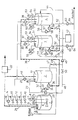
- the plant for the purification of waste water in particular industrial waste water, shown schematically in the drawing, has four containers 1 to 4, of which container 1 represents a collecting and pumping station and containers 2 to 4 reaction containers.
- the collection and pumping station 1 is provided with an inlet 5 for the waste water to be treated.
- the collecting and pumping station 1 has a mixer 6 with a mixing motor M, which constantly keeps the waste water in the station 1 in motion.
- the collection and pumping station 1 is provided with measuring points 7 and 8 for detecting the redox potential (rH) and pH value of the waste water.
- station 1 is provided with a level indicator F, via which the wastewater level is detected.
- the collection and pumping station 1 there is a feed line 9 through which additives, liquids or the like can be added to the waste water, for example in order to change the pH or the redox potential.
- bases such as sodium hydroxide solution (NaOH) or acids such as sulfuric acid (H2SO4) can be added.
- the individual, leading aggregates Lines 10 to 14 are connected to the feed line 9 via shut-off valves 15 to 18 or a pump 19.
- the addition of the additives can thus be automatically supplied to the waste water via the shut-off valves 15 to 18 or the pump 19 depending on the measured values of the measuring points 7 and 8 or the level indicator F.
- the collection and pumping station 1 has a further feed line 20, via which it is supplied with waste water from the reaction vessel 2.
- a discharge line 21 via which gases from the station 1 are discharged into the open via a gas scrubber 22.
- the feed line 20 is connected to the upper section of the reaction container 2 and forms an overflow for the waste water located in this container.
- This reaction container 2 is filled via a feed line 23 which opens into this reaction container 2 in the lid area and is connected via a pump 24 to an outlet 25 provided in the lower section of the collecting and pumping station 1.
- a constant circulation of waste water between the collection and pumping station 1 and the reaction vessel 2 is maintained via the pump 24.
- a supply line 26 is also provided in the lid area and is connected via a pump 27 to a storage container containing a defoamer. Accordingly, a defoaming agent can be supplied to the waste water in the reaction vessel 2 via the feed line 26, which reduces the foam formation.
- the reservoir containing the defoaming agent is also connected to the reaction vessels 3 and 4 via further feed lines 28 and 29 and pumps 30 and 31 located in these lines.
- a partial flow of the waste water is removed from the reaction container 2 via a suction line 32, which opens into the reaction container 2 below the waste water level and is connected to the suction side of a pump 33, and is fed back to the reaction container 2 in the lower region via a jet pump 34.
- the jet pump 34 has an intake port 35, via which it sucks in gaseous medium from the upper regions of the reaction vessels 3 and 4.
- the intake port 35 is connected via a suction line 36 and two shut-off valves 37 and 38 to lines 39 and 40 for the gaseous medium located in the upper region of the reaction vessels 3 and 4.
- the gaseous medium introduced into the wastewater in the reaction vessel 2 via the jet pump 34 in the partial flow of the wastewater travels upward through the reaction vessel 2 and accumulates there in a gas cushion 41 above the wastewater level.
- a discharge line 42 leads into this gas cushion, via which the escaping gaseous medium can escape into the open via the gas scrubber 22.
- the gas scrubber 22 also has a residual ozone destroyer. In the gas scrubber 22, gases released, such as NH 3, CN etc., are especially eliminated during the wastewater treatment.
- the two reaction vessels 3 and 4 are connected in series. These reaction vessels 3 and 4 are filled via the feed lines 44, which are connected to a pump 46 via shut-off valves 45.
- the suction side of this pump 46 is connected to suction lines 47 and 48, in which, in turn, shut-off valves 49 and 50 are provided, with the lower sections of the reaction container 2 or the collection and pumping station 1, so that waste water can be removed from these containers.
- This Waste water is supplied via the feed lines 44 to the reaction container 3 or the reaction container 4 or both at the same time in the upper region thereof according to the valve position of the shut-off valves 45.
- the reaction containers 3 and 4 are filled until the waste water level is at a predetermined distance from the upper cover of the containers 3 and 4, respectively. This has the advantage that a gas cushion 51 can form in each of the two tanks 3 and 4 above the waste water level.
- the two reaction vessels 3 and 4 are also provided with measuring points 53 and 54 for determining the redox potential (rH) and the pH of the waste water.
- a feed line 55 opens into the top of each container 3 or 4, via which an acid or an alkali can be introduced to change the pH of the waste water.
- an acid or an alkali can be introduced to change the pH of the waste water.
- caustic soda (NaOH) and, for example, sulfuric acid (H2SO4) can be used as the alkali.
- a partial flow of the waste water is removed by means of a suction line 56 and, via a pump 57, to the suction side of which the suction line 56 is connected, with the interposition of a jet pump 58, the partial flow of each vessel 3 or 4 fed in its lower area again.
- an intake port 59 is provided, via which a gaseous medium is drawn in.
- the ozone generator 43 connects to this intake port 59 via suction lines 60 and shut-off valves 61. Fresh ozone emerging from the ozone generator 43 is thus supplied via the jet pump 58 to the partial flow conveyed by the pump 57.
- the finely distributed ozone in the partial wastewater now rises within the reaction vessels 3 and 4 and reacts with the waste water.
- the residual ozone accumulates in the gas cushion 51 above the waste water level until it is used again.
- the operation of the cleaning system is described below.
- the complex-containing wastewater, dyeing wastewater, chemical wastewater, leachate, and other wastewater with biodegradable constituents that flows in electroplating plants flows into the inlet of the collection and pumping station 1.
- the redox potential and the pH value are measured via measuring points 7 and 8 and, depending on the measured values, the wastewater is pretreated, for example, by adding an alkali or an acid.
- the already pretreated wastewater is fed via the pump 24 to the reaction vessel 2 until it is filled, that is to say until wastewater is returned to the collection and pumping station 1 via the feed line 20, which acts as an overflow.
- a partial flow is withdrawn from the waste water via the suction line 32 and the pump 33, to which ozone is fed by means of the jet pump 34.
- This ozone which is finely distributed in the partial flow, now flows through the waste water in the reaction vessel 2 and reacts with the pollutants.
- complexing agents such as cyanide, NTA (nitrilotriacetic acid), EDTA (ethylenediaminetetraacetate), HEDTA (hydroxietylenediaminetetraacetate), citrate, tartrate, quadrol and hard complexes such as nickel cyano and Ni-EDTA complexes, or from environmentally relevant organics such as phenols, such as PCB (polychlorinated biphenyls), dioxins, furans, PAKW (polycyclic aromatic hydrocarbons) or pesticides.
- complexing agents such as cyanide, NTA (nitrilotriacetic acid), EDTA (ethylenediaminetetraacetate), HEDTA (hydroxietylenediaminetetraacetate), citrate, tartrate, quadrol and hard complexes such as nickel cyano and Ni-EDTA complexes, or from environmentally relevant organics such as phenols, such as PCB (polychlorinated biphenyls), dioxins, furans
- a gas scrubber 22 with an ozone destroyer in the discharge line 42 so that exhaust gas emerging from the reaction vessel 2 is cleaned, thereby eliminating, for example, NH 3, CN and residual ozone.
- the main and final cleaning takes place in the reaction containers 3 and 4, whereby, as already described above, a partial flow is taken from the waste water via the suction line 56 and the pump 57, the partial flow via the jet pump 58 oxygen with ozone is fed, which is finely distributed in the partial flow and finally flows through the waste water in the reaction vessel 3 or 4 from bottom to top and rapidly oxidatively destroys the above-mentioned complexing agents or organics.
- the end products include CO2, H2O, oxalic acid, acetic acid and other harmless molecular fragments.
- the wastewater in the reaction containers 3 and 4 is supplied with ozone until the pollutants have been broken down to a permissible limit value. If the wastewater in one of the reaction vessels 3 or 4 is cleaned in this way, the Containers emptied via the pump 63 and refilled via the feed line 44 either with waste water from the reaction container 2 or from the collection and pumping station 1. During the emptying and filling process of one reaction container 3 or 4, the cleaning of the wastewater in the other reaction container 4 or 3 is continued without interruption, only by blocking a shut-off valve for the reaction container which is currently being emptied or refilled all of the ozone generated by the ozone generator 43 is supplied to the other reaction vessel. This has the advantage that the ozone generator 43 can be operated continuously. This continuous operation ensures a high level of utilization of the ozone generator 43, and in contrast to ozone generators which have downtimes, it can be of smaller dimensions.
- the wastewater newly filled into the reaction containers is now cleaned in the manner described above until the required limit values are reached again.
- the other reaction vessel the waste water of which already has a higher degree of purity, can be emptied when the waste water has reached the required limit values.
- a so-called batch operation is possible with the two reaction containers 3 and 4, that is, while the waste water is being cleaned in one reaction container, the other reaction container can be emptied and refilled and vice versa. This process enables continuous operation of the system and ensures maximum utilization of the individual components.
- Another advantage of the cleaning system is that the remaining, unused ozone accumulating in the gas boiler 51 of the two reaction vessels 3 and 4 is fed via the suction line 36 to the suction nozzle 35 and the jet pump 34 and thus to the partial flow flowing through the suction line 32, so that this unused residual ozone is used for the pretreatment of the wastewater in the reaction vessel 2, as a result of which a high degree of utilization of the ozone generated by the ozone generator 43 is achieved.
Landscapes
- Life Sciences & Earth Sciences (AREA)
- Hydrology & Water Resources (AREA)
- Engineering & Computer Science (AREA)
- Environmental & Geological Engineering (AREA)
- Water Supply & Treatment (AREA)
- Chemical & Material Sciences (AREA)
- Organic Chemistry (AREA)
- Treatment Of Water By Oxidation Or Reduction (AREA)
- Separation Using Semi-Permeable Membranes (AREA)
Claims (10)
- Appareil pour le traitement d'eaux résiduaires, en particulier d'eaux résiduaires industrielles, avec un milieu gazeux, de préférence de l'ozone, comprenant au moins trois récipients réactionnels (2, 3, 4) auxquels les eaux résiduaires et le milieu gazeux sont amenés en contre-courant l'un par rapport à l'autre, caractérisé en ce qu'au moins deux des récipients réactionnels (3 et 4) sont montés en parallèle et en ce qu'un troisième récipient réactionnel (2) est monté en série par rapport à ceux-ci.
- Appareil suivant la revendication 1, caractérisé en ce que les récipients réactionnels (3 et 4) montés en parallèle sont, par rapport aux eaux résiduaires, montés en aval du récipient réactionnel (2) monté en série.
- Appareil suivant l'une des revendications 1 et 2, caractérisé en ce que chaque récipient réactionnel (2, 3, 4) présente un agencement de pompes, en particulier une pompe de circulation (33, 57) et une pompe à jet (34, 58) montée en aval de celle-ci, à travers lequel un courant partiel des eaux résiduaires est passé et au côté aspiration duquel (35, 59) le milieu gazeux est amené, cet agencement de pompes prélevant le courant partiel à proximité de l'entrée des eaux résiduaires qui se trouve à l'extrémité supérieure du récipient et le ramenant, conjointement au milieu gazeux, à proximité de sa sortie des eaux résiduaires qui se trouve à l'extrémité inférieure du récipient.
- Procédé de traitement d'eaux résiduaires, en particulier au moyen d'un dispositif suivant l'une des revendications précédentes, dans lequel les eaux résiduaires sont conduites à travers deux d'au moins trois récipients réactionnels, un milieu gazeux, de préférence de l'ozone, étant amené aux eaux résiduaires en contre-courant, caractérisé en ce que, par rapport au sens d'écoulement des eaux résiduaires, les eaux résiduaires sont traitées parallèlement au dernier récipient réactionnel dans au moins un autre récipient.
- Procédé suivant la revendication 4, caractérisé en ce que le traitement des eaux résiduaires dans les récipients réactionnels agencés mutuellement parallèlement est effectué de manière alternée ou respectivement dans un procédé par lot, pendulaire.
- Procédé suivant l'une des revendications 4 et 5, caractérisé en ce que, pendant le traitement des eaux résiduaires dans un des récipients réactionnels agencés mutuellement parallèlement, l'autre est vidé et ensuite rempli avec de nouvelles eaux résiduaires.
- Procédé suivant l'une des revendications 4 à 6, caractérisé en ce que les eaux résiduaires, qui se trouvent dans les récipients réactionnels montés parallèlement l'un à l'autre, sont traitées par un milieu gazeux frais.
- Procédé suivant la revendication 7, caractérisé en ce que les eaux résiduaires, qui se trouvent dans les récipients montés en amont, sont traitées par le milieu gazeux qui n'a pas réagi et qui est obtenu dans les récipients réactionnels mutuellement parallèles.
- Procédé suivant l'une des revendications 4 à 8, caractérisé en ce que les eaux résiduaires sont, entre le récipient réactionnel avant et une station de récolte et de pompage, maintenues en circulation en particulier continue et en ce qu'elles sont prétraitées avec le milieu gazeux et d'autres agents, par exemple pour l'ajustement de la valeur du pH, du potentiel d'oxydoréduction, pour empêcher la formation de mousse, etc.
- Procédé suivant l'une des revendications 4 à 9, caractérisé en ce que le milieu gazeux libéré est purifié et respectivement lavé et/ou rendu biologiquement non nocif.
Priority Applications (1)
| Application Number | Priority Date | Filing Date | Title |
|---|---|---|---|
| AT91106898T ATE85786T1 (de) | 1990-05-10 | 1991-04-27 | Vorrichtung und verfahren zur behandlung von abwaessern. |
Applications Claiming Priority (2)
| Application Number | Priority Date | Filing Date | Title |
|---|---|---|---|
| DE4015029 | 1990-05-10 | ||
| DE4015029A DE4015029A1 (de) | 1990-05-10 | 1990-05-10 | Vorrichtung und verfahren zur behandlung von abwaessern |
Publications (2)
| Publication Number | Publication Date |
|---|---|
| EP0456071A1 EP0456071A1 (fr) | 1991-11-13 |
| EP0456071B1 true EP0456071B1 (fr) | 1993-02-17 |
Family
ID=6406134
Family Applications (1)
| Application Number | Title | Priority Date | Filing Date |
|---|---|---|---|
| EP91106898A Expired - Lifetime EP0456071B1 (fr) | 1990-05-10 | 1991-04-27 | Appareil et procédé pour le traitement des eaux résiduaires |
Country Status (3)
| Country | Link |
|---|---|
| EP (1) | EP0456071B1 (fr) |
| AT (1) | ATE85786T1 (fr) |
| DE (2) | DE4015029A1 (fr) |
Families Citing this family (4)
| Publication number | Priority date | Publication date | Assignee | Title |
|---|---|---|---|---|
| DE4412320C2 (de) * | 1994-04-11 | 1996-05-23 | Wedeco Umwelttechnologie Wasser Boden Luft Gmbh | Verfahren zur Reinigung von mit bestimmten organischen Molekülen, insbesondere Farbstoffen, belastetem Abwasser |
| JP4334347B2 (ja) * | 2001-10-01 | 2009-09-30 | ガマ−グリーノル・リサーチ・アンド・ディベロップメント・リミテッド | 特に自動車エンジンのための、少なくとも一つの燃料を供給するための方法と装置 |
| CA2542673A1 (fr) * | 2006-04-10 | 2007-10-10 | Peter Klaptchuk | Methode et appareillage de reduction pathogene et chimique des dechets fluides |
| CN110980918B (zh) * | 2019-11-25 | 2022-05-31 | 哈尔滨工创环保科技有限公司 | 一种多级臭氧催化氧化内循环装置及使用方法 |
Family Cites Families (14)
| Publication number | Priority date | Publication date | Assignee | Title |
|---|---|---|---|---|
| US996560A (en) * | 1905-06-19 | 1911-06-27 | Richard B Wilson | Apparatus for purifying water by ozone. |
| CH541518A (de) * | 1971-08-13 | 1973-09-15 | August Klueber App Bau Und Was | Verfahren und Vorrichtung zur Aufbereitung von umgewälztem Badebeckenwasser |
| DE2426117C3 (de) * | 1974-05-29 | 1978-07-27 | Gebr. Herrmann, 5000 Koeln | Verfahren zum mehrstufigen kontinuierlichen Aufbereiten von organische Farbstoffe und Produktionshilfsmittel enthaltenden neutralen Färbereiabwassern mittels Ozon unter Turbulenz |
| GB1521219A (en) * | 1975-08-18 | 1978-08-16 | Emery Industries Inc | Method and apparatus for treating aqueous liquids with ozone |
| US4104166A (en) * | 1976-05-17 | 1978-08-01 | Laraus Julius | Apparatus for purifying septic tank effluent |
| DE2719638A1 (de) * | 1977-05-03 | 1978-11-09 | Scholl Ag | Verfahren zum reinigen von abwasser und einrichtung zur ausuebung des verfahrens |
| US4197200A (en) * | 1978-08-29 | 1980-04-08 | The United States Of America As Represented By The Secretary Of The Navy | Shipboard blackwater physical/chemical treatment system |
| DE3011615A1 (de) * | 1980-03-26 | 1981-10-01 | Hoechst Ag, 6000 Frankfurt | Verfahren und vorrichtung zur absorption von ozon |
| DE3230922A1 (de) * | 1982-08-20 | 1984-02-23 | Messer Griesheim Gmbh, 6000 Frankfurt | Verfahren zur behandlung von stoffen mit ozon |
| CH662553A5 (en) * | 1984-01-19 | 1987-10-15 | Melyepitesi Tervezo Vallalat | Process and device for purifying water, using ozone produced from oxygen-rich gas |
| US4696739A (en) * | 1984-04-02 | 1987-09-29 | Aqua Strip Corporation | Water purification apparatus |
| US4728441A (en) * | 1986-09-12 | 1988-03-01 | King Arthur S | Electrical waste water treatment system employing oxygen recovery and ozone injection means |
| CH674356A5 (fr) * | 1987-11-27 | 1990-05-31 | Bbc Brown Boveri & Cie | |
| DE3834834A1 (de) * | 1988-02-11 | 1989-08-17 | Guetling Gmbh | Anordnung zur behandlung von industrieabwaessern |
-
1990
- 1990-05-10 DE DE4015029A patent/DE4015029A1/de not_active Ceased
-
1991
- 1991-04-27 EP EP91106898A patent/EP0456071B1/fr not_active Expired - Lifetime
- 1991-04-27 DE DE9191106898T patent/DE59100041D1/de not_active Expired - Fee Related
- 1991-04-27 AT AT91106898T patent/ATE85786T1/de active
Also Published As
| Publication number | Publication date |
|---|---|
| DE4015029A1 (de) | 1991-11-14 |
| EP0456071A1 (fr) | 1991-11-13 |
| DE59100041D1 (de) | 1993-03-25 |
| ATE85786T1 (de) | 1993-03-15 |
Similar Documents
| Publication | Publication Date | Title |
|---|---|---|
| DE69229111T2 (de) | Vorrichtung zur diskontinuierlichen reinigung von flüssigkeiten | |
| DE2343849A1 (de) | Verfahren und vorrichtung zur abwasserbehandlung | |
| DE2705903A1 (de) | Horizontale gas-spruehreinigungsvorrichtung | |
| DE1459449A1 (de) | Verfahren und Einrichtung zur vollbiologischen Reinigung von Abwaessern | |
| DE2835709A1 (de) | Verfahren und vorrichtung zum loesen von luft in wasser und anschliessendes entspannen des wassers in flotationsanlagen | |
| DE3014727C2 (fr) | ||
| DE10262036B4 (de) | Reinstwasserversorgungsanlage für Dialysegeräte | |
| DE2434935A1 (de) | Verfahren und vorrichtung zum belueften einer fluessigkeit | |
| DE8913496U1 (de) | Vorrichtung zur Elution von körnigem Waschgut | |
| EP0456071A1 (fr) | Appareil et procédé pour le traitement des eaux résiduaires | |
| DE4008676A1 (de) | Verfahren und vorrichtung zur aeroben abwasserbehandlung | |
| WO2003011775A2 (fr) | Procede et installation pour traiter des liquides, notamment pour purifier de l'eau contaminee | |
| DE2708653A1 (de) | Mischgeraet fuer eine biochemische aufbereitung von fluessigkeiten mit sauerstoff | |
| DE2913132C2 (fr) | ||
| DE2637418A1 (de) | Verfahren und vorrichtung zur ozonbehandlung waessriger fluessigkeiten | |
| EP0229875B1 (fr) | Dispositif pour mélanger des matières pulvérulentes avec des liquides | |
| DE2612255A1 (de) | Verfahren und anlage zur reinigung von abwasser nach dem belebtschlammverfahren | |
| EP0328035A2 (fr) | Installation pour le traitement des eaux résiduaires industrielles | |
| DE2938264A1 (de) | Verfahren und vorrichtung zur wasserreinigung und/oder -belueftung durch entspannungsflotation | |
| DE2118642A1 (de) | Gaswäscher | |
| EP0154915B1 (fr) | Procédé et dispositif pour la purification biologique d'eau usée | |
| DE1517661A1 (de) | Vorrichtung zur Entfernung von synthetischen Reinigungsmitteln und anderen Stoffen aus waessrigen Loesungen | |
| CH521293A (de) | Verfahren und Einrichtung zur Aufbereitung von Detergentien enthaltendem Abwasser mittels Ozon | |
| EP1369386A2 (fr) | Dispositif d'aération d'eaux usées et de nettoyage d'une installation à membranes et microstation d'épuration d'eau contenant ce dispositif | |
| DE3203620A1 (de) | Verfahren und anlage zur aufbereitung von restbeton |
Legal Events
| Date | Code | Title | Description |
|---|---|---|---|
| PUAI | Public reference made under article 153(3) epc to a published international application that has entered the european phase |
Free format text: ORIGINAL CODE: 0009012 |
|
| AK | Designated contracting states |
Kind code of ref document: A1 Designated state(s): AT BE CH DE DK ES FR GB IT LI NL SE |
|
| 17P | Request for examination filed |
Effective date: 19911012 |
|
| 17Q | First examination report despatched |
Effective date: 19920611 |
|
| GRAA | (expected) grant |
Free format text: ORIGINAL CODE: 0009210 |
|
| ITF | It: translation for a ep patent filed | ||
| AK | Designated contracting states |
Kind code of ref document: B1 Designated state(s): AT BE CH DE DK ES FR GB IT LI NL SE |
|
| PG25 | Lapsed in a contracting state [announced via postgrant information from national office to epo] |
Ref country code: SE Effective date: 19930217 Ref country code: GB Effective date: 19930217 Ref country code: ES Free format text: THE PATENT HAS BEEN ANNULLED BY A DECISION OF A NATIONAL AUTHORITY Effective date: 19930217 Ref country code: DK Effective date: 19930217 |
|
| REF | Corresponds to: |
Ref document number: 85786 Country of ref document: AT Date of ref document: 19930315 Kind code of ref document: T |
|
| REF | Corresponds to: |
Ref document number: 59100041 Country of ref document: DE Date of ref document: 19930325 |
|
| ET | Fr: translation filed | ||
| GBV | Gb: ep patent (uk) treated as always having been void in accordance with gb section 77(7)/1977 [no translation filed] |
Effective date: 19930217 |
|
| PLBE | No opposition filed within time limit |
Free format text: ORIGINAL CODE: 0009261 |
|
| STAA | Information on the status of an ep patent application or granted ep patent |
Free format text: STATUS: NO OPPOSITION FILED WITHIN TIME LIMIT |
|
| 26N | No opposition filed | ||
| PGFP | Annual fee paid to national office [announced via postgrant information from national office to epo] |
Ref country code: DE Payment date: 19940420 Year of fee payment: 4 |
|
| PGFP | Annual fee paid to national office [announced via postgrant information from national office to epo] |
Ref country code: DK Payment date: 19940630 Year of fee payment: 4 |
|
| PGFP | Annual fee paid to national office [announced via postgrant information from national office to epo] |
Ref country code: FR Payment date: 19950609 Year of fee payment: 5 |
|
| PGFP | Annual fee paid to national office [announced via postgrant information from national office to epo] |
Ref country code: AT Payment date: 19950613 Year of fee payment: 5 |
|
| PGFP | Annual fee paid to national office [announced via postgrant information from national office to epo] |
Ref country code: CH Payment date: 19950614 Year of fee payment: 5 |
|
| PGFP | Annual fee paid to national office [announced via postgrant information from national office to epo] |
Ref country code: NL Payment date: 19950628 Year of fee payment: 5 |
|
| PGFP | Annual fee paid to national office [announced via postgrant information from national office to epo] |
Ref country code: BE Payment date: 19950712 Year of fee payment: 5 |
|
| PG25 | Lapsed in a contracting state [announced via postgrant information from national office to epo] |
Ref country code: DE Effective date: 19960103 |
|
| PG25 | Lapsed in a contracting state [announced via postgrant information from national office to epo] |
Ref country code: AT Effective date: 19960427 |
|
| PG25 | Lapsed in a contracting state [announced via postgrant information from national office to epo] |
Ref country code: LI Effective date: 19960430 Ref country code: CH Effective date: 19960430 Ref country code: BE Effective date: 19960430 |
|
| BERE | Be: lapsed |
Owner name: GUTLING G.M.B.H. Effective date: 19960430 |
|
| PG25 | Lapsed in a contracting state [announced via postgrant information from national office to epo] |
Ref country code: NL Effective date: 19961101 |
|
| REG | Reference to a national code |
Ref country code: CH Ref legal event code: PL |
|
| PG25 | Lapsed in a contracting state [announced via postgrant information from national office to epo] |
Ref country code: FR Effective date: 19961227 |
|
| NLV4 | Nl: lapsed or anulled due to non-payment of the annual fee |
Effective date: 19961101 |
|
| REG | Reference to a national code |
Ref country code: FR Ref legal event code: ST |
|
| PG25 | Lapsed in a contracting state [announced via postgrant information from national office to epo] |
Ref country code: IT Free format text: LAPSE BECAUSE OF NON-PAYMENT OF DUE FEES Effective date: 20050427 |