EP0456130A2 - Appareil et procédé pour la réalisation optique d'opérations sur images - Google Patents
Appareil et procédé pour la réalisation optique d'opérations sur images Download PDFInfo
- Publication number
- EP0456130A2 EP0456130A2 EP91107207A EP91107207A EP0456130A2 EP 0456130 A2 EP0456130 A2 EP 0456130A2 EP 91107207 A EP91107207 A EP 91107207A EP 91107207 A EP91107207 A EP 91107207A EP 0456130 A2 EP0456130 A2 EP 0456130A2
- Authority
- EP
- European Patent Office
- Prior art keywords
- light
- crystal
- plane
- inputted
- probe
- Prior art date
- Legal status (The legal status is an assumption and is not a legal conclusion. Google has not performed a legal analysis and makes no representation as to the accuracy of the status listed.)
- Ceased
Links
Images

Classifications
-
- G—PHYSICS
- G02—OPTICS
- G02F—OPTICAL DEVICES OR ARRANGEMENTS FOR THE CONTROL OF LIGHT BY MODIFICATION OF THE OPTICAL PROPERTIES OF THE MEDIA OF THE ELEMENTS INVOLVED THEREIN; NON-LINEAR OPTICS; FREQUENCY-CHANGING OF LIGHT; OPTICAL LOGIC ELEMENTS; OPTICAL ANALOGUE/DIGITAL CONVERTERS
- G02F1/00—Devices or arrangements for the control of the intensity, colour, phase, polarisation or direction of light arriving from an independent light source, e.g. switching, gating or modulating; Non-linear optics
- G02F1/01—Devices or arrangements for the control of the intensity, colour, phase, polarisation or direction of light arriving from an independent light source, e.g. switching, gating or modulating; Non-linear optics for the control of the intensity, phase, polarisation or colour
- G02F1/03—Devices or arrangements for the control of the intensity, colour, phase, polarisation or direction of light arriving from an independent light source, e.g. switching, gating or modulating; Non-linear optics for the control of the intensity, phase, polarisation or colour based on ceramics or electro-optical crystals, e.g. exhibiting Pockels effect or Kerr effect
- G02F1/0338—Devices or arrangements for the control of the intensity, colour, phase, polarisation or direction of light arriving from an independent light source, e.g. switching, gating or modulating; Non-linear optics for the control of the intensity, phase, polarisation or colour based on ceramics or electro-optical crystals, e.g. exhibiting Pockels effect or Kerr effect structurally associated with a photoconductive layer or having photo-refractive properties
-
- G—PHYSICS
- G02—OPTICS
- G02F—OPTICAL DEVICES OR ARRANGEMENTS FOR THE CONTROL OF LIGHT BY MODIFICATION OF THE OPTICAL PROPERTIES OF THE MEDIA OF THE ELEMENTS INVOLVED THEREIN; NON-LINEAR OPTICS; FREQUENCY-CHANGING OF LIGHT; OPTICAL LOGIC ELEMENTS; OPTICAL ANALOGUE/DIGITAL CONVERTERS
- G02F3/00—Optical logic elements; Optical bistable devices
-
- G—PHYSICS
- G06—COMPUTING OR CALCULATING; COUNTING
- G06V—IMAGE OR VIDEO RECOGNITION OR UNDERSTANDING
- G06V10/00—Arrangements for image or video recognition or understanding
- G06V10/88—Image or video recognition using optical means, e.g. reference filters, holographic masks, frequency domain filters or spatial domain filters
Definitions
- This invention relates to an apparatus for optically effecting the logical operation of an image signal, and in particular to an optical image operation apparatus suitable for executing logical operations such as NAND, NOT and NOR of a two-dimensional image.
- bistable optical devices utilizing the optical bistability are formed in the form of a two-dimensional array, with a view to effect logical operations of a two-dimensional image at a higher speed than the processing by an electronic computer.
- a nonlinear optical output response characteristic to an optical input is obtained by a construction including a pair of Fabry-Perot resonators in the form of parallel flat plates and a medium having the nonlinear refractive effect therein.
- An object of the present invention is to provide an optical image operation apparatus which is easy to be fabricated and is reliable to execute the operation even with a low-intensity light for the image projection by making a further improvement of the conventional apparatus using the above-mentioned optical induction index crystal, and to provide an image operation method using the above apparatus.
- an optical image operation apparatus comprising: an optical induction refractive index crystal having first and second planes parallel to each other; means for inputting a coherent probe light from the first plane of the aforesaid crystal; means for taking out at least one of the first light output from the first plane of the aforesaid crystal and the second light output from the second plane thereof, wherein one of the first and second lights being amplified by the two-wave coupling of the probe light reflected by the second plane and the probe light inputted from the first plane, and the other being attenuated likewise by the two-wave coupling; and means for projecting the inputted image onto the crystal by using an incoherent light to the probe light, and with the incidence of this incoherent light, the gain distribution corresponding to the inputted image being generated in the crystal to modulate the aforesaid first and second lights spatially.
- a method for obtaining a modulated light showing the image operated by the above-mentioned apparatus comprises steps of: inputting a coherent probe light from the first plane of the aforesaid crystal; taking out at least one of the first light output from the first plane of the aforesaid crystal and the second light output from the second plane thereof, wherein one of the first second lights being amplified by the two-wave coupling of the prove light reflected by the second plane and the probe light inputted from the first plane, and the other being attenuated likewise by the two-wave coupling; and projecting the inputted image onto the crystal by using an incoherent light against the probe light, and with the incidence of this incoherent light, the again distribution corresponding to the inputted image being generated in the crystal to modulate the aforesaid first and second light spatially.
- an optical image operation apparatus comprises: an optical induction refractive index crystal having first and second planes parallel to a each other; means for inputting a coherent probe light from the first plane of the aforesaid crystal; mirrors provided in parallel to each other at predetermined intervals facing the second plane of the aforesaid crystal, the aforesaid mirrors constituting a resonator in cooperation with the crystal to reflect the probe light transmitted through the crystal; means for taking out at least one of the first light output from the first plane of the aforesaid crystal or the second light output from the second plane thereof, wherein the second light being amplified by the two-wave coupling of the probe light reflected by the mirrors and the probe light inputted from the first plane, and the first light being attenuated likewise by the two-wave coupling; and means for projecting the inputted image onto the crystal by using an incoherent light against the probe light, and with the incidence of this incoherent light, the gain distribution corresponding to the
- a method for obtaining a modulated light showing the image operated by the apparatus comprises steps of: inputting a coherent probe light from the first plane of the aforesaid crystal, here, the light transmitted through the crystal being reflected by the mirrors; taking out at least one of the first light output from the first plane of the aforesaid crystal and the second light output from the second plane thereof, here the second light being amplified by the two-wave coupling of the probe light reflected by the mirrors and the probe light inputted from the first plane, and the first light being attenuated likewise by the two-wave coupling; and projecting the inputted image onto the crystal by using an incoherent light against the probe light, and with the incidence of this incoherent light, the again distribution corresponding to the inputted image being generated in the crystal to modulate the aforesaid first and second light spatially.
- the present invention is fundementally constituted to provide an arrangement to intensity the non-reciplocal reflections and transmission characteristics by the two-wave coupling in the PR crystal having the PR effect, i.e., to increase the reflectivity (or transmissivity) in the specific direction of the PR crystal, and to execute the logical operations of the inputted image by controlling the intensity of the two-wave coupling in the PR crystal by using the beam inputted into the PR crystal carrying the image information therewith.
- Fig. 1 is a view schematically showing a first embodiment of the optical image operation apparatus according to the present invention.
- Fig. 2 is a schematic view illustrating the two-wave coupling in the PR crystal.
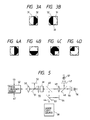
- Fig. 3A and Fig. 3B are views respectively showing the examples of the inputted and output images in the apparatus of the present invention.
- Fig. 4A and Fig. 4B are views showing the examples of the images inputted into the apparatus of the present invention
- Fig. 4C and Fig. 4D are views respectively showing the NOR output image and NAND output image when the images shown in Fig. 4A and Fig. 4B are inputted into the apparatus of the present invention.
- Fig. 5 is a view schematically showing a second embodiment of the optical operation apparatus according to the present invention.
- Fig. 1 is a view schematically showing a first embodiment of the optical image operation apparatus according to the present invention.
- a reference numeral 1 designates a PR crystal having the PR effect.
- the PR crystal 1 is of a flat plate having first and second planes parallel to each other.
- a numeral 2 designates a probe beam to be incident on the PR crystal 1; 3, a polarization plate; and 4, a lens, respectively.
- Reference numerals 5 and 6 designate inputted images respectively illuminated by a white light in one or two dimensions.
- Reference numerals 7, 8, and 10 designate means for dividing light such as beam splitters, and 9 and 11, the output planes where the output images are taken out.
- Reference numerals 13 and 14 designate the white light sources respectively illuminating the inputted images 5 and 6. Also, a reference numeral 12 designates a laser light source which inputs the coherent light 2 into the crystal 1.
- the coherent light 2 generated by the laser light source 12 is inputted into the crystal from the first plane of the PR crystal 1 through the means 8 for dividing light and the polarization plate 3.
- the images 5 and 6 illuminated by the light sources 13 and 14 are superimposed by the light splitting mean 7 and projected onto the PR crystal 1 by the lens 4.
- the modulated light by the two-wave coupling corresponding to the inputted image is taken out respectively to the output planes 9 and 11 by the light splitting means 8 and 10.
- a nonlinear medium having a wide wave length sensitivity in the visible region and the near infrared region such as BaTiO3, bismuth silicon oxide (BSO), strontium barium niobium oxide (SBN), bismuth germanium oxide (BGO), and GaAs, is preferably used as the PR crystal 1.
- the crystal orientation of this PR crystal 1 is arranged so as to obtain the energy coupling effect between two non-reciplocal beams generated by the two-wave coupling in the PR crystal as mentioned below.
- reference numerals 21 and 22 designate inputted lights coherent to each other; 23 and 24, reflective lights of those inputted lights, 25, an interference fringe pattern; and 26, a lattice pattern formed by the PR effect for the refractive index.
- the refractive index lattice 26 i.e., the pattern showing the refractive index variation, is induced by the utilization of the PR effect by the interference fringe 25 formed in the PR crystal 1 by the incident beams 21 and 22.
- the incident beams 21 and 22 are affected by the Bragg reflection because of the refractive index lattice 26.
- the spatial position or phases of the interference fringe 25 and the refractive index lattice 26 due to the PR effect do not match in general.
- the Bragg reflection light of the incident light 21 (or 22) and the transmitted light of the incident light 22 (or 21) are superimposed with each other at the same phase (or opposite phase), and the energy exchange between the two beams 21 and 22 is performed.
- the reflection beam 23 is amplified to be an amplified light
- the reflection beams 24 is attenuated to be an attenuated light.
- the direction of the amplified light depends on the crystal orientation of the PR crystal 1.
- the c axis of the PR crystal 1 is arranged in parallel with the incident beams 21 and 22, i.e., in the horizontal direction in Fig. 2, the amplified beam is a reflected beam in the + c axial direction, and the beam reflected in the - c direction becomes an attenuated light.
- the incident beam 2 is inputted to the PR crystal 1 through the polarization plate 3 as a linearly polarized light in a given direction
- the above-mentioned two-wave coupling is caused between the reflected light of the incident beams 2 (corresponding to either one of the incident beams 21 and 22 in Fig. 2) from the second plane (the right-hand plane in Fig. 1) of the PR crystal 1 and the above-mentioned incident beam 2 (corresponding to the other one of the incident beams 21 and 22).
- the intensively reflected light of the incident beams from the PR crystal 1 appears on the output plane 9 as an evenly bright pattern through the means 8 for dividing light.
- an dielectric may be stacked on each side of the PR crystal 1 to increase extremely the transmissivity of the first plane thereof, to which the incident beam 2 is inputted (the left-hand plane in Fig. 1), to intensify the reflectivity of the aforesaid second plane extremely.
- the inputted image 5, which is illuminated by the white light, i.e., the incoherent light against the probe light 2, is formed through the lens 4 on the PR crystal 1 which is thus functioning optically by the two-wave coupling.
- this white light is arranged to be in a linearly polarized condition rectangular to the polarized condition of the incident beam 2 in the PR crystal 1.
- the means 10 for dividing light should be the one having polarization characteristics such as a polarized beam splitter.
- the gain coefficient ⁇ representing the intensity of the above-mentioned reflection light amplified by the two-wave coupling in the PR crystal 1 can be expressed in the equation given below.
- Iin is the intensity of the above-mentioned white beam
- I0 is the intensity of laser light related to the two-wave coupling in the PR crystal 1, i.e., the intensity of the incident light 2
- ⁇ is the sensitivity ratio of the beam having the intensity Iin and the beam 2 having the intensity I0 against the PR effect
- the gain coefficient ⁇ corresponding to the bright portion of the inputted image 5 becomes small, and the reflectivity of this portion is reduced. Accordingly, on the output plane 9 where the image on the plane of the PR crystal 1 is formed by an appropriate image-formation system, a portion corresponding to this portion becomes dark.
- the reflectivity of the portion corresponding to the bright portion of the inputted image 5 of the beam of the incident beam 2, which is transmitted through the PR crystal 1 is reduced as described above, and the intensity of the transmitting light is increased. Hence, this transmitting light is effectively reflected through the means 10 for dividing light.
- the means 10 for dividing light allows the linearly polarized light rectangular to the polarizing condition of the incident beam 2 in the PR crystal 1 to be transmitted, and the transmitting light which is the polarized light rectangular to this linearly polarized light has reflecting polarized light characteristics. Then, the portion corresponding to the above-mentioned portion of the other output plane 11 of the plane of the PR crystal 1, on which the image formed by an appropriate image-formation system becomes bright. In other words, the output plane 11 outputs the image of the reverse contrast to the image formed on the output plane 9.
- Fig. 3A and Fig. 3B are views illustrating the operation in the case of the inputted image 5 being a binarized image.
- Fig. 3A shows a specific example of the inputted image 5 which is divided into the highly contrasted two portions, bright and dark.
- Fig. 3B shows the result of this inputted image 5 appearing on the output plane 9.
- Fig. 3A shows a specific example of the inputted image 5 which is divided into the highly contrasted two portions, bright and dark.
- Fig. 3B shows the result of this inputted image 5 appearing on the output plane 9.
- a reference numeral 29 designates the bright portion of the inputted image 5; 30, the dark portion of the inputted image 5; 31, the bright portion resulting from the incident beam 2 which is intensively reflected by the PR crystal 1; 32, the dark portion resulting from the reduced reflectivity of the PR crystal 1 caused by the reduction of the two-wave coupling in the PR crystal 1 in accordance with the equation (1); and 33, the boundary thereof.
- This result of the operation means that a logical operation of NOT is executable for the inputted image 5.
- an image having the same bright and dark portions as the inputted image 5 is output after being converted into the laser beam coherent to the incident beam 2.
- the above-mentioned result is of course applicable to the case where the inputted image 5 has a continuously analogous transmissivity.
- an inverse image of the inputted image 5 is obtained on the output plane 9 with the intensified or weakened contrast by the above-mentioned ⁇ value and others because the dependability of the intensity Iin of the white light of the gain coefficinet ⁇ in the above-mentioned equation (1) is not linear.
- an image having the same bright and dark portions as the inputted image 5 is output with the intensified or weakened contrast after being converted into the laser beam coherent to the incident beam 2.
- the required threshold value can possibly be defined by controlling the bias point of the dependability Iin of the gain coefficient ⁇ in the equation (1).
- an incoherent light independent of the inputted image 5 should be irradiated from the outside evenly on the plane of the PR crystal 1, and the above-mentioned bias point can be controlled by adjusting the intensity of this even irradiation.
- Fig. 4A is an example of the inputted image 5 shown in Fig. 1.
- Fig. 4B shows one example of the inputted image 6.
- Fig. 4C and Fig. 4D show the output images on the output plane 9 from the two inputted images 5 and 6.
- an image corresponding to the result of a NOT operation shown in Fig. 4C and Fig. 4D i.e., the results of an OR operation shown in Fig. 4C and an AND in Fig. 4D, is obtainable if the above-mentioned operation is executed.
- Fig. 5 is a view schematically showing a second embodiment of the optical operation apparatus according to the present invention.
- a reference numeral 41 designates a PR crystal as in the first embodiment.
- a reference numeral 42 designates a phase conjugate mirror which is designed to make the reflectivity of the phase conjugate mirror 42 100% or more with the supply of the pumping lights 43 and 43' from the outside to materialize a four-wave coupling.
- the phase conjugate mirror 42 is formed by a nonlinearly optical material, but the material is not necessarily limited to the PR crystal. Some other nonlinearly optical material (an organic material, for example) or the like may also be employed.
- a reference numeral 44 designates an probe beam inputted into the PR crystal 41; 45, 48, 51, and 53, means for dividing light such as beam splitters and half mirrors; 46 and 47, one- or two-dimensionally input images irradiated by the incoherent light having the wave length which enables the PR crystal 41 to sense; 49, a lens to form the inputted images 46 and 47 on the PR crystal 41; 50, a lens to converge lights onto the phase conjugate mirror 42; 52 and 54, output planes; and 55, a polarizing plate.
- the incident beam 44 is assumed to carry the wave length which induces the PR effect in the PR crystal 41, and further generates the phase conjugate wave in the phase conjugate mirror 42.
- the crystal orientation of the PR crystal 41 is arranged to obtain the energy coupling effect between the two non-reciprocal beams by the two-wave coupling in the PR crystal set forth below.
- reference numerals 56 and 57 designate respectively white light sources illuminating the inputted images 46 and 47.
- a reference numeral 58 designates a laser light source for inputting the coherent light 44 into the crystal 41.
- the image operation is also executed by the use of the two-wave coupling described in Fig. 2.
- the incident beam 44 of the linearly polarized light is inputted into the PR crystal 41 through means 53, 55 for dividing light and after being transmitted therethrough, the beam is inputted into the phase conjugate mirror 42 through the polarizing plate 55 having the same direction as the polarized light orientation of this incident beam 44 and the lens 50.
- the time-inversion wave (phase conjugate wave) of the incident beam 44 is generated by the four-wave mixture in the phase conjugate mirror 42.
- this phase conjugate wave is again inputted into the PR crystal 41, the crystal orientation of the PR crystal 41 is arranged to reflect the phase conjugate wave intensively by the above-mentioned two-wave coupling.
- the incident beam 44 inputted into the PR crystal 41 from the right-hand side of Fig. 5 corresponds to one the inputted lights 21 and 22 in Fig. 2 which are coherent to each other, and this phase conjugate wave corresponds to the other one of the inputted lights 21 and 22.
- the phase conjugate light intensively reflected from the PR crystal 41 by the above-mentioned PR effect is again returned to the phase conjugate mirror 42.
- phase condition it is necessary to make the phase of the resonator in one cycle in the optical path a multiple integer of 2 ⁇ .
- the phase condition is automatically satisfied irrespective of the resonator length because the phase conjugate mirror 42 is employed for one of the mirrors forming the resonator.
- the gain coefficient ⁇ is expressed by the aforesaid equation (1) if the incoherent beam is irradiated onto the PR crystal 41 simultaneously.
- the resonant threshold value provided by the equation (2) can be controlled by the above-mentioned incoherent beam.
- the resonant condition at this time is provided by the equation given below based on the equations (1) and (2). Iin ⁇ -I0/ ⁇ ⁇ ⁇ 1+z ⁇ 0/InR(1 - L) ⁇ (3) Therefore, in the case where any incoherent beam of a great light intensity which does not satisfy the equation (3) is inputted into the PR crystal 41, the resonance of the resonator is suspended.
- the gain coefficient ⁇ of the two-wave coupling corresponding to the bright portion of the inputted image 46 is reduced in accordance with the equation (1).
- the two-wave coupling in the PR crystal 41 is suppressed in the portion of the PR crystal 41 where the intensity of the irradiated incoherent light does not satisfy the condition of the equation (3), and the resonance in the resonator is suspended. Consequently, the light intensity in the resonator is reduced.
- an inverse (negative) image binarized by a certain threshold value for the above-mentioned inputted image 46 is obtainable on the output plane 52.
- the beam transmits the PA crystal 41 from the left to the right in Fig. 5. Therefore, when the image on the plane of the PA crystal 41 is formed by an appropriate optical system (not shown) through the means 45 for dividing light and the means 53 for dividing light, the inverse image of the result on the output plane 52 is obtained on the other output plane 54.
- a polarized light beam splitter or the like which has polarized light characteristics as the means 45 for dividing light because, as described above, the polarized light from the inputted image 46 is transmitted but the polarized light of the incident beam 44 is reflected to remove the reflected light from the inputted image 46.
- the image operations are also executable for the second embodiment as described in conjunction with Fig. 3A, Fig. 3B and Fig. 4A through Fig. 4D.
- the laser light of the wavelength different from the probe light is used for the incidence of the inputted image
- those having wavelength selection characteristics are used as means for dividing light. It may also be possible to make the reflectivity of the means for dividing light extremely great against the polarized light condition or wavelength of the probe beam in order to increase the S/N of the operation result on the output plane.
- the two-wave coupling between the probe light beam and the reflected light thereof on the PR crystal is used, but as described in Fig. 2, it may be possible to input the two incoherent beams required for the two-wave coupling independently from both sides of the PA crystal. It is also possible to use any wavelength sensitivity range for the PR crystal appropriately as required.
- the apparatus includes an optical induction refractive index crystal having first and second planes parallel to each other and device for inputting a coherent probe light from the first plane of the crystal. At least one of the first light output from the first plane of the crystal and the second light output from the second plane of the crystal is taken out so that one of the first and second lights is amplified by the two-wave coupling of the probe light reflected by the second plane and the probe light inputted from the first plane and the other light is attenuated likewise by the two-wave coupling.
- the inputted image is projected onto the crystal by use of light incoherent to the probe light. With the incidence of the incoherent light, a gain distribution corresponding to the inputted image is generated in the crystal so as to modulate the first and second lights spatially.
Landscapes
- Physics & Mathematics (AREA)
- Engineering & Computer Science (AREA)
- General Physics & Mathematics (AREA)
- Nonlinear Science (AREA)
- Optics & Photonics (AREA)
- Multimedia (AREA)
- Theoretical Computer Science (AREA)
- Chemical & Material Sciences (AREA)
- Ceramic Engineering (AREA)
- Crystallography & Structural Chemistry (AREA)
- Lasers (AREA)
Applications Claiming Priority (4)
| Application Number | Priority Date | Filing Date | Title |
|---|---|---|---|
| JP116185/90 | 1990-05-05 | ||
| JP11618590A JP2850263B2 (ja) | 1990-05-05 | 1990-05-05 | 光学的画像演算装置 |
| JP11837890A JPH04230740A (ja) | 1990-05-08 | 1990-05-08 | 光学的画像演算装置 |
| JP118378/90 | 1990-05-08 |
Publications (2)
| Publication Number | Publication Date |
|---|---|
| EP0456130A2 true EP0456130A2 (fr) | 1991-11-13 |
| EP0456130A3 EP0456130A3 (en) | 1992-07-01 |
Family
ID=26454571
Family Applications (1)
| Application Number | Title | Priority Date | Filing Date |
|---|---|---|---|
| EP19910107207 Ceased EP0456130A3 (en) | 1990-05-05 | 1991-05-03 | Apparatus and method for optically effecting image operations |
Country Status (2)
| Country | Link |
|---|---|
| US (1) | US5223966A (fr) |
| EP (1) | EP0456130A3 (fr) |
Cited By (1)
| Publication number | Priority date | Publication date | Assignee | Title |
|---|---|---|---|---|
| CN115612995A (zh) * | 2022-09-15 | 2023-01-17 | 广东省科学院测试分析研究所(中国广州分析测试中心) | 一种氧化铋薄膜制备方法及可重构光电逻辑门 |
Families Citing this family (4)
| Publication number | Priority date | Publication date | Assignee | Title |
|---|---|---|---|---|
| FR2684202B1 (fr) * | 1991-11-27 | 1994-03-04 | Conoscope Sa | Procede et dispositif holographiques perfectionnes en lumiere incoherente. |
| US5557431A (en) * | 1993-12-16 | 1996-09-17 | Hughes Aircraft Company | Real-time compensated imaging system and method using a double-pumped phase-conjugate mirror |
| JP3455791B2 (ja) * | 1995-12-25 | 2003-10-14 | 独立行政法人産業技術総合研究所 | 光演算処理装置 |
| CN114637027B (zh) * | 2022-02-24 | 2024-05-10 | 中国科学院西安光学精密机械研究所 | 基于弱光非线性效应的透雾成像方法及成像系统 |
Family Cites Families (6)
| Publication number | Priority date | Publication date | Assignee | Title |
|---|---|---|---|---|
| US4632518A (en) * | 1984-07-31 | 1986-12-30 | Hughes Aircraft Company | Phase insensitive optical logic gate device |
| US4701030A (en) * | 1985-03-15 | 1987-10-20 | American Telephone And Telegraph Company, At&T Bell Laboratories | Thermal stable optical logic element |
| FR2607941B1 (fr) * | 1986-12-09 | 1989-02-10 | Thomson Csf | Dispositif bistable optique a cristal photorefractif |
| JPS6410225A (en) * | 1987-07-02 | 1989-01-13 | Canon Kk | Optical image arithmetic unit |
| US4921335A (en) * | 1988-09-01 | 1990-05-01 | The United States Of America As Represented By The Secretary Of The Navy | Optical phase conjugate beam modulator and method therefor |
| US4930873A (en) * | 1988-09-23 | 1990-06-05 | Hunter Bryan D | Optical flip-flop |
-
1991
- 1991-05-03 US US07/695,094 patent/US5223966A/en not_active Expired - Fee Related
- 1991-05-03 EP EP19910107207 patent/EP0456130A3/en not_active Ceased
Non-Patent Citations (3)
| Title |
|---|
| APPLIED OPTICS. vol. 25, no. 10, May 1986, NEW YORK US pages 1598 - 1603; Y. FAINMAN ET AL.: 'Optical digital logic operations by two-beam coupling in photorefractive material' * |
| OPTICS COMMUNICATIONS. vol. 50, no. 3, June 1984, AMSTERDAM NL pages 146 - 150; K.R. MAC DONALD ET AL.: 'Asymmetric transmission through a photorefractive crystal of barium titanate' * |
| OPTICS LETTERS. vol. 13, no. 8, August 1988, NEW YORK US pages 654 - 656; A. MARRAKCHI: 'Photorefractive spatial light modulation based on enhanced seld-diffraction in sillenite crystals' * |
Cited By (1)
| Publication number | Priority date | Publication date | Assignee | Title |
|---|---|---|---|---|
| CN115612995A (zh) * | 2022-09-15 | 2023-01-17 | 广东省科学院测试分析研究所(中国广州分析测试中心) | 一种氧化铋薄膜制备方法及可重构光电逻辑门 |
Also Published As
| Publication number | Publication date |
|---|---|
| EP0456130A3 (en) | 1992-07-01 |
| US5223966A (en) | 1993-06-29 |
Similar Documents
| Publication | Publication Date | Title |
|---|---|---|
| US3905676A (en) | Coupling device for optical waveguide | |
| US4948212A (en) | Optical processing in III-V and II-VI compound semiconductors | |
| EP0376449A1 (fr) | Interféromètre | |
| US5105304A (en) | Acousto-optic modulation device | |
| US5241616A (en) | Optical pattern recognition system utilizing resonator array | |
| US5223966A (en) | Method and apparatus for obtaining modulated light indicative of an image operationally formed by projecting an inputted image on the flat plate of an optical induction reflective index crystal | |
| US5335062A (en) | Apparatus for all-optical self-aligning holographic phase modulation and motion sensing and method sensing and method for sensing such phase modulation | |
| Mantsevich et al. | Multiple-band frequency locking in an acousto-optic system with optoelectronic feedback | |
| Turner et al. | Optical correlator using very-large-scale integrated circuit/ferroelectric-liquid-crystal electrically addressed spatial light modulators | |
| US4815799A (en) | Infrared crystalline spatial light modulator | |
| US6611644B2 (en) | Non-reciprocal optical element for photonic devices | |
| JPH0585889B2 (fr) | ||
| Lewis | Real-time coherent optical edge enhancement | |
| JPH01152781A (ja) | レーザ光源 | |
| US4913534A (en) | Real-time dynamic holographic image storage device | |
| US5361160A (en) | Large angle broadband multilayer deflectors | |
| JP2850263B2 (ja) | 光学的画像演算装置 | |
| JPH02284131A (ja) | 光学ビーム間の相関用装置 | |
| Ja | Real-time optical image differentiation by degenerate four-wave mixing | |
| US4822147A (en) | Contrast enhancement of optical images with nonlinear media | |
| SU1728832A1 (ru) | Устройство дл передачи пол ризованного оптического излучени | |
| JPH04230740A (ja) | 光学的画像演算装置 | |
| JPS62269125A (ja) | 光論理演算素子 | |
| US6434298B1 (en) | Quantum optical methods of and apparatus for writing bragg reflection filters | |
| Magnusson et al. | Design relations for resonant waveguide-grating filters |
Legal Events
| Date | Code | Title | Description |
|---|---|---|---|
| PUAI | Public reference made under article 153(3) epc to a published international application that has entered the european phase |
Free format text: ORIGINAL CODE: 0009012 |
|
| AK | Designated contracting states |
Kind code of ref document: A2 Designated state(s): DE FR GB IT NL |
|
| PUAL | Search report despatched |
Free format text: ORIGINAL CODE: 0009013 |
|
| AK | Designated contracting states |
Kind code of ref document: A3 Designated state(s): DE FR GB IT NL |
|
| 17P | Request for examination filed |
Effective date: 19921117 |
|
| 17Q | First examination report despatched |
Effective date: 19940811 |
|
| GRAG | Despatch of communication of intention to grant |
Free format text: ORIGINAL CODE: EPIDOS AGRA |
|
| STAA | Information on the status of an ep patent application or granted ep patent |
Free format text: STATUS: THE APPLICATION HAS BEEN REFUSED |
|
| 18R | Application refused |
Effective date: 19960627 |