EP0456321A2 - Circuit comprenant une caractéristique de transfert commandée - Google Patents
Circuit comprenant une caractéristique de transfert commandée Download PDFInfo
- Publication number
- EP0456321A2 EP0456321A2 EP91201074A EP91201074A EP0456321A2 EP 0456321 A2 EP0456321 A2 EP 0456321A2 EP 91201074 A EP91201074 A EP 91201074A EP 91201074 A EP91201074 A EP 91201074A EP 0456321 A2 EP0456321 A2 EP 0456321A2
- Authority
- EP
- European Patent Office
- Prior art keywords
- switch
- frequency range
- input signal
- frequency
- takes place
- Prior art date
- Legal status (The legal status is an assumption and is not a legal conclusion. Google has not performed a legal analysis and makes no representation as to the accuracy of the status listed.)
- Granted
Links
- 230000001419 dependent effect Effects 0.000 claims abstract description 19
- 230000005540 biological transmission Effects 0.000 claims abstract description 6
- 239000003990 capacitor Substances 0.000 claims description 3
- 239000004065 semiconductor Substances 0.000 claims description 2
- 230000007423 decrease Effects 0.000 description 20
- 230000003321 amplification Effects 0.000 description 2
- 238000010586 diagram Methods 0.000 description 2
- 238000003199 nucleic acid amplification method Methods 0.000 description 2
- 230000008878 coupling Effects 0.000 description 1
- 238000010168 coupling process Methods 0.000 description 1
- 238000005859 coupling reaction Methods 0.000 description 1
- 238000001914 filtration Methods 0.000 description 1
- 230000000717 retained effect Effects 0.000 description 1
Images


Classifications
-
- H—ELECTRICITY
- H03—ELECTRONIC CIRCUITRY
- H03K—PULSE TECHNIQUE
- H03K3/00—Circuits for generating electric pulses; Monostable, bistable or multistable circuits
- H03K3/02—Generators characterised by the type of circuit or by the means used for producing pulses
- H03K3/023—Generators characterised by the type of circuit or by the means used for producing pulses by the use of differential amplifiers or comparators, with internal or external positive feedback
-
- H—ELECTRICITY
- H03—ELECTRONIC CIRCUITRY
- H03G—CONTROL OF AMPLIFICATION
- H03G5/00—Tone control or bandwidth control in amplifiers
- H03G5/02—Manually-operated control
- H03G5/04—Manually-operated control in untuned amplifiers
-
- H—ELECTRICITY
- H03—ELECTRONIC CIRCUITRY
- H03G—CONTROL OF AMPLIFICATION
- H03G3/00—Gain control in amplifiers or frequency changers
- H03G3/001—Digital control of analog signals
Definitions
- the invention relates to a circuit arrangement with electronically controllable transmission behavior, in particular actuator circuit, the input signal being fed to an amplifier with controllable negative feedback, at the output of which a voltage divider arrangement with frequency-dependent behavior is connected, which is provided with a plurality of taps, which are connected via a first electronically controllable changeover switch an inverting input of the amplifier and are connected to the output of the circuit via a second electronically controllable changeover switch.
- the frequency response of the input signal is influenced by suitable switching of the two electronically controllable changeover switches.
- the two change-over switches are controlled in such a way that, in order to raise the input signal in a frequency range determined by the frequency-dependent voltage divider, the second change-over switch is set to the position at which the signal with the greatest level is coupled out.
- the amount of increase is changed by setting the first switch to its different positions.
- the frequency range is reduced in that the first switch is set to that position for maximum negative feedback and the switch 2 is actuated between its different positions.
- the invention is based on the knowledge that for an increase in the input signal in the frequency range determined by the frequency-dependent voltage divider, the quality of the filter curve generated by the circuit arrangement depends on the position of the first switch, that is to say on the degree of negative feedback from the output to the inverting input of the amplifier.
- the quality of the resulting filter curve can be influenced, i.e. that is, the frequency range width in which the input signal is raised.
- the amount of the increase is carried out by setting the switch 2 to a suitable position.
- the position of the switch 1 determines the quality of the filter curves that arise, while the degree of increase is determined by suitable control of the switch 2.
- the situation is reversed for a lowering of the input signal in the frequency range, since here the quality of the resulting filter curves is determined by the position of the switch 2.
- the second changeover switch must therefore be set to such a position that the reduction takes place with the desired frequency range width or quality.
- the degree of lowering is now carried out by setting the first switch to a suitable position.
- the first changeover switch is set to a fixed position, which results in an increase in the desired frequency range width or quality.
- the degree of increase is then influenced by suitably setting the switch 2, the switch 1 remaining in its position.
- the lowering in which the quality is carried out by setting the switch 2 in a position which is retained below and the degree of lowering is carried out by suitably setting the switch 1.
- the circuit arrangement according to the invention thus makes it possible, by suitably setting the changeover switches, to influence not only the amount of increase, but also the width of the frequency range affected, i.e. that is the quality of the resulting filter curves.
- the quality of the filter curves has relatively low values for relatively small increases or decreases in the input signal in the frequency range.
- the first switch is set to the position for minimal negative feedback in order to raise the input signal in the frequency range
- the second switch is set to the position in which the input signal is lowered in the frequency range the greatest attenuation of the output signal occurs.
- the changeover switch is set in such a way that the maximum achievable quality of the resulting filter curves is always given for various influences on the frequency range. For boosting the input signal in the frequency range, this is done by setting the first changeover switch to the position for minimal negative feedback, since filter curves with maximum quality are generated for raising the input signal. Conversely, for the lowering of the input signal, the second changeover switch is set to the position at which the greatest attenuation of the output signal takes place through this changeover switch. To lower the input signal, maximum quality of the filter curves is achieved in this position of the second switch.
- This configuration is particularly advantageous in those cases in which the narrowest possible frequency range is also to be influenced when only small increases or decreases are to be carried out, as is the case with equalizers, for example.
- semiconductor switches are provided as changeover switches, the switching states of which can be controlled by digital data words. It is thus possible in a simple manner to check both the quality of the filter curves that are created, i.e. So the width of the affected frequency range, as well as the desired amount of increase or decrease in a simple manner.
- an equalizer can be set up relatively easily, for which it is particularly advantageous that relatively small frequency response influences can be carried out with the same quality as larger influences on the frequency response.
- FIG. 1 shows a circuit arrangement according to the invention, by means of which its input signal can be influenced in a specific frequency range.
- a circuit can be used in particular for audio devices, possibly in a form connected several times in series to influence different frequency ranges.
- the circuit arrangement shown in FIG. 1 has an operational amplifier 1, the non-inverting input 2 of which is supplied with the input signal to be influenced.
- An output 3 of the operational amplifier 1 is connected to a resistor chain, which consists of resistors 4, 5, 6 and 7 connected in series.
- a first electronically controllable changeover switch 8 is also provided, which has five input connections 9, 10, 11, 12 and 13 and an output connection 14.
- the changeover switch itself is represented schematically in the figure by a pointer 15, by means of which one of the inputs 9 to 13 is switched to the output 14.
- the changeover switch 8 is an electronic changeover switch which can be controlled from the outside by suitable data words, for example in a manner not shown in the figure.
- the first input 9 of the electronic switch 8 is connected to the output 3 of the operational amplifier 1.
- the second input 10 of the changeover switch 8 is at the connection point between the resistors 4 and 5, the third input 11 at the connection point between the resistors 5 and 6, the fourth input 12 at the connection point between the resistors 6 and 7 and the fifth input 13 the switch 8 is connected to the end point of the resistor chain.
- the output 14 of the first switch 8 is connected to an inverting input 16 of the operational amplifier 1. Depending on the switching of the first switch 8 to one of the inputs 9 to 13, the negative feedback of the operational amplifier 1 can be set.
- a frequency-dependent circuit element 20 is connected in parallel with the resistor chain, consisting of resistors 4 to 7. This is made up of two capacitors 21 and 22 connected in series, the connection point of which is led to ground via a resistor 23.
- the resistance chain, consisting of the Resistors 4 to 7 and the circuit element 20 form the voltage divider arrangement with frequency-dependent behavior. In the embodiment shown in FIG. 1, this voltage divider arrangement is designed such that it influences the input signal in a frequency range around 1 kHz.
- a second electronically controllable changeover switch 30 is also provided, which, like the first changeover switch 8 in FIG. 1, is only shown schematically and which has five inputs 31, 32, 33, 34 and 35.
- the input 31 of the second switch 30 is connected in the same way as the input 9 of the first switch 8.
- the further inputs 32 to 35 are connected as well as the inputs 10 to 13 of the first switch 8.
- the inputs 31 to 35 of the second electronically controllable switch 30 can be switched to its output 36.
- the degree of decoupling of the output signal of the circuit arrangement supplied at the output 36 of the second switch 30 can be adjusted.
- the circuit arrangement shown in FIG. 1 permits an increase or decrease in the input signal fed to the non-inverting input 2 of the operational amplifier 1 as a function of the control of the two electronic changeover switches 8 and 30.
- the corresponding output signal is made available at the output 36 of the second changeover switch 30.
- the width of the frequency range in which the boost takes place is determined by the position of the first electronic switch 8 influenced.
- the extent of the increase is influenced by the position of the second electronic switch 30.
- the width of the affected frequency range is determined by the position of the second switch 30, while the extent of the decrease is influenced by the position of the first electronic switch 8.
- the voltage divider arrangement with frequency-dependent behavior which is constructed from the resistor chain with resistors 4 to 7 and the frequency-dependent circuit element 20, influences the frequency range of the input signal in the range around 1 kHz, with the maximum influence at 1 kHz.
- FIG. 2 shows a family of curves which represents the output signal of the circuit arrangement for a linear input signal for different positions of the changeover switches 8 and 30.
- the circuit arrangement according to FIG. 1, or its electronically controllable changeover switch 8 and 30, was controlled in such a way that filter curves of approximately the same quality are produced even for small increases or decreases in the input signal in the frequency range around 1 kHz as for larger increases or decreases.
- curves 42 to 45 in which the input signal is raised in the frequency range by 1 kHz.
- these curves were chosen so that the quality of the filter curves 42 to 45 is approximately the same.
- the first electronic switch 8 is set to its input 13 in the circuit arrangement according to FIG. 1.
- the curve 42 shown in FIG. 2 then arises from the fact that the second electronic changeover switch 30 is set to its input 34.
- the coupling attenuation is reduced, so that the frequency-dependent behavior of the voltage divider arrangement now influences the output signal. If an even stronger increase according to curve 43 in the illustration according to FIG. 2 is to be carried out, then the electronic switch 30 is set to its input 33.
- the course of the curve 44 according to FIG. 2 is created by switching the electronic switch 30 to its input 32 and the curve 45 is formed by switching the switch to its input 31.
- the curve 45 represents the maximum possible increase in the input signal in the frequency range around 1 kHz, which in the in the example shown in FIG. 2 is approximately 12 dB.
- filter curves 46, 47, 48 and 49 which show a reduction in the input signal in the frequency range around 1 kHz.
- the second electronic switch Since the position of the second electronic switch 30 must not be changed to lower the input signal with filter curves of constant quality, the second electronic switch is switched to its input 35 for the family of curves 46 to 49 shown in FIG. 2.
- the different degree of reduction represented by the family of curves 46 to 49 is carried out by appropriately switching the first electronic switch 8.
- the curve 46 arises when the first electronic switch 8 is switched to its input 12.
- the maximum reduction in the input signal in the frequency range around 1 kHz in accordance with curve profile 49 arises when the first electronic switch 8 is switched to its first input 9.
- FIG. 2 was chosen so that both an increase and a decrease in the input signal in the frequency range is always carried out with the maximum possible quality. This will be desirable, for example, in equalizers, in which the narrowest possible frequency range is usually to be influenced.
- the circuit arrangement according to the invention allows the quality of the filter curve generated by it to be set in a targeted manner, there is also the possibility of setting filter curves of different quality for a certain degree of increase or decrease in the input signal.
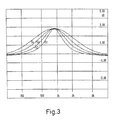
- FIG. 3 shows some filter curves, such as can also be generated in such a case by means of the circuit arrangement shown in FIG. 1.
- 3 shows four filter curves 51 to 54, in which the same amount of increase in the input signal, namely approximately 3 dB, is carried out in the frequency range around 1 kHz. However, this increase takes place in a frequency range of different widths, i.e. with filter curves of different qualities.
- the curve course 51 according to FIG. 3 represents the one with the maximum quality, that is to say the one in which the increase takes place in a relatively narrow frequency range.
- the first switch 8 is set to its input 13 while the second electronic switch 30 is set to its input 34. 3
- the first electronic changeover switch 8 is switched to its input 12 and the second electronic changeover switch 30 to its input 33.
- the first electronic switch 8 is on its Input 11 and the second electronic switch 30 switched to its input 32.
- the first electronic switch 8 of the circuit arrangement according to FIG. 1 is set to its input 10 and the second electronic switch 30 to its input 31 .
- the curve family according to Fig. 3 shows that the quality of the filter curves generated, i.e. that is, the width of the affected frequency range is influenced by the position of the first changeover switch 8 when the input signal is raised.
- This first switch 8 determines the degree of negative feedback in the circuit arrangement and thus not only the quality of the filter curves but also the degree of amplification.
- the filter curves shown in FIG. 3 with the same degree of increase is to compensate for this different negative feedback and thus also different amplification in the circuit arrangement by suitably setting the second switch 30.
- the various positions of the second changeover switch 30 do not influence the quality of the filter curves that arise when the input signal is raised.
Landscapes
- Networks Using Active Elements (AREA)
- Tone Control, Compression And Expansion, Limiting Amplitude (AREA)
Applications Claiming Priority (2)
| Application Number | Priority Date | Filing Date | Title |
|---|---|---|---|
| DE4015019 | 1990-05-10 | ||
| DE4015019A DE4015019A1 (de) | 1990-05-10 | 1990-05-10 | Schaltungsanordnung mit elektronisch steuerbarem uebertragungsverhalten |
Publications (3)
| Publication Number | Publication Date |
|---|---|
| EP0456321A2 true EP0456321A2 (fr) | 1991-11-13 |
| EP0456321A3 EP0456321A3 (en) | 1992-02-19 |
| EP0456321B1 EP0456321B1 (fr) | 1995-12-13 |
Family
ID=6406127
Family Applications (1)
| Application Number | Title | Priority Date | Filing Date |
|---|---|---|---|
| EP91201074A Expired - Lifetime EP0456321B1 (fr) | 1990-05-10 | 1991-05-06 | Circuit comprenant une caractéristique de transfert commandée |
Country Status (5)
| Country | Link |
|---|---|
| US (1) | US5206603A (fr) |
| EP (1) | EP0456321B1 (fr) |
| JP (1) | JP3092968B2 (fr) |
| KR (1) | KR910021016A (fr) |
| DE (2) | DE4015019A1 (fr) |
Cited By (1)
| Publication number | Priority date | Publication date | Assignee | Title |
|---|---|---|---|---|
| US5724006A (en) * | 1994-09-03 | 1998-03-03 | U.S. Philips Corporation | Circuit arrangement with controllable transmission characteristics |
Families Citing this family (3)
| Publication number | Priority date | Publication date | Assignee | Title |
|---|---|---|---|---|
| US6118338A (en) * | 1999-11-23 | 2000-09-12 | Agilent Technologies | Low noise amplifier circuit with an isolating switch topology |
| US20060182298A1 (en) * | 2004-07-20 | 2006-08-17 | Stiles Enrique M | Bessel soundbar |
| WO2007108138A1 (fr) * | 2006-03-17 | 2007-09-27 | Niigata Seimitsu Co., Ltd. | Filtre passe-bande composite et procédé de filtrage de signaux en quadrature |
Family Cites Families (5)
| Publication number | Priority date | Publication date | Assignee | Title |
|---|---|---|---|---|
| JPS5617506A (en) * | 1979-07-23 | 1981-02-19 | Sony Corp | Digital type gain control device |
| DE3132402A1 (de) * | 1980-10-08 | 1982-05-27 | Philips Patentverwaltung Gmbh, 2000 Hamburg | Schaltungsanordnung mit elektronisch steuerbarem uebertragungsverhalten |
| US4439739A (en) * | 1981-08-17 | 1984-03-27 | U.S. Philips Corporation | Circuit arrangement with electronically controllable transfer characteristic |
| NL8201376A (nl) * | 1982-04-01 | 1983-11-01 | Philips Nv | Schakeling voor het versterken en/of verzwakken van een signaal. |
| JPH0712133B2 (ja) * | 1988-10-21 | 1995-02-08 | 三菱電機株式会社 | 音質調整装置 |
-
1990
- 1990-05-10 DE DE4015019A patent/DE4015019A1/de not_active Withdrawn
-
1991
- 1991-05-06 DE DE59107055T patent/DE59107055D1/de not_active Expired - Fee Related
- 1991-05-06 EP EP91201074A patent/EP0456321B1/fr not_active Expired - Lifetime
- 1991-05-09 JP JP03132244A patent/JP3092968B2/ja not_active Expired - Fee Related
- 1991-05-09 KR KR1019910007465A patent/KR910021016A/ko not_active Abandoned
- 1991-05-09 US US07/697,846 patent/US5206603A/en not_active Expired - Fee Related
Cited By (2)
| Publication number | Priority date | Publication date | Assignee | Title |
|---|---|---|---|---|
| US5724006A (en) * | 1994-09-03 | 1998-03-03 | U.S. Philips Corporation | Circuit arrangement with controllable transmission characteristics |
| EP0700153A3 (fr) * | 1994-09-03 | 1998-05-06 | Philips Patentverwaltung GmbH | Circuit avec caractéristiques de transfert contrÔlables |
Also Published As
| Publication number | Publication date |
|---|---|
| US5206603A (en) | 1993-04-27 |
| DE59107055D1 (de) | 1996-01-25 |
| DE4015019A1 (de) | 1991-11-14 |
| KR910021016A (ko) | 1991-12-20 |
| EP0456321A3 (en) | 1992-02-19 |
| JP3092968B2 (ja) | 2000-09-25 |
| EP0456321B1 (fr) | 1995-12-13 |
| JPH04230109A (ja) | 1992-08-19 |
Similar Documents
| Publication | Publication Date | Title |
|---|---|---|
| DE102004052174A1 (de) | Verstärker mit tiefpassgefilterter Rückkopplung | |
| DE2556684A1 (de) | Entzerrungsschaltungsanordnung | |
| DE69223318T2 (de) | RC-Filter für niedrige und sehr niedrige Frequenzanwendungen | |
| DE3404191A1 (de) | Verfahren und schaltungsanordnung zur frequenzkompensation in daempfungsschaltungsanordnungen | |
| EP0456321B1 (fr) | Circuit comprenant une caractéristique de transfert commandée | |
| DE2647981A1 (de) | Aktives nebenschlussfilter | |
| DE3602551C2 (de) | Operationsverstärker | |
| DE2323937C2 (fr) | ||
| DE1541874A1 (de) | Daempfungs-Schaltung | |
| DE3246295C2 (de) | Frequenzmodulierbarer Oszillator | |
| DE3026551C2 (fr) | ||
| DE2755827A1 (de) | Schaltungsanordnung mit einem durch eine steuergleichspannung veraenderbaren frequenzgang | |
| DE2361809C3 (de) | Verstärkungsreglerschaltung | |
| DE3145771C2 (fr) | ||
| DE68906289T2 (de) | Dämpfungsausgleichschaltung für Bandsperre für Frequenzen unter der Grenzfrequenz. | |
| DE2236173B2 (de) | Schaltungsanordnung zum Übertragen von Eingangssignalen zwischen einer Signalquelle und einem Signalempfänger | |
| DE4227833C2 (de) | Zwischenfrequenzfilter für einen Funkempfänger | |
| DE2711520C3 (de) | Belastungsschaltung für eine Signalquelle | |
| DE3724262C2 (de) | Schaltungsanordnung für kapazitive Spannungsquellen hoher Ausgangsimpedanz, insbesondere für Kondensatormikrophone | |
| DE2529031C3 (de) | Verstärker mit steuerbarem Übertragungsmaß und umschaltbarer Steuerkennlinie | |
| DE3786627T2 (de) | Kontrollverstaerker. | |
| DE69816719T2 (de) | Verstärker | |
| DE2546067C2 (de) | Verstärker mit steuerbarem Übertragungsmaß und umschaltbarer Steuerkennlinie | |
| DE3042114C2 (de) | Einstellbarer Entzerrerverstärker | |
| DE1512671C (de) | Schaltung mit veränderlicher Dampfung großer Amplituden |
Legal Events
| Date | Code | Title | Description |
|---|---|---|---|
| PUAI | Public reference made under article 153(3) epc to a published international application that has entered the european phase |
Free format text: ORIGINAL CODE: 0009012 |
|
| AK | Designated contracting states |
Kind code of ref document: A2 Designated state(s): DE FR GB IT |
|
| PUAL | Search report despatched |
Free format text: ORIGINAL CODE: 0009013 |
|
| AK | Designated contracting states |
Kind code of ref document: A3 Designated state(s): DE FR GB IT |
|
| 17P | Request for examination filed |
Effective date: 19920727 |
|
| 17Q | First examination report despatched |
Effective date: 19950217 |
|
| GRAA | (expected) grant |
Free format text: ORIGINAL CODE: 0009210 |
|
| AK | Designated contracting states |
Kind code of ref document: B1 Designated state(s): DE FR GB IT |
|
| REF | Corresponds to: |
Ref document number: 59107055 Country of ref document: DE Date of ref document: 19960125 |
|
| ITF | It: translation for a ep patent filed | ||
| GBT | Gb: translation of ep patent filed (gb section 77(6)(a)/1977) |
Effective date: 19960305 |
|
| ET | Fr: translation filed | ||
| PLBE | No opposition filed within time limit |
Free format text: ORIGINAL CODE: 0009261 |
|
| STAA | Information on the status of an ep patent application or granted ep patent |
Free format text: STATUS: NO OPPOSITION FILED WITHIN TIME LIMIT |
|
| 26N | No opposition filed | ||
| REG | Reference to a national code |
Ref country code: FR Ref legal event code: CD |
|
| PGFP | Annual fee paid to national office [announced via postgrant information from national office to epo] |
Ref country code: FR Payment date: 20010523 Year of fee payment: 11 |
|
| PGFP | Annual fee paid to national office [announced via postgrant information from national office to epo] |
Ref country code: GB Payment date: 20010531 Year of fee payment: 11 |
|
| PGFP | Annual fee paid to national office [announced via postgrant information from national office to epo] |
Ref country code: DE Payment date: 20010717 Year of fee payment: 11 |
|
| REG | Reference to a national code |
Ref country code: GB Ref legal event code: IF02 |
|
| PG25 | Lapsed in a contracting state [announced via postgrant information from national office to epo] |
Ref country code: GB Free format text: LAPSE BECAUSE OF NON-PAYMENT OF DUE FEES Effective date: 20020506 |
|
| PG25 | Lapsed in a contracting state [announced via postgrant information from national office to epo] |
Ref country code: DE Free format text: LAPSE BECAUSE OF NON-PAYMENT OF DUE FEES Effective date: 20021203 |
|
| GBPC | Gb: european patent ceased through non-payment of renewal fee |
Effective date: 20020506 |
|
| PG25 | Lapsed in a contracting state [announced via postgrant information from national office to epo] |
Ref country code: FR Free format text: LAPSE BECAUSE OF NON-PAYMENT OF DUE FEES Effective date: 20030131 |
|
| REG | Reference to a national code |
Ref country code: FR Ref legal event code: ST |
|
| PG25 | Lapsed in a contracting state [announced via postgrant information from national office to epo] |
Ref country code: IT Free format text: LAPSE BECAUSE OF NON-PAYMENT OF DUE FEES;WARNING: LAPSES OF ITALIAN PATENTS WITH EFFECTIVE DATE BEFORE 2007 MAY HAVE OCCURRED AT ANY TIME BEFORE 2007. THE CORRECT EFFECTIVE DATE MAY BE DIFFERENT FROM THE ONE RECORDED. Effective date: 20050506 |