EP0456444A2 - Enzyme and its preparation - Google Patents
Enzyme and its preparation Download PDFInfo
- Publication number
- EP0456444A2 EP0456444A2 EP91304078A EP91304078A EP0456444A2 EP 0456444 A2 EP0456444 A2 EP 0456444A2 EP 91304078 A EP91304078 A EP 91304078A EP 91304078 A EP91304078 A EP 91304078A EP 0456444 A2 EP0456444 A2 EP 0456444A2
- Authority
- EP
- European Patent Office
- Prior art keywords
- pepc
- activity
- enzyme
- buffer
- tricine
- Prior art date
- Legal status (The legal status is an assumption and is not a legal conclusion. Google has not performed a legal analysis and makes no representation as to the accuracy of the status listed.)
- Withdrawn
Links
Classifications
-
- C—CHEMISTRY; METALLURGY
- C12—BIOCHEMISTRY; BEER; SPIRITS; WINE; VINEGAR; MICROBIOLOGY; ENZYMOLOGY; MUTATION OR GENETIC ENGINEERING
- C12N—MICROORGANISMS OR ENZYMES; COMPOSITIONS THEREOF; PROPAGATING, PRESERVING, OR MAINTAINING MICROORGANISMS; MUTATION OR GENETIC ENGINEERING; CULTURE MEDIA
- C12N9/00—Enzymes; Proenzymes; Compositions thereof; Processes for preparing, activating, inhibiting, separating or purifying enzymes
- C12N9/88—Lyases (4.)
-
- C—CHEMISTRY; METALLURGY
- C12—BIOCHEMISTRY; BEER; SPIRITS; WINE; VINEGAR; MICROBIOLOGY; ENZYMOLOGY; MUTATION OR GENETIC ENGINEERING
- C12N—MICROORGANISMS OR ENZYMES; COMPOSITIONS THEREOF; PROPAGATING, PRESERVING, OR MAINTAINING MICROORGANISMS; MUTATION OR GENETIC ENGINEERING; CULTURE MEDIA
- C12N1/00—Microorganisms; Compositions thereof; Processes of propagating, maintaining or preserving microorganisms or compositions thereof; Processes of preparing or isolating a composition containing a microorganism; Culture media therefor
- C12N1/20—Bacteria; Culture media therefor
- C12N1/205—Bacterial isolates
-
- C—CHEMISTRY; METALLURGY
- C12—BIOCHEMISTRY; BEER; SPIRITS; WINE; VINEGAR; MICROBIOLOGY; ENZYMOLOGY; MUTATION OR GENETIC ENGINEERING
- C12Q—MEASURING OR TESTING PROCESSES INVOLVING ENZYMES, NUCLEIC ACIDS OR MICROORGANISMS; COMPOSITIONS OR TEST PAPERS THEREFOR; PROCESSES OF PREPARING SUCH COMPOSITIONS; CONDITION-RESPONSIVE CONTROL IN MICROBIOLOGICAL OR ENZYMOLOGICAL PROCESSES
- C12Q1/00—Measuring or testing processes involving enzymes, nucleic acids or microorganisms; Compositions therefor; Processes of preparing such compositions
- C12Q1/527—Measuring or testing processes involving enzymes, nucleic acids or microorganisms; Compositions therefor; Processes of preparing such compositions involving lyase
-
- C—CHEMISTRY; METALLURGY
- C12—BIOCHEMISTRY; BEER; SPIRITS; WINE; VINEGAR; MICROBIOLOGY; ENZYMOLOGY; MUTATION OR GENETIC ENGINEERING
- C12R—INDEXING SCHEME ASSOCIATED WITH SUBCLASSES C12C - C12Q, RELATING TO MICROORGANISMS
- C12R2001/00—Microorganisms ; Processes using microorganisms
- C12R2001/01—Bacteria or Actinomycetales ; using bacteria or Actinomycetales
-
- Y—GENERAL TAGGING OF NEW TECHNOLOGICAL DEVELOPMENTS; GENERAL TAGGING OF CROSS-SECTIONAL TECHNOLOGIES SPANNING OVER SEVERAL SECTIONS OF THE IPC; TECHNICAL SUBJECTS COVERED BY FORMER USPC CROSS-REFERENCE ART COLLECTIONS [XRACs] AND DIGESTS
- Y10—TECHNICAL SUBJECTS COVERED BY FORMER USPC
- Y10S—TECHNICAL SUBJECTS COVERED BY FORMER USPC CROSS-REFERENCE ART COLLECTIONS [XRACs] AND DIGESTS
- Y10S435/00—Chemistry: molecular biology and microbiology
- Y10S435/975—Kit
Definitions
- This invention relates to the enzyme phosphoenolpyruvate carboxylase (PEPC) and to its preparation.
- PEPC phosphoenolpyruvate carboxylase
- PEPC is useful in the measurement of bicarbonate in biological samples.
- PEPC The most popular commercial sources of PEPC are Zea maize and wheat germ. From both sources, the PEPC has poor intrinsic stability (i.e. in the absence of stabiliser), there are inconsistencies in the raw material, and batch-to-batch variation occurs in the quality of the final product. Further the PEPC may be obtained together with PEP-degrading enzymes which may affect the stability of the assay kit.
- PEPC polystyrene-maleic anhydride copolymer
- Novel PEPC according to this invention has a relatively high specific activity, for purified protein, of at least 40, e.g. 50-100 units/mg protein.
- the novel PEPC is from a microbial source, and does not suffer from the disadvantages associated with plant sources. It has a relatively high k m , and can therefore be used in kinetic assays, by rate methodology; to date, end-point assays have been more usual.
- the novel PEPC also has a relatively high stability, e.g. losing no more than 50%, preferably no more than 25%, activity after 10 days in 100 mM Tris-HCl buffer, pH 8.0, and 15 mM MgCl2, at 25°C. It does not require the SH-containing stabilisers such as glutathione required by PEPC from, say, Zea maize.
- the novel PEPC has, as an especially valuable characteristic, a pH profile such that, at pH 6.5 (a preferred condition of use), its activity is at least 40%, preferably at least 50%, e.g. up to 75%, 90% or more, relative to the activity at optimum pH.
- the advantages of the invention are apparently associated with enzymes obtained from serine pathway methylotrophic bacteria.
- Suitable genera of PEPC-containing methylotrophs are Hyphomicrobium , Pseudomonas sp. and Methylomonas .
- strains of the microorganism genus Hyphomicrobium have been isolated and grown in fermentation using methanol and methylamine or trimethylamine as carbon and nitrogen sources.
- the enzyme from such a strain has been purified.
- Hyphomicrobium identified as ENZA-30, has been deposited in accordance with the provisions of the Budapest Treaty, at the National Collection of Industrial Bacteria, on 04.05.90.
- the accession number is NCIMB 40280.
- Yields and specific activities, and also other characteristics, may be improved by selection procedures, e.g. after mutagenesis.
- This invention includes mutants of the deposited and wild-type serine pathway methylotrophs.
- Conventional mutagens such as NTG, EMS or UV light may be used.
- PEPC of the invention may be prepared by cloning. This may be done by conventional techniques.
- PEPC of the invention can conveniently be freeze-dried, in which form it retains good activity. It may be formulated as a powder, e.g. together with trehalose and/or buffer salts. Alternatively, as indicated above, it retains good activity in liquid form, e.g. in tricine buffer, at pH 6.5-8, e.g. pH 7.
- the PEPC may be provided in a formulation together with the substrate PEP, MDH, NADH, Mg2+ ions and a buffer, pH 5-10, e.g. 6.5-8.
- a formulation may be freeze-dried, before reconstitution with freshly-distilled, boiled water free of CO2 or buffer.
- the enzyme and substrates can also be provided in separate containers of an assay kit.
- Example illustrates fermentation of a PEPC-producing strain according to the invention.
- Cells of Hyphomicrobium sp. NCIMB 40280 are transferred from an agar plate into a 2 l flask containing 500 ml of medium. After shaking for 36 hours the contents are transferred into 12.5 l medium in a seed fermenter. This is then grown aerobically for 14 hours after which the contents are transferred into the production fermenter containing 375 l of medium. The fermentation is continued until the carbon source has been exhausted, about 16 hours, after which feeding is started. The time for starting the feed is signified by a drop in the oxygen demand in the fermenter. At this time a pulse of feed is automatically added to bring the methylamine concentration to about 90 mMolar. When this carbon has been utilised a further pulse is added. This pulsed addition is maintained until all the feed (100 l) has been added. By feeding in this fashion, the methylamine concentration in the fermenter does not build up and become toxic.
- the media for seed growth and initial batch growth in the production fermenter are the same excepting that an additional 15 g/l agar is added to make the seed plates. All fermentations are carried out at 30°C.
- the pH of the medium is adjusted to 7.0 prior to sterilisation and maintained during fermentation by the addition of 4N sodium hydroxide or 20% phosphoric acid as required.
- the monomethylamine phosphate is filter-sterilised as a concentrated aqueous solution separately from the other components.
- the feed is filter-sterilised directly into the fermenter.
- the cells are harvested in a continuous disc stack centrifuge.
- PEPC ethylene glycol
- column chromatography concentration and dialysis
- simple sugar formulation and freeze-drying.
- the scheme is illustrated in the following Example.
- the absorption can be is carried out as a batch up-take.
- the gel also has a batch wash prior to packing into the column for a gradient elution.
- the gradient is of increasing salt concentration.
- the active fractions are pooled to give a specific activity of >30 U/mg but some fractions contain enzyme of 60 U/mg protein.
- the enzyme may be held on the gel overnight; no loss of activity is seen. If stored for longer, then the recoveries begin to decrease. Typical results are shown in Table 1:
- Lyophilised PEPC powder is obtained, having the following characteristics:
- the enzyme was stored in assay buffer (167 mM Tricine/HCl with 15 mM MgCl2, pH 8.0).
- the buffer normally used in the bicarbonate assay is 150 mM Tricine and 1 mM MgCl2, pH 8.0.
- the activity results suggest that 150 mM Bis-tris buffer at pH 7.0 would be better.
- Mg2+ seems to be the only effective activator of the enzyme, and works better as the chloride compound than as the sulphate.
- Hyphomicrobium PEPC The km's of Hyphomicrobium PEPC were checked with both sodium bicarbonate and phosphoenol pyruvate as substrates. The effect of various pH values and temperature were investigated.
- the effect of temperature on the activity of PEPC was evaluated. Lyophilised enzyme was resuspended in 167 mM tricine buffer pH 7.0 containing 1 mM MgCl2 at a concentration of 300 u/l. The enzyme was then assayed at the desired temperature using the recommended reagents.
- the relative activity rose from approximately 10% at 20°C to 100% at 50°C, and then fell rapidly to about 10% at 55°C.
- the effect of pH on the activity of PEPC was evaluated. Lyophilised enzyme was resuspended (10 mg/ml)) in 167 mM Tricine pH 8.0 (+1 mM MgCl2) and diluted to a concentration of 1 u/ml. The enzyme was then assayed in the following buffer systems. At pH 6.0, 8.0 and 9.0 Tricine (150 mM) was used. At pH 6.5 and 7.0 bis-tris (150 mM) was used.
- the relative activity was approximately 70%, 85%, 115%, 100% and 90%, at pH 6.0, 6.5, 7.0, 8.0 and 9.0, respectively.
Landscapes
- Chemical & Material Sciences (AREA)
- Life Sciences & Earth Sciences (AREA)
- Health & Medical Sciences (AREA)
- Organic Chemistry (AREA)
- Engineering & Computer Science (AREA)
- Zoology (AREA)
- Wood Science & Technology (AREA)
- Genetics & Genomics (AREA)
- Bioinformatics & Cheminformatics (AREA)
- Biotechnology (AREA)
- Biochemistry (AREA)
- Microbiology (AREA)
- General Health & Medical Sciences (AREA)
- General Engineering & Computer Science (AREA)
- Medicinal Chemistry (AREA)
- Proteomics, Peptides & Aminoacids (AREA)
- Molecular Biology (AREA)
- Biomedical Technology (AREA)
- Analytical Chemistry (AREA)
- Physics & Mathematics (AREA)
- Biophysics (AREA)
- Immunology (AREA)
- Tropical Medicine & Parasitology (AREA)
- Virology (AREA)
- Enzymes And Modification Thereof (AREA)
- Measuring Or Testing Involving Enzymes Or Micro-Organisms (AREA)
Abstract
Description
- This invention relates to the enzyme phosphoenolpyruvate carboxylase (PEPC) and to its preparation.
- PEPC is useful in the measurement of bicarbonate in biological samples. When this enzyme is linked to malate dehydrogenase, the concentration of bicarbonate is directly proportional to the consumption of oxaloacetate and NADH, as follows (MDH = malate dehydrogenase; PEP = phosphoenolpyruvate):

- The most popular commercial sources of PEPC are Zea maize and wheat germ. From both sources, the PEPC has poor intrinsic stability (i.e. in the absence of stabiliser), there are inconsistencies in the raw material, and batch-to-batch variation occurs in the quality of the final product. Further the PEPC may be obtained together with PEP-degrading enzymes which may affect the stability of the assay kit.
- It would be desirable if PEPC could be obtained from more consistent raw material, and that there should be no seasonal limitations on raw materials. Further, there would desirably be simpler purification, less significant contaminating enzymes, more liquid stability, and increased activity. Commercially-available PEPC usually has a specific activity of about 5 units/mg, although activities of 20-22 units/mg protein have been claimed.
- Strains of serine pathway methylotrophs which are hyper-producers of PEPC, have been identified. The isolated enzyme shows intrinsic enhanced liquid stability, a broad pH profile and high purity. It is thus suitable for producing a superior diagnostic reagent for the measurement of bicarbonate in biological fluids.
- Novel PEPC according to this invention has a relatively high specific activity, for purified protein, of at least 40, e.g. 50-100 units/mg protein.
- The novel PEPC is from a microbial source, and does not suffer from the disadvantages associated with plant sources. It has a relatively high km, and can therefore be used in kinetic assays, by rate methodology; to date, end-point assays have been more usual.
- The novel PEPC also has a relatively high stability, e.g. losing no more than 50%, preferably no more than 25%, activity after 10 days in 100 mM Tris-HCl buffer, pH 8.0, and 15 mM MgCl₂, at 25°C. It does not require the SH-containing stabilisers such as glutathione required by PEPC from, say, Zea maize.
- The novel PEPC has, as an especially valuable characteristic, a pH profile such that, at pH 6.5 (a preferred condition of use), its activity is at least 40%, preferably at least 50%, e.g. up to 75%, 90% or more, relative to the activity at optimum pH.
- The advantages of the invention are apparently associated with enzymes obtained from serine pathway methylotrophic bacteria. Suitable genera of PEPC-containing methylotrophs are Hyphomicrobium, Pseudomonas sp. and Methylomonas.
- For example, strains of the microorganism genus Hyphomicrobium have been isolated and grown in fermentation using methanol and methylamine or trimethylamine as carbon and nitrogen sources. The enzyme from such a strain has been purified.
- A strain of Hyphomicrobium, identified as ENZA-30, has been deposited in accordance with the provisions of the Budapest Treaty, at the National Collection of Industrial Bacteria, on 04.05.90. The accession number is NCIMB 40280.
- Yields and specific activities, and also other characteristics, may be improved by selection procedures, e.g. after mutagenesis. This invention includes mutants of the deposited and wild-type serine pathway methylotrophs. Conventional mutagens such as NTG, EMS or UV light may be used.
- Although its preparation from microorganisms has been described, it is anticipated that PEPC of the invention may be prepared by cloning. This may be done by conventional techniques.
- PEPC of the invention can conveniently be freeze-dried, in which form it retains good activity. It may be formulated as a powder, e.g. together with trehalose and/or buffer salts. Alternatively, as indicated above, it retains good activity in liquid form, e.g. in tricine buffer, at pH 6.5-8, e.g. pH 7.
- For use in assaying bicarbonate in biological samples, the PEPC may be provided in a formulation together with the substrate PEP, MDH, NADH, Mg²⁺ ions and a buffer, pH 5-10, e.g. 6.5-8. Such a formulation may be freeze-dried, before reconstitution with freshly-distilled, boiled water free of CO₂ or buffer. The enzyme and substrates can also be provided in separate containers of an assay kit.
- In the assay, serum is added to the given components, and the decrease in absorbance at 340 nm, as NADH is converted, is measured. This decrease is directly proportional to the concentration of bicarbonate in the serum.
- The following Example illustrates fermentation of a PEPC-producing strain according to the invention.
- Cells of Hyphomicrobium sp. NCIMB 40280 are transferred from an agar plate into a 2 l flask containing 500 ml of medium. After shaking for 36 hours the contents are transferred into 12.5 l medium in a seed fermenter. This is then grown aerobically for 14 hours after which the contents are transferred into the production fermenter containing 375 l of medium. The fermentation is continued until the carbon source has been exhausted, about 16 hours, after which feeding is started. The time for starting the feed is signified by a drop in the oxygen demand in the fermenter. At this time a pulse of feed is automatically added to bring the methylamine concentration to about 90 mMolar. When this carbon has been utilised a further pulse is added. This pulsed addition is maintained until all the feed (100 l) has been added. By feeding in this fashion, the methylamine concentration in the fermenter does not build up and become toxic.
- The media for seed growth and initial batch growth in the production fermenter are the same excepting that an additional 15 g/l agar is added to make the seed plates. All fermentations are carried out at 30°C.
Media:
The feed medium:
The trace element solution:
- The pH of the medium is adjusted to 7.0 prior to sterilisation and maintained during fermentation by the addition of 4N sodium hydroxide or 20% phosphoric acid as required. The monomethylamine phosphate is filter-sterilised as a concentrated aqueous solution separately from the other components. The feed is filter-sterilised directly into the fermenter.
- After growth, the cells are harvested in a continuous disc stack centrifuge.
- By way of example, the purification of PEPC begins with a detergent lysis and is followed by column chromatography, concentration and dialysis, followed by simple sugar formulation and freeze-drying. The scheme is illustrated in the following Example.
-
- (a) Lysis is performed with a solution of Triton X-100, a non-ionic detergent. It is added to resuspended cells (10% w/v) at 1% v/v. Lysis usually takes about 1 to 1.5 hours at 15 to 20°C. Once lysis is complete, the cell debris is removed by centrifugation with the aid of streptomycin sulphate.
- (b) Column chromatosraphy involves the use of a strong anion exchanger such as Fractogel-TMAE, DEAE sepharose, Q sepharose, DE 52 or QA 52.
- For a large volume of enzyme solution, the absorption can be is carried out as a batch up-take. The gel also has a batch wash prior to packing into the column for a gradient elution.
- The gradient is of increasing salt concentration. The active fractions are pooled to give a specific activity of >30 U/mg but some fractions contain enzyme of 60 U/mg protein.
- The enzyme may be held on the gel overnight; no loss of activity is seen. If stored for longer, then the recoveries begin to decrease. Typical results are shown in Table 1:

- (c) Concentration involves the use of a tangential flow system. If concentrated to approximately 300 U/ml, there is usually about 1.0 l from the 10 l column pool. The protein concentration can be taken as high as 12 mg/ml without adverse effect.
- (d) Dialysis reduces the salt concentration. Typically, a 1.0 l solution is dialysed against 100 l of buffer, and the enzyme solution clarified by centrifugation. The clarified solution is then filtered. Some precipitation may be seen at this stage. This precipitation does not effect the enzyme activity and recovery from dialysis is usually between 95 and 98%.
- (e) Formulation involves only the addition of trehalose (1 mg/ml). This gives good results upon resuspension in terms of clarity and stability of the enzyme. The presence of salt at 0.15 M is also found to help solubilisation and subsequent stability.
- Lyophilised PEPC powder is obtained, having the following characteristics:

- Stability trials have been conducted on lyophilised enzyme, at 4°C, 25°C and 37°C. Results are shown in Table 2: (NT = not tested)

- All recoveries are based on specific activity to rule out weighing errors. The powder is very stable at 4°C and there is only a slight decrease in activity at 25°C and 37°C with time.
- The results of reconstituted enzyme at 37°C, 25°C and 4°C with azide are shown in Table 3:

- The enzyme was stored in assay buffer (167 mM Tricine/HCl with 15 mM MgCl₂, pH 8.0).
- There are a number of pH effects on PEPC, most of which depend on the buffer that has been used. Through various trials it was discovered that at pH 7.0 Bis-tris buffer gave better stability and activity than the normally used Tricine buffer. The stability of the enzyme when at pH 7.0 is recorded in Table 4:

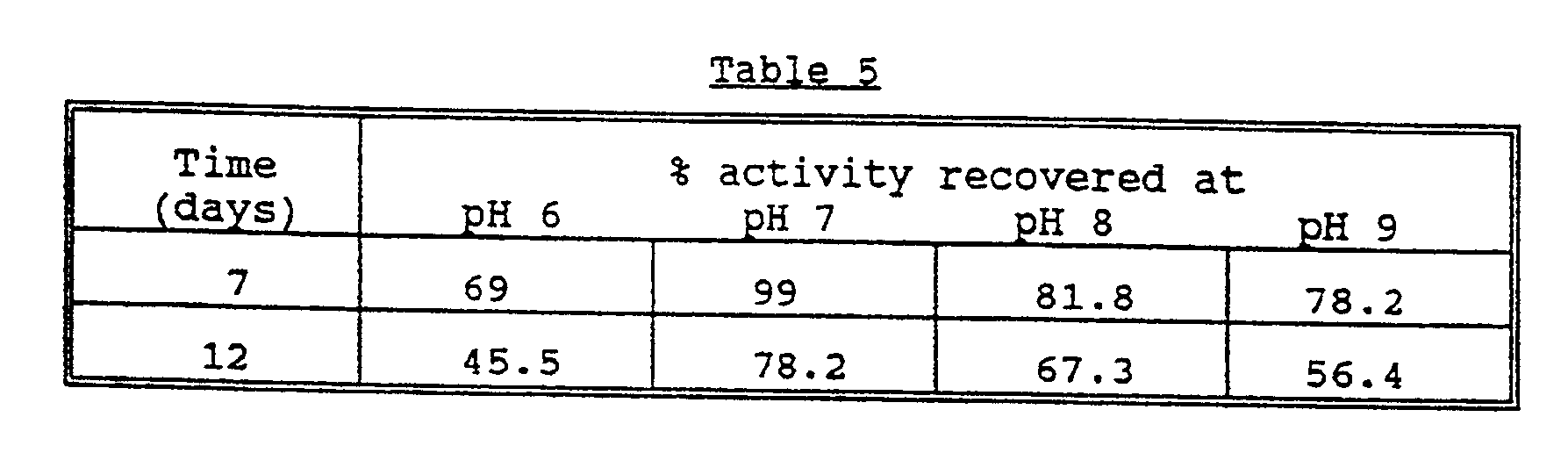
- For pH 6.0, 8.0 and 9.0, 150 mM Tricine + 1 mM MgCl₂ was used. For pH 7.0 150 mM bis-tris + 1 mM MgCl₂ was chosen. Solutions were stored at 25°C. Results for pH stability are given in Table 5:
- The effect of pH on the enzyme activity was checked by changing the buffers as well as pH values. Once again, at pH 7 Bis-tris was used. The results are shown in Table 6:
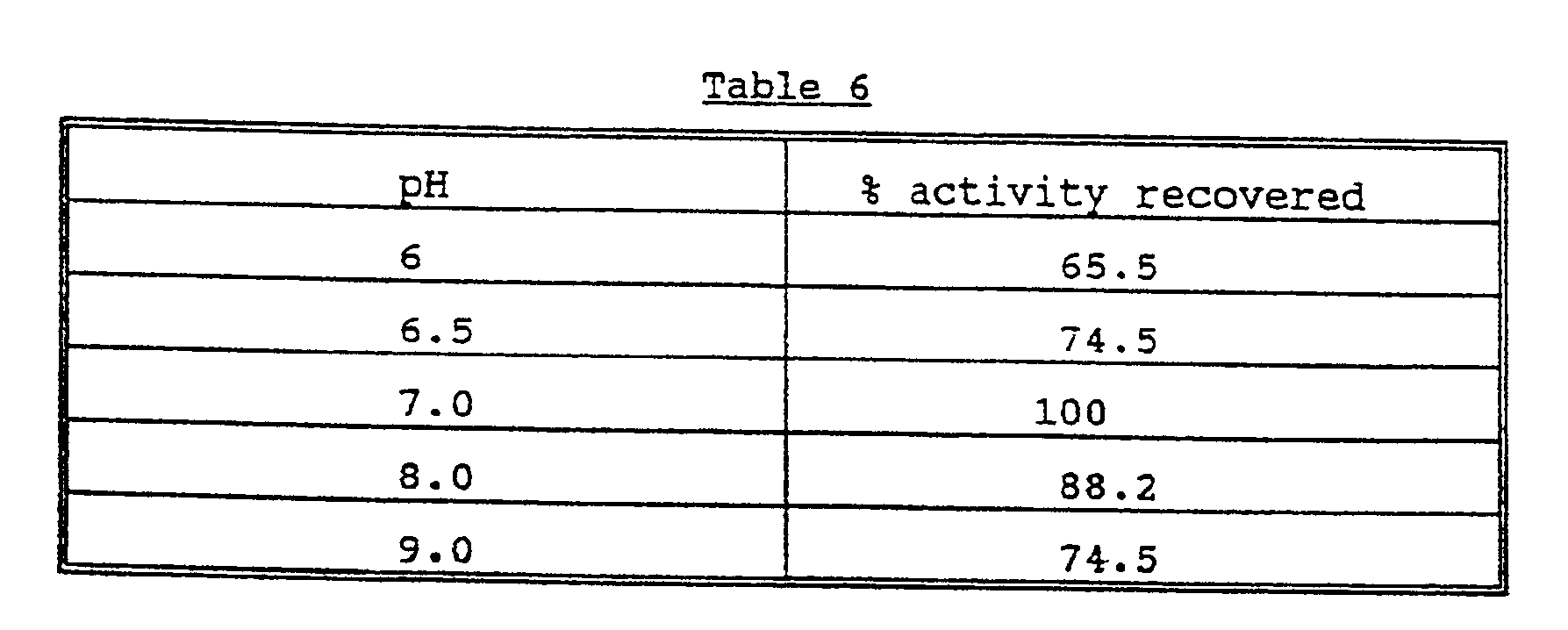
- The buffer normally used in the bicarbonate assay is 150 mM Tricine and 1 mM MgCl₂, pH 8.0. The activity results suggest that 150 mM Bis-tris buffer at pH 7.0 would be better.
- Low concentrations of calcium have an inhibitory effect on the PEPC activity. Mg²⁺ seems to be the only effective activator of the enzyme, and works better as the chloride compound than as the sulphate.
- The km's of Hyphomicrobium PEPC were checked with both sodium bicarbonate and phosphoenol pyruvate as substrates. The effect of various pH values and temperature were investigated.
- The effect of bicarbonate on the activity of PEPC was evaluated at pH 8.0 in 167 mM Tricine buffer + 1 mM MgCl₂. The km was 1.3 mM. This is high due to inference of dissolved carbon dioxide from the atmosphere. It is probably below 1 mM in this buffer.
- The km values of the monocyclohexylammonium salt and tricyclohexylammonium PEP salts at pH 7.0 and 25°C were found to be very similar. The result is 0.91 mM for the tricyclohexylammonium salt.
- The effect of temperature on the activity of PEPC was evaluated. Lyophilised enzyme was resuspended in 167 mM tricine buffer pH 7.0 containing 1 mM MgCl₂ at a concentration of 300 u/l. The enzyme was then assayed at the desired temperature using the recommended reagents.
- The relative activity rose from approximately 10% at 20°C to 100% at 50°C, and then fell rapidly to about 10% at 55°C.
- The effect of pH on the activity of PEPC was evaluated. Lyophilised enzyme was resuspended (10 mg/ml)) in 167 mM Tricine pH 8.0 (+1 mM MgCl₂) and diluted to a concentration of 1 u/ml. The enzyme was then assayed in the following buffer systems. At pH 6.0, 8.0 and 9.0 Tricine (150 mM) was used. At pH 6.5 and 7.0 bis-tris (150 mM) was used.
- The relative activity was approximately 70%, 85%, 115%, 100% and 90%, at pH 6.0, 6.5, 7.0, 8.0 and 9.0, respectively.
- The following Example illustrates the phosphoenolpyruvate carboxylase assay.
- Reagents:
- A 167 mM Tricine.HCl buffer, pH 8.0, containing 16.7 mM MgCl₂
- B 20.7 mM sodium bicarbonate in Reagent A
- C 217 mM phosphoenolpyruvate in Reagent A
- D 10 mM NADH solution, the concentration of which is checked in the following way:
- 1 Dispense 0.98 ml of Reagent A into a cuvette and zero a spectrophotometer set at 340 nm with this cuvette
- 2 Add 0.02 ml of Reagent D to this cuvette and mix thoroughly
- 3 The A₃₄₀ of this solution must be 1.14 to 1.185
- E 700 U/ml malate dehydrogenase
- Method:
- 1 Adjust spectrophotometer to 340 nm and 25°C
- 2 Prepare a reagent cocktail as follows:
Into a 50 ml beaker dispense;
46.0 ml Reagent B
1.0 ml Reagent C
This cocktail is stable for 8 hr when stored at 4°C - 3 Dispense 0.94 ml of the reagent cocktail into a cuvette together with 0.02 ml of Reagent D, and 0.02 ml of Reagent E
Incubate the cuvette in the spectrophotometer at 25°C to attain temperature equilibration and then establish background rate, if any - 4 Dilute the enzyme to approximately 1.5 U/ml in reagent A, and initiate the reaction by adding 0.02 ml of this solution to the cuvette
- 5. Calculate the change in absorbance (Δ A/min) over the linear portion of the reaction
- 6 Activity (U/ml) =

Claims (10)
- Phosphoenolpyruvate carboxylase (PEPC) characterised by, at pH 6.5, an activity of at least 40% relative to the activity at optimum pH.
- PEPC according to claim 1, wherein the relative activity is at least 50%.
- PEPC characterised by a specific activity of at least 40 U/mg protein.
- PEPC characterised by no more than 50% loss of activity after 60 days in 167 mM Tricine/HCl aqueous buffer, pH 8.0, and 15 mM MgCl₂, at 25°C, in the absence of stabiliser.
- PEPC having 2, 3 or more of the characteristics given in preceding claims.
- PEPC according to any preceding claim, of microbial origin.
- A strain of a serine pathway methylotrophic bacterium capable of giving PEPC according to any of claims 1 to 5.
- A strain of Hyphomicrobium according to claim 7.
- A strain of Hyphomicrobium according to claim 8 having the characteristics of that available as NCIMB 40280, or a mutant thereof.
- A composition or assay kit, for use in measuring bicarbonate in biological samples, comprising PEPC according to any of claims 1 to 6, malate dehydrogenase, PEP, buffer (pH 5-10) and NADH.
Applications Claiming Priority (2)
| Application Number | Priority Date | Filing Date | Title |
|---|---|---|---|
| GB909010359A GB9010359D0 (en) | 1990-05-09 | 1990-05-09 | Enzyme and its preparation |
| GB9010359 | 1990-05-09 |
Publications (2)
| Publication Number | Publication Date |
|---|---|
| EP0456444A2 true EP0456444A2 (en) | 1991-11-13 |
| EP0456444A3 EP0456444A3 (en) | 1992-04-15 |
Family
ID=10675672
Family Applications (1)
| Application Number | Title | Priority Date | Filing Date |
|---|---|---|---|
| EP19910304078 Withdrawn EP0456444A3 (en) | 1990-05-09 | 1991-05-07 | Enzyme and its preparation |
Country Status (5)
| Country | Link |
|---|---|
| US (1) | US5514538A (en) |
| EP (1) | EP0456444A3 (en) |
| JP (1) | JPH04228074A (en) |
| GB (1) | GB9010359D0 (en) |
| IE (1) | IE911560A1 (en) |
Cited By (1)
| Publication number | Priority date | Publication date | Assignee | Title |
|---|---|---|---|---|
| US5547851A (en) * | 1993-03-22 | 1996-08-20 | Toyo Boseki Kabushiki Kaisha | Method for measuring carbon dioxide and reagent therefor |
Families Citing this family (3)
| Publication number | Priority date | Publication date | Assignee | Title |
|---|---|---|---|---|
| CA2111168A1 (en) * | 1992-12-21 | 1994-06-22 | Shing F. Kwan | Stable single liquid reagent for the determination of carbon dioxide in serum |
| US6485927B2 (en) * | 1997-09-30 | 2002-11-26 | Fuji Photo Film Co., Ltd. | Method for quantitatively determining bicarbonate ion in liquid and dry analysis device |
| US7299805B2 (en) * | 2002-06-07 | 2007-11-27 | Marctec, Llc | Scaffold and method for implanting cells |
Family Cites Families (4)
| Publication number | Priority date | Publication date | Assignee | Title |
|---|---|---|---|---|
| DE3268576D1 (en) * | 1981-10-05 | 1986-02-27 | Boehringer Mannheim Corp | Linear kinetic determination of bicarbonate in body fluids |
| GB2223754B (en) * | 1988-09-12 | 1992-07-22 | Degussa | Dna encoding phosphoenolpyruvate carboxylase |
| US5112740A (en) * | 1989-12-18 | 1992-05-12 | Eastman Kodak Company | Carbon dioxide assay for body fluids comprising carbonic anhydrase |
| US5116728A (en) * | 1990-07-20 | 1992-05-26 | Em Diagnostic Systems, Incorporated | Reagents for co2 detection |
-
1990
- 1990-05-09 GB GB909010359A patent/GB9010359D0/en active Pending
-
1991
- 1991-05-07 EP EP19910304078 patent/EP0456444A3/en not_active Withdrawn
- 1991-05-08 IE IE156091A patent/IE911560A1/en unknown
- 1991-05-08 JP JP3102640A patent/JPH04228074A/en active Pending
-
1993
- 1993-03-30 US US08/040,273 patent/US5514538A/en not_active Expired - Fee Related
Cited By (1)
| Publication number | Priority date | Publication date | Assignee | Title |
|---|---|---|---|---|
| US5547851A (en) * | 1993-03-22 | 1996-08-20 | Toyo Boseki Kabushiki Kaisha | Method for measuring carbon dioxide and reagent therefor |
Also Published As
| Publication number | Publication date |
|---|---|
| JPH04228074A (en) | 1992-08-18 |
| EP0456444A3 (en) | 1992-04-15 |
| GB9010359D0 (en) | 1990-06-27 |
| US5514538A (en) | 1996-05-07 |
| IE911560A1 (en) | 1991-11-20 |
Similar Documents
| Publication | Publication Date | Title |
|---|---|---|
| US3806416A (en) | Creatine amidohydrolase and process for its preparation | |
| US5468625A (en) | α-L-Rhamnosidase for obtaining rhamnose, a process for its preparation and its use | |
| US4745064A (en) | Process for the degradation of s-triazine derivatives in aqueous solutions | |
| FI86889C (en) | Process for the preparation of L-carnitine in a microbiological manner | |
| Davis | Neurospora mutant lacking an arginine-specific carbamyl phosphokinase | |
| Ely et al. | Ammonia assimilation and glutamate formation in Caulobacter crescentus | |
| Varga et al. | Isolation from soil of phenol-utilizing organisms and metabolic studies on the pathways of phenol degradation | |
| EP0019937B1 (en) | A method for producing alcohol oxidase, alcohol oxidase, enzyme preparation and a method for determining the concentration of a compound in an alcohol-containing sample | |
| US5514538A (en) | Bicarbonate assay and phosphoenolpyruvate carboxylase enzyme from hyphomicrobium | |
| EP0486024B1 (en) | Lactobacillus SP.B001 and method of producing mannitol | |
| US5416019A (en) | Rhodococcus microorganisms that produce phenylalanine dehydroganase | |
| US4753882A (en) | Urease and process for preparation thereof | |
| CA1318631C (en) | Process for production of superoxide dismutase | |
| EP0668359B1 (en) | Continuous fermentation process which is useful for the simultaneous optimal production of propionic acid and vitamin B12 | |
| EP0556838A1 (en) | Method of producing trehalose | |
| KR100541578B1 (en) | Erythritol production method | |
| Fensom et al. | The use of ferricyanide for the production of 3‐keto sugars by non‐growing suspensions of Agrobacterium tumefaciens | |
| JPH04365473A (en) | Cryptococcus laurenty dsm2762 | |
| KR100237091B1 (en) | Method for preparing flavin nucleotide | |
| EP0071485A2 (en) | Novel microorganisms derived from microorganisms of the genus Escherichia by mutation and their use in the preparation of glutathione | |
| JPS6112282A (en) | Microorganism producing alkaline cellulase | |
| EP0205303A2 (en) | Microbiological method of producing ethylene | |
| KR880001680B1 (en) | Method for producing sisomycin by fermentation | |
| US5547851A (en) | Method for measuring carbon dioxide and reagent therefor | |
| Ozaki | Partial purification and properties of enzyme inactivating showdomycin from Streptomyces sp. No. 383 |
Legal Events
| Date | Code | Title | Description |
|---|---|---|---|
| PUAI | Public reference made under article 153(3) epc to a published international application that has entered the european phase |
Free format text: ORIGINAL CODE: 0009012 |
|
| AK | Designated contracting states |
Kind code of ref document: A2 Designated state(s): AT BE CH DE DK ES FR GB GR IT LI LU NL SE |
|
| PUAL | Search report despatched |
Free format text: ORIGINAL CODE: 0009013 |
|
| AK | Designated contracting states |
Kind code of ref document: A3 Designated state(s): AT BE CH DE DK ES FR GB GR IT LI LU NL SE |
|
| 17P | Request for examination filed |
Effective date: 19921014 |
|
| RAP1 | Party data changed (applicant data changed or rights of an application transferred) |
Owner name: GENZYME LIMITED |
|
| 17Q | First examination report despatched |
Effective date: 19940928 |
|
| STAA | Information on the status of an ep patent application or granted ep patent |
Free format text: STATUS: THE APPLICATION IS DEEMED TO BE WITHDRAWN |
|
| 18D | Application deemed to be withdrawn |
Effective date: 19960711 |