EP0456473B1 - Polyvinylchloridzusammensetzung - Google Patents
Polyvinylchloridzusammensetzung Download PDFInfo
- Publication number
- EP0456473B1 EP0456473B1 EP91304127A EP91304127A EP0456473B1 EP 0456473 B1 EP0456473 B1 EP 0456473B1 EP 91304127 A EP91304127 A EP 91304127A EP 91304127 A EP91304127 A EP 91304127A EP 0456473 B1 EP0456473 B1 EP 0456473B1
- Authority
- EP
- European Patent Office
- Prior art keywords
- parts
- polyvinyl chloride
- weight
- based resin
- chloride based
- Prior art date
- Legal status (The legal status is an assumption and is not a legal conclusion. Google has not performed a legal analysis and makes no representation as to the accuracy of the status listed.)
- Expired - Lifetime
Links
- 0 *c1ccccc1* Chemical compound *c1ccccc1* 0.000 description 2
Classifications
-
- F—MECHANICAL ENGINEERING; LIGHTING; HEATING; WEAPONS; BLASTING
- F16—ENGINEERING ELEMENTS AND UNITS; GENERAL MEASURES FOR PRODUCING AND MAINTAINING EFFECTIVE FUNCTIONING OF MACHINES OR INSTALLATIONS; THERMAL INSULATION IN GENERAL
- F16F—SPRINGS; SHOCK-ABSORBERS; MEANS FOR DAMPING VIBRATION
- F16F1/00—Springs
- F16F1/36—Springs made of rubber or other material having high internal friction, e.g. thermoplastic elastomers
- F16F1/3605—Springs made of rubber or other material having high internal friction, e.g. thermoplastic elastomers characterised by their material
-
- C—CHEMISTRY; METALLURGY
- C08—ORGANIC MACROMOLECULAR COMPOUNDS; THEIR PREPARATION OR CHEMICAL WORKING-UP; COMPOSITIONS BASED THEREON
- C08K—Use of inorganic or non-macromolecular organic substances as compounding ingredients
- C08K5/00—Use of organic ingredients
- C08K5/04—Oxygen-containing compounds
- C08K5/10—Esters; Ether-esters
- C08K5/12—Esters; Ether-esters of cyclic polycarboxylic acids
-
- C—CHEMISTRY; METALLURGY
- C08—ORGANIC MACROMOLECULAR COMPOUNDS; THEIR PREPARATION OR CHEMICAL WORKING-UP; COMPOSITIONS BASED THEREON
- C08K—Use of inorganic or non-macromolecular organic substances as compounding ingredients
- C08K5/00—Use of organic ingredients
- C08K5/49—Phosphorus-containing compounds
- C08K5/51—Phosphorus bound to oxygen
- C08K5/52—Phosphorus bound to oxygen only
- C08K5/521—Esters of phosphoric acids, e.g. of H3PO4
- C08K5/523—Esters of phosphoric acids, e.g. of H3PO4 with hydroxyaryl compounds
Definitions
- This invention relates to polyvinyl chloride based resin compositions having such an excellent ability to absorb vibrational energy that they are suitable for use in various applications including transportation equipment, precision electronic devices and acoustic devices.
- the compositions are capable of improving the response speed of transportation equipment, increasing the precision of measurement with electronic devices and enhancing the sound quality and comfort of acoustic devices.
- the loss tangent is preferably as high as possible whereas the storage modulus has an optimum value depending on the form in which they are used. These two factors usually have high dependency on temperature.
- the storage modulus decreases gradually with increasing temperature and decreases sharply at certain temperatures, typically beyond the glass transition point.
- the loss tangent shows the highest value at temperatures slightly beyond the glass transition point and tends to decrease at lower or much higher temperatures.
- the first criterion for successful vibration absorbing materials has been that they have high loss tangents in the temperature range in which they are used.
- the storage modulus it has been possible to attain an optimum value since adjustments can be effected over a considerably broad range by addition of inorganic or metallic fillers, softening agents, rubber, etc.
- butyl rubbers, polynorbornene rubbers and specialty urethane based elastomers have attained excellent loss tangents (tan ⁇ ) that are respectively 1.4, 2.8 and 1.3 at maximum.
- these materials have found only limited use because of their relatively low processability and formability.
- Polyvinyl chloride resins have long been used as a class of general-purpose resins and not only their economy but also practically all of the methods of shaping and processing them have been established. As other advantages, they are noncrystalline resins and permit easy production of composites with inorganic or metallic fillers or softening agents.
- Polyvinyl chloride alone has a loss tangent that peaks at about 1.1 at temperatures of ca. 90°C. If di-2-ethylhexyl phthalate (hereinafter abbreviated as DOP) which is a typical plasticizer is added in an amount of 100 parts by weight per 100 parts by weight of the resin, the peak temperature of the resin's loss tangent will drop to ca. 5°C and at the same time the peak value of the loss tangent also drops to ca. 0.7. It has heretofore been held that this phenomenon is due to the broadening of the distribution of relaxation time that occurs as a result of the entrance of a dissimilar molecule into the moleculecular chain of polyvinyl chloride per se.
- DOP di-2-ethylhexyl phthalate
- Foams are extensively used as absorbents, particularly for absorbing vibrational impacts and polyvinyl chloride paste resins are used most commonly in this area of applications.
- polyvinyl chloride paste resins are typically used as a sol after being mixed with liquid plasticisers and hence are not highly compatible with dicyclohexyl phthalate which is solid at room temperature.
- An object, therefore, of the present invention is to provide a polyvinyl chloride based resin composition that retains the characteristics of polyvinyl chloride based resins and which yet exhibits excellent ability to absorb vibrational energy without experiencing bleeding even if dicyclohexyl phthalate is added.
- Another object of the present invention is to provide a material for absorbing vibrational energy that retains the characteristics of polyvinyl chloride based resins and which yet has high loss tangent or maintains a relatively high loss tangent over a broad range of temperatures with reduced occurrence of bleeding.
- Still another object of the present invention is to provide a foam for absorbing vibrational impacts that retains the characteristics of polyvinyl chloride based resins and which yet has excellent ability to absorb vibrational energy without suffering from the bleeding of plasticisers.
- US-A-2557089 is concerned with finding a single plasticizer for PVC for coating textiles for clothing, drapes and furniture covering and recommends the use of such compounds as lauryl diphenyl phosphate. It refers to the possibility of plasticizing PVC with a mixture of tricresylphosphate and a secondary plasticizer such as dibutyl phthalate, but says that the compositions are unsatisfactory for many uses because of high volatility and inflammability of dibutyl phthalate.
- a polyvinyl chloride based resin composition comprises 100 parts by weight of a polyvinyl chloride based resin, a phthalic acid ester having the following formula (i): where R 1 and R 2 which may be the same or different each represents a monocyclic hydrocarbon group; and a phosphoric acid ester having the following structural formula (ii): where R 3 , R 4 and R 5 which may be the same or different, each represents an aromatic monocyclic hydrocarbon group, the total amount of components (i) and (ii) being from 5 to 200 parts per 100 parts of polyvinyl chloride based resin.
- the invention also extends to a material for absorbing vibrational energy that comprises a polyvinyl chloride based resin, a petroleum resin and a plasticizer, the said petroleum resin being contained in an amount of 3-200 parts by weight per 100 parts by weight of the polyvinyl chloride based resin, the plasticizer consisting of a phthalic acid ester having the following formula (i): where R 1 and R 2 which may be the same or different each represents a monocyclic hydrocarbon group and a phosphoric acid ester having the following structural formula (ii): where R 3 , R 4 and R 5 which may be the same or different, each represents an aromatic monocyclic hydrocarbon group, the total amount of components (i) and (ii) being from 5 to 200 parts per 100 parts of polyvinyl chloride based resin.
- the present invention also relates to a material for absorbing vibrational energy that is comprised of said composition, as well as a foam for absorbing vibrational impacts.
- polyvinyl chloride based resin means not only a homopolymer of vinyl chloride but also any other resins that are generally recognised as a class of polyvinyl chloride based resins including copolymers of vinyl chloride with vinyl acetate and ethylene, graft polymers of vinyl chloride with a ethylene-vinyl acetate copolymer of polyurethane, and polyvinyl chloride paste resins.
- polyvinyl chloride paste resins that are used in wall paper and cushion floors are particularly preferred.
- the phthalic acid ester having the structural formula represented by (i) is desirably such a compound that R 1 and R 2 which may be the same or different each represents a monocyclic hydrocarbon group such as one having 3-8 carbon atoms, with one having 6 carbon atoms being particularly preferred.
- the hydrogen atoms on the ring may be replaced by other substituents.
- the phthalic acid ester of the formula (i) include dicyclohexyl phthalate (DCHP), dimethylcyclohexyl phthalate (DMCHP) and diphenyl phthalate (DPP), with dicyclohexyl phthalate being preferred.
- DCHP dicyclohexyl phthalate
- DMCHP dimethylcyclohexyl phthalate
- DPP diphenyl phthalate
- the phthalic acid ester is added in an amount of 5 - 200 parts, more preferably from 10 to 100 parts by weight, per 100 parts by weight of the polyvinyl chloride based resin.
- Polyvinyl chloride taken alone shows a maximum tan ⁇ value of 1.1 at ca.
- the phosphoric acid ester having the structural formula represented by (ii) is such a compound that R 3 , R 4 and R 5 which may be the same or different each represents an aromatic monocyclic hydrocarbon group, such as one having 6 - 9 carbon atoms, with a phenyl group having a substituent being particularly preferred.
- the hydrogen atoms on the ring of each R may be replaced by other substituents.
- phosphoric acid ester of the formula (ii) include tricresyl phosphate (TCP) and trixylenyl phosphate (TXP).
- TCP tricresyl phosphate
- TXP trixylenyl phosphate
- Trixylenyl phosphate is particularly preferred since it has the advantage that even if it is added independently to the polyvinyl chloride based resin, the latter retains a maximum tan ⁇ of ca. 1.1.
- the phosphoric acid ester is added in an amount of 5 - 200 parts by weight, more preferably from 10 to 100 parts by weight, per 100 parts by weight of the polyvinyl chloride based resin.
- the bleeding of the phthalic acid ester can be significantly suppressed by adding at least 5 parts by weight of the phosphoric acid ester.
- the temperature at which the resin composition of the present invention exhibits a maximum value of tan ⁇ can be adjusted over a broad range from room temperature to a point in the neighborhood of 80°C by controlling the proportions of the phthalaic acid ester and the phosphoric acid ester. Further, the resin composition can retain a tan ⁇ of at least 1.2 and hence it may well be considered to be a material that is very effective for the purpose of absorbing vibrational energy.
- the petroleum resin to be used in one aspect of the present invention is one that is obtained by polymerising a mixture of C 5 - C 9 olefins.
- the addition of the petroleum resin contributes to a significant enhancement of the maximum value of loss tangent but the degree of its effectiveness will vary considerably depending on its composition and molecular weight.
- a preferred petroleum resin is one that contains at least 50 wt% of indene and styrene which are C 9 components. More desirably, styrene is present in a larger amount than indene. It is also preferred that the petroleum resin has a number average molecular weight of 500 - 1,500 and outside this range, the loss tangent of the resin composition will decrease.
- the petroleum resin is preferably added in an amount of 3 - 200 parts by weight, more preferably from 10 to 100 parts by weight, per 100 parts by weight of the polyvinyl chloride based resin. If the content of the petroleum resin is less than 3 parts by weight, it does not make much contribution to the increase in loss tangent. On the other hand, if the petroleum resin is added in an amount exceeding 200 parts by weight, the processability of the resin composition will deteriorate markedly.
- the petroleum resin is certainly effective in increasing the loss tangent of the resin composition but its effectiveness will vary greatly depending upon the type of the plasticizer which is added as the third component.
- the plasticizer which is to be added as the third component in the present invention is selected from among those which have high miscibility with polyvinyl chloride, namely those which will increase the loss tangent of the resin composition.
- desirable plasticizers include the phthalic acid ester having the structural formula (i) and the phosphoric acid ester having the structural formula (ii).
- the phthalic acid (i) may be specifically exemplified by dicyclohexyl phthalate, dimethylcyclohexyl phthalate and diphenyl phthalate, and the phosphoric acid ester (ii) may be specifically exemplified by tricresyl phosphate and trixylenyl phosphate.
- the phtalic acid ester to be used in the present invention is low in the efficiency of plasticization, so it suffers from the disadvantage that even if it is added in a substantial amount, the temperature range where a maximum loss tangent is attained cannot be effectively lowered to room temperature and its neighborhood, which is the most common temperature range for the use of vibration absorbing materials. This defect can be compensated for by using the phosphoric acid ester in combination with the phthalic acid ester.
- the amounts in which the two ester based plasticizers are added vary with the use and cannot be determined uniquely.
- the two ester compounds are suitably used in a total amount of 5 - 200 parts by weight per 100 parts by weight of the polyvinyl chloride based resin. If the sum of the two ester compounds is less than 5 parts by weight, a significant enhancement of loss tangent cannot be expected. If the sum of the two ester compounds exceeds 200 parts, they will bleed to make the resin composition too sticky.
- foaming agents may be added to make a foam of the resin composition and they include azodicarbonamide, azobisisobutyronitrile and 4,4'-oxybisbenzenesulfonyl hydrazide. These foaming agents are desirably added in amounts of 0.3 - 20 parts by weight per 100 parts by weight of the polyvinyl chloride based resin. If the addition of foaming agents is less than 0.3 parts by weight, desired foam ratios cannot be attained. On the other hand, no economic advantage will result even if foaming agents are added in amounts exceeding 20 parts by weight.
- the resin composition of the present invention is capable of inhibiting the bleeding of the phthalic acid ester by using the phosphoric acid ester and, at the same time, it retains the desirable features of the polyvinyl chloride based resin. Accordingly, the resin composition of the present invention can be formed into any desired shapes by conventional forming techniques such as calendering, compression molding and injection molding that are commonly applied to polyvinyl chloride based resins. In order to make foams, a polyvinyl chloride paste resin is mixed with the two plasticizers to form a sol, which is coated over a substrate and allowed to expand in a blowing oven.
- the resin composition of the present invention may incorporate, as required, fillers (e.g. calcium carbonate, talc, mica and graphite), flame retardants (e.g. antimony trioxide) and plasticizers that are commonly used with polyvinyl chloride based resins.
- fillers e.g. calcium carbonate, talc, mica and graphite
- flame retardants e.g. antimony trioxide
- plasticizers that are commonly used with polyvinyl chloride based resins.
- the composition may be blended with polymeric materials such as polyvinyl acetate, ethylene-vinyl acetate copolymer and acrylonitrile-butadiene rubber that are commonly used to modify the general properties of polyvinyl chloride based resins, as well as polymeric materials such as coumarone and xylene resins that are conventionally held to be effective for the purpose of absorbing vibrational energy.
- the vibration absorbing material produced by the present invention can be used as a support member for precision electronic devices, precision measuring instruments and other devices the precision of which is adversely affected by vibrations, as a sound damping or insulation member in the production line of electronic parts and other equipment that requires high precision of production, as a member for securing packings and gaskets, or as a laminated member in acoustic devices.
- the absorbent may be directly attached to heavily vibrating sites of automobiles, industrial equipment, etc. so as to suppress vibrations, or it may be made into a composite with wood, inorganic materials or metallic materials including stainless steel and aluminum sheets.
- the foam produced by the present invention can also be sandwiched between two wood plies to produce wood floors having improved sound insulating quality.
- ethylene-vinyl chloride copolymer resin Rosoh Corp.
- TXP trixylenyl phosphate
- DCHP dicyclohexyl phthalate
- heat stabilizers 2 parts by weight of barium stearate and 1 part by weight of zinc stearate
- a hundred parts by weight of a polyvinyl chloride resin (Ryuron Paste R-725 of Tosoh Corp.), 100 parts by weight of trixylenyl phosphate (TXP of Daihachi Chemical Industry Co., Ltd.), 60 parts by weight of dicyclohexyl phthalate (DCHP of Osaka Organic Chemical Industry, Ltd.), 2 parts by weight of a heat stabilizer (AC-113 of Adeka Argus Chemical Co., Ltd.) and 2 parts by weight of a flame retardant antimony trioxide (ATOX-S (Registered Trade Mark) of Nihon Seiko Co., Ltd.) were mixed and kneaded in a roll mill at 170°C to form a sheet of a resin composition within the scope of the present invention.
- ATOX-S flame retardant antimony trioxide
- Example 2 The procedure of Example 1 was repeated except that the amounts of trixylenyl phosphate and dicyclohexyl phthalate were changed to 35 and 15 parts by weight, respectively, and that 15 parts by weight of a polyester based plasticizer (ADK CIZER (Registered Trade Mark) PN-77 of Adeka Argus Chemical Co., Ltd.) was further added. As a result, a sheet of a resin composition within the scope of the present invention was obtained.
- ADK CIZER Registered Trade Mark
- DOMINAS Registered Trade Mark
- Example 2 The procedure of Example 1 was repeated except that the amounts of trixylenyl phosphate and dicyclohexyl phthalate were changed to 0 and 20 parts by weight, respectively, and that 30 parts by weight of a polyester based plasticizer (ADK CIZER PN-77 of Adeka Argus Chemical Co., Ltd.) was further added. As a result, a sheet of a resin composition outside the scope of the present invention was obtained.
- a polyester based plasticizer ADK CIZER PN-77 of Adeka Argus Chemical Co., Ltd.
- Example 1 The procedure of Example 1 was repeated except that the amounts of trixylenyl phosphate and dicyclohexyl phthalate were changed to 0 and 20 parts by weight, respectively, and that 30 parts by weight of di-2-ethylhexyl phthalate (VINYCIZER (Registered Trade Mark) 80 of Kao Corp.) was further added. As a result, a sheet of resin composition outside the scope of the present invention was obtained.
- VNYCIZER Registered Trade Mark 80 of Kao Corp.
- Example 1 The procedure of Example 1 was repeated except that the amounts of trixylenyl phosphate and dicyclohexyl phthalate were changed to 0 and 20 parts by weight, respectively, and that 30 parts by weight of dioctyl adipate (DOA of Kurogane Kasei Co., Ltd.) was further added. As a result, a sheet of a resin composition outside the scope of the present invention was obtained.
- DOA dioctyl adipate
- a hundred parts by weight of an ethylene-vinyl chloride copolymer resin (Ryuron E-2800 of Tosoh Corp.), 40 parts by weight of a petroleum resin (Petcoal LX-HS of Tosoh Corp.), 70 parts by weight of dicyclohexyl phthalate (DCHP of Osaka Organic Chemical Industry, Ltd.), 70 parts by weight of trixylenyl phosphate (TXP of Daihachi Chemical Industry Co., Ltd.), 3 parts by weight of a stabilizer (OG-756 of Mizusawa Industrial Chemicals, Ltd.), a flame retardant system consisting of 7 parts by weight of antimony trioxide (ATOX-S of Nihon Seiko Co., Ltd.) and 20 parts by weight of zinc borate (ZINC BORATE 2335 of United States Borax & Chemical Corporation), and an inorganic filler system consisting of 25 parts by weight of calcium carbonate (WHITON P-30 of Shiraishi Calcium Kaisha, Ltd.) and 10 parts by
- a hundred parts by weight of an ethylene-vinyl chloride copolymer resin (Ryuron E-2800 of Tosoh Corp.), 100 parts by weight of di-2-ethylhexyl phthalate (VINYCIZER 80 of Kao Corp.), 6 parts by weight of a stabilizer (OG-756 of Mizusawa Industrial Chemicals, Ltd.) and 7 parts of a flame retardant antimony trioxide (ATOX-S of Nihon Seiko Co., Ltd.) were mixed and kneaded on rolls at 140°C for ca. 5 min to form a sheet of a resin composition outside the scope of the present invention.
- a resin sheet was formed by repeating the procedure of Example 1 except that 1 part by weight of a heat stabilizer zinc stearate, 6.5 parts by weight of an azo compound (AC#R (Registered Trade Mark), a foaming agent of Eiwa Chemical Ind, Co., Ltd.) and 4 parts by weight of a foam stabilizer (FL-21 (Registered Trade Mark) of Adeka Argus Chemical Co., Ltd.) were added to the recipe of the formulation
- the rolled sheet was pressed to form a flat sheet 1 mm thick. which was expanded in a hot (200°C) atmosphere to make a foam 5 mm thick that was within the scope of the present invention.
- a hundred parts by weight of a polyvinyl chloride paste resin (Ryuron Paste R-725 of Tosoh Corp.), 80 parts by weight of trixylenyl phosphate (TXP of Daihachi Chemical Industry Co., Ltd.), 40 parts by weight of dimethylcyclohexyl phthalate (EDENOL (Registered Trade Mark) 344 of Henkel Hakusui Corporation), 20 parts by weight of di-2-ethylhexyl phthalate (VINYCIZER 80 of Kao Corp.), 2 parts by weight of a flame retardant antimony trioxide (ATOX-S of Nihon Seiko Co., Ltd.), 6.5 parts by weight of an azo compound (AC#R, a foaming agent of Eiwa Chemical Ind.
- TXP trixylenyl phosphate
- EDENOL Registered Trade Mark 344 of Henkel Hakusui Corporation
- VINYCIZER 80 of Kao Corp. 2 parts by weight of
- Example 8 The procedure of Example 8 was repeated except that the amounts of trixylenyl phosphate (TXP of Daihachi Chemical Industry Co., Ltd.), dimethylcyclohexyl phthalate (EDENOL 344 of Henkel Hakusui Corporation) and di-2-ethylhexyl phthalate (VINYCIZER 80 of Kao Corp.) were respectively changed to 60, 20 and 0 parts by weight. As a result, a resin sheet and a foam that were within the scope of the present invention were obtained.
- TXP trixylenyl phosphate
- EDENOL 344 dimethylcyclohexyl phthalate
- VINYCIZER 80 of Kao Corp. di-2-ethylhexyl phthalate
- a resin sheet was formed by repeating the procedure of Example 6 except that 6.5 parts by weight of an azo compound (AC#R, a foaming agent of Eiwa Chemical Ind. Co., Ltd.) and 4 parts by weight of a foam stabilizer (FL-21 of Adeka Argus Chemical Co., Ltd.) were added to the recipe of the formulation.
- the rolled sheet was pressed to form a flat sheet 1 mm thick, which was expanded in a hot (200°C) atmosphere to make a foam 5 mm thick that was within the scope of the present invention.
- Example 8 The procedure of Example 8 was repeated except that the amounts of trixylenyl phosphate, dimethylcyclohexyl phthalate and di-2-ethylhexyl phthalate were respectively changed to 0, 0 and 70 parts by weight. As a result, a resin sheet and a foam that were outside the scope of the present invention were obtained.
- the sheets prepared in Examples 1 - 4 and Comparative Examples 1 - 3 were left to stand in a thermostatic chamber at 23°C and 50% RH. Thereafter, the sheets were visually checked for the occurrence of bleeding. The results are shown in Table 1, together with the time period that lapsed before visually detectable bleeding occured. The samples were labeled "negative" when no detectable bleeding occurred even after the passage of six months.
- a rubber sheet 3 mm thick was spread over an iron plate 30 mm thick and each of the foams prepared in Examples 7 - 10 and Comparative Example 5 was placed on top of the iron plate.
- a accelerometer product of Brüel & Kjaer
- the present invention offers a polyvinyl chloride based resin composition that experiences less bleeding and which exhibits a higher loss tangent on account of the use of a specified phosphoric acid ester in combination with a specified phthalic acid ester.
- a vibration absorbing material is produced by mixing a polyvinyl chloride based resin with a petroleum resin, as well as a specified phthalate and phosphate ester.
- This absorbent material has the advantage that the peak value of tan ⁇ can be elevated to 1.5 or more, or that the temperature range in which tan ⁇ shows values of at least 0,5 can be extended to at least 24°C e.g. 25 to 37°C or to a range as great as 50°C or higher. Further, the absorbent material will experience less bleeding.
- foams made of the vibration absorbing material of the present invention benefit from the fact that the skeletal resin has a very high tan ⁇ which is at least 1.0.
- each of the two major factors of impact absorption i.e., impact transmission (as detected with the accelerometer in terms of voltage) and impact damping (as detected with the force transducer in terms of voltage) can be improved by 20 - 60%. Tan ⁇ (max) Temp.
Landscapes
- Chemical & Material Sciences (AREA)
- Health & Medical Sciences (AREA)
- Chemical Kinetics & Catalysis (AREA)
- Medicinal Chemistry (AREA)
- Polymers & Plastics (AREA)
- Organic Chemistry (AREA)
- Engineering & Computer Science (AREA)
- General Engineering & Computer Science (AREA)
- Mechanical Engineering (AREA)
- Compositions Of Macromolecular Compounds (AREA)
Claims (9)
- Harzzusammensetzung auf Polyvinylchlorid-Basis, umfassend 100 Gewichtsteile eines Harzes auf Polyvinylchlorid-Basis, einen Phthalsäureester der folgenden Formel (i):wobei R1 und R2, die gleich oder verschieden sein können, jeweils einen monocyclischen Kohlenwasserstoffrest bedeuten; und einen Phosphorsäureester der folgenden Strukturformel (ii):
 wobei R3, R4 und R5, die gleich oder verschieden sein können, jeweils einen aromatischen monocyclischen Kohlenwasserstoffrest bedeuten, wobei die Gesamtmenge der Komponenten (i) und (ii) 5 bis 200 Teile pro 100 Teile Harz auf Polyvinylchlorid-Basis ist.
- Material zur Absorption von Schwingungsenergie, umfassend ein Harz auf Polyvinylchlorid-Basis, ein Petroleumharz und einen Weichmacher, wobei eine Menge von 3 bis 200 Gewichtsteilen Petroleumharz pro 100 Gewichtsteile Harz auf Polyvinylchlorid-Basis enthalten ist und wobei der Weichmacher aus einem Phthalsäureester der folgenden Formel (i):wobei R1 und R2, die gleich oder verschieden sein können, jeweils einen monocyclischen Kohlenwasserstoffrest bedeuten und aus einem Phosphorsäureester der folgenden Strukturformel (ii):
 wobei R3, R4 und R5, die gleich oder verschieden sein können, jeweils einen aromatischen monocyclischen Kohlenwasserstoffrest bedeuten, besteht, und wobei die Gesamtmenge der Komponenten (i) und (ii) 5 bis 200 Teile pro 100 Teile Harz auf Polyvinylchlorid-Basis ist.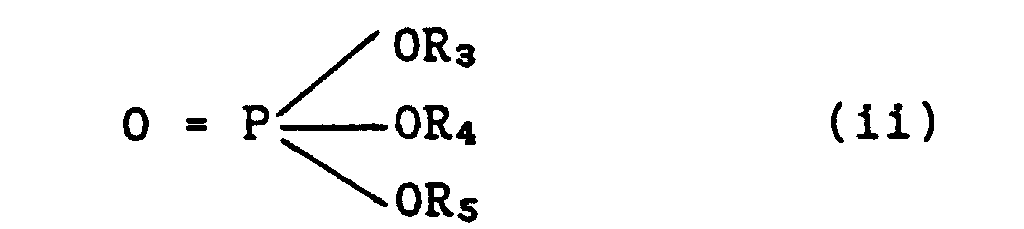
- Harzzusammensetzung auf Polyvinylchlorid-Basis nach Anspruch 1 oder 2, dadurch gekennzeichnet, daß R1 und R2 der Formel (i) jeweils ein monocyclischer Kohlenwasserstoffrest mit 6 Kohlenstoffatomen ist.
- Harzzusammensetzung auf Polyvinylchlorid-Basis nach Anspruch 1, 2 oder 3, dadurch gekennzeichnet, daß R3, R4 und R5 der Formel (ii) jeweils eine substituierte Phenylgruppe ist.
- Zusammensetzung nach Anspruch 1 oder 2, dadurch gekennzeichnet, daß der Phthalsäureester Dicyclohexylphthalat, Dimethylcyclohexylphthalat oder Diphenylphthalat ist und der Phosphorsäureester Tricresylphosphat oder Trixylenylphosphat ist.
- Material zur Absorption von Schwingungsstößen in Form eines Schaumstoffes, der eine Zusammensetzung nach einem der Ansprüche 1 bis 5 umfaßt.
- Komponente zur Absorption von Schwingungsenergie, die eine Zusammensetzung nach einem der Ansprüche 1 bis 5 umfaßt.
- Verwendung einer Zusammensetzung oder eines Materials nach einem der Ansprüche 1 bis 7 zur Absorption von Schwingungssenergie.
- Verwendung einer Zusammensetzung oder eines Materials nach einem der Ansprüche 1 bis 7 zur Herstellung einer Komponente zur Absorption von Schwingungen.
Applications Claiming Priority (9)
| Application Number | Priority Date | Filing Date | Title |
|---|---|---|---|
| JP11881790A JP2913487B2 (ja) | 1990-05-10 | 1990-05-10 | ポリ塩化ビニル系樹脂組成物 |
| JP118817/90 | 1990-05-10 | ||
| JP11881790 | 1990-05-10 | ||
| JP14863690A JP3177654B2 (ja) | 1990-06-08 | 1990-06-08 | 振動エネルギー吸収材 |
| JP148636/90 | 1990-06-08 | ||
| JP14863690 | 1990-06-08 | ||
| JP16843890A JP3044753B2 (ja) | 1990-06-28 | 1990-06-28 | 振動衝撃吸収フォーム |
| JP168438/90 | 1990-06-28 | ||
| JP16843890 | 1990-06-28 |
Publications (3)
| Publication Number | Publication Date |
|---|---|
| EP0456473A2 EP0456473A2 (de) | 1991-11-13 |
| EP0456473A3 EP0456473A3 (en) | 1992-07-29 |
| EP0456473B1 true EP0456473B1 (de) | 1999-07-14 |
Family
ID=27313678
Family Applications (1)
| Application Number | Title | Priority Date | Filing Date |
|---|---|---|---|
| EP91304127A Expired - Lifetime EP0456473B1 (de) | 1990-05-10 | 1991-05-08 | Polyvinylchloridzusammensetzung |
Country Status (3)
| Country | Link |
|---|---|
| US (1) | US5264473A (de) |
| EP (1) | EP0456473B1 (de) |
| DE (1) | DE69131434T2 (de) |
Families Citing this family (4)
| Publication number | Priority date | Publication date | Assignee | Title |
|---|---|---|---|---|
| DE202004014160U1 (de) * | 2004-09-09 | 2004-11-18 | Mohr, Wolfgang | Bodenbelagelement |
| DE102005052130A1 (de) * | 2005-10-28 | 2007-05-03 | Röhm Gmbh | Spritzbare Akustikmassen |
| CN104592686B (zh) * | 2015-02-02 | 2016-08-24 | 江南大学 | 用于制造乒乓球的聚氯乙烯材料及其制备方法 |
| WO2019236342A1 (en) * | 2018-06-07 | 2019-12-12 | Eastman Chemical Company | Highly filled plastisols |
Family Cites Families (8)
| Publication number | Priority date | Publication date | Assignee | Title |
|---|---|---|---|---|
| US2502371A (en) * | 1947-03-11 | 1950-03-28 | Monsanto Chemicals | Polyvinyl chloride compositions |
| US2500891A (en) * | 1947-08-22 | 1950-03-14 | Goodrich Co B F | Plasticized vinyl resin compositions |
| US2557089A (en) * | 1948-01-02 | 1951-06-19 | Monsanto Chemicals | Compositions comprising a polymerized vinyl chloride resin plasticized with monoalkyl diaryl phosphate esters |
| US2831824A (en) * | 1955-04-26 | 1958-04-22 | Us Rubber Co | Gelled vinyl chloride polymer plastisols and method of making same |
| US3842027A (en) * | 1973-06-26 | 1974-10-15 | Union Carbide Corp | Vinyl chloride polymer powders |
| US4098753A (en) * | 1976-08-16 | 1978-07-04 | Amax Inc. | Ester-plasticized polyvinyl chloride resin composition containing molybdenum flame retardant and smoke suppressant agent |
| JPS5661446A (en) * | 1979-10-24 | 1981-05-26 | Ajinomoto Co Inc | Stabilizer for halogen-containing resin |
| US4670494A (en) * | 1985-07-30 | 1987-06-02 | Gary Chemical Corp. | Flame retardant low smoke poly(vinyl chloride) thermoplastic composition |
-
1991
- 1991-05-08 DE DE69131434T patent/DE69131434T2/de not_active Expired - Fee Related
- 1991-05-08 EP EP91304127A patent/EP0456473B1/de not_active Expired - Lifetime
- 1991-05-09 US US07/697,365 patent/US5264473A/en not_active Expired - Fee Related
Non-Patent Citations (1)
| Title |
|---|
| DATABASE CHEMICAL ABSTACTS (HOST:STN), CA 97(26): 217425e, Colombus , Ohio, US; & RO-B-70 546 (INSTITUTUL DE CHIMIE MACROMOLECULARA "PETRU PONI") 15-07-1981 * |
Also Published As
| Publication number | Publication date |
|---|---|
| US5264473A (en) | 1993-11-23 |
| EP0456473A3 (en) | 1992-07-29 |
| DE69131434D1 (de) | 1999-08-19 |
| DE69131434T2 (de) | 2000-03-23 |
| EP0456473A2 (de) | 1991-11-13 |
Similar Documents
| Publication | Publication Date | Title |
|---|---|---|
| US3399104A (en) | Vibration damping composition and laminated construction | |
| US6265475B1 (en) | High damping material composition | |
| IE51489B1 (en) | Filled and plasticized blends of linear low density polyethylene | |
| CA2650023A1 (en) | Rigid polyvinyl chloride polymer compositions having improved impact properties | |
| KR20190025337A (ko) | 폴리에스테르 수지의 발포 시트를 포함하는 차량용 흡차음재 | |
| US20160075891A1 (en) | Polymeric compositions with improved noise suppression | |
| US5264473A (en) | Polyvinyl chloride based resin composition | |
| EP1413603A1 (de) | Schwingungsdämpfende Materialzusammensetzung | |
| CN114127177B (zh) | 墙纸用氯乙烯树脂组合物 | |
| JP3177654B2 (ja) | 振動エネルギー吸収材 | |
| US11414570B2 (en) | Resin foam, resin foam sheet, adhesive tape, vehicle member, and building member | |
| KR0163208B1 (ko) | 방음용 조성물 및 그 성형품 | |
| JP7477258B2 (ja) | 壁紙 | |
| KR102309348B1 (ko) | 건축용 방진패드 | |
| JP2913487B2 (ja) | ポリ塩化ビニル系樹脂組成物 | |
| JPH0457835A (ja) | 振動衝撃吸収フォーム | |
| JP3077299B2 (ja) | 振動エネルギ−吸収材 | |
| JP3610613B2 (ja) | 振動衝撃エネルギー吸収材用組成物及びそれから得られる振動衝撃エネルギー吸収フォーム | |
| JP3132072B2 (ja) | 合成ゴム組成物 | |
| JP3218636B2 (ja) | ポリウレタン組成物及びそれから成る部材 | |
| EP0045967B1 (de) | Gefüllte thermoplastische Zusammensetzungen aus Äthylen-Copolymer-Mischungen | |
| JP3536404B2 (ja) | ポリ塩化ビニル系樹脂組成物 | |
| JPH11106580A (ja) | 高減衰材料組成物 | |
| JPS6258365B2 (de) | ||
| JP2000198898A (ja) | ポリ塩化ビニル系樹脂組成物及びそれよりなる振動エネルギ―吸収材 |
Legal Events
| Date | Code | Title | Description |
|---|---|---|---|
| PUAI | Public reference made under article 153(3) epc to a published international application that has entered the european phase |
Free format text: ORIGINAL CODE: 0009012 |
|
| AK | Designated contracting states |
Kind code of ref document: A2 Designated state(s): DE FR GB IT NL |
|
| PUAL | Search report despatched |
Free format text: ORIGINAL CODE: 0009013 |
|
| AK | Designated contracting states |
Kind code of ref document: A3 Designated state(s): DE FR GB IT NL |
|
| 17P | Request for examination filed |
Effective date: 19921113 |
|
| 17Q | First examination report despatched |
Effective date: 19931122 |
|
| GRAG | Despatch of communication of intention to grant |
Free format text: ORIGINAL CODE: EPIDOS AGRA |
|
| GRAG | Despatch of communication of intention to grant |
Free format text: ORIGINAL CODE: EPIDOS AGRA |
|
| GRAG | Despatch of communication of intention to grant |
Free format text: ORIGINAL CODE: EPIDOS AGRA |
|
| GRAH | Despatch of communication of intention to grant a patent |
Free format text: ORIGINAL CODE: EPIDOS IGRA |
|
| GRAH | Despatch of communication of intention to grant a patent |
Free format text: ORIGINAL CODE: EPIDOS IGRA |
|
| GRAH | Despatch of communication of intention to grant a patent |
Free format text: ORIGINAL CODE: EPIDOS IGRA |
|
| ITF | It: translation for a ep patent filed | ||
| GRAA | (expected) grant |
Free format text: ORIGINAL CODE: 0009210 |
|
| AK | Designated contracting states |
Kind code of ref document: B1 Designated state(s): DE FR GB IT NL |
|
| REF | Corresponds to: |
Ref document number: 69131434 Country of ref document: DE Date of ref document: 19990819 |
|
| ET | Fr: translation filed | ||
| PGFP | Annual fee paid to national office [announced via postgrant information from national office to epo] |
Ref country code: GB Payment date: 20000503 Year of fee payment: 10 |
|
| PLBE | No opposition filed within time limit |
Free format text: ORIGINAL CODE: 0009261 |
|
| STAA | Information on the status of an ep patent application or granted ep patent |
Free format text: STATUS: NO OPPOSITION FILED WITHIN TIME LIMIT |
|
| PGFP | Annual fee paid to national office [announced via postgrant information from national office to epo] |
Ref country code: FR Payment date: 20000517 Year of fee payment: 10 |
|
| PGFP | Annual fee paid to national office [announced via postgrant information from national office to epo] |
Ref country code: NL Payment date: 20000524 Year of fee payment: 10 |
|
| 26N | No opposition filed | ||
| PGFP | Annual fee paid to national office [announced via postgrant information from national office to epo] |
Ref country code: DE Payment date: 20000731 Year of fee payment: 10 |
|
| PG25 | Lapsed in a contracting state [announced via postgrant information from national office to epo] |
Ref country code: GB Free format text: LAPSE BECAUSE OF NON-PAYMENT OF DUE FEES Effective date: 20010508 |
|
| PG25 | Lapsed in a contracting state [announced via postgrant information from national office to epo] |
Ref country code: NL Free format text: LAPSE BECAUSE OF NON-PAYMENT OF DUE FEES Effective date: 20011201 |
|
| GBPC | Gb: european patent ceased through non-payment of renewal fee |
Effective date: 20010508 |
|
| PG25 | Lapsed in a contracting state [announced via postgrant information from national office to epo] |
Ref country code: FR Free format text: LAPSE BECAUSE OF NON-PAYMENT OF DUE FEES Effective date: 20020131 |
|
| NLV4 | Nl: lapsed or anulled due to non-payment of the annual fee |
Effective date: 20011201 |
|
| PG25 | Lapsed in a contracting state [announced via postgrant information from national office to epo] |
Ref country code: DE Free format text: LAPSE BECAUSE OF NON-PAYMENT OF DUE FEES Effective date: 20020301 |
|
| PG25 | Lapsed in a contracting state [announced via postgrant information from national office to epo] |
Ref country code: IT Free format text: LAPSE BECAUSE OF NON-PAYMENT OF DUE FEES;WARNING: LAPSES OF ITALIAN PATENTS WITH EFFECTIVE DATE BEFORE 2007 MAY HAVE OCCURRED AT ANY TIME BEFORE 2007. THE CORRECT EFFECTIVE DATE MAY BE DIFFERENT FROM THE ONE RECORDED. Effective date: 20050508 |