EP0456541A1 - Keramische Sinterkörper und Verfahren zu seiner Herstellung - Google Patents
Keramische Sinterkörper und Verfahren zu seiner Herstellung Download PDFInfo
- Publication number
- EP0456541A1 EP0456541A1 EP91401056A EP91401056A EP0456541A1 EP 0456541 A1 EP0456541 A1 EP 0456541A1 EP 91401056 A EP91401056 A EP 91401056A EP 91401056 A EP91401056 A EP 91401056A EP 0456541 A1 EP0456541 A1 EP 0456541A1
- Authority
- EP
- European Patent Office
- Prior art keywords
- titanium
- oxide
- yttrium
- composition
- ceramics
- Prior art date
- Legal status (The legal status is an assumption and is not a legal conclusion. Google has not performed a legal analysis and makes no representation as to the accuracy of the status listed.)
- Granted
Links
Images
Classifications
-
- C—CHEMISTRY; METALLURGY
- C04—CEMENTS; CONCRETE; ARTIFICIAL STONE; CERAMICS; REFRACTORIES
- C04B—LIME, MAGNESIA; SLAG; CEMENTS; COMPOSITIONS THEREOF, e.g. MORTARS, CONCRETE OR LIKE BUILDING MATERIALS; ARTIFICIAL STONE; CERAMICS; REFRACTORIES; TREATMENT OF NATURAL STONE
- C04B35/00—Shaped ceramic products characterised by their composition; Ceramics compositions; Processing powders of inorganic compounds preparatory to the manufacturing of ceramic products
- C04B35/50—Shaped ceramic products characterised by their composition; Ceramics compositions; Processing powders of inorganic compounds preparatory to the manufacturing of ceramic products based on rare-earth compounds
- C04B35/505—Shaped ceramic products characterised by their composition; Ceramics compositions; Processing powders of inorganic compounds preparatory to the manufacturing of ceramic products based on rare-earth compounds based on yttrium oxide
Definitions
- the present invention relates to a composition intended for the manufacture of ceramics. It also relates to its processes for obtaining and its use in the manufacture of sintered ceramic bodies.
- the problem is to accelerate the densification process compared to that of granular growth. It would thus be possible to obtain ceramics having high densities at lower temperatures, final densities closer to the theoretical density and an improved microstructure.
- the object of the invention is therefore to find a formulation which promotes the sinterability of the yttrium oxide powder.
- composition based on yttrium oxide intended for the preparation of a sintered ceramic body characterized in that it comprises yttrium oxide and at least one titanium oxide or the precursors of said oxides.
- yttrium oxide and titanium oxide precursor any yttrium or titanium compound (mineral or organic salts, hydroxides, etc.) capable of leading to an oxide phase under the manufacturing conditions of the sintered ceramic body.
- titanium oxide means titanium oxide TiO2 and / or a mixed Ti-Y oxide such as Y2TiO5 and / or Y2Ti2O7.
- composition which is the subject of the present invention is intended for the formation of a sintered ceramic body. It can take several forms essentially related to their method of preparation which will be detailed below.
- This composition can be any oxide, that is to say contain yttrium oxide and titanium oxide in the form of a simple oxide, optionally a mixed oxide Y2TiO5, Y2Ti2O7.
- It can be in the form of a mixture of yttrium oxide and a titanium oxide precursor.
- the yttrium and the titanium both are in the form of a precursor in the case of the use of a co-precipitate.
- composition for ceramics of the invention can be prepared according to different routes.
- a first variant of the invention consists of a "chamotte" technique.
- An intimate mixing of the yttrium oxide is carried out with at least one titanium oxide, optionally drying.
- the yttrium oxide used in the invention is a known product and described in the literature.
- It can be prepared in particular by heating in air between 400 ° C and 1000 ° C of yttrium hydroxide or certain oxygenated salts such as nitrates, sulfates, carbonates, oxalates, acetates (Cf. Paul PASCAL - New Treaty of Mineral Chemistry, Volume VII).
- the yttrium oxide used is of high purity, preferably greater than 99%.
- titanium oxide use may be made of titanium monoxide, titanium sesquioxide, titanium dioxide in anatase or rutile form.
- titanium ions in the form of a mixed oxide of yttrium and titanium and in particular Y2TiO5 and Y2Ti2O7. These are obtained for example by chamotte of a mixture of titanium and yttrium oxides in suitable proportions at about 1300 ° C. It is also possible to use a mixture of the abovementioned oxides.
- the proportion of the various oxides used is such that the weight percentages defined above are obtained.
- the various oxide powders are, if necessary, deagglomerated so as not to exhibit hard agglomerates. It is desirable that they have a particle size such that their average diameter is less than or equal to 1 ⁇ m: the particle size analysis being carried out using the SEDIGRAPH 5000 D instrument which measures the distribution of the particles in suspension.
- the mean diameter is defined as being a diameter such that 50% of the particles by weight have a diameter greater or less than the mean diameter.
- grinding In order to bring the powders to the desired particle size, grinding is most often carried out which can be carried out wet or dry.
- the grinding of the oxide powders in suspension is carried out in water or in an organic liquid such as alcohols, for example, methanol, ethanol, n-propanol, isopropanol or aldehydes or ketones such that for example benzaldehyde and, optionally, in the presence of a dispersing agent such as, for example, sodium hexametaphosphate, sodium silicate, triethanolamine, ammonium polyacrylates, glycols such as propylene glycol, diethylene glycol, triethylene glycol, etc.
- alcohols for example, methanol, ethanol, n-propanol, isopropanol or aldehydes or ketones
- a dispersing agent such as, for example, sodium hexametaphosphate, sodium silicate, triethanolamine, ammonium polyacrylates
- glycols such as propylene glycol, diethylene glycol, triethylene glycol, etc.
- a mixture which may contain from 40 to 80% of water or organic liquid. It is then desirable to remove it by drying.
- the drying is carried out at a temperature which depends on the liquid to be removed and which is most often between 20 and 400 ° C but preferably between 20 and 150 ° C.
- This operation can be performed in air or under reduced pressure, for example between 1 and 100 mm of mercury (133.3322 Pa and 13332.2 Pa). It can be carried out in particular using the atomization technique, that is to say by spraying in a stream of hot air, the temperature of which is chosen within the above-mentioned range.
- the drying time depends on the amount of liquid to be removed and the technique used. It can therefore vary within wide limits, for example, between 15 minutes and 48 hours.
- the yttrium and the titanium are co-precipitated.
- the starting soluble salt solutions can be aqueous or organic solutions of mineral or organometallic compounds.
- organic solvent it is chosen to be miscible with water, preferably an aliphatic alcohol having from 1 to 4 carbon atoms or a glycol such as, for example, ethylene glycol or diethylene glycol.
- solutions of soluble yttrium salts which are used at the start are preferably solutions of nitrate, chloride and / or yttrium sulfate.
- the yttrium salt is chosen so that it does not contain impurities which can be found in the calcined product. It may be advantageous to use an yttrium salt having a degree of purity greater than 99%.
- the concentration in the solution of the yttrium salt is not a critical factor according to the invention and it can vary within wide limits; a concentration of between 0.2 and 4 moles per liter is preferred.
- titanium salts the following is a non-limiting list of compounds which may be used: titanium chloride, titanium oxychloride, a titanium alcoholate derived from an aliphatic alcohol having from 1 to 4 carbon atoms such as, for example, tetramethylate, tetraethylate, tetra n-propylate, tetraisopropylate, tetra n-butylate, tetra isobutylate of titanium.
- the titanium salt is preferably chosen to be of high purity like the yttrium salt.
- the concentration in the solution of the titanium salt is not critical and can also preferably vary between 0.002 and 0.04 moles per liter.
- As yttrium and titanium compounds which can be precipitated mention may in particular be made of hydroxides, oxalates and carbonates.
- the co-precipitation of the hydroxides can be carried out by mixing a solution of the soluble salts with a basic solution.
- the basic solution used can in particular be an aqueous solution of ammonia or sodium hydroxide, of potassium hydroxide.
- An ammonia solution is preferably used.
- the normality of the basic solution used is not a critical factor according to the invention, it can vary within wide limits, it will however advantageously be between 1 and 5 N, preferably 2 to 3 N.
- the proportion between the basic solution and the solution of soluble yttrium and titanium salts must be such that the number of basic equivalents is greater than or equal to the number of yttrium and titanium equivalents.
- the pH of the reaction medium is not critical and can vary between 7 and approximately 14. It is advantageously between 9 and 12.
- the temperature of the reaction medium is generally between 10 and 95 ° C., preferably.
- a mixed co-precipitate of yttrium and titanium hydroxides is obtained.
- Another other mode of precipitation can in particular be oxalic co-precipitation.
- oxalic acid or its salts preferably ammonium
- It can be used in crystallized form or in the form of an aqueous solution.
- the concentration expressed as oxalic acid can vary between 0.8 and 3 moles / liter, preferably 0.3 to 1 mole / liter.
- the proportion between the oxalic solution and the solution of soluble yttrium and titanium salts is such that the number of oxalic equivalents is equal to or greater than the number of yttrium and titanium equivalents.
- An excess of up to 50% of the stoichiometry can be used.
- Co-precipitation is carried out at a temperature between 10 and 95 ° C and at a pH of 5.5 to 6.
- a co-precipitate of yttrium oxalates and of titanium is obtained.
- the second step of the process consists in separating the co-precipitate from the suspension obtained. This separation can be carried out according to conventional liquid / solid separation techniques such as decantation, spinning, filtration and / or centrifugation.
- the separated co-precipitate can then be washed with water.
- the product obtained after separation and optionally washing can then be dried under the conditions described above.
- the drying temperature is preferably between 20 and 150 ° C; the drying time preferably varying between 15 minutes and 48 hours.
- the dry product can then be calcined.
- the calcination is generally carried out at a temperature between 400 and 600 ° C.
- the duration of the calcination can vary between 30 minutes and 24 hours for example, and preferably between 1 and 13 hours.
- the duration of the calcination is correlated with the temperature and the shorter the calcination temperature, the shorter it is.
- Another alternative embodiment of the invention consists in using the technique of impregnating yttrium oxide using a solution of at least one titanium salt decomposable into oxide by heating which is will denote, in a simplified way, oxide precursor.
- the abovementioned soluble salts may be used, placed in aqueous or organic solution as described above.
- the concentration of the oxide precursor solution depends on the solubility of said precursor.
- the impregnation can be carried out by introducing a soluble titanium salt during the deagglomeration of yttrium oxide in an alcoholic medium, for example by introducing an organometallic compound of titanium, such as for example tetrabutylate. or tetraisopropylate and by hydrolyzing this organometallic compound by adding water.
- the oxide powders in suspension are then dried as in the case of the chamotte technique. Drying and calcination can be carried out according to the conditions previously given.
- compositions of the invention obtained according to the different routes are intended for the manufacture of ceramic bodies. They preferably have a particle size so that their average diameter is less than or equal to about 1 ⁇ m with a distribution of the sizes of its grains as monomodal as possible.
- compositions described above are shaped by known methods such as uniaxial, isostatic pressing or by casting or injection.
- the body is then cooked so that it undergoes the densification necessary for the formation of the sintered ceramic body according to the invention.
- Another object of the present invention is the sintered ceramic body having a high specific gravity and comprising essentially from 80 to 99.99% by weight approximately of yttrium expressed as yttrium oxide and from 0.01 to 20% by weight approximately of titanium expressed as TiO2.
- the theoretical specific gravity of yttrium oxide is 5.031 g / cm3.
- the sintered ceramic body obtained from the composition of the invention has a specific weight of at least 4.50 g / cm3, which corresponds to a density representing 90% of the theoretical density determined as a function of the mesh parameters.
- the sintered ceramic body prefferably has the following composition from 90 to 99.98% by weight approximately of yttrium oxide and from 0.02 to 10% by weight of titanium oxide.
- the ceramic body obtained then has a specific weight very close to the theoretical specific weight which is preferably located above 4.78 g / cm3, which corresponds to a density representing from 95 to 100% of the theoretical density.
- the body obtained is therefore sintered during a thermal cycle the temperature of which ranges between ambient temperature and 1700 ° C., preferably between ambient temperature and 1550 ° C. and the temperature is maintained when it reaches 1300 to 1550 ° C. for a period which depends on the temperature and on the desired microstructure.
- the temperature ranges between ambient temperature and 1700 ° C., preferably between ambient temperature and 1550 ° C. and the temperature is maintained when it reaches 1300 to 1550 ° C. for a period which depends on the temperature and on the desired microstructure.
- the sintered ceramic body has a very good microstructure, without excessive grain growth.
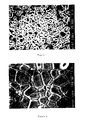
- FIGS. 1 and 2 represent photographs taken with a scanning electron microscope (with a respective magnification of 5,000 and 10,000) of different ceramics.
- FIG. 1 shows the microstructure of a ceramic made up of yttrium oxide alone and sintered at 1500 ° C.
- Figure 2 reveals the microstructure of a sintered powder at 1500 ° C containing 99% Y2O3 and 1% TiO2. Reference is made to Example 1 for more details on its preparation.
- compositions of the invention can be used in particular as raw materials in the manufacture of ceramics, as alumina enhancers and as grinding media. They can also be used in the metallurgy field, in particular for the production of crucibles and filters for liquid metals.
- composition of the invention is prepared by mixing yttrium oxide powder and titanium oxide.
- the titanium oxide is then added in an adequate quantity defined in Table I and co-grinding is carried out for 30 minutes.
- the ethanol and water are removed by evaporation in an evaporator under reduced pressure provided by the water pump.
- a composition is obtained in the form of a powder which is subjected to sieving, which makes it possible to remove agglomerates with a diameter greater than 400 ⁇ m.
- the temperature is gradually raised from 20 ° C / min to 1000 ° C and then from 3 ° C / min to the sintering temperature of 1500 ° C: said temperature is maintained for 3 hours.
- d represents the density of the ceramic obtained measured by the Archimedes technique using permuted water as liquid
- dr is the relative density expressed as a percentage of the theoretical density calculated with the assumption of a two-phase mixture Y2O3-Y2TiO5.
- the ceramic obtained has a good microstructure.
- It has grains of substantially the same shape and has a uniform distribution of their size which varies between 1 and 5 ⁇ m after sintering at 1500 ° C.
- composition is prepared containing yttrium oxide and titanium oxide according to an impregnation technique.
- the assembly is subjected to a grinding operation, in a zircon ball mill (ATTRITOR) rotating at 200 revolutions / minute for 15 minutes.
- ATTRITOR zircon ball mill
- the ethanol and water are removed by evaporation in an evaporator under reduced pressure provided by the water pump.
- a composition is obtained in the form of a powder which is sieved to 100 ⁇ m.
- the temperature is gradually raised from 15 ° C / min to 1100 ° C and then from 5 ° C / min to the sintering temperature of 1500 ° C: said temperature is maintained for 3 hours.
- composition of the invention is prepared from yttrium oxide and from Y2Ti2O5.
- the ethanol and water are removed by evaporation in an evaporator under reduced pressure provided by the water pump.
- a powder is obtained which is sieved to 100 ⁇ m.
Landscapes
- Engineering & Computer Science (AREA)
- Chemical & Material Sciences (AREA)
- Ceramic Engineering (AREA)
- Manufacturing & Machinery (AREA)
- Materials Engineering (AREA)
- Structural Engineering (AREA)
- Organic Chemistry (AREA)
- Compositions Of Oxide Ceramics (AREA)
- Ceramic Products (AREA)
Applications Claiming Priority (2)
| Application Number | Priority Date | Filing Date | Title |
|---|---|---|---|
| FR9005888 | 1990-05-11 | ||
| FR9005888A FR2661904B1 (fr) | 1990-05-11 | 1990-05-11 | Composition pour ceramiques et ses procedes d'obtention. |
Publications (2)
| Publication Number | Publication Date |
|---|---|
| EP0456541A1 true EP0456541A1 (de) | 1991-11-13 |
| EP0456541B1 EP0456541B1 (de) | 1995-12-06 |
Family
ID=9396506
Family Applications (1)
| Application Number | Title | Priority Date | Filing Date |
|---|---|---|---|
| EP91401056A Expired - Lifetime EP0456541B1 (de) | 1990-05-11 | 1991-04-22 | Keramische Sinterkörper und Verfahren zu seiner Herstellung |
Country Status (12)
| Country | Link |
|---|---|
| US (1) | US5508242A (de) |
| EP (1) | EP0456541B1 (de) |
| JP (1) | JP2528043B2 (de) |
| KR (1) | KR910019931A (de) |
| AT (1) | ATE131144T1 (de) |
| CA (1) | CA2042296A1 (de) |
| DE (1) | DE69115115T2 (de) |
| FR (1) | FR2661904B1 (de) |
| IE (1) | IE911616A1 (de) |
| PT (1) | PT97607A (de) |
| TW (1) | TW221048B (de) |
| ZA (1) | ZA912827B (de) |
Cited By (3)
| Publication number | Priority date | Publication date | Assignee | Title |
|---|---|---|---|---|
| GB2256430A (en) * | 1991-06-05 | 1992-12-09 | Commissariat Energie Atomique | Transparent ceramics and process for the productionthereof |
| EP0635854A1 (de) * | 1993-07-20 | 1995-01-25 | Murata Manufacturing Co., Ltd. | Magnetmaterial für hohe Frequenzen |
| CN109678551A (zh) * | 2019-01-21 | 2019-04-26 | 河北工业大学 | 一种多孔烧绿石陶瓷复合材料及其制备方法 |
Families Citing this family (22)
| Publication number | Priority date | Publication date | Assignee | Title |
|---|---|---|---|---|
| JP2000001362A (ja) * | 1998-06-10 | 2000-01-07 | Nippon Seratekku:Kk | 耐食性セラミックス材料 |
| KR20000067819A (ko) | 1999-04-13 | 2000-11-25 | 가와다 마사오끼 | 도전성 세라믹스, 그 제조방법 및 정전 척 |
| US6541112B1 (en) * | 2000-06-07 | 2003-04-01 | Dmc2 Degussa Metals Catalysts Cerdec Ag | Rare earth manganese oxide pigments |
| US6770392B2 (en) * | 2001-04-27 | 2004-08-03 | Air Products And Chemicals, Inc. | Ceria based solid electrolytes |
| NO318580B1 (no) * | 2001-10-19 | 2005-04-11 | Norsk Hydro As | Keramisk varmeveksler |
| TWI226377B (en) * | 2002-11-08 | 2005-01-11 | Ind Tech Res Inst | Dielectric material compositions |
| DE112004001391B4 (de) | 2003-07-29 | 2014-07-17 | Kyocera Corp. | Korrosionsfester Bestandteil und Verfahren zur Herstellung desselben und ein Bestandteil für eine Halbleiter- oder Flüssigkristall-erzeugende Anlage |
| DE102006005057A1 (de) * | 2006-02-03 | 2007-08-16 | Access E.V. | Werkzeug zum Herstellen eines Gußteils und Verfahren zum Herstellen des Werkzeugs |
| FR2898890B1 (fr) * | 2006-03-23 | 2008-05-09 | Saint Gobain Ct Recherches | Produit d'oxyde d'yttrium fritte et dope. |
| US7928029B2 (en) * | 2007-02-20 | 2011-04-19 | Corning Incorporated | Refractory ceramic composite and method of making |
| FR2917404B1 (fr) * | 2007-06-15 | 2009-09-04 | Saint Gobain Ct Recherches | Produit fritte de structure cubique. |
| JP4572967B2 (ja) * | 2008-07-25 | 2010-11-04 | パナソニック電工株式会社 | 単相ブラシレスdcモータの駆動回路 |
| US7968452B2 (en) * | 2009-06-30 | 2011-06-28 | Intermolecular, Inc. | Titanium-based high-K dielectric films |
| JP5274508B2 (ja) * | 2010-04-26 | 2013-08-28 | 京セラ株式会社 | 耐食性部材とその製造方法および半導体・液晶製造装置用部材 |
| WO2013062023A1 (ja) * | 2011-10-24 | 2013-05-02 | 京セラ株式会社 | セラミック焼結体および高温用部材ならびに電気化学素子 |
| JP6071368B2 (ja) * | 2012-09-20 | 2017-02-01 | 石原 達己 | 固体酸化物形燃料電池セル用中間層、固体酸化物形燃料電池セル、固体酸化物形燃料電池セル用中間層の製造方法および固体酸化物形燃料電池セルの製造方法 |
| JP6267908B2 (ja) * | 2013-09-27 | 2018-01-24 | 三井金属鉱業株式会社 | 分散液及びその製造方法並びに薄膜 |
| CN108046794B (zh) * | 2017-12-08 | 2020-11-10 | 中国科学院上海硅酸盐研究所 | 利用共沉淀法合成粉体制备钛酸钇透明陶瓷的方法 |
| DE102018115752A1 (de) * | 2018-06-29 | 2020-01-02 | Friatec Gmbh | Mahlkörper |
| CN113383405B (zh) * | 2019-02-12 | 2024-08-30 | 应用材料公司 | 用于制造腔室部件的方法 |
| CN115196979A (zh) * | 2022-01-17 | 2022-10-18 | 大连大学 | 一种钛合金精密铸造用陶瓷型壳耐火材料的制备方法 |
| CN119661224A (zh) * | 2024-12-20 | 2025-03-21 | 南京理工大学 | 一种抗侵蚀渗透氧化钇耐火材料、制备方法及用途 |
Citations (4)
| Publication number | Priority date | Publication date | Assignee | Title |
|---|---|---|---|---|
| GB605351A (en) * | 1940-11-25 | 1948-07-21 | Philips Nv | Improvements in or relating to ceramic insulators |
| US3897358A (en) * | 1971-03-01 | 1975-07-29 | Gen Electric | Polycrystalline ceramic lasers |
| US4040845A (en) * | 1976-03-04 | 1977-08-09 | The Garrett Corporation | Ceramic composition and crucibles and molds formed therefrom |
| GB2163970A (en) * | 1984-07-20 | 1986-03-12 | Nippon Mining Co | Method of manufacturing a humidity-sensing element |
Family Cites Families (6)
| Publication number | Priority date | Publication date | Assignee | Title |
|---|---|---|---|---|
| US3545987A (en) * | 1966-09-28 | 1970-12-08 | Gen Electric | Transparent yttria-based ceramics and method for producing same |
| US4115134A (en) * | 1977-07-11 | 1978-09-19 | Gte Laboratories Incorporated | Transparent yttria ceramics and method for producing same |
| EP0206780B1 (de) * | 1985-06-20 | 1992-02-26 | Tosoh Corporation | Zirkoniumdioxidsinterkörper mit verbesserter Lichtdurchlässigkeit |
| JPS63141205A (ja) * | 1986-12-04 | 1988-06-13 | 太陽誘電株式会社 | 誘電体磁器 |
| US4761390A (en) * | 1987-02-02 | 1988-08-02 | Raytheon Company | Optically transparent yttrium oxide |
| FR2677352B1 (fr) * | 1991-06-05 | 1994-04-08 | Rhone Poulenc Chimie | Ceramiques transparentes et procede de fabrication de celles-ci. |
-
1990
- 1990-05-11 FR FR9005888A patent/FR2661904B1/fr not_active Expired - Lifetime
-
1991
- 1991-04-15 TW TW080102888A patent/TW221048B/zh active
- 1991-04-16 ZA ZA912827A patent/ZA912827B/xx unknown
- 1991-04-22 AT AT91401056T patent/ATE131144T1/de not_active IP Right Cessation
- 1991-04-22 DE DE69115115T patent/DE69115115T2/de not_active Expired - Fee Related
- 1991-04-22 EP EP91401056A patent/EP0456541B1/de not_active Expired - Lifetime
- 1991-05-08 JP JP3131658A patent/JP2528043B2/ja not_active Expired - Lifetime
- 1991-05-08 PT PT97607A patent/PT97607A/pt not_active Application Discontinuation
- 1991-05-10 CA CA002042296A patent/CA2042296A1/fr not_active Abandoned
- 1991-05-10 IE IE161691A patent/IE911616A1/en unknown
- 1991-05-11 KR KR1019910007623A patent/KR910019931A/ko not_active Withdrawn
-
1993
- 1993-11-23 US US08/156,933 patent/US5508242A/en not_active Expired - Fee Related
Patent Citations (4)
| Publication number | Priority date | Publication date | Assignee | Title |
|---|---|---|---|---|
| GB605351A (en) * | 1940-11-25 | 1948-07-21 | Philips Nv | Improvements in or relating to ceramic insulators |
| US3897358A (en) * | 1971-03-01 | 1975-07-29 | Gen Electric | Polycrystalline ceramic lasers |
| US4040845A (en) * | 1976-03-04 | 1977-08-09 | The Garrett Corporation | Ceramic composition and crucibles and molds formed therefrom |
| GB2163970A (en) * | 1984-07-20 | 1986-03-12 | Nippon Mining Co | Method of manufacturing a humidity-sensing element |
Cited By (8)
| Publication number | Priority date | Publication date | Assignee | Title |
|---|---|---|---|---|
| GB2256430A (en) * | 1991-06-05 | 1992-12-09 | Commissariat Energie Atomique | Transparent ceramics and process for the productionthereof |
| FR2677352A1 (fr) * | 1991-06-05 | 1992-12-11 | Rhone Poulenc Chimie | Ceramiques transparentes et procede de fabrication de celles-ci. |
| US5308809A (en) * | 1991-06-05 | 1994-05-03 | Commissariat A L'energie Atomique | Transparent ceramics and production process for the same |
| GB2256430B (en) * | 1991-06-05 | 1995-05-10 | Commissariat Energie Atomique | Transparent ceramics and production process for the same |
| EP0635854A1 (de) * | 1993-07-20 | 1995-01-25 | Murata Manufacturing Co., Ltd. | Magnetmaterial für hohe Frequenzen |
| US5458797A (en) * | 1993-07-20 | 1995-10-17 | Murata Mfg. Co., Ltd. | Magnetic material for high frequencies |
| CN109678551A (zh) * | 2019-01-21 | 2019-04-26 | 河北工业大学 | 一种多孔烧绿石陶瓷复合材料及其制备方法 |
| CN109678551B (zh) * | 2019-01-21 | 2021-04-20 | 河北工业大学 | 一种多孔烧绿石陶瓷复合材料及其制备方法 |
Also Published As
| Publication number | Publication date |
|---|---|
| EP0456541B1 (de) | 1995-12-06 |
| FR2661904B1 (fr) | 1993-10-15 |
| KR910019931A (ko) | 1991-12-19 |
| JPH05330911A (ja) | 1993-12-14 |
| IE911616A1 (en) | 1991-11-20 |
| CA2042296A1 (fr) | 1991-11-12 |
| JP2528043B2 (ja) | 1996-08-28 |
| PT97607A (pt) | 1992-02-28 |
| DE69115115T2 (de) | 1996-07-04 |
| FR2661904A1 (fr) | 1991-11-15 |
| ZA912827B (en) | 1992-02-26 |
| TW221048B (de) | 1994-02-11 |
| US5508242A (en) | 1996-04-16 |
| DE69115115D1 (de) | 1996-01-18 |
| ATE131144T1 (de) | 1995-12-15 |
Similar Documents
| Publication | Publication Date | Title |
|---|---|---|
| EP0456541B1 (de) | Keramische Sinterkörper und Verfahren zu seiner Herstellung | |
| TW201638009A (zh) | 燒結用材料及用以製造燒結用材料之粉末 | |
| FR2946337A1 (fr) | Produit fritte a base d'alumine et de zircone | |
| FR2579199A1 (fr) | Ceramique a base de zircone | |
| WO2020074609A1 (fr) | Billes frittees en carbure(s) de tungstene | |
| EP3558895B1 (de) | Poröse keramikprodukte von titansuboxiden | |
| EP0320345A1 (de) | Stabilisierter Zirconiumdioxyd, sein Herstellungsverfahren und seine Verwendung in keramischen Zusammensetzungen | |
| FR2631333A1 (fr) | Dielectriques ceramiques, procedes et compositions pour les produire | |
| KR20230147153A (ko) | 조밀한 그린 테이프, 그 제조방법 및 용도 | |
| WO2022008522A1 (fr) | Membrane en un produit polycristallin de llzo | |
| FR2888836A1 (fr) | Fines particules d'alpha-alumine, leur procede de production, corps en alpha-alumine et son procede de production, et abrasif comprenant l'alpha-alumine | |
| FR2677352A1 (fr) | Ceramiques transparentes et procede de fabrication de celles-ci. | |
| EP1785408A1 (de) | Verfahren zur Herstellung von porösen keramischen Trägern mit kontrollierter Mikrostruktur | |
| EP0691935B1 (de) | Dotiertes zinkoxidpulver, seine herstellung und keramik hieraus hergestellt | |
| EP3676234B1 (de) | Verfahren zur herstellung eines pulvers auf basis von oxid(en) von yttrium, von aluminium und gegebenenfalls von mindestens einem anderen element | |
| EP0309323B1 (de) | Verfahren zur Herstellung von Supraleiter und hiermit erhaltene Produkte | |
| EP4267531B1 (de) | Magnetkugel | |
| EP0310480A1 (de) | Verfahren zur Herstellung von mit Yttrium stabilisiertem Zirkoniumdioxid und erhaltenes Produkt | |
| EP0308338A1 (de) | Verfahren zur Herstellung supraleitender Materialien und so hergestellte Materialien | |
| JP6793217B2 (ja) | プラズマ溶射膜 | |
| EP0405352A1 (de) | Verfahren zur Herstellung eines supraleitfähigen keramischen Formkörpers | |
| FR2723584A1 (fr) | Moules en carapace en ceramique et noyaux pour couler des metaux reactifs | |
| TW442447B (en) | Method for producing zirconia suspension and high density sintered body | |
| JPH05506206A (ja) | 焼結反応性亜クロム酸ランタンおよびその製法 | |
| FR3161679A1 (fr) | Utilisation d’une poudre de billes frittees en carbure(s) metallique(s) |
Legal Events
| Date | Code | Title | Description |
|---|---|---|---|
| PUAI | Public reference made under article 153(3) epc to a published international application that has entered the european phase |
Free format text: ORIGINAL CODE: 0009012 |
|
| AK | Designated contracting states |
Kind code of ref document: A1 Designated state(s): AT BE CH DE DK ES FR GB GR IT LI LU NL SE |
|
| 17P | Request for examination filed |
Effective date: 19920206 |
|
| 17Q | First examination report despatched |
Effective date: 19940310 |
|
| RAP1 | Party data changed (applicant data changed or rights of an application transferred) |
Owner name: COMMISSARIAT A L'ENERGIE ATOMIQUE |
|
| GRAA | (expected) grant |
Free format text: ORIGINAL CODE: 0009210 |
|
| AK | Designated contracting states |
Kind code of ref document: B1 Designated state(s): AT BE CH DE DK ES FR GB GR IT LI LU NL SE |
|
| PG25 | Lapsed in a contracting state [announced via postgrant information from national office to epo] |
Ref country code: NL Free format text: LAPSE BECAUSE OF FAILURE TO SUBMIT A TRANSLATION OF THE DESCRIPTION OR TO PAY THE FEE WITHIN THE PRESCRIBED TIME-LIMIT Effective date: 19951206 Ref country code: GR Free format text: LAPSE BECAUSE OF FAILURE TO SUBMIT A TRANSLATION OF THE DESCRIPTION OR TO PAY THE FEE WITHIN THE PRESCRIBED TIME-LIMIT Effective date: 19951206 Ref country code: ES Free format text: THE PATENT HAS BEEN ANNULLED BY A DECISION OF A NATIONAL AUTHORITY Effective date: 19951206 Ref country code: DK Effective date: 19951206 Ref country code: AT Effective date: 19951206 |
|
| REF | Corresponds to: |
Ref document number: 131144 Country of ref document: AT Date of ref document: 19951215 Kind code of ref document: T |
|
| REF | Corresponds to: |
Ref document number: 69115115 Country of ref document: DE Date of ref document: 19960118 |
|
| ITF | It: translation for a ep patent filed | ||
| PG25 | Lapsed in a contracting state [announced via postgrant information from national office to epo] |
Ref country code: SE Effective date: 19960306 |
|
| GBT | Gb: translation of ep patent filed (gb section 77(6)(a)/1977) |
Effective date: 19960221 |
|
| PG25 | Lapsed in a contracting state [announced via postgrant information from national office to epo] |
Ref country code: LU Free format text: LAPSE BECAUSE OF NON-PAYMENT OF DUE FEES Effective date: 19960430 Ref country code: LI Effective date: 19960430 Ref country code: CH Effective date: 19960430 Ref country code: BE Effective date: 19960430 |
|
| NLV1 | Nl: lapsed or annulled due to failure to fulfill the requirements of art. 29p and 29m of the patents act | ||
| PGFP | Annual fee paid to national office [announced via postgrant information from national office to epo] |
Ref country code: FR Payment date: 19960820 Year of fee payment: 6 |
|
| PLBE | No opposition filed within time limit |
Free format text: ORIGINAL CODE: 0009261 |
|
| STAA | Information on the status of an ep patent application or granted ep patent |
Free format text: STATUS: NO OPPOSITION FILED WITHIN TIME LIMIT |
|
| BERE | Be: lapsed |
Owner name: COMMISSARIAT A L'ENERGIE ATOMIQUE Effective date: 19960430 |
|
| 26N | No opposition filed | ||
| REG | Reference to a national code |
Ref country code: CH Ref legal event code: PL |
|
| PG25 | Lapsed in a contracting state [announced via postgrant information from national office to epo] |
Ref country code: FR Free format text: LAPSE BECAUSE OF NON-PAYMENT OF DUE FEES Effective date: 19971231 |
|
| REG | Reference to a national code |
Ref country code: FR Ref legal event code: ST |
|
| PGFP | Annual fee paid to national office [announced via postgrant information from national office to epo] |
Ref country code: GB Payment date: 20000418 Year of fee payment: 10 |
|
| PGFP | Annual fee paid to national office [announced via postgrant information from national office to epo] |
Ref country code: DE Payment date: 20000517 Year of fee payment: 10 |
|
| PG25 | Lapsed in a contracting state [announced via postgrant information from national office to epo] |
Ref country code: GB Free format text: LAPSE BECAUSE OF NON-PAYMENT OF DUE FEES Effective date: 20010422 |
|
| GBPC | Gb: european patent ceased through non-payment of renewal fee |
Effective date: 20010422 |
|
| PG25 | Lapsed in a contracting state [announced via postgrant information from national office to epo] |
Ref country code: DE Free format text: LAPSE BECAUSE OF NON-PAYMENT OF DUE FEES Effective date: 20020201 |
|
| PG25 | Lapsed in a contracting state [announced via postgrant information from national office to epo] |
Ref country code: IT Free format text: LAPSE BECAUSE OF NON-PAYMENT OF DUE FEES;WARNING: LAPSES OF ITALIAN PATENTS WITH EFFECTIVE DATE BEFORE 2007 MAY HAVE OCCURRED AT ANY TIME BEFORE 2007. THE CORRECT EFFECTIVE DATE MAY BE DIFFERENT FROM THE ONE RECORDED. Effective date: 20050422 |