EP0456903A1 - Procédé et dispositif de réduction de jitter à temps d'attente - Google Patents
Procédé et dispositif de réduction de jitter à temps d'attente Download PDFInfo
- Publication number
- EP0456903A1 EP0456903A1 EP90124043A EP90124043A EP0456903A1 EP 0456903 A1 EP0456903 A1 EP 0456903A1 EP 90124043 A EP90124043 A EP 90124043A EP 90124043 A EP90124043 A EP 90124043A EP 0456903 A1 EP0456903 A1 EP 0456903A1
- Authority
- EP
- European Patent Office
- Prior art keywords
- digital signal
- measure
- clock
- synchronizer
- fill level
- Prior art date
- Legal status (The legal status is an assumption and is not a legal conclusion. Google has not performed a legal analysis and makes no representation as to the accuracy of the status listed.)
- Granted
Links
Images



Classifications
-
- H—ELECTRICITY
- H04—ELECTRIC COMMUNICATION TECHNIQUE
- H04J—MULTIPLEX COMMUNICATION
- H04J3/00—Time-division multiplex systems
- H04J3/02—Details
- H04J3/06—Synchronising arrangements
- H04J3/07—Synchronising arrangements using pulse stuffing for systems with different or fluctuating information rates or bit rates
- H04J3/076—Bit and byte stuffing, e.g. SDH/PDH desynchronisers, bit-leaking
Definitions
- the invention relates to a method for reducing waiting time jitter, which is based on data transmission using a stuffing method, and to an arrangement for reducing waiting time jitter.
- a given digital signal is to be transmitted at a bit rate other than its original, then the method of pulse stuffing is used. It is used in particular when plesiochronous signals are bundled in time division multiplex in multiplex devices or when the inverse function is carried out in a demultiplexer and when, for example for the purpose of synchronization, a signal with a first bit rate in a switching frame with a second, higher bit rate is mapped. This process, which mostly takes place according to a rule, is referred to below as mapping and the inverse process as mapping.
- the positive plug Basically two variants of the impulse plug are known: the positive plug and the positive zero negative plug.
- the stuffing process must be reversed in order to recover the original digital signal.
- An important point is the clock recovery.
- the clock is only smoothed out incompletely. It differs from the original clock by a phase modulation, the jitter.
- the waiting time jitter is a low-frequency phase jitter, which is always always occurs when asynchronous digital signals are synchronized using pulse stuffing.
- a tamping process is carried out at the next opportunity.
- the processes for recovering signal D are essentially reversed.
- two counters and a phase comparator are provided in the desynchronizer.
- the clock of the main channel of the input signal is used to recover the clock T.
- a slightly slower or a somewhat faster clock is switched on as a read-out clock for a compensation time interval.
- the invention has for its object to provide a method with which the waiting time jitter can be reduced. It is also an object of the invention to provide an arrangement which is suitable for reducing waiting time jitter.
- the input signal of the synchronizer is the signal D with the clock T.
- the output signal of the synchronizer consists of a main signal D 'and an auxiliary channel D ".
- the original signal D is written into the elastic memory ES, the addressing using the write counter Z1, the counts with the clock T.
- a read clock with which the data are read out from the elastic memory ES is generated in the control unit S and fed to the read counter Z2 If the average bit rates of the signals D and D 'differ from one another, then A phase comparator P compares the phases of the write counter Z1 and read counter Z2.
- the control circuit S initiates a stuffing process.
- a stuffing bit is inserted into the signal at a defined point D '.
- an additional information bit is extracted from the elastic memory forth in the auxiliary channel D "transmitted. The information as to whether a useful information bit or a stuffing bit is transmitted in a stuffable time segment (positive stuffing point) or whether an information bit is transmitted in the auxiliary channel D "(negative stuffing point) is transmitted in certain time segments, the so-called stuffing information bits of the auxiliary channel D" .
- the input signals of the desynchronizer are the main signal D 'and the auxiliary channel D ".
- the output signal is the recovered data signal D *, which differs from the input signal of the synchronizer in that it has a waiting time jitter.
- the processes for recovering the signal D proceed in the essential vice versa, like the processes described in the adaptation.
- the control circuit S ' either emits an additional pulse which writes the information bit I received in the auxiliary channel D "into the elastic memory ES' (negative stuffing process) or the control circuit S ' suppresses a clock pulse so that the stuffing bit from the signal D 'is not written into the elastic memory (positive stuffing process.)
- a PLL circuit can be provided the output signal of the phase comparator P ', which compares the phase of the write counter Z1' with that of the read counter Z2 ', is filtered in a filter F and the filtered value is fed to a voltage-controlled oscillator VCO, which generates the read clock.
- the measured phase difference between the phases of write counter Z1 and read counter Z2 corresponds to the fill level of the elastic memory ES.
- phase information - given by the change in the average fill level of the elastic memory - can only be transmitted in 1-bit steps from the synchronizer to the desynchronizer using the stuffing information. As a result, a high waiting time jitter can occur with the usual positive-zero-negative stuffing.
- a signal D is to be mapped into a signal A.
- the signals A and D can have frequency fluctuations which cannot be absorbed by the elastic memory ES, so that the signal A must be stuffed. Sufficient free space is available within signal A so that additional information can be transmitted.
- the fill level of the elastic memory in the synchronizer is determined at several points in time within the frame of signal A, the support points.
- the values are accumulated, i.e. an average fill level is determined.
- the accumulated value is transmitted to the desynchronizer as additional information.
- There the fill level of the elastic memory ES ' is determined and accumulated at the same support points within the framework of the signal A.
- the PLL arrangement in the desynchronizer is controlled with the comparison value of the accumulated dimensions for the fill level of the elastic memory in the synchronizer or desynchronizer.
- the following criteria are advantageous for the selection of the support points for determining the fill level of the elastic store in order to obtain the lowest possible waiting time jitter:
- the time interval between the support points should be equidistant.
- the number of nodes should correspond to the nominal value of the bit rate of signal A divided by the largest common divisor from the nominal values of the bit rates of signal D and signal A.
- the largest waiting time jitter corresponds to the product of one to two times the reciprocal number of support points and the maximum waiting time jitter.
- the accumulation must relate to the same number of summands (sample values) and the sample values must have the same position within the scope of the second digital signal A.
- the method for reducing waiting time jitter can be done with any stuffing method, e.g. B. can be combined with one of the tamping methods described in the introduction.
- the circuits for determining the average fill level are identical in principle in the synchronizer and desynchronizer.
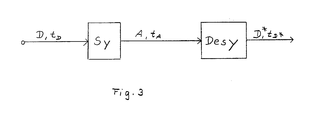
- FIG. 3 shows that a first digital signal D with a first bit rate, which corresponds to a first clock t D , is fed to a synchronizer Sy. From the synchronizer a second digital signal A with a second bit rate, which corresponds to a second clock t A , is supplied to the desynchronizer Desy. The first digital signal D is to be regenerated at the first bit rate in the desynchronizer Desy. The output signal of the desynchronizer Desy, the recovered signal D *, differs from the digital signal D in the waiting time jitter with which the clock t D * of the recovered signal D * is afflicted. The bit rates of the digital signals D and A are selected so that the first digital signal D can be transmitted in the second digital signal A by means of pulse stuffing technology.
- the digital signal D has a bit rate of 34.368 Mbit / s and the digital signal A has a bit rate of 39.936 Mbit / s.
- the basic structure of the synchronizer Sy and the desynchronizer Desy can be seen in FIG.
- the first digital signal D with 34.368 Mbit / s is fed to an elastic memory ES in the synchronizer Sy. It is written with the clock t D of 34.368 MHz.
- a counter Z1 is operated with the same clock t D.
- the digital signal A is read out from the elastic memory ES.
- a read counter Z2 runs with it, which is always incremented by 1 when a bit is read from the elastic memory.
- the read counter operates at a frequency t A of 39.936 MHz, but sometimes has "misfires” or "jumps" when counting, namely whenever there is stuffing.
- the digital signal A is transmitted in a frame with a frame frequency of 8 kHz.
- a frame has three stuffing frames, ie three times the possibility of stuffing is given in each frame of the digital signal A.
- the darning frame is therefore repeated at a frequency of 24 kHz.
- a tamping unit is provided with which tamping can be carried out by any method. The unit is not shown in Figure 4.
- the write counter Z1 is scanned with the clock t A of 39.936 MHz by means of a scanner Ab.
- the sample value is compared with the state of the read counter Z2 in a comparator ⁇ .
- the comparison value is a measure of the current fill level of the elastic memory ES, which is determined in whole bits.
- the comparison values are accumulated in the comparator ⁇ . A new sum is created for each darning frame. It is not necessary to provide all comparison values as summands of the accumulation.
- the value 208 has been found to be a useful number of summands.
- the measure for the average fill level is also transmitted once in the stuffing frame as part of the digital signal A. This dimension is transmitted as additional information.
- the frame of the digital signal A is shown in FIG. 5.
- the frame consists of 39 lines, each 16 bytes wide. Information is transmitted in the hatched fields.
- the fields labeled S contain synchronous words. Parity is transferred in the field labeled P.
- the fields labeled H1, H2 and H3 contain a pointer.
- the path overhead is included in the fields labeled O.
- a fixed stuffing byte is included in the fields labeled R * and R.
- the fields R * differ from the fields R in that the R * fields also contain stuffing control bits.
- In the Field Z is the port address.
- the buffer level is transferred in the first column in each of the last two lines of a stuffing frame.
- the fields are marked with F.
- the first column of the frame has several fields in which no signal is transmitted, which corresponds to gaps in the transmission.
- the digital signal A is thus transmitted in the frame just described to the desynchronizer Desy.
- the digital signal A is partially written into the elastic memory ES '.
- the counter Z1 ' runs along, which is an exact replica of the counter Z2 in the synchronizer Sy. It is not the entire digital signal A that is written into the elastic memory ES ', but only the parts that also belong to the digital signal D. For example, the synchronous words, the buffer fill level and the pointers are not adopted.
- the letter is written with a frequency t A of 39.936 MHz, if one ignores the gaps in the letter.
- the digital signal D is to be recovered at its original bit rate.
- the bit rate jitter caused by the plug should be kept as low as possible.
- the output signal of the desynchronizer is the signal D * whose clock has a low jitter.
- the unit which is responsible for the unblocking is not shown in FIG. 4.
- the average fill level of the elastic memory ES ' is determined in the desynchronizer Desy, as was done in the synchronizer Sy. It should be noted that the summands for the accumulation of the average fill level were obtained at the same points in the context of the digital signal A as the summands in the synchronizer Sy. This ensures that the average fill levels of the elastic storage devices ES and ES 'are comparable.
- the mean fill levels of the elastic memory ES' and the transmitted mean fill levels of the elastic memory ES compared in a comparator V.
- the comparison value is fed to a filter F and the filtered value regulates a voltage-controlled oscillator which is intended to restore the original clock t D as well as possible.
- the recovered clock t D * which differs only slightly from the clock t D , is then fed to the counter Z2 '.
- the method according to the invention achieves phase tracking in the desynchronizer to restore the original clock t D.
Landscapes
- Engineering & Computer Science (AREA)
- Computer Networks & Wireless Communication (AREA)
- Signal Processing (AREA)
- Time-Division Multiplex Systems (AREA)
- Synchronisation In Digital Transmission Systems (AREA)
Applications Claiming Priority (2)
| Application Number | Priority Date | Filing Date | Title |
|---|---|---|---|
| DE4014814A DE4014814A1 (de) | 1990-05-09 | 1990-05-09 | Verfahren und anordnung zur reduktion von wartezeitjitter |
| DE4014814 | 1990-05-09 |
Publications (2)
| Publication Number | Publication Date |
|---|---|
| EP0456903A1 true EP0456903A1 (fr) | 1991-11-21 |
| EP0456903B1 EP0456903B1 (fr) | 1995-02-22 |
Family
ID=6405994
Family Applications (1)
| Application Number | Title | Priority Date | Filing Date |
|---|---|---|---|
| EP90124043A Expired - Lifetime EP0456903B1 (fr) | 1990-05-09 | 1990-12-13 | Procédé et dispositif de réduction de jitter à temps d'attente |
Country Status (2)
| Country | Link |
|---|---|
| EP (1) | EP0456903B1 (fr) |
| DE (2) | DE4014814A1 (fr) |
Cited By (1)
| Publication number | Priority date | Publication date | Assignee | Title |
|---|---|---|---|---|
| DE19806589A1 (de) * | 1998-02-17 | 1999-08-19 | Siemens Ag | Verfahren und Netzelement zur Weiterreichung des Taktes in PCM-Übertragungsnetzen |
Families Citing this family (7)
| Publication number | Priority date | Publication date | Assignee | Title |
|---|---|---|---|---|
| DE4121863C2 (de) * | 1991-07-02 | 1995-12-14 | Siemens Ag | Verfahren und Anordnung zur Überwachung und Vermeidung eines Überlaufs und/oder einer Entleerung eines Pufferspeichers |
| DE4205623B4 (de) * | 1992-02-25 | 2006-06-29 | Philips Intellectual Property & Standards Gmbh | Leitungsendgerät |
| DE4316225C2 (de) * | 1993-05-14 | 2000-06-08 | Deutsche Telekom Ag | Verfahren und Anordnung zur störungsfreien empfangsseitigen Taktrückgewinnung für Digitalsignale mit konstanter Bitrate |
| ES2102938B1 (es) * | 1994-03-28 | 1998-04-16 | Alcatel Standard Electrica | Sistema de reduccion de fluctuaciones de fase en demultiplexores digitales. |
| US5781597A (en) * | 1995-02-16 | 1998-07-14 | Alcatel Sel Aktiengesellschaft | Synchronous digital transmission system having justification circuit that counts frame bytes, calculates offsets, compares thresholds, and initiates justification action |
| DE19653470C2 (de) * | 1996-12-20 | 1998-10-08 | Siemens Ag | Verfahren und Anordnung zur Taktrückgewinnung aus einem Digitalsignal |
| DE19820572A1 (de) * | 1998-05-08 | 1999-11-11 | Alcatel Sa | Desynchronisiereinrichtung für ein synchrones digitales Nachrichtenübertragungssystem |
Citations (2)
| Publication number | Priority date | Publication date | Assignee | Title |
|---|---|---|---|---|
| US4764941A (en) * | 1987-05-22 | 1988-08-16 | American Telephone And Telegraph Company, At&T Bell Laboratories | Digital frame synchronizer |
| US4920547A (en) * | 1986-12-02 | 1990-04-24 | Nec Corporation | Stuff synchronization circuit |
-
1990
- 1990-05-09 DE DE4014814A patent/DE4014814A1/de active Granted
- 1990-12-13 EP EP90124043A patent/EP0456903B1/fr not_active Expired - Lifetime
- 1990-12-13 DE DE59008538T patent/DE59008538D1/de not_active Expired - Fee Related
Patent Citations (2)
| Publication number | Priority date | Publication date | Assignee | Title |
|---|---|---|---|---|
| US4920547A (en) * | 1986-12-02 | 1990-04-24 | Nec Corporation | Stuff synchronization circuit |
| US4764941A (en) * | 1987-05-22 | 1988-08-16 | American Telephone And Telegraph Company, At&T Bell Laboratories | Digital frame synchronizer |
Non-Patent Citations (4)
| Title |
|---|
| DIGITALE VERMITTLUNGSTECHNIK, 1981, R. Oldenbourg Verlag MÙnchen Wien H. BESIER, P. HEUER, G. KETTLER Seiten 137-144 * |
| FREQUENZ, Band 32, Nr. 10, Oktober 1978, Berlin, DE F. K¨HNE, K. LANG "Positiv-Null-Negativ-Stopf- technik fÙr die Multiplex- Ùbertragung plesiochroner Datensignale" Seiten 281-287 * |
| GLOBECOM'87 W.D. GROVER, T.E. MOORE, J.A. McEACHERN "Waiting Time Jitter Reduction by Synchro- nizer Stuff Threshold Modu- lation" Seiten 514-518 * |
| THE BELL SYSTEM TECHNICAL JOURNAL, BAnd 51, Nr. 1, JÛnner 1972, US D.L. DUTTWEILER "Waiting Time Jitter" Seiten 165-207 * |
Cited By (2)
| Publication number | Priority date | Publication date | Assignee | Title |
|---|---|---|---|---|
| DE19806589A1 (de) * | 1998-02-17 | 1999-08-19 | Siemens Ag | Verfahren und Netzelement zur Weiterreichung des Taktes in PCM-Übertragungsnetzen |
| DE19806589C2 (de) * | 1998-02-17 | 2000-05-25 | Siemens Ag | Verfahren und Netzelement zur Weiterreichung des Taktes in PCM-Übertragungsnetzen |
Also Published As
| Publication number | Publication date |
|---|---|
| DE59008538D1 (de) | 1995-03-30 |
| DE4014814A1 (de) | 1991-11-21 |
| EP0456903B1 (fr) | 1995-02-22 |
| DE4014814C2 (fr) | 1992-02-27 |
Similar Documents
| Publication | Publication Date | Title |
|---|---|---|
| DE69831473T2 (de) | Verfahren und Vorrichtung zum Multiplexen und Demultiplexen digitaler Signalströme | |
| EP0503732B1 (fr) | Méthode et système de transmission pour la hiérarchie numérique synchrone | |
| DE69124319T2 (de) | Bitsynchronisierung mittels elastisches Speichers | |
| DE69016634T2 (de) | Inverse Multiplexer- und Demultiplexerverfahren. | |
| EP0507385B1 (fr) | Système de transmission pour la hiérarchie numérique synchrone | |
| DE3886819T2 (de) | Digitaler Asynchron-Synchronmultiplexer/Demultiplexer mit asynchroner Taktregeneration. | |
| DE69227820T2 (de) | Sonet DS-N-Desynchronisiereinrichtung | |
| DE69108068T2 (de) | Rahmenumstrukturierungsschnittstelle für Digitalfolgen multiplexiert im Zeitmultiplex aus digitalen untergeordneten Kanälen von verschiedenen Bitraten. | |
| US5263057A (en) | Method of reducing waiting time jitter | |
| DE69232057T2 (de) | Digitale schaltungen zur taktentflatterung mit minimalem zittern | |
| EP0475498B1 (fr) | Circuit d'adaption du débit binaire de deux signaux numériques | |
| DE69132247T2 (de) | Phasenverriegelte Schleifenanordnung | |
| DE60226234T2 (de) | Verfahren und vorrichtung zum entsynchronisieren eines ds-3-signals und/oder eines e3-signals aus dem datenteil eines sts/stm-nutzsignals | |
| DE69127489T2 (de) | Elementäre Schaltungseinheit zur Verzweigung von digitalen Bitflüssen durch Zeitvervielfachung von Bitströmen mit verschiedener Bitrate | |
| DE69432171T2 (de) | Verfahren und Schaltungsanordnung zur Realisierung der Anpassungsfunktion eines höheren Pfades in Einrichtungen der synchronen digitalen Hierarchie | |
| DE69229668T2 (de) | Synchrone Schaltung | |
| DE4014814C2 (fr) | ||
| DE19545675A1 (de) | Synchrones digitales Übertragungssystem | |
| EP0963069B1 (fr) | Système de désynchronisation pour système de transmission digitale synchrone | |
| DE60108728T2 (de) | Verfahren und ein Vorrichtung zum Übersenden und Empfangen gemultiplexter untergeordneter Signale | |
| DE69828768T2 (de) | Vorrichtung zur Anfrage von Änderungen bezüglich der Nutzdaten und diese Vorrichtung enthaltende Übertragungsvorrichtung | |
| EP0645909A2 (fr) | Système de transmission avec un circuit d'adaption | |
| DE3881621T2 (de) | Jitterregelung in digitalen uebertragungsstrecken. | |
| DE69219282T2 (de) | Synchrones optisches Multiplexsystem | |
| DE19820658C2 (de) | Digitale Phasenregelschleife für Niedriggeschwindigkeitssignalschaltsystem mit plesiochroner digitaler Hierarchie |
Legal Events
| Date | Code | Title | Description |
|---|---|---|---|
| PUAI | Public reference made under article 153(3) epc to a published international application that has entered the european phase |
Free format text: ORIGINAL CODE: 0009012 |
|
| 17P | Request for examination filed |
Effective date: 19901228 |
|
| AK | Designated contracting states |
Kind code of ref document: A1 Designated state(s): DE FR GB IT SE |
|
| 17Q | First examination report despatched |
Effective date: 19931018 |
|
| GRAA | (expected) grant |
Free format text: ORIGINAL CODE: 0009210 |
|
| ITF | It: translation for a ep patent filed | ||
| AK | Designated contracting states |
Kind code of ref document: B1 Designated state(s): DE FR GB IT SE |
|
| GBT | Gb: translation of ep patent filed (gb section 77(6)(a)/1977) |
Effective date: 19950224 |
|
| REF | Corresponds to: |
Ref document number: 59008538 Country of ref document: DE Date of ref document: 19950330 |
|
| PG25 | Lapsed in a contracting state [announced via postgrant information from national office to epo] |
Ref country code: SE Effective date: 19950522 |
|
| ET | Fr: translation filed | ||
| PGFP | Annual fee paid to national office [announced via postgrant information from national office to epo] |
Ref country code: GB Payment date: 19951130 Year of fee payment: 6 |
|
| PGFP | Annual fee paid to national office [announced via postgrant information from national office to epo] |
Ref country code: FR Payment date: 19951214 Year of fee payment: 6 |
|
| PLBE | No opposition filed within time limit |
Free format text: ORIGINAL CODE: 0009261 |
|
| 26N | No opposition filed | ||
| PG25 | Lapsed in a contracting state [announced via postgrant information from national office to epo] |
Ref country code: GB Effective date: 19961213 |
|
| PG25 | Lapsed in a contracting state [announced via postgrant information from national office to epo] |
Ref country code: DE Effective date: 19970501 |
|
| GBPC | Gb: european patent ceased through non-payment of renewal fee |
Effective date: 19961213 |
|
| PG25 | Lapsed in a contracting state [announced via postgrant information from national office to epo] |
Ref country code: FR Effective date: 19970829 |
|
| REG | Reference to a national code |
Ref country code: FR Ref legal event code: ST |
|
| PG25 | Lapsed in a contracting state [announced via postgrant information from national office to epo] |
Ref country code: IT Free format text: LAPSE BECAUSE OF NON-PAYMENT OF DUE FEES;WARNING: LAPSES OF ITALIAN PATENTS WITH EFFECTIVE DATE BEFORE 2007 MAY HAVE OCCURRED AT ANY TIME BEFORE 2007. THE CORRECT EFFECTIVE DATE MAY BE DIFFERENT FROM THE ONE RECORDED. Effective date: 20051213 |