EP0456909A2 - Nachrichtenkabel und Schacht für optische Faser - Google Patents
Nachrichtenkabel und Schacht für optische Faser Download PDFInfo
- Publication number
- EP0456909A2 EP0456909A2 EP90125439A EP90125439A EP0456909A2 EP 0456909 A2 EP0456909 A2 EP 0456909A2 EP 90125439 A EP90125439 A EP 90125439A EP 90125439 A EP90125439 A EP 90125439A EP 0456909 A2 EP0456909 A2 EP 0456909A2
- Authority
- EP
- European Patent Office
- Prior art keywords
- duct
- polyvinyl chloride
- plastic
- polymer
- cable
- Prior art date
- Legal status (The legal status is an assumption and is not a legal conclusion. Google has not performed a legal analysis and makes no representation as to the accuracy of the status listed.)
- Withdrawn
Links
Images

Classifications
-
- G—PHYSICS
- G02—OPTICS
- G02B—OPTICAL ELEMENTS, SYSTEMS OR APPARATUS
- G02B6/00—Light guides; Structural details of arrangements comprising light guides and other optical elements, e.g. couplings
- G02B6/46—Processes or apparatus adapted for installing or repairing optical fibres or optical cables
- G02B6/50—Underground or underwater installation; Installation through tubing, conduits or ducts
- G02B6/52—Underground or underwater installation; Installation through tubing, conduits or ducts using fluid, e.g. air
-
- G—PHYSICS
- G02—OPTICS
- G02B—OPTICAL ELEMENTS, SYSTEMS OR APPARATUS
- G02B6/00—Light guides; Structural details of arrangements comprising light guides and other optical elements, e.g. couplings
- G02B6/44—Mechanical structures for providing tensile strength and external protection for fibres, e.g. optical transmission cables
- G02B6/4401—Optical cables
- G02B6/4415—Cables for special applications
- G02B6/4416—Heterogeneous cables
-
- G—PHYSICS
- G02—OPTICS
- G02B—OPTICAL ELEMENTS, SYSTEMS OR APPARATUS
- G02B6/00—Light guides; Structural details of arrangements comprising light guides and other optical elements, e.g. couplings
- G02B6/44—Mechanical structures for providing tensile strength and external protection for fibres, e.g. optical transmission cables
- G02B6/4401—Optical cables
- G02B6/4429—Means specially adapted for strengthening or protecting the cables
- G02B6/4438—Means specially adapted for strengthening or protecting the cables for facilitating insertion by fluid drag in ducts or capillaries
-
- G—PHYSICS
- G02—OPTICS
- G02B—OPTICAL ELEMENTS, SYSTEMS OR APPARATUS
- G02B6/00—Light guides; Structural details of arrangements comprising light guides and other optical elements, e.g. couplings
- G02B6/44—Mechanical structures for providing tensile strength and external protection for fibres, e.g. optical transmission cables
- G02B6/4439—Auxiliary devices
- G02B6/4459—Ducts; Conduits; Hollow tubes for air blown fibres
-
- G—PHYSICS
- G02—OPTICS
- G02B—OPTICAL ELEMENTS, SYSTEMS OR APPARATUS
- G02B6/00—Light guides; Structural details of arrangements comprising light guides and other optical elements, e.g. couplings
- G02B6/44—Mechanical structures for providing tensile strength and external protection for fibres, e.g. optical transmission cables
- G02B6/4479—Manufacturing methods of optical cables
- G02B6/4485—Installing in protective tubing by fluid drag during manufacturing
Definitions
- the present invention relates to cable designs for optical fiber cables, and more particularly to novel combinations of materials useful in the fabrication of such cables to facilitate the installation of optical fibers into the cables, after the cables have been installed, by the process known in the art as fiber blowing.
- the terms “blow,” “blown,” and “blowable” as currently used in optical fiber design and optical telecommunications technology refer to optical fibers or lightweight optical fiber cables which may be installed in specially designed conduits or ducts by the effect of viscous fluid drag.
- the fibers or cables are sufficiently small and/or light, and the ducts sufficiently close in size to the fibers or cables, that significant forces tending to draw the fibers or cables through the ducts can be generated by forcing a gas such as air through the ducts and past the fibers or cables in the direction in which they are to be drawn.
- the plastic installation tube or duct has been recognized as a critical and integral part of the blown fiber system, since it provides the pneumatic pathway through which the blown fiber must be installed.
- the tube material composition must thus be such that the frictional interaction between the tube and the fiber units, which may be single fibers or small fiber bundles or minicables incorporating smooth or textured plastic coatings, is minimized. The lower the frictional interaction, the longer the duct length through which the fiber can be installed.
- the tube or duct material meet or exceed NEC and UL flammability requirements for in-building use.
- the tubes are normally only a part of a larger cable system, they should not contribute to or aggravate the flame or smoke characteristics of the cables in the event of fire.
- the art has identified a number of different materials as useful for fabricating tubes or ducts through which fibers or small cables may be installed.
- One early blown fiber duct system is found in British Patent Application GB 2,156,837A. That application discloses the use of plastic ducts, formed for example of polyethylene, into which a multipurpose additive is incorporated.
- the multipurpose additive comprises, among other agents, one or more ingredients which function as a slip agent, as an antistatic agent, and as an antioxidant.
- the slip agent used may be any organic chemical which is incompatible with the polymer forming the duct wall. Due to this incompatibility, the additive blooms onto the inner surface of the polyethylene duct, and there acts as a lubricant to reduce friction between the wall and fibers being drawn through the duct.
- U. S. Patent No. 4,691,896 also discloses designs for optical fibers and optical fiber ducts useful for blow-in installation of the fibers.
- polyethylene is suggested for use as a duct wall material while polyethylene or polypropylene are used for the fiber coatings.
- the duct sizes disclosed are typically below 10 millimeters in diameter, and the fiber or cable sizes are in the range of 1-4 millimeters in diameter. Ducts in this size range are sometimes referred to as ductlets or microducts in the art.
- New cable designs for electrical power lines which incorporate ducts for the blow-in installation of optical fibers are described by H. G. Haag et al. in "New Generation of Self-Supporting Optical Fibre Aerial Cables," International Wire and Cable Symposium Proceedings-1989 , pages 575-582.
- the ducts used in the Haag et al. cable designs are typically composed of high density polyethylene or polyamide plastics.
- duct composition material offering improved chemical stability in storage and use would be advantageous. This characteristic is particularly important where cables are installed with empty ducts to satisfy existing telecommunications demand, but with the intention to add optical fiber links at an indefinite future date as demand increase warrant.
- the present invention provides optical cable and optical duct designs for such cable which incorporate improved polymer sidewall materials offering stable, low-friction performance for easy fiber installation and, in the preferred embodiments, good flame retardance characteristics as well.
- the invention provides a novel combination of a coated optical fiber or fiber bundle and a plastic duct or an optical cable incorporating one or more plastic ducts, wherein the ducts loosely contain the coated fiber or fiber bundle and wherein the polymer material forming the sidewall of the duct or tube provides low friction against the coated optical fiber or bundle.
- the particularly preferred combinations also provide substantially improved resistance to flame propagation.
- the coated optical fiber or fiber bundle most preferably includes a textured plastic outer coating, composed for example of foamed polyvinyl chloride. Coatings of this type impart advantageous blow-in characteristics to the fiber or bundle, yet are frictionally compatible with the duct sidewall materials of the invention.
- the cable conduit or tube provided in accordance with the invention has a side wall composition composed at least predominantly of polyvinyl chloride polymer, i.e., composed of at least about 50% of polyvinyl chloride by weight.
- the sidewall composition further comprises, as an additive to the polyvinyl chloride polymer, a finely dispersed fluorocarbon polymer in a proportion of about 0.5-20% by weight of the sidewall polymer composition. Additional components of the side wall composition may include well known and conventional constituents of commercial PVC compounds, including plasticizers, stabilizers, flame retardants or the like.
- the preferred fluorocarbon polymer is polytetrafluoroethylene. This polymer is compounded directly with PVC resins and other additives in a manner such that a fine dispersion of the fluorocarbon polymer in the PVC sidewall compound, discovered to be highly effective to significantly improve the friction performance of the sidewall, is achieved.
- the optical cables comprising improved duct sidewall polymer materials in accordance with the invention may be adapted to contain one or a multiplicity of optical fibers.
- the cable may consist of or include only a single duct for the installation of a single fiber or a small fiber bundle (a so-called "minicable"), or the cable may instead comprise multiple such ducts or tubes.
- the ducts or tubes may consist of discrete tubing, or may be provided as bore channels in an extended polymer body or matrix.
- the particularly preferred base polymers for the fiber duct materials to be provided in accordance with the invention are semi-rigid flame-retardant polyvinyl chloride compounds.
- semi-rigid refers inter alia to plasticized PVC compounds with reduced plasticizer content.
- the use of the preferred polyvinyl chloride polymer as the predominant component of the sidewall composition imparts a high degree of flame retardancy to the cable design.
- the polyvinyl chloride side wall materials of the invention additionally containing the fluorocarbon polymer component compounded therewith, offer substantial reductions in both flame propagation rate and smoke emission when subjected to standard fire code tests.
- PVC polyvinyl chloride
- blowing distances can be achieved through the use of semi-rigid PVC formulations, e.g., PVC formulations in which the amount of plasticizer is reduced to achieve a harder material.
- semi-rigid PVC formulations e.g., PVC formulations in which the amount of plasticizer is reduced to achieve a harder material.
- blowing distances only on the order of 90 meters are obtained with some types of commercial fibers. These distances reflect measured coefficient of friction values on the order of 0.30, as measured between semi-rigid tubing and test fibers comprising foamed PVC coatings, although it is well recognized that such friction measurements are highly sensitive to test methods and other variables.
- an addition of 5% by weight of polytetrafluoroethylene to a polyvinyl chloride polymer provided as the wall material for a microduct or tube can reduce the coefficient of friction value against PVC-foam-coated optical fiber as above described to a value of approximately 0.18. This improves blowing performance for the coated fiber to distances in excess of about 200 meters.
- polyvinyl chloride sidewall material additives in addition to the fluorocarbon polymer having desirable effects on duct or cable performance characteristics.
- an antistatic agent may conventionally be included in the polymer to reduce the build up of static charges during fiber installation. Static charges can undesirably increase the forces inhibiting fiber transport through the microduct, thus reducing the distance over which the fiber can be installed.
- Carbon black is an example of a material with static dissipative properties which can be included in the tube wall if desired.
- FIG. 1a is a schematic illustration in cross-section, not in true proportion or to scale, of a small tubular plastic duct or so-called microduct 10 of a kind suitable for inclusion in an optical or conventional coaxial cable into which optical fibers are to be installed after cable installation.
- Microduct 10 in Fig. 1a is formed of a PTFE-modified PVC compound, and contains within its bore a plastic-coated, blowable optical fiber 20 of known type.
- the optical fiber will typically comprise a glass optical fiber 22 supporting a plastic coating 24 for protection and enhanced blow-in performance.
- the outer portion of plastic coating 24 is made of a textured or, most preferably, a foamed polymer such as a foamed polyvinyl chloride polymer.
- polyvinyl chloride polymer utilized for the fabrication of the tube or microduct is not critical.
- Polyvinyl chloride tubing can be manufactured in various grades, ranging in flame retardance from a so-called plenum grade, suitable for use in cable types intended for horizontal installations such as for ceiling or floor wiring, to a so-called riser grade polymer suitable for use in cable types for floor-to-floor or other vertical installations.
- General grades of PVC not comprising flame retardant additives may also provide good blow-in performance for applications where such additives are not required.
- fluorocarbon polymer utilized as an additive for the selected sidewall polymer is likewise not critical, provided that the polymer is in a form which can be dispersed with the requisite degree of uniformity in a polyvinyl chloride base.
- Powders of polytetrafluoroethylene (PTFE), the preferred fluorocarbon polymer are commercially available which provide an adequate feedstock material for the preparation of a suitable duct sidewall material for blown fiber installation.
- suitable materials include the Polymist R F PTFE powders sold by Ausimont, Incorporated of Morristown, NJ. These powders are conventionally used as dry lubricants in applications where graphite or other lubricants are unsuitable, and/or as additives to inks, oils and greases to improve the lubricating and/or surface finish characteristics of these materials.
- polyvinyl chloride base polymer The addition of the selected fluorocarbon polymer to the polyvinyl chloride base polymer must, however, be properly performed in order to render the blended material useful for blown optical fiber applications.
- a blend of these two polymers by combining a commercially available polyvinyl chloride polymer in the form of a granular feed material with a polytetrafluoroethylene powder additive, applying conventional milling and blending procedures to produce a polyvinyl chloride/PTFE blend.
- An operative and presently preferred approach for the production of useful modified polyvinyl chloride duct materials comprises compounding the PTFE directly with a selected polyvinyl chloride resin material as the polyvinyl chloride is first being manufactured from pure PVC polymer feedstock. This approach avoids agglomeration of the PTFE, such that the particle size of the PTFE is quite small and dispersion of this additive in the base polymer is uniform and complete.
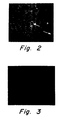
- Fig. 2 of the drawing is an electron photomicrograph of a cross-section of a freshly compounded PVC duct sidewall material at a magnification of 50x.
- the sidewall material is composed of 95% by weight of polyvinyl chloride to which 5% by weight of PTFE powder has been added.
- Fig. 2 The process used to prepare the material shown in Fig. 2 comprised blending a commercially available PTFE powder with pellets of a commercial PVC compound, the latter consisting of PVC pellets sold by Cary Chemicals, Incorporated, Farmingdale, NJ.
- the arrows in Fig. 2 identify polymer agglomerates which have been determined by energy-dispersive x-ray spectrographic analysis to be fluorocarbon polymer agglomerates. These inclusions appear to be in the range of 50-100 ⁇ m in size.
- Fig. 3 of the drawing is an electron photomicrograph similar in format to the micrograph of Fig. 2, but in this case is a cross-section of a PVC/PTFE duct sidewall material prepared in accordance with the preferred process of the invention. Again the micrograph is taken at a magnification of 50x.
- the material shown in Fig. 3 is of the same overall composition as the PTFE-modified PVC compound shown in Fig. 2. However, in the material of Fig. 3, the powdered PTFE polymer additive was introduced at the compounding stage, i.e., included directly with virgin PVC polymer feeds, plasticizers, flame retardants and stabilizing additives in the batch of constituents used to provide the modified PVC compound.
- the PVC sidewall material provided in accordance with the invention contains no visible inclusions or agglomerations of PTFE.
- modified PVC polymers provided by direct compounding with PTFE in the manner of this material can be generally characterized as substantially free of discrete PTFE granules or domains larger than about 20 microns.
- these PVC/PTFE sidewall materials exhibit excellent and consistent low-friction behavior against conventional optical fiber materials, particularly including foamed PVC plastic fiber coatings.
- the preferred duct material for use in accordance with the invention will consists at least predominantly (50% by weight or more) of plasticized polyvinyl chloride polymer.
- plasticized polyvinyl chloride polymer These polymers are well known in the art, typically comprising a homogenous blend of PVC resin (pure polymerized vinyl chloride) with one or more conventional plasticizers and other additives.
- the plasticizers are generally di- or tri-alkyl pthalates, alkyl trimellitates, alkyl adipates, epoxidized esters such as epoxidized linseed oil, alkyl phosphates and alkyl stearates.
- the plasticizers may constitute 20-40% or more of the plasticized PVC polymer, with the remainder comprising the vinyl chloride polymer itself, together with minor additions of light stabilizers, flame retardants, and other modifiers.
- the compounding of a polyvinyl chloride polymer comprising a PTFE addition to render the PVC suitable for use as a fiber duct material in accordance with the invention can follow conventional PVC compounding procedures well known in the art.
- the following hypothetical example provides an illustration such a procedure.
- a feed material for the extrusion of a PTFE-modified polyvinyl chloride microduct tube may be prepared from conventional batch materials as follows. One hundred parts by weight of a powdered polyvinyl resin, commercially available as Geon R 102 EP PVC from the B. F. Goodrich Company, Chemical Group, Cleveland, Ohio, is mixed with 8 parts by weight of a commercial PTFE powder.
- the PTFE powder is Polymist F-5 powder from Ausimont, Incorporated of Morristown, NJ, having a specific gravity of 2.28 and an average particle size below about 10 ⁇ m.
- a conventional plasticizer most preferably one or a mixture of trialkyl trimellitate plasticizers.
- 3 parts by weight of an epoxidized ester plasticizer 0.5 parts stearic acid, and 3.25 parts total of uv absorbers and stabilizers.
- Up to 3 parts by weight of one or more flame retardants such as antimony oxides, alumina trihydrate or the like may also be included for improved flame resistance.
- the modified PVC feedstock thus provided may thereafter be reprocessed by extrusion into a cylindrical tube or microduct of dimensions suitable for the blow-in installation of optical fibers.
- Microducts with walls of 0.03-0.06 inches thickness and outer diameters of 0.25-0.50 inches are quite suitable for use, for example, where single plastic-coated optical fibers or bundles or groups of 2-8 optical fibers are to be installed.
- a plastic microduct of 0.25 inches outer diameter and 0.030 inches wall thickness is provided.
- This microduct having a composition of about 95% of flame retardant plasticized polyvinyl chloride polymer and 5% PTFE polymer, is extruded from a PVC compound prepared by Cary Chemicals, Incorporated. It is similar in composition to Cary 1690-1011 flame-retardant PVC, but with plasticizer levels reduced by about 50% and with the added PTFE powder.
- the custom compounded material thus provided is substantially free of PTFE agglomerates.
- the microduct thus provided is installed horizontally in a ceiling installation such that the duct traverses six 90° bends of six-inch radius over each 150 meters of duct traverse length.
- Four coated optical fibers are then selected for installation in the microduct.
- the optical fibers are 125 ⁇ m diameter low-loss glass optical fibers provided with uv-cured acrylate protective coatings covered by foamed polyvinyl chloride outer jackets to enhance the blow-in characteristics of the fibers.
- the outer diameter of each of the coated optical fibers is 700 ⁇ m.
- the optical fibers are inserted as a loose fiber group into the microduct and compressed air is forced past the fibers and through the duct as the fibers are fed into the duct inlet.
- Air pressures used are in the range of 10-102 psi, although higher pressures can be used if desired.
- Blow-in distances for the fiber group under these conditions is determined by a cut-back method wherein a very long initial length of the microduct is first tried. The duct length is then successively shortened, after each installation run, until successful installation of the fiber bundle is achieved. Using this method, the measured blow-in distance for the described fiber bundle is approximately 220 meters, representing a very substantial increase over the blow-in distances attained under identical installation conditions utilizing unmodified PVC microducts.
- Example 2 The microduct extrusion procedure of Example 2 is repeated to produce a blow-in duct of identical configuration, except that the compound used for the extrusion of the microduct is one comprising 10% by weight of PTFE in the formulation. As in Example 2, the compound thus provided is substantially free of PTFE agglomerations.
- Blow-in installation into the duct is attempted using a 4-fiber group of PVC-foam-coated fibers as in Example 2. Utilizing the cut-back method for determining blow-in distance, installation into 260 meters of the microduct is successfully achieved. Thus the use of somewhat greater PTFE concentrations can achieve useful increases in blowing distance, the largest measure of improvement, insofar as coefficient of friction data are concerned, is obtained at PTFE concentrations in the 1-8% PTFE content range.
- the PVC compound used to fabricate the ducts included 5% by weight of PTFE in the formulation.
- the microduct dimensions were the same as for Examples 2 and 3 above.
- the flame propagation test employed in testing the cable followed Underwriters Laboratories test UL 910 for plenum cable installations. Among other requirements, that test specifies a flame propagation distance of less than five feet, a peak smoke optical density of less than 0.5, and an average smoke optical density of 0.15 under precisely controlled burning conditions.
Landscapes
- Physics & Mathematics (AREA)
- General Physics & Mathematics (AREA)
- Optics & Photonics (AREA)
- Engineering & Computer Science (AREA)
- Manufacturing & Machinery (AREA)
- Light Guides In General And Applications Therefor (AREA)
- Electric Cable Installation (AREA)
Applications Claiming Priority (2)
| Application Number | Priority Date | Filing Date | Title |
|---|---|---|---|
| US525077 | 1983-08-22 | ||
| US07/525,077 US5046815A (en) | 1990-05-17 | 1990-05-17 | Optical fiber cabling |
Publications (2)
| Publication Number | Publication Date |
|---|---|
| EP0456909A2 true EP0456909A2 (de) | 1991-11-21 |
| EP0456909A3 EP0456909A3 (en) | 1992-01-08 |
Family
ID=24091818
Family Applications (1)
| Application Number | Title | Priority Date | Filing Date |
|---|---|---|---|
| EP19900125439 Withdrawn EP0456909A3 (en) | 1990-05-17 | 1990-12-24 | Telecommunications cable and duct for optical fiber |
Country Status (4)
| Country | Link |
|---|---|
| US (1) | US5046815A (de) |
| EP (1) | EP0456909A3 (de) |
| JP (1) | JP3057336B2 (de) |
| CA (1) | CA2033723A1 (de) |
Cited By (4)
| Publication number | Priority date | Publication date | Assignee | Title |
|---|---|---|---|---|
| EP0454405A3 (en) * | 1990-04-24 | 1992-08-05 | Bicc Public Limited Company | Duct for receiving an optical fibre member |
| WO2002012943A1 (en) * | 2000-08-07 | 2002-02-14 | Pirelli General Plc | Optical fibre cable |
| US7027697B2 (en) | 2001-12-28 | 2006-04-11 | Pirelli Communications Cables And Systems Usa, Llc | Cable having conduits for receiving optical fibers |
| US7136556B2 (en) | 2002-08-10 | 2006-11-14 | Emtelle Uk Limited | Signal transmitting cable |
Families Citing this family (26)
| Publication number | Priority date | Publication date | Assignee | Title |
|---|---|---|---|---|
| GB8815977D0 (en) * | 1988-07-05 | 1988-08-10 | British Telecomm | Transmission line ducts |
| US5091053A (en) * | 1990-02-28 | 1992-02-25 | At&T Bell Laboratories | Matte finishes on optical fibers and other glass articles |
| US5268971A (en) * | 1991-11-07 | 1993-12-07 | Alcatel Na Cable Systems, Inc. | Optical fiber/metallic conductor composite cable |
| GB9123760D0 (en) | 1991-11-08 | 1992-01-02 | Stockman Anthony J | Optical fibre sheathing |
| GB2270992B (en) * | 1992-08-04 | 1995-12-20 | Pirelli General Plc | Cables having electrical conductors and optical fibres |
| FR2730101A1 (fr) * | 1995-01-31 | 1996-08-02 | Noane Georges Le | Dispositif pour subdiviser une conduite d'installation de cables |
| US5692545A (en) * | 1995-12-05 | 1997-12-02 | Rodrigue; Wayne | Fiber optic cable duct |
| JP2000221372A (ja) * | 1999-01-28 | 2000-08-11 | Sumitomo Wiring Syst Ltd | 床下配線用複合ケーブル |
| EP1250386A1 (de) | 1999-12-30 | 2002-10-23 | Corning Incorporated | Klebemittelenthaltende zusammensetzung und verfahren zur veränderung von zeitempfindlichen rheologischen eigenschaften einer optischen faserbeschichtung |
| AU2001234594A1 (en) | 2000-03-10 | 2001-09-24 | Corning Incorporated | Optical fiber with absorbing overclad glass layer |
| EP1306708B1 (de) * | 2000-06-06 | 2009-03-11 | Asahi Glass Company Ltd. | Faseroptisches kabel |
| US6870995B2 (en) | 2001-07-05 | 2005-03-22 | Pirelli Cables And Systems Llc | High fiber count optical fiber cable with buffer tubes around central strength member |
| US6628875B2 (en) | 2001-07-20 | 2003-09-30 | Corning Incorporated | Optical fibers possessing a primary coating with a higher degree of cure and methods of making |
| US20030215197A1 (en) * | 2002-05-14 | 2003-11-20 | Simon Jonathan N. | Combined optical and electrical transmission line |
| US6977280B2 (en) * | 2003-06-11 | 2005-12-20 | Teknor Apex Company | Polyvinyl chloride or polyolefin melt processable compositions containing polytetrafluoroethylene micropowder |
| US20060013246A1 (en) * | 2004-07-13 | 2006-01-19 | International Business Machines Corporation | System, apparatus and method for gigabit ethernet communications over an IBM cabling system |
| KR100571604B1 (ko) * | 2004-09-10 | 2006-04-17 | 엘에스전선 주식회사 | 광복합전력케이블의 포설방법 및 이를 위한 케이블 구조 |
| US7749024B2 (en) | 2004-09-28 | 2010-07-06 | Southwire Company | Method of manufacturing THHN electrical cable, and resulting product, with reduced required installation pulling force |
| WO2009042566A2 (en) * | 2007-09-25 | 2009-04-02 | Polyone Corporation | Concentric insulation sleeve having inner and outer surfaces with different properties |
| JP2009134059A (ja) * | 2007-11-30 | 2009-06-18 | Sumitomo Electric Ind Ltd | 光ファイバ布設用管路部材および光ファイバ布設方法 |
| US8582941B2 (en) * | 2009-02-16 | 2013-11-12 | Corning Cable Systems Llc | Micromodule cables and breakout cables therefor |
| CN102948092A (zh) * | 2010-06-23 | 2013-02-27 | 3M创新有限公司 | 室内无线网络应用的混合布线系统和网络 |
| NO2549318T3 (de) * | 2011-07-18 | 2018-08-04 | ||
| US10173286B2 (en) | 2011-10-19 | 2019-01-08 | Weatherford Technology Holdings, Llc | Optical fiber coating to reduce friction and static charge |
| WO2019079425A1 (en) * | 2017-10-17 | 2019-04-25 | Corning Research & Development Corporation | SPEAKER FOR SPLICING OPTICAL FIBERS |
| US11598928B2 (en) | 2018-07-20 | 2023-03-07 | Weatherford Technology Holdings, Llc | Cable to reduce optical fiber movement and methods to fabricate |
Family Cites Families (16)
| Publication number | Priority date | Publication date | Assignee | Title |
|---|---|---|---|---|
| DE2626497B2 (de) * | 1976-06-12 | 1980-03-06 | Standard Elektrik Lorenz Ag, 7000 Stuttgart | Anschlußkabel für Fernsprechvermittlungsämter |
| DE3106147A1 (de) * | 1981-02-13 | 1982-09-09 | Siemens AG, 1000 Berlin und 8000 München | Isoliermischung fuer elektrische kabel |
| EP0108590B1 (de) * | 1982-11-08 | 1986-11-26 | BRITISH TELECOMMUNICATIONS public limited company | Optische Übertragungsfasern |
| US4691896C1 (en) * | 1982-11-08 | 2001-05-08 | British Telecomm | Optical fibre transmission line |
| EP0157610B1 (de) * | 1984-03-29 | 1989-09-13 | BRITISH TELECOMMUNICATIONS public limited company | Mantel für optische Fasern |
| GB2156837A (en) * | 1984-03-29 | 1985-10-16 | British Telecomm | Optical fibre transmission lines |
| US4687294A (en) * | 1984-05-25 | 1987-08-18 | Cooper Industries, Inc. | Fiber optic plenum cable |
| US4688890A (en) * | 1985-03-11 | 1987-08-25 | Goodall Rubber Company | Fiber optic cable inner duct |
| US4781433A (en) * | 1985-04-30 | 1988-11-01 | American Telephone And Telegraph Company, At&T Bell Laboratories | Optical fiber plenum cable and methods of making |
| US4723831A (en) * | 1985-12-02 | 1988-02-09 | American Telephone And Telegraph Company At&T Bell Laboratories | Optical fiber communications cable |
| US4881794A (en) * | 1986-04-02 | 1989-11-21 | Pennwalt Corporation | Low smoke and reduced flame fluorinated polymer compositions and cable constructions |
| US4818060A (en) * | 1987-03-31 | 1989-04-04 | American Telephone And Telegraph Company, At&T Bell Laboratories | Optical fiber building cables |
| GB8714226D0 (en) * | 1987-06-17 | 1987-07-22 | Bicc Plc | Optical fibre cables |
| GB8714640D0 (en) * | 1987-06-23 | 1987-07-29 | Bicc Plc | Optical fibre cables |
| JP5920074B2 (ja) | 2012-07-12 | 2016-05-18 | 富士通株式会社 | 電子機器及び発熱部品の冷却方法 |
| JP6238682B2 (ja) | 2013-11-06 | 2017-11-29 | 大成建設株式会社 | 風揺れ抑制装置 |
-
1990
- 1990-05-17 US US07/525,077 patent/US5046815A/en not_active Expired - Lifetime
- 1990-12-24 EP EP19900125439 patent/EP0456909A3/en not_active Withdrawn
-
1991
- 1991-01-07 CA CA002033723A patent/CA2033723A1/en not_active Abandoned
- 1991-05-16 JP JP13942291A patent/JP3057336B2/ja not_active Expired - Fee Related
Cited By (7)
| Publication number | Priority date | Publication date | Assignee | Title |
|---|---|---|---|---|
| EP0454405A3 (en) * | 1990-04-24 | 1992-08-05 | Bicc Public Limited Company | Duct for receiving an optical fibre member |
| US5214733A (en) * | 1990-04-24 | 1993-05-25 | Bicc Plc | Duct for receiving an optical fibre member |
| WO2002012943A1 (en) * | 2000-08-07 | 2002-02-14 | Pirelli General Plc | Optical fibre cable |
| US6876800B2 (en) | 2000-08-07 | 2005-04-05 | Pirelli General Plc | Optical fiber cable |
| US7027697B2 (en) | 2001-12-28 | 2006-04-11 | Pirelli Communications Cables And Systems Usa, Llc | Cable having conduits for receiving optical fibers |
| US7136556B2 (en) | 2002-08-10 | 2006-11-14 | Emtelle Uk Limited | Signal transmitting cable |
| USRE41388E1 (en) | 2002-08-10 | 2010-06-22 | Emtelle Uk Limited | Signal transmitting cable |
Also Published As
| Publication number | Publication date |
|---|---|
| JPH04350606A (ja) | 1992-12-04 |
| JP3057336B2 (ja) | 2000-06-26 |
| CA2033723A1 (en) | 1991-11-18 |
| EP0456909A3 (en) | 1992-01-08 |
| US5046815A (en) | 1991-09-10 |
Similar Documents
| Publication | Publication Date | Title |
|---|---|---|
| US5046815A (en) | Optical fiber cabling | |
| US5841072A (en) | Dual insulated data communication cable | |
| US7968613B2 (en) | Compositions for compounding, extrusion and melt processing of foamable and cellular fluoropolymers | |
| AU2011215703B2 (en) | Compositions for riser and plenum cables | |
| US5378856A (en) | Transmission cable having a nonhalogenated jacket formulation | |
| CN101029154B (zh) | 无卤素阻燃性树脂组合物及使用其的电线·电缆 | |
| US8354469B2 (en) | Perfluoropolymer composition | |
| EP1059331A1 (de) | In der Schmelze zu verarbeitende, vernetzbare Beschichtung | |
| WO2007041297A1 (en) | Highly filled unsaturated fluoropolymer compositions for cables | |
| US7652211B2 (en) | Plenum cable | |
| WO2025194576A1 (zh) | 一种90℃热塑性无卤低烟阻燃聚烯烃护套料及其制备方法 | |
| US7459498B2 (en) | Filled perfluoropolymer composition | |
| EP1709648B1 (de) | Gefüllte perfluorpolymere | |
| US9812231B2 (en) | Jacket composition for riser and plenum cables | |
| US8682122B2 (en) | Concentric insulation sleeve having inner and outer surfaces with different properties | |
| IT8522693A1 (it) | Cavo elettrico e materiale per il rivestimento di conduttori, elettrici avente funzione di isolante e/o di guaina. | |
| CN114822960A (zh) | 一种绝缘性好的中压铜芯电力电缆 | |
| EP0241330B1 (de) | Ölfestes Kabel | |
| DE69617373T2 (de) | Nachrichtenkabel für Plenum | |
| US7744794B2 (en) | Extrusion process | |
| CN110016176A (zh) | 一种适用于气吹铺设光缆用低摩擦低烟无卤阻燃护套料及其制备方法 | |
| US20050161856A1 (en) | Extrusion jacketing process | |
| US20220339925A1 (en) | Foamed filler rod in optical fiber cables | |
| CN120581275A (zh) | 一种用于高湿环境的耐火防潮地铁电缆及其制备方法 | |
| WO1984000245A1 (en) | Wire and cable products with improved jacketing |
Legal Events
| Date | Code | Title | Description |
|---|---|---|---|
| PUAI | Public reference made under article 153(3) epc to a published international application that has entered the european phase |
Free format text: ORIGINAL CODE: 0009012 |
|
| PUAL | Search report despatched |
Free format text: ORIGINAL CODE: 0009013 |
|
| AK | Designated contracting states |
Kind code of ref document: A2 Designated state(s): DE FR GB |
|
| AK | Designated contracting states |
Kind code of ref document: A3 Designated state(s): DE FR GB |
|
| STAA | Information on the status of an ep patent application or granted ep patent |
Free format text: STATUS: THE APPLICATION IS DEEMED TO BE WITHDRAWN |
|
| 18D | Application deemed to be withdrawn |
Effective date: 19920709 |