EP0457005A1 - Procédé et dispositif pour séparer des acides d'air ou de gaz d'échappement provenant de mélanges de solvants organiques contenant des acides - Google Patents
Procédé et dispositif pour séparer des acides d'air ou de gaz d'échappement provenant de mélanges de solvants organiques contenant des acides Download PDFInfo
- Publication number
- EP0457005A1 EP0457005A1 EP91104974A EP91104974A EP0457005A1 EP 0457005 A1 EP0457005 A1 EP 0457005A1 EP 91104974 A EP91104974 A EP 91104974A EP 91104974 A EP91104974 A EP 91104974A EP 0457005 A1 EP0457005 A1 EP 0457005A1
- Authority
- EP
- European Patent Office
- Prior art keywords
- solvent
- solvent mixture
- acid
- calcium
- water
- Prior art date
- Legal status (The legal status is an assumption and is not a legal conclusion. Google has not performed a legal analysis and makes no representation as to the accuracy of the status listed.)
- Granted
Links
Images


Classifications
-
- B—PERFORMING OPERATIONS; TRANSPORTING
- B01—PHYSICAL OR CHEMICAL PROCESSES OR APPARATUS IN GENERAL
- B01D—SEPARATION
- B01D53/00—Separation of gases or vapours; Recovering vapours of volatile solvents from gases; Chemical or biological purification of waste gases, e.g. engine exhaust gases, smoke, fumes, flue gases, aerosols
- B01D53/34—Chemical or biological purification of waste gases
- B01D53/46—Removing components of defined structure
- B01D53/72—Organic compounds not provided for in groups B01D53/48 - B01D53/70, e.g. hydrocarbons
-
- B—PERFORMING OPERATIONS; TRANSPORTING
- B01—PHYSICAL OR CHEMICAL PROCESSES OR APPARATUS IN GENERAL
- B01D—SEPARATION
- B01D53/00—Separation of gases or vapours; Recovering vapours of volatile solvents from gases; Chemical or biological purification of waste gases, e.g. engine exhaust gases, smoke, fumes, flue gases, aerosols
- B01D53/34—Chemical or biological purification of waste gases
- B01D53/46—Removing components of defined structure
- B01D53/68—Halogens or halogen compounds
- B01D53/70—Organic halogen compounds
-
- C—CHEMISTRY; METALLURGY
- C07—ORGANIC CHEMISTRY
- C07B—GENERAL METHODS OF ORGANIC CHEMISTRY; APPARATUS THEREFOR
- C07B63/00—Purification; Separation; Stabilisation; Use of additives
- C07B63/02—Purification; Separation; Stabilisation; Use of additives by treatment giving rise to a chemical modification
Definitions
- the present invention relates to a method and a device for removing or working up acidic organic chemical solvents or solvent mixtures, which originate from exhaust air or exhaust gases, by contact with alkaline reagents, wherein carbonic acid-containing and low-chlorine hydrocarbon-free or low-organic chemical solvents or solvent mixtures with acids reacted and / or adsorptively acting calcium compounds or calcium-containing compounds and / or amines and / or quaternary ammonium compounds in finely divided or dissolved form or mixed and the organic chemical solvent or organic chemical solvent mixture is separated.
- DE-OS 2 833 548 and DE-OS 2 833 586 already describe a neutralization process for certain chlorinated hydrocarbons, magnesium oxide with a certain grain size serving as the neutralizing agent for the hydrochloric acid formed, which is preferably used as a shaped body.
- magnesium oxide is only expedient in the case of solvents with strong mineral acids, in particular hydrochloric acid or hydrogen chloride and in the case of certain chlorinated hydrocarbons, since the rate of conversion does not permit economical industrial production with other organic acids.
- alkali metal hydroxides are used for the deacidification of organic solvents, there is a risk of undesired side reactions, in particular in the presence of aldehydes, ketones and / or esters, which lead to a change in the composition and the property of the organic solvent or solvent mixture.
- the invention has for its object to avoid the aforementioned disadvantages and to provide a method and a device which ensures the safe and economical removal of carboxylic acids and water, if appropriate, from organic chlorine-free or low-chlorine solvents or solvent mixtures.
- the process should be operated as waste-free or waste-free as possible.
- the reuse of the recovered solvents in the production plant should be made possible. There should therefore only be a low acid and water content in the treated solvents after the treatment.
- carboxylic acid and Chlorinated hydrocarbon-free or low-organic-chemical solvents or solvent mixtures with calcium-reactive or / or adsorptive acids or calcium-containing compounds which have a solubility product (measured in water at room temperature) of more than (1.0 ⁇ 0.5) x 10 ⁇ 11 , preferably of more than (1.0 ⁇ 0.5) x 10 ⁇ 8, and / or amines and / or quaternary ammonium compounds treated or mixed in finely divided or dissolved form and the organic chemical solvent or organic chemical solvent mixture separated.
- Calcium compounds or calcium-containing compounds with a solubility product (measured in water at room temperature) of (5.0 ⁇ 2.0) ⁇ 10 ⁇ 6 are particularly preferably used.
- the reaction or adsorption of the carboxylic acids is carried out at temperatures in the range between + 10 ° C and the boiling point of the organic chemical solvent or the low-boiling organic solvent or the solvent mixture, preferably above + 15 ° C and below + 120 ° C , a part of the water preferably being removed from the solvent or solvent mixture purified from the carboxylic acids immediately, subsequently or after intermediate storage.
- the solvent or solvent mixture based on the concentration of the acid and / or acids present, the alkaline reagent consisting of calcium compounds or calcium-containing compounds, amines and / or quaternary ammonium compounds in a 1.05 to 10-fold stoichiometric amount, preferably in 1.1 to 4 times the stoichiometric amount and / or added in such an amount that the solvent or Solvent mixture after distillation has an acidity between ⁇ 0.01 to 10 meq H+ / dm3, preferably ⁇ 0.1 to 2 meq H+ / dm3.
- the drying (removal of water or reduction of the water content) of the solvent or solvent mixture is carried out by at least one azeotropic distillation and / or pervaporation and / or by sorption to such an extent that after drying the Solvent or solvent mixture the final water content of the same is between 0.0001 to 3.0 mass%, preferably between 0.001 to 0.1 mass%.
- the alkaline reagent consists of calcium oxide, calcium hydroxide, calcium acetate and / or mixtures of calcium oxide and / or calcium hydroxide and / or calcium acetate and calcium carbonate, dolomite, burnt dolomite and / or mixtures or solid solutions of one or more of these alkaline earth metal compounds and / or from at least one amine and / or a quaternary ammonium compound, the grain size of the alkaline reagents used in the solid state being less than 500 ⁇ m, preferably less than 100 ⁇ m, and / or these compounds are used with a specific surface area which is above 0, 5 m2 / g, preferably over 20 m2 / g.
- the organic chemical solvent or solvent mixture and / or the alkaline reagent is adjusted or used such that the total water content of the acidic solvent (calculated including the alkaline reagent) is more than 0.001% by mass, preferably 0.0015 to 2.0% by mass, the setting preferably being made by adding an amount of water required to set this mass concentration, and preferably using at least one calcium compound as the alkaline Reagent takes place, the water to be added preferably originating from or being used from the water phase separated in the azeotropic distillation and / or pervaporation.
- the solvent or solvent mixture is preferably distilled off in the presence of at least one alkaline reagent.
- the distillation of the solvent or solvent mixture is preferably carried out at a pressure of more than 0.01 mbar, preferably 30 to 1013 mbar.
- the reaction time within the stirring process before the distillation is between 0.08 and 24 hours, preferably between 0.25 and 2.5 hours.
- Tributylamine, tripentylamine, trihexylamine, triheptylamine, trioctylamine, triethanolamine and tripropanolamines are advantageously used as amines.
- primary or secondary amines can also be used.
- Tetrasubstituted ammonium hydroxides preferably tetra-n-butyl ammonium hydroxide, are used as quaternary ammonium compounds.
- a ratio of 0.1 stoichiometric equivalents of triethanolamine and 3 stoichiometric equivalents of Ca (OH) 2 is particularly preferred.
- This embodiment has the advantage that the reaction proceeds faster than with Ca (OH) 2 or CaO alone and the presence of water is not necessary. Since a smaller amount of amine is used, the amount of amine to be disposed of is less than in the case of using amine alone. The embodiment mentioned is of particular interest in the case of solvents to be cleaned which have a very low water content.
- the organic chemical solvent or solvent mixture is distilled off after an increase in temperature of more than + 10 ° C, preferably more than + 20 ° C (compared to the starting reaction temperature) in the presence of the excess reagent or the alkaline reagents and preferably subsequently or after storage for Treated reduction in water content.
- organic-chemical solvents or solvent mixtures which are preferably used within the process are those which have been removed from the exhaust air or the exhaust gases and then desorbed using absorbents and / or adsorbents, preferably activated carbon.
- the desorption is carried out with heating as a function of the pressure or reduced pressure or by means of steam and / or at least one inert gas, preferably nitrogen, the gaseous acidic solvent or Solvent mixture is condensed and subjected to the process according to the invention for removing acids immediately or after intermediate storage.
- inert gas preferably nitrogen
- the alkaline earth metal compound and / or the amine used or reacted within the process is subjected to a thermal treatment and then used again as an alkaline reagent within the process.
- the solvent or solvent mixture to be treated is mixed in at least one reactor, preferably in a stirred reactor, with 1.25 to 3 times the stoichiometric amount of the powdery or liquid alkaline reagent according to the invention, based on the concentration of the acids present, and at room temperature or at temperatures up to the boiling point of the solvent well stirred for a certain time.
- the solvent or solvent mixture is then filtered or distilled directly from the stirred reactor or in a thin-film evaporator, then condensed, separated from a possibly occurring aqueous phase in a water separator and then fed to a plant section for removing the water (e.g. pervaporation).
- the treated solvents and solvent mixtures are then again suitable for use in the production process.
- the invention also relates to a device for carrying out the method according to the invention.
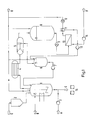
- the device or device combination consists of one, with at least one vapor condenser (4) for the cleaned, evaporated solvent or solvent mixture, at least one separator (5) for the water-containing solvent mixture, at least one heatable reactor (1) connected to the distillate container (8), at least one reagent template (2) for the reagent (s) to be used, at least one intermediate container (6) for water separated from the solvent, optionally at least one drying device (10) and at least one residue container (15).
- the separator (5) for the cleaned water-containing solvent or solvent mixture is connected in its lower part to the intermediate container (6) via a pipeline and in its upper part to the distillate container (8) for the pure solvent or solvent mixture.
- At least one heating device and one cooling device are arranged on the reactor and the reactor has at least one stirring device.
- At least one metering device is arranged on the reactor (1), the reagent reservoir (2) and / or on at least one pipeline located between them.
- At least one pipe is also arranged between the drying device (10) and the intermediate container (6), so that this is in the Drying device (10) water removed from the solvent can be passed into the intermediate container (6).
- the intermediate container (6) is also connected to the reactor (1) via at least one pipe.
- the invention further relates to the use of the alkaline earth metal compound which has been wholly or partly converted by the method for flue gas cleaning. These are e.g. used for flue gas desulfurization.
- the invention further relates to the use of the distillation residue obtained by the process, consisting of solvents or solvent mixture and fully or partially converted alkaline earth metal compounds or amines for energy generation in combustion plants.
- Low-chlorinated hydrocarbon solvents are understood to mean those organic-chemical solvents or solvent mixtures which contain a chlorinated hydrocarbon content of less than 25% by mass (based on 100% by mass of solvent or solvent mixture), preferably below 8% by mass. Chlorinated hydrocarbon-free solvents or those with a chlorinated hydrocarbon content of less than 3% by mass are preferably used.
- a mixture of solvents is produced during the desorption of the activated carbon.
- this solvent mixture consisting of 74 vol .-% ketones with C4 to C6, 23 vol .-% carboxylic esters with C4, 1.5 vol.% Aromatic hydrocarbons, with an acidity of 95 meq H+ / dm3 (caused by organic Carboxylic acids, in particular acetic acid, propionic acid, isobutyric acid, isovaleric acid) and a water content of 1.5% by mass, 750 g of powdered calcium hydroxide with a specific surface area of 25 m 2 / g are added and mixed well for 15 minutes at room temperature.
- the solvent mixture is then distilled off in the presence of the calcium hydroxide.
- the condensed organic phase of the distillate has an acidity of 1.5 meq H+ / dm3 and a water content of 1 mass%.
- the aqueous phase of the distillate is separated off in a water separator.
- the organic phase of the distillate is then fed to a pervaporation plant.
- the retentate of the pervaporation plant has a water content of ⁇ 0.1 mas.% And is returned to the production process.
- the method was carried out in the device according to the invention according to FIG. 1.
- the condensed organic phase of the distillate has an acidity of ⁇ 0.5 meq H+ / dm3.
- a drying of the solvent mixture and thus the activation of a drying device (pervaporation device) was not necessary due to the low initial water content.
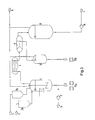
- a distillate with an acidity of 58 meq H+ / dm3 is obtained. This method was carried out in the device according to the invention according to FIG. 2.
- a mixture of solvents is produced during the desorption of the activated carbon.
- this solvent mixture consisting of 74 vol% ketones with C4 to C6, 23 vol .-% carboxylic esters with C4, 1.5 vol .-% aromatic carbons with an acidity of 75 meq H+ / dm3 (caused by organic Carboxylic acids, especially acetic acid, propionic acid, isobubutyric acid, isovaleric acid) and a water content of ⁇ 0.1 mas.%
- organic Carboxylic acids especially acetic acid, propionic acid, isobubutyric acid, isovaleric acid
- a water content of ⁇ 0.1 mas.% are 920 g of a mixture of calcium hydroxide and triethanolamine (0.1 times the stoichiometric amount of amine and 3.0 times the stoichiometric amount of calcium hydroxide, based on the Concentration of the acid present; sum of the two stoichiometric factors: 3.1) and thoroughly mixed
- the solvent mixture is then distilled off at a pressure of 100 mbar.
- the condensed organic phase of the distillate has an acidity of ⁇ 2 meq H+ / dm3. Drying the solvent mixture was not necessary due to the low initial water content.
- the method was carried out in the device according to the invention according to FIG. 3.
- the device according to the invention is shown schematically.
- 1 consists of at least one vapor condenser (4) for the cleaned, evaporated solvent or solvent mixture, at least one separator (5) for the water-containing solvent mixture, at least one heatable reactor (1) connected to the distillate container (8), at least a reagent template (2) for the reagent (s) to be used, at least one intermediate container (6) for water separated from the solvent, at least one drying device (10) and at least one residue container (15), the separator (5) for the cleaned one water-containing solvent or solvent mixture is connected in its lower part via a pipeline to the intermediate container (6) and in its upper part to the distillate container (8) for the pure solvent or solvent mixture.
- the crude product in the form of the acidic solvent or solvent mixture (A) is introduced via a pump or similar conveying device (3).
- the process water (B) is required to control the process and to maintain a certain water content.
- the residue (C) is removed from the reactor according to the schematic drawing and reaches the residue container (15) or is further processed, stored or used for other processes.
- the reagent (E) in the form of calcium compounds, calcium-containing compounds, amines or quaternary ammonium compounds which are reactive and / or adsorptive to acids is introduced into the storage container or into the reagent storage tank (2).
- the end product (F) is preferably obtained, derived, filled and the like using pumps or similar conveying devices, in particular a retentate pump (14).
- Exhaust air (D) is fed to an exhaust air purification system.
- number 7 shows a pump
- number 9 a pump pervaporation feed pump
- number 12 a pump vacuum pump
- number 13 a pump permeate pump
- number 10 is the Pervaporation and the permeate condenser shown in Section 11.
- the device according to the invention is shown without using the pervaporation device.
- the storage containers for triethanolamine and calcium hydroxide or calcium oxide are drawn in with 2a and 2b.
- 15 a denotes the residue drums for the bottom discharge
- 15 b the container for the water phase from the separator 6.
- 16 denotes a continuous evaporator, preferably a thin-film evaporator, and 17 a pump for supplying this evaporator with the suspension mixture of triethanolamine and calcium hydroxide or calcium oxide.
Landscapes
- Chemical & Material Sciences (AREA)
- Engineering & Computer Science (AREA)
- Organic Chemistry (AREA)
- Health & Medical Sciences (AREA)
- Biomedical Technology (AREA)
- Environmental & Geological Engineering (AREA)
- Analytical Chemistry (AREA)
- General Chemical & Material Sciences (AREA)
- Oil, Petroleum & Natural Gas (AREA)
- Chemical Kinetics & Catalysis (AREA)
- Organic Low-Molecular-Weight Compounds And Preparation Thereof (AREA)
- Treating Waste Gases (AREA)
Applications Claiming Priority (4)
| Application Number | Priority Date | Filing Date | Title |
|---|---|---|---|
| DE4015427 | 1990-05-14 | ||
| DE4015427 | 1990-05-14 | ||
| DE4101360 | 1991-01-18 | ||
| DE4101360A DE4101360A1 (de) | 1990-05-14 | 1991-01-18 | Verfahren und vorrichtung zum entfernen von saeuren aus abluft oder abgasen stammenden organisch-chemischen saeurehaltigen loesemitteln oder loesemittelgemischen |
Publications (2)
| Publication Number | Publication Date |
|---|---|
| EP0457005A1 true EP0457005A1 (fr) | 1991-11-21 |
| EP0457005B1 EP0457005B1 (fr) | 1996-06-12 |
Family
ID=25893193
Family Applications (1)
| Application Number | Title | Priority Date | Filing Date |
|---|---|---|---|
| EP91104974A Expired - Lifetime EP0457005B1 (fr) | 1990-05-14 | 1991-03-28 | Procédé et dispositif pour séparer des acides d'air ou de gaz d'échappement provenant de mélanges de solvants organiques contenant des acides |
Country Status (3)
| Country | Link |
|---|---|
| EP (1) | EP0457005B1 (fr) |
| AT (1) | ATE139220T1 (fr) |
| DE (2) | DE4101360A1 (fr) |
Families Citing this family (1)
| Publication number | Priority date | Publication date | Assignee | Title |
|---|---|---|---|---|
| DE102011004900A1 (de) * | 2011-03-01 | 2012-09-06 | Dirk Dombrowski | Mineralisches, granuliertes Entschwefelungs- und Reduktionsmittel, Verfahren zu seiner Herstellung sowie seine Verwendung |
Citations (2)
| Publication number | Priority date | Publication date | Assignee | Title |
|---|---|---|---|---|
| FR2278830A1 (fr) * | 1974-04-24 | 1976-02-13 | Centre Tech Teinture Nettoyage | Procede et dispositif pour eliminer les corps gras dissous dans les solvants de nettoyage a sec des matieres textiles |
| EP0007387A1 (fr) * | 1978-07-31 | 1980-02-06 | Hüls Troisdorf Aktiengesellschaft | Procédé de neutralisation d'hydrocarbures chlorés |
-
1991
- 1991-01-18 DE DE4101360A patent/DE4101360A1/de not_active Withdrawn
- 1991-03-28 DE DE59107917T patent/DE59107917D1/de not_active Expired - Fee Related
- 1991-03-28 EP EP91104974A patent/EP0457005B1/fr not_active Expired - Lifetime
- 1991-03-28 AT AT91104974T patent/ATE139220T1/de not_active IP Right Cessation
Patent Citations (2)
| Publication number | Priority date | Publication date | Assignee | Title |
|---|---|---|---|---|
| FR2278830A1 (fr) * | 1974-04-24 | 1976-02-13 | Centre Tech Teinture Nettoyage | Procede et dispositif pour eliminer les corps gras dissous dans les solvants de nettoyage a sec des matieres textiles |
| EP0007387A1 (fr) * | 1978-07-31 | 1980-02-06 | Hüls Troisdorf Aktiengesellschaft | Procédé de neutralisation d'hydrocarbures chlorés |
Non-Patent Citations (2)
| Title |
|---|
| PATENT ABSTRACTS OF JAPAN vol. 11, no. 141 (C-421)(2588) 8 Mai 1987, & JP-A-61 280450 (MITSUBISHI HEAVY IND LTD) 11 Dezember 1986, * |
| PATENT ABSTRACTS OF JAPAN vol. 4, no. 159 (C-30)(641) 6 November 1980, & JP-A-55 104230 (MITSUBISHI JUKOGYO K.K.) 9 August 1980, * |
Also Published As
| Publication number | Publication date |
|---|---|
| ATE139220T1 (de) | 1996-06-15 |
| EP0457005B1 (fr) | 1996-06-12 |
| DE59107917D1 (de) | 1996-07-18 |
| DE4101360A1 (de) | 1991-11-21 |
Similar Documents
| Publication | Publication Date | Title |
|---|---|---|
| EP0492329B1 (fr) | Procédé pour le traitement de solutions aqueuses contenant de l'acide sulfhydrique, de l'acide cyanhydrique et de l'ammoniac | |
| DE69704848T2 (de) | Herstellung von aromatischen polycarbonsäuren | |
| DE3102948C2 (fr) | ||
| DE69724047T2 (de) | Verfahren zur Entschwefelung und zur Entziehung von Kohlensäure | |
| DE2658909C3 (de) | Verfahren zur Behandlung von Abwasser | |
| DE4416571C1 (de) | Verfahren und Vorrichtung zur Rückgewinnung von Aminen aus Aminwaschlösungen und Verwendung spezieller verfahrensmäßig erhaltbarer Rückstände bei der Herstellung von Zement oder als Düngemittelkomponente | |
| DE2701062B2 (de) | Verfahren zur Herstellung von Estern | |
| DE2447551C3 (de) | Verfahren zur Herstellung von Methylchlorid | |
| DE68928021T2 (de) | Industrielles Verfahren zur Trennung und Rückgewinnung von Chlor | |
| EP2588440A1 (fr) | Procédé de production d'acide formique | |
| EP2418176A1 (fr) | Procédé de nettoyage d'eaux usées issues du traitement de mono-nitrobenzole brut | |
| DE2451958C3 (de) | Verfahren zur Abtrennung von Schwefelwasserstoff und/oder Kohlendioxid sowie von Feuchtigkeit aus einem Kohlenwasserstoffstrom | |
| EP0425922B1 (fr) | Procédé de purification et de concentration d'acide chlorhydrique dilué impure | |
| DE2557560C3 (de) | Verfahren zum gleichzeitigen Entfernen von Stickstoffoxiden und Schwefeldioxid aus Rauchgasen | |
| DE69406203T2 (de) | Verfahren zum Entfernen von säure- und salzhaltigen Verunreinigungen aus einem den Dimethylcarbonatsynthesereaktor verlassenden Gasstrom | |
| JP3244350B2 (ja) | 高純度酢酸の製造方法 | |
| DE68905512T2 (de) | Methode zum reaktivieren eines gruppe-viii-edelmetallkatalysators zur verwendung bei der reinigung roher terephthalsaeure. | |
| EP0457005B1 (fr) | Procédé et dispositif pour séparer des acides d'air ou de gaz d'échappement provenant de mélanges de solvants organiques contenant des acides | |
| DE69507208T2 (de) | Verfahren zur Herstellung von Alkanolaminen | |
| DE2443246A1 (de) | Verfahren zum reinigen der abwaesser aus der herstellung von dialkylphthalaten | |
| DE1443677C3 (de) | Verfahren zur Gewinnung von spektrophotometrisch reinem Dimethylsulfoxid | |
| EP1385816A1 (fr) | Procede de purification d'un solvant organique destine a l'absorption de l'anhydride de l'acide maleique | |
| DE2901359A1 (de) | Verfahren zur entfernung von jod aus organischen verbindungen | |
| DE2209841A1 (de) | Verfahren zur Abtrennung von Fluorwasserstoff | |
| DE2759026A1 (de) | Verfahren zur herstellung von terephthalsaeure |
Legal Events
| Date | Code | Title | Description |
|---|---|---|---|
| PUAI | Public reference made under article 153(3) epc to a published international application that has entered the european phase |
Free format text: ORIGINAL CODE: 0009012 |
|
| 17P | Request for examination filed |
Effective date: 19910412 |
|
| AK | Designated contracting states |
Kind code of ref document: A1 Designated state(s): AT BE CH DE DK ES FR GB GR IT LI LU NL SE |
|
| 17Q | First examination report despatched |
Effective date: 19940117 |
|
| RAP1 | Party data changed (applicant data changed or rights of an application transferred) |
Owner name: DEUTSCHE SOLVAY-WERKE GESELLSCHAFT MIT BESCHRAENKT Owner name: ALKOR GMBH KUNSTSTOFFE |
|
| GRAH | Despatch of communication of intention to grant a patent |
Free format text: ORIGINAL CODE: EPIDOS IGRA |
|
| GRAA | (expected) grant |
Free format text: ORIGINAL CODE: 0009210 |
|
| AK | Designated contracting states |
Kind code of ref document: B1 Designated state(s): AT BE CH DE DK ES FR GB GR IT LI LU NL SE |
|
| PG25 | Lapsed in a contracting state [announced via postgrant information from national office to epo] |
Ref country code: IT Free format text: LAPSE BECAUSE OF FAILURE TO SUBMIT A TRANSLATION OF THE DESCRIPTION OR TO PAY THE FEE WITHIN THE PRE;WARNING: LAPSES OF ITALIAN PATENTS WITH EFFECTIVE DATE BEFORE 2007 MAY HAVE OCCURRED AT ANY TIME BEFORE 2007. THE CORRECT EFFECTIVE DATE MAY BE DIFFERENT FROM THE ONE RECORDED.SCRIBED TIME-LIMIT Effective date: 19960612 Ref country code: GR Free format text: LAPSE BECAUSE OF FAILURE TO SUBMIT A TRANSLATION OF THE DESCRIPTION OR TO PAY THE FEE WITHIN THE PRESCRIBED TIME-LIMIT Effective date: 19960612 Ref country code: NL Free format text: LAPSE BECAUSE OF FAILURE TO SUBMIT A TRANSLATION OF THE DESCRIPTION OR TO PAY THE FEE WITHIN THE PRESCRIBED TIME-LIMIT Effective date: 19960612 Ref country code: ES Free format text: THE PATENT HAS BEEN ANNULLED BY A DECISION OF A NATIONAL AUTHORITY Effective date: 19960612 Ref country code: GB Effective date: 19960612 Ref country code: DK Effective date: 19960612 Ref country code: FR Effective date: 19960612 |
|
| REF | Corresponds to: |
Ref document number: 139220 Country of ref document: AT Date of ref document: 19960615 Kind code of ref document: T |
|
| REF | Corresponds to: |
Ref document number: 59107917 Country of ref document: DE Date of ref document: 19960718 |
|
| PG25 | Lapsed in a contracting state [announced via postgrant information from national office to epo] |
Ref country code: SE Effective date: 19960912 |
|
| NLV1 | Nl: lapsed or annulled due to failure to fulfill the requirements of art. 29p and 29m of the patents act | ||
| EN | Fr: translation not filed | ||
| GBV | Gb: ep patent (uk) treated as always having been void in accordance with gb section 77(7)/1977 [no translation filed] |
Effective date: 19960612 |
|
| PG25 | Lapsed in a contracting state [announced via postgrant information from national office to epo] |
Ref country code: AT Free format text: LAPSE BECAUSE OF NON-PAYMENT OF DUE FEES Effective date: 19970328 |
|
| PG25 | Lapsed in a contracting state [announced via postgrant information from national office to epo] |
Ref country code: CH Effective date: 19970331 Ref country code: BE Effective date: 19970331 Ref country code: LI Effective date: 19970331 Ref country code: LU Free format text: LAPSE BECAUSE OF NON-PAYMENT OF DUE FEES Effective date: 19970331 |
|
| PLBE | No opposition filed within time limit |
Free format text: ORIGINAL CODE: 0009261 |
|
| STAA | Information on the status of an ep patent application or granted ep patent |
Free format text: STATUS: NO OPPOSITION FILED WITHIN TIME LIMIT |
|
| 26N | No opposition filed | ||
| REG | Reference to a national code |
Ref country code: CH Ref legal event code: PL |
|
| PGFP | Annual fee paid to national office [announced via postgrant information from national office to epo] |
Ref country code: DE Payment date: 20050324 Year of fee payment: 15 |
|
| PG25 | Lapsed in a contracting state [announced via postgrant information from national office to epo] |
Ref country code: DE Free format text: LAPSE BECAUSE OF NON-PAYMENT OF DUE FEES Effective date: 20061003 |