EP0457038A1 - Procédé et appareil pour revêtir de tous les côtés, une planche en matériau sensible à l'humidité - Google Patents
Procédé et appareil pour revêtir de tous les côtés, une planche en matériau sensible à l'humidité Download PDFInfo
- Publication number
- EP0457038A1 EP0457038A1 EP91105939A EP91105939A EP0457038A1 EP 0457038 A1 EP0457038 A1 EP 0457038A1 EP 91105939 A EP91105939 A EP 91105939A EP 91105939 A EP91105939 A EP 91105939A EP 0457038 A1 EP0457038 A1 EP 0457038A1
- Authority
- EP
- European Patent Office
- Prior art keywords
- edge
- edge surface
- coating
- work station
- plate
- Prior art date
- Legal status (The legal status is an assumption and is not a legal conclusion. Google has not performed a legal analysis and makes no representation as to the accuracy of the status listed.)
- Withdrawn
Links
Images

Classifications
-
- B—PERFORMING OPERATIONS; TRANSPORTING
- B05—SPRAYING OR ATOMISING IN GENERAL; APPLYING FLUENT MATERIALS TO SURFACES, IN GENERAL
- B05D—PROCESSES FOR APPLYING FLUENT MATERIALS TO SURFACES, IN GENERAL
- B05D7/00—Processes, other than flocking, specially adapted for applying liquids or other fluent materials to particular surfaces or for applying particular liquids or other fluent materials
- B05D7/06—Processes, other than flocking, specially adapted for applying liquids or other fluent materials to particular surfaces or for applying particular liquids or other fluent materials to wood
- B05D7/08—Processes, other than flocking, specially adapted for applying liquids or other fluent materials to particular surfaces or for applying particular liquids or other fluent materials to wood using synthetic lacquers or varnishes
Definitions
- the invention relates to a method according to the preamble of claim 1.
- the invention further relates to a device according to the preamble of claim 5.
- Edge processing machines are known which are designed and designed to process plate-shaped components to be used in the context of furniture, which have a protective or decorative coating on the top and bottom sides, and to coat them with a suitable coating material.
- these components are chipboard or other fibrous or porous panels made on the basis of wood or cellulose, which tend to swell under the influence of moisture.
- the edge coatings are applied with the help of so-called hot melt adhesives, for example based on polyamide, polyurethane or also ethylene vinyl acetate.
- the edge surface to be coated in each case using the customary film-like or plate-like coatings is impregnated with a solvent-containing liquid sealing agent prior to the application of the edge surface coating, which is pressed into the structure of the plate, for example a particle board.
- the sealant can, for example, have a paint-like texture so that after evaporation or evaporation of the solvent, a liquid-tight coating is obtained which, depending on its depth of penetration into the substance of the particle board, reliably seals its edge surface against moisture penetration.
- a large number of plastics dissolved in a suitable solvent can be used as the sealing agent, provided that these form a liquid-tight layer after the solvent has been separated off.
- a coating is applied to the edge surface sealed in this sense in a manner known per se, for example using a hot melt adhesive. Due to the edge-side sealing of the panel, the penetration of moisture into its substance can be ruled out, so that the panels produced in this sense can be used as components of such furniture parts which are intended for use in damp rooms.
- the sealing agent is a hardenable plastic, for example a reaction resin.
- the depth of penetration of the sealing means in the structure of the plate can be measured in accordance with the features of claim 3 in accordance with the intended use of the sealing means, namely the sealing of the edge side.
- a very small penetration depth of the order of ⁇ 0.2 mm can be regarded as sufficient.
- the method according to the invention essentially consists of three steps insofar as it relates to the coating of the edge sides of the plate. It is the application of the liquid sealant to the free surface of the edge, the pressing of the sealing agent into the structure of the plate using compressed air, which acts on the free surface of the sealing agent, and the conventional application of a surface coating after the evaporation of the solvent and, if appropriate, the curing of the plastic. If necessary, a drying section can be added to accelerate the evaporation of the solvent or to dry the edge surface.
- Essential to the invention for the device suitable for carrying out the method described above is that commercially available components or device components can be used in the context of its individual workstations.
- a known paint application roller can be used in the work station for applying the liquid sealing agent
- a compressed air broad jet nozzle can be used in the work station for applying the compressed air to the free surface of the sealing agent, through which the largest possible exposure to the air from the Sealant existing liquid film is guaranteed.
- the feed device connecting the individual work stations for the plate to be processed on the edge side can in principle be of any type.
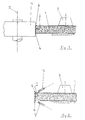
- All of these three workstations can be spatially combined in one device, with the process steps carried out shown in FIG. 3 being followed by a customary coating of the cut surfaces 2, but the drawing of which has been omitted.
- the starting product for the method according to the invention in the work station shown in FIG. 1 is a chipboard 1 coated on the top and bottom in the usual way, which coatings can be made of conventional materials, for example PVC-based plastics, which are bonded to the chipboard.
- any other plate made of a porous material that is to be protected from moisture and which has top and bottom coatings and their frontal cut surfaces 2 are also to be coated.
- the chipboard 1 is here, for example, of rectangular or square shape, wherein the cut surface 2 in the initial state according to FIG. 1 can be disclosed as a result of a previous cutting process.
- this feed device 3 denotes a feed device in which the chipboard to be treated on its cut surfaces 2 is held and through which it is guided relative to fixed parts of the respective work station.
- the detailed design of this feed device 3 can in principle be arbitrary, so that a detailed description or description thereof is dispensed with.
- the work station shown in Fig. 1 is used to apply a sealant, which can consist of a hardenable plastic dissolved in a liquid solvent.
- a sealant which can consist of a hardenable plastic dissolved in a liquid solvent.
- This liquid-form, for example lacquer-like sealing agent is applied by means of an application roller 4 known per se, which is rotatably mounted about an axis S in a manner not shown in the drawing and which enables metered application of a uniform layer thickness to the respective cut surface 2.
- an application roller 4 known per se
- the cut surfaces 2 of the chipboard 1 are covered by a liquid film formed by the said sealing agent and having a uniform layer thickness, which adheres to the porous surface of the cut surface 2.
- the particle board 1 is subjected to an aftertreatment in the work station shown in FIG. 2.
- the chipboard is guided along an arrangement of compressed air nozzles 7, which are arranged above and below the chipboard 1, namely in the vicinity of the cutting surface 2 thereof.
- the axes of the compressed air nozzles extend at an acute angle to the surface of the chipboard and its distance from the beads 6 and the amount of compressed air flowing through these compressed air nozzles 7 are dimensioned such that the beads 6 are released from the plane of the top and bottom by the escaping air flow Bottom of the chipboard 1 are displaced.
- the compressed air nozzles 7 mentioned can be individual, but also linearly distributed nozzle arrangements.
- the beads 6 are displaced towards the side of the cut surface and the chipboard 1 reaches the work station shown in FIG. 3 in this state.
- the cut surface to be treated, coated with the liquid sealing agent is guided along a compressed air broad jet nozzle 8 or a comparable device, the direction of which is perpendicular to said cut surface 2.
- the purpose of this compressed air broad jet nozzle 8 is that sealing agents adhering to the porous surface of the cut surface 2 are pressed into the pores of the structure of the chipboard 1 by effective pneumatic pressure, so that the substance of the chipboard is impregnated with the sealing agent at a penetration depth 9.
- a structurally solidified sealing layer is formed from the substance of the sealing agent, preventing the penetration of moisture into the remaining substance of the chipboard.
- the evaporation or evaporation of the solvent can be accelerated in the usual way in the course of a drying section, depending on its properties.
- the resultant product of the work station shown in FIG. 3 is thus a chipboard which is sealed liquid-tight on its cut surfaces 2.
- the further coating of the cut surfaces 2 of the chipboard takes place in a conventional manner.
- FIG. 4 shows an end region of a particle board 1 produced according to the invention and coated on all sides in section. However, the thicknesses of the individual layers are not drawn to scale to illustrate the overall structure.
- the actual core substance of the chipboard is covered on the top and bottom by a layer 10 made of a suitable plastic, which is glued to the core substance mentioned in a manner not shown but known per se.
- the cut surface 2 has been pretreated in the manner described above, ie it is impregnated on the end face with a hardenable sealing agent, specifically at a penetration depth 9, so that this cut surface 2 is sealed against liquid.
- An adhesive layer 11, for example a hot-melt adhesive, is applied to the cut surface 2 which has been pretreated in this way and which serves to connect an edge coating 12.
- the edge coating 12 consists of a material the layer 10 corresponding material.
Landscapes
- Life Sciences & Earth Sciences (AREA)
- Engineering & Computer Science (AREA)
- Wood Science & Technology (AREA)
- Application Of Or Painting With Fluid Materials (AREA)
- Motor Or Generator Current Collectors (AREA)
Applications Claiming Priority (2)
| Application Number | Priority Date | Filing Date | Title |
|---|---|---|---|
| DE19904015700 DE4015700A1 (de) | 1990-05-16 | 1990-05-16 | Verfahren und vorrichtung zum allseitigen beschichten von aus feuchtigkeitsempfindlichen werkstoffen bestehenden platten |
| DE4015700 | 1990-05-16 |
Publications (1)
| Publication Number | Publication Date |
|---|---|
| EP0457038A1 true EP0457038A1 (fr) | 1991-11-21 |
Family
ID=6406526
Family Applications (1)
| Application Number | Title | Priority Date | Filing Date |
|---|---|---|---|
| EP91105939A Withdrawn EP0457038A1 (fr) | 1990-05-16 | 1991-04-13 | Procédé et appareil pour revêtir de tous les côtés, une planche en matériau sensible à l'humidité |
Country Status (3)
| Country | Link |
|---|---|
| EP (1) | EP0457038A1 (fr) |
| DE (1) | DE4015700A1 (fr) |
| YU (1) | YU83891A (fr) |
Cited By (1)
| Publication number | Priority date | Publication date | Assignee | Title |
|---|---|---|---|---|
| EP2714350A4 (fr) * | 2011-05-25 | 2014-11-12 | Superl Technology Ltd | Procédés de revêtement de poudre et éléments à enduire de poudre |
Families Citing this family (4)
| Publication number | Priority date | Publication date | Assignee | Title |
|---|---|---|---|---|
| CN103917345A (zh) * | 2011-05-25 | 2014-07-09 | 励泰科技有限公司 | 粉末涂覆方法以及被涂覆粉末的工件 |
| CN103774786A (zh) * | 2014-01-20 | 2014-05-07 | 老虎粉末涂料制造(太仓)有限公司 | 一种水泥板 |
| CN103805026A (zh) * | 2014-01-20 | 2014-05-21 | 老虎粉末涂料制造(太仓)有限公司 | 一种中纤板 |
| CN103802194A (zh) * | 2014-01-20 | 2014-05-21 | 老虎粉末涂料制造(太仓)有限公司 | 一种刨花板 |
Citations (8)
| Publication number | Priority date | Publication date | Assignee | Title |
|---|---|---|---|---|
| US1887691A (en) * | 1931-10-08 | 1932-11-15 | Emil C Loetscher | Method of veneering |
| US2720478A (en) * | 1953-03-20 | 1955-10-11 | James H Hogg | Method of making and finishing veneers |
| US3219473A (en) * | 1964-12-29 | 1965-11-23 | Gen Plywood Corp | Method of coating and smoothing wood surface |
| GB1055658A (en) * | 1964-05-28 | 1967-01-18 | Ver Abziehbilderwerke Veb | Improvements in or relating to the production of a surface finish on chip board and sheets of fibrous materials |
| DE1446704A1 (de) * | 1957-09-25 | 1969-06-04 | Statens Skogsind Ab | Verfahren zur Verbesserung der Farbhaftfestigkeit auf Hartplatten |
| DE2361434A1 (de) * | 1972-12-13 | 1974-06-20 | Hobjeto Ind E Comercio De Move | Verfahren zum dichten belegen der raender von holzplatten, schichtholz- und pressholzplatten und nach diesem verfahren hergestellte produkte |
| US4258651A (en) * | 1979-09-20 | 1981-03-31 | Knudtson Brice N | Apparatus for applying sealant to the irregular side edges of a panel |
| FR2583312A1 (fr) * | 1985-06-17 | 1986-12-19 | Peytavie Jacques | Machine applicatrice de produits liquides ou semi-liquides, en particulier pour teinter les bordures de panneaux de bois. |
Family Cites Families (1)
| Publication number | Priority date | Publication date | Assignee | Title |
|---|---|---|---|---|
| DE2116418A1 (en) * | 1971-04-03 | 1972-10-19 | Fa. Heinrich Riffer, 3500 Kassel-Bettenhausen | Polyurethane cladding - using a porous carrier material for the resin to be rolled through |
-
1990
- 1990-05-16 DE DE19904015700 patent/DE4015700A1/de not_active Ceased
-
1991
- 1991-04-13 EP EP91105939A patent/EP0457038A1/fr not_active Withdrawn
- 1991-05-13 YU YU83891A patent/YU83891A/sh unknown
Patent Citations (8)
| Publication number | Priority date | Publication date | Assignee | Title |
|---|---|---|---|---|
| US1887691A (en) * | 1931-10-08 | 1932-11-15 | Emil C Loetscher | Method of veneering |
| US2720478A (en) * | 1953-03-20 | 1955-10-11 | James H Hogg | Method of making and finishing veneers |
| DE1446704A1 (de) * | 1957-09-25 | 1969-06-04 | Statens Skogsind Ab | Verfahren zur Verbesserung der Farbhaftfestigkeit auf Hartplatten |
| GB1055658A (en) * | 1964-05-28 | 1967-01-18 | Ver Abziehbilderwerke Veb | Improvements in or relating to the production of a surface finish on chip board and sheets of fibrous materials |
| US3219473A (en) * | 1964-12-29 | 1965-11-23 | Gen Plywood Corp | Method of coating and smoothing wood surface |
| DE2361434A1 (de) * | 1972-12-13 | 1974-06-20 | Hobjeto Ind E Comercio De Move | Verfahren zum dichten belegen der raender von holzplatten, schichtholz- und pressholzplatten und nach diesem verfahren hergestellte produkte |
| US4258651A (en) * | 1979-09-20 | 1981-03-31 | Knudtson Brice N | Apparatus for applying sealant to the irregular side edges of a panel |
| FR2583312A1 (fr) * | 1985-06-17 | 1986-12-19 | Peytavie Jacques | Machine applicatrice de produits liquides ou semi-liquides, en particulier pour teinter les bordures de panneaux de bois. |
Cited By (1)
| Publication number | Priority date | Publication date | Assignee | Title |
|---|---|---|---|---|
| EP2714350A4 (fr) * | 2011-05-25 | 2014-11-12 | Superl Technology Ltd | Procédés de revêtement de poudre et éléments à enduire de poudre |
Also Published As
| Publication number | Publication date |
|---|---|
| YU83891A (sh) | 1994-09-09 |
| DE4015700A1 (de) | 1991-11-21 |
Similar Documents
| Publication | Publication Date | Title |
|---|---|---|
| DE29517995U1 (de) | Fußbodenelement, insbesondere Laminatpaneel oder -kassette aus einer Holzwerkstoffplatte | |
| EP1401650B1 (fr) | Procede et dispositif de fabrication de contreplaques et d'elements contreplaques et contreplaques et elements contreplaques | |
| EP0030714A2 (fr) | Procédé de fabrication d'un élément de construction | |
| EP0457038A1 (fr) | Procédé et appareil pour revêtir de tous les côtés, une planche en matériau sensible à l'humidité | |
| EP3670176A1 (fr) | Procédé de fabrication d'un matériau dérivé du bois contreplaqué et matériau dérivé du bois constitué d'une plaque porteuse et d'au moins deux feuilles du contreplaqué | |
| DE2731657A1 (de) | Verfahren und vorrichtung zum kaschieren von werkstuecken | |
| EP1838460B1 (fr) | Procede de colmatage de surfaces | |
| DE3032180A1 (de) | Verfahren und vorrichtung zum herstellen eines auch kantenseitig mit einer deckschicht ausgestatteten bauteils | |
| DE2610286A1 (de) | Fertigbearbeitung von brettraendern | |
| DE9010615U1 (de) | Aus zellulosehaltigen Werkstoffen bestehende oberflächlich beschichtete Platten | |
| DE102005024005A1 (de) | Verfahren zum Kantenbeschichten einer Möbelplatte | |
| DE2817917A1 (de) | Kaschierung sowie verfahren zu ihrer herstellung und vorrichtung zur durchfuehrung des verfahrens | |
| EP1925426A1 (fr) | Dispositif et procédé destinés au revêtement d'une plaque de matériau dérivé du bois à l'aide d'une feuille | |
| EP3556549B1 (fr) | Matériau support pour résine synthétique | |
| EP3822054B1 (fr) | Procédé de fabrication d'une plaque contreplaquée | |
| EP3822077B1 (fr) | Procédé de fabrication d'une plaque contreplaquée | |
| DE3940292A1 (de) | Verfahren zum verarbeiten von zweikomponenten-klebstoff | |
| EP1798053B1 (fr) | Substrat pour l'impression par jet d'encre | |
| DE102004036922A1 (de) | Verfahren zur Herstellung einer Platte mit einer schmutzabweisenden Oberfläche sowie Platte mit einer schmutzabweisenden Oberfläche | |
| DE2234020C2 (fr) | ||
| DE29808946U1 (de) | Laminatfilm | |
| DE102014106419B4 (de) | Verfahren und Vorrichtung zum flächigen Verbinden von zwei Substraten | |
| AT395889B (de) | Tuerblatt fuer raumabschlusstueren in sandwichbauweise mit linienartigen verzierungen | |
| DE10313240B3 (de) | Dekorleiste und Verfahren zum Herstellen einer solchen Dekorleiste | |
| EP1494854A1 (fr) | Procede pour recouvrir des supports non plans avec des materiaux de revetement de faible epaisseur et support ainsi revetu |
Legal Events
| Date | Code | Title | Description |
|---|---|---|---|
| PUAI | Public reference made under article 153(3) epc to a published international application that has entered the european phase |
Free format text: ORIGINAL CODE: 0009012 |
|
| AK | Designated contracting states |
Kind code of ref document: A1 Designated state(s): AT BE CH DE FR IT LI NL |
|
| STAA | Information on the status of an ep patent application or granted ep patent |
Free format text: STATUS: THE APPLICATION HAS BEEN WITHDRAWN |
|
| 18W | Application withdrawn |
Withdrawal date: 19920407 |
|
| R18W | Application withdrawn (corrected) |
Effective date: 19920407 |