EP0457123B1 - Support de test pour la détermination analytique d'un composant dans un liquide de prélèvement - Google Patents
Support de test pour la détermination analytique d'un composant dans un liquide de prélèvement Download PDFInfo
- Publication number
- EP0457123B1 EP0457123B1 EP91107169A EP91107169A EP0457123B1 EP 0457123 B1 EP0457123 B1 EP 0457123B1 EP 91107169 A EP91107169 A EP 91107169A EP 91107169 A EP91107169 A EP 91107169A EP 0457123 B1 EP0457123 B1 EP 0457123B1
- Authority
- EP
- European Patent Office
- Prior art keywords
- layer
- test carrier
- test
- binding partner
- fixing layer
- Prior art date
- Legal status (The legal status is an assumption and is not a legal conclusion. Google has not performed a legal analysis and makes no representation as to the accuracy of the status listed.)
- Expired - Lifetime
Links
Images
Classifications
-
- G—PHYSICS
- G01—MEASURING; TESTING
- G01N—INVESTIGATING OR ANALYSING MATERIALS BY DETERMINING THEIR CHEMICAL OR PHYSICAL PROPERTIES
- G01N33/00—Investigating or analysing materials by specific methods not covered by groups G01N1/00 - G01N31/00
- G01N33/48—Biological material, e.g. blood, urine; Haemocytometers
- G01N33/50—Chemical analysis of biological material, e.g. blood, urine; Testing involving biospecific ligand binding methods; Immunological testing
- G01N33/53—Immunoassay; Biospecific binding assay; Materials therefor
- G01N33/543—Immunoassay; Biospecific binding assay; Materials therefor with an insoluble carrier for immobilising immunochemicals
- G01N33/54366—Apparatus specially adapted for solid-phase testing
- G01N33/54386—Analytical elements
- G01N33/54387—Immunochromatographic test strips
- G01N33/54391—Immunochromatographic test strips based on vertical flow
-
- Y—GENERAL TAGGING OF NEW TECHNOLOGICAL DEVELOPMENTS; GENERAL TAGGING OF CROSS-SECTIONAL TECHNOLOGIES SPANNING OVER SEVERAL SECTIONS OF THE IPC; TECHNICAL SUBJECTS COVERED BY FORMER USPC CROSS-REFERENCE ART COLLECTIONS [XRACs] AND DIGESTS
- Y10—TECHNICAL SUBJECTS COVERED BY FORMER USPC
- Y10S—TECHNICAL SUBJECTS COVERED BY FORMER USPC CROSS-REFERENCE ART COLLECTIONS [XRACs] AND DIGESTS
- Y10S436/00—Chemistry: analytical and immunological testing
- Y10S436/805—Optical property
-
- Y—GENERAL TAGGING OF NEW TECHNOLOGICAL DEVELOPMENTS; GENERAL TAGGING OF CROSS-SECTIONAL TECHNOLOGIES SPANNING OVER SEVERAL SECTIONS OF THE IPC; TECHNICAL SUBJECTS COVERED BY FORMER USPC CROSS-REFERENCE ART COLLECTIONS [XRACs] AND DIGESTS
- Y10—TECHNICAL SUBJECTS COVERED BY FORMER USPC
- Y10S—TECHNICAL SUBJECTS COVERED BY FORMER USPC CROSS-REFERENCE ART COLLECTIONS [XRACs] AND DIGESTS
- Y10S436/00—Chemistry: analytical and immunological testing
- Y10S436/807—Apparatus included in process claim, e.g. physical support structures
- Y10S436/81—Tube, bottle, or dipstick
Definitions
- the invention relates to a test carrier for the analytical determination of a component of a sample liquid with the aid of a specific binding reaction of two bioaffine binding partners with a plurality of test layers which are arranged in such a way that they are wetted by the liquid one after the other and form a liquid transport path.
- Capillary-active test layers which usually consist of absorbent layer materials such as paper, nonwovens or porous plastics, are attached in various arrangements on or to a base element such that the liquid flows through them one after the other.
- the test layers contain reagents that are referred to collectively as the reagent system and their Reaction with the sample leads to a detection signal in the form of a physically detectable change, in particular a color change in a detection layer.
- Test carriers are known in various external designs. Of particular importance are strip-shaped test carriers, in which a plastic strip forms the base element on which the test layers are attached, and test carriers in the form of square plates, in which the test layers are framed in a frame. In Anglo-Saxon literature, they are referred to as “test carriers”, often also as “solid state analysis elements”.
- test carriers have also been proposed for test methods which are based on a specific binding reaction between two bioaffine binding partners.
- Specific binding reactions in this sense are, in particular, immunological interactions, that is, interactions between antigens or haptens on the one hand and antibodies on the other.
- other specific bioaffine interactions can also be used, such as biotin-streptavidin, lectin-sugar or an active substance-receptor interaction.
- immunological interactions by way of example without restriction of generality.
- a fixing layer is often used for the separation, which is a porous one Has carrier matrix on which one of the two binding partners of the specific binding reaction is fixed.
- the fixing layer is arranged on the test carrier in such a way that the liquid which contains the second binding partner flows through it.
- the binding reaction takes place, ie a part of the second binding partner is bound to the carrier-fixed first binding partner on the basis of the specific binding reaction and, at the same time, is fixed.
- the unbound part of the second binding partner remains freely movable and continues to flow through the fixing layer into at least one absorbent layer arranged in the liquid transport path behind the fixing layer.
- Test carriers were therefore developed for immunological analyzes in which the sample liquid does not cross the fixation layer perpendicular to its surface, but flows parallel to the surface of the fixation layer, that is to say in its longitudinal direction. Similar to a chromatography procedure, this means a relatively long way (usually several centimeters) available for the course of the binding reaction and the B / F separation.
- Such test carriers are described in U.S. Patents 4,361,537 and 4,861,711.
- a test carrier construction is conceptually superior, in which the fixing layer is arranged on the test carrier in such a way that the liquid with the second binding partner flows through it perpendicular to its surface.
- a test carrier is described, for example, in EP-A-318 777.
- extreme requirements have to be met.
- the reaction time for the immunological binding reaction is extremely short. It is typically less than 10 seconds. Nevertheless, in order to achieve sufficient accuracy, the most complete possible binding (more than 90%) should be achieved.
- These requirements are further increased by working with extremely small sample quantities (typically less than 30 »l) in modern analysis test carriers and therefore the fixing layer is extremely thin (typical thickness less than 0.5 mm).
- the invention is therefore based on the object of enabling a largely complete course of the binding reaction and removal of the bound portion in the shortest possible time, namely when flowing through a fixing layer perpendicular to its surface.
- the carrier matrix of the fixing layer is a microporous plastic layer with a pore size P of at least 0.01 »m, and the size D of the second binding partner and the pore size P of the plastic layer are matched to one another are that the pore size P is at least two and at most ten times the size D of the second binding partner.
- porous plastic layers as a carrier matrix for immunological reagent components is known. It is mentioned, for example, in DE-A-33 29 728, in which numerous different materials are compared.
- EP-A-194 578 and EP-A-274 911 deal specifically with porous plastic membranes as a carrier material for immunological tests. However, the special requirements of a thin fixation layer flowing through perpendicular to its surface are not dealt with there.
- the second condition is realized in that the second binding partner is increased by chemical bonding to a molecular weight which is increased in comparison to the molecular weight of its monomeric form. Surprisingly, this enlargement leads to significantly faster and more complete binding, although the total number of binding sites is not increased.
- the enlargement of the second binding partner can be realized by using an oligomer or polymer of the second binding partner.
- aggregates often arise automatically.
- conjugates of antibody and enzyme mostly have active groups in the area of the bridge between enzyme and antibody. So far, the smallest possible fractions have been selected, for example with a molecular sieve, from the resulting mixture.
- the aim was to use so-called 1: 1 conjugates, in each of which an antibody is conjugated to an enzyme molecule. In some cases even the enzyme was reduced further by using FAB fragments in order to achieve the highest possible sensitivity.
- the second binding partner is the use of a polymeric labeling enzyme (for example in the production of antibody-enzyme conjugates) or the binding to particles which are inert with regard to the bioaffine interaction, for example macromolecules or latex particles.
- a polymeric labeling enzyme for example in the production of antibody-enzyme conjugates
- the binding to particles which are inert with regard to the bioaffine interaction for example macromolecules or latex particles.
- microporous plastic layer materials with a very uniform pore size distribution are offered. Your pore size is usually specified by the manufacturer.
- Polyvinyl difloride, polyamide, polystyrene and nitrocellulose are particularly suitable as layer materials for the invention.
- the second binding partner is necessarily a mixture of different particle sizes.
- the specification of the particle size D relates to the mean value of this mixture.
- the first binding partner can be bound to the microporous plastic layer by the customary methods.
- Reactive organic groups are usually generated on the plastic surface by etching, to which, for example, antigens and antibodies can be covalently bound. Such methods are described, for example, in the literature references mentioned at the outset, to which reference is hereby made.
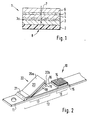
- the 1 consists of a base layer 2 made of a transparent plastic material, a color proof layer 3, a fixing layer 4, a flow control layer 5 and a conjugate layer 6.
- the layers 3-6 are attached to the base layer 2 in such a way that they are in full-surface contact with one another, which enables a uniform transfer of liquid in the direction transverse to the layer surface.
- the liquid transport path thus formed is indicated by arrow 7.
- test carrier The function of the test carrier shown as an example is explained on the basis of a test sequence which is modeled on the immunoenzymometric test principle. For example, if an antigen (Ag) contained in the sample is to be determined, the analysis proceeds as follows.
- a drop of sample for example blood, is applied to the conjugate layer 6 and spreads thereon.
- the layer 6 serves as a liquid supply layer for the layers following on the liquid transport path 7.
- the conjugate layer 6 contains an enzymatically labeled antibody (Ak) for the Ag in excess of the maximum Ag concentration in the sample.
- Ak enzymatically labeled antibody
- the antibody-enzyme conjugate (AkE) is released from the penetrating sample liquid. This creates complexes between the AkE and the Ag, which are referred to as Ag-AkE. Since the AkE is present in excess, free AkE remains when the equilibrium is established.
- the flow control layer 5 serves to control the point in time of the liquid transfer from the conjugate layer 6 into the fixing layer 4. It can in particular be designed as a delayed-release barrier layer, it consisting of a layer-forming material that is only slowly dissolved by the liquid. This procedure is known and need not be explained in more detail here. Through the flow control layer 5 it can be achieved that the complex formation between Ag and AkE in the conjugate layer 6 is practically completed before the liquid penetrates into the fixing layer 4. However, it should be emphasized that the flow control layer is optional.
- the fixation layer 4 serves to eliminate the AkE which interferes with further detection by immunological binding. It contains the Ag or an analogue thereof (another substance which can be specifically bound with the antibody) in a carrier-fixed form. When the liquid flows through the fixing layer 4, the non-complexed AkE binds with the carrier-fixed Ag (f), while the Ag-AkE complexes can continue to flow unhindered. The desired separation is thereby achieved.
- the enzymatically labeled complexes penetrate into the detection layer 3, which is a color-forming substrate S for the labeling enzyme E contains.
- the reaction between the enzyme and the substrate changes its color and the color formation is evidence of the concentration of the analyte Ag.
- the substrate Since the substrate is usually soluble in the detection layer 3, there is a risk that it will diffuse from layer 3 into layer 4 and possibly even into layers 5 and 6 after it has been detached from the sample. It comes into contact with labeling enzyme E, which is not characteristic of the analysis. This can lead to a falsification of the measurement result if the color formation is perceptible from the evaluation side 8.
- the color detection layer 3 is designed to be optically opaque, for example by embedding TiO2.
- a special liquid-permeable radiation-blocking layer 3a can also be provided between layers 3 and 4, which is indicated by dashed lines in the figure.
- test carrier according to the invention, it being understood that an antibody present in the sample can of course be determined in an analogous manner if antibodies and antigen are interchanged in the layer sequence of the test carrier.
- the invention is not limited to such a method. Rather, regardless of the details of the process sequence, it can be used advantageously anywhere, when passing a fixing layer 4 over a very short distance and in a very short time, a practically complete binding reaction between a carrier-fixed binding partner and one with the sample liquid transported binding partner should expire.
- Figure 2 shows a particularly preferred embodiment with which an analysis in a short time with high accuracy and with a very small amount of sample is possible.
- the test carrier 10 has a detection zone 12 on a base layer 11, on which the test layers that form the liquid transport path are arranged.
- An erythrocyte separation layer 15 is provided in a sample application zone 13 under a cover net 14.
- a conjugate layer 16 arranged between this and the base layer 11 runs from the sample application zone 13 into an evaluation zone 17 parallel to the surface of the base layer 11.
- a fixing layer 18, an optical barrier layer 19 and a color detection layer 20 are fastened such that they are shown in the illustration
- the initial state of the test carrier 10 is not in fluid contact with the conjugate layer 16 serving as the liquid supply layer, but can be brought into liquid contact by external manipulation.
- the shown layer sequence of the separate ones Layers 18, 19 and 20 are particularly advantageous.
- the fixing layer 18 can be extremely thin, preferably less than 0.5 mm, particularly preferably even less than 0.25 mm thick. As a result, it absorbs little sample liquid.
- the color detection layer 20 consists of a carrier film 20a and a reagent film layer 20b, which is coated on the side of the carrier film 20a facing in the conjugate layer 16 and is also extremely thin (layer thickness less than 200 »m). This allows intensive color detection with a small amount of sample. A prerequisite for an undisturbed evaluation of the color formation is a completely opaque optical barrier layer 19.
- the optical barrier layer 19 can be made sufficiently thick (layer thickness at least 50 »m) without the total need for sample liquid above the desired one Limit (in the example 30 »l) to increase.
- the optical barrier layer can also be coated directly on the reagent film layer 20b, which results in a further reduction in the liquid absorption.
- test sequence corresponds to that previously described in connection with FIG. 1, the layer 15 ensuring that the erythrocytes are separated from the blood so that they can no longer disrupt the subsequent reaction steps (in particular the color detection in layer 20).
- the construction shown with a flap allows an even more reliable time separation of the individual reaction steps than in the embodiment according to FIG. 1. This is of particular advantage in connection with the excellent separating action of the fixing layer 18 according to the invention, because, for example, in the reaction sequence described before the flap 18, 19, 20 is pressed against the conjugate layer 16, a first reaction step can take place completely and in a controlled manner, while the subsequent separation reaction using the fixing layer 18 can be carried out quickly and yet completely expires.
- the construction with a flap-like fixing layer means that the fixing layer 18 is flowed through in an extremely short time (typically less than 10 seconds). Nevertheless, according to the invention, a sufficient separating effect is achieved, as will be demonstrated in the following using exemplary embodiments.
- Two samples A, B, C are produced from test carriers according to FIG. 2, which differ from one another only with regard to the pore size P of the fixing layer 18 and the particle size D of the conjugate in the conjugate layer 16.
- the conjugate layer consists of a glass fiber fleece, which is coated with polyvinyl alcohol to facilitate detachment.
- This carrier matrix is covalently loaded with a theophylline polyhapten (protein coated with theophylline) with a loading density of 50 »g / cm2.
- the detection layer and the optical barrier layer consist of a dispersion reagent film using Propriofan (trademark of BASF AG) as a film former, in which chlorophenol red galactoside is embedded as a color-forming substrate.
- the optical barrier layer consists of titanium dioxide, which is coated directly on the color detection layer.
- the three samples are used to examine serum or blood with a total of six different concentrations of theophylline, for which purpose the commercially available device Reflotron (trademark of Boehringer Mannheim GmbH) is used.
- the flap 20 is pressed against the liquid supply layer 16 with a mechanism provided on this device, the shutter speed being 0.3 seconds. This time is an approximate measure of the time in which the fixing layer 18 is flowed through.
- Pre-reaction time solution of the conjugate and complex formation with the antigen in the sample: 120 sec, then closing the valve; Measurement of color formation after 120 sec.
- Biotinylated theophylline (theophylline-8-carboxypropyl-biotin) is additionally impregnated into the conjugate layer 16 at a concentration of 0.5 »g / ml.
- the layer 15 in pattern D corresponds to layer 15 in pattern A (high molecular weight conjugate) and in pattern E corresponds to pattern B and C (low molecular weight conjugate) in example 1.
- Both samples are used to measure serum with different concentrations of theophylline.
- the measuring technique is the same as in example 1, but the flap is closed more slowly. A shutter speed of 8 seconds ensures that the streptavidin is renatured to a sufficient extent after contact with the sample liquid.
- the test principle deviates from the test principle described in connection with FIG. 2 and example 1.
- the Ag displaces the biotinylated antigen (B-Ag) from its binding with the antibody-enzyme conjugate (AkE) from the sample. Complexes B-Ag-AkE and Ag-AkE are formed, the concentration of the latter complexes being higher the more antigen was in the sample.
- both complexes penetrate into the fixing layer 18, the biotin-containing complexes binding to the streptavidin and thereby being retained.
- the color formation in the color detection layer 20 is a measure of the antigen concentration.
Landscapes
- Health & Medical Sciences (AREA)
- Immunology (AREA)
- Life Sciences & Earth Sciences (AREA)
- Engineering & Computer Science (AREA)
- Molecular Biology (AREA)
- Biomedical Technology (AREA)
- Chemical & Material Sciences (AREA)
- Hematology (AREA)
- Urology & Nephrology (AREA)
- Biotechnology (AREA)
- Microbiology (AREA)
- Cell Biology (AREA)
- Food Science & Technology (AREA)
- Medicinal Chemistry (AREA)
- Physics & Mathematics (AREA)
- Analytical Chemistry (AREA)
- Biochemistry (AREA)
- General Health & Medical Sciences (AREA)
- General Physics & Mathematics (AREA)
- Pathology (AREA)
- Investigating Or Analyzing Non-Biological Materials By The Use Of Chemical Means (AREA)
- Investigating Or Analysing Biological Materials (AREA)
Claims (11)
- Support de test pour la détermination analytique d'un composant dans un liquide de prélèvement à l'aide d'une réaction spécifique de liaison de deux partenaires de liaison bioaffines, muni d'une multitude de couches de test qui sont disposées de façon à être imprégnées les unes après les autres par le liquide et à constituer un parcours de liquide (7), une des couches de test étant une couche de fixation (4, 18) qui présente une matrice porteuse poreuse sur laquelle est fixé le premier des deux partenaires de liaison, la couche de fixation (4, 18) étant disposée sur le support de test (1, 10) de façon à être traversée perpendiculairement à sa surface par le liquide qui contient le second partenaire de liaison, et au moins une couche absorbante (3, 19, 20) étant prévue dans le parcours de liquide (7), derrière la couche de fixation (4, 18), caractérisé en ce que la matrice porteuse de la couche de fixation (4, 18) est une couche de plastique microporeuse avec une grosseur de pores P d'au moins 0,01 »m et en ce que la grosseur D du second partenaire de liaison ainsi que la grosseur de pores P de la couche de plastique sont adaptées l'une à l'autre de telle sorte que la grosseur de pores P est au moins deux et au maximum dix fois aussi importante que la grosseur D du second partenaire de liaison.
- Support de test selon la revendication 1, caractérisé en ce que le second partenaire de liaison est agrandi par liaison chimique à un poids moléculaire supérieur à celui auquel correspond sa forme monomère.
- Support de test selon la revendication 2, caractérisé en ce que le second partenaire de liaison est un oligomère ou un polymère de la forme monomère.
- Support de test selon la revendication 2, caractérisé en ce que le second partenaire de liaison est agrandi par liaison chimique avec un partenaire de liaison inerte par rapport à la réaction de liaison bioaffine.
- Support de test selon la revendication 2, caractérisé en ce que le premier partenaire de liaison contient de la streptavidine et le second partenaire de liaison de la biotine.
- Support de test selon la revendication 1, caractérisé en ce qu'une couche d'indication colorée (20) est disposée dans le parcours de liquide, derrière la couche de fixation (18), et une couche optique d'arrêt (19) entre la couche de fixation (18) et la couche d'indication colorée (20).
- Support de test selon l'une des revendications précédentes, caractérisé en ce que l'épaisseur de la couche de fixation est inférieure à 0,5 mm et, en particulier, inférieure à 0,25 mm.
- Support de test selon l'une des revendications précédentes, caractérisé en ce qu'un élément de contrôle de l'écoulement (5, 22) à travers lequel peut être commandé le moment de passage du liquide de prélèvement par la couche de fixation est affecté à la couche de fixation.
- Support de test selon la revendication 8, caractérisé en ce que la couche de fixation (18) est fixée au support de test (10) de façon à ne pas être en contact fluidique avec une couche d'amenée du liquide préalablement logée dans le parcours de liquide (16), lorsque le support de test (10) est à l'état de sortie mais à pouvoir être mise en contact fluidique avec la couche d'amenée du liquide (16).
- Support de test selon la revendication 9 en liaison avec la revendication 6, caractérisé en ce que la couche de fixation (18), la couche optique d'arrêt, (19) et la couche d'indication colorée (20) sont disposées dans cet ordre, comme un clapet, au-dessus de la couche d'amenée du liquide.
- Support de test selon l'une des revendications précédentes, caractérisé en ce que la couche de fixation (18) se compose de difluorure de polyvinyle, de polyamide, de polystyrol ou de nitrocellulose.
Applications Claiming Priority (2)
| Application Number | Priority Date | Filing Date | Title |
|---|---|---|---|
| DE4015378A DE4015378A1 (de) | 1990-05-14 | 1990-05-14 | Testtraeger fuer die analytische bestimmung eines bestandteils einer probenfluessigkeit |
| DE4015378 | 1990-05-14 |
Publications (3)
| Publication Number | Publication Date |
|---|---|
| EP0457123A2 EP0457123A2 (fr) | 1991-11-21 |
| EP0457123A3 EP0457123A3 (en) | 1992-11-19 |
| EP0457123B1 true EP0457123B1 (fr) | 1995-07-19 |
Family
ID=6406317
Family Applications (1)
| Application Number | Title | Priority Date | Filing Date |
|---|---|---|---|
| EP91107169A Expired - Lifetime EP0457123B1 (fr) | 1990-05-14 | 1991-05-03 | Support de test pour la détermination analytique d'un composant dans un liquide de prélèvement |
Country Status (7)
| Country | Link |
|---|---|
| US (1) | US5232663A (fr) |
| EP (1) | EP0457123B1 (fr) |
| JP (1) | JP2505658B2 (fr) |
| AT (1) | ATE125364T1 (fr) |
| DE (2) | DE4015378A1 (fr) |
| ES (1) | ES2076404T3 (fr) |
| GR (1) | GR3017007T3 (fr) |
Families Citing this family (8)
| Publication number | Priority date | Publication date | Assignee | Title |
|---|---|---|---|---|
| BE1007067A3 (nl) | 1992-07-15 | 1995-03-07 | Emiel Vanderstraeten Besloten | Sputterkathode en werkwijze voor het vervaardigen van deze kathode. |
| IL108159A (en) * | 1993-12-23 | 1998-02-08 | Orgenics Ltd | Apparatus for separation, concentration and detection of target molecules in liquid sample |
| US5620860A (en) * | 1995-02-24 | 1997-04-15 | Johnson & Johnson Clinical Diagnostics | Method for washing immunoassay elements |
| US5641688A (en) * | 1995-06-06 | 1997-06-24 | Johnson & Johnson Clinical Diagnostics, Inc. | Immunoassay including washing a slide at different locations |
| US5879951A (en) | 1997-01-29 | 1999-03-09 | Smithkline Diagnostics, Inc. | Opposable-element assay device employing unidirectional flow |
| US5939252A (en) | 1997-05-09 | 1999-08-17 | Lennon; Donald J. | Detachable-element assay device |
| US8475735B2 (en) * | 2004-11-01 | 2013-07-02 | Uma Mahesh Babu | Disposable immunodiagnostic test system |
| ES2564169T3 (es) * | 2004-11-24 | 2016-03-18 | Techlab, Inc. | Dispositivo y método para la detección de analitos |
Family Cites Families (15)
| Publication number | Priority date | Publication date | Assignee | Title |
|---|---|---|---|---|
| US4361537A (en) * | 1979-01-12 | 1982-11-30 | Thyroid Diagnostics, Inc. | Test device and method for its use |
| JPS5818167A (ja) * | 1981-07-24 | 1983-02-02 | Fuji Photo Film Co Ltd | 分析フイルム及びこれを用いる分析方法 |
| JPS5934154A (ja) * | 1982-08-19 | 1984-02-24 | Konishiroku Photo Ind Co Ltd | 免疫分析素子測定法 |
| DE3247608A1 (de) * | 1982-12-23 | 1984-07-05 | Boehringer Mannheim Gmbh, 6800 Mannheim | Teststreifen |
| DE3445816C1 (de) * | 1984-12-15 | 1986-06-12 | Behringwerke Ag, 3550 Marburg | Flaechenfoermiges diagnostisches Mittel |
| DE3529094A1 (de) * | 1985-03-13 | 1986-09-18 | Miles Laboratories, Inc., Elkhart, Ind. | An polyamide oder cellulosehydrat immobilisierte proteine und deren verwendung zur herstellung von biokatalysatoren, teststreifen oder chromatographiematerialien |
| US4806311A (en) * | 1985-08-28 | 1989-02-21 | Miles Inc. | Multizone analytical element having labeled reagent concentration zone |
| US4851210A (en) * | 1986-05-22 | 1989-07-25 | Genelabs Incorporated | Blood typing device |
| DE3638654A1 (de) * | 1986-11-12 | 1988-05-26 | Boehringer Mannheim Gmbh | Testtraeger zur analytischen bestimmung eines bestandteils einer koerperfluessigkeit |
| DE3640318A1 (de) * | 1986-11-26 | 1988-06-09 | Boehringer Mannheim Gmbh | Verfahren und testtraeger zur bestimmung eines analyten |
| GB2199946A (en) * | 1987-01-12 | 1988-07-20 | Pall Corp | Diagnostic device, |
| DE3740471A1 (de) * | 1987-11-28 | 1989-06-08 | Boehringer Mannheim Gmbh | Testtraeger zur analyse einer probenfluessigkeit und verfahren zu seiner herstellung |
| US4891313A (en) * | 1988-01-21 | 1990-01-02 | Boehringer Manheim Corporation | Method for determination of a component of a sample |
| DE3814370A1 (de) * | 1988-04-28 | 1989-11-09 | Boehringer Mannheim Gmbh | Testtraeger fuer die analyse einer probenfluessigkeit, verfahren zur durchfuehrung einer solchen analyse und herstellungsverfahren |
| DE3826057A1 (de) * | 1988-07-30 | 1990-02-01 | Boehringer Mannheim Gmbh | Testtraeger zur analytischen bestimmung eines bestandteils einer fluessigen probe |
-
1990
- 1990-05-14 DE DE4015378A patent/DE4015378A1/de not_active Withdrawn
-
1991
- 1991-05-03 ES ES91107169T patent/ES2076404T3/es not_active Expired - Lifetime
- 1991-05-03 EP EP91107169A patent/EP0457123B1/fr not_active Expired - Lifetime
- 1991-05-03 AT AT91107169T patent/ATE125364T1/de not_active IP Right Cessation
- 1991-05-03 DE DE59106009T patent/DE59106009D1/de not_active Expired - Fee Related
- 1991-05-08 JP JP3102837A patent/JP2505658B2/ja not_active Expired - Fee Related
- 1991-05-09 US US07/697,566 patent/US5232663A/en not_active Expired - Fee Related
-
1995
- 1995-08-02 GR GR950402127T patent/GR3017007T3/el unknown
Also Published As
| Publication number | Publication date |
|---|---|
| DE59106009D1 (de) | 1995-08-24 |
| JPH04231875A (ja) | 1992-08-20 |
| US5232663A (en) | 1993-08-03 |
| EP0457123A3 (en) | 1992-11-19 |
| JP2505658B2 (ja) | 1996-06-12 |
| GR3017007T3 (en) | 1995-11-30 |
| DE4015378A1 (de) | 1991-11-21 |
| EP0457123A2 (fr) | 1991-11-21 |
| ATE125364T1 (de) | 1995-08-15 |
| ES2076404T3 (es) | 1995-11-01 |
Similar Documents
| Publication | Publication Date | Title |
|---|---|---|
| EP0353500B1 (fr) | Bande-test pour la détermination analytique d'un composant dans un échantillon liquide | |
| DE69636389T2 (de) | Vorrichtungen und verfahren zur abtrennung zellulärer blutbestandteile von flüssigen blutanteilen | |
| DE69921199T2 (de) | Zweirichtungsquerflussteststreifen und verfahren | |
| DE69936916T2 (de) | Liganden-bindetest und kit mit einer abtrennzone für störende probenkomponenten | |
| DE3887491T2 (de) | Chromatographische Bindungstesteinrichtungen und Verfahren. | |
| DE68911395T3 (de) | Vorrichtung zum Transportieren von Flüssigkeiten und Vorrichtung zur diagnostischen Analyse. | |
| DE3879048T2 (de) | Geraet fuer die laterale immunochromatographische bestimmung. | |
| DE3887771T2 (de) | Immunoassays und Vorrichtungen dafür. | |
| DE602004013147T2 (de) | Nativer analyt als referenz in lateralfluss-assays | |
| DE69630295T2 (de) | Diagnostische vorrichtung und verfahren | |
| DE69608880T2 (de) | Testsatz und verfahren | |
| DE3852040T2 (de) | Vorrichtung und verfahren zur bestimmung einer komponente einer probe. | |
| DD280610A5 (de) | Testtraeger fuer die analyse einer probenfluessigkeit, verfahren zur durchfuehrung einer solchen analyse und herstellungsverfahren | |
| EP0634215A1 (fr) | Dispositif pour la détermination simultanée d'analytes | |
| EP0309883B1 (fr) | Bande d'analyse pour la détermination d'un composant dans un fluide corporel | |
| DE10009503A1 (de) | Verfahren zur Immobilisierung von Konjugaten in diagnostischen Tests | |
| DE10330982A1 (de) | Vorrichtung und Verfahren zur simultanen Bestimmung von Blutgruppenantigenen | |
| EP0290921A2 (fr) | Diagnostique pour l'analyse des échantillons liquides et procédé pour leur préparation | |
| EP1759209B1 (fr) | Procede pour elargir la plage de mesure dynamique d'elements servant a realiser des tests notamment immunologiques, bases sur des reactions de fixation specifiques | |
| DE3784479T2 (de) | Diagnostisches hilfsmittel, seine herstellung und seine verwendung. | |
| DE69719737T2 (de) | Immunoassay von vollblutproben | |
| EP1141713A1 (fr) | Procede et dispositif pour determiner un analyte | |
| DE69837092T2 (de) | Immunoassayvorrichtung | |
| DE69815325T2 (de) | Feststellung von analyten mit niedrigen gehalt in proben | |
| EP0586789B1 (fr) | Enrichissement réparti uniformément d'une substance en solution sur la face à pores minces d'une membrane poreuse asymétrique |
Legal Events
| Date | Code | Title | Description |
|---|---|---|---|
| PUAI | Public reference made under article 153(3) epc to a published international application that has entered the european phase |
Free format text: ORIGINAL CODE: 0009012 |
|
| 17P | Request for examination filed |
Effective date: 19910503 |
|
| AK | Designated contracting states |
Kind code of ref document: A2 Designated state(s): AT BE CH DE DK ES FR GB GR IT LI LU NL SE |
|
| PUAL | Search report despatched |
Free format text: ORIGINAL CODE: 0009013 |
|
| AK | Designated contracting states |
Kind code of ref document: A3 Designated state(s): AT BE CH DE DK ES FR GB GR IT LI LU NL SE |
|
| 17Q | First examination report despatched |
Effective date: 19941004 |
|
| GRAA | (expected) grant |
Free format text: ORIGINAL CODE: 0009210 |
|
| AK | Designated contracting states |
Kind code of ref document: B1 Designated state(s): AT BE CH DE DK ES FR GB GR IT LI LU NL SE |
|
| PG25 | Lapsed in a contracting state [announced via postgrant information from national office to epo] |
Ref country code: GB Effective date: 19950719 Ref country code: DK Effective date: 19950719 Ref country code: BE Effective date: 19950719 |
|
| REF | Corresponds to: |
Ref document number: 125364 Country of ref document: AT Date of ref document: 19950815 Kind code of ref document: T |
|
| REF | Corresponds to: |
Ref document number: 59106009 Country of ref document: DE Date of ref document: 19950824 |
|
| ET | Fr: translation filed | ||
| ITF | It: translation for a ep patent filed | ||
| REG | Reference to a national code |
Ref country code: GR Ref legal event code: FG4A Free format text: 3017007 |
|
| REG | Reference to a national code |
Ref country code: ES Ref legal event code: FG2A Ref document number: 2076404 Country of ref document: ES Kind code of ref document: T3 |
|
| GBV | Gb: ep patent (uk) treated as always having been void in accordance with gb section 77(7)/1977 [no translation filed] |
Effective date: 19950719 |
|
| PLBE | No opposition filed within time limit |
Free format text: ORIGINAL CODE: 0009261 |
|
| STAA | Information on the status of an ep patent application or granted ep patent |
Free format text: STATUS: NO OPPOSITION FILED WITHIN TIME LIMIT |
|
| PG25 | Lapsed in a contracting state [announced via postgrant information from national office to epo] |
Ref country code: LU Free format text: LAPSE BECAUSE OF NON-PAYMENT OF DUE FEES Effective date: 19960531 |
|
| 26N | No opposition filed | ||
| PGFP | Annual fee paid to national office [announced via postgrant information from national office to epo] |
Ref country code: SE Payment date: 20010417 Year of fee payment: 11 |
|
| PGFP | Annual fee paid to national office [announced via postgrant information from national office to epo] |
Ref country code: AT Payment date: 20010514 Year of fee payment: 11 |
|
| PGFP | Annual fee paid to national office [announced via postgrant information from national office to epo] |
Ref country code: FR Payment date: 20010518 Year of fee payment: 11 |
|
| PGFP | Annual fee paid to national office [announced via postgrant information from national office to epo] |
Ref country code: GR Payment date: 20010530 Year of fee payment: 11 Ref country code: ES Payment date: 20010530 Year of fee payment: 11 |
|
| PGFP | Annual fee paid to national office [announced via postgrant information from national office to epo] |
Ref country code: NL Payment date: 20010531 Year of fee payment: 11 |
|
| PG25 | Lapsed in a contracting state [announced via postgrant information from national office to epo] |
Ref country code: AT Free format text: LAPSE BECAUSE OF NON-PAYMENT OF DUE FEES Effective date: 20020503 |
|
| PG25 | Lapsed in a contracting state [announced via postgrant information from national office to epo] |
Ref country code: SE Free format text: LAPSE BECAUSE OF NON-PAYMENT OF DUE FEES Effective date: 20020504 Ref country code: ES Free format text: LAPSE BECAUSE OF NON-PAYMENT OF DUE FEES Effective date: 20020504 |
|
| PGFP | Annual fee paid to national office [announced via postgrant information from national office to epo] |
Ref country code: DE Payment date: 20020508 Year of fee payment: 12 |
|
| PGFP | Annual fee paid to national office [announced via postgrant information from national office to epo] |
Ref country code: CH Payment date: 20020517 Year of fee payment: 12 |
|
| PG25 | Lapsed in a contracting state [announced via postgrant information from national office to epo] |
Ref country code: NL Free format text: LAPSE BECAUSE OF NON-PAYMENT OF DUE FEES Effective date: 20021201 |
|
| PG25 | Lapsed in a contracting state [announced via postgrant information from national office to epo] |
Ref country code: GR Free format text: LAPSE BECAUSE OF NON-PAYMENT OF DUE FEES Effective date: 20021206 |
|
| EUG | Se: european patent has lapsed | ||
| PG25 | Lapsed in a contracting state [announced via postgrant information from national office to epo] |
Ref country code: FR Free format text: LAPSE BECAUSE OF NON-PAYMENT OF DUE FEES Effective date: 20030131 |
|
| NLV4 | Nl: lapsed or anulled due to non-payment of the annual fee |
Effective date: 20021201 |
|
| REG | Reference to a national code |
Ref country code: FR Ref legal event code: ST |
|
| PG25 | Lapsed in a contracting state [announced via postgrant information from national office to epo] |
Ref country code: LI Free format text: LAPSE BECAUSE OF NON-PAYMENT OF DUE FEES Effective date: 20030531 Ref country code: CH Free format text: LAPSE BECAUSE OF NON-PAYMENT OF DUE FEES Effective date: 20030531 |
|
| PG25 | Lapsed in a contracting state [announced via postgrant information from national office to epo] |
Ref country code: DE Free format text: LAPSE BECAUSE OF NON-PAYMENT OF DUE FEES Effective date: 20031202 |
|
| REG | Reference to a national code |
Ref country code: CH Ref legal event code: PL |
|
| REG | Reference to a national code |
Ref country code: ES Ref legal event code: FD2A Effective date: 20030611 |
|
| PG25 | Lapsed in a contracting state [announced via postgrant information from national office to epo] |
Ref country code: IT Free format text: LAPSE BECAUSE OF NON-PAYMENT OF DUE FEES;WARNING: LAPSES OF ITALIAN PATENTS WITH EFFECTIVE DATE BEFORE 2007 MAY HAVE OCCURRED AT ANY TIME BEFORE 2007. THE CORRECT EFFECTIVE DATE MAY BE DIFFERENT FROM THE ONE RECORDED. Effective date: 20050503 |