EP0457280B1 - Projektionsschirm und Projektionssystem mit diesem Schirm - Google Patents
Projektionsschirm und Projektionssystem mit diesem Schirm Download PDFInfo
- Publication number
- EP0457280B1 EP0457280B1 EP91107801A EP91107801A EP0457280B1 EP 0457280 B1 EP0457280 B1 EP 0457280B1 EP 91107801 A EP91107801 A EP 91107801A EP 91107801 A EP91107801 A EP 91107801A EP 0457280 B1 EP0457280 B1 EP 0457280B1
- Authority
- EP
- European Patent Office
- Prior art keywords
- lens
- screen
- array
- sheet
- screen according
- Prior art date
- Legal status (The legal status is an assumption and is not a legal conclusion. Google has not performed a legal analysis and makes no representation as to the accuracy of the status listed.)
- Expired - Lifetime
Links
- 230000003287 optical effect Effects 0.000 claims description 30
- 230000004907 flux Effects 0.000 claims description 17
- 238000009826 distribution Methods 0.000 claims description 15
- 238000003491 array Methods 0.000 claims description 5
- 239000000463 material Substances 0.000 description 13
- 238000009125 cardiac resynchronization therapy Methods 0.000 description 4
- 230000000694 effects Effects 0.000 description 4
- NIXOWILDQLNWCW-UHFFFAOYSA-N acrylic acid group Chemical group C(C=C)(=O)O NIXOWILDQLNWCW-UHFFFAOYSA-N 0.000 description 3
- 230000004075 alteration Effects 0.000 description 3
- 238000000034 method Methods 0.000 description 3
- 238000010521 absorption reaction Methods 0.000 description 2
- 238000012423 maintenance Methods 0.000 description 2
- 238000004519 manufacturing process Methods 0.000 description 2
- 239000004033 plastic Substances 0.000 description 2
- 239000004417 polycarbonate Substances 0.000 description 2
- 229920000515 polycarbonate Polymers 0.000 description 2
- 229920000642 polymer Polymers 0.000 description 2
- 206010010071 Coma Diseases 0.000 description 1
- 239000004641 Diallyl-phthalate Substances 0.000 description 1
- YCKRFDGAMUMZLT-UHFFFAOYSA-N Fluorine atom Chemical compound [F] YCKRFDGAMUMZLT-UHFFFAOYSA-N 0.000 description 1
- 206010073261 Ovarian theca cell tumour Diseases 0.000 description 1
- QUDWYFHPNIMBFC-UHFFFAOYSA-N bis(prop-2-enyl) benzene-1,2-dicarboxylate Chemical compound C=CCOC(=O)C1=CC=CC=C1C(=O)OCC=C QUDWYFHPNIMBFC-UHFFFAOYSA-N 0.000 description 1
- 239000003086 colorant Substances 0.000 description 1
- 238000010276 construction Methods 0.000 description 1
- 230000001419 dependent effect Effects 0.000 description 1
- 238000011161 development Methods 0.000 description 1
- 230000018109 developmental process Effects 0.000 description 1
- 238000006073 displacement reaction Methods 0.000 description 1
- 239000000428 dust Substances 0.000 description 1
- 229910052731 fluorine Inorganic materials 0.000 description 1
- 239000011737 fluorine Substances 0.000 description 1
- 239000011521 glass Substances 0.000 description 1
- 230000005499 meniscus Effects 0.000 description 1
- 239000000178 monomer Substances 0.000 description 1
- 230000002093 peripheral effect Effects 0.000 description 1
- 208000001644 thecoma Diseases 0.000 description 1
- 239000012780 transparent material Substances 0.000 description 1
Images





Classifications
-
- G—PHYSICS
- G03—PHOTOGRAPHY; CINEMATOGRAPHY; ANALOGOUS TECHNIQUES USING WAVES OTHER THAN OPTICAL WAVES; ELECTROGRAPHY; HOLOGRAPHY
- G03B—APPARATUS OR ARRANGEMENTS FOR TAKING PHOTOGRAPHS OR FOR PROJECTING OR VIEWING THEM; APPARATUS OR ARRANGEMENTS EMPLOYING ANALOGOUS TECHNIQUES USING WAVES OTHER THAN OPTICAL WAVES; ACCESSORIES THEREFOR
- G03B21/00—Projectors or projection-type viewers; Accessories therefor
- G03B21/54—Accessories
- G03B21/56—Projection screens
- G03B21/60—Projection screens characterised by the nature of the surface
- G03B21/62—Translucent screens
- G03B21/625—Lenticular translucent screens
Definitions
- the present invention relates to a screen and a projection system using said screen, and more particularly to a screen having a lenticular sheet and a projector system for displaying an image using such screen.
- Figs. 1 and 2 are a perspective view and a side view showing a rear projection display unit which has been conventionally used, respectively.
- Fig. 3 shows an optical arrangement of the display unit developed in a plane.
- red, green and blue images displayed respectively on the tube planes of three CRTs 111R, 111G and 111B are magnified and projected via three projection lenses 112R, 112G and 112B, and a reflecting mirror 113, so that a color image built up by the red, green and blue images is displayed on a translucent (or transmissible) screen 114.
- the screen 114 is composed of a Fresnel lens sheet 114a having a function of directing a light from each of projection lenses 112R, 112G, 112B toward the observer and a lenticular lens sheet 114b having a function of extending the angle of visibility of the unit by diffusing the light, as shown in Fig. 3.
- lights ⁇ R , ⁇ G , ⁇ B reaching an arbitrary point a on the screen 114 are incident at a certain angle ⁇ (thereafter referred to as "convergence angle").
- ⁇ thereafter referred to as "convergence angle”
- lights ⁇ R , ⁇ G , ⁇ B diffused by the lenticular lens sheet 114b have different directions with the most intensive lights ⁇ R , ⁇ G , ⁇ B , depending on the convergence angle of each light ⁇ R , ⁇ G , ⁇ B , so that a phenomenon called a "color shift", in which the color appears to be varied depending on a direction of observation, may occur, causing a degraded image.
- the shapes of lens surfaces on the incident and emergent surfaces are made aspherical so as to eliminate the color shift with the effects of both aspherical surfaces.
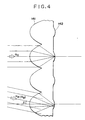
- Fig. 4 is an enlarged view showing a basic construction of the lenticular lens sheet as described in the above application.
- the lenticular lens sheet is a two-sided lenticular lens sheet composed of an incident external surface 141 formed of aspherical lens surfaces in or near elliptical shape, and an emergent external surface 142 formed of aspherical lens surfaces having a positive power disposed in an area onto which the light beam refracted at the incident surface converges.
- the light beam refracted at the incident surface 141 will converge into one point, at or near which convergent point is disposed the emergent surface 142.
- the light fluxes from the red and blue projection lenses 112R, 112B having non zero incident angles of principal light beams onto the lenticular lens sheet may produce a coma aberration due to refraction at the incident surface 141, and so do not converge into a point on the emergent surface 142.
- a mechanism for eliminating the color shift makes use of the displacement of incident position onto the emergent surface 142 which may be caused by the coma aberration. That is, the refractive angle at the emergent surface 142 of principal light beams in light fluxes from the projection lenses 112R, 112B incident onto each point on the emergent surface 142 are adjusted so that the luminance distribution of diffused light formed on the operator side by light flux from the projection lens 112G and that of each of light fluxes from the projection lenses 112R, 112B may coincide.
- the orientation of plane can be determined to correspond to the above refractive angle, so that the emergent surface can be shaped by connecting them smoothly.
- Fig. 5 is a schematic view for explanation of the principle for eliminating the above color shift by replacement with a telecentric optical system.
- An optical system of Fig. 5 places a diaphragm 151 at the focal position of a condenser lens 152, wherein when light beams of three colors R, G, B with equal intensities enter this optical system at different incident angles, each emergent light beam will exit therefrom with equal intensity and direction. This means that the color shift has been eliminated.
- the effective width of lens surfaces on the incident surface 141 must be extended. Accordingly, with a wider angle of visibility, the distance between incident and emergent surfaces (plate thickness) for a lens pitch of the lenticular lens sheet is correspondingly reduced. For example, to obtain an angle of visibility (half band width) of 40°, the sheet thickness for the lenticular lens sheet must be thinned up to a pitch of lens for the lenticular lens sheet.
- the screen for high definition image display unit such as HDTV (a pitch of 0.4mm for the lenticular lens sheet is necessary for a horizontal resolution of 1000 lines and a screen size of 1000 mm (40 inches) (aspect ratio 9:16)) may require a very thin lenticular lens sheet, thereby causing a lack of mechanical strength.
- the screen of high definition has a disadvantage that owing to finer pitch of lens, blinding due to dust and dirt may easily occur, which requires to perform the maintenance.
- Document JP-A-634228 discloses a screen for displaying an image projected onto the screen.
- the screen comprises a lenticular lens sheet of a transparent material having a major surface which constitutes an array of lens surfaces each having a positive refractive power.
- a circular concave Fresnel lens is bonded to that side of the lenticular lens sheet opposite to the array of lens surfaces.
- the Fresnel lens is constituted by an array of lens portions, each of these lens portions having a refractive index higher than that of the lenticular lens sheet and a positive refractive power on the interface with the lenticular lens sheet.
- the present invention provides an improved screen and an improved projection system.
- a screen according to a first aspect of the present invention comprises the features of claim 1.
- a screen according to a second aspect of the present invention comprises the features of claim 11.
- Projection systems according to the present invention are defined in claims 19 and 20.
- Figs. 1 and 2 are a perspective view and a side view showing a constituion of conventional example, respectively.
- Fig. 3 is a view showing a conventional optical arrangement expanded in a plane.
- Fig. 4 is a view showing a basic constitution for a conventional lenticular lens sheet.
- Fig. 5 is a view for explaining a principle of eliminating the color shift in a conventional example.
- Figs. 6 and 7 are a perspective view and a side view showing a consitution of a first example according to the present invention, respectively.
- Fig. 8 is a view showing an optical arrangement of the first example expanded in a plane.
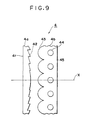
- Fig. 9 is an upper view for explaining in detail the constitution of a screen 4 as shown in Fig. 6.
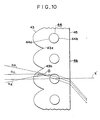
- Fig. 10 is a partial enlarged view for explaining the constitution of a lenticular lens sheet 4b as shown in Fig. 9.
- Fig. 11 is a view showing an optical principle for explaining a color shift eliminating mechanism in the first example.
- Fig. 12 is a view for explaining an example of method for fabricating the lenticular lens sheet 4b as shown in Fig. 9.
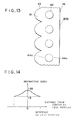
- Fig. 13 is a view showing the constitution of essential parts in a second example according to the present invention.
- Fig. 14 is a view showing a distribution of refractive index in the direction symmetrical to the central axis of a lens portion 82 as shown in Fig. 13.
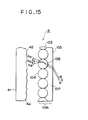
- Fig. 15 is an upper view showing a constitution of essential parts in a third example according to the present invention.
- an example of a translucent (or transmissible) screen as disclosed below is one having a lenticular lens sheet for diffusing the light in a horizontal direction, in which the lenticular lens sheet comprises an array of lens portions provided along a travelling direction of the incident light.
- the opposite surfaces of the lens portions constitute a first and a second array of lens surfaces which are formed in the interior of the lenticular lens sheet.
- the lenticular lens sheet furthermore comprises a third array of lens surfaces for causing the refractive action of a positive power.
- lens surfaces of the third array of lens surfaces aspherical shaped lens surfaces are shown in which the curvature gradually increases from the optical axis to the outside thereof, such as stretching an incident surface in a direction of optical axis.
- lens portions there are shown a form of bar-like lens portions which are formed of a material of higher refractive index than a material of a transparent layer of the sheet for defining the incident and emergent surfaces embedded in the interior of the lenticular lens sheet.
- the light incident upon an incident surface of the lenticular lens sheet passes through the lens surfaces of the first to third arrays of lens surfaces, and exits in diffused ray from an emergent surface of sheet.
- the first, the second and the third lens surfaces produce the positive power refractive index action
- the above incident light is converged by the third lens surfaces if the third lens surfaces are formed on the incident surface, and further converged in passing through the first and second lens surfaces formed in the interior of lenticular lens, so that it exits in diffused state from the emergent surface.
- this emergent surface may not (or may) give the lens action, it can be formed flat.
- the refractive angle of light beam at the first and second lens surfaces is different depending on the incident position of light beam onto the first lens surfaces, it is also possible to make the incident lights in parallel form and emanate them, when a plurality of incident lights (e.g., light for each color of R, G, B) enter the lenticular lens sheet at different angles.
- a plurality of incident lights e.g., light for each color of R, G, B
- an example of a translucent (or transmissible) screen as disclosed below is one having a lenticular lens sheet for diffusing the light in a horizontal direction, in which the lenticular lens sheet comprises a first array of lens surfaces for causing the refractive action of a positive power and a second array of lens surfaces provided along a travelling direction of the incident light, with the second array of lens surfaces being formed in the interior of the lenticular lens sheet.
- An array of bar-like lens portions of the refractive index distribution type is commonly used for the first and second arrays of lens surfaces, wherein the first array of lens surfaces is disposed on an incident surface of the lenticular lens sheet.
- the light incident upon an incident surface of the lenticular lens sheet passes through the first and second arrays of lens surfaces, and exits in diffused ray from an emergent surface of sheet.
- both the first and the second lens surfaces produce the positive power refractive index action
- the above incident light is converged by the lens surfaces of the first array of lens surfaces if the first array of lens surfaces is formed on the incident surface, and further converged in passing through the lens surfaces of the second array of lens surfaces formed in the interior of lenticular lens sheet, so that it exits in diffused state from the emergent surface.
- this emergent surface may not (or may) give the lens action, it can be formed flat. Since the refractive angle of light beam at the second array of lens surfaces is different depending on the incident position of light beam onto the lens surfaces of the second array of lens surfaces, it is also possible to make the incident lights in parallel form and emanate them, when a plurality of incident lights (e.g., light for each color of R, G, B) enter the lenticular lens at different angles.
- a plurality of incident lights e.g., light for each color of R, G, B
- a projection type display unit is constituted with the lenticular lens sheet according to the first or second aspect, a wide angle of visibility can be obtained with the above action and the color shift is not produced.
- Figs. 6 and 7, respectively, are a perspective view and a side view showing the constitution of an example of a projection system according to the present invention, this projection system being a rear projection display unit.
- Fig. 8 shows an optical arrangement of the rear projection display unit expanded in a plane.
- red, green and blue images displayed respectively on tube planes of three CRTs, 1R, 1G and 1B are magnified and projected via three projection lenses 2R, 2G and 2B and a reflecting mirror 3, so that a color image built up of red, green and blue images is displayed on a translucent screen 4.
- Each of the three CRTs 1R, 1G and 1B forms a projecting optical system together with the respective one of the projection lenses 2R, 2G and 2B.
- the screen 4 is composed of a Fresnel lens sheet 4a having a function of directing a light from each of projection lenses 2R, 2G, 2B toward the observer and a lenticular lens sheet 4b having a function of extending the angle of visibility of the unit by diffusing the light, as shown in Fig. 8.
- the lights ⁇ R , ⁇ G , ⁇ B reaching an arbitrary point ⁇ on the screen are incident thereon at a certain angle ⁇ (thereafter referred to as "convergence angle").
- ⁇ the angle ⁇
- the pupil center distance for each projection lens 2R, 2G, 2B is about 150mm.
- the projection distance is 800mm (the maximum angle of view for the projection lens is about 33 degrees in a diagonal display screen size of 1016 mm (40 inches)), the convergence angle ⁇ on a central portion of screen is about 10 degrees.
- Fig. 9 is an upper view for explaining in detail the constitution of a screen 4.
- a Fresnel lens sheet 4a constituting an element of the screen 4 comprises an incident surface 41 of plane and an emergent surface 42 of Fresnel lens plane.
- the focal distance of the Fresnel lens sheet 4a is approximately equal to a distance between each of projection lenses 2R, 2G, 2B and the screen 4, so that each light flux (principal light beam) expanding all over the screen from each projection lens 2R, 2G, 2B is deflected to be approximately parallel to the optical axis X of lenticular lens sheet 4b.
- the Fresnel lens sheet 4a is made of a plastic material such as acrylic or polycarbonate.
- An incident major surface 43 of lenticular lens sheet 4b as shown in Fig. 9 has a lenticular shape and is constituted by an array of cylindrical and aspherical lens surfaces each having a positive refractive power, like a conventional incident surface 141 as shown in Fig. 4.
- the array of lens surfaces constituting the incident major surface 43 is designated "the third array of lens surfaces”.
- the lenticular lens sheet 4b furthermore comprises an array of cylindrical lens portions 44 which are arranged in the area onto which each light beam refracted at the incident major surface 43 is converged and which are made of a homogeneous medium with higher refractive index than that of a transparent layer into which the lens portions 44 are embedded.
- the surfaces of the lens portions 44 constitute a first array of lens surfaces 44a and a second array of lens surfaces 44b, these surfaces having a refractive action of positive power.
- An emergent major surface 45 of the sheet 4b is a flat surface.
- the light flux deflected by the Fresnel lens sheet 4a enter the lenticular lens sheet 4b over the whole area on the screen, in approximately parallel to the above optical axis X for the principal light beam from the green projection lens 2G, or in the direction oblique to the optical axis (i.e., with some convergence angle) for the principal light beams from the red or blue projection lenses 2R, 2B.
- Fig. 10 is a partially enlarged view for explaining the constitution of a lenticular lens sheet 4b, wherein one optical path is illustrated for each principal light beam ⁇ R , ⁇ G , ⁇ B of the image forming light flux from each projection lens 2R, 2G, 2B.
- the green light ⁇ G which is parallel to the optical axis X', it is refracted at a lens surface of the incident surface 43, further refracted at the lens surfaces 44a and 44b formed by the surfaces of a lens portion 44 at the interface between the lens portion 44 and the transparent layer, finally refracted at the emergent surface 45, and exits therefrom.
- the above four refractive surfaces have all the deflection action for deflecting the incident light in a direction of optical axis.
- the light converging action with the three lens surfaces except for the emergent surface 45 allows for a screen having the wide angle of visibility.
- the refractive power can be dispersed with these three lens surfaces, unlike a two-sided lenticular lens sheet as shown in the conventional example, a refractive surface for the wide angle of visibility can be constructed without difficulty.
- the surface containing junction points 43a, 43b between adjacent lens surfaces on the incident surface 43 is a diaphragm (or iris) position for a unit of lens.
- This diaphragm position is almost coincident with a focal position of the lens portion 44.
- Each light beam (principal light beam) ⁇ R , ⁇ G , ⁇ B is selected so that the extension line of each light beam can pass through a point A ⁇ on the diaphragm.
- the light beams ⁇ R , ⁇ G , ⁇ B have the incident angles increasing in the order of ⁇ R , ⁇ G , ⁇ B for the lens surface 44a on the incident side of the lens portion 44 with higher refractive index, and also the deflection angles of the lens portion 44 increasing in the order of ⁇ R , ⁇ G , ⁇ B . Accordingly, differences between ⁇ R , ⁇ G , ⁇ B in the travelling direction become smaller.
- the lens surface 44b on the emergent side has the similar effects, so that it is possible to make almost parallel the travelling directions of three color light beams ⁇ R , ⁇ G , ⁇ B due to the action of the lens surfaces 44a, 44b of the lens portion with higher refractive index.
- the junction points 43a, 43b of adjacent lens surfaces on the incident surface 43 may correspond to the above diaphragm plane 62, and the lens portion 44 with higher refractive index may correspond to the convex lens 61.
- the transparent layer i.e. the portion except for the lens portion 44 with higher refractive index
- the transparent layer is constructed of an acrylic material having a refractive index of about 1.5
- the lens portion with higher refractive index is constructed of a polycarbonate material having a refractive index of about 1.6.
- the material is not limited to the above type. Accordingly, it is possible to use a glass material rather than plastic.
- One method of manufacturing a lenticular lens sheet 4b can be conceived in which it is formed by bonding mutually three portions of a first member 71 having an array of meniscus cylindrical lens surfaces, a second member 72 having a flat major surface and a plurality of cylindrical lens portions 44, as shown in Fig. 12, for example.
- the emergent surface 45 is a plane
- its action for the light beam is not changed in whatever position the emergent surface may be placed in accordance with the thickness of lenticular lens sheet. Accordingly, the plate thickness can be obtained with sufficient mechanical strength.
- the screen 4 of the present invention is a combination of a Fresnel lens sheet 4a whose incident surface is a plane and a lenticular lens sheet 4b whose emergent surface is a plane, so that the screen with easy maintenance can be constructed because of the planes at both sides.
- Fig. 13 is an enlarged upper view showing the constitution of essential parts for a lenticular lens sheet 84b in a second example according to the present invention
- Fig. 14 is a view showing a distribution of refractive index in the direction (radial direction) symmetrical to the central axis (optical axis) for a cylindrical lens portion 82 as shown in Fig. 13.
- the lenticular lens sheet 84b of this example is one as used for the projection type display unit, in place of the sheet 4b of previous example.
- the cylindrical lens portion 82 embedded into a transparent layer 81 of lenticular lens sheet 84b is one as partially formed of a material with higher refractive index, which has different refractive index or the distribution of refractive index.
- the constituion except for the lenticular sheet 84b is the same as that shown in Figs. 8 and 9, and so the detail explanation will be omitted.
- the lenticular lens sheet 84b is constructed of the transparent layer 81 made of an acrylic material with a refractive index of 1.5, and lens portions 82 of refractive index distribution type with a central refractive index of 1.55 and a peripheral refractive index of 1.5.
- An optical material for such a lens portion 82 is, for example, one obtained by diffusing a fluorine monomer in a polymer of diallyl phthalate (refractive index of 1.57 for polymer).
- the first example has the refractive action only on the opposite surfaces of the lens portion 44, it is possible in this example to avoid the color shift which can not sufficiently eliminated with the lens portion made of uniform medium in such a manner as to increase the refractive effect for the light beam passing through central region of the lens portion 82 or the refractive power in intermediate region of the lens portion 82 by controlling the refractive index within the lens portion to be variable.
- Fig. 15 is an upper view showing the constitution of essential parts for a screen in a third example according to the present invention.
- This screen is also provided on the projection type display unit as shown in Fig. 8.
- 4a is a Fresnel lens sheet, as shown in the first example, which is constructed of an incident surface 41 formed as the plane and an emergent surface 42 formed as the Fresnel lens.
- the focal distance of this Fresnel lens sheet 4a is approximately equal to a distance from each projection lens to the screen, as previously described, so that the principal light beam of flux diffusing from each projection lens to the entire screen is made approximately parallel light flux.
- lenticular lens sheet 101b is a lenticular lens sheet, including cylindrical lens portions 103 of refractive index distribution type provided on the side of the incident surface, the emergent major surface 105 being processed as flat, and a transparent layer 107 formed of a material of lower refractive index than central refractive index of the cylindrical lens portions 103.
- the external surfaces of the lens portions 103 disposed on the incident side constitute a first array of lens surfaces at the incident major surface 104 of the sheet 101 b.
- the principal light beam ⁇ G for green light is incident in parallel to the optical axis of lenticular lens sheet 101b, and each of the principal light beams ⁇ R , ⁇ B for red and blue lights is incident at a convergence angle ⁇ with respect to the optical axis of lenticular lens sheet 101b.
- the refractive index distribution for the cylindrical lens portion 103 in this example has the same refractive action as that for a cylindrical lens surface on the incident surface 43 and a lens portion 44 in the first example (see Fig. 10), in which an array of cylindrical lens portions 103 can be used instead of the three arrays of lens surfaces in the first example. Therefore, each of incident light fluxes R, G, B can be sequentially converged in order due to the refractive action with a refractive index distribution at least in the interior of cylindrical lens portion 103, and with the difference of refractive index at the emergent surface 105, so that an appropriate angle of visibility extended over wide visible area can be obtained.
- the lens surfaces of the incident surface 104 of the lenticular lens sheet 101b correspond to the diaphragm 62 as shown in Fig. 11, and are positioned approximately at the focal point of a second array of lens surfaces constituted by the interface 106 between the lens portions 103 and the transparent layer 107.
- the explanation is given qualitatively in the following.
- each incident light beam ⁇ R , ⁇ G , ⁇ B has the deflection angle continuously changed in the interior of cylindrical lens portion 103 so that mutual differences between the light beams ⁇ R , ⁇ G , ⁇ B in the travelling direction may become smaller in accordance with the incident angle and position on to the lens portion 103.
- light beams ⁇ R , ⁇ G , ⁇ B have different deflection angles at the interface 106 with the refractive action at the interface 106, depending on the incident angle upon the interface 106, so that the respective travelling directions after exiting from the interface 106 are made almost coincident, and the color shift can be eliminated.
- each incident light flux R, G, B can be diffused upward and downward, left and right, and therefore, over a further wider visible area.
- the incident surface 43 is constituted of lens surfaces of rotation symmetry, rather than cylindrical lens surfaces.
- the face shape of the lens portions in the lenticular lens sheet is shown as a cylindrical shape having a spherical surface in view of easy manufacture, it should be also noted that the face shape may be satisfied with a curved surface symmetrical with respect to the optical axis, and the degree of freedom in controlling the light beam can be improved if the face shape is made aspherical. It is also sufficient that the lenticular lens sheet may be formed as follows.
- the visibility of image can be improved because the reflective light at the emergent surface of screen is reduced so that the disturbance light is prevented from entering the interior of screen.
- the visibility of image can be also improved because the disturbance light is scattered.
- the unreflecting processing as indicated by (3) the visibility can be also improved because the emergent light is prevented from reflecting upon the emergent surface, and flare is prevented from occurring with the Fresnel lens.
- the lens portion is described as having the convergence action to the same optical axis as that for the lens surface of lenticular lens sheet at the incident side, it can be appreciated that the visibility can be further improved by displacing the optical axis of each lens surface relatively depending on the illuminating position of the incident light on to the screen, and such a constitution may be also permitted.
- the third array of lens surfaces is described as being formed on the side of an incident surface of lenticular lens sheet, it can be also realized that the third array of lens surfaces is formed on the side of an emergent surface of lenticular lens sheet, and the incident surface of sheet may be formed flat.
- the first array of lens surfaces is described as being formed on the side of an incident surface of the lenticular lens sheet, it can also be realized that the first array of lens surfaces is formed on the side of an emergent surface of the lenticular lens sheet, and the incident surface of the sheet may be formed flat.
Landscapes
- Physics & Mathematics (AREA)
- General Physics & Mathematics (AREA)
- Overhead Projectors And Projection Screens (AREA)
- Devices For Indicating Variable Information By Combining Individual Elements (AREA)
Claims (23)
- Projektionsschirm (4) zur Anzeige eines auf den Projektionsschirm projizierten Bilds, wobei der Projektionsschirm eine Platte (4b, 84b) aus linsenförmigen Linsen aufweist, welche durch eine transparente Schicht (71-72, 81), die zwei Hauptaußenflächen (43, 45) hat, und eine regelmäßige Anordnung von bikonvexen Linsenabschnitten (44, 82) gebildet ist, die vollständig in der Schicht eingebettet sind, wobei der Brechungskoeffizient der Linsenabschnitte höher als der Brechungskoeffizient der Schicht ist, so daß die gegenüberliegenden Flächen (44a, 44b) der Linsenabschnitte relativ zu einer Richtung (X, X') orthogonal zu der Platte eine erste (44a) und eine zweite (44b) regelmäßige Anordnung von Linsenflächen bilden, die eine positive Brechkraft haben, wobei eine (43) der zwei Hauptflächen der Schicht eine linsenförmige Form hat, die eine dritte regelmäßige Anordnung von Linsenflächen bildet, von denen jede eine positive Brechkraft hat, wobei jede der Linsenflächen der dritten regelmäßigen Anordnung von Linsenflächen optisch ausgerichtet mit einem entsprechenden der Linsenabschnitte der regelmäßigen Anordnung von Linsenabschnitten ist.
- Projektionsschirm gemäß Anspruch 1, bei welchem jeder der Linsenabschnitte (44, 82) ein zylindrischer Linsenabschnitt ist, und bei welchem jede der Linsenflächen der dritten regelmäßigen Anordnung von Linsenflächen eine zylindrische Linsenfläche ist.
- Projektionsschirm gemäß Anspruch 1, bei welchem jede der Linsenflächen der dritten regelmäßigen Anordnung von Linsenflächen eine rotationssymmetrische Linsenfläche ist.
- Projektionsschirm gemäß Anspruch 2, bei welchem die Richtung der Erzeugenden für jeden der zylindrischen Linsenabschnitte (44, 82) im wesentlichen mit der Richtung für jede der Linsenflächen der dritten regelmäßigen Anordnung von Linsenflächen übereinstimmt.
- Projektionsschirm gemäß einem der Ansprüche 1 bis 4, bei welchem jede Linsenfläche der dritten regelmäßigen Anordnung von Linsenflächen torisch ausgebildet ist.
- Projektionsschirm gemäß Anspruch 5, bei welchem der Krümmungsradius der torischen Linsenflächen beim Wegführen von der optischen Achse jeder torischen Linsenfläche allmählich zunimmt.
- Projektionsschirm gemäß einem der Ansprüche 1 bis 6, bei welchem jeder der Linsenabschnitte (44, 82) aus einem Medium gefertigt ist, das eine uneinheitliche Verteilung des Brechungskoeffizienten hat.
- Projektionsschirm gemäß einem der Ansprüche 1 bis 7, bei welchem die optische Achse jeder Linsenfläche der dritten regelmäßigen Anordnung von Linsenflächen und die einer entsprechenden der Linsenflächen der ersten regelmäßigen Anordnung von Linsenflächen (44a) miteinander übereinstimmen.
- Projektionsschirm gemäß einem der Ansprüche 1 bis 8, bei welchem die Linsenflächen der ersten, zweiten und dritten regelmäßigen Anordnung von Linsenflächen ein im wesentlichen telezentrisches System an einer der Hauptflächen (45) der Platte (4b, 84b) bilden, die eine Außenfläche des Projektionsschirms bildet.
- Projektionsschirm gemäß einem der Ansprüche 1 bis 9, bei welchem die andere der zwei Hauptflächen der Schicht (71-72, 81) im wesentlichen flach ist.
- Projektionsschirm gemäß einem der Ansprüche 1 bis 10, der ferner eine Fresnellinsenplatte (4a) aufweist.
- Projektionsschirm (4) zur Anzeige eines auf den Projektionsschirm projizierten Bilds, wobei der Projektionsschirm eine Platte (101b) aus linsenförmigen Linsen aufweist, welche durch eine transparente Schicht (107), die eine erste (106) und eine zweite (105) Hauptfläche hat, und eine regelmäßige Anordnung von bikonvexen Linsenabschnitten (103) gebildet ist, die auf der ersten Hauptfläche (106) nur teilweise in der Schicht eingebettet sind, wobei der Brechungskoeffizient der Linsenabschnitte höher als der Brechungskoeffizient der Schicht ist, so daß die gegenüberliegenden Flächen (104, 106) der Linsenabschnitte relativ zu einer Richtung orthogonal zu der Platte eine erste (104) und eine zweite (106) regelmäßige Anordnung von Linsenflächen bilden, die eine positive Brechkraft haben, wobei die zweite regelmäßige Anordnung von Linsenflächen durch die Grenzfläche (106) zwischen der Schicht und der Anordnung von Linsenflächen (103 gebildet wird, und wobei die zweite Hauptfläche (105) der Schicht eine der Außenflächen der Platte bildet und die erste regelmäßige Anordnung von Linsenflächen (104) die andere der Außenflächen der Platte bildet.
- Projektionsschirm gemäß Anspruch 12, bei welchem jeder der Linsenabschnitte (103) ein zylindrischer Linsenabschnitt ist.
- Projektionsschirm gemäß Anspruch 12 oder 13, bei welchem jede Linsenfläche der ersten regelmäßigen Anordnung von Linsenflächen (104) torisch ausgebildet ist.
- Projektionsschirm gemäß Anspruch 14, bei welchem der Krümmungsradius der torischen Linsenflächen beim Wegführen von der optischen Achse jeder torischen Linsenfläche allmählich zunimmt.
- Projektionsschirm gemäß einem der Ansprüche 12 bis 15, bei welchem jeder der Linsenabschnitte (103) aus einem Medium gefertigt ist, das eine uneinheitliche Verteilung des Brechungskoeffizienten hat.
- Projektionsschirm gemäß einem der Ansprüche 12 bis 16, bei welchem die erste regelmäßige Anordnung von Linsenflächen (104) und die zweite regelmäßige Anordnung von Linsenflächen ein im wesentlichen telezentrisches System an der zweiten Außenfläche (105) der Platte (107) bildet.
- Projektionsschirm gemäß einem der Ansprüche 12 bis 17, bei welchem die zweite der zwei Hauptflächen der Schicht (107) im wesentlichen flach ist.
- Projektionsschirm gemäß einem der Ansprüche 12 bis 18, der ferner eine Fresnellinsenplatte (4a) aufweist.
- Projektionssystem, das aufweist,einen Projektionsschirm (4), wie er in einem der Ansprüche 1 bis 19 definiert ist, undein Projektorsystem (1R, 1G, 1B, 2R, 2G, 2B, 3), um ein Bild auf den Projektionsschirm zu projizieren.
- Projektionssystem, das aufweist,einen Projektionsschirm (4), wie er in Anspruch 11 oder 19 definiert ist, undein Projektorsystem (1R, 1G, 1B, 2R, 2G, 2B, 3), um ein Bild auf den Projektionsschirm zu projizieren,wobei die Fresnellinsenplatte (4a) gestattet, daß der Hauptstrahls des Lichtstroms, der das Bild von dem Projektorsystem zeigt, paralleles Licht ist, und der das Bild zeigende Lichtstrom auf die Platte (4b, 84b, 101b) gerichtet ist.
- Projektionssystem gemäß Anspruch 21, bei welchem die Platte (4b, 84b, 101b) gestattet, daß der das Bild zeigende Lichtstrom zumindest innerhalb einer horizontalen Fläche gestreut wird.
- Projektionssystem gemäß einem der Ansprüche 20 bis 22, wobei das Projektorsystem (1R, 1G, 1B, 2R, 2G, 2B, 3) mindestens drei optische Projektionssysteme aufweist, um jeweils rote, grüne und blaue Bilder auf den Projektionsschirm (4) zu projizieren.
Applications Claiming Priority (3)
| Application Number | Priority Date | Filing Date | Title |
|---|---|---|---|
| JP12108690 | 1990-05-14 | ||
| JP121086/90 | 1990-05-14 | ||
| JP2121086A JP2831436B2 (ja) | 1990-05-14 | 1990-05-14 | スクリーンおよびこれを用いた投写型表示装置 |
Publications (3)
| Publication Number | Publication Date |
|---|---|
| EP0457280A2 EP0457280A2 (de) | 1991-11-21 |
| EP0457280A3 EP0457280A3 (en) | 1992-08-19 |
| EP0457280B1 true EP0457280B1 (de) | 1999-08-11 |
Family
ID=14802523
Family Applications (1)
| Application Number | Title | Priority Date | Filing Date |
|---|---|---|---|
| EP91107801A Expired - Lifetime EP0457280B1 (de) | 1990-05-14 | 1991-05-14 | Projektionsschirm und Projektionssystem mit diesem Schirm |
Country Status (5)
| Country | Link |
|---|---|
| EP (1) | EP0457280B1 (de) |
| JP (1) | JP2831436B2 (de) |
| AT (1) | ATE183314T1 (de) |
| CA (1) | CA2042444C (de) |
| DE (1) | DE69131516T2 (de) |
Families Citing this family (3)
| Publication number | Priority date | Publication date | Assignee | Title |
|---|---|---|---|---|
| US6262840B1 (en) | 1996-05-30 | 2001-07-17 | Sony Corporation | Plano lens, rear-projection type projector screen employing the same, and rear-projection type video display apparatus |
| US6535333B1 (en) | 2000-11-21 | 2003-03-18 | 3M Innovative Properties Company | Optical system with reduced color shift |
| JP6743372B2 (ja) * | 2015-11-19 | 2020-08-19 | 大日本印刷株式会社 | 光広角照射装置 |
Citations (2)
| Publication number | Priority date | Publication date | Assignee | Title |
|---|---|---|---|---|
| JPS634228A (ja) * | 1986-06-24 | 1988-01-09 | Mitsubishi Rayon Co Ltd | 透過型スクリ−ン |
| EP0305009A2 (de) * | 1987-08-28 | 1989-03-01 | Koninklijke Philips Electronics N.V. | Einteiliger Projektionsschirm |
Family Cites Families (2)
| Publication number | Priority date | Publication date | Assignee | Title |
|---|---|---|---|---|
| US2213077A (en) * | 1937-01-02 | 1940-08-27 | Firm Of Fernseh Ag | Transparent projection screen |
| NL8300817A (nl) * | 1983-03-07 | 1984-10-01 | Philips Nv | Projektiescherm. |
-
1990
- 1990-05-14 JP JP2121086A patent/JP2831436B2/ja not_active Expired - Fee Related
-
1991
- 1991-05-13 CA CA002042444A patent/CA2042444C/en not_active Expired - Fee Related
- 1991-05-14 DE DE69131516T patent/DE69131516T2/de not_active Expired - Fee Related
- 1991-05-14 EP EP91107801A patent/EP0457280B1/de not_active Expired - Lifetime
- 1991-05-14 AT AT91107801T patent/ATE183314T1/de not_active IP Right Cessation
Patent Citations (2)
| Publication number | Priority date | Publication date | Assignee | Title |
|---|---|---|---|---|
| JPS634228A (ja) * | 1986-06-24 | 1988-01-09 | Mitsubishi Rayon Co Ltd | 透過型スクリ−ン |
| EP0305009A2 (de) * | 1987-08-28 | 1989-03-01 | Koninklijke Philips Electronics N.V. | Einteiliger Projektionsschirm |
Also Published As
| Publication number | Publication date |
|---|---|
| EP0457280A2 (de) | 1991-11-21 |
| DE69131516D1 (de) | 1999-09-16 |
| EP0457280A3 (en) | 1992-08-19 |
| JP2831436B2 (ja) | 1998-12-02 |
| CA2042444C (en) | 1995-08-08 |
| JPH0418534A (ja) | 1992-01-22 |
| DE69131516T2 (de) | 2000-04-13 |
| ATE183314T1 (de) | 1999-08-15 |
Similar Documents
| Publication | Publication Date | Title |
|---|---|---|
| US5241416A (en) | Screen and projector using said screen | |
| US4941732A (en) | Transmission type projection screen | |
| KR940006725B1 (ko) | 배면 투사 스크린 | |
| US5590943A (en) | Rear projection type image display apparatus and transmission type screen used therein | |
| US4431266A (en) | Optical refractor for diffusing light | |
| US4054907A (en) | Back projection apparatus | |
| EP0913728B1 (de) | Projektionsschirm | |
| US5751387A (en) | Fresnel lens and liquid crystal display device | |
| JPWO2000016157A1 (ja) | 光学装置およびこれを用いた表示装置 | |
| JPH083603B2 (ja) | リアプロジェクションスクリーン | |
| US5208620A (en) | Display apparatus | |
| KR100432349B1 (ko) | 단일 패널 칼라 투사 비디오 디스플레이용 광학주사 방법 및 장치 | |
| US7287881B2 (en) | Light deflector and rear-projection screen | |
| EP0457280B1 (de) | Projektionsschirm und Projektionssystem mit diesem Schirm | |
| US6211932B1 (en) | Fresnel lens and liquid crystal display device | |
| US6560025B2 (en) | Translucent screen | |
| KR100525622B1 (ko) | 광학적 보정 기능을 갖는 홀로그래픽 스크린이 구비된투사형 텔레비전 | |
| JPWO1992016871A1 (ja) | 投射型表示装置 | |
| KR100607989B1 (ko) | 어레이 미러를 구비한 반사부 유닛 및 이를 채용한프로젝션 디스플레이 시스템 | |
| KR100669855B1 (ko) | 후면투사 스크린 | |
| JPH1073886A (ja) | スクリーンおよびこれを用いた投写型表示装置 | |
| JP3423133B2 (ja) | 透過型スクリーン及び背面投写型画像ディスプレイ装置並びにマルチスクリーンディスプレイ装置 | |
| JP2002031842A (ja) | 投射型表示装置 | |
| JPH0387819A (ja) | 透過形投影スクリーン | |
| CN117012107B (zh) | 一种显示装置 |
Legal Events
| Date | Code | Title | Description |
|---|---|---|---|
| PUAI | Public reference made under article 153(3) epc to a published international application that has entered the european phase |
Free format text: ORIGINAL CODE: 0009012 |
|
| AK | Designated contracting states |
Kind code of ref document: A2 Designated state(s): AT BE CH DE DK ES FR GB GR IT LI LU NL SE |
|
| PUAL | Search report despatched |
Free format text: ORIGINAL CODE: 0009013 |
|
| AK | Designated contracting states |
Kind code of ref document: A3 Designated state(s): AT BE CH DE DK ES FR GB GR IT LI LU NL SE |
|
| 17P | Request for examination filed |
Effective date: 19921229 |
|
| 17Q | First examination report despatched |
Effective date: 19940722 |
|
| GRAG | Despatch of communication of intention to grant |
Free format text: ORIGINAL CODE: EPIDOS AGRA |
|
| GRAG | Despatch of communication of intention to grant |
Free format text: ORIGINAL CODE: EPIDOS AGRA |
|
| GRAG | Despatch of communication of intention to grant |
Free format text: ORIGINAL CODE: EPIDOS AGRA |
|
| GRAH | Despatch of communication of intention to grant a patent |
Free format text: ORIGINAL CODE: EPIDOS IGRA |
|
| GRAH | Despatch of communication of intention to grant a patent |
Free format text: ORIGINAL CODE: EPIDOS IGRA |
|
| GRAA | (expected) grant |
Free format text: ORIGINAL CODE: 0009210 |
|
| AK | Designated contracting states |
Kind code of ref document: B1 Designated state(s): AT BE CH DE DK ES FR GB GR IT LI LU NL SE |
|
| PG25 | Lapsed in a contracting state [announced via postgrant information from national office to epo] |
Ref country code: SE Free format text: THE PATENT HAS BEEN ANNULLED BY A DECISION OF A NATIONAL AUTHORITY Effective date: 19990811 Ref country code: NL Free format text: LAPSE BECAUSE OF FAILURE TO SUBMIT A TRANSLATION OF THE DESCRIPTION OR TO PAY THE FEE WITHIN THE PRESCRIBED TIME-LIMIT Effective date: 19990811 Ref country code: LI Free format text: LAPSE BECAUSE OF FAILURE TO SUBMIT A TRANSLATION OF THE DESCRIPTION OR TO PAY THE FEE WITHIN THE PRESCRIBED TIME-LIMIT Effective date: 19990811 Ref country code: GR Free format text: LAPSE BECAUSE OF NON-PAYMENT OF DUE FEES Effective date: 19990811 Ref country code: ES Free format text: THE PATENT HAS BEEN ANNULLED BY A DECISION OF A NATIONAL AUTHORITY Effective date: 19990811 Ref country code: CH Free format text: LAPSE BECAUSE OF FAILURE TO SUBMIT A TRANSLATION OF THE DESCRIPTION OR TO PAY THE FEE WITHIN THE PRESCRIBED TIME-LIMIT Effective date: 19990811 Ref country code: BE Free format text: LAPSE BECAUSE OF FAILURE TO SUBMIT A TRANSLATION OF THE DESCRIPTION OR TO PAY THE FEE WITHIN THE PRESCRIBED TIME-LIMIT Effective date: 19990811 Ref country code: AT Free format text: LAPSE BECAUSE OF FAILURE TO SUBMIT A TRANSLATION OF THE DESCRIPTION OR TO PAY THE FEE WITHIN THE PRESCRIBED TIME-LIMIT Effective date: 19990811 |
|
| REF | Corresponds to: |
Ref document number: 183314 Country of ref document: AT Date of ref document: 19990815 Kind code of ref document: T |
|
| REG | Reference to a national code |
Ref country code: CH Ref legal event code: EP |
|
| REF | Corresponds to: |
Ref document number: 69131516 Country of ref document: DE Date of ref document: 19990916 |
|
| ITF | It: translation for a ep patent filed | ||
| PG25 | Lapsed in a contracting state [announced via postgrant information from national office to epo] |
Ref country code: DK Free format text: LAPSE BECAUSE OF FAILURE TO SUBMIT A TRANSLATION OF THE DESCRIPTION OR TO PAY THE FEE WITHIN THE PRESCRIBED TIME-LIMIT Effective date: 19991111 |
|
| ET | Fr: translation filed | ||
| NLV1 | Nl: lapsed or annulled due to failure to fulfill the requirements of art. 29p and 29m of the patents act | ||
| REG | Reference to a national code |
Ref country code: CH Ref legal event code: PL |
|
| PG25 | Lapsed in a contracting state [announced via postgrant information from national office to epo] |
Ref country code: LU Free format text: LAPSE BECAUSE OF NON-PAYMENT OF DUE FEES Effective date: 20000514 |
|
| PLBE | No opposition filed within time limit |
Free format text: ORIGINAL CODE: 0009261 |
|
| STAA | Information on the status of an ep patent application or granted ep patent |
Free format text: STATUS: NO OPPOSITION FILED WITHIN TIME LIMIT |
|
| 26N | No opposition filed | ||
| REG | Reference to a national code |
Ref country code: GB Ref legal event code: IF02 |
|
| PGFP | Annual fee paid to national office [announced via postgrant information from national office to epo] |
Ref country code: FR Payment date: 20040510 Year of fee payment: 14 |
|
| PGFP | Annual fee paid to national office [announced via postgrant information from national office to epo] |
Ref country code: GB Payment date: 20040512 Year of fee payment: 14 |
|
| PGFP | Annual fee paid to national office [announced via postgrant information from national office to epo] |
Ref country code: DE Payment date: 20040527 Year of fee payment: 14 |
|
| PG25 | Lapsed in a contracting state [announced via postgrant information from national office to epo] |
Ref country code: IT Free format text: LAPSE BECAUSE OF NON-PAYMENT OF DUE FEES;WARNING: LAPSES OF ITALIAN PATENTS WITH EFFECTIVE DATE BEFORE 2007 MAY HAVE OCCURRED AT ANY TIME BEFORE 2007. THE CORRECT EFFECTIVE DATE MAY BE DIFFERENT FROM THE ONE RECORDED. Effective date: 20050514 Ref country code: GB Free format text: LAPSE BECAUSE OF NON-PAYMENT OF DUE FEES Effective date: 20050514 |
|
| PG25 | Lapsed in a contracting state [announced via postgrant information from national office to epo] |
Ref country code: DE Free format text: LAPSE BECAUSE OF NON-PAYMENT OF DUE FEES Effective date: 20051201 |
|
| GBPC | Gb: european patent ceased through non-payment of renewal fee |
Effective date: 20050514 |
|
| PG25 | Lapsed in a contracting state [announced via postgrant information from national office to epo] |
Ref country code: FR Free format text: LAPSE BECAUSE OF NON-PAYMENT OF DUE FEES Effective date: 20060131 |
|
| REG | Reference to a national code |
Ref country code: FR Ref legal event code: ST Effective date: 20060131 |