EP0457413B1 - Wundverband und Verfahren zu seiner Herstellung - Google Patents
Wundverband und Verfahren zu seiner Herstellung Download PDFInfo
- Publication number
- EP0457413B1 EP0457413B1 EP91201186A EP91201186A EP0457413B1 EP 0457413 B1 EP0457413 B1 EP 0457413B1 EP 91201186 A EP91201186 A EP 91201186A EP 91201186 A EP91201186 A EP 91201186A EP 0457413 B1 EP0457413 B1 EP 0457413B1
- Authority
- EP
- European Patent Office
- Prior art keywords
- wound
- layer
- cushion
- fluid
- wound dressing
- Prior art date
- Legal status (The legal status is an assumption and is not a legal conclusion. Google has not performed a legal analysis and makes no representation as to the accuracy of the status listed.)
- Expired - Lifetime
Links
- 238000004519 manufacturing process Methods 0.000 title claims description 7
- 238000000034 method Methods 0.000 title claims description 5
- 239000000463 material Substances 0.000 claims abstract description 15
- 239000011148 porous material Substances 0.000 claims abstract description 14
- 239000002250 absorbent Substances 0.000 claims abstract description 11
- 239000012530 fluid Substances 0.000 claims abstract description 11
- 238000010030 laminating Methods 0.000 claims abstract description 7
- 230000002745 absorbent Effects 0.000 claims description 5
- 230000002209 hydrophobic effect Effects 0.000 claims description 4
- 229920000297 Rayon Polymers 0.000 claims description 3
- 239000003292 glue Substances 0.000 claims description 3
- 238000003490 calendering Methods 0.000 claims description 2
- 229920001971 elastomer Polymers 0.000 abstract 1
- 239000000806 elastomer Substances 0.000 abstract 1
- 206010052428 Wound Diseases 0.000 description 59
- 208000027418 Wounds and injury Diseases 0.000 description 59
- 239000010410 layer Substances 0.000 description 54
- 210000003491 skin Anatomy 0.000 description 35
- 239000012528 membrane Substances 0.000 description 6
- 239000000853 adhesive Substances 0.000 description 4
- 230000001070 adhesive effect Effects 0.000 description 4
- 230000035876 healing Effects 0.000 description 4
- 229920002635 polyurethane Polymers 0.000 description 4
- 239000004814 polyurethane Substances 0.000 description 4
- 229920003171 Poly (ethylene oxide) Polymers 0.000 description 3
- 230000007547 defect Effects 0.000 description 3
- 239000011505 plaster Substances 0.000 description 3
- 229920003023 plastic Polymers 0.000 description 3
- 239000004033 plastic Substances 0.000 description 3
- 241000894006 Bacteria Species 0.000 description 2
- 239000012790 adhesive layer Substances 0.000 description 2
- 239000003397 biobrane Substances 0.000 description 2
- 239000011248 coating agent Substances 0.000 description 2
- 238000000576 coating method Methods 0.000 description 2
- 210000002615 epidermis Anatomy 0.000 description 2
- 230000002439 hemostatic effect Effects 0.000 description 2
- 239000004745 nonwoven fabric Substances 0.000 description 2
- 229920000573 polyethylene Polymers 0.000 description 2
- 239000005871 repellent Substances 0.000 description 2
- 229920002379 silicone rubber Polymers 0.000 description 2
- 239000004945 silicone rubber Substances 0.000 description 2
- 238000004659 sterilization and disinfection Methods 0.000 description 2
- HRPVXLWXLXDGHG-UHFFFAOYSA-N Acrylamide Chemical compound NC(=O)C=C HRPVXLWXLXDGHG-UHFFFAOYSA-N 0.000 description 1
- 102000004506 Blood Proteins Human genes 0.000 description 1
- 108010017384 Blood Proteins Proteins 0.000 description 1
- 102000008186 Collagen Human genes 0.000 description 1
- 108010035532 Collagen Proteins 0.000 description 1
- 229920000742 Cotton Polymers 0.000 description 1
- 108010049003 Fibrinogen Proteins 0.000 description 1
- 102000008946 Fibrinogen Human genes 0.000 description 1
- 239000004705 High-molecular-weight polyethylene Substances 0.000 description 1
- 206010020751 Hypersensitivity Diseases 0.000 description 1
- 208000034693 Laceration Diseases 0.000 description 1
- 239000004677 Nylon Substances 0.000 description 1
- 239000004743 Polypropylene Substances 0.000 description 1
- 108010094028 Prothrombin Proteins 0.000 description 1
- 102100027378 Prothrombin Human genes 0.000 description 1
- 206010039509 Scab Diseases 0.000 description 1
- 206010072170 Skin wound Diseases 0.000 description 1
- 238000005299 abrasion Methods 0.000 description 1
- 239000006096 absorbing agent Substances 0.000 description 1
- 230000001464 adherent effect Effects 0.000 description 1
- 230000002411 adverse Effects 0.000 description 1
- 230000000844 anti-bacterial effect Effects 0.000 description 1
- 239000004599 antimicrobial Substances 0.000 description 1
- 230000008952 bacterial invasion Effects 0.000 description 1
- 230000004888 barrier function Effects 0.000 description 1
- 230000015572 biosynthetic process Effects 0.000 description 1
- 230000000740 bleeding effect Effects 0.000 description 1
- 210000004369 blood Anatomy 0.000 description 1
- 239000008280 blood Substances 0.000 description 1
- 238000006243 chemical reaction Methods 0.000 description 1
- 239000003795 chemical substances by application Substances 0.000 description 1
- 229920001436 collagen Polymers 0.000 description 1
- 150000001875 compounds Chemical class 0.000 description 1
- 230000008602 contraction Effects 0.000 description 1
- 238000005516 engineering process Methods 0.000 description 1
- 239000004744 fabric Substances 0.000 description 1
- 229940012952 fibrinogen Drugs 0.000 description 1
- 230000000025 haemostatic effect Effects 0.000 description 1
- 230000002706 hydrostatic effect Effects 0.000 description 1
- GJIDOLBZYSCZRX-UHFFFAOYSA-N hydroxymethyl prop-2-enoate Chemical compound OCOC(=O)C=C GJIDOLBZYSCZRX-UHFFFAOYSA-N 0.000 description 1
- 238000009434 installation Methods 0.000 description 1
- 239000000203 mixture Substances 0.000 description 1
- 239000000178 monomer Substances 0.000 description 1
- 229920001778 nylon Polymers 0.000 description 1
- 230000035515 penetration Effects 0.000 description 1
- 210000002381 plasma Anatomy 0.000 description 1
- 239000002985 plastic film Substances 0.000 description 1
- 229920006255 plastic film Polymers 0.000 description 1
- 229920000747 poly(lactic acid) Polymers 0.000 description 1
- 239000004626 polylactic acid Substances 0.000 description 1
- 239000002861 polymer material Substances 0.000 description 1
- 229920001155 polypropylene Polymers 0.000 description 1
- 229920001296 polysiloxane Polymers 0.000 description 1
- 229920006264 polyurethane film Polymers 0.000 description 1
- 102000004196 processed proteins & peptides Human genes 0.000 description 1
- 108090000765 processed proteins & peptides Proteins 0.000 description 1
- 230000001681 protective effect Effects 0.000 description 1
- 102000004169 proteins and genes Human genes 0.000 description 1
- 108090000623 proteins and genes Proteins 0.000 description 1
- 229940039716 prothrombin Drugs 0.000 description 1
- 238000011084 recovery Methods 0.000 description 1
- 230000029058 respiratory gaseous exchange Effects 0.000 description 1
- 210000001519 tissue Anatomy 0.000 description 1
- 230000008467 tissue growth Effects 0.000 description 1
- XLYOFNOQVPJJNP-UHFFFAOYSA-N water Substances O XLYOFNOQVPJJNP-UHFFFAOYSA-N 0.000 description 1
- 230000029663 wound healing Effects 0.000 description 1
Images
Classifications
-
- A—HUMAN NECESSITIES
- A61—MEDICAL OR VETERINARY SCIENCE; HYGIENE
- A61F—FILTERS IMPLANTABLE INTO BLOOD VESSELS; PROSTHESES; DEVICES PROVIDING PATENCY TO, OR PREVENTING COLLAPSING OF, TUBULAR STRUCTURES OF THE BODY, e.g. STENTS; ORTHOPAEDIC, NURSING OR CONTRACEPTIVE DEVICES; FOMENTATION; TREATMENT OR PROTECTION OF EYES OR EARS; BANDAGES, DRESSINGS OR ABSORBENT PADS; FIRST-AID KITS
- A61F13/00—Bandages or dressings; Absorbent pads
- A61F13/02—Adhesive bandages or dressings
- A61F13/0203—Adhesive bandages or dressings with fluid retention members
Definitions
- the invention relates to a wound dressing and a method for the production thereof.
- the wound dressing according to the invention comprises:
- a wound dressing of this type is described in EP-A-0 206 697.
- a hemostatic adhesive bandage comprises an absorbant pad attached to an adhesive backing. Said pad is covered by a perforated film-type non-adherent wound release cover which is coated with a very thin coating of a high molecular weight polyethylene oxide. This polyethylene oxide coating may or may not have openings corresponding to those on the release cover. This means that this plastic film functions as a wound release cover surface so that when the bandage is removed the scab will not be disrupted and reinitiate bleeding.
- the wound dressing according to the invention is intended in particular for the treatment of skin defects such as burns and lacerations as well as abrasions. It is known that so-called “artificial skin” can be used for the treatment of skin defects of this type. "Artificial skin” is in general "biocompatible" polymer material in the form of membranes. Membranes of this type have a pore structure such that, on the one hand, bacteria are kept outside the body and, on the other hand, an optimum passage of wound fluid is possible.
- the underlayer to be applied to the wound bed consists of a biodegradable polylactic acid/polyurethane mixture and contains pores having a diameter of 40-200 ⁇ m to promote tissue growth. After application, this underlayer is gradually hydrolysed and replaced by newly-formed tissue.
- the top layer in contrast, consists of a non-biodegradable polyurethane and contains pores having a diameter of 0.5-1.0 ⁇ m. This top layer, which serves to protect the wound against a bacterial invasion and must ensure adequate transport of water vapour, is said to be pulled off the skin wound after healing.
- Omiderm an artificial skin based on a polyurethane membrane is described which is marketed under the name "omiderm”. More particularly, Omiderm is built up from a polyurethane film to which hydrophilic monomers such as hydroxymethyl acrylate and/or acrylamide have been grafted.
- Biobrane (Burns 7 , (1979), 123-130). More particularly, this Biobrane artificial skin consists of a flexible nylon fabric with a protective silicone rubber membrane. Both layers are coated with a layer of hydrophilic collagen peptides. The top silicone rubber layer is mechanically punctured in a regular manner to enable drainage of wound fluid in this way.
- the present invention relates to a wound dressing of the type as described in the preamble, which is characterized in that there is an elastomeric layer which is able to adhere to the wound and is permeable to wound fluid and which is provided with pores having a diameter of 20-200 ⁇ m, on the side which comes into contact with the wound, and in that the adhesion of layer (2) of the wound cushion to the layer (1) which is able to adhere to the wound is less than the adhesion of layer (1) to the wounded skin.
- the artificial skin used is preferably an artificial skin for which exclusive rights are applied for in NL-A-8801741 or an artificial skin which is described in NL-A-90,00113.
- layer (1) comprises a flat product which has a porosity of more than 75% and contains so-called macropores having a diameter in the range of 20-200 ⁇ m. In this product, pores having a diameter of 0.1-25 ⁇ m and in particular 1-20 ⁇ m are present in the walls of the macropores.
- the wound dressing according to the invention contains, as layer (1), an elastomeric layer which is permeable to wound fluid and which is provided, on the side which does not come into contact with the wound, with micropores, that is to say pores which are smaller than the abovementioned macropores and which generally have a diameter of at most 0.7 ⁇ m and preferably 0.1-0.5 ⁇ m.
- the thickness of layer (1) of the wound dressing according to the invention is not critical and in total can be, for example, 0.1-1 mm.
- the layer (1) has a porosity of more than 75%, further pores having a diameter of 0.1-25 ⁇ m are present in the walls of the pores of layer (1), and that side of layer (1) which does not come into contact with the wound is provided with pores having a diameter of at most 0.7 ⁇ m and preferably 0.1-0.5 ⁇ m.
- layer (1) has the following combination of desired properties, layer (1) being indicated as "artificial skin”:
- the wound dressing according to the invention comprises, on the one hand, a porous, fluid-permeable layer (2) adjacent to layer (1).
- a porous polyethene or polyurethane sheet can, for example, be used as layer (2).
- the fluid-permeable laminating sheet serves to stick the absorbent wound cushion (3) to the artificial skin (layer (1)) in an easily detachable manner.
- the layer (1) When the wound dressing according to the invention is applied to a skin defect, the layer (1) will adhere to the wound by means of capillary action.
- the system comprising layers (2) and (3) remains present on the layer (1) for a certain period in order (particularly at the start of the healing process), to allow exuded wound fluid to pass through (layer (2)) and to be absorbed (layer 3).
- the layers (2) and (3) can be removed from the layer (1), the pulling force exerted for the removal of the layers (2) and (3) being so low that the adhesion of the artificial skin layer (1) to the wound is not disturbed. Disturbance of this type would, after all, adversely affect the healing process.
- the invention therefore relates to a wound dressing in which the materials are chosen such that the adhesion of the layer (2) of wound cushion to the layer which is able to adhere to the wound is less than the adhesion of layer (1) to the wounded skin.
- the absorbent material (3) on the side which faces away from the wound, is preferably coated or impregnated with a hydrophobic material.
- Hydrophobic materials are generally "non-wovens" which are permeable to air and are provided with a water-repellent finish.
- the non-wovens are usually manufactured from polypropene, polyethene or viscose. Breathing, water-repellent films can also be used.
- fluid-absorbent material (3) which is used in the wound dressing according to the invention is not critical.
- viscose is used which is processed in the form of fibres which are needled to give a non-woven. It is, however, equally possible to use cotton fibres or absorbent materials which are termed "absorbers" in the technology of wound dressings and hygienic dressings.
- wound dressing can be provided with further means for fixing to the skin.
- fixing plasters may be considered.
- the wound dressing according to the invention is preferably produced by laminating the layers (1) and (2)/(3).
- a conventional plastic as adhesive, which plastic can be applied either in the form of a film or as loose grains.
- the layer (1) is brought into contact with the layer (2) by means of a pressure roller (calendering).
- Another production method for the production of the wound dressing according to the invention comprises attaching the elastomeric layer (1) to the layer (2) using water-soluble glue. In this case it suffices to provide only a small surface area of the layers to be combined with glue.
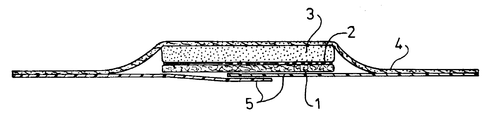
- FIG. 1 indicates the skin-replacing membrane, that is to say the elastomeric layer of the wound dressing according to the invention.
- the second part is formed by a porous, fluid-permeable laminating film layer (2) and a fluid-absorbent wound cushion layer (3).
- a hydrophobic layer can be present on wound cushion layer (3) in order to prevent the wound cushion absorbing fluid on the side which faces away from the wound.
- a sticking plaster for attaching to the skin is indicated by 4.
- the adhesive layer of plaster 4 is provided with cover means 5, for example consisting of paper or plastic treated with a stripping agent (silicones), which can easily be detached from the adhesive layer of plaster 4.
Landscapes
- Health & Medical Sciences (AREA)
- Engineering & Computer Science (AREA)
- Biomedical Technology (AREA)
- Heart & Thoracic Surgery (AREA)
- Vascular Medicine (AREA)
- Life Sciences & Earth Sciences (AREA)
- Animal Behavior & Ethology (AREA)
- General Health & Medical Sciences (AREA)
- Public Health (AREA)
- Veterinary Medicine (AREA)
- Materials For Medical Uses (AREA)
Claims (7)
- Wundverband mit:A. einer Schicht (1), die bestimmt ist, mit der Wunde in Kontakt gebracht zu werden, undB. einem Kissen, das auf der Seite angebracht wird, die mit der Wunde nicht in Kontakt kommt, wobei das Kissen versehen ist mit:dadurch gekennzeichnet, daß1. einem der Schicht (1) benachbarten, porösen, fluidpermeablen Laminierfilm (2), und2. einem der Schicht (2) benachbarten fluidabsorbierenden Material (3),
auf der Seite, die mit der Wunde in Kontakt kommt, eine elastomere Schicht (1), die an der Wunde haften kann und die für Wundfluid permeabel ist und die mit Poren mit einem Durchmesser von 20-200 µm versehen ist, vorgesehen ist, und daß die Adhäsion der Schicht (2) des Wundkissens an der Schicht (1), die an der Wunde haften kann, kleiner als die Adhäsion der Schicht (1) an der verwundeten Haut ist. - Wundverband nach Anspruch 1, wobei die Schicht (1) eine Porosität von mehr als 75 % hat, wobei in den Wänden der Poren der Schicht (1) weitere Poren mit einem Durchmesser von 0,1-25 µm vorhanden sind, und wobei die Seite der Schicht (1), die nicht in Kontakt mit der Wunde kommt, mit Poren versehen ist, die einen Durchmesser von höchstens 0,7 µm und vorzugsweise von 0,1-0,5 µm haben.
- Wundverband nach Anspruch 1 oder 2, wobei das absorbierende Material (3) auf der von der Wunde wegweisenden Seite mit einem hydrophoben Material überzogen oder imprägniert ist.
- Wundverband nach einem der Ansprüche 1 bis 3, wobei das absorbierende Material (3) Viskose ist.
- Wundverband nach einem der Ansprüche 1 bis 4, wobei dieser mit einer zusätzlichen Anordnung (4) zum Fixieren an der Haut versehen ist.
- Verfahren für die Herstellung eines Wundverbands nach einem der Ansprüche 1 bis 5, wobei die elastomere Schicht (1) infolge von Kalandrieren an der Schicht (2) des Wundkissens haftet.
- Verfahren für die Herstellung eines Wundverbands nach einem der Ansprüche 1 bis 6, wobei die elastomere Schicht (1) mit Hilfe eines wasserlöslichen Leims an der Schicht (2) des Wundkissens haftet.
Applications Claiming Priority (2)
| Application Number | Priority Date | Filing Date | Title |
|---|---|---|---|
| NL9001156 | 1990-05-17 | ||
| NL9001156A NL9001156A (nl) | 1990-05-17 | 1990-05-17 | Wondbedekker alsmede werkwijze voor het vervaardigen daarvan. |
Publications (2)
| Publication Number | Publication Date |
|---|---|
| EP0457413A1 EP0457413A1 (de) | 1991-11-21 |
| EP0457413B1 true EP0457413B1 (de) | 1994-10-26 |
Family
ID=19857112
Family Applications (1)
| Application Number | Title | Priority Date | Filing Date |
|---|---|---|---|
| EP91201186A Expired - Lifetime EP0457413B1 (de) | 1990-05-17 | 1991-05-16 | Wundverband und Verfahren zu seiner Herstellung |
Country Status (5)
| Country | Link |
|---|---|
| EP (1) | EP0457413B1 (de) |
| AT (1) | ATE113193T1 (de) |
| CA (1) | CA2042839A1 (de) |
| DE (1) | DE69104769T2 (de) |
| NL (1) | NL9001156A (de) |
Families Citing this family (2)
| Publication number | Priority date | Publication date | Assignee | Title |
|---|---|---|---|---|
| US20040002676A1 (en) * | 2002-06-28 | 2004-01-01 | Siegwart Kathleen Ann | Adhesive bandage having a selectively placed layer |
| US20110077608A1 (en) * | 2009-09-25 | 2011-03-31 | Macedo Jr Carlos Da Silva | Cushioned adhesive bandage |
Family Cites Families (6)
| Publication number | Priority date | Publication date | Assignee | Title |
|---|---|---|---|---|
| US3157178A (en) * | 1961-12-14 | 1964-11-17 | Oneida Ltd | Dressing |
| US3285245A (en) * | 1964-07-06 | 1966-11-15 | Minnesota Mining & Mfg | Absorbent wound dressing |
| FR2044554A5 (en) * | 1969-05-23 | 1971-02-19 | Wuhrlin Jean | Absorbent pads with perforated plastic dia - phragh to increase moisture uptake |
| US3888247A (en) * | 1973-10-10 | 1975-06-10 | Minnesota Mining & Mfg | First aid bandage |
| US4616644A (en) * | 1985-06-14 | 1986-10-14 | Johnson & Johnson Products, Inc. | Hemostatic adhesive bandage |
| NL8801741A (nl) * | 1988-07-08 | 1990-02-01 | Utermoehlen Nv | Kunsthuid. |
-
1990
- 1990-05-17 NL NL9001156A patent/NL9001156A/nl not_active Application Discontinuation
-
1991
- 1991-05-16 DE DE69104769T patent/DE69104769T2/de not_active Expired - Fee Related
- 1991-05-16 EP EP91201186A patent/EP0457413B1/de not_active Expired - Lifetime
- 1991-05-16 AT AT91201186T patent/ATE113193T1/de not_active IP Right Cessation
- 1991-05-17 CA CA002042839A patent/CA2042839A1/en not_active Abandoned
Also Published As
| Publication number | Publication date |
|---|---|
| EP0457413A1 (de) | 1991-11-21 |
| DE69104769D1 (de) | 1994-12-01 |
| CA2042839A1 (en) | 1991-11-18 |
| ATE113193T1 (de) | 1994-11-15 |
| DE69104769T2 (de) | 1995-04-13 |
| NL9001156A (nl) | 1991-12-16 |
Similar Documents
| Publication | Publication Date | Title |
|---|---|---|
| EP2572737B1 (de) | Verbesserte Wundauflage | |
| EP0536875B1 (de) | Hydrogelverband | |
| EP0455324B1 (de) | Produkt zur Pflege einer Brandwunde | |
| RU2586313C2 (ru) | Абсорбирующая гидроцеллюлозная повязка, ее применение при лечении хронических и острых поражений | |
| US4977892A (en) | Wound dressing with hydrophilic absorbent layer | |
| CA1048363A (en) | First aid bandage | |
| JP2875469B2 (ja) | 創傷ドレッシング | |
| CA2539945C (en) | Wound dressing and method for manufacturing the same | |
| RU2597566C2 (ru) | Суперабсорбирующая тонкая адгезивная повязка, ее применение при лечении хронических поражений | |
| US5204110A (en) | High absorbency hydrogel wound dressing | |
| JP2012516703A (ja) | 創傷手当用品、その製造方法および創傷治療におけるその使用 | |
| JPS5934263A (ja) | 接着性創傷用保護材 | |
| EP0463076A1 (de) | Absorbierende körper sowie deren vorstufen. | |
| GB2455962A (en) | Reinforced adhesive backing sheet, for plaster | |
| JPS6187549A (ja) | 接着性ドレッシング | |
| KR20120003231U (ko) | 카르복시 메틸셀룰로오스 섬유를 이용한 창상피복재 | |
| EP0304536A2 (de) | Wundverband aus Polymeren | |
| EP1267763B1 (de) | Wundverband, herstellungsverfahren und daraus erstellbare gegenstände | |
| EP0457413B1 (de) | Wundverband und Verfahren zu seiner Herstellung | |
| JPH07112021A (ja) | 抗菌性外科用ドレッシング | |
| EP0257133B1 (de) | Wundverband und Verfahren zu seiner Herstellung | |
| KR101231069B1 (ko) | 구급 반창고 | |
| EP1653899B1 (de) | Saugfähiges flächenstück mit leckbarrieren zur verwendung beim verbinden von wunden | |
| JPH05192386A (ja) | 創傷被覆材 | |
| GB2404861A (en) | Absorbant layers for use in wound dressings |
Legal Events
| Date | Code | Title | Description |
|---|---|---|---|
| PUAI | Public reference made under article 153(3) epc to a published international application that has entered the european phase |
Free format text: ORIGINAL CODE: 0009012 |
|
| AK | Designated contracting states |
Kind code of ref document: A1 Designated state(s): AT BE CH DE DK ES FR GB GR IT LI LU NL SE |
|
| 17P | Request for examination filed |
Effective date: 19920124 |
|
| 17Q | First examination report despatched |
Effective date: 19930810 |
|
| GRAA | (expected) grant |
Free format text: ORIGINAL CODE: 0009210 |
|
| AK | Designated contracting states |
Kind code of ref document: B1 Designated state(s): AT BE CH DE DK ES FR GB GR IT LI LU NL SE |
|
| PG25 | Lapsed in a contracting state [announced via postgrant information from national office to epo] |
Ref country code: IT Free format text: LAPSE BECAUSE OF FAILURE TO SUBMIT A TRANSLATION OF THE DESCRIPTION OR TO PAY THE FEE WITHIN THE PRE;WARNING: LAPSES OF ITALIAN PATENTS WITH EFFECTIVE DATE BEFORE 2007 MAY HAVE OCCURRED AT ANY TIME BEFORE 2007. THE CORRECT EFFECTIVE DATE MAY BE DIFFERENT FROM THE ONE RECORDED.SCRIBED TIME-LIMIT Effective date: 19941026 Ref country code: DK Effective date: 19941026 Ref country code: LI Effective date: 19941026 Ref country code: GR Free format text: LAPSE BECAUSE OF FAILURE TO SUBMIT A TRANSLATION OF THE DESCRIPTION OR TO PAY THE FEE WITHIN THE PRESCRIBED TIME-LIMIT Effective date: 19941026 Ref country code: CH Effective date: 19941026 Ref country code: ES Free format text: THE PATENT HAS BEEN ANNULLED BY A DECISION OF A NATIONAL AUTHORITY Effective date: 19941026 Ref country code: AT Effective date: 19941026 |
|
| REF | Corresponds to: |
Ref document number: 113193 Country of ref document: AT Date of ref document: 19941115 Kind code of ref document: T |
|
| REF | Corresponds to: |
Ref document number: 69104769 Country of ref document: DE Date of ref document: 19941201 |
|
| ET | Fr: translation filed | ||
| PG25 | Lapsed in a contracting state [announced via postgrant information from national office to epo] |
Ref country code: SE Effective date: 19950126 |
|
| REG | Reference to a national code |
Ref country code: CH Ref legal event code: PL |
|
| PG25 | Lapsed in a contracting state [announced via postgrant information from national office to epo] |
Ref country code: LU Free format text: LAPSE BECAUSE OF NON-PAYMENT OF DUE FEES Effective date: 19950531 |
|
| PLBE | No opposition filed within time limit |
Free format text: ORIGINAL CODE: 0009261 |
|
| STAA | Information on the status of an ep patent application or granted ep patent |
Free format text: STATUS: NO OPPOSITION FILED WITHIN TIME LIMIT |
|
| 26N | No opposition filed | ||
| PGFP | Annual fee paid to national office [announced via postgrant information from national office to epo] |
Ref country code: GB Payment date: 19971114 Year of fee payment: 7 |
|
| PGFP | Annual fee paid to national office [announced via postgrant information from national office to epo] |
Ref country code: NL Payment date: 19971117 Year of fee payment: 7 |
|
| PGFP | Annual fee paid to national office [announced via postgrant information from national office to epo] |
Ref country code: FR Payment date: 19971118 Year of fee payment: 7 |
|
| PGFP | Annual fee paid to national office [announced via postgrant information from national office to epo] |
Ref country code: DE Payment date: 19971119 Year of fee payment: 7 |
|
| PGFP | Annual fee paid to national office [announced via postgrant information from national office to epo] |
Ref country code: BE Payment date: 19971125 Year of fee payment: 7 |
|
| PG25 | Lapsed in a contracting state [announced via postgrant information from national office to epo] |
Ref country code: GB Free format text: LAPSE BECAUSE OF NON-PAYMENT OF DUE FEES Effective date: 19980516 |
|
| PG25 | Lapsed in a contracting state [announced via postgrant information from national office to epo] |
Ref country code: BE Free format text: LAPSE BECAUSE OF NON-PAYMENT OF DUE FEES Effective date: 19980531 Ref country code: FR Free format text: LAPSE BECAUSE OF NON-PAYMENT OF DUE FEES Effective date: 19980531 |
|
| BERE | Be: lapsed |
Owner name: KONINKLIJKE UTERMOHLEN N.V. Effective date: 19980531 |
|
| PG25 | Lapsed in a contracting state [announced via postgrant information from national office to epo] |
Ref country code: NL Free format text: LAPSE BECAUSE OF NON-PAYMENT OF DUE FEES Effective date: 19981201 |
|
| GBPC | Gb: european patent ceased through non-payment of renewal fee |
Effective date: 19980516 |
|
| NLV4 | Nl: lapsed or anulled due to non-payment of the annual fee |
Effective date: 19981201 |
|
| PG25 | Lapsed in a contracting state [announced via postgrant information from national office to epo] |
Ref country code: DE Free format text: LAPSE BECAUSE OF NON-PAYMENT OF DUE FEES Effective date: 19990302 |
|
| REG | Reference to a national code |
Ref country code: FR Ref legal event code: ST |