EP0457566B1 - Composition d'adhésif sensible à la pression - Google Patents
Composition d'adhésif sensible à la pression Download PDFInfo
- Publication number
- EP0457566B1 EP0457566B1 EP91304354A EP91304354A EP0457566B1 EP 0457566 B1 EP0457566 B1 EP 0457566B1 EP 91304354 A EP91304354 A EP 91304354A EP 91304354 A EP91304354 A EP 91304354A EP 0457566 B1 EP0457566 B1 EP 0457566B1
- Authority
- EP
- European Patent Office
- Prior art keywords
- composition
- adhesive composition
- adhesive
- monomer
- weight
- Prior art date
- Legal status (The legal status is an assumption and is not a legal conclusion. Google has not performed a legal analysis and makes no representation as to the accuracy of the status listed.)
- Expired - Lifetime
Links
- 239000000203 mixture Substances 0.000 title claims description 160
- 239000004820 Pressure-sensitive adhesive Substances 0.000 title claims description 36
- 230000001070 adhesive effect Effects 0.000 claims description 134
- 239000000853 adhesive Substances 0.000 claims description 131
- 239000000178 monomer Substances 0.000 claims description 67
- NIXOWILDQLNWCW-UHFFFAOYSA-N acrylic acid group Chemical group C(C=C)(=O)O NIXOWILDQLNWCW-UHFFFAOYSA-N 0.000 claims description 21
- 229920000642 polymer Polymers 0.000 claims description 20
- 239000000463 material Substances 0.000 claims description 16
- 229920001971 elastomer Polymers 0.000 claims description 15
- 125000004432 carbon atom Chemical group C* 0.000 claims description 12
- 229920001577 copolymer Polymers 0.000 claims description 11
- 125000000217 alkyl group Chemical group 0.000 claims description 10
- 125000004435 hydrogen atom Chemical group [H]* 0.000 claims description 10
- 239000005060 rubber Substances 0.000 claims description 9
- 229920001400 block copolymer Polymers 0.000 claims description 8
- 239000003963 antioxidant agent Substances 0.000 claims description 6
- 150000003509 tertiary alcohols Chemical class 0.000 claims description 6
- 125000000391 vinyl group Chemical group [H]C([*])=C([H])[H] 0.000 claims description 6
- VSKJLJHPAFKHBX-UHFFFAOYSA-N 2-methylbuta-1,3-diene;styrene Chemical compound CC(=C)C=C.C=CC1=CC=CC=C1.C=CC1=CC=CC=C1 VSKJLJHPAFKHBX-UHFFFAOYSA-N 0.000 claims description 5
- 230000003078 antioxidant effect Effects 0.000 claims description 5
- 125000005397 methacrylic acid ester group Chemical group 0.000 claims description 5
- 229920005996 polystyrene-poly(ethylene-butylene)-polystyrene Polymers 0.000 claims description 5
- HRPVXLWXLXDGHG-UHFFFAOYSA-N Acrylamide Chemical compound NC(=O)C=C HRPVXLWXLXDGHG-UHFFFAOYSA-N 0.000 claims description 4
- CERQOIWHTDAKMF-UHFFFAOYSA-N Methacrylic acid Chemical compound CC(=C)C(O)=O CERQOIWHTDAKMF-UHFFFAOYSA-N 0.000 claims description 4
- 229920000468 styrene butadiene styrene block copolymer Polymers 0.000 claims description 4
- 229920002725 thermoplastic elastomer Polymers 0.000 claims description 4
- JAHNSTQSQJOJLO-UHFFFAOYSA-N 2-(3-fluorophenyl)-1h-imidazole Chemical compound FC1=CC=CC(C=2NC=CN=2)=C1 JAHNSTQSQJOJLO-UHFFFAOYSA-N 0.000 claims description 3
- NLHHRLWOUZZQLW-UHFFFAOYSA-N Acrylonitrile Chemical compound C=CC#N NLHHRLWOUZZQLW-UHFFFAOYSA-N 0.000 claims description 3
- LFQSCWFLJHTTHZ-UHFFFAOYSA-N Ethanol Chemical compound CCO LFQSCWFLJHTTHZ-UHFFFAOYSA-N 0.000 claims description 3
- GYCMBHHDWRMZGG-UHFFFAOYSA-N Methylacrylonitrile Chemical compound CC(=C)C#N GYCMBHHDWRMZGG-UHFFFAOYSA-N 0.000 claims description 3
- FACXGONDLDSNOE-UHFFFAOYSA-N buta-1,3-diene;styrene Chemical compound C=CC=C.C=CC1=CC=CC=C1.C=CC1=CC=CC=C1 FACXGONDLDSNOE-UHFFFAOYSA-N 0.000 claims description 3
- 238000007334 copolymerization reaction Methods 0.000 claims description 3
- 150000002148 esters Chemical class 0.000 claims description 3
- 125000005647 linker group Chemical group 0.000 claims description 3
- FQPSGWSUVKBHSU-UHFFFAOYSA-N methacrylamide Chemical compound CC(=C)C(N)=O FQPSGWSUVKBHSU-UHFFFAOYSA-N 0.000 claims description 3
- 125000002496 methyl group Chemical group [H]C([H])([H])* 0.000 claims description 3
- LVHBHZANLOWSRM-UHFFFAOYSA-N methylenebutanedioic acid Natural products OC(=O)CC(=C)C(O)=O LVHBHZANLOWSRM-UHFFFAOYSA-N 0.000 claims description 3
- 125000000896 monocarboxylic acid group Chemical group 0.000 claims description 2
- -1 acrylic ester Chemical class 0.000 description 10
- 238000012360 testing method Methods 0.000 description 10
- XEKOWRVHYACXOJ-UHFFFAOYSA-N Ethyl acetate Chemical compound CCOC(C)=O XEKOWRVHYACXOJ-UHFFFAOYSA-N 0.000 description 9
- YXFVVABEGXRONW-UHFFFAOYSA-N Toluene Chemical compound CC1=CC=CC=C1 YXFVVABEGXRONW-UHFFFAOYSA-N 0.000 description 8
- 239000000243 solution Substances 0.000 description 8
- 239000004615 ingredient Substances 0.000 description 6
- 239000003112 inhibitor Substances 0.000 description 6
- 230000003647 oxidation Effects 0.000 description 6
- 238000007254 oxidation reaction Methods 0.000 description 6
- CERQOIWHTDAKMF-UHFFFAOYSA-M Methacrylate Chemical compound CC(=C)C([O-])=O CERQOIWHTDAKMF-UHFFFAOYSA-M 0.000 description 5
- 235000006708 antioxidants Nutrition 0.000 description 5
- 239000000806 elastomer Substances 0.000 description 5
- 238000009472 formulation Methods 0.000 description 5
- 239000011521 glass Substances 0.000 description 5
- SMZOUWXMTYCWNB-UHFFFAOYSA-N 2-(2-methoxy-5-methylphenyl)ethanamine Chemical compound COC1=CC=C(C)C=C1CCN SMZOUWXMTYCWNB-UHFFFAOYSA-N 0.000 description 4
- VTYYLEPIZMXCLO-UHFFFAOYSA-L Calcium carbonate Chemical compound [Ca+2].[O-]C([O-])=O VTYYLEPIZMXCLO-UHFFFAOYSA-L 0.000 description 4
- VYPSYNLAJGMNEJ-UHFFFAOYSA-N Silicium dioxide Chemical compound O=[Si]=O VYPSYNLAJGMNEJ-UHFFFAOYSA-N 0.000 description 4
- 239000011248 coating agent Substances 0.000 description 4
- 238000000576 coating method Methods 0.000 description 4
- 229910052751 metal Inorganic materials 0.000 description 4
- 239000002184 metal Substances 0.000 description 4
- 238000000034 method Methods 0.000 description 4
- 150000002989 phenols Chemical class 0.000 description 4
- 229920000139 polyethylene terephthalate Polymers 0.000 description 4
- 239000005020 polyethylene terephthalate Substances 0.000 description 4
- 239000007787 solid Substances 0.000 description 4
- ZWEHNKRNPOVVGH-UHFFFAOYSA-N 2-Butanone Chemical compound CCC(C)=O ZWEHNKRNPOVVGH-UHFFFAOYSA-N 0.000 description 3
- QPRQEDXDYOZYLA-UHFFFAOYSA-N 2-methylbutan-1-ol Chemical compound CCC(C)CO QPRQEDXDYOZYLA-UHFFFAOYSA-N 0.000 description 3
- XDTMQSROBMDMFD-UHFFFAOYSA-N Cyclohexane Chemical compound C1CCCCC1 XDTMQSROBMDMFD-UHFFFAOYSA-N 0.000 description 3
- 229920002633 Kraton (polymer) Polymers 0.000 description 3
- LRHPLDYGYMQRHN-UHFFFAOYSA-N N-Butanol Chemical compound CCCCO LRHPLDYGYMQRHN-UHFFFAOYSA-N 0.000 description 3
- 238000013329 compounding Methods 0.000 description 3
- 239000012943 hotmelt Substances 0.000 description 3
- JYVLIDXNZAXMDK-UHFFFAOYSA-N pentan-2-ol Chemical compound CCCC(C)O JYVLIDXNZAXMDK-UHFFFAOYSA-N 0.000 description 3
- 239000004014 plasticizer Substances 0.000 description 3
- 238000002360 preparation method Methods 0.000 description 3
- 229920005989 resin Polymers 0.000 description 3
- 239000011347 resin Substances 0.000 description 3
- 239000000126 substance Substances 0.000 description 3
- XLYOFNOQVPJJNP-UHFFFAOYSA-N water Substances O XLYOFNOQVPJJNP-UHFFFAOYSA-N 0.000 description 3
- 239000002023 wood Substances 0.000 description 3
- GRWFGVWFFZKLTI-IUCAKERBSA-N (-)-α-pinene Chemical compound CC1=CC[C@@H]2C(C)(C)[C@H]1C2 GRWFGVWFFZKLTI-IUCAKERBSA-N 0.000 description 2
- ZXDDPOHVAMWLBH-UHFFFAOYSA-N 2,4-Dihydroxybenzophenone Chemical compound OC1=CC(O)=CC=C1C(=O)C1=CC=CC=C1 ZXDDPOHVAMWLBH-UHFFFAOYSA-N 0.000 description 2
- JLZIIHMTTRXXIN-UHFFFAOYSA-N 2-(2-hydroxy-4-methoxybenzoyl)benzoic acid Chemical compound OC1=CC(OC)=CC=C1C(=O)C1=CC=CC=C1C(O)=O JLZIIHMTTRXXIN-UHFFFAOYSA-N 0.000 description 2
- PFNHSEQQEPMLNI-UHFFFAOYSA-N 2-methyl-1-pentanol Chemical compound CCCC(C)CO PFNHSEQQEPMLNI-UHFFFAOYSA-N 0.000 description 2
- IWTBVKIGCDZRPL-UHFFFAOYSA-N 3-methylpentanol Chemical compound CCC(C)CCO IWTBVKIGCDZRPL-UHFFFAOYSA-N 0.000 description 2
- NIXOWILDQLNWCW-UHFFFAOYSA-M Acrylate Chemical compound [O-]C(=O)C=C NIXOWILDQLNWCW-UHFFFAOYSA-M 0.000 description 2
- XKRFYHLGVUSROY-UHFFFAOYSA-N Argon Chemical compound [Ar] XKRFYHLGVUSROY-UHFFFAOYSA-N 0.000 description 2
- GHKOFFNLGXMVNJ-UHFFFAOYSA-N Didodecyl thiobispropanoate Chemical compound CCCCCCCCCCCCOC(=O)CCSCCC(=O)OCCCCCCCCCCCC GHKOFFNLGXMVNJ-UHFFFAOYSA-N 0.000 description 2
- RZKSECIXORKHQS-UHFFFAOYSA-N Heptan-3-ol Chemical compound CCCCC(O)CC RZKSECIXORKHQS-UHFFFAOYSA-N 0.000 description 2
- AMQJEAYHLZJPGS-UHFFFAOYSA-N N-Pentanol Chemical compound CCCCCO AMQJEAYHLZJPGS-UHFFFAOYSA-N 0.000 description 2
- PXHVJJICTQNCMI-UHFFFAOYSA-N Nickel Chemical compound [Ni] PXHVJJICTQNCMI-UHFFFAOYSA-N 0.000 description 2
- NINIDFKCEFEMDL-UHFFFAOYSA-N Sulfur Chemical compound [S] NINIDFKCEFEMDL-UHFFFAOYSA-N 0.000 description 2
- GWEVSGVZZGPLCZ-UHFFFAOYSA-N Titan oxide Chemical compound O=[Ti]=O GWEVSGVZZGPLCZ-UHFFFAOYSA-N 0.000 description 2
- 229920006243 acrylic copolymer Polymers 0.000 description 2
- 239000012790 adhesive layer Substances 0.000 description 2
- 235000010216 calcium carbonate Nutrition 0.000 description 2
- 239000006229 carbon black Substances 0.000 description 2
- 230000015556 catabolic process Effects 0.000 description 2
- 238000006243 chemical reaction Methods 0.000 description 2
- 239000003795 chemical substances by application Substances 0.000 description 2
- 239000004927 clay Substances 0.000 description 2
- 230000000052 comparative effect Effects 0.000 description 2
- MWKFXSUHUHTGQN-UHFFFAOYSA-N decan-1-ol Chemical compound CCCCCCCCCCO MWKFXSUHUHTGQN-UHFFFAOYSA-N 0.000 description 2
- 230000003247 decreasing effect Effects 0.000 description 2
- 238000006731 degradation reaction Methods 0.000 description 2
- LQZZUXJYWNFBMV-UHFFFAOYSA-N dodecan-1-ol Chemical compound CCCCCCCCCCCCO LQZZUXJYWNFBMV-UHFFFAOYSA-N 0.000 description 2
- 239000000945 filler Substances 0.000 description 2
- QNVRIHYSUZMSGM-UHFFFAOYSA-N hexan-2-ol Chemical compound CCCCC(C)O QNVRIHYSUZMSGM-UHFFFAOYSA-N 0.000 description 2
- 230000007774 longterm Effects 0.000 description 2
- 238000005259 measurement Methods 0.000 description 2
- 238000012986 modification Methods 0.000 description 2
- 230000004048 modification Effects 0.000 description 2
- SSDSCDGVMJFTEQ-UHFFFAOYSA-N octadecyl 3-(3,5-ditert-butyl-4-hydroxyphenyl)propanoate Chemical compound CCCCCCCCCCCCCCCCCCOC(=O)CCC1=CC(C(C)(C)C)=C(O)C(C(C)(C)C)=C1 SSDSCDGVMJFTEQ-UHFFFAOYSA-N 0.000 description 2
- SJWFXCIHNDVPSH-UHFFFAOYSA-N octan-2-ol Chemical compound CCCCCCC(C)O SJWFXCIHNDVPSH-UHFFFAOYSA-N 0.000 description 2
- AQIXEPGDORPWBJ-UHFFFAOYSA-N pentan-3-ol Chemical compound CCC(O)CC AQIXEPGDORPWBJ-UHFFFAOYSA-N 0.000 description 2
- 239000000049 pigment Substances 0.000 description 2
- 150000003839 salts Chemical class 0.000 description 2
- 239000003381 stabilizer Substances 0.000 description 2
- 229910001220 stainless steel Inorganic materials 0.000 description 2
- 239000010935 stainless steel Substances 0.000 description 2
- 238000007655 standard test method Methods 0.000 description 2
- 230000003068 static effect Effects 0.000 description 2
- 125000001424 substituent group Chemical group 0.000 description 2
- 239000000758 substrate Substances 0.000 description 2
- 229910052717 sulfur Inorganic materials 0.000 description 2
- 239000011593 sulfur Substances 0.000 description 2
- 239000004094 surface-active agent Substances 0.000 description 2
- 235000012222 talc Nutrition 0.000 description 2
- 238000010998 test method Methods 0.000 description 2
- 238000009736 wetting Methods 0.000 description 2
- WTARULDDTDQWMU-RKDXNWHRSA-N (+)-β-pinene Chemical compound C1[C@H]2C(C)(C)[C@@H]1CCC2=C WTARULDDTDQWMU-RKDXNWHRSA-N 0.000 description 1
- WTARULDDTDQWMU-IUCAKERBSA-N (-)-Nopinene Natural products C1[C@@H]2C(C)(C)[C@H]1CCC2=C WTARULDDTDQWMU-IUCAKERBSA-N 0.000 description 1
- 239000001618 (3R)-3-methylpentan-1-ol Substances 0.000 description 1
- 239000005968 1-Decanol Substances 0.000 description 1
- TZYRSLHNPKPEFV-UHFFFAOYSA-N 2-ethyl-1-butanol Chemical compound CCC(CC)CO TZYRSLHNPKPEFV-UHFFFAOYSA-N 0.000 description 1
- BODRLKRKPXBDBN-UHFFFAOYSA-N 3,5,5-Trimethyl-1-hexanol Chemical compound OCCC(C)CC(C)(C)C BODRLKRKPXBDBN-UHFFFAOYSA-N 0.000 description 1
- DXPPIEDUBFUSEZ-UHFFFAOYSA-N 6-methylheptyl prop-2-enoate Chemical compound CC(C)CCCCCOC(=O)C=C DXPPIEDUBFUSEZ-UHFFFAOYSA-N 0.000 description 1
- RSWGJHLUYNHPMX-UHFFFAOYSA-N Abietic-Saeure Natural products C12CCC(C(C)C)=CC2=CCC2C1(C)CCCC2(C)C(O)=O RSWGJHLUYNHPMX-UHFFFAOYSA-N 0.000 description 1
- 239000004215 Carbon black (E152) Substances 0.000 description 1
- 229920000742 Cotton Polymers 0.000 description 1
- 229920001875 Ebonite Polymers 0.000 description 1
- 239000001856 Ethyl cellulose Substances 0.000 description 1
- ZZSNKZQZMQGXPY-UHFFFAOYSA-N Ethyl cellulose Chemical compound CCOCC1OC(OC)C(OCC)C(OCC)C1OC1C(O)C(O)C(OC)C(CO)O1 ZZSNKZQZMQGXPY-UHFFFAOYSA-N 0.000 description 1
- 239000004831 Hot glue Substances 0.000 description 1
- 239000013032 Hydrocarbon resin Substances 0.000 description 1
- 239000004677 Nylon Substances 0.000 description 1
- ISWSIDIOOBJBQZ-UHFFFAOYSA-N Phenol Chemical compound OC1=CC=CC=C1 ISWSIDIOOBJBQZ-UHFFFAOYSA-N 0.000 description 1
- 239000004698 Polyethylene Substances 0.000 description 1
- 239000004743 Polypropylene Substances 0.000 description 1
- 239000004793 Polystyrene Substances 0.000 description 1
- WTARULDDTDQWMU-UHFFFAOYSA-N Pseudopinene Natural products C1C2C(C)(C)C1CCC2=C WTARULDDTDQWMU-UHFFFAOYSA-N 0.000 description 1
- 229920000297 Rayon Polymers 0.000 description 1
- KHPCPRHQVVSZAH-HUOMCSJISA-N Rosin Natural products O(C/C=C/c1ccccc1)[C@H]1[C@H](O)[C@@H](O)[C@@H](O)[C@@H](CO)O1 KHPCPRHQVVSZAH-HUOMCSJISA-N 0.000 description 1
- 229920002472 Starch Polymers 0.000 description 1
- 238000013019 agitation Methods 0.000 description 1
- 150000001336 alkenes Chemical class 0.000 description 1
- 125000005250 alkyl acrylate group Chemical group 0.000 description 1
- 125000005233 alkylalcohol group Chemical group 0.000 description 1
- XCPQUQHBVVXMRQ-UHFFFAOYSA-N alpha-Fenchene Natural products C1CC2C(=C)CC1C2(C)C XCPQUQHBVVXMRQ-UHFFFAOYSA-N 0.000 description 1
- MVNCAPSFBDBCGF-UHFFFAOYSA-N alpha-pinene Natural products CC1=CCC23C1CC2C3(C)C MVNCAPSFBDBCGF-UHFFFAOYSA-N 0.000 description 1
- 230000004075 alteration Effects 0.000 description 1
- 238000010539 anionic addition polymerization reaction Methods 0.000 description 1
- 125000000129 anionic group Chemical group 0.000 description 1
- 238000013459 approach Methods 0.000 description 1
- 229910052786 argon Inorganic materials 0.000 description 1
- 239000000440 bentonite Substances 0.000 description 1
- 229910000278 bentonite Inorganic materials 0.000 description 1
- SVPXDRXYRYOSEX-UHFFFAOYSA-N bentoquatam Chemical compound O.O=[Si]=O.O=[Al]O[Al]=O SVPXDRXYRYOSEX-UHFFFAOYSA-N 0.000 description 1
- 229930006722 beta-pinene Natural products 0.000 description 1
- 125000000484 butyl group Chemical group [H]C([*])([H])C([H])([H])C([H])([H])C([H])([H])[H] 0.000 description 1
- 229910000019 calcium carbonate Inorganic materials 0.000 description 1
- 229920002301 cellulose acetate Polymers 0.000 description 1
- 239000000919 ceramic Substances 0.000 description 1
- 229910010293 ceramic material Inorganic materials 0.000 description 1
- 239000013522 chelant Substances 0.000 description 1
- 229910052570 clay Inorganic materials 0.000 description 1
- 230000001010 compromised effect Effects 0.000 description 1
- 239000012141 concentrate Substances 0.000 description 1
- 230000007423 decrease Effects 0.000 description 1
- 238000012217 deletion Methods 0.000 description 1
- 230000037430 deletion Effects 0.000 description 1
- 230000001419 dependent effect Effects 0.000 description 1
- 238000011161 development Methods 0.000 description 1
- 239000012895 dilution Substances 0.000 description 1
- 238000010790 dilution Methods 0.000 description 1
- 239000012990 dithiocarbamate Substances 0.000 description 1
- 229920001249 ethyl cellulose Polymers 0.000 description 1
- 235000019325 ethyl cellulose Nutrition 0.000 description 1
- 125000001495 ethyl group Chemical group [H]C([H])([H])C([H])([H])* 0.000 description 1
- FKRCODPIKNYEAC-UHFFFAOYSA-N ethyl propionate Chemical class CCOC(=O)CC FKRCODPIKNYEAC-UHFFFAOYSA-N 0.000 description 1
- 238000007765 extrusion coating Methods 0.000 description 1
- 239000004744 fabric Substances 0.000 description 1
- 239000010419 fine particle Substances 0.000 description 1
- 235000013312 flour Nutrition 0.000 description 1
- 229910021485 fumed silica Inorganic materials 0.000 description 1
- 125000000524 functional group Chemical group 0.000 description 1
- 239000000417 fungicide Substances 0.000 description 1
- LCWMKIHBLJLORW-UHFFFAOYSA-N gamma-carene Natural products C1CC(=C)CC2C(C)(C)C21 LCWMKIHBLJLORW-UHFFFAOYSA-N 0.000 description 1
- 229920000578 graft copolymer Polymers 0.000 description 1
- 238000007757 hot melt coating Methods 0.000 description 1
- 229930195733 hydrocarbon Natural products 0.000 description 1
- 229920006270 hydrocarbon resin Polymers 0.000 description 1
- 239000011256 inorganic filler Substances 0.000 description 1
- 229910003475 inorganic filler Inorganic materials 0.000 description 1
- 239000010410 layer Substances 0.000 description 1
- 230000000670 limiting effect Effects 0.000 description 1
- 238000011068 loading method Methods 0.000 description 1
- 238000004519 manufacturing process Methods 0.000 description 1
- 230000000873 masking effect Effects 0.000 description 1
- 125000005395 methacrylic acid group Chemical group 0.000 description 1
- 238000002156 mixing Methods 0.000 description 1
- 238000000465 moulding Methods 0.000 description 1
- 125000000740 n-pentyl group Chemical group [H]C([H])([H])C([H])([H])C([H])([H])C([H])([H])C([H])([H])* 0.000 description 1
- 150000002815 nickel Chemical class 0.000 description 1
- 229910052759 nickel Inorganic materials 0.000 description 1
- 239000004745 nonwoven fabric Substances 0.000 description 1
- 229920001778 nylon Polymers 0.000 description 1
- JRZJOMJEPLMPRA-UHFFFAOYSA-N olefin Natural products CCCCCCCC=C JRZJOMJEPLMPRA-UHFFFAOYSA-N 0.000 description 1
- 238000005457 optimization Methods 0.000 description 1
- 239000012766 organic filler Substances 0.000 description 1
- 239000002985 plastic film Substances 0.000 description 1
- 229920006255 plastic film Polymers 0.000 description 1
- 229920000728 polyester Polymers 0.000 description 1
- 229920000573 polyethylene Polymers 0.000 description 1
- 238000006116 polymerization reaction Methods 0.000 description 1
- 229920000193 polymethacrylate Polymers 0.000 description 1
- 229920000098 polyolefin Polymers 0.000 description 1
- 229920001155 polypropylene Polymers 0.000 description 1
- 229920002223 polystyrene Polymers 0.000 description 1
- 229920000346 polystyrene-polyisoprene block-polystyrene Polymers 0.000 description 1
- 239000004800 polyvinyl chloride Substances 0.000 description 1
- 229920000915 polyvinyl chloride Polymers 0.000 description 1
- GRWFGVWFFZKLTI-UHFFFAOYSA-N rac-alpha-Pinene Natural products CC1=CCC2C(C)(C)C1C2 GRWFGVWFFZKLTI-UHFFFAOYSA-N 0.000 description 1
- 239000002964 rayon Substances 0.000 description 1
- 229920006395 saturated elastomer Polymers 0.000 description 1
- 230000035945 sensitivity Effects 0.000 description 1
- 239000000377 silicon dioxide Substances 0.000 description 1
- 238000002798 spectrophotometry method Methods 0.000 description 1
- 230000006641 stabilisation Effects 0.000 description 1
- 238000011105 stabilization Methods 0.000 description 1
- 239000008107 starch Substances 0.000 description 1
- 235000019698 starch Nutrition 0.000 description 1
- 239000012209 synthetic fiber Substances 0.000 description 1
- 229920002994 synthetic fiber Polymers 0.000 description 1
- 239000000454 talc Substances 0.000 description 1
- 229910052623 talc Inorganic materials 0.000 description 1
- 238000010345 tape casting Methods 0.000 description 1
- 238000009864 tensile test Methods 0.000 description 1
- 230000009974 thixotropic effect Effects 0.000 description 1
- 239000004408 titanium dioxide Substances 0.000 description 1
- KHPCPRHQVVSZAH-UHFFFAOYSA-N trans-cinnamyl beta-D-glucopyranoside Natural products OC1C(O)C(O)C(CO)OC1OCC=CC1=CC=CC=C1 KHPCPRHQVVSZAH-UHFFFAOYSA-N 0.000 description 1
- 238000012546 transfer Methods 0.000 description 1
- 239000002759 woven fabric Substances 0.000 description 1
Classifications
-
- C—CHEMISTRY; METALLURGY
- C09—DYES; PAINTS; POLISHES; NATURAL RESINS; ADHESIVES; COMPOSITIONS NOT OTHERWISE PROVIDED FOR; APPLICATIONS OF MATERIALS NOT OTHERWISE PROVIDED FOR
- C09J—ADHESIVES; NON-MECHANICAL ASPECTS OF ADHESIVE PROCESSES IN GENERAL; ADHESIVE PROCESSES NOT PROVIDED FOR ELSEWHERE; USE OF MATERIALS AS ADHESIVES
- C09J109/00—Adhesives based on homopolymers or copolymers of conjugated diene hydrocarbons
-
- C—CHEMISTRY; METALLURGY
- C09—DYES; PAINTS; POLISHES; NATURAL RESINS; ADHESIVES; COMPOSITIONS NOT OTHERWISE PROVIDED FOR; APPLICATIONS OF MATERIALS NOT OTHERWISE PROVIDED FOR
- C09J—ADHESIVES; NON-MECHANICAL ASPECTS OF ADHESIVE PROCESSES IN GENERAL; ADHESIVE PROCESSES NOT PROVIDED FOR ELSEWHERE; USE OF MATERIALS AS ADHESIVES
- C09J151/00—Adhesives based on graft polymers in which the grafted component is obtained by reactions only involving carbon-to-carbon unsaturated bonds; Adhesives based on derivatives of such polymers
-
- C—CHEMISTRY; METALLURGY
- C09—DYES; PAINTS; POLISHES; NATURAL RESINS; ADHESIVES; COMPOSITIONS NOT OTHERWISE PROVIDED FOR; APPLICATIONS OF MATERIALS NOT OTHERWISE PROVIDED FOR
- C09J—ADHESIVES; NON-MECHANICAL ASPECTS OF ADHESIVE PROCESSES IN GENERAL; ADHESIVE PROCESSES NOT PROVIDED FOR ELSEWHERE; USE OF MATERIALS AS ADHESIVES
- C09J153/00—Adhesives based on block copolymers containing at least one sequence of a polymer obtained by reactions only involving carbon-to-carbon unsaturated bonds; Adhesives based on derivatives of such polymers
-
- C—CHEMISTRY; METALLURGY
- C09—DYES; PAINTS; POLISHES; NATURAL RESINS; ADHESIVES; COMPOSITIONS NOT OTHERWISE PROVIDED FOR; APPLICATIONS OF MATERIALS NOT OTHERWISE PROVIDED FOR
- C09J—ADHESIVES; NON-MECHANICAL ASPECTS OF ADHESIVE PROCESSES IN GENERAL; ADHESIVE PROCESSES NOT PROVIDED FOR ELSEWHERE; USE OF MATERIALS AS ADHESIVES
- C09J7/00—Adhesives in the form of films or foils
- C09J7/30—Adhesives in the form of films or foils characterised by the adhesive composition
- C09J7/38—Pressure-sensitive adhesives [PSA]
- C09J7/381—Pressure-sensitive adhesives [PSA] based on macromolecular compounds obtained by reactions involving only carbon-to-carbon unsaturated bonds
-
- C—CHEMISTRY; METALLURGY
- C08—ORGANIC MACROMOLECULAR COMPOUNDS; THEIR PREPARATION OR CHEMICAL WORKING-UP; COMPOSITIONS BASED THEREON
- C08L—COMPOSITIONS OF MACROMOLECULAR COMPOUNDS
- C08L2666/00—Composition of polymers characterized by a further compound in the blend, being organic macromolecular compounds, natural resins, waxes or and bituminous materials, non-macromolecular organic substances, inorganic substances or characterized by their function in the composition
- C08L2666/02—Organic macromolecular compounds, natural resins, waxes or and bituminous materials
-
- C—CHEMISTRY; METALLURGY
- C08—ORGANIC MACROMOLECULAR COMPOUNDS; THEIR PREPARATION OR CHEMICAL WORKING-UP; COMPOSITIONS BASED THEREON
- C08L—COMPOSITIONS OF MACROMOLECULAR COMPOUNDS
- C08L2666/00—Composition of polymers characterized by a further compound in the blend, being organic macromolecular compounds, natural resins, waxes or and bituminous materials, non-macromolecular organic substances, inorganic substances or characterized by their function in the composition
- C08L2666/02—Organic macromolecular compounds, natural resins, waxes or and bituminous materials
- C08L2666/24—Graft or block copolymers according to groups C08L51/00, C08L53/00 or C08L55/02; Derivatives thereof
-
- Y—GENERAL TAGGING OF NEW TECHNOLOGICAL DEVELOPMENTS; GENERAL TAGGING OF CROSS-SECTIONAL TECHNOLOGIES SPANNING OVER SEVERAL SECTIONS OF THE IPC; TECHNICAL SUBJECTS COVERED BY FORMER USPC CROSS-REFERENCE ART COLLECTIONS [XRACs] AND DIGESTS
- Y10—TECHNICAL SUBJECTS COVERED BY FORMER USPC
- Y10T—TECHNICAL SUBJECTS COVERED BY FORMER US CLASSIFICATION
- Y10T428/00—Stock material or miscellaneous articles
- Y10T428/28—Web or sheet containing structurally defined element or component and having an adhesive outermost layer
Definitions
- This invention relates to pressure-sensitive adhesives, and, more particularly, a composition formed from a blend of pressure-sensitive adhesives.
- Normally tacky pressure-sensitive adhesive compositions must have an appropriate balance of wetting ability or tack, adhesion, and cohesive strength. All pressure-sensitive adhesive compositions exhibit each of these properties in varying degrees.
- block copolymers such as, for example, styrene-isoprene-styrene and styrene-butadiene-styrene, have been formulated into pressure-sensitive adhesive compositions having an excellent balance of tack, adhesion, and cohesive strength. They also exhibit hot melt processability and high values of peel adhesion to both polar and non-polar surfaces. However, they do not exhibit the resistance to oxidation or the high temperature holding power of the acrylic ester elastomer adhesives.
- styrene-ethylene/butylene-styrene block copolymers which have a saturated olefin midblock, permit the formulation of adhesive compositions that exhibit high values of peel adhesion to both polar and non-polar surfaces and are resistant to oxidation and photochemical degradation.
- adhesive compositions that contain styrene-isoprene-styrene and styrene-butadiene-styrene block copolymers they do not exhibit the high temperature holding power of adhesive compositions that contain acrylic esters.
- EP-A-0,357,229 discloses acrylic hot melt pressure sensitive adhesive compositions which are prepared by copolymerizing acrylic and methacrylic alkyl esters of a non-tertiary alcohol with polymerizable poly methacrylate based macromonomers.
- the resulting acrylic copolymer has a graft or comb structure in which the acrylic backbone has a low Tg and the pendant macromonomer side chains have a Tg above room temperature.
- These acrylic copolymers are compounded with tackifiers and optionally with plasticizers so as to dramatically improve the balance of pressure sensitive adhesive properties while lowering melt viscosity into a desirable range.
- the acrylic backbone is tailored by judicious selection of acrylic comonomers to allow compounding with several high performance hydrogenated tackifiers and plasticizers that provide water white and clear adhesive formulations while ensuring long term colour stability, weatherability and general durability.
- US-A-4,209,594 discloses an elastomeric blend having excellent resistance to oil made from a block copolymer rubber and a graft copolymer made by copolymerizing a macromolecular monomer with one or more alkyl acrylates.
- the blends of the reference are especially useful in shoe sole compositions to impart oil resistance thereto.
- This invention provides a pressure sensitive adhesive composition
- a blend consisting essentially of:
- the number and composition of the attached polymeric moieties in the polymer of composition (2) is such as to provide a tape coated with the adhesive composition with a shear holding value of at least 50 minutes and the adhesive composition with an inherent viscosity greater than 0.2.
- the ratio, based on weight, of adhesive composition (1) to adhesive composition (2) ranges from 99:1 to 1:99, and preferably ranges from 99:1 to 1:1.
- Pressure-sensitive adhesives prepared from the composition of this invention can be tailored to exhibit high values of peel adhesion with respect to both polar and non-polar surfaces, a high level of tack, and a high level of static shear.
- Adhesives suitable for adhesive composition (1) are tacky pressure-sensitive adhesives having moieties, e.g., blocks or grafts, that associate with the polymeric moieties grafted to the backbone of the polymer of adhesive composition (2).
- tacky means having sticky nature or immediate adhesion on contact with a substrate. Some adhesives are inherently tacky, while others are rendered tacky by addition of a tackifier. The term “tacky” is intended to refer to both inherently tacky adhesives and adhesive compositions which include an added tackifier.
- any tacky pressure-sensitive adhesive can be used, adhesives derived from rubbers, are preferred for adhesive compositions that are expected to be removable from various substrates.
- rubber-based adhesives suitable for adhesive composition (1) include thermoplastic elastomers, such as, for example styrene-butadiene-styrene, styrene-isoprene-styrene, and styrene-ethylene/butylene-styrene.
- adhesives suitable for adhesive composition (1) include the styrene-isoprene-styrene elastomer "Kraton 1107” and the styrene-ethylene/butylene-styrene elastomer "Kraton 1657”, both available from Shell Chemical Company.
- the adhesives of adhesive composition (1) can be tackified by a tackifying agent, by appropriate modification of the structure of the adhesive molecule, or by a combination of both approaches.
- Tackifiers suitable for tackifying the pressure-sensitive adhesives of adhesive composition (1) include low molecular weight hydrocarbon resins, and ⁇ - and ⁇ -pinene based resins. Many tackifiers are commercially available, and optimum selection thereof can be accomplished by one of ordinary skill in the adhesive compounding art.
- tackifiers suitable for this invention include the resins available under the trademarks "Regalrez 1018”, “Regalrex 1078”, and “REZ-D 2084”, available from Hercules Incorporated, "Escorez-143H”, and “Escorez 5380”, available from Exxon Corporation, and "Wingtack Plus”, available from Firestone Tire and Rubber Co. If rubber is used to prepare adhesive composition (1), the ratio, based on weight, of tackifier to rubber preferably ranges from 0.5:1.0 to 2.5:1.0.
- the pressure-sensitive adhesive composition (2) comprises a copolymer having an inherent viscosity greater than 0.2 and consists essentially of copolymerized repeating units from two types of monomers (hereinafter monomer A and monomer C) and optionally a third type of monomer (hereinafter monomer B).
- monomer A is a monomeric acrylic or methacrylic acid ester of a non-tertiary alcohol, said alcohol having from 1 to 14 carbon atoms with the average number of carbon atoms being 4 to 12.
- monomer B is at least one polar monomer copolymerizable with monomer A.
- monomer B examples include acrylic acid, methacrylic acid, itaconic acid, acrylamide, methacrylamide, acrylonitrile and methacrylonitrile.
- Monomer B can comprise up to 12% by weight of the total weight of all monomers in the copolymer of composition (2).
- Monomer C has the general formula X-(Y) n -Z wherein X represents a vinyl group copolymerizable with monomer A and monomer B.
- Y represents a divalent linking group where n can be zero or one.
- Z represents a monovalent polymeric moiety having a Tg greater than 20°C and a weight average molecular weight in the range of about 2,000 to 30,000 and being essentially unreactive under copolymerization conditions.
- the vinyl group of monomer C and monomer A and monomer B are copolymerized to form a soft backbone having pendant therefrom the aforementioned polymeric moieties.
- the percent by weight of monomer C is within the range of 1 to 30% of the total weight of all monomers in the copolymer of composition (2).
- the total percent by weight of monomer B and monomer C in the copolymer of composition (2) is within the range of 4 to 30% of the total weight of all monomers in the copolymer.
- Monomer A is a monomeric acrylic or methacrylic acid ester of a non-tertiary alcohol, said alcohol having from 1 to 14 carbon atoms with the average number of carbon atoms being 4 to 12.
- Representative examples of monomer A include the esters of acrylic acid or methacrylic acid with non-tertiary alkyl alcohols such as 1-butanol, 1-pentanol, 2-pentanol, 3-pentanol, 2-methyl-1-butanol, 1-methyl-1-butanol, 1-methyl-1-pentanol, 2-methyl-1-pentanol, 3-methyl-1-pentanol, 2-ethyl-1-butanol, 3,5,5-trimethyl-1-hexanol, 3-heptanol, 2-octanol, 1-decanol, 1-dodecanol, and the like.
- Such monomeric acrylic or methacrylic esters are known in the art and many are commercially available.
- monomer B is copolymerizable with monomer A.
- Representative examples of monomer B include acrylic acid, methacrylic acid, itaconic acid, acrylamide, methacrylamide, acrylonitrile and methacrylonitrile.
- Monomer B is not necessary to produce pressure-sensitive adhesive composition (2), but monomer B can be present in a concentration of up to 12% of the total weight of all monomers in the copolymer of composition (2).
- the preferred pressure-sensitive adhesive composition (2) will contain from 2 to 8% by weight of monomer B based on the total weight of all monomers in the copolymer of composition (2).
- Monomer C is a polymeric material having a copolymerizable vinyl group with which monomer A and monomer B will copolymerize under appropriate polymerization conditions.
- Monomer C can be represented by the general formula X-(Y) n -Z wherein:
- monomer C may be further defined as having an X group which has the general formula: wherein R represents a hydrogen atom or a COOH group and R′ represents a hydrogen atom or methyl group.
- R represents a hydrogen atom or a COOH group
- R′ represents a hydrogen atom or methyl group.
- the double bond between the carbon atoms provides a copolymerizable moiety capable of copolymerizing with monomer A and monomer B.
- monomer C includes a Z group which has the general formula: wherein R 2 represents a hydrogen atom or a lower alkyl group, R 3 represents a lower alkyl group, n represents an integer from 20 to 500 and R 4 represents a monovalent radical selected from the group consisting of: and -CO 2 R 6 wherein R 5 represents a hydrogen atom or a lower alkyl group and R 6 represents a lower alkyl group.
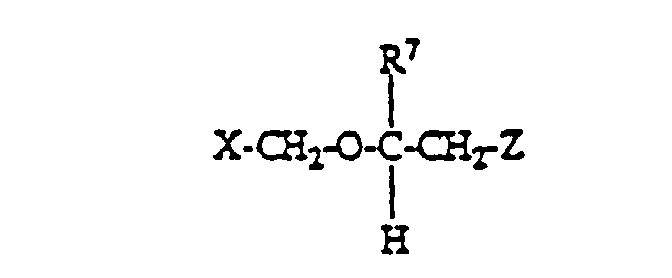
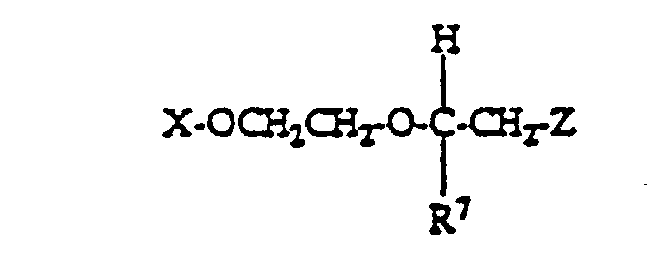
- monomer C has a general formula selected from the group consisting of: wherein R 7 represents a hydrogen atom or a lower alkyl group.
- Monomer C is a functionally terminal polymer, having a single functional group (the vinyl group) and is sometimes identified as a "semi-telechelic" polymer. (Vol. 27, “Functionally Terminal Polymers Via Anionic Methods", D.N. Schultz et al, pp. 427-440, Anionic Polymerization, American Chemical Society (1981).)
- the amounts of monomer C set forth above indicate the level at which optimization of the shear strength value is noted.
- An excessive quantity of monomer C makes the resultant copolymer overly reinforced, decreasing its adhesive tack and making it more like a polymeric film rather than an adhesive composition. While certain of such compositions have utility as hot melt adhesives, they do not generally find utility as pressure-sensitive adhesive compositions.
- Adhesive composition (2) is described in greater detail in U.S. Patent No. 4,554,324.
- the ratio, based on weight, of adhesive composition (1) to adhesive composition (2) in the composition of this invention ranges from 99:1 to 1:99, and preferably ranges from 99:1 to 1:1.
- Adhesive compositions according to the present invention preferably include an anti-oxidant to inhibit oxidation of the tackifying agent and consequent loss of tackiness as the adhesive composition ages.
- an anti-oxidant which is based on either (1) a hindered phenol or (2) a sulfur-containing organo-metal salt.
- the hindered phenols are the ortho-substituted or the 2,5-di-substituted phenols where the substituent group (or groups) is a branched hydrocarbon radical having 2 to 30 carbon atoms, e.g., tertiary butyl or tertiary amyl.
- hindered phenols useful in practicing the invention include para-substituted phenols where the substituent groups is -OR 8 , R 8 being methyl, ethyl, 3-substituted propionic ester, etc.
- sulfur-containing organo-metal salts are the nickel derivatives of dibutyl dithiocarbamate.
- Representative examples of commercially available anti-oxidants suitable for this invention include the hindered phenols available under the trademarks "Irganox 1076", available from Ciba-Geigy Corp., and “Cyanox LTDP", available from American Cyanamid Co.
- Inorganic fillers such as calcium carbonate, clay, talc, silica, and limited amounts of carbon black can be used with the adhesives of this invention, as well as organic fillers such as wood flour or starch. Calcium carbonates, clays and talcs are most commonly used.
- Various levels of fillers can be used to significantly reduce costs of formulations containing the adhesives of this invention. Lower levels will scarcely affect properties, whereas higher levels will appreciably increase stiffness, hardness, and resistance to deformation.
- Very fine particle size fillers such as bentonite clay or a fumed silica sold under the trade designation "Cab-O-Sil” (Cabot Corporation) can be used to increase viscosity of solutions or to impart thixotropic solution properties.
- the adhesives of this invention can be easily colored by compounding with dry pigments or color concentrates (usually polystyrene based). Some typical pigments which may be used are titanium dioxide and carbon black.
- the adhesives of this invention require little or no added stabilizers for many applications. Thus, in most formulations, ingredients other than the adhesive composition (1) and adhesive composition (2) will degrade first. Therefore, the kind or type of stabilization required is highly dependent on the formulation rather than on the nature of adhesive composition (1) or adhesive composition (2).
- the resistance to ultraviolet light degradation of the adhesives of this invention can be enhanced by incorporating ultraviolet inhibitors into the adhesive composition of the invention.
- ultraviolet inhibitors having the trade designation "Cyasorb IV 531” (American Cyanamid Co.), or a mixture of equal parts of ultraviolet inhibitors having the trade designations "Tinuvin 328" (Ciba-Geigy Corp.) and “Uvinul 400” (GAF Corp.) is sufficient to provide this enhancement.
- Enhanced results may be achieved from a combination of 0.5 phr of one of the three above-mentioned ultraviolet inhibitors with a nickel chelate having one of the following trade designations: "Cyasorb UV 1084" (0.5 phr)(American Cyanamid Co.) or "NBC" (0.1 phr)(E.I. du Pont de Nemours and Company).
- phr is based on the weight of rubber in adhesive composition (1).
- the adhesive composition of this invention can be used in the following areas: mounting and masking tapes, particularly when the tape is to be removed after long-term exposure to oxidation; tape for adhering to non-polar surfaces and to polar surfaces, e.g., window insulating kits, automobile side moldings.
- the adhesive composition can be applied to a backing material by conventional means, such as, for example, knife coating, blade coating, roll coating, extrusion coating, hot melt coating, to form a tape.
- Backing materials can be flexible or inflexible.
- Flexible backing materials can be any material conventionally utilized as a tape backing or any other flexible material.
- Typical examples of flexible backing materials employed as conventional tape backings which can be used as tape backings for the adhesive compositions of this invention include those made of paper and those made of plastic films, such as, for example, polypropylene, polyethylene, polyvinyl chloride, polyester (e.g., polyethylene terephthalate), cellulose acetate, and ethyl cellulose.
- Backings can also be prepared of fabric such as woven fabric formed of threads of synthetic or natural materials such as cotton, nylon, rayon, glass and ceramic material, or non-woven fabric such as air laid webs of natural or synthetic fibers or blends of these.
- the backing can also be formed of metal, metallized polymeric films, or ceramic sheet materials.
- the coated sheet materials can take the form of any article conventionally known to be utilized with pressure-sensitive adhesive compositions such as labels, tapes, signs, covers and marking indicia.
- the adhesive composition of this invention can also be used as a transfer adhesive.
- the adhesive composition of this invention provides unexpected advantages over the adhesive compositions of U.S. Patent Nos. 4,554,324 and 4,835,217.
- One significant advantage is that no surfactants are required to blend the two adhesive compositions. Deletion of surfactants not only greatly simplifies manufacturing operations, but also decreases moisture sensitivity.
- a significant advantage of the present invention is that the adhesive blend can be used with both high energy surfaces and low energy surfaces, thereby allowing bonding between polyolefins and wood, metal, glass and polymeric surfaces.
- test methods used to evaluate the parameters of flexible sheet materials coated with the pressure-sensitive adhesive composition of this invention are standard industrial tests.
- the standard tests are described in detail in various publications of the American Society for Testing and Materials (ASTM), Philadelphia, Pa. and the Pressure-Sensitive Tape Council (PSTC), Glenview, Ill.
- the standard test methods are described in detail below.
- the reference source of each of the standard test methods is also given.
- the shear strength is a measure of the cohesiveness or internal strength of an adhesive. It is based upon the amount of force required to pull an adhesive strip from a standard flat surface in a direction parallel to the surface to which it has been affixed with a definite pressure. It is measured in terms of time (in minutes) required to pull a standard area of adhesive coated sheet material from a stainless steel test panel under stress of a constant, standard load.
- the tests were conducted on adhesive coated strips applied to a stainless steel panel such that a 12.5 mm by 12.5 mm portion of each strip was in firm contact with the panel with one end portion of the tape being free.
- the panel with coated strip attached was held in a rack such that the panel forms an angle of 178° with the extended tape-free end which is then tensioned by application of a force of one kilogram applied as a hanging weight from the free end of the coated strip.
- the 2° less than 180° is used to negate any peel forces, thereby insuring that only the shear forces are measured in an attempt to more accurately determine the holding power of the tape being tested.
- the time elapsed for each tape example to separate from the test panel is recorded as the shear strength.
- Peel adhesion is the force required to remove a coated flexible sheet material from a test panel measured at a specific angle and rate of removal. In the examples, this force is expressed in Newtons per 100 mm (N/100 mm) width of coated sheet. The measurement procedure is as follows:
- Adhesive anchorage to backing is measured by the following procedure:
- the inherent viscosity is measured by conventional means using a Cannon-Fenske #50 viscometer in a water bath controlled at 25°C to measure the flow time of 10 ml of a polymer solution (0.15 g of polymer per deciliter of ethyl acetate).
- the examples and control examples being run for comparison were run under identical conditions.
- This example illustrates a composition for preparing the pressure-sensitive adhesive of the present invention.
- the percentage of conversion was determined to be 98.7% by infrared spectrophotometric analysis.
- the solution contained 40% solids and had a viscosity of about 3500 cps (as measured by a Brookfield viscometer, Model HAT, Spindle No. 4, speed at 50 rpm).
- the inherent viscosity was 0.53 determined using 0.15 g of polymer in 100 ml of ethyl acetate.
- Adhesive composition (1) Adhesive composition (2) Control 1 100 0 1 75 25 2 65 35 3 50 50 4 25 75 Control 2 0 100
- Viscosities of the solutions of the adhesive blends of Examples 1 - 4 ranged from 3,000 to 4,000 cps (as measured by Brookfield viscometer, Model HAT, Spindle No. 4, speed at 50 rpm).
- the blend of each example and the adhesive compositions of Control Example 1 and Control Example 2 were coated onto oriented polyethylene terephthalate film having 0.025 mm thickness by means of laboratory 6-inch knife coater at a knife setting of about 0.18 mm.
- the coated films were dried in an air-circulating oven at 95°C for 15 minutes to give an average adhesive coating weight of about 4.2 mg/cm 2 .
- Peel adhesion data is set forth in Table II.
- Anchorage, shear, and tack data are set forth in Table III.
- Example 2 The procedure of Example 2 was repeated with the exception that 2-polystyrylethyl methacrylate was omitted from adhesive composition (2) and that the percentage of solids in adhesive composition (2) was decreased from 40% to 35%.
- the percentage of conversion of the adhesive composition (2) that lacked the 2-polystyrylethyl methacrylate was determined to be 99.2%.
- the blend had a viscosity of about 2,000 cps (as measured by a Brookfield viscometer, Model HAT, Spindle No. 4, speed at 50 rpm). The inherent viscosity was determined to be 0.57.
Landscapes
- Chemical & Material Sciences (AREA)
- Organic Chemistry (AREA)
- Chemical Kinetics & Catalysis (AREA)
- Adhesives Or Adhesive Processes (AREA)
- Addition Polymer Or Copolymer, Post-Treatments, Or Chemical Modifications (AREA)
Claims (36)
- Composition d'adhésif sensible à la pression comprenant un mélange constitué essentiellement de :(1) une composition d'adhésif comprenant un adhésif sensible à la pression collant, et(2) une composition d'adhésif normalement collante et sensible à la pression comprenant un polymère dont le squelette comporte au moins une partie principale en poids d'ester d'acide acrylique ou méthacrylique monomère polymérisé d'un alcool non tertiaire ayant de 1 à 14 atomes de carbone, avec un nombre moyen d'atomes de carbone entre 4 et 12, et greffés au squelette, des fragments polymères ayant une Tg supérieure à environ 20°C et un poids moléculaire moyen en poids en poids supérieur à 2000,ledit adhésif de la composition d'adhésif (1) ayant des fragments qui s'associent aux fragments polymères greffés au squelette du polymère de composition d'adhésif (2), et où le rapport, par rapport au poids, de la composition d'adhésif (1) à la composition d'adhésif (2) est compris entre 99:1 et 1:99.
- Composition selon la revendication 1, dans laquelle ledit adhésif sensible à la pression, collant, de composition d'adhésif (1) est un adhésif à base de caoutchouc.
- Composition selon l'une quelconque des revendications précédentes, dans laquelle l'adhésif de ladite composition d'adhésif (1) comprend un élastomère thermoplastique.
- Composition selon la revendication 3, dans laquelle ledit élastomère thermoplastique est un copolymère séquencé choisi parmi le groupe constitué du styrène-butadiène-styrène, du styrène-isoprène-styrène et du styrène-éthylène/butylène-styrène.
- Composition selon l'une quelconque des revendications précédentes incluant en outre un antioxydant.
- Composition selon l'une quelconque des revendications précédentes, incluant en outre un matériau qui améliore la résistance à la lumière ultraviolette.
- Composition selon l'une quelconque des revendications précédentes incluant en outre un agent à rendre adhésif.
- Composition selon l'une quelconque des revendications précédentes, dans laquelle la composition d'adhésif (2) comprend un copolymère ayant une viscosité inhérente supérieure à 0,2 et consiste essentiellement en des unités répétées copolymérisées de (a) un ester d'acide méthacrylique ou acrylique monomère d'un alcool non tertiaire, ledit alcool comportant de 1 à 14 atomes de carbone, avec un nombre moyen d'atomes de carbone entre 4 et 12, et de (b) un monomère de formule générale X-(Y)n-Z, où X représente un groupe vinyle copolymérisable avec ledit ester monomère, Y représente un groupe de liaison bivalent dans lequel n vaut zéro ou un, Z représente un fragment polymère monovalent ayant une Tg supérieure à 20°C et un poids moléculaire moyen en poids en poids dans la plage comprise entre environ 2000 et 30 000 et pratiquement non réactif dans les conditions de copolymérisation.
- Composition selon la revendication 8, dans laquelle le groupe X dudit monomère de formule générale X-(Y)n-Z, a la formule générale :

- Composition selon l'une quelconque des revendications précédentes 8 à 9, dans laquelle le groupe Z dudit monomère de formule générale X-(Y)n-Z a la formule générale :


- Composition selon l'une quelconque des revendications précédentes 8 à 10, dans laquelle ledit monomère de formule générale X-(Y)n-Z est choisi parmi le groupe constitué de :




- Composition selon l'une quelconque des revendications précédentes 8 à 11, dans laquelle le poids dudit monomère de formule générale X-(Y)n-Z est compris entre 1 et 30 %, par rapport au poids, du poids total de tous les monomères dans ledit polymère de composition (2) .
- Composition selon l'une quelconque des revendications précédentes 8 à 12, incluant en outre au moins un monomère polaire copolymérisable avec ledit ester monomère et avec ledit groupe représenté par X.
- Composition selon la revendication 13, dans laquelle ledit monomère polaire est choisi parmi le groupe constitué de l'acide acrylique, l'acide méthacrylique, l'acide itaconique, l'acrylamide, le méthacrylamide, l'acrylonitrile et le méthacrylonitrile.
- Composition selon l'une quelconque des revendications précédentes 13 à 14, dans laquelle la quantité en poids dudit monomère polaire peut aller jusqu'à 12 % du poids total de tous les monomères dans ledit polymère de composition (2).
- Composition selon l'une quelconque des revendications précédentes 13 à 15, dans laquelle le poids total dudit monomère polaire et dudit monomère de formule générale X-(Y)n-Z est compris entre 4 et 30 % du poids total de tous les monomères dans ledit polymère de composition (2).
- Composition selon l'une quelconque des revendications précédentes, dans laquelle le rapport, par rapport au poids, de composition d'adhésif (1) à la composition d'adhésif (2) est compris entre 99:1 et 1:1.
- Bande comprenant un renfort portant sur au moins une surface principale de celui-ci une couche de la composition selon l'une quelconque des revendications précédentes.
- Bande enduite d'une composition d'adhésif selon l'une quelconque des revendications précédentes 1 à 17, qui comporte une valeur de tenue au cisaillement d'au moins 50 minutes, où la composition d'adhésif a une viscosité inhérente supérieure à 0,2.
Applications Claiming Priority (2)
| Application Number | Priority Date | Filing Date | Title |
|---|---|---|---|
| US525155 | 1990-05-17 | ||
| US07/525,155 US5143972A (en) | 1990-05-17 | 1990-05-17 | Pressure-sensitive adhesive composition |
Publications (3)
| Publication Number | Publication Date |
|---|---|
| EP0457566A2 EP0457566A2 (fr) | 1991-11-21 |
| EP0457566A3 EP0457566A3 (en) | 1993-03-10 |
| EP0457566B1 true EP0457566B1 (fr) | 1996-12-18 |
Family
ID=24092159
Family Applications (1)
| Application Number | Title | Priority Date | Filing Date |
|---|---|---|---|
| EP91304354A Expired - Lifetime EP0457566B1 (fr) | 1990-05-17 | 1991-05-15 | Composition d'adhésif sensible à la pression |
Country Status (8)
| Country | Link |
|---|---|
| US (1) | US5143972A (fr) |
| EP (1) | EP0457566B1 (fr) |
| JP (1) | JPH04227983A (fr) |
| KR (1) | KR910020140A (fr) |
| AU (1) | AU637897B2 (fr) |
| CA (1) | CA2040768A1 (fr) |
| DE (1) | DE69123637T2 (fr) |
| ES (1) | ES2095908T3 (fr) |
Families Citing this family (35)
| Publication number | Priority date | Publication date | Assignee | Title |
|---|---|---|---|---|
| US5215818A (en) * | 1990-04-20 | 1993-06-01 | Minnesota Mining And Manufacturing Company | Pressure-sensitive adhesive comprising solid tacky microspheres and macromonomer-containing binder copolymer |
| US5352516A (en) * | 1992-01-31 | 1994-10-04 | Adhesives Research, Inc. | Water-inactivatable pressure sensitive adhesive |
| US5314944A (en) * | 1992-10-01 | 1994-05-24 | Moore Business Forms | Pressure sensitive adhesive |
| US5602202A (en) * | 1994-01-14 | 1997-02-11 | Minnesota Mining And Manufacturing Company | Methods of using acrylate-containing polymer blends |
| WO1995019393A1 (fr) * | 1994-01-14 | 1995-07-20 | Minnesota Mining And Manufacturing Company | Melanges polymeres contenant de l'acrylate |
| US5677376A (en) * | 1994-01-14 | 1997-10-14 | Minnesota Mining And Manufacturing Company | Acrylate-containing polymer blends |
| CA2198390C (fr) * | 1994-09-14 | 2009-08-11 | James E. Garbe | Matrice pour l'administration transdermique de medicaments |
| US6063838A (en) * | 1995-02-16 | 2000-05-16 | 3M Innovative Properties Company | Blended pressure-sensitive adhesives |
| JP4317935B2 (ja) * | 1995-02-16 | 2009-08-19 | スリーエム カンパニー | 感圧接着剤 |
| US6630238B2 (en) | 1995-02-16 | 2003-10-07 | 3M Innovative Properties Company | Blended pressure-sensitive adhesives |
| US6632522B1 (en) | 1995-02-16 | 2003-10-14 | 3M Innovative Properties Company | Blended pressure-sensitive adhesives |
| CN1177369A (zh) * | 1995-03-03 | 1998-03-25 | 美国3M公司 | 包括含低分子量端嵌段的嵌段共聚物和与其相容的增粘剂或油的压敏粘合剂 |
| US5605964A (en) * | 1995-06-22 | 1997-02-25 | Minnesota Mining And Manufacturing Company | Acrylate-containing polymer blends and methods of using |
| US5623010A (en) * | 1995-06-22 | 1997-04-22 | Minnesota Mining And Manufacturing Company | Acrylate-containing polymer blends and methods of using |
| AU3150195A (en) * | 1995-07-26 | 1997-02-26 | Minnesota Mining And Manufacturing Company | Pressure sensitive adhesive patch |
| US5795834A (en) * | 1995-12-22 | 1998-08-18 | Minnesota Mining & Manufacturing Company | Adhesive tape and method of making |
| AU732803B2 (en) * | 1996-01-17 | 2001-05-03 | National Starch And Chemical Investment Holding Corporation | Adhesives resistant to skin-penetration enhancers |
| US6187432B1 (en) | 1997-03-11 | 2001-02-13 | Avery Dennison Corporation | Composite pressure sensitive adhesive |
| US6106941A (en) * | 1998-07-29 | 2000-08-22 | Adco Products, Inc. | Adhesive system |
| US6734256B1 (en) | 1998-12-29 | 2004-05-11 | 3M Innovative Properties Company | Block copolymer hot-melt processable adhesives, methods of their preparation, and articles therefrom |
| DE69833800T3 (de) * | 1998-12-29 | 2013-08-22 | Minnesota Mining And Mfg. Co. | Schmelzklebstoffe aus blockcopolymeren, verfahren zu ihrer herstellung und gegenstände daraus |
| US6379791B1 (en) | 2000-02-08 | 2002-04-30 | 3M Innovative Properties Company | Compatibilized pressure-sensitive adhesives |
| US6503621B1 (en) | 2000-02-08 | 2003-01-07 | 3M Innovative Properties Company | Pressure sensitive adhesives and articles including radial block and acrylic polymers |
| US6383653B1 (en) | 2000-02-22 | 2002-05-07 | Moore North America, Inc. | Pressure sensitive cohesive |
| DE10129608A1 (de) * | 2001-06-20 | 2003-05-28 | Tesa Ag | Stripfähige Systeme auf Basis von Acrylatblockcopolymeren |
| US7013818B2 (en) | 2001-10-18 | 2006-03-21 | Guangdong Esquel Textiles Co. Ltd. | Wrinkle free garment and method of manufacture |
| US6838500B2 (en) | 2002-02-07 | 2005-01-04 | Carlisle Stuart D | Adhesive compositions and tapes comprising same |
| CN101111584B (zh) * | 2004-12-13 | 2011-10-26 | 3M创新有限公司 | 粘着剂组合物 |
| DE102005056393A1 (de) * | 2005-11-24 | 2007-05-31 | Grünenthal GmbH | Multicyclische Verbindungen in druckempfindlichen Klebstoffen |
| DE102006011112A1 (de) * | 2006-03-08 | 2007-09-13 | Tesa Ag | Selbstklebemasse und ihre Verwendung |
| IT1392180B1 (it) * | 2008-12-11 | 2012-02-22 | Bouty Spa | Un sistema matriciale auto-adesivo comprendente un copolimero a blocchi stirenico |
| EP2479231B1 (fr) | 2009-02-13 | 2020-07-08 | Avery Dennison Corporation | Composés adhésifs |
| US20140255681A1 (en) | 2013-03-05 | 2014-09-11 | Avery Dennison Corporation | Differential dual functional foam tapes |
| DE102013215296A1 (de) | 2013-08-02 | 2015-02-05 | Tesa Se | Haftklebemasse |
| EP3555222B1 (fr) * | 2016-12-19 | 2023-03-29 | 3M Innovative Properties Company | Compositions adhésives et articles associés |
Family Cites Families (7)
| Publication number | Priority date | Publication date | Assignee | Title |
|---|---|---|---|---|
| US4243500A (en) * | 1978-12-04 | 1981-01-06 | International Coatings, Co., Inc. | Pressure sensitive adhesives |
| US4209594A (en) * | 1979-03-27 | 1980-06-24 | Arco Polymers, Inc. | Thermoplastic elastomer blends having improved resistance to oil |
| US4554324A (en) * | 1982-09-16 | 1985-11-19 | Minnesota Mining And Manufacturing Co. | Acrylate copolymer pressure-sensitive adhesive composition and sheet materials coated therewith |
| US4835217A (en) * | 1985-10-17 | 1989-05-30 | Minnesota Mining And Manufacturing Company | Pressure-sensitive adhesive having broad useful temperature range |
| US4699842A (en) * | 1985-10-17 | 1987-10-13 | Minnesota Mining And Manufacturing Company | Pressure-sensitive adhesive having broad useful temperature range |
| JPH0726076B2 (ja) * | 1987-11-26 | 1995-03-22 | 積水化学工業株式会社 | 粘着剤組成物 |
| EP0357229B1 (fr) * | 1988-08-01 | 1994-01-05 | E.I. Du Pont De Nemours And Company | Composition d'adhésif thermofusible sensible à la pression |
-
1990
- 1990-05-17 US US07/525,155 patent/US5143972A/en not_active Expired - Lifetime
-
1991
- 1991-04-18 CA CA002040768A patent/CA2040768A1/fr not_active Abandoned
- 1991-04-19 AU AU75198/91A patent/AU637897B2/en not_active Ceased
- 1991-05-15 DE DE69123637T patent/DE69123637T2/de not_active Expired - Lifetime
- 1991-05-15 ES ES91304354T patent/ES2095908T3/es not_active Expired - Lifetime
- 1991-05-15 EP EP91304354A patent/EP0457566B1/fr not_active Expired - Lifetime
- 1991-05-16 KR KR1019910007925A patent/KR910020140A/ko not_active Withdrawn
- 1991-05-16 JP JP3111769A patent/JPH04227983A/ja active Pending
Also Published As
| Publication number | Publication date |
|---|---|
| CA2040768A1 (fr) | 1991-11-18 |
| HK1007762A1 (en) | 1999-04-23 |
| EP0457566A3 (en) | 1993-03-10 |
| DE69123637D1 (de) | 1997-01-30 |
| AU637897B2 (en) | 1993-06-10 |
| AU7519891A (en) | 1991-11-21 |
| KR910020140A (ko) | 1991-12-19 |
| US5143972A (en) | 1992-09-01 |
| ES2095908T3 (es) | 1997-03-01 |
| DE69123637T2 (de) | 1997-05-28 |
| EP0457566A2 (fr) | 1991-11-21 |
| JPH04227983A (ja) | 1992-08-18 |
Similar Documents
| Publication | Publication Date | Title |
|---|---|---|
| EP0457566B1 (fr) | Composition d'adhésif sensible à la pression | |
| US4699842A (en) | Pressure-sensitive adhesive having broad useful temperature range | |
| EP0269421B1 (fr) | Composition de colle de contact à base d'acrylate renforcée par une polyalkyloxazoline | |
| US4835217A (en) | Pressure-sensitive adhesive having broad useful temperature range | |
| US4851278A (en) | Acrylate hot melt adhesive containing zinc carboxylate | |
| EP0202831B1 (fr) | Feuille adhésive renforcée par un macromère et composition adhésive pour la peau | |
| KR0161295B1 (ko) | 자동차 페인트막-보호용 시이트 | |
| US6558790B1 (en) | Water vapor-permeable, pressure-sensitive adhesives | |
| AU607603B2 (en) | Pressure-sensitive adhesive having improved adhesion to plasticized vinyl substrates | |
| HK1007760B (en) | Pressure-sensitive adhesive having broad useful temperature range | |
| CA2101629A1 (fr) | Compositions adhesives autocollantes, specifiques pour l'intervalle de temperature; materiel adhesif et methodes d'utilisation | |
| MXPA05001109A (es) | Adhesivos de acrilico sensibles a la presion. | |
| US5229206A (en) | Pressure-sensitive adhesive composition | |
| US4456741A (en) | Terpolymer compositions useful as pressure-sensitive adhesives | |
| JPH09503532A (ja) | 極性感圧接着剤 | |
| US5496635A (en) | Directly printable coating for olefinic polymer films and articles utilizing such coating | |
| JP2006524741A (ja) | 可塑剤耐性を有する剥離可能な感圧接着剤 | |
| KR19980703241A (ko) | 압력에 민감한 접착제를 함유하는 비-부식성과 저휘발성의 접착제 조성물 | |
| CA1295075C (fr) | Adhesif thermoplastique a base d'acrylate contenant du carboxylate de zinc | |
| KR100377243B1 (ko) | 박리용이성 점착제, 테이프 및 라벨 | |
| US4164614A (en) | Terpolymer compositions useful as pressure-sensitive adhesives | |
| HK1007762B (en) | Pressure-sensitive adhesive composition | |
| USRE40723E1 (en) | Automobile paint film-protective sheet | |
| US5728786A (en) | Styrl-modified acrylate polymer pressure sensitive adhesive beads | |
| EP0454426A2 (fr) | Film composite à revêtement adhésif susceptible d'adhésion permanente à un substrat plastifié |
Legal Events
| Date | Code | Title | Description |
|---|---|---|---|
| PUAI | Public reference made under article 153(3) epc to a published international application that has entered the european phase |
Free format text: ORIGINAL CODE: 0009012 |
|
| AK | Designated contracting states |
Kind code of ref document: A2 Designated state(s): CH DE ES FR GB IT LI NL SE |
|
| PUAL | Search report despatched |
Free format text: ORIGINAL CODE: 0009013 |
|
| AK | Designated contracting states |
Kind code of ref document: A3 Designated state(s): CH DE ES FR GB IT LI NL SE |
|
| 17P | Request for examination filed |
Effective date: 19930810 |
|
| 17Q | First examination report despatched |
Effective date: 19940823 |
|
| GRAG | Despatch of communication of intention to grant |
Free format text: ORIGINAL CODE: EPIDOS AGRA |
|
| GRAH | Despatch of communication of intention to grant a patent |
Free format text: ORIGINAL CODE: EPIDOS IGRA |
|
| GRAH | Despatch of communication of intention to grant a patent |
Free format text: ORIGINAL CODE: EPIDOS IGRA |
|
| GRAA | (expected) grant |
Free format text: ORIGINAL CODE: 0009210 |
|
| AK | Designated contracting states |
Kind code of ref document: B1 Designated state(s): CH DE ES FR GB IT LI NL SE |
|
| PG25 | Lapsed in a contracting state [announced via postgrant information from national office to epo] |
Ref country code: IT Free format text: LAPSE BECAUSE OF FAILURE TO SUBMIT A TRANSLATION OF THE DESCRIPTION OR TO PAY THE FEE WITHIN THE PRESCRIBED TIME-LIMIT;WARNING: LAPSES OF ITALIAN PATENTS WITH EFFECTIVE DATE BEFORE 2007 MAY HAVE OCCURRED AT ANY TIME BEFORE 2007. THE CORRECT EFFECTIVE DATE MAY BE DIFFERENT FROM THE ONE RECORDED. Effective date: 19961218 Ref country code: NL Free format text: LAPSE BECAUSE OF FAILURE TO SUBMIT A TRANSLATION OF THE DESCRIPTION OR TO PAY THE FEE WITHIN THE PRESCRIBED TIME-LIMIT Effective date: 19961218 |
|
| REG | Reference to a national code |
Ref country code: CH Ref legal event code: NV Representative=s name: E. BLUM & CO. PATENTANWAELTE |
|
| REF | Corresponds to: |
Ref document number: 69123637 Country of ref document: DE Date of ref document: 19970130 |
|
| ET | Fr: translation filed | ||
| REG | Reference to a national code |
Ref country code: ES Ref legal event code: FG2A Ref document number: 2095908 Country of ref document: ES Kind code of ref document: T3 |
|
| PG25 | Lapsed in a contracting state [announced via postgrant information from national office to epo] |
Ref country code: SE Effective date: 19970318 |
|
| NLV1 | Nl: lapsed or annulled due to failure to fulfill the requirements of art. 29p and 29m of the patents act | ||
| PLBE | No opposition filed within time limit |
Free format text: ORIGINAL CODE: 0009261 |
|
| STAA | Information on the status of an ep patent application or granted ep patent |
Free format text: STATUS: NO OPPOSITION FILED WITHIN TIME LIMIT |
|
| 26N | No opposition filed | ||
| REG | Reference to a national code |
Ref country code: GB Ref legal event code: IF02 |
|
| PGFP | Annual fee paid to national office [announced via postgrant information from national office to epo] |
Ref country code: ES Payment date: 20070528 Year of fee payment: 17 |
|
| PGFP | Annual fee paid to national office [announced via postgrant information from national office to epo] |
Ref country code: CH Payment date: 20070530 Year of fee payment: 17 |
|
| REG | Reference to a national code |
Ref country code: CH Ref legal event code: PFA Owner name: MINNESOTA MINING AND MANUFACTURING COMPANY Free format text: MINNESOTA MINING AND MANUFACTURING COMPANY#3M CENTER, P.O. BOX 33427#ST. PAUL, MINNESOTA 55133-3427 (US) -TRANSFER TO- MINNESOTA MINING AND MANUFACTURING COMPANY#3M CENTER, P.O. BOX 33427#ST. PAUL, MINNESOTA 55133-3427 (US) |
|
| PGFP | Annual fee paid to national office [announced via postgrant information from national office to epo] |
Ref country code: GB Payment date: 20080529 Year of fee payment: 18 |
|
| REG | Reference to a national code |
Ref country code: CH Ref legal event code: PL |
|
| PG25 | Lapsed in a contracting state [announced via postgrant information from national office to epo] |
Ref country code: LI Free format text: LAPSE BECAUSE OF NON-PAYMENT OF DUE FEES Effective date: 20080531 Ref country code: CH Free format text: LAPSE BECAUSE OF NON-PAYMENT OF DUE FEES Effective date: 20080531 |
|
| REG | Reference to a national code |
Ref country code: ES Ref legal event code: FD2A Effective date: 20080516 |
|
| PG25 | Lapsed in a contracting state [announced via postgrant information from national office to epo] |
Ref country code: ES Free format text: LAPSE BECAUSE OF NON-PAYMENT OF DUE FEES Effective date: 20080516 |
|
| GBPC | Gb: european patent ceased through non-payment of renewal fee |
Effective date: 20090515 |
|
| REG | Reference to a national code |
Ref country code: FR Ref legal event code: ST Effective date: 20100129 |
|
| PG25 | Lapsed in a contracting state [announced via postgrant information from national office to epo] |
Ref country code: FR Free format text: LAPSE BECAUSE OF NON-PAYMENT OF DUE FEES Effective date: 20090602 |
|
| PGFP | Annual fee paid to national office [announced via postgrant information from national office to epo] |
Ref country code: FR Payment date: 20080519 Year of fee payment: 18 |
|
| PG25 | Lapsed in a contracting state [announced via postgrant information from national office to epo] |
Ref country code: GB Free format text: LAPSE BECAUSE OF NON-PAYMENT OF DUE FEES Effective date: 20090515 |
|
| PGFP | Annual fee paid to national office [announced via postgrant information from national office to epo] |
Ref country code: DE Payment date: 20100512 Year of fee payment: 20 |
|
| REG | Reference to a national code |
Ref country code: DE Ref legal event code: R071 Ref document number: 69123637 Country of ref document: DE |
|
| PG25 | Lapsed in a contracting state [announced via postgrant information from national office to epo] |
Ref country code: DE Free format text: LAPSE BECAUSE OF EXPIRATION OF PROTECTION Effective date: 20110515 |