EP0457981A1 - Procédé de pervaporation en multiples étapes - Google Patents
Procédé de pervaporation en multiples étapes Download PDFInfo
- Publication number
- EP0457981A1 EP0457981A1 EP90305577A EP90305577A EP0457981A1 EP 0457981 A1 EP0457981 A1 EP 0457981A1 EP 90305577 A EP90305577 A EP 90305577A EP 90305577 A EP90305577 A EP 90305577A EP 0457981 A1 EP0457981 A1 EP 0457981A1
- Authority
- EP
- European Patent Office
- Prior art keywords
- stage
- component
- retentate
- membrane
- feed
- Prior art date
- Legal status (The legal status is an assumption and is not a legal conclusion. Google has not performed a legal analysis and makes no representation as to the accuracy of the status listed.)
- Withdrawn
Links
Images
Classifications
-
- B—PERFORMING OPERATIONS; TRANSPORTING
- B01—PHYSICAL OR CHEMICAL PROCESSES OR APPARATUS IN GENERAL
- B01D—SEPARATION
- B01D61/00—Processes of separation using semi-permeable membranes, e.g. dialysis, osmosis or ultrafiltration; Apparatus, accessories or auxiliary operations specially adapted therefor
- B01D61/36—Pervaporation; Membrane distillation; Liquid permeation
- B01D61/362—Pervaporation
- B01D61/3621—Pervaporation comprising multiple pervaporation steps
Definitions
- This invention relates to a multi-stage pervaporation process for separating feed streams containing multiple components.
- a process for separating organic compounds is described - a process especially useful for separating aromatics from non-aromatics.
- the feed is sent to a membrane separation zone preferably operated under a vacuum (pervaporation) to yield a permeate and a retentate.
- a vacuum pervaporation
- a number of permeation zones may be used. when the concentration of the components therein is suitable, permeate and retentate may be recycled to the various stages.
- U.S. Patent 2,947,687 describes hydrocarbon separation by the use of a permeation membrane operated under perstraction or pervaporation conditions. By using a sweep gas or by maintaining the permeate zone at sub atmospheric pressure, permeate is removed from the permeation zone. Retentate from one separation stage can be used as the feed to subsequent membrane separation zones. In the Example each permeation stage is maintained at the same vacuum level - about 100 mm Hg abs. Each successive stage is employed to remove additional quantities of the same component. See also U.S. Patent 3,043,891.
- U.S. Patent 2,985,588 describes a membrane permeation separation technique which provides trouble free start-up and shut down procedures.
- the permeation temperature is maintained between the softening point transition temperature and not higher than 20°C above the first order transition temperature displayed by the plastic membrane; the mixture of molecules in the feed zone is maintained in the liquid state; the mixture of molecules in the permeate zone is maintained in the vapor state; the absolute pressure in the permeate zone is maintained at less than one-half (e.g., one-tenth) of the vapor pressure normally exerted by the mixture in the permeate zone.
- a hydrocarbon mixture containing 50% benzene is sent to a membrane unit at about 90°C.
- the retentate containing about 23% benzene (the remainder being other hydrocarbons) is sent to a second membrane unit at about 110°C. This higher temperature can be employed because of the lower concentration of benzene present in the feed to the second membrane unit.
- the retentate from this unit containing about 7.5% benzene (the remainder being other hydrocarbons) is sent to a third membrane unit after being heated to about 120°C. This higher temperature is permissible because of the lower concentration of benzene present in the feed to this third membrane unit.
- temperature staging is used to separate the one compound, benzene, from a mixture of benzene with other hydrocarbons.
- the present invention is directed to a multi-stage pervaporation process wherein each successive stage, which may contain one membrane unit or multiple membrane units run either in series or in parallel is run at a progressively stronger vacuum, a progressively higher temperature or both than the preceding stage.
- This process allows a multi component mixture to be membrane separated into multiple fractions of different molecular type and of different boiling point.
- the feed is initially heated to an appropriate temperature and fed to a membrane pervaporation stage operated at low (i.e. , weak) vacuum in order to produce a permeate and a retentate.
- the retentate either as is or with any additionally needed heating to replace the lost heat of evaporation from the first stage (i.e.
- the vacuum employed in the succeeding stage can be the same as that of the preceding stage, that is, the process can be run at isobaric conditions.
- both the temperature and the pressure are increased in each succeeding stage.
- stage n any number of stages (n) can be employed with the retentate from stage n-1 being the feed to stage n run at a higher vacuum, a higher temperature or both than that used at stage n-1.
- the lighter, lower boiling components are thus recovered as permeate in the initial stages, and the heavier components are recovered in the later stages.
- the maximum operating temperature and vacuum are set with due regard paid to the nature of the heaviest component to be recovered as well as the mechanical limits of the membranes used in the pervaporation stages.
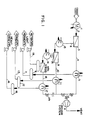
- Figure 1 is a schematic of an embodiment of the present invention containing multiple membrane pervaporation stages.
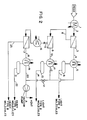
- Figure 2 is a schematic of an embodiment of the present invention functioning as a multi-staged membrane distillation unit.
- the present invention is a process for separating feed streams containing multiple components.
- the process employs a multi-membrane staged pervaporation scheme wherein each stage may contain one membrane unit or multiple membrane units run either in series or in parallel and wherein each membrane stage in series is run at a progressively stronger vacuum, higher temperature or both.
- the process is especially useful for separating components from wide boiling range mixtures.
- a multi-component feed is fed to a first membrane stage.
- the feed is heated to a temperature appropriate for the lightest, lowest boiling component of the feed.
- the first membrane pervaporation stage is run at a low vacuum.
- a first permeate of light, lower boiling material is recovered, and a retentate is produced.
- This retentate is fed to a second membrane pervaporation stage which is run at a higher temperature, a stronger vacuum or both than the preceding stage. In this second stage a second permeate is recovered which is heavier and higher boiling than the permeate of the preceding stage.
- a second retentate is also produced which is fed to a third membrane pervaporation stage which is run at a still higher temperature, a higher vacuum or both than the preceding second stage.
- the retentate can be fed to the next succeeding stage as it comes from the preceding stage or it can be at least subjected to interstage reheat to make up for heat lost due to evporation of the permeate in the preceding stages such conditions being called isothermal conditions.
- the retentate can be fed to the next succeeding stage at a temperature higher than the preceding stage but the succeeding stage is run at the same vacuum pressure as the preceding stage.
- the amount of heat supplied in each heating/reheating is enough to evaporate the desired permeate for that particular stage and the heating is, therefore, to a temperature higher than in the preceding zone while each stage is run at a successively greater vacuum than the preceding stage.
- the maximum amount of heat which can be employed is determined by the mechanical maximum operating temperature of the membrane at the vacuum employed at the particular stage running at this temperature.
- the process of the present invention may employ as many membrane pervaporation stages as there are recoverable components or fractions in the initial feed.
- the only requirement is that the temperature, vacuum or both used in stage n be greater than the vacuum in the preceding stage n-1.
- Different membranes can be employed in each stage in order to obtain the optimum performance.
- each stage is run using only as much vacuum, heat or both as necessary to pervaporate a particular component or narrow range of components, the condensers associated with each stage can be scaled and powered accordingly.
- the permeate condensers can use cooling water.
- the later stages, run at higher temperatures, successively higher vacuums or both can still use cheap cooling water condensers because the heavier permeated components are more easily condensed than the lighter ones evaporated in the earlier stages.
- This scheme, wherein only cheap cooling water condensers are needed is much more economical than current schemes which use single pervaporation units to perform broad cut separations of feeds and therefore require expensive refrigerated condensers to condense the lighter components.
- the process of the present invention is useful for separating complex multi component feeds, especially those having a wide boiling range. It has special utility in those instances where different components of a stream possess approximately the same boiling point so traditional distillation cannot be used.
- the present process can be used to recover a number of fractions of aromatics as permeates boiling at different temperatures. Non-aromatics boiling at substantially the same temperature as the aromatics are not permeated and remain in the retentate fractions.
- the pervaporation process of the present invention can be used to separate feeds on the basis of both molecular type and boiling point, the present pervaporation process combines the benefit of both distillation and membrane separation in a single process.
- One process can be used in place of two, thereby simplifying material handlings and energy requirements.
- the different pervaporation units may employ the same or different membranes depending on the separation desired at each stage.
- U.S. Patents 2,923,749, 2,947,687, 3,043,891 and 2,985,588 suggest the use of various cellulose esters, cellulose ethers, and mixed cellulose esters and ethers and irradiated polyethylene as useable membranes.
- the membranes can be used as such or they can have their permeability increased by using various diluents or feed additives such as oxygenated hydrocarbons, halogenated hydrocarbons, sulfur containing organic compounds, nitrogen containing organic compounds etc.
- U.S. Patent 4,115,465 teaches polyurethane membranes for use in the pervaporative separation of aromatics from various non-aromatic compounds.
- USSN 108,822 teaches a particular polyurea-urethane membrane for aromatic-non-aromatic separation.
- Such polyurea-urethane membranes are preferably anisotropic in nature. The production of such anisotropic membranes is taught in USSN 108,821.
- the membranes are prepared from the corresponding co-polymer by synthesizing the copolymer in a good solvent containing less than 5 vol % non-solvent, producing a film of this polymer solution on a support with a maximum pore size less than 20 microns, subjecting the film to conditions such that the solvent vapor pressure-time factor is 1000 mm Hg min. or less and quenching the membrane film in a non-solvent yielding the anisotropic membrane.
- Pervaporation processes preferably use membranes in the form of hollow fibres.
- Hollow fibres of the above described polyurea-urethane polymer can be made by using hollow fibres of regenerated cellulose as the support on which the polymer is deposited, subjecting the film to conditions resulting in the proper solvent vapor pressure-time factor, preferably immediately quenching the fibre in a non-solvent.
- the multi component feed to be separated into selected components is passed through heater (1) and heated to a temperature T1 sufficient to provide the necessary heat to evaporate the desired boiling range permeate.
- the heated feed is passed via line (2) to the first pervaporative membrane unit (3) where it is subject to a low vacuum sufficient to draw off the light, low boiling permeate.
- the vacuum is produced by vacuum pump (A).
- the amount of vacuum applied to each membrane unit is controlled by valves (V1 and V2 ... V N shown in the figure).
- This permeate is passed through line (4) to chiller (5) where it is condensed and sent to permeate storage vessel (6).
- This permeate can be sent via line (7) to further processing, treatment or blending units (not shown).
- the retentate from membrane unit 3 is passed via line (8) to the second membrane unit (9).
- the retentate in line 8 can be sent to the second membrane unit (9) directly or it can first be passed through a heater (15) wherein heat lost in stage 1 membrane unit to evaporation is replaced or the retentate is heated to a temperature T2 sufficient to provide the heat of evaporation of the next lightest, higher boiling component present in the retentate.
- stage 2 membrane unit (9) the retentate from stage 1 is subjected to the same or a higher vacuum than that in stage 1 membrane unit 3 producing a second permeate passed via line (10) to cooler (11) for storing in permeate storage vessel (12). This permeate can be passed via line (13) to further processing, treatment or blending units (not shown).
- stage 2 membrane unit (9) The retentate from stage 2 membrane unit (9) is passed via line (14) through a series of stages until the highest desired boiling component is recovered.
- the retentate from heater n is passed to stage n membrane unit wherein it is subjected to the highest vacuum used in the process to produce a final permeate stream (16) passed through chiller (17) and sent to permeate vessel (18).
- the retentate, containing the non-permeating species of the feed is sent via line 19 for treatment, processing, blending etc. not shown.
- Figure 2 describes a multi-stage membrane distillation unit in which molecules can be separated by boiling point as well as molecular type.
- a multi-component feed to be separated into selected components is passed through heater (1) and heated to a temperature T1 sufficient to provide the necessary heat to evaporate the desired boiling range permeate.
- the heated feed is passed via line (2) to the first pervaporative membrane unit (3) in stage 1 housing membrane A which selectively permeates type A molecules.
- This permeate is passed through line (4) to chiller (5) where it is condensed and sent to permeate storage vessel (6).
- This permeate can be sent via line (7) to further processing, treatment or blending units (not shown).
- the retentate from membrane unit (3) is sent via line (8) to the second membrane unit (9) in stage 1 which houses membrane B which selectively permeates type B molecules.
- a heater (not shown) can be employed prior to unit 9 if required.
- the permeate from unit 9 is passed through line (10) to chiller (11) where it is condensed and sent to permeate storage vessel (13). This permeate can be sent via line (14) to further processing, treatment or blending units. Any number of membrane units housing different membranes which are selective to different molecular types can be employed. All the membrane units in stage 1 are subjected to a vacuum sufficient to draw off the light low boiling permeate.
- the vacuum is produced by a vacuum generating system (i.e., vacuum pump, steam ejector).
- the retentate from the stage 1 membrane units is passed via line 15 through a series of stages until the highest desired boiling component is recovered.
- the retentate from heater 16 is passed to membrane unit 17 in stage n wherein it is subjected to the highest vacuum used in the process to produce a final permeate stream (18) passed through chiller (19) and sent to permeate vessel (21).
- This permeate can be sent via line (22) to further processing, treatment or blending units. All membrane units are subjected to a vacuum produced by a vacuum pump, the vacuum being delivered to the membrane units via lines 12 and 20 and regulated by means of valve VI.
- the retentate, containing the non-permeating species of the feed to membrane unit 17 is sent via line 23 for further treatment or processing.
Landscapes
- Engineering & Computer Science (AREA)
- Water Supply & Treatment (AREA)
- Chemical & Material Sciences (AREA)
- Chemical Kinetics & Catalysis (AREA)
- Separation Using Semi-Permeable Membranes (AREA)
Applications Claiming Priority (1)
| Application Number | Priority Date | Filing Date | Title |
|---|---|---|---|
| US07/315,867 US4962270A (en) | 1989-02-27 | 1989-02-27 | Multi-stage pervaporation process run at progressively higher vacuum, higher temperature or both at each successive retentate stage |
Publications (1)
| Publication Number | Publication Date |
|---|---|
| EP0457981A1 true EP0457981A1 (fr) | 1991-11-27 |
Family
ID=23226400
Family Applications (1)
| Application Number | Title | Priority Date | Filing Date |
|---|---|---|---|
| EP90305577A Withdrawn EP0457981A1 (fr) | 1989-02-27 | 1990-05-22 | Procédé de pervaporation en multiples étapes |
Country Status (2)
| Country | Link |
|---|---|
| US (1) | US4962270A (fr) |
| EP (1) | EP0457981A1 (fr) |
Cited By (8)
| Publication number | Priority date | Publication date | Assignee | Title |
|---|---|---|---|---|
| WO1994007592A1 (fr) * | 1992-10-07 | 1994-04-14 | Exxon Research And Engineering Company | Procede d'evaporation a travers une membrane utilisant un recyclage du permeat |
| EP0641593A1 (fr) * | 1993-09-08 | 1995-03-08 | Texaco Development Corporation | Récipient de pervaporation et procédé |
| EP0655274A1 (fr) * | 1993-11-29 | 1995-05-31 | Mitsubishi Chemical Corporation | Procédé et dispositif pour la séparation d'un mélange liquide |
| NL1017516C2 (nl) * | 2001-03-06 | 2002-09-09 | Tno | Fractionering van vloeistofmengsels met behulp van membraancontactoren. |
| EP1372822A4 (fr) * | 2001-03-30 | 2004-05-12 | Trans Ionics Corp | Systeme de pervaporation par membrane et de permeation a la vapeur |
| WO2004056457A3 (fr) * | 2002-12-19 | 2005-04-07 | Univ Marburg Philipps | Procede de separation de systemes polymeres et films polymeres non poreux utilises dans ce procede |
| WO2005029625A3 (fr) * | 2003-09-16 | 2005-10-13 | Gillette Co | Distribution de combustible amelioree pour piles a methanol direct |
| US6986802B2 (en) * | 2003-08-28 | 2006-01-17 | Bp Corporation North America Inc. | Selective separation of fluid compounds utilizing a membrane separation process |
Families Citing this family (27)
| Publication number | Priority date | Publication date | Assignee | Title |
|---|---|---|---|---|
| FR2501044A1 (fr) * | 1981-03-04 | 1982-09-10 | Machugh John | Medicament a base de 3,3-bis-(p-hydroxyphenyl)-phtalide et son procede de preparation |
| US5063186A (en) * | 1987-10-14 | 1991-11-05 | Exxon Research & Engineering Company | Highly aromatic polyurea/urethane membranes and their use of the separation of aromatics from non-aromatics |
| US4962270A (en) * | 1989-02-27 | 1990-10-09 | Exxon Research And Engineering Company | Multi-stage pervaporation process run at progressively higher vacuum, higher temperature or both at each successive retentate stage |
| US5045206A (en) * | 1990-12-05 | 1991-09-03 | Exxon Research & Engineering Company | Selective multi-ring aromatics extraction using a porous, non-selective partition membrane barrier |
| US5254795A (en) * | 1992-10-07 | 1993-10-19 | Exxon Research And Engineering Company | Removal of 2-ring aromatics from low boiling streams containing low concentrations of same using membranes |
| US5556539A (en) * | 1993-02-26 | 1996-09-17 | Mitsubishi Chemical Corporation | Apparatus for separating a liquid mixture by pervaporation |
| DE4410243C1 (de) * | 1994-03-24 | 1995-06-29 | Carbone Ag | Membranverfahren zur Trennung fluider Gemische |
| FR2753702B1 (fr) * | 1996-09-24 | 1999-12-03 | Inst Francais Du Petrole | Procede de purification du benzene comprenant deux etapes de permeation |
| US5873260A (en) * | 1997-04-02 | 1999-02-23 | Linhardt; Hans D. | Refrigeration apparatus and method |
| US6013852A (en) * | 1997-11-21 | 2000-01-11 | Shell Oil Company | Producing light olefins from a contaminated liquid hydrocarbon stream by means of thermal cracking |
| FR2794379B1 (fr) * | 1999-06-04 | 2002-06-07 | Separex Sa | Dispositif de fractionnement de melanges a membrane operant a pression supercritique |
| WO2003064015A2 (fr) * | 2002-01-25 | 2003-08-07 | Colorado School Of Mines | Melanges de polymeres et procedes de separation utilisant ces polymeres |
| US7837877B2 (en) * | 2006-06-09 | 2010-11-23 | Air Products And Chemicals, Inc. | Process for separating components of a multi-component feed stream |
| US7708151B2 (en) * | 2006-08-08 | 2010-05-04 | Exxonmobil Research And Engineering Company | Membrane for separating aromatic and aliphatic compounds |
| US8083946B2 (en) * | 2006-08-08 | 2011-12-27 | Exxonmobil Research And Engineering Company | Chemically cross-linked polymeric membranes and method of use |
| US7785471B2 (en) * | 2006-08-08 | 2010-08-31 | Exxonmobil Research And Engineering Company | Chromatographic membrane separation |
| US7749387B2 (en) * | 2006-08-08 | 2010-07-06 | Exxonmobil Research And Engineering Company | Integrally-layered polymeric membranes and method of use |
| US20080035567A1 (en) * | 2006-08-08 | 2008-02-14 | Sabottke Craig Y | Enhanced membrane separation system |
| JP5308022B2 (ja) * | 2007-12-28 | 2013-10-09 | 三菱重工業株式会社 | 脱水装置及び方法 |
| US7951224B2 (en) * | 2008-12-24 | 2011-05-31 | Exxonmobil Research And Engineering Company | Process for improving the cetane rating of distillate and diesel boiling range fractions |
| US20100155300A1 (en) * | 2008-12-24 | 2010-06-24 | Sabottke Craig Y | Process for producing gasoline of increased octane and hydrogen-containing co-produced stream |
| US9044711B2 (en) | 2009-10-28 | 2015-06-02 | Oasys Water, Inc. | Osmotically driven membrane processes and systems and methods for draw solute recovery |
| EA027334B1 (ru) | 2009-10-28 | 2017-07-31 | Оасис Уотер, Инк. | Способы прямого осмотического разделения |
| US8906143B2 (en) * | 2011-09-02 | 2014-12-09 | Membrane Technology And Research, Inc. | Membrane separation apparatus for fuel gas conditioning |
| GB2504503A (en) | 2012-07-31 | 2014-02-05 | Ibm | Desalination system |
| US10427067B1 (en) | 2018-03-26 | 2019-10-01 | Extractcraft, Llc | Controlling heat flux during distillation and concentration of extract |
| CN108704484A (zh) * | 2018-06-06 | 2018-10-26 | 大连理工大学 | 一种用于多元污染物水溶液的膜接触器分离方法 |
Citations (4)
| Publication number | Priority date | Publication date | Assignee | Title |
|---|---|---|---|---|
| US4435191A (en) * | 1983-06-30 | 1984-03-06 | Monsanto Company | Process for separating aggressive gases from gas mixtures |
| US4650574A (en) * | 1983-02-12 | 1987-03-17 | Gsk Forschungszentrum Geesthacht Gmbh | Apparatus for the separation of solutions by pervaporation |
| US4828773A (en) * | 1987-10-14 | 1989-05-09 | Exxon Research And Engineering Company | Highly aromatic anisotropic polyurea/urethane membranes and their use for the separation of aromatics from non-aromatics |
| US4962270A (en) * | 1989-02-27 | 1990-10-09 | Exxon Research And Engineering Company | Multi-stage pervaporation process run at progressively higher vacuum, higher temperature or both at each successive retentate stage |
Family Cites Families (10)
| Publication number | Priority date | Publication date | Assignee | Title |
|---|---|---|---|---|
| US3043891A (en) * | 1954-10-29 | 1962-07-10 | Standard Oil Co | Separation of hydrocarbons |
| US2947687A (en) * | 1954-10-29 | 1960-08-02 | American Oil Co | Separation of hydrocarbons by permeation membrane |
| US2923749A (en) * | 1955-05-27 | 1960-02-02 | American Oil Co | Prevention of membrane rupture in a separatory process for oil soluble organic compounds using a non-porous plastic permeation membrane |
| US2985588A (en) * | 1957-03-28 | 1961-05-23 | Standard Oil Co | Separation technique through a permeation membrane |
| US3062905A (en) * | 1958-05-22 | 1962-11-06 | Standard Oil Co | Separation process |
| US3398091A (en) * | 1966-08-09 | 1968-08-20 | Ionics | Membrane separation apparatus and process |
| US3370102A (en) * | 1967-05-05 | 1968-02-20 | Abcor Inc | Isothermal-liquid-liquid permeation separation systems |
| US3520803A (en) * | 1968-12-24 | 1970-07-21 | Ionics | Membrane fluid separation apparatus and process |
| DE2947089A1 (de) * | 1979-11-22 | 1981-05-27 | Helmut Dr.-Ing. 5804 Herdecke Michele | Verfahren zur trennung von fluiden durch permeation |
| US4397661A (en) * | 1980-06-27 | 1983-08-09 | Monsanto Company | Gas permeation apparatus having permeate rate controlled valving |
-
1989
- 1989-02-27 US US07/315,867 patent/US4962270A/en not_active Expired - Fee Related
-
1990
- 1990-05-22 EP EP90305577A patent/EP0457981A1/fr not_active Withdrawn
Patent Citations (4)
| Publication number | Priority date | Publication date | Assignee | Title |
|---|---|---|---|---|
| US4650574A (en) * | 1983-02-12 | 1987-03-17 | Gsk Forschungszentrum Geesthacht Gmbh | Apparatus for the separation of solutions by pervaporation |
| US4435191A (en) * | 1983-06-30 | 1984-03-06 | Monsanto Company | Process for separating aggressive gases from gas mixtures |
| US4828773A (en) * | 1987-10-14 | 1989-05-09 | Exxon Research And Engineering Company | Highly aromatic anisotropic polyurea/urethane membranes and their use for the separation of aromatics from non-aromatics |
| US4962270A (en) * | 1989-02-27 | 1990-10-09 | Exxon Research And Engineering Company | Multi-stage pervaporation process run at progressively higher vacuum, higher temperature or both at each successive retentate stage |
Non-Patent Citations (1)
| Title |
|---|
| World Patent Index Latest database, Derwent Publications Ltd, London, GB. Accession No. & JP-A-58-095523 (Kuraray),(07.06.83) * |
Cited By (12)
| Publication number | Priority date | Publication date | Assignee | Title |
|---|---|---|---|---|
| WO1994007592A1 (fr) * | 1992-10-07 | 1994-04-14 | Exxon Research And Engineering Company | Procede d'evaporation a travers une membrane utilisant un recyclage du permeat |
| EP0641593A1 (fr) * | 1993-09-08 | 1995-03-08 | Texaco Development Corporation | Récipient de pervaporation et procédé |
| US5445731A (en) * | 1993-09-08 | 1995-08-29 | Texaco Inc. | Pervaporation vessel |
| EP0655274A1 (fr) * | 1993-11-29 | 1995-05-31 | Mitsubishi Chemical Corporation | Procédé et dispositif pour la séparation d'un mélange liquide |
| US5494556A (en) * | 1993-11-29 | 1996-02-27 | Mitsubishi Chemical Corporation | Method of and an apparatus for separating a liquid mixture |
| NL1017516C2 (nl) * | 2001-03-06 | 2002-09-09 | Tno | Fractionering van vloeistofmengsels met behulp van membraancontactoren. |
| WO2002070113A1 (fr) * | 2001-03-06 | 2002-09-12 | Nederlandse Organisatie Voor Toegepast-Natuurwetenschappelijk Onderzoek Tno | Fractionnement de melanges de liquides au moyen de contacteurs a membrane |
| EP1372822A4 (fr) * | 2001-03-30 | 2004-05-12 | Trans Ionics Corp | Systeme de pervaporation par membrane et de permeation a la vapeur |
| WO2004056457A3 (fr) * | 2002-12-19 | 2005-04-07 | Univ Marburg Philipps | Procede de separation de systemes polymeres et films polymeres non poreux utilises dans ce procede |
| US6986802B2 (en) * | 2003-08-28 | 2006-01-17 | Bp Corporation North America Inc. | Selective separation of fluid compounds utilizing a membrane separation process |
| WO2005029625A3 (fr) * | 2003-09-16 | 2005-10-13 | Gillette Co | Distribution de combustible amelioree pour piles a methanol direct |
| JP2007506253A (ja) * | 2003-09-16 | 2007-03-15 | ザ ジレット カンパニー | 直接メタノール型燃料電池用の強化燃料供給 |
Also Published As
| Publication number | Publication date |
|---|---|
| US4962270A (en) | 1990-10-09 |
Similar Documents
| Publication | Publication Date | Title |
|---|---|---|
| US4962270A (en) | Multi-stage pervaporation process run at progressively higher vacuum, higher temperature or both at each successive retentate stage | |
| US6986802B2 (en) | Selective separation of fluid compounds utilizing a membrane separation process | |
| EP0657205B1 (fr) | Pervaporation à l'aide d'un balayage condensable à contre-courant | |
| US4510047A (en) | Selective extraction solvent recovery using regenerated cellulose membrane under reverse osmosis conditions | |
| EP1515790B1 (fr) | Procedes utilisant des membranes selectivement permeables et montees en plusieurs groupes pour la recuperation simultanee de produits specifies dans un melange de fluides | |
| US4900402A (en) | Pervaporation process of separating a liquid mixture | |
| US5785739A (en) | Steam cracker gas separation process | |
| EP1102734B1 (fr) | Recuperation d'hydrocarbures aromatiques a l'aide de membranes traitees avec une huile lubrifiante | |
| US5013447A (en) | Process of treating alcoholic beverages by vapor-arbitrated pervaporation | |
| KR101464006B1 (ko) | 혼합된 기-액 공급물을 사용하는 개선된 막 분리 방법 | |
| AU2004224457B2 (en) | Purification of fluid compounds utilizing a distillation-membrane separation process | |
| US8535413B2 (en) | Integrated mechanical vapor recompression (MVR) and membrane vapor permeation process for ethanol recovery (ethanol dehydration) from fermentation broth | |
| EP0701857A1 (fr) | Déshydration de courants vaporeux à l'aide d'une membrane avec balayage condensable à contre-courant | |
| JP2002517161A (ja) | 流体流から成分を除去するための薄膜方法および装置 | |
| US5256297A (en) | Multi-stage ultrafiltration process (OP-3711) | |
| US4806245A (en) | Pervaporation of phenols | |
| Baker | Membrane technology in the chemical industry: future directions | |
| US5914435A (en) | Process for reducing the benzene content in a hydrocarbon fraction | |
| EP0160142A1 (fr) | Combinaison d'extraction par membranes et de déparaffinage d'huiles lubrifiantes | |
| CA1312550C (fr) | Pervaporation de phenols | |
| JPH0422423A (ja) | 各連続するリテンテート段階において次第に高い真空、高い温度またはその両方で運転される多段パーベーパレーション法 | |
| CA2015856A1 (fr) | Procede de prevaporation a plusieurs etages, avec accroissement progressif de la depression, de la temperature ou des deux | |
| EP1372822B1 (fr) | Procede de pervaporation et de permeation de vapeur par membrane | |
| WO1990008183A1 (fr) | Procede de traitement de boissons alcoolisees par evaporation au travers d'une membrane commandee par la vapeur | |
| EP4308533B1 (fr) | Récupération de diols à partir d'un mélange |
Legal Events
| Date | Code | Title | Description |
|---|---|---|---|
| PUAI | Public reference made under article 153(3) epc to a published international application that has entered the european phase |
Free format text: ORIGINAL CODE: 0009012 |
|
| AK | Designated contracting states |
Kind code of ref document: A1 Designated state(s): BE DE FR GB IT NL |
|
| 17P | Request for examination filed |
Effective date: 19920522 |
|
| 17Q | First examination report despatched |
Effective date: 19921014 |
|
| STAA | Information on the status of an ep patent application or granted ep patent |
Free format text: STATUS: THE APPLICATION IS DEEMED TO BE WITHDRAWN |
|
| 18D | Application deemed to be withdrawn |
Effective date: 19950919 |