EP0458130B1 - Weitwinkel-Spiegelteleskop mit Mehrfach-Gesichtsfeld - Google Patents
Weitwinkel-Spiegelteleskop mit Mehrfach-Gesichtsfeld Download PDFInfo
- Publication number
- EP0458130B1 EP0458130B1 EP91107438A EP91107438A EP0458130B1 EP 0458130 B1 EP0458130 B1 EP 0458130B1 EP 91107438 A EP91107438 A EP 91107438A EP 91107438 A EP91107438 A EP 91107438A EP 0458130 B1 EP0458130 B1 EP 0458130B1
- Authority
- EP
- European Patent Office
- Prior art keywords
- assembly
- mirror
- elements
- view
- field
- Prior art date
- Legal status (The legal status is an assumption and is not a legal conclusion. Google has not performed a legal analysis and makes no representation as to the accuracy of the status listed.)
- Expired - Lifetime
Links
- 230000003287 optical effect Effects 0.000 claims description 34
- 210000001747 pupil Anatomy 0.000 claims description 15
- 210000003128 head Anatomy 0.000 claims description 10
- 238000003384 imaging method Methods 0.000 claims description 7
- 230000000712 assembly Effects 0.000 description 10
- 238000000429 assembly Methods 0.000 description 10
- 230000008901 benefit Effects 0.000 description 4
- 230000007246 mechanism Effects 0.000 description 4
- 230000004075 alteration Effects 0.000 description 3
- 230000008859 change Effects 0.000 description 2
- 239000000463 material Substances 0.000 description 2
- 206010010071 Coma Diseases 0.000 description 1
- 201000009310 astigmatism Diseases 0.000 description 1
- 230000005540 biological transmission Effects 0.000 description 1
- 230000008878 coupling Effects 0.000 description 1
- 238000010168 coupling process Methods 0.000 description 1
- 238000005859 coupling reaction Methods 0.000 description 1
- 238000010586 diagram Methods 0.000 description 1
- 238000007516 diamond turning Methods 0.000 description 1
- 230000001939 inductive effect Effects 0.000 description 1
- 238000003754 machining Methods 0.000 description 1
- 238000000034 method Methods 0.000 description 1
- 230000004048 modification Effects 0.000 description 1
- 238000012986 modification Methods 0.000 description 1
- 238000004806 packaging method and process Methods 0.000 description 1
- 230000005855 radiation Effects 0.000 description 1
- 230000003252 repetitive effect Effects 0.000 description 1
- 230000003595 spectral effect Effects 0.000 description 1
Images

Classifications
-
- G—PHYSICS
- G02—OPTICS
- G02B—OPTICAL ELEMENTS, SYSTEMS OR APPARATUS
- G02B17/00—Systems with reflecting surfaces, with or without refracting elements
- G02B17/02—Catoptric systems, e.g. image erecting and reversing system
- G02B17/06—Catoptric systems, e.g. image erecting and reversing system using mirrors only, i.e. having only one curved mirror
- G02B17/0626—Catoptric systems, e.g. image erecting and reversing system using mirrors only, i.e. having only one curved mirror using three curved mirrors
- G02B17/0636—Catoptric systems, e.g. image erecting and reversing system using mirrors only, i.e. having only one curved mirror using three curved mirrors off-axis or unobscured systems in which all of the mirrors share a common axis of rotational symmetry
-
- G—PHYSICS
- G02—OPTICS
- G02B—OPTICAL ELEMENTS, SYSTEMS OR APPARATUS
- G02B17/00—Systems with reflecting surfaces, with or without refracting elements
- G02B17/02—Catoptric systems, e.g. image erecting and reversing system
- G02B17/06—Catoptric systems, e.g. image erecting and reversing system using mirrors only, i.e. having only one curved mirror
- G02B17/0694—Catoptric systems, e.g. image erecting and reversing system using mirrors only, i.e. having only one curved mirror with variable magnification or multiple imaging planes, including multispectral systems
Definitions
- This invention relates to reflective telescope systems and, more particularly, to an all-reflective multiple field of view optical system.
- the observer When viewing a distant object through a telescope system, the observer is commonly interested in performing two separate and sequential functions.
- the first of these functions is a coarse search over a large field of view for the purposes of locating or acquiring previously undetected objects.
- the second function is the fine examination over a smaller field of view for purposes of identification or discrimination of the previously located object.
- Refractive optical systems generally have one or more of the following disadvantages.
- Refractive systems generally have spectral limitations and chromatic aberrations.
- Refractive systems have size limitations, lens material limitations and a lack of radiation hardness. Further, the refractive systems are more sensitive to thermal changes and are exceptionally heavy when used in large aperture designs.
- a system which retains the versatility and benefits of reflective optics while eliminating the disadvantages of refractive optical systems.
- the present invention provides a single telescope with a pair of three-mirror anastigmats which may be moved with respect to one another to provide a multiple field of view optical system.
- the telescope system will include a lower magnification, coarser resolution, wider field of view extreme to enable search and acquisition functions during operation of the system.
- the system will include a higher magnification, finer resolution and narrower field of view to enable tracking and detailed imaging during operation of the system.
- the present invention provides the art with an all-reflective afocal telescope which exhibits substantially unobscured aperture and field capabilities.
- a multiple field of view operation in a single housing body to minimize the space and components necessary in an optical system is provided by the invention.
- the present invention provides for correction of spherical aberration, coma and astigmatism while providing a flat field of view.
- Both of the reflective systems of the invention utilize common entrance pupil regions and a common exit pupil. Imaging optics of a scanning or staring variety are generally placed behind the exit pupil to provide a final image plane.
- the reflective multiple field of view optical system includes an entrance pupil region, first and second assemblies for reflecting light from a viewed object, and a viewing plane.
- the first and second reflecting assemblies are movably positioned with respect to one another such that in a first position, one of the reflecting assemblies reflects light from the entrance pupil to the plane for viewing. In the second position, the other of the reflecting assemblies reflects light to the plane for viewing.
- the field of view and the afocal magnification of the first and second reflecting assemblies are different.
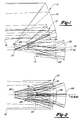
- an afocal optical system including a first 10 and a second 12 reflecting assembly.
- the system also includes an entrance pupil region 14 and an exit pupil 16.
- the first reflecting assembly 10 is comprised of a primary 18, secondary 20 and tertiary 22 mirror.
- the second reflecting assembly 12 is comprised of a primary 24, secondary 26 and tertiary 28 mirror.
- the primary mirror 18 of the first reflecting assembly 10 includes a central axis 30 defining the system optical axis.
- the primary mirror 18 is fixably or stationarily positioned with respect to the optical axis.
- the primary mirror 18 is a positive power mirror and may be a paraboloid conic or higher order aspheric mirror.
- the secondary mirror 20 is a negative power mirror and is positioned such that it is in a Cassegrain-like configuration with the primary mirror 18.
- the secondary mirror is fixably positioned off-axis with respect to the optical axis 30.
- the secondary mirror 20 may be a hyperboloid conic or higher order aspheric mirror.
- the tertiary mirror 22 is a positive power mirror.
- the tertiary mirror is movably positioned such that it is off-axis with respect to the optical axis of the system.
- the tertiary mirror 22 may be a paraboloid conic or higher order aspheric mirror.
- the first reflecting assembly 10 generally performs a narrow field of view operation.
- the narrow field of view provides high magnification, finer resolution and smaller field of view enabling tracking and detailed imaging during operation of the optical system.
- the primary mirror 24 of the second reflecting assembly 12 is movably positioned and includes a central axis 32 defining the system optical axis.
- the primary mirror 24 is a positive power mirror and may be a paraboloid conic or higher order aspheric mirror.
- the secondary mirror 26 of the second reflecting assembly 12 is a negative power mirror and is positioned such that it is in a Cassegrain-like configuration with the primary mirror 24.
- the secondary mirror 26 is movably positioned off-axis of the system.
- the secondary mirror 26 may be a hyperboloid conic or higher order aspheric mirror.
- the tertiary mirror 28 is a positive power mirror.
- the tertiary mirror 28 is fixably positioned off-axis with respect to the system.
- the tertiary mirror 28 may be of a spherical shape conic or higher order aspheric mirror.
- the second reflecting assembly 12 generally performs a wide field of view operation.
- the wide field of view provides a lower magnification, coarser resolution, larger field of view extreme to enable search and acquisition functions during operation of the optical system.
- the above mirrors can be machined using precision diamond turning techniques which provide for high optical transmission. Also, the precision machining enables fewer total parts and the use of relatively inexpensive materials when compared to refractive elements.
- the second reflecting assembly 12 mirrors are positioned such that one or more of the mirrors may be movable with respect to the first reflective assembly 10.
- the movability or pivoting of one or more of the mirrors of the second reflecting assembly 12 enables the telescope to be compact and the second reflecting assembly 12 to pivot 90° with respect to the first reflecting assembly 10.
- This pivoting of 90° enables one or more of the mirrors of the second assembly 12 to be positioned out of the line of sight of the first reflecting assembly 10 and, therefore, enables the light to pass from the object being viewed through the first reflecting assembly 10.
- the mechanism can be moved or pivoted so that the second reflecting assembly mirrors are aligned for viewing the object to be viewed.
- the system generally utilizes the common entrance pupil region 14 and common exit pupil 16.
- FIGS. 1 and 2 A specific prescription for the system in accordance with the present invention as illustrated in FIGS. 1 and 2 is as follows:
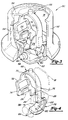
- FIGS. 3 through 6 a mechanical implementation of the present invention is illustrated.
- the two reflecting assemblies 10 and 12 are illustrated within a hardware package or sensor head assembly 50.
- the head assembly 50 includes a casing 52 and window 54.
- the window 54 enables light to pass to the optical system from the object being viewed.
- the main optical housing 56 Positioned within the casing 52 is a main optical housing 56, a detector dewar 58, a scanner 60, an imager housing assembly 62, switching motor mechanism 64 and the reflecting assembly switching assembly 66.
- the main optical housing 56 includes a viewing aperture 68 serving as an entrance pupil region to enable light from the object being viewed to pass into the reflecting assemblies of the optical system.
- the switching assembly 66 generally includes a yoke member 70.
- the yoke member 70 is U-shaped and includes an enlarged portion 72 at one end of one of the legs of the yoke 70, as seen in FIG. 4.
- a viewing aperture 74 is formed in the enlarged portion 72 and serves as the entrance pupil when the wide field of view mode of the telescope is utilized, as seen in FIG. 6.
- the enlarged portion 72 serves as a mounting surface for the secondary mirror 26 of the second reflecting assembly 14, as seen in FIGS. 3-5.
- the other leg 76 of the U-shaped yoke member 70 includes a mounting surface for the primary mirror 24 of the second reflective assembly 12. Also, a U-shaped member 78 extends from the leg 76 to enable coupling of the yoke with the switching motor mechanism through a gear train or the like. The member 78 also includes a projecting member 80 for mounting of the tertiary mirror 22 of the first reflecting assembly 10, as seen in FIG. 4. Thus, the movable mirrors are mounted on the yoke 70.
- the fixed or stationary mirrors are mounted in a manner as now will be described.
- the primary mirror 18 of the first reflecting assembly 10 is fixably mounted to the optical housing 56.
- the second mirror 20 of the first reflective assembly 10 is fixably mounted to the optical housing 56 above the scanner 60, as seen in FIG. 5.
- the tertiary mirror 28 of the second reflecting assembly 12 is fixably mounted on the housing 56.
- the first reflective assembly 10 receives light from an object being viewed.
- the light from the object being viewed passes through the window 54, passes the viewing aperture 68 in the optical housing 56 and to the primary mirror 18.
- the beams of light are reflected from the primary mirror 18 to the secondary mirror 20 and to the tertiary mirror 22.
- the beams of light from the tertiary mirror 22 are reflected into the scanner 60 and imaging assembly 62 until the ultimate image is produced.
- the yoke member 70 is transverse to or out of alignment with the beams of light, as illustrated in FIG. 5.
- the yoke member is rotated 90° by the motor 64 of the switching assembly 66.
- a two-position precision hardened index stopping mechanism (not shown) provides for the switching of the yoke 70 from the narrow field of view position to the wide field of view position.
- the motor 64 drives the yoke 70 until it is in alignment with the beams of light, as illustrated in FIG. 6. At this point, light passes through the window 54, through the housing viewing aperture 68 and through the yoke viewing aperture 74. The beams of light contact the primary mirror 24 and are reflected to the secondary mirror 26 and to the tertiary mirror 28. As mentioned above, the beams of light are then reflected to the scanner 60 and the imaging assembly 62.
- the movable field of view mirrors include the primary 24 and secondary 26 mirrors of the second reflecting assembly 12, and also the tertiary 22 mirror of the first reflecting assembly 10.
- the first reflecting assembly tertiary mirror 22 is the least sensitive element of the first reflecting assembly, permitting rotation in and out of position for field of view change without inducing unacceptable foresight errors.
- the second reflecting assembly primary 24 and secondary 26 mirrors are co-mounted on the yoke 70 preserving close tolerances.
- the second reflective assembly tertiary mirror 28 is the least sensitive element of this field of view system and, therefore, can be mounted on the main housing 56 separately from the primary 24 and secondary 26 mirrors.
- the assembly accomplishes field of view mode change in less than one second and allows repetitive foresight to less than 0.1 mrad in the first reflecting assembly mode or the narrow field of view mode while retaining less than 5 mrads shift in the second reflecting assembly mode or the wide field of view foresight from the first reflecting assembly field of view.
- the present invention has several advantages over conventional three-mirror astigmatic optical systems.
- the present invention uses an all-reflective system, providing a plurality of fields of view.
- the present invention enables the reflective assemblies to be positioned in nested configurations with the mirrors of one assembly being moved in and out of the line of sight of the beams to provide more than one field of view.
- the invention minimizes the space requirements for multi-field of view systems.
Landscapes
- Physics & Mathematics (AREA)
- General Physics & Mathematics (AREA)
- Optics & Photonics (AREA)
- Spectroscopy & Molecular Physics (AREA)
- Telescopes (AREA)
- Lenses (AREA)
Claims (12)
- Ein vollständig reflektives optisches System mit Mehrfachgesichtsfeld mit:
einer ersten Baugruppe (10) mit einem ersten, zweiten und sechsten Licht reflektierenden Element (18, 20, 28); und
einer zweiten Baugruppe (12) mit einem dritten, vierten und fünften Licht reflektierenden Element (22, 24, 26), wobei die zweite Baugruppe (12) bewegbar bezüglich der ersten Baugruppe (10) derart positioniert ist, daß in einer ersten Position das erste, zweite und dritte Element (18, 20, 22) zusammenwirken zum Reflektieren von durch einen Eintrittpupillenbereich hindurchtretendem Licht in eine Betrachtungsebene, und daß in einer zweiten Position das vierte, fünfte und sechste Element (24, 26, 28) zusammenwirken zum Reflektieren von Licht von der Pupille in die Betrachtungsebene, wobei das Gesichtsfeld und die afokale Vergrößerung des zusammenwirkenden ersten, zweiten und dritten Elements (18, 20, 22) sich zu dem Gesichtsfeld und der afokalen Vergrößerung der zusammenwirkenden vierten, fünften und sechsten Elemente (24, 26, 28) unterscheiden. - Das vollständig reflektive optische System mit Mehrfachgesichtsfeld gemäß Anspruch 1, wobei das erste, zweite und dritte Element (18, 20, 22) zusammenwirken zur Bildung eines afokalen Dreispiegelanastigmaten und wobei das vierte, fünfte und sechste Element (24, 26, 28) Zusammenwirken zur Bildung eines afokalen Dreispiegelanastigmaten.
- Das vollständig reflektive optische System mit Mehrfachgesichtsfeld gemäß Anspruch 2, wobei jeder der afokalen Dreispiegelanastigmaten ein außeraxiales System ist.
- Ein vollständig reflektives optisches System mit Mehrfachgesichtsfeld gemäß Anspruch 1, wobei
das erste Element (18) ein Primärspiegel ist mit einer zentralen Achse (30), wobei das zweite Element (20) ein Sekundärspiegel und das dritte Element (22) ein Tertiärspiegel ist;
und wobei das vierte Element (24) ein Primärspiegel ist mit einer zentralen Achse (32), das fünfte Element (26) ein Sekundärspiegel und das sechste Element (28) ein Tertiärspiegel ist. - Eine Sensorkopfanordnung mit:
einem Gehäuse (52) mit einer Lichtdurchlaßeinrichtung (74), um zu ermöglichen, daß Licht in das Gehäuse eintritt; und einer Vorrichtung (70, 72, 76) zum Anbringen des optischen Systems nach Anspruch 1, wobei die Vorrichtung zum Anbringen innerhalb des Gehäuses vorgesehen ist, um zu ermöglichen, daß das vierte und fünfte Element (24, 26) der zweiten Baugruppe und das sechste Element (22) der ersten Baugruppe beweglich in bezug auf die anderen Elemente (18, 20, 28) in einer ersten Position angeordnet sind, wobei das erste, zweite und dritte Element (18, 20, 22) zusammenwirken zum Reflektieren von durch einen Eintrittpupillenbereich hindurchtretendem Licht in eine Betrachtungsebene und wobei in einer zweiten Position das vierte, fünfte und sechste Element (24, 26, 28) zusammenwirken zum Reflektieren von Licht von der Pupille in die Betrachtungsebene, wobei das Gesichtsfeld und die afokale Verstärkung der zusammenwirkenden ersten, zweiten und dritten Elemente (18, 20, 22) sich zu dem Gesichtsfeld und der afokalen Verstärkung der zusammenwirkenden vierten, fünften und sechsten Elemente (24, 26, 28) unterscheiden. - Der Sensorkopf gemäß Anspruch 5, wobei die Vorrichtung zum Anbringen weiter ein optisches Gehäuse umfaßt mit einer Öffnung (74), die ermöglicht, daß Licht hindurchtritt, und einer Umschaltanordnung, die bewegbar mit dem optischen Gehäuse gekoppelt ist, wobei das vierte und fünfte Element (24, 26) der zweiten Baugruppe und das sechste Element (28) der ersten Baugruppe mit dem optischen Gehäuse und der Umschaltanordnung gekoppelt sind.
- Der Sensorkopf gemäß Anspruch 6, wobei die Umschaltanordnung weiter ein U-förmiges Jochteil (70) umfaßt, das mit einer Motoranordnung zum Bewegen des Jochteils gekoppelt ist.
- Der Sensorkopf gemäß Anspruch 6, wobei die erste Baugruppe einen afokalen Dreispiegelanastigmaten umfaßt.
- Der Sensorkopf gemäß Anspruch 6, wobei die zweite Baugruppe einen afokalen Dreispiegelanastigmaten umfaßt.
- Der Sensorkopf gemäß Anspruch 5, der weiter eine innerhalb des Gehäuses angeordnete Detektorvorrichtung umfaßt, die mit der ersten und zweiten Baugruppe in Zusammenhang steht.
- Der Sensorkopf gemäß Anspruch 5, der weiter eine innerhalb des Gehäuses angeordnete Abtastvorrichtung umfaßt, die mit der ersten und zweiten Baugruppe in Zusammenhang steht.
- Der Sensorkopf gemäß Anspruch 5, der weiter eine innerhalb des Gehäuses angeordnete Abbildungsvorrichtung umfaßt, die mit der ersten und zweiten Baugruppe in Zusammenhang steht.
Applications Claiming Priority (2)
| Application Number | Priority Date | Filing Date | Title |
|---|---|---|---|
| US525801 | 1990-05-21 | ||
| US07/525,801 US5009494A (en) | 1990-05-21 | 1990-05-21 | Wide field all-reflective multiple field of view telescope |
Publications (3)
| Publication Number | Publication Date |
|---|---|
| EP0458130A2 EP0458130A2 (de) | 1991-11-27 |
| EP0458130A3 EP0458130A3 (en) | 1992-03-04 |
| EP0458130B1 true EP0458130B1 (de) | 1995-06-28 |
Family
ID=24094653
Family Applications (1)
| Application Number | Title | Priority Date | Filing Date |
|---|---|---|---|
| EP91107438A Expired - Lifetime EP0458130B1 (de) | 1990-05-21 | 1991-05-07 | Weitwinkel-Spiegelteleskop mit Mehrfach-Gesichtsfeld |
Country Status (5)
| Country | Link |
|---|---|
| US (1) | US5009494A (de) |
| EP (1) | EP0458130B1 (de) |
| JP (1) | JPH06317755A (de) |
| DE (1) | DE69110762D1 (de) |
| IL (1) | IL97940A0 (de) |
Families Citing this family (26)
| Publication number | Priority date | Publication date | Assignee | Title |
|---|---|---|---|---|
| DE3943258A1 (de) * | 1989-12-29 | 1991-07-11 | Michael Brunn | Silhouettierungsfreies spiegelsystem fuer astronomische teleskope vom typ schiefspiegler |
| JPH05134192A (ja) * | 1991-05-02 | 1993-05-28 | Hughes Aircraft Co | 多数の同時機能を有する光学系 |
| US5227923A (en) * | 1991-09-30 | 1993-07-13 | Hughes Aircraft Company | Dual-field of view reflective reimaging telescope |
| US5414555A (en) * | 1992-01-13 | 1995-05-09 | Aerojet-General Corporation | Method for the manufacture of a three-mirror optical system and the optical system resulting therefrom |
| US5221990A (en) * | 1992-03-09 | 1993-06-22 | Hughes Aircraft Company | Wide field of view automotive rear vision optical system |
| US5287218A (en) * | 1992-04-07 | 1994-02-15 | Hughes Aircraft Company | Re-imaging optical system including refractive and diffractive optical elements |
| US5363235A (en) * | 1993-02-10 | 1994-11-08 | Hughes Aircraft Company | Dual field of view multi wavelength sensor |
| US5930055A (en) * | 1994-09-29 | 1999-07-27 | Eisenberg; Yeshayahu S. | Lens apparatus |
| US5477395A (en) * | 1994-11-14 | 1995-12-19 | Hughes Aircraft Company | Two nested all-reflective afocal telescopes providing four fields of view |
| DE69737785T2 (de) * | 1996-04-18 | 2008-02-07 | Kanebo Trinity Holdings, Ltd. | Nahen infrarotstrahlen absorbierender film und damit ausgerüstete mehrschichtige verbrundplatte |
| US5831762A (en) * | 1996-06-21 | 1998-11-03 | Raytheon Company | Imaging sensor having multiple fields of view and utilizing all-reflective optics |
| US6020994A (en) * | 1998-09-23 | 2000-02-01 | Raytheon Company | Integrated multifunctional multispectral sight assembly and method |
| US6862146B2 (en) * | 2002-06-11 | 2005-03-01 | Magna Donnelly, Inc. | Afocal optical rearview mirror assembly |
| US7099077B2 (en) * | 2005-01-05 | 2006-08-29 | Raytheon Company | Optical system having three fields of view using two all-reflective optical modules |
| US20070209268A1 (en) * | 2006-03-09 | 2007-09-13 | Santa Barbara Infrared, Inc. | Laser rangefinder sighting apparatus and method |
| US8154712B2 (en) * | 2008-07-23 | 2012-04-10 | Corning Incorporated | Insertion of laser path in multiple field of view reflective telescope |
| US7952799B2 (en) * | 2009-06-19 | 2011-05-31 | Corning Incorporated | Extreme broadband compact optical system with multiple fields of view |
| DE102010018498B4 (de) * | 2010-04-22 | 2021-08-19 | Andreas Obrebski | Optische Anordnung und optische Vorrichtung oder Gerät |
| US9228895B2 (en) * | 2012-05-25 | 2016-01-05 | Raytheon Company | Imaging system with multiple focal plane array sensors |
| US9200966B2 (en) | 2013-07-24 | 2015-12-01 | Raytheon Company | Dual field of view telescope |
| DE102015104323A1 (de) | 2015-03-23 | 2016-09-29 | Carl Zeiss Smt Gmbh | Zoomsystem mit austauschbaren optischen Elementen |
| US10761307B2 (en) * | 2016-12-06 | 2020-09-01 | Raytheon Company | Bypass optical switch and methods |
| US11099371B2 (en) * | 2017-12-12 | 2021-08-24 | Raytheon Company | Telescope bypass mirror mechanism with minimized stow volume |
| US11268860B2 (en) | 2020-07-24 | 2022-03-08 | Raytheon Company | Radiometric calibration of detector |
| CN115683565B (zh) * | 2022-10-12 | 2025-08-05 | 中国航空工业集团公司洛阳电光设备研究所 | 一种离轴两反产品零度视场光轴的寻找方法及监测方法 |
| CN117908243B (zh) * | 2024-03-12 | 2024-06-07 | 东华大学 | 多视场望远系统 |
Family Cites Families (12)
| Publication number | Priority date | Publication date | Assignee | Title |
|---|---|---|---|---|
| US3554628A (en) * | 1966-05-03 | 1971-01-12 | Texas Instruments Inc | Infrared optical system utilizing circular scanning |
| US3631248A (en) * | 1969-12-30 | 1971-12-28 | Texas Instruments Inc | Target-scanning camera comprising a constant temperature source for providing a calibration signal |
| US3674334A (en) * | 1971-01-04 | 1972-07-04 | Perkin Elmer Corp | Catoptric anastigmatic afocal optical system |
| US3790247A (en) * | 1972-06-09 | 1974-02-05 | Bendix Corp | All reflective image space scanning device |
| GB1594966A (en) * | 1977-06-01 | 1981-08-05 | Pilkington Perkin Elmer Ltd | Infra-red optical lens sytems |
| US4101195A (en) * | 1977-07-29 | 1978-07-18 | Nasa | Anastigmatic three-mirror telescope |
| US4265510A (en) * | 1979-05-16 | 1981-05-05 | Hughes Aircraft Company | Three mirror anastigmatic optical system |
| US4812030A (en) * | 1985-01-03 | 1989-03-14 | The Boeing Company | Catoptric zoom optical device |
| US4804258A (en) * | 1986-05-05 | 1989-02-14 | Hughes Aircraft Company | Four mirror afocal wide field of view optical system |
| US4934805A (en) * | 1986-11-12 | 1990-06-19 | The Boeing Company | Fixed step catoptric zoom system |
| US4834517A (en) * | 1987-01-13 | 1989-05-30 | Hughes Aircraft Company | Method and apparatus for receiving optical signals |
| DE68913256T2 (de) * | 1988-10-17 | 1994-09-08 | Hughes Aircraft Co | Reflektierendes, kontinuierliches optisches Zoomsystem. |
-
1990
- 1990-05-21 US US07/525,801 patent/US5009494A/en not_active Expired - Fee Related
-
1991
- 1991-04-24 IL IL97940A patent/IL97940A0/xx not_active IP Right Cessation
- 1991-05-07 DE DE69110762T patent/DE69110762D1/de not_active Expired - Lifetime
- 1991-05-07 EP EP91107438A patent/EP0458130B1/de not_active Expired - Lifetime
- 1991-05-21 JP JP3145529A patent/JPH06317755A/ja active Pending
Also Published As
| Publication number | Publication date |
|---|---|
| EP0458130A3 (en) | 1992-03-04 |
| US5009494A (en) | 1991-04-23 |
| JPH06317755A (ja) | 1994-11-15 |
| DE69110762D1 (de) | 1995-08-03 |
| IL97940A0 (en) | 1992-06-21 |
| EP0458130A2 (de) | 1991-11-27 |
Similar Documents
| Publication | Publication Date | Title |
|---|---|---|
| EP0458130B1 (de) | Weitwinkel-Spiegelteleskop mit Mehrfach-Gesichtsfeld | |
| US5477395A (en) | Two nested all-reflective afocal telescopes providing four fields of view | |
| US5227923A (en) | Dual-field of view reflective reimaging telescope | |
| US4733955A (en) | Reflective optical triplet having a real entrance pupil | |
| US5309276A (en) | Catoptric optical system including concave and convex reflectors | |
| US5144476A (en) | All-reflective zoom optical system | |
| US4993818A (en) | Continuous zoom all-reflective optical system | |
| JP3177118B2 (ja) | 補正ミラーを有する軸を外れた3ミラーアナスチグマート装置 | |
| US4804258A (en) | Four mirror afocal wide field of view optical system | |
| EP0512439B1 (de) | Reflektierendes optisches System, das Licht auf eine Vielzahl von Beobachtungsregionen richtet | |
| EP1774386B1 (de) | Reflektorteleskop für mehrere sichtfelder | |
| US4964706A (en) | Multi-focal length, multi-field of view three mirror anastrigmat | |
| EP0601871A1 (de) | Grosses lichtstarkes Weitwinkel-Spiegelsystem ohne zentrale Abschattung mit gefaltetem Strahlengang | |
| US5363235A (en) | Dual field of view multi wavelength sensor | |
| US5173801A (en) | Wide field of view afocal three-mirror anastigmat | |
| EP3356874B1 (de) | Afokales optisches system mit 5-spiegeln und breitem sichtfeld | |
| US6324016B1 (en) | Telecentric lens | |
| US3827778A (en) | Dual imaging concentric optics | |
| EP0364951B1 (de) | Reflektierendes, kontinuierliches optisches Zoomsystem | |
| Cook | Wide field of view three-mirror anastigmat (TMA) employing spherical secondary and tertiary mirrors | |
| Wetherell | Afocal systems | |
| Wetherell | All-reflecting afocal telescopes | |
| Ryan-Howard | GHIS optical design | |
| Cook | The last three-mirror anastigmat? | |
| Rakich | Plate-corrected adaptive optics relays |
Legal Events
| Date | Code | Title | Description |
|---|---|---|---|
| PUAI | Public reference made under article 153(3) epc to a published international application that has entered the european phase |
Free format text: ORIGINAL CODE: 0009012 |
|
| AK | Designated contracting states |
Kind code of ref document: A2 Designated state(s): DE ES FR GB IT NL |
|
| PUAL | Search report despatched |
Free format text: ORIGINAL CODE: 0009013 |
|
| RHK1 | Main classification (correction) |
Ipc: G02B 17/06 |
|
| AK | Designated contracting states |
Kind code of ref document: A3 Designated state(s): DE ES FR GB IT NL |
|
| 17P | Request for examination filed |
Effective date: 19920317 |
|
| 17Q | First examination report despatched |
Effective date: 19931018 |
|
| GRAA | (expected) grant |
Free format text: ORIGINAL CODE: 0009210 |
|
| AK | Designated contracting states |
Kind code of ref document: B1 Designated state(s): DE ES FR GB IT NL |
|
| PG25 | Lapsed in a contracting state [announced via postgrant information from national office to epo] |
Ref country code: IT Free format text: LAPSE BECAUSE OF FAILURE TO SUBMIT A TRANSLATION OF THE DESCRIPTION OR TO PAY THE FEE WITHIN THE PRESCRIBED TIME-LIMIT;WARNING: LAPSES OF ITALIAN PATENTS WITH EFFECTIVE DATE BEFORE 2007 MAY HAVE OCCURRED AT ANY TIME BEFORE 2007. THE CORRECT EFFECTIVE DATE MAY BE DIFFERENT FROM THE ONE RECORDED. Effective date: 19950628 Ref country code: ES Free format text: THE PATENT HAS BEEN ANNULLED BY A DECISION OF A NATIONAL AUTHORITY Effective date: 19950628 Ref country code: FR Effective date: 19950628 Ref country code: NL Free format text: LAPSE BECAUSE OF FAILURE TO SUBMIT A TRANSLATION OF THE DESCRIPTION OR TO PAY THE FEE WITHIN THE PRESCRIBED TIME-LIMIT Effective date: 19950628 |
|
| REF | Corresponds to: |
Ref document number: 69110762 Country of ref document: DE Date of ref document: 19950803 |
|
| PG25 | Lapsed in a contracting state [announced via postgrant information from national office to epo] |
Ref country code: DE Effective date: 19950929 |
|
| EN | Fr: translation not filed | ||
| NLV1 | Nl: lapsed or annulled due to failure to fulfill the requirements of art. 29p and 29m of the patents act | ||
| PLBE | No opposition filed within time limit |
Free format text: ORIGINAL CODE: 0009261 |
|
| STAA | Information on the status of an ep patent application or granted ep patent |
Free format text: STATUS: NO OPPOSITION FILED WITHIN TIME LIMIT |
|
| PG25 | Lapsed in a contracting state [announced via postgrant information from national office to epo] |
Ref country code: GB Effective date: 19960507 |
|
| 26N | No opposition filed | ||
| GBPC | Gb: european patent ceased through non-payment of renewal fee |
Effective date: 19960507 |