EP0458617A2 - Silicone rubber composition - Google Patents
Silicone rubber composition Download PDFInfo
- Publication number
- EP0458617A2 EP0458617A2 EP91304630A EP91304630A EP0458617A2 EP 0458617 A2 EP0458617 A2 EP 0458617A2 EP 91304630 A EP91304630 A EP 91304630A EP 91304630 A EP91304630 A EP 91304630A EP 0458617 A2 EP0458617 A2 EP 0458617A2
- Authority
- EP
- European Patent Office
- Prior art keywords
- group
- diorganopolysiloxane
- composition according
- general formula
- silicone rubber
- Prior art date
- Legal status (The legal status is an assumption and is not a legal conclusion. Google has not performed a legal analysis and makes no representation as to the accuracy of the status listed.)
- Granted
Links
- 239000000203 mixture Substances 0.000 title claims abstract description 56
- 229920002379 silicone rubber Polymers 0.000 title claims abstract description 31
- 239000004945 silicone rubber Substances 0.000 title claims abstract description 28
- 229920005645 diorganopolysiloxane polymer Polymers 0.000 claims abstract description 37
- 125000005010 perfluoroalkyl group Chemical group 0.000 claims abstract description 13
- 125000004435 hydrogen atom Chemical group [H]* 0.000 claims abstract description 9
- 125000001033 ether group Chemical group 0.000 claims abstract description 6
- 239000001257 hydrogen Substances 0.000 claims abstract description 6
- 229910052739 hydrogen Inorganic materials 0.000 claims abstract description 6
- 125000001931 aliphatic group Chemical group 0.000 claims description 18
- -1 3,3,3-trifluoropropyl groups Chemical group 0.000 claims description 14
- 229920006136 organohydrogenpolysiloxane Polymers 0.000 claims description 12
- 239000000945 filler Substances 0.000 claims description 10
- 239000003795 chemical substances by application Substances 0.000 claims description 9
- 125000002496 methyl group Chemical group [H]C([H])([H])* 0.000 claims description 8
- 150000001451 organic peroxides Chemical class 0.000 claims description 8
- YCKRFDGAMUMZLT-UHFFFAOYSA-N Fluorine atom Chemical compound [F] YCKRFDGAMUMZLT-UHFFFAOYSA-N 0.000 claims description 6
- 239000011737 fluorine Substances 0.000 claims description 6
- 229910052731 fluorine Inorganic materials 0.000 claims description 6
- 125000000962 organic group Chemical group 0.000 claims description 6
- 125000004432 carbon atom Chemical group C* 0.000 claims description 4
- 125000000391 vinyl group Chemical group [H]C([*])=C([H])[H] 0.000 claims description 4
- 125000003903 2-propenyl group Chemical group [H]C([*])([H])C([H])=C([H])[H] 0.000 claims description 3
- 125000001495 ethyl group Chemical group [H]C([H])([H])C([H])([H])* 0.000 claims description 3
- 125000001997 phenyl group Chemical group [H]C1=C([H])C([H])=C(*)C([H])=C1[H] 0.000 claims description 3
- 229920002554 vinyl polymer Polymers 0.000 claims description 3
- HSFWRNGVRCDJHI-UHFFFAOYSA-N alpha-acetylene Chemical group C#C HSFWRNGVRCDJHI-UHFFFAOYSA-N 0.000 claims description 2
- 125000002534 ethynyl group Chemical group [H]C#C* 0.000 claims description 2
- 125000001183 hydrocarbyl group Chemical group 0.000 claims 5
- UHOVQNZJYSORNB-UHFFFAOYSA-N Benzene Chemical compound C1=CC=CC=C1 UHOVQNZJYSORNB-UHFFFAOYSA-N 0.000 abstract description 8
- 239000002798 polar solvent Substances 0.000 abstract description 5
- 239000012454 non-polar solvent Substances 0.000 abstract description 4
- 150000002148 esters Chemical class 0.000 abstract description 2
- 150000002576 ketones Chemical class 0.000 abstract description 2
- 229920001971 elastomer Polymers 0.000 description 17
- 239000005060 rubber Substances 0.000 description 17
- BASFCYQUMIYNBI-UHFFFAOYSA-N platinum Chemical compound [Pt] BASFCYQUMIYNBI-UHFFFAOYSA-N 0.000 description 16
- 229920000642 polymer Polymers 0.000 description 16
- 239000002904 solvent Substances 0.000 description 11
- VYPSYNLAJGMNEJ-UHFFFAOYSA-N Silicium dioxide Chemical compound O=[Si]=O VYPSYNLAJGMNEJ-UHFFFAOYSA-N 0.000 description 9
- 239000003054 catalyst Substances 0.000 description 8
- 238000001723 curing Methods 0.000 description 8
- JJRDHFIVAPVZJN-UHFFFAOYSA-N cyclotrisiloxane Chemical compound O1[SiH2]O[SiH2]O[SiH2]1 JJRDHFIVAPVZJN-UHFFFAOYSA-N 0.000 description 8
- 150000002430 hydrocarbons Chemical group 0.000 description 8
- 230000002522 swelling effect Effects 0.000 description 8
- 229910052697 platinum Inorganic materials 0.000 description 7
- 238000003756 stirring Methods 0.000 description 7
- 239000004593 Epoxy Substances 0.000 description 5
- 229920005560 fluorosilicone rubber Polymers 0.000 description 5
- 229910052744 lithium Inorganic materials 0.000 description 5
- 229910052751 metal Inorganic materials 0.000 description 5
- 239000002184 metal Substances 0.000 description 5
- BVTLTBONLZSBJC-UHFFFAOYSA-N 2,4,6-tris(ethenyl)-2,4,6-trimethyl-1,3,5,2,4,6-trioxatrisilinane Chemical compound C=C[Si]1(C)O[Si](C)(C=C)O[Si](C)(C=C)O1 BVTLTBONLZSBJC-UHFFFAOYSA-N 0.000 description 4
- IJGRMHOSHXDMSA-UHFFFAOYSA-N Atomic nitrogen Chemical compound N#N IJGRMHOSHXDMSA-UHFFFAOYSA-N 0.000 description 4
- RTZKZFJDLAIYFH-UHFFFAOYSA-N Diethyl ether Chemical compound CCOCC RTZKZFJDLAIYFH-UHFFFAOYSA-N 0.000 description 4
- 235000013870 dimethyl polysiloxane Nutrition 0.000 description 4
- 125000002887 hydroxy group Chemical group [H]O* 0.000 description 4
- 229920000435 poly(dimethylsiloxane) Polymers 0.000 description 4
- ZUHZGEOKBKGPSW-UHFFFAOYSA-N tetraglyme Chemical compound COCCOCCOCCOCCOC ZUHZGEOKBKGPSW-UHFFFAOYSA-N 0.000 description 4
- 0 C*(C)N*C(C)(C)C Chemical compound C*(C)N*C(C)(C)C 0.000 description 3
- UQSXHKLRYXJYBZ-UHFFFAOYSA-N Iron oxide Chemical compound [Fe]=O UQSXHKLRYXJYBZ-UHFFFAOYSA-N 0.000 description 3
- WMFOQBRAJBCJND-UHFFFAOYSA-M Lithium hydroxide Chemical compound [Li+].[OH-] WMFOQBRAJBCJND-UHFFFAOYSA-M 0.000 description 3
- KWYUFKZDYYNOTN-UHFFFAOYSA-M Potassium hydroxide Chemical compound [OH-].[K+] KWYUFKZDYYNOTN-UHFFFAOYSA-M 0.000 description 3
- HEMHJVSKTPXQMS-UHFFFAOYSA-M Sodium hydroxide Chemical compound [OH-].[Na+] HEMHJVSKTPXQMS-UHFFFAOYSA-M 0.000 description 3
- 238000007259 addition reaction Methods 0.000 description 3
- 239000002390 adhesive tape Substances 0.000 description 3
- 239000003513 alkali Substances 0.000 description 3
- 229920001577 copolymer Polymers 0.000 description 3
- OLLFKUHHDPMQFR-UHFFFAOYSA-N dihydroxy(diphenyl)silane Chemical compound C=1C=CC=CC=1[Si](O)(O)C1=CC=CC=C1 OLLFKUHHDPMQFR-UHFFFAOYSA-N 0.000 description 3
- 239000004205 dimethyl polysiloxane Substances 0.000 description 3
- 239000003822 epoxy resin Substances 0.000 description 3
- 229910021485 fumed silica Inorganic materials 0.000 description 3
- 238000010438 heat treatment Methods 0.000 description 3
- 239000000463 material Substances 0.000 description 3
- 230000000704 physical effect Effects 0.000 description 3
- 229920000647 polyepoxide Polymers 0.000 description 3
- 239000000843 powder Substances 0.000 description 3
- DMWVYCCGCQPJEA-UHFFFAOYSA-N 2,5-bis(tert-butylperoxy)-2,5-dimethylhexane Chemical compound CC(C)(C)OOC(C)(C)CCC(C)(C)OOC(C)(C)C DMWVYCCGCQPJEA-UHFFFAOYSA-N 0.000 description 2
- XEEYBQQBJWHFJM-UHFFFAOYSA-N Iron Chemical compound [Fe] XEEYBQQBJWHFJM-UHFFFAOYSA-N 0.000 description 2
- KDLHZDBZIXYQEI-UHFFFAOYSA-N Palladium Chemical compound [Pd] KDLHZDBZIXYQEI-UHFFFAOYSA-N 0.000 description 2
- QAOWNCQODCNURD-UHFFFAOYSA-N Sulfuric acid Chemical compound OS(O)(=O)=O QAOWNCQODCNURD-UHFFFAOYSA-N 0.000 description 2
- GWEVSGVZZGPLCZ-UHFFFAOYSA-N Titan oxide Chemical compound O=[Ti]=O GWEVSGVZZGPLCZ-UHFFFAOYSA-N 0.000 description 2
- 239000002253 acid Substances 0.000 description 2
- 239000003377 acid catalyst Substances 0.000 description 2
- 239000010425 asbestos Substances 0.000 description 2
- CETPSERCERDGAM-UHFFFAOYSA-N ceric oxide Chemical compound O=[Ce]=O CETPSERCERDGAM-UHFFFAOYSA-N 0.000 description 2
- 229910000422 cerium(IV) oxide Inorganic materials 0.000 description 2
- 238000013329 compounding Methods 0.000 description 2
- 238000007334 copolymerization reaction Methods 0.000 description 2
- 238000011156 evaluation Methods 0.000 description 2
- 238000009472 formulation Methods 0.000 description 2
- HTDJPCNNEPUOOQ-UHFFFAOYSA-N hexamethylcyclotrisiloxane Chemical compound C[Si]1(C)O[Si](C)(C)O[Si](C)(C)O1 HTDJPCNNEPUOOQ-UHFFFAOYSA-N 0.000 description 2
- FFUAGWLWBBFQJT-UHFFFAOYSA-N hexamethyldisilazane Chemical compound C[Si](C)(C)N[Si](C)(C)C FFUAGWLWBBFQJT-UHFFFAOYSA-N 0.000 description 2
- ZLNQQNXFFQJAID-UHFFFAOYSA-L magnesium carbonate Chemical compound [Mg+2].[O-]C([O-])=O ZLNQQNXFFQJAID-UHFFFAOYSA-L 0.000 description 2
- 239000001095 magnesium carbonate Substances 0.000 description 2
- 229910000021 magnesium carbonate Inorganic materials 0.000 description 2
- 238000005259 measurement Methods 0.000 description 2
- 238000000034 method Methods 0.000 description 2
- 229910052757 nitrogen Inorganic materials 0.000 description 2
- 238000012856 packing Methods 0.000 description 2
- 239000011541 reaction mixture Substances 0.000 description 2
- 229910052895 riebeckite Inorganic materials 0.000 description 2
- 150000003377 silicon compounds Chemical class 0.000 description 2
- 239000000377 silicon dioxide Substances 0.000 description 2
- WGTYBPLFGIVFAS-UHFFFAOYSA-M tetramethylammonium hydroxide Chemical compound [OH-].C[N+](C)(C)C WGTYBPLFGIVFAS-UHFFFAOYSA-M 0.000 description 2
- 230000008719 thickening Effects 0.000 description 2
- WRXCBRHBHGNNQA-UHFFFAOYSA-N (2,4-dichlorobenzoyl) 2,4-dichlorobenzenecarboperoxoate Chemical compound ClC1=CC(Cl)=CC=C1C(=O)OOC(=O)C1=CC=C(Cl)C=C1Cl WRXCBRHBHGNNQA-UHFFFAOYSA-N 0.000 description 1
- OXYKVVLTXXXVRT-UHFFFAOYSA-N (4-chlorobenzoyl) 4-chlorobenzenecarboperoxoate Chemical compound C1=CC(Cl)=CC=C1C(=O)OOC(=O)C1=CC=C(Cl)C=C1 OXYKVVLTXXXVRT-UHFFFAOYSA-N 0.000 description 1
- XMNIXWIUMCBBBL-UHFFFAOYSA-N 2-(2-phenylpropan-2-ylperoxy)propan-2-ylbenzene Chemical compound C=1C=CC=CC=1C(C)(C)OOC(C)(C)C1=CC=CC=C1 XMNIXWIUMCBBBL-UHFFFAOYSA-N 0.000 description 1
- 125000001731 2-cyanoethyl group Chemical group [H]C([H])(*)C([H])([H])C#N 0.000 description 1
- BIISIZOQPWZPPS-UHFFFAOYSA-N 2-tert-butylperoxypropan-2-ylbenzene Chemical compound CC(C)(C)OOC(C)(C)C1=CC=CC=C1 BIISIZOQPWZPPS-UHFFFAOYSA-N 0.000 description 1
- 239000004342 Benzoyl peroxide Substances 0.000 description 1
- OMPJBNCRMGITSC-UHFFFAOYSA-N Benzoylperoxide Chemical compound C=1C=CC=CC=1C(=O)OOC(=O)C1=CC=CC=C1 OMPJBNCRMGITSC-UHFFFAOYSA-N 0.000 description 1
- AOTOMVRCWUMWDC-UHFFFAOYSA-N CCCCP(CCCC)(CCCC)CCCC.O Chemical compound CCCCP(CCCC)(CCCC)CCCC.O AOTOMVRCWUMWDC-UHFFFAOYSA-N 0.000 description 1
- OKTJSMMVPCPJKN-UHFFFAOYSA-N Carbon Chemical compound [C] OKTJSMMVPCPJKN-UHFFFAOYSA-N 0.000 description 1
- 229920000298 Cellophane Polymers 0.000 description 1
- 239000004129 EU approved improving agent Substances 0.000 description 1
- LFQSCWFLJHTTHZ-UHFFFAOYSA-N Ethanol Chemical compound CCO LFQSCWFLJHTTHZ-UHFFFAOYSA-N 0.000 description 1
- VGGSQFUCUMXWEO-UHFFFAOYSA-N Ethene Chemical compound C=C VGGSQFUCUMXWEO-UHFFFAOYSA-N 0.000 description 1
- 239000005977 Ethylene Substances 0.000 description 1
- UFHFLCQGNIYNRP-UHFFFAOYSA-N Hydrogen Chemical compound [H][H] UFHFLCQGNIYNRP-UHFFFAOYSA-N 0.000 description 1
- 229910020175 SiOH Inorganic materials 0.000 description 1
- XUIMIQQOPSSXEZ-UHFFFAOYSA-N Silicon Chemical group [Si] XUIMIQQOPSSXEZ-UHFFFAOYSA-N 0.000 description 1
- 238000013006 addition curing Methods 0.000 description 1
- 150000001299 aldehydes Chemical class 0.000 description 1
- 229910001854 alkali hydroxide Inorganic materials 0.000 description 1
- 229910052783 alkali metal Inorganic materials 0.000 description 1
- 150000008044 alkali metal hydroxides Chemical class 0.000 description 1
- 150000001340 alkali metals Chemical class 0.000 description 1
- 150000001336 alkenes Chemical class 0.000 description 1
- 125000003342 alkenyl group Chemical group 0.000 description 1
- 125000000217 alkyl group Chemical group 0.000 description 1
- PNEYBMLMFCGWSK-UHFFFAOYSA-N aluminium oxide Inorganic materials [O-2].[O-2].[O-2].[Al+3].[Al+3] PNEYBMLMFCGWSK-UHFFFAOYSA-N 0.000 description 1
- 125000003710 aryl alkyl group Chemical group 0.000 description 1
- 125000003118 aryl group Chemical group 0.000 description 1
- 239000002585 base Substances 0.000 description 1
- 239000000440 bentonite Substances 0.000 description 1
- 229910000278 bentonite Inorganic materials 0.000 description 1
- SVPXDRXYRYOSEX-UHFFFAOYSA-N bentoquatam Chemical compound O.O=[Si]=O.O=[Al]O[Al]=O SVPXDRXYRYOSEX-UHFFFAOYSA-N 0.000 description 1
- 235000019400 benzoyl peroxide Nutrition 0.000 description 1
- 125000001797 benzyl group Chemical group [H]C1=C([H])C([H])=C(C([H])=C1[H])C([H])([H])* 0.000 description 1
- 125000000484 butyl group Chemical group [H]C([*])([H])C([H])([H])C([H])([H])C([H])([H])[H] 0.000 description 1
- 229910000420 cerium oxide Inorganic materials 0.000 description 1
- 239000007809 chemical reaction catalyst Substances 0.000 description 1
- 239000003086 colorant Substances 0.000 description 1
- 238000001816 cooling Methods 0.000 description 1
- 238000004132 cross linking Methods 0.000 description 1
- 125000000753 cycloalkyl group Chemical group 0.000 description 1
- 125000000113 cyclohexyl group Chemical group [H]C1([H])C([H])([H])C([H])([H])C([H])(*)C([H])([H])C1([H])[H] 0.000 description 1
- 125000001511 cyclopentyl group Chemical group [H]C1([H])C([H])([H])C([H])([H])C([H])(*)C1([H])[H] 0.000 description 1
- LSXWFXONGKSEMY-UHFFFAOYSA-N di-tert-butyl peroxide Chemical compound CC(C)(C)OOC(C)(C)C LSXWFXONGKSEMY-UHFFFAOYSA-N 0.000 description 1
- 239000002270 dispersing agent Substances 0.000 description 1
- NKSJNEHGWDZZQF-UHFFFAOYSA-N ethenyl(trimethoxy)silane Chemical compound CO[Si](OC)(OC)C=C NKSJNEHGWDZZQF-UHFFFAOYSA-N 0.000 description 1
- 239000000835 fiber Substances 0.000 description 1
- 239000012765 fibrous filler Substances 0.000 description 1
- 125000003709 fluoroalkyl group Chemical group 0.000 description 1
- 239000003365 glass fiber Substances 0.000 description 1
- 150000008282 halocarbons Chemical group 0.000 description 1
- 125000006038 hexenyl group Chemical group 0.000 description 1
- 238000007654 immersion Methods 0.000 description 1
- 239000004615 ingredient Substances 0.000 description 1
- 229910052742 iron Inorganic materials 0.000 description 1
- 125000001449 isopropyl group Chemical group [H]C([H])([H])C([H])(*)C([H])([H])[H] 0.000 description 1
- 238000004898 kneading Methods 0.000 description 1
- 239000010445 mica Substances 0.000 description 1
- 229910052618 mica group Inorganic materials 0.000 description 1
- 238000002156 mixing Methods 0.000 description 1
- WWZKQHOCKIZLMA-UHFFFAOYSA-M octanoate Chemical compound CCCCCCCC([O-])=O WWZKQHOCKIZLMA-UHFFFAOYSA-M 0.000 description 1
- JRZJOMJEPLMPRA-UHFFFAOYSA-N olefin Natural products CCCCCCCC=C JRZJOMJEPLMPRA-UHFFFAOYSA-N 0.000 description 1
- TWNQGVIAIRXVLR-UHFFFAOYSA-N oxo(oxoalumanyloxy)alumane Chemical compound O=[Al]O[Al]=O TWNQGVIAIRXVLR-UHFFFAOYSA-N 0.000 description 1
- BMMGVYCKOGBVEV-UHFFFAOYSA-N oxo(oxoceriooxy)cerium Chemical compound [Ce]=O.O=[Ce]=O BMMGVYCKOGBVEV-UHFFFAOYSA-N 0.000 description 1
- NDLPOXTZKUMGOV-UHFFFAOYSA-N oxo(oxoferriooxy)iron hydrate Chemical compound O.O=[Fe]O[Fe]=O NDLPOXTZKUMGOV-UHFFFAOYSA-N 0.000 description 1
- 229910052763 palladium Inorganic materials 0.000 description 1
- 150000002978 peroxides Chemical class 0.000 description 1
- 125000000286 phenylethyl group Chemical group [H]C1=C([H])C([H])=C(C([H])=C1[H])C([H])([H])C([H])([H])* 0.000 description 1
- 239000000049 pigment Substances 0.000 description 1
- 238000006116 polymerization reaction Methods 0.000 description 1
- 229920001296 polysiloxane Polymers 0.000 description 1
- 229910052700 potassium Inorganic materials 0.000 description 1
- 239000011591 potassium Substances 0.000 description 1
- 239000010453 quartz Substances 0.000 description 1
- 230000003014 reinforcing effect Effects 0.000 description 1
- 239000012763 reinforcing filler Substances 0.000 description 1
- 239000010948 rhodium Substances 0.000 description 1
- 229910052703 rhodium Inorganic materials 0.000 description 1
- MHOVAHRLVXNVSD-UHFFFAOYSA-N rhodium atom Chemical compound [Rh] MHOVAHRLVXNVSD-UHFFFAOYSA-N 0.000 description 1
- 238000007789 sealing Methods 0.000 description 1
- 239000003566 sealing material Substances 0.000 description 1
- 125000005372 silanol group Chemical group 0.000 description 1
- 229910052710 silicon Inorganic materials 0.000 description 1
- 235000012239 silicon dioxide Nutrition 0.000 description 1
- 125000005625 siliconate group Chemical group 0.000 description 1
- NTHWMYGWWRZVTN-UHFFFAOYSA-N sodium silicate Chemical compound [Na+].[Na+].[O-][Si]([O-])=O NTHWMYGWWRZVTN-UHFFFAOYSA-N 0.000 description 1
- 150000003460 sulfonic acids Chemical class 0.000 description 1
- 239000000454 talc Substances 0.000 description 1
- 229910052623 talc Inorganic materials 0.000 description 1
- GJBRNHKUVLOCEB-UHFFFAOYSA-N tert-butyl benzenecarboperoxoate Chemical compound CC(C)(C)OOC(=O)C1=CC=CC=C1 GJBRNHKUVLOCEB-UHFFFAOYSA-N 0.000 description 1
- 238000012360 testing method Methods 0.000 description 1
- 239000004408 titanium dioxide Substances 0.000 description 1
- 125000003944 tolyl group Chemical group 0.000 description 1
- ITMCEJHCFYSIIV-UHFFFAOYSA-N triflic acid Chemical compound OS(=O)(=O)C(F)(F)F ITMCEJHCFYSIIV-UHFFFAOYSA-N 0.000 description 1
- UKRDPEFKFJNXQM-UHFFFAOYSA-N vinylsilane Chemical compound [SiH3]C=C UKRDPEFKFJNXQM-UHFFFAOYSA-N 0.000 description 1
- 125000005023 xylyl group Chemical group 0.000 description 1
Images
Classifications
-
- C—CHEMISTRY; METALLURGY
- C08—ORGANIC MACROMOLECULAR COMPOUNDS; THEIR PREPARATION OR CHEMICAL WORKING-UP; COMPOSITIONS BASED THEREON
- C08K—Use of inorganic or non-macromolecular organic substances as compounding ingredients
- C08K5/00—Use of organic ingredients
- C08K5/04—Oxygen-containing compounds
- C08K5/14—Peroxides
-
- C—CHEMISTRY; METALLURGY
- C08—ORGANIC MACROMOLECULAR COMPOUNDS; THEIR PREPARATION OR CHEMICAL WORKING-UP; COMPOSITIONS BASED THEREON
- C08K—Use of inorganic or non-macromolecular organic substances as compounding ingredients
- C08K13/00—Use of mixtures of ingredients not covered by one single of the preceding main groups, each of these compounds being essential
- C08K13/02—Organic and inorganic ingredients
-
- C—CHEMISTRY; METALLURGY
- C08—ORGANIC MACROMOLECULAR COMPOUNDS; THEIR PREPARATION OR CHEMICAL WORKING-UP; COMPOSITIONS BASED THEREON
- C08L—COMPOSITIONS OF MACROMOLECULAR COMPOUNDS
- C08L83/00—Compositions of macromolecular compounds obtained by reactions forming in the main chain of the macromolecule a linkage containing silicon with or without sulfur, nitrogen, oxygen or carbon only; Compositions of derivatives of such polymers
- C08L83/04—Polysiloxanes
- C08L83/08—Polysiloxanes containing silicon bound to organic groups containing atoms other than carbon, hydrogen and oxygen
Definitions
- This invention relates to a silicone rubber composition which has low swelling properties in a variety of solvents.
- Silicone rubbers are excellent in electrical insulating property, heat resistance, cold resistance, weatherability, etc. and are used in various fields. However, the silicone rubbers are poor in solvent resistance. For example, upon making contact with or being immersed in a solvent, a silicone rubber swells to be deformed markedly and reduced in strength.
- fluorosilicone rubbers containing a fluoroalkyl group such as 3,3,3-trifluoropropyl have been developed.
- the fluorosilicone rubbers exhibit excellent resistance to nonpolar solvents such as benzene, but they are yet poor in resistance to polar solvents such as ketones, esters, etc. In fact, the fluorosilicone rubbers will swell extremely easily in polar solvents.
- a silicone rubber composition comprising: (A) a diorganopolysiloxane having the following general formula [I]: wherein R1 and R2 may be the same or different and each are an unsubstituted or substituted monovalent hydrocarbon group which does not have aliphatic unsaturated bonds, R3 is an unsaturated monovalent aliphatic hydrocarbon group, R4 is a divalent hydrocarbon group not having aliphatic unsaturated bonds or is a group having the following general formula [II]: -R5-O-R6- [II] wherein R5 and R6 are each a divalent hydrocarbon group which does not have aliphatic unsaturated bonds, Rf is a perfluoroalkyl group or a perfluoroalkyl ether group, X is hydrogen or a group having the following general formula [III]: wherein R7, R8 and R9 may be the same or different and each are an unsubstituted or substituted monovalent hydrocarbon group which does not have
- the silicone rubber composition of this invention has excellent resistance to polar solvents as well as non-polar solvents, and is highly applicable to such uses as packing material, sealing material, etc.
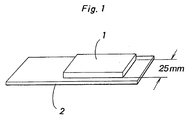
- Figure 1 is an illustration of a test specimen to be used for measurement of releasability of a cured rubber sheet from an epoxy resin.
- R1 and R2 are unsubstituted or substituted hydrocarbon groups, especially of from 1 to 8 carbon atoms, which do not have aliphatic unsaturated bonds.
- the groups R1 and R2 include alkyl groups such as methyl, ethyl, isopropyl, butyl, etc.; cycloalkyl groups such as cyclohexyl, cyclopentyl, etc.; aryl groups such as phenyl, tolyl, xylyl, etc.; aralkyl groups such as benzyl, phenylethyl, etc.; halogenated hydrocarbon groups such as chlorocyclohexyl, 3,3,3-trifluoropropyl, etc.; cyanohydrocarbon groups such as 2-cyanoethyl, and so on.
- these groups particularly preferred in this invention are methyl, ethyl, phenyl, and 3,3,3-trifluoropropyl.
- R3 is an unsaturated monovalent aliphatic hydrocarbon group, for example, vinyl, allyl, ethynyl, etc.
- the vinyl group is particularly preferred.
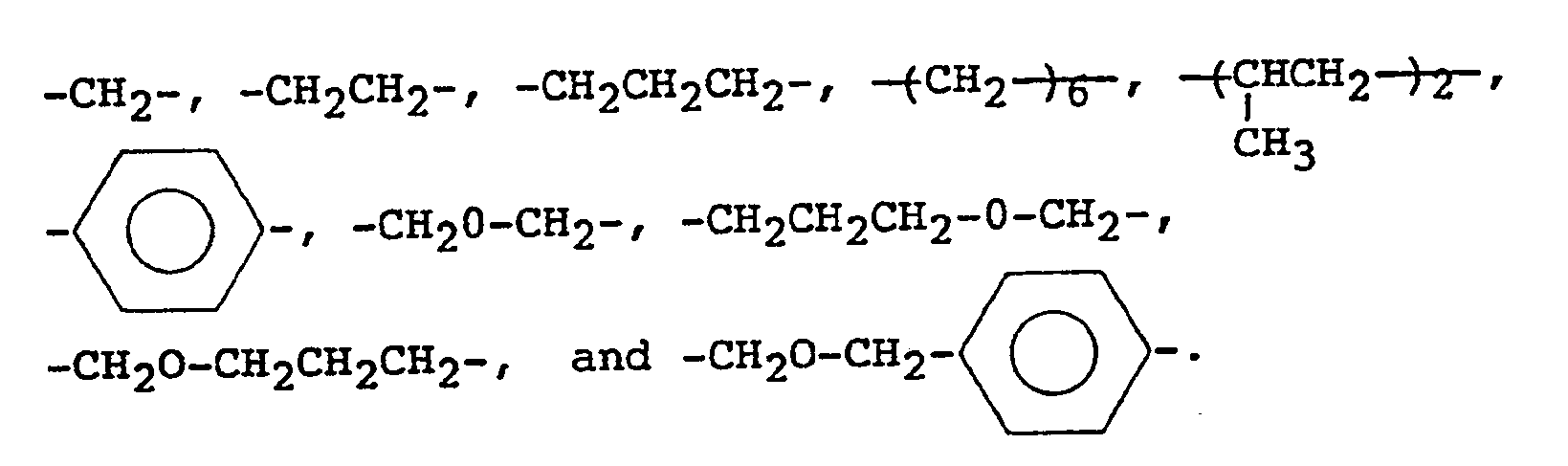
- R4 is a divalent group intermediate between the silicon atom and the fluorine-containing group Rf, and is a divalent hydrocarbon group not having aliphatic unsaturated bonds or is a divalent organic group containing an ether linkage having the following general formula [II]: wherein R5 and R6 are each a divalent organic group not containing aliphatic unsaturated bonds.
- Specific examples of R4 include: particularly preferred are -CH2CH2-, -CH2CH2CH2-, and -CH2CH2CH2-O-CH2-.
- Rf is a fluorine-containing organic group, which is either a perfluoroalkyl group or a perfluoroalkyl ether group.
- the applicable perfluoroalkyl groups include, for example, those having the following formula: C p F 2P+1 - wherein P is an integer of from 4 to 10.
- Preferable perfluoroalkyl groups are C6F13-, C8F17, C10F21-, and so on.
- the perfluoroalkyl ether groups usable include, for example, those having from 4 to 20 carbon atoms, preferably and so on.
- X is hydrogen or a group having the following general formula [III]: wherein R7 to R9 may be the same or different and each are an unsubstituted or substituted monovalent hydrocarbon group.
- the groups R7 to R9 include, for example, those hydrocarbon groups not having aliphatic unsaturated bonds which have been mentioned as exemplars of R1 above, and alkenyl groups such as vinyl, allyl, hexenyl, etc.
- l is an integer of 1 or above, preferably from 100 to 10,000
- m is an integer of 1 or above, preferably from 50 to 5,000
- n is an integer of 0 or above. It is preferable that m/(l+m+n) has a value of from 1/50 to 1/3.
- the diorganopolysiloxane used in this invention does not require the structural unit of the following formula: as an essential component thereof.
- the structural unit is essential to the diorganopolysiloxane only where the diorganopolysiloxane is cured by an addition reaction; when the curing is carried out by use of an organic peroxide, the above structural unit may not necessarily be contained in the diorganopolysiloxane.
- diorganopolysiloxane those having a viscosity of from 100 to 10,000,000 at 25°C are preferably used. These diorganopolysiloxanes may be used either singly or in combination of two or more.
- the diorganopolysiloxanes having the aforementioned general formula [I] can be prepared by methods known per se.
- the diorganopolysiloxanes can be obtained by copolymerizing a cyclotrisiloxane (a) having the following general formula [IV]: wherein R1, R2, R4 and Rf are as defined above, with a cyclotrisiloxane (b) having the following general formula [V]: wherein R1 is as defined above, and, optionally, a cyclotrisiloxane (c) having the following general formula [VI]: wherein R1 and R3 are as defined above, in the presence of an alkali or acid catalyst.
- the diorganopolysiloxanes obtained in this case are those having the aforementioned general formula [I] in which X is hydrogen, namely, those diorganopolysiloxanes which have the silanol group (SiOH) at their molecular ends.
- the diorganopolysiloxanes blocked by the group of the aforementioned general formula [III] at their molecular ends can be obtained by carrying out the copolymerization of the cyclotrisiloxanes (a) and (b), optionally with (c), in the presence of a silicon compound having the following formula [VII]: wherein R7 to R9 are as defined above, or the following formula [VIII]: wherein R1 and R7 to R9 are as defined above, q is an integer of 0 or above, and M is an alkali metal.
- the alkali or acid catalyst for use in the above copolymerization includes, for example, alkali hydroxides such as lithium hydroxide, sodium hydroxide, potassium hydroxide, etc.; alkali siliconates such as lithium siliconate, sodium siliconate, potassium siliconate, etc.; quaternary salt hydroxides such as tetrabutylphosphine hydroxide, tetramethylammonium hydroxide, etc.; a five-coordinate silicon compound having the following formula: sulfuric acid; sulfonic acids such as trifluoromethanesulfonic acid, and so on.
- a filler as component (B) is used, in addition to the diorganopolysiloxane of component (A).
- a variety of fillers conventionally used in general silicone rubber compositions can be used, for example,reinforcing fillers such as fumed silica, precipitated silica, carbon powder, titanium dioxide, mica, aluminum oxide, quartz powder, talc, diatomaceous earths, bentonite, etc.; fibrous fillers such as asbestos, glass fibers, organic fibers, and so on.
- the fillers are generally compounded in an amount of preferably from 10 to 300 parts by weight, more preferably from 20 to 200 parts by weight, per 100 parts by weight of the component (A).
- the amount of the fillers is less than 10 parts by weight, a sufficient reinforcing effect is not obtainable. If the amount of the fillers exceeds 300 parts by weight, on the other hand, cured products of the composition would have a lowered mechanical strength.
- the curing agent to be used in the silicone rubber composition according to this invention includes, for example, organic peroxides and organohydrogenpolysiloxanes having at least one silicon-bonded hydrogen atom in the molecule thereof.
- organic peroxide various ones which are conventionally used for organic peroxide crosslinking can be used.
- the usable organic peroxides include, for example, benzoyl peroxide, 2,4-dichlorobenzoyl peroxide, 4-monochlorobenzoyl peroxide, dicumyl peroxide, tert-butyl perbenzoate, tert-butyl peroxide, 2,5-dimethyl-2,5-bis(tert-butylperoxy)hexane, cumyl-tert-butyl peroxide.
- These peroxides may be used either singly or in combination of two or more. It is generally preferable to use the organic peroxides in an amount of from 0.2 to 5 parts by weight per 100 parts by weight of the component (A).
- the diorganopolysiloxane of component (A) in the silicone rubber composition of this invention has an unsaturated aliphatic group, namely, when n in the general formula [I] is an integer of 1 or above, the aforementioned organohydrogenpolysiloxane may be used as the curing agent.
- curing of the composition is effected through an addition reaction between the unsaturated aliphatic groups in the diorganopolysiloxane and the silicon-bonded hydrogen atoms in the organohydrogenpolysiloxane.
- organohydrogenpolysiloxanes which are ordinarily used in addition-curing type silicone compositions can be used.
- organohydrogenpolysiloxanes (1) and (2) are particularly preferred for use in this invention.
- R2, R4 and Rf are as defined above, s and t are each an integer of 0 or above, and u is an integer of 1 or above.
- (2) Copolymers comprising (CH3)2HSiO 0.5 units and SiO2 units.
- organohydrogenpolysiloxanes should have a viscosity of 1,000 or above at 25°C.
- the amount of the organohydrogenpolysiloxane used is so controlled as to provide at least one ⁇ Si-H group, more preferably from one to five ⁇ Si-H groups, per one unsaturated aliphatic hydrocarbon group (R3) in the diorganopolysiloxane of component (A).
- a platinum family metal catalyst may be used as an addition reaction catalyst.
- the platinum family metal catalysts include platinum catalysts, palladium catalysts and rhodium catalysts, of which the platinum catalysts are generally preferable.
- Typical examples of the platinum family metal catalysts for use in this case include platinum black, chloroplatinic acid, complexes of chloroplatinic acid with an olefin, such as ethylene, an alcohol, ether, aldehyde, vinylsilane, vinylsiloxane or the like, and platinum powder supported on a carrier such as alumina, silica, asbestos, etc.
- These platinum family metal catalysts are generally used in an amount of preferably from 1 to 500 ppm, more preferably from 5 to 20 ppm, in terms as the platinum family metal, based on the component (A).
- silicone rubber composition in the silicone rubber composition according to this invention, a variety of other compounding agents can be incorporated, in such ranges as not to impair the object of the invention, namely, improvement of solvent resistance.
- dispersing agents such as diphenylsilanediol, low polymerization degree dimethylpolysiloxanes blocked by the hydroxyl group at their molecular ends, hexamethyldisilazane, etc.
- heat resistance improving agents such as ferrous oxide, ferric oxide, cerium oxide, iron octylate, etc.
- coloring agents such as pigments, and so on can be incorporated in the silicone rubber composition, as required.
- the silicone rubber composition according to this invention can be prepared easily by kneading uniformly the aforementioned components by use of a mixing machine such as roll mill, kneader, Banbury mixer, etc.
- the silicone rubber composition will cure completely to give a highly elastic, cured silicone rubber product when heated at normal or applied pressure to a temperature of from 100 to 300°C for a period of from 30 seconds to 1 hour and, if necessary, subjected to secondary curing at 150 to 250°C for 2 to 24 hours.
- the silicone rubber composition of this invention has low swelling properties in a variety of solvents, as well as the intrinsic properties of silicone rubber. Therefore, the silicone rubber composition of the invention is highly suitable for such uses as packing, sealing, etc. Furthermore, the composition of this invention is also suitable for such applications as a rubber material for PPC rolls, as a mold-making material, and so on.
- a one-liter four-necked flask equipped with a stirring rod, a nitrogen inlet pipe, a thermometer and an exhaust pipe was charged with 1000 g of cyclotrisiloxane having the formula: 4.2 g of 1,3,5-trivinyl-1,3,5-trimethylcyclotrisiloxane, 1.0 g of tetraglyme, and 0.2 g of a lithium siliconate having the formula: and the resulting mixture was heated to 110°C with stirring.
- the reaction mixture started thickening after 10 minutes of heating with stirring. After 4 hours, a rubber gum-like polymer I was obtained.
- the polymer I had an average molecular formula as follows:
- composition I 100 parts of the kneaded mixture, 2.0 parts of a dimethylpolysiloxane containing 5 mol% of vinylmethylsiloxane units, 0.3 part of magnesium carbonate, 0.8 part of cerium dioxide, and 0.4 part of 2,5-dimethy1-2,5-bis(t-butylperoxy)hexane were mixed uniformly by a twin-roll mill, to yield a composition I.
- composition I was pressed at a temperature of 165°C and a pressure of 120 kg/m2 for 15 minutes, into a sheet 2 mm thick.
- the sheet was then heat-treated at 200°C for 4 hours, and the properties of the sheet thus obtained were examined according to JIS K 6301.
- Table 1 In this table, and the subsequent ones, the hardness is given in values determined on a type A spring hardness tester according to JIS K 6301.
- the heat-treated sheet was evaluated as to swelling properties in various solvents.
- the swelling property was expressed in terms of volume change (%) and weight change (%) observed upon immersion of the sheet in a given solvent at 20°C for 72 hours.
- the evaluation results are shown in Table 2.
- the toner release property and epoxy peel force were determined by the following methods.
- a toner powder was placed on the cured rubber sheet, which was then placed in a 200°C dryer for 10 minutes to melt the toner powder thereon.
- the cured rubber sheet with the molten toner thereon was removed from the dryer, followed by cooling to solidify the toner.
- a piece of cellophane adhesive tape was adhered to the solidified toner on the cured rubber sheet, and was peeled off.
- the ratio of the area of the toner released from the cured rubber sheet together with the adhesive tape thus peeled off to the area over which the adhesive tape had been adhered was measured visually. The ratio thus obtained was used as an indication of toner release property (%).
- An epoxy resin 1 was cured on the cured rubber sheet 2, in the manner as shown in Figure 1.
- the force required to peel off the cured rubber sheet 2 from the cured epoxy resin 1 was measured, to be used for expressing the epoxy peel force.
- a 500-ml four-necked flask equipped with a stirring rod, a nitrogen inlet pipe, a thermometer and an exhaust pipe was charged with 500 g of a cyclotrisiloxane having the following formula: 2.1 g of 1,3,5-trivinyl-1,3,5-trimethylcyclotrisiloxane, 0.3 g of tetraglyme, and a lithium siliconate having the average formula: and the resulting mixture was heated to 110°C with stirring.
- the reaction mixture started thickening after 20 minutes of heating with stirring. The heating and stirring operation was continued for 6 hours, to yield a rubber gum-like polymer II was obtained.
- the polymer II thus obtained has the following average molecular formula:
- composition II was prepared according to the same formulation as in Example 1 except for using the polymer II in place of the polymer I.
- the composition II was pressed in the same manner as in Example I, into a silicone rubber sheet 2 mm thick, which was heat-treated in the same manner as in Example 1.
- the heat-treated sheet had the physical properties, toner release property and epoxy peel force as shown in Table 4 below.
- the polymer III thus obtained had the following average molecular formula:
- a rubber gum-like polymer IV was obtained in the same manner as above except for changing the amounts of the components to (a) 66.9 g, (b) 233.1 g, (c) 0.87 g, (d) 0.3 g, and (e) 0.39 g, respectively.
- the polymer IV thus obtained had the following average molecular formula:
- compositions III and IV were pressed in the same manner as in Example 1 to form silicone rubber sheets 2 mm thick, which were heat-treated in the same manner as in Example 1.
- the polymer V had the following average molecular formula:
- a polymer IV resembling crude rubber was obtained in the same manner as above except for changing the amounts of the components to (a) 70.2 g, (b) 229.8 g, (c) 0.87 g, (d) 0.3 g, and (e) 0.39 g, respectively.
- the polymer IV thus obtained had the following average molecular formula:
- compositions V and VI were prepared according to the same formulation as in Example 3 except for using the copolymers V and VI, respectively, in place of the copolymer III.
- the compositions V and VI thus obtained were pressed in the same manner as in Example 1 to form silicone rubber sheets 2 mm thick, which were heat-treated in the same manner as in Example 1.
Landscapes
- Chemical & Material Sciences (AREA)
- Health & Medical Sciences (AREA)
- Chemical Kinetics & Catalysis (AREA)
- Medicinal Chemistry (AREA)
- Polymers & Plastics (AREA)
- Organic Chemistry (AREA)
- Compositions Of Macromolecular Compounds (AREA)
Abstract
Description
- This invention relates to a silicone rubber composition which has low swelling properties in a variety of solvents.
- Silicone rubbers are excellent in electrical insulating property, heat resistance, cold resistance, weatherability, etc. and are used in various fields. However, the silicone rubbers are poor in solvent resistance. For example, upon making contact with or being immersed in a solvent, a silicone rubber swells to be deformed markedly and reduced in strength.
- In order to improve the solvent resistance of the silicone rubbers, fluorosilicone rubbers containing a fluoroalkyl group such as 3,3,3-trifluoropropyl have been developed.
- The fluorosilicone rubbers exhibit excellent resistance to nonpolar solvents such as benzene, but they are yet poor in resistance to polar solvents such as ketones, esters, etc. In fact, the fluorosilicone rubbers will swell extremely easily in polar solvents.
- It is accordingly an object of this invention to provide a silicone rubber composition which shows excellent resistance to both nonpolar and polar solvents.
- According to this invention, there is provided a silicone rubber composition comprising:
(A) a diorganopolysiloxane having the following general formula [I]:
wherein
R¹ and R² may be the same or different and each are an unsubstituted or substituted monovalent hydrocarbon group which does not have aliphatic unsaturated bonds,
R³ is an unsaturated monovalent aliphatic hydrocarbon group,
R⁴ is a divalent hydrocarbon group not having aliphatic unsaturated bonds or is a group having the following general formula [II]:
-R⁵-O-R⁶- [II]
wherein
R⁵ and R⁶ are each a divalent hydrocarbon group which does not have aliphatic unsaturated bonds,
Rf is a perfluoroalkyl group or a perfluoroalkyl ether group,
X is hydrogen or a group having the following general formula [III]:
wherein
R⁷, R⁸ and R⁹ may be the same or different and each are an unsubstituted or substituted monovalent hydrocarbon group,
l and m are each an integer of 1 or above, and
n is an integer of 0 or above,
(B) a filler, and
(C) a curing agent. - The silicone rubber composition of this invention has excellent resistance to polar solvents as well as non-polar solvents, and is highly applicable to such uses as packing material, sealing material, etc.
- Figure 1 is an illustration of a test specimen to be used for measurement of releasability of a cured rubber sheet from an epoxy resin.
- In the silicone rubber composition according to this invention, a diorganopolysiloxane having the aforementioned general formula [I], namely:

wherein R¹ to R⁴, Rf, l, m and n are as defined above, is used as a base component. - In the general formula [I], R¹ and R² are unsubstituted or substituted hydrocarbon groups, especially of from 1 to 8 carbon atoms, which do not have aliphatic unsaturated bonds. Specific examples of the groups R¹ and R² include alkyl groups such as methyl, ethyl, isopropyl, butyl, etc.; cycloalkyl groups such as cyclohexyl, cyclopentyl, etc.; aryl groups such as phenyl, tolyl, xylyl, etc.; aralkyl groups such as benzyl, phenylethyl, etc.; halogenated hydrocarbon groups such as chlorocyclohexyl, 3,3,3-trifluoropropyl, etc.; cyanohydrocarbon groups such as 2-cyanoethyl, and so on. Of these groups, particularly preferred in this invention are methyl, ethyl, phenyl, and 3,3,3-trifluoropropyl.
- R³ is an unsaturated monovalent aliphatic hydrocarbon group, for example, vinyl, allyl, ethynyl, etc. The vinyl group is particularly preferred. R⁴ is a divalent group intermediate between the silicon atom and the fluorine-containing group Rf, and is a divalent hydrocarbon group not having aliphatic unsaturated bonds or is a divalent organic group containing an ether linkage having the following general formula [II]:

wherein R⁵ and R⁶ are each a divalent organic group not containing aliphatic unsaturated bonds. Specific examples of R⁴ include:
particularly preferred are -CH₂CH₂-, -CH₂CH₂CH₂-, and -CH₂CH₂CH₂-O-CH₂-. - Rf is a fluorine-containing organic group, which is either a perfluoroalkyl group or a perfluoroalkyl ether group. The applicable perfluoroalkyl groups include, for example, those having the following formula:
CpF2P+1-
wherein P is an integer of from 4 to 10. Preferable perfluoroalkyl groups are C₆F₁₃-, C₈F₁₇, C₁₀F₂₁-, and so on. The perfluoroalkyl ether groups usable include, for example, those having from 4 to 20 carbon atoms, preferably
and so on. - X is hydrogen or a group having the following general formula [III]:

wherein R⁷ to R⁹ may be the same or different and each are an unsubstituted or substituted monovalent hydrocarbon group. In the general formula [III], the groups R⁷ to R⁹ include, for example, those hydrocarbon groups not having aliphatic unsaturated bonds which have been mentioned as exemplars of R¹ above, and alkenyl groups such as vinyl, allyl, hexenyl, etc. Particularly preferred X groups in this invention are hydrogen, (CH₃)₃Si-, and (CH₂=CH)(CH₃)₂Si-. - In the above general formula [I], l is an integer of 1 or above, preferably from 100 to 10,000, and m is an integer of 1 or above, preferably from 50 to 5,000. n is an integer of 0 or above. It is preferable that m/(l+m+n) has a value of from 1/50 to 1/3. As is apparent from the value of n, the diorganopolysiloxane used in this invention does not require the structural unit of the following formula:

as an essential component thereof. That is, the structural unit is essential to the diorganopolysiloxane only where the diorganopolysiloxane is cured by an addition reaction; when the curing is carried out by use of an organic peroxide, the above structural unit may not necessarily be contained in the diorganopolysiloxane. - As the diorganopolysiloxane, those having a viscosity of from 100 to 10,000,000 at 25°C are preferably used. These diorganopolysiloxanes may be used either singly or in combination of two or more.
- The diorganopolysiloxanes having the aforementioned general formula [I] can be prepared by methods known per se. For example, the diorganopolysiloxanes can be obtained by copolymerizing a cyclotrisiloxane (a) having the following general formula [IV]:

wherein R¹, R², R⁴ and Rf are as defined above, with a cyclotrisiloxane (b) having the following general formula [V]: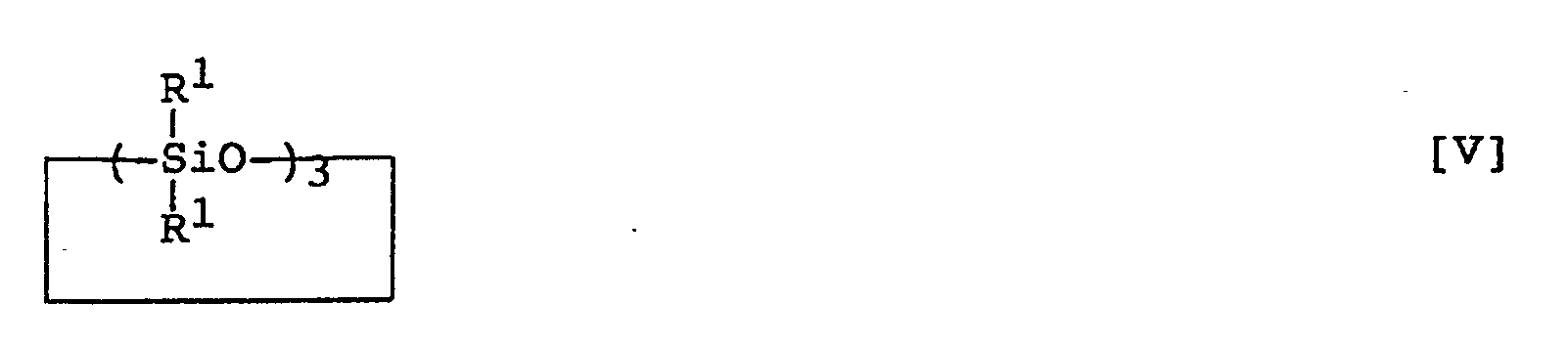
wherein R¹ is as defined above, and, optionally, a cyclotrisiloxane (c) having the following general formula [VI]: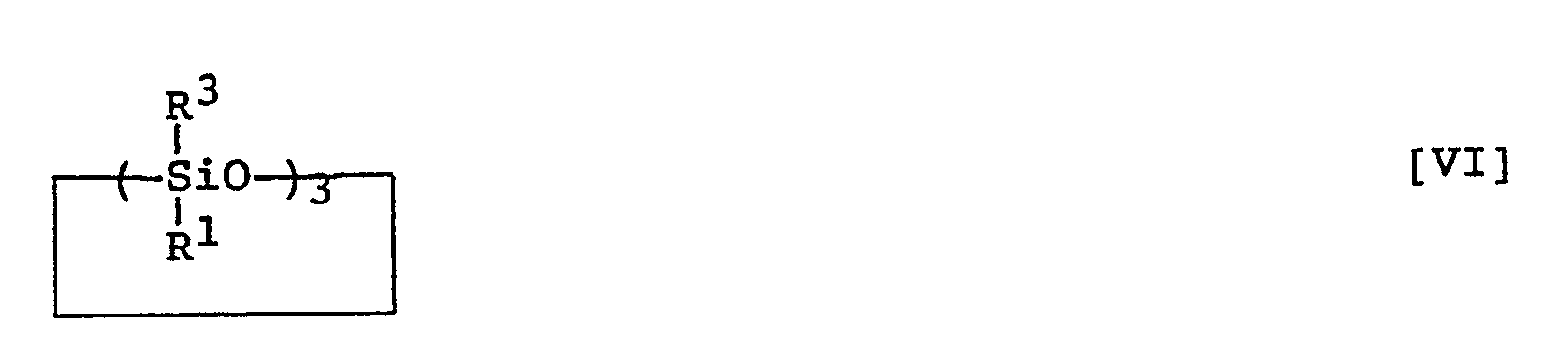
wherein R¹ and R³ are as defined above, in the presence of an alkali or acid catalyst. The diorganopolysiloxanes obtained in this case are those having the aforementioned general formula [I] in which X is hydrogen, namely, those diorganopolysiloxanes which have the silanol group (SiOH) at their molecular ends. - On the other hand, the diorganopolysiloxanes blocked by the group of the aforementioned general formula [III] at their molecular ends can be obtained by carrying out the copolymerization of the cyclotrisiloxanes (a) and (b), optionally with (c), in the presence of a silicon compound having the following formula [VII]:

wherein R⁷ to R⁹ are as defined above, or the following formula [VIII]:
wherein R¹ and R⁷ to R⁹ are as defined above, q is an integer of 0 or above, and M is an alkali metal. - The alkali or acid catalyst for use in the above copolymerization includes, for example, alkali hydroxides such as lithium hydroxide, sodium hydroxide, potassium hydroxide, etc.; alkali siliconates such as lithium siliconate, sodium siliconate, potassium siliconate, etc.; quaternary salt hydroxides such as tetrabutylphosphine hydroxide, tetramethylammonium hydroxide, etc.; a five-coordinate silicon compound having the following formula:

sulfuric acid; sulfonic acids such as trifluoromethanesulfonic acid, and so on. - In this invention, a filler as component (B) is used, in addition to the diorganopolysiloxane of component (A). As the filler, a variety of fillers conventionally used in general silicone rubber compositions can be used, for example,reinforcing fillers such as fumed silica, precipitated silica, carbon powder, titanium dioxide, mica, aluminum oxide, quartz powder, talc, diatomaceous earths, bentonite, etc.; fibrous fillers such as asbestos, glass fibers, organic fibers, and so on.
- In the silicone rubber composition of this invention, the fillers are generally compounded in an amount of preferably from 10 to 300 parts by weight, more preferably from 20 to 200 parts by weight, per 100 parts by weight of the component (A). When the amount of the fillers is less than 10 parts by weight, a sufficient reinforcing effect is not obtainable. If the amount of the fillers exceeds 300 parts by weight, on the other hand, cured products of the composition would have a lowered mechanical strength.
-
- The curing agent to be used in the silicone rubber composition according to this invention includes, for example, organic peroxides and organohydrogenpolysiloxanes having at least one silicon-bonded hydrogen atom in the molecule thereof.
- As the organic peroxide, various ones which are conventionally used for organic peroxide crosslinking can be used. The usable organic peroxides include, for example, benzoyl peroxide, 2,4-dichlorobenzoyl peroxide, 4-monochlorobenzoyl peroxide, dicumyl peroxide, tert-butyl perbenzoate, tert-butyl peroxide, 2,5-dimethyl-2,5-bis(tert-butylperoxy)hexane, cumyl-tert-butyl peroxide. These peroxides may be used either singly or in combination of two or more. It is generally preferable to use the organic peroxides in an amount of from 0.2 to 5 parts by weight per 100 parts by weight of the component (A).
- When the diorganopolysiloxane of component (A) in the silicone rubber composition of this invention has an unsaturated aliphatic group, namely, when n in the general formula [I] is an integer of 1 or above, the aforementioned organohydrogenpolysiloxane may be used as the curing agent. In such a case, curing of the composition is effected through an addition reaction between the unsaturated aliphatic groups in the diorganopolysiloxane and the silicon-bonded hydrogen atoms in the organohydrogenpolysiloxane.
- As the organohydrogenpolysiloxane for this purpose, those organohydrogenpolysiloxanes which are ordinarily used in addition-curing type silicone compositions can be used. Among others, the following organohydrogenpolysiloxanes (1) and (2) are particularly preferred for use in this invention.
(1) Organohydrogenpolysiloxanes having the following formulas (C-1) to (C-4):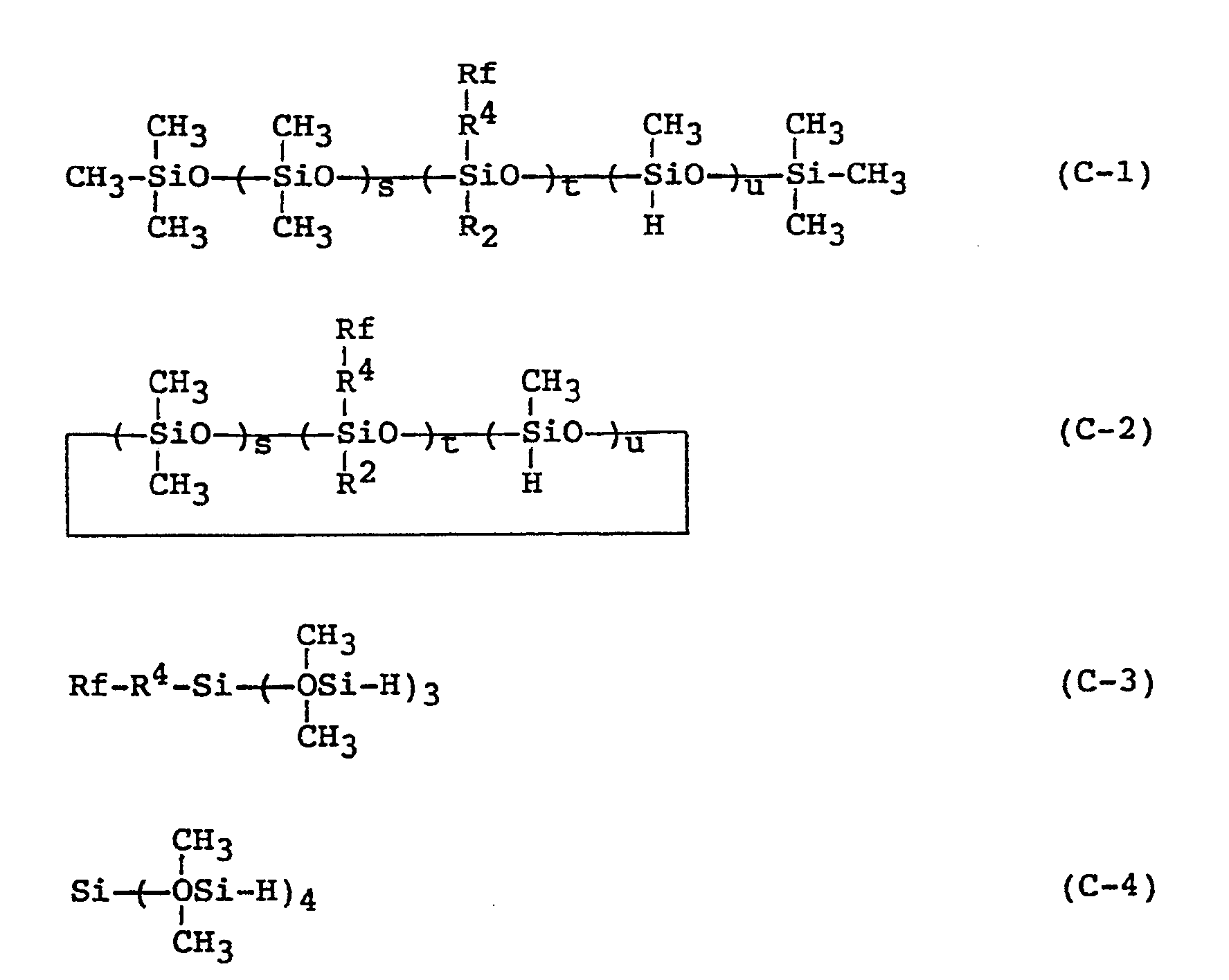
- In the above formulas (C-1) to (C-4), R², R⁴ and Rf are as defined above, s and t are each an integer of 0 or above, and u is an integer of 1 or above.
(2) Copolymers comprising (CH₃)₂HSiO0.5 units and SiO₂ units. - It is generally desirable that the organohydrogenpolysiloxanes should have a viscosity of 1,000 or above at 25°C.
- It is generally preferable that the amount of the organohydrogenpolysiloxane used is so controlled as to provide at least one ≡Si-H group, more preferably from one to five ≡Si-H groups, per one unsaturated aliphatic hydrocarbon group (R³) in the diorganopolysiloxane of component (A).
- Furthermore, when the aforementioned organohydrogenpolysiloxane is used as the curing agent in the silicone rubber composition according to this invention, a platinum family metal catalyst may be used as an addition reaction catalyst. The platinum family metal catalysts include platinum catalysts, palladium catalysts and rhodium catalysts, of which the platinum catalysts are generally preferable. Typical examples of the platinum family metal catalysts for use in this case include platinum black, chloroplatinic acid, complexes of chloroplatinic acid with an olefin, such as ethylene, an alcohol, ether, aldehyde, vinylsilane, vinylsiloxane or the like, and platinum powder supported on a carrier such as alumina, silica, asbestos, etc. These platinum family metal catalysts are generally used in an amount of preferably from 1 to 500 ppm, more preferably from 5 to 20 ppm, in terms as the platinum family metal, based on the component (A).
- In the silicone rubber composition according to this invention, a variety of other compounding agents can be incorporated, in such ranges as not to impair the object of the invention, namely, improvement of solvent resistance. For example, dispersing agents such as diphenylsilanediol, low polymerization degree dimethylpolysiloxanes blocked by the hydroxyl group at their molecular ends, hexamethyldisilazane, etc., heat resistance improving agents such as ferrous oxide, ferric oxide, cerium oxide, iron octylate, etc., coloring agents such as pigments, and so on can be incorporated in the silicone rubber composition, as required.
- The silicone rubber composition according to this invention can be prepared easily by kneading uniformly the aforementioned components by use of a mixing machine such as roll mill, kneader, Banbury mixer, etc.
- The silicone rubber composition will cure completely to give a highly elastic, cured silicone rubber product when heated at normal or applied pressure to a temperature of from 100 to 300°C for a period of from 30 seconds to 1 hour and, if necessary, subjected to secondary curing at 150 to 250°C for 2 to 24 hours.
- The silicone rubber composition of this invention has low swelling properties in a variety of solvents, as well as the intrinsic properties of silicone rubber. Therefore, the silicone rubber composition of the invention is highly suitable for such uses as packing, sealing, etc. Furthermore, the composition of this invention is also suitable for such applications as a rubber material for PPC rolls, as a mold-making material, and so on.
- This invention will now be demonstrated by the following nonlimitative examples, in which "part(s)" means "part(s) by weight".
- A one-liter four-necked flask equipped with a stirring rod, a nitrogen inlet pipe, a thermometer and an exhaust pipe was charged with 1000 g of cyclotrisiloxane having the formula:

4.2 g of 1,3,5-trivinyl-1,3,5-trimethylcyclotrisiloxane, 1.0 g of tetraglyme, and 0.2 g of a lithium siliconate having the formula:
and the resulting mixture was heated to 110°C with stirring. The reaction mixture started thickening after 10 minutes of heating with stirring. After 4 hours, a rubber gum-like polymer I was obtained. - The polymer I had an average molecular formula as follows:

- Next, a mixture of 100 parts of the polymer I, 23 parts of fumed silica (specific surface area: 200 m²/g), 2.0 parts of diphenylsilanediol, 1.5 parts of a dimethylpolysiloxane (vinylmethylsiloxane unit content: 10 mol%) having a viscosity of 20 cSt (25°C) and blocked by the hydroxyl group at both molecular ends, and 1.6 parts of a 3,3,3-trifluoropropylmethylpolysiloxane having a viscosity of 30 cSt (25°C) and blocked by the hydroxyl group at both molecular ends, was kneaded in a kneader and heated to 150°C for 4 hours.
- Further, 100 parts of the kneaded mixture, 2.0 parts of a dimethylpolysiloxane containing 5 mol% of vinylmethylsiloxane units, 0.3 part of magnesium carbonate, 0.8 part of cerium dioxide, and 0.4 part of 2,5-dimethy1-2,5-bis(t-butylperoxy)hexane were mixed uniformly by a twin-roll mill, to yield a composition I.
- The composition I was pressed at a temperature of 165°C and a pressure of 120 kg/m² for 15 minutes, into a
sheet 2 mm thick. The sheet was then heat-treated at 200°C for 4 hours, and the properties of the sheet thus obtained were examined according to JIS K 6301. The results are shown in Table 1. In this table, and the subsequent ones, the hardness is given in values determined on a type A spring hardness tester according to JIS K 6301.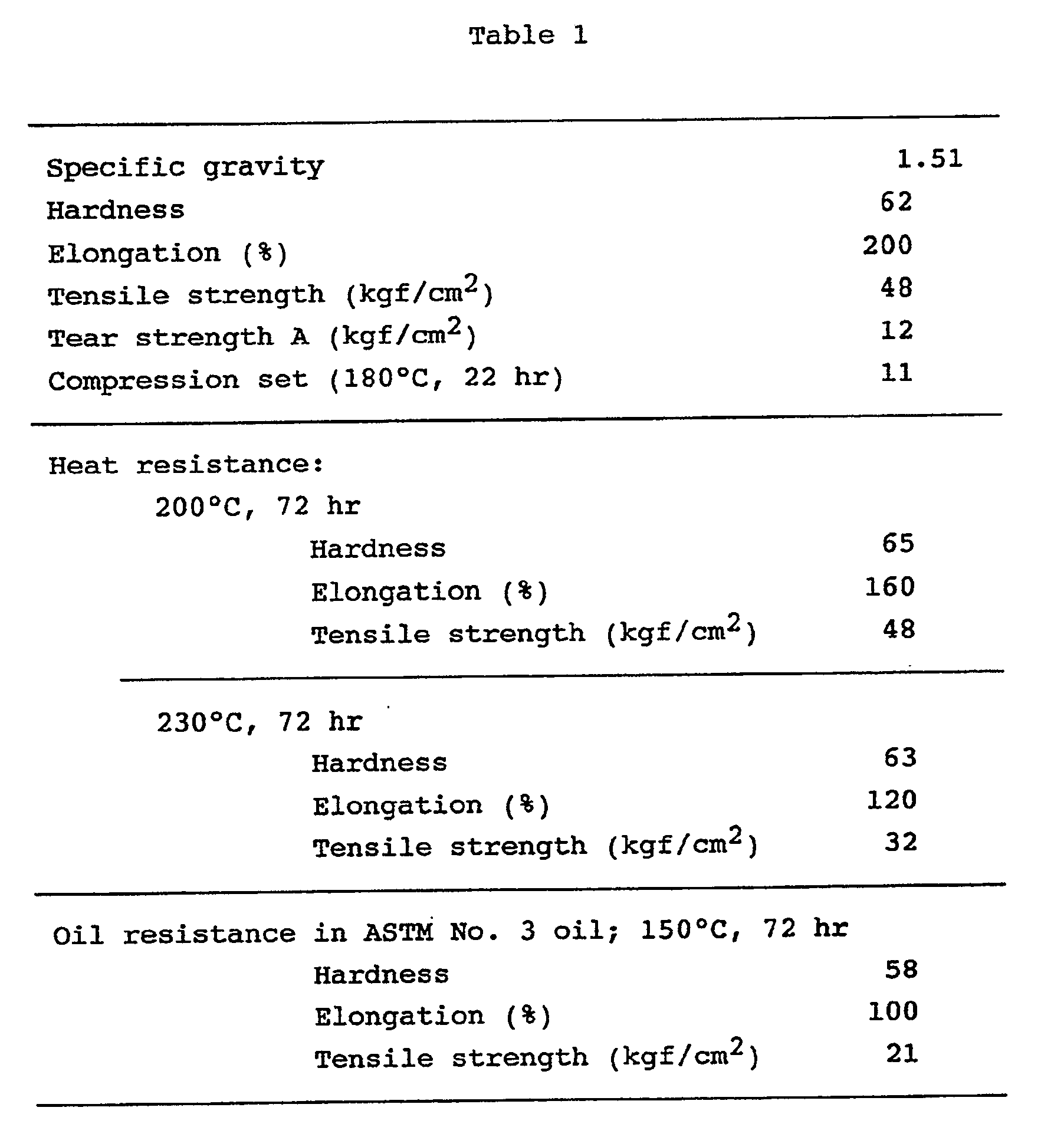
- The heat-treated sheet was evaluated as to swelling properties in various solvents. The swelling property was expressed in terms of volume change (%) and weight change (%) observed upon immersion of the sheet in a given solvent at 20°C for 72 hours. The evaluation results are shown in Table 2.
- By way of comparison, respective cured products of a dimethylsilicone rubber KE951 and a fluorosilicone rubber FE251 (of the trifluoropropylmethylsiloxane rubber type), both produced by Shin-Etsu Chemical Co., Ltd., were also subjected to the measurement of swelling properties in the same manner as above. The results are shown in Table 2.

- Subsequently, evaluation of release properties of the cured rubber sheet obtained above was carried out by determination of toner release property and epoxy peel force. For comparison, the aforementioned fluorosilicone rubber FE251 was also evaluated in the same manner. The results are shown in Table 3.

- The toner release property and epoxy peel force were determined by the following methods.
- A toner powder was placed on the cured rubber sheet, which was then placed in a 200°C dryer for 10 minutes to melt the toner powder thereon. The cured rubber sheet with the molten toner thereon was removed from the dryer, followed by cooling to solidify the toner.
- A piece of cellophane adhesive tape was adhered to the solidified toner on the cured rubber sheet, and was peeled off.
- The ratio of the area of the toner released from the cured rubber sheet together with the adhesive tape thus peeled off to the area over which the adhesive tape had been adhered was measured visually. The ratio thus obtained was used as an indication of toner release property (%).
- An
epoxy resin 1 was cured on the curedrubber sheet 2, in the manner as shown in Figure 1. The force required to peel off the curedrubber sheet 2 from the curedepoxy resin 1 was measured, to be used for expressing the epoxy peel force. - A 500-ml four-necked flask equipped with a stirring rod, a nitrogen inlet pipe, a thermometer and an exhaust pipe was charged with 500 g of a cyclotrisiloxane having the following formula:

2.1 g of 1,3,5-trivinyl-1,3,5-trimethylcyclotrisiloxane, 0.3 g of tetraglyme, and a lithium siliconate having the average formula:
and the resulting mixture was heated to 110°C with stirring. - The reaction mixture started thickening after 20 minutes of heating with stirring. The heating and stirring operation was continued for 6 hours, to yield a rubber gum-like polymer II was obtained.
- The polymer II thus obtained has the following average molecular formula:

- Next, a composition II was prepared according to the same formulation as in Example 1 except for using the polymer II in place of the polymer I. The composition II was pressed in the same manner as in Example I, into a
silicone rubber sheet 2 mm thick, which was heat-treated in the same manner as in Example 1. - The heat-treated sheet had the physical properties, toner release property and epoxy peel force as shown in Table 4 below.

- Also, the swelling properties of the heat-treated sheet in various solvents were measured in the same manner as in Example 1. The results are shown in Table 5.

- A 500-ml four-necked flask equivalent to that used in Example 2 was charged with:
- (a) 152.1 g of a cyclotrisiloxane having the following formula:

- (b) 147.9 g of hexamethylcyclotrisiloxane,
- (c) 0.87 g of 1,3,5-trivinyl-1,3,5-trimethylcyclotrisiloxane,
- (d) 0.3 g of tetraglyme, and
- (e) 0.39 g of the same lithium siliconate as used in Example 2,
- The polymer III thus obtained had the following average molecular formula:

- Further, a rubber gum-like polymer IV was obtained in the same manner as above except for changing the amounts of the components to (a) 66.9 g, (b) 233.1 g, (c) 0.87 g, (d) 0.3 g, and (e) 0.39 g, respectively.
- The polymer IV thus obtained had the following average molecular formula:

- Admixtures of 100 parts of each of the polymers III and IV, obtained above, with 0.5 part of vinyltrimethoxysilane, 2.5 parts of diphenylsilanediol, 8.0 parts of a dimethylpolysiloxane blocked by the hydroxyl group at both molecular ends (viscosity at 25°C: 30 cSt) and 30 parts of fumed silica, were kneaded at 170°C for 3 hours by a kneader.
- Then, 100 parts of each of the kneaded products thus obtained was mixed uniformly with 0.5 part of cerium dioxide, 8.0 parts of magnesium carbonate and 0.4 part of 2,5-dimethyl-2,5-bis(t-butylperoxy)hexane by a twin-roll mill, to yield a composition III and a composition IV, respectively.
- The compositions III and IV were pressed in the same manner as in Example 1 to form
silicone rubber sheets 2 mm thick, which were heat-treated in the same manner as in Example 1. - The physical properties of the sheets thus heat-treated were determined. The results are shown in Table 6 below.

- The swelling properties of the above heat-treated sheet in solvents were determined in the same manner as in Example 1. The results are shown in Table 8 below.
- A four-necked flask similar to that used in Example 2 was charged with:
- (a) 159.3 g of the same fluorine-containing cyclotrisiloxane as used in Example 2,
- (b) 140.7 g of hexamethylcyclotrisiloxane,
- (c) 0.87 g of 1,3,5-trivinyl-1,3,5-trimethylcyclotrisiloxane,
- (d) 0.3 g of tetraglyme, and
- (e) 0.39 g of the same lithium siliconate as used in Example 2,
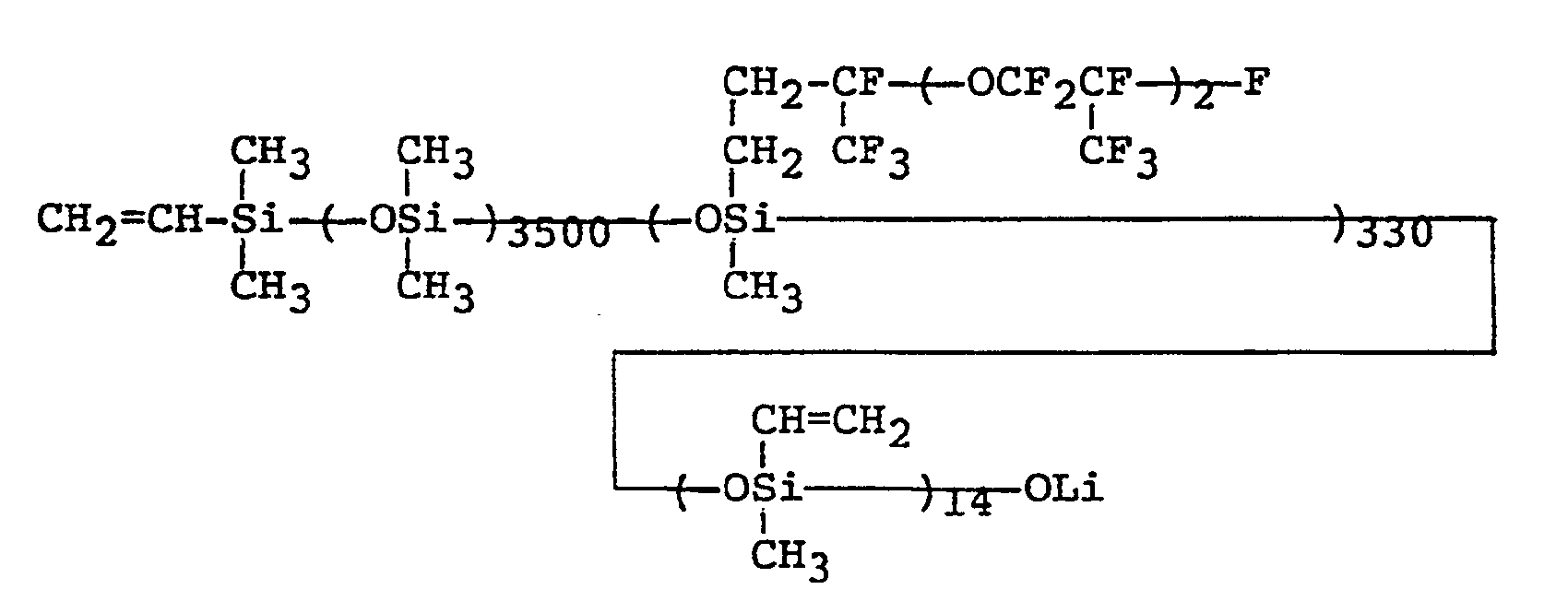
- The polymer V had the following average molecular formula:
- Also, a polymer IV resembling crude rubber was obtained in the same manner as above except for changing the amounts of the components to (a) 70.2 g, (b) 229.8 g, (c) 0.87 g, (d) 0.3 g, and (e) 0.39 g, respectively.
- The polymer IV thus obtained had the following average molecular formula:

- Compositions V and VI were prepared according to the same formulation as in Example 3 except for using the copolymers V and VI, respectively, in place of the copolymer III. The compositions V and VI thus obtained were pressed in the same manner as in Example 1 to form
silicone rubber sheets 2 mm thick, which were heat-treated in the same manner as in Example 1. - The physical properties of the heat-treated sheets are shown in Table 7.

- Further, the swelling properties of the heat-treated sheets in solvents were measured in the same manner as in Example 1. The results are shown in Table 8.

Claims (15)
- A silicone rubber composition comprising:
(A) a diorganopolysiloxane having the following general formula [I]:
R¹ and R² may be the same or different and each are an unsubstituted or substituted monovalent hydrocarbon group which contains no aliphatic unsaturated bonds,
R³ is an unsaturated monovalent aliphatic hydrocarbon group,
R⁴ is a divalent hydrocarbon group not having aliphatic unsaturated bonds or is a group having the following general formula [II]:
-R⁵-O-R⁶- [II]
wherein
R⁵ and R⁶ are each a divalent hydrocarbon group which does not have aliphatic unsaturated bonds,
Rf is a perfluoroalkyl group or a perfluoroalkyl ether group,
X is a hydrogen atom or a group having the following general formula [III]:
l and m are each an integer of 1 or above, and
n is an integer of 0 or above,
(B) a filler, and
(C) a curing agent. - The composition according to claim 1, wherein the diorganopolysiloxane (A) is a diorganopolysiloxane of the general formula [I] in which the monovalent hydrocarbon groups R¹ and R² are each a group of from 1 to 8 carbon atoms.
- The composition according to claim 2, wherein R¹ and R² are each a group selected from the group consisting of methyl, ethyl, phenyl and 3,3,3-trifluoropropyl groups.
- The composition according to claim 1, wherein the diorganopolysiloxane (A) is a diorganopolysiloxane of the general formula [I] in which the unsaturated monovalent aliphatic hydrocarbon group R³ is vinyl, allyl or ethynyl.
- The composition according to claim 1, wherein the diorganopolysiloxane (A) is a diorganopolysiloxane of the general formula [I] in which the divalent group R⁴ is a group selected from the group consisting of
- The composition according to claim 1, wherein the diorganopolysiloxane (A) is a diorganopolysiloxane of the general formula [I] in which the fluorine-containing organic group Rf is a perfluoroalkyl group having the following formula:
CpF2p+1-
wherein p is an integer of from 4 to 10. - The composition according to claim 1, wherein the diorganopolysiloxane (A) is a diorganopolysiloxane of the general formula [I] in which the fluorine-containing organic group Rf is a perfluoroalkyl ether group of from 4 to 20 carbon atoms.
- The composition according to claim 7, wherein the fluorine-containing organic group Rf is a group selected from the group consisting of

- The composition according to claim 1, wherein the diorganopolysiloxane (A) is a diorganopolysiloxane of the general formula [I] in which X is hydrogen, (CH₃)₃Si-, or (CH₂=CH)(CH₃)₂Si-.
- The composition according to claim 1, wherein the filler (B) is present in an amount of from 10 to 300 parts by weight per 100 parts by weight of the diorganopolysiloxane (A).
- The composition according to claim 1, wherein the curing agent (C) comprises an organic peroxide.
- The composition according to claim 11, wherein the organic peroxide is present in an amount of from 0.2 to 5 parts by weight per 100 parts by weight of the diorganopolysiloxane (A).
- The composition according to claim 1, wherein the diorganopolysiloxane (A) is a diorganopolysiloxane of the general formula [I] in which n is 1 or above, and the curing agent (C) comprises an organohydrogenpolysiloxane having at least one silicon-bonded hydrogen atom in its molecule.
- The composition according to claim 13, wherein the organohydrogenpolysiloxane is compounded in such an amount as to provide from 1 to 5 ≡Si-H groups per one unsaturated aliphatic group (R³) in the diorganopolysiloxane (A).
- A cured product obtained by curing the silicone rubber composition as claimed in claim 1.
Applications Claiming Priority (2)
| Application Number | Priority Date | Filing Date | Title |
|---|---|---|---|
| JP132248/90 | 1990-05-22 | ||
| JP2132248A JPH0813928B2 (en) | 1990-05-22 | 1990-05-22 | Silicone rubber composition |
Publications (3)
| Publication Number | Publication Date |
|---|---|
| EP0458617A2 true EP0458617A2 (en) | 1991-11-27 |
| EP0458617A3 EP0458617A3 (en) | 1992-04-29 |
| EP0458617B1 EP0458617B1 (en) | 1996-08-28 |
Family
ID=15076834
Family Applications (1)
| Application Number | Title | Priority Date | Filing Date |
|---|---|---|---|
| EP91304630A Expired - Lifetime EP0458617B1 (en) | 1990-05-22 | 1991-05-22 | Silicone rubber composition |
Country Status (4)
| Country | Link |
|---|---|
| US (1) | US5179159A (en) |
| EP (1) | EP0458617B1 (en) |
| JP (1) | JPH0813928B2 (en) |
| DE (1) | DE69121634T2 (en) |
Cited By (8)
| Publication number | Priority date | Publication date | Assignee | Title |
|---|---|---|---|---|
| EP0488709A3 (en) * | 1990-11-29 | 1992-11-25 | Shin-Etsu Chemical Co., Ltd. | Silicone rubber composition having excellent durability in repeated mold release |
| EP0551211A1 (en) * | 1992-01-10 | 1993-07-14 | Shin-Etsu Chemical Co., Ltd. | Fluorosilicone rubber composition |
| EP0562830A1 (en) * | 1992-03-24 | 1993-09-29 | Shin-Etsu Chemical Co., Ltd. | Fluorine-containing silicone rubber composition |
| US5342913A (en) * | 1990-11-29 | 1994-08-30 | Shin-Etsu Chemical Co., Ltd. | Silicon rubber composition having excellent durability in repeated mold release |
| EP0590595A3 (en) * | 1992-09-28 | 1994-11-17 | Dow Corning Toray Silicone | Oil-resistant silicone rubber composition. |
| GB2290990A (en) * | 1994-07-11 | 1996-01-17 | Gen Electric | Fluorosilicone coatings |
| EP0798344A3 (en) * | 1996-03-29 | 1997-12-10 | Dow Corning Toray Silicone Company, Limited | Fluorosilicone rubber composition and method of adhering it to a substrate |
| EP0640644B1 (en) * | 1992-03-10 | 1999-07-07 | Kao Corporation | Fluorine-modified silicone derivative, production thereof, and cosmetic containing the same |
Families Citing this family (6)
| Publication number | Priority date | Publication date | Assignee | Title |
|---|---|---|---|---|
| JP2724953B2 (en) * | 1993-05-11 | 1998-03-09 | 信越化学工業株式会社 | Silicone rubber composition |
| US5532294A (en) * | 1993-06-17 | 1996-07-02 | Shin-Etsu Chemical Co., Ltd. | Thixotropic fluorosilicone gel composition |
| US5811214A (en) * | 1997-05-08 | 1998-09-22 | Eastman Kodak Company | Monocomponent developer comprising surface treated toners |
| ATE384768T1 (en) * | 2000-07-27 | 2008-02-15 | Gen Electric | RTV FLUOROSILICONE SEALANT AND PRODUCTION PROCESS |
| JP6205824B2 (en) * | 2013-04-26 | 2017-10-04 | 富士電機株式会社 | Power module |
| JP2024159087A (en) * | 2023-04-28 | 2024-11-08 | 信越化学工業株式会社 | Millable-type fluorosilicone rubber composition and rubber parts for transport aircraft engines |
Family Cites Families (12)
| Publication number | Priority date | Publication date | Assignee | Title |
|---|---|---|---|---|
| CA625778A (en) * | 1961-08-15 | F. Hyde James | Room temperature curing organopolysiloxane resins | |
| US3847961A (en) * | 1973-04-02 | 1974-11-12 | Minnesota Mining & Mfg | Fluoroaliphaticthiomethylsiloxanes |
| US4029629A (en) * | 1975-10-06 | 1977-06-14 | General Electric Company | Solvent resistant room temperature vulcanizable silicone rubber composition |
| US4525528A (en) * | 1983-10-11 | 1985-06-25 | General Electric Company | Peroxide-curable fluorosilicone copolymer compositions |
| JPS62174260A (en) * | 1986-01-20 | 1987-07-31 | Shin Etsu Chem Co Ltd | Fluorosilicone rubber composition |
| JPS62190254A (en) * | 1986-02-14 | 1987-08-20 | Shin Etsu Chem Co Ltd | Curable fluorosilicone rubber composition |
| EP0255957A3 (en) * | 1986-08-08 | 1988-11-17 | Asahi Glass Company Ltd. | Fluorosilicone polymer, processes for the production thereof and composition containing it |
| US4732931A (en) * | 1986-10-09 | 1988-03-22 | Dow Corning Corporation | Heat curable fluorosilicone coating composition |
| JPS6474268A (en) * | 1987-09-14 | 1989-03-20 | Shinetsu Chemical Co | Curable silicone composition |
| US4882368A (en) * | 1988-09-26 | 1989-11-21 | Dow Corning Corporation | Low compression set fluorosilicone rubber |
| JPH02289650A (en) * | 1989-02-14 | 1990-11-29 | Asahi Glass Co Ltd | Fluorosilicone rubber composition |
| JPH0618880B2 (en) * | 1989-02-21 | 1994-03-16 | 信越化学工業株式会社 | Fluoroorganopolysiloxane and method for producing the same |
-
1990
- 1990-05-22 JP JP2132248A patent/JPH0813928B2/en not_active Expired - Lifetime
-
1991
- 1991-05-21 US US07/710,523 patent/US5179159A/en not_active Expired - Fee Related
- 1991-05-22 EP EP91304630A patent/EP0458617B1/en not_active Expired - Lifetime
- 1991-05-22 DE DE69121634T patent/DE69121634T2/en not_active Expired - Fee Related
Cited By (15)
| Publication number | Priority date | Publication date | Assignee | Title |
|---|---|---|---|---|
| US5342913A (en) * | 1990-11-29 | 1994-08-30 | Shin-Etsu Chemical Co., Ltd. | Silicon rubber composition having excellent durability in repeated mold release |
| EP0488709A3 (en) * | 1990-11-29 | 1992-11-25 | Shin-Etsu Chemical Co., Ltd. | Silicone rubber composition having excellent durability in repeated mold release |
| EP0551211A1 (en) * | 1992-01-10 | 1993-07-14 | Shin-Etsu Chemical Co., Ltd. | Fluorosilicone rubber composition |
| US5342879A (en) * | 1992-01-10 | 1994-08-30 | Shin-Etsu Chemical Co., Ltd. | Fluorosilicone rubber composition |
| EP0640644B1 (en) * | 1992-03-10 | 1999-07-07 | Kao Corporation | Fluorine-modified silicone derivative, production thereof, and cosmetic containing the same |
| EP0562830A1 (en) * | 1992-03-24 | 1993-09-29 | Shin-Etsu Chemical Co., Ltd. | Fluorine-containing silicone rubber composition |
| US5310846A (en) * | 1992-03-24 | 1994-05-10 | Shin-Etsu Chemical Co., Ltd. | Fluorine-containing silicone rubber composition |
| EP0590595A3 (en) * | 1992-09-28 | 1994-11-17 | Dow Corning Toray Silicone | Oil-resistant silicone rubber composition. |
| US5616403A (en) * | 1994-07-11 | 1997-04-01 | General Electric Company | Fluorosilicone coatings |
| US5753318A (en) * | 1994-07-11 | 1998-05-19 | General Electric Company | Fluorosilicone coatings |
| GB2290990B (en) * | 1994-07-11 | 1999-02-24 | Gen Electric | Fluorosilicone coatings |
| US5919526A (en) * | 1994-07-11 | 1999-07-06 | General Electric Company | Fluorosilicone coatings |
| GB2290990A (en) * | 1994-07-11 | 1996-01-17 | Gen Electric | Fluorosilicone coatings |
| US6074703A (en) * | 1994-07-11 | 2000-06-13 | General Electric Company | Fluorosilicone coatings |
| EP0798344A3 (en) * | 1996-03-29 | 1997-12-10 | Dow Corning Toray Silicone Company, Limited | Fluorosilicone rubber composition and method of adhering it to a substrate |
Also Published As
| Publication number | Publication date |
|---|---|
| EP0458617A3 (en) | 1992-04-29 |
| EP0458617B1 (en) | 1996-08-28 |
| JPH0813928B2 (en) | 1996-02-14 |
| DE69121634T2 (en) | 1997-01-23 |
| JPH0425563A (en) | 1992-01-29 |
| US5179159A (en) | 1993-01-12 |
| DE69121634D1 (en) | 1996-10-02 |
Similar Documents
| Publication | Publication Date | Title |
|---|---|---|
| US4339564A (en) | Heat curable organopolysiloxane compositions | |
| EP0388201B1 (en) | Curable silicone composition | |
| US4332844A (en) | Silicone compositions for adhesion and method for adhering silicone rubber to a substrate | |
| US5138009A (en) | Curable compositions comprising organopolysiloxane-polyoxyalkylene block copolymers and cured products obtained from the compositions | |
| US5447987A (en) | Organopolysiloxane compositions | |
| EP0458617A2 (en) | Silicone rubber composition | |
| EP0488709A2 (en) | Silicone rubber composition having excellent durability in repeated mold release | |
| EP0279706B1 (en) | Vulcanizable fluorinated silicone compositions | |
| US5239034A (en) | High-strength silicon rubber compositions | |
| JP2833406B2 (en) | Organopolysiloxane composition | |
| JPH02218755A (en) | Curable organopolysiloxane composition | |
| JP2006022223A (en) | Curable fluoropolyether composition | |
| CA2401597A1 (en) | Silicone amino-epoxy cross-linking system | |
| EP0491598A2 (en) | Curable organopolysiloxane composition having constant mould-release properties | |
| JP2753662B2 (en) | Adhesive composition | |
| EP0444960A2 (en) | Curable organopolysiloxane composition | |
| CA1337226C (en) | Paintable organopolysiloxane compositions which crosslink at room temperature to form elastomers | |
| US5380811A (en) | Fluorine-containing organopolysiloxane composition | |
| EP0551211B1 (en) | Fluorosilicone rubber composition | |
| US5248751A (en) | Curable organopolysiloxane compositions | |
| US5416183A (en) | Room temperature curable composition | |
| JPH04311765A (en) | Curable organopolysiloxane composition | |
| US5342913A (en) | Silicon rubber composition having excellent durability in repeated mold release | |
| EP0381384A2 (en) | Primer composition | |
| JP2974229B2 (en) | Fluorosilicone rubber composition |
Legal Events
| Date | Code | Title | Description |
|---|---|---|---|
| PUAI | Public reference made under article 153(3) epc to a published international application that has entered the european phase |
Free format text: ORIGINAL CODE: 0009012 |
|
| AK | Designated contracting states |
Kind code of ref document: A2 Designated state(s): DE FR GB |
|
| PUAL | Search report despatched |
Free format text: ORIGINAL CODE: 0009013 |
|
| AK | Designated contracting states |
Kind code of ref document: A3 Designated state(s): DE FR GB |
|
| 17P | Request for examination filed |
Effective date: 19921006 |
|
| 17Q | First examination report despatched |
Effective date: 19940919 |
|
| GRAH | Despatch of communication of intention to grant a patent |
Free format text: ORIGINAL CODE: EPIDOS IGRA |
|
| GRAH | Despatch of communication of intention to grant a patent |
Free format text: ORIGINAL CODE: EPIDOS IGRA |
|
| GRAA | (expected) grant |
Free format text: ORIGINAL CODE: 0009210 |
|
| AK | Designated contracting states |
Kind code of ref document: B1 Designated state(s): DE FR GB |
|
| ET | Fr: translation filed | ||
| REF | Corresponds to: |
Ref document number: 69121634 Country of ref document: DE Date of ref document: 19961002 |
|
| PLBE | No opposition filed within time limit |
Free format text: ORIGINAL CODE: 0009261 |
|
| STAA | Information on the status of an ep patent application or granted ep patent |
Free format text: STATUS: NO OPPOSITION FILED WITHIN TIME LIMIT |
|
| 26N | No opposition filed | ||
| PGFP | Annual fee paid to national office [announced via postgrant information from national office to epo] |
Ref country code: FR Payment date: 19990511 Year of fee payment: 9 |
|
| PGFP | Annual fee paid to national office [announced via postgrant information from national office to epo] |
Ref country code: GB Payment date: 19990519 Year of fee payment: 9 |
|
| PGFP | Annual fee paid to national office [announced via postgrant information from national office to epo] |
Ref country code: DE Payment date: 19990525 Year of fee payment: 9 |
|
| PG25 | Lapsed in a contracting state [announced via postgrant information from national office to epo] |
Ref country code: GB Free format text: LAPSE BECAUSE OF NON-PAYMENT OF DUE FEES Effective date: 20000522 |
|
| GBPC | Gb: european patent ceased through non-payment of renewal fee |
Effective date: 20000522 |
|
| PG25 | Lapsed in a contracting state [announced via postgrant information from national office to epo] |
Ref country code: FR Free format text: LAPSE BECAUSE OF NON-PAYMENT OF DUE FEES Effective date: 20010131 |
|
| PG25 | Lapsed in a contracting state [announced via postgrant information from national office to epo] |
Ref country code: DE Free format text: LAPSE BECAUSE OF NON-PAYMENT OF DUE FEES Effective date: 20010301 |
|
| REG | Reference to a national code |
Ref country code: FR Ref legal event code: ST |