EP0458653A1 - Outil à main pour la chirurgie de la cataracte - Google Patents
Outil à main pour la chirurgie de la cataracte Download PDFInfo
- Publication number
- EP0458653A1 EP0458653A1 EP91304747A EP91304747A EP0458653A1 EP 0458653 A1 EP0458653 A1 EP 0458653A1 EP 91304747 A EP91304747 A EP 91304747A EP 91304747 A EP91304747 A EP 91304747A EP 0458653 A1 EP0458653 A1 EP 0458653A1
- Authority
- EP
- European Patent Office
- Prior art keywords
- housing
- handtool
- shaft
- passageway
- cataract
- Prior art date
- Legal status (The legal status is an assumption and is not a legal conclusion. Google has not performed a legal analysis and makes no representation as to the accuracy of the status listed.)
- Withdrawn
Links
- 208000002177 Cataract Diseases 0.000 title claims abstract description 25
- 238000001356 surgical procedure Methods 0.000 title description 4
- 230000002262 irrigation Effects 0.000 claims abstract description 15
- 238000003973 irrigation Methods 0.000 claims abstract description 15
- 239000012530 fluid Substances 0.000 claims abstract description 8
- 230000001804 emulsifying effect Effects 0.000 claims abstract description 4
- 238000007789 sealing Methods 0.000 claims description 3
- 239000002775 capsule Substances 0.000 abstract description 12
- 239000000463 material Substances 0.000 abstract description 11
- 239000000839 emulsion Substances 0.000 abstract 1
- 238000000034 method Methods 0.000 description 11
- 210000003128 head Anatomy 0.000 description 9
- 210000004087 cornea Anatomy 0.000 description 3
- 238000005553 drilling Methods 0.000 description 3
- 238000000605 extraction Methods 0.000 description 3
- 210000001519 tissue Anatomy 0.000 description 3
- 238000004945 emulsification Methods 0.000 description 2
- 210000003205 muscle Anatomy 0.000 description 2
- 210000001525 retina Anatomy 0.000 description 2
- 230000035939 shock Effects 0.000 description 2
- 230000002411 adverse Effects 0.000 description 1
- 210000004556 brain Anatomy 0.000 description 1
- 210000003161 choroid Anatomy 0.000 description 1
- 239000012141 concentrate Substances 0.000 description 1
- 230000006866 deterioration Effects 0.000 description 1
- 201000010099 disease Diseases 0.000 description 1
- 208000037265 diseases, disorders, signs and symptoms Diseases 0.000 description 1
- 230000000694 effects Effects 0.000 description 1
- 230000004438 eyesight Effects 0.000 description 1
- 210000000873 fovea centralis Anatomy 0.000 description 1
- 238000004519 manufacturing process Methods 0.000 description 1
- 210000001328 optic nerve Anatomy 0.000 description 1
- 210000003786 sclera Anatomy 0.000 description 1
- 238000010561 standard procedure Methods 0.000 description 1
- 210000004127 vitreous body Anatomy 0.000 description 1
Images

Classifications
-
- A—HUMAN NECESSITIES
- A61—MEDICAL OR VETERINARY SCIENCE; HYGIENE
- A61F—FILTERS IMPLANTABLE INTO BLOOD VESSELS; PROSTHESES; DEVICES PROVIDING PATENCY TO, OR PREVENTING COLLAPSING OF, TUBULAR STRUCTURES OF THE BODY, e.g. STENTS; ORTHOPAEDIC, NURSING OR CONTRACEPTIVE DEVICES; FOMENTATION; TREATMENT OR PROTECTION OF EYES OR EARS; BANDAGES, DRESSINGS OR ABSORBENT PADS; FIRST-AID KITS
- A61F9/00—Methods or devices for treatment of the eyes; Devices for putting in contact-lenses; Devices to correct squinting; Apparatus to guide the blind; Protective devices for the eyes, carried on the body or in the hand
- A61F9/007—Methods or devices for eye surgery
- A61F9/00736—Instruments for removal of intra-ocular material or intra-ocular injection, e.g. cataract instruments
- A61F9/00763—Instruments for removal of intra-ocular material or intra-ocular injection, e.g. cataract instruments with rotating or reciprocating cutting elements, e.g. concentric cutting needles
-
- A—HUMAN NECESSITIES
- A61—MEDICAL OR VETERINARY SCIENCE; HYGIENE
- A61B—DIAGNOSIS; SURGERY; IDENTIFICATION
- A61B17/00—Surgical instruments, devices or methods
- A61B17/32—Surgical cutting instruments
- A61B2017/320044—Blunt dissectors
Definitions
- the present invention relates to equipment for use in cataract surgery.
- a cataract is, generally speaking, a disease of the eye in which the normally transparent lens becomes opaque. Treatment of this condition traditionally involves removal of the opaque lens (the cataract) and replacement thereof by an artificial lens implanted within the capsule that surrounds the lens.
- a handtool for use in surgically emulsifying and aspirating a cataract from an eye, characterised in that said handtool comprises: elongate housing means containing drive motor means connectable to a power source and to power control means, said motor means including a rotatable chuck portion at a forward end thereof; a shaft housing extending forwardly of said housing means, said shaft housing defining concentric interior and annular passageways extending therealong between proximal and open distal ends thereof; drill bit means having an elongate shaft receivable in said interior passageway, one end of said shaft being receivable in said chuck portion, the other end including a generally spherical head having a plurality of dull, generally radially projecting, teeth thereon; an irrigation conduit having one end connectable to a source of irrigation fluid and the other end connected to said shaft housing and communicating with said annular passageway; and an aspiration conduit having one end connectable to aspiration means and the other end connected to said
- the present invention operates on the simple principle of drilling.
- my handtool which utilizes a round-tipped microdrill or microbit which can be inserted through a tiny slit in the eye, the slit being in the order of 2.1 mm.
- the drill bit rotates it emulsifies the cataract that it contacts and the emulsified material is aspirated simultaneously through appropriate conduits positioned in close proximity to the bit.
- the aspirating inlet and associated irrigation outlet are integrally provided in the nosepiece of the handtool.
- the action on the cataract is at the tip of the bit which allows the ophthalmologist to bring the bit close to vital structure of the eye without a high risk of damage thereto.
- This possibility does not exist with phacoemulsification since the vibrating tip of the device, whether it be vibrated ultrasonically or by a pulsed laser, produces a shock wave that can damage surrounding structure in the eye during the emulsification process. While that shock wave is effective in emulsifying the cataract it can seriously damage the surrounding capsule or the iris if if contacts those tissues inadvertently.
- a removable nosepiece which terminates close to the bit tip includes conduit portions for irrigation fluid and aspiration of the fluid and the emulsified cataract.
- the surgeon needs only a small incision in the eye and he has a single-hand control of his instrument, requiring less dexterity and coordination than with prior techniques.
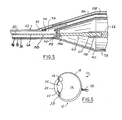
- Figure 6 generally illustrates a human eye 10, the main body 12 including, although not separately shown, a plurality of layers 14, namely the sclera, choroid and retina.
- the eye also contains the vitreous body 16 (a fluid).
- the optic nerve 18 transmits a signal, received at the fovea centralis of the retina, to the brain.
- At the front of the eye is the cornea 20, iris 22 and the lens 24.
- the lens in a healthy eye is a transparent gelatinous material but in a diseased eye it becomes harder and opaque, causing deterioration of the individual's eyesight.
- the lens is contained within a thin capsule or shell 26 to which various muscles, such as are shown at 28, are connected. The muscles alter the configuration of the capsule 26 so as to alter the focal length of the lens during focusing of the eye. It is understood that an eye contains many more elements than are mentioned herein but Figure 6 shows all that is necessary for an understanding of the present invention.
- the handtool 30 which is used to emulsify the cataract within the capsule 26 and to aspirate the emulsified material therefrom.
- the handtool 30 includes a small-diameter cylindrical housing or barrel portion 32 containing a variable speed electric motor 34.
- the motor has a rating of about 1.5 volts. It is connected to a suitable power source via a wire 36 and, preferably, there will also be provided a suitable power controller in the electrical circuit so that the surgeon can vary the speed of the motor 34 at will.
- the tool 30 also includes a separable nosepiece 38 which includes a frustoconical portion 40 leading from the diameter of the housing 32 down to that of a forwardly projecting shaft housing 42.
- the length of the tool 30 will be in the order of 15 cm while the diameter thereof will be in the order of 1.5 cm.
- the motor 34 has a shaft 44 projecting forwardly therefrom through an opening 46 in the internal bulkhead 48 of the housing 32.
- the shaft 44 has a blind bore 50 emending axially from the front face thereof, the bore 50- serving as a chuck for the drill bit to be used .
- a replaceable resilient washer member 56 fits against the inside surface of the bulkhead 52 to help prevent the intrusion of unwanted fluids into the interior of the tool 30.
- the bit to be used is a slightly modified version of a commercially available bit, not unlike a dentist's burr.
- the bit 58 has an enlarged shaft portion 60 at one end receivable in the bore or chuck 50 so that the bit can be driven by the motor.
- the intermediate portion stops just short of the washer 56 and prevents movement thereof away from the bulkhead 52.
- the head 66 of the bit is best seen in Figures 3 and 4 and it is evident that it has a generally spherical appearance with a plurality of curved teeth 68 extending radially from a central hub portion.
- the tips 70 of the teeth are somewhat dull to reduce damage that might otherwise occur if the teeth were sharp.
- the diameter of the bit head 66 will be less than the length of the incision to be made in the eye and thus will be in the order of 0.5 mm to 1.0 mm
- the shaft housing 42 actually comprises a pair of concentric housing sections 72,74 best seen in Figures 3 and 5.
- the outer cylindrical housing section 72 extends from its proximal end adjacent the frustoconical portion 40 to its distal end just short of the end of the shaft housing 42.
- the inner cylindrical housing section 74 extends from its proximal end adjacent the frustoconical portion 40 to its distal end just beyond the outer housing section 72 creating an annular passageway 76 between the housing sections ( Figure 5). That annular passageway is sealed at the outer end of the outer housing section 74 as at 78 although a plurality of radially directed circumferentially spaced openings 80 in the outer housing section 74 communicate the annular passageway 76 with the atmosphere.
- the interior passageway 82 of the inner housing section 72 is open to the atmosphere at its outer end via an open end 84 through which the shaft 64 passes.
- Irrigation and aspiration are achieved via independent conduits 86 and 88 respectively, which conduits are rigidly affixed to the tool 30 and which may be connected via flexible conduits (not shown) to respective irrigation and aspiration pumps as are known in the art.
- the conduits are separable as at 90 so that portions affixed to the removable nosepiece 30 are removable therewith from portions affixed to the main housing 32.
- the irrigation conduit 86 communicates with the annular passageway 76 through an opening 92 and that the aspiration conduit 88 communicates with the interior passageway 92 of the inner housing section 74 via an opening 94.
- the opening 94 is sealed from the annular passageway 76 by an appropriate sealing member 96.
- the technique of phacodrilling utilizing my handtool involves the surgeon making appropriately small incisions or openings in the cornea 20 and the capsule 26, using standard procedures, through the opening defined by the iris 22. An incision of about 2.1 mm is all that is required in the eye.
- the bit head 66 and the adjacent end of the shaft housing 42 are progressively inserted through the openings into the cataract with the head 66 being rotatably driven by the motor 34 under the surgeon's control. As the bit head 66 rotates it contacts the cataract and has the effect of slightly abrading the lens material that has hardened into the cataract.
- Irrigation fluid is introduced through the conduit 66, the annular passageway 76 and the openings 60 to the area adjacent the bit head 66 so as to emulsify the lens material that has been churned up by the head 66.
- a vacuum is applied to the conduit 69 so that the emulsified lens material is aspirated, or sucked, from the capsule 26 through the opening 84, the interior passageway 82 of the inner shaft housing 74, and the conduit 99.
- the drilling procedure is continued until all of the diseased material has been removed from within the capsule 26. Thereafter the surgeon can complete the operation in the usual manner.
- the desired handtool is not expensive to manufacture and the ancillary equipment, including the necessary pumps and electrical circuitry is readily available "off the shelf".
- a surgeon can set himself up to practice the phacodrilling technique with a small capital expenditure, with the expectation that many individuals requiring cataract surgery will request the technique in view of the inherent safety thereof.
Landscapes
- Health & Medical Sciences (AREA)
- Ophthalmology & Optometry (AREA)
- Heart & Thoracic Surgery (AREA)
- Surgery (AREA)
- Engineering & Computer Science (AREA)
- Biomedical Technology (AREA)
- Nuclear Medicine, Radiotherapy & Molecular Imaging (AREA)
- Vascular Medicine (AREA)
- Life Sciences & Earth Sciences (AREA)
- Animal Behavior & Ethology (AREA)
- General Health & Medical Sciences (AREA)
- Public Health (AREA)
- Veterinary Medicine (AREA)
- Surgical Instruments (AREA)
Applications Claiming Priority (2)
| Application Number | Priority Date | Filing Date | Title |
|---|---|---|---|
| US52788290A | 1990-05-24 | 1990-05-24 | |
| US527882 | 1990-05-24 |
Publications (1)
| Publication Number | Publication Date |
|---|---|
| EP0458653A1 true EP0458653A1 (fr) | 1991-11-27 |
Family
ID=24103336
Family Applications (1)
| Application Number | Title | Priority Date | Filing Date |
|---|---|---|---|
| EP91304747A Withdrawn EP0458653A1 (fr) | 1990-05-24 | 1991-05-24 | Outil à main pour la chirurgie de la cataracte |
Country Status (2)
| Country | Link |
|---|---|
| EP (1) | EP0458653A1 (fr) |
| JP (1) | JPH04231036A (fr) |
Cited By (6)
| Publication number | Priority date | Publication date | Assignee | Title |
|---|---|---|---|---|
| EP0582533A1 (fr) * | 1992-08-06 | 1994-02-09 | Laboratoires Domilens Societe Anonyme | Instrument chirurgical pour la fragmentation in situ d'un matériau vivant |
| WO1994028808A1 (fr) * | 1993-06-07 | 1994-12-22 | Leon Turjanski | Instrument ameliore servant a retirer des tumeurs neurologiques |
| RU2128489C1 (ru) * | 1997-12-11 | 1999-04-10 | Марухненко Александр Михайлович | Устройство для дробления ядра хрусталика |
| WO2004110321A1 (fr) * | 2003-06-17 | 2004-12-23 | Universa Kunststofftechnik Gmbh & Co. Kg | Outil de fraisage pour enlever du tissu epithelial de la cornee |
| EP3166551A4 (fr) * | 2014-09-04 | 2018-02-07 | Alcon Pharmaceuticals Ltd. | Pièce à main chirurgicale pour une opération de la cataracte |
| WO2020021397A1 (fr) | 2018-07-24 | 2020-01-30 | Johnson & Johnson Surgical Vision, Inc. | Instruments chirurgicaux pour une chirurgie oculaire |
Citations (6)
| Publication number | Priority date | Publication date | Assignee | Title |
|---|---|---|---|---|
| US3809093A (en) * | 1972-04-14 | 1974-05-07 | S Abraham | Surgical tool |
| US4014342A (en) * | 1975-04-11 | 1977-03-29 | Concept, Inc. | Vitreous cutter |
| US4167944A (en) * | 1977-06-27 | 1979-09-18 | Surgical Design Corp. | Rotatable surgical cutting instrument with improved cutter blade wear |
| US4320761A (en) * | 1979-02-06 | 1982-03-23 | Haddad Heskel M | Surgical device for excision of tissue |
| GB2093353A (en) * | 1981-02-25 | 1982-09-02 | Dyonics Inc | A surgical instrument for arthroscopic arthroplasty |
| US4436091A (en) * | 1981-03-20 | 1984-03-13 | Surgical Design Corporation | Surgical cutting instrument with release mechanism |
-
1991
- 1991-05-24 EP EP91304747A patent/EP0458653A1/fr not_active Withdrawn
- 1991-05-24 JP JP3120066A patent/JPH04231036A/ja active Granted
Patent Citations (6)
| Publication number | Priority date | Publication date | Assignee | Title |
|---|---|---|---|---|
| US3809093A (en) * | 1972-04-14 | 1974-05-07 | S Abraham | Surgical tool |
| US4014342A (en) * | 1975-04-11 | 1977-03-29 | Concept, Inc. | Vitreous cutter |
| US4167944A (en) * | 1977-06-27 | 1979-09-18 | Surgical Design Corp. | Rotatable surgical cutting instrument with improved cutter blade wear |
| US4320761A (en) * | 1979-02-06 | 1982-03-23 | Haddad Heskel M | Surgical device for excision of tissue |
| GB2093353A (en) * | 1981-02-25 | 1982-09-02 | Dyonics Inc | A surgical instrument for arthroscopic arthroplasty |
| US4436091A (en) * | 1981-03-20 | 1984-03-13 | Surgical Design Corporation | Surgical cutting instrument with release mechanism |
Cited By (9)
| Publication number | Priority date | Publication date | Assignee | Title |
|---|---|---|---|---|
| EP0582533A1 (fr) * | 1992-08-06 | 1994-02-09 | Laboratoires Domilens Societe Anonyme | Instrument chirurgical pour la fragmentation in situ d'un matériau vivant |
| FR2696924A1 (fr) * | 1992-08-06 | 1994-04-22 | Domilens Laboratoires | Instrument chirurgical pour la fragmentation in situ d'un matériau vivant, notamment instrument de phaco-fragmentation ou phaco-émulsification. |
| WO1994028808A1 (fr) * | 1993-06-07 | 1994-12-22 | Leon Turjanski | Instrument ameliore servant a retirer des tumeurs neurologiques |
| RU2128489C1 (ru) * | 1997-12-11 | 1999-04-10 | Марухненко Александр Михайлович | Устройство для дробления ядра хрусталика |
| WO2004110321A1 (fr) * | 2003-06-17 | 2004-12-23 | Universa Kunststofftechnik Gmbh & Co. Kg | Outil de fraisage pour enlever du tissu epithelial de la cornee |
| EP3166551A4 (fr) * | 2014-09-04 | 2018-02-07 | Alcon Pharmaceuticals Ltd. | Pièce à main chirurgicale pour une opération de la cataracte |
| WO2020021397A1 (fr) | 2018-07-24 | 2020-01-30 | Johnson & Johnson Surgical Vision, Inc. | Instruments chirurgicaux pour une chirurgie oculaire |
| EP3826596A4 (fr) * | 2018-07-24 | 2022-08-17 | Johnson & Johnson Surgical Vision, Inc. | Instruments chirurgicaux pour une chirurgie oculaire |
| US12329681B2 (en) | 2018-07-24 | 2025-06-17 | Johnson & Johnson Surgical Vision, Inc. | Surgical instruments for ocular surgery |
Also Published As
| Publication number | Publication date |
|---|---|
| JPH0576855B2 (fr) | 1993-10-25 |
| JPH04231036A (ja) | 1992-08-19 |
Similar Documents
| Publication | Publication Date | Title |
|---|---|---|
| US5322504A (en) | Method and apparatus for tissue excision and removal by fluid jet | |
| US5674226A (en) | Method and apparatus for tissue excision and removal by fluid jet | |
| EP1809196B1 (fr) | Dispositif de capsulo-rhexis | |
| US5154696A (en) | Phacoemulsification, irrigation and aspiration method and apparatus | |
| EP1852095B1 (fr) | Pointe d'irrigation/aspiration | |
| EP1700584B1 (fr) | Sonde de phaco-émulsification | |
| JP3368046B2 (ja) | 生物の眼から水晶体核を柔らかくして摘出するための眼外科的装置 | |
| JP2018537214A (ja) | 単一ポートハイブリッドゲージ手術装置および方法 | |
| US6428508B1 (en) | Pulsed vacuum cataract removal system | |
| US10052227B2 (en) | Cataract removal device and integrated tip | |
| US20080188881A1 (en) | Dual Coil Vitrectomy Probe | |
| TW201617034A (zh) | 具有光纖掃描器之玻璃體切除術探針 | |
| WO2016036406A1 (fr) | Pièce à main chirurgicale pour une opération de la cataracte | |
| EP1632205A1 (fr) | Dispositif chirurgique | |
| EP1609446B1 (fr) | Appareil chirurgical | |
| US7704244B2 (en) | Surgical method | |
| EP1852096A1 (fr) | Pointe de phaco-émulsification | |
| JPH04231036A (ja) | 白内障外科手術用マイクロドリル型手工具 | |
| US20060206050A1 (en) | Phacoemulsification tip | |
| US12329681B2 (en) | Surgical instruments for ocular surgery | |
| EP1767173A1 (fr) | Appareil chirurgical | |
| US11986423B1 (en) | Method of using a vitrectomy instrument | |
| Verma et al. | 39 Vitreoretinal Surgery: Instrumentation | |
| JPH07313517A (ja) | 流体ジェットによる組織の摘出及び除去装置及び方法 |
Legal Events
| Date | Code | Title | Description |
|---|---|---|---|
| PUAI | Public reference made under article 153(3) epc to a published international application that has entered the european phase |
Free format text: ORIGINAL CODE: 0009012 |
|
| AK | Designated contracting states |
Kind code of ref document: A1 Designated state(s): DE ES FR GB IT |
|
| 17P | Request for examination filed |
Effective date: 19920427 |
|
| STAA | Information on the status of an ep patent application or granted ep patent |
Free format text: STATUS: THE APPLICATION IS DEEMED TO BE WITHDRAWN |
|
| 18D | Application deemed to be withdrawn |
Effective date: 19931201 |