EP0458836B1 - Verfahren und hilfsmittel zur erzeugung von musiknotenzusammenhängen - Google Patents
Verfahren und hilfsmittel zur erzeugung von musiknotenzusammenhängen Download PDFInfo
- Publication number
- EP0458836B1 EP0458836B1 EP90903199A EP90903199A EP0458836B1 EP 0458836 B1 EP0458836 B1 EP 0458836B1 EP 90903199 A EP90903199 A EP 90903199A EP 90903199 A EP90903199 A EP 90903199A EP 0458836 B1 EP0458836 B1 EP 0458836B1
- Authority
- EP
- European Patent Office
- Prior art keywords
- musical
- array
- contact positions
- row
- instrument
- Prior art date
- Legal status (The legal status is an assumption and is not a legal conclusion. Google has not performed a legal analysis and makes no representation as to the accuracy of the status listed.)
- Expired - Lifetime
Links
- 238000000034 method Methods 0.000 title abstract description 3
- 230000000007 visual effect Effects 0.000 claims abstract description 7
- 230000003247 decreasing effect Effects 0.000 claims 1
- 230000003190 augmentative effect Effects 0.000 description 4
- 230000003292 diminished effect Effects 0.000 description 3
- 239000012780 transparent material Substances 0.000 description 2
- 241000538562 Banjos Species 0.000 description 1
- 241000872198 Serjania polyphylla Species 0.000 description 1
- 241000405217 Viola <butterfly> Species 0.000 description 1
- 230000004075 alteration Effects 0.000 description 1
- 230000015572 biosynthetic process Effects 0.000 description 1
- 230000008859 change Effects 0.000 description 1
- 239000003086 colorant Substances 0.000 description 1
- 238000003780 insertion Methods 0.000 description 1
- 230000037431 insertion Effects 0.000 description 1
- 230000003993 interaction Effects 0.000 description 1
- 238000002372 labelling Methods 0.000 description 1
- 239000011159 matrix material Substances 0.000 description 1
- 239000002184 metal Substances 0.000 description 1
- 238000012986 modification Methods 0.000 description 1
- 230000004048 modification Effects 0.000 description 1
- 230000008569 process Effects 0.000 description 1
- 239000010454 slate Substances 0.000 description 1
Images








Classifications
-
- G—PHYSICS
- G10—MUSICAL INSTRUMENTS; ACOUSTICS
- G10C—PIANOS, HARPSICHORDS, SPINETS OR SIMILAR STRINGED MUSICAL INSTRUMENTS WITH ONE OR MORE KEYBOARDS
- G10C3/00—Details or accessories
- G10C3/12—Keyboards; Keys
-
- G—PHYSICS
- G09—EDUCATION; CRYPTOGRAPHY; DISPLAY; ADVERTISING; SEALS
- G09B—EDUCATIONAL OR DEMONSTRATION APPLIANCES; APPLIANCES FOR TEACHING, OR COMMUNICATING WITH, THE BLIND, DEAF OR MUTE; MODELS; PLANETARIA; GLOBES; MAPS; DIAGRAMS
- G09B15/00—Teaching music
- G09B15/001—Boards or like means for providing an indication of chords
- G09B15/004—Non-electrically operated systems
- G09B15/005—Non-electrically operated systems of the slide type
-
- G—PHYSICS
- G09—EDUCATION; CRYPTOGRAPHY; DISPLAY; ADVERTISING; SEALS
- G09B—EDUCATIONAL OR DEMONSTRATION APPLIANCES; APPLIANCES FOR TEACHING, OR COMMUNICATING WITH, THE BLIND, DEAF OR MUTE; MODELS; PLANETARIA; GLOBES; MAPS; DIAGRAMS
- G09B15/00—Teaching music
- G09B15/001—Boards or like means for providing an indication of chords
- G09B15/004—Non-electrically operated systems
- G09B15/005—Non-electrically operated systems of the slide type
- G09B15/006—Non-electrically operated systems of the slide type with indication of the keys or strings to be played on instruments
-
- G—PHYSICS
- G09—EDUCATION; CRYPTOGRAPHY; DISPLAY; ADVERTISING; SEALS
- G09B—EDUCATIONAL OR DEMONSTRATION APPLIANCES; APPLIANCES FOR TEACHING, OR COMMUNICATING WITH, THE BLIND, DEAF OR MUTE; MODELS; PLANETARIA; GLOBES; MAPS; DIAGRAMS
- G09B15/00—Teaching music
- G09B15/001—Boards or like means for providing an indication of chords
- G09B15/004—Non-electrically operated systems
- G09B15/007—Non-electrically operated systems using disc-shaped boards
-
- G—PHYSICS
- G09—EDUCATION; CRYPTOGRAPHY; DISPLAY; ADVERTISING; SEALS
- G09B—EDUCATIONAL OR DEMONSTRATION APPLIANCES; APPLIANCES FOR TEACHING, OR COMMUNICATING WITH, THE BLIND, DEAF OR MUTE; MODELS; PLANETARIA; GLOBES; MAPS; DIAGRAMS
- G09B15/00—Teaching music
- G09B15/02—Boards or like means for providing an indication of notes
- G09B15/04—Boards or like means for providing an indication of notes with sound emitters
-
- G—PHYSICS
- G10—MUSICAL INSTRUMENTS; ACOUSTICS
- G10H—ELECTROPHONIC MUSICAL INSTRUMENTS; INSTRUMENTS IN WHICH THE TONES ARE GENERATED BY ELECTROMECHANICAL MEANS OR ELECTRONIC GENERATORS, OR IN WHICH THE TONES ARE SYNTHESISED FROM A DATA STORE
- G10H1/00—Details of electrophonic musical instruments
- G10H1/32—Constructional details
- G10H1/34—Switch arrangements, e.g. keyboards or mechanical switches specially adapted for electrophonic musical instruments
- G10H1/344—Structural association with individual keys
-
- G—PHYSICS
- G10—MUSICAL INSTRUMENTS; ACOUSTICS
- G10H—ELECTROPHONIC MUSICAL INSTRUMENTS; INSTRUMENTS IN WHICH THE TONES ARE GENERATED BY ELECTROMECHANICAL MEANS OR ELECTRONIC GENERATORS, OR IN WHICH THE TONES ARE SYNTHESISED FROM A DATA STORE
- G10H2220/00—Input/output interfacing specifically adapted for electrophonic musical tools or instruments
- G10H2220/155—User input interfaces for electrophonic musical instruments
- G10H2220/221—Keyboards, i.e. configuration of several keys or key-like input devices relative to one another
- G10H2220/251—Keyboards, i.e. configuration of several keys or key-like input devices relative to one another arranged as 2D or 3D arrays; Keyboards ergonomically organised for playing chords or for transposing, e.g. Janko keyboard
Definitions
- This invention relates to a learning aid for producing musical note relationships, and in particular to such relationships which consist of groups of musical notes forming musical intervals, scales, chords, etc in different musical keys.
- An example of a known such learning aid is described in US-A-3 572 205.
- the invention further relates to a musical instrument in which the contact positions for generation of musical notes are arranged in a new manner. Examples of traditional manners of arranging such contact positions are normal keyboard or string instruments like piano and guitar.
- a learning aid according to claim 1.
- the second member may comprise an outer sleeve within which the first member is slidable.
- the first and second members may be disc shaped and rotatable relative to each other, said symbols of said array being arranged in concentric circular rows.
- the musical instrument may be for example a stringed instrument with the contact positions being defined by a number of strings tensioned across a fingerboard of the instrument.
- the instrument may be a keyboard instrument with the contact positions being defined by the keys of the keyboard.
- the rows may be arranged in horizontal rows of semi-tones with the contact position arranged such that each note of a line of semi-tones is positioned between the fourth and fifth note in the row of semi-tones immediately above it when counting in a direction to the right from the same note in that row, and is positioned between the fourth and fifth note in that row immediately below it when counting in a direction to the left from the same note in that row.
- the present invention may be utilised in many different forms, for example written or printed charts, computer software, or mechanical devices such as slide rules, which can indicate the specific configurations, within the array, which provide the musical note relationships.
- the present invention provides easy access to musical information which is often hard to absorb and understand in a conventional manner.
- the shifting frames of reference which characterise musical harmony are a constant source of confusion which the present invention clarifies by its symmetry.
- when applied to a musical instrument it provides a way of positioning notes on a keyboard or fingerboard, for example, in such a way that the player of an instrument can easily see all the harmonic possibilities and play can with equal ability in all musical keys.
- the visual arrangements of the notes on these instruments clarifies the learning process and, because there is no bias towards a particular musical key, the present invention facilitates more flexible playing than on conventional instruments where up to twelve musical keys need to be learnt separately before flexible playing is possible.
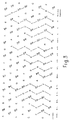
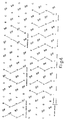
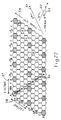
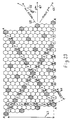
- Figures 1 to 6 show a two-dimensional array of well known musical symbols, which each represent a musical note in known manner.
- the array consists of a number of horizontal rows, for example as shown by reference 1, with each row including repeated series of twelve symbols from A to G#/Ab, which each represent a musical note and together form a musical series of semi-tones, otherwise known as a chromatic scale, giving rise to twelve different musical keys.
- each note is placed between its major and minor third notes in the row immediately above it.
- the note A in the second row from the top of the array is positioned between the notes C and C#/Db in the top row of the array.
- each note is placed between the fourth and fifth note in the adjacent row immediately above it, when counting in a direction to the right from the same note in that adjacent row, or is placed between the fourth and fifth note in the adjacent row immediately below it, when counting in a direction to the left from that same note in that adjacent row.
- the same note in the adjacent row is counted as the first note.
- note A in the second row from the top of the array is between the notes C and C#/Db in the top row, which are the fourth and fifth notes to the right of note A in the top row.
- note A in the second row is also between the notes F#/Gb and F in the third row of the array, which are the fourth and fifth notes to the left of note A in the third row.
- the vertical configurations 14 to 19 each show fifths from D to A, B to F#/Gb, D#/Eb to A#/Bb, etc, and the diagonal configurations 20 to 28 each show fourths from G to C, D#/Eb to G#/Ab to C#/Db, etc.
- Figure 2 shows examples of interconnecting configurations within the array, which each determine a different musical interval.
- Figure 3 shows examples of configurations, which determine chords in specific musical keys.
- the top half of the array shows examples of configurations, which respectively determine natural minor, harmonic minor, and augmented scales in specific musical keys.
- Figure 6 form connected unisons and octaves, which, for any given note, in this example : A, form a grid dividing the array into equal sections, each containing the same notes in the same positions.
- the array as shown in Figures 1 to 6 can be used in many different forms as, for example, an aid to learning the musical note relationships in all musical keys.
- the array may be incorporated into:-
- Figures 7 to 18 illustrate how the array can be applied to an electronic keyboard (Figs. 7, 8 and 8a) or a fingerboard of a guitar (Figs. 9 to 13) or a fingerboard of a bass guitar (Figs. 14 to 18).
- the keyboard shown generally at 30 in Figure 7 has several horizontal rows of contact positions, in the form of keys, such as at 31, with each key being capable of being used to produce a separate audible note, and the notes being arranged by pitch in a series of semi-tones, in the same arrangement as the symbols of the array shown in Figures 1 to 6.
- the keys are each hexagonal in shape, to produce the staggered arrangement within the array, and form two sets of crossing diagonal rows, one of minor thirds and one of major thirds. This arrangement thus determines all intervals, chords, scales, etc. which each from a particular visual configuration in all musical keys in the same way as shown in Figures 1 to 6, which is not possible on a convention keyboard.
- each configuration of the keys on the keyboard is the same for each chord, scale, etc in all musical keys, the arrangement of notes on the keyboard also enables all scales, chords, etc and even melodies, to be played in all twelve keys without altering the fingering pattern for each key, thus enabling the player to modulate through the keys far more easily. Furthermore, the player may play equally well from any position around the instrument.
- a seven octave expanded keyboard can have sixteen rows and, by the present invention, can be smaller in overall size than a conventional keyboard instrument. Larger and smaller versions, with differing numbers of keys, can be produced, and the shapes of the keys can be other than hexagonal, for example circular, without altering their alignment with each other. The sound can be reproduced in the same way as on any conventional or other electronic keyboard or synthesizer.
- FIG. 8 shows an example of an electronic keyboard instrument including a keyboard 51, in accordance with the keyboard shown in Figure 8, and a number of control switches or buttons 52, an L.E.D. 53, a number of control key pads 54 and a back-lit L.C.D. 55 arranged around the keyboard 51.
- the instrument in this example may have a five octave range and can be worn with a shoulder strap or be placed on a stand.
- a suitable standard interface (not shown) may be used to connect the instrument with other sound modules, etc.
- Figures 9 to 12 show different embodiments of a fingerboard of a guitar, to which the array, as shown in Figures 1 to 6 has been applied.
- Figure 9 illustrates the position of the notes and
- Figures 10 to 12 illustrate three examples of different embodiments of the fingerboard.
- the fingerboards shown in Figures 10 to 12 each have seven strings, which define contact positions and which are set closer together than on a conventional six stringed guitar fingerboard.
- This number of strings gives the guitar, in accordance with the invention, the same pitch range (approximately four octaves) as a conventional guitar, because the interval from string to string is shorter.
- contact positions at the semi-tone intervals for each string are midway between contact positions on the neighbouring strings.
- the fingerboard 32 in Figure 10 has frets 33, which slant at predetermined angles relative to the strings, to provide the contact positions along the strings to obtain the arrangement of the array.
- fingerboard 34 has a moulded formation 35 shaped to provide the necessary contact positions along the strings to obtain the array.
- fingerboard 36 is provided with studs 37, which provide the contact positions along the strings and each consist of a section of metal rod set into and protruding from holes in the fingerboard and shaped in such a way that the string can be Precisely stopped on it, as well as being pushed or pulled sideways onto another protruding stud.
- a nut 38 is shaped so as to set up the staggered contact positions. The nut is divided to produce one scale length for the first, third, fifth and seventh strings and another scale length, half a fret space shorter, for the second, fourth and sixth strings.
- Figure 13 shows schematically an electric guitar having a body 40 and a neck with a fingerboard 32.
- the fingerboard is the same arrangement as that shown in Figure 10 with slanting frets 33 and seven strings tensioned across the frets.
- the end of the neck is provided with a headstock carrying tuning pegs 41, for adjusting the tension of the strings.
- these may be mounted on the body end of the instrument in a way similar to existing 'headless' guitars and basses.
- each embodiment of the fingerboard can be similar to conventional guitars thus giving the instruments of the present invention a familiar feel to players of conventional guitars.
- the staggered arrangement of notes from string to string provides more finger room in spite of the closer spacing of the strings, and also enables the player to hold down a major triad with one finger. A slight backward movement of the same finger on the finaerboard will change it to the minor triad.
- Two fingers laid across the fingerboard can hold down a seven note chord and the playing of any diagonal rows produces diminished and augmented chords. All chords and single note passages can be played with the same finger positions throughout, without the alteration necessary on conventional guitars when allowing for the (differently tuned) third string.
- the array may be applied in a similar manner to the fingerboard of a bass, rather than a guitar.
- the fingerboards have only five strings and, in addition, as shown in Figure 15, a fretless bass fingerboard 39 may be used.
- a device comprising two overlapping members slidably movable relative to each other, one of the members having an array of symbols each representing a musical note and being arranged in accordance with the second aspect of the present invention, and the other member being arranged to indicate on the array each musical note relationship in different musical keys as the members are slidably moved relative to each other.
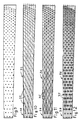
- a slide rule device including an outer sleeve 42, which acts as a cursor, having two opposite sides 43,44, within which the inner member 45 can be slid.
- the slide rule provides a reference to the musical note content, in any key, of intervals, of varying types of chords, and of scales, including the modes of the major scale.
- the outer sleeve 42 carries connecting bands, such as at 46 to indicate intervals and chords, and block shapes such as 47 to indicate scales and modes.
- the inner member 45 is folded along line 48 before insertion into the sleeve 42 and each side of the folded inner member 45 carries the array of musical notes as snown in Figures 1 to 6.
- connecting bands to indicate a useful chord progression, the "cycle of fifths" and a shape indicating augmented and diminished chords. These markings are visible only when the inner member is removed from the outer sleeve.
- the outer sleeve 42 is formed on each side with holes or transparent windows, such as those shown at 48, through which the notes of the array on the inner member 45 are visible, as shown in Figures 18a and 18b. The notes visible through the holes or windows are thus changed as the inner member 45 is slid within the sleeve 42.
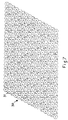
- the slide rule can also be made in a disc form, with the array of notes in a pattern such as is shown schematically in Figure 19, wherein each row of semitones follows a circular path.
- slide rules based on the same array include three dimensional ones such as prismatic, cylindrical and conical.
- the array may be formed by vertical, rather than horizontal, lines.
- the lines of semitones may be curved instead of straight, and can even form concentric circles or semicircles.
- Figure 20 shows a circular keyboard with concentric circles of hexagonal keys 49. The relationship between musical notes from one circle to the next is the same as that described for the keyboard with straight rows of semitones. Any degree of curvature is possible, from none at all to slight or extreme.
- Figure 21 shows another circular keyboard with the rows of hexagonal keys 50 arranged in straight lines forming the radii of a circle.
- Figure 22 shows another example comprising a seven octave keyboard wherein all the "A" keys are shaded and with the lines of semi-tones, such as the one shown at 56, being rotated 60° anti-clockwise with respect to the horizontal lines shown for example in Figure 8.
- This arrangement thus produces octaves, such as at 57 and 58, minor 3rds as at 59, 4ths as at 60, 5ths as at 61, and major 3rds as at 62.
- Figure 23 shows yet another example of a seven octave keyboard, again with all "A" keys shaded, but with the lines of semi-tones, such as the one shown at 63, rotated 90° anti-clockwise and turned upside down so that the semi-tones increase in pitch from the bottom of the keyboard upwards.
- This then produces octaves, such as at 64, minor 3rds as at 65, 4ths as at 66, 5ths as at 67, and major 3rds as at 68.
- the symbols arranged to produce the array may take the form of any visual representation, which can be used to represent different musical notes.
- the symbols may consist of different colours, letters, numbers or any other design.
Landscapes
- Engineering & Computer Science (AREA)
- Physics & Mathematics (AREA)
- Multimedia (AREA)
- General Physics & Mathematics (AREA)
- Educational Administration (AREA)
- Educational Technology (AREA)
- Business, Economics & Management (AREA)
- Theoretical Computer Science (AREA)
- Acoustics & Sound (AREA)
- Electrophonic Musical Instruments (AREA)
- Stringed Musical Instruments (AREA)
- Auxiliary Devices For Music (AREA)
- Toys (AREA)
Claims (10)
- Verfahren und Hilfsmittel zur Erzeugung von Musiknotenzusammenhängen mit ersten und zweiten überlappenden Teilen (45, 42), die zueinander beweglich sind, wobei der erste Teil (45) eine regelmäßige Anordnung von Symbolen aufweist, von denen jedes Symbol jeweils eine Musiknote darstellt und die regelmäßige Anordnung aus Reihen der genannten Symbole besteht, dadurch gekennzeichnet, daß jede gegebene Reihe (1) in bezug auf eine daran angrenzende Reihe so angeordnet ist, daß aufeinanderfolgende Symbole der genannten gegebenen Reihe (1) jeweils im wesentlichen zwischen zwei aufeinanderfolgenden Symbolen der genannten angrenzenden Reihe liegen, die genannten aufeinanderfolgenden Symbole jeder Reihe die Musiknoten einer chromatischen Tonleiter darstellen, der genannte zweite Teil (42) eine Vielzahl darin ausgebildeter Fenster (48) aufweist, durch die hindurch die Symbole auf dem ersten Teil sichtbar sind, die genannten Fenster (48) gruppenweise (47) in unterschiedlichen Konfigurationen zusammengestellt sind, wobei für jedes Symbol der genannten gegebenen Reihe (1), das im wesentlichen zwischen zwei aufeinanderfolgenden Symbolen der genannten angrenzenden Reihe liegt, die beiden aufeinanderfolgenden Symbole Noten darstellen, die Musikintervalle mit der durch das genannte Symbol jeweils einer großen und einer kleinen Terz dargestellten Note bilden, und daß die genannten Gruppen (47) zu den Symbolen auf dem ersten Teil (45) so angeordnet sind, daß verschiedene der genannten Gruppen (47) eine anschauliche Darstellung der verschiedenen Musiknotenzusammenhänge in Form von Tonleitern, Akkorden, Intervallen und Tonarten schaffen, die alle von der Lernhilfe direkt ablesbar sind, und durch Bewegen des ersten und des zweiten Teils (45, 42) zueinander für jede gegebene Fenstergruppe (47) derselbe Musiknotenzusammenhang in verschiedenen Tonarten durch die Fenster der genannten Gruppe (47) hindurch ablesbar ist.
- Lernhilfe nach Anspruch 1, in der das genannte zweite Teil (42) eine äußere Hülle umfaßt, in der das genannte erste Teil (45) verschiebar ist.
- Lernhilfe nach Anspruch 2, in der die Fenster (48) auf beiden Seiten der genannten Hülle (42) ausgebildet sind und das genannte erste Teil (45) die genannte regelmäßige Anordnung auf beiden Seiten aufweist.
- Lernhilfe nach Anspruch 1, in der das genannte erste und das genannte zweite Teil scheibenförmig ausgebildet sind, die zueinander drehbar sind, wobei die genannten Symbole der genannten regelmäßigen Anordnung in konzentrisch runden Reihen auf dem ersten Teil angeordnet sind.
- Musikinstrument mit einer Vielzahl Kontaktstellen (31) jeweils zur Erzeugung einer hörbaren Musiknote, dadurch gekennzeichnet, daß die genannten Kontaktstellen (31) in einer regelmäßigen Anordnung angeordnet sind, wobei die Gruppen der genannten Kontaktstellen, mit denen derselbe Musiknotenzusammenhang in verschiedenen Tonarten herstellbar ist, dieselbe optische Konfiguration an den jeweiligen Stellen innerhalb der regelmäßigen Anordnung bilden, daß die genannte regelmäßige Anordnung aus Reihen mit Kontaktstellen (31) besteht, jede gegebene Reihe (1) zu einer daran angrenzenden Reihe (1) so angeordnet ist, daß aufeinanderfolgende Kontaktstellen der genannten gegebenen Reihe (1) jeweils im wesentlichen zwischen zwei aufeinanderfolgenden Kontaktstellen der genannten angrenzenden Reihe liegen, die Kontaktstellen (31) jeder Reihe so angeordnet sind, daß aufeinanderfolgende Kontaktstellen (31) eine chromatische Tonleiter erzeugen, wobei bei jeder Kontaktstelle (31) der genannten gegebenen Reihe, die im wesentlichen zwischen zwei aufeinanderfolgenden Kontaktstellen (31) der genannten angrenzenden Reihe liegt, die beiden aufeinanderfolgenden Kontaktstellen (31) zur Erzeugung hörbarer Musiknoten dienen, die die Musikintervalle zu der von der genannten Kontaktstelle (31) jeweils einer großen und einer kleinen Terz erzeugten Musiknote bilden.
- Musikinstrument nach Anspruch 5, bei dem sich die genannte angrenzende Reihe unmittelbar an eine Seite der genannten gegebenen Reihe anschließt, und die genannten zwei aufeinanderfolgenden Kontaktstellen (31) zur Erzeugung der vierten und fünften Töne der chromatischen Tonleiter beginnend mit dem von der genannten Kontaktstelle (31) erzeugten Ton ansteigend dienen, und die genannte Kontaktstelle (31) zwischen zwei weiteren aufeinanderfolgenden Kontaktstellen einer anderen Reihe unmittelbar an der anderen Seite der genannten gegebenen Reihe angeordnet ist, wobei die genannten zwei weiteren aufeinanderfolgenden Kontaktstellen zur Erzeugung der vierten und der fünften Töne der chromatischen Tonleiter beginnend mit dem gegebenen Ton abfallend dienen.
- Musikinstrument nach einem der Ansprüche 5 oder 6, bei dem das Instrument ein Saiteninstrument ist, wobei die Kontaktstellen durch eine Reihe von Saiten bestimmt werden, die auf ein Griffbrett (32; 34; 36) des Instrumentes gespannt sind.
- Musikinstrument nach Anspruch 7, bei dem die Kontaktstellen weiter durch eine Bundanordnung (33; 35; 37) bestimmt werden, die sich auf dem Griffbrett (32; 34; 36) befinden.
- Musikinstrument nach einem der Ansprüche 5 oder 6, bei dem das Instrument ein Tasteninstrument ist, dessen Kontaktstellen (31) jeweils eine Kontakttaste (31) enthalten.
- Musikinstrument nach Anspruch 9 bei dem jede der Tasten (31) sechseckig ausgebildet ist, um eine Anordnung im wesentlichen parallel ausgeführter Reihen von Tasten (31) zu schaffen, die zueinander versetzt sind.
Applications Claiming Priority (3)
| Application Number | Priority Date | Filing Date | Title |
|---|---|---|---|
| GB8903672 | 1989-02-17 | ||
| GB898903672A GB8903672D0 (en) | 1989-02-17 | 1989-02-17 | A method of and means for determining musical note relationships |
| PCT/GB1990/000263 WO1990009650A1 (en) | 1989-02-17 | 1990-02-16 | A method of and means for producing musical note relationships |
Publications (2)
| Publication Number | Publication Date |
|---|---|
| EP0458836A1 EP0458836A1 (de) | 1991-12-04 |
| EP0458836B1 true EP0458836B1 (de) | 1994-12-07 |
Family
ID=10651884
Family Applications (1)
| Application Number | Title | Priority Date | Filing Date |
|---|---|---|---|
| EP90903199A Expired - Lifetime EP0458836B1 (de) | 1989-02-17 | 1990-02-16 | Verfahren und hilfsmittel zur erzeugung von musiknotenzusammenhängen |
Country Status (10)
| Country | Link |
|---|---|
| US (1) | US5415071A (de) |
| EP (1) | EP0458836B1 (de) |
| JP (1) | JP2859736B2 (de) |
| AT (1) | ATE115316T1 (de) |
| AU (1) | AU640632B2 (de) |
| CA (1) | CA2048658C (de) |
| DE (1) | DE69014862T2 (de) |
| ES (1) | ES2067736T3 (de) |
| GB (2) | GB8903672D0 (de) |
| WO (1) | WO1990009650A1 (de) |
Cited By (1)
| Publication number | Priority date | Publication date | Assignee | Title |
|---|---|---|---|---|
| DE202012005308U1 (de) | 2012-05-24 | 2012-09-10 | Bernd Klausmann | Vorrichtung zur Ermittlung der Töne für Musikinstrumente |
Families Citing this family (58)
| Publication number | Priority date | Publication date | Assignee | Title |
|---|---|---|---|---|
| DE4419039C1 (de) * | 1994-05-31 | 1995-08-03 | Ludwig Schiesl | Musikinstrument, bei dem die Tonauslösungselemente auf Linien angeordnet sind |
| FR2735601B1 (fr) * | 1995-06-13 | 1997-08-01 | Castry Jean Fred | Systeme pour applications en formation musicale |
| WO1997020306A1 (en) * | 1995-11-24 | 1997-06-05 | Castlemont Investments Pty. Ltd. | Keyboards for musical instruments |
| US5805157A (en) * | 1996-08-12 | 1998-09-08 | International Business Machines Corporation | Mobile client computer with hexagonal keyboard |
| US6215057B1 (en) | 1998-05-14 | 2001-04-10 | Dorly Oren-Chazon | Sound generating educational musical toy and teaching device |
| US6337434B2 (en) | 1998-05-14 | 2002-01-08 | Dorly Oren-Chazon | Music teaching instrument |
| US6392131B2 (en) * | 2000-06-09 | 2002-05-21 | Stephen W. Boyer | Device for patterned input and display of musical notes |
| US6323410B1 (en) * | 2000-07-21 | 2001-11-27 | Daniel P. Rackow | Slide rule musical scale teaching device |
| US6841724B2 (en) | 2001-05-30 | 2005-01-11 | Michael P. George | Method and system of studying music theory |
| US6670535B2 (en) * | 2002-05-09 | 2003-12-30 | Clifton L. Anderson | Musical-instrument controller with triad-forming note-trigger convergence points |
| WO2004038679A1 (en) * | 2002-10-22 | 2004-05-06 | Matthew Guinness | Slide rule for misic |
| US6755713B1 (en) | 2003-05-08 | 2004-06-29 | Mattel | Toy with correlated audible and visual outputs |
| US7554025B2 (en) * | 2003-05-09 | 2009-06-30 | Winston Harrison | Visual chord keyboard instructional method |
| WO2005041168A1 (es) * | 2003-10-24 | 2005-05-06 | Sebastian Brown Apraiz | Metodo de disposicion de notas musicales y disposiciones asi obtenidas |
| US7119270B2 (en) * | 2004-07-28 | 2006-10-10 | Delaporte Stephen E | Geometric system and method for generating tone using fluid |
| WO2006083184A2 (en) * | 2005-02-01 | 2006-08-10 | Cheock Frederick Hubert Sarmie | The cheock 12 dimension music code |
| DE102006008298B4 (de) | 2006-02-22 | 2010-01-14 | Fraunhofer-Gesellschaft zur Förderung der angewandten Forschung e.V. | Vorrichtung und Verfahren zum Erzeugen eines Notensignals |
| DE102006008260B3 (de) * | 2006-02-22 | 2007-07-05 | Fraunhofer-Gesellschaft zur Förderung der angewandten Forschung e.V. | Vorrichtung und Verfahren zur Analyse eines Audiodatums |
| US7538265B2 (en) * | 2006-07-12 | 2009-05-26 | Master Key, Llc | Apparatus and method for visualizing music and other sounds |
| US20080173163A1 (en) * | 2007-01-24 | 2008-07-24 | Pratt Jonathan E | Musical instrument input device |
| US7880076B2 (en) * | 2007-04-03 | 2011-02-01 | Master Key, Llc | Child development and education apparatus and method using visual stimulation |
| US7589269B2 (en) * | 2007-04-03 | 2009-09-15 | Master Key, Llc | Device and method for visualizing musical rhythmic structures |
| US7932454B2 (en) * | 2007-04-18 | 2011-04-26 | Master Key, Llc | System and method for musical instruction |
| WO2008130697A1 (en) * | 2007-04-19 | 2008-10-30 | Master Key, Llc | Method and apparatus for editing and mixing sound recordings |
| WO2008130665A1 (en) * | 2007-04-19 | 2008-10-30 | Master Key, Llc | System and method for audio equalization |
| US7928306B2 (en) * | 2007-04-20 | 2011-04-19 | Master Key, Llc | Musical instrument tuning method and apparatus |
| WO2008130663A1 (en) * | 2007-04-20 | 2008-10-30 | Master Key, Llc | System and method for foreign language processing |
| WO2008130658A1 (en) * | 2007-04-20 | 2008-10-30 | Master Key, Llc | System and method for speech therapy |
| WO2008130662A1 (en) * | 2007-04-20 | 2008-10-30 | Master Key, Llc | Method and apparatus for providing medical treatment using visualization components of audio spectrum signals |
| WO2008130666A2 (en) * | 2007-04-20 | 2008-10-30 | Master Key, Llc | System and method for music composition |
| US7820900B2 (en) | 2007-04-20 | 2010-10-26 | Master Key, Llc | System and method for sound recognition |
| WO2008130661A1 (en) * | 2007-04-20 | 2008-10-30 | Master Key, Llc | Method and apparatus for comparing musical works |
| US8018459B2 (en) * | 2007-04-20 | 2011-09-13 | Master Key, Llc | Calibration of transmission system using tonal visualization components |
| WO2008130660A1 (en) * | 2007-04-20 | 2008-10-30 | Master Key, Llc | Archiving of environmental sounds using visualization components |
| WO2008130657A1 (en) * | 2007-04-20 | 2008-10-30 | Master Key, Llc | Method and apparatus for computer-generated music |
| US8073701B2 (en) * | 2007-04-20 | 2011-12-06 | Master Key, Llc | Method and apparatus for identity verification using visual representation of a spoken word |
| RU2367028C2 (ru) * | 2007-09-10 | 2009-09-10 | Владилен Иванович Плотников | Способ игры на балалайке (переборы плотникова) |
| CA2684424C (en) * | 2007-10-26 | 2015-12-29 | Brian R. Copeland | An apparatus for percussive harmonic musical syntheses utilizing midi technology (aphams) |
| WO2009099593A1 (en) * | 2008-02-01 | 2009-08-13 | Master Key, Llc | Apparatus and method of displaying infinitely small divisions of measurement |
| US7875787B2 (en) * | 2008-02-01 | 2011-01-25 | Master Key, Llc | Apparatus and method for visualization of music using note extraction |
| USD614645S1 (en) * | 2008-04-04 | 2010-04-27 | Per Ola Kristensson | On screen keyboard for electronic devices, including mobile phones and tablet computers |
| USD606081S1 (en) * | 2008-12-03 | 2009-12-15 | Microsoft Corporation | User interface for a display screen |
| FR2944373B1 (fr) * | 2009-04-14 | 2014-01-10 | Julien Adrien Hotrique | Clavier pour instrument de musique et instrument comportant un tel clavier |
| US8674207B1 (en) * | 2012-10-12 | 2014-03-18 | Advins, Inc. | Electronic musical instrument |
| JP5641551B1 (ja) * | 2014-06-11 | 2014-12-17 | 白井 和彦 | キーボード楽器 |
| USD774086S1 (en) | 2014-10-06 | 2016-12-13 | Vixlet LLC | Display screen with computer icon |
| USD772929S1 (en) | 2014-10-06 | 2016-11-29 | Vixlet LLC | Display screen with icons |
| USD774085S1 (en) | 2014-10-06 | 2016-12-13 | Vixlet LLC | Computer display with icons |
| USD772928S1 (en) | 2014-10-06 | 2016-11-29 | Vixlet LLC | Display screen with computer icons |
| USD775198S1 (en) | 2014-10-06 | 2016-12-27 | Vixlet LLC | Display screen with icons |
| USD772288S1 (en) | 2014-10-06 | 2016-11-22 | Vixlet LLC | Display screen with computer icons |
| US9530391B2 (en) * | 2015-01-09 | 2016-12-27 | Mark Strachan | Music shaper |
| US9747875B2 (en) * | 2015-10-22 | 2017-08-29 | Tanate Ua-Aphithorn | Accordion and electronic accordion |
| US9520112B1 (en) * | 2015-10-22 | 2016-12-13 | Tanate Ua-Aphithorn | Accordion, electronic accordion, and computer program product |
| US10618571B2 (en) | 2016-06-07 | 2020-04-14 | Auria Solutions UK | Ltd. | Manufacture and use of nonwoven products utilizing ribbon cross-section fibers for automotive applications |
| US11114076B1 (en) * | 2020-03-26 | 2021-09-07 | Yizong He | Switch fingerboard for violin family musical instruments |
| JP1746311S (ja) * | 2022-04-14 | 2023-06-14 | グラフィカルユーザーインターフェース | |
| USD1117293S1 (en) * | 2024-03-15 | 2026-03-10 | Number Hive Limited | Display screen or portion thereof with graphical user interface |
Family Cites Families (14)
| Publication number | Priority date | Publication date | Assignee | Title |
|---|---|---|---|---|
| US3592099A (en) * | 1969-04-11 | 1971-07-13 | Delbert F Gibby | Slide rule for computing musical relationships |
| US3572205A (en) * | 1969-07-07 | 1971-03-23 | Lois G Scholfield | Harmonic teaching device |
| DE2054561A1 (de) * | 1970-11-06 | 1972-05-10 | Müller, Egon, 7501 Grünwettersbach | Lehrmittel zur Veranschaulichung des Harmonie system s der tonalen Musik |
| US3677130A (en) * | 1971-06-09 | 1972-07-18 | Michael G Petreycik | Chord teaching device |
| US3752031A (en) * | 1971-08-05 | 1973-08-14 | I Mohos | Twelve-tone-row modulator |
| US3748947A (en) * | 1972-01-10 | 1973-07-31 | R Freiheit | Melody chord constructor for string instruments |
| US3908506A (en) * | 1974-02-22 | 1975-09-30 | Verna M Leonard | Diatonic and chromatic chord dial |
| SE396837B (sv) * | 1975-01-30 | 1977-10-03 | Andersson John Olle | Anordning for overforing av konventionellt notsystem vid spelning pa strenginstrument till ett system som direkt anger det lege lengs de enskilda strengarna vid vilket olika toner skall skapas |
| US4175468A (en) * | 1976-10-22 | 1979-11-27 | Whitlock Robert R | Method and apparatus for music instruction |
| GB2119153B (en) * | 1982-04-27 | 1986-02-05 | Duncan Glen Thorburn | Musical scale indicator |
| GB2131592B (en) * | 1982-12-02 | 1986-08-20 | Brian Gordon Hayden | Arrangements of notes on musical instruments |
| US4677893A (en) * | 1985-07-11 | 1987-07-07 | Fahnestock E Carl | Quick music notes slide rule |
| WO1988010483A1 (en) * | 1987-06-15 | 1988-12-29 | Victorian Economic Development Corporation | Device for the display of musical information |
| FR2643181B1 (fr) * | 1989-02-13 | 1992-12-31 | Scotto Attilio | Nouvel instrument de musique a claviers |
-
1989
- 1989-02-17 GB GB898903672A patent/GB8903672D0/en active Pending
-
1990
- 1990-02-16 AT AT90903199T patent/ATE115316T1/de not_active IP Right Cessation
- 1990-02-16 WO PCT/GB1990/000263 patent/WO1990009650A1/en not_active Ceased
- 1990-02-16 AU AU50828/90A patent/AU640632B2/en not_active Ceased
- 1990-02-16 EP EP90903199A patent/EP0458836B1/de not_active Expired - Lifetime
- 1990-02-16 DE DE69014862T patent/DE69014862T2/de not_active Expired - Fee Related
- 1990-02-16 JP JP2503365A patent/JP2859736B2/ja not_active Expired - Fee Related
- 1990-02-16 US US07/761,775 patent/US5415071A/en not_active Expired - Lifetime
- 1990-02-16 ES ES90903199T patent/ES2067736T3/es not_active Expired - Lifetime
- 1990-02-16 CA CA002048658A patent/CA2048658C/en not_active Expired - Lifetime
- 1990-02-16 GB GB9116880A patent/GB2245409B/en not_active Expired - Fee Related
Cited By (1)
| Publication number | Priority date | Publication date | Assignee | Title |
|---|---|---|---|---|
| DE202012005308U1 (de) | 2012-05-24 | 2012-09-10 | Bernd Klausmann | Vorrichtung zur Ermittlung der Töne für Musikinstrumente |
Also Published As
| Publication number | Publication date |
|---|---|
| GB8903672D0 (en) | 1989-04-05 |
| JP2859736B2 (ja) | 1999-02-24 |
| GB2245409A (en) | 1992-01-02 |
| EP0458836A1 (de) | 1991-12-04 |
| JPH04506872A (ja) | 1992-11-26 |
| ES2067736T3 (es) | 1995-04-01 |
| DE69014862T2 (de) | 1995-07-06 |
| CA2048658A1 (en) | 1990-08-18 |
| WO1990009650A1 (en) | 1990-08-23 |
| DE69014862D1 (de) | 1995-01-19 |
| US5415071A (en) | 1995-05-16 |
| GB9116880D0 (en) | 1991-09-18 |
| ATE115316T1 (de) | 1994-12-15 |
| CA2048658C (en) | 1999-09-21 |
| AU640632B2 (en) | 1993-09-02 |
| AU5082890A (en) | 1990-09-05 |
| GB2245409B (en) | 1993-12-01 |
Similar Documents
| Publication | Publication Date | Title |
|---|---|---|
| EP0458836B1 (de) | Verfahren und hilfsmittel zur erzeugung von musiknotenzusammenhängen | |
| US5741990A (en) | Method of and means for producing musical note relationships | |
| US4257306A (en) | Electronic display device for fretted stringed instruments | |
| US8039721B2 (en) | Kit and method for learning to play an instrument | |
| US6841724B2 (en) | Method and system of studying music theory | |
| US6483018B2 (en) | Method and apparatus for teaching playing of stringed instrument | |
| US4031800A (en) | Keyboard for a musical instrument | |
| US6288315B1 (en) | Method and apparatus for musical training | |
| US3748947A (en) | Melody chord constructor for string instruments | |
| US20090266223A1 (en) | Stringed instrument learning and teaching method, music notation system, and corresponding visual aid | |
| CN101128859A (zh) | Morpheus(梦神)音乐符号系统 | |
| JP6441681B2 (ja) | ギター演奏教習データ作成装置、ギター演奏教習システム、ギター演奏教習データ作成方法及びギター演奏教習データ作成プログラム | |
| US4314499A (en) | Musical instruments facilitating teaching, composing and improvisation | |
| US4969383A (en) | Musical scale indicator | |
| US7381878B2 (en) | Musical instrument display | |
| US4175468A (en) | Method and apparatus for music instruction | |
| US20250046210A1 (en) | Music theory teaching method and system | |
| US4289057A (en) | Pattern composer for fingerboard instrument instruction | |
| CN118942431A (zh) | 十二半音同构乐器与配套十二半音同构记谱法 | |
| US20200066239A1 (en) | Sang Lee's Music Notation System, SALEMN, Maps Out Space-Time Topology of Sound, Enriches Palettes of Colors via Hand-Brush Techniques | |
| Mermikides | The digital fretboard | |
| GB2092816A (en) | Electronic Chord Indicator | |
| US7554025B2 (en) | Visual chord keyboard instructional method | |
| US7435886B2 (en) | Interval models for the musical octave | |
| Mermikides | Remapping and relearning the guitar's pitch matrix with MIDI and Max/MSP |
Legal Events
| Date | Code | Title | Description |
|---|---|---|---|
| PUAI | Public reference made under article 153(3) epc to a published international application that has entered the european phase |
Free format text: ORIGINAL CODE: 0009012 |
|
| 17P | Request for examination filed |
Effective date: 19910809 |
|
| AK | Designated contracting states |
Kind code of ref document: A1 Designated state(s): AT BE CH DE DK ES FR GB IT LI LU NL SE |
|
| 17Q | First examination report despatched |
Effective date: 19930305 |
|
| RAP1 | Party data changed (applicant data changed or rights of an application transferred) |
Owner name: NOTEPOOL LTD |
|
| GRAA | (expected) grant |
Free format text: ORIGINAL CODE: 0009210 |
|
| AK | Designated contracting states |
Kind code of ref document: B1 Designated state(s): AT BE CH DE DK ES FR IT LI LU NL SE |
|
| PG25 | Lapsed in a contracting state [announced via postgrant information from national office to epo] |
Ref country code: NL Effective date: 19941207 Ref country code: DK Effective date: 19941207 Ref country code: AT Effective date: 19941207 |
|
| REF | Corresponds to: |
Ref document number: 115316 Country of ref document: AT Date of ref document: 19941215 Kind code of ref document: T |
|
| REF | Corresponds to: |
Ref document number: 69014862 Country of ref document: DE Date of ref document: 19950119 |
|
| PG25 | Lapsed in a contracting state [announced via postgrant information from national office to epo] |
Ref country code: LU Free format text: LAPSE BECAUSE OF NON-PAYMENT OF DUE FEES Effective date: 19950228 |
|
| ITF | It: translation for a ep patent filed | ||
| PG25 | Lapsed in a contracting state [announced via postgrant information from national office to epo] |
Ref country code: SE Effective date: 19950307 |
|
| ET | Fr: translation filed | ||
| REG | Reference to a national code |
Ref country code: ES Ref legal event code: FG2A Ref document number: 2067736 Country of ref document: ES Kind code of ref document: T3 |
|
| NLV1 | Nl: lapsed or annulled due to failure to fulfill the requirements of art. 29p and 29m of the patents act | ||
| PLBE | No opposition filed within time limit |
Free format text: ORIGINAL CODE: 0009261 |
|
| STAA | Information on the status of an ep patent application or granted ep patent |
Free format text: STATUS: NO OPPOSITION FILED WITHIN TIME LIMIT |
|
| 26N | No opposition filed | ||
| REG | Reference to a national code |
Ref country code: ES Ref legal event code: FD2A Effective date: 19991102 |
|
| REG | Reference to a national code |
Ref country code: ES Ref legal event code: FD2A Effective date: 20010822 |
|
| PGFP | Annual fee paid to national office [announced via postgrant information from national office to epo] |
Ref country code: CH Payment date: 20080225 Year of fee payment: 19 Ref country code: ES Payment date: 20080221 Year of fee payment: 19 |
|
| PGFP | Annual fee paid to national office [announced via postgrant information from national office to epo] |
Ref country code: IT Payment date: 20080227 Year of fee payment: 19 |
|
| PGFP | Annual fee paid to national office [announced via postgrant information from national office to epo] |
Ref country code: FR Payment date: 20080219 Year of fee payment: 19 Ref country code: DE Payment date: 20080423 Year of fee payment: 19 |
|
| PGFP | Annual fee paid to national office [announced via postgrant information from national office to epo] |
Ref country code: BE Payment date: 20080222 Year of fee payment: 19 |
|
| BERE | Be: lapsed |
Owner name: *NOTEPOOL LTD Effective date: 20090228 |
|
| REG | Reference to a national code |
Ref country code: CH Ref legal event code: PL |
|
| PG25 | Lapsed in a contracting state [announced via postgrant information from national office to epo] |
Ref country code: LI Free format text: LAPSE BECAUSE OF NON-PAYMENT OF DUE FEES Effective date: 20090228 Ref country code: CH Free format text: LAPSE BECAUSE OF NON-PAYMENT OF DUE FEES Effective date: 20090228 |
|
| REG | Reference to a national code |
Ref country code: FR Ref legal event code: ST Effective date: 20091030 |
|
| PG25 | Lapsed in a contracting state [announced via postgrant information from national office to epo] |
Ref country code: DE Free format text: LAPSE BECAUSE OF NON-PAYMENT OF DUE FEES Effective date: 20090901 |
|
| PG25 | Lapsed in a contracting state [announced via postgrant information from national office to epo] |
Ref country code: BE Free format text: LAPSE BECAUSE OF NON-PAYMENT OF DUE FEES Effective date: 20090228 |
|
| REG | Reference to a national code |
Ref country code: ES Ref legal event code: FD2A Effective date: 20090217 |
|
| PG25 | Lapsed in a contracting state [announced via postgrant information from national office to epo] |
Ref country code: FR Free format text: LAPSE BECAUSE OF NON-PAYMENT OF DUE FEES Effective date: 20090302 |
|
| PG25 | Lapsed in a contracting state [announced via postgrant information from national office to epo] |
Ref country code: ES Free format text: LAPSE BECAUSE OF NON-PAYMENT OF DUE FEES Effective date: 20090217 |
|
| PG25 | Lapsed in a contracting state [announced via postgrant information from national office to epo] |
Ref country code: IT Free format text: LAPSE BECAUSE OF NON-PAYMENT OF DUE FEES Effective date: 20090216 |