EP0458938B1 - Système de lutte contre les incendies essentiellement conçu pour la sauvegarde des forêts - Google Patents
Système de lutte contre les incendies essentiellement conçu pour la sauvegarde des forêts Download PDFInfo
- Publication number
- EP0458938B1 EP0458938B1 EP91901284A EP91901284A EP0458938B1 EP 0458938 B1 EP0458938 B1 EP 0458938B1 EP 91901284 A EP91901284 A EP 91901284A EP 91901284 A EP91901284 A EP 91901284A EP 0458938 B1 EP0458938 B1 EP 0458938B1
- Authority
- EP
- European Patent Office
- Prior art keywords
- data
- peripheral
- fire
- fire fighting
- fighting system
- Prior art date
- Legal status (The legal status is an assumption and is not a legal conclusion. Google has not performed a legal analysis and makes no representation as to the accuracy of the status listed.)
- Expired - Lifetime
Links
Images

Classifications
-
- G—PHYSICS
- G08—SIGNALLING
- G08B—SIGNALLING SYSTEMS, e.g. PERSONAL CALLING SYSTEMS; ORDER TELEGRAPHS; ALARM SYSTEMS
- G08B17/00—Fire alarms; Alarms responsive to explosion
- G08B17/005—Fire alarms; Alarms responsive to explosion for forest fires, e.g. detecting fires spread over a large or outdoors area
-
- G—PHYSICS
- G08—SIGNALLING
- G08B—SIGNALLING SYSTEMS, e.g. PERSONAL CALLING SYSTEMS; ORDER TELEGRAPHS; ALARM SYSTEMS
- G08B17/00—Fire alarms; Alarms responsive to explosion
- G08B17/12—Actuation by presence of radiation or particles, e.g. of infrared radiation or of ions
- G08B17/125—Actuation by presence of radiation or particles, e.g. of infrared radiation or of ions by using a video camera to detect fire or smoke
Definitions
- the invention presented regards an integrated system which is particularly well suited for the safeguard of wooded areas against fires.
- the invention refers to a fire fighting system, mainly intend for the safeguard of wooded areas, for raising a fire alarm
- a peripheral detection station including an infrared sensor for detecting a given surveyed area, which infrared sensor measures the radiation flow coming from a small angular region of said area, rotating means supporting the infrared sensor, which confers an azimuth scan to the infrared sensor, a local processor which acquires data from the infrared sensor and manages data exchange with a local control centre, from which it receives commands, a peripheral station communications subsystem provides for transmission of data to the local control centre; and said local control center including a communications subsystem which receives the data sent by said peripheral station communications subsystem and emits said commands for controlling of the local processor, a peripheral memory unit for recording of data, a central processor which controls the peripheral detection station, controls the exchange of commands and data, illustrates the notified alarm on topographic maps of the area, records data on said peripheral memory unit, displays system status and integrates the notified alarm with data
- a peripheral station is equipped with some TV infrared cameras. The cameras can rotate over a 180° angle in the azimuthal plane. The peripheral station is connected via a microwave radio link and a bidirectional UHF radio link to a control station, where the whole surveillance operation takes place.
- the processor can not integrates the received alarm with the current and historical weather data. For that reason there is no possibility to calculate a fire propagation model with information about propagation speed and direction of the fire.
- the scope of this invention is therefore a system which offers automatic monitoring of fires and which calculates a fire propagation model.
- the utilisation of infrared sensors and of all the devices which form the system, are noteworthy step ahead in the safeguard of wooded areas, till present trusted to towers and look out personnel.
- the fire fighting system is characterised in that the local processor of the peripheral detection station further acquires data from means for collecting current weather data included in the peripheral detection station, provides for extraction of fire alarm and causes the transmission of the alarm signal and the weather data to the local control centre via the communications subsystems, and in that the central processor of the local control centre further integrates the alarm extracted by said peripheral detection station with instantaneous weather data and with data of the historical data bank further containing information on recent weather conditions, as to develop a fire propagation model as a function of said integration, whereby the model is based upon the instantaneous weather data, the vegetation distribution, and the recent weather conditions, resulting in a propagation speed and direction of the fire.
- the system of the invention so consists of two sub assemblies: the remote detector and the local control centre. More than one detector can be connected to the local control centre, in quantities from 5 to 10.
- the invention will now be decribed with reference to the tables of drawings attached.
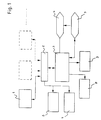
- Figure 1 shows the block diagram of the entire system, where the arrows stand for the connections among the units of the system:
- FIG. 2 is a schematic representation of the peripheral detector, indicated as block 1 in figure 1. Here we can see:
- the remote detector consists of:
- An infrared sensor 10 which has a spectral sensitivity such as to provide an optimum detection of hot sources (300-700 degrees C) against an ambient temperature background (0-40 degrees C).
- a spectral sensitivity such as to provide an optimum detection of hot sources (300-700 degrees C) against an ambient temperature background (0-40 degrees C).
- a group of weather sensors 14 which provide data on temperature, relative humidity, pressure, wind speed and direction, solar radiation and rain rate.
- a TV camera 11 for possible visual monitoring of the surveilled area.
- a motor driven platform 12 which confers an azimuth scan to the infrared sensor and to the TV camera over 360 degrees.
- a processor 13 which acquires data from the infrared sensor and provides for extraction of possible alarms, acquires weather sensor data, manages data exchange with the local control centre, from which it receives all commands.
- the infrared sensor data processing is based upon the following procedure: The infrared sensor measures the radiation flow coming from a small angular region, such as 1 degree x 1 degree; the vertical coverage of the sensor is 15 to 20 degrees and is obtained by means of a linear array of sensitive elements. All data coming from a detector is taken into account: in our case taken as an example, there are 360 datum points, one per azimuth degree covered. The number of data may be less if the area to be monitored is only part of a whole round angle.
- the processor calculates the value of the derivative of the signal. This provides for the elimination of the signal long term changing effects, on an angle scale of 10 degrees for instance.
- Such variations are typically due to the variation of the angle between the line of sight of the sensor and the position of the sun.
- the processor then extracts the mean square value of the fluctuations of the signal subject to derivation for each group of data corresponding to a vertical position which we shall call line.
- Such value is proportional to the fluctuations of the background on the line itself and, multiplied by a suitable constant value, it is taken as a threshold for the detection of possible signals.
- the processor Based upon the threshold determined above, the processor identifies any signal present above such threshold on a line basis. The azimuth angle of the signal is compared with that of signals detected in the previous scans. This is necessary to confer a better reliability to the alarm through a number of consecutive confirmed appearances.
- an alarm is taken as true and therefore transmitted to the local control centre only if it has received a number of confirmations greater than or equal to two in four successive scans.
- a communications system 15 such as a radio link remotely controlled by the processor, provides for digital transmission of detected alarms detected by the IR sensor, of weather data and of the TV image to the local control centre.
- the local control centre consists of the following:
- One or more processors with the following functions:
- the function provided by the program may be performed during operation of the fire fighting system (called in the following on line functions) or separately (off line).
- the main functions performed by the program are the following: Digitising of topographic and thematic maps.
- the data which is available from this digitising are the substrate absolutely necessary for the visualization of alarms on the monitor display of the processor and for the development of the forecast algorithms of the fire development.
- Peripheral management This function preferably used off line transports onto paper the graphics displayed on the monitor; this is the documentation required by the fire fighting squads.
- Intervisibility management which is performed between any point of the map and one of the peripheral detection stations. This function is used mostly during setting up of the system and it guides in the selection of the best sighting of the peripheral detectors.
- Forecast of the fire development is based upon the speed and direction of the wind, on ground gradient and type of fuel, resulting in a propagation speed of the fire as a function of absolute azimuth against north.
- the algorithm adopted utilises the following parameters:
- the program provides a graphic output overlayed on the digitised topographic map showing the successive positions of the fire front edge at pre established time intervals.
- the data which is detected by the infrared sensor 10 are acquired and processed by local processor 13.
- One of the tasks of the processor is also the management of rotating platform 12 onto which the IR sensor and the TV camera 11 are fitted.
- the processor transmits the position of any possible fire together with weather data by means of the communications system 15.
- the TV camera transmits images directly to the local control centre by means of the communications system.
- the data coming from the peripheric detection station 1 is sorted by the communications subsystem 2.
- the TV video is visualized on monitor 6 and can also be recorded 7.
- the infrared sensor data regarding the position of any alarm is fed to processor 3 which places them on the topographic maps.
- the modelling program 4 develops a forecast of the fire evolution in the hours following detections, relying upon historic, weather, vegetation and other data contained in data bank 5.
- the weather data acquired in the last scan are inserted in the data bank.
Landscapes
- Physics & Mathematics (AREA)
- General Physics & Mathematics (AREA)
- Business, Economics & Management (AREA)
- Emergency Management (AREA)
- Life Sciences & Earth Sciences (AREA)
- Multimedia (AREA)
- Engineering & Computer Science (AREA)
- Biodiversity & Conservation Biology (AREA)
- Alarm Systems (AREA)
- Fire Alarms (AREA)
- Chemical And Physical Treatments For Wood And The Like (AREA)
- Fire-Extinguishing Compositions (AREA)
- Fire-Extinguishing By Fire Departments, And Fire-Extinguishing Equipment And Control Thereof (AREA)
Claims (10)
- Système de lutte contre les incendies, essentiellement destiné à la sauvegarde des régions boisées, pour émettre une alarme d'incendie, comprenant une station de détection périphérique (1) incluant:- un capteur infrarouge (10) pour détecter une région surveillée donnée, lequel capteur infrarouge mesure le flux de radiation provenant d'une faible zone angulaire de ladite région,- un moyen de rotation (12) supportant le capteur infrarouge (10), qui confère au capteur infrarouge un balayage en azimut,- un processeur local (13) qui fait l'acquisition de données provenant du capteur infrarouge (10) et gère l'échange des données avec un centre de commande local, à partir duquel il reçoit des commandes,- un sous-système (15) de communications de station périphérique assure la transmission de données vers le centre de commande localet ledit centre de commande local incluant :- un sous-système (2) de communications qui reçoit les données envoyées par ledit sous-système (15) de communications de station périphérique et émet lesdites commandes pour commander le processeur local (13),- une unité de mémoire périphérique (8) pour enregistrer les données,- un processeur central (3) qui commande la station de détection périphérique (1), commande l'échange des commandes et des données, illustre l'alarme notifiée sur des cartes topographiques de la région, enregistre les données dans ladite unité de mémoire périphérique (8), affiche l'état du système et intègre l'alarme notifiée avec les données d'une banque de données historiques (5) contenant les informations sur la distribution de végétation de la région surveillée ;caractérisé en ce que le processeur local (13) de la station de détection périphérique fait en outre l'acquisition de données à partir de moyens pour collecter les données météorologiques courantes (14) incluses dans la station de détection périphérique (1), assure l'extraction de l'alarme d'incendie et provoque la transmission du signal d'alarme et des données météorologiques vers le centre de commande local par l'intermédiaire de sous-systèmes de communications (15, 2), et en ce que le processeur central (3) du centre de commande local assure en outre l'intégration de l'alarme extraite par ladite station de détection périphérique (1) avec les données météorologiques instantanées et avec les données de la banque de données historiques (5) contenant en outre l'information sur les conditions météorologiques récentes, de façon à développer un modèle de propagation d'incendie en fonction de ladite intégration, de sorte que le modèle est basé sur les données météorologiques instantanées, la distribution de végétation, et les conditions météorologiques récentes, résultant en une vitesse et une direction de propagation de l'incendie.
- Système de lutte contre les incendies selon la revendication 1, caractérisé en ce que le moyen pour collecter les données météorologiques courantes comprend un groupe de capteurs météorologiques (14) qui fournit les données de température, d'humidité relative, de pression, de vitesse et de direction du vent, de radiation solaire et de taux de précipitation.
- système de lutte contre les incendies selon les revendications 1 ou 2, caractérisé en ce que la banque de données historiques (5) contient en outre des informations sur le gradient de sol et sur la présence humaine dans la région surveillée, lesquelles informations sont utilisées respectivement pour calculer le modèle de propagation d'incendie et pour désigner les zones qu'il faut protéger en particulier.
- Système de lutte contre les incendies selon l'une quelconque des revendications 1 à 3, caractérisé en ce que la station de détection périphérique (1) comprend en outre une caméra TV (11) pour surveiller si possible visuellement ladite région surveillée, adaptée sur le moyen de rotation (12), et en ce que le centre de commande local comprend en outre un écran de télévision (6) pour visualiser les images TV prises par la caméra TV (11) de la station de détection périphérique (1) et transférées à l'aide desdits sous-systèmes de communications (15, 2), et un enregistreur video (7) pour enregistrer si possible les images TV.
- Système de lutte contre les incendies selon l'une quelconque des revendications 1 à 4, caractérisé en ce que le centre de commande local comprend en outre une imprimante (9) sur laquelle sont imprimés des messages d'alarme générés par le processeur central (3).
- Système de lutte contre les incendies selon l'une quelconque des revendications 1 à 5, caractérisé en ce que le capteur infrarouge (10) a une sensibilité spectrale adaptée pour produire une détection optimale des sources chaudes allant de 300°C à 700°C par rapport à un environnement de température ambiante allant de 0°C à 40°C.
- Système de lutte contre les incendies selon l'une quelconque des revendications 1 à 6, caractérisé en ce que le moyen de rotation est une plateforme rotative (12) pilotée par le processeur local (13) de la station de détection périphérique (1), qui confère un balayage en azimut au capteur infrarouge (10) et à la caméra TV (11), dans le cas où celle-ci est disponible, sur 360 degrés.
- Système de lutte contre les incendies selon l'une quelconque des revendications 1 à 7, caractérisé en ce que le signal émis par le capteur infrarouge (10) atteint le processeur local (13), qui calcule la valeur de la dérivée dudit signal et extrait la valeur quadratique moyenne des fluctuations du signal sujet à dérive pour chaque groupe de données correspondant à une position verticale, multiplie ladite valeur quadratique moyenne avec une valeur constante et fournit une valeur de seuil pour la détection du signal d'alarme éventuel.
- Système de lutte contre les incendies selon l'une quelconque des revendications 1 à 8, caractérisé en ce que le centre de commande local commande une pluralité de stations de détection périphériques (1).
- Système de lutte contre les incendies selon la revendication 9, caractérisé en ce que le processeur central (3) reçoit les alarmes provenant de différentes stations de détection périphériques (1) et calcule des intersections éventuelles entre lesdites alarmes de façon à assurer une localisation encore plus précise de l'incendie.
Applications Claiming Priority (3)
| Application Number | Priority Date | Filing Date | Title |
|---|---|---|---|
| IT4868689 | 1989-12-20 | ||
| IT04868689A IT1237262B (it) | 1989-12-21 | 1989-12-21 | Sistema antincendio prevalentemente concepito per la salvaguardia dei boschi. |
| PCT/EP1990/002244 WO1991009390A1 (fr) | 1989-12-20 | 1990-12-19 | Systeme de lutte contre les incendies essentiellement conçu pour la sauvegarde des forets |
Publications (2)
| Publication Number | Publication Date |
|---|---|
| EP0458938A1 EP0458938A1 (fr) | 1991-12-04 |
| EP0458938B1 true EP0458938B1 (fr) | 1996-08-28 |
Family
ID=11268042
Family Applications (1)
| Application Number | Title | Priority Date | Filing Date |
|---|---|---|---|
| EP91901284A Expired - Lifetime EP0458938B1 (fr) | 1989-12-20 | 1990-12-19 | Système de lutte contre les incendies essentiellement conçu pour la sauvegarde des forêts |
Country Status (11)
| Country | Link |
|---|---|
| EP (1) | EP0458938B1 (fr) |
| AT (1) | ATE142039T1 (fr) |
| BR (1) | BR9007134A (fr) |
| CA (1) | CA2047190C (fr) |
| DE (1) | DE69028296T2 (fr) |
| ES (1) | ES2094807T3 (fr) |
| GR (1) | GR3021588T3 (fr) |
| IT (1) | IT1237262B (fr) |
| PT (1) | PT96268B (fr) |
| TN (1) | TNSN90156A1 (fr) |
| WO (1) | WO1991009390A1 (fr) |
Cited By (1)
| Publication number | Priority date | Publication date | Assignee | Title |
|---|---|---|---|---|
| CN106355811A (zh) * | 2016-07-22 | 2017-01-25 | 河南城建学院 | 一种电气火灾监测系统 |
Families Citing this family (22)
| Publication number | Priority date | Publication date | Assignee | Title |
|---|---|---|---|---|
| GB9216811D0 (en) * | 1992-08-07 | 1992-09-23 | Graviner Ltd Kidde | Flame detection methods and apparatus |
| SG84488A1 (en) * | 1992-10-09 | 2001-11-20 | Mutuo Tanaka | Remote monitoring unit |
| ES2070710B1 (es) * | 1993-02-10 | 1997-05-01 | Nacional Bazan De Construccion | Sistema de vigilancia y deteccion de focos de calor en areas abiertas . |
| DE9417289U1 (de) * | 1994-10-27 | 1995-01-26 | Meinke, Peter, Prof. Dr.-Ing., 82319 Starnberg | Detektoreinrichtung, Detektorsystem und Immunosensor zum Erkennen von Bränden |
| DE19603828A1 (de) * | 1996-02-02 | 1997-08-07 | Sel Alcatel Ag | Vorrichtung zum Erzeugen eines Alarmes und zur Überwachung eines Gebietes |
| ES2235605B1 (es) * | 2003-06-02 | 2006-10-16 | Universidad Politecnica De Valencia | Sistema de vigilancia para la deteccion precoz de incendios. |
| DE102007007492A1 (de) * | 2007-02-15 | 2008-08-21 | Airmatic Gesellschaft für Umwelt und Technik mbH | Verfahren zur integrierten, simulationsbasierten Waldbrandbekämpfung |
| CN102280005B (zh) * | 2011-06-09 | 2014-10-29 | 广州飒特红外股份有限公司 | 基于红外热成像技术的森林防火预警系统及方法 |
| CN106997461B (zh) | 2017-03-28 | 2019-09-17 | 浙江大华技术股份有限公司 | 一种烟火检测方法及装置 |
| US12594448B2 (en) | 2019-06-22 | 2026-04-07 | Mighty Fire Breaker Llc | Environmentally-clean aqueous-based fire extinguishing biochemical liquid concentrates for mixing with proportioned quantities of water to produce fire extinguishing water streams |
| US20240157180A1 (en) | 2021-02-04 | 2024-05-16 | Mighty Fire Breaker Llc | Method of and kit for installing and operating a wildfire defense spraying system on a property parcel for proactively spraying environmentally-clean liquid fire inhibitor thereover to inhibit fire ignition and flame spread caused by wind-driven wildfire embers |
| US11865390B2 (en) | 2017-12-03 | 2024-01-09 | Mighty Fire Breaker Llc | Environmentally-clean water-based fire inhibiting biochemical compositions, and methods of and apparatus for applying the same to protect property against wildfire |
| US11865394B2 (en) | 2017-12-03 | 2024-01-09 | Mighty Fire Breaker Llc | Environmentally-clean biodegradable water-based concentrates for producing fire inhibiting and fire extinguishing liquids for fighting class A and class B fires |
| US10653904B2 (en) | 2017-12-02 | 2020-05-19 | M-Fire Holdings, Llc | Methods of suppressing wild fires raging across regions of land in the direction of prevailing winds by forming anti-fire (AF) chemical fire-breaking systems using environmentally clean anti-fire (AF) liquid spray applied using GPS-tracking techniques |
| CN108096752A (zh) * | 2017-12-19 | 2018-06-01 | 江苏盖亚建筑工程有限公司 | 一种消防系统 |
| US11826592B2 (en) | 2018-01-09 | 2023-11-28 | Mighty Fire Breaker Llc | Process of forming strategic chemical-type wildfire breaks on ground surfaces to proactively prevent fire ignition and flame spread, and reduce the production of smoke in the presence of a wild fire |
| CN111354152A (zh) * | 2018-12-24 | 2020-06-30 | 北京华航无线电测量研究所 | 一种火焰检测与定位系统 |
| CN110251861B (zh) * | 2019-06-19 | 2021-02-09 | 深圳市恒升森林消防装备有限公司 | 一种森林消防灭火系统 |
| US11911643B2 (en) | 2021-02-04 | 2024-02-27 | Mighty Fire Breaker Llc | Environmentally-clean fire inhibiting and extinguishing compositions and products for sorbing flammable liquids while inhibiting ignition and extinguishing fire |
| US20240252866A1 (en) | 2020-03-01 | 2024-08-01 | Mighty Fire Breaker Llc | Liquid hydrocarbon sorbing article of manufacture for inhibiting fire ignition involving flammable liquid hydrocarbons, while absorbing the flammable liquid hydrocarbons when spilled on a body of water and/or land |
| GR20200100134A (el) * | 2020-03-13 | 2021-10-13 | Νικολαος Κωνσταντινου Ζερβος | Συστημα εγκαιρου ανιχνευσης και ειδοποιησης πυρκαγιων |
| CN118570943B (zh) * | 2024-01-10 | 2024-10-29 | 吉林省林业科学研究院(吉林省林业生物防治中心站) | 一种森林防火监测预警系统 |
Family Cites Families (1)
| Publication number | Priority date | Publication date | Assignee | Title |
|---|---|---|---|---|
| JPH0610837B2 (ja) * | 1983-03-31 | 1994-02-09 | 能美防災株式会社 | 火災感知装置 |
-
1989
- 1989-12-21 IT IT04868689A patent/IT1237262B/it active IP Right Grant
-
1990
- 1990-12-19 BR BR909007134A patent/BR9007134A/pt not_active IP Right Cessation
- 1990-12-19 PT PT96268A patent/PT96268B/pt not_active IP Right Cessation
- 1990-12-19 WO PCT/EP1990/002244 patent/WO1991009390A1/fr not_active Ceased
- 1990-12-19 AT AT91901284T patent/ATE142039T1/de not_active IP Right Cessation
- 1990-12-19 EP EP91901284A patent/EP0458938B1/fr not_active Expired - Lifetime
- 1990-12-19 ES ES91901284T patent/ES2094807T3/es not_active Expired - Lifetime
- 1990-12-19 CA CA002047190A patent/CA2047190C/fr not_active Expired - Fee Related
- 1990-12-19 DE DE69028296T patent/DE69028296T2/de not_active Expired - Fee Related
- 1990-12-20 TN TNTNSN90156A patent/TNSN90156A1/fr unknown
-
1996
- 1996-11-07 GR GR960402962T patent/GR3021588T3/el unknown
Cited By (1)
| Publication number | Priority date | Publication date | Assignee | Title |
|---|---|---|---|---|
| CN106355811A (zh) * | 2016-07-22 | 2017-01-25 | 河南城建学院 | 一种电气火灾监测系统 |
Also Published As
| Publication number | Publication date |
|---|---|
| IT8948686A1 (it) | 1991-06-21 |
| TNSN90156A1 (fr) | 1991-03-05 |
| DE69028296T2 (de) | 1997-04-24 |
| EP0458938A1 (fr) | 1991-12-04 |
| WO1991009390A1 (fr) | 1991-06-27 |
| PT96268B (pt) | 1998-07-31 |
| ATE142039T1 (de) | 1996-09-15 |
| ES2094807T3 (es) | 1997-02-01 |
| IT1237262B (it) | 1993-05-27 |
| CA2047190A1 (fr) | 1991-06-21 |
| CA2047190C (fr) | 1999-05-11 |
| PT96268A (pt) | 1992-09-30 |
| GR3021588T3 (en) | 1997-02-28 |
| DE69028296D1 (de) | 1996-10-02 |
| BR9007134A (pt) | 1991-12-17 |
| IT8948686A0 (it) | 1989-12-21 |
Similar Documents
| Publication | Publication Date | Title |
|---|---|---|
| EP0458938B1 (fr) | Système de lutte contre les incendies essentiellement conçu pour la sauvegarde des forêts | |
| US5734335A (en) | Forest surveillance and monitoring system for the early detection and reporting of forest fires | |
| EP0611242B1 (fr) | Système pour la surveillance et la détection de sources de chaleur sur terrains ouverts | |
| US6937743B2 (en) | Process and device for detecting fires based on image analysis | |
| US5966074A (en) | Intruder alarm with trajectory display | |
| CA2492360A1 (fr) | Systeme et procede de controle thermique d'un territoire | |
| CN106657921A (zh) | 一种便携式雷达周界安防系统 | |
| JP3326482B2 (ja) | 火災監視システム | |
| US5465080A (en) | Infrared intrusion sensor | |
| CN107360394A (zh) | 应用于边防视频监控系统的多预置点动态智能监测方法 | |
| EP3452848B1 (fr) | Procédé de surveillance faisant appel à un système de caméra avec détection de mouvement de zone | |
| US6529132B2 (en) | Device for monitoring an enclosure, in particular the hold of an aircraft | |
| CN101719300A (zh) | 智能视频火灾预警系统及其报警参数的确定方法 | |
| US20220058932A1 (en) | Man over board detection system | |
| KR102259272B1 (ko) | 감시 카메라 제어 장치 및 방법 | |
| RU2542873C1 (ru) | Комплекс технического наблюдения за охраняемой территорией | |
| JP2847597B2 (ja) | 赤外線監視システム | |
| EP0614155A2 (fr) | Système de détection de mouvement | |
| JPH09167287A (ja) | 都市防災用監視装置 | |
| JPH0638217A (ja) | 赤外線監視システム | |
| JP3042837B2 (ja) | 都市防災用監視装置 | |
| JP3143304B2 (ja) | 複合型監視装置 | |
| EP0126703A1 (fr) | Appareil de détection | |
| JPH0962964A (ja) | 火災覚知センサ | |
| Warren et al. | Processing infrared images for fire management applications |
Legal Events
| Date | Code | Title | Description |
|---|---|---|---|
| PUAI | Public reference made under article 153(3) epc to a published international application that has entered the european phase |
Free format text: ORIGINAL CODE: 0009012 |
|
| AK | Designated contracting states |
Kind code of ref document: A1 Designated state(s): AT BE CH DE DK ES FR GB GR IT LI LU NL SE |
|
| 17P | Request for examination filed |
Effective date: 19911225 |
|
| 17Q | First examination report despatched |
Effective date: 19940607 |
|
| GRAA | (expected) grant |
Free format text: ORIGINAL CODE: 0009210 |
|
| AK | Designated contracting states |
Kind code of ref document: B1 Designated state(s): AT BE CH DE DK ES FR GB GR IT LI LU NL SE |
|
| PG25 | Lapsed in a contracting state [announced via postgrant information from national office to epo] |
Ref country code: IT Free format text: LAPSE BECAUSE OF FAILURE TO SUBMIT A TRANSLATION OF THE DESCRIPTION OR TO PAY THE FEE WITHIN THE PRESCRIBED TIME-LIMIT;WARNING: LAPSES OF ITALIAN PATENTS WITH EFFECTIVE DATE BEFORE 2007 MAY HAVE OCCURRED AT ANY TIME BEFORE 2007. THE CORRECT EFFECTIVE DATE MAY BE DIFFERENT FROM THE ONE RECORDED. Effective date: 19960828 Ref country code: LI Effective date: 19960828 Ref country code: CH Effective date: 19960828 Ref country code: AT Effective date: 19960828 Ref country code: DK Effective date: 19960828 Ref country code: NL Free format text: LAPSE BECAUSE OF FAILURE TO SUBMIT A TRANSLATION OF THE DESCRIPTION OR TO PAY THE FEE WITHIN THE PRESCRIBED TIME-LIMIT Effective date: 19960828 Ref country code: BE Effective date: 19960828 |
|
| REF | Corresponds to: |
Ref document number: 142039 Country of ref document: AT Date of ref document: 19960915 Kind code of ref document: T |
|
| REF | Corresponds to: |
Ref document number: 69028296 Country of ref document: DE Date of ref document: 19961002 |
|
| ET | Fr: translation filed | ||
| ET | Fr: translation filed | ||
| PG25 | Lapsed in a contracting state [announced via postgrant information from national office to epo] |
Ref country code: SE Effective date: 19961128 |
|
| PG25 | Lapsed in a contracting state [announced via postgrant information from national office to epo] |
Ref country code: GB Effective date: 19961219 |
|
| PG25 | Lapsed in a contracting state [announced via postgrant information from national office to epo] |
Ref country code: LU Free format text: LAPSE BECAUSE OF NON-PAYMENT OF DUE FEES Effective date: 19961231 |
|
| REG | Reference to a national code |
Ref country code: GR Ref legal event code: FG4A Free format text: 3021588 |
|
| REG | Reference to a national code |
Ref country code: ES Ref legal event code: FG2A Ref document number: 2094807 Country of ref document: ES Kind code of ref document: T3 |
|
| NLV1 | Nl: lapsed or annulled due to failure to fulfill the requirements of art. 29p and 29m of the patents act | ||
| REG | Reference to a national code |
Ref country code: CH Ref legal event code: PL |
|
| PLBE | No opposition filed within time limit |
Free format text: ORIGINAL CODE: 0009261 |
|
| STAA | Information on the status of an ep patent application or granted ep patent |
Free format text: STATUS: NO OPPOSITION FILED WITHIN TIME LIMIT |
|
| GBPC | Gb: european patent ceased through non-payment of renewal fee |
Effective date: 19961219 |
|
| 26N | No opposition filed | ||
| PGFP | Annual fee paid to national office [announced via postgrant information from national office to epo] |
Ref country code: DE Payment date: 19990226 Year of fee payment: 9 |
|
| REG | Reference to a national code |
Ref country code: FR Ref legal event code: TP |
|
| PGFP | Annual fee paid to national office [announced via postgrant information from national office to epo] |
Ref country code: GR Payment date: 19991027 Year of fee payment: 10 |
|
| PGFP | Annual fee paid to national office [announced via postgrant information from national office to epo] |
Ref country code: FR Payment date: 19991217 Year of fee payment: 10 |
|
| PGFP | Annual fee paid to national office [announced via postgrant information from national office to epo] |
Ref country code: ES Payment date: 19991230 Year of fee payment: 10 |
|
| REG | Reference to a national code |
Ref country code: ES Ref legal event code: PC2A |
|
| PG25 | Lapsed in a contracting state [announced via postgrant information from national office to epo] |
Ref country code: DE Free format text: LAPSE BECAUSE OF NON-PAYMENT OF DUE FEES Effective date: 20001003 |
|
| PG25 | Lapsed in a contracting state [announced via postgrant information from national office to epo] |
Ref country code: GR Free format text: LAPSE BECAUSE OF NON-PAYMENT OF DUE FEES Effective date: 20001231 |
|
| PG25 | Lapsed in a contracting state [announced via postgrant information from national office to epo] |
Ref country code: FR Free format text: LAPSE BECAUSE OF NON-PAYMENT OF DUE FEES Effective date: 20010831 |
|
| REG | Reference to a national code |
Ref country code: FR Ref legal event code: ST |
|
| PG25 | Lapsed in a contracting state [announced via postgrant information from national office to epo] |
Ref country code: ES Free format text: LAPSE BECAUSE OF NON-PAYMENT OF DUE FEES Effective date: 20011220 |
|
| REG | Reference to a national code |
Ref country code: ES Ref legal event code: FD2A Effective date: 20020112 |