EP0459040A1 - Substrats fibreux pour enveloppes de saucisses et leur procédé de préparation - Google Patents
Substrats fibreux pour enveloppes de saucisses et leur procédé de préparation Download PDFInfo
- Publication number
- EP0459040A1 EP0459040A1 EP90305827A EP90305827A EP0459040A1 EP 0459040 A1 EP0459040 A1 EP 0459040A1 EP 90305827 A EP90305827 A EP 90305827A EP 90305827 A EP90305827 A EP 90305827A EP 0459040 A1 EP0459040 A1 EP 0459040A1
- Authority
- EP
- European Patent Office
- Prior art keywords
- weight
- substrate
- carbamate
- casing
- resin
- Prior art date
- Legal status (The legal status is an assumption and is not a legal conclusion. Google has not performed a legal analysis and makes no representation as to the accuracy of the status listed.)
- Granted
Links
- 239000000758 substrate Substances 0.000 title claims abstract description 91
- 238000000034 method Methods 0.000 title claims description 18
- 235000013580 sausages Nutrition 0.000 title description 4
- KXDHJXZQYSOELW-UHFFFAOYSA-M Carbamate Chemical compound NC([O-])=O KXDHJXZQYSOELW-UHFFFAOYSA-M 0.000 claims abstract description 68
- 239000011347 resin Substances 0.000 claims abstract description 48
- 229920005989 resin Polymers 0.000 claims abstract description 48
- 239000003518 caustics Substances 0.000 claims abstract description 23
- 239000007767 bonding agent Substances 0.000 claims abstract description 22
- 229920002647 polyamide Polymers 0.000 claims abstract description 11
- BRLQWZUYTZBJKN-UHFFFAOYSA-N Epichlorohydrin Chemical compound ClCC1CO1 BRLQWZUYTZBJKN-UHFFFAOYSA-N 0.000 claims abstract description 10
- 239000007795 chemical reaction product Substances 0.000 claims abstract description 10
- 235000013305 food Nutrition 0.000 claims abstract description 10
- 239000004952 Polyamide Substances 0.000 claims abstract description 7
- 239000000243 solution Substances 0.000 claims description 42
- 239000000463 material Substances 0.000 claims description 34
- 229920000297 Rayon Polymers 0.000 claims description 33
- 229920002678 cellulose Polymers 0.000 claims description 17
- 239000001913 cellulose Substances 0.000 claims description 17
- 239000000835 fiber Substances 0.000 claims description 13
- 239000004094 surface-active agent Substances 0.000 claims description 10
- 239000011230 binding agent Substances 0.000 claims description 9
- 230000008569 process Effects 0.000 claims description 9
- 238000004519 manufacturing process Methods 0.000 claims description 8
- 238000010998 test method Methods 0.000 claims description 6
- 239000012670 alkaline solution Substances 0.000 claims description 4
- 239000004721 Polyphenylene oxide Substances 0.000 claims description 3
- 125000002877 alkyl aryl group Chemical group 0.000 claims description 3
- 229920000570 polyether Polymers 0.000 claims description 3
- LFQSCWFLJHTTHZ-UHFFFAOYSA-N Ethanol Chemical compound CCO LFQSCWFLJHTTHZ-UHFFFAOYSA-N 0.000 claims 1
- 239000000203 mixture Substances 0.000 abstract description 11
- 238000009472 formulation Methods 0.000 abstract description 7
- 229920000875 Dissolving pulp Polymers 0.000 abstract description 2
- 239000002585 base Substances 0.000 description 23
- 238000001035 drying Methods 0.000 description 7
- HEMHJVSKTPXQMS-UHFFFAOYSA-M Sodium hydroxide Chemical compound [OH-].[Na+] HEMHJVSKTPXQMS-UHFFFAOYSA-M 0.000 description 6
- 239000011248 coating agent Substances 0.000 description 6
- 238000000576 coating method Methods 0.000 description 6
- 239000000047 product Substances 0.000 description 6
- 230000006872 improvement Effects 0.000 description 5
- 244000025254 Cannabis sativa Species 0.000 description 4
- 235000012766 Cannabis sativa ssp. sativa var. sativa Nutrition 0.000 description 4
- 235000012765 Cannabis sativa ssp. sativa var. spontanea Nutrition 0.000 description 4
- 238000010521 absorption reaction Methods 0.000 description 4
- 235000009120 camo Nutrition 0.000 description 4
- 235000005607 chanvre indien Nutrition 0.000 description 4
- 239000011487 hemp Substances 0.000 description 4
- 230000007935 neutral effect Effects 0.000 description 4
- -1 nonylphenoxy Chemical group 0.000 description 4
- 238000005406 washing Methods 0.000 description 4
- 239000002253 acid Substances 0.000 description 3
- 150000001298 alcohols Chemical class 0.000 description 3
- 125000002091 cationic group Chemical group 0.000 description 3
- 230000000694 effects Effects 0.000 description 3
- 235000019441 ethanol Nutrition 0.000 description 3
- 238000005470 impregnation Methods 0.000 description 3
- 235000013372 meat Nutrition 0.000 description 3
- 230000035515 penetration Effects 0.000 description 3
- 229920002451 polyvinyl alcohol Polymers 0.000 description 3
- 229920001187 thermosetting polymer Polymers 0.000 description 3
- XLYOFNOQVPJJNP-UHFFFAOYSA-N water Substances O XLYOFNOQVPJJNP-UHFFFAOYSA-N 0.000 description 3
- 240000000907 Musa textilis Species 0.000 description 2
- PPBRXRYQALVLMV-UHFFFAOYSA-N Styrene Chemical compound C=CC1=CC=CC=C1 PPBRXRYQALVLMV-UHFFFAOYSA-N 0.000 description 2
- QAOWNCQODCNURD-UHFFFAOYSA-N Sulfuric acid Chemical compound OS(O)(=O)=O QAOWNCQODCNURD-UHFFFAOYSA-N 0.000 description 2
- 229920004929 Triton X-114 Polymers 0.000 description 2
- 239000002250 absorbent Substances 0.000 description 2
- 230000002745 absorbent Effects 0.000 description 2
- 239000003513 alkali Substances 0.000 description 2
- 230000015572 biosynthetic process Effects 0.000 description 2
- 229920001577 copolymer Polymers 0.000 description 2
- 238000004132 cross linking Methods 0.000 description 2
- 230000007246 mechanism Effects 0.000 description 2
- 238000012545 processing Methods 0.000 description 2
- 230000001172 regenerating effect Effects 0.000 description 2
- 239000000523 sample Substances 0.000 description 2
- 125000000467 secondary amino group Chemical group [H]N([*:1])[*:2] 0.000 description 2
- 239000000725 suspension Substances 0.000 description 2
- 238000012360 testing method Methods 0.000 description 2
- 231100000331 toxic Toxicity 0.000 description 2
- 230000002588 toxic effect Effects 0.000 description 2
- KXDHJXZQYSOELW-UHFFFAOYSA-N Carbamic acid Chemical compound NC(O)=O KXDHJXZQYSOELW-UHFFFAOYSA-N 0.000 description 1
- 229920002134 Carboxymethyl cellulose Polymers 0.000 description 1
- 229920005682 EO-PO block copolymer Polymers 0.000 description 1
- SXRSQZLOMIGNAQ-UHFFFAOYSA-N Glutaraldehyde Chemical compound O=CCCCC=O SXRSQZLOMIGNAQ-UHFFFAOYSA-N 0.000 description 1
- 229920000877 Melamine resin Polymers 0.000 description 1
- 239000002202 Polyethylene glycol Substances 0.000 description 1
- NINIDFKCEFEMDL-UHFFFAOYSA-N Sulfur Chemical compound [S] NINIDFKCEFEMDL-UHFFFAOYSA-N 0.000 description 1
- XSQUKJJJFZCRTK-UHFFFAOYSA-N Urea Chemical compound NC(N)=O XSQUKJJJFZCRTK-UHFFFAOYSA-N 0.000 description 1
- 239000003929 acidic solution Substances 0.000 description 1
- 150000007513 acids Chemical class 0.000 description 1
- 230000004913 activation Effects 0.000 description 1
- 230000006978 adaptation Effects 0.000 description 1
- 230000002411 adverse Effects 0.000 description 1
- 125000001931 aliphatic group Chemical group 0.000 description 1
- 230000004075 alteration Effects 0.000 description 1
- 239000007864 aqueous solution Substances 0.000 description 1
- 125000003118 aryl group Chemical group 0.000 description 1
- 230000009172 bursting Effects 0.000 description 1
- 239000004202 carbamide Substances 0.000 description 1
- 125000004432 carbon atom Chemical group C* 0.000 description 1
- 239000001768 carboxy methyl cellulose Substances 0.000 description 1
- 235000010948 carboxy methyl cellulose Nutrition 0.000 description 1
- 239000008112 carboxymethyl-cellulose Substances 0.000 description 1
- 230000015556 catabolic process Effects 0.000 description 1
- 230000008859 change Effects 0.000 description 1
- 238000006243 chemical reaction Methods 0.000 description 1
- 239000013626 chemical specie Substances 0.000 description 1
- 239000003431 cross linking reagent Substances 0.000 description 1
- 238000006731 degradation reaction Methods 0.000 description 1
- 230000001627 detrimental effect Effects 0.000 description 1
- 239000012895 dilution Substances 0.000 description 1
- 238000010790 dilution Methods 0.000 description 1
- 238000003618 dip coating Methods 0.000 description 1
- 150000002170 ethers Chemical class 0.000 description 1
- ZOOODBUHSVUZEM-UHFFFAOYSA-N ethoxymethanedithioic acid Chemical compound CCOC(S)=S ZOOODBUHSVUZEM-UHFFFAOYSA-N 0.000 description 1
- 238000002474 experimental method Methods 0.000 description 1
- IVJISJACKSSFGE-UHFFFAOYSA-N formaldehyde;1,3,5-triazine-2,4,6-triamine Chemical compound O=C.NC1=NC(N)=NC(N)=N1 IVJISJACKSSFGE-UHFFFAOYSA-N 0.000 description 1
- 239000011521 glass Substances 0.000 description 1
- 238000007654 immersion Methods 0.000 description 1
- 238000009533 lab test Methods 0.000 description 1
- 238000005259 measurement Methods 0.000 description 1
- 238000012986 modification Methods 0.000 description 1
- 230000004048 modification Effects 0.000 description 1
- 231100000252 nontoxic Toxicity 0.000 description 1
- 230000003000 nontoxic effect Effects 0.000 description 1
- 230000001473 noxious effect Effects 0.000 description 1
- UYDLBVPAAFVANX-UHFFFAOYSA-N octylphenoxy polyethoxyethanol Chemical compound CC(C)(C)CC(C)(C)C1=CC=C(OCCOCCOCCOCCO)C=C1 UYDLBVPAAFVANX-UHFFFAOYSA-N 0.000 description 1
- 230000020477 pH reduction Effects 0.000 description 1
- 238000004806 packaging method and process Methods 0.000 description 1
- 229920002401 polyacrylamide Polymers 0.000 description 1
- 229920001281 polyalkylene Polymers 0.000 description 1
- 229920000768 polyamine Polymers 0.000 description 1
- 229920001223 polyethylene glycol Polymers 0.000 description 1
- 229920002689 polyvinyl acetate Polymers 0.000 description 1
- 239000011118 polyvinyl acetate Substances 0.000 description 1
- 238000002360 preparation method Methods 0.000 description 1
- 230000008929 regeneration Effects 0.000 description 1
- 238000011069 regeneration method Methods 0.000 description 1
- 238000009877 rendering Methods 0.000 description 1
- 239000011342 resin composition Substances 0.000 description 1
- 239000012260 resinous material Substances 0.000 description 1
- 229920006395 saturated elastomer Polymers 0.000 description 1
- 238000006467 substitution reaction Methods 0.000 description 1
- 229910052717 sulfur Inorganic materials 0.000 description 1
- 239000011593 sulfur Substances 0.000 description 1
- 150000003512 tertiary amines Chemical class 0.000 description 1
- GPRLSGONYQIRFK-MNYXATJNSA-N triton Chemical compound [3H+] GPRLSGONYQIRFK-MNYXATJNSA-N 0.000 description 1
- 229920001567 vinyl ester resin Polymers 0.000 description 1
- 239000012991 xanthate Substances 0.000 description 1
Images
Classifications
-
- A—HUMAN NECESSITIES
- A22—BUTCHERING; MEAT TREATMENT; PROCESSING POULTRY OR FISH
- A22C—PROCESSING MEAT, POULTRY, OR FISH
- A22C13/00—Sausage casings
- A22C13/0013—Chemical composition of synthetic sausage casings
-
- Y—GENERAL TAGGING OF NEW TECHNOLOGICAL DEVELOPMENTS; GENERAL TAGGING OF CROSS-SECTIONAL TECHNOLOGIES SPANNING OVER SEVERAL SECTIONS OF THE IPC; TECHNICAL SUBJECTS COVERED BY FORMER USPC CROSS-REFERENCE ART COLLECTIONS [XRACs] AND DIGESTS
- Y10—TECHNICAL SUBJECTS COVERED BY FORMER USPC
- Y10T—TECHNICAL SUBJECTS COVERED BY FORMER US CLASSIFICATION
- Y10T428/00—Stock material or miscellaneous articles
- Y10T428/13—Hollow or container type article [e.g., tube, vase, etc.]
- Y10T428/1324—Flexible food casing [e.g., sausage type, etc.]
-
- Y—GENERAL TAGGING OF NEW TECHNOLOGICAL DEVELOPMENTS; GENERAL TAGGING OF CROSS-SECTIONAL TECHNOLOGIES SPANNING OVER SEVERAL SECTIONS OF THE IPC; TECHNICAL SUBJECTS COVERED BY FORMER USPC CROSS-REFERENCE ART COLLECTIONS [XRACs] AND DIGESTS
- Y10—TECHNICAL SUBJECTS COVERED BY FORMER USPC
- Y10T—TECHNICAL SUBJECTS COVERED BY FORMER US CLASSIFICATION
- Y10T428/00—Stock material or miscellaneous articles
- Y10T428/31504—Composite [nonstructural laminate]
- Y10T428/31971—Of carbohydrate
- Y10T428/31975—Of cellulosic next to another carbohydrate
- Y10T428/31978—Cellulosic next to another cellulosic
Definitions
- the present invention relates generally to casing used for packaging food products such as sausage and the like. More particularly it is concerned with a new and improved casing substrate and reinforced casing made therefrom, as well as with a new and improved method of producing such substrates and casings.
- viscose a cellulose coating material, such as cellulose xanthate, hereinafter referred to as viscose. That treatment includes the preparation of a bonded casing substrate having substantial caustic stability followed by the final casing-forming operations.
- the caustic stable substrate is prepared by bonding a preformed and dried paper or fibrous base web with a dilute viscose solution followed by the steps of drying, regenerating the cellulose, washing and redrying.
- This initial bonding operation using the dilute viscose solution is required in order to impart sufficient caustic resistance to the bonded substrate to retain its structural integrity during the final casing-forming operations where treatment with a more concentrated viscose solution is carried out under highly alkaline conditions.
- the bonded substrate must also retain its porous, absorbent characteristics in order to permit complete impregnation and encasement by the concentrated viscose solution.
- the bonded substrate then undergoes the casing-forming operation that includes the steps of forming the substrate into a cylindrical tube, impregnating and encasing the substrate tube with a highly caustic viscose solution, regenerating the impregnate with acid, washing to remove excess acid and viscose and drying of the final fiber reinforced leakproof cellulosic film, hereinafter referred to as the casing or skin.
- This process is set forth in greater detail in the Underwood U.S. Patent No. 3,135,613 entitled "Impregnated Paper Webs and Method of Making Sausage Casing Thereof", thus clarifying the sequential evolution of the base web to the bonded substrate and then to the reinforced casing.
- tubular casings produced in the manner set forth possess enough strength and burst resistance to be particularly well suited for enclosing meat and other food products that are injected into the interior of the tubes under pressure. They thereby provide firm uniform enclosures for well known products such as sausage, bologna and the like as well as other food products.
- Modern processing equipment makes such products automatically but requires casing material that withstands high stuffing pressures without bursting and can be filled to a known and uniform diameter.
- the product may be automatically sliced and wrapped and must meet a stated meat content since any increase in the diameter of the casing over the required minimum necessarily results in a loss to the meat packer.
- casing substrates made according to the prior art have yielded casing of satisfactory strength and uniformity for the equipment utilized heretofore, modern machinery has required casings of improved strength characteristics.
- the bonding agent should be one which will not cause the substrate to become discolored during exposure to the conditions of the casing forming process.
- U.S. Patent 3,484,256 to Chiu et al it is suggested that the dilute viscose bonding treatment be replaced by the use of a bonding agent or mixture of a cationic thermosetting resin and a polyacrylamid resin.
- a bonding mixture of a cationic alkaline curing resin and carboxymethyl cellulose is disclosed in U.S. Patent 3,468,696 to Conway as a substitute wet strength bonding treatment.
- Patents 3,640,734 and 3,640,735 to Oppenheimer et al teach the formation of substrates using insolublized poly (vinyl alcohol) or poly (vinyl alcohol)/poly (vinyl ester) copolymers such as poly (vinyl alcohol)/poly (vinyl acetate).
- porous bonded fibrous substrate comprising a fibrous base web containing about 10% by weight and less of a particular bonding agent.
- the bonding agent is formulated by dissolving cellulose carbamate and an alkaline curing resin in a dilute caustic solution in such a manner that the ratio of carbamate to resin is greater than 1:1 by weight.
- the bonded substrate exhibits a porosity that is not significantly less than that of the base web, i.e., a porosity of at least about 300 liters/min as determined by TAPPI test method T251-pm-75, a caustic tensile strength greater than 300 grams per 25 millimeters and is readily adapted to form reinforced casing films of improved burst strength.
- Casings made from the substrate can use the casing films employed heretofore or a carbamate-resin film formulation of the present invention.
- the invention accordingly comprises the several steps and the relation of one or more of such steps with respect to each of the others and the article possessing the features, properties and relation of elements exemplified in the following detailed disclosure.
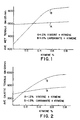
- Figures 1 and 2 are graphs illustrating the effect on the wet and caustic tensile strength of bonded substrates where the resin concentration is varied in either a carbamate or viscose bonding solution.
- the process comprises the steps of forming a dilute suspension of cellulosic fibers, such as manila hemp fibers, and thereafter forming a base web from the suspension.
- the base web is then bonded using a solution of cellulose carbamate and certain neutral to alkaline curing resin materials, such as the polymeric reaction product of epichlorohydrin and a polyamide.
- alkaline curing resin materials such as the polymeric reaction product of epichlorohydrin and a polyamide.
- the base web for the casing substrate is generally composed of natural fibers of pure cellulose and preferably comprises the long, light weight and nonhydrated fibers of the Musa textilis species, typical of which are hemp fibers. Webs made from this material are generally soft, porous papers of uniform texture and thickness and possess a tensile ratio close to unity, that is, a substantially equal tensile strength in both the machine and transverse directions. However, it will be appreciated that the tensile ratio may vary from about 0.5 to about 1.0, where such is desired.
- the bonding agent utilized namely the combination of resin and carbamate, not only imparts to the web a resistance to highly caustic solutions, but also provides no significant interference with the absorption characteristics of the base web.
- the bonding agent should improve the secure adhesion of the casing forming coating to the reinforced substrate since it is believed that the secure bonding therebetween results in substantial improvement in the burst strength of the resulting casing material. While the mechanism of the present invention is not fully understood it is believed there is a possibility the resin in the bonding agent acts as a bridge between the carbamate and the fibers in the base web.
- the web should be devoid, at least as far as possible, of impregnates which might interfere with both the absorption and bonding mechanism. It is therefore necessary that the bonding agent utilized effectuate as little resistance as possible to the penetration of the casing forming coating into the substrate material.
- the bonding agent is a combination or mixture of cellulose carbamate and an alkaline curing resin, that is, a resin curable by neutral or base activation.
- the carbamate can be manufactured in accordance with known procedures such as by the reaction of cellulose with urea at elevated temperatures in accordance with the technique disclosed in U.S. Patent No. 2,134,825 to Hill et al and U.S. Patent No. 4,404,369 to Huttunen et al and the characteristics of the resultant carbamate material are substantially as disclosed therein. Accordingly, the disclosures contained within those patents are incorporated herein by reference.
- the carbamate is stable in its dry state and can be stored or transported.
- a suitable caustic solution such as a sodium hydroxide solution
- carbamate concentration up to 15% by weight
- the alkaline curing resins have proved satisfactory from the standpoint of caustic resistance and have resulted in burst ratios for the casings that are comparable to or exceed those obtained by the previously employed dilute viscose bonding treatment.
- the preferred resinous materials are the uncured thermosetting resins that are neutral or base activated and particularly the polymeric reaction products of epichlorohydrin and polyamides containing secondary amine groups.
- the epichlorohydrin is used in amounts sufficient to convert the secondary amine groups therein to tertiary amines.
- polyamids from polyalkylene polyamines and saturated or unsaturated aliphatic or aromatic polycarboxylic acids containing from about three to ten carbon atoms are preferred.
- a typical example of such a material is the water soluble thermosetting cationic epichlorohydrin-polyamid reaction product sold by Hercules Incorporated of Wilmington, Delaware under the trade names "Kymene-557H", “Kymene 2064", “Kymene D45” and the like.
- Other alkaline curing resins include a styrene maleice anhydride copolymer sold by Monsanto under the trademark “Seripset” and a polyamide sold by Borden under the trademark "C12".
- the amount of alkaline curing resin used in the bonding solution will vary depending on the desired properties. However, it has been found that good results are obtained when the ratio of resin to carbamate is less than 1:1 and preferably within the range of about 1:10 to about 4:5. Typically, the preferred amount by weight of resin relative to the carbamate falls between the range of 1:5 to 1:2. For example, the preferred resin to carbamate ratio within the bonding solution is about 1 to 3.
- a surfactant as an absorption aid.
- materials such as the nonionic alkylaryl polyether alcohols may be used.
- the octylphenoxy polyethoxy ethanol sold by Rohm and Haas under the trademark "Triton X114" has been effectively used.
- Other surfactants include nonylphenoxy poly(ethyleneoxy) ethanols, block copolymers of ethylene oxide and propylene oxide, trimethylnonyl polyethylene glycol ethers, ethoxylated alkyl phenols and alcohols and alkylaryl polyether alcohols.
- the surfactants are used in the caustic binder solution at concentrations below 2.0% by weight and in fact at concentrations of less that 0.5% by weight and preferably less than 0.1% by weight so as to avoid loss of wet strength in the bonded substrate. Typically concentrations of about 0.01 to 0.05% by weight are used. Below this level the water climb characteristics of the substrate are adversely affected.
- the carbamate is dissolved in an alkali solution, such as an 8% solution of sodium hydroxide at a high concentration, e.g. about 6% by weight carbamate.
- the solution is then diluted, followed by the addition of the alkaline curing resin and surfactant.
- the mixture desirably takes the form of a dilute aqueous solution having an alkaline concentration of about 1 to 8% by weight.
- concentrations of the components are adjusted to obtain the desired formulation.
- the pH of the solution is generally in the high alkali range, namely above about 10.0 with the operating pH being approximately 12 to 13.
- the preformed fibrous webs after partial or complete drying, are treated with the dilute alkaline bonding solution in accordance with conventional treatment techniques. Excellent results have been obtained utilizing an immersion or dip coating process to obtain the desired impregnation of the web with the bonding solution.
- the treated web is then dried and, in accordance with the present invention, is subjected to subsequent acidification, washing and drying steps that impart to the sheet material the desired improved wet strength characteristics while lowering the paper pH to approximately 7.0 and less.
- the coated and dried substrate evidences a binder pickup of about 10% by weight and less, with the amount of binder typically falling within the range of 0.5 to 6% by weight. Best results are achieved when the binder pickup is about 2.0 to 4.5% by weight.
- the bonded substrate not only exhibits improved wet tensile and caustic tensile strength, e.g. caustic tensile strength greater than 300 grams, but also retains a high degree of its porous, absorbent character in order to permit impregnation and encasement during the final casing forming operation.
- the porosity of the bonded substrate can be measured in accordance with TAPPI test method T251-pm-75 and exhibits a Gurley porosity greater than 300 liters/minute.
- the porosity will vary with the weight of the base web and typically falls within the range of about 500 to 1,500 liters/ minute. Lighter sheets will of course have a higher porosity while heavier weight materials exhibit lower porosities. For example, in accordance with the present invention the porosity of the bonded substrate may fall within the range of about 600-1,200 liters/minute.
- the final casing is made in accordance with conventional casing forming techniques.
- the carbamate/alkaline curing resin composition may also be used in more concentrated form to provide the final casing.
- the carbamate is mixed in an alkaline solution in substantially the same way as when the bonding solution is being prepared.
- the dilution steps are eliminated so that the concentration of the carbamate and alkaline curing resin are approximately 2 to 6 times greater than the concentration of those materials within the bonding solution.
- the casing forming solution may have a carbamate concentration of approximately 6% by weight rather than the 1.5% preferred for the bonding solution.
- the ratio of carbamate to alkaline curing resin is maintained at essentially the same level in the casing forming formulation as is found in the bonding solution.
- the total concentration of the surfactant remains substantially the same as in the bonding solution and is not correspondingly increased in the casing film forming formulation.
- the casing forming operation results in not only absorption of the casing forming solution within the substrate but the complete encasement of the substrate by the film forming material.
- the relative proportion of the casing film to the substrate on a weight basis is about 1:1 or greater and preferably about 2:1 where coating from one side only. Double sided coating, of course, will result in a higher ratio.
- the resultant casing product is, in effect, a film of the casing forming material reinforced by a bonded fibrous substrate fully embedded therein.
- a commercially made preformed fibrous sheet having a ream weight of about 14.2 pounds (24gm/m2) and composed of 100% hemp fibers was dip coated in a dilute aqueous alkaline solution having a pH of 12.0.
- the solution had a cellulose carbamate concentration of about 1.5% by weight, 0.5% by weight of a polymeric reaction product of epichlorohydrin and a polyamid (Kymene 557H) and 0.015% of the surfactant Triton X114.
- the treated substrate was dried and the carbamate regenerated by drying, followed by a 1% sulfuric acid wash to neutralize the sheet, followed by a water wash for about 10 minutes and subsequent drying.
- the resultant substrate is labelled A in Table 1.
- a second series of substrates was prepared using the same base web material but bonding the base web with a dilute alkaline solution containing about 1.2 % viscose followed by drying, regeneration, washing and redrying. This substrate is labeled B.
- substrate A bonded with the carbamate-resin bonding system of the present invention exhibited a significant improvement in tensile stress relative to the viscose bonded material regardless of the casing film used to form the final casing product. Additionally, it will be noted the stress measurement for the carbamate casing is substantially the same as that obtained for the viscose casing where the substrate is viscose bonded. Best results were obtained when the carbamate/Kymene combination of the present invention was employed as both the bonding agent and the casing forming film material.
- Table I further reports the tensile stress of cast films of various materials. As indicated, the carbamate/Kymene 557 formulation of the present invention forms a significantly weaker film thereby rendering the results of substrate A particularly surprising.
- the burst strengths of the viscose casings made from substrate A and B were measured in order to compare the properties of the resultant casings. This was accomplished by placing the open ended casing tube in an apparatus consisting of two air fed cup-shaped mandrels, one secured in place, the other mounted on a slide-way system. The case tube was mounted so that the ends of the tube slip over the open ends of the mandrels and are secured by means of strong adjustable clips making an air tight seal between the tube and the mandrel. Two lightweight probes, one on either side of the tube are moved in their slide-way systems so that they lightly touch the tube sides after the tube has been inflated by a test air pressure of 2psi.
- Air is then fed continuously into the tube via one of the mandrels at a rate of 2psi per minute. Any increase in length of the tube is compensated for by the mobile mandrel.
- the pressure increase and increasing distance between the probes as the tube expands under pressure are plotted on a chart recorder as an X-Y plot of pressure vs increasing diameter. The test ends when the tube fails under pressure.
- the tube burst strength was found to be 12.45 psi for the substrate B casing and 14.4 psi for the substrate A casing at substantially identical tube weights of 5.38 grams and 5.34 grams, respectively.
- the casing using the substrate of the present invention exhibited a burst strength improvement of more than 15%.
- a preformed fiber sheet having a ream weight of about 14.2 pounds and comprising 100% hemp fibers with about 0.1% Kymene 557 added to the beater prior to sheet formation were bonded in the laboratory using the carbamate/Kymene bonding solution and the carbamate bonding solution of Example 1.
- the wet tensile strength of the substrate treated in accordance with the present invention was 1,700 grams per 25 millimeters while the material bonded with only carbamate exhibited a wet tensile strength of 916 grams per 25 millimeters.
- the caustic tensile strength for these substrates was 917 grams and 159 grams, respectively.
- Example 2 The procedure of Example 2 was repeated except that the fibrous base web did not contain beater added Kymene.
- the wet tensile strength of the substrate treated in accordance with the present invention was 1,762 grams per 25 millimeters while the material bonded with only carbamate exhibited a wet tensile strength of only 54 grams per 25 millimeters.
- the caustic tensile strength for these substrates was 1,240 grams and 0, respectively.
- Example 3 The procedure of Example 3 was repeated except that the bonding operation was provided by dip treating the fibrous base web material on a pilot machine.
- the viscose bonded sheet showed a machine direction wet tensile strength of 1685 grams per 25 millimeters while the carbamate/Kymene treated substrate exhibited a machine direction wet tensile strength of 1943 grams per 25 millimeters.
- Paper samples from a hemp fiber paper having a basis weight of about 14.2 pounds were treated with bonding solution to provide a pick up when dry of 1.5% carbamate plus incremental amounts of Kymene 557. Similar samples were treated with a standard viscose binder containing about 1.2% viscose and similarly increasing amounts of Kymene 557. The resultant substrate materials were tested for average wet tensile strength and average caustic tensile strength. The results were plotted to provide the graphs of Figures 1 and 2.
- the bonding solution containing carbamate had a lower initial wet tensile and caustic tensile strengths but rapidly increased in strength as a result of the Kymene addition while the strength of the viscose bonding material showed very little change as a result of the Kymene addition.
Landscapes
- Life Sciences & Earth Sciences (AREA)
- Engineering & Computer Science (AREA)
- Wood Science & Technology (AREA)
- Zoology (AREA)
- Food Science & Technology (AREA)
- Processing Of Meat And Fish (AREA)
- Paper (AREA)
- Treatments For Attaching Organic Compounds To Fibrous Goods (AREA)
Priority Applications (1)
| Application Number | Priority Date | Filing Date | Title |
|---|---|---|---|
| DE1990621556 DE69021556T2 (de) | 1990-05-29 | 1990-05-29 | Fasersubstrate für Naturdarm und Verfahren zur Herstellung derselben. |
Applications Claiming Priority (1)
| Application Number | Priority Date | Filing Date | Title |
|---|---|---|---|
| US07/336,779 US4952431A (en) | 1989-04-13 | 1989-04-13 | Fibrous substrates for sausage casing and method for producing same |
Publications (2)
| Publication Number | Publication Date |
|---|---|
| EP0459040A1 true EP0459040A1 (fr) | 1991-12-04 |
| EP0459040B1 EP0459040B1 (fr) | 1995-08-09 |
Family
ID=23317632
Family Applications (1)
| Application Number | Title | Priority Date | Filing Date |
|---|---|---|---|
| EP90305827A Expired - Lifetime EP0459040B1 (fr) | 1989-04-13 | 1990-05-29 | Substrats fibreux pour enveloppes de saucisses et leur procédé de préparation |
Country Status (2)
| Country | Link |
|---|---|
| US (1) | US4952431A (fr) |
| EP (1) | EP0459040B1 (fr) |
Cited By (5)
| Publication number | Priority date | Publication date | Assignee | Title |
|---|---|---|---|---|
| EP0635211A1 (fr) * | 1993-07-23 | 1995-01-25 | Teepak, Inc. | Enveloppes fibreuses pour aliments ayant des propriétés de décollage améliorées et leur procédé de fabrication |
| WO1995010190A1 (fr) * | 1993-10-08 | 1995-04-20 | J.R. Crompton Limited | Materiau en feuille fibreux, lie |
| GB2297097A (en) * | 1993-10-08 | 1996-07-24 | Crompton J R Plc | Bonded fibrous sheet material |
| CN1045364C (zh) * | 1995-11-08 | 1999-10-06 | 梧州市蛋白肠衣厂 | 一种胶原蛋白肠衣的生产方法 |
| CN1047281C (zh) * | 1996-12-20 | 1999-12-15 | 梧州市蛋白肠衣厂 | 可食胶原蛋白肠衣的生产方法 |
Families Citing this family (6)
| Publication number | Priority date | Publication date | Assignee | Title |
|---|---|---|---|---|
| US5063104A (en) * | 1990-01-03 | 1991-11-05 | The Dexter Corporation | Fibrous base web bonding system and method |
| US5300319A (en) * | 1991-09-05 | 1994-04-05 | The Dexter Corporation | Bonded fibrous casing substrates and method of making same |
| US5603884A (en) * | 1994-11-18 | 1997-02-18 | Viskase Corporation | Reinforced cellulosic film |
| US5747125A (en) * | 1996-07-18 | 1998-05-05 | Viskase Corporation | Fibrous composite cellulosic film and method |
| US6589615B1 (en) * | 1999-01-04 | 2003-07-08 | William W. Yen | Thermoplastic food casing |
| DE10125207A1 (de) * | 2001-05-18 | 2002-11-21 | Kalle Gmbh & Co Kg | Rauchdurchlässige Nahrungsmittelhülle auf Polyamidbasis |
Citations (5)
| Publication number | Priority date | Publication date | Assignee | Title |
|---|---|---|---|---|
| US3135613A (en) * | 1959-08-17 | 1964-06-02 | Union Carbide Corp | Impregnated paper web and method of making sausage casings therefrom |
| US3378379A (en) * | 1963-05-21 | 1968-04-16 | Union Carbide Corp | Food casing and method of producing same |
| GB1520260A (en) * | 1975-12-12 | 1978-08-02 | Dexter Ltd C H | Casing paper having a alkali resistance |
| US4789006A (en) * | 1987-03-13 | 1988-12-06 | Teepak, Inc. | Cellulose aminomethanate sausage casings |
| EP0369337A1 (fr) * | 1988-11-18 | 1990-05-23 | Teepak, Inc. | Enveloppes pour saucisses en aminométhanate de cellulose |
Family Cites Families (7)
| Publication number | Priority date | Publication date | Assignee | Title |
|---|---|---|---|---|
| US3468696A (en) * | 1965-04-05 | 1969-09-23 | C H Dexter & Sons Inc | Method of producing a fibrous web material having retained wet strength at high humidity and the fibrous material produced thereby |
| US3484256A (en) * | 1967-01-31 | 1969-12-16 | Union Carbide Corp | Fibrous food casings and method of producing same |
| US3884270A (en) * | 1969-01-06 | 1975-05-20 | Union Carbide Corp | Method for producing flexible regenerated cellulosic tubing and the tubing obtained therefrom |
| DE2654418A1 (de) * | 1976-12-01 | 1978-06-08 | Hoechst Ag | Verfahren zur herstellung von formkoerpern auf basis von chemisch modifiziertem cell ilosehydrat |
| US4590107A (en) * | 1981-02-06 | 1986-05-20 | Teepak, Inc. | Thin-walled, low plasticized content regenerated cellulose sausage casing |
| DE3208283A1 (de) * | 1982-03-08 | 1983-09-15 | Hoechst Ag, 6230 Frankfurt | Schlauchfoermige lebensmittelhuelle mit ueberzug auf ihrer innenseite, verfahren zu ihrer herstellung und ihre verwendung als wursthaut |
| US4762564A (en) * | 1987-03-13 | 1988-08-09 | Teepak, Inc. | Reinforced cellulose aminomethanate |
-
1989
- 1989-04-13 US US07/336,779 patent/US4952431A/en not_active Expired - Lifetime
-
1990
- 1990-05-29 EP EP90305827A patent/EP0459040B1/fr not_active Expired - Lifetime
Patent Citations (5)
| Publication number | Priority date | Publication date | Assignee | Title |
|---|---|---|---|---|
| US3135613A (en) * | 1959-08-17 | 1964-06-02 | Union Carbide Corp | Impregnated paper web and method of making sausage casings therefrom |
| US3378379A (en) * | 1963-05-21 | 1968-04-16 | Union Carbide Corp | Food casing and method of producing same |
| GB1520260A (en) * | 1975-12-12 | 1978-08-02 | Dexter Ltd C H | Casing paper having a alkali resistance |
| US4789006A (en) * | 1987-03-13 | 1988-12-06 | Teepak, Inc. | Cellulose aminomethanate sausage casings |
| EP0369337A1 (fr) * | 1988-11-18 | 1990-05-23 | Teepak, Inc. | Enveloppes pour saucisses en aminométhanate de cellulose |
Cited By (6)
| Publication number | Priority date | Publication date | Assignee | Title |
|---|---|---|---|---|
| EP0635211A1 (fr) * | 1993-07-23 | 1995-01-25 | Teepak, Inc. | Enveloppes fibreuses pour aliments ayant des propriétés de décollage améliorées et leur procédé de fabrication |
| WO1995010190A1 (fr) * | 1993-10-08 | 1995-04-20 | J.R. Crompton Limited | Materiau en feuille fibreux, lie |
| GB2297097A (en) * | 1993-10-08 | 1996-07-24 | Crompton J R Plc | Bonded fibrous sheet material |
| GB2297097B (en) * | 1993-10-08 | 1997-05-07 | Crompton J R Plc | Bonded fibrous sheet material |
| CN1045364C (zh) * | 1995-11-08 | 1999-10-06 | 梧州市蛋白肠衣厂 | 一种胶原蛋白肠衣的生产方法 |
| CN1047281C (zh) * | 1996-12-20 | 1999-12-15 | 梧州市蛋白肠衣厂 | 可食胶原蛋白肠衣的生产方法 |
Also Published As
| Publication number | Publication date |
|---|---|
| EP0459040B1 (fr) | 1995-08-09 |
| US4952431A (en) | 1990-08-28 |
Similar Documents
| Publication | Publication Date | Title |
|---|---|---|
| EP0531097B1 (fr) | Substrats non-tissés liés pour enveloppes et leur procédé de fabrication | |
| FI64413B (fi) | Papper med god uppsugningsfoermaoga och alkalibestaendighet | |
| US4952431A (en) | Fibrous substrates for sausage casing and method for producing same | |
| US3135613A (en) | Impregnated paper web and method of making sausage casings therefrom | |
| CA1172507A (fr) | Enveloppe tubulaire pour produits alimentaires a arome de fumee et procede de production | |
| FI101851B (fi) | Selluloosahydraattiin pohjautuva tasomainen tai letkun muotoinen kalvo | |
| US5063104A (en) | Fibrous base web bonding system and method | |
| CA1247925A (fr) | Enveloppe non comestible a base d'amylose et d'amidon-amylose renforce pour produits alimentaires | |
| US3433663A (en) | Impregnated porous paper webs and method of obtaining same | |
| JP2817003B2 (ja) | 結合された多孔性の繊維性基体、その製造プロセス及び繊維強化されたケーシング材料 | |
| US5108546A (en) | Bonded fibrous sheet material | |
| FI58428B (fi) | Foerfarande foer framstaellning av ett foerstaerkt artificiellt korvskinn | |
| FI110471B (fi) | Makkaranpäällysten kuitumaiset substraatit ja menetelmä niiden valmistamiseksi | |
| US7282232B2 (en) | Bonded fibrous sheet material | |
| DE69021556T2 (de) | Fasersubstrate für Naturdarm und Verfahren zur Herstellung derselben. | |
| US4222821A (en) | Casing paper having alkali resistance | |
| FI67896C (fi) | Alkalifast omslagspapper | |
| WO1995010190A1 (fr) | Materiau en feuille fibreux, lie |
Legal Events
| Date | Code | Title | Description |
|---|---|---|---|
| PUAI | Public reference made under article 153(3) epc to a published international application that has entered the european phase |
Free format text: ORIGINAL CODE: 0009012 |
|
| AK | Designated contracting states |
Kind code of ref document: A1 Designated state(s): BE DE FR GB |
|
| 17P | Request for examination filed |
Effective date: 19920203 |
|
| 17Q | First examination report despatched |
Effective date: 19930624 |
|
| GRAA | (expected) grant |
Free format text: ORIGINAL CODE: 0009210 |
|
| AK | Designated contracting states |
Kind code of ref document: B1 Designated state(s): BE DE FR GB |
|
| PG25 | Lapsed in a contracting state [announced via postgrant information from national office to epo] |
Ref country code: BE Effective date: 19950809 |
|
| REF | Corresponds to: |
Ref document number: 69021556 Country of ref document: DE Date of ref document: 19950914 |
|
| ET | Fr: translation filed | ||
| PLBE | No opposition filed within time limit |
Free format text: ORIGINAL CODE: 0009261 |
|
| STAA | Information on the status of an ep patent application or granted ep patent |
Free format text: STATUS: NO OPPOSITION FILED WITHIN TIME LIMIT |
|
| 26N | No opposition filed | ||
| REG | Reference to a national code |
Ref country code: GB Ref legal event code: IF02 |
|
| PGFP | Annual fee paid to national office [announced via postgrant information from national office to epo] |
Ref country code: DE Payment date: 20080425 Year of fee payment: 19 |
|
| PGFP | Annual fee paid to national office [announced via postgrant information from national office to epo] |
Ref country code: FR Payment date: 20080414 Year of fee payment: 19 |
|
| PGFP | Annual fee paid to national office [announced via postgrant information from national office to epo] |
Ref country code: GB Payment date: 20080425 Year of fee payment: 19 |
|
| GBPC | Gb: european patent ceased through non-payment of renewal fee |
Effective date: 20090529 |
|
| REG | Reference to a national code |
Ref country code: FR Ref legal event code: ST Effective date: 20100129 |
|
| PG25 | Lapsed in a contracting state [announced via postgrant information from national office to epo] |
Ref country code: FR Free format text: LAPSE BECAUSE OF NON-PAYMENT OF DUE FEES Effective date: 20090602 |
|
| PG25 | Lapsed in a contracting state [announced via postgrant information from national office to epo] |
Ref country code: GB Free format text: LAPSE BECAUSE OF NON-PAYMENT OF DUE FEES Effective date: 20090529 |
|
| PG25 | Lapsed in a contracting state [announced via postgrant information from national office to epo] |
Ref country code: DE Free format text: LAPSE BECAUSE OF NON-PAYMENT OF DUE FEES Effective date: 20091201 |