EP0459140A2 - Cyanochinoline als Herbizide - Google Patents
Cyanochinoline als Herbizide Download PDFInfo
- Publication number
- EP0459140A2 EP0459140A2 EP91106568A EP91106568A EP0459140A2 EP 0459140 A2 EP0459140 A2 EP 0459140A2 EP 91106568 A EP91106568 A EP 91106568A EP 91106568 A EP91106568 A EP 91106568A EP 0459140 A2 EP0459140 A2 EP 0459140A2
- Authority
- EP
- European Patent Office
- Prior art keywords
- group
- alkyl
- hydrogen
- formula
- alkoxy
- Prior art date
- Legal status (The legal status is an assumption and is not a legal conclusion. Google has not performed a legal analysis and makes no representation as to the accuracy of the status listed.)
- Granted
Links
- 0 CC=C(CC(*)C=C)N=C[C@]1(*)N=C(CCC#N)C=C1 Chemical compound CC=C(CC(*)C=C)N=C[C@]1(*)N=C(CCC#N)C=C1 0.000 description 5
- STKINUBZJQGSFL-UHFFFAOYSA-N CC1(C=CC(N=CC=C(C2)[N+]([O-])=O)=C2C=C1)N Chemical compound CC1(C=CC(N=CC=C(C2)[N+]([O-])=O)=C2C=C1)N STKINUBZJQGSFL-UHFFFAOYSA-N 0.000 description 1
Classifications
-
- C—CHEMISTRY; METALLURGY
- C07—ORGANIC CHEMISTRY
- C07D—HETEROCYCLIC COMPOUNDS
- C07D401/00—Heterocyclic compounds containing two or more hetero rings, having nitrogen atoms as the only ring hetero atoms, at least one ring being a six-membered ring with only one nitrogen atom
- C07D401/02—Heterocyclic compounds containing two or more hetero rings, having nitrogen atoms as the only ring hetero atoms, at least one ring being a six-membered ring with only one nitrogen atom containing two hetero rings
- C07D401/04—Heterocyclic compounds containing two or more hetero rings, having nitrogen atoms as the only ring hetero atoms, at least one ring being a six-membered ring with only one nitrogen atom containing two hetero rings directly linked by a ring-member-to-ring-member bond
-
- C—CHEMISTRY; METALLURGY
- C07—ORGANIC CHEMISTRY
- C07D—HETEROCYCLIC COMPOUNDS
- C07D215/00—Heterocyclic compounds containing quinoline or hydrogenated quinoline ring systems
- C07D215/02—Heterocyclic compounds containing quinoline or hydrogenated quinoline ring systems having no bond between the ring nitrogen atom and a non-ring member or having only hydrogen atoms or carbon atoms directly attached to the ring nitrogen atom
- C07D215/12—Heterocyclic compounds containing quinoline or hydrogenated quinoline ring systems having no bond between the ring nitrogen atom and a non-ring member or having only hydrogen atoms or carbon atoms directly attached to the ring nitrogen atom with substituted hydrocarbon radicals attached to ring carbon atoms
-
- A—HUMAN NECESSITIES
- A01—AGRICULTURE; FORESTRY; ANIMAL HUSBANDRY; HUNTING; TRAPPING; FISHING
- A01N—PRESERVATION OF BODIES OF HUMANS OR ANIMALS OR PLANTS OR PARTS THEREOF; BIOCIDES, e.g. AS DISINFECTANTS, AS PESTICIDES OR AS HERBICIDES; PEST REPELLANTS OR ATTRACTANTS; PLANT GROWTH REGULATORS
- A01N25/00—Biocides, pest repellants or attractants, or plant growth regulators, characterised by their forms, or by their non-active ingredients or by their methods of application, e.g. seed treatment or sequential application; Substances for reducing the noxious effect of the active ingredients to organisms other than pests
- A01N25/32—Ingredients for reducing the noxious effect of the active substances to organisms other than pests, e.g. toxicity reducing compositions, self-destructing compositions
-
- C—CHEMISTRY; METALLURGY
- C07—ORGANIC CHEMISTRY
- C07D—HETEROCYCLIC COMPOUNDS
- C07D215/00—Heterocyclic compounds containing quinoline or hydrogenated quinoline ring systems
- C07D215/02—Heterocyclic compounds containing quinoline or hydrogenated quinoline ring systems having no bond between the ring nitrogen atom and a non-ring member or having only hydrogen atoms or carbon atoms directly attached to the ring nitrogen atom
- C07D215/16—Heterocyclic compounds containing quinoline or hydrogenated quinoline ring systems having no bond between the ring nitrogen atom and a non-ring member or having only hydrogen atoms or carbon atoms directly attached to the ring nitrogen atom with hetero atoms or with carbon atoms having three bonds to hetero atoms with at the most one bond to halogen, e.g. ester or nitrile radicals, directly attached to ring carbon atoms
- C07D215/48—Carbon atoms having three bonds to hetero atoms with at the most one bond to halogen
-
- C—CHEMISTRY; METALLURGY
- C07—ORGANIC CHEMISTRY
- C07D—HETEROCYCLIC COMPOUNDS
- C07D215/00—Heterocyclic compounds containing quinoline or hydrogenated quinoline ring systems
- C07D215/02—Heterocyclic compounds containing quinoline or hydrogenated quinoline ring systems having no bond between the ring nitrogen atom and a non-ring member or having only hydrogen atoms or carbon atoms directly attached to the ring nitrogen atom
- C07D215/16—Heterocyclic compounds containing quinoline or hydrogenated quinoline ring systems having no bond between the ring nitrogen atom and a non-ring member or having only hydrogen atoms or carbon atoms directly attached to the ring nitrogen atom with hetero atoms or with carbon atoms having three bonds to hetero atoms with at the most one bond to halogen, e.g. ester or nitrile radicals, directly attached to ring carbon atoms
- C07D215/48—Carbon atoms having three bonds to hetero atoms with at the most one bond to halogen
- C07D215/54—Carbon atoms having three bonds to hetero atoms with at the most one bond to halogen attached in position 3
-
- C—CHEMISTRY; METALLURGY
- C07—ORGANIC CHEMISTRY
- C07D—HETEROCYCLIC COMPOUNDS
- C07D215/00—Heterocyclic compounds containing quinoline or hydrogenated quinoline ring systems
- C07D215/02—Heterocyclic compounds containing quinoline or hydrogenated quinoline ring systems having no bond between the ring nitrogen atom and a non-ring member or having only hydrogen atoms or carbon atoms directly attached to the ring nitrogen atom
- C07D215/16—Heterocyclic compounds containing quinoline or hydrogenated quinoline ring systems having no bond between the ring nitrogen atom and a non-ring member or having only hydrogen atoms or carbon atoms directly attached to the ring nitrogen atom with hetero atoms or with carbon atoms having three bonds to hetero atoms with at the most one bond to halogen, e.g. ester or nitrile radicals, directly attached to ring carbon atoms
- C07D215/48—Carbon atoms having three bonds to hetero atoms with at the most one bond to halogen
- C07D215/54—Carbon atoms having three bonds to hetero atoms with at the most one bond to halogen attached in position 3
- C07D215/56—Carbon atoms having three bonds to hetero atoms with at the most one bond to halogen attached in position 3 with oxygen atoms in position 4
-
- C—CHEMISTRY; METALLURGY
- C07—ORGANIC CHEMISTRY
- C07D—HETEROCYCLIC COMPOUNDS
- C07D401/00—Heterocyclic compounds containing two or more hetero rings, having nitrogen atoms as the only ring hetero atoms, at least one ring being a six-membered ring with only one nitrogen atom
- C07D401/02—Heterocyclic compounds containing two or more hetero rings, having nitrogen atoms as the only ring hetero atoms, at least one ring being a six-membered ring with only one nitrogen atom containing two hetero rings
- C07D401/12—Heterocyclic compounds containing two or more hetero rings, having nitrogen atoms as the only ring hetero atoms, at least one ring being a six-membered ring with only one nitrogen atom containing two hetero rings linked by a chain containing hetero atoms as chain links
Definitions
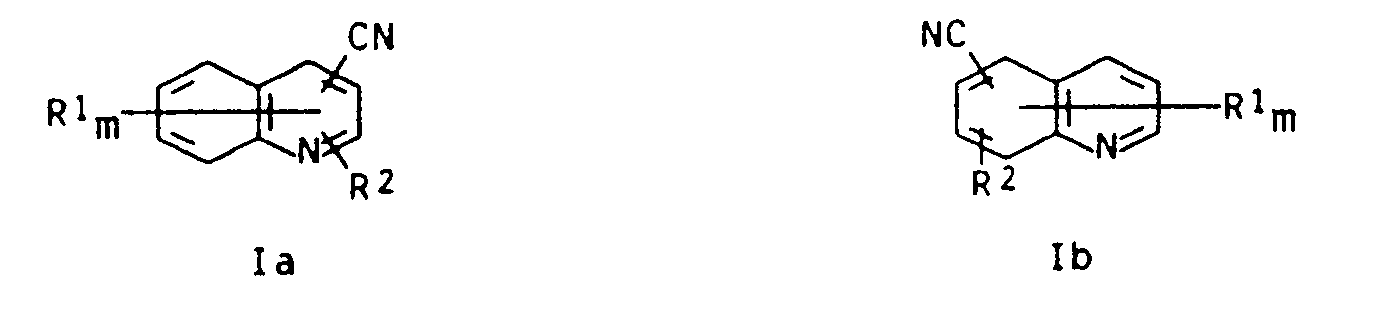
- the present invention relates to cyanoquinoline compounds of the general formula Ia or Ib in which the substituents and the index have the following meaning:
- R1 CH C (CN) 2;
- CH NOH; Halogen; Hydroxy; Nitro; Cyano; C1-C4-alkyl, which can be simply substituted by cyano, hydroxy, carboxyl or C1-C4-alkoxycarbonyl; C1-C4 haloalkyl; C1-C4 alkoxy; C1-C4 haloalkoxy; C1-C4 alkylthio, which can be simply substituted by C1-C4 alkoxycarbonyl; Pyrrolidinyl; Piperidinyl; Morpholinyl; Thiomorpholinyl; Phenyl, phenyloxy, phenylthio, phenyldithiolyl, phen
- R d is a C1-C4 alkyl group
- R e is a C1-C4 alkyl group, a C3-C4 alkenyl group, a C3-C4 alkynyl group, a C3-C4 haloalkylene group or a thenyl group which may be substituted by a halogen atom
- a C3-C4 alkenyl group which carries a phenyl radical, which can carry one to three of the following radicals: halogen, C1-C4-alkyl, C1-C4-alkoxy, C1-C4-haloalkyl and / or C1-C4-haloalkoxy
- R f is a C1-C4-alkyl group which can be mono- or disubstituted by C1-C4-alkylthio or C1-
- the present invention was based on the object of finding compounds which reduce the disadvantages that exist when using the abovementioned herbicides of the formulas IX and X at least to such an extent that the crop yield of the crop plants is no longer or not significantly reduced.
- the compounds Ia and Ib according to the invention are accessible in various ways.
- Substituted cyanquinolines are obtained e.g. by condensation of optionally substituted o-aminobenzaldehydes with cyanoacetic acid derivatives (G. Jones in “Chemistry of Heterocyclic Compounds", vol. 32/1, Wiley and Sons, New York / London, p. 180-190) or by reacting haloquinolines (RK Smalley in "Chemistry of Heterocyclic Compounds", vol. 32/1, Wiley and Sons, New York / London, p. 319-521) with copper (I) cyanide (P.
- the cyanoquinolines Ia and Ib are obtained, for example, according to the literature cited at the outset, by reacting a haloquinoline of the formula IIa or IIb in the presence of an organic base such as pyridine and quinoline with an inorganic cyanide of the formula III.
- Hal represents a halogen atom such as fluorine, chlorine, bromine and iodine, preferably chlorine and bromine.
- M ⁇ in the formula III stands for an equivalent of a metal cation such as copper (I), silver (I) and zinc (II), preferably copper I ions.
- the reaction can be carried out continuously or batchwise at normal, positive or negative pressure using the customary techniques.
- the reaction temperature is generally 20 to 400, in particular 150 to 200 ° C, advantageously in the boiling range of the solvent.
- the starting materials IIa or IIb and III are used in a stoichiometric ratio. However, an excess of one or the other can be advantageous in individual cases.
- R represents an alkyl group such as methyl, ethyl, propyl, 1-methylethyl, butyl, 1-methylpropyl, 2-methylpropyl and 1,1-dimethylethyl, preferably methyl and ethyl.
- the reaction can be carried out continuously or batchwise at normal, positive or negative pressure using the customary techniques.
- the reaction temperature is generally 20 to 200, in particular 50 to 150 ° C, advantageously in the boiling range of the solvent.
- suitable solvents are aliphatic and aromatic, optionally chlorinated hydrocarbons such as petroleum ether, benzene, toluene, xylene, gasoline, dichloromethane, chloroform, carbon tetrachloride, 1,2-dichloroethane, chlorobenzene, higher-boiling ethers such as tetrahydrofuran or dioxane; Nitriles such as acetonitrile and propionitrile can be considered.
- suitable solvents are aliphatic and aromatic, optionally chlorinated hydrocarbons such as petroleum ether, benzene, toluene, xylene, gasoline, dichloromethane, chloroform, carbon tetrachloride, 1,2-dichloroethane, chlorobenzene, higher-boiling ethers such as tetrahydrofuran or dioxane; Nitriles such as acetonitrile and propionitrile can be considered.
- Suitable bases are in particular aliphatic, aromatic or heterocyclic amines, such as triethylamine, dimethylamine, diisopropylamine, piperidine, dimethylaniline, dimethylbenzylamine, pyridine and 4-dimethylaminopyridine; Hydroxides of alkali and alkaline earth metals, such as sodium hydroxide, potassium hydroxide and calcium hydroxide; Alcoholates of alkali and alkaline earth metals such as sodium methylate, sodium ethylate, calcium methylate and potassium tert-butoxide; Alkali and alkaline earth metal hydrides such as sodium hydride, potassium hydride and calcium hydride.
- the compounds Ia and Ib in which R2 is amino are also obtained by reacting a nitroquinoline VIa or VIb in a manner known per se in an inert organic solvent in the presence of a base with an acetonitrile of the formula Vb as defined above
- the starting materials V and VI are used in a ratio of 1: 1 to 10: 1, in particular 2: 1 to 5: 1 with 1 to 10 mol-eq., In particular 1 to 5 mol-eq., Based on VI, base .
- the reaction can be carried out continuously or batchwise at normal, positive or negative pressure using the customary techniques.
- the reaction temperature is generally 0 to 100, in particular 15 to 60 ° C.
- Dipolar aprotic compounds such as dimethylformamide, N-methylpyrrolidone or dimethyl sulfoxide can be used as solvents.
- hydroxides of alkali and alkaline earth metals such as sodium hydroxide, potassium hydroxide, calcium hydroxide
- Alcoholates of alkali and alkaline earth metals such as sodium methylate, sodium ethylate, calcium methylate, potassium tert-butoxide
- Alkali or alkaline earth metal hydrides such as sodium hydride, potassium hydride or calcium hydride
- Alkali amides such as sodium amide or potassium amide
- Alkali cyanides such as sodium cyanide and potassium cyanide.
- Suitable salts of the compounds of the formula IA and IB are agriculturally useful salts, for example alkali metal salts, in particular the potassium or sodium salt, alkaline earth metal salts, in particular the calcium, magnesium or barium salt, manganese, copper, zinc or iron salts and ammonium, phosphonium -, Sulfonium or sulfoxonium salts, for example ammonium salts, tetraalkylammonium salts, benzyltrialkylammonium salts, trialkylsulfonium salts or trialkylsulfoxonium salts.
- alkali metal salts in particular the potassium or sodium salt
- alkaline earth metal salts in particular the calcium, magnesium or barium salt, manganese, copper, zinc or iron salts and ammonium, phosphonium -, Sulfonium or sulfoxonium salts, for example ammonium salts, tetraalkylammonium salts, benzyltrialky
- herbicidal (heteroaryloxy) or aryloxy-phenoxyacetic acid derivatives of the formula IX are listed in Table A below.
- Herbicidal active ingredients and antidote compounds can be applied together or separately after emergence onto the leaves and shoots of the crop plants and the unwanted grasses.
- the antidote agent is preferably applied simultaneously with the herbicidal active ingredient. Separate application is also possible, with the antidote being brought into the field first and then the herbicidal active ingredient.
- Herbicidal active ingredient and antidote can be formulated here as a spraying agent in suspendable, emulsifiable or soluble form together or separately.
- herbicidal (heteroaryloxy) phenoxyacetic acid derivatives IX different amounts of an antidote compound are required if the herbicide is used in different crops.
- the proportions are variable in a wide range. They are also dependent on the structure of the (heteroaryloxy) phenoxyacetic acid derivatives IX and the respective target culture. Suitable proportions of herbicidal active compounds: antidote compound are between 1:10 to 1: 0.01; preferably between 1: 4 to 1: 0.1 part by weight.
- Suitable proportions of herbicidal active ingredient: antidote compound are between 1:10 to 1: 0.01; preferably 1: 4 to 1: 0.25 parts by weight both when applied together and when applied separately.
- the new herbicidal compositions can comprise further herbicidal or growth-regulating active ingredients of another chemical structure, the antagonistic effect being retained.
- the herbicidal active ingredients or the antidote are administered, for example, in the form of directly sprayable solutions, powders, suspensions, including high-strength aqueous, oily or other suspensions, or dispersions, emulsions, Oil dispersions, pastes, dusts, sprinkles or granules by spraying, atomizing, dusting, scattering or pouring.
- directly sprayable solutions powders, suspensions, including high-strength aqueous, oily or other suspensions, or dispersions, emulsions, Oil dispersions, pastes, dusts, sprinkles or granules by spraying, atomizing, dusting, scattering or pouring.
- sprayable solutions powders, suspensions, including high-strength aqueous, oily or other suspensions, or dispersions, emulsions, Oil dispersions, pastes, dusts, sprinkles or granules by spraying, atomizing, dusting, scattering or pour
- mineral oil fractions of medium to high boiling point such as kerosene or diesel oil, furthermore coal tar oils, as well as oils of vegetable or animal origin, aliphatic, cyclic or aromatic hydrocarbons, e.g. Benzene, toluene, xylene, paraffin, tetrahydronaphthalene, alkylated naphthalenes or their derivatives, e.g.
- Aqueous application forms can be prepared from emulsion concentrates, pastes or wettable powders (wettable powders), oil dispersions by adding water.
- herbicidal active ingredient and / or antidote as such or dissolved in an oil or solvent can be homogenized in water by means of wetting agents, adhesives, dispersants or emulsifiers.
- concentrates consisting of herbicidal active ingredient and / or antidote wetting agent, tackifier, dispersant or emulsifier and, if appropriate, solvent or oil, which are suitable for dilution with water.
- Powders, materials for spreading and dusts can be prepared by mixing or grinding the herbicidal active ingredient and / or antidote together with a solid carrier.
- Granules e.g. Coating, impregnation and homogeneous granules can be produced by binding the active ingredients to solid carriers.
- Solid carriers are e.g. mineral soils such as silica gel, silicas, silica gels, silicates, talc, kaolin, Attaclay, limestone, chalk, bolus, loess, clay, dolomite, diatomaceous earth, calcium and magnesium sulfate, magnesium oxide, ground plastics, fertilizers, e.g. Ammonium sulfate, ammonium phosphate, ammonium nitrate, ureas and vegetable products, such as flour, bark, wood and nutshell flour, cellulose powder and other solid carriers.
- mineral soils such as silica gel, silicas, silica gels, silicates, talc, kaolin, Attaclay, limestone, chalk, bolus, loess, clay, dolomite, diatomaceous
- the formulations contain between 0.1 and 95% by weight of herbicidal active ingredient and antidote, preferably between 0.5 and 90% by weight.
- the application rates of herbicidal active ingredient are 0.2 to 5 kg / ha of active substance (a.S.).
- Plastic flower pots with around 300 cm3 content and loamy sand with around 3.0% humus served as culture vessels.
- the seeds of the test plants are separated according to species, sown flat and moistened.
- the pots were then covered with transparent plastic covers until the seeds had germinated evenly and the plants had grown.
- test plants For the post-emergence treatment, the test plants, depending on the growth habit, were first grown to a height of 3 to 20 cm and only then treated.
- the herbicidal compositions were suspended or emulsified in water as a distribution agent and sprayed by means of finely distributing nozzles.
- test vessels were set up in the greenhouse, 18 to 30 ° C. being preferred for heat-loving species and 10 to 25 ° C. being preferred for more moderate climates.
- the trial period lasted 3 to 5 weeks. During this time, the plants were cared for and their response to each treatment was recorded.
- the damage to the test plants was assessed on a scale from 0 to 100% in comparison to the untreated control plants. 0 means no damage and 100 means complete destruction of the plants.
- the plants used in the greenhouse experiments are composed of the following types:
- the herbicidal active ingredient X.2 was added to the spray mixture as a commercially formulated product (184 g / l EC alone, in each case with the addition of that amount of solvent system XXII - empty formulation) and applied together with the antidotic compound.
- the active ingredient X.41 was applied as an emulsion concentrate with 200 g of active ingredient / l, likewise by adding the amounts of solvent required for the antidotes, 80% cyclohexenone and 20% Emulphor EL with 10% (% by weight) of active ingredient.
- All antidote compounds were prepared for the post-emergence treatment in a mixture consisting of 80% cyclohexenone and 20% Emulphor EL with 10% (% by weight) of active ingredient.
Landscapes
- Organic Chemistry (AREA)
- Chemical & Material Sciences (AREA)
- Life Sciences & Earth Sciences (AREA)
- General Health & Medical Sciences (AREA)
- Health & Medical Sciences (AREA)
- Toxicology (AREA)
- Pest Control & Pesticides (AREA)
- Plant Pathology (AREA)
- Agronomy & Crop Science (AREA)
- Engineering & Computer Science (AREA)
- Dentistry (AREA)
- Wood Science & Technology (AREA)
- Zoology (AREA)
- Environmental Sciences (AREA)
- Agricultural Chemicals And Associated Chemicals (AREA)
- Plural Heterocyclic Compounds (AREA)
- Quinoline Compounds (AREA)
Abstract
in der die Substituenten und der Index folgende Bedeutung haben:
R¹ CH=C(CN)₂; CH=N-N-CH-(5-Chinolinyl); Methylsulfonyl; CH=NOH;Halogen; Hydroxy; Nitro; Cyano; ggf. subst. C₁-C₄-Alkyl C₁-C₄-Alkoxy oder C₁-C₄-Alkylthio; Pyrrolidinyl; Piperidinyl; Morpholinyl; Thiomorpholinyl;
ggf. subst. Phenyl, Phenyloxy, Phenylthio, Phenyldithiolyl, Phenylsulfonyl oder Pyrrolyl;
m 0, 1, 2 oder 3;
R² Wasserstoff; Hydroxy; Halogen; C₁-C₄-Alkoxy; -NR³R⁴; -NR⁵-CXR⁶ oder -N=CR⁷R⁸;
R³ Wasserstoff oder ggf. subst. C₁-C₄-Alkyl;
R⁴ ein Rest R³;
C₁-C₄-Alkylamino; Di-C₁-C₄-alkylamino oder subst. C₁-C₄-Alkyl; CH=N-(3-Cyano-2-chinolinyl);
oder R³ und R⁴ gemeinsam C₄-C₅-Alkylen, welches durch ein Heteroatom unterbrochen sein kann;
oder ggf. subst. 1,3-Butadienyl;
R⁵, R⁷ Wasserstoff oder C₁-C₄-Alkyl;
R⁶, R⁸ ein Rest R⁵; subst. C₁-C₄-Alkyl; C₃-C₇-Cycloalkyl; C₁-C₄-Alkoxycarbonyl; ggf. subst. Phenyl, ggf. subst. Amino;
X Sauerstoff oder Schwefel;
Verfahren zur Herstellung sowie sie enthaltende herbizide Mittel.
Description
- Die vorliegende Erfindung betrifft Cyanochinolinverbindungen der allgemeinen Formel Ia oder Ib

in der die Substituenten und der Index folgende Bedeutung haben:
R¹ CH=C(CN)₂; CH=N-N=CH-(5-Chinolinyl); Methylsulfonyl; CH=NOH; Halogen; Hydroxy; Nitro; Cyano; C₁-C₄-Alkyl, welches einfach durch Cyano, Hydroxy, Carboxyl oder C₁-C₄-Alkoxycarbonyl substituiert sein kann; C₁-C₄-Halogenalkyl; C₁-C₄-Alkoxy; C₁-C₄-Halogenalkoxy; C₁-C₄-Alkylthio, welches einfach durch C₁-C₄-Alkoxycarbonyl substituiert sein kann; Pyrrolidinyl; Piperidinyl; Morpholinyl; Thiomorpholinyl;
Phenyl, Phenyloxy, Phenylthio, Phenyldithiolyl, Phenylsulfonyl oder Pyrrolyl, welche ein bis drei der folgenden Gruppen tragen können: Halogen, C₁-C₄-Alkyl, C₁-C₄-Halogenalkyl, C₁-C₄-Alkoxy, C₁-C₄-Alkylthio, C₂-C₄-Alkenyl, Nitro, Amino, Nitro-C₂-C₄-alkenyl und/oder Benzyl;
m 0, 1, 2 oder 3, wobei die Reste R¹ verschieden sein können, wenn m 2 oder 3 bedeutet;
R² Wasserstoff; Hydroxy; Halogen; C₁-C₄-Alkoxy; eine Gruppe -NR³R⁴; eine Gruppe -NR⁵-CXR⁶; oder eine Gruppe -N=CR⁷R⁸;
R³ Wasserstoff oder eine C₁-C₄-Alkylgruppe, welche ein bis fünf Halogenatome und/oder eine der folgenden Gruppen tragen kann: Hydroxy; C₁-C₄-Alkoxy; C₁-C₄-Halogenalkoxy; C₁-C₄-Alkylthio; Amino; C₁-C₄-Alkylamino oder Di-C₁-C₄4-alkylamino;
R⁴ eine der bei R³ genannten Gruppen;
eine C₁-C₄-Alkylaminogruppe; eine Di-C₁-C₄-alkylaminogruppe; eine C₁-C₄-Alkylgruppe, welche einen der folgenden Reste trägt: C₁-C₄-Alkoxycarbonyl, 1-Pyrrolidinyl oder 1-Imidazolyl; CH=N-(3-Cyano-2-chinolinyl);
oder R³ und R⁴ gemeinsam
eine C₄-C₅-Alkylenkette, welche durch ein Sauerstoff- oder ein Stickstoff-Glied unterbrochen sein kann, wobei das Stickstoffatom seinerseits eine C₁-C₄-Alkylgruppe oder eine Amino-C₁-C₄-alkylgruppe tragen kann
oder eine 1,3-Butadienylkette, welche ein oder zwei der bei R¹ genannten Reste oder eine Formylgruppe tragen kann;
R⁵ Wasserstoff oder eine C₁-C₄-Alkylgruppe;
R⁶ eine der bei R⁵ genannten Gruppen;
eine C₁-C₄-Alkylgruppe, welche einen der folgenden Reste trägt: C₁-C₄-Alkoxy, C₁-C₄-Alkylcarbonyl oder C₁-C₄-Alkoxycarbonyl; C₃-C₇-Cycloalkyl; C₁-C₄-Alkoxycarbonyl;
ein Phenylring, welcher ein bis drei der bei R¹ genannten Gruppen tragen kann; eine Aminogruppe; eine C₁-C₄-Alkylaminogruppe; eine Di-C₁-C₄-alkylaminogruppe; eine C₃-C₇-Cycloalkylaminogruppe oder eine Phenylaminogruppe, wobei der aromatische Ring ein bis drei der bei R¹ genannten Gruppen tragen kann;
X Sauerstoff oder Schwefel;
R⁷ eine der bei R⁵ genannten Gruppen;
R⁸ eine der bei R⁶ genannten Gruppen,
wobei R² nicht Wasserstoff, Hydroxy oder Amino bedeutet, wenn m = 0 ist und R¹ nicht Methoxy und m 1 bedeutet, wenn R² Wasserstoff bedeutet,
sowie die umweltverträglichen Salze der Verbindungen Ia und Ib sofern diese verbindungen einen basischen Stickstoffsubstituenten oder einen sauren Hydroxysubstituenten enthalten. - Außerdem betrifft die Erfindung Verfahren zur Herstellung der Verbindungen Ia und Ib sowie herbizide Mittel, die 2-(4-Heteroaryloxy)- oder 2-(4-Aryloxy)-phenoxyessig- oder -propionsäurederivate und/oder Cyclohexenonderivate als herbizide Wirkstoffe und Cyanchinoline IA und IB als Antidots enthalten

wobei die Substituenten R¹ und R² und der Index die vorstehend gegebene Bedeutung haben und außerdem
R² Wasserstoff; Hydroxy oder Amino bedeutet, wenn m = 0 ist und R¹ Methoxy bedeutet, wenn m = 1 und R² Wasserstoff bedeutet,
sowie Verfahren zur selektiven Bekämpfung von unerwünschtem Pflanzenwuchs mit diesen herbiziden Mitteln. - Herbizide Wirkstoffe aus der Gruppe der 2-(4-Heteroaryloxy)- oder 2-(4-Aryloxy)-phenoxyessigsäurederivate der Formel IX,

in der die Substituenten folgende Bedeutung haben:
Ra ein Phenylring, ein Pyridylring, ein Benzoxazylrest, ein Benzthiazylrest oder ein Benzpyrazinylrest, wobei diese aromatischen Ringsysteme bis zu zwei der folgenden Reste tragen können: Halogen, Nitro, C₁-C₄-Alkyl, C₁-C₄-Halogenalkyl und/oder C₁-C₄-Halogenalkoxy,
Rb Wasserstoff, eine C₁- C₄-Alkylgruppe oder das Äquivalent eines pflanzenverträglichen Kations und
Rc Wasserstoff oder eine Methylgruppe,
sind aus der Literatur, z.B. aus DE-A-22 23 894, DE-A-24 33 067, DE-A-25 76 251, DE-A-30 04 770, BE-A-868 875 und BE-A-858 618 bekannt. - Sie dienen der Bekämpfung von unerwünschten Pflanzen aus der Familie der Gramineen. Die Verträglichkeit dieser Substanzen für Kulturpflanzen variiert jedoch zwischen kommerziell akzeptabel und unverträglich, je nach Substituenten und Aufwandmenge.
- Ebenso verhält es sich mit Cyclohexenonderivaten der Formel X,

in welcher die Substituenten folgende Bedeutung haben:
Rd eine C₁-C₄-Alkylgruppe;
Re eine C₁-C₄-Alkylgruppe, eine C₃-C₄-Alkenylgruppe, eine C₃-C₄-Alkinylgruppe, eine C₃-C₄-Halogenalkylengruppe oder eine Thenylgruppe, welche durch ein Halogenatom substituiert sein kann; eine C₃-C₄-Alkenylgruppe, welche einen Phenylrest trägt, wobei dieser ein bis drei der folgenden Reste tragen kann: Halogen, C₁-C₄-Alkyl, C₁-C₄-Alkoxy, C₁-C₄-Halogenalkyl und/oder C₁-C₄-Halogenalkoxy;
Rf eine C₁-C₄-Alkylgruppe, welche ein- oder zweifach durch C₁-C₄-Alkylthio oder C₁-C₄-Alkoxy substituiert sein kann;
ein 5- oder 6-gliedriges gesättigtes oder einfach ungesättigtes Ringsystem, welches neben Kohlenstoffgliedern ein Sauerstoff-, ein Schwefelatom oder eine Sulfoxid- oder Sulfongruppe enthalten kann, und dieser Ring bis zu drei der folgenden Reste tragen kann: Hydroxy, Halogen, C₁-C₄-Alkyl, C₁-C₄-Halogenalkyl, C₁-C₄-Alkoxy und/oder C₁-C₄-Alkylthio;
ein 10-gliedriger gesättigter oder einfach ungesättigter Heterocyclus, welcher zwei Sauerstoffatome oder Schwefelatome enthält und durch bis zu drei C₁-C₄-Alkylgruppen und/oder Methoxygruppen substituiert sein kann;
ein Phenylrest, ein Pyridylrest ein Thiazolylrest, ein Pyrazolylrest, ein Pyrrolylrest oder ein Isoxazolylrest, wobei diese Reste bis zu drei der folgenden Gruppen tragen können: C₁-C₄-Alkyl, C₁-C₄-Halogenalkyl, C₁-C₄-Alkoxy, C₁-C₄-Alkylthio, C₃-C₆-Alkenyloxy, C₃-C₆-Alkinyloxy, C₁-C₄-Alkoxy-C₁-C₃-alkyl, C₁-C₄-Dialkoxy-C₁-C₃-alkyl, Formyl, Halogen und/oder Benzoylamino
Rg Wasserstoff, Hydroxy oder, wenn Rf die Bedeutung C₁-C₆-Alkylgruppe hat, eine C₁-C₆-Alkylgruppe;
Rh Wasserstoff, eine Cyanogruppe, ein Halogenatom, eine C₁-C₄-Alkoxycarbonylgruppe oder eine C₁-C₄-Alkylketoximgruppe und
Ri Wasserstoff oder das Äquivalent eines umweltverträglichen Kations. - Sie sind in der Literatur (z.B. EP-A 228 598, EP-A 230 235, EP-A 238 021, US-A 4 432 786, DE-A 24 39 104) ebenfalls als Herbizide beschrieben und dienen vorwiegend zur Bekämpfung unerwünschter Gräser in dicotylen Kulturen und in Gräsern, die nicht zur Familie der Gramineen zählen. Je nach Struktur der Substituenten und Dosis der Anwendung können Verbindungen aus dieser Gruppe auch zur selektiven Bekämpfung von unerwünschten Gräsern in Gramineen Kulturen wie Weizen und Reis eingesetzt werden.
- Der vorliegenden Erfindung lag nun die Aufgabe zugrunde, Verbindungen zu finden, welche die Nachteile, die bei der Verwendung der obengenannten Herbizide der Formeln IX und X bestehen, zumindest so stark verringern, daß der Ernteertrag der Kulturpflanzen nicht mehr oder nicht nennenswert herabgesetzt wird.
- Die erfindungsgemäßen Verbindungen Ia und Ib sind auf verschiedenen Wegen zugänglich. Substituierte Cyanchinoline erhält man z.B. durch Kondensation von gegebenenfalls substituierten o-Aminobenzaldehyden mit Cyanessigsäurederivaten (G. Jones in "Chemistry of Heterocyclic Compounds", Vol. 32/1, Wiley and Sons, New York/London, p. 180-190) oder durch Umsetzung von Halogenchinolinen (R.K. Smalley in "Chemistry of Heterocyclic Compounds", Vol. 32/1, Wiley and Sons, New York/London, p. 319-521) mit Kupfer(I)-cyanid (P. Kurtz in "Methoden der organischen Chemie" (Houben-Weyl), Bd. VIII, S. 302-304, G. Thieme, Stuttgart, 1952). Einen weiteren Zugang bildet die Reaktion von Nitrochinolinen mit Cyanessigsäureestern (M. Yamazaki et al., Chem.Pharm.Bull. 29 (1981) 1286, 1292, 1328; Chem. Pharm.Bull. 30 (1982) 851; Chem.Pharm.Bull. 33 (1985) 1360). Eine pflanzenschützende wirkung ist dem Stand der Technik nicht zu entnehmen.
- So erhält man die Cyanochinoline Ia und Ib beispielsweise gemäß der eingangs zitierten Literatur dadurch, daß man ein Halogenchinolin der Formel IIa bzw. IIb in Gegenwart einer organischen Base wie Pyridin und Chinolin mit einem anorganischen Cyanid der Formel III umsetzt.

- In den Formeln IIa und IIb bedeutet Hal ein Halogenatom wie Fluor, Chlor, Brom und Jod, vorzugsweise Chlor und Brom.
- M⊕ in der Formel III steht für ein Äquivalent eines Metallkations wie Kupfer-(I), Silber(I) und Zink(II), vorzugsweise für Kupfer-I-ionen.
- Als Lösungsmittel dienen insbesondere Pyridin, Chinolin, Dimethylformamid, Dimethylsulfoxid und N-Methylpyrrolidon.
- Die Umsetzung kann kontinuierlich oder diskontinuierlich bei Normal-, über- oder Unterdruck nach den dafür üblichen Techniken durchgeführt werden. Die Reaktionstemperatur liegt im allgemeinen bei 20 bis 400, insbesondere bei 150 bis 200°C, vorteilhaft im Siedebereich des Lösungsmittels.
- Üblicherweise setzt man die Ausgangsstoffe IIa bzw. IIb und III in stöchiometrischem Verhältnis ein. Ein überschuß des einen oder anderen kann in Einzelfällen aber durchaus vorteilhaft sein.
- Verbindungen der Formel Ia, in denen R² Hydroxy oder Amino bedeutet, erhält man besonders vorteilhaft dadurch, daß man einen o-Aminobenzaldehyd IV in an sich bekannter Weise in einem inerten organischen Lösungsmittel in Gegenwart einer Base mit einem Acetonitril Va bzw. Vb anelliert.

- In der Formel Vb bedeutet R eine Alkylgruppe wie Methyl, Ethyl, Propyl, 1-Methylethyl, Butyl, 1-Methylpropyl, 2-Methylpropyl und 1,1-Dimethylethyl, vorzugsweise Methyl und Ethyl.
- Die Umsetzung kann kontinuierlich oder diskontinuierlich bei Normal-, über- oder Unterdruck nach den dafür üblichen Techniken durchgeführt werden. Die Reaktionstemperatur liegt im allgemeinen bei 20 bis 200, insbesondere bei 50 bis 150°C, vorteilhaft im Siedebereich des Lösungsmittels.
- Als Lösungsmittel kommen beispielsweise aliphatische und aromatische, gegebenenfalls chlorierte Kohlenwasserstoffe wie Petrolether, Benzol, Toluol, Xylol, Benzin, Dichlormethan, Chloroform, Tetrachlormethan, 1,2-Dichlorethan, Chlorbenzol, höhersiedende Ether wie Tetrahydrofuran oder Dioxan; Nitrile wie Acetonitril und Propionitril in Betracht.
- Geeignete Basen sind insbesondere aliphatische, aromatische oder heterocyclische Amine, wie Triethylamin, Dimethylamin, Diisopropylamin, Piperidin, Dimethylanilin, Dimethylbenzylamin, Pyridin und 4-Dimethylaminopyridin; Hydroxide von Alkali- und Erdalkalimetallen, wie Natriumhydroxid, Kaliumhydroxid und Calciumhydroxid; Alkoholate von Alkali- und Erdalkalimetallen wie Natriummethylat, Natriumethylat, Calciummethylat und Kalium-tert.-butylat; Alkali- und Erdalkalimetallhydride wie Natriumhydrid, Kaliumhydrid und Calciumhydrid.
- Die Verbindungen Ia und Ib in denen R² Amino bedeutet erhält man aber auch, indem man ein Nitrochinolin VIa bzw. VIb in an sich bekannter Weise in einem inerten organischen Lösungsmittel in Gegenwart einer Base mit einem Acetonitril der Formel Vb wie vorstehend definiert umsetzt

- Üblicherweise setzt man die Ausgangsstoffe V und VI im Verhältnis 1:1 bis 10:1, insbesondere 2:1 bis 5:1 mit 1 bis 10 mol-äq., insbesondere 1 bis 5 mol-äq., bezogen auf VI, Base ein.
- Die Umsetzung kann kontinuierlich oder diskontinuierlich bei Normal-, Über- oder Unterdruck nach den dafür üblichen Techniken durchgeführt werden. Die Reaktionstemperatur liegt im allgemeinen bei 0 bis 100, insbesondere bei 15 bis 60°C.
- Als Lösungsmittel können dipolare aprotische Verbindungen wie Dimethylformamid, N-Methylpyrrolidon oder Dimethylsulfoxid verwendet werden.
- Als Base dienen insbesondere Hydroxide von Alkali- und Erdalkalimetallen, wie z.B. Natriumhydroxid, Kaliumhydroxid, Calciumhydroxid; Alkoholate von Alkali- und Erdalkalimetallen wie beispielsweise Natriummethylat, Natriumethylat, Calciummethylat, Kalium-tert.-butylat; Alkali- oder Erdalkalimetallhydride wie beispielsweise Natriumhydrid, Kaliumhydrid oder Calciumhydrid; Alkaliamide wie Natriumamid oder Kaliumamid; Alkalicyanide wie Natriumcyanid und Kaliumcyanid.
- Im Hinblick auf die bestimmungsgemäße verwendung der Verbindungen Ia und Ib kommen als Substituenten bevorzugt folgende Reste in Betracht:
R¹ CH=C(CN)₂; CH=N-N-CH-(5-Chinolinyl); Methylsulfonyl; CH=NOH; Halogen wie Fluor, Chlor, Brom und Jod, insbesondere Chlor und Brom;
Hydroxy;
Alkyl wie Methyl, Ethyl, Propyl, 1-Methylethyl, Butyl, 1-Methylpropyl, 2-Methylpropyl und 1,1-Dimethylethyl, insbesondere Methyl und Ethyl, welches einfach durch Cyano, Hydroxy, Carboxyl oder C₁-C₄-Alkoxycarbonyl wie insbesondere Methoxycarbonyl, Ethoxycarbonyl und 1-Methylethoxycarbonyl substituiert sein kann;
Halogenalkyl wie Fluormethyl, Difluormethyl, Trifluormethyl, Chlordifluormethyl, Dichlorfluormethyl, Trichlormethyl, 1-Fluorethyl, 2-Fluorethyl, 2,2-Difluorethyl, 2,2,2-Trifluorethyl, 2-Chlor-2,2-di-fluorethyl, 2,2-Dichlor-2-fluorethyl, 2,2,2-Trichlorethyl und Pentafluorethyl, insbesondere Trifluormethyl und Trichlormethyl;
Alkoxy wie Methoxy, Ethoxy, Propoxy, 1-Methylethoxy, Butoxy, 1-Methylpropoxy, 2-Methylpropoxy und 1,1-Dimethylethoxy, insbesondere Methoxy und Ethoxy;
Halogenalkoxy wie Difluormethoxy, Trifluormethoxy, Chlor-difluormethoxy, Dichlorfluormethoxy, 1-Fluorethoxy, 2-Fluorethoxy, 2,2-Difluorethoxy, 1,1,2,2-Tetrafluorethoxy, 2,2,2-Trifluorethoxy, 2-Chlor-1,1,2-trifluorethoxy und Pentafluorethoxy, insbesondere 2,2,2-Trifluorethoxy;
Alkylthio wie Methylthio, Ethylthio, Propylthio, 1-Methylethylthio, Butylthio, 1-Methylpropylthio, 2-Methylpropylthio und 1,1-Dimethylethylthio, insbesondere Methylthio und Butylthio, welches einfach durch C₁-C₄-Alkoxycarbonyl, insbesondere wie vorstehend genannt, substituiert sein kann;
Pyrrolidinyl; Piperidinyl; Morpholinyl, Thiomorpholinyl;
Phenyl, Phenoxy, Phenylthio, Phenyldithiolyl (-S-S-Phenyl), oder Pyrrolyl, wobei diese Substituenten ein bis drei der folgenden Reste tragen können:
Alkyl wie vorstehend genannt, insbesondere Methyl; Halogenalkyl wie vorstehend genannt, insbesondere Trifluormethyl; Alkoxy wie vorstehend genannt, insbesondere Methoxy, Ethoxy und 1-Methylethoxy; Alkylthio wie vorstehend genannt, insbesondere Methylthio; Alkenyl wie insbesondere Ethenyl, 1-Propenyl, 2-Propenyl, 1-Butenyl, 2-Butenyl, 3-Butenyl, 1-Methyl-1-propenyl, 2-Methyl-1-propenyl, 1-Methyl-2-propenyl und 2-Methyl-2-propenyl; Nitro, Amino, Nitroalkenyl wie insbesondere 2-Nitro-ethenyl und/oder Benzyl;
m 0, 1, 2 oder 3, wobei die Reste R¹ verschieden sein können; wenn m 2 oder 3 bedeutet;
R² Wasserstoff; Hydroxy;
Halogen wie bei R¹ genannt, insbesondere Chlor und Brom;
Alkoxy wie bei R¹ genannt, insbesondere Methoxy und Ethoxy;
eine Gruppe -NR³R⁴; eine Gruppe -NR⁵-CXR⁶ oder eine Gruppe -N=CR⁷R⁸;
R³ Wasserstoff;
Alkyl wie bei R¹ genannt, insbesondere Methyl und Ethyl;
welche ein bis fünf der im allgemeinen und im besonderen bei R¹ genannten Halogenatome und/oder eine der folgenden Gruppen tragen kann: Hydroxy, Alkoxy wie bei R¹ genannt, insbesondere Fluor und Chlor;
Halogenalkoxy wie bei R¹ genannt, insbesondere 2,2,2-Trifluorethoxy;
Alkylthio wie bei R¹ genannt, insbesondere Methylthio und Butylthio;
oder Amino, welches ein oder zwei der bei R¹ genannten Alkylreste tragen kann, wobei diese Alkylreste bei zweifach substituiertem Amino verschieden sein können, insbesondere Dimethylamino;
R⁴ eine der bei R³ im allgemeinen und im besonderen genannten Gruppen;
Amino, welches ein oder zwei der bei R¹ genannten Alkylreste trägt, wobei diese Alkylreste bei zweifach substituiertem Amino verschieden sein können, insbesondere Dimethylamino;
Alkyl wie bei R¹ genannt, insbesondere Methyl und Ethyl;
welches einen der folgenden Reste trägt:
Alkoxycarbonyl wie Methoxycarbonyl, Ethoxycarbonyl, Propyloxycarbonyl, 1-Methylethoxycarbonyl, Butyloxycarbonyl, 1-Methylpropyloxycarbonyl, 2-Methylpropyloxycarbonyl und 1,1-Dimethylethoxycarbonyl, insbesondere Methoxycarbonyl;
1-Pyrrolidinyl oder 1-Imidazolyl;
CH=N-(3-Cyano-2-chinolinyl);
oder
R³ und R⁴ gemeinsam
eine Butylen- oder Pentylenkette, welche durch ein Stickstoffatom unterbrochen sein kann, wie -CH₂CH₂-NH-CH₂CH₂- oder -CH₂CH₂-NH-CH₂CH₂CH₂-, wobei das Stickstoffatom seinerseits eine Alkylgruppe wie bei R¹ genannt tragen kann, insbesondere Methyl und Ethyl;
wobei diese Alkylgruppe ihrerseits insbesondere in 2-Position eine Aminogruppe tragen kann;
eine 1,3-Butadienylgruppe, welche ein oder zwei der bei R¹ genannten Reste, insbesondere Methyl;
oder eine Formylgruppe tragen kann;
R⁵ Wasserstoff;
Alkyl wie bei R¹ genannt, insbesondere Methyl;
R⁶ eine der bei R⁵ genannten Gruppen;
Alkyl wie bei R¹ genannt, insbesondere Methyl und 2,2-Dimethylpropyl;
welches einen der folgenden Reste trägt: Alkoxy wie bei R¹ genannt, insbesondere Methoxy;
Cycloalkyl wie Cyclopropyl, Cyclobutyl, Cyclopentyl, Cyclohexyl und Cycloheptyl; Alkoxycarbonyl, im allgemeinen und im besonderen wie vorstehend bei R⁴ genannt;
Phenyl, welches ein bis drei der im allgemeinen und im besonderen bei R¹ genannten Reste tragen kann;
Amino, welches ein oder zwei der bei R¹ genannten Alkylreste tragen kann, wobei diese Alkylreste bei zweifach substituiertem Amino verschieden sein können, insbesondere Methylamino und Ethylamino;
Phenylamino, wobei der Phenylring seinerseits ein bis drei der im allgemeinen und im besonderen bei R¹ genannten Reste tragen kann;
X Sauerstoff oder Schwefel;
R⁷ eine der bei R⁵ im allgemeinen und im besonderen genannten Gruppen;
R⁸ eine der bei R⁶ im allgemeinen und im besonderen genannten Gruppen;
wobei
R² nicht Wasserstoff, Hydroxy oder Amino bedeutet, wenn m=0 ist und R¹ nicht Methoxy bedeutet, wenn R² Wasserstoff bedeutet und m=1 ist,
sowie die landwirtschaftlich brauchbaren Salze der Verbindungen Ia und Ib, sofern diese Verbindungen einen basischen Stickstoffsubstituenten oder einen sauren Hydroxysubstituenten enthalten. - Als Salze der Verbindungen der Formel IA und IB kommen landwirtschaftlich brauchbare Salze, beispielsweise Alkalimetallsalze, insbesondere das Kalium- oder Natriumsalz, Erdalkalimetallsalze, insbesondere das Calcium-, Magnesium- oder Bariumsalz, Mangan-, Kupfer-, Zink- oder Eisensalze sowie Ammonium, Phosphonium-, Sulfonium- oder Sulfoxoniumsalze, beispielsweise Ammoniumsalze, Tetraalkylammoniumsalze, Benzyltrialkylammoniumsalze, Trialkylsulfoniumsalze oder Trialkylsulfoxoniumsalze in Betracht.
- Spezielle Beispiele für herbizide (Heteroaryloxy)- bzw. Aryloxy-phenoxyessigsäurederivate der Formel IX, deren Kulturpflanzenverträglichkeit durch substituierte Cyanochinoline der Formel IA und IB verbessert werden kann, sind in der folgenden Tabelle A aufgeführt.

- Spezielle Beispiele für Cyclohexenone der Formel X, deren Kulturpflanzenverträglichkeit durch Verbindungen der Formel Ia und Ib verbessert werden kann, sind in der folgenden Tabelle B aufgeführt.

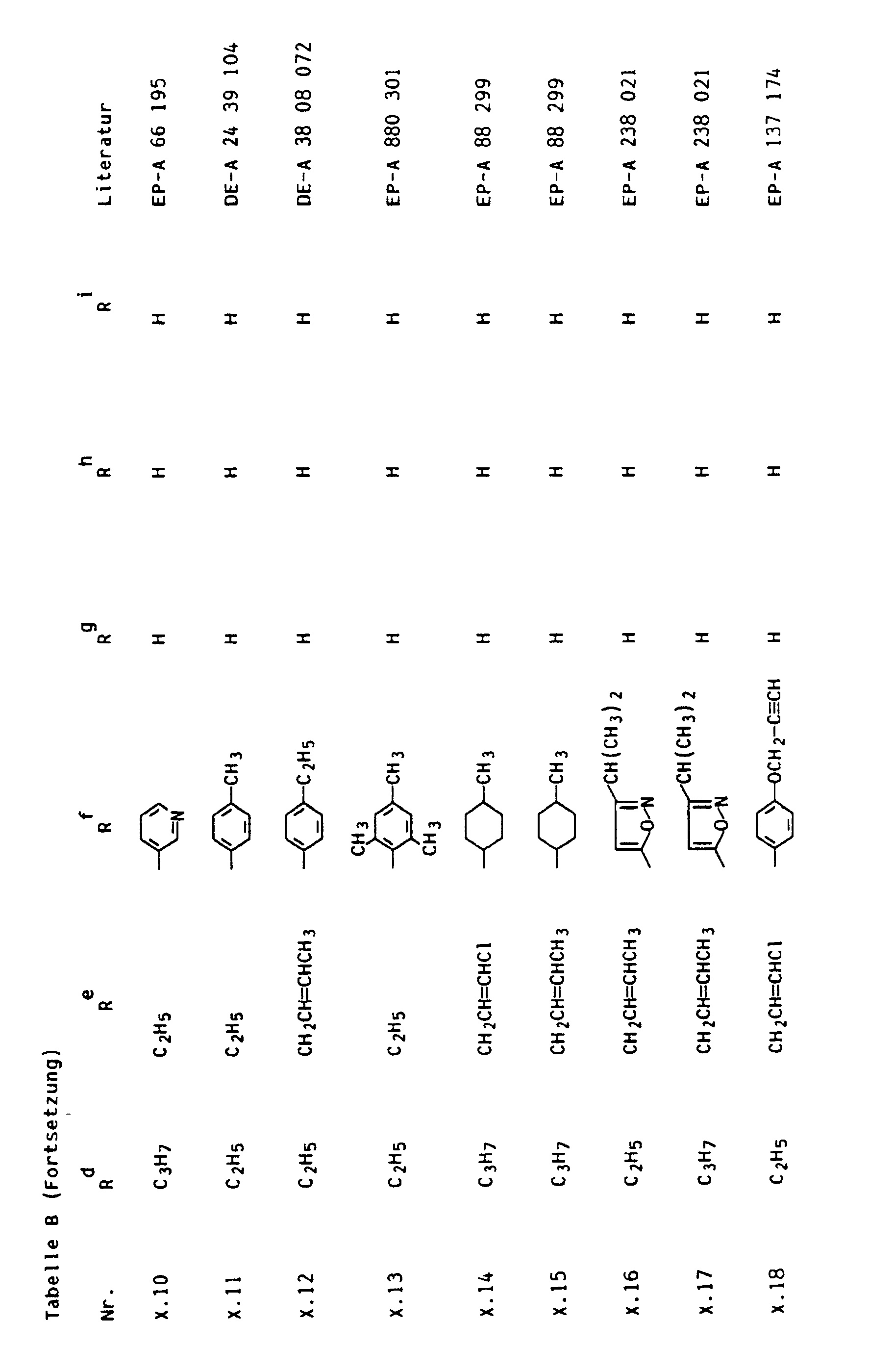


- Herbizide Wirkstoffe und antidotisch wirkende Verbindungen können gemeinsam oder getrennt nach dem Auflaufen auf die Blätter und Sprosse der Kulturpflanzen und der unerwünschten Gräser ausgebracht werden. Bevorzugt wird das antidotisch wirkende Mittel gleichzeitig mit dem herbiziden Wirkstoff ausgebracht. Auch eine getrennte Ausbringung, wobei das Antidot zuerst und anschließend der herbizide Wirkstoff auf das Feld gebracht werden, ist möglich. Herbizider Wirkstoff und Antidot können hierbei als Spritzmittel in suspendierbarer, emulgierbarer oder löslicher Form gemeinsam oder getrennt formuliert vorliegen.
- In der Praxis von Bedeutung ist auch eine Behandlung der Kulturpflanzensamen mit dem Antidot vor der Aussaat. Der herbizide Wirkstoff wird dann allein in der üblichen Weise appliziert.
- Für herbizide (Heteroaryloxy)phenoxyessigsäurederivate IX werden unterschiedliche Mengen einer antidotisch wirkenden Verbindung benötigt, wenn das Herbizid in verschiedenen Kulturen eingesetzt wird. Die Mengenverhältnisse sind in breiten Bereichen variabel. Sie sind ebenfalls abhängig von der Struktur der (Heteroaryloxy)phenoxyessigsäurederivate IX und der jeweiligen Zielkultur. Geeignete Anteilverhältnisse herbizider Wirkstoffe:antidotisch wirkender Verbindung liegen zwischen 1 : 10 bis 1 : 0,01; vorzugsweise zwischen 1 : 4 bis 1 : 0,1 Gew.-Teile.
- Für das gleiche Cyclohexenonderivat X werden unterschiedliche Mengen einer antidotisch wirkenden Verbindung benötigt, wenn das Cyclohexenonderivat X in verschiedenen Kulturen eingesetzt wird. Die Mengenverhältnisse, in denen ein Cyclohexenonderivat X und ein Cyanochinolin IA oder IB eingesetzt werden, sind in breiten Bereichen variabel. Sie sind abhängig von der Struktur des Cyclohexenonderivats X, des Cyanochinolins IA bzw. IB und der jeweiligen Kultur. Geeignete Anteilverhältnisse herbizider Wirkstoff: antidotisch wirkender Verbindung liegen zwischen 1 : 10 bis 1 : 0,01; vorzugsweise 1 : 4 bis 1 : 0,25 Gew.-Teile sowohl bei gemeinsamer als auch bei getrennter Ausbringung.
- Die neuen herbiziden Mittel können neben dem Cyanochinolin IA bzw. IB als Antidot und dem Herbizid aus der Gruppe der (Heteroaryloxy)phenoxyessigsäuren IX bzw. der Cyclohexenone X weitere herbizide oder wachstumsregulierende Wirkstoffe anderer chemischer Struktur enthalten, wobei der antagonistische Effekt erhalten bleibt.
- Die erfindungsgemäßen Mittel bzw. bei getrennter Ausbringung die herbiziden Wirkstoffe oder das Antidot werden beispielsweise in Form von direkt versprühbaren Lösungen, Pulvern, Suspensionen, auch hochprozentige wäßrige, ölige oder sonstige Suspensionen, oder Dispersionen, Emulsionen, Öldispersionen, Pasten, Stäubemitteln, Streumitteln oder Granulaten durch Versprühen, Vernebeln, Verstäuben, Verstreuen oder Gießen angewendet. Die Anwendungsformen richten sich ganz nach den Verwendungszwecken.
- Zur Herstellung von direkt versprühbaren Lösungen, Emulsionen, Pasten und Ölsdispersionen kommen Mineralölfraktionen von mittlerem bis hohem Siedepunkt, wie Kerosin oder Dieselöl, ferner Kohlenteeröle, sowie Öle pflanzlichen oder tierischen Ursprungs, aliphatische, cyclische oder aromatische Kohlenwasserstoffe, z.B. Benzol, Toluol, Xylol, Paraffin, Tetrahydronaphthalin, alkylierte Naphthaline oder deren Derivate, z.B. Methanol, Ethanol, Propanol, Butanol, Chloroform, Tetrachlorkohlenstoff, Cyclohexanol, Cyclohexanon, Chlorbenzol, Isophoron, stark polare Lösungsmittel, wie z.B. Dimethylformamid, Dimethylsulfoxid, N-Methylpyrrolidon und Wasser, in Betracht.
- Wäßrige Anwendungsformen können aus Emulsionskonzentraten, Pasten oder netzbaren Pulvern (Spritzpulvern), Öldispersionen durch Zusatz von Wasser bereitet werden. Zur Herstellung von Emulsionen, Pasten oder Öldispersionen können herbizider Wirkstoff und/oder Antidot als solche oder in einem Öl oder Lösungsmittel gelöst, mittels Netz-, Haft-, Dispergier- oder Emulgiermittel in Wasser homogenisiert werden. Es können aber auch aus herbizidem Wirkstoff und/oder Antidot Netz-, Haft-, Dispergier- oder Emulgiermittel und eventuell Lösungsmittel oder Öl bestehende Konzentrate hergestellt werden, die zur Verdünnung mit Wasser geeignet sind.
- Als oberflächenaktive Stoffe kommen Alkali-, Erdalkali-, Ammoniumsalze von Ligninsulfonsäure, Naphthalinsulfonsäure, Phenolsulfonsäure, Alkylarylsulfonate, Alkylsulfate, Alkylsulfonate, Alkali- und Erdalkalisalze der Dibutylnaphthalinsulfonsäure, Laurylethersulfat, Fettalkoholsulfate, fettsaure Alkali- und Erdalkalisalze, Salze sulfatierter Hexadecanole, Heptadecanole, Octadecanole, Salze von sulfatierten Fettalkoholglykolethern, Kondensationsprodukte von sulfoniertem Naphthalin und Naphthalinderivaten mit Formaldehyd, Kondensationsprodukte des Naphthalins bzw. der Naphthalinsulfonsäuren mit Phenol und Formaldehyd, Polyoxyethylenoctylphenolether, ethoxyliertes Isooctylphenol, Octylphenol, Nonylphenol, Alkylphenolpolyglykolether, Tributylphenylpolyglykolether, Alkylarylpolyetheralkohole, Isotridecylalkohol, Fettalkoholethylenoxid-Kondensate, ethoxyliertes Rizinusöl, Polyoxyethylenalkylether, ethoxyliertes Polyoxypropylen, Laurylalkoholpolylglykoletheracetal, Sorbitester, Lignin-Sulfitablaugen und Methylcellulose in Betracht.
- Pulver, Streu- und Stäubmittel können durch Mischen oder gemeinsames vermahlen von herbizidem Wirkstoff und/oder Antidot mit einem festen Trägerstoff hergestellt werden.
- Granulate, z.B. Umhüllungs-, Imprägnierungs- und Homogengranulate, können durch Bindung der Wirkstoffe an feste Trägerstoffe hergestellt werden. Feste Trägerstoffe sind z.B. mineralerden wie Silicagel, Kieselsäuren, Kieselgele, Silikate, Talkum, Kaolin, Attaclay, Kalkstein, Kreide, Bolus, Löß, Ton, Dolomit, Diatomeenerde, Calcium- und Magnesiumsulfat, Magnesiumoxid, gemahlene Kunststoffe, Düngemittel, wie z.B. Ammoniumsulfat, Ammoniumphosphat, Ammoniumnitrat, Harnstoffe und pflanzliche Produkte, wie Getreidemehle, Baumrinden-, Holz- und Nußschalenmehl, Cellulosepulver und andere feste Trägerstoffe.
- Die Formulierungen enthalten zwischen 0,1 und 95 Gew.-% an herbizidem Wirkstoff und Antidot, vorzugsweise zwischen 0,5 und 90 Gew.-%. Die Aufwandmengen an herbizidem Wirkstoff betragen 0,2 bis 5 kg/ha aktive Substanz (a.S.).
- Die Herstellung der erfindungsgemäßen Verbindungen wird durch die nachstehend beschriebenen Beispiele näher erläutert.
- Herstellungsbeispiele
-

- Eine Mischung aus 3,8 g (0,02 mol) 7-Chlor-3,8-dimethyl-5-nitrochinolin, 2,6 g (0,04 mol) Kaliumcyanid und 150 ml Methanol wurde 15 h unter Rückfluß zum Sieden erhitzt. Anschließend wurde die Reaktionsmischung mit Wasser versetzt und mit Methylenchlorid extrahiert. Aus der organischen Phase erhielt man nach chromatographischer Reinigung 1,5 g (38 %) des Produkts; Fp. 173-174°C; Wirkstoffbeispiel 4.001
-
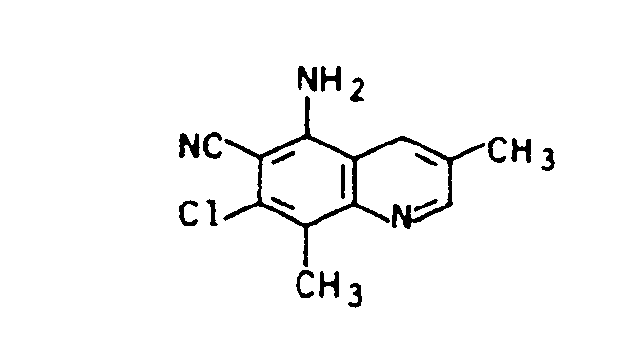
- Eine Mischung aus 11,8 g (0,05 mol) 7-Chlor-3,8-dimethyl-5-nitrochinolin, 150 ml Dimethylformamid (wasserfrei), 16 ml (0,15 mol) Cyanessigsäureethylester, 5,5 g (0,10 mol) Kaliumhydroxid und 3,3 g (0,05 mol) Kaliumcyanid wurde 15 h bei 50°C belassen. Anschließend wurde das Lösungsmittel bei vermindertem Druck abdestilliert und der so erhaltene Rückstand wurde mit 100 ml Natronlauge (5 %ige wäßrige Lösung) 0,5 h bei 80°C gehalten. Beim Abkühlen fiel das Produkt als Feststoff aus.
- Ausbeute 8,4 g (72 %); Fp.: 260-265°C; Wirkstoffbeispiel 4.002
-

- Eine Mischung aus 6,95 g (0,03 mol) des Produktes aus Beispiel 2, 100 ml Pyridin, 0,5 g 4-N,N-Dimethylaminopyridin und 5,0 ml (0,04 mol) Benzoylchlorid wurde 40 h bei 80°C belassen. Anschließend wurde die Reaktionsmischung mit 400 ml Salzsäure (5 %ig) gemischt, wobei das Produkt als Feststoff ausfiel.
- Ausbeute: 3,6 g (36 %); Fp.: >240°C; Wirkstoffbeispiel 4.003
-

- Eine Mischung von 5,8 g (0,025 mol) des Produktes aus Beispiel 2, 100 ml Nitrobenzol, 5,64 g (0,03 mol) 3,4-Dichlorphenylisocyanat und 2,16 g (0,04 mol) Natriummethylat wurde 4 h bei 80°C belassen. Beim Abkühlen der Reaktionsmischung fiel das Produkt als Feststoff aus.
- Ausbeute: 4,3 g (41 %); Fp.: 215-218°C; Wirkstoffbeispiel 4.004
-

- Eine Mischung von 6,95 g (0,03 mol) des Produktes aus Beispiel 2 und 50 ml Essigsäureanhydrid wurde 20 h unter Rückfluß bei 120°C belassen. Beim Abkühlen der Reaktionsmischung fiel das Produkt als Feststoff aus.
- Ausbeute: 7,0 g (98 %); Fp.: 220-225°C; Wirkstoffbeispiel 4.005
-

- Eine Lösung von 54,5 g (0,55 mol) Cyanessigsäuremethylester und 56 g (0,55 mol) Triethylamin in 50 ml Dimethylformamid wurde tropfenweise mit 81,5 g (0,50 mol) Isatosäureanhydrid versetzt und 4 h bei 80°C gerührt. Nach Zugabe von 60 g Natriumcarbonat in 400 ml Wasser wurde das Gemisch 2 h unter Rückfluß zum Sieden erhitzt. Bei Zugabe von 250 ml konz. Salzsäure fiel das Produkt als Feststoff aus.
- Ausbeute: 80 g (85 %); Fp.: >250°C
-

- Eine Mischung aus 60 g (0,38 mol) Phosphonoxychlorid, 15 g (0,14 mol) Triethylamin und 33,5 g (0,15 mol) 7-Chlor-3-cyano-2,4-dihydroxy-8-methylchinolin wurde 6 h unter Rückfluß zum Sieden erhitzt. Nach Abkühlen und Hydrolyse der Reaktionsmischung mit 500 g Eis wurden 21 g (55 %) festes Produkt isoliert. Fp.: 135°C.
-

60,5 g (0,5 mol) o-Aminobenzaldehyd und 35 g (0,53 mol) Malodinitril wurden in 500 ml Ethanol mit 1 ml Pyridin 3 h zum Sieden erhitzt. Nach Abkühlen fielen 72,5 g (86 %) des festen Produktes aus. Fp.: 235°C. - Lit: E.C. Taylor, N.W. Kalenda, J.Org.Chem. 18 (1953), 1755
- Die in den nachstehenden Tabellen aufgeführten Wirkstoffe können analog zu diesen Verfahrensbeispielen hergestellt werden.


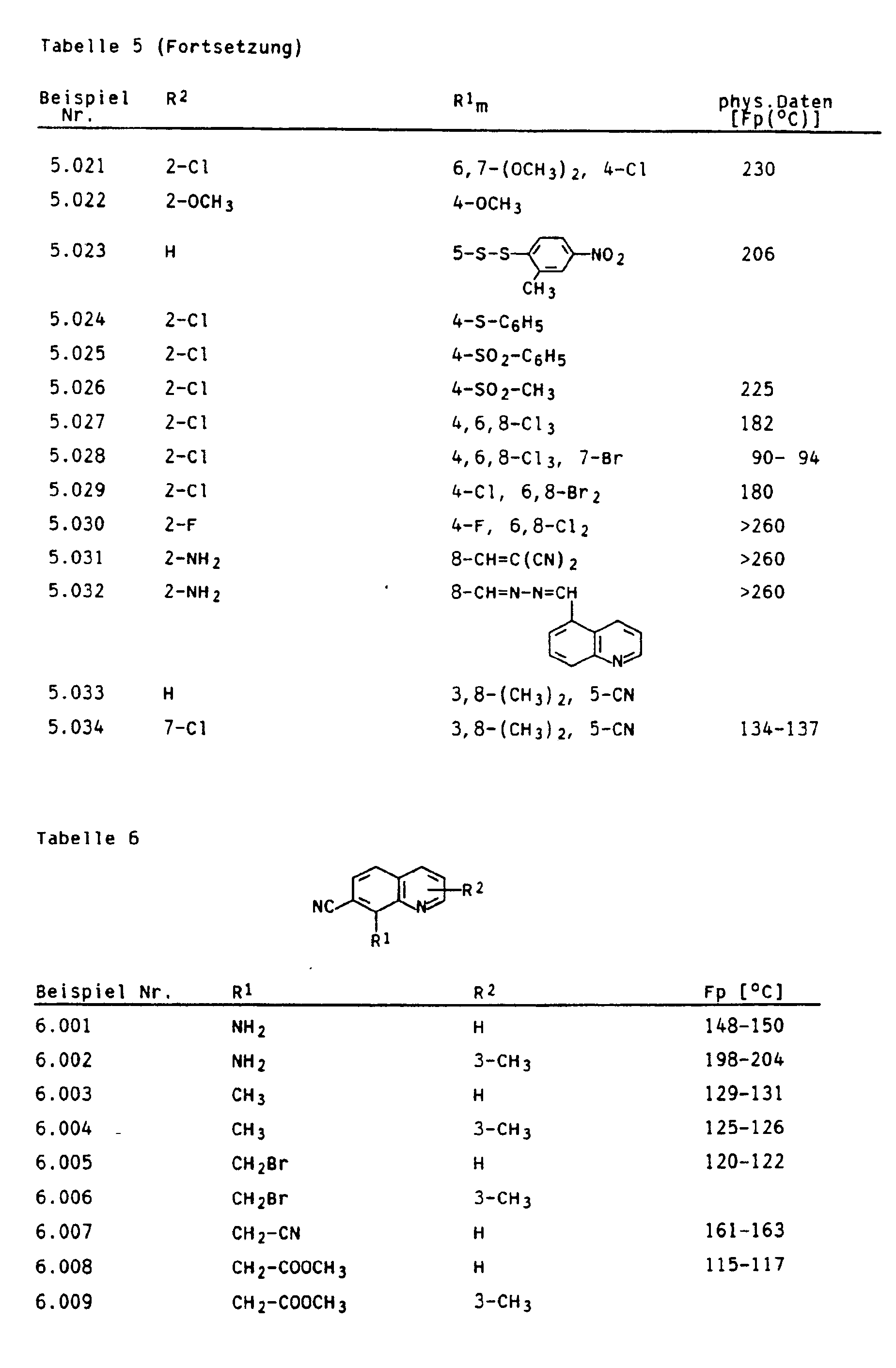

- In der folgenden Tabelle I sind aus der Literatur bekannte Cyanochinolinverbindungen aufgeführt, welche ebenfalls die Kulturpflanzenverträglichkeit der herbiziden Wirkstoffe der Formeln IX und X zu steigern vermögen.

- Beispiele zur biologischen Wirkung
- Der Einfluß verschiedener Vertreter der erfindungsgemäßen herbiziden Mittel bzw. Mittelkombinationen, bestehend aus Herbizid und antidotisch wirkender Verbindung, auf das Wachstum von erwünschten und unerwünschten Pflanzen im Vergleich zum herbiziden Wirkstoff allein wird durch die folgenden biologischen Beispiele aus Gewächshausversuchen belegt:
- Als Kulturgefäße dienten Plastikblumentöpfe mit rund 300 cm³ Inhalt und lehmiger Sand mit etwa 3,0 % Humus als Substrat. Die Samen der Testpflanzen werden nach Arten getrennt, flach eingesät und befeuchtet. Danach wurden die Gefäße mit durchsichtigen Plastikhauben abgedeckt, bis die Samen gleichmäßig gekeimt und die Pflanzen angewachsen waren.
- Für die Nachauflaufbehandlung wurden die Testpflanzen je nach Wuchsform erst bis zu einer Wuchshöhe von 3 bis 20 cm angezüchtet und erst dann behandelt. Die herbiziden Mittel wurden hierbei in Wasser als Verteilungsmittel suspendiert oder emulgiert und mittels fein verteilender Düsen gespritzt.
- Die Versuchsgefäße wurden im Gewächshaus aufgestellt, wobei für wärmeliebende Arten 18 bis 30°C und für solche gemäßigtere Klimate 10 bis 25°C bevorzugt wurden.
- Die Versuchsperiode erstreckte sich über 3 bis 5 Wochen. Während dieser Zeit wurden die Pflanzen gepflegt, und ihre Reaktion auf die einzelnen Behandlungen wurde erfaßt.
- Bewertet wurde die Schädigung der Testpflanzen anhand einer Skala von 0 bis 100 % im Vergleich zu den unbehandelten Kontrollpflanzen. Dabei bedeutet 0 keine Schädigung und 100 eine völlige Zerstörung der Pflanzen.
- Die in den Gewächshausversuchen verwendeten Pflanzen setzten sich aus folgenden Arten zusammen:

- Als Beispielsherbizid der Cyclohexenonderivate der Formel X diente

- Der herbizide Wirkstoff X.2 wurde als kommerziell formuliertes Produkt (184 g/l EC auch allein jeweils unter Zugabe von derjenigen Menge an Lösungsmittelsystem XXII - Leerformulierung -) in die Spritzbrühe gegeben und gemeinsam mit der antidotischen Verbindung ausgebracht.
- Als weiteres Beispiel der herbiziden Cyclohexenonderivate der Formel X wurde

eingesetzt. - Der Wirkstoff X.41 wurde als Emulsionskonzentrat mit 200 g Wirkstoff/l ebenfalls allein unter Zugabe der für die Antidots nötigen Lösungsmittelmengen, 80 % Cyclohexenon und 20 % Emulphor EL mit 10 % (Gew.%) Wirkstoff, appliziert.
- Sämtliche antidotisch wirkende Verbindungen wurden für die Nachauflaufbehandlung in einem Gemisch, bestehend aus 80 % Cyclohexenon und 20 % Emulphor EL mit 10 % (Gew.%) Wirkstoff aufbereitet.
- Die anschließenden Tabellen dokumentieren die antidotische Wirkung der erfindungsgemäßen Verbindungen 1.017, 3.003, 4.002, 4.008, 5.014, 6.002 und 7.007.
- Dabei verbessern diese Verbindungen deutlich die Verträglichkeit des Wirkstoffs X.2 sowie auch des Wirkstoffs X.41 für zu der Familie der Gramineen (Gräser) zählende Kulturpflanzen.
- Verbesserung der verträglichkeit des herbiziden Wirkstoffs X.2 für Kulturpflanzen durch Kombination mit der Verbindung 1.017 bei Nachauflaufanwendung im Gewächshaus

- Verbesserung der Verträglichkeit des herbiziden Wirkstoffs X.2 für Kulturpflanzen durch Kombination mit der Verbindung 3.003 bei Nachauflaufanwendung im Gewächshaus

- Verbesserung der Verträglichkeit des herbiziden Wirkstoffs X.2 für Kulturpflanzen durch Kombination mit der Verbindung 4.006 bei Nachauflaufanwendung im Gewächshaus

- Verbesserung der Verträglichkeit des herbiziden Wirkstoffs X.2 für Kulturpflanzen durch Kombination mit der Verbindung 5.014 bei Nachauflaufanwendung im Gewächshaus

- Verbesserung der Verträglichkeit des herbiziden Wirkstoffs X.2 für Kulturpflanzen durch Kombination mit der Verbindung 6.002 bei Nachauflaufanwendung im Gewächshaus

- Verbesserung der Verträglichkeit des herbiziden Wirkstoffs X.2 für Kulturpflanzen durch Kombination mit der Verbindung 7.007 bei Nachauflaufanwendung im Gewächshaus

- Verbesserung der Verträglichkeit des herbiziden Wirkstoffs X.2 für Kulturpflanzen durch Kombination mit der Verbindung 7.007 bei Nachauflaufanwendung im Gewächshaus

- Verbesserung der Verträglichkeit des herbiziden Wirkstoffs X.41 für Kulturpflanzen durch Kombination mit der Verbindung 4.002 bei Nachauflaufanwendung im Gewächshaus

Claims (9)
- Verfahren zur Herstellung der Verbindungen Ia oder Ib

R¹ CH=C(CN)₂; CH=N-N=CH-(5-Chinolinyl); Methylsulfonyl; CH=NOH; Halogen; Hydroxy; Nitro; Cyano; C₁-C₄-Alkyl, welches einfach durch Cyano, Hydroxy, Carboxyl oder C₁-C₄-Alkoxycarbonyl substituiert sein kann; C₁-C₄-Halogenalkyl; C₁-C₄-Alkoxy; C₁-C₄-Halogenalkoxy; C₁-C₄-Alkylthio, welches einfach durch C₁-C₄-Alkoxycarbonyl substituiert sein kann; Pyrrolidinyl; Piperidinyl; Morpholinyl; Thiomorpholinyl;
Phenyl, Phenyloxy, Phenylthio, Phenyldithiolyl, Phenylsulfonyl oder Pyrrolyl, welche ein bis drei der folgenden Gruppen tragen können: Halogen, C₁-C₄-Alkyl, C₁-C₄-Halogenalkyl, C₁-C₄-Alkoxy, C₁-C₄-Alkylthio, C₂-C₄-Alkenyl, Nitro, Amino, Nitro-C₂-C₄-alkenyl und/oder Benzyl;
m 0, 1, 2 oder 3, wobei die Reste R¹ verschieden sein können, wenn m 2 oder 3 bedeutet;
R² Wasserstoff; Hydroxy; Halogen; C₁-C₄-Alkoxy; eine Gruppe -NR³R⁴; eine Gruppe -NR⁵-CXR⁶; oder eine Gruppe -N=CR⁷R⁸;
R³ Wasserstoff oder eine C₁-C₄-Alkylgruppe, welche ein bis fünf Halogenatome und/oder eine der folgenden Gruppen tragen kann: Hydroxy; C₁-C₄-Alkoxy; C₁-C₄-Halogenalkoxy; C₁-C₄-Alkylthio; Amino; C₁-C₄-Alkylamino oder Di-C₁-C₄-alkylamino;
R⁴ eine der bei R³ genannten Gruppen;
eine C₁-C₄-Alkylaminogruppe; eine Di-C₁-C₄-alkylaminogruppe; eine C₁-C₄-Alkylgruppe, welche einen der folgenden Reste trägt: C₁-C₄-Alkoxycarbonyl, 1-Pyrrolidinyl oder 1-Imidazolyl; CH=N-(3-Cyano-2-chinolinyl);
oder R³ und R⁴ gemeinsam
eine C₄-C₅-Alkylenkette, welche durch ein Sauerstoff- oder ein Stickstoff-Glied unterbrochen sein kann, wobei das Stickstoffatom seinerseits eine C₁-C₄-Alkylgruppe oder eine Amino-C₁-C₄-alkylgruppe tragen kann
oder eine 1,3-Butadienylkette, welche ein oder zwei der bei R¹ genannten Reste oder eine Formylgruppe tragen kann;
R⁵ Wasserstoff oder eine C₁-C₄-Alkylgruppe;
R⁶ eine der bei R⁵ genannten Gruppen;
eine C₁-C₄-Alkylgruppe, welche einen der folgenden Reste trägt: C₁-C₄-Alkoxy, C₁-C₄-Alkylcarbonyl oder C₁-C₄-Alkoxycarbonyl; C₃-C₇-Cycloalkyl, C₁-C₄-Alkoxycarbonyl;
ein Phenylring, welcher ein bis drei der bei R¹ genannten Gruppen tragen kann; eine Aminogruppe; eine C₁-C₄-Alkylaminogruppe; eine Di-C₁-C₄-alkylaminogruppe; eine C₃-C₇-Cycloalkylaminogruppe oder eine Phenylaminogruppe, wobei der aromatische Ring ein bis drei der bei R¹ genannten Gruppen tragen kann;
X Sauerstoff oder Schwefel;
R⁷ eine der bei R⁵ genannten Gruppen;
R⁸ eine der bei R⁶ genannten Gruppen,
wobei R² nicht Wasserstoff, Hydroxy oder Amino bedeutet, wenn m = 0 ist und R¹ nicht Methoxy und m 1 bedeutet, wenn R² Wasserstoff bedeutet,
dadurch gekennzeichnet, daß man ein Halogenchinolin der Formel IIa bzw. IIb
M⊕ CN⊖ III
in der M⊕ für das Äquivalent eines Metallkations steht, umsetzt. - Verfahren zur Herstellung der Verbindungen Ia gemäß Anspruch 1, in denen R² für Hydroxy oder Amino steht, dadurch gekennzeichnet, daß man einen o-Aminobenzaldehyd IVin an sich bekannter Weise in einem inerten organischen Lösungsmittel in Gegenwart einer Base mit einem Acetonitril der Formel Va oder Vb
 wobei R in Formel Vb eine C₁-C₄-Alkylgruppe bedeutet, anelliert.
- Verfahren zur Herstellung der Verbindungen Ia und Ib gemäß Anspruch 1, dadurch gekennzeichnet, daß man ein Nitrochinolin der Formel VIa bzw. VIb

- Verfahren zur Herstellung der Verbindungen Ia und Ib gemäß Anspruch 1, in denen R² eine Gruppe -NR³R⁴, jedoch nicht -NH₂, eine Gruppe -NR⁵-CXR⁶ oder eine Gruppe -N=CR⁷R⁸ bedeutet, dadurch gekennzeichnet, daß man eine aminosubstituierte Cyanochinolinverbindung Ia bzw. Ib, in der R² eine NH₂-Gruppe bedeutet,
 in denen R³, R⁴ und R⁵ nicht Wasserstoff bedeuten und Nu¹, Nu², Nu³ und Nu⁴ für nucleophile Abgangsgruppen stehen oder mit einer Carbonylverbindung VIII
R⁷R⁸C=O VIII
umsetzt. - Herbizides Mittel, enthaltend mindestens eine Cyanochinolinverbindung der allgemeinen Formel IA oder IB

R² Wasserstoff; Hydroxy oder Amino bedeutet, wenn m = 0 ist und R¹ Methoxy bedeutet, wenn m = 1 und R² Wasserstoff bedeutet,
sowie die landwirtschaftlich brauchbaren Salze der Verbindungen IA und IB, sofern diese Verbindungen einen basischen Stickstoffsubstituenten oder einen sauren Hydroxysubstituenten enthalten und mindestens einen herbiziden Wirkstoff aus der Gruppea) der 2-(4-Heteroaryloxy)- oder 2-(4-Aryloxy)-phenoxyessigsäurederivate der Formel IX,
Ra ein Phenylring, ein Pyridylring, ein Benzoxazylrest, ein Benzthiazylrest oder ein Benzpyrazinylrest, wobei diese aromatischen Ringsysteme bis zu zwei der folgenden Reste tragen können: Halogen, Nitro, C₁-C₄-Alkyl, C₁-C₄-Halogenalkyl und/oder C₁-C₄-Halogenalkoxy,
Rb Wasserstoff, eine C₁- C₄-Alkylgruppe oder das Äquivalent eines pflanzenverträglichen Kations und
Rc Wasserstoff oder eine Methylgruppe
und
b) der Cyclohexenonoximether der Formel X
Rd eine C₁-C₄-Alkylgruppe;
Re eine C₁-C₄-Alkylgruppe, eine C₃-C₄-Alkenylgruppe, eine C₃-C₄-Alkinylgruppe, eine C₃-C₄-Halogenalkylengruppe oder eine Thenylgruppe, welche durch ein Halogenatom substituiert sein kann; eine C₃-C₄-Alkenylgruppe, welche einen Phenylrest trägt, wobei dieser ein bis drei der folgenden Reste tragen kann: Halogen, C₁-C₄-Alkyl, C₁-C₄-Alkoxy, C₁-C₄-Halogenalkyl und/oder C₁-C₄-Halogenalkoxy;
Rf eine C₁-C₄-Alkylgruppe, welche ein- oder zweifach durch C₁-C₄-Alkylthio oder C₁-C₄-Alkoxy substituiert sein kann;
ein 5- oder 6-gliedriges gesättigtes oder einfach ungesättigtes Ringsystem, welches neben Kohlenstoffgliedern ein Sauerstoff-, ein Schwefelatom oder eine Sulfoxid- oder Sulfongruppe enthalten kann, und dieser Ring bis zu drei der folgenden Reste tragen kann: Hydroxy, Halogen, C₁-C₄-Alkyl, C₁-C₄-Halogenalkyl, C₁-C₄-Alkoxy und/oder C₁-C₄-Alkylthio;
ein 10-gliedriger gesättigter oder einfach ungesättigter Heterocyclus, welcher zwei Sauerstoffatome oder Schwefelatome enthält und durch bis zu drei C₁-C₄-Alkylgruppen und/oder Methoxygruppen substituiert sein kann;
ein Phenylrest, ein Pyridylrest ein Thiazolylrest, ein Pyrazolylrest, ein Pyrrolylrest oder ein Isoxazolylrest, wobei diese Reste bis zu drei der folgenden Gruppen tragen können: C₁-C₄-Alkyl, C₁-C₄-Halogenalkyl, C₁-C₄-Alkoxy, C₁-C₄-Alkylthio, C₃-C₆-Alkenyloxy, C₃-C₆-Alkinyloxy, C₁-C₄-Alkoxy-C₁-C₃-alkyl, C₁-C₄-Dialkoxy-C₁-C₃-alkyl, Formyl, Halogen und/oder Benzoylamino
Rg Wasserstoff, Hydroxy oder, wenn Rf die Bedeutung C₁-C₆-Alkylgruppe hat, eine C₁-C₆-Alkylgruppe;
Rh Wasserstoff, eine Cyanogruppe, ein Halogenatom eine C₁-C₄-Alkoxycarbonylgruppe oder eine C₁-C₄-Alkylketoximgruppe und
Ri Wasserstoff oder das Äquivalent eines umweltverträglichen Kations. - Herbizides Mittel nach Anspruch 5, dadurch gekennzeichnet, daß das Gewichtsverhältnis Cyanochinolinverbindung IA oder IB zu herbizidem Wirkstoff a) oder b) 0.01:1 bis 10:1 Gew.-Teile beträgt.
- Verfahren zur selektiven Bekämpfung von unerwünschtem Pflanzenwuchs, dadurch gekennzeichnet, daß man ein Cyanochinolin der Formel IA oder IB gemäß Anspruch 5 und ein 2-(4-Heteroaryloxy)- oder 2-(4-Aryloxy)-phenoxyessigsäurederivat der Formel IX oder ein Cyclohexenonderivat der Formel X gemäß Anspruch 5 vor, bei oder nach der Aussaat der Kulturpflanzen, vor oder während des Auflaufens der Kulturpflanzen gleichzeitig oder nacheinander ausbringt.
- Verfahren zur Verhinderung von Schädigungen von Kulturpflanzen durch herbizide 2-(4-Heteroaryloxy)- oder 2-(4-Aryloxy)-phenoxyessigsäurederivate der Formel IX oder Cyclohexenonderivate der Formel X gemäß Anspruch 5, dadurch gekennzeichnet, daß man das Saatgut der Kulturpflanzen mit einer antagonistisch wirksamen Menge eines Cyanochinolins der Formel IA oder IB gemäß Anspruch 5 behandelt.
Applications Claiming Priority (2)
| Application Number | Priority Date | Filing Date | Title |
|---|---|---|---|
| DE4014171 | 1990-05-03 | ||
| DE4014171A DE4014171A1 (de) | 1990-05-03 | 1990-05-03 | Cyanochinolinverbindungen |
Publications (3)
| Publication Number | Publication Date |
|---|---|
| EP0459140A2 true EP0459140A2 (de) | 1991-12-04 |
| EP0459140A3 EP0459140A3 (en) | 1992-05-20 |
| EP0459140B1 EP0459140B1 (de) | 1996-09-11 |
Family
ID=6405624
Family Applications (1)
| Application Number | Title | Priority Date | Filing Date |
|---|---|---|---|
| EP91106568A Expired - Lifetime EP0459140B1 (de) | 1990-05-03 | 1991-04-24 | Cyanochinoline als Herbizide |
Country Status (8)
| Country | Link |
|---|---|
| US (1) | US5565408A (de) |
| EP (1) | EP0459140B1 (de) |
| JP (1) | JPH04225960A (de) |
| KR (1) | KR910019982A (de) |
| CA (1) | CA2041684A1 (de) |
| DE (2) | DE4014171A1 (de) |
| ES (1) | ES2091258T3 (de) |
| HU (1) | HU209438B (de) |
Cited By (1)
| Publication number | Priority date | Publication date | Assignee | Title |
|---|---|---|---|---|
| EP0552493A1 (de) * | 1992-01-23 | 1993-07-28 | BASF Aktiengesellschaft | Thiochromenonderivate als Antidots und sie enthaltende herbizide Mittel |
Families Citing this family (13)
| Publication number | Priority date | Publication date | Assignee | Title |
|---|---|---|---|---|
| DE4227896A1 (de) * | 1992-08-22 | 1994-02-24 | Basf Ag | Cyclohexenonoximether, ihre Herstellung und ihre Verwendung |
| WO1997048694A1 (en) | 1996-06-20 | 1997-12-24 | Board Of Regents, The University Of Texas System | Compounds and methods for providing pharmacologically active preparations and uses thereof |
| US7157408B2 (en) * | 2003-12-11 | 2007-01-02 | Valent Biosciences Corporation | Quinoline fungicides |
| EP2309860B1 (de) | 2008-07-22 | 2014-01-08 | Trustees of Dartmouth College | Monocyclische cyanoenone und anwendungsverfahren |
| CN103596929B (zh) | 2010-12-17 | 2016-10-19 | 里亚塔医药公司 | 作为抗氧化发炎调节剂的吡唑及嘧啶三环烯酮 |
| WO2014028829A1 (en) * | 2012-08-16 | 2014-02-20 | The Scripps Research Institute | Novel kappa opioid ligands |
| EP3662751B1 (de) * | 2015-05-26 | 2021-10-13 | Kaohsiung Medical University | Pyrazolo[4,3-c]chinolin-derivate zur hemmung von b-glucuronidase |
| PL3456717T3 (pl) | 2015-07-06 | 2021-10-25 | Gilead Sciences, Inc. | Pochodna 4,6-diaminochinolino-3-karbonitrylu jako modulator cot (cancer osaka thyroid) do leczenia choroby zapalnej |
| TWI770527B (zh) | 2019-06-14 | 2022-07-11 | 美商基利科學股份有限公司 | Cot 調節劑及其使用方法 |
| KR20220087497A (ko) | 2019-10-18 | 2022-06-24 | 더 리전츠 오브 더 유니버시티 오브 캘리포니아 | 병원성 혈관을 표적화하기 위한 화합물 및 방법 |
| US12590298B2 (en) | 2019-10-18 | 2026-03-31 | The Regents Of The University Of California | Ex vivo tumor angiogenesis model |
| CA3175541A1 (en) | 2020-03-30 | 2021-10-07 | Gilead Sciences, Inc. | Solid forms of (s)-6-(((1-(bicyclo[1.1.1]pentan-1-yl)-1h-1,2,3-triazol-4-yl)2-methyl-1-oxo-1,2- dihydroisoquinolin-5-yl)methyl)))amino)8-chloro-(neopentylamino)quinoline-3-carb onitrile a cot inhibitor compound |
| JP7446475B2 (ja) | 2020-04-02 | 2024-03-08 | ギリアード サイエンシーズ, インコーポレイテッド | Cot阻害剤化合物を調製するためのプロセス |
Family Cites Families (33)
| Publication number | Priority date | Publication date | Assignee | Title |
|---|---|---|---|---|
| US2507146A (en) * | 1946-03-12 | 1950-05-09 | Eastman Kodak Co | Method of making a 3-halo-2-methylquinoline |
| US2991285A (en) * | 1958-09-09 | 1961-07-04 | Rohm & Haas | Process of cyanation and nitriles produced thereby |
| DE1170955B (de) * | 1961-06-10 | 1964-05-27 | Bayer Ag | Verfahren zur Herstellung von 2-Methylmercapto-3-cyano-4-chlorchinolin |
| GB1207771A (en) * | 1968-03-18 | 1970-10-07 | Warner Lambert Pharmaceutical | Anti-virally active quinoline derivatives |
| LU65139A1 (de) * | 1972-04-07 | 1973-10-22 | ||
| HU167910B (de) * | 1972-11-22 | 1976-01-28 | ||
| SE406911B (sv) * | 1973-08-28 | 1979-03-05 | Chinoin Gyogyszer Es Vegyeszet | Sett att framstella nya kinolinderivat |
| DE2363459A1 (de) * | 1973-12-20 | 1975-06-26 | Basf Ag | Neue fluoreszierende chinolinverbindungen |
| US4362876A (en) * | 1978-08-11 | 1982-12-07 | The Sherwin-Williams Company | Preparation of dihydroxyquinoline and certain derivatives |
| US4488898A (en) * | 1978-08-31 | 1984-12-18 | Ciba-Geigy Corporation | Oxime derivatives for protecting plant crops |
| US4490167A (en) * | 1979-08-06 | 1984-12-25 | Ciba-Geigy Corporation | Oxime derivatives of diphenyl ethers and their use in herbicidal compositions |
| US4456468A (en) * | 1980-01-14 | 1984-06-26 | Ciba-Geigy Corporation | Aminoglyoxylonitrile oximiro carbamates for the protection of crops against injury by herbicides |
| US4497651A (en) * | 1982-02-17 | 1985-02-05 | Basf Aktiengesellschaft | Dichloroquinoline derivatives for use as herbicides |
| MA19709A1 (fr) * | 1982-02-17 | 1983-10-01 | Ciba Geigy Ag | Application de derives de quinoleine a la protection des plantes cultivees . |
| EP0089313B1 (de) * | 1982-03-15 | 1985-05-02 | Ciba-Geigy Ag | Neue Oximäther, Verfahren zu ihrer Herstellung, Mittel die die neuen Oximäther enthalten und ihre Verwendung |
| DE3210979A1 (de) * | 1982-03-25 | 1983-09-29 | Basf Ag, 6700 Ludwigshafen | 3-chlor-8-cyano-chinoline, verfahren zu ihrer herstellung und ihre verwendung zur bekaempfung unerwuenschten pflanzenwuchses |
| SE8206378L (sv) * | 1982-11-10 | 1984-05-11 | Sverker Hogberg | Nya kelatbildande kinolinforeningar |
| US4496569A (en) * | 1983-03-25 | 1985-01-29 | The Dow Chemical Company | Antiallergic (1H-tetrazol-5-yl)tetrazolo[1,5-a]quinolines and derivatives thereof |
| US4496725A (en) * | 1983-05-23 | 1985-01-29 | The Dow Chemical Company | Substituted 1,2,3-triazino[4',5':4,5]-thieno[2,3-B]quinolin-4(3H)-ones |
| US4540786A (en) * | 1983-08-22 | 1985-09-10 | The Dow Chemical Company | Preparation of 2-chloro-3-cyano-quinolines |
| EP0159287B1 (de) * | 1984-03-15 | 1989-10-11 | Ciba-Geigy Ag | Verwendung von Chinolinderivaten zum Schützen von Kulturpflanzen |
| EP0159290A1 (de) * | 1984-03-28 | 1985-10-23 | Ciba-Geigy Ag | Verwendung von Chinolinderivaten zum Schützen von Kulturpflanzen |
| DE3620856A1 (de) * | 1986-06-21 | 1987-12-23 | Basf Ag | 3-cyanchinolinderivate |
| EP0258184A3 (de) * | 1986-08-13 | 1988-11-30 | Ciba-Geigy Ag | Chinolinderivate als Herbizid- antagonisten für Kulturpflanzen |
| GB8702613D0 (en) * | 1987-02-05 | 1987-03-11 | Ici Plc | Compositions |
| US4920128A (en) * | 1987-07-08 | 1990-04-24 | Sterling Drug Inc. | Pyrazolo[3,4-b]quinolines and their use as antiviral agents |
| US4933447A (en) * | 1987-09-24 | 1990-06-12 | Ss Pharmaceutical Co., Ltd. | Quinoline derivatives |
| GB8727737D0 (en) * | 1987-11-26 | 1987-12-31 | Ici Plc | Antitumour agents |
| IE892088L (en) * | 1988-07-12 | 1990-01-12 | William Henry Deryk Morris | Quinoline derivatives, their production and use |
| DE3829851A1 (de) * | 1988-09-02 | 1990-03-08 | Basf Ag | Tetraazaporphyrine sowie strahlungsempfindliche beschichtungsfilme |
| DE3837926A1 (de) * | 1988-11-09 | 1990-05-17 | Basf Ag | Herbizide mittel, die 2-(4-heteroaryloxy)- oder 2-(4-aryloxy)-phenoxyessig- oder -propionsaeurederivate und/oder cyclohexenonderivate als herbizide wirkstoffe und naphthalinderivate als antidots enthalten, sowie ihre verwendung zur bekaempfung unerwuenschten pflanzenwuchses |
| DE3907938A1 (de) * | 1989-03-11 | 1990-09-13 | Basf Ag | 2,3-substituierte 1,8-naphthyridine, verfahren zu ihrer herstellung und ihre verwendung als antidots |
| US4929128A (en) * | 1989-06-23 | 1990-05-29 | Affleck Robert J | Masonry drill assembly |
-
1990
- 1990-05-03 DE DE4014171A patent/DE4014171A1/de not_active Withdrawn
-
1991
- 1991-04-24 EP EP91106568A patent/EP0459140B1/de not_active Expired - Lifetime
- 1991-04-24 ES ES91106568T patent/ES2091258T3/es not_active Expired - Lifetime
- 1991-04-24 DE DE59108164T patent/DE59108164D1/de not_active Expired - Lifetime
- 1991-04-26 JP JP3096845A patent/JPH04225960A/ja not_active Withdrawn
- 1991-05-02 CA CA002041684A patent/CA2041684A1/en not_active Abandoned
- 1991-05-02 HU HU911479A patent/HU209438B/hu not_active IP Right Cessation
- 1991-05-03 KR KR1019910007170A patent/KR910019982A/ko not_active Withdrawn
-
1995
- 1995-04-17 US US08/423,325 patent/US5565408A/en not_active Expired - Fee Related
Cited By (2)
| Publication number | Priority date | Publication date | Assignee | Title |
|---|---|---|---|---|
| EP0552493A1 (de) * | 1992-01-23 | 1993-07-28 | BASF Aktiengesellschaft | Thiochromenonderivate als Antidots und sie enthaltende herbizide Mittel |
| US5378677A (en) * | 1992-01-23 | 1995-01-03 | Basf Aktiengesellschaft | Thiochromenone derivatives as antidotes, and herbicides containing them |
Also Published As
| Publication number | Publication date |
|---|---|
| US5565408A (en) | 1996-10-15 |
| JPH04225960A (ja) | 1992-08-14 |
| EP0459140B1 (de) | 1996-09-11 |
| EP0459140A3 (en) | 1992-05-20 |
| HUT57539A (en) | 1991-12-30 |
| CA2041684A1 (en) | 1991-11-04 |
| ES2091258T3 (es) | 1996-11-01 |
| DE4014171A1 (de) | 1991-11-07 |
| HU911479D0 (en) | 1991-11-28 |
| HU209438B (en) | 1994-06-28 |
| DE59108164D1 (de) | 1996-10-17 |
| KR910019982A (ko) | 1991-12-19 |
Similar Documents
| Publication | Publication Date | Title |
|---|---|---|
| EP0346789A2 (de) | Salicylsäurederivate und deren Schwefelanaloge | |
| EP0329012A2 (de) | Naphthyridin- und Pyridopyrimidinsulfonamide | |
| EP0459140A2 (de) | Cyanochinoline als Herbizide | |
| EP0527378B1 (de) | Salicyl(thio)etherderivate, Verfahren und Zwischenprodukte zu ihrer Herstellung | |
| DE4035479A1 (de) | Substituierte pyrido (2,3-d)pyrimidin-2,4(1h,3h)-dione | |
| EP0544151A1 (de) | Hydroxypyridoncarbonsäureamide, deren Herstellung und Verwendung als Herbizide | |
| EP0490060B1 (de) | Salicylsäurederivate | |
| EP0561845B1 (de) | Pyrido-anellierte 4-oxo-4h-benzopyrane, verfahren zu ihrer herstellung und ihre verwendung als antidots | |
| EP0414058B1 (de) | Carbonsäurederivate | |
| EP0368212B1 (de) | Herbizide Mittel, die 2-(4-Heteroaryloxy)- oder 2-(4-Aryloxy)-phenoxy-essig- oder -propionsäurederivate und/oder Cyclohexenonderivate als herbizide Wirkstoffe und Naphthalinderivate als Antidots enthalten, sowie ihre Verwendung zur Bekämpfung unerwünschten Pflanzenwuchses | |
| EP0387582B1 (de) | 2,3-substituierte 1,8-Naphthyridine, Verfahren zu ihrer Herstellung und ihre Verwendung als Antidots | |
| EP0527380B1 (de) | Salicylsäurederivate als selektive Herbizide | |
| EP0387568B1 (de) | Substituierte 1,8-Naphthyridine, Verfahren zu ihrer Herstellung und ihre Verwendung als Antidots | |
| EP0548710B1 (de) | Glykolaldehyd- und Milchsäurederivate, deren Herstellung und herbizide Verwendung | |
| EP0407888B1 (de) | Pyrimido(5,4-e)-as-triazin-5,7(6H,8H)-dione zur Bekämpfung unerwünschten Pflanzenwuchses | |
| EP0490224B1 (de) | Salicylaldehyd- und Salicylsäurederivate sowie deren Schwefelanaloge, Verfahren und Zwischenprodukte zu ihrer Herstellung | |
| DE3902439A1 (de) | Pflanzenschuetzende mittel auf basis von 1-aryl- bzw. 1-hetarylimidazolcarbonsaeureestern | |
| EP0554661B1 (de) | Thiocarbonsäurederivate, Verfahren und Zwischenprodukte zu ihrer Herstellung | |
| EP0380985B1 (de) | 4-Aryl-2-halogenimidazol-5-carbonsäureester, ihre Herstellung und Verwendung | |
| EP0435104A2 (de) | Salicylsäurederivate, Verfahren zu ihrer Herstellung und ihre Verwendung als Herbizide und Bioregulatoren | |
| EP0400427B1 (de) | Herbizide 5-(N-3,4,5,6-tetrahydrophthalimido)-zimtsäureester, Verfahren zur Herstellung und ihre Verwendung | |
| DE4123469A1 (de) | Herbizide mittel, die n-dichloracetyl-diazacycloalkane als antagonistische verbindungen enthalten | |
| EP0561830B1 (de) | 2-amino-4-oxo-4h-benzopyrane, verfahren zu ihrer herstellung und ihre verwendung als antidots | |
| EP0456125A1 (de) | N-Aryltetrahydrophthalimide und ihre Verwendung als Herbizide | |
| EP0355684A1 (de) | 2-Chlorimidazolderivate, Verfahren zu ihrer Herstellung sowie sie enthaltende Mittel |
Legal Events
| Date | Code | Title | Description |
|---|---|---|---|
| PUAI | Public reference made under article 153(3) epc to a published international application that has entered the european phase |
Free format text: ORIGINAL CODE: 0009012 |
|
| AK | Designated contracting states |
Kind code of ref document: A2 Designated state(s): BE CH DE ES FR GB IT LI NL |
|
| PUAL | Search report despatched |
Free format text: ORIGINAL CODE: 0009013 |
|
| AK | Designated contracting states |
Kind code of ref document: A3 Designated state(s): BE CH DE ES FR GB IT LI NL |
|
| 17P | Request for examination filed |
Effective date: 19920407 |
|
| 17Q | First examination report despatched |
Effective date: 19930408 |
|
| GRAH | Despatch of communication of intention to grant a patent |
Free format text: ORIGINAL CODE: EPIDOS IGRA |
|
| GRAH | Despatch of communication of intention to grant a patent |
Free format text: ORIGINAL CODE: EPIDOS IGRA |
|
| GRAA | (expected) grant |
Free format text: ORIGINAL CODE: 0009210 |
|
| AK | Designated contracting states |
Kind code of ref document: B1 Designated state(s): BE CH DE ES FR GB IT LI NL |
|
| REF | Corresponds to: |
Ref document number: 59108164 Country of ref document: DE Date of ref document: 19961017 |
|
| REG | Reference to a national code |
Ref country code: ES Ref legal event code: FG2A Ref document number: 2091258 Country of ref document: ES Kind code of ref document: T3 |
|
| ITF | It: translation for a ep patent filed | ||
| GBT | Gb: translation of ep patent filed (gb section 77(6)(a)/1977) |
Effective date: 19961029 |
|
| ET | Fr: translation filed | ||
| PLBE | No opposition filed within time limit |
Free format text: ORIGINAL CODE: 0009261 |
|
| STAA | Information on the status of an ep patent application or granted ep patent |
Free format text: STATUS: NO OPPOSITION FILED WITHIN TIME LIMIT |
|
| 26N | No opposition filed | ||
| PGFP | Annual fee paid to national office [announced via postgrant information from national office to epo] |
Ref country code: NL Payment date: 19980320 Year of fee payment: 8 |
|
| PGFP | Annual fee paid to national office [announced via postgrant information from national office to epo] |
Ref country code: CH Payment date: 19980325 Year of fee payment: 8 |
|
| PGFP | Annual fee paid to national office [announced via postgrant information from national office to epo] |
Ref country code: BE Payment date: 19980402 Year of fee payment: 8 |
|
| PG25 | Lapsed in a contracting state [announced via postgrant information from national office to epo] |
Ref country code: LI Free format text: LAPSE BECAUSE OF NON-PAYMENT OF DUE FEES Effective date: 19990430 Ref country code: CH Free format text: LAPSE BECAUSE OF NON-PAYMENT OF DUE FEES Effective date: 19990430 Ref country code: BE Free format text: LAPSE BECAUSE OF NON-PAYMENT OF DUE FEES Effective date: 19990430 |
|
| BERE | Be: lapsed |
Owner name: BASF A.G. Effective date: 19990430 |
|
| PG25 | Lapsed in a contracting state [announced via postgrant information from national office to epo] |
Ref country code: NL Free format text: LAPSE BECAUSE OF NON-PAYMENT OF DUE FEES Effective date: 19991101 |
|
| REG | Reference to a national code |
Ref country code: CH Ref legal event code: PL |
|
| NLV4 | Nl: lapsed or anulled due to non-payment of the annual fee |
Effective date: 19991101 |
|
| PGFP | Annual fee paid to national office [announced via postgrant information from national office to epo] |
Ref country code: FR Payment date: 20010316 Year of fee payment: 11 |
|
| PGFP | Annual fee paid to national office [announced via postgrant information from national office to epo] |
Ref country code: ES Payment date: 20010409 Year of fee payment: 11 |
|
| PGFP | Annual fee paid to national office [announced via postgrant information from national office to epo] |
Ref country code: GB Payment date: 20010418 Year of fee payment: 11 |
|
| PGFP | Annual fee paid to national office [announced via postgrant information from national office to epo] |
Ref country code: DE Payment date: 20010424 Year of fee payment: 11 |
|
| REG | Reference to a national code |
Ref country code: GB Ref legal event code: IF02 |
|
| PG25 | Lapsed in a contracting state [announced via postgrant information from national office to epo] |
Ref country code: DE Free format text: LAPSE BECAUSE OF THE APPLICANT RENOUNCES Effective date: 20020413 |
|
| PG25 | Lapsed in a contracting state [announced via postgrant information from national office to epo] |
Ref country code: GB Free format text: LAPSE BECAUSE OF NON-PAYMENT OF DUE FEES Effective date: 20020424 |
|
| PG25 | Lapsed in a contracting state [announced via postgrant information from national office to epo] |
Ref country code: ES Free format text: LAPSE BECAUSE OF NON-PAYMENT OF DUE FEES Effective date: 20020425 |
|
| GBPC | Gb: european patent ceased through non-payment of renewal fee |
Effective date: 20020424 |
|
| PG25 | Lapsed in a contracting state [announced via postgrant information from national office to epo] |
Ref country code: FR Free format text: LAPSE BECAUSE OF NON-PAYMENT OF DUE FEES Effective date: 20021231 |
|
| REG | Reference to a national code |
Ref country code: FR Ref legal event code: ST |
|
| REG | Reference to a national code |
Ref country code: ES Ref legal event code: FD2A Effective date: 20030514 |
|
| PG25 | Lapsed in a contracting state [announced via postgrant information from national office to epo] |
Ref country code: IT Free format text: LAPSE BECAUSE OF NON-PAYMENT OF DUE FEES;WARNING: LAPSES OF ITALIAN PATENTS WITH EFFECTIVE DATE BEFORE 2007 MAY HAVE OCCURRED AT ANY TIME BEFORE 2007. THE CORRECT EFFECTIVE DATE MAY BE DIFFERENT FROM THE ONE RECORDED. Effective date: 20050424 |