EP0459155A1 - Wismut enthaltender Supraleiter - Google Patents
Wismut enthaltender Supraleiter Download PDFInfo
- Publication number
- EP0459155A1 EP0459155A1 EP91106795A EP91106795A EP0459155A1 EP 0459155 A1 EP0459155 A1 EP 0459155A1 EP 91106795 A EP91106795 A EP 91106795A EP 91106795 A EP91106795 A EP 91106795A EP 0459155 A1 EP0459155 A1 EP 0459155A1
- Authority
- EP
- European Patent Office
- Prior art keywords
- dopant atoms
- superconductive
- oxide
- additive
- powder
- Prior art date
- Legal status (The legal status is an assumption and is not a legal conclusion. Google has not performed a legal analysis and makes no representation as to the accuracy of the status listed.)
- Withdrawn
Links
- 239000002887 superconductor Substances 0.000 title description 11
- 229910052797 bismuth Inorganic materials 0.000 title 1
- JCXGWMGPZLAOME-UHFFFAOYSA-N bismuth atom Chemical compound [Bi] JCXGWMGPZLAOME-UHFFFAOYSA-N 0.000 title 1
- 239000000843 powder Substances 0.000 claims abstract description 119
- 239000002019 doping agent Substances 0.000 claims abstract description 84
- 239000000203 mixture Substances 0.000 claims abstract description 59
- 150000001875 compounds Chemical class 0.000 claims abstract description 39
- 238000000034 method Methods 0.000 claims abstract description 39
- JFALSRSLKYAFGM-OIOBTWANSA-N uranium-235 Chemical compound [235U] JFALSRSLKYAFGM-OIOBTWANSA-N 0.000 claims abstract description 38
- 230000004992 fission Effects 0.000 claims abstract description 37
- 230000008569 process Effects 0.000 claims abstract description 32
- OYEHPCDNVJXUIW-FTXFMUIASA-N 239Pu Chemical compound [239Pu] OYEHPCDNVJXUIW-FTXFMUIASA-N 0.000 claims abstract description 26
- 239000000654 additive Substances 0.000 claims description 53
- 230000000996 additive effect Effects 0.000 claims description 53
- 239000011159 matrix material Substances 0.000 claims description 43
- 239000002243 precursor Substances 0.000 claims description 41
- 239000011541 reaction mixture Substances 0.000 claims description 35
- 239000007795 chemical reaction product Substances 0.000 claims description 33
- FCTBKIHDJGHPPO-UHFFFAOYSA-N uranium dioxide Inorganic materials O=[U]=O FCTBKIHDJGHPPO-UHFFFAOYSA-N 0.000 claims description 29
- OOAWCECZEHPMBX-UHFFFAOYSA-N oxygen(2-);uranium(4+) Chemical compound [O-2].[O-2].[U+4] OOAWCECZEHPMBX-UHFFFAOYSA-N 0.000 claims description 24
- 239000000376 reactant Substances 0.000 claims description 21
- 229910052770 Uranium Inorganic materials 0.000 claims description 18
- 238000006243 chemical reaction Methods 0.000 claims description 18
- 230000001590 oxidative effect Effects 0.000 claims description 18
- JFALSRSLKYAFGM-UHFFFAOYSA-N uranium(0) Chemical compound [U] JFALSRSLKYAFGM-UHFFFAOYSA-N 0.000 claims description 17
- 239000002245 particle Substances 0.000 claims description 16
- 238000010304 firing Methods 0.000 claims description 15
- 238000004519 manufacturing process Methods 0.000 claims description 11
- 239000007787 solid Substances 0.000 claims description 10
- 239000007788 liquid Substances 0.000 claims description 9
- 238000001816 cooling Methods 0.000 claims description 8
- 229910000439 uranium oxide Inorganic materials 0.000 claims description 7
- 239000011248 coating agent Substances 0.000 claims description 4
- 238000000576 coating method Methods 0.000 claims description 4
- 239000000523 sample Substances 0.000 description 46
- 239000000463 material Substances 0.000 description 26
- QPLDLSVMHZLSFG-UHFFFAOYSA-N Copper oxide Chemical compound [Cu]=O QPLDLSVMHZLSFG-UHFFFAOYSA-N 0.000 description 21
- 239000000047 product Substances 0.000 description 21
- OKKJLVBELUTLKV-UHFFFAOYSA-N Methanol Chemical compound OC OKKJLVBELUTLKV-UHFFFAOYSA-N 0.000 description 15
- MCMNRKCIXSYSNV-UHFFFAOYSA-N Zirconium dioxide Chemical compound O=[Zr]=O MCMNRKCIXSYSNV-UHFFFAOYSA-N 0.000 description 14
- 230000004907 flux Effects 0.000 description 13
- 239000012634 fragment Substances 0.000 description 12
- 229960004643 cupric oxide Drugs 0.000 description 9
- 230000005855 radiation Effects 0.000 description 9
- 230000000694 effects Effects 0.000 description 7
- PNEYBMLMFCGWSK-UHFFFAOYSA-N Alumina Chemical compound [O-2].[O-2].[O-2].[Al+3].[Al+3] PNEYBMLMFCGWSK-UHFFFAOYSA-N 0.000 description 6
- IJGRMHOSHXDMSA-UHFFFAOYSA-N Atomic nitrogen Chemical compound N#N IJGRMHOSHXDMSA-UHFFFAOYSA-N 0.000 description 6
- VTYYLEPIZMXCLO-UHFFFAOYSA-L Calcium carbonate Chemical compound [Ca+2].[O-]C([O-])=O VTYYLEPIZMXCLO-UHFFFAOYSA-L 0.000 description 6
- 238000005259 measurement Methods 0.000 description 6
- 239000002002 slurry Substances 0.000 description 6
- VEXZGXHMUGYJMC-UHFFFAOYSA-M Chloride anion Chemical compound [Cl-] VEXZGXHMUGYJMC-UHFFFAOYSA-M 0.000 description 5
- 229910002480 Cu-O Inorganic materials 0.000 description 5
- 230000002939 deleterious effect Effects 0.000 description 5
- -1 for example Substances 0.000 description 5
- 239000007789 gas Substances 0.000 description 5
- 238000010438 heat treatment Methods 0.000 description 5
- 230000005415 magnetization Effects 0.000 description 5
- 230000007704 transition Effects 0.000 description 5
- 125000005289 uranyl group Chemical group 0.000 description 5
- 229910002651 NO3 Inorganic materials 0.000 description 4
- NHNBFGGVMKEFGY-UHFFFAOYSA-N Nitrate Chemical compound [O-][N+]([O-])=O NHNBFGGVMKEFGY-UHFFFAOYSA-N 0.000 description 4
- 239000004698 Polyethylene Substances 0.000 description 4
- 238000002441 X-ray diffraction Methods 0.000 description 4
- 239000003513 alkali Substances 0.000 description 4
- QVGXLLKOCUKJST-UHFFFAOYSA-N atomic oxygen Chemical compound [O] QVGXLLKOCUKJST-UHFFFAOYSA-N 0.000 description 4
- 230000015572 biosynthetic process Effects 0.000 description 4
- WMWLMWRWZQELOS-UHFFFAOYSA-N bismuth(iii) oxide Chemical compound O=[Bi]O[Bi]=O WMWLMWRWZQELOS-UHFFFAOYSA-N 0.000 description 4
- BRPQOXSCLDDYGP-UHFFFAOYSA-N calcium oxide Chemical compound [O-2].[Ca+2] BRPQOXSCLDDYGP-UHFFFAOYSA-N 0.000 description 4
- ODINCKMPIJJUCX-UHFFFAOYSA-N calcium oxide Inorganic materials [Ca]=O ODINCKMPIJJUCX-UHFFFAOYSA-N 0.000 description 4
- 239000000292 calcium oxide Substances 0.000 description 4
- 239000002270 dispersing agent Substances 0.000 description 4
- PCHJSUWPFVWCPO-UHFFFAOYSA-N gold Chemical compound [Au] PCHJSUWPFVWCPO-UHFFFAOYSA-N 0.000 description 4
- 229910052760 oxygen Inorganic materials 0.000 description 4
- 239000001301 oxygen Substances 0.000 description 4
- 229920000573 polyethylene Polymers 0.000 description 4
- BVKZGUZCCUSVTD-UHFFFAOYSA-L Carbonate Chemical compound [O-]C([O-])=O BVKZGUZCCUSVTD-UHFFFAOYSA-L 0.000 description 3
- VYPSYNLAJGMNEJ-UHFFFAOYSA-N Silicium dioxide Chemical compound O=[Si]=O VYPSYNLAJGMNEJ-UHFFFAOYSA-N 0.000 description 3
- 238000004458 analytical method Methods 0.000 description 3
- 229910000019 calcium carbonate Inorganic materials 0.000 description 3
- 230000008859 change Effects 0.000 description 3
- 239000000356 contaminant Substances 0.000 description 3
- 238000007796 conventional method Methods 0.000 description 3
- 230000008878 coupling Effects 0.000 description 3
- 238000010168 coupling process Methods 0.000 description 3
- 238000005859 coupling reaction Methods 0.000 description 3
- 239000013078 crystal Substances 0.000 description 3
- 230000003247 decreasing effect Effects 0.000 description 3
- 230000007547 defect Effects 0.000 description 3
- 238000009826 distribution Methods 0.000 description 3
- 238000002474 experimental method Methods 0.000 description 3
- 239000012535 impurity Substances 0.000 description 3
- 230000033001 locomotion Effects 0.000 description 3
- 229910052757 nitrogen Inorganic materials 0.000 description 3
- 239000000243 solution Substances 0.000 description 3
- 238000003786 synthesis reaction Methods 0.000 description 3
- XLYOFNOQVPJJNP-UHFFFAOYSA-N water Substances O XLYOFNOQVPJJNP-UHFFFAOYSA-N 0.000 description 3
- XKRFYHLGVUSROY-UHFFFAOYSA-N Argon Chemical compound [Ar] XKRFYHLGVUSROY-UHFFFAOYSA-N 0.000 description 2
- 229910052580 B4C Inorganic materials 0.000 description 2
- 239000004593 Epoxy Substances 0.000 description 2
- XEEYBQQBJWHFJM-UHFFFAOYSA-N Iron Chemical compound [Fe] XEEYBQQBJWHFJM-UHFFFAOYSA-N 0.000 description 2
- PXHVJJICTQNCMI-UHFFFAOYSA-N Nickel Chemical compound [Ni] PXHVJJICTQNCMI-UHFFFAOYSA-N 0.000 description 2
- 239000004677 Nylon Substances 0.000 description 2
- 238000013459 approach Methods 0.000 description 2
- 229910052796 boron Inorganic materials 0.000 description 2
- INAHAJYZKVIDIZ-UHFFFAOYSA-N boron carbide Chemical compound B12B3B4C32B41 INAHAJYZKVIDIZ-UHFFFAOYSA-N 0.000 description 2
- 239000006227 byproduct Substances 0.000 description 2
- 150000004649 carbonic acid derivatives Chemical class 0.000 description 2
- 239000000919 ceramic Substances 0.000 description 2
- 230000007423 decrease Effects 0.000 description 2
- 230000001419 dependent effect Effects 0.000 description 2
- 239000012153 distilled water Substances 0.000 description 2
- 239000012530 fluid Substances 0.000 description 2
- 239000005350 fused silica glass Substances 0.000 description 2
- 230000005251 gamma ray Effects 0.000 description 2
- 230000014509 gene expression Effects 0.000 description 2
- 239000011521 glass Substances 0.000 description 2
- 239000001307 helium Substances 0.000 description 2
- 229910052734 helium Inorganic materials 0.000 description 2
- SWQJXJOGLNCZEY-UHFFFAOYSA-N helium atom Chemical compound [He] SWQJXJOGLNCZEY-UHFFFAOYSA-N 0.000 description 2
- BDAGIHXWWSANSR-NJFSPNSNSA-N hydroxyformaldehyde Chemical compound O[14CH]=O BDAGIHXWWSANSR-NJFSPNSNSA-N 0.000 description 2
- 238000010191 image analysis Methods 0.000 description 2
- 230000001939 inductive effect Effects 0.000 description 2
- 239000011872 intimate mixture Substances 0.000 description 2
- 229910000464 lead oxide Inorganic materials 0.000 description 2
- 238000003801 milling Methods 0.000 description 2
- 239000004570 mortar (masonry) Substances 0.000 description 2
- 229920001778 nylon Polymers 0.000 description 2
- YEXPOXQUZXUXJW-UHFFFAOYSA-N oxolead Chemical compound [Pb]=O YEXPOXQUZXUXJW-UHFFFAOYSA-N 0.000 description 2
- 239000004033 plastic Substances 0.000 description 2
- 229920003023 plastic Polymers 0.000 description 2
- 239000012254 powdered material Substances 0.000 description 2
- 230000035484 reaction time Effects 0.000 description 2
- 238000011160 research Methods 0.000 description 2
- 150000003839 salts Chemical class 0.000 description 2
- 230000035939 shock Effects 0.000 description 2
- 239000006104 solid solution Substances 0.000 description 2
- 239000002904 solvent Substances 0.000 description 2
- 229910000018 strontium carbonate Inorganic materials 0.000 description 2
- IATRAKWUXMZMIY-UHFFFAOYSA-N strontium oxide Chemical compound [O-2].[Sr+2] IATRAKWUXMZMIY-UHFFFAOYSA-N 0.000 description 2
- 229910002007 uranyl nitrate Inorganic materials 0.000 description 2
- ZOXJGFHDIHLPTG-UHFFFAOYSA-N Boron Chemical compound [B] ZOXJGFHDIHLPTG-UHFFFAOYSA-N 0.000 description 1
- RYGMFSIKBFXOCR-UHFFFAOYSA-N Copper Chemical compound [Cu] RYGMFSIKBFXOCR-UHFFFAOYSA-N 0.000 description 1
- 239000005751 Copper oxide Substances 0.000 description 1
- 229910020012 Nb—Ti Inorganic materials 0.000 description 1
- 229920004890 Triton X-100 Polymers 0.000 description 1
- 239000013504 Triton X-100 Substances 0.000 description 1
- 229910009203 Y-Ba-Cu-O Inorganic materials 0.000 description 1
- 230000001464 adherent effect Effects 0.000 description 1
- 229910052786 argon Inorganic materials 0.000 description 1
- 230000005540 biological transmission Effects 0.000 description 1
- 239000011575 calcium Substances 0.000 description 1
- 229910052799 carbon Inorganic materials 0.000 description 1
- 150000001768 cations Chemical class 0.000 description 1
- 229910010293 ceramic material Inorganic materials 0.000 description 1
- 238000004814 ceramic processing Methods 0.000 description 1
- 150000003841 chloride salts Chemical class 0.000 description 1
- 238000000975 co-precipitation Methods 0.000 description 1
- 239000004020 conductor Substances 0.000 description 1
- 238000011109 contamination Methods 0.000 description 1
- 239000013068 control sample Substances 0.000 description 1
- 229910052802 copper Inorganic materials 0.000 description 1
- 239000010949 copper Substances 0.000 description 1
- 229910000431 copper oxide Inorganic materials 0.000 description 1
- 230000005347 demagnetization Effects 0.000 description 1
- 230000001066 destructive effect Effects 0.000 description 1
- 238000006073 displacement reaction Methods 0.000 description 1
- 230000007717 exclusion Effects 0.000 description 1
- 230000006872 improvement Effects 0.000 description 1
- 229910052742 iron Inorganic materials 0.000 description 1
- 230000004807 localization Effects 0.000 description 1
- 229910052751 metal Inorganic materials 0.000 description 1
- 239000002184 metal Substances 0.000 description 1
- 238000000386 microscopy Methods 0.000 description 1
- 238000002156 mixing Methods 0.000 description 1
- 229910052759 nickel Inorganic materials 0.000 description 1
- 229910000657 niobium-tin Inorganic materials 0.000 description 1
- 229910052756 noble gas Inorganic materials 0.000 description 1
- 239000003960 organic solvent Substances 0.000 description 1
- 238000002360 preparation method Methods 0.000 description 1
- 239000010453 quartz Substances 0.000 description 1
- 230000002285 radioactive effect Effects 0.000 description 1
- 239000012429 reaction media Substances 0.000 description 1
- 230000035945 sensitivity Effects 0.000 description 1
- HBMJWWWQQXIZIP-UHFFFAOYSA-N silicon carbide Chemical compound [Si+]#[C-] HBMJWWWQQXIZIP-UHFFFAOYSA-N 0.000 description 1
- 229910010271 silicon carbide Inorganic materials 0.000 description 1
- 238000003746 solid phase reaction Methods 0.000 description 1
- 238000010671 solid-state reaction Methods 0.000 description 1
- 238000007711 solidification Methods 0.000 description 1
- 230000008023 solidification Effects 0.000 description 1
- 238000004627 transmission electron microscopy Methods 0.000 description 1
Images


Classifications
-
- C—CHEMISTRY; METALLURGY
- C01—INORGANIC CHEMISTRY
- C01G—COMPOUNDS CONTAINING METALS NOT COVERED BY SUBCLASSES C01D OR C01F
- C01G29/00—Compounds of bismuth
- C01G29/006—Compounds containing bismuth, with or without oxygen or hydrogen, and containing two or more other elements
-
- C—CHEMISTRY; METALLURGY
- C04—CEMENTS; CONCRETE; ARTIFICIAL STONE; CERAMICS; REFRACTORIES
- C04B—LIME, MAGNESIA; SLAG; CEMENTS; COMPOSITIONS THEREOF, e.g. MORTARS, CONCRETE OR LIKE BUILDING MATERIALS; ARTIFICIAL STONE; CERAMICS; REFRACTORIES; TREATMENT OF NATURAL STONE
- C04B35/00—Shaped ceramic products characterised by their composition; Ceramics compositions; Processing powders of inorganic compounds preparatory to the manufacturing of ceramic products
- C04B35/01—Shaped ceramic products characterised by their composition; Ceramics compositions; Processing powders of inorganic compounds preparatory to the manufacturing of ceramic products based on oxide ceramics
- C04B35/45—Shaped ceramic products characterised by their composition; Ceramics compositions; Processing powders of inorganic compounds preparatory to the manufacturing of ceramic products based on oxide ceramics based on copper oxide or solid solutions thereof with other oxides
- C04B35/4521—Shaped ceramic products characterised by their composition; Ceramics compositions; Processing powders of inorganic compounds preparatory to the manufacturing of ceramic products based on oxide ceramics based on copper oxide or solid solutions thereof with other oxides containing bismuth oxide
-
- C—CHEMISTRY; METALLURGY
- C04—CEMENTS; CONCRETE; ARTIFICIAL STONE; CERAMICS; REFRACTORIES
- C04B—LIME, MAGNESIA; SLAG; CEMENTS; COMPOSITIONS THEREOF, e.g. MORTARS, CONCRETE OR LIKE BUILDING MATERIALS; ARTIFICIAL STONE; CERAMICS; REFRACTORIES; TREATMENT OF NATURAL STONE
- C04B35/00—Shaped ceramic products characterised by their composition; Ceramics compositions; Processing powders of inorganic compounds preparatory to the manufacturing of ceramic products
- C04B35/01—Shaped ceramic products characterised by their composition; Ceramics compositions; Processing powders of inorganic compounds preparatory to the manufacturing of ceramic products based on oxide ceramics
- C04B35/45—Shaped ceramic products characterised by their composition; Ceramics compositions; Processing powders of inorganic compounds preparatory to the manufacturing of ceramic products based on oxide ceramics based on copper oxide or solid solutions thereof with other oxides
- C04B35/4521—Shaped ceramic products characterised by their composition; Ceramics compositions; Processing powders of inorganic compounds preparatory to the manufacturing of ceramic products based on oxide ceramics based on copper oxide or solid solutions thereof with other oxides containing bismuth oxide
- C04B35/4525—Shaped ceramic products characterised by their composition; Ceramics compositions; Processing powders of inorganic compounds preparatory to the manufacturing of ceramic products based on oxide ceramics based on copper oxide or solid solutions thereof with other oxides containing bismuth oxide also containing lead oxide
-
- H—ELECTRICITY
- H10—SEMICONDUCTOR DEVICES; ELECTRIC SOLID-STATE DEVICES NOT OTHERWISE PROVIDED FOR
- H10N—ELECTRIC SOLID-STATE DEVICES NOT OTHERWISE PROVIDED FOR
- H10N60/00—Superconducting devices
- H10N60/80—Constructional details
- H10N60/85—Superconducting active materials
- H10N60/855—Ceramic superconductors
- H10N60/857—Ceramic superconductors comprising copper oxide
-
- C—CHEMISTRY; METALLURGY
- C01—INORGANIC CHEMISTRY
- C01P—INDEXING SCHEME RELATING TO STRUCTURAL AND PHYSICAL ASPECTS OF SOLID INORGANIC COMPOUNDS
- C01P2002/00—Crystal-structural characteristics
- C01P2002/50—Solid solutions
- C01P2002/52—Solid solutions containing elements as dopants
- C01P2002/54—Solid solutions containing elements as dopants one element only
-
- C—CHEMISTRY; METALLURGY
- C01—INORGANIC CHEMISTRY
- C01P—INDEXING SCHEME RELATING TO STRUCTURAL AND PHYSICAL ASPECTS OF SOLID INORGANIC COMPOUNDS
- C01P2004/00—Particle morphology
- C01P2004/60—Particles characterised by their size
- C01P2004/61—Micrometer sized, i.e. from 1-100 micrometer
-
- C—CHEMISTRY; METALLURGY
- C01—INORGANIC CHEMISTRY
- C01P—INDEXING SCHEME RELATING TO STRUCTURAL AND PHYSICAL ASPECTS OF SOLID INORGANIC COMPOUNDS
- C01P2006/00—Physical properties of inorganic compounds
- C01P2006/32—Thermal properties
-
- C—CHEMISTRY; METALLURGY
- C01—INORGANIC CHEMISTRY
- C01P—INDEXING SCHEME RELATING TO STRUCTURAL AND PHYSICAL ASPECTS OF SOLID INORGANIC COMPOUNDS
- C01P2006/00—Physical properties of inorganic compounds
- C01P2006/40—Electric properties
-
- C—CHEMISTRY; METALLURGY
- C01—INORGANIC CHEMISTRY
- C01P—INDEXING SCHEME RELATING TO STRUCTURAL AND PHYSICAL ASPECTS OF SOLID INORGANIC COMPOUNDS
- C01P2006/00—Physical properties of inorganic compounds
- C01P2006/42—Magnetic properties
-
- C—CHEMISTRY; METALLURGY
- C01—INORGANIC CHEMISTRY
- C01P—INDEXING SCHEME RELATING TO STRUCTURAL AND PHYSICAL ASPECTS OF SOLID INORGANIC COMPOUNDS
- C01P2006/00—Physical properties of inorganic compounds
- C01P2006/88—Isotope composition differing from the natural occurrence
-
- Y—GENERAL TAGGING OF NEW TECHNOLOGICAL DEVELOPMENTS; GENERAL TAGGING OF CROSS-SECTIONAL TECHNOLOGIES SPANNING OVER SEVERAL SECTIONS OF THE IPC; TECHNICAL SUBJECTS COVERED BY FORMER USPC CROSS-REFERENCE ART COLLECTIONS [XRACs] AND DIGESTS
- Y10—TECHNICAL SUBJECTS COVERED BY FORMER USPC
- Y10S—TECHNICAL SUBJECTS COVERED BY FORMER USPC CROSS-REFERENCE ART COLLECTIONS [XRACs] AND DIGESTS
- Y10S505/00—Superconductor technology: apparatus, material, process
- Y10S505/775—High tc, above 30 k, superconducting material
- Y10S505/776—Containing transition metal oxide with rare earth or alkaline earth
- Y10S505/782—Bismuth-, e.g. BiCaSrCuO
-
- Y—GENERAL TAGGING OF NEW TECHNOLOGICAL DEVELOPMENTS; GENERAL TAGGING OF CROSS-SECTIONAL TECHNOLOGIES SPANNING OVER SEVERAL SECTIONS OF THE IPC; TECHNICAL SUBJECTS COVERED BY FORMER USPC CROSS-REFERENCE ART COLLECTIONS [XRACs] AND DIGESTS
- Y10—TECHNICAL SUBJECTS COVERED BY FORMER USPC
- Y10S—TECHNICAL SUBJECTS COVERED BY FORMER USPC CROSS-REFERENCE ART COLLECTIONS [XRACs] AND DIGESTS
- Y10S505/00—Superconductor technology: apparatus, material, process
- Y10S505/775—High tc, above 30 k, superconducting material
- Y10S505/785—Composition containing superconducting material and diverse nonsuperconducting material
Definitions
- this invention discloses the production of a Bi-containing powder which has been doped with fissionable material. In another aspect, this invention discloses the use of such a doped Bi-containing powder to form a polycrystalline body which can be irradiated to improve its superconductive properties.
- the pinning of flux within bulk type-II superconductors is caused by imperfections in the lattice.
- imperfections or pinning centers include dislocations, grain boundaries, and non-superconducting inclusions or voids.
- high-temperature ceramic superconductors it is not clear what the naturally occurring weak pinning centers are.
- Another approach that has been effective in the older, low-temperature superconductors is the introduction of pinning centers by radiation damage.
- this invention discloses that fission-fragment damage is introduced by doping Bi-containing superconductive powder with natural uranium, forming a sintered polycrystalline body thereof, and exposing the polycrystalline body to thermal neutrons, inducing fission of the uranium-235 component.
- the special opportunity that is envisioned in inducing fission is that the fraction of dispersed, isolated point defects is minimized relative to clumps of displaced atoms and disordered material, which are expected to be more effective pinning centers. Thus, greater flux pinning should be created before the total damage begins to degrade the critical temperature seriously.
- the present process for producing a sinterable polycrystalline doped superconductive powder comprises providing a matrix powder selected from the group consisting of superconductive oxide, reactant oxides and/or precursor therefor and mixtures thereof, wherein the oxide composition of said matrix powder ranges from substantially stoichiometric to in excess of stoichiometric for producing the superconductive oxide compound selected from the group consisting of Bi2CaSr2Cu2O 8 ⁇ x where x ranges from zero to .5, Bi 2-y Pb y Ca2Sr2Cu3O 10 ⁇ z where y ranges from .1 to .5 and z ranges from zero to less than 1, and mixtures thereof, providing dopant atoms by providing an oxide additive or precursor therefor selected from the group consisting of natural uranium dioxide or an oxide containing dopant atoms equivalent to said natural uranium dioxide, uranium-235 dioxide or an oxide containing dopant atoms equivalent to said uranium-235 dioxide, plutonium-239
- a matrix powder is provided selected from the group consisting of superconductive oxide, reactant oxides and/or precursor therefor and mixtures thereof.
- the oxide composition of the matrix powder ranges from substantially stoichiometric to in excess of stoichiometric with respect to the particular superconductive oxide compound to be produced.
- the particular composition of the matrix powder depends largely on the composition of the superconductive compound to be produced, and whether it is advantageous for a particular application to provide an excess amount of any of the reactant oxides determined empirically, to increase production of the particular compound or improve any of its superconductive properties.
- the matrix powder is comprised of the superconductive compound Bi2CaSr2Cu2O 8 ⁇ x where x ranges from zero to .5, and preferably x is zero.
- Superconductive Bi2CaSr2Cu2O 8 ⁇ x is also referred to herein as (2122).
- the matrix powder is comprised of the superconductive compound Bi 2-y Pb y Ca2Sr2Cu3O 10 ⁇ z where y ranges from .1 to .5, preferably from .25 to .35, and most preferably it is .3, and z ranges from zero to less than 1.
- This superconductive compound also is referred to herein as (2223).
- the matrix powder is comprised of reactant oxides and/or precursors therefor.
- the conventional preparation of these superconductive compounds can be used herein, and it is either the solid-state reaction of an intimate mixture of the particulate oxides, or compounds which yield them on heating, or the co-precipitation of the cations in intimate mixture as some salt that yields the oxides on subsequent heating to facilitate compound formation.
- the precursor for a reactant oxide generally is inorganic and should thermally decompose completely preferably below reaction temperature to form the oxide and by-product gas or gases leaving no contaminants in the reaction product.
- the precursor is used in an amount sufficient to produce the respective oxide in the desired amount.
- the carbonate is used as the source of calcium oxide or strontium oxide.
- the matrix powder is comprised only of oxides.
- a mixture of all precursors for reactant oxides is pre-fired in air at about atmospheric pressure at a temperature sufficient to thermally decompose the precursors, but preferably below the temperature at which significant liquid forms, and the resulting product is cooled in air to produce an oxide solid reacted product which generally is friable and can be comminuted in a conventional manner without introducing significant impurities.
- the oxide reacted product can then be used in providing the all-oxide matrix powder.
- an oxide reacted product is used to provide calcium oxide.
- the matrix powder is formulated to provide calcium oxide and/or copper in an amount ranging from 0.1 mole to 1.75 moles in excess of stoichiometric.
- (2122) powder also can be prepared according to U.S. Serial No. 07/399,197 by using a molten alkali chloride solvent reaction medium in which (2122) is precipitated and, after solidification of the reacted mass, (2122) is recovered by dissolving the chloride with water.
- the matrix powder can be produced as set forth in U.S. Serial No. 07/478,393 which discloses a process for producing solid superconductive material containing superconductive Bi 2-y Pb y Ca2Sr2Cu30 10 ⁇ z composition in an amount of at least 90% by weight of the material which comprises providing a particulate mixture of reactants comprised of Bi2CaSr2Cu20 8 ⁇ x where x ranges from 0 to .5, Ca2Cu03, cupric oxide, and lead oxide, said mixture of reactants being formulated to produce said superconductive composition and to provide an excess amount of said Ca2Cu03 and cupric oxide sufficient to drive the reaction to produce said superconductive composition in said superconductive material, said Ca2Cu03 and cupric oxide in said mixture being present in substantially mole equivalents to each other, heating said mixture in an oxidizing atmosphere at a reaction temperature ranging from 820°C to 860°C to produce a reaction product wherein said superconductive composition comprises at least 90% by weight of said product, said
- U.S. Serial No. 07/478,393 also discloses that an oxide product comprised of a mixture of Ca2CuO3 and CuO is used therein to form the mixture of reactants; that to produce this oxide product, a particulate mixture of calcium carbonate and copper oxide initially is formed;that the mixture is formulated to produce substantially mole equivalents of calcium oxide and cupric oxide; that the mixture is fired in air at a temperature at least sufficient to decompose the carbonate but not so high as to form a significant amount of liquid;that firing temperature ranges from greater than about 850°C to less than about 950°C; and that firing is carried out at least until no significant amount of the carbonate remains.
- the oxide product is cooled in air, preferably to room temperature.
- the oxide product is friable, and preferably, before it is mixed with the other reactants, it is lightly dry ground in a conventional manner. Generally, from 1.1 to 1.75 moles of total "CaCuO2" is used per mole of (2122) in the mixture of reactants.
- the number of dopant atoms in the mixture comprised of the matrix powder and additive is the same as, or not significantly different from, the number of dopant atoms in the resulting sinterable powder, or in the resulting sintered body, prior to irradiation.
- the present additive powder is an oxide, or precursor therefor, selected from the group consisting of natural uranium dioxide (UO2)or an oxide containing equivalent dopant atoms, uranium-235 dioxide (235UO2) or an oxide containing equivalent dopant atoms, plutonium-239 dioxide (239PuO2) or an oxide containing equivalent dopant atoms, and mixtures thereof.
- UO2 natural uranium dioxide
- 235UO2 uranium-235 dioxide
- 239PuO2 plutonium-239 dioxide
- the additive should be used at least in an amount which provides sufficient uranium-235 and/or plutonium-239 dopant atoms to produce a sinterable powder which can be formed into a sintered body which can be irradiated with thermal neutrons to produce from about 0.25 x 10¹⁴ to about 5 x 10¹⁴ fission events per cubic centimeter of the resulting irradiated superconductive body.
- the precursor for the oxide additive is inorganic. It should thermally decompose completely preferably below reaction temperature, to produce an oxide with dopant atoms equivalent to that of the dioxide and by-product gas or gases leaving no contaminants in the reacted mass.
- the precursor should be used in an amount sufficient to produce an oxide with the desired number of dopant atoms.
- the precursor for the oxide additive is the nitrate.
- the nitrate is dissolved in an organic solvent, for example, methanol, and the solution is admixed with the matrix powder and dried to leave a coating of the precursor on the powder.
- Natural uranium dioxide powder which is derived from uranium ore, provides dopant atoms comprised of natural uranium which includes three natural radioactive isotopes. These are (% by weight of total natural uranium atoms) U-234 (0.0055%), U-235 (0.719%) and U-238 (balance).
- Uranium-235 (235U) is a readily fissionable isotope, and it is this isotope of uranium which is caused to undergo fission herein.
- natural uranium dioxide powder is used in an amount ranging from about 0.04% to about 0.8% by weight of the mixture comprised of the matrix powder and additive.
- it, or an oxide containing equivalent dopant atoms is used in an amount which provides dopant atoms, i.e. its entire uranium component including isotopes thereof, ranging from about 150 to about 2300 atomic parts, i.e. dopant atoms, per million atomic parts of the total amount of the mixture of matrix powder and additive.
- Uranium-235 dioxide is preferred since it provides only U-235 dopant atoms thereby providing a larger effect, i.e. more fission events, with lesser neutron irradiation.
- uranium-235 dioxide is used in an amount ranging from about 3 parts per million to about 8000 parts per million, preferably between 6 and 4000 parts per million, by weight of the mixture of matrix powder and additive.
- the 235UO2 powder, or an oxide containing equivalent dopant atoms is used in an amount which provides from about 0.8 to about 2000 atomic 235U parts per million atomic parts of the mixture of matrix powder and additive.
- 239PuO2 ranges from about 2 parts per million to about 0.6%, preferably about between about 5 and 2500 parts per million, by weight of the mixture of matrix powder and additive.
- the 239PuO2 powder, or an oxide which contains equivalent dopant atoms provides from about 0.6 to about 1500 atomic 239Pu parts per million atomic parts of the mixture of matrix powder and additive.
- the additive is comprised of a mixture formed by adding 235UO2 to natural uranium dioxide, i.e. enriched uranium dioxide, wherein 235UO2 comprises from about 1% to about 93% by weight of the additive, or wherein the 235U atoms comprise from about 1% to about 93% by weight of the dopant atoms.
- the components of the reaction mixture comprised of matrix powder and oxide additive or precursor therefor should be of a size which allows the reaction product to be produced. Generally, these powders range from submicron up to about 100 microns, frequently from submicron to less than 50 microns. The powders should be free of large, hard aggregates, i.e. significantly above 100 microns in size, which might survive the mixing process and prevent sufficient reactant contact for satisfactory reaction rates.
- the components of the matrix powder as well as the reaction mixture can be admixed by a number of conventional techniques to produce a particulate mixture which is sufficiently uniform and is of a sufficiently fine size to carry out the reaction to produce the desired reaction product.
- the components of the matrix powder as well as the reaction mixture are admixed to produce as intimate a mixture as possible without significant contamination to insure good contact.
- any (2122) or (2223) powder has an average particle size ranging in its longest dimension to less than 10 microns, or preferably it is less than 2 microns, and all other reactants or precursors therefor have an average particle size which is submicron.
- reaction mixture of matrix powder and additive is reacted in an oxidizing atmosphere to produce the present reaction product.
- the particular reaction temperature is determined empirically and depends largely on the composition of the reactants, i.e. the composition being fired. Generally, reaction temperature ranges from about 820°C to 860°C for (2223) material, and from about 820°C to 870°C for (2122) material. Frequently, reaction temperature ranges from 820°C to 860°C. The reaction temperature should be below the temperature at which a sufficient amount of liquid forms that segregates the reactants sufficiently to prevent production of the desired superconductive compound.
- Reaction time is determined empirically, i.e. it should be sufficient to enable the production of the reaction product containing the desired superconductive oxide in an amount generally of at least 70%, or at least 85%, and preferably at least 90%, by weight of the product. Also, reaction time should be sufficient to at least adhere sufficient uranium-235 and/or plutonium-239 dopant atoms to the superconductive compound forming an adherent coating of dopant atoms thereon to make the resulting sinterable powder useful for producing a superconductive sintered body which can be irradiated with thermal neutrons to produce from about 0.25 x 10¹⁴ to about 5.0 x 10¹⁴ fission events per cubic centimeter of the irradiated superconductive body.
- firing at reaction temperature is carried out to substitute a portion, preferably the maximum soluble portion, determined empirically, of the dopant atoms in the superconductive compound.
- the reaction product is cooled in an oxidizing atmosphere, generally to about room temperature, to produce the desired solid superconductive reaction product.
- the oxidizing atmosphere i.e., the atmosphere for carrying out the reaction as well as for cooling the reaction product, is comprised of at least about 1% by volume of oxygen and the remainder of the atmosphere is a gas which has no significant deleterious effect on the reaction product such as nitrogen or a noble gas such as argon or helium.
- the oxidizing atmosphere is air.
- the oxidizing atmosphere is at about atmospheric pressure.
- the cooling rate of the reaction product is determined empirically and can vary, i.e. it can be fast or slow cooled. In one embodiment, it is furnace cooled to room temperature.
- the reaction product is comminuted to produce the present superconductive sinterable powder of desired size.
- the particular size, or size distribution, of the powder is determined empirically. However, to enable the production of the irradiated sintered body having the required fission events per cubic centimeter herein, the sinterable powder ranges in particle size to a maximum of 40 microns, preferably to a maximum of 20 microns, in its longest dimension.
- the present superconductive sinterable powder has an average size in its longest dimension ranging up to about 10 microns and frequently it is less than about 2 microns.
- the reaction product is dry milled, i.e. preferably with zirconia media, in a dry atmosphere such as nitrogen.
- the sinterable powder is polycrystalline and is comprised of an oxide or oxides. It contains at least a detectable amount of dopant atoms, i.e. an amount detectable by a mass spectrometer.
- the sinterable powder may be pressed into green bodies of desired size and shape and sintered in a known manner at temperatures determined empirically, preferably ranging from 820°C to 850°C, generally ranging from about 820°C to 860°C for (2223) material and from 820°C to 870°C for (2122) material, in air at about atmospheric pressure to produce a sintered body of desired density, preferably having a total porosity no greater than 20% by volume, and cooled in air at a rate determined empirically, preferably rapidly, at about atmospheric pressure preferably to room temperature.
- room temperature herein it is meant a temperature ranging from 15°C to 30°C.
- Superconductivity of the sintered body, before and after irradiation can be determined by conventional techniques. For example, it can be demonstrated by magnetic flux exclusion, the Meissner effect.
- the superconductive body is irradiated with thermal neutrons to cause a sufficient number of uranium-235 dopant atoms, or plutonium-239 dopant atoms, or a mixture thereof to undergo fission to produce from about 0.25 x 10¹⁴ to about 5 x 10¹⁴ fission events per cubic centimeter of the body.
- fission events it is meant herein the energetic process of division of a fissionable nucleus that has absorbed a neutron into primarily two heavy nuclei, each comprising substantially half of the mass of the original fissionable nucleus, and the motion of these fission fragments until they come to rest.
- the fission products are known and can be identified and counted by a mass spectrometer.
- fission fragments which causes radiation damage in the grains of the body resulting in a significant improvement in certain superconductive properties.
- the production of less than about 0.25 x 10¹⁴ fission events per cubic centimeter of the body may not have a significant effect on its properties.
- the production of more than about 5 x 10¹⁴ fission events per cubic centimeter of the body may have a significant deleterious effect thereon, such as, for example, lowering its zero resistance transition, i.e. critical, temperature substantially.
- irradiation is carried out to produce from about 0.6 x 10¹⁴ to about 2 x 10¹⁴ fission events per cubic centimeter of the body.
- the irradiation of the superconductive body with thermal neutrons can be carried out in a known manner.
- the radiation dose should be sufficient to produce the present fission events in the body and should not have a significantly deleterious effect thereon.
- the particular radiation dose is calculated from the number of 235U and/or 239Pu dopant atoms in the body, the fission cross-sections of the 235U and/or 239Pu, and the particular superconductive properties desired.
- the minimum radiation dose ranges from about 5 x 10¹⁴ to about 1 x 10¹⁷ thermal neutrons per square centimeter of the body.
- a radiation dose of at least about 5 x 10¹⁴ thermal neutrons per square centimeter of the body is required when the dopant atoms are comprised of 235U or 239Pu.
- a radiation dose of at least about 1 x 10¹⁷ thermal neutrons per square centimeter of the body is required when the dopant atoms are comprised of natural uranium.
- irradiation is carried out as close to room temperature as the neutron source that is used permits. Irradiation is carried out in an atmosphere which can be at about atmospheric pressure or a partial vacuum which has no significant deleterious effect on the superconductive body which can be determined empirically. Preferably, irradiation is carried out in an atmosphere of oxygen or an oxygen-enriched atmosphere at about atmospheric pressure or a partial vacuum if the sample has a tendency to lose oxygen.
- the irradiation lowers the zero resistance transition temperature of the superconductive body less than 30%, preferably less than 20%, and more preferably it does not change it, or does not change it significantly.
- the irradiation produces a superconductive polycrystalline body having a significantly higher magnetic hysteresis at a temperature at which it is superconductive above 5K.
- a temperature at which the body is superconductive it is meant herein a temperature at which it has no electrical resistance.
- Irradiation of the doped sintered body may result in a body comprised of grains wherein the individual grains have a significantly higher critical current density at a temperature above 5K at which the body is superconductive.
- magnetic hysteresis is a measure of critical current density, it can be inferred that an increase in magnetic hysteresis is accompanied with an increase in critical current density.
- the irradiated superconductive body would be useful as a conductor for magnets, motors, generators, and power transmission lines.
- the dispersant used was an organic dispersant sold under the trademark Triton X-100.
- Example A three samples of powder were produced, an undoped control sample comprised of Bi 1.7 Pb .3 Ca2Sr2Cu3O 10 ⁇ z (Sample A), and two doped samples of Bi 1.7 Pb .3 Ca2Sr2Cu3O 10 ⁇ z (Samples B and C).
- the matrix powder was formulated to have an oxide composition corresponding to Bi 1.7 Pb .3 Ca 2.75 Sr2Cu 3.75 O 10 ⁇ z .
- a particulate mixture comprised of 158.41 grams of calcium carbonate, 169.93 grams of strontium carbonate and 171.66 grams of cupric oxide was wet milled in a two liter polyethylene jar with dense zirconia media using distilled water as the milling fluid and a few drops of dispersant for three hours at room temperature.
- the resulting slurry was separated from the zirconia media and dried in air in an oven at from about 120°C to 150°C.
- the resulting powdered material had an average particle size which was submicron. It was placed in shallow, high density, high purity alumina ceramic boats to form a low bulk density powder bed roughly 1.0 to 1.5 cm in depth in each boat. Loose fitting alumina lids were placed on the boats.
- the material was heated in air at about atmospheric pressure to 750°C at a rate of 100°C per hour to protect the alumina boats from thermal shock, then to 925°C at a rate of 10°C per hour. It was maintained at 925°C for 48 hours and then furnace cooled to room temperature. X-ray diffraction analysis of the resultant product showed that the carbonates had completely decomposed to their respective oxides and that these oxides had reacted with themselves and the cupric oxide to form compounds and had also combined to form solid solutions. No appreciable amounts of the individual oxides was detected.
- the matrix powder 117.54 grams of the resulting Ca-Sr-Cu-oxide product, 70.56 grams of bismuth sesquioxide powder and 11.94 grams of lead oxide powder were dry-milled in a polyethylene jar with dense zirconia media for 30 minutes at room temperature. The milled material, i.e. matrix powder, was separated from the media on a coarse Nylon screen.
- a predetermined amount of a 0.017 molar solution of uranyl nitrate in methanol was blended with about 25.0 grams of the matrix powder along with sufficient methanol to form a slurry.
- the slurry was dried in air at low heat below 100°C.
- the resulting Reaction Mixture B (used to form Sample B) was provided (by the nitrate) with an oxide with dopant atoms equivalent to natural uranium dioxide in an amount of 0.4% by weight of the reaction mixture (800 atomic ppm U).
- Reaction Mixture C (used to form Sample C) was produced in substantially the same manner as Reaction Mixture B except that it was provided with the equivalent of natural uranium dioxide in an amount of 0.8% by weight of the reaction mixture (1600 atomic ppm U).
- Reaction Mixture A (used to form Sample A) was an undoped control comprised only of the matrix powder.
- Each reaction mixture appeared to be comprised of an intimate uniform mixture of the reactants.
- each reaction mixture about 5-7 grams was placed in a gold foil boat, covered with loose fitting gold foil cover, fired in air at 860°C for 187 hours, and quenched in air to room temperature.
- each resulting product was comminuted with boron carbide mortar and pestle to deaggregate the material and reduce its crystal size.
- Substantially equivalent amounts (about 0.22 grams) of the resulting samples (Samples A, B and C) were tamped into small fused quartz tubes using a pressure of about 2 MPa at 23°C. Each tube was closed with a plastic plug and sealed with epoxy.
- the superconductivity of the Sample A powder was determined by a conventional technique, i.e. the AC Susceptibility Technique.
- This technique comprised using the powder as an active element in a L-C resonance circuit and measuring the resonance frequency as a function of the circuit's temperature.
- the transition temperature is that at which there is a larger than background increase in the resonant frequency.
- the powder was determined to have a zero resistance transition temperature of about 109K.
- a particulate mixture comprised of 100.09 grams of calcium carbonate, 295.26 grams of strontium carbonate and 159.08 grams of cupric oxide was wet milled in a two liter polyethylene jar with 3200 grams of 3/8 inch diameter dense zirconia media using distilled water as the milling fluid and a few drops of dispersant for three hours at room temperature.
- the resulting slurry was separated from the zirconia media and dried in air in an oven at from about 120°C to 150°C.
- the resulting powdered material had an average particle size which was submicron. It was placed in shallow, high density, high purity alumina ceramic boats to form a low bulk density powder bed roughly 1.0 to 1.5 cm in depth in each boat. Loose fitting alumina lids were placed on the boats.
- the material was heated in air at about atmospheric pressure to 750°C at a rate of 100°C per hour to protect the alumina boats from thermal shock, then to 925°C at a rate of 10°C per hour. It was maintained at 925°C for 48 hours and then furnace cooled to room temperature. X-ray diffraction analysis of the resultant product showed that the carbonates had completely decomposed to their respective oxides and that these oxides had reacted with themselves and the cupric oxide to form compounds and had also combined to form solid solutions. No appreciable amounts of the individual oxides was detected.
- a predetermined amount of a 0.017 molar solution of uranyl nitrate in methanol was blended with about 25 grams of the milled material along with sufficient methanol to form a slurry.
- the slurry was dried in air at low heat below 100°C.
- the resulting Reaction Mixture BB (used to form Sample BB) was provided (by the nitrate) with the equivalent of natural uranium dioxide in an amount of 0.4% by weight of the reaction mixture (880 atomic ppm U).
- Reaction Mixture CC (used to form Sample CC) was produced in substantially the same manner as Reaction Mixture BB except that it was provided with the equivalent of natural uranium dioxide in an amount of 0.8% by weight of the reaction mixture (1760 atomic ppm U).
- Reaction Mixture AA (used to form Sample AA) was an undoped control comprised only of the matrix powder.
- each reaction mixture about 5-7 grams was placed in a gold foil boat, covered with loose fitting gold foil cover, fired in air at 850°C for 41.5 hours, and quenched in air to room temperature.
- Each resulting reacted product was in the form of crystalline aggregates intermixed with the solidified alkali chloride solvent.
- the alkali chloride comprised about 20% by weight of the product.
- Each resulting product i.e. sample, was comminuted with boron carbide mortar and pestle to deaggregate the material and reduce its crystal size.
- the superconductivity of Sample AA was determined by the AC Susceptibility Technique disclosed in Example 1.
- the powder was determined to have a zero resistance transition temperature of about 84K.
- Samples AA, BB and CC Substantially equivalent amounts (about 0.22 grams) of the resulting samples (Samples AA, BB and CC) were tamped into small fused quartz tubes using a pressure of about 2 MPa at 23°C. Each tube was closed with a plastic plug and sealed with epoxy.
- the samples produced in Examples 1 and 2 were exposed in the sealed quartz tubes to thermal neutrons (ratio of ⁇ 1 MeV to >1 MeV, 33:1) in the Brookhaven Medical Reactor.
- the nominal background temperature during irradiation was 60°C; the highest temperature was less than 100°C.
- the samples were exposed to a fluence of 1.9 x 10¹⁷ thermal neutrons per cm2, as was determined by fission track counting in glass dosimeters as disclosed in the article by R.L. Fleischer, P.B. Price, and R.M. Walker, Nucl. Sci. Eng. 22, 153 (1965).
- Fission fragments for 235U have a double-peaked mass and energy distribution with an average of mass of 117 and energy of 84 MeV.
- the maximum internal concentration of fission events of 1.1 x 10¹⁴/cm3 was designed to approach (within a factor of two) that known to have a large effect on the critical current of Y-Ba-Cu-O at 1 to 3 Tesla, as disclosed in the article by R.L. Fleischer, H.R. Hart, Jr., K.W. Lay, and F.E. Luborsky, Phys. Rev. B40 (1989) page 2163.
- the concentration is given by 30 x 10 ⁇ 8 ⁇ c, where ⁇ is the neutron fluence in cm ⁇ 2 and c, the uranium concentration, is in atom fraction/106. Given that the sum of the ranges of the two fragments from a fission event is 16 ⁇ m, the maximum internal dose may also be thought of as 9 x 10¹⁰ fission fragments/cm2.
- a Princeton Applied Research vibrating-sample magnetometer was used with a 3 Tesla electromagnet.
- the current in the electromagnet was programmed with a triangular wave form in order to generate the magnetization-hysteresis curve; saturation of the iron in the electromagnet resulted in a nonlinear field sweep.
- the field was measured by a Hall probe placed in the gap of the magnet.
- An ac signal proportional to the magnetization was detected by pick-up coils arranged to cancel out common-mode noise.
- the output of the coils was amplified by a lock-in amplifier using a 100 ms filter time constant.
- the outputs of the Hall probe (field) and lock-in (magnetization) were fed to an x-y recorder. Calibration of the magnetization scale was done by measuring the saturation flux from a disk of pure nickel of known weight. The sample was mounted with the long axis perpendicular to the magnetic field. Demagnetization effects are negligible ( ⁇ 1.5%) for the magnetizations observed at 0.8 Tesla.
- a Janis helium cryostat, a Lake Shore temperature controller, and a carbon-glass resistance thermometer were used to control the temperature in the range 10K to 77K. At each temperature, after the temperature was stabilized, the sample was run through one ⁇ 2.5 Tesla field cycle before recording the magnetization-hysteresis curve. A constant sweep rate of current corresponding to a 1000 second period was used.
- Magnetization-hysteresis curves at 35K were measured for the unirradiated and irradiated samples and are shown in Figures 1 and 2.
- ⁇ M in the definition of hysteresis is the full difference in magnetization.
- the data are the average of the ⁇ M's obtained at 0.8 Tesla and at -0.8 Tesla.
- ⁇ M at 0.8 Tesla was measured for field sweep periods ranging from 20 seconds to 2000 seconds for the samples and temperature shown in Figure 1.
- the hysteresis at ⁇ 0.8 Tesla was found typically to decrease linearly with the logarithm of the period.
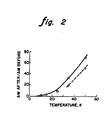
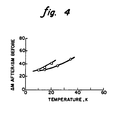
- Figures 1 and 3 are the results of hysteresis measurements displayed for irradiated samples containing 0, 800, and 1600 atomic ppm of uranium and for unirradiated 0 and 1600 ppm samples.
- the irradiation was 1.9 x 10¹⁷ thermal neutrons/cm2. Strong, temperature-dependent enhancement was observed.
- the enhancements in flux pinning are shown in Figures 2 and 4. They range from 10 times at 25K to 70 times at 50K. Note that magnetic hysteresis is not decreasing at liquid nitrogen temperature.
- the temperature dependence of the hysteresis indicates that not only the magnitude of the hysteresis has increased upon radiation; the pinning energy of the fission-fragment-induced pinning centers was larger than that of the pinning centers in the unirradiated samples.
- Fission Fragment Dose can be considered as substantially the equivalent of fission events per cubic centimeter of a sintered body.
- Table I shows that the hysteresis for the undoped samples was very little changed by a thermal neutron fluence of 1.9 x 10¹⁷/cm2. The increases were 4.0%, 1.3%, and 0.8% of those produced in the 1600 ppm-uranium sample (Sample C) at 10K, 35K, and 50K.
- the hysteresis values for the irradiated U-doped samples were enhanced relative to both the undoped, irradiated samples and the unirradiated doped samples.
- the grains may be essentially isolated as far as supercurrents are concerned; in this case the product obtained is J c,g D g , where D g is the dimension of the grain.
- Intermediate situations can occur, in which a portion of the super current flows throughout the sample and another portion is restricted to the grains.
- the critical-state model does not allow one to determine separately the applicable sizes of the regions and the appropriate J c 's. There is thus an essential ambiguity in the interpretation of magnetic hysteresis by means of the critical-state model.
- Kitazawa, and H.L. Tuller (Materials Research Society, Pittsburgh, 1988), p. 247; and K. Itoh, H. Wada, T. Kuroda, Y. Kaieda, O. Odawara, and T. Oie, Cryogenics 28 , 575 (1988); have shown that for polycrystalline sintered compacts the effective size is not the sample size, but is closer to the (much smaller) grain size. This result is to be expected if the intergrain superconductive coupling is very weak. In the present analysis the assumption is made that, at 0.8 Tesla, the currents are restricted to the grains; the measured, appropriately averaged grain size is used for D and the current densities thus calculated are described as intragranular critical-current densities.
- the critical-state model yields particularly simple expressions for the hysteresis for crystals of simple cross-section when certain conditions are met:
- the applied field is large compared with H c1 ; the field variation across the sample is small enough that J c varies little across the sample; and the field has been swept through a sufficiently large excursion that critical currents have been induced in the same sense throughout the sample.
- These conditions are met at 0.8 Tesla in the present experiment.
- the intragranular critical-current densities calculated are shown in Figure 1 on the right-hand scale.
- fission events One special merit of fission events is a greater localization of damage into clumps of disorder - as opposed to dispersed point defects, such as produced for example by electron or gamma-ray irradiation. Because transmission electron microscopy examination found no tracks, the damage present is not from ionization, but from the 5% of the fission energy that goes directly into atomic collisions.
- Table II indicates the relative damage effectiveness of fission fragments under the assumption that each 50 eV expended in atomic collisions can on the average displace an atom.
- the fission damage is localized to within ⁇ 10 ⁇ m of the fissionable atom, whereas the mean free path for a 1 MeV neutron in Bi 1.7 Pb 0.3 Ca2Sr2Cr3O10 is about 3 cm and its energy will be lost through a series of collisions, not in a single event.
- the number is uncertain, but not necessarily small, relative to fission damage, but it is more uniformly dispersed.
Landscapes
- Chemical & Material Sciences (AREA)
- Engineering & Computer Science (AREA)
- Ceramic Engineering (AREA)
- Organic Chemistry (AREA)
- Manufacturing & Machinery (AREA)
- Materials Engineering (AREA)
- Structural Engineering (AREA)
- Inorganic Chemistry (AREA)
- Inorganic Compounds Of Heavy Metals (AREA)
- Compositions Of Oxide Ceramics (AREA)
- Superconductor Devices And Manufacturing Methods Thereof (AREA)
- Superconductors And Manufacturing Methods Therefor (AREA)
Applications Claiming Priority (2)
| Application Number | Priority Date | Filing Date | Title |
|---|---|---|---|
| US07/529,814 US5087606A (en) | 1990-05-29 | 1990-05-29 | Bismuth-containing superconductors containing radioactive dopants |
| US529814 | 1990-05-29 |
Publications (1)
| Publication Number | Publication Date |
|---|---|
| EP0459155A1 true EP0459155A1 (de) | 1991-12-04 |
Family
ID=24111342
Family Applications (1)
| Application Number | Title | Priority Date | Filing Date |
|---|---|---|---|
| EP91106795A Withdrawn EP0459155A1 (de) | 1990-05-29 | 1991-04-26 | Wismut enthaltender Supraleiter |
Country Status (5)
| Country | Link |
|---|---|
| US (1) | US5087606A (de) |
| EP (1) | EP0459155A1 (de) |
| JP (1) | JPH0725548B2 (de) |
| CA (1) | CA2034402A1 (de) |
| IL (1) | IL98097A (de) |
Families Citing this family (7)
| Publication number | Priority date | Publication date | Assignee | Title |
|---|---|---|---|---|
| DE69224064T2 (de) * | 1991-07-01 | 1998-06-18 | Univ Houston | Verfahren zur herstellung von formkörpern aus hochtemperatursupraleitern mit hohen kritischen stromdichten |
| DE4124823A1 (de) * | 1991-07-26 | 1993-01-28 | Hoechst Ag | Hochtemperatur-supraleiter und verfahren zu seiner herstellung |
| US6083885A (en) * | 1997-01-14 | 2000-07-04 | Weinstein; Roy | Method of forming textured high-temperature superconductors |
| GB0313451D0 (en) * | 2003-06-11 | 2003-07-16 | Urenco Power Technologies Ltd | Improvements in and relating to uranium-containing materials |
| US9865383B2 (en) * | 2014-01-22 | 2018-01-09 | National Oilwell Varco, L.P. | Systems and methods for activation of trapped field magnets |
| US11783953B2 (en) * | 2018-10-02 | 2023-10-10 | Massachusetts Institute Of Technology | Cryogenic radiation enhancement of superconductors |
| US20220123194A1 (en) * | 2020-10-17 | 2022-04-21 | Carlo A. Trugenberger | High Temperature Superconducting Device |
Citations (4)
| Publication number | Priority date | Publication date | Assignee | Title |
|---|---|---|---|---|
| US3310395A (en) * | 1964-08-27 | 1967-03-21 | Gen Electric | Superconductors containing a fission able metal or boron impurity |
| US3346425A (en) * | 1964-04-01 | 1967-10-10 | Gen Electric | Superconductors |
| EP0308892A2 (de) * | 1987-09-21 | 1989-03-29 | The Furukawa Electric Co., Ltd. | Supraleitende Oxydflocken und deren Herstellungsverfahren |
| EP0334517A1 (de) * | 1988-03-21 | 1989-09-27 | AT&T Corp. | Wachstum von Supraleitermaterial aus einer Flussmittel-Schmelze, sowie Fertigungsartikel |
Family Cites Families (1)
| Publication number | Priority date | Publication date | Assignee | Title |
|---|---|---|---|---|
| US4996192A (en) * | 1989-07-17 | 1991-02-26 | General Electric Company | Y-Ba-Cu-O superconductor containing radioactive dopants |
-
1990
- 1990-05-29 US US07/529,814 patent/US5087606A/en not_active Expired - Fee Related
-
1991
- 1991-01-17 CA CA002034402A patent/CA2034402A1/en not_active Abandoned
- 1991-04-26 EP EP91106795A patent/EP0459155A1/de not_active Withdrawn
- 1991-05-10 IL IL9809791A patent/IL98097A/en not_active IP Right Cessation
- 1991-05-27 JP JP3149179A patent/JPH0725548B2/ja not_active Expired - Lifetime
Patent Citations (4)
| Publication number | Priority date | Publication date | Assignee | Title |
|---|---|---|---|---|
| US3346425A (en) * | 1964-04-01 | 1967-10-10 | Gen Electric | Superconductors |
| US3310395A (en) * | 1964-08-27 | 1967-03-21 | Gen Electric | Superconductors containing a fission able metal or boron impurity |
| EP0308892A2 (de) * | 1987-09-21 | 1989-03-29 | The Furukawa Electric Co., Ltd. | Supraleitende Oxydflocken und deren Herstellungsverfahren |
| EP0334517A1 (de) * | 1988-03-21 | 1989-09-27 | AT&T Corp. | Wachstum von Supraleitermaterial aus einer Flussmittel-Schmelze, sowie Fertigungsartikel |
Also Published As
| Publication number | Publication date |
|---|---|
| US5087606A (en) | 1992-02-11 |
| JPH04228429A (ja) | 1992-08-18 |
| IL98097A (en) | 1995-10-31 |
| CA2034402A1 (en) | 1991-11-30 |
| JPH0725548B2 (ja) | 1995-03-22 |
| IL98097A0 (en) | 1992-06-21 |
Similar Documents
| Publication | Publication Date | Title |
|---|---|---|
| Kumakura et al. | Localized large superconducting critical currents in Ba2Y1Cu3O9− y | |
| Paranthaman et al. | Synthesis and magnetic characterization of the high-Tc superconducting compound HgBa2CuO4+ δ | |
| US4996192A (en) | Y-Ba-Cu-O superconductor containing radioactive dopants | |
| Sankaranarayanan et al. | An investigation of particle size effects in ultrafine barium ferrite | |
| US6525002B1 (en) | Textured high-temperature superconductors | |
| US5087606A (en) | Bismuth-containing superconductors containing radioactive dopants | |
| Schwartz et al. | Large critical current density in neutron-irradiated polycrystalline HgBa 2 CuO 4+ δ | |
| JP3327548B2 (ja) | 高臨界電流を有する高温超伝導体の成形体の製法 | |
| Wortmann et al. | Mössbauer study of the magnetic high-Tc superconductor GdBa2Cu3O7− δ | |
| Muralidhar et al. | Improved critical current densities in bulk FeSe superconductor using ball milled powders and high temperature sintering | |
| Luborsky et al. | Critical currents after thermal neutron irradiation of uranium doped superconductors | |
| Lyubutin et al. | Comparative Mössbauer spectroscopy and neutron diffraction analysis in YBa2 (Cu1− xFex) 3Oy I. Structural transitions | |
| Hart et al. | Flux pinning and flux creep in uranium-doped (Bi, Pb)-Sr-Ca-Cu-O superconducting powders after thermal-neutron irradiation | |
| JP2609460B2 (ja) | セラミックス系酸化物超電導物質成型体の製造方法 | |
| Malik et al. | Magnetic and Mössbauer studies on GdCo3B2 and DyCo3B2 | |
| EP0430568B1 (de) | Verfahren zur Herstellung eines hoch Tc supraleitenden Materials und nach dem Verfahren hergestellter Artikel | |
| McGuire et al. | Magnetic properties of Y‐Ba‐Cu‐O superconductors | |
| Komura et al. | Absence of neutron Bragg reflections from the magnetic flux-line lattice structures in YBa2Cu3O7 and Bi2Sr2CaCu2O8 | |
| US6191075B1 (en) | Method of manufacturing a high temperature superconductor with improved transport properties | |
| Lu | Experimental studies of yttrium barium (2)(copper (1-x) iron (x))(3) oxygen (7+ delta) and bismuth (2) strontium (2) calcium (n-1) copper (n) oxygen (2n+ 4) high T (c) superconductors | |
| Amm | Synthesis and properties of mercury cuprate superconductors with metallic interfaces | |
| Sosnowski et al. | Magnetic hysteresis effects in high-Tc oxide superconductors | |
| Tan | Microstructure, phase characterization and texture processing of high temperature superconductors | |
| Daeumling | Superconducting magnetic properties and granularity in single and polycrystalline (yttrium, dysprosium) barium (2) copper (3) oxygen (7-delta) | |
| JPH01212222A (ja) | 酸化物超伝導材料 |
Legal Events
| Date | Code | Title | Description |
|---|---|---|---|
| PUAI | Public reference made under article 153(3) epc to a published international application that has entered the european phase |
Free format text: ORIGINAL CODE: 0009012 |
|
| AK | Designated contracting states |
Kind code of ref document: A1 Designated state(s): DE FR GB NL |
|
| 17P | Request for examination filed |
Effective date: 19920212 |
|
| 17Q | First examination report despatched |
Effective date: 19940125 |
|
| STAA | Information on the status of an ep patent application or granted ep patent |
Free format text: STATUS: THE APPLICATION IS DEEMED TO BE WITHDRAWN |
|
| 18D | Application deemed to be withdrawn |
Effective date: 19950926 |