EP0459213B1 - Dispositif d'entraînement pour un arceau de sécurité d'un véhicule automobile - Google Patents
Dispositif d'entraînement pour un arceau de sécurité d'un véhicule automobile Download PDFInfo
- Publication number
- EP0459213B1 EP0459213B1 EP91107798A EP91107798A EP0459213B1 EP 0459213 B1 EP0459213 B1 EP 0459213B1 EP 91107798 A EP91107798 A EP 91107798A EP 91107798 A EP91107798 A EP 91107798A EP 0459213 B1 EP0459213 B1 EP 0459213B1
- Authority
- EP
- European Patent Office
- Prior art keywords
- drive according
- roll bar
- drive
- spring
- motor
- Prior art date
- Legal status (The legal status is an assumption and is not a legal conclusion. Google has not performed a legal analysis and makes no representation as to the accuracy of the status listed.)
- Expired - Lifetime
Links
- 238000006073 displacement reaction Methods 0.000 claims description 11
- 230000008878 coupling Effects 0.000 claims description 2
- 238000010168 coupling process Methods 0.000 claims description 2
- 238000005859 coupling reaction Methods 0.000 claims description 2
- 238000005192 partition Methods 0.000 claims description 2
- 241000282472 Canis lupus familiaris Species 0.000 claims 4
- 210000000078 claw Anatomy 0.000 description 5
- 238000010276 construction Methods 0.000 description 4
- 230000006835 compression Effects 0.000 description 3
- 238000007906 compression Methods 0.000 description 3
- 230000007246 mechanism Effects 0.000 description 1
- 230000000284 resting effect Effects 0.000 description 1
- 239000007858 starting material Substances 0.000 description 1
Images




Classifications
-
- B—PERFORMING OPERATIONS; TRANSPORTING
- B60—VEHICLES IN GENERAL
- B60R—VEHICLES, VEHICLE FITTINGS, OR VEHICLE PARTS, NOT OTHERWISE PROVIDED FOR
- B60R21/00—Arrangements or fittings on vehicles for protecting or preventing injuries to occupants or pedestrians in case of accidents or other traffic risks
- B60R21/02—Occupant safety arrangements or fittings, e.g. crash pads
- B60R21/13—Roll-over protection
-
- B—PERFORMING OPERATIONS; TRANSPORTING
- B60—VEHICLES IN GENERAL
- B60R—VEHICLES, VEHICLE FITTINGS, OR VEHICLE PARTS, NOT OTHERWISE PROVIDED FOR
- B60R21/00—Arrangements or fittings on vehicles for protecting or preventing injuries to occupants or pedestrians in case of accidents or other traffic risks
- B60R21/02—Occupant safety arrangements or fittings, e.g. crash pads
- B60R21/13—Roll-over protection
- B60R2021/132—Roll bars for convertible vehicles
- B60R2021/134—Roll bars for convertible vehicles movable from a retracted to a protection position
- B60R2021/135—Roll bars for convertible vehicles movable from a retracted to a protection position automatically during an accident
Definitions
- the invention relates to a drive for a roll bar of a motor vehicle with the features specified in the preamble of claim 1.
- a known drive of this type (DE-PS 37 32 562) provides for the rapid, sensor-controlled erection of the roll bar at least one piston-cylinder unit which works under the action of an ejection spring.
- An additional drive is provided for the arbitrary erection and lowering of the roll bar, which can be designed as a spindle drive but also as a double-acting hydraulic cylinder. So that the additional drive does not hinder the sensor-controlled rapid erection, the influence of the additional drive on the spring-loaded support piston must be able to be canceled when a crash signal is present.
- the invention has for its object to provide a drive device for a roll bar of a motor vehicle, which requires less construction and is also easier to control.
- the drive motor which is expediently formed by an electric motor, is preferably subjected to a voltage which is below the on-board voltage of the motor vehicle for arbitrary displacement of the roll bar and at least approximately the full on-board voltage for sensor-controlled extension.
- the roll bar is extended or retracted at a reduced speed.
- the full on-board voltage is supplied to the electric motor and the extension speed of the roll bar is significantly higher.
- a possible brief overload of the electric motor will survive without damage if this motor is designed accordingly. Since only one type of drive is used for the roll bar, not only the construction effort and thus the weight is significantly reduced, but also the control effort.
- Fig. 1 of the drawing the rear body area of a convertible vehicle is indicated.
- two roll bars 1 are provided, each of which can be pivoted about a pivot axis 2 running in the longitudinal direction L of the vehicle from the lowered rest position indicated by dash-dotted lines to the support position shown in solid lines.
- Fig. 2a the lowered rest position is shown schematically and in Fig. 2b the upright support position of a roll bar 1 each.
- the roll bar 1 can be controlled arbitrarily at a relatively slow speed, at the discretion of the vehicle user, if appropriate also automatically with automatic convertible top actuation be driven back and forth.
- sensor-controlled very rapid extension from the position according to FIG. 2a to the position according to FIG. 2b, only a few tenths of a second are available for the extension movement.
- One and the same drive motor, namely the electric motor 3 is provided both for the sensor-controlled extension just mentioned and for the much slower arbitrary displacement.
- the electric motor 3 can be loaded with a voltage below the on-board voltage of the motor vehicle for arbitrary displacement and with at least approximately the full on-board voltage for sensor-controlled, rapid extension.
- the roll bar 1 is provided with a partial toothed ring 4 which is coaxial with the pivot axis 2 and into which a pinion 5 which can be driven by the electric motor 3 engages.
- the roll bar 1 also has a locking toothing 6, through which it is fixed in the erected support position by a spring-loaded latch 7.
- a rectilinear roll bar which is essentially displaceable in the vertical direction.
- Support position is a extending in the direction of displacement, axially supported relative to the body of the motor vehicle and driven by the electric motor 3 'threaded spindle 8, which cooperates with a roll bar 1' connected to a threaded nut 9.
- the threaded nut 9 is arranged on a transverse yoke 10, which is connected at its ends with one of the downwardly directed U-legs 11 of the U-shaped roll bar 1 'in a suitable manner.
- a spring-loaded latch 12 is also mounted, which cooperates in the extended position of the roll bar 1 'with a locking toothing 13 supported by the structure.
- the threaded spindle 8 can be connected via a rubber-elastic coupling 14 to the electric motor 3 '. 3, the threaded spindle 8 is supported at its end remote from the electric motor 3 'relative to the vehicle body in a pivot bearing 15.
- the roll bar 1 'with its U-legs 11 is guided by constructionally supported guide tubes 16.
- the guide tubes 16 are located in a flat housing 17 and are fastened to the bottom thereof and are held at their upper edge by the indicated T-profiles 18.
- a housing 17 ' is also provided, which receives each roll bar 1 ⁇ and leads over somewhat differently designed guide tubes 16'.
- spring accumulators 19 are provided which support the extension movement of the roll bar 1 ⁇ in the upright support position.
- the threaded spindle 8 ' is axially supported and supported both at its upper end and at its lower end via corresponding pivot bearings 15 with respect to the vehicle body.
- the threaded spindle 8 ' also works with a threaded nut 9', which in turn is received in a transverse yoke 10, which is connected at its ends to a U-leg 11 of the roll bar 1 ⁇ .
- the electric motor 3 ⁇ , the threaded spindle 8 ', the spring accumulator 19 and the guide tubes 16 are also in this embodiment in a housing 17' which can be attached to the (not shown) vehicle body.
- 3 and the housing 17 'of the embodiment of Figures 4 and 5 is designed so that it can be attached to the partition provided between the passenger compartment and the luggage compartment of the vehicle.
- each spring accumulator 19 is formed by compression springs 20 arranged in the guide tubes 16 '.
- each guide tube 16 ' a plurality of pressure springs 20 connected in series, between which guide pieces 21 are provided.
- the threaded spindle 8 'of the embodiment of Figures 4 and 5 has a steep thread, the pitch angle ⁇ between 35 ° and 55 °, advantageously at about 45 °.
- the thread is a double-start thread.
- the threaded spindle 8 ' can be driven by the electric motor 3 ⁇ over two different gear ratios.
- a double gear 22 which can be driven by the electric motor 3 ⁇ and is axially displaceable between two switching positions is provided.
- the double gear wheel 22 has an internal toothing 23 with a large diameter and coaxial with it, but with an axial offset, an external toothing 24 with a small diameter.
- the switch position 4 in which a rapid extension of the roll bar 1 ⁇ is possible, the internal toothing 23 meshes with a large diameter with a drive gear 25 of the threaded spindle 8 '.
- the other switching position of the double gear 22 which can be seen in Fig.
- a U-shaped roll bar 1 ′′′ is also provided, which is displaceably guided in the direction of its downwardly directed U-legs 11.
- a headrest 27 can also be arranged in its upper region.
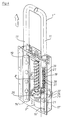
- the roll bar 1 ′′′, together with its guide and the drive elements, is also essentially accommodated in a housing 17 ⁇ . Also in this embodiment, the electric motor 3 ′′′, the drive influence is never canceled, for retracting and extending the roll bar 1 ′′′.
- the attached to the housing 17 ⁇ electric motor 3 ⁇ drives a pulley 28 to which a traction cable 29 is connected, which on the other hand is connected to the roll bar 1 ′′′.
- the pull cable 29 runs in the illustrated embodiment from the pulley 28 up to a pulley 30 and from there down to a U-leg 11 of the roll bar 1 ′′′ connecting transverse yoke 10 ', to which it is attached.
- the cable pulley 28 also has a pulley section 31 with a smaller roll-up diameter, on which a tension cable 32 is fixed.
- the other end of the tension cable 32 is connected to a drive spring 33 which supports the extension movement of the roll bar 1 ′′′.
- the tensioning rope is also guided upward from the roller section 31 of the rope pulley 28 to a further deflection roller 30 and from there down again to the drive spring 33.
- Fig. 6 shows the roll bar in its fully retracted position, in which it has come by a rotational movement of the pulley 28 and the roller section 31 in the direction of arrow 35.
- the pull rope 29 is unwound from the pulley 28 and the roll bar 1 ′′′ can move downwards.
- the drive spring 33 is fully compressed and is in its tensioned state. From this state, it can be unlocked by sensor control in the manner described below. After unlocking (FIG. 7), it exerts a high tensile force on the tensioning cable 32, and thereby supports the rotary movement of the cable pulley 28, which is driven by the electric motor 3′′′ in the sense of the arrow 36 in a sensor-controlled manner. About the traction cable 29, the transverse yoke 10 'and thus the roll bar 1 ′′′ is pulled up very quickly.
- the drive spring 33 is supported with its upper end on the housing 17 ⁇ and with its lower end on the bottom of a displaceable spring sleeve 37 which can be locked and unlocked with respect to the housing 17 ⁇ .
- the spring sleeve 37 has at its upper end at least one angular slot 38 for a fixed mounting pin 39.
- a section of the angular slot 38 runs in the direction of displacement and is open to the upper edge of the spring sleeve 37.
- the other section of the angular slot 38 runs approximately transversely.
- the spring sleeve 37 can be rotated to a limited extent from a locking position (FIG. 6) into a release position (FIG. 7).
- the spring sleeve 37 is held in the locking position by a claw washer 40 which can engage in the longitudinal slots 42 of the spring sleeve 37 with claws 41 projecting axially downward. In the locked position (FIGS.
- the claw plate 40 is held by an electromagnet 43, which can engage with a retaining pin in a bore in a radial arm 44 of the claw plate 40. If the arm 44 is released (FIG. 7), the spring sleeve 37 can rotate under the action of the drive spring 33 to such an extent that it comes free from the holding pin 39 and can be displaced downward.
- the drive spring 33 When the roll bar 1 ′′′ is shifted arbitrarily, the drive spring 33 also always remains in its tensioned state according to FIG. 8. If the claw plate 40 is released under sensor control, the drive spring can 33 also support the complete extension of the roll bar 1 into the upper extreme position from an intermediate position, so that this remaining extension takes place again very quickly.
- the lower end of the drive spring 33 is not directly connected to the free end of the tensioning cable 32 which is guided downward by the deflection roller 34.
- This tensioning cable 32 is connected to the bottom of an upwardly open sleeve 45 which receives a further compression spring 46.
- This compression spring 46 which is significantly weaker than the drive spring 33, rests with its upper end on the bottom of the spring sleeve 37 from below. It supports the retraction of the roll bar 1 don when it is moved arbitrarily and also serves to compensate for the length between the pull rope 29 and the tension rope 32, both of which are wound up or unwound at different diameters of the rope pulley 38.
Landscapes
- Engineering & Computer Science (AREA)
- Mechanical Engineering (AREA)
- Body Structure For Vehicles (AREA)
- Automatic Cycles, And Cycles In General (AREA)
Claims (31)
- Entraînement pour à arceau de sécurité d'un véhicule automobile qui, commandé par un capteur, sort rapidement d'une position de repos abaissée en une position d'appui sortie, et commandé volontairement avec une vitesse lente peut se déplacer dans les deux sens entre ces deux positions extrêmes, caractérisé en ce qu'on prévoit un seul et même moteur d'entraînement (3, 3′, 3˝, 3‴) pour la sortie commandée par capteur ainsi que pour le déplacement volontaire.
- Entraînement selon la revendication 1, caractérisé en ce que le moteur d'entraînement est un moteur électrique (3, 3′, 3˝, 3‴).
- Entraînement selon la revendication 2, caractérisé en ce que le moteur (3, 3′, 3˝, 3‴) est alimenté avec une tension inférieure à celle de la tension embarquée du véhicule automobile pour le déplacement volontaire, et avec une tension proche de la tension embarquée pour la sortie commandée par le capteur.
- Entraînement selon la revendication 1 pour un arceau de sécurité pouvant tourner autour d'un axe de rotation, caractérisé en ce que l'arceau de sécurité (1) présente une couronne (4) partielle dentée coaxiale à l'axe de pivotement (2), laquelle vient en prise un pignon (5) entraînable par le moteur d'entraînement (3).
- Entraînement selon la revendication 1 pour un arceau de sécurité déplaçable approximativement en ligne, caractérisé par une tige filetée (8,8′) entraînée par le moteur d'entraînement (3′, 3˝) s'étendant dans le sens du déplacement, logée axialement vis-à-vis de la structure du véhicule à moteur, tige qui coopère avec un écrou fileté (9, 9′) lié à l'arceau de sécurité (1, 1′).
- Entraînement selon la revendication 5 pour un arceau de sécurité en U, dont les pattes du U sont dirigées vers le bas, caractérisé en ce que l'écrou fileté (9, 9′) est disposé sur une traverse (10, 10′) dont chacune des extrémités est reliée à une patte du U (11).
- Entraînement selon la revendication 5, caractérisé en ce que sur la traverse (10) est logé un cliquet de verrouillage (12) chargé par un ressort qui, en position sortie de l'arceau de sécurité (l') coopère avec une crémaillère (13) solidaire de la structure.
- Entraînement selon la revendication 5, caractérisé en ce que la tige filetée (8) est reliée par un accouplement élastique en caoutchouc (14) au moteur électrique (3′).
- Entraînement selon la revendication 5, caractérisé en ce que la tige filetée (8, 8′) est logée dans un palier de rotation à son extrémité opposée au moteur électrique (3, 3˝) sur la structure du véhicule.
- Entraînement selon la revendication 1, caractérisé en ce qu'on prévoit au moins un ressort accumulateur (19) qui contribue au mouvement de sortie de l'arceau de sécurité (1˝) en position d'appui redressée.
- Entraînement selon la revendication 5, caractérisé en ce que l'arceau de sécurité (1′, 1˝) est guidé à l'aide de ses pattes en U (16, 16′) par des tubes de guidage (16, 16′) appuyés sur la structure.
- Entraînement selon les revendications 10 et 11, caractérisé en ce que le moteur d'entraînement (3˝), la tige filetée (8′), le ressort accumulateur (19) et les tubes de guidage (16′) sont logés dans un boîtier (17′), qu'on peut fixer sur la structure du véhicule.
- Entraînement selon la revendication 12, caractérisé en ce que le boîtier (17, 17′) peut être fixé sur la cloison prévue entre l'habitacle et le coffre à bagage.
- Entraînement selon la revendication 10, caractérisé en ce que le ressort accumulateur (19) est constitué de ressorts de compression (20) disposés dans les tubes de guidage (16′).
- Entraînement selon la revendication 14, caractérisé en ce que dans chaque tube de guidage (16′) on implante l'un derrière l'autre plusieurs ressorts de compression (20), entre lesquels on prévoit des pièces de guidage (21).
- Entraînement selon la revendication 5, caractérisé en ce que la tige filetée (8′) a un filetage à pas rapide de manière appropriée avec un angle de pente (13) compris entre 35° et 55°.
- Entraînement selon la revendication 16, caractérisé en ce que le filetage est un filetage à double pas.
- Entraînement selon la revendication 5, caractérisé en ce que la tige filetée (8′) peut être entraînée par le moteur électrique (3˝) par l'intermédiaire de deux étages différents de transmission.
- Entraînement selon la revendication 18, caractérisé en ce que le moteur électrique (3˝) entraîne une roue à double denture (22) pouvant se déplacer axialement entre deux positions, qui présente une denture interne (23) à grand diamètre et coaxialement, mais avec un décalage axial une petite denture externe (24), dans une position de commutation la denture interne (23) étant en prise et dans l'autre position de commutation la denture externe (24) étant en prise avec une roue dentée d'entraînement (25) de la tige filetée (8′).
- Entraînement selon la revendication 1 pour un arceau de sécurité en U qui est guidé en coulissement dans le sens de ses pattes en U dirigées vers le bas, caractérisé en ce que le moteur d'entraînement (3‴) entraîne une poulie de câble (28) qui est reliée à un câble de traction (29), qui d'autre part est relié à l'arceau de sécurité (1‴).
- Entraînement selon la revendication 20, caractérisé en ce que le câble de traction (29) part vers le haut depuis la poulie de câble (28) sur une poulie de renvoi (30) et de là vers le bas vers une traverse (10′) reliant les pattes en U de l'arceau de sécurité (1‴), et sur laquelle il est fixé.
- Entraînement selon la revendication 20, caractérisé en ce que la poulie de câble (28) présente une partie de poulie (31) avec un diamètre d'enroulement plus petit, sur laquelle est fixé un câble de tension (32), dont l'autre extrémité est reliée à au moins un ressort d'entraînement (33) participant au mouvement de sortie de l'arceau de sécurité (1‴).
- Entraînement selon la revendication 22, caractérisé en ce que le câble de tension (32) est guidé par la partie de poulie (31) de la poulie de câble (28) vers le haut vers une poulie de renvoi (34) et de là à nouveau vers le bas vers le ressort d'entraînement (33).
- Entraînement selon la revendication 22 ou 23, caractérisé en ce que le ressort d'entraînement (33) est déverrouillable dans son état chargé sous la commande du capteur.
- Entraînement selon la revendication 24, caractérisé en ce que le ressort d'entraînement (33) s'appuie par une extrémité sur la structure et par l'autre extrémité sur le fond d'une gaine de ressort (37) déplaçable, qui peut être verrouillée et déverrouillée de façon solidaire de la structure.
- Entraînement selon la revendication 25, caractérisé en ce que la gaine de ressort (37) présente à une extrémité une fente angulaire (38) pour un tourillon de maintien (39) solidaire de la structure, dont une partie s'étend dans le sens de déplacement et est ouverte vers le bord de la gaine de ressort, l'autre partie de fente (38) s'étendant presque transversalement.
- Entraînement selon la revendication 26, caractérisé en ce que la partie dirigée transversalement vers la partie ouverte s'étend en biais et inclinée vers le haut.
- Entraînement selon la revendication 26 ou 27, caractérisé en ce que la gaine de ressort (37) limitée par une position de verrouillage (figure 6) peut tourner dans une position de libération (figure 7).
- Entraînement selon la revendication 28, caractérisé en ce que la gaine de ressort (37) peut tourner grâce à une rondelle à clabots (40), et elle présente des dents axiales (41) qui viennent en prise dans la fente longitudinale du côté bord (42) de la gaine de ressort (37).
- Entraînement selon la revendication 29, caractérisé en ce que la rondelle à clabots (40) est munie à un écartement radial de son axe de rotation, d'un trou (48) dans lequel une tige de maintien (47) déplaçable longitudinalement par un électro aimant (43) peut venir en prise.
- Entraînement selon la revendication 30, caractérisé en ce que le trou (48) est prévu dans un bras radial (44) de la rondelle à clabots (40).
Applications Claiming Priority (2)
| Application Number | Priority Date | Filing Date | Title |
|---|---|---|---|
| DE4017778A DE4017778A1 (de) | 1990-06-01 | 1990-06-01 | Antrieb fuer einen ueberrollbuegel eines kraftfahrzeuges |
| DE4017778 | 1990-06-01 |
Publications (2)
| Publication Number | Publication Date |
|---|---|
| EP0459213A1 EP0459213A1 (fr) | 1991-12-04 |
| EP0459213B1 true EP0459213B1 (fr) | 1992-12-02 |
Family
ID=6407683
Family Applications (1)
| Application Number | Title | Priority Date | Filing Date |
|---|---|---|---|
| EP91107798A Expired - Lifetime EP0459213B1 (fr) | 1990-06-01 | 1991-05-14 | Dispositif d'entraînement pour un arceau de sécurité d'un véhicule automobile |
Country Status (3)
| Country | Link |
|---|---|
| EP (1) | EP0459213B1 (fr) |
| DE (2) | DE4017778A1 (fr) |
| ES (1) | ES2036907T3 (fr) |
Cited By (4)
| Publication number | Priority date | Publication date | Assignee | Title |
|---|---|---|---|---|
| DE4342402C2 (de) * | 1993-12-13 | 2000-08-10 | Ise Gmbh | Antriebs- und Riegelmechanismus für einen geradlinig ausfahrbaren Überrollbügel |
| DE4342403C2 (de) * | 1993-12-13 | 2001-08-16 | Ise Gmbh | Führungsbuchse für einen Überrollbügel |
| US7478874B2 (en) | 2004-03-30 | 2009-01-20 | Wilhelm Karmann Gmbh | Vehicle seat and cabriolet vehicle with such a vehicle seat |
| DE19710095B4 (de) * | 1997-03-12 | 2011-02-03 | Ise Automotive Gmbh | Multifunktionsführungsring zur Radialkraftaufnahme und spiel- und reibungsfreier Axialführung zylindrischer Bauteile |
Families Citing this family (29)
| Publication number | Priority date | Publication date | Assignee | Title |
|---|---|---|---|---|
| DE4100506C1 (fr) * | 1991-01-10 | 1992-05-21 | Mercedes-Benz Aktiengesellschaft, 7000 Stuttgart, De | |
| DE4108878C2 (de) * | 1991-03-19 | 2003-04-17 | Ise Gmbh | Antrieb für einen translatorisch ausfahrbaren Überrollbügel eines Kraftfahrzeuges |
| DE9200457U1 (de) * | 1992-01-16 | 1993-05-19 | Visual Communications Ingenieurberatungs GmbH, 81243 München | Kraftfahrzeug-Cabrio mit Überrollschutz |
| DE4302152C2 (de) * | 1993-01-27 | 2001-07-26 | Ise Gmbh | Mit einer Steuermutter versehener, elektrisch betätigter Komfortantrieb für Überrollbügel |
| DE4307963C2 (de) * | 1993-03-12 | 1995-12-21 | Thomas Heger | Antriebs- und Abstützmechanismus für einen Überrollbügel |
| DE4314538C3 (de) * | 1993-05-03 | 2000-11-09 | Bayerische Motoren Werke Ag | Überrollschutz-Vorrichtung für ein Kraftfahrzeug |
| US5626361A (en) * | 1993-05-03 | 1997-05-06 | Bayerische Motoren Werke Ag | Roll-over protection arrangement for a motor vehicle |
| DE4345425C2 (de) * | 1993-05-03 | 2003-02-20 | Bayerische Motoren Werke Ag | Überrollschutz-Vorrichtung für ein Kraftfahrzeug |
| DE4345523C2 (de) * | 1993-08-03 | 2002-05-23 | Ise Gmbh | Überrollschutzsystem |
| DE4342400C2 (de) * | 1993-08-03 | 2002-06-13 | Ise Gmbh | Überrollbügeleinrichtung |
| NO962574D0 (no) * | 1996-06-18 | 1996-06-18 | Raufoss Automotive As | Anordning ved velteböyle for et kjöretöy |
| DE19752484C2 (de) * | 1997-11-27 | 2000-08-10 | Ise Gmbh | Ausfahrbarer Überrollbügel für Kraftfahrzeuge |
| DE19803398A1 (de) * | 1998-01-29 | 1999-08-05 | Volkswagen Ag | Cabriolet mit Kopfstütze und Überrollschutz an mindestens einem Sitz |
| DE19834689A1 (de) * | 1998-07-31 | 2000-02-03 | Bayerische Motoren Werke Ag | Überrollschutz-System für ein Kraftfahrzeug, insbesondere für ein Cabriolet |
| DE19906912C1 (de) * | 1999-02-19 | 2000-04-13 | Ise Gmbh | Überroll-Schutzsystem für Kraftfahrzeuge |
| FR2791021B1 (fr) * | 1999-03-16 | 2001-05-11 | France Design | Arceau de protection pour vehicule decouvrable a toit repliable |
| DE19943582A1 (de) * | 1999-09-13 | 2001-03-22 | Karmann Gmbh W | Bauteilgruppe für ein Cabriolet-Fahrzeug |
| DE20101165U1 (de) | 2001-01-23 | 2001-06-13 | Blechformwerke Bernsbach Gmbh | Insassen-Schutzvorrichtung für ein Kraftfahrzeug |
| FR2845047B1 (fr) * | 2002-09-30 | 2005-09-09 | Faurecia Sieges Automobile | Appui-tete de vehicule automobile pourvu d'un arceau de securite deployable |
| DE102004035015B3 (de) * | 2004-07-20 | 2005-12-08 | Ise Innomotive Systems Europe Gmbh | Überrollschutzsystem für Kraftfahrzeuge mit versenkbarem Dach |
| DE102005047274B3 (de) * | 2005-10-01 | 2007-01-18 | Ise Innomotive Systems Europe Gmbh | Überrollschutzsystem für Kraftfahrzeuge mit einem aufstellbaren Überrollkörper |
| DE102006013913B4 (de) * | 2006-03-25 | 2008-05-29 | Automotive Group Ise Innomotive Systems Europe Gmbh | Schutzvorrichtung in Kraftfahrzeugen zum Personenschutz |
| DE102006050183A1 (de) * | 2006-10-25 | 2008-04-30 | Daimler Ag | Kopfstützenanordnung für einen Kraftwagen |
| DE102006057029A1 (de) * | 2006-12-04 | 2008-06-26 | Automotive Group Ise Innomotive Systems Europe Gmbh | Überrollschutzsystem für Kraftfahrzeuge mit einem sensorgesteuert aktiv aufstellbaren Drehbügel |
| DE102006057030A1 (de) * | 2006-12-04 | 2008-06-26 | Automotive Group Ise Innomotive Systems Europe Gmbh | Überrollschutzsystem für Kraftfahrzeuge mit einem sensorgesteuert aktiv aufstellbaren Überrollkörper |
| DE102010013975A1 (de) * | 2010-04-06 | 2011-10-06 | Dr. Ing. H.C. F. Porsche Aktiengesellschaft | Überrollbügelanordnung für ein Kraftfahrzeug und Kraftfahrzeug mit einer solchen Überrollbügelanordnung |
| DE102010061303B4 (de) * | 2010-12-17 | 2023-04-27 | Dr. Ing. H.C. F. Porsche Aktiengesellschaft | Kastenförmiger Überrollkörper und Überrollschutzsystem |
| DE102013204567B4 (de) * | 2013-03-15 | 2022-03-24 | Deutsches Zentrum für Luft- und Raumfahrt e.V. | Fahrzeug |
| GB2531645A (en) * | 2015-09-09 | 2016-04-27 | Daimler Ag | Roll over protection system for a vehicle, in particular a convertible |
Family Cites Families (9)
| Publication number | Priority date | Publication date | Assignee | Title |
|---|---|---|---|---|
| GB1105132A (en) * | 1964-04-20 | 1968-03-06 | Lansing Bagnall Ltd | Improvements in or relating to control systems for electric motors |
| US3292726A (en) * | 1964-12-21 | 1966-12-20 | Jr Emile Jette | Automobile safety device having roof reinforcing bar |
| GB1159594A (en) * | 1966-10-11 | 1969-07-30 | Emile Jette Jr | Automobile Safety Device having Roof Reinforcing Bar |
| JPS577737A (en) * | 1980-06-13 | 1982-01-14 | Aisin Seiki Co Ltd | Controller of door and seat on vehicle |
| US4557502A (en) * | 1983-11-07 | 1985-12-10 | Onofrio Scaduto | Roll bar retracting mechanism for convertibles |
| JPS60153692U (ja) * | 1984-03-23 | 1985-10-14 | アルプス電気株式会社 | モ−タ駆動制御装置 |
| US4733145A (en) * | 1985-07-11 | 1988-03-22 | Aisin Seiki Kabushiki Kaisha | Drive control system for vehicle mounted, electrically driven devices |
| DE3732562C1 (de) * | 1987-09-26 | 1988-11-24 | Daimler Benz Ag | Antriebsvorrichtung fuer einen UEberrollbuegel fuer Kraftwagen |
| DE3736400A1 (de) * | 1987-10-28 | 1989-05-11 | Reitter & Schefenacker Kg | Sicherheitsvorrichtung fuer bewegliche teile, vorzugsweise fuer fensterheber und schiebedaecher von kraftfahrzeugen |
-
1990
- 1990-06-01 DE DE4017778A patent/DE4017778A1/de not_active Withdrawn
-
1991
- 1991-05-14 ES ES199191107798T patent/ES2036907T3/es not_active Expired - Lifetime
- 1991-05-14 EP EP91107798A patent/EP0459213B1/fr not_active Expired - Lifetime
- 1991-05-14 DE DE9191107798T patent/DE59100016D1/de not_active Expired - Fee Related
Cited By (4)
| Publication number | Priority date | Publication date | Assignee | Title |
|---|---|---|---|---|
| DE4342402C2 (de) * | 1993-12-13 | 2000-08-10 | Ise Gmbh | Antriebs- und Riegelmechanismus für einen geradlinig ausfahrbaren Überrollbügel |
| DE4342403C2 (de) * | 1993-12-13 | 2001-08-16 | Ise Gmbh | Führungsbuchse für einen Überrollbügel |
| DE19710095B4 (de) * | 1997-03-12 | 2011-02-03 | Ise Automotive Gmbh | Multifunktionsführungsring zur Radialkraftaufnahme und spiel- und reibungsfreier Axialführung zylindrischer Bauteile |
| US7478874B2 (en) | 2004-03-30 | 2009-01-20 | Wilhelm Karmann Gmbh | Vehicle seat and cabriolet vehicle with such a vehicle seat |
Also Published As
| Publication number | Publication date |
|---|---|
| ES2036907T3 (es) | 1993-06-01 |
| DE4017778A1 (de) | 1991-12-05 |
| DE59100016D1 (de) | 1993-01-14 |
| EP0459213A1 (fr) | 1991-12-04 |
Similar Documents
| Publication | Publication Date | Title |
|---|---|---|
| EP0459213B1 (fr) | Dispositif d'entraînement pour un arceau de sécurité d'un véhicule automobile | |
| EP0240747B1 (fr) | Stores sans guidage, notamment pour véhicules automobiles | |
| EP1905630B1 (fr) | Store de fenêtre actionné manuellement | |
| EP0309686B1 (fr) | Dispositif d'actionnement d'un arceau de sécurité d'automobile | |
| EP1332056B1 (fr) | Store de fenetre ou grille de separation comportant deux engrenages angulaires | |
| EP1524153B1 (fr) | Dispositif de protection pour un coffre de véhicule | |
| EP2913577B1 (fr) | Dispositif de recouvrement pour ouvertures, plus particulièrement pour ouvertures de machines | |
| DE10151872A1 (de) | Geteiltes Fensterrollo für Kraftfahrzeuge | |
| EP1844984A2 (fr) | Espace de chargement pour un véhicule automobile doté d'un dispositif de protection | |
| EP0504482B1 (fr) | Dispositif d'entraînement pour un arceau de sécurité déplaçable en translation | |
| DE3415930A1 (de) | Kraftfahrzeugfensterrollo | |
| DE29810132U1 (de) | Laderaumabdeckung für Kraftfahrzeuge, insbesondere für Kombinations-Personenkraftwagen o.dgl. | |
| WO2018219665A1 (fr) | Dispositif d'entraînement conçu pour un siège de véhicule, en particulier un siège de véhicule automobile, et siège de véhicule | |
| EP0608794B1 (fr) | Entraînement électrique pour arceau de sécurité comportant un écrou de commande | |
| EP1325507A1 (fr) | Accumulateur d'energie pour un commutateur a plots | |
| EP2289743B1 (fr) | Appui de levage | |
| DE20112948U1 (de) | Sichtschutzvorrichtung für eine Kraftfahrzeugscheibe | |
| EP0192094B1 (fr) | Dispositif pour le verrouillage et déverrouillage d'éléments tubulaires s'insérant télescopiquement et coaxialement les uns dans les autres | |
| EP3478521B1 (fr) | Dispositif d'ombrage pour une vitre de véhicule automobile | |
| DE10048224A1 (de) | Verriegelungseinheit für einen Teleskopausleger eines Krans | |
| EP1057696B1 (fr) | Dispositif à arceau de sécurité pour véhicules | |
| DE102018005268B4 (de) | Vorrichtung zum Umklappen einer Sitzlehne eines Fahrzeugsitzes | |
| EP1186482B1 (fr) | Cartouche pour arceau de sécurité guidant un arceau déployable et rétractable | |
| WO2014040867A1 (fr) | Béquille réglable en hauteur pour semi-remorques ou analogues | |
| EP2922728A1 (fr) | Dispositif de protection destiné à l'habitacle d'un véhicule et mécanisme de levage pour ledit dispositif |
Legal Events
| Date | Code | Title | Description |
|---|---|---|---|
| PUAI | Public reference made under article 153(3) epc to a published international application that has entered the european phase |
Free format text: ORIGINAL CODE: 0009012 |
|
| 17P | Request for examination filed |
Effective date: 19910930 |
|
| AK | Designated contracting states |
Kind code of ref document: A1 Designated state(s): DE ES FR GB IT |
|
| 17Q | First examination report despatched |
Effective date: 19920514 |
|
| GRAA | (expected) grant |
Free format text: ORIGINAL CODE: 0009210 |
|
| AK | Designated contracting states |
Kind code of ref document: B1 Designated state(s): DE ES FR GB IT |
|
| ET | Fr: translation filed | ||
| GBT | Gb: translation of ep patent filed (gb section 77(6)(a)/1977) |
Effective date: 19921211 |
|
| REF | Corresponds to: |
Ref document number: 59100016 Country of ref document: DE Date of ref document: 19930114 |
|
| ITF | It: translation for a ep patent filed | ||
| REG | Reference to a national code |
Ref country code: ES Ref legal event code: FG2A Ref document number: 2036907 Country of ref document: ES Kind code of ref document: T3 |
|
| PLBE | No opposition filed within time limit |
Free format text: ORIGINAL CODE: 0009261 |
|
| STAA | Information on the status of an ep patent application or granted ep patent |
Free format text: STATUS: NO OPPOSITION FILED WITHIN TIME LIMIT |
|
| 26N | No opposition filed | ||
| PGFP | Annual fee paid to national office [announced via postgrant information from national office to epo] |
Ref country code: DE Payment date: 19990507 Year of fee payment: 9 |
|
| PGFP | Annual fee paid to national office [announced via postgrant information from national office to epo] |
Ref country code: ES Payment date: 19990512 Year of fee payment: 9 |
|
| PGFP | Annual fee paid to national office [announced via postgrant information from national office to epo] |
Ref country code: GB Payment date: 19990513 Year of fee payment: 9 |
|
| PGFP | Annual fee paid to national office [announced via postgrant information from national office to epo] |
Ref country code: FR Payment date: 19990528 Year of fee payment: 9 |
|
| PG25 | Lapsed in a contracting state [announced via postgrant information from national office to epo] |
Ref country code: GB Free format text: LAPSE BECAUSE OF NON-PAYMENT OF DUE FEES Effective date: 20000514 |
|
| PG25 | Lapsed in a contracting state [announced via postgrant information from national office to epo] |
Ref country code: ES Free format text: THE PATENT HAS BEEN ANNULLED BY A DECISION OF A NATIONAL AUTHORITY Effective date: 20000516 |
|
| GBPC | Gb: european patent ceased through non-payment of renewal fee |
Effective date: 20000514 |
|
| PG25 | Lapsed in a contracting state [announced via postgrant information from national office to epo] |
Ref country code: FR Free format text: LAPSE BECAUSE OF NON-PAYMENT OF DUE FEES Effective date: 20010131 |
|
| PG25 | Lapsed in a contracting state [announced via postgrant information from national office to epo] |
Ref country code: DE Free format text: LAPSE BECAUSE OF NON-PAYMENT OF DUE FEES Effective date: 20010301 |
|
| REG | Reference to a national code |
Ref country code: FR Ref legal event code: ST |
|
| REG | Reference to a national code |
Ref country code: ES Ref legal event code: FD2A Effective date: 20020204 |
|
| PG25 | Lapsed in a contracting state [announced via postgrant information from national office to epo] |
Ref country code: IT Free format text: LAPSE BECAUSE OF NON-PAYMENT OF DUE FEES;WARNING: LAPSES OF ITALIAN PATENTS WITH EFFECTIVE DATE BEFORE 2007 MAY HAVE OCCURRED AT ANY TIME BEFORE 2007. THE CORRECT EFFECTIVE DATE MAY BE DIFFERENT FROM THE ONE RECORDED. Effective date: 20050514 |