EP0459344A1 - Dispositif de téléchargement de logiciel pour un terminal de télécommunication - Google Patents
Dispositif de téléchargement de logiciel pour un terminal de télécommunication Download PDFInfo
- Publication number
- EP0459344A1 EP0459344A1 EP91108566A EP91108566A EP0459344A1 EP 0459344 A1 EP0459344 A1 EP 0459344A1 EP 91108566 A EP91108566 A EP 91108566A EP 91108566 A EP91108566 A EP 91108566A EP 0459344 A1 EP0459344 A1 EP 0459344A1
- Authority
- EP
- European Patent Office
- Prior art keywords
- software
- interface
- download
- radiotelephone
- network
- Prior art date
- Legal status (The legal status is an assumption and is not a legal conclusion. Google has not performed a legal analysis and makes no representation as to the accuracy of the status listed.)
- Withdrawn
Links
Images



Classifications
-
- H—ELECTRICITY
- H04—ELECTRIC COMMUNICATION TECHNIQUE
- H04W—WIRELESS COMMUNICATION NETWORKS
- H04W8/00—Network data management
- H04W8/22—Processing or transfer of terminal data, e.g. status or physical capabilities
- H04W8/24—Transfer of terminal data
- H04W8/245—Transfer of terminal data from a network towards a terminal
-
- G—PHYSICS
- G06—COMPUTING OR CALCULATING; COUNTING
- G06F—ELECTRIC DIGITAL DATA PROCESSING
- G06F8/00—Arrangements for software engineering
- G06F8/60—Software deployment
- G06F8/65—Updates
-
- H—ELECTRICITY
- H04—ELECTRIC COMMUNICATION TECHNIQUE
- H04M—TELEPHONIC COMMUNICATION
- H04M1/00—Substation equipment, e.g. for use by subscribers
- H04M1/72—Mobile telephones; Cordless telephones, i.e. devices for establishing wireless links to base stations without route selection
- H04M1/724—User interfaces specially adapted for cordless or mobile telephones
- H04M1/72403—User interfaces specially adapted for cordless or mobile telephones with means for local support of applications that increase the functionality
- H04M1/72406—User interfaces specially adapted for cordless or mobile telephones with means for local support of applications that increase the functionality by software upgrading or downloading
-
- H—ELECTRICITY
- H04—ELECTRIC COMMUNICATION TECHNIQUE
- H04W—WIRELESS COMMUNICATION NETWORKS
- H04W88/00—Devices specially adapted for wireless communication networks, e.g. terminals, base stations or access point devices
- H04W88/02—Terminal devices
- H04W88/06—Terminal devices adapted for operation in multiple networks or having at least two operational modes, e.g. multi-mode terminals
Definitions
- the software executed by each of the terminals must be able to evolve over time, in order to: correct anamolies in this software; or improve the operation of the terminal; or offer new services to subscribers; or follow the evolution of technical specifications of telecommunications networks; or adapt to different networks requiring the execution of different software, for example if a terminal is moved from one country to another.
- the download delay can be inconvenient for the subscriber.
- a first object of the invention is to propose a device which not only makes it possible to download the operating software of a terminal but which also allows frequent changes from one operating software to another without delays annoying for the user. .
- the device thus characterized makes it possible to change the operating software without having to download it each time. It therefore simplifies the adaptation of a radiotelephone or a cordless telephone to a change of network.
- the adaptation only consists in selecting one of the memories, if the software corresponding to the zone where the terminal is located, has already been downloaded previously.
- the terminal has a single memory or several random access memories to store one or more operating software, it is necessary to connect this terminal to a center providing the software to be downloaded.
- One known means consists in using the conventional interface for connecting the terminal to the telecommunications network, the software to be downloaded being routed by said network via the conventional interface.
- the device as well characterized has the advantage of being particularly simple since it does not require adding an additional interface.
- it has the drawback of subjecting the download to the limitations of the terminal's usual transmission channel. For example, the download speed of a radio telephone is limited by the speed of its voice channel or its signaling channel.
- the device thus characterized has the advantage of allowing the downloading of a radiotelephone entirely independently of the radiotelephone network to which the terminal is usually connected, which makes it possible to avoid any constraint imposed by the latter, such as a limitation of the speed of the information transmitted for download, or such as the occupation of a transmission channel, for the entire time necessary to download the software.
- the radiotelephone 9 shown in FIG. 1 comprises: a first random access memory 1; a second RAM 2; a read only memory 3 storing download software; a microprocessor 4; and a radio interface 5. All of these means are linked together by a bus.
- the radiotelephone 9 is in radio relation with a base station, 8, connected to a radiotelephone network 7.
- the radio interface 5 is a conventional interface allowing the radiotelephone to communicate with the base station 8, but it is also used to download operating software, into one of the two random access memories, 1 and 2.
- the downloading operations are carried out by the microprocessor 4 by executing the downloading software stored in the read only memory 3.
- the radiotelephone 9 comprising a plurality of random access memories, 1 and 2, means are provided for selecting one of these random access memories in writing, with a view to downloading different software in each of these random access memories; and means for selecting one of these read-only memories, for executing only one of these software programs.
- the means for selecting one of the two random access memories, for writing consist essentially of the microprocessor 4, controlled by: the download software contained in the read only memory 3, or by a module provided in each operating software.
- the writing selection is controlled by the microprocessor 4 according to the instructions of the downloading software.
- the download software also provides instructions to allow the radiotelephone to establish a radio link, and then download software over that link.
- the execution of the download software is launched: either by a message supplied by the network 7, or by an order from the user, by means of a keyboard incorporated in the radiotelephone 9 and not shown.
- the selection of the software to be executed for the usual operation that is to say the selection of one of the two read random access memories is controlled either by a message sent by the network 7, or by an order given by the user.
- Each operating software comprises a module for taking into account: a message from the network 7; or an order from the user; and the identity of the software possibly stored in the two RAMs, 2 and 3; and to deduce therefrom which random access memory must be selected, in writing or in reading.
- the radio interface defined by the Special Mobile Group of the European Telecommunications Conference provides for data transmission channels between the network and mobile radiotelephones, for point-to-point transmission or general broadcast. These channels allow a bit rate of up to 9.6 kbits per second.
- General broadcasting can be used to update the radiotelephone software for an entire fleet simultaneously.
- point-to-point transmission can be used to download a particular radiotelephone which enters a geographical area served by a network requiring the execution of operating software, which is not already stored in one of the memories from the radiotelephone.
- the download is launched on the initiative of the network, after analysis of a parameter called "Classmark Update” contained in a message called “Loc Upd Request” sent by the mobile radiotelephone to initialize a procedure called localization, when it enters the new area.
- This parameter indicates the version of the radiotelephone. It indicates whether this radiotelephone is downloadable and what type of download it is likely to accept: partial, for certain functions; or total, for all functions except location and download.
- the network 7 initiates the download by sending to the radiotelephone 9, by radio, a message which is interpreted by the microprocessor 4 by executing an adequate module of the operating software, which is being executed at the instant considered. Once the download operation is complete, the location procedure is complete. The radiotelephone then has all the information necessary to operate in the new area.
- the creation of the download software is within the reach of those skilled in the art.
- the part ensuring the loading of random access memories is analogous to the bootstrap software (bootstrap in English) used to load software from a floppy disk to the main memory of a computer.
- the part ensuring the establishment of a radio link is a simplified version of conventional software controlling the operation of a radiotelephone.
- This first variant of the device according to the invention has the advantage of being simple and inexpensive, since it suffices to provide the radiotelephone with at least one random access memory, and one read-only memory containing download software, without interface. additional compared to a conventional radiotelephone.
- the downloads of several terminals can be carried out simultaneously, which allows a upgrade of part or all of the terminals of a radiotelephony network, in a single operation. Distributing software fixes, or completely replacing software is therefore easy.
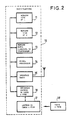
- FIG. 2 represents the block diagram of a radiotelephone 10 comprising a second embodiment of the device according to the invention.
- the radiotelephone 10 comprises: two RAM 11 and 12; a read only memory 13 containing the download software; a microprocessor 14; a conventional radio interface 15; a smart card reader interface, 16; and a smart card reader, 17.
- the means 11 to 16 are interconnected by a bus.
- the download interface is a specific interface, independent of the radio interface 15, and made up of the smart card reader interface, 16.
- This variant allows software to be downloaded independently of the radiotelephony network, which has the advantage of avoiding the constraints thereof.
- a card download software is simpler than a radio link download software, the latter requiring a complex procedure for its establishment.
- the download is controlled by the user by means of a keyboard incorporated into the radiotelephone 10, after the user has inserted a smart card 18 into the smart card reader 17.
- the selection of one of the two random access memories , 11 or 12, in writing is controlled by the user by means of his keyboard.
- the selection of one of the two read-only memories is controlled either by the user or by a module of the operating software, during execution, in the manner described above for the radiotelephone 9, for example during a change in geographic area.
- the smart card 18 is distributed to users by the operator of the network, either directly by mail, or through a distribution channel such as commercial agencies, or traditional businesses. Note that the smart card reader can be replaced by a magnetic card reader.
- FIG. 3 represents the block diagram of a radiotelephone 20 comprising a third embodiment of the device according to the invention. It includes: two RAMs, 21 and 22; a memory 23 storing download software; a microprocessor 24; a conventional radio interface 25; and an interface 26 for connection to a standardized access to a digital network with integrated services, 57.
- the radiotelephone 20 establishes a radiotelephone link with a base station 59, connected to a radiotelephone network 58. The latter is connected to the network integrated service digital, 57.
- the means 21 to 26 are interconnected by a bus.
- the radio interface 25 can establish a radio relationship with the base station 59 for the transmission of telephone signals, against the software download being carried out by means of a cable temporarily connecting the interface 26 to a standardized network access 57.
- This cable is provided with a standardized male connector 27 which can be inserted into a standardized female connector 28 connected to the network 57.
- This variant has the advantage of using a means of transmitting the software which is more readily available than a smart card, insofar as the number of accesses to the network 57 is very high.
- FIG. 4 represents the block diagram of a fixed terminal 30 for a digital network with service integration, this terminal 30 comprising a fourth embodiment of the device according to the invention.
- the terminal 30 comprises two random access memories, 31 and 32, for storing respectively two different operating software, registered by download; a read only memory 33 storing in permanently download software; a microprocessor 34; and an interface 35, for connection to a digital network with service integration, also constituting an interface for downloading operating software.
- the interface 35 is permanently connected to a standardized access of a digital network with integration of services, 38, by a cable provided with a standardized male connector 36 plugged into a standardized female connector 37 connected to the network 38.
- This variant of embodiment has the advantage that the operating software is downloaded via a conventional interface 35, which avoids adding a specific interface.
- Each standardized access 37 comprises a so-called user-to-user signaling channel, and several channels for the actual transmission, carrying voice signals, for example.
- Downloading software can be done through one of these two types of channels, or by combining the two; the transmission channels being used to transmit the software to be downloaded, and the signaling channel being used to initiate and complete the download.
- the download of one of the random access memories, 31 or 32 is started by the user, by means of a keyboard, or by the operating software being executed, when he receives a download order sent by the network 38.
- Each operating software comprises a module for taking into account: an order from the user, or an order from the network 38.
- the selection of one of the two read-write or read-only memories is controlled by the microprocessor 4, according to the instructions of the download software and according to the orders given by the user or by the network.
- Downloading new operating software and switching from old software to new software can be entirely remote controlled by the network operator 38, without user intervention.
- FIG. 5 represents the block diagram of another example of a fixed terminal, 40, for a digital network with integrated services, 51, this terminal comprising a download device according to the second variant.
- This terminal 40 comprises: two random access memories, 41 and 42, for storing respectively two different operating software, which are downloaded; a read only memory 43 permanently storing download software; a microprocessor 44; an interface 45 for connection to a digital network with integrated services; an interface 46 for a smart card reader; and a smart card reader 47.
- the means 41 to 46 are interconnected by a bus.
- the interface 45 is a conventional interface permanently connected to a digital network with integrated services, 51, by means of a cable provided with a standardized male connector, 49, plugged into a standardized female connector, 50, connected to the network 51.
- the smart card reader 47 is connected to an input of the interface 46.
- the user selects one of the two random access memories, 41 or 42, by means of a non-keyboard shown, then introduces a smart card 48 into the reader 47.
- the selection of one of the two read-only memories is carried out in a similar manner to that described above, for the terminal 30.
- the reader 47 can be replaced by a magnetic card reader.
Landscapes
- Engineering & Computer Science (AREA)
- Software Systems (AREA)
- Computer Networks & Wireless Communication (AREA)
- Signal Processing (AREA)
- General Engineering & Computer Science (AREA)
- Theoretical Computer Science (AREA)
- Human Computer Interaction (AREA)
- Computer Security & Cryptography (AREA)
- Databases & Information Systems (AREA)
- Physics & Mathematics (AREA)
- General Physics & Mathematics (AREA)
- Mobile Radio Communication Systems (AREA)
- Information Transfer Between Computers (AREA)
Abstract
L'invention concerne un dispositif pour télécharger un terminal de télécommunication, par exemple un radiotéléphone (9), afin de changer son logiciel de fonctionnement, sans que l'usager de ce radiotéléphone doive l'apporter à une agence commerciale de l'opérateur du réseau de radiotéléphonie. Dans un exemple de réalisation, chaque radiotéléphone comporte :
- une pluralité de mémoires vives (1, 2) pour stocker différents logiciels de fonctionnement;
- une mémoire morte (3) stockant un logiciel de téléchargement;
- un microprocesseur (4) exécutant soit le logiciel de téléchargement, soit l'un des programmes de fonctionnement;
- une interface radio classique (5), utilisée, d'une part, comme interface de téléchargement, et d'autre part, pour les liaisons radiotéléphoniques classiques.
Application à tous les terminaux de télécommunication, comportant un microprocesseur, notamment les terminaux répandus en très grand nombre dans le public.
Description
- L'invention concerne un dispositif de téléchargement de logiciel pour un terminal de télécommunication, tel qu'un radiotéléphone mobile pour réseau cellulaire, ou un téléphone sans fil, ou un terminal fixe de réseau numérique à intégration de services. Ces terminaux ont des caractéristiques communes :
- ils exécutent un logiciel, car ils comportent un microprocesseur réalisant l'essentiel des opérations constituant leur fonctionnement;
- ils sont diffusés en très grand nombre dans le grand public.
- Le logiciel exécuté par chacun des terminaux doit pouvoir évoluer au cours du temps, pour : corriger des anamolies de ce logiciel; ou améliorer le fonctionnement du terminal; ou offrir de nouveaux services aux abonnés; ou suivre l'évolution des spécifications techniques des réseaux de télécommunication; ou s'adapter à différents réseaux nécessitant l'exécution de logiciels différents, par exemple si un terminal est déplacé d'un pays à un autre.
- Changer le logiciel exécuté par un terminal présente des difficultés importantes. Le logiciel est classiquement stocké dans une mémoire morte. Changer un logiciel nécessite de rapporter les terminaux à une agence commerciale et de remplacer des composants dans ces terminaux. Chaque terminal est donc indisponible à l'usager pendant un certain temps. Ces opérations sont donc coûteuses pour l'opérateur du réseau.
- L'article "Portable Telecommunication" dans "Proceedings of the national communications forum" vol 42 n°2, 30 septembre 1988, page 1708, mentionne que des protocoles de réseau, des services et des possibilités d'accès peuvent être téléchargés dans un terminal portable de télécommunication. Cependant cette solution n'est pas bien adaptée au cas d'un terminal mobile qui franchit fréquemment une frontière entre deux territoires sur lesquels les protocoles de communications sont différents. En effet, il faut un certain délai pour chaque téléchargement de logiciel de fonctionnement.
- Le délai de téléchargement peut être gênant pour l'abonné.
- Un premier but de l'invention est de proposer un dispositif qui permettent non seulement de télécharger le logiciel de fonctionnement d'un terminal mais qui permette en outre des changements fréquents d'un logiciel de fonctionnement à un autre sans délais gênant par l'usager.
- Selon l'invention, un dispositif de téléchargement de logiciel pour un terminal de télécommunication raccordé à un réseau de télécommunication par une interface classique appelée interface de raccordement au réseau, ledit terminal comportant un microprocesseur commandant le fonctionnement dudit terminal en exécutant un logiciel dit de fonctionnement, est caractérisé en ce qu'il comporte en outre :
- une pluralité de mémoires vive pour mémoriser plusieurs logiciels de fonctionnement;
- au moins une interface de téléchargement pour recevoir, et inscrire dans une mémoire vive, un logiciel de fonctionnement;
- une mémoire morte stockant un logiciel de téléchargement.
- des moyens pour sélectionner l'une de ces mémoires vives en écriture, pour télécharger un logiciel différent dans chacune de ces mémoires vives; et pour sélectionner l'un de ces mémoires vives en lecture, pour exécuter l'un de ces logiciels dans le microprocesseur.
- Le dispositif ainsi caractérisé permet de changer le logiciel de fonctionnement sans avoir à le télécharger à chaque fois. Il simplifie donc l'adaptation d'un radiotéléphone ou d'un téléphone sans fil, à un changement de réseau. L'adaptation consiste seulement à sélectionner l'une des mémoires, si le logiciel correspondant à la zone où est situé le terminal, a déjà été téléchargé antérieurement.
- Que le terminal comporte une seule mémoire ou plusieurs mémoires vives pour stocker un ou plusieurs logiciels de fonctionnement, il est nécessaire de relier ce terminal à un centre fournissant les logiciels à télécharger. Un moyen connu consiste à utiliser l'interface classique de raccordement du terminal au réseau de télécommunication, le logiciel à télécharger étant acheminé par ledit réseau via l'interface classique. Le dispositif ainsi caractérisé a pour avantage d'être particulièrement simple puisqu'il ne nécessite pas de rajouter une interface supplémentaire. Mais il a pour inconvénient de soumettre le téléchargement aux limitations du canal de transmission habituelle du terminal. Par exemple, le débit du téléchargement d'un radio-téléphone est limité par le débit de son canal vocal ou de son canal de signalisation.
- Un second but de l'invention est de proposer un dispositif de téléchargement qui n'ai pas cet inconvénient. Un second objet de l'invention est un dispositif de téléchargement pour un radiotéléphone, ledit radiotéléphone comportant :
- un microprocesseur commandant le fonctionnement dudit radiotéléphone en exécutant un logiciel dit de fonctionnement;
- au moins une mémoire vive pour mémoriser au moins un logiciel de fonctionnement;
- au moins une interface de téléchargement pour recevoir, et inscrire dans une mémoire vive, un logiciel de fonctionnement;
- une mémoire morte stockant un logiciel de téléchargement;
- Le dispositif ainsi caractérisé présente l'avantage de permettre le téléchargement d'un radiotéléphone tout à fait indépendamment du réseau de radiotéléphonie auquel le terminal est relié habituellement, ce qui permet d'éviter toute contrainte imposée par ce dernier, telle qu'une limitation du débit des informations transmises pour le téléchargement, ou telle que l'occupation d'un canal de transmission, pendant toute la durée nécessaire au téléchargement du logiciel.
- L'invention sera mieux comprise et d'autres détails apparaîtront à l'aide de la description ci-dessous, et des figures l'accompagnant :
- les figures 1 à 3 représentent respectivement les schémas synoptiques de trois exemples de radiotéléphone comportant respectivement trois exemples de réalisation du dispositif selon l'invention;
- les figures 4 et 5 représentent respectivement les schémas synoptiques de deux exemples de terminaux fixes de réseau numérique à intégration de services, comportant respectivement deux exemples de réalisation du dispositif selon l'invention.
- Le radiotéléphone 9 représenté sur la figure 1 comporte : une première mémoire vive 1; une seconde mémoire vive 2; une mémoire morte 3 stockant un logiciel de téléchargement; un microprocesseur 4; et une interface radio 5. Tous ces moyens sont reliés entre eux par un bus. Le radiotéléphone 9 est en relation radio avec une station de base, 8, reliée à un réseau de radiotéléphonie 7. L'interface radio 5 est une interface classique permettant au radiotéléphone de communiquer avec la station de base 8, mais elle est en outre utilisée pour télécharger un logiciel de fonctionnement, dans l'une des deux mémoires vives, 1 et 2. Les opérations de téléchargement sont réalisées par le microprocesseur 4 en exécutant le logiciel de téléchargment stocké dans la mémoire morte 3.
- La présence de deux mémoires vives, 1 et 2, permet de stocker deux logiciels différents correspondant par exemple au logiciel en cours de validité et à un autre logiciel qui remplacera le précédent à une date prédéterminée. Ou bien, ces deux logiciels correspondent à deux types de réseau différents, exploités dans des pays différents. Naturellement, cet exemple n'est pas limitatif et il est possible de prévoir un plus grand nombre de mémoires vives, si la diversité des réseaux conduit à utiliser plus de deux logiciels différents.
- Le radiotéléphone 9 comportant une pluralité de mémoires vives, 1 et 2, il est prévu des moyens pour sélectionner l'une de ces mémoires vives en écriture, en vue de télécharger un logiciel différent dans chacune de ces mémoires vives; et des moyens pour sélectionner l'une de ces mémoires vives en lecture, pour éxécuter seulement l'un de ces logiciels.
- Les moyens pour sélectionner l'une des deux mémoires vives, en écriture, sont constitués essentiellement par le microprocesseur 4, commandé par : le logiciel de téléchargement contenu dans la mémoire morte 3, ou par un module prévu dans chaque logiciel de fonctionnement.
- Lorsqu' aucun logiciel de fonctionnement n'est présent dans les mémoires vives, la sélection en écriture est commandée par le microprocesseur 4 en fonction des instructions du logiciel de téléchargement. Le logiciel de téléchargement fournit en outre des instructions pour permettre au radiotéléphone d'établir une liaison radio, puis télécharger un logiciel par cette liaison.
- L'exécution du logiciel de téléchargement est lancée : soit par un message fourni par le réseau 7, soit par un ordre de l'usager, au moyen d'un clavier incorporé au radiotéléphone 9 et non représenté.
- La sélection du logiciel à exécuter pour le fonctionnement habituel, c'est-à-dire la sélection de l'une des deux mémoires vives en lecture est commandée soit par un message envoyé par le réseau 7, soit par un ordre donné par l'usager.
- Chaque logiciel de fonctionnement comporte un module pour prendre en compte : un message du réseau 7; ou un ordre de l'usager; et l'identité des logiciels éventuellement stockés dans les deux mémoires vives, 2 et 3; et pour en déduire quelle mémoire vive doit être sélectionnée, en écriture ou en lecture.
- L'interface radio définie par le Groupe Spécial Mobile de la Conférence Européenne des Télécommunications, prévoie des canaux de transmission de données entre le réseau et les radiotéléphone mobiles, pour une transmission de point à point ou une diffusion générale. Ces canaux autorisent un débit pouvant atteindre 9,6 kbits par seconde.
- La diffusion générale est utilisable pour mettre à jour simultanément les logiciels des radiotéléphones de tout un parc. Au contraire, la transmission de point à point est utilisable pour télécharger un radiotéléphone particulier qui entre dans une zone géographique desservie par un réseau nécessitant l'exécution d'un logiciel de fonctionnement, qui n'est pas déjà stocké dans l'une des mémoires vives du radiotéléphone.
- Le téléchargement est lancé à l'initiative du réseau, après analyse d'un paramètre appelé "Classmark Update" contenu dans un message appelé "Loc Upd Request" envoyé par le radiotéléphone mobile pour initialiser une procédure dite de localisation, lorqu'il entre dans la nouvelle zone. Ce paramètre indique la version du radiotéléphone. Il indique si ce radiotéléphone est téléchargeable et quel type de téléchargement il est susceptible d'accepter : partiel, pour certaines fonctions; ou total, pour toutes les fonctions sauf la localisation et le téléchargement. Le réseau 7 lance le téléchargement en envoyant au radiotéléphone 9, par radio, un message qui est interprêté par le microprocesseur 4 en exécutant un module adéquat du logiciel de fonctionnement, qui est en cours d'exécution à l'instant considéré. Une fois l'opération de téléchargement terminée, la procédure de localisation est terminée. Le radiotéléphone dispose alors de toutes les informations nécessaires pour fonctionner dans la nouvelle zone.
- La réalisation du logiciel de téléchargement est à la portée de l'Homme de l'Art. La partie assurant le chargement des mémoires vives est analogue au logiciel d'amorçage (bootstrap en anglais) utilisé pour charger un logiciel d'une disquette vers la mémoire centrale d'un ordinateur. La partie assurant l'établissement d'une liaison radio est une version simplifiée d'un logiciel classique commandant le fonctionnement d'un radiotéléphone.
- Cette première variante du dispositif selon l'invention a pour avantage d'être simple et peu coûteuse, puisqu'il suffit de munir le radiotéléphone d'au moins une mémoire vive, et d'une mémoire morte contenant un logiciel de téléchargement, sans interface supplémentaire par rapport à un radiotéléphone classique. Les téléchargements de plusieurs terminaux peuvent être réalisés simultanément, ce qui permet une mise à niveau d'une partie ou de l'ensemble des terminaux d'un réseau de radiotéléphonie, en une seule opération. La diffusion de corrections d'un logiciel, ou le remplacement complet d'un logiciel est donc facile.
- La figure 2 représente le schéma synoptique d'un radiotéléphone 10 comportant un second exemple de réalisation du dispositif selon l'invention. Le radiotéléphone 10 comporte : deux mémoires vives 11 et 12; une mémoire morte 13 contenant le logiciel de téléchargement; un microprocesseur 14; une interface radio classique 15; une interface de lecteur de carte à puce, 16; et un lecteur de carte à puce, 17. Les moyens 11 à 16 sont reliés entre eux par un bus.
- L'interface de téléchargement est une interface spécifique, indépendante de l'interface radio 15, et constituée de l'interface de lecteur de carte à puce, 16. Cette variante de réalisation permet de télécharger un logiciel indépendamment du réseau de radiotéléphonie, ce qui présente l'avantage d'éviter les contraintes de celui-ci. D'autre part un logiciel de téléchargement par carte est plus simple qu'un logiciel de téléchargement par relation radio, celle-ci nécessitant une procédure complexe pour son établissement. Le téléchargement est commandé par l'usager au moyen d'un clavier incorporé au radiotéléphone 10, après que l'usager ait introduit une carte à puce 18 dans le lecteur de carte à puce 17. La sélection de l'une des deux mémoires vives, 11 ou 12, en écriture est commandée par l'usager au moyen de son clavier. La sélection de l'une des deux mémoires vives en lecture est commandée soit par l'usager, soit par un module du logiciel de fonctionnement, en cours d'éxécution, de la façon décrite précédemment pour le radiotéléphone 9, par exemple lors d'un changement de zone géographique.
- Il est possible de réaliser un logiciel de téléchargement permettant un téléchargement alternativement par l'interface radio 15, comme décrit pour le radiotéléphone 9, ou par le lecteur de carte 17, comme décrit ci-dessus pour le radiotéléphone 10.
- La carte à puce 18 est distribuée aux usagers par l'opérateur du réseau, soit directement par courrier, soit par l'intermédiaire d'un circuit de distribution telles que des agences commerciales, ou des commerces classiques. Il est à remarquer que le lecteur de carte à puce peut être remplacé par un lecteur de carte magnétique.
- La figure 3 représente le schéma synoptique d'un radiotéléphone 20 comportant un troisième exemple de réalisation du dispositif selon l'invention. Il comporte : deux mémoires vives, 21 et 22; une mémoire 23 stockant un logiciel de téléchargement; un microprocesseur 24; une interface radio classique 25; et une interface 26 de raccordement à un accès normalisé d'un réseau numérique à intégration de services, 57. Le radiotéléphone 20 établit une liaison radiotéléphonique avec une station de base 59, reliée à un réseau de radiotéléphonie 58. Ce dernier est relié au réseau numérique à intégration de services, 57. Les moyens 21 à 26 sont reliés entre eux par un bus. L'interface radio 25 peut établir une relation radio avec la station de base 59 pour la transmission de signaux téléphoniques, par.contre le téléchargement de logiciel est effectué au moyen d'un câble reliant temporairement l'interface 26 à un accès normalisé du réseau 57. Ce câble est muni d'un connecteur mâle normalisé 27 pouvant inséré dans un connecteur femelle normalisé 28 relié au réseau 57.
- Quand l'usager décide de télécharger un logiciel dans son radiotéléphone 20, il sélectionne en écriture l'une des deux mémoires vives, 21 ou 22, au moyen d'un clavier, après avoir connecté le câble reliant l'interface 26 au réseau 57. La sélection en lecture de l'une des deux mémoires vives, 21 ou 22, est réalisée de manière analogue à celle décrite pour le radio téléphone 9.
- Cette variante a pour avantage d'utiliser un moyen de transmission du logiciel qui est plus facilement disponible qu'une carte à puce, dans la mesure où le nombre d'accès au réseau 57 est très élevé.
- La figure 4 représente le schéma synoptique d'un terminal fixe 30 pour réseau numérique à intégration de services, ce terminal 30 comportant un quatrième exemple de réalisation du dispositif selon l'invention. Le terminal 30 comporte deux mémoires vives, 31 et 32, pour stocker respectivement deux logiciels de fonctionnement, différents, inscrits par téléchargement; une mémoire morte 33 stockant en permanence un logiciel de téléchargement; un microprocesseur 34; et une interface 35, de raccordement à un réseau numérique à intégration de services, constituant aussi une interface de téléchargement des logiciels de fonctionnement.
- L'interface 35 est reliée en permanence à un accès normalisé d'un réseau numérique à intégration de services, 38, par un câble muni d'un connecteur mâle normalisé 36 enfiché dans un connecteur femelle normalisé 37 raccordé au réseau 38. Cette variante de réalisation, a pour avantage que les logiciels de fonctionnement sont téléchargés par l'intermédiaire d'un interface classique 35, ce qui évite de rajouter une interface spécifique.
- Chaque accès normalisé 37 comporte un canal dit de signalisation d'usager à usager, et plusieurs canaux pour la transmissionn proprement dite, acheminant des signaux vocaux, par exemple. Le téléchargement d'un logiciel peut être réalisé par l'intermédiaire de l'un de ces deux types de canaux, ou bien en combinant les deux; les canaux de transmission étant utilisés pour transmettre le logiciel à télécharger, et le canal de signalisation étant utilisé pour initialiser et pour conclure le téléchargement.
- Le téléchargement de l'une des mémoires vives, 31 ou 32, est lancé par l'usager, au moyen d'un clavier, ou par le logiciel de fonctionnement en cours d'éxécution, lorsqu'il reçoit un ordre de téléchargement envoyé par le réseau 38. Chaque logiciel de fonctionnement comporte un module pour prendre en compte : un ordre de l'usager, ou un ordre du réseau 38. La sélection de l'une des deux mémoires vives en écriture ou en lecture est commandée par la microprocesseur 4, en fonction des instructions du logiciel de téléchargement et en fonction des ordres donnés par l'usager ou par le réseau.
- Le téléchargement d'un nouveau logiciel de fonctionnement et le basculement d'un logiciel ancien au logiciel nouveau peuvent être entièrement télécommandés par l'opérateur du réseau 38, sans intervention de l'usager.
- La figure 5 représente le schéma synoptique d'un autre exemple de terminal fixe, 40, pour réseau numérique à intégration de services, 51, ce terminal comportant un dispositif de téléchargement selon la seconde variante. Ce terminal 40 comporte : deux mémoires vives, 41 et 42, pour stocker respectivement deux logiciels de fonctionnement, différents, qui sont téléchargés; une mémoire morte 43 stockant en permanence un logiciel de téléchargement; un microprocesseur 44; une interface 45 de raccordement à un réseau numérique à intégration de services; une interface 46 pour lecteur de carte à puce; et un lecteur de carte à puce 47. Les moyens 41 à 46 sont reliés entre eux par un bus.
- L'interface 45 est une interface classique reliée en permanence à un réseau numérique à intégration de services, 51, au moyen d'un câble muni d'un connecteur mâle normalisé, 49, enfiché dans un connecteur femelle normalisé, 50, relié au réseau 51. Le lecteur 47 de carte à puce est relié à une entrée de l'interface 46. Pour télécharger un logiciel de fonctionnement, l'usager sélectionne l'une des deux mémoires vives, 41 ou 42, au moyen d'un clavier non représenté, puis introduit une carte à puce 48 dans le lecteur 47. La sélection de l'une des deux mémoires vives en lecture est réalisée de manière analogue à celle décrite précédemment, pour le terminal 30.
- Il est possible de prévoir un logiciel de téléchargement permettant de télécharger alternativement par le réseau 51 ou par une carte 48, en fonction des circonstances. Le lecteur 47 peut être remplacé par un lecteur de carte magnétique.
- La portée de l'invention n'est pas limitée aux exemples décrits ci-dessus. Elle est applicable à tout autre terminal de télécommunication comportant un microprocesseur, si la complexité de son logiciel et son évolution dans le temps justifient de changer occasionnellement ce logiciel.
Claims (4)
- Dispositif de téléchargement de logiciel pour un terminal de télécommunication (9) raccordé à un réseau de télécommunication (7) par une interface classique (5) appelée interface de raccordement au réseau, ledit terminal comportant un microprocesseur (4 ) commandant le fonctionnement dudit terminal (9) en exécutant un logiciel dit de fonctionnement;
caractérisé en ce qu'il comporte en outre :- une pluralité de mémoires vive (1, 2) pour mémoriser plusieurs logiciels de fonctionnement;- au moins une interface de téléchargement (5) pour recevoir, et inscrire dans une mémoire vive (1, 2), un logiciel de fonctionnement;- une mémoire morte (3) stockant un logiciel de téléchargement.- des moyens (4) pour sélectionner l'une de ces mémoires vives en écriture, pour télécharger un logiciel différent dans chacune de ces mémoires vives; et pour sélectionner l'une de ces mémoires vives en lecture, pour exécuter l'un de ces logiciels dans le microprocesseur (4). - Dispositif selon la revendication 1, caractérisé en ce que les moyens pour sélectionner (4) sont commandés par un message du réseau, acheminé par l'interface (5) de raccordement au réseau de télécommunication (7).
- Dispositif selon la revendication 2, caractérisé en ce que les moyens pour sélectionner (4) sont commandés au moyen d'un clavier manipulé par l'usager du terminal (9).
- Dispositif pour télécharger un logiciel dans un radiotéléphone (20), caractérisé en ce qu'il comporte une interface spécifique pour le téléchargement constituée d'une interface (26) permettant de raccorder ledit radiotéléphone (20) à un accès normalisé (28) d'un réseau numérique à intégration de service (57), le logiciel à télécharger étant acheminé par ledit réseau, jusqu'à cet accès normalisé (28).
Applications Claiming Priority (2)
| Application Number | Priority Date | Filing Date | Title |
|---|---|---|---|
| FR9006710A FR2662891A1 (fr) | 1990-05-30 | 1990-05-30 | Dispositif de telechargement de logiciel pour un terminal de telecommunication. |
| FR9006710 | 1990-05-30 |
Publications (1)
| Publication Number | Publication Date |
|---|---|
| EP0459344A1 true EP0459344A1 (fr) | 1991-12-04 |
Family
ID=9397088
Family Applications (1)
| Application Number | Title | Priority Date | Filing Date |
|---|---|---|---|
| EP91108566A Withdrawn EP0459344A1 (fr) | 1990-05-30 | 1991-05-27 | Dispositif de téléchargement de logiciel pour un terminal de télécommunication |
Country Status (3)
| Country | Link |
|---|---|
| EP (1) | EP0459344A1 (fr) |
| AU (1) | AU643526B2 (fr) |
| FR (1) | FR2662891A1 (fr) |
Cited By (67)
| Publication number | Priority date | Publication date | Assignee | Title |
|---|---|---|---|---|
| GB2256113A (en) * | 1991-05-24 | 1992-11-25 | Nokia Mobile Phones Ltd | Programming of the functions of a cellular radio |
| EP0510322A3 (en) * | 1991-04-24 | 1993-04-07 | Robert Bosch Gmbh | Digital radio telephone network |
| EP0562890A1 (fr) * | 1992-03-27 | 1993-09-29 | Orange Personal Communications Services Limited | Réseau de communication mobile avec actualisation à distance des modules d'identité des participants dans des terminals mobiles |
| FR2695526A1 (fr) * | 1992-09-04 | 1994-03-11 | Motorola Inc | Système permettant le transfert d'informations entre un émetteur-récepteur radio et élément de mémorisation portatif. |
| EP0578760A4 (fr) * | 1991-04-04 | 1994-10-19 | Motorola Inc | Unite de communication equipee d'une programmation radioelectrique. |
| WO1994030023A1 (fr) * | 1993-06-15 | 1994-12-22 | Celltrace Communications Limited | Systeme de telecommunications |
| FR2710224A1 (fr) * | 1993-07-30 | 1995-03-24 | Ericsson Ge Mobile Communicat | Procédé et appareil de perfectionnement de téléphones mobiles cellulaires. |
| FR2725052A1 (fr) * | 1994-09-27 | 1996-03-29 | Eca | Dispositif de telecommande d'organes, tels que des vannes, a actionnement hydraulique en milieu sous-marin |
| WO1996014719A1 (fr) * | 1994-11-07 | 1996-05-17 | Motorola Inc. | Systeme et procede d'exploitation de systeme de communications |
| WO1996038993A1 (fr) * | 1995-06-02 | 1996-12-05 | Dsc Communications Corporation | Terminal d'abonne reconfigurable pour systeme de telecommunications sans fil |
| FR2736735A1 (fr) * | 1995-07-11 | 1997-01-17 | Mireille Campana | Systeme de chargement du logiciel dans des organes de telephonie et notamment dans des publiphones |
| WO1997029606A1 (fr) * | 1996-02-12 | 1997-08-14 | British Telecommunications Public Limited Company | Systeme telephonique |
| WO1998007287A1 (fr) * | 1996-08-15 | 1998-02-19 | British Telecommunications Public Limited Company | Systeme de telephone mobile |
| GB2319438A (en) * | 1996-11-13 | 1998-05-20 | Int Maritime Satellite Organiz | User Terminal for Multiple Services |
| WO1998038820A3 (fr) * | 1997-02-26 | 1998-12-03 | Ericsson Telefon Ab L M | Procede et appareil permettant d'apporter a distance des ameliorations a un logiciel de commande dans un telephone cellulaire |
| WO1998058506A1 (fr) * | 1997-06-17 | 1998-12-23 | Telefonaktiebolaget Lm Ericsson | Systeme et procede permettant de personnaliser des unites de communication sans fil |
| WO1998041044A3 (fr) * | 1997-03-14 | 1999-01-14 | Northern Telecom Inc | Procede et appareil destines a une mise a jour de parametres declenchee par reseau |
| WO1999003288A1 (fr) * | 1997-07-10 | 1999-01-21 | Ericsson Inc. | Systeme et procede de mise a jour d'une memoire dans un dispositif electronique par transfert de donnees sans fil |
| US5887254A (en) * | 1996-04-26 | 1999-03-23 | Nokia Mobile Phones Limited | Methods and apparatus for updating the software of a mobile terminal using the air interface |
| EP0812120A3 (fr) * | 1996-06-06 | 1999-05-19 | Nokia Mobile Phones Ltd. | Méthode d'utilisation des services offerts par un réseau, un système de télécommunication et terminal correspondant |
| EP0836340A3 (fr) * | 1996-10-08 | 1999-05-19 | At&T Wireless Services, Inc. | Procédé et dispositif de programmation par voie radio de services de télécommunication |
| US5909437A (en) * | 1995-06-02 | 1999-06-01 | Airspan Communications Corporation | Software download for a subscriber terminal of a wireless telecommunications system |
| EP0804045A3 (fr) * | 1996-04-24 | 1999-06-09 | Telia Ab | Service multimédia adaptatif |
| EP0802694A3 (fr) * | 1996-04-16 | 1999-08-11 | Nokia Mobile Phones Ltd. | Terminal mobile programmable à distance |
| EP0739148A3 (fr) * | 1995-04-21 | 1999-08-11 | Siemens Aktiengesellschaft | Réseau de programmation à distance d'une station radio mobile et station radio mobile à cet effet |
| AU713402B2 (en) * | 1996-02-12 | 1999-12-02 | British Telecommunications Public Limited Company | Telephone system |
| US6006104A (en) * | 1987-10-09 | 1999-12-21 | Motorola, Inc. | Mixed mode transceiver system |
| US6195532B1 (en) | 1996-06-28 | 2001-02-27 | At&T Wireless Srcs. Inc. | Method for categorization of multiple providers in a wireless communications service environment |
| US6223042B1 (en) | 1997-06-26 | 2001-04-24 | At&T Wireless Services Inc | Method of intelligent roaming using network information |
| FR2800963A1 (fr) * | 1999-11-09 | 2001-05-11 | Wavecom Sa | Procede de mise a jour d'un programme principal execute par un module de radiocommunication et/ou de donnees associees a ce programme principal, et module de radiocommunication correspondant |
| AU734670B2 (en) * | 1997-02-26 | 2001-06-21 | Telefonaktiebolaget Lm Ericsson (Publ) | Method and apparatus for remotely upgrading control software in a cellular telephone |
| US6282420B1 (en) | 1995-12-12 | 2001-08-28 | At&T Wireless Services Inc. | Method for selecting a wireless communications service provider in a multi-service provider environment |
| US6298235B1 (en) | 1995-12-12 | 2001-10-02 | At&T Wireless Services, Inc. | Powered down selection of a preferable wireless communications service provider in a multi-service provider environment |
| WO2001086985A1 (fr) * | 2000-05-08 | 2001-11-15 | Nokia Corporation | Procede de gestion de station mobile par radio |
| US6349204B1 (en) * | 1996-02-12 | 2002-02-19 | British Telecommunications Public Limited Company | Provision of telecommunications control program data pursuant to preliminary data exchange between system elements |
| WO2002043421A1 (fr) * | 2000-11-21 | 2002-05-30 | Siemens Aktiengesellschaft | Procede de configuration automatisee de liaisons de communication d'un terminal mobile appartenant a un systeme de telephonie mobile |
| US6418318B1 (en) | 1995-12-12 | 2002-07-09 | At&T Wireless Services, Inc. | Method for selecting a preferable wireless communications service provider in a multi-service provider environment |
| US6470182B1 (en) | 1998-08-17 | 2002-10-22 | At&T Wireless Service, Inc. | Mobile station roaming in a multiple service provider area |
| FR2824442A1 (fr) * | 2001-05-07 | 2002-11-08 | Sagem | Procede et dispositif de mise a jour de logiciel de telephone mobile a distance |
| US6487403B2 (en) * | 1999-08-19 | 2002-11-26 | Verizon Laboratories Inc. | Wireless universal provisioning device |
| EP0820614A4 (fr) * | 1995-04-12 | 2003-01-02 | Minorplanet Systems Usa Inc | Correction a distance d'un code d'exploitation dans une unite mobile |
| AU758367B2 (en) * | 1997-02-26 | 2003-03-20 | Telefonaktiebolaget Lm Ericsson (Publ) | Method and apparatus for remotely upgrading control software in a cellular telephone |
| WO2003010668A3 (fr) * | 2001-07-26 | 2003-09-25 | Kyocera Wireless Corp | Systeme et procede destines au diagnostic sur le terrain d'un logiciel de systeme de dispositif de communications sans fil |
| US6643506B1 (en) * | 1996-08-07 | 2003-11-04 | Telxon Corporation | Wireless software upgrades with version control |
| WO2003043303A3 (fr) * | 2001-11-13 | 2003-12-04 | France Telecom | Reconfiguration de composants programmables dans un appareil electronique |
| US6684324B2 (en) * | 1998-10-09 | 2004-01-27 | Nokia Mobile Phones Ltd. | Method for installing two or more operating systems/user interfaces into an electronic device and an electronic device |
| EP1398983A1 (fr) * | 2002-09-12 | 2004-03-17 | Sagem SA | Procédé de mise à jour à distance d'un logiciel embarqué dans un Téléphone mobile et système de mise en oeuvre |
| EP1429569A1 (fr) * | 2002-12-13 | 2004-06-16 | Samsung Electronics Co., Ltd. | Station mobile et méthode pour télécharger sélectivement des composants d'un logiciel en comparant les spécifiques nombres de version des composants |
| WO2004077802A1 (fr) * | 2003-02-26 | 2004-09-10 | Ip2H Ag | Appareil de telecommunication, reseau de telecommunication et procede de mise a jour de logiciels au sein d'un appareil de telecommunication |
| US6961537B2 (en) | 2001-08-10 | 2005-11-01 | Kyocera Wireless Corp. | System and method for peer-to-peer handset communication |
| US7027806B2 (en) | 2001-07-26 | 2006-04-11 | Kyocera Wireless, Corp. | System and method for field downloading a wireless communications device software code section |
| US7088990B1 (en) | 1996-02-26 | 2006-08-08 | Nokia Mobile Phones, Ltd. | Communication network terminal supporting a plurality of applications |
| WO2006089902A1 (fr) * | 2005-02-25 | 2006-08-31 | Thomson Licensing | Dispositif de radiocommunication et systeme de radiocommunication comportant un tel dispositif |
| US7143407B2 (en) | 2001-07-26 | 2006-11-28 | Kyocera Wireless Corp. | System and method for executing wireless communications device dynamic instruction sets |
| US7159214B2 (en) | 2001-07-26 | 2007-01-02 | Kyocera Wireless Corp. | System and method for compacting field upgradeable wireless communication device software code sections |
| US7184759B2 (en) | 2001-07-26 | 2007-02-27 | Kyocera Wireless Corp. | Modular software components for wireless communication devices |
| US7184793B2 (en) | 2001-07-26 | 2007-02-27 | Kyocera Wireless Corp. | System and method for over the air area code update |
| US7197302B2 (en) | 2001-07-26 | 2007-03-27 | Kyocera Wireless Corp. | System and method for interchangeable modular hardware components for wireless communication devices |
| US7200389B2 (en) | 2001-07-26 | 2007-04-03 | Kyocera Wireless Corp. | Dynamic interface software for wireless communication devices |
| US7254386B2 (en) | 2001-08-10 | 2007-08-07 | Kyocera Wireless Corp. | System and method for improved security in handset reprovisioning and reprogramming |
| US7328007B2 (en) | 2001-07-26 | 2008-02-05 | Kyocera Wireless Corp. | System and method for organizing wireless communication device system software |
| US7359698B2 (en) | 2003-09-08 | 2008-04-15 | Kyocera Wireless Corp. | Systems and methods for enhanced over-the-air programming |
| US7386846B2 (en) | 2001-07-26 | 2008-06-10 | Kyocera Wireless Corp. | System and method for the management of wireless communications device system software downloads in the field |
| CN100473180C (zh) * | 2001-06-22 | 2009-03-25 | 无纸交互式报纸公司 | 多媒体广播、用于蜂窝电话和其它用户的广播服务,以及用于使能这种广播接收的改进的sim卡及相关装置 |
| US8135745B2 (en) | 2008-03-04 | 2012-03-13 | Core Wireless Licensing S.A.R.L. | Storage management |
| US8866589B2 (en) | 2000-05-23 | 2014-10-21 | M2M Solutions Llc | Programmable communicator |
| US9554268B2 (en) | 2001-07-26 | 2017-01-24 | Kyocera Corporation | System and method for updating persistent data in a wireless communications device |
Families Citing this family (3)
| Publication number | Priority date | Publication date | Assignee | Title |
|---|---|---|---|---|
| FI98183C (fi) * | 1992-02-14 | 1997-04-25 | Nokia Mobile Phones Ltd | Järjestely data-adapterin kytkemiseksi GSM-solukkopuhelimeen |
| DE4417296B4 (de) * | 1994-01-21 | 2005-10-20 | Kolbus Gmbh & Co Kg | Vorrichtung zum Einrichten einer Buchbindemaschine |
| AU687996B2 (en) | 1994-02-24 | 1998-03-05 | Gte Wireless Service Corporation | Cellular radiotelephone system with remotely programmed mobile stations |
Citations (4)
| Publication number | Priority date | Publication date | Assignee | Title |
|---|---|---|---|---|
| US4736409A (en) * | 1985-09-02 | 1988-04-05 | Kabushiki Kaisha Toshiba | Control data transmission system for private branch exchange |
| EP0297616A1 (fr) * | 1987-07-02 | 1989-01-04 | Alcatel SEL Aktiengesellschaft | Equipement d'abonné radio à commande par processeur |
| DE3815071A1 (de) * | 1988-05-04 | 1989-11-16 | Loewe Opta Gmbh | Verfahren zur bestimmungsgemaessen programmierung eines bildschirmtextgeraetes |
| EP0369110A2 (fr) * | 1988-11-15 | 1990-05-23 | Robert Bosch Gmbh | Radiotéléphone mobile |
-
1990
- 1990-05-30 FR FR9006710A patent/FR2662891A1/fr not_active Withdrawn
-
1991
- 1991-05-27 EP EP91108566A patent/EP0459344A1/fr not_active Withdrawn
- 1991-05-29 AU AU77395/91A patent/AU643526B2/en not_active Ceased
Patent Citations (4)
| Publication number | Priority date | Publication date | Assignee | Title |
|---|---|---|---|---|
| US4736409A (en) * | 1985-09-02 | 1988-04-05 | Kabushiki Kaisha Toshiba | Control data transmission system for private branch exchange |
| EP0297616A1 (fr) * | 1987-07-02 | 1989-01-04 | Alcatel SEL Aktiengesellschaft | Equipement d'abonné radio à commande par processeur |
| DE3815071A1 (de) * | 1988-05-04 | 1989-11-16 | Loewe Opta Gmbh | Verfahren zur bestimmungsgemaessen programmierung eines bildschirmtextgeraetes |
| EP0369110A2 (fr) * | 1988-11-15 | 1990-05-23 | Robert Bosch Gmbh | Radiotéléphone mobile |
Non-Patent Citations (2)
| Title |
|---|
| PHILIPS TDS REVIEW, vol. 45, no. 2, juin 1987, pages 10-26, Eindhoven, NL; J.F. BRIEND et al.: "French PTT MINITEL and LECAM programme" * |
| PROCEEDINGS OF THE NATIONAL COMMUNICATIONS FORUM, vol. 42, no. 2, 30 septembre 1988, pages 1706-1713; P.E. JACKSON et al.: "Portable communication" * |
Cited By (127)
| Publication number | Priority date | Publication date | Assignee | Title |
|---|---|---|---|---|
| US6006104A (en) * | 1987-10-09 | 1999-12-21 | Motorola, Inc. | Mixed mode transceiver system |
| EP0578760A4 (fr) * | 1991-04-04 | 1994-10-19 | Motorola Inc | Unite de communication equipee d'une programmation radioelectrique. |
| EP0510322A3 (en) * | 1991-04-24 | 1993-04-07 | Robert Bosch Gmbh | Digital radio telephone network |
| GB2256113B (en) * | 1991-05-24 | 1995-09-27 | Nokia Mobile Phones Ltd | Programming of the functions of a cellular radio telephone |
| GB2256113A (en) * | 1991-05-24 | 1992-11-25 | Nokia Mobile Phones Ltd | Programming of the functions of a cellular radio |
| EP0562890A1 (fr) * | 1992-03-27 | 1993-09-29 | Orange Personal Communications Services Limited | Réseau de communication mobile avec actualisation à distance des modules d'identité des participants dans des terminals mobiles |
| FR2695526A1 (fr) * | 1992-09-04 | 1994-03-11 | Motorola Inc | Système permettant le transfert d'informations entre un émetteur-récepteur radio et élément de mémorisation portatif. |
| US6453167B1 (en) | 1993-06-15 | 2002-09-17 | British Technology Group Inter-Corporate Licensing | Telecommunications systems |
| EP1298946A3 (fr) * | 1993-06-15 | 2008-02-27 | British Technology Group Inter-Corporate Licensing Limited | Système de télécommunications |
| CN1083667C (zh) * | 1993-06-15 | 2002-04-24 | 英国技术集团国际合作许可有限公司 | 包括控制其中的用户单元的模块的电信系统及操作方法 |
| US7551933B2 (en) | 1993-06-15 | 2009-06-23 | Celltrace Llc | Telecommunications system |
| WO1994030023A1 (fr) * | 1993-06-15 | 1994-12-22 | Celltrace Communications Limited | Systeme de telecommunications |
| US6011976A (en) * | 1993-06-15 | 2000-01-04 | Celltrace Communications Limited | Telecommunications system with value added service directory and an integrated circuit module therefor |
| CN100440985C (zh) * | 1993-06-15 | 2008-12-03 | 英国技术集团国际合作许可有限公司 | 电信系统 |
| AU691812B2 (en) * | 1993-06-15 | 1998-05-28 | British Technology Group Inter-Corporate Licensing Limited | Telecommunications system |
| FR2710224A1 (fr) * | 1993-07-30 | 1995-03-24 | Ericsson Ge Mobile Communicat | Procédé et appareil de perfectionnement de téléphones mobiles cellulaires. |
| EP0704779A1 (fr) * | 1994-09-27 | 1996-04-03 | Societe Eca | Dispositif de télécommande d'organes, tels que des vannes, à actionnement hydraulique en milieu sous-marin |
| FR2725052A1 (fr) * | 1994-09-27 | 1996-03-29 | Eca | Dispositif de telecommande d'organes, tels que des vannes, a actionnement hydraulique en milieu sous-marin |
| US6223030B1 (en) * | 1994-11-07 | 2001-04-24 | Motorola, Inc. | Communications operating system and method therefor |
| AU700136B2 (en) * | 1994-11-07 | 1998-12-24 | Motorola, Inc. | Communications operating system and method therefor |
| WO1996014719A1 (fr) * | 1994-11-07 | 1996-05-17 | Motorola Inc. | Systeme et procede d'exploitation de systeme de communications |
| GB2294844B (en) * | 1994-11-07 | 1999-05-26 | Motorola Inc | Communications operating system and method therefor |
| CN1080976C (zh) * | 1994-11-07 | 2002-03-13 | 摩托罗拉公司 | 通信系统操作方法 |
| EP0820614A4 (fr) * | 1995-04-12 | 2003-01-02 | Minorplanet Systems Usa Inc | Correction a distance d'un code d'exploitation dans une unite mobile |
| EP2177996A3 (fr) * | 1995-04-12 | 2010-05-26 | Sasial Vehicle Technologies Limited | Adaption à distance de code d'opération dans une unité mobile |
| EP0739148A3 (fr) * | 1995-04-21 | 1999-08-11 | Siemens Aktiengesellschaft | Réseau de programmation à distance d'une station radio mobile et station radio mobile à cet effet |
| US5930704A (en) * | 1995-06-02 | 1999-07-27 | Airspan Communications Corporation | Reconfigurable subscriber terminal for a wireless telecommunications system |
| WO1996038993A1 (fr) * | 1995-06-02 | 1996-12-05 | Dsc Communications Corporation | Terminal d'abonne reconfigurable pour systeme de telecommunications sans fil |
| US5909437A (en) * | 1995-06-02 | 1999-06-01 | Airspan Communications Corporation | Software download for a subscriber terminal of a wireless telecommunications system |
| FR2736735A1 (fr) * | 1995-07-11 | 1997-01-17 | Mireille Campana | Systeme de chargement du logiciel dans des organes de telephonie et notamment dans des publiphones |
| US6430396B1 (en) | 1995-12-12 | 2002-08-06 | At&T Wireless Services, Inc. | Method for selecting a wireless communications service provider in a multi-service provider environment |
| US6282420B1 (en) | 1995-12-12 | 2001-08-28 | At&T Wireless Services Inc. | Method for selecting a wireless communications service provider in a multi-service provider environment |
| US6418318B1 (en) | 1995-12-12 | 2002-07-09 | At&T Wireless Services, Inc. | Method for selecting a preferable wireless communications service provider in a multi-service provider environment |
| US6311064B1 (en) | 1995-12-12 | 2001-10-30 | At&T Wireless Services, Inc. | Powered down selection of a preferable wireless communications service provider in a multi-service provider environment |
| US7356338B2 (en) | 1995-12-12 | 2008-04-08 | At&T Mobility Ii Llc | Method for selecting a wireless communication service provider in a multi-service provider environment |
| US8081973B2 (en) | 1995-12-12 | 2011-12-20 | At&T Mobility Ii Llc | Method for selecting a preferable wireless communications service provider in a multi-service provider environment |
| US7346350B2 (en) | 1995-12-12 | 2008-03-18 | At&T Mobility Llc | Method for selecting a preferable wireless communications service provider in a multi-service provider environment |
| US6782259B2 (en) | 1995-12-12 | 2004-08-24 | At&T Wireless Services, Inc. | Method for selecting a preferable wireless communication service provider in a multi-service provider environment |
| US6298235B1 (en) | 1995-12-12 | 2001-10-02 | At&T Wireless Services, Inc. | Powered down selection of a preferable wireless communications service provider in a multi-service provider environment |
| US6771961B2 (en) | 1995-12-12 | 2004-08-03 | At&T Wireless Services, Inc. | Method for selecting a wireless communications service provider in a multi-service provider environment |
| US6349204B1 (en) * | 1996-02-12 | 2002-02-19 | British Telecommunications Public Limited Company | Provision of telecommunications control program data pursuant to preliminary data exchange between system elements |
| WO1997029606A1 (fr) * | 1996-02-12 | 1997-08-14 | British Telecommunications Public Limited Company | Systeme telephonique |
| AU713402B2 (en) * | 1996-02-12 | 1999-12-02 | British Telecommunications Public Limited Company | Telephone system |
| US7088990B1 (en) | 1996-02-26 | 2006-08-08 | Nokia Mobile Phones, Ltd. | Communication network terminal supporting a plurality of applications |
| US7366529B2 (en) | 1996-02-26 | 2008-04-29 | Nokia Corporation | Communication network terminal supporting a plurality of applications |
| EP0802694A3 (fr) * | 1996-04-16 | 1999-08-11 | Nokia Mobile Phones Ltd. | Terminal mobile programmable à distance |
| EP0804045A3 (fr) * | 1996-04-24 | 1999-06-09 | Telia Ab | Service multimédia adaptatif |
| EP0804046A3 (fr) * | 1996-04-26 | 1999-07-14 | Nokia Mobile Phones Ltd. | Procédé et appareil de mise à jour du logiciel d'un terminal mobile utilisant l'interface air |
| US5887254A (en) * | 1996-04-26 | 1999-03-23 | Nokia Mobile Phones Limited | Methods and apparatus for updating the software of a mobile terminal using the air interface |
| EP0812120A3 (fr) * | 1996-06-06 | 1999-05-19 | Nokia Mobile Phones Ltd. | Méthode d'utilisation des services offerts par un réseau, un système de télécommunication et terminal correspondant |
| US6035189A (en) * | 1996-06-06 | 2000-03-07 | Nokia Mobile Phone, Ltd. | Method for using services offered by a telecommunication network, a telecommunication system and a terminal for it |
| US7409213B2 (en) | 1996-06-28 | 2008-08-05 | At&T Mobility Ii Llc | Method for categorization of multiple providers in a wireless communications service environment |
| US6377787B1 (en) | 1996-06-28 | 2002-04-23 | At&T Wireless Services, Inc. | Method for categorization of multiple providers in a wireless communications service environment |
| US9002355B2 (en) | 1996-06-28 | 2015-04-07 | At&T Mobility Llc | Method for categorization of multiple providers in a wireless communication service environment |
| US6195532B1 (en) | 1996-06-28 | 2001-02-27 | At&T Wireless Srcs. Inc. | Method for categorization of multiple providers in a wireless communications service environment |
| US6807418B2 (en) | 1996-06-28 | 2004-10-19 | At&T Wireless Services, Inc. | Method for categorization of multiple providers in a wireless communications service environment |
| US6643506B1 (en) * | 1996-08-07 | 2003-11-04 | Telxon Corporation | Wireless software upgrades with version control |
| EP0825791A1 (fr) * | 1996-08-15 | 1998-02-25 | BRITISH TELECOMMUNICATIONS public limited company | Système téléphonique mobile |
| WO1998007287A1 (fr) * | 1996-08-15 | 1998-02-19 | British Telecommunications Public Limited Company | Systeme de telephone mobile |
| EP0836340A3 (fr) * | 1996-10-08 | 1999-05-19 | At&T Wireless Services, Inc. | Procédé et dispositif de programmation par voie radio de services de télécommunication |
| EP1406463A3 (fr) * | 1996-10-08 | 2006-09-06 | At&T Wireless Services, Inc. | Système de communication mobile et procédé pour la réception d'information intelligente d'itinérance |
| US6456843B1 (en) | 1996-10-08 | 2002-09-24 | At&T Wireless Services, Inc. | Method and apparatus for over-the-air programming of telecommunication services |
| EP1406462A3 (fr) * | 1996-10-08 | 2006-09-06 | At&T Wireless Services, Inc. | Système de communication mobile et procédé pour la réception d'information intelligente d'itinérance |
| US7136633B2 (en) | 1996-10-08 | 2006-11-14 | Cingular Wireless Ii, Llc | Method and apparatus for over-the-air programming of telecommunication services |
| GB2319438A (en) * | 1996-11-13 | 1998-05-20 | Int Maritime Satellite Organiz | User Terminal for Multiple Services |
| WO1998038820A3 (fr) * | 1997-02-26 | 1998-12-03 | Ericsson Telefon Ab L M | Procede et appareil permettant d'apporter a distance des ameliorations a un logiciel de commande dans un telephone cellulaire |
| AU734670B2 (en) * | 1997-02-26 | 2001-06-21 | Telefonaktiebolaget Lm Ericsson (Publ) | Method and apparatus for remotely upgrading control software in a cellular telephone |
| US6023620A (en) * | 1997-02-26 | 2000-02-08 | Telefonaktiebolaget Lm Ecrisson | Method for downloading control software to a cellular telephone |
| AU758367B2 (en) * | 1997-02-26 | 2003-03-20 | Telefonaktiebolaget Lm Ericsson (Publ) | Method and apparatus for remotely upgrading control software in a cellular telephone |
| USRE39878E1 (en) * | 1997-03-14 | 2007-10-09 | Nortel Networks Limited | Method and apparatus for network initiated parameter updating |
| US6195546B1 (en) | 1997-03-14 | 2001-02-27 | Nortel Networks Limited | Method and apparatus for network initiated parameter updating |
| WO1998041044A3 (fr) * | 1997-03-14 | 1999-01-14 | Northern Telecom Inc | Procede et appareil destines a une mise a jour de parametres declenchee par reseau |
| US6138009A (en) * | 1997-06-17 | 2000-10-24 | Telefonaktiebolaget Lm Ericsson | System and method for customizing wireless communication units |
| WO1998058506A1 (fr) * | 1997-06-17 | 1998-12-23 | Telefonaktiebolaget Lm Ericsson | Systeme et procede permettant de personnaliser des unites de communication sans fil |
| US6223042B1 (en) | 1997-06-26 | 2001-04-24 | At&T Wireless Services Inc | Method of intelligent roaming using network information |
| US5974312A (en) * | 1997-07-10 | 1999-10-26 | Ericsson Inc. | System and method for updating a memory in an electronic device via wireless data transfer |
| WO1999003288A1 (fr) * | 1997-07-10 | 1999-01-21 | Ericsson Inc. | Systeme et procede de mise a jour d'une memoire dans un dispositif electronique par transfert de donnees sans fil |
| US6470182B1 (en) | 1998-08-17 | 2002-10-22 | At&T Wireless Service, Inc. | Mobile station roaming in a multiple service provider area |
| US6684324B2 (en) * | 1998-10-09 | 2004-01-27 | Nokia Mobile Phones Ltd. | Method for installing two or more operating systems/user interfaces into an electronic device and an electronic device |
| US6487403B2 (en) * | 1999-08-19 | 2002-11-26 | Verizon Laboratories Inc. | Wireless universal provisioning device |
| CN100391279C (zh) * | 1999-11-09 | 2008-05-28 | 维夫康姆公司 | 更新无线电通信模块执行的主程序的方法 |
| WO2001035686A1 (fr) * | 1999-11-09 | 2001-05-17 | Wavecom | Procede de mise a jour d'un programme principal execute par un module de radiocommunication |
| FR2800963A1 (fr) * | 1999-11-09 | 2001-05-11 | Wavecom Sa | Procede de mise a jour d'un programme principal execute par un module de radiocommunication et/ou de donnees associees a ce programme principal, et module de radiocommunication correspondant |
| US7809365B2 (en) | 2000-05-08 | 2010-10-05 | Nokia Corporation | Method for over the air mobile station management |
| WO2001086985A1 (fr) * | 2000-05-08 | 2001-11-15 | Nokia Corporation | Procede de gestion de station mobile par radio |
| EP1860899A1 (fr) * | 2000-05-08 | 2007-11-28 | Nokia Corporation | Station mobile, système et serveur pour la gestion d'une station mobile par liaison radio |
| US6993328B1 (en) | 2000-05-08 | 2006-01-31 | Nokia Corporation | Method for over the air mobile station management |
| US9125079B2 (en) | 2000-05-23 | 2015-09-01 | M2M Solutions Llc | Programmable communicator |
| US8866589B2 (en) | 2000-05-23 | 2014-10-21 | M2M Solutions Llc | Programmable communicator |
| US9078152B2 (en) | 2000-05-23 | 2015-07-07 | M2M Solutions Llc | Programmable communicator |
| US8872624B2 (en) | 2000-05-23 | 2014-10-28 | M2M Solutions Llc | Programmable communicator |
| WO2002043421A1 (fr) * | 2000-11-21 | 2002-05-30 | Siemens Aktiengesellschaft | Procede de configuration automatisee de liaisons de communication d'un terminal mobile appartenant a un systeme de telephonie mobile |
| FR2824442A1 (fr) * | 2001-05-07 | 2002-11-08 | Sagem | Procede et dispositif de mise a jour de logiciel de telephone mobile a distance |
| CN100473180C (zh) * | 2001-06-22 | 2009-03-25 | 无纸交互式报纸公司 | 多媒体广播、用于蜂窝电话和其它用户的广播服务,以及用于使能这种广播接收的改进的sim卡及相关装置 |
| WO2003013103A3 (fr) * | 2001-07-26 | 2004-04-08 | Kyocera Wireless Corp | Systeme et procede de communication bidirectionnelle et execution d'ensembles d'instructions dynamiques |
| US7197302B2 (en) | 2001-07-26 | 2007-03-27 | Kyocera Wireless Corp. | System and method for interchangeable modular hardware components for wireless communication devices |
| US8032865B2 (en) | 2001-07-26 | 2011-10-04 | Kyocera Corporation | System and method for field diagnosis of wireless communications device system software |
| US9554268B2 (en) | 2001-07-26 | 2017-01-24 | Kyocera Corporation | System and method for updating persistent data in a wireless communications device |
| CN100378661C (zh) * | 2001-07-26 | 2008-04-02 | 京瓷无线公司 | 用于双向通信和执行动态指令集的系统和方法 |
| US7200389B2 (en) | 2001-07-26 | 2007-04-03 | Kyocera Wireless Corp. | Dynamic interface software for wireless communication devices |
| US8479180B2 (en) | 2001-07-26 | 2013-07-02 | Kyocera Corporation | Maintenance of over the air upgradeable wireless communication device software |
| US7970375B2 (en) | 2001-07-26 | 2011-06-28 | Kyocera Corporation | System and method for expiring modular software components for wireless communication devices |
| US7027806B2 (en) | 2001-07-26 | 2006-04-11 | Kyocera Wireless, Corp. | System and method for field downloading a wireless communications device software code section |
| US7328007B2 (en) | 2001-07-26 | 2008-02-05 | Kyocera Wireless Corp. | System and method for organizing wireless communication device system software |
| US7386846B2 (en) | 2001-07-26 | 2008-06-10 | Kyocera Wireless Corp. | System and method for the management of wireless communications device system software downloads in the field |
| WO2003010668A3 (fr) * | 2001-07-26 | 2003-09-25 | Kyocera Wireless Corp | Systeme et procede destines au diagnostic sur le terrain d'un logiciel de systeme de dispositif de communications sans fil |
| US7184793B2 (en) | 2001-07-26 | 2007-02-27 | Kyocera Wireless Corp. | System and method for over the air area code update |
| US7184759B2 (en) | 2001-07-26 | 2007-02-27 | Kyocera Wireless Corp. | Modular software components for wireless communication devices |
| US7542758B2 (en) | 2001-07-26 | 2009-06-02 | Kyocera Wireless Corp. | Field downloading of wireless device software |
| US7159214B2 (en) | 2001-07-26 | 2007-01-02 | Kyocera Wireless Corp. | System and method for compacting field upgradeable wireless communication device software code sections |
| US7143407B2 (en) | 2001-07-26 | 2006-11-28 | Kyocera Wireless Corp. | System and method for executing wireless communications device dynamic instruction sets |
| US6961537B2 (en) | 2001-08-10 | 2005-11-01 | Kyocera Wireless Corp. | System and method for peer-to-peer handset communication |
| US7359699B2 (en) | 2001-08-10 | 2008-04-15 | Kyocera Wireless Corp. | System and method for peer-to-peer handset communication |
| US7254386B2 (en) | 2001-08-10 | 2007-08-07 | Kyocera Wireless Corp. | System and method for improved security in handset reprovisioning and reprogramming |
| WO2003043303A3 (fr) * | 2001-11-13 | 2003-12-04 | France Telecom | Reconfiguration de composants programmables dans un appareil electronique |
| US7245904B2 (en) | 2001-11-13 | 2007-07-17 | France Telecom | Reconfiguration of programmable components in an electronic apparatus |
| EP1398983A1 (fr) * | 2002-09-12 | 2004-03-17 | Sagem SA | Procédé de mise à jour à distance d'un logiciel embarqué dans un Téléphone mobile et système de mise en oeuvre |
| FR2844662A1 (fr) * | 2002-09-12 | 2004-03-19 | Sagem | Procede de mise a jour a distance d'un logiciel embarque dans un telephone mobile et systeme de mise en oeuvre |
| EP1429569A1 (fr) * | 2002-12-13 | 2004-06-16 | Samsung Electronics Co., Ltd. | Station mobile et méthode pour télécharger sélectivement des composants d'un logiciel en comparant les spécifiques nombres de version des composants |
| WO2004077802A1 (fr) * | 2003-02-26 | 2004-09-10 | Ip2H Ag | Appareil de telecommunication, reseau de telecommunication et procede de mise a jour de logiciels au sein d'un appareil de telecommunication |
| US7359698B2 (en) | 2003-09-08 | 2008-04-15 | Kyocera Wireless Corp. | Systems and methods for enhanced over-the-air programming |
| CN101129079B (zh) * | 2005-02-25 | 2011-09-28 | 汤姆森许可贸易公司 | 无线电通信设备和包括该设备的无线电通信系统 |
| US8244892B2 (en) | 2005-02-25 | 2012-08-14 | Thomson Licensing | Radio communication device and radio communication system comprising same |
| KR101244857B1 (ko) * | 2005-02-25 | 2013-03-19 | 톰슨 라이센싱 | 무선 통신 디바이스와 그것을 포함하는 무선 통신 시스템 |
| WO2006089902A1 (fr) * | 2005-02-25 | 2006-08-31 | Thomson Licensing | Dispositif de radiocommunication et systeme de radiocommunication comportant un tel dispositif |
| US8135745B2 (en) | 2008-03-04 | 2012-03-13 | Core Wireless Licensing S.A.R.L. | Storage management |
| US8583689B2 (en) | 2008-03-04 | 2013-11-12 | Core Wirless Licensing S.A.R.L. | Storage management of profiles in mobile devices |
Also Published As
| Publication number | Publication date |
|---|---|
| AU7739591A (en) | 1991-12-05 |
| AU643526B2 (en) | 1993-11-18 |
| FR2662891A1 (fr) | 1991-12-06 |
Similar Documents
| Publication | Publication Date | Title |
|---|---|---|
| FR2662891A1 (fr) | Dispositif de telechargement de logiciel pour un terminal de telecommunication. | |
| CA2174754C (fr) | Installation de radio-telephone numerique a terminaux mobiles | |
| EP0996299B1 (fr) | Procédé de lancement d'une application par un terminal, sous commande d'un module d'identification d'abonné | |
| FR2753862A1 (fr) | Procede et systeme de communication interactive entre deux appareils telephoniques via le reseau internet | |
| FR2724086A1 (fr) | Combine radiotelephonique adaptable | |
| EP0786916B1 (fr) | Procédé de mise à jour de données entre cartes utilisateur dans un système de radiocommunication cellulaire, et terminaux correspondants | |
| FR2692096A1 (fr) | Chambre destiné à recevoir et à retenir une carte d'informations et radiotéléphone comportant une telle chambre. | |
| WO2001031953A1 (fr) | Procede et systeme de commande d'un equipement tiers par une carte sim, et dispositifs correspondants | |
| EP0955779A1 (fr) | Procédé pour paramétrer l'affichage sur un équipement mobile de radiocommunication coopérant avec un module d'identification d'abonné | |
| FR2695526A1 (fr) | Système permettant le transfert d'informations entre un émetteur-récepteur radio et élément de mémorisation portatif. | |
| EP1442567B1 (fr) | Systeme de communication polyvalent sans fil | |
| FR2832233A1 (fr) | Reconfiguration de composants programmables dans un appareil electronique | |
| FR2702913A1 (fr) | Circuit d'association d'ensembles de séquences de données numériques pour former des codes d'identification téléphonique et procédé associé. | |
| FR2807267A1 (fr) | Reseau de radiotelephonie mobile etendu et publiphone pour la mise en oeuvre d'un tel reseau | |
| EP0932315B1 (fr) | Dispositif pour relier un commutateur téléphonique à un réseau téléphonique fixe via une pluralité de terminaux radiotéléphoniques fixes | |
| EP0949827A1 (fr) | Equipment téléphonique, système de communications radio et procédé d'identification de l'appelant | |
| EP0809385B1 (fr) | Dispositif d'interface homme-machine pour terminal téléphonique | |
| EP0963127A1 (fr) | Allocation de ressources radio dans un système cellulaire multiservices | |
| EP0785693B1 (fr) | Protocole d'acheminement local d'appels entrants du réseau téléphonique commuté dans un réseau cellulaire | |
| EP0424212B1 (fr) | Radiotéléphone | |
| EP1065633A1 (fr) | Téléphone mobile avec une architecture à plusieurs supports à puce | |
| EP1095485B1 (fr) | Systeme mobile de reseau pour raccordement temporaire a un systeme d'information fixe | |
| EP0966170A1 (fr) | Procédé pour l'envoi d'un groupe d'informations à un terminal radiotéléphonique en cours de communication, et terminal correspondant | |
| EP1041802B1 (fr) | Procédé de gestion de la fonction renvoi d'appel dans un téléphone portable | |
| FR2800227A1 (fr) | Ergonomie d'un terminal radiotelephonique bimode dect/gsm |
Legal Events
| Date | Code | Title | Description |
|---|---|---|---|
| PUAI | Public reference made under article 153(3) epc to a published international application that has entered the european phase |
Free format text: ORIGINAL CODE: 0009012 |
|
| AK | Designated contracting states |
Kind code of ref document: A1 Designated state(s): AT BE CH DE DK ES FR GB IT LI NL SE |
|
| 17P | Request for examination filed |
Effective date: 19920601 |
|
| 17Q | First examination report despatched |
Effective date: 19940608 |
|
| STAA | Information on the status of an ep patent application or granted ep patent |
Free format text: STATUS: THE APPLICATION IS DEEMED TO BE WITHDRAWN |
|
| 18D | Application deemed to be withdrawn |
Effective date: 19941019 |