EP0459511A2 - Vorrichtung zur Messung der Konzentration einer Testsubstanz in einer Flüssigkeit - Google Patents
Vorrichtung zur Messung der Konzentration einer Testsubstanz in einer Flüssigkeit Download PDFInfo
- Publication number
- EP0459511A2 EP0459511A2 EP91108952A EP91108952A EP0459511A2 EP 0459511 A2 EP0459511 A2 EP 0459511A2 EP 91108952 A EP91108952 A EP 91108952A EP 91108952 A EP91108952 A EP 91108952A EP 0459511 A2 EP0459511 A2 EP 0459511A2
- Authority
- EP
- European Patent Office
- Prior art keywords
- thin film
- electrode unit
- enzyme electrode
- opening
- concentration
- Prior art date
- Legal status (The legal status is an assumption and is not a legal conclusion. Google has not performed a legal analysis and makes no representation as to the accuracy of the status listed.)
- Granted
Links
Images




Classifications
-
- G—PHYSICS
- G01—MEASURING; TESTING
- G01N—INVESTIGATING OR ANALYSING MATERIALS BY DETERMINING THEIR CHEMICAL OR PHYSICAL PROPERTIES
- G01N35/00—Automatic analysis not limited to methods or materials provided for in any single one of groups G01N1/00 - G01N33/00; Handling materials therefor
- G01N35/00009—Automatic analysis not limited to methods or materials provided for in any single one of groups G01N1/00 - G01N33/00; Handling materials therefor provided with a sample supporting tape, e.g. with absorbent zones
Definitions
- This invention relates to a concentration measuring apparatus for measuring the concentration of test substances in a liquid. More specifically the present invention relates to a concentration measuring apparatus which has a thin film in which openings for passing through test liquid are formed at predetermined relative positions and at predetermined distances, each opening being covered by an assistant membrane for concentration measurement such as a diffusion-limiting membrane or the like.
- the concentration measuring apparatus performs concentration measuring processing by depositing a test liquid in a region including the opening of the thin film, then moving the thin film in a predetermined direction so as to be able to contact a measurement electrode to the assistance membrane on which the test liquid is deposited for concentration measurement.
- physiologically active substances have a characteristic of being capable of selectively detecting a very complicated organic compound, protein or the like with high sensibility.
- an enzyme electrode unit having base electrodes on which a physiologically active substance (hereinafter referred to as an enzyme) is immobilized.
- the test substance When measuring a test substance in a liquid with the use of the enzyme electrode unit above-mentioned, the test substance is oxidized or reduced in the presence of such enzyme.
- the concentration of the test substance is determined by applying predetermined processing to an electric signal output, corresponding to the amount of a substance produces or consumed in such oxidation or reduction, from the enzyme electrode unit.
- the oxidation or reduction depends not only on the amount of the test substance but also on the amount of substance which is needed for oxidation or reduction. It is accordingly impossible to generate or consume an amount of substance corresponding to the amount of the test substance when the substance which is needed for oxidation or reduction is lacking. As a result, concentration measurement results of the test substance become inaccurate.
- the concentration of glucose is measured using an enzyme electrode unit consisting of glucose oxidase as an enzyme and a platinum electrode and a silver electrode as base electrodes, the following reaction occurs.
- oxygen is consumed and hydrogen peroxide is produced.
- the concentration of glucose is determined by measuring the amount of hydrogen peroxide produced or oxygen consumed. Accordingly, the upper limit of concentration which can be measured, is determined dependent on the amount of a substance used for the oxidation or reduction, for example the amount of oxygen.
- the quantity of test substance to be oxidized or reduced in the presence of enzyme is limited even when the concentration of the test substance in the test solution is high, and the necessary amount of substance which is needed for oxidation or reduction is accordingly decreased.
- the removable membrane is preferably exchanged with a new membrane at every concentration measurement when the concentration of test substance in the test solution includ as large amounts of interfering substances.
- the enzyme electrode unit must be arranged to be movable in an up and down manner to prevent rubbing of the thin film with the enzyme electrode unit when the thin film is moved so as to lengthen the life span of the enzyme electrode.
- the enzyme electrode unit When the enzyme electrode unit is arranged to be movable in an up and down manner, the enzyme electrode unit and the membrane covering the opening of the thin film must contact one another. To obtain good contact, the thin film must be applied with tension in both sides thereof with respect to contacting portion of the thin film with the enzyme electrode unit.
- the thin film moving portion of the casing which houses the thin film is to small, the location for providing tension applying mechanisms is limited and the tension applying mechanisms must be smaller. As a result, the tension applying mechanisms meeting the above mentioned requirements can not be realized easily. Also, the disadvantage arises that necessary force for moving the thin film becomes greater because the tension applied to the thin film functions as a resistance with respect to moving of the thin film.
- the concentration measuring apparatus for measuring the concentration of test substances in a liquid in accordance with the present invention comprises; a main body, an enzyme electrode unit provided in a predetermined position of the main body adapted to be movable in an up and down manner, a thin film in which plural openings for passing through test solution are formed at cartain predetermined distances, each opening being covered by an assistance membrane for concentration measurement, driving means for moving the thin film in a predetermined direction, and flexible pressing means which are positioned to oppose upward movement of the edge portion of the enzyme electrode unit when contacting the interposed thin film when the concentration of a test substance is to be measured.
- the thin film is housed in a predetermined position of the main body, then the thin film is moved a predetermined distance when the enzyme electrode unit is moved down. Thereafter, the enzyme electrode unit is moved up, to thereby accomplish good contact between the assistance membrane and the enzyme electrode unit because the thin film is regulated by the flexible pressing means.
- the concentration measurement is performed based upon the quantity of test substance diffused to the enzyme electrode unit through the assistance membrane. Variation in the concentration measurements can be remarkably decreased because the contact between the assistant membrane and the enzyme electrode unit is obtained with good reproducibility.
- the flexible pressing means can be a pair of inner projections opposite one another in a square crossing direction relative to the moving direction of the thin film.
- the guiding portion of the housing for guiding movement of the thin film is prevented from enlarging because of the location of the pair of inner projections which are provided at the guiding portion of the housing.
- the inner projections are securely prevented from contacting test solution even when the thin film is moved because the pair of inner projections are arranged opposite one another with a predetermined distance therebetween.
- the flexible pressing means at their distal ends can have a shape corresponding to the shape of the edge portion of the enzyme electrode unit which is mised in contact with and underneath the film.
- the thin film is in contact with the enzyme electrode unit in good condition because the thin film is regulated by the flexible pressing means, thereby to remarkably decrease variation in the concentration measurement.
- the thin film is raised by raising means at a position opposite to the opening for deposition and a second pair of inner projections, called assistance inner projections are further provided for that purpose at a position a little distance removed from the inner projections towards the opening for the deposition.
- the pair of assistance inner projections are opposite one another in a square crossing direction to the direction of movement of the thin film.
- the bottom surface of the assistance inner projections when viewed in cross section, be positioned below the level of the bottom surface of the inner projections.
- this arrangement is employed, better contact is maintained between the thin film and the enzyme electrode unit due to the pair of inner projections.
- the effect caused by the raising of the thin film at the depositing position is securely controlled by the pair of assistance inner projections, even when the thin film is forcibly raised at the position of the opening for deposition.
- a cartridge is further housed on the main body, and the cartridge has the flexible pressing means at a predetermined position of an upper portion thereof and houses the thin film in a movable manner in a predetermined direction.
- the flexible pressing means being provided at the predetermined position of the upper portion thereof.
- the cartridge has an elongated opening including the opening for deposition at its top surface and has an opening at its bottom surface for permitting the enzyme electrode unit to move upwardly therein.
- the opening for permitting the enzyme electrode unit to move upwardly therein is not limited to an opening formed only in a partial region of the bottom surface of the cartridge.
- the opening for permitting the enzyme electrode unit to enter therein may be a large opening formed in the entire region of the bottom surface of the cartridge.
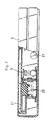
- Fig. 5 is a partial section perspective view of a concentration measuring apparatus in accordance with a first embodiment of the present invention, while Figs. 6 and 7 are partial vertical section views thereof.
- a casing 2 has inner space at a predetermined position for housing a cartridge 11 in which an elongate film 1 is housed.
- An opening 20 for depositing test solution is formed in an upstream predetermined position, while measuring portion 21a for permitting an enzyme electrode unit 22 to contact with a diffusion-limiting membrane 16 which is adhered to the elongate film 1 is formed in a downstream predetermined position with respect to the moving path of the elongate film 1.
- a wetting liquid housing tank 21 is disposed above and spsced from the moving path by a predetermined horizontal distance.
- An electrode driving mechanism 3 is disposed in the casing 2, the mechanism 3 moving the enzyme electrode unit 22 to and fro between a position to contact the enzyme electrode unit 22 with the elongate film 1 and to a position to contact the enzyme electrode unit 22 with the wetting liquid housing tank 21.
- a film driving mechanism (not shown) for moving the elongate film 1 is also disposed in the casing 2.
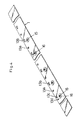
- Fig. 4 is a perspective view showing the elongate film 1. Openings 15 for passing through test solution are formed in the central portion of the elongate film 1 at certain predetermined distances. Diffusion-limiting membranes 16 as an assistance membrane for the concentration measurement are adhered to the bottom surface of the elongate film 1 to cover the openings 15. Shorter holes 13a and longer holes 13b are formed in the elongate film 1 at predetermined relative positions to corresponding openings 15 except the last opening 15. A longer hole 13c and a shorter hole 13d are formed in the elongate film 1 at a predetermined relative position to the last opening 15. The elongate film 1 is accurately positioned by detecting the longer and shorter holes with photo sensors (not shown).
- the elongate film 1 is resistant against the test solutions.
- the diffusion-limiting membrane 16 has a separating function for interfering substances contained in a test solution which adhered to the diffusion-limiting membrane, a diffusion-limiting function to some degree, and a function for permitting deposition of the test solution without contacting the enzyme electrode unit 22 and the like. It may consist of a poly-carbonate membrane having a plurality of minute pores. When a diffusion-limiting membrane for limiting diffusion of the test substance is secured on to the enzyme electrode unit 22 which will be described later, the diffusion-limiting membrane 16 prevents the diffusion-limiting membrane secured on the enzyme electrode unit 22 from being clogged.
- the diffusion-limiting membrane 16 may consist of a membrane to sufficiently limit penetration of test substance, and then the diffusion-limiting membrane secured to the enzyme electrode unit 22 may be omitted.
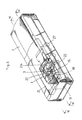
- Fig. 1 is a partial section perspective view showing the cartridge in which the elongate film is housed, while Figs. 2 and 3 are cross section views along lines II-II and III-III in Fig. 1 respectively.
- the cartridge 11 has a supplying chamber 17 for housing the elongate film 1 in a rolled manner, a receiving chamber 18 for receiving the rolled up elongate film 1 and a bridging member 19 connecting the supplying chamber 17 and the receiving chamber 18.
- a rotary shaft 18a provided with the receiving chamber 18 is projected therefrom and selectively transmits rotary force from a motor 27.
- the bridging member 19 is arranged to guide the elongate film 1.
- the bridging member 19 is open on its top surface to form a large opening 19c and has formed in its bottom surface an opening 19a for allowing the enzyme electrode unit 22 to move upward and enter therein.
- a pair of inner projections 19b made of plastic or the like are provided at a position level with the upper edge portion of both side plates of the cartridge 11.
- the length of the inner projections 19b is determined so as to form a clearance between the leading edges of the inner projections 19b, the clearance being slightly smaller than the diameter of the opening 19a.
- Each inner projection 19b is concaved in arc shape at the center portion of its leading edge, thereby enabling the leading edge to fit to the edge portion of the enzyme electrode unit 22 with the elongate film 1 being located interposed therebetween.
- a wiping member 18b is secured to the receiving chamber 18.
- the measuring of concentrations of test substances using the apparatus of the invention is carried out as follows.
- a test solution is deposited onto the corresponding diffusion-limiting membrane through the opening 20 when the opening 15 covered by the diffusion-limiting membrane 16 is opposite the opening 20 for deposition.
- the elongate film 1 with the test solution deposited thereon is moved a predetermined distance by the film driving mechanism to be opposite the opening 15 to the measuring portion 21a.
- the enzyme electrode unit 22 is moved by the electrode driving mechanism 3, whereby the enzyme electrode unit 22 is placed in contact with the diffusion-limiting membrane 16 having the test solution deposited thereon.
- good contact conditions of the enzyme electrode unit 22 with the diffusion-limiting membrane 16 are obtained (refer to two dots and dash line in Fig. 3) without applying tension to the elongate film especially, because the edge portions of the elongate film 1 in a width direction are controlled by the pair of inner projections 19b.
- the test substance in the test solution diffuses to the enzyme electrode unit 22 through the diffusion-limiting membrane 16, whereby an electric signal corresponding to the diffusing quantity of the test substance is output from the enzyme electrode unit 22.
- the concentration of the test substance in the test solution is accordingly obtained based upon the electric signal.
- the elongate film 1 is moved to locate the next opening 15 on the film adjacent the opening 20 for deposition. Then the next concentration measurement is ready to be carried out.
- the inner projections 19b are securely prevented from becoming wetted with test solution because the inner projections 19b are spaced apart by a predetermined distance from one another. Because the elongate film 1 has no tension applied to it at all, the force which is necessary for moving the elongate film 1 can be decreased.
- Fig. 8 is a partial vertical section view showing a main portion of the concentration measuring apparatus in accordance with a modified embodiment of the present invention.
- This embodiment has a different structure from the embodiment shown in Fig. 6 in that the entire region of the bottom plate of the bridging member 19 is open, instead of opening 19a, for allowing the enzyme electrode unit 22 to enter therein.
- Fig. 9 is a partial vertical section view of a concentration measuring apparatus in accordance with another embodiment of the present invention.
- Fig. 10 is a plan view of a cartridge.
- Fig. 11 is a cross section along a line XI-XI in Fig. 10 showing a main portion of the cartridge.
- the pair of assistance inner projections 19d are provided in a condition that base portions of the assistance inner projections 19d for connecting to the bridging member 19 are positioned slightly higher than base portions of the inner projections 19b for connecting to the bridging member 19.
- the thickness of the assistance inner projection 19d is determned to be greater than that of the inner projection 19b, and the strength of the assistance inner projection 19d is determined to be greater than that of the inner projection 19b.
- the thickness of the assistance inner projection 19d is determined so as to locate its bottom surface lower than the bottom surface of the inner projection 19b when viewed in cross section.
- the system for concentration measurement is improved because the deposition operation is carried out in a situation where the elongate film 1 is in the raised portion 20a.
- a regulating member having a slightly smaller opening than the diameter of the enzyme electrode unit 22 may be employed in the first embodiment instead of the pair of inner projections 19b.
- the regulating member may have an arrangement that the pair of inner projections 19b are elongated to be connected one another and the slightly smaller opening is formed at the conter portion thereof.
- a disk-shaped film may be employed instead of the elongate film 1 in both embodiments.
- the raised portion 20a may be arranged to move up and down.
- the assistance membrane may be an enzyme-immobilized membrane, a laminated membrane including a diffusion-limiting membrane and an enzyme-immobilized membrane, or a laminated membrane including a diffusion-limiting membrane, an enzyme-immobilized membrane and a selective penetration membrane for allowing penetration of only substance consumed or generated under the existance of enzyme.
Landscapes
- Physics & Mathematics (AREA)
- Health & Medical Sciences (AREA)
- Life Sciences & Earth Sciences (AREA)
- Chemical & Material Sciences (AREA)
- Analytical Chemistry (AREA)
- Biochemistry (AREA)
- General Health & Medical Sciences (AREA)
- General Physics & Mathematics (AREA)
- Immunology (AREA)
- Pathology (AREA)
- Apparatus Associated With Microorganisms And Enzymes (AREA)
- Measuring Or Testing Involving Enzymes Or Micro-Organisms (AREA)
Applications Claiming Priority (2)
| Application Number | Priority Date | Filing Date | Title |
|---|---|---|---|
| JP142070/90 | 1990-05-31 | ||
| JP14207090 | 1990-05-31 |
Publications (3)
| Publication Number | Publication Date |
|---|---|
| EP0459511A2 true EP0459511A2 (de) | 1991-12-04 |
| EP0459511A3 EP0459511A3 (en) | 1992-05-20 |
| EP0459511B1 EP0459511B1 (de) | 1995-12-13 |
Family
ID=15306732
Family Applications (1)
| Application Number | Title | Priority Date | Filing Date |
|---|---|---|---|
| EP19910108952 Expired - Lifetime EP0459511B1 (de) | 1990-05-31 | 1991-05-31 | Vorrichtung zur Messung der Konzentration einer Testsubstanz in einer Flüssigkeit |
Country Status (2)
| Country | Link |
|---|---|
| EP (1) | EP0459511B1 (de) |
| DE (1) | DE69115355T2 (de) |
Cited By (4)
| Publication number | Priority date | Publication date | Assignee | Title |
|---|---|---|---|---|
| EP0644424A1 (de) * | 1993-09-21 | 1995-03-22 | Asulab S.A. | Messvorrichtung für abnehmbare Mehrzonensensoren |
| EP0685735A1 (de) * | 1994-06-03 | 1995-12-06 | Metrohm Ag | Vorrichtung für die Voltammetrie, Indikatorelektroden-Anordnung für eine solche Vorrichtung, insbesondere als Teil einer Bandkassette, und Reihenanalyse-Verfahren für die Voltammetrie |
| WO1996013724A1 (en) * | 1994-10-28 | 1996-05-09 | Biomolecular Research Institute Ltd. | A sample holder |
| WO2004034063A3 (en) * | 2002-10-09 | 2004-07-29 | Well Cow Ltd | Detecting apparatus |
Family Cites Families (5)
| Publication number | Priority date | Publication date | Assignee | Title |
|---|---|---|---|---|
| US3926765A (en) * | 1973-04-13 | 1975-12-16 | Instrumentation Labor Inc | Electrochemical electrode structure |
| DE3111190C2 (de) * | 1981-03-21 | 1983-04-07 | Drägerwerk AG, 2400 Lübeck | Elektrochemischer Meßaufnehmer mit auswechselbarer Membranhalterung |
| US4430299A (en) * | 1981-06-18 | 1984-02-07 | Coulter Electronics, Inc. | Apparatus for monitoring chemical reactions |
| US4929330A (en) * | 1987-03-31 | 1990-05-29 | Daikin Industries, Ltd. | Diffusion-limiting membrane holding means for sensor |
| EP0373629B1 (de) * | 1988-12-13 | 1995-03-01 | Daikin Industries, Limited | Testvorrichtung zur Messung der Konzentration einer Testsubstanz in einer Flüssigkeit |
-
1991
- 1991-05-31 DE DE1991615355 patent/DE69115355T2/de not_active Expired - Fee Related
- 1991-05-31 EP EP19910108952 patent/EP0459511B1/de not_active Expired - Lifetime
Cited By (5)
| Publication number | Priority date | Publication date | Assignee | Title |
|---|---|---|---|---|
| EP0644424A1 (de) * | 1993-09-21 | 1995-03-22 | Asulab S.A. | Messvorrichtung für abnehmbare Mehrzonensensoren |
| FR2710412A1 (fr) * | 1993-09-21 | 1995-03-31 | Asulab Sa | Dispositif de mesure pour capteurs multizones amovibles. |
| EP0685735A1 (de) * | 1994-06-03 | 1995-12-06 | Metrohm Ag | Vorrichtung für die Voltammetrie, Indikatorelektroden-Anordnung für eine solche Vorrichtung, insbesondere als Teil einer Bandkassette, und Reihenanalyse-Verfahren für die Voltammetrie |
| WO1996013724A1 (en) * | 1994-10-28 | 1996-05-09 | Biomolecular Research Institute Ltd. | A sample holder |
| WO2004034063A3 (en) * | 2002-10-09 | 2004-07-29 | Well Cow Ltd | Detecting apparatus |
Also Published As
| Publication number | Publication date |
|---|---|
| DE69115355T2 (de) | 1996-07-11 |
| EP0459511A3 (en) | 1992-05-20 |
| EP0459511B1 (de) | 1995-12-13 |
| DE69115355D1 (de) | 1996-01-25 |
Similar Documents
| Publication | Publication Date | Title |
|---|---|---|
| RU2305279C2 (ru) | Устройство и способ для определения концентрации восстановленной формы или окисленной формы окислительно-восстановительного вещества в жидкой пробе | |
| US6852212B2 (en) | Method and apparatus for automatic analysis | |
| CA2357968C (en) | Biosensor | |
| JP4879459B2 (ja) | 液体サンプルの分析のための電気化学式バイオセンサストリップ | |
| CA2375089C (en) | Disposable sub-microliter volume sensor and method of making | |
| CA2481426C (en) | Disposable sub-microliter volume biosensor with enhanced sample inlet | |
| JP2002195972A (ja) | バイオセンサ | |
| JPS63128252A (ja) | バイオセンサ | |
| CA2654499A1 (en) | Capillary flow control in a flow channel | |
| EP0459511B1 (de) | Vorrichtung zur Messung der Konzentration einer Testsubstanz in einer Flüssigkeit | |
| US10329684B2 (en) | Method for forming an optical test sensor | |
| JPH02129541A (ja) | 使い拾て型酵素電極 | |
| KR100776393B1 (ko) | 바이오센서 및 그 제조방법 | |
| JP3063232B2 (ja) | 濃度測定装置 | |
| JP3067265B2 (ja) | 濃度測定装置 | |
| JPH0816661B2 (ja) | 濃度測定装置 | |
| JPS61210939A (ja) | 尿酸の測定法 | |
| JPS63144249A (ja) | バイオセンサ | |
| JPS6275343A (ja) | バイオセンサ | |
| JPH01134243A (ja) | バイオセンサ | |
| JPS6275344A (ja) | バイオセンサ |
Legal Events
| Date | Code | Title | Description |
|---|---|---|---|
| PUAI | Public reference made under article 153(3) epc to a published international application that has entered the european phase |
Free format text: ORIGINAL CODE: 0009012 |
|
| AK | Designated contracting states |
Kind code of ref document: A2 Designated state(s): DE FR GB NL |
|
| PUAL | Search report despatched |
Free format text: ORIGINAL CODE: 0009013 |
|
| AK | Designated contracting states |
Kind code of ref document: A3 Designated state(s): DE FR GB NL |
|
| 17P | Request for examination filed |
Effective date: 19920715 |
|
| 17Q | First examination report despatched |
Effective date: 19940113 |
|
| GRAA | (expected) grant |
Free format text: ORIGINAL CODE: 0009210 |
|
| RIN1 | Information on inventor provided before grant (corrected) |
Inventor name: NAKANO, HITONAGA Inventor name: TERAWAKI, HIROSHI Inventor name: MUKAI, TOJI |
|
| AK | Designated contracting states |
Kind code of ref document: B1 Designated state(s): DE FR GB NL |
|
| REF | Corresponds to: |
Ref document number: 69115355 Country of ref document: DE Date of ref document: 19960125 |
|
| ET | Fr: translation filed | ||
| PLBE | No opposition filed within time limit |
Free format text: ORIGINAL CODE: 0009261 |
|
| STAA | Information on the status of an ep patent application or granted ep patent |
Free format text: STATUS: NO OPPOSITION FILED WITHIN TIME LIMIT |
|
| 26N | No opposition filed | ||
| REG | Reference to a national code |
Ref country code: FR Ref legal event code: TP |
|
| NLS | Nl: assignments of ep-patents |
Owner name: SANKYO COMPANY LIMITED |
|
| REG | Reference to a national code |
Ref country code: GB Ref legal event code: 732E |
|
| REG | Reference to a national code |
Ref country code: GB Ref legal event code: IF02 |
|
| PGFP | Annual fee paid to national office [announced via postgrant information from national office to epo] |
Ref country code: FR Payment date: 20020508 Year of fee payment: 12 |
|
| PGFP | Annual fee paid to national office [announced via postgrant information from national office to epo] |
Ref country code: NL Payment date: 20020529 Year of fee payment: 12 Ref country code: GB Payment date: 20020529 Year of fee payment: 12 |
|
| PGFP | Annual fee paid to national office [announced via postgrant information from national office to epo] |
Ref country code: DE Payment date: 20020610 Year of fee payment: 12 |
|
| PG25 | Lapsed in a contracting state [announced via postgrant information from national office to epo] |
Ref country code: GB Free format text: LAPSE BECAUSE OF NON-PAYMENT OF DUE FEES Effective date: 20030531 |
|
| PG25 | Lapsed in a contracting state [announced via postgrant information from national office to epo] |
Ref country code: NL Free format text: LAPSE BECAUSE OF NON-PAYMENT OF DUE FEES Effective date: 20031201 |
|
| PG25 | Lapsed in a contracting state [announced via postgrant information from national office to epo] |
Ref country code: DE Free format text: LAPSE BECAUSE OF NON-PAYMENT OF DUE FEES Effective date: 20031202 |
|
| GBPC | Gb: european patent ceased through non-payment of renewal fee |
Effective date: 20030531 |
|
| PG25 | Lapsed in a contracting state [announced via postgrant information from national office to epo] |
Ref country code: FR Free format text: LAPSE BECAUSE OF NON-PAYMENT OF DUE FEES Effective date: 20040130 |
|
| NLV4 | Nl: lapsed or anulled due to non-payment of the annual fee |
Effective date: 20031201 |
|
| REG | Reference to a national code |
Ref country code: FR Ref legal event code: ST |