EP0459820B1 - Bipolarmembran und Verfahren zu ihrer Herstellung - Google Patents
Bipolarmembran und Verfahren zu ihrer Herstellung Download PDFInfo
- Publication number
- EP0459820B1 EP0459820B1 EP91304937A EP91304937A EP0459820B1 EP 0459820 B1 EP0459820 B1 EP 0459820B1 EP 91304937 A EP91304937 A EP 91304937A EP 91304937 A EP91304937 A EP 91304937A EP 0459820 B1 EP0459820 B1 EP 0459820B1
- Authority
- EP
- European Patent Office
- Prior art keywords
- membrane
- cation
- exchange
- exchange membrane
- anion
- Prior art date
- Legal status (The legal status is an assumption and is not a legal conclusion. Google has not performed a legal analysis and makes no representation as to the accuracy of the status listed.)
- Expired - Lifetime
Links
Images
Classifications
-
- B—PERFORMING OPERATIONS; TRANSPORTING
- B01—PHYSICAL OR CHEMICAL PROCESSES OR APPARATUS IN GENERAL
- B01D—SEPARATION
- B01D61/00—Processes of separation using semi-permeable membranes, e.g. dialysis, osmosis or ultrafiltration; Apparatus, accessories or auxiliary operations specially adapted therefor
- B01D61/42—Electrodialysis; Electro-osmosis ; Electro-ultrafiltration; Membrane capacitive deionization
- B01D61/44—Ion-selective electrodialysis
- B01D61/445—Ion-selective electrodialysis with bipolar membranes; Water splitting
-
- C—CHEMISTRY; METALLURGY
- C08—ORGANIC MACROMOLECULAR COMPOUNDS; THEIR PREPARATION OR CHEMICAL WORKING-UP; COMPOSITIONS BASED THEREON
- C08J—WORKING-UP; GENERAL PROCESSES OF COMPOUNDING; AFTER-TREATMENT NOT COVERED BY SUBCLASSES C08B, C08C, C08F, C08G or C08H
- C08J5/00—Manufacture of articles or shaped materials containing macromolecular substances
- C08J5/20—Manufacture of shaped structures of ion-exchange resins
- C08J5/22—Films, membranes or diaphragms
- C08J5/2206—Films, membranes or diaphragms based on organic and/or inorganic macromolecular compounds
- C08J5/2275—Heterogeneous membranes
-
- C—CHEMISTRY; METALLURGY
- C08—ORGANIC MACROMOLECULAR COMPOUNDS; THEIR PREPARATION OR CHEMICAL WORKING-UP; COMPOSITIONS BASED THEREON
- C08J—WORKING-UP; GENERAL PROCESSES OF COMPOUNDING; AFTER-TREATMENT NOT COVERED BY SUBCLASSES C08B, C08C, C08F, C08G or C08H
- C08J2381/00—Characterised by the use of macromolecular compounds obtained by reactions forming in the main chain of the macromolecule a linkage containing sulfur with or without nitrogen, oxygen, or carbon only; Polysulfones; Derivatives of such polymers
- C08J2381/06—Polysulfones; Polyethersulfones
Definitions
- the present invention relates to a novel bipolar membrane and a method for producing it.
- Bipolar membranes are widely used as diaphragms in electrolysis of water (water splitting) or as separating membranes in reclaiming acids and alkalis from aqueous solutions of salts that are products formed by neutralization between acids and alkalis, and as ion-exchange membranes known in the art. They have a basic structure comprised of a lamination of a cation-exchange membrane and an anion-exchange membrane, and various methods for their production have been proposed.
- the methods can be exemplified by a method in which a cation-exchange membrane and an anion-exchange membrane are laminated using a mixture of polyethyleneimine and epichlorohydrin and then bonded to each other by curing (Japanese Patent Publication No. 32-3962); a method in which a cation-exchange membrane is bonded to an anion-exchange membrane using an adhesive having the properties of exchanging ions (Japanese Patent Publication No. 34-3961); a method in which a paste material comprising vinyl pyridine and an epoxy compound is coated on the surface of a cation-exchange membrane, followed by exposure to radiation to obtain the product (Japanese Patent Publication No.
- bipolar membranes obtained by these methods have the problem that a membrane potential much higher (e.g., 2.5 V to 3.0 V, or higher) than the theoretical water-splitting membrane potential (0.83 V) is applied when attempting to split water, resulting in a high-power consumption. They can also never be satisfactory from the point of view of current efficiency.
- Electrochemica Acta, Vol. 31, No. 9, pp.1175-1176 (1986) reports a production method in which cation- and anion-exchange membranes whose surfaces have been coated with a solution comprising at least one kind of inorganic electrolyte selected from sodium tungstate, chromium nitrate, sodium metasilicate, ruthenium trichloride are put together and then pressed to give a bipolar membrane having a low water-splitting membrane potential.
- This bipolar membrane compared with the above numerous bipolar membranes, is characterised by a low water-splitting membrane potential, but, only at the initial stage of use.
- this membrane is disadvantageous in that the water-splitting membrane potential increases in a relatively short time, bubbles or blisters may occur at the interface between the cation-exchange membrane and the anion-exchange membrane rendering it of no use, and also, depending on conditions of use, the bipolar membrane may separate into the cation-exchange membrane and the anion-exchange membrane thereby destroying utility. Also, it does not exhibit good currency efficiency and can not be said to be a bipolar membrane satisfactory for use on an industrial scale.
- WO-A-89/01059 discloses a bipolar membrane formed by conjoining treated anion and cation exchange membranes. The treatment comprises contacting the membranes with an aqueous solution of at least one cation prior to conjoining and contacting at least one face of the membranes with an aqueous alkaline solution. Bipolar membranes are also disclosed in EP-A-0,251,511 and FR-A-2,361,927.
- An object of the present invention is to provide a bipolar membrane that can be used on an industrial scale.
- Another object of the present invention is to provide a bipolar membrane that has a water-splitting current efficiency of not less than 80%, and preferably not less than 90%, has a water-splitting membrane potential of not more than 2.0 V, and preferably not more than 1.8 V, and also can be used for a long period of time.
- Still another object of the present invention is to provide a bipolar membrane comprised of a cation-exchange membrane on the surface of which a film comprising a polymer having anion-exchange groups is formed, thereby giving a peel strength of not less than 0.2 kg.f/25 mm.
- a process for producing a bipolar membrane comprises bringing a solution of a polymer having an anion-exchange group or a functional group capable of an conversion to an anion-exchange group in a solvent into contact with a surface of a cation-exchange membrane which has been ion-exchanged with a heavy metal ion, removing the solvent so as to form a film of the polymer on the surface of the cation-exchange membrane and, when necessary, converting the functional group into an anion-exchange group.
- a bipolar membrane comprising a cation-exchange membrane and an anion-exchange membrane closely adhered to each other at a peel strength of not less than 0.2 kg ⁇ f/25mm;
- cation-exchange membrane in a bipolar membrane of the present invention there are no particular limitations on the cation-exchange membrane in a bipolar membrane of the present invention. Any conventional cation-exchange membrane can be used.
- a cation-exchange membrane having an ion-exchange group such as a sulfonic acid group or a carboxylic acid can be used.
- the cation-exchange capacity of the cation-exchange membrane and those conventionally known can be used. In general, it may be in the range of 0.5 meq/g to 3 meq/g, and preferably 1 meq/g to 2.5 meq/g.
- the cation-exchange membrane may be of a polymerized type, a homogeneous type or a nonhomogeneous type.
- it may be provided with a reinforcing material (centre layer), and may be of any kind or form depending on the method by with it is prepared.
- Ion-exchange membranes comprising a cation-exchange membrane having therein a small proportion of an anion-exchange group may also be satisfactorily used as the cation-exchange membrane for the present invention so long as they have cation transport numbers of not less than 0.9.
- a counter ion of an ion-exchange group present at least at its adhered surface is required to have been ion-exchanged with a heavy metal ion to give a heavy metal type membrane.
- a heavy metal (ion) referred to in the present invention may include elements (ions) of the atomic number of from 20 to 90, preferably from 22 to 50, and more preferably from 26 to 50, except for halogens and inert gas elements.
- those preferably used may specifically include ions of iron (II, III), titanium (IV), tin (II, IV), zirconium (IV), palladium (II), and ruthenium (III).
- ions of iron, ruthenium and tin are effective.
- the cation-exchange membrane of a heavy metal type can be obtained using conventionally known ion-exchange methods. It can be commonly obtained by, e.g., a method in which a cation-exchange membrane is immersed in a solution of a heavy metal salt, and a method in which a solution of a heavy metal salt is coated or sprayed onto a cation-exchange membrane.
- the heavy metal ions present in such a heavy metal type cation-exchange membrane need not be distributed uniformly in the thickness direction (i.e., to the whole extent) of the membrane, but will be present at least on the side to which the anion-exchange membrane is put and adhered.
- the ion-exchanged heavy metal ions may be present usually in such a proportion that they comprise 0.001% to 100%, and particularly preferably 0.01% to 50%, of the total ion-exchange capacity.
- a cation-exchange membrane ion-exchanged with heavy metal ions will be bonded to an anion-exchange membrane so that the cation-exchange membrane and the anion-exchange membrane are closely adhered to each other at a peel strength of not less than 0.2 kg ⁇ f/25mm in a wet state.
- a peel strength smaller than the above value is not acceptable because it tends to allow separation of the constituent membranes when the bipolar membrane is used in a wet state as in water splitting, making its long-term use impossible.
- a bipolar membrane of the present invention prevents formation of blisters or bubbles at the interface between the cation-exchange membrane and anion-exchange membrane regardless of conditions of use.
- the mechanism by which blisters or bubbles occur in prior art bipolar membranes is not absolutely clear, the inventors for the present invention have confirmed that the causes differ depending on the production method.
- a method is often employed in which the cation-exchange membrane is immersed in a solution of a heavy metal salt or a solution of a heavy metal salt is coated or sprayed onto the cation-exchange membrane.
- the resulting bipolar membrane may form blisters or bubbles at its interface when immersed in water, if the anion-exchange membrane is bonded in the state that unreacted heavy metal salt solution remains on the surface of the cation-exchange membrane.
- a bipolar membrane of the present invention is also required to have a water-splitting current efficiency of not less than 80%, and preferably not less than 90%, and also have a water-splitting membrane potential of not more than 2.0 V, and preferably not more than 1.8 V.
- known bipolar membranes can also satisfy an efficiency of 80%.
- bipolar membranes capable of keeping a membrane potential of not more than 2.0 V for a long period of time are almost unknown.
- some conventional bipolar membrane are known to have a membrane potential of about 1.0 V at the initial stage of their use. In almost all of them, however, this membrane potential gradually increases with the lapse of electrodialysis time to exceed 2.0 V in a very short time.
- bipolar membranes can not be achieved by controlling only one step in their production process. They must be achieved by control while correlating the various requirements with each other.
- a bipolar membrane having a peel strength of not less than 1.0 kg ⁇ f/25mm can be obtained in the form of a laminated bipolar membrane by bonding a cation-exchange membrane to an anion-exchange membrane, or in the form of a single-film bipolar membrane comprising a single film to both surfaces of which different ion-exchange groups have been imparted.
- the bipolar membranes obtained by such methods tend to have a high water-splitting membrane potential and a low current efficiency.
- a bipolar membrane of the present invention can not be obtained by application of conventional methods. Rather, the bipolar membrane of the present inventions is obtainable by a process according to the invention, which process comprises bringing a solution of a polymer having an anion exchange group or a functional group capable of conversion to an anion-exchange group in a solvent into contact with a surface of a cation-exchange membrane which has been ion-exchanged with a heavy metal ion, removing the solvent so as to form a film of the polymer on the surface of the cation-exchange membrane and, when necessary, converting the functional group into an anion-exchange group.
- This method is hereinafter simply referred to as the polymer film method.
- the peel strength may be affected by the conditions under which the cation-exchange membrane is treated when the cation-exchange membrane is bonded to the anion-exchange membrane. For example, the peel strength is lower and also the resulting bipolar membrane has less favourable water-splitting performance when the polymer film is applied in the state that any unreacted heavy metal salts arising from the introduction of heavy metal ions remain on the cation-exchange membrane.
- the peel strength becomes 0.3 to 0.5 kg ⁇ f/25mm or higher. Such a membrane is well suited for practical use.
- a bipolar membrane making use of a cation-exchange membrane whose surface has been roughened and on which the polymer film is formed can give a peel strength of 1 kg ⁇ f/25mm or more, which is a highly satisfactory strength.
- a peel strength of 1 kg ⁇ f/25mm or more which is a highly satisfactory strength.
- the cation-exchange groups present at the adhered surface of the cation-exchange membrane to which the anion-exchange membrane is adhered have been ion-exchanged with the heavy metal ions.
- the heavy metal ions introduced as a result of such ion exchange are presumed to permeate into the cathode side with the lapse of time and disappear, when water is split using the bipolar membrane.
- heavy metal ions present in the cation-exchange membrane at a region distant from the adhered surface are presumed to move little by little in the cathode direction by the influence of continually flowing H + ions until they are released from the cation-exchange membrane.
- the water in the vicinity of the heavy metal ions is affected by the heavy metal ions and the water bonds are weakened, so that the water can be separated into H + and OH - with ease by an application of potential.
- the heavy metal ions are required to be present only at the surface adhered to the anion-exchange membrane and hence it is presumed satisfactory for the heavy metal ions to be in a very small quantity.
- the content of heavy metal ions at the interface of a bipolar membrane before use in water splitting can be confirmed by fluorescent X-ray measurement.
- the heavy metal ions After use in water splitting for 60 days, the heavy metal ions no longer remain in such a quantity that their presence can be confirmed by fluorescent X-ray measurement. Their presence can be confirmed however at this time by electron spectroscopy chemical analysis (ESCA).
- ESA electron spectroscopy chemical analysis
- Such a phenomenon has been revealed for the first time by the present invention. It can be said to be á surprising phenomenon that the heavy metal ions ion-exchanged to the ion-exchange groups at the interface remain in such a state they are preferentially distributed without release from the bipolar membrane even after use in water splitting. Moreover, it can be also said to be a surprising phenomenon that the heavy metal ions remaining in the state that they are preferentially distributed act to prevent the membrane potential increasing so that water splitting can be carried out at a low membrane potential over a long period of time. On the basis of such action, the bipolar membrane of the present invention enables water-splitting while keeping the current efficiency at not less than 80%, and usually not less than 90%.
- This method generally comprises coating the surface of the cation-exchange membrane with a solution prepared by dissolving in a solvent a polymer having an anion-exchange group or a functional group capable of ready conversion to an anion-exchange group, removing the solvent to form a film and if necessary converting the functional group into an anion exchange group.
- a polymer having an anion-exchange group or a functional group capable of ready conversion to an anion-exchange group may preferably be a thermoplastic resin soluble in a solvent suitable for preparation of a solution for forming the film.
- the film may preferably be formed as a strongly basic polymer whose anion-exchange group is mainly comprised of a quaternary ammonium group.
- the thickness of such a film an excessively large thickness results in an increase in the water-splitting membrane potential and an excessively small thickness results in a lowering of the current efficiency.
- the thickness it is preferable for the thickness to be 5 ⁇ m to 300 ⁇ m, and particularly 10 ⁇ m to 200 ⁇ m.
- polymers having an anion-exchange group for use in the present invention so long as it is capable of being dissolved in a solvent.
- Particularly preferred polymers can be exemplified by linear polymers including copolymers of trialkylvinylbenzyl ammonium with a vinyl compound such as styrene, vinyltoluene or acrylonitrile; polymers obtained by chloromethylation and then quaternization of polymers such as polysulfone, polystyrene, polyphenylene oxide, polyether ether ketone, an ethylene-styrene copolymer and a propylene-styrene copolymer; and blend polymers of polysulfone with a polyalkylvinylbenzyl ammonium salt.
- linear polymers having an anion-exchange group should preferably have an ion-exchange capacity of 0.4 meq/g to 2.5 meq/g, and particularly 0.6 meq/g to 1.5 meq/g, because those having a large ion-exchange capacity make the film formed liable to be dissolved in water or swell, resulting in a lowering of the water-splitting current efficiency in the bipolar membrane, and those having a small ion-exchange capacity tend to bring about an increase in the water-splitting membrane potential because of an increase in electrical resistance.
- polymers having a functional group capable of ready conversion to an anion-exchange group for use in the present invention those particularly suitable can be exemplified by polymers having a chloromethyl group, such as chloromethylated polystyrene, polychloromethylstyrene, chloromethylated polyphenylene oxide, chloromethylated polyether ether ketone, and a copolymer of chloromethylated ethylene or propylene with styrene.
- These polymers having a chloromethyl group may be used optionally together with an inert polymer that does not react with amino compounds, such as polysulfone, polystyrene or polyacrylonitrile, to form a polymer solution.
- a film serving as a precursor of the anion-exchange membrane is formed on the surface of the heavy metal type cation-exchange membrane, which is then reacted with, e.g., a trialkylamine, a dialkylamine, N,N,N',N'-tetramethyl-1,6-hexamethylenediamine, N,N-dimethylpropanediamine or N,N-dimethylbutanediamine.
- a film comprised of an anion-exchanger into which a quaternary ammonium salt group and a crosslink have been introduced can be formed.
- a polymer having an anion-exchange group or a functional group capable of being converted to an anion-exchange group and a polymer having two or more reactive groups it is also possible to form the polymer film by reacting a polymer having an anion-exchange group or a functional group capable of being converted to an anion-exchange group and a polymer having two or more reactive groups, and if necessary introducing an anion-exchange group, so as to form a crosslinked structure.
- a combination of polymers may preferably include, for example, a combination of a polymer having two or more tertiary amino groups with a polymer having two or more epoxy groups, and a combination of a polymer similarly having two or more tertiary amino groups and a polymer having two or more halomethyl group.
- suitable polymers having two or more tertiary amino groups are polydialkylvinylbenzylamines, polydialkylaminoethylstyrenes, polydimethyallylamines, N,N,N',N'-tetramethyl-1,6-hexamethylenediamine, N,N,N',N',N"-pentamethyldipropylenetriamine and N,N,N' N'-tetramethyl-1,3-trimethylenediamine.
- suitable polymers having two or more epoxy groups are bisphenol-A type diglycidyl ether, resorsin type diglycidyl ether, glycerol triglycidyl ether, novolac type polyglycidyl ether, vinylcyclohexane dioxide, and dicyclopentadiene dioxide.
- suitable polymers having two or more halomethyl group are polychloromethylstyrene and chloromethylated polyether ether ketone.
- a film comprised of a crosslinked ion-exchanger should preferably have an ion-exchange capacity of 0.3 meq/g to 2.0 meq/g, and particularly 0.5 meq/g to 1.5 meq/g, because those having a large ion-exchange capacity tend to become brittle making use in a bipolar membrane difficult, and those having a small ion-exchange capacity tend to bring about an increase in electrical resistance and also bring about an increase in the water-splitting membrane potential.
- the above polymer solution is prepared by dissolving the polymer as described above in an organic solvent exemplified by ethylene chloride, chloroform, tetrahydrofuran, dimethylformamide, N-methylpyrolidone and methylalcohol, with adjustment of its concentration and viscosity so as to be suitable for its coating on the surface of the heavy metal type cation-exchange membrane to form the desired film.
- organic solvent exemplified by ethylene chloride, chloroform, tetrahydrofuran, dimethylformamide, N-methylpyrolidone and methylalcohol
- the film can be obtained usually by a method comprising applying the polymer solution to the surface of the heavy metal type cation-exchange membrane by coating or spraying, followed by drying to remove the solvent, or a method comprising immersing in the polymer solution a heavy metal type cation-exchange membrane one side of which has been covered with an opaque film sheet, glass plate or the like, and drawing up the membrane, followed by a similar drying.
- the surface of the cation-exchange membrane to which the anion-exchange membrane is adhered may preferably be roughened.There are no particular limitations on the method of roughing the surface so long as the performance of the cation-exchange membrane is not impaired. In general, it is preferred to use a means of finely roughing the surface of the cation-exchange membrane by brushing it using sandpaper, fine sands or the like, or roughing the membrane surface by bringing it into contact with a guide roll having a rough surface, used when the membrane is rolled up in the process of manufacture.
- the degree of roughness on the surface of the cation-exchange membrane may be on the basis of a depth of usually 0,1 ⁇ to 100 ⁇ , and preferably 1 ⁇ to 60 ⁇ .
- the bipolar membrane of the present invention enables long-term water splitting to be carried out at a current efficiency of not less than 80%, usually not less than 90%, and at a membrane potential of not more than 2.0 V, and usually 0.9 V to 1.8 V. Hence, the power consumption for water splitting can be greatly decreased.
- a bipolar membrane of the present invention may be usefully employed to reclaim acids and alkalis from the salts by electrolysis.
- the characteristics of the bipolar membranes were determined as follows: Using platinum plates as electrodes, a given bipolar membrane with an effective area of 10 cm 2 was provided between them. On the side of its cation-exchange membrane, 100 ml of an aqueous solution of 1.00N hydrochloric acid was fed, and on the side of its anion-exchange membrane 100 ml of an aqueous solution of 1.00N sodium hydroxide was fed. At a current density of 10 A/dm 2 , electric currents were supplied for 4 hours to 16 hours, and thereafter the quantities of acids, bases and salts in the solutions on either side of the membrane were measured.
- hydroxyl ion current efficiency ⁇ (OH), hydrogen ion current efficiency ⁇ (H), chloride ion current efficiency ⁇ (Cl) and sodium ion current efficiency ⁇ (Na) were determined as water-splitting current efficiency of the bipolar membrane.
- Wire platinum electrodes were also provided cross the bipolar membrane to measure the drop of membrane potential of the bipolar membrane.
- the peel strength was measured according to JIS K-6854.
- a tensile shear tester used therefor was TENSILON UTM-1-5000B (manufactured by TOYO BALDWIN CO., LTD.). Using this tester, the strength was measured on test pieces of 25 mm wide bipolar membranes in a wet state, under conditions of a temperature of 23°C, a relative humidity of 52% and a grip movement rate of 200 mm/min.
- a cation-exchange membrane having sulfonic acid groups as ion-exchange groups NEOSEPTA CM-1 (trademark: available from TOKUYAMA SODA CO., LTD.) was previously rubbed with sandpaper to rough one side surface thereof. Thereafter the membrane was immersed in an aqueous solutions of 2% by weight of ferrous chloride at 25°C for 1 hour, followed by thorough cleaning with ionexchanged water and then air drying at room temperature. The cation-exchange membrane thus treated has an iron content of 98% of the total exchange capacity. It was possible to confirm the presence of iron also by fluorescent X-ray measurement.
- the solution of aminated polysulfone was coated, followed by drying to produce a bipolar membrane having a layer of the aminated sulfone with a thickness of 90 ⁇ m.
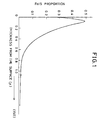
- FIG. 1 shows a proportion of Fe atoms and S atoms (Fe/S) measured by ESCA, the former being those remaining in the separated cation-exchange membrane from its surface to its interior in the thickness direction and the latter being those of the sulfonic acid groups.
- This Fig. 1 shows that the Fe ions are present with a density gradient from the surface (adhered surface) of the cation-exchange membrane toward its opposite surface.
- a bipolar membrane was produced in entirely the same procedure as in Example 1 except that the cation-exchange membrane was not treated with the aqueous ferrous chloride solution.
- Example 2 The same cation-exchange membrane as used in Example 1 was immersed in an aqueous 2% ferrous chloride solution and then taken out. Next, an anion-exchange membrane NEOSEPTA AM-1 (trademark: available from TOKUYAMA SODA CO., LTD.) was superposed on the above cation-exchange membrane. The membranes thus put together were pressed in a temperature environment of 130°C under a pressure of 2 kg/cm 2 for 10 minutes. The bipolar membrane thus obtained caused blistering at the interface when immersed in water, resulting in separation into two membranes to have come to be of no use.
- NEOSEPTA AM-1 trademark: available from TOKUYAMA SODA CO., LTD.
- Comparative Example 2 was repeated except that the cation-exchange membrane as used therein was washed with water to remove the ferrous chloride present on the surface of the cation-exchange membrane, having not been ion-exchanged.
- Example 1 was repeated except that the surface of the cation-exchange membrane as used therein was not roughed with sandpaper.
- These performances of the bipolar membrane showed a little increase in membrane potential to 1.4 V after the lapse of 2 months, but neither bubbles nor blisters were seen to occur in the membrane.
- Polydimethylvinylbenzylamine (molecular weight: about 10,000) was dissolved in chloroform. Subsequently bisphenol-A diglycidyl ether was dissolved therein. Thus a solution comprising polydimethylvinylbenzylamine, bisphenol-A diglycidyl ether and chloroform in 1:1:10 (weight ratio) was prepared. This solution was coated on a cation-exchange membrane containing Fe, having been treated in the same manner as in Example 1, followed by drying at room temperature for 10 hours to effect curing of the epoxy resin. At the same time, an anion-exchange membrane of a quaternary ammonium group type was formed. A bipolar membrane was thus produced.
- the cation-exchange membrane thus treated had a tin content of 3.2% of the total exchange capacity.
- NOSEPTA CM-1 The same cation-exchange membrane (NEOSEPTA CM-1) as used in Example 1, with its surface having been roughed, was immersed in an aqueous ruthenium chloride (RuCl 3 ) solution of 0.1% by weight at 25°C for a day, and thereafter thoroughly washed with ion-exchanged water, followed by air drying at room temperature.
- This cation-exchange membrane had a ruthenium content of 0.02% of the total exchange capacity.
- Example 1 was repeated except that the aqueous solution used therein for ion exchange to the cation-exchange membrane was replaced with each of aqueous solutions of the compounds shown in Table 1.
- the bipolar membranes obtained had the performances shown in Table 1. In all the bipolar membranes, neither bubbles nor blisters were seen to occur in the membrane.
- Example 5 On one side of the cation-exchange membrane obtained in Example 5, containing ruthenium ions, a 15% by weight solution prepared by dissolving in organic solvent a chloromethylated polymer having a chlorine content of 1.5 meq/g was coated, and thereafter the solvent was evaporated at room temperature, followed by drying to give a film with a thickness 90 ⁇ m.
- the aminated polystyrene film had a thickness of 100 um.
Landscapes
- Chemical & Material Sciences (AREA)
- Engineering & Computer Science (AREA)
- Health & Medical Sciences (AREA)
- Manufacturing & Machinery (AREA)
- Water Supply & Treatment (AREA)
- Chemical Kinetics & Catalysis (AREA)
- Inorganic Chemistry (AREA)
- Urology & Nephrology (AREA)
- Materials Engineering (AREA)
- Medicinal Chemistry (AREA)
- Polymers & Plastics (AREA)
- Organic Chemistry (AREA)
- Manufacture Of Macromolecular Shaped Articles (AREA)
Claims (10)
- Verfahren zum Herstellen einer bipolaren Membran, umfassend das in Kontakt bringen einer Polymerlösung, die eine Anionen-Austauschgruppe oder eine funktionellen Gruppe, die in einem Lösungsmittel in eine Anionen-Austauschgruppe umgewandelt werden kann, umfaßt, mit einer Oberfläche einer Kationen-Austauschmembran, bei der ein lonenaustausch mit einem Schwermetallion stattgefunden hat, das Entfemen des Lösungsmittels, um einen Film des Polymers auf der Oberfläche der Kationen-Austauschmembran zu bilden und, falls nötig, das Umwandeln der funktionellen Gruppe in eine Anionen-Austauschgruppe.
- Verfahren nach Anspruch 1, dadurch gekennzeichnet, daß die Kationen-Austauschmembran vor dem Kontaktieren mit der Polymerlösung mit Wasser gewaschen wird, um jede freie Metallsalzverbindung zu entfemen, und daß die Oberfläche getrocknet wird.
- Verfahren nach Anspruch 2, dadurch gekennzeichnet, daß bei der Kationen-Austauschmembran ein lonenaustausch mit einem Schwermetall durch Eintauchen der Membran in eine wäßrige Lösung eines Schwermetallsalzes oder durch Beschichten der Oberfläche einer Kationen-Austauschmembran mit einer wäßrigen Lösung eines Schwermetallsalzes vor dem Waschen und Trocknen stattfindet.
- Verfahren nach einem der Ansprüche 1 bis 3, gekennzeichnet durch das Aufrauhen der Oberfläche der Kationen-Austauschmembran.
- Bipolare Membran, umfassend eine Kationen-Austauschmembran und eine Anionen-Austauschmembran, die mit einer Schälfestigkeit von nicht weniger als 0,2 kg/25 mm (0,08 N/mm) eng aneinander haften, wobei die Kationen-Austauschmembran Kationen-Austauschgruppen wenigstens an ihrer haftenden Oberfläche aufweist, bei denen ein Ionenaustausch mit einem Schwermetallion stattgefunden hat, und die haftende Oberfläche einen Film trägt, der ein Polymer mit Anionen-Austauschgruppen aufweist, wobei die bipolare Membran einen Wasserspaltungs-Stromwirkungsgrad von nicht weniger als 80% und ein Wasserspaltungs-Membranpotential von nicht mehr als 2,0V aufweist, und die durch ein Verfahren nach einem der vorhergehenden Ansprüche herstellbar ist.
- Membran nach Anspruch 5, dadurch gekennzeichnet, daß keine freien Schwermetallsalz-Verbindungen an der Grenzfläche zwischen der Kationen-Austauschmembran und der Anionen-Austauschmembran vorhanden sind.
- Membran nach Anspruch 5 oder 6, dadurch gekennzeichnet, daß die Anionen-Austauschmembran 5 µm bis 300 µm dick ist.
- Membran nach einem der Ansprüche 5 bis 7, dadurch gekennzeichnet, daß das Schwermetallion aus Titan, Eisen, Zirkonium, Ruthenium, Palladium oder Zinn ausgewählt ist.
- Membran nach einem der Ansprüche 5 bis 8, dadurch gekennzeichnet, daß die Anionen-Austauschmembran eine Anionenaustauschkapazität von 0,4 meq/g bis 2,5 meq/g und die Kationen-Austauschmembran eine Kationenaustauschkapazität von 0,5 meq/g bis 3 meq/g aufweist.
- Membran nach einem der Ansprüche 5 bis 9, dadurch gekennzeichnet, daß die Kationen-Austauschmembran eine rauhe Oberfläche aufweist.
Applications Claiming Priority (2)
| Application Number | Priority Date | Filing Date | Title |
|---|---|---|---|
| JP139870/90 | 1990-05-31 | ||
| JP13987090 | 1990-05-31 |
Publications (3)
| Publication Number | Publication Date |
|---|---|
| EP0459820A2 EP0459820A2 (de) | 1991-12-04 |
| EP0459820A3 EP0459820A3 (en) | 1993-01-13 |
| EP0459820B1 true EP0459820B1 (de) | 1997-07-30 |
Family
ID=15255479
Family Applications (1)
| Application Number | Title | Priority Date | Filing Date |
|---|---|---|---|
| EP91304937A Expired - Lifetime EP0459820B1 (de) | 1990-05-31 | 1991-05-31 | Bipolarmembran und Verfahren zu ihrer Herstellung |
Country Status (4)
| Country | Link |
|---|---|
| US (1) | US5221455A (de) |
| EP (1) | EP0459820B1 (de) |
| CA (1) | CA2043583C (de) |
| DE (1) | DE69127026T2 (de) |
Cited By (7)
| Publication number | Priority date | Publication date | Assignee | Title |
|---|---|---|---|---|
| US7622217B2 (en) | 2005-10-12 | 2009-11-24 | 3M Innovative Properties Company | Fuel cell nanocatalyst |
| US8092954B2 (en) | 2004-09-20 | 2012-01-10 | 3M Innovative Properties Company | Method of making a fuel cell polymer electrolyte membrane comprising manganese oxide |
| CN102580549A (zh) * | 2012-01-12 | 2012-07-18 | 福建师范大学 | 一种带有阴离子基团碳纳米管改性双极膜的制备方法 |
| US8367267B2 (en) | 2005-10-28 | 2013-02-05 | 3M Innovative Properties Company | High durability fuel cell components with cerium oxide additives |
| US8628871B2 (en) | 2005-10-28 | 2014-01-14 | 3M Innovative Properties Company | High durability fuel cell components with cerium salt additives |
| US9034538B2 (en) | 2004-09-20 | 2015-05-19 | 3M Innovative Properties Company | Casting solution and method for making a polymer electrolyte membrane |
| CN106310950A (zh) * | 2016-08-31 | 2017-01-11 | 山东天维膜技术有限公司 | 一种以胺基聚合物为中间催化层的双极膜及其制备方法 |
Families Citing this family (21)
| Publication number | Priority date | Publication date | Assignee | Title |
|---|---|---|---|---|
| BE1006774A3 (fr) * | 1993-02-24 | 1994-12-06 | Univ Bruxelles | MEMBRANE BIPOLAIRE, PROCEDE POUR SON OBTENTION ET UTILISATION DE CELLE-CI POUR LA PRODUCTION DE BASES ET D'ACIDES OU POUR LA REGULATION DU pH D'UNE SOLUTION AQUEUSE. |
| BE1006940A6 (fr) * | 1993-04-08 | 1995-01-31 | Solvay | Procede de fabrication d'une membrane bipolaire et procede de fabrication d'une solution aqueuse d'hydroxyde de metal alcalin. |
| IT1269982B (it) * | 1994-09-20 | 1997-04-16 | Solvay | Procedimento di fabbricazione di una membrana bipolare e procedimento di preparazione di una soluzione acquosa di un idrossido di un metalloalcalino mediante elettrodialisi |
| JP4331909B2 (ja) * | 2000-02-25 | 2009-09-16 | 株式会社トクヤマ | バイポーラ膜 |
| FR2807950B1 (fr) * | 2000-04-19 | 2002-07-19 | Solvay | Procede de fabrication d'une membrane bipolaire et utilisation de la membrane bipolaire ainsi obtenue |
| CN1323745C (zh) * | 2004-06-01 | 2007-07-04 | 中国科学技术大学 | 双极膜及其制备方法 |
| US7959780B2 (en) * | 2004-07-26 | 2011-06-14 | Emporia Capital Funding Llc | Textured ion exchange membranes |
| US7780833B2 (en) | 2005-07-26 | 2010-08-24 | John Hawkins | Electrochemical ion exchange with textured membranes and cartridge |
| WO2007044609A1 (en) | 2005-10-06 | 2007-04-19 | Pionetics Corporation | Electrochemical ion exchange treatment of fluids |
| JP5339878B2 (ja) | 2008-12-08 | 2013-11-13 | 株式会社アストム | バイポーラ膜及びその製造方法 |
| CN101899675B (zh) * | 2009-10-13 | 2012-02-22 | 福建师范大学 | 一种双极膜及其制备方法 |
| CN101983759A (zh) * | 2010-09-21 | 2011-03-09 | 福建师范大学 | 一种掺杂阴离子型快离子导体制备高离子传导效率的双极膜的方法 |
| AU2015315620B2 (en) | 2014-09-08 | 2019-02-07 | 3M Innovative Properties Company | Ionic polymer membrane for a carbon dioxide electrolyzer |
| KR101988951B1 (ko) * | 2014-11-19 | 2019-06-13 | 웅진코웨이 주식회사 | 바이폴라 이온교환시트 및 그 제조방법 |
| US9757695B2 (en) | 2015-01-03 | 2017-09-12 | Pionetics Corporation | Anti-scale electrochemical apparatus with water-splitting ion exchange membrane |
| NL2014500B1 (en) | 2015-03-20 | 2017-01-19 | Univ Delft Tech | Water splitting device. |
| KR101710195B1 (ko) * | 2015-04-30 | 2017-03-08 | 한남대학교 산학협력단 | 산/염기 발생을 위한 물분해 전기투석 공정용 바이폴라막 |
| JP6166814B1 (ja) * | 2016-04-14 | 2017-07-19 | 株式会社アストム | バイポーラ膜 |
| KR20200135791A (ko) | 2018-03-26 | 2020-12-03 | 가부시키가이샤 아스토무 | 바이폴라막 및 그의 제조 방법 |
| CN109876678A (zh) * | 2019-04-02 | 2019-06-14 | 浙江迪萧环保科技有限公司 | 一种双极性膜及制备方法 |
| CN111495215A (zh) * | 2020-05-12 | 2020-08-07 | 福建师范大学 | 侧链含酞菁水解离催化基团单片型聚芳醚砜酮双极膜制备方法 |
Citations (1)
| Publication number | Priority date | Publication date | Assignee | Title |
|---|---|---|---|---|
| FR2361927A1 (fr) * | 1976-08-19 | 1978-03-17 | Allied Chem | Procede de preparation de membranes bipolaires stables |
Family Cites Families (3)
| Publication number | Priority date | Publication date | Assignee | Title |
|---|---|---|---|---|
| AU1615983A (en) * | 1982-06-22 | 1984-01-05 | Unsearch Ltd. | Bipolar membrane |
| US4766161A (en) * | 1986-06-05 | 1988-08-23 | Allied Corporation | Bipolar membranes and methods of making same |
| ATE111165T1 (de) * | 1987-07-30 | 1994-09-15 | Unisearch Ltd | Bipolare hochleistungsmembranen. |
-
1991
- 1991-05-30 CA CA002043583A patent/CA2043583C/en not_active Expired - Lifetime
- 1991-05-31 EP EP91304937A patent/EP0459820B1/de not_active Expired - Lifetime
- 1991-05-31 DE DE69127026T patent/DE69127026T2/de not_active Expired - Lifetime
- 1991-05-31 US US07/708,497 patent/US5221455A/en not_active Expired - Lifetime
Patent Citations (1)
| Publication number | Priority date | Publication date | Assignee | Title |
|---|---|---|---|---|
| FR2361927A1 (fr) * | 1976-08-19 | 1978-03-17 | Allied Chem | Procede de preparation de membranes bipolaires stables |
Cited By (9)
| Publication number | Priority date | Publication date | Assignee | Title |
|---|---|---|---|---|
| US8092954B2 (en) | 2004-09-20 | 2012-01-10 | 3M Innovative Properties Company | Method of making a fuel cell polymer electrolyte membrane comprising manganese oxide |
| US8101317B2 (en) | 2004-09-20 | 2012-01-24 | 3M Innovative Properties Company | Durable fuel cell having polymer electrolyte membrane comprising manganese oxide |
| US9034538B2 (en) | 2004-09-20 | 2015-05-19 | 3M Innovative Properties Company | Casting solution and method for making a polymer electrolyte membrane |
| US7622217B2 (en) | 2005-10-12 | 2009-11-24 | 3M Innovative Properties Company | Fuel cell nanocatalyst |
| US8367267B2 (en) | 2005-10-28 | 2013-02-05 | 3M Innovative Properties Company | High durability fuel cell components with cerium oxide additives |
| US8628871B2 (en) | 2005-10-28 | 2014-01-14 | 3M Innovative Properties Company | High durability fuel cell components with cerium salt additives |
| CN102580549A (zh) * | 2012-01-12 | 2012-07-18 | 福建师范大学 | 一种带有阴离子基团碳纳米管改性双极膜的制备方法 |
| CN102580549B (zh) * | 2012-01-12 | 2014-04-30 | 福建师范大学 | 一种带有阴离子基团碳纳米管改性双极膜的制备方法 |
| CN106310950A (zh) * | 2016-08-31 | 2017-01-11 | 山东天维膜技术有限公司 | 一种以胺基聚合物为中间催化层的双极膜及其制备方法 |
Also Published As
| Publication number | Publication date |
|---|---|
| CA2043583C (en) | 1999-01-05 |
| DE69127026T2 (de) | 1997-11-13 |
| DE69127026D1 (de) | 1997-09-04 |
| US5221455A (en) | 1993-06-22 |
| CA2043583A1 (en) | 1991-12-01 |
| EP0459820A3 (en) | 1993-01-13 |
| EP0459820A2 (de) | 1991-12-04 |
Similar Documents
| Publication | Publication Date | Title |
|---|---|---|
| US5221455A (en) | Bipolar membrane and method for its production | |
| KR100730009B1 (ko) | 양극성 막 | |
| US5401408A (en) | Bipolar membrane | |
| EP2368933B1 (de) | Bipolare membran und herstellungsverfahren dafür | |
| JPWO2001062384A1 (ja) | バイポーラ膜 | |
| JP7179376B2 (ja) | バイポーラ膜及びその製造方法 | |
| JP2524012B2 (ja) | バイポ―ラ膜及びその製造方法 | |
| US5840192A (en) | Single-film membrane, process for obtaining it and use thereof | |
| JP4371601B2 (ja) | バイポーラ膜 | |
| JP2024034112A (ja) | 陰イオン交換膜による効率的なヨウ素成分含有水溶液の製造方法 | |
| JPH06145379A (ja) | バイポーラ膜 | |
| US4806219A (en) | Method of double decomposition of neutral salt | |
| JPH0813900B2 (ja) | バイポーラ膜の製造方法 | |
| JP2021154277A (ja) | アニオン交換膜及びその製造方法 | |
| JP2801469B2 (ja) | バイポーラ膜 | |
| JP2525075B2 (ja) | バイポ―ラ膜の製造方法 | |
| JP3134016B2 (ja) | バイポーラ膜 | |
| EP0556827B1 (de) | Verfahren zur wasserstoffionenselektiven Elektrodialyse | |
| JP2624424B2 (ja) | バイポーラ膜 | |
| JP2001200079A (ja) | バイポーラ膜及びその製造方法 | |
| JPH11151430A (ja) | バイポーラ膜 | |
| JP3193425B2 (ja) | 電気透析方法 | |
| JP2003164734A (ja) | 電気再生式脱イオン装置 | |
| JPH04171028A (ja) | バイポーラ膜を用いた電気透析法水スプリッタシステム | |
| JPH0152043B2 (de) |
Legal Events
| Date | Code | Title | Description |
|---|---|---|---|
| PUAI | Public reference made under article 153(3) epc to a published international application that has entered the european phase |
Free format text: ORIGINAL CODE: 0009012 |
|
| AK | Designated contracting states |
Kind code of ref document: A2 Designated state(s): DE FR GB SE |
|
| PUAL | Search report despatched |
Free format text: ORIGINAL CODE: 0009013 |
|
| AK | Designated contracting states |
Kind code of ref document: A3 Designated state(s): DE FR GB SE |
|
| 17P | Request for examination filed |
Effective date: 19930709 |
|
| RAP1 | Party data changed (applicant data changed or rights of an application transferred) |
Owner name: TOKUYAMA CORPORATION |
|
| 17Q | First examination report despatched |
Effective date: 19950608 |
|
| GRAG | Despatch of communication of intention to grant |
Free format text: ORIGINAL CODE: EPIDOS AGRA |
|
| GRAH | Despatch of communication of intention to grant a patent |
Free format text: ORIGINAL CODE: EPIDOS IGRA |
|
| GRAH | Despatch of communication of intention to grant a patent |
Free format text: ORIGINAL CODE: EPIDOS IGRA |
|
| GRAH | Despatch of communication of intention to grant a patent |
Free format text: ORIGINAL CODE: EPIDOS IGRA |
|
| GRAA | (expected) grant |
Free format text: ORIGINAL CODE: 0009210 |
|
| AK | Designated contracting states |
Kind code of ref document: B1 Designated state(s): DE FR GB SE |
|
| ET | Fr: translation filed | ||
| REF | Corresponds to: |
Ref document number: 69127026 Country of ref document: DE Date of ref document: 19970904 |
|
| PLBE | No opposition filed within time limit |
Free format text: ORIGINAL CODE: 0009261 |
|
| STAA | Information on the status of an ep patent application or granted ep patent |
Free format text: STATUS: NO OPPOSITION FILED WITHIN TIME LIMIT |
|
| 26N | No opposition filed | ||
| PGFP | Annual fee paid to national office [announced via postgrant information from national office to epo] |
Ref country code: SE Payment date: 20000504 Year of fee payment: 10 |
|
| PG25 | Lapsed in a contracting state [announced via postgrant information from national office to epo] |
Ref country code: SE Free format text: LAPSE BECAUSE OF NON-PAYMENT OF DUE FEES Effective date: 20010601 |
|
| REG | Reference to a national code |
Ref country code: GB Ref legal event code: IF02 |
|
| EUG | Se: european patent has lapsed |
Ref document number: 91304937.5 |
|
| PGFP | Annual fee paid to national office [announced via postgrant information from national office to epo] |
Ref country code: GB Payment date: 20100329 Year of fee payment: 20 |
|
| PGFP | Annual fee paid to national office [announced via postgrant information from national office to epo] |
Ref country code: FR Payment date: 20100525 Year of fee payment: 20 |
|
| PGFP | Annual fee paid to national office [announced via postgrant information from national office to epo] |
Ref country code: DE Payment date: 20100526 Year of fee payment: 20 |
|
| REG | Reference to a national code |
Ref country code: DE Ref legal event code: R071 Ref document number: 69127026 Country of ref document: DE |
|
| REG | Reference to a national code |
Ref country code: GB Ref legal event code: PE20 Expiry date: 20110530 |
|
| PG25 | Lapsed in a contracting state [announced via postgrant information from national office to epo] |
Ref country code: GB Free format text: LAPSE BECAUSE OF EXPIRATION OF PROTECTION Effective date: 20110530 |
|
| PG25 | Lapsed in a contracting state [announced via postgrant information from national office to epo] |
Ref country code: DE Free format text: LAPSE BECAUSE OF EXPIRATION OF PROTECTION Effective date: 20110601 |