EP0459827A1 - Procédé pour l'étalement d'un câble de multifilaments crêpés et produit obtenu - Google Patents
Procédé pour l'étalement d'un câble de multifilaments crêpés et produit obtenu Download PDFInfo
- Publication number
- EP0459827A1 EP0459827A1 EP91304957A EP91304957A EP0459827A1 EP 0459827 A1 EP0459827 A1 EP 0459827A1 EP 91304957 A EP91304957 A EP 91304957A EP 91304957 A EP91304957 A EP 91304957A EP 0459827 A1 EP0459827 A1 EP 0459827A1
- Authority
- EP
- European Patent Office
- Prior art keywords
- tow
- tension
- crimp
- speed
- staple
- Prior art date
- Legal status (The legal status is an assumption and is not a legal conclusion. Google has not performed a legal analysis and makes no representation as to the accuracy of the status listed.)
- Granted
Links
- 238000000034 method Methods 0.000 title claims abstract description 26
- 230000009477 glass transition Effects 0.000 claims abstract description 3
- 239000004952 Polyamide Substances 0.000 claims description 7
- 229920002647 polyamide Polymers 0.000 claims description 7
- 230000000704 physical effect Effects 0.000 claims 2
- 239000004677 Nylon Substances 0.000 abstract description 4
- 229920001778 nylon Polymers 0.000 abstract description 4
- 239000000047 product Substances 0.000 description 24
- 239000000835 fiber Substances 0.000 description 11
- 238000012545 processing Methods 0.000 description 10
- 238000012360 testing method Methods 0.000 description 6
- 238000004458 analytical method Methods 0.000 description 5
- 238000009960 carding Methods 0.000 description 4
- 238000003860 storage Methods 0.000 description 4
- XLYOFNOQVPJJNP-UHFFFAOYSA-N water Substances O XLYOFNOQVPJJNP-UHFFFAOYSA-N 0.000 description 4
- 239000012467 final product Substances 0.000 description 3
- 239000007787 solid Substances 0.000 description 3
- VYZAMTAEIAYCRO-UHFFFAOYSA-N Chromium Chemical compound [Cr] VYZAMTAEIAYCRO-UHFFFAOYSA-N 0.000 description 2
- 241000282326 Felis catus Species 0.000 description 2
- 238000009835 boiling Methods 0.000 description 2
- 235000013351 cheese Nutrition 0.000 description 2
- 238000006243 chemical reaction Methods 0.000 description 2
- 230000001276 controlling effect Effects 0.000 description 2
- 238000005520 cutting process Methods 0.000 description 2
- 239000004744 fabric Substances 0.000 description 2
- 238000005259 measurement Methods 0.000 description 2
- 230000000717 retained effect Effects 0.000 description 2
- 101100008047 Caenorhabditis elegans cut-3 gene Proteins 0.000 description 1
- 229920002302 Nylon 6,6 Polymers 0.000 description 1
- 238000012512 characterization method Methods 0.000 description 1
- 238000002788 crimping Methods 0.000 description 1
- 230000007547 defect Effects 0.000 description 1
- 230000007812 deficiency Effects 0.000 description 1
- 238000001514 detection method Methods 0.000 description 1
- 238000010586 diagram Methods 0.000 description 1
- 238000011156 evaluation Methods 0.000 description 1
- 238000002789 length control Methods 0.000 description 1
- 238000002156 mixing Methods 0.000 description 1
- 238000012544 monitoring process Methods 0.000 description 1
- 238000011084 recovery Methods 0.000 description 1
- 230000001105 regulatory effect Effects 0.000 description 1
- 238000009987 spinning Methods 0.000 description 1
- 238000010998 test method Methods 0.000 description 1
- 238000004148 unit process Methods 0.000 description 1
- 239000002023 wood Substances 0.000 description 1
Images

Classifications
-
- G—PHYSICS
- G01—MEASURING; TESTING
- G01N—INVESTIGATING OR ANALYSING MATERIALS BY DETERMINING THEIR CHEMICAL OR PHYSICAL PROPERTIES
- G01N33/00—Investigating or analysing materials by specific methods not covered by groups G01N1/00 - G01N31/00
- G01N33/36—Textiles
- G01N33/365—Filiform textiles, e.g. yarns
-
- D—TEXTILES; PAPER
- D02—YARNS; MECHANICAL FINISHING OF YARNS OR ROPES; WARPING OR BEAMING
- D02J—FINISHING OR DRESSING OF FILAMENTS, YARNS, THREADS, CORDS, ROPES OR THE LIKE
- D02J1/00—Modifying the structure or properties resulting from a particular structure; Modifying, retaining, or restoring the physical form or cross-sectional shape, e.g. by use of dies or squeeze rollers
- D02J1/22—Stretching or tensioning, shrinking or relaxing, e.g. by use of overfeed and underfeed apparatus, or preventing stretch
- D02J1/227—Control of the stretching tension; Localisation of the stretching neck; Draw-pins
-
- Y—GENERAL TAGGING OF NEW TECHNOLOGICAL DEVELOPMENTS; GENERAL TAGGING OF CROSS-SECTIONAL TECHNOLOGIES SPANNING OVER SEVERAL SECTIONS OF THE IPC; TECHNICAL SUBJECTS COVERED BY FORMER USPC CROSS-REFERENCE ART COLLECTIONS [XRACs] AND DIGESTS
- Y10—TECHNICAL SUBJECTS COVERED BY FORMER USPC
- Y10T—TECHNICAL SUBJECTS COVERED BY FORMER US CLASSIFICATION
- Y10T428/00—Stock material or miscellaneous articles
- Y10T428/29—Coated or structually defined flake, particle, cell, strand, strand portion, rod, filament, macroscopic fiber or mass thereof
- Y10T428/2904—Staple length fiber
-
- Y—GENERAL TAGGING OF NEW TECHNOLOGICAL DEVELOPMENTS; GENERAL TAGGING OF CROSS-SECTIONAL TECHNOLOGIES SPANNING OVER SEVERAL SECTIONS OF THE IPC; TECHNICAL SUBJECTS COVERED BY FORMER USPC CROSS-REFERENCE ART COLLECTIONS [XRACs] AND DIGESTS
- Y10—TECHNICAL SUBJECTS COVERED BY FORMER USPC
- Y10T—TECHNICAL SUBJECTS COVERED BY FORMER US CLASSIFICATION
- Y10T428/00—Stock material or miscellaneous articles
- Y10T428/29—Coated or structually defined flake, particle, cell, strand, strand portion, rod, filament, macroscopic fiber or mass thereof
- Y10T428/2904—Staple length fiber
- Y10T428/2909—Nonlinear [e.g., crimped, coiled, etc.]
-
- Y—GENERAL TAGGING OF NEW TECHNOLOGICAL DEVELOPMENTS; GENERAL TAGGING OF CROSS-SECTIONAL TECHNOLOGIES SPANNING OVER SEVERAL SECTIONS OF THE IPC; TECHNICAL SUBJECTS COVERED BY FORMER USPC CROSS-REFERENCE ART COLLECTIONS [XRACs] AND DIGESTS
- Y10—TECHNICAL SUBJECTS COVERED BY FORMER USPC
- Y10T—TECHNICAL SUBJECTS COVERED BY FORMER US CLASSIFICATION
- Y10T428/00—Stock material or miscellaneous articles
- Y10T428/29—Coated or structually defined flake, particle, cell, strand, strand portion, rod, filament, macroscopic fiber or mass thereof
- Y10T428/2913—Rod, strand, filament or fiber
-
- Y—GENERAL TAGGING OF NEW TECHNOLOGICAL DEVELOPMENTS; GENERAL TAGGING OF CROSS-SECTIONAL TECHNOLOGIES SPANNING OVER SEVERAL SECTIONS OF THE IPC; TECHNICAL SUBJECTS COVERED BY FORMER USPC CROSS-REFERENCE ART COLLECTIONS [XRACs] AND DIGESTS
- Y10—TECHNICAL SUBJECTS COVERED BY FORMER USPC
- Y10T—TECHNICAL SUBJECTS COVERED BY FORMER US CLASSIFICATION
- Y10T428/00—Stock material or miscellaneous articles
- Y10T428/29—Coated or structually defined flake, particle, cell, strand, strand portion, rod, filament, macroscopic fiber or mass thereof
- Y10T428/2913—Rod, strand, filament or fiber
- Y10T428/2922—Nonlinear [e.g., crimped, coiled, etc.]
-
- Y—GENERAL TAGGING OF NEW TECHNOLOGICAL DEVELOPMENTS; GENERAL TAGGING OF CROSS-SECTIONAL TECHNOLOGIES SPANNING OVER SEVERAL SECTIONS OF THE IPC; TECHNICAL SUBJECTS COVERED BY FORMER USPC CROSS-REFERENCE ART COLLECTIONS [XRACs] AND DIGESTS
- Y10—TECHNICAL SUBJECTS COVERED BY FORMER USPC
- Y10T—TECHNICAL SUBJECTS COVERED BY FORMER US CLASSIFICATION
- Y10T428/00—Stock material or miscellaneous articles
- Y10T428/29—Coated or structually defined flake, particle, cell, strand, strand portion, rod, filament, macroscopic fiber or mass thereof
- Y10T428/2913—Rod, strand, filament or fiber
- Y10T428/2933—Coated or with bond, impregnation or core
- Y10T428/2964—Artificial fiber or filament
- Y10T428/2967—Synthetic resin or polymer
- Y10T428/2969—Polyamide, polyimide or polyester
Definitions
- This invention relates to a method and apparatus for deregistering crimped multifilament polyamide tow and the product produced by this method and, more particularly, it relates to maintaining the tension on the crimped tow substantially constant during the stretching operation used to deregister the crimped tow.
- an enhanced method and apparatus for producing a deregistered crimped polyamide tow comprises stretching by redrawing drawn crimped polyamide tow at a temperature below the glass transition temperature of the polyamide at conditions of operation and under controlled substantially constant tension. Following stretching at controlled tension, the tow may be cut into staple or packaged as tow. Tension levels are maintained in the range of from about 0.05 to about 0.80 grams/denier and preferably in the range of from about 0.10 to about 0.30 grams/denier.
- a preferred feed product is stuffer box crimped and steam annealed nylon tow or staple having a denier per filament of 6 to 24 and a crimp level of 6-20 crimps per inch with a crimp elongation of 25 to 45%. After stretching by redrawing, the crimp will be reduced to 15 to 35% crimp elongation for optimum mill processing. Performance and quality of stretched product are substantially improved and less crimp will be lost through carding and subsequent mill processing, thereby increasing the crimp recovery and without loss of bulk of the yarn in the final product in the preferred range.
- the redrawing operation of this invention which reduces the apparent crimp (i.e., % crimp elongation after redrawing) in the product does not result in a loss of retained crimp (i.e. % crimp elongation) in final spun and twistset yarns; it in fact enhances it. This is attributed to the uniform nature of crimp reduction accomplished during redrawing versus the random reduction which occurs in carding and subsequent mill processing.
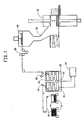
- Fig. 1 is a schematic illustration of the steps of deregistering crimped tow by stretching, then cutting the tow, and baling the cut tow.
- Fig. 2 is a schematic illustration of the means for controlling the tension during deregistration at a substantially constant level.
- crimped nylon tows 10 are taken from storage containers 12 and passed through guide rollers 14 to feed rolls 16 of stretching apparatus 18 and then to draw rolls 20.
- a tension transducer 22 (model UPB-10-MWF2500 by Cleveland kidder Co.) is located between feed rolls 16 and draw rolls 20 to monitor tension and transmit a signal speed control unit 24 for feed rolls 16.
- the tow After stretching,the tow enters a powered puller section 26 which provides a stable tension to cutter 28 where tow is cut to a desired fiber length, normally 4.0 to 8.0 inches for carpet fibers.
- the cut staple descends via chute 30 to the entrance of a baler 32. Tow which is packaged as tow goes directly to a storage device (not shown) from puller section 26.
- Fig. 2 illustrates the control system for controlling tension during deregistration wherein crimped tow 10 is fed to a stretching apparatus or deregistering unit 18 comprising a feed module 16 containing a plurality of smooth surfaced chrome plated rolls 16 geared together and all driven by a variable speed DC motor 40 and Reliance Maxi Pac solid state drive 50.
- a tension monitoring roll 70 which is mounted on Cleveland kidder model UPB-10-MWF-2500 tension transducer 22.
- the redraw module 20 also contains a plurality of smooth chrome plated rolls all geared together and driven at the same speed by a variable speed DC motor 90 and controlled by a Reliance Maxi Pac solid state drive 50′.
- the speed of the motor 90 is preset to a desired rate and the speed of the feed nodule motor 40 is modulated through an Avtron PDC-5 drive control device 24 and the feed module solid state drive 50′ based on the tension measurements from transducers 22. Any deviations in infeed tension due to crimp variations or defects in the product such as a joined section are instantly sensed and the speed of the feed module 16 is adjusted to maintain constant tension.
- the drive module controller 24 is capable of both speed and tension control to facilitate ease of startup. Tension control is the preferred mode of operation for optimum product uniformity.
- An accumulator 62 is located at the discharge of the redraw module 20 and it contains a speed control device 64 on the floating roll which regulates the speed of puller rolls 26 through its drive 68 and motor 69.
- the speed of a cutter 28 downstream of the puller roll is regulated to maintain constant tension between the puller roll 66 and cutter 28.
- a tension sensor 22′ located at the discharge of the puller section 26 is used to regulate the speed of the cutter drive 74 and its motor 76. Operation of the entire line is supervised by an Allen Bradley PLC-5-15 controller 72 which interfaces with a process computer 79.
- tension control avoids over-extending the product in these sections.
- the control system is also capable of reducing tension to process these sections.
- a detection plate (not shown) connected to a limit switch detects large deviations in cross section, a signal is sent to the controller 24 and tension is reduced to a preset level of ⁇ 0.10 gpd until the splice exits and is detected by a similar plate at the exit. If tension variations are detected due to regions of low or high crimp, a signal is sent to the control device 24 which feeds back an input signal to the feed section drive 50 and infeed speed is reduced or increased to maintain constant tension on the tow.
- Local variations in crimp level associated with stops and starts of a draw line, small changes in moisture content or temperature, or storage conditions for split process product are continuously occurring and, therefore, adjustments in tension are continuously made to maintain final product uniformity.
- leg length (L) is the distance between midpoints of the bends in the filament.
- the elbow (E) is the midpoint of the filament bend.
- the crimp angle (CA) is the angle formed by the two legs on either side of an elbow.
- the crimp/inch is equal to one half the number of leg lengths in an inch of filament (an inch is measured when the filament is straightened out). Crimps per inch are measured by counting the total number of elbows in an inch of straightened filament and dividing by two. Crimp is the combinatiion of crimp/inch (leg length) and crimp angles which make textured yarn different from normal drawn yarn.
- Crimp elongation is measured by hanging a length of crimped yarn under an added load of ⁇ 0.1 grams per denier for a fixed period varying from several seconds to a minute and an extended length (L,) is determined. The load is then removed and the retracted length is determined (L,) after waiting again for a specified period as stated.
- a method for determination of crimp properties which establishs a measure of performance potential through a staple conversion operation can be achieved by use of the Spinlab Co. model 580 machine. This unit processes a small sample of cut product and measures the power to form it into a sliver similar to that achieved by conventional carding, the first step in a mill process for conversion of staple products back to spun yarns.
- the mode of operation is as follows:
- the Fiber Opening Test is a test using a standard commercially available fiber opening device similar to those used in carpet mills on blending and opening lines to assess the processing rates and overall quality of crimped staple products.
- FIG. 1 A 36 inch wide Fiber Controls Feeder model M-6 Syncro-Feeder equipped with a sargent comb on the hopper side and a rotary doffer on the discharge side of the lift apron was used for this test.
- the unit illustrated in Fig. 1 contains a feed hopper 1 of approximately 2 cubic feet, a wood slat floor apron 2, a lift apron 3 containing pin lagged flats with 0.6875 inch long pins spaced 1.5 inches on center across the flats. Flat to flat spacing is 1.75 inches and the pins are inclined at a 15° angle facing up.
- a variable speed drive is provided to allow lift apron speeds to be controlled from 10 to 100 feet per minute surface speed.
- the floor apron is driven from the lift apron and is operated at one third the lift apron surface speed.
- an oscillating comb is provided to level fiber on the lift apron.
- the comb is gauged 2.0 inches off the apron and its stroke is adjusted to move from horizontal to 30° below the horizontal with a surface speed of 2X the lift apron.
- a rotary doffer is provided with brushes. This device operates at the surface speed of the apron and the brushes are gauged to intersect with the teeth on the apron.
- a watt meter is provided to monitor overall drive load and help establish maximum rate.
- Evaluation of opening rates is done by conducting a series of throughput tests for 5 minute periods at a range of speeds.
- the feed hopper is filled between trials to insure constant pressure against the lift apron.
- a curve of performance is plotted and the maximum rate obtained is established as well as the power consumption at this rate.
- the maximum rate is around 60 feet per minute apron speed; at higher speed throughput rates drop due to apron loading. All tests are duplicated and rates averaged.
- Bulk density of the product fed and delivered to the opener is established in a 16 cubic foot container as is the average clump weight of tufts fed and delivered for an overall performance potential assessment.
Landscapes
- Engineering & Computer Science (AREA)
- Textile Engineering (AREA)
- Health & Medical Sciences (AREA)
- Life Sciences & Earth Sciences (AREA)
- Chemical & Material Sciences (AREA)
- Analytical Chemistry (AREA)
- Medicinal Chemistry (AREA)
- Physics & Mathematics (AREA)
- Food Science & Technology (AREA)
- Biochemistry (AREA)
- General Health & Medical Sciences (AREA)
- General Physics & Mathematics (AREA)
- Immunology (AREA)
- Pathology (AREA)
- Yarns And Mechanical Finishing Of Yarns Or Ropes (AREA)
- Preliminary Treatment Of Fibers (AREA)
Applications Claiming Priority (2)
| Application Number | Priority Date | Filing Date | Title |
|---|---|---|---|
| US07/531,654 US5110517A (en) | 1990-06-01 | 1990-06-01 | Method for deregistering crimped multifilament tow |
| US531654 | 1990-06-01 |
Publications (2)
| Publication Number | Publication Date |
|---|---|
| EP0459827A1 true EP0459827A1 (fr) | 1991-12-04 |
| EP0459827B1 EP0459827B1 (fr) | 1996-01-31 |
Family
ID=24118503
Family Applications (1)
| Application Number | Title | Priority Date | Filing Date |
|---|---|---|---|
| EP91304957A Expired - Lifetime EP0459827B1 (fr) | 1990-06-01 | 1991-05-31 | Procédé pour l'étalement d'un câble de multifilaments crêpés et produit obtenu |
Country Status (5)
| Country | Link |
|---|---|
| US (2) | US5110517A (fr) |
| EP (1) | EP0459827B1 (fr) |
| AU (2) | AU640229B2 (fr) |
| CA (1) | CA2043225A1 (fr) |
| DE (1) | DE69116739T2 (fr) |
Families Citing this family (12)
| Publication number | Priority date | Publication date | Assignee | Title |
|---|---|---|---|---|
| DE19517348C1 (de) * | 1995-05-11 | 1996-08-29 | Inventa Ag | Verfahren zur Herstellung von selbstkräuselnden Polymer-Bikomponenten-Fasern |
| US5737815A (en) * | 1996-02-29 | 1998-04-14 | Fiberco Inc. | Method and apparatus for controlling a take-up point when texturizing a yarn |
| FR2750979B1 (fr) * | 1996-07-10 | 1998-10-02 | Vetrotex France Sa | Dispositif pour la fabrication d'un fil composite |
| US5870808A (en) * | 1997-10-24 | 1999-02-16 | E. I. Du Pont De Nemours And Company | Draw point control arrangement |
| FR2815046B1 (fr) * | 2000-10-11 | 2003-01-10 | Vetrotex France Sa | Procede et dispositif de production d'un fil composite |
| TWI302903B (en) * | 2003-02-05 | 2008-11-11 | Saurer Gmbh & Co Kg | Yarn withdrawal device |
| ITFI20030116A1 (it) * | 2003-04-24 | 2004-10-25 | Pecci Filati S P A | Procedimento ed apparecchiatura per la trasformazione di filati e filato cosi' realizzato |
| US20060201129A1 (en) * | 2005-03-09 | 2006-09-14 | Keith Bumgardner | Continuous constant tension air covering |
| FR2899243B1 (fr) * | 2006-03-30 | 2008-05-16 | Saint Gobain Vetrotex | Procede et dispositif de fabrication d'un fil composite |
| FR2899571B1 (fr) | 2006-04-10 | 2009-02-06 | Saint Gobain Vetrotex | Procede de fabrication d'un enroulement a fils separes |
| US7481158B2 (en) * | 2006-12-19 | 2009-01-27 | Lummus Corporation | Apparatus and method for baling lint cotton fibers |
| CN114045593B (zh) * | 2021-11-19 | 2023-02-03 | 平顶山神马帘子布发展有限公司 | 一种紧张热定型处理装置及高模量锦纶66工业用长丝生产方法 |
Citations (3)
| Publication number | Priority date | Publication date | Assignee | Title |
|---|---|---|---|---|
| GB810922A (en) * | 1954-07-14 | 1959-03-25 | Bayer Ag | Apparatus for stretching or shrinking continuously moving fully synthetic filaments or tapes |
| US3452131A (en) * | 1967-06-27 | 1969-06-24 | Du Pont | Process for stretching filaments |
| US4393701A (en) * | 1982-01-29 | 1983-07-19 | Lawson-Hemphill, Inc. | Yarn tester system |
Family Cites Families (8)
| Publication number | Priority date | Publication date | Assignee | Title |
|---|---|---|---|---|
| US2581922A (en) * | 1947-02-05 | 1952-01-08 | Firestone Tire & Rubber Co | Apparatus for and method of forming filaments |
| US3143784A (en) * | 1962-07-05 | 1964-08-11 | Du Pont | Process of drawing for bulky yarn |
| US3271943A (en) * | 1963-12-30 | 1966-09-13 | Du Pont | Process for stabilizing bulked yarns and product thereof |
| US3465399A (en) * | 1967-07-03 | 1969-09-09 | Kimberly Clark Co | Derigestering apparatus for crimped multifilament tow |
| US3549741A (en) * | 1967-10-30 | 1970-12-22 | Mildred H Caison | Process for preparing improved carpet yarn |
| US4069363A (en) * | 1975-05-27 | 1978-01-17 | E. I. Du Pont De Nemours And Company | Crimpable nylon bicomponent filament and fabrics made therefrom |
| US4501710A (en) * | 1975-07-15 | 1985-02-26 | Allied Corporation | Controlled tow stretching process |
| US4404718A (en) * | 1977-10-17 | 1983-09-20 | Teijin Limited | Apparatus for manufacturing a bulky textured yarn |
-
1990
- 1990-06-01 US US07/531,654 patent/US5110517A/en not_active Expired - Lifetime
-
1991
- 1991-05-24 CA CA002043225A patent/CA2043225A1/fr not_active Abandoned
- 1991-05-28 AU AU77364/91A patent/AU640229B2/en not_active Ceased
- 1991-05-31 DE DE69116739T patent/DE69116739T2/de not_active Expired - Fee Related
- 1991-05-31 EP EP91304957A patent/EP0459827B1/fr not_active Expired - Lifetime
-
1993
- 1993-05-31 AU AU39877/93A patent/AU651784B2/en not_active Ceased
- 1993-08-10 US US08/102,323 patent/US5422180A/en not_active Expired - Fee Related
Patent Citations (3)
| Publication number | Priority date | Publication date | Assignee | Title |
|---|---|---|---|---|
| GB810922A (en) * | 1954-07-14 | 1959-03-25 | Bayer Ag | Apparatus for stretching or shrinking continuously moving fully synthetic filaments or tapes |
| US3452131A (en) * | 1967-06-27 | 1969-06-24 | Du Pont | Process for stretching filaments |
| US4393701A (en) * | 1982-01-29 | 1983-07-19 | Lawson-Hemphill, Inc. | Yarn tester system |
Also Published As
| Publication number | Publication date |
|---|---|
| AU7736491A (en) | 1991-12-05 |
| DE69116739T2 (de) | 1996-08-14 |
| AU651784B2 (en) | 1994-07-28 |
| US5110517A (en) | 1992-05-05 |
| DE69116739D1 (de) | 1996-03-14 |
| CA2043225A1 (fr) | 1991-12-02 |
| AU3987793A (en) | 1993-09-09 |
| AU640229B2 (en) | 1993-08-19 |
| EP0459827B1 (fr) | 1996-01-31 |
| US5422180A (en) | 1995-06-06 |
Similar Documents
| Publication | Publication Date | Title |
|---|---|---|
| US5422180A (en) | Method and apparatus for deregistering multi-filament tow and product thereof | |
| US3429018A (en) | Method of converting waste filamentary material into staple fiber | |
| US6536087B2 (en) | Method and apparatus for continuously unwinding and processing a yarn | |
| US3459845A (en) | Process for producing polyamide staple fibers | |
| US20030150266A1 (en) | Use of microwaves in the spinning industry | |
| US3214899A (en) | Cordage product | |
| CN105316818B (zh) | 纺纱机、纺纱方法及纺纱 | |
| US4356690A (en) | Fasciated yarn | |
| US3321448A (en) | Nylon staple fiber for blending with other textile fibers | |
| JPH05195329A (ja) | カーディングする方法とカーディング装置 | |
| US3333467A (en) | Method and apparatus for evaluating crimp uniformity | |
| CA2351108A1 (fr) | Procedes et systemes pour fabriquer des fils de filament continu gonflant synthetique | |
| US5437182A (en) | Method and device for determining strength properties of the warp threads of a warp | |
| CA1055239A (fr) | Procede d'entrelacement des fibres utilisant des jets de fluide | |
| EP0806503B1 (fr) | Machine à conférer une fausse torsion à un fil texturé | |
| CN1036806A (zh) | 制备高抱合性空气喷射变形纱的设备 | |
| US4019229A (en) | Yarn texturing apparatus | |
| CN110714247B (zh) | 一种高档环保纱生产方法 | |
| JPS6123297B2 (fr) | ||
| JPS6212328B2 (fr) | ||
| US3401559A (en) | Method and apparatus for determining the degree of cohesion in multifilament yarn strands | |
| Taylor et al. | The Influence of front-roll coverings on the spinning strength of cotton | |
| US3466861A (en) | Converting crimped filamentary material to continuous elongated body | |
| JPH05125620A (ja) | 化学繊維連続フイラメントを紡糸可能な化学繊維スライバに牽切する方法及び装置 | |
| US6553826B1 (en) | Process and device for monitoring the quality of textile strips |
Legal Events
| Date | Code | Title | Description |
|---|---|---|---|
| PUAI | Public reference made under article 153(3) epc to a published international application that has entered the european phase |
Free format text: ORIGINAL CODE: 0009012 |
|
| AK | Designated contracting states |
Kind code of ref document: A1 Designated state(s): DE FR GB |
|
| 17P | Request for examination filed |
Effective date: 19920508 |
|
| 17Q | First examination report despatched |
Effective date: 19931026 |
|
| GRAA | (expected) grant |
Free format text: ORIGINAL CODE: 0009210 |
|
| AK | Designated contracting states |
Kind code of ref document: B1 Designated state(s): DE FR GB |
|
| ET | Fr: translation filed | ||
| REF | Corresponds to: |
Ref document number: 69116739 Country of ref document: DE Date of ref document: 19960314 |
|
| PLBE | No opposition filed within time limit |
Free format text: ORIGINAL CODE: 0009261 |
|
| STAA | Information on the status of an ep patent application or granted ep patent |
Free format text: STATUS: NO OPPOSITION FILED WITHIN TIME LIMIT |
|
| 26N | No opposition filed | ||
| REG | Reference to a national code |
Ref country code: GB Ref legal event code: IF02 |
|
| REG | Reference to a national code |
Ref country code: GB Ref legal event code: 732E |
|
| REG | Reference to a national code |
Ref country code: GB Ref legal event code: 732E |
|
| PGFP | Annual fee paid to national office [announced via postgrant information from national office to epo] |
Ref country code: FR Payment date: 20060515 Year of fee payment: 16 |
|
| PGFP | Annual fee paid to national office [announced via postgrant information from national office to epo] |
Ref country code: DE Payment date: 20060525 Year of fee payment: 16 |
|
| PGFP | Annual fee paid to national office [announced via postgrant information from national office to epo] |
Ref country code: GB Payment date: 20060531 Year of fee payment: 16 |
|
| GBPC | Gb: european patent ceased through non-payment of renewal fee |
Effective date: 20070531 |
|
| REG | Reference to a national code |
Ref country code: FR Ref legal event code: ST Effective date: 20080131 |
|
| PG25 | Lapsed in a contracting state [announced via postgrant information from national office to epo] |
Ref country code: DE Free format text: LAPSE BECAUSE OF NON-PAYMENT OF DUE FEES Effective date: 20071201 |
|
| PG25 | Lapsed in a contracting state [announced via postgrant information from national office to epo] |
Ref country code: GB Free format text: LAPSE BECAUSE OF NON-PAYMENT OF DUE FEES Effective date: 20070531 |
|
| PG25 | Lapsed in a contracting state [announced via postgrant information from national office to epo] |
Ref country code: FR Free format text: LAPSE BECAUSE OF NON-PAYMENT OF DUE FEES Effective date: 20070531 |