EP0459844B1 - Méthode et dispositif de diagraphie pour déterminer la porosité par neutrons épithermiques - Google Patents
Méthode et dispositif de diagraphie pour déterminer la porosité par neutrons épithermiques Download PDFInfo
- Publication number
- EP0459844B1 EP0459844B1 EP91401062A EP91401062A EP0459844B1 EP 0459844 B1 EP0459844 B1 EP 0459844B1 EP 91401062 A EP91401062 A EP 91401062A EP 91401062 A EP91401062 A EP 91401062A EP 0459844 B1 EP0459844 B1 EP 0459844B1
- Authority
- EP
- European Patent Office
- Prior art keywords
- porosity
- epithermal
- measurement
- formation
- neutron
- Prior art date
- Legal status (The legal status is an assumption and is not a legal conclusion. Google has not performed a legal analysis and makes no representation as to the accuracy of the status listed.)
- Expired - Lifetime
Links
Images



Classifications
-
- G—PHYSICS
- G01—MEASURING; TESTING
- G01V—GEOPHYSICS; GRAVITATIONAL MEASUREMENTS; DETECTING MASSES OR OBJECTS; TAGS
- G01V5/00—Prospecting or detecting by the use of ionising radiation, e.g. of natural or induced radioactivity
- G01V5/04—Prospecting or detecting by the use of ionising radiation, e.g. of natural or induced radioactivity specially adapted for well-logging
- G01V5/08—Prospecting or detecting by the use of ionising radiation, e.g. of natural or induced radioactivity specially adapted for well-logging using primary nuclear radiation sources or X-rays
- G01V5/10—Prospecting or detecting by the use of ionising radiation, e.g. of natural or induced radioactivity specially adapted for well-logging using primary nuclear radiation sources or X-rays using neutron sources
- G01V5/107—Prospecting or detecting by the use of ionising radiation, e.g. of natural or induced radioactivity specially adapted for well-logging using primary nuclear radiation sources or X-rays using neutron sources and detecting reflected or back-scattered neutrons
- G01V5/108—Prospecting or detecting by the use of ionising radiation, e.g. of natural or induced radioactivity specially adapted for well-logging using primary nuclear radiation sources or X-rays using neutron sources and detecting reflected or back-scattered neutrons the neutron source being of the pulsed type
Definitions
- the present invention relates generally to epithermal neutron well logging and, more particularly, to a method and an apparatus for determining the porosities of subsurface earth formations based on measurements of both the slowing down lengths and slowing down times of epithermal neutrons with minimal effects of the borehole environment.
- Epithermal neutron porosity logging makes use of the facts that hydrogen strongly affects neutron moderation and that the pore spaces of earth formations are usually filled with hydrogen-rich fluids, namely hydrocarbons or water.
- the borehole and formation are irradiated with neutrons from a chemical or accelerator source, and the populations of epithermal neutrons are detected at one or more locations some distance or distances from the neutron source.
- the detected counts are correlatable with porosity either individually or as ratios of counts.
- the detected count rates and count rate ratios are functions of the slowing down lengths of epithermal neutrons in the irradiated formations.
- the borehole and formation are irradiated with discrete short bursts of neutrons from an accelerator source, and the time rate of decay (slowing down time) of epithermal neutrons is determined by measuring the die-away or decay of epithermal neutrons as a function of time (as counts in multiple channels). Again, there is a correlation between the epithermal neutron slowing down time and formation porosity.
- the count rate data are affected in various, though different, ways by borehole environmental conditions, borehole size, tool standoff, formation fluids, mudcake thickness and composition, and formation lithology.
- slowing down length measurements are less affected by borehole environment and tool standoff than slowing down time-derived measurements.
- Slowing down length measurements are more strongly affected by formation lithology than are slowing down time-derived porosity measurements.
- the usual slowing down length measurement technique uses far-spaced detector and near-spaced detector count rates
- a slowing down time measurement technique uses relatively close spacing of the detector (or detectors) to the source in order to obtain statistically meaningful count rates in each time interval.
- U.S. Patent No. 4,760,252 (Albats et al., July 26, 1988) describes neutron porosity logging tools having a pulsed neutron source, near and far epithermal neutron detectors that are specially shielded and located on the sonde to optimize response to formation porosity and minimize the near/far ratio response to borehole environmental effects, and a neutron source monitor that enables normalization of count data and measurement of capture gamma rays.
- Formation porosity values are derived by taking the ratio of the near-and-far epithermal neutron counts or by cross-plotting the nornalized near-and-far counts directly.
- One objective of the present invention is to investigate formation porosity by epithermal neutron logging in a manner that provides a greater range of neutron scattering data than is attained by separate slowing down time measurements or slowing down length measurements. Another objective is to detect epithermal neutron populations in a manner that enables derivation of formation porosities that are inherently corrected for the effects of tool standoff. Still another object of the inventions is to provide slowing down length-based porosity measurements which have been corrected for tool standoff effects. Still a further objective is to provide simultaneous epithermal neutron slowing down length measurements and epithermal neutron slowing down time measurements, which may then be processed separately or in combination to provide enhanced and more reliable information of formation porosities.
- the time distribution of epithermal neutrons following each neutron burst is also detected, either at one of the near-far locations or, preferably, at a third location from the neutron source, and signals indicative of the slowing down time of the epithermal neutron population are generated.
- the near-far epithermal neutron population measurements and the epithermal neutron slowing down time measurements may be processed separately to derive independent values of formation porosity, or they may be combined, in accordance with predetermined empirical relationships, to provide standoff-compensated porosity values.
- the latter step may be carried out, for example, by cross plotting the ratio of the near-far epithermal neutron population measurements against the epithermal slowing down time or, alternatively, the independently derived values of formation porosity may be crossplotted to obtain a correction factor to be applied to the slowing down length (near-far ratio)-derived porosity value to compensate for standoff.
- the simultaneous measurements of both the number and the time evolution of epithermal neutrons provides porosity measurements more powerful than either measurement alone provides.
- the near-far ratio derived porosity is relatively sensitive to formation lithology and relatively less sensitive, but not wholly insensitive, to tool standoff.
- the slowing-down-time derived porosity is very sensitive to tool standoff effects and relatively intensitive to formation lithology.
- the present invention results in ratio-derived porosity values that are standoff corrected.
- the two measurements have different depths of investigation, and making both of them improves the measurement of overall vertical and radial porosity variations.
- Epithermal neutron porosity logging can be carried out using a logging tool similar in most respects to those described and shown in U.S. Patent No. 4,760,252 (Albats et al., July 26, 1988), which is hereby incorporated herein by reference, or any similar tool.
- an embodiment of the tool (or sonde) 10 includes an accelerator neutron source 12, such as a D-T type (14 MeV) source having an output of the order of 5 x 10⁸ n/sec or greater, a neutron source monitor 14, a near epithermal neutron detector 16, a far epithermal neutron detector 18, and an array 20 of two (or more) epithermal neutron detectors 20a and 20b.
- an accelerator neutron source 12 such as a D-T type (14 MeV) source having an output of the order of 5 x 10⁸ n/sec or greater
- a neutron source monitor 14 having an output of the order of 5 x 10⁸ n/sec or greater
- a neutron source monitor 14 such as
- one or more thermal neutron detectors 20c may also be included in the detector array 20. It will be appreciated that, while preferred, not all of the detectors or the neutron monitor are required. It is necessary only that at least two differently-spaced epithermal neutron detectors be provided to generate the near/far count ratio, one or both of which detectors could then also be used to generate the slowing down time measurement. As described hereinafter, however, the combination of a near/far count rate ratio measurement from the detectors 16 and 18 and a slowing down time measurement from one (or more) of the epithermal array detectors 20a, 20b is of particular advantage in optimizing count rate statistics and sensitivity to formation porosity.
- the near detector 16 is centralized within the sonde and surrounded by an annular neutron shield 22, while the far detector 18 and the array 20 are eccentered within the sonde and are back-shielded by neutron shields 24 and 26, respectively.
- the positioning and the shielding of the far detector 18 and the array 20 are such as to provide high sensitivities to neutrons scattered from the formation by excluding as much as possible neutrons scattered from the borehole.
- the near detector 16, on the other hand, is located near the neutron source 12, is centralized within the sonde, and is shielded to desensitize it to formation neutrons and sensitize it to borehole neutrons.
- the epithermal detectors 16, 18 and 20 are of the He-3 proportional counter type shielded against thermal neutrons, and the low energy detection threshold of the near detector 16 is raised by the external shield 22 to at least approximately 10 eV.
- the ratio of the near to the far epithermal neutron counts is inherently more sensitive to the far counts and thus porrosity, while the sensitivity of the near detector to borehole neutrons affords information useful in compensating the near to far count ratios for environmental effects and tool standoff.
- the sonde 10 is run eccentrically in the borehole, being held in contact with the borehole wall by a bowspring 28 or other suitable means.
- the sonde 10 has a power supply 30 and a downhole electronics package 32 and is run in the borehole suspended by a cable 34 that includes conductors to provide electrical power to the sonde power supply 30 and to transmit data from the downhole electronics package 32 to the surface electronics 36.
- a cable 34 that includes conductors to provide electrical power to the sonde power supply 30 and to transmit data from the downhole electronics package 32 to the surface electronics 36.
- each neutron burst is initiated by a signal from a sonde programmer 38 to an ion source pulser 40.
- the burst timing regime may be selected as desired, but preferably is of the order of 20 microsecond burst width at 100 microsecond intervals.
- the output signals of the neutron source monitor 14, if used, are applied to a pre-amp 42, amplifier 44 and time digitizer 46 for production of a neutron burst histogram (neutron source output versus time curve) for use, if desired, in normalizing detector counts, deriving thermal neutron capture data, and defining a fiducial time window for processing the epithermal die-away curve data. Further information concerning the source monitor 14 and its use are set out in the aforementioned U.S.
- the time digitizer 46 is armed by a START pulse from the programmer 38, which is synchronized with the ion source pulse and occurs slightly before the neutron burst.
- CLOCK pulses from the programmer determine the widths of the time channels, and the input pulses from the amplifier 44 stop the CLOCK pulse counters in the digitizer 46 to digitize the time intervals from the START pulse to the input pulses.
- the digitizer 46 is reset to zero and the counts per channel data are read out by a RESET pulse from the programmer 38 to a multiplexer 48 and applied (along with detector signals) to a digital read-write memory 50.
- the signals from each of the slowing down time epithermal neutron detectors 20a and 20b are amplified (pre-amps and amps 52, 54, 56 and 58), applied in response to CLOCK signals to time digitizers 60 and 62, and stored in the memory 50 by channels.
- the signals from the near and far epithermal neutron detectors 16 and 18, after processing in pre-amps 64 and 66 and amplifiers 68 and 70, are applied to scalers 68 and 70 where they are accumulated for a predetermined time interval, e.g. on the order of several seconds.
- RESET signals apply the total counts of the near and far detectors to the memory 50.
- the multiplexing and memorizing of count data are controlled by a memory programmer 76, which also controls the periodic destructive readout of the data from the memory 50 through telemetry 52 to the surface electronics 36 over the sonde cable 34.
- the ratio of the epithermal neutron population counted by the near detector 16 to the epithermal neutron population counted by the far detector 18 correlates with formation porosity.
- the correlation varies with formation lithology and borehole size. It is also sensitive to the tool standoff that results from either riding of the tool on a mudcake or local irregularities in the borehole wall or both.
- the design of the sonde - shielding and location of detectors 16 and 18 - is such that standoff is compensated to some extent in the near/far count ratio itself. Nonetheless, the tool response to standoff affects the measured count data, and the tool standoff effect is not always fully taken into account in presently available correlation procedures upon which the computations of formation porosities from the near/far count ratios are made.
- the epithermal neutron count data from either or both of the detectors 20a and 20b will show a decay curve which reflects both the formation epithermal neutron slowing down time ( ⁇ ) and the slowing down time effect of standoff.
- the neutron count data can be processed in various ways that are well-known to obtain a single time parameter that responds to both formation porosity and the amount of standoff.
- the count data may, for example, be processed to fit the decay curve to a single-component time decay function such as a single exponential function or, preferably, a single-component diffusion function, as described in allowed commonly-owned U.S. patent application Serial No.
- the single epithermal slowing down time value obtained by one of these methods may be converted, by use of predetermined correlation curves such as that of Fig. 4, to provide a measurement of formation porosity.
- Fig. 4 shows a representative crossplot of the inverse slowing down time constant ⁇ determined from laboratory, test pit or test well measurements versus porosity at 0 inch standoff. Fig. 4 resulted in a correlation of the slowing down time constant computed from the measured decay rates to be largely independent of formation lithology.
- the decay curve may be fitted so that both the formation slowing down time and a parameter indicative of standoff may be extracted.
- a parameter indicative of standoff may be extracted.
- formation porosities substantially free of the effects of tool standoff are determined from simultaneous measurements of total epithermal neutron populations at two spaced locations and of the rate of decay of epithermal neutron populations at least at one location.
- the ratio of the total counts (or a crossplot of such counts) at the near and far locations is a function of the slowing down length of scattered epithermal neutrons, and the measurement of the rate of decay of the scattered epithermal neutrons following each neutron burst is indicative of slowing down time.
- those two forms of measurement investigate somewhat different aspects of the environments (both borehole and formation environments) irradiated by the neutron burst. By measuring them both simultaneously and using both to determine formation porosity, more powerful data are available, and more accurate correlations of the measurements with true formation porosities are attainable.
- the present invention involves correlation of data obtained from the logging run with empirically predetermined tool responses to known conditions in test pits and test wells.
- count data are determined with the tool at known standoffs, porosities and lithology, and the measured near/far count ratios as-derived from the detectors 16 and 18 are cross-plotted-against the inverse slowing down time calculated by fitting the count data from the slowing down time detector 20a to a single exponential function or some other suitable fitting function.
- the time-dependent count data used in deriving ⁇ can be developed from the near epithermal detector 18 if desired.
- the use of the near-spaced detector 16 and the far-spaced detector 18 to generate the near/far count ratio measurement and an intermediately-spaced detector or detectors 20a, 20b to generate the slowing down time measurement is preferred, however, as it optimizes the sensitivity of both the near/far ratio and the slowing down time measurements to formation porosity commensurate with acceptable count rate statistics.
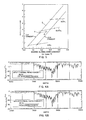
- FIG. 5 will be recognized as a "spine and ribs" chart, the spine being the line “S” of measurements at 0 standoff and the ribs being the 0, 15.4 and 30 p.u. porosity lines.
- the data crossplotted in Fig. 5 were obtained by logging a test well of known formation porosity and lithology. One logging pass was made at 0 standoff and a second pass at forced 0.5-inch (12.7 mm) standoff. The test well was substantially free of mudcake.
- the spine and ribs plot enables corrections to be made for unknown tool standoffs of near/far ratios and slowing down times measured in a wellbore of the same size in formations of similar lithology.
- measured data point X there is a data point on the crossplot, for example, measured data point X.
- the correction is made by transfer of the data point in the rib direction across to the 0 standoff line (the spine) by interpolation along the spine between ribs to yield the porosity value at the point marked Y in Fig. 5.
- a collection of crossplots for use in boreholes of various sizes and with various lithologies is determined empirically and stored as programs in the surface computer to enable the corrected porosity values to be plotted as a function of depth as the tool is being run.
- the count data are also routinely recorded for further processing, if desired.
- a recorder/plotter 74 suitably coupled to a cable-follower mechanism, is provided for these purposes, as is conventional in the art.
- Fig. 6A Logs of two runs ("passes") of the tool in the test well are shown in Fig. 6A, the solid-line curve representing the observed porosity at 0 standoff and the broken-line curve representing the observed porosity at fixed 0.5 in. (12.7 mm) standoff. Both logs plot the formation porosities in porosity units (p.u.) determined from predetermined empirical correlations of the near/far count ratios of epithermal neutrons to porosity, as shown for example in Fig. 3. The effect of standoff on the ratio-based porosity log at the known 0.5 in (12.7 mm) standoff is clearly apparent.
- Fig. 6B shows the same 0 standoff log (solid-line curve) as in Fig. 6A, but shows the 0.5 in.
- the relatively small slopes of the porosity ribs in Fig. 5 indicate that the ratio of the measured epilthermal neutron populations is not as greatly afffected by tool standoff as are measurements of the slowing down time. Accordingly, the present invention provides a method for using the large sensitivity of slowing down time measurements to tool standoff to make an appropriate and significant simultaneous correction to the measured epithermal neutron ratio.
- the ribs representing porosities (0, 15.4 and 30 p.u.) were established from empirical measurements of tool responses (detected near/far count ratios R and slowing down time constant ⁇ ) under known borehole and formation conditions, thereby affording standoff-compensated porosity measurements based directly on measured values of the near/far count ratio and the epithermal slowing down time constant ⁇ .
- Another way of compensating for the effects of standoff on the observed porosity is to derive a crossplot of the type shown in Fig. 7, which yields a correction factor ⁇ R to be subtracted from the observed near/far ratio-derived porosity to obtain the true porosity.
- Fig. 7 Another way of compensating for the effects of standoff on the observed porosity is to derive a crossplot of the type shown in Fig. 7, which yields a correction factor ⁇ R to be subtracted from the observed near/far ratio-derived porosity to obtain the true porosity.
- the difference between the slowing down time-derived porosity ⁇ sdt (e.g., from Fig. 4) and the near/far ratio-derived porosity ⁇ R (e.g., from Fig. 3) is plotted against the correction factor ⁇ for a formation porosity of 15.4 p.u. and two different standoffs (0.5 in. (12.7 mm) and 1 in. (25.4 mm)).
- the crossplot of Fig. 7 is easily programmed for use with the uncorrected values of ⁇ sdt and ⁇ R derived from the measured values of the near/far ratio and ⁇ to correct the measured ⁇ R values for standoff and, thereby, obtain true porosities.
Landscapes
- Physics & Mathematics (AREA)
- High Energy & Nuclear Physics (AREA)
- Life Sciences & Earth Sciences (AREA)
- General Life Sciences & Earth Sciences (AREA)
- General Physics & Mathematics (AREA)
- Geophysics (AREA)
- Analysing Materials By The Use Of Radiation (AREA)
- Breeding Of Plants And Reproduction By Means Of Culturing (AREA)
- Geophysics And Detection Of Objects (AREA)
- Measurement Of Radiation (AREA)
- Other Investigation Or Analysis Of Materials By Electrical Means (AREA)
- Solid-Sorbent Or Filter-Aiding Compositions (AREA)
- Polishing Bodies And Polishing Tools (AREA)
- Luminescent Compositions (AREA)
Claims (18)
- Méthode pour déterminer la porosité d'une formation du sous-sol entourant un trou de sonde, comprenant les étapes consistant à : irradier de façon répétitive le trou de sonde et la formation du sol avec des rafales discrètes de neutrons de haute énergie provenant d'une source de neutrons, lesquels neutrons interagissent avec les noyaux des matières dans le trou de sonde et dans la formation pour y produire des neutrons épithermiques, détecter des neutrons épithermiques à des emplacements proches et éloignés dans le trou de sonde espacés longitudinalement par différentes distances de la source de neutrons, générer des signaux de compte indicatifs des neutrons épithermiques détectés aux emplacements proches et éloignés, et dériver à partir des signaux de compte proches et éloignés un signal de mesure représentatif de la porosité de la formation entourant le trou de sonde, la méthode comprenant en outre les étapes consistant à : détecter les populations de neutrons épithermiques aux emplacements proches et éloignés, les signaux de compte étant indicatifs des populations, détecter l'affaiblissement des populations de neutrons épithermiques suivant les rafales de neutrons à au moins un emplacement dans le trou de sonde et générer des signaux le représentant, dériver à partir des signaux d'affaiblissement un signal indicatif du temps de ralentissement des neutrons épithermiques dans la formation au moins audit emplacement et dériver à partir des signaux de compte de population et du signal de temps de ralentissement un signal de mesure représentatif de la porosité de la formation où les effets d'écart d'outil sont compensés intrinsèquement à la réponse de l'outil de diagraphie.
- Méthode selon la revendication 1, dans laquelle l'étape de dérivation de la mesure de la porosité comprend la combinaison, selon une relation prédéterminée, d'un signal représentatif des signaux de compte de population proches et éloignés et du signal de temps de ralentissement épithermique pour dériver la mesure de la porosité de la formation où l'écart est compensé.
- Méthode selon la revendication 1 ou 2, dans laquelle l'étape de dérivation de la mesure de la porosité comprend la dérivation d'un premier signal de mesure de porosité à partir des signaux de compte proches et éloignés et d'un second signal de mesure de porosité à partir du signal de temps de ralentissement épithermique, et la combinaison des premier et second signaux de mesure de porosité selon une relation prédéterminée pour dériver un facteur de correction indicatif de l'effet d'un écart d'outil sur le premier signal de mesure de porosité.
- Méthode selon la revendication 3, dans laquelle l'étape de dérivation de la mesure de la porosité comprend en outre la combinaison du facteur de correction avec le premier signal de mesure de porosité pour dériver le signal de mesure de la porosité avec écart compensé.
- Méthode selon la revendication 3 ou 4, dans laquelle le premier signal de mesure de porosité est dérivé en fonction de la longueur de ralentissement des neutrons épithermiques dans la formation.
- Méthode selon la revendication 5, comprenant l'étape consistant à former un rapport des signaux de compte de population de neutrons épithermiques et la dérivation d'un signal le représentant, et convertir le signal de rapport selon une relation prédéterminée pour déduire la première mesure de la porosité.
- Méthode selon l'une quelconque des revendications 3 - 6, dans laquelle le second signal de mesure de porosité est dérivé par conversion du signal de temps de ralentissement épithermique selon une relation prédéterminée.
- Dispositif pour déterminer la porosité d'une formation du sous-sol entourant un trou de sonde, comprenant : un moyen (12) pour irradier de façon répétitive le trou de sonde et la formation du sol avec des rafales discrètes de neutrons de haute énergie provenant d'une source de neutrons, ces neutrons ayant une interaction avec les noyaux des matières dans le trou de sonde et dans la formation pour y produire des neutrons épithermiques, des moyens (16, 18) pour détecter des neutrons épithermiques à des emplacements proches et éloignés dans le trou de sonde espacés longitudinalement par différentes distances de la source de neutrons (12), des moyens (64, 66, 68, 70, 72, 74) pour engendrer des signaux de compte indicatifs des neutrons épithermiques détectés aux emplacements proches et éloignés, et un moyen (36) pour dériver à partir des signaux de compte proches et éloignés un signal de mesure représentatif de la porosité de la formation entourant le trou de sonde, dans lequel les moyens de détection (16, 18) pour détecter les neutrons épithermiques aux emplacements proches et éloignés détectent des populations de neutrons épithermiques aux emplacements proches et éloignés, les signaux de compte étant indicatifs de ces populations, et comprenant en outre des moyens (20a, 20b, 20c) pour détecter l'affaiblissement des populations de neutrons épithermiques suivant les rafales de neutrons à au moins un emplacement dans le trou de sonde et engendrer des signaux le représentant, un moyen (36) pour dériver à partir des signaux d'affaiblissement un signal indicatif du temps de ralentissement des neutrons épithermiques dans la formation au moins audit emplacement et un moyen (36) pour dériver à partir des signaux de compte de population et du signal de temps de ralentissement un signal de mesure représentatif de la porosité de la formation où les effets d'écart d'outil sont compensés intrinsèquement à la réponse de l'outil de diagraphie.
- Dispositif selon la revendication 8, dans lequel le moyen de dérivation de la mesure de la porosité (36) comprend un moyen pour combiner, selon une relation prédéterminée, un signal représentatif du rapport des signaux de compte de population proches et éloignés et du signal de temps de ralentissement épithermique pour déduire la mesure de la porosité de la formation avec écart compensé.
- Dispositif selon la revendication 8 ou 9, dans lequel le moyen de dérivation de la mesure de la porosité (36) comprend un moyen pour dériver un premier signal de mesure de porosité à partir des signaux de compte proches et éloignés et un second signal de mesure de porosité à partir du signal de temps de ralentissement épithermique, et un moyen pour combiner les premier et second signaux de mesure de porosité selon une relation prédéterminée afin de dériver un facteur de correction indicatif de l'effet d'un écart d'outil sur le premier signal de mesure de porosité.
- Dispositif selon la revendication 10, dans lequel le moyen de dérivation de la mesure de la porosité (36) comprend en outre un moyen pour combiner le signal de facteur de correction avec le premier signal de mesure de porosité afin de dériver le signal de mesure de la porosité avec écart compensé.
- Dispositif selon la revendication 10 ou 11, dans lequel le moyen (36) pour dériver le premier signal de mesure de porosité comprend un moyen pour dériver une fonction de la longueur de ralentissement des neutrons épithermiques dans la formation.
- Dispositif selon la revendication 12, dans lequel le moyen (36) pour dériver le premier signal de mesure de porosité comprend un moyen pour former un rapport des mesures de population de neutrons épithermiques et dériver un signal le représentant, et un moyen pour convertir le signal de rapport selon une relation prédéterminée afin de dériver la première mesure de la porosité.
- Dispositif selon l'une quelconque des revendications 10-13, dans lequel le moyen (36) pour dériver la seconde mesure de la porosité comprend un moyen pour dériver une mesure du temps de ralentissement des neutrons épithermiques de la formation du sol à partir des signaux d'affaiblissement des neutrons épithermiques et engendrer un signal la représentant, et un moyen pour convertir le signal de mesure du temps de ralentissement épithermique selon une relation prédéterminée afin de déduire la seconde mesure de la porosité.
- Dispositif selon l'une quelconque des revendications 8-14, comprenant :(a) une sonde (10) adaptée pour la déplacer jusqu'au fond du trou de sonde ;(b) un moyen accélérateur de source de neutrons (12) dans la sonde (10) ;(c) un premier détecteur de neutrons épithermiques (16) dans la sonde (10), espacé mais proche de la source de neutrons (12) sans interposition substantielle d'un blindage à haute densité ;(d) un premier moyen de blindage (22) pour blinder le premier détecteur (16) de manière à augmenter son seuil de détection des neutrons de basse énergie à au moins 10 eV approximativement ;(e) un deuxième détecteur de neutrons épithermiques (18) dans la sonde (10) situé plus loin de la source de neutrons (12) que le premier détecteur (16), le deuxième détecteur (18) étant excentré vers un côté de la sonde (10) ;(f) un deuxième moyen de blindage (24) pour blinder le deuxième détecteur (18) contre les neutrons incidents sur celui-ci de tous les côtés à l'exception dudit côté de la sonde (10) ;(g) un troisième détecteur de neutrons épithermiques (20) dans la sonde (10) situé entre les premier et deuxième détecteurs (16, 18) par rapport à la source de neutrons (12) et excentré vers ledit côté de la sonde (10) ;(h) un troisième moyen de blindage (26) pour blinder le troisième détecteur (20) contre les neutrons incidents sur celui-ci de tous les côtés à l'exception dudit côté ;(i) un moyen (28) pour excentrer la sonde (10) dans le trou de sonde pour que ledit côté soit étroitement adjacent à la paroi du trou de sonde ;(j) un moyen pour compter séparément les neutrons détectés par les premier et deuxième détecteurs (16, 18) sur un intervalle de temps englobant une pluralité de rafales de neutrons et pour engendrer des premier et deuxième signaux de compte les représentant ;(k) un moyen (36) pour déduire des premier et deuxième signaux de compte une première mesure indicative de la porosité de la formation du sol ;(l) un moyen pour compter les neutrons détectés par le troisième détecteur (20) pendant une pluralité d'intervalles de temps entre les rafales successives de neutrons et engendrer une pluralité correspondante de signaux de compte les représentant ; et,(m) un moyen (36) pour déduire de la pluralité des signaux de compte une mesure du temps de ralentissement des neutrons épithermiques dans la formation du sol comme deuxième mesure indicative de la porosité de la formation.
- Dispositif selon la revendication 15, dans lequel la première mesure comprend un rapport des premier et deuxième signaux de compte.
- Dispositif selon la revendication 15 ou 16, comprenant en outre un moyen (36) pour convertir la première mesure en une première mesure quantitative de la porosité de la formation, et un moyen pour convertir la deuxième mesure en une deuxième mesure quantitative de la porosité de la formation.
- Dispositif selon la revendication 17, comprenant en outre un moyen (36) pour combiner les première et deuxième mesures afin de déduire une mesure améliorée de la porosité de la formation.
Applications Claiming Priority (2)
| Application Number | Priority Date | Filing Date | Title |
|---|---|---|---|
| US07/517,268 US5051581A (en) | 1990-05-01 | 1990-05-01 | Method and apparatus for epithermal neutron porosity well logging |
| US517268 | 1990-05-01 |
Publications (3)
| Publication Number | Publication Date |
|---|---|
| EP0459844A2 EP0459844A2 (fr) | 1991-12-04 |
| EP0459844A3 EP0459844A3 (fr) | 1992-12-30 |
| EP0459844B1 true EP0459844B1 (fr) | 1996-03-13 |
Family
ID=24059108
Family Applications (1)
| Application Number | Title | Priority Date | Filing Date |
|---|---|---|---|
| EP91401062A Expired - Lifetime EP0459844B1 (fr) | 1990-05-01 | 1991-04-23 | Méthode et dispositif de diagraphie pour déterminer la porosité par neutrons épithermiques |
Country Status (17)
| Country | Link |
|---|---|
| US (1) | US5051581A (fr) |
| EP (1) | EP0459844B1 (fr) |
| AT (1) | ATE135472T1 (fr) |
| AU (1) | AU643983B2 (fr) |
| BR (1) | BR9101642A (fr) |
| DE (1) | DE69117803T2 (fr) |
| DK (1) | DK0459844T3 (fr) |
| DZ (1) | DZ1502A1 (fr) |
| EG (1) | EG19325A (fr) |
| IE (1) | IE911454A1 (fr) |
| MA (1) | MA24510A1 (fr) |
| NO (1) | NO304040B1 (fr) |
| NZ (1) | NZ237576A (fr) |
| OA (1) | OA09290A (fr) |
| TN (1) | TNSN91028A1 (fr) |
| TR (1) | TR26463A (fr) |
| ZA (1) | ZA912502B (fr) |
Cited By (1)
| Publication number | Priority date | Publication date | Assignee | Title |
|---|---|---|---|---|
| RU2199010C2 (ru) * | 1997-07-31 | 2003-02-20 | Шлюмбергер Текнолоджи Б.В. | Способ и устройство для измерения характеристик скважин и свойств образований |
Families Citing this family (24)
| Publication number | Priority date | Publication date | Assignee | Title |
|---|---|---|---|---|
| US5235185A (en) * | 1992-01-09 | 1993-08-10 | Schlumberger Technology Corporation | Formation sigma measurement from thermal neutron detection |
| US5349184A (en) * | 1993-01-21 | 1994-09-20 | Schlumberger Technology Corporation | Method and apparatus for reducing matrix density effects on porosity measurements during epithermal neutron porosity well logging |
| US5413179A (en) * | 1993-04-16 | 1995-05-09 | The Energex Company | System and method for monitoring fracture growth during hydraulic fracture treatment |
| US5322126A (en) * | 1993-04-16 | 1994-06-21 | The Energex Company | System and method for monitoring fracture growth during hydraulic fracture treatment |
| US5420422A (en) * | 1994-01-11 | 1995-05-30 | Schlumberger Technology Corporation | Methods and apparatus for epithermal neutron porosity logging |
| US5608215A (en) | 1994-09-16 | 1997-03-04 | Schlumberger Technology Corporation | Method and apparatus for determining density of earth formations |
| US5804820A (en) * | 1994-09-16 | 1998-09-08 | Schlumberger Technology Corporation | Method for determining density of an earth formation |
| US5539225A (en) * | 1994-09-16 | 1996-07-23 | Schlumberger Technology Corporation | Accelerator-based methods and apparatus for measurement-while-drilling |
| US5528030A (en) * | 1995-03-17 | 1996-06-18 | Western Atlas International, Inc. | System for determining gas saturation of a formation and a wellbore through casing |
| US5532481A (en) * | 1995-03-23 | 1996-07-02 | Western Atlas International, Inc. | System for measuring epithermal neutron porosity having reduced borehole effect |
| US5635712A (en) * | 1995-05-04 | 1997-06-03 | Halliburton Company | Method for monitoring the hydraulic fracturing of a subterranean formation |
| US5596191A (en) * | 1995-05-22 | 1997-01-21 | Western Atlas International, Inc. | Method and apparatus for epithermal neutron porosity measurement corrected for tool standoff and formation lithology |
| US7148471B2 (en) * | 2001-05-18 | 2006-12-12 | Schlumberger Technology Corporation | Well logging apparatus and method for measuring formation properties |
| US6571619B2 (en) * | 2001-10-11 | 2003-06-03 | Schlumberger Technology Corporation | Real time petrophysical evaluation system |
| US6894274B2 (en) * | 2002-12-11 | 2005-05-17 | Pathfinder Energy Services, Inc. | Estimation of formation porosity using water measurement |
| US7339161B2 (en) | 2005-02-24 | 2008-03-04 | Schlumberger Technology Corporation | Shielded pads for detecting subsurface radiation phenomena |
| US7544929B1 (en) | 2008-05-13 | 2009-06-09 | Precision Energy Services, Inc. | Borehole imaging and standoff determination using neutron measurements |
| US9031790B2 (en) * | 2010-03-23 | 2015-05-12 | Schlumberger Technology Corporation | System and method for correction of borehole effects in a neutron porosity measurement |
| US9372277B2 (en) * | 2010-04-21 | 2016-06-21 | Schlumberger Technology Corporation | Neutron porosity downhole tool with improved precision and reduced lithology effects |
| US8604417B2 (en) * | 2011-08-26 | 2013-12-10 | Baker Hughes Incorporated | Targetless pulsed neutron generator using beam-beam interaction |
| US9753177B2 (en) * | 2013-11-12 | 2017-09-05 | Baker Hughes Incorporated | Standoff specific corrections for density logging |
| CN105604538B (zh) * | 2014-11-03 | 2024-02-02 | 中国石油集团长城钻探工程有限公司 | 可控中子源补偿中子测井仪及其控制电路 |
| CN115267930B (zh) * | 2022-07-08 | 2025-03-25 | 中国石油大学(华东) | 一种基于d-t脉冲中子源的高灵敏度中子孔隙度测量方法 |
| CN116029128B (zh) * | 2023-01-04 | 2026-04-10 | 中科超安科技有限公司 | 一种测量地层孔隙度的中子测井方法、系统和电子设备 |
Family Cites Families (9)
| Publication number | Priority date | Publication date | Assignee | Title |
|---|---|---|---|---|
| US4097737A (en) * | 1976-11-01 | 1978-06-27 | Mobil Oil Corporation | Epithermal die-away porosity logging |
| US4152590A (en) * | 1977-05-19 | 1979-05-01 | Texaco Inc. | Simultaneous thermal neutron decay time and porosity logging system |
| US4266126A (en) * | 1979-06-25 | 1981-05-05 | Mobil Oil Corporation | Pulsed radiation decay logging |
| US4283624A (en) * | 1979-06-25 | 1981-08-11 | Mobil Oil Corporation | Epithermal neutron decay logging |
| US4423323A (en) * | 1981-09-09 | 1983-12-27 | Schlumberger Technology Corporation | Neutron logging method and apparatus for determining a formation characteristic free of environmental effects |
| US4760252A (en) * | 1983-06-28 | 1988-07-26 | Schlumberger Technology Corporation | Well logging tool with an accelerator neutron source |
| US4625110A (en) * | 1983-10-24 | 1986-11-25 | Halliburton Company | Epithermal neutron porosity measurement |
| EP0269620B1 (fr) * | 1986-06-05 | 1991-09-11 | Societe De Prospection Electrique Schlumberger | Outil de diagraphie du trou de sondage comportant une source acceleratrice de neutrons |
| US4910397A (en) * | 1989-01-10 | 1990-03-20 | Mobil Oil Corporation | Pulsed neutron porosity logging |
-
1990
- 1990-05-01 US US07/517,268 patent/US5051581A/en not_active Expired - Lifetime
-
1991
- 1991-03-26 NZ NZ237576A patent/NZ237576A/en unknown
- 1991-03-26 AU AU73778/91A patent/AU643983B2/en not_active Expired
- 1991-04-04 ZA ZA912502A patent/ZA912502B/xx unknown
- 1991-04-22 DZ DZ910060A patent/DZ1502A1/fr active
- 1991-04-23 AT AT91401062T patent/ATE135472T1/de active
- 1991-04-23 DE DE69117803T patent/DE69117803T2/de not_active Expired - Lifetime
- 1991-04-23 EP EP91401062A patent/EP0459844B1/fr not_active Expired - Lifetime
- 1991-04-23 DK DK91401062.4T patent/DK0459844T3/da active
- 1991-04-24 BR BR919101642A patent/BR9101642A/pt not_active IP Right Cessation
- 1991-04-25 MA MA22411A patent/MA24510A1/fr unknown
- 1991-04-26 TR TR91/0395A patent/TR26463A/xx unknown
- 1991-04-29 EG EG24691A patent/EG19325A/xx active
- 1991-04-30 IE IE145491A patent/IE911454A1/en not_active IP Right Cessation
- 1991-04-30 TN TNTNSN91028A patent/TNSN91028A1/fr unknown
- 1991-04-30 NO NO911714A patent/NO304040B1/no not_active IP Right Cessation
- 1991-04-30 OA OA59996A patent/OA09290A/xx unknown
Cited By (1)
| Publication number | Priority date | Publication date | Assignee | Title |
|---|---|---|---|---|
| RU2199010C2 (ru) * | 1997-07-31 | 2003-02-20 | Шлюмбергер Текнолоджи Б.В. | Способ и устройство для измерения характеристик скважин и свойств образований |
Also Published As
| Publication number | Publication date |
|---|---|
| NO911714L (no) | 1991-11-04 |
| ZA912502B (en) | 1992-01-29 |
| OA09290A (en) | 1992-08-31 |
| BR9101642A (pt) | 1991-12-10 |
| DZ1502A1 (fr) | 2004-09-13 |
| US5051581A (en) | 1991-09-24 |
| NZ237576A (en) | 1994-05-26 |
| AU7377891A (en) | 1991-11-07 |
| ATE135472T1 (de) | 1996-03-15 |
| DE69117803T2 (de) | 1996-10-02 |
| NO911714D0 (no) | 1991-04-30 |
| DE69117803D1 (de) | 1996-04-18 |
| EP0459844A2 (fr) | 1991-12-04 |
| TR26463A (tr) | 1995-03-15 |
| IE911454A1 (en) | 1991-11-06 |
| AU643983B2 (en) | 1993-12-02 |
| EG19325A (en) | 1995-08-30 |
| MA24510A1 (fr) | 1998-12-31 |
| EP0459844A3 (fr) | 1992-12-30 |
| NO304040B1 (no) | 1998-10-12 |
| DK0459844T3 (da) | 1996-04-15 |
| TNSN91028A1 (fr) | 1992-10-25 |
Similar Documents
| Publication | Publication Date | Title |
|---|---|---|
| EP0459844B1 (fr) | Méthode et dispositif de diagraphie pour déterminer la porosité par neutrons épithermiques | |
| US5349184A (en) | Method and apparatus for reducing matrix density effects on porosity measurements during epithermal neutron porosity well logging | |
| US4972082A (en) | Methods and apparatus for epithermal neutron logging | |
| US6207953B1 (en) | Apparatus and methods for determining gas saturation and porosity of a formation penetrated by a gas filled or liquid filled borehole | |
| US4055763A (en) | Neutron characteristic and spectroscopy logging methods and apparatus | |
| US4152590A (en) | Simultaneous thermal neutron decay time and porosity logging system | |
| US4092536A (en) | Method for detecting cement voids or borehole washouts | |
| US4350887A (en) | Method of assaying uranium with prompt fission and thermal neutron borehole logging adjusted by borehole physical characteristics | |
| US4122340A (en) | Pulsed neutron porosity logging system | |
| US4910397A (en) | Pulsed neutron porosity logging | |
| US4002903A (en) | Simultaneous thermal neutron decay time and shale compensated chlorine log system | |
| EP0184898A1 (fr) | Procédé de diagraphie utilisant deux détecteurs de radiation | |
| US7361886B2 (en) | Corrections of gamma-ray responses | |
| US4137450A (en) | Dual detector pulsed neutron logging for providing indication of formation porosity | |
| US4157469A (en) | Pulsed neutron well logging apparatus having means for determining background radiation | |
| US4180727A (en) | Gamma-gamma density logging method | |
| US3971935A (en) | Two detector pulsed neutron porosity and water salinity apparatus and methods | |
| US4446369A (en) | Method and system for radioactive assaying | |
| US4380701A (en) | Nuclear well logging with neutron source and separate spaced radiation detectors to determine silicon/oxygen ratio | |
| US3435216A (en) | Pulsed neutron well logging technique and system | |
| US4180729A (en) | Uranium logging in earth formations | |
| CA1103814A (fr) | Feuille de porosite de formations terrestres, avec mesure du spectre energetique des neutrons rapides | |
| US4379229A (en) | Measuring of gamma-ray energy due to thermal neutron capture of copper and nickel | |
| US4209694A (en) | Assaying for uranium-bearing ore | |
| CA1149971A (fr) | Methode et appareil pour la mesure des caracteristiques neutroniques de materiaux entourant un trou de forage |
Legal Events
| Date | Code | Title | Description |
|---|---|---|---|
| PUAI | Public reference made under article 153(3) epc to a published international application that has entered the european phase |
Free format text: ORIGINAL CODE: 0009012 |
|
| AK | Designated contracting states |
Kind code of ref document: A2 Designated state(s): AT DE DK ES FR GB IT NL |
|
| PUAL | Search report despatched |
Free format text: ORIGINAL CODE: 0009013 |
|
| AK | Designated contracting states |
Kind code of ref document: A3 Designated state(s): AT DE DK ES FR GB IT NL |
|
| 17P | Request for examination filed |
Effective date: 19930616 |
|
| 17Q | First examination report despatched |
Effective date: 19941104 |
|
| GRAA | (expected) grant |
Free format text: ORIGINAL CODE: 0009210 |
|
| ITF | It: translation for a ep patent filed | ||
| AK | Designated contracting states |
Kind code of ref document: B1 Designated state(s): AT DE DK ES FR GB IT NL |
|
| PG25 | Lapsed in a contracting state [announced via postgrant information from national office to epo] |
Ref country code: ES Free format text: THE PATENT HAS BEEN ANNULLED BY A DECISION OF A NATIONAL AUTHORITY Effective date: 19960313 Ref country code: AT Effective date: 19960313 |
|
| REF | Corresponds to: |
Ref document number: 135472 Country of ref document: AT Date of ref document: 19960315 Kind code of ref document: T |
|
| REG | Reference to a national code |
Ref country code: DK Ref legal event code: T3 |
|
| REF | Corresponds to: |
Ref document number: 69117803 Country of ref document: DE Date of ref document: 19960418 |
|
| ET | Fr: translation filed | ||
| GRAH | Despatch of communication of intention to grant a patent |
Free format text: ORIGINAL CODE: EPIDOS IGRA |
|
| PLBE | No opposition filed within time limit |
Free format text: ORIGINAL CODE: 0009261 |
|
| STAA | Information on the status of an ep patent application or granted ep patent |
Free format text: STATUS: NO OPPOSITION FILED WITHIN TIME LIMIT |
|
| 26N | No opposition filed | ||
| REG | Reference to a national code |
Ref country code: GB Ref legal event code: IF02 |
|
| PGFP | Annual fee paid to national office [announced via postgrant information from national office to epo] |
Ref country code: FR Payment date: 20030408 Year of fee payment: 13 |
|
| PGFP | Annual fee paid to national office [announced via postgrant information from national office to epo] |
Ref country code: NL Payment date: 20030429 Year of fee payment: 13 |
|
| PG25 | Lapsed in a contracting state [announced via postgrant information from national office to epo] |
Ref country code: NL Free format text: LAPSE BECAUSE OF NON-PAYMENT OF DUE FEES Effective date: 20041101 |
|
| PG25 | Lapsed in a contracting state [announced via postgrant information from national office to epo] |
Ref country code: FR Free format text: LAPSE BECAUSE OF NON-PAYMENT OF DUE FEES Effective date: 20041231 |
|
| NLV4 | Nl: lapsed or anulled due to non-payment of the annual fee |
Effective date: 20041101 |
|
| REG | Reference to a national code |
Ref country code: FR Ref legal event code: ST |
|
| PG25 | Lapsed in a contracting state [announced via postgrant information from national office to epo] |
Ref country code: IT Free format text: LAPSE BECAUSE OF NON-PAYMENT OF DUE FEES Effective date: 20050423 |
|
| PGFP | Annual fee paid to national office [announced via postgrant information from national office to epo] |
Ref country code: GB Payment date: 20100325 Year of fee payment: 20 |
|
| PGFP | Annual fee paid to national office [announced via postgrant information from national office to epo] |
Ref country code: DK Payment date: 20100412 Year of fee payment: 20 |
|
| PGFP | Annual fee paid to national office [announced via postgrant information from national office to epo] |
Ref country code: DE Payment date: 20100430 Year of fee payment: 20 |
|
| REG | Reference to a national code |
Ref country code: DE Ref legal event code: R071 Ref document number: 69117803 Country of ref document: DE |
|
| REG | Reference to a national code |
Ref country code: DK Ref legal event code: EUP |
|
| REG | Reference to a national code |
Ref country code: GB Ref legal event code: PE20 Expiry date: 20110422 |
|
| PG25 | Lapsed in a contracting state [announced via postgrant information from national office to epo] |
Ref country code: GB Free format text: LAPSE BECAUSE OF EXPIRATION OF PROTECTION Effective date: 20110422 |
|
| PG25 | Lapsed in a contracting state [announced via postgrant information from national office to epo] |
Ref country code: DE Free format text: LAPSE BECAUSE OF EXPIRATION OF PROTECTION Effective date: 20110423 |