EP0459896A1 - Method and apparatus for investigating the visco-elastic behaviour of a viscoelastic material - Google Patents
Method and apparatus for investigating the visco-elastic behaviour of a viscoelastic material Download PDFInfo
- Publication number
- EP0459896A1 EP0459896A1 EP91401390A EP91401390A EP0459896A1 EP 0459896 A1 EP0459896 A1 EP 0459896A1 EP 91401390 A EP91401390 A EP 91401390A EP 91401390 A EP91401390 A EP 91401390A EP 0459896 A1 EP0459896 A1 EP 0459896A1
- Authority
- EP
- European Patent Office
- Prior art keywords
- deformation
- sample
- phase
- compression
- elastic recovery
- Prior art date
- Legal status (The legal status is an assumption and is not a legal conclusion. Google has not performed a legal analysis and makes no representation as to the accuracy of the status listed.)
- Granted
Links
- 238000000034 method Methods 0.000 title claims abstract description 27
- 239000003190 viscoelastic substance Substances 0.000 title description 2
- 238000007906 compression Methods 0.000 claims abstract description 28
- 230000006835 compression Effects 0.000 claims abstract description 28
- 239000000463 material Substances 0.000 claims abstract description 27
- 229920001971 elastomer Polymers 0.000 claims abstract description 22
- 239000000203 mixture Substances 0.000 claims abstract description 17
- 239000000806 elastomer Substances 0.000 claims abstract description 11
- 238000011084 recovery Methods 0.000 claims description 46
- 238000012423 maintenance Methods 0.000 claims description 5
- 238000012545 processing Methods 0.000 claims description 4
- 238000013519 translation Methods 0.000 claims description 2
- 238000012360 testing method Methods 0.000 description 40
- 238000005259 measurement Methods 0.000 description 14
- 239000005060 rubber Substances 0.000 description 11
- 230000008961 swelling Effects 0.000 description 10
- 230000006870 function Effects 0.000 description 8
- 230000006399 behavior Effects 0.000 description 4
- 238000006073 displacement reaction Methods 0.000 description 4
- 229920003052 natural elastomer Polymers 0.000 description 4
- 229920001194 natural rubber Polymers 0.000 description 4
- 244000043261 Hevea brasiliensis Species 0.000 description 3
- 241001441571 Hiodontidae Species 0.000 description 3
- 238000002156 mixing Methods 0.000 description 3
- 238000000465 moulding Methods 0.000 description 3
- RRHGJUQNOFWUDK-UHFFFAOYSA-N Isoprene Chemical compound CC(=C)C=C RRHGJUQNOFWUDK-UHFFFAOYSA-N 0.000 description 2
- 230000003321 amplification Effects 0.000 description 2
- 238000010586 diagram Methods 0.000 description 2
- 238000003199 nucleic acid amplification method Methods 0.000 description 2
- 229920001195 polyisoprene Polymers 0.000 description 2
- 230000004044 response Effects 0.000 description 2
- 230000001629 suppression Effects 0.000 description 2
- 241001080024 Telles Species 0.000 description 1
- 238000013459 approach Methods 0.000 description 1
- 238000000429 assembly Methods 0.000 description 1
- 238000004364 calculation method Methods 0.000 description 1
- 238000012512 characterization method Methods 0.000 description 1
- 238000006243 chemical reaction Methods 0.000 description 1
- 230000003750 conditioning effect Effects 0.000 description 1
- 238000001816 cooling Methods 0.000 description 1
- 238000005520 cutting process Methods 0.000 description 1
- 238000013461 design Methods 0.000 description 1
- 239000006185 dispersion Substances 0.000 description 1
- 230000000694 effects Effects 0.000 description 1
- 239000000945 filler Substances 0.000 description 1
- 238000009472 formulation Methods 0.000 description 1
- 208000024693 gingival disease Diseases 0.000 description 1
- 238000010348 incorporation Methods 0.000 description 1
- 239000004615 ingredient Substances 0.000 description 1
- 238000012886 linear function Methods 0.000 description 1
- 238000003754 machining Methods 0.000 description 1
- 238000012544 monitoring process Methods 0.000 description 1
- 238000002360 preparation method Methods 0.000 description 1
- 238000004080 punching Methods 0.000 description 1
- 238000007493 shaping process Methods 0.000 description 1
- 238000003860 storage Methods 0.000 description 1
- 229920003051 synthetic elastomer Polymers 0.000 description 1
- 230000036962 time dependent Effects 0.000 description 1
- 238000013518 transcription Methods 0.000 description 1
- 230000035897 transcription Effects 0.000 description 1
- 238000009423 ventilation Methods 0.000 description 1
- 238000004073 vulcanization Methods 0.000 description 1
- 238000005303 weighing Methods 0.000 description 1
Images


Classifications
-
- G—PHYSICS
- G01—MEASURING; TESTING
- G01N—INVESTIGATING OR ANALYSING MATERIALS BY DETERMINING THEIR CHEMICAL OR PHYSICAL PROPERTIES
- G01N3/00—Investigating strength properties of solid materials by application of mechanical stress
- G01N3/08—Investigating strength properties of solid materials by application of mechanical stress by applying steady tensile or compressive forces
-
- G—PHYSICS
- G01—MEASURING; TESTING
- G01N—INVESTIGATING OR ANALYSING MATERIALS BY DETERMINING THEIR CHEMICAL OR PHYSICAL PROPERTIES
- G01N11/00—Investigating flow properties of materials, e.g. viscosity, plasticity; Analysing materials by determining flow properties
-
- G—PHYSICS
- G01—MEASURING; TESTING
- G01N—INVESTIGATING OR ANALYSING MATERIALS BY DETERMINING THEIR CHEMICAL OR PHYSICAL PROPERTIES
- G01N2203/00—Investigating strength properties of solid materials by application of mechanical stress
- G01N2203/0058—Kind of property studied
- G01N2203/0092—Visco-elasticity, solidification, curing, cross-linking degree, vulcanisation or strength properties of semi-solid materials
- G01N2203/0094—Visco-elasticity
Definitions
- the present invention relates to a method for characterizing the viscoelastic behavior of a material, as well as to an apparatus allowing the implementation of this method. More particularly, the present invention is in the field of measuring the rheological characteristics of viscoelastic bodies, in particular of the type of natural or synthetic elastomers and elastomeric mixtures.
- the apparatus and method allow the simultaneous determination of viscosity and elasticity descriptors.
- the dimensional stability of the mixtures after passing through the extruders and on the calenders is linked to the elastic component of the mixtures which is manifested by an increase in dimensions or "recovery".
- An object of the present invention is to propose an apparatus of the plastometer type with parallel plates, making it possible to subject a viscoelastic sample to a deformation in linear compression as a function of time over a wide range of speeds. It makes it possible to follow, under reliable and reproducible conditions, the evolution of the force developed during the deformation, as well as the elastic recovery phase.
- the invention particularly relates to an apparatus in which the deformation is guided by the edge of a rotating cam, this cam preferably being a cam in the form of an Archimedes spiral.
- cam plastometers were already known, in particular from patent US-4,109,516.
- these cam devices are not intended to allow deformation at constant speed of the treated materials, but are intended to allow better control of the deformation forces as well as the kinematics of deformation of the test pieces.
- the present invention provides access to new rheological descriptors of rubber, which can provide additional information on the characterization of elastomers and are therefore likely to interest both producers and manufacturers in their search for better monitoring. delicate implementation operations.
- the method and apparatus of the invention make it possible to measure, by a single test (therefore a single test piece), a "viscous" component (quantity linked to the speed of stress) and an “elastic” component (quantity linked to recovery), these two parameters characterizing the rheological properties of a sample at a given loading speed.
- the method and apparatus of the invention also allow the introduction, among the descriptors of the elastomer, of quantities associating a recovery parameter and a viscosity parameter (linked to the deformation at constant speed).
- the measurement of rheological characteristics of a sample can be carried out for a wide range of speeds (at least two decades).
- an apparent viscosity ⁇ a of the material is calculated for a maximum rate of deformation, for example of around 60%.
- an elastic recovery parameter is determined for the elastic recovery phase equal to the increase in height of the sample relative to the variation in height of the sample during the compression.
- the elastic recovery parameter of the sample can be determined in a time equal to approximately once the deformation time.
- a rheological parameter is for example calculated for a deformation speed of between 1% deformation per second and 150% deformation per second.
- said sample is maintained at a constant level of deformation or stress.
- data relating to the relaxation of said sample can be collected during a compression phase, a sample can be subjected to a deformation cycle between two predetermined stress levels and / or deformation.
- the invention also relates to an apparatus allowing the implementation of this process.
- this apparatus comprises a support intended to receive a sample, means for compressing said sample on said support actuated by the translational movement of a connecting element, said connecting element being driven in translation by contact with the edge of a cam driven in rotation by motor means, and also comprising means making it possible to determine the compression force and / or the height of deformation.
- the connecting element is preferably a rod, one end of which carries means for compressing a sample and the other end of which is intended to be in contact with the edge of the cam.
- the cam has a particularly advantageous shape of an Archimedes spiral.
- the apparatus also includes, for example, electronic data processing means allowing the programming of the operating parameters and the acquisition of data relating to the deformation of the samples.
- the block diagram of the measurement chain referenced 1 as a whole, consists of two sub-assemblies: the first, referenced 2, brings together analog electronics; the second, referenced 3, brings together digital electronics. These two circuits 2 and 3 are supplied separately by means of specific circuits 12.
- the analog assembly 2 is made up of a strain gauge force sensor 4 and a linear displacement sensor 5, associated with a conditioning and amplification module 6.
- the signals from the sensors 4 and 5 are injected into a 12-bit analog-digital amplification and conversion module comprising a sampler-amplifier 7 and an analog-digital converter 8. This digital transcription signals is then stored in the memory of a computer system 9 for further processing.
- the computer system 9 controls the operation of the stepping motor 11, a means of applying the force.
- FIG. 2 and 3 There is shown schematically in Figures 2 and 3 the mechanical part of the apparatus, which comprises a frame 13 whose walls essentially define an enclosure 14 thermostatically controlled by means of a ventilation 23 for a range of temperatures use ranging from room temperature to + 200 ° C.
- the upper face of the latter corresponds to the lower plate of an assembly consisting of two parallel plates 17 and 18 intended to enclose the sample E to be studied.
- These two plates 17 and 18 have a diameter greater than that of the sample E, so as to induce in compression a deformation of the radial flow type.
- These plates 17 and 18 can nevertheless be replaced by plates of smaller diameter, if one wants to subject another type of deformation to the test piece E, such as punching for example.
- the deformation is applied to the test piece E by means of a movable rod 19 extending partially in the enclosure 14 to the plate 18, which is mounted at the end of said movable rod 19, perpendicular to the latter.
- Said rod 19 is guided relative to the frame 13, by a ball bearing 20 which passes through the upper part of said frame 13 and in which said rod 19 slides.
- the translational movement of said rod is imposed by a stepping motor 11.
- This motor 11 drives, by means of a belt, a cam 21 in the form of an Archimedes spiral which transforms the circular movement of the motor shaft 11 into a rectilinear movement of the rod 19.
- the edge of said cam 21 is in contact with the edge of a crown 22 mounted on a ball bearing at the end of said rod 19 opposite the plate 18.
- the contour of the cam 21 having the shape of an Archimedes spiral, when the engine rotates at constant speed, the deformation of the test piece E is a linear function of time.
- the deformation of the sample E is followed by a displacement sensor 5 secured to the rod 19.
- the rate of deformation is generally obtained by means of shims, which requires the use of specimens of perfectly defined height imposing a sophisticated preparation
- the apparatus conforms to the he invention, thanks to its electronics, adjusts the parameters chosen to the actual height of the test piece E.
- the height of the test piece therefore does not need to be rigorously defined.
- FIGS. 8 and 9 show examples of graphical recording of tests carried out with the apparatus of the invention.
- Figure 8 represents, for five speeds covering two decades (from 1 to 100% deformation per second), the variation of the force during the deformation.
- the sample studied is a natural grade 10 elastomer. We observe in particular the non-linearity of the force during the deformation.
- Figure 9 represents for the five preceding speeds the variation of the elastic recovery according to the logarithm of time after suppression of the load. The times displayed on these curves are those of the samples whose deformation phase is represented in FIG. 8.
- this device allows, by a single test, and therefore a single test piece, to have access to both a "viscous” component, quantity linked to the speed of stress and to an “elastic component” ", quantity linked to recovery for a given loading speed.
- ⁇ a for velocities ranging from 1 to 100% of deformation per second, as well as the constants K and n, which can easily be calculated from tests carried out with the device described above, can be used as descriptors of the viscosity.
- This recovery is generally measured after a time depending on the deformation duration to. For example, it can be measured after 0.3to, to, 3to and 10to following the removal of the deformation, the values can be used as descriptors of elasticity.
- R1 will call the recovery measured after a time equal to once the deformation time.
- the apparatus making it possible to determine an apparent viscosity corresponding to the global deformation of the test-piece at constant speed as well as values of the recovery, it becomes possible to calculate, for a given speed of deformation, rheological descriptors which associate the parameters of viscosity and elasticity.
- rheological descriptors which associate the parameters of viscosity and elasticity.
- Reproducibility measurements showed a low dispersion of the results, less than 1% for the recovery measurements and of the order of 2% for the viscosity measurements.
- the tests were carried out with elastomer test pieces in homogenized gum or in black mixture, obtained by molding.
- the rubber was homogenized, prior to molding, on a roller mixer (ISO 1796 standard).
- the black mixture is prepared according to the following formulation (weight proportions):
- the mixing was carried out in an internal laboratory mixer of the Werner type, then homogenized and drawn in sheets on the roller mixer.
- the elastomers studied are of natural or synthetic origin.
- the swelling at the die at the extruder outlet is a phenomenon linked to the elasticity of the mixtures. It therefore seemed interesting to examine how the parameters determined with the elasticimeter are classified with a particular measurement of die swelling carried out in the laboratory.
- the recovery is measured after a time equal to once the duration of deformation.
- the test is carried out at a temperature of 75 ° C. with a speed of rotation of the screw of 100 rpm.
- the measurement procedure is inspired by ASTM D2330, method B.
- the average is determined by weighing 3 rods of defined length (1m ⁇ 1mm) cut after two hours of rest.
- Figures 11 and 12 illustrate the correlation between the swelling on the die on a black mixture and the elastic recovery R1 for a speed of 1% deformation per second, this elastic recovery being calculated respectively on homogenized rubber (Figure 11) and on mixture to black ( Figure 12).
- Figures 13 and 14 for their part, illustrate the correlation between the swelling on the die on black mixing and the rheological parameter ⁇ a x R1 for a speed of 1% deformation per second calculated on homogenized rubber (Figure 13) and on black mixture ( Figure 14).
Landscapes
- Physics & Mathematics (AREA)
- Health & Medical Sciences (AREA)
- Life Sciences & Earth Sciences (AREA)
- Chemical & Material Sciences (AREA)
- Analytical Chemistry (AREA)
- Biochemistry (AREA)
- General Health & Medical Sciences (AREA)
- General Physics & Mathematics (AREA)
- Immunology (AREA)
- Pathology (AREA)
- Investigating Strength Of Materials By Application Of Mechanical Stress (AREA)
- Processing And Handling Of Plastics And Other Materials For Molding In General (AREA)
- Processes Of Treating Macromolecular Substances (AREA)
Abstract
Description
La présente invention est relative à un procédé de caractérisation du comportement viscoélastique d'un matériau, ainsi qu'à un appareillage permettant la mise en oeuvre de ce procédé. Plus particulièrement, la présente invention est du domaine de la mesure de caractéristiques rhéologiques de corps viscoélastiques, notamment du type des élastomères naturels ou synthétiques et des mélanges élastomériques. L'appareillage et le procédé permettent la détermination simultanée de descripteurs de viscosité et d'élasticité.The present invention relates to a method for characterizing the viscoelastic behavior of a material, as well as to an apparatus allowing the implementation of this method. More particularly, the present invention is in the field of measuring the rheological characteristics of viscoelastic bodies, in particular of the type of natural or synthetic elastomers and elastomeric mixtures. The apparatus and method allow the simultaneous determination of viscosity and elasticity descriptors.
Dans l'industrie du caoutchouc, la mise en oeuvre revêt une importance capitale. En fait, elle consiste en une série d'opérations complexes dont la régularité conditionne la qualité et la constance des produits finis : mélangeage de la gomme brute, incorporation de charges et ingrédients, mise en forme, vulcanisation.In the rubber industry, implementation is of paramount importance. In fact, it consists of a series of complex operations, the regularity of which conditions the quality and consistency of the finished products: mixing of the raw gum, incorporation of fillers and ingredients, shaping, vulcanization.
Les élastomères et les mélanges élastomériques, matériaux viscoélastiques, lorsqu'ils sont soumis à un état de contrainte, présentent une réponse fonction du temps décomposable en deux termes, l'un visqueux, l'autre élastique. Le premier traduit la plus ou moins grande facilité d'écoulement, le second la tendance plus ou moins marquée de retour vers l'état initial après suppression des contraintes ; tous deux jouent un rôle essentiel dans la plupart des opérations de mise en oeuvre. C'est ainsi que la stabilité dimensionnelle des mélanges après passage dans les extrudeuses et sur les calandres est liée à la composante élastique des mélanges qui se manifeste par une augmentation des dimensions ou "reprise".Elastomers and elastomeric mixtures, viscoelastic materials, when subjected to a state of stress, have a time-dependent response which can be broken down into two terms, one viscous and the other elastic. The first reflects the greater or lesser ease of flow, the second the more or less marked tendency to return to the initial state after removal of the constraints; both play an essential role in most implementation operations. Thus, the dimensional stability of the mixtures after passing through the extruders and on the calenders is linked to the elastic component of the mixtures which is manifested by an increase in dimensions or "recovery".
Il est donc souhaitable de pouvoir mesurer les deux composantes avec précision et dans une large gamme de vitesses de sollicitation (c'est-à-dire de vitesses de déformation) afin de caractériser aussi complètement que possible les propriétés rhéologiques des mélanges.It is therefore desirable to be able to measure the two components with precision and over a wide range of stressing rates (that is to say deformation rates) in order to characterize as completely as possible the rheological properties of the mixtures.
Pour déterminer ces grandeurs, plusieurs types d'appareils existent :
- ceux susceptibles de fournir des indications sur la composante visqueuse uniquement, comme le viscosimètre à cisaillement Mooney (décrit dans la norme NFT 43005) ;
- ceux renseignant sur les composantes visqueuse et élastique, comme les plastomètres à plateaux parallèles.
- those likely to provide indications on the viscous component only, such as the Mooney shear viscometer (described in standard NFT 43005);
- those providing information on viscous and elastic components, such as plastometers with parallel plates.
Ces derniers appareils permettent d'évaluer la plasticité et la reprise élastique des caoutchoucs bruts et des mélanges de caoutchouc non vulcanisés. Certains de ces appareils, qui sont d'une conception et d'une utilisation complexes, sont destinés à soumettre les échantillons de matériaux à des efforts de torsion et de cisaillement : c'est notamment le cas de l'appareil objet du brevet US 4.095.461. On connait aussi des appareils qui reposent sur le principe de compression sous charge constante puis de mesure de l'épaisseur de l'éprouvette. Ces appareils peuvent se présenter sous plusieurs variantes, toutes basées sur ce principe, la compression étant obtenue soit par une chute de poids, soit par un ressort. Ils sont décrits dans les normes NFT 43013, NFT 43019, ASTM D926.67 et DIN 53.514. On peut encore citer à titre informatif les appareillages décrits dans les brevets US-4.074.569 et US-4.383.450. Cependant, pour chacun de ces appareils, la vitesse de déformation n'est jamais constante et la déformation n'y est donc pas linéaire en fonction du temps.These latter devices make it possible to evaluate the plasticity and the elastic recovery of raw rubbers and unvulcanized rubber mixtures. Some of these devices, which are of complex design and use, are intended to subject the samples of materials to torsional and shear forces: this is notably the case of the device which is the subject of US Pat. .461. There are also known devices which are based on the principle of compression under constant load and then of measuring the thickness of the test piece. These devices can come in several variants, all based on this principle, the compression being obtained either by a drop in weight, or by a spring. They are described in standards NFT 43013, NFT 43019, ASTM D926.67 and DIN 53.514. Mention may also be made, for information purposes, of the apparatus described in patents US-4,074,569 and US-4,383,450. However, for each of these devices, the deformation speed is never constant and the deformation is therefore not linear as a function of time.
Pour mieux caractériser le matériau, il a été proposé, notamment dans le brevet FR 2 429 423, un plastomètre DEFO utilisé en chargement en contrainte alternée de l'éprouvette, ce qui permet d'avoir une mesure de fatigue. Là encore, cette détermination s'effectue avec une vitesse de déformation non contrôlée. La déformation y est en effet provoquée par une charge constante. Il en résulte que la vitesse de déformation varie de façon importante au cours de l'essai. Les grandeurs de viscosité et de reprise élastique qui y sont données sont rapportées à une vitesse moyenne évaluée dans la phase finale de déformation. En outre, au moins deux éprouvettes sont nécessaires pour avoir accès aux caractéristiques rhéologiques.To better characterize the material, it has been proposed, in particular in
Or, il est apparu aux sociétés demanderesses que l'étude de la réponse visco-élastique d'un matériau sous l'effet d'une déformation à vitesse constante présentait de nombreux avantages, parmis lesquels, notamment, celui de permettre l'accès à la viscosité apparente du matériau, alors que les solutions proposées jusqu'à présent ne permettaient que la détermination d'un indice de viscosité calculé à partir de vitesses moyennes.However, it has appeared to the plaintiff companies that the study of the visco-elastic response of a material under the effect of a deformation at constant speed had many advantages, including, in particular, that of allowing access to the apparent viscosity of the material, while the solutions proposed so far only allowed the determination of a viscosity index calculated from average speeds.
On connaît déjà, notamment par le résumé des revendications de la demande de brevet suédois SU-A-13 39 436 des tests rhéologiques dans lesquels les échantillons sont soumis à des déformations à des vitesses constantes. Néanmoins, les tests qui y sont décrits sont plus particulièrement destinés à l'étude du phénomène de relaxation et ne sont aucunement destinés à caractériser avec un seul essai, à la fois la viscosité et l'élasticité du matériau.The rheological tests in which the samples are subjected to deformations at constant speeds are already known, in particular from the summary of claims of the Swedish patent application SU-A-13 39 436. Nevertheless, the tests described therein are more particularly intended for the study of the relaxation phenomenon and are in no way intended to characterize with a single test, both the viscosity and the elasticity of the material.
Un but de la présente invention est de proposer un appareillage du type plastomètre à plateaux parallèles, permettant de soumettre un échantillon viscoélastique à une déformation en compression linéaire en fonction du temps dans une large gamme de vitesses. Il permet de suivre dans des conditions fiables et reproductibles l'évolution de la force développée au cours de la déformation, ainsi que la phase de reprise élastique.An object of the present invention is to propose an apparatus of the plastometer type with parallel plates, making it possible to subject a viscoelastic sample to a deformation in linear compression as a function of time over a wide range of speeds. It makes it possible to follow, under reliable and reproducible conditions, the evolution of the force developed during the deformation, as well as the elastic recovery phase.
Pour ce faire, l'invention a notamment pour objet un appareillage dans lequel la déformation est guidée par le bord d'une came en rotation, cette came étant préférentiellement une came en forme de spirale d'Archimède. Il est à noter que des plastomètres à came étaient déjà connus, notamment par le brevet US-4.109.516. Cependant, ces appareils à came ne sont pas destinés à permettre une déformation à vitesse constante des matériaux traités, mais ont pour objet de permettre un meilleur contrôle des forces de déformation ainsi que de la cinématique de déformation des éprouvettes.To do this, the invention particularly relates to an apparatus in which the deformation is guided by the edge of a rotating cam, this cam preferably being a cam in the form of an Archimedes spiral. It should be noted that cam plastometers were already known, in particular from patent US-4,109,516. However, these cam devices are not intended to allow deformation at constant speed of the treated materials, but are intended to allow better control of the deformation forces as well as the kinematics of deformation of the test pieces.
La présente invention permet d'accéder à de nouveaux descripteurs rhéologiques du caoutchouc, qui peuvent apporter des compléments d'information sur la caractérisation des élastomères et sont donc susceptibles d'intéresser aussi bien les producteurs que les manufacturiers dans leur recherche d'un meilleur suivi des délicates opérations de mise en oeuvre. En particulier, le procédé et l'appareillage de l'invention permettent de mesurer, par un seul essai (donc une seule éprouvette), une composante "visqueuse" (grandeur liée à la vitesse de sollicitation) et une composante "élastique" (grandeur liée à la reprise), ces deux paramètres caractérisant les propriétés rhéologiques d'un échantillon à une vitesse de sollicitation donnée. Par ailleurs, le procédé et l'appareillage de l'invention permettent aussi l'introduction, parmi les descripteurs de l'élastomère, de grandeurs associant un paramètre de reprise et un paramètre de viscosité (lié à la déformation à vitesse constante).The present invention provides access to new rheological descriptors of rubber, which can provide additional information on the characterization of elastomers and are therefore likely to interest both producers and manufacturers in their search for better monitoring. delicate implementation operations. In particular, the method and apparatus of the invention make it possible to measure, by a single test (therefore a single test piece), a "viscous" component (quantity linked to the speed of stress) and an "elastic" component (quantity linked to recovery), these two parameters characterizing the rheological properties of a sample at a given loading speed. Furthermore, the method and apparatus of the invention also allow the introduction, among the descriptors of the elastomer, of quantities associating a recovery parameter and a viscosity parameter (linked to the deformation at constant speed).
Plus particulièrement, dans le procédé de l'invention, on a la possibilité de soumettre l'échantillon à différents types de déformations avant mesure de la reprise élastique :
- une déformation linéaire en fonction du temps ;
- une déformation linéaire en fonction du temps, puis maintien de la déformation à un niveau donné afin de caractériser le phénomène de relaxation (qui est la variation de force en maintien de la déformation) ;
- une déformation linéaire en fonction du temps puis maintien à un niveau de force donnée, afin de caractériser le phénomène de fluage (variation de la déformation sous force constante) ;
- un cycle à vitesse constante entre deux niveaux de déformation ou deux niveaux de force afin de mesurer la reprise élastique d'un matériau ayant subi plusieurs cycles de déformation bien contrôlés.
- linear deformation as a function of time;
- a linear deformation as a function of time, then maintenance of the deformation at a given level in order to characterize the relaxation phenomenon (which is the variation in force while maintaining the deformation);
- a linear deformation as a function of time then maintenance at a given level of force, in order to characterize the phenomenon of creep (variation of the deformation under constant force);
- a cycle at constant speed between two levels of deformation or two levels of force in order to measure the elastic recovery of a material having undergone several well-controlled deformation cycles.
La mesure de caractéristiques rhéologiques d'un échantillon peut être effectuée pour une large gamme de vitesses (au moins deux décades).The measurement of rheological characteristics of a sample can be carried out for a wide range of speeds (at least two decades).
La présente invention a donc pour objet un procédé de caractérisation du comportement viscoélastique d'un matériau du type élastomère ou mélange élastomérique, dans lequel :
- on soumet un échantillon dudit matériau à au moins une phase de compression ou de maintien en compression, cette phase étant suivie par une phase de reprise élastique pendant laquelle l'échantillon n'est plus sollicité ;
- on relève des données relatives aux sollicitations auxquelles on soumet ledit échantillon et/ou aux déformations dudit échantillon pendant et après ladite phase de compression ;
- on calcule, à partir de ces données, des paramètres caractéristiques du comportement dudit matériau ; caractérisé en ce que, pendant ladite phase de compression, on soumet ledit échantillon à au moins une déformation à vitesse constante et en ce que les paramètres calculés à partir des données relatives au seul susdit échantillon, caractérisent à la fois la viscosité du matériau et son élasticité.
- a sample of said material is subjected to at least one phase of compression or of maintaining in compression, this phase being followed by a phase of elastic recovery during which the sample is no longer stressed;
- data relating to the stresses to which said sample is subjected and / or to the deformations of said sample during and after said compression phase are noted;
- on the basis of these data, parameters characteristic of the behavior of said material are calculated; characterized in that, during the said compression phase, the said sample is subjected to at least one deformation at constant speed and in that the parameters calculated from the data relating to the aforesaid sample only, characterize both the viscosity of the material and its elasticity.
De façon avantageuse, lors d'une déformation à vitesse constante, on relève, pour un taux de déformation donné, une valeur relative à la sollicitation à laquelle on soumet l'échantillon et l'on calcule, à partir de cette valeur, la viscosité apparente ηa du matériau. Egalement, l'on peut calculer, à partir de plusieurs valeurs de viscosité apparente ηa obtenues pour un meme taux de déformation et pour plusieurs vitesses de sollicitation, les valeurs des constantes K et n qui vérifient ηa = Kv-n, K et n étant les constantes propres à chaque échantillon audit taux de déformation.Advantageously, during a deformation at constant speed, there is, for a given rate of deformation, a value relating to the stress to which the sample is subjected and the viscosity is calculated from this value. apparent ηa of the material. Also, one can calculate, from several values of apparent viscosity η a obtained for the same strain rate and for several stress rates, the values of the constants K and n which verify η a = Kv -n , K and n being the constants specific to each sample at said deformation rate.
Notamment, on calcule une viscosité apparente ηa du matériau pour un taux maximum de déformation par exemple d'environ 60 %.In particular, an apparent viscosity ηa of the material is calculated for a maximum rate of deformation, for example of around 60%.
De façon préférentielle, on détermine pour la phase de reprise élastique un paramètre de reprise élastique égal à l'augmentation de hauteur de l'échantillon rapportée à la variation de hauteur de l'échantillon au cours de la compression. On peut déterminer le paramètre de reprise élastique de l'échantillon en un temps égal à environ une fois le temps de déformation. On détermine, comme paramètre rhéologique caractéristique du matériau, un paramètre tenant compte de la phase de déformation du matériau et de la phase de reprise élastique.Preferably, an elastic recovery parameter is determined for the elastic recovery phase equal to the increase in height of the sample relative to the variation in height of the sample during the compression. The elastic recovery parameter of the sample can be determined in a time equal to approximately once the deformation time. One determines, as characteristic rheological parameter of the material, a parameter taking into account the phase of deformation of the material and the phase of elastic recovery.
On peut notamment déterminer un paramètre rhéologique égal pour un taux de compression et une vitesse donnés, au produit ou au rapport des paramètres de reprise élastique et de viscosité apparente. Un paramètre rhéologique est par exemple calculé pour une vitesse de déformation comprise entre 1 % de déformation par seconde et 150 % de déformation par seconde.One can in particular determine an equal rheological parameter for a given compression ratio and speed, to the product or to the ratio of the parameters of elastic recovery and apparent viscosity. A rheological parameter is for example calculated for a deformation speed of between 1% deformation per second and 150% deformation per second.
De préférence encore, on maintient, après une déformation à vitesse constante, ledit échantillon à un niveau constant de déformation ou de sollicitation. Lors du maintien d'un échantillon à un niveau constant de déformation, on peut relever des données relatives à la relaxation dudit échantillon lors d'une phase de compression, on peut soumettre un échantillon à un cycle de déformation entre deux niveaux prédéterminés de sollicitation et/ou de déformation.More preferably, after deformation at constant speed, said sample is maintained at a constant level of deformation or stress. When maintaining a sample at a constant level of deformation, data relating to the relaxation of said sample can be collected during a compression phase, a sample can be subjected to a deformation cycle between two predetermined stress levels and / or deformation.
L'invention a aussi pour objet un appareillage permettant la mise en oeuvre de ce procédé.The invention also relates to an apparatus allowing the implementation of this process.
Avantageusement, cet appareillage comporte un support destiné à recevoir un échantillon, des moyens de compression dudit échantillon sur ledit support actionnés par le mouvement de translation d'un élément de liaison, ledit élément de liaison étant entraîné en translation par contact avec le bord d'une came entraînée en rotation par des moyens moteurs, et comportant aussi des moyens permettant de déterminer la force de compression et/ou la hauteur de déformation.Advantageously, this apparatus comprises a support intended to receive a sample, means for compressing said sample on said support actuated by the translational movement of a connecting element, said connecting element being driven in translation by contact with the edge of a cam driven in rotation by motor means, and also comprising means making it possible to determine the compression force and / or the height of deformation.
L'élément de liaison est préférentiellement une tige dont une extrémité porte des moyens de compression d'un échantillon et dont l'autre extrémité est destinée à être en contact avec le bord de la came.The connecting element is preferably a rod, one end of which carries means for compressing a sample and the other end of which is intended to be in contact with the edge of the cam.
La came a de façon particulièrement avantageuse la forme d'une spirale d'Archimède.The cam has a particularly advantageous shape of an Archimedes spiral.
L'appareillage comporte aussi, par exemple, des moyens électro-informatiques permettant la programmation des paramètres de fonctionnement et l'acquisition de données relatives à la déformation des échantillons.The apparatus also includes, for example, electronic data processing means allowing the programming of the operating parameters and the acquisition of data relating to the deformation of the samples.
La description qui suit est donnée à titre purement illustratif et nullement limitatif, en référence aux dessins annexés, sur lesquels :
- La Figure 1 est un schéma synoptique des moyens électro-informatiques utilisés dans un appareillage conforme à l'invention ;
- La Figure 2 est une vue d'ensemble schématique en coupe de la partie mécanique du même appareillage ;
- La Figure 3 est une vue de côté schématique d'un détail de la partie mécanique dudit appareillage ;
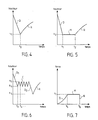
- Les Figures 4 à 7 illustrent quelques types de sollicitation qui peuvent être réalisées à l'aide de l'appareillage des Figures 1 à 3 ;
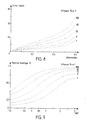
- Les Figures 8
et 9 illustrent des exemples de courbes force/déformation ou reprise élastique/temps obtenues actuellement avec ledit appareillage. - La Figure 10 illustre la correspondance entre une courbe de cinétique de reprise élastique, qui suit une relation déterminée empiriquement, et des valeurs de reprise élastique obtenues expérimentalement.
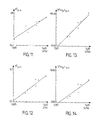
- Les Figures 11 à 14 illustrent les corrélations obtenues entre valeurs des descripteurs propres au procédé conforme à l'invention et des valeurs de paramètres de mise en oeuvre telle que la mesure de gonflement à la filière.
- Figure 1 is a block diagram of the electronic means used in an apparatus according to the invention;
- Figure 2 is a schematic sectional overview of the mechanical part of the same apparatus;
- Figure 3 is a schematic side view of a detail of the mechanical part of said apparatus;
- Figures 4 to 7 illustrate some types of stress which can be achieved using the apparatus of Figures 1 to 3;
- Figures 8 and 9 illustrate examples of force / deformation or elastic recovery / time curves currently obtained with said apparatus.
- Figure 10 illustrates the correspondence between an elastic recovery kinetics curve, which follows an empirically determined relationship, and values of elastic recovery obtained experimentally.
- Figures 11 to 14 illustrate the correlations obtained between values of descriptors specific to the process according to the invention and values of implementation parameters such as the swelling measurement in the die.
Si l'on se réfère plus particulièrement à la Figure 1, on constate que le schéma synoptique de la chaîne de mesure référencée 1 dans son ensemble, se compose de deux sous-ensembles : le premier, référencé 2, rassemble l'électronique analogique ; le second, référencé 3, rassemble l'électronique numérique. Ces deux circuits 2 et 3 sont alimentés séparément au moyen de circuits spécifiques 12.If we refer more particularly to Figure 1, we see that the block diagram of the measurement chain referenced 1 as a whole, consists of two sub-assemblies: the first, referenced 2, brings together analog electronics; the second, referenced 3, brings together digital electronics. These two
L'ensemble analogique 2 se compose d'un capteur de forces à jauges de contraintes 4 et d'un capteur de déplacement linéaire 5, associés à un module de conditionnement et d'amplification 6.The
En ce qui concerne l'ensemble numérique 3, les signaux des capteurs 4 et 5 sont injectés dans un module d'amplification et de conversion analogique-numérique 12 bits comportant un échantillonneur-amplificateur 7 et un convertisseur analogique-numérique 8. Cette transcription numérique des signaux est ensuite stockée dans la mémoire d'un système informatique 9 pour traitements ultérieurs.With regard to the
Par ailleurs, le système informatique 9, au travers d'un unité de commande 10, pilote le fonctionnement du moteur pas à pas 11, moyen d'application de l'effort.Furthermore, the
On a représenté de façon schématique sur les Figures 2 et 3 la partie mécanique de l'appareillage, qui comprend un bâti 13 dont les parois délimitent essentiellement une enceinte 14 thermostatée par l'intermédiaire d'une ventilation 23 pour une gamme de températures d'utilisation allant de la température ambiante jusqu'à +200°C. Sur l'embase 15, dont est muni ledit bâti 13, repose le capteur de forces 4 monté sous un porte-échantillon 16. La face supérieure de ce dernier correspond au plateau inférieur d'un ensemble constitué de deux plateaux parallèles 17 et 18 destinés à enserrer l'échantillon E à étudier. Ces deux plateaux 17 et 18 ont un diamètre supérieur à celui de l'échantillon E, de façon à induire en compression une déformation du type écoulement radial. Ces plateaux 17 et 18 peuvent néanmoins être remplacés par des plateaux de diamètre moins important, si l'on veut faire subir un autre type de déformation à l'éprouvette E, tel qu'un poinçonnage par exemple.There is shown schematically in Figures 2 and 3 the mechanical part of the apparatus, which comprises a
La déformation est appliquée à l'éprouvette E par l'intermédiaire d'une tige mobile 19 s'étendant partiellement dans l'enceinte 14 jusqu'au plateau 18, qui est monté à l'extrémité de ladite tige mobile 19, perpendiculairement à celle-ci. Ladite tige 19 est guidée par rapport au bâti 13, par un palier à billes 20 qui traverse la partie supérieure dudit bâti 13 et dans lequel coulisse ladite tige 19. Le mouvement de translation de ladite tige est imposé par un moteur pas à pas 11. Ce moteur 11 entraîne, par l'intermédiaire d'une courroie, une came 21 en forme de spirale d'Archimède qui transforme le mouvement circulaire de l'arbre du moteur 11 en un mouvement rectiligne de la tige 19. Le bord de ladite came 21 est en contact avec le bord d'une couronne 22 montée sur roulement à billes à l'extrémité de ladite tige 19 opposée au plateau 18. Le contour de la came 21 ayant la forme d'une spirale d'Archimède, lorsque le moteur tourne à vitesse constante, la déformation de l'éprouvette E est une fonction linéaire du temps.The deformation is applied to the test piece E by means of a
La déformation de l'échantillon E est suivie par un capteur de déplacement 5 solidaire de la tige 19.The deformation of the sample E is followed by a
Un essai se déroule selon les séquences suivantes :
- mise en place de l'éprouvette E ;
- paramètrage de l'essai (entre autre : choix de la vitesse et du taux de déformation, de la durée du préchauffage, de la durée du palier...) ;
- préchauffage de l'éprouvette E ;
- approche de la came 21 jusqu'au contact de la tige 19 et de l'éprouvette E ;
- acquisition des données propres à l'éprouvette E (hauteur initiale, par exemple) et calcul théorique de la hauteur en fin de déformation par l'ordinateur ;
- phase de déformation, avec acquisition en parallèle, des valeurs de la force et du déplacement ;
- dégagement quasi-instantané de la came ;
- phase de reprise avec acquisition des valeurs fournies par le capteur de déplacement ;
- traitement des données.
- fitting of the test piece E;
- test setting (among other things: choice of speed and deformation rate, preheating time, bearing time ...);
- preheating of the test piece E;
- approach of the
cam 21 until contact with therod 19 and the test piece E; - acquisition of data specific to the test piece E (initial height, for example) and theoretical calculation of the height at the end of the deformation by the computer;
- deformation phase, with parallel acquisition of force and displacement values;
- almost instantaneous release of the cam;
- recovery phase with acquisition of the values supplied by the displacement sensor;
- data processing.
Alors que pour les appareillages connus dans l'art antérieur, le taux de déformation est obtenu généralement par l'intermédiaire de cales, ce qui nécessite l'emploi d'éprouvettes de hauteur parfaitement définie imposant une préparation sophistiquée, l'appareil conforme à l'invention, grâce à son électronique, ajuste les paramètres choisis à la hauteur réelle de l'éprouvette E. La hauteur de l'éprouvette n'a donc pas besoin d'être rigoureusement définie.Whereas for the apparatuses known in the prior art, the rate of deformation is generally obtained by means of shims, which requires the use of specimens of perfectly defined height imposing a sophisticated preparation, the apparatus conforms to the he invention, thanks to its electronics, adjusts the parameters chosen to the actual height of the test piece E. The height of the test piece therefore does not need to be rigorously defined.
Les Figures 4 à 7 illustrent quelques unes des différentes possibilités non limitatives de sollicitations que l'on peut imposer à une éprouvette, à l'aide de l'appareillage qui vient d'être décrit :
- le premier type de sollicitation (Figure 4) est une déformation linéaire D jusqu'à un temps to et une hauteur h₁, la vitesse de sollicitation et le taux de déformation étant des paramètres ajustables, cette déformation linéaire étant suivie par une phase R où l'on mesure la reprise élastique, après suppression de la déformation ;
- le second type de sollicitation (Figure 5) correspond à une déformation linéaire D jusqu'à un temps t₁ et une hauteur h₂, suivie d'un maintien M de la déformation jusqu'à un temps t₂, au cours duquel éventuellement on suit la relaxation, puis d'une phase de reprise élastique R, la vitesse de sollicitation, le taux de déformation et la durée du palier étant les paramètres ajustables ;
- le troisième type de sollicitation (Figure 6) inclut après une déformation linéaire D₁ jusqu'à un temps t₃ et une hauteur h₄ un cycle C entre deux hauteurs de déformation h₃ et h₄, ou éventuellement deux niveaux de force, ce qui permet une sollicitation plus sévère (la vitesse de sollicitation, les taux de déformations entre lesquels se font les cycles, le nombre de cycles étant les paramètres ajustables, le cycle C étant suivi par une nouvelle déformation linéaire D₂ de la hauteur h₃ jusqu'à la hauteur h₅, puis par une reprise élastique R ;
- le quatrième type de sollicitation (Figure 7) correspond à une déformation linéaire D jusqu'à un temps t₅ suivie d'un maintien M de l'éprouvette à un niveau de force f₁ donné, jusqu'à un temps t₆ au cours duquel on suit éventuellement le fluage, la vitesse de déformation, la force à laquelle est effectué le maintien et la durée du palier étant les paramètres ajustables, puis d'une phase de reprise élastique R.
- the first type of stress (Figure 4) is a linear strain D up to a time t o and a height h₁, the stress speed and the strain rate being adjustable parameters, this linear strain being followed by a phase R where the elastic recovery is measured, after the deformation has been removed;
- the second type of stress (Figure 5) corresponds to a linear deformation D until a time t₁ and a height h₂, followed by a maintenance M of the deformation until a time t₂, during which optionally the relaxation is followed , then an elastic recovery phase R, the stress rate, the deformation rate and the duration of the bearing being the adjustable parameters;
- the third type of stress (Figure 6) includes after a linear deformation D₁ up to a time t₃ and a height h₄ a cycle C between two heights of deformation h₃ and h₄, or possibly two levels of force, which allows more stress severe (the speed of stress, the rates of deformation between which cycles occur, the number of cycles being the adjustable parameters, the cycle C being followed by a new linear deformation D₂ from the height h₃ to the height h₅, then by an elastic recovery R;
- the fourth type of stress (Figure 7) corresponds to a linear deformation D until a time t₅ followed by a maintenance M of the test-piece at a given level of force f₁, until a time t₆ during which one follows possibly the creep, the speed of deformation, the force at which the holding is carried out and the duration of the bearing being the adjustable parameters, then of an elastic recovery phase R.
Sur les Figures 8 et 9 sont représentés des exemples d'enregistrement graphique d'essais réalisés avec l'appareillage de l'invention.FIGS. 8 and 9 show examples of graphical recording of tests carried out with the apparatus of the invention.
En particulier, la Figure 8 représente, pour cinq vitesses couvrant deux décades (de 1 à 100 % de déformation par seconde), la variation de la force durant la déformation. L'échantillon étudié est un élastomère naturel de grade 10. On observe en particulier la non linéarité de la force durant la déformation.In particular, Figure 8 represents, for five speeds covering two decades (from 1 to 100% deformation per second), the variation of the force during the deformation. The sample studied is a
La Figure 9 représente pour les cinq vitesses précédentes la variation de la reprise élastique en fonction du logarithme du temps après suppression de la charge. Les reprises visualisées sur ces courbes sont celles des échantillons dont la phase de déformation est représentée sur la figure 8.Figure 9 represents for the five preceding speeds the variation of the elastic recovery according to the logarithm of time after suppression of the load. The times displayed on these curves are those of the samples whose deformation phase is represented in FIG. 8.
Ainsi que cela a déjà été indiqué, cet appareil permet, par un seul essai, et donc une seule éprouvette, d'avoir accès à la fois à une composante "visqueuse", grandeur liée à la vitesse de sollicitation et à une composante "élastique", grandeur liée à la reprise pour une vitesse de sollicitation donnée.As already indicated, this device allows, by a single test, and therefore a single test piece, to have access to both a "viscous" component, quantity linked to the speed of stress and to an "elastic component" ", quantity linked to recovery for a given loading speed.
La détermination de ces paramètres s'effectue de la façon qui va maintenant être décrite.The determination of these parameters is carried out from the way which will now be described.
En ce qui concerne le paramètre visqueux, contrairement à l'appareil décrit dans la demande de brevet FR-2.429.423, qui détermine un indice de viscosité calculé en fonction d'une vitesse de déformation soit moyenne, soit quasi-constante, l'appareil proposé par l'invention permet, grâce aux déformations à vitesse constante qu'il entraîne, d'avoir accès pour un taux de déformation donné à la viscosité apparente ηa du matériau ( ηa = F/V, F étant la force de déformation relevée par le capteur 4, V étant la vitesse de déformation). Il a été vérifié que les échantillons d'élastomères étudiés obéissent à la loi puissance de la forme :
Les valeurs de ηa pour des vitesses allant de 1 à 100 % de déformation par seconde, ainsi que les constantes K et n, facilement calculables à partir des essais réalisés avec l'appareil précédemment décrit, peuvent être utilisées comme descripteurs de la viscosité.The values of η a for velocities ranging from 1 to 100% of deformation per second, as well as the constants K and n, which can easily be calculated from tests carried out with the device described above, can be used as descriptors of the viscosity.
En ce qui concerne le paramètre élastique, l'appareil permet de suivre l'évolution de la hauteur de l'éprouvette en fonction du temps. La reprise élastique est définie comme l'augmentation de hauteur de l'éprouvette rapportée à la variation de hauteur de l'échantillon au cours de la déformation.
- Ho =
- hauteur initiale de l'éprouvette
- H₁ =
- hauteur de l'éprouvette en fin de déformation
- H′(t) =
- hauteur de l'éprouvette au cours de la phase de "reprise"
- H o =
- initial height of test piece
- H₁ =
- height of test piece at end of deformation
- H ′ (t) =
- height of the test piece during the "recovery" phase
Cette definition de R(t) présente plusieurs avantages :
- elle tient compte de l'écrasement subi par l'éprouvette, ce qui permet de comparer des reprises obtenues après des taux de déformation différents ;
- elle exprime directement le pourcentage de la déformation qui est récupérée ;
- elle varie de 0 à 1, soit dans un domaine plus large que celui de la hauteur relative.
- it takes account of the crushing undergone by the test piece, which makes it possible to compare recoveries obtained after different rates of deformation;
- it directly expresses the percentage of the deformation which is recovered;
- it varies from 0 to 1, ie in a wider field than that of the relative height.
Il a été possible d'établir empiriquement (voir Figure 10) que la cinétique de la reprise élastique suit la relation suivante :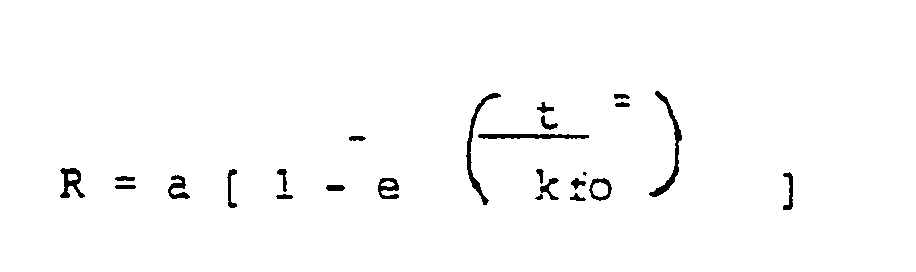
on a représenté la limite de la reprise élastique en un temps infini, k et m étant des constantes. Pour un caoutchouc naturel de grade 10 (mélange à noir) et pour un essai à une vitesse de 10 % de déformation par seconde, les valeurs déterminées pour ces constantes sont les suivantes :
- a =
- 0,9622
- m =
- 0,3102
- k =
- 0,2875
- a =
- 0.9622
- m =
- 0.3102
- k =
- 0.2875
Cette reprise est généralement mesurée après un temps fonction de la durée de déformation to. Par exemple, elle peut être mesurée après 0,3to, to, 3to et 10to suivant la suppression de la déformation, les valeurs pouvant être utilisées comme descripteurs de l'élasticité.This recovery is generally measured after a time depending on the deformation duration to. For example, it can be measured after 0.3to, to, 3to and 10to following the removal of the deformation, the values can be used as descriptors of elasticity.
Par la suite, on appelera R¹ la reprise mesurée après un temps égal à une fois le temps de déformation.Thereafter, R¹ will call the recovery measured after a time equal to once the deformation time.
L'appareil permettant de déterminer une viscosité apparente correspondant à la déformation globale de l'éprouvette à vitesse constante ainsi que des valeurs de la reprise, il devient possible de calculer, pour une vitesse de déformation donnée, des descripteurs rhéologiques qui associent les paramètres de viscosité et d'élasticité. Ces descripteurs peuvent être, par exemple :
Des mesures de reproductibilité ont montré une faible dispersion des résultats, inférieure à 1 % pour les mesures de reprise et de l'ordre de 2 % pour les mesures de viscosité.Reproducibility measurements showed a low dispersion of the results, less than 1% for the recovery measurements and of the order of 2% for the viscosity measurements.
L'invention sera encore illustrée par des exemples concrets d'appplication concernant l'utilisation de l'appareillage (élasticimètre) selon l'invention.The invention will be further illustrated by concrete examples of application concerning the use of the apparatus (elasticimeter) according to the invention.
Les essais ont été réalisés avec des éprouvettes d'élastomère en gomme homogénéisée ou en mélange à noir, obtenues par moulage.The tests were carried out with elastomer test pieces in homogenized gum or in black mixture, obtained by molding.
Dans le cas des gommes brutes, le caoutchouc a été homogénéisé, préalablement au moulage, sur mélangeur à cylindres (norme ISO 1796).In the case of raw gums, the rubber was homogenized, prior to molding, on a roller mixer (ISO 1796 standard).
A titre d'exemple, le mélange à noir est préparé selon la formulation suivante (proportions pondérales) :
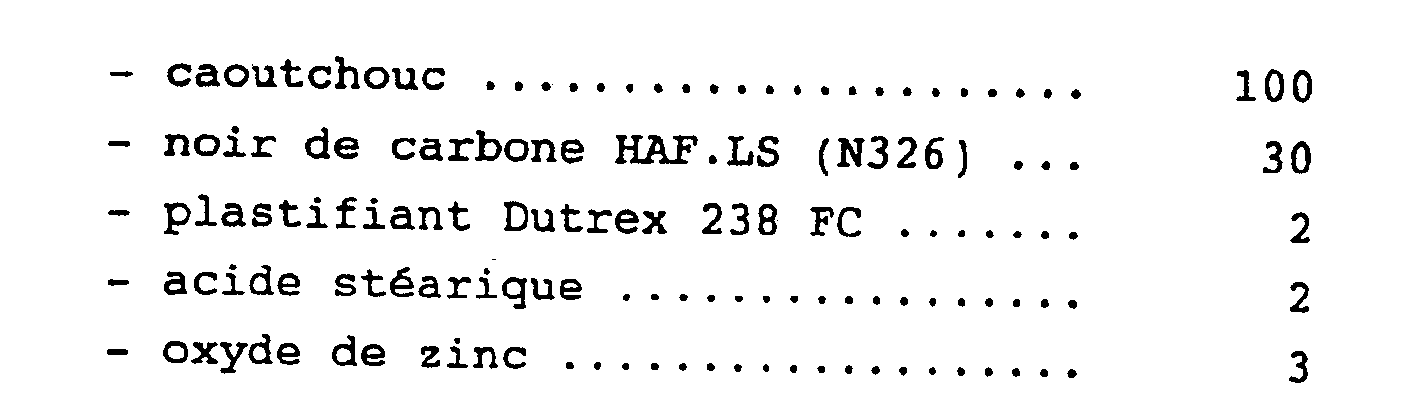
Le mélange a été effectué dans un mélangeur interne de laboratoire du type Werner, puis homogénéisé et tiré en feuilles sur le malaxeur à cylindres.The mixing was carried out in an internal laboratory mixer of the Werner type, then homogenized and drawn in sheets on the roller mixer.
Le moulage des éprouvettes a été effectué comme suit :
- découpage du caoutchouc en petits morceaux ;
- préchauffage du caoutchouc dans un moule à pistons (faible pression, T=100°C, t=30 min) ;
- mise sous pression (T=100°C, P=230 bars) ;
- refroidissement dans le moule
pendant 16 heures ; - démoulage et stockage dans un dessicateur.
- cutting rubber into small pieces;
- preheating the rubber in a piston mold (low pressure, T = 100 ° C, t = 30 min);
- pressurization (T = 100 ° C, P = 230 bar);
- cooling in the mold for 16 hours;
- demoulding and storage in a desiccator.
Dimensions finales des éprouvettes :
- diamètre .............. 16 mm
- hauteur ............... 16 mm ± 1 mm
- diameter .............. 16 mm
- height ............... 16 mm ± 1 mm
Les essais avec l'élasticimètre ont été effectués dans les conditions suivantes :
- température de l'enceinte : 70°C ;
- déformation jusqu'à 60 % ;
- vitesse de mise en déformation : 1 à 100 % de déformation par seconde ;
- type de sollicitation : déformation linéaire, puis mesure de la reprise (Figure 4) ;
- enregistrement de la
reprise pendant 15 min.
- enclosure temperature: 70 ° C;
- deformation up to 60%;
- deformation rate: 1 to 100% deformation per second;
- type of stress: linear deformation, then measurement of recovery (Figure 4);
- recording of the recovery for 15 min.
Les élastomères étudiés sont d'origine naturelle ou synthétique.The elastomers studied are of natural or synthetic origin.
Parmi les descripteurs calculés avec l'élasticimètre, figurent dans le Tableau I les paramètres suivants :Among the descriptors calculated with the elasticimeter, the following parameters appear in Table I:
Paramètres de viscosité :
- n exposant de la loi de puissance ;
- k constante de viscosité pour une vitesse de 1 % s⁻¹
- n exponent of the law of power;
- k viscosity constant for a speed of 1% s⁻¹
Paramètres d'élasticité :
- (R¹)v - 1
Valeur de la reprise après une durée égale à la durée de déformation, lorsque l'éprouvette a été sollicitée à 1 % de déformation par seconde ; - (R¹)v - 50
Valeur de la reprise après une durée égale à la durée de déformation, lorsque l'éprouvette a été sollicitée à 50 % de déformation par seconde ; - ( ηa x R¹)v - 1
Paramètre rhéologique pour une vitesse de sollicitation de 1 % par seconde ; - ( ηa x R¹)v - 50
Paramètre rhéologique pour une vitesse de sollicitation de 50 % par seconde.
- (R¹) v - 1
Value of the recovery after a duration equal to the duration of deformation, when the specimen was stressed at 1% deformation per second; - (R¹) v - 50
Value of the recovery after a duration equal to the duration of deformation, when the specimen was stressed at 50% deformation per second; - (η a x R¹) v - 1
Rheological parameter for a loading speed of 1% per second; - (η a x R¹) v - 50
Rheological parameter for a loading speed of 50% per second.
Des caractéristiques mesurées avec l'élasticimètre pour différents élastomères sont données dans le Tableau I.

Des caoutchoucs naturels commerciaux de même grade ayant subi le même usinage sont considérés comme identiques quant aux spécifications de la norme ISO 2000. Deux caoutchoucs ainsi identiques ont été analysés avec l'élasticimètre. Le Tableau II rassemble leurs caractéristiques mesurées selon la norme ISO 2000 et quelques paramètres de viscosité et d'élasticité mesurées avec l'élasticimètre.

Il apparaît donc que deux caoutchoucs identiques selon les spécifications usuelles présentent des différences dans les caractéristiques de viscosité et d'élasticité déterminées à l'élasticimètre, ce qui permet de prévoir des comportements différents lors de la mise en oeuvre.It therefore appears that two identical rubbers according to the usual specifications have differences in the viscosity and elasticity characteristics determined with the elasticimeter, which makes it possible to provide for different behaviors during implementation.
Le gonflement à la filière en sortie d'extrudeuse est un phénomène lié à l'élasticité des mélanges. Il a donc paru intéressant d'examiner comment se classent les paramètres déterminés à l'élasticimètre avec une mesure particulière de gonflement filière réalisée en laboratoire.The swelling at the die at the extruder outlet is a phenomenon linked to the elasticity of the mixtures. It therefore seemed interesting to examine how the parameters determined with the elasticimeter are classified with a particular measurement of die swelling carried out in the laboratory.
Mesure des paramètres élastiques :Measurement of elastic parameters:
La reprise est mesurée après un temps égal à une fois la durée de déformation.The recovery is measured after a time equal to once the duration of deformation.
Mesure du gonflement filière :Measurement of die swelling:
Les essais sont réalisés sur une extrudeuse de laboratoire dont les caractéristiques sont les suivantes : Extrudeuse RHEOMEX HAAKE (montée sur un appareil de mesure Rhéocord)The tests are carried out on a laboratory extruder with the following characteristics: RHEOMEX HAAKE extruder (mounted on a Rhéocord measuring device)
Vis :
diamètre D = 19,05 mm
L/D = 10Screw:
diameter D = 19.05 mm
L / D = 10
Filière :
diamètre D = 4,76 mm
L/D = 38Faculty :
diameter D = 4.76 mm
L / D = 38
L'essai est réalisé à une température de 75°C avec une vitesse de rotation de la vis de 100 tr/min.The test is carried out at a temperature of 75 ° C. with a speed of rotation of the screw of 100 rpm.
La procédure de mesure s'inspire de la norme ASTM D2330, méthode B.The measurement procedure is inspired by ASTM D2330, method B.
Le gonflement est donné par :
Ao est l'aire de la section droite de la filière
A est l'aire moyenne d'une section droite du jonc extrudé.The swelling is given by:
Ao is the area of the straight section of the die
A is the mean area of a cross section of the extruded rod.
La moyenne est déterminée par pesée de 3 joncs de longueur définie (1m ± 1mm) découpés après deux heures de repos.The average is determined by weighing 3 rods of defined length (1m ± 1mm) cut after two hours of rest.
L'étude a été réalisée en gommes homogénéisées et en mélanges à noir sur 7 échantillons de caoutchoucs naturels de grade 5 dans une gamme de consistance Mooney allant de 50 à 84. Le gonflement à la filière n'a été réalisé que sur les mélanges à noir.The study was carried out in homogenized gums and in black mixes on 7 samples of
Les Figures 11 et 12 illustrent la corrélation entre le gonflement à la filière sur mélange à noir et la reprise élastique R¹ pour une vitesse de 1 % de déformation par seconde, cette reprise élastique étant respectivement calculée sur gomme homogénéisée (Figure 11) et sur mélange à noir (Figure 12).Figures 11 and 12 illustrate the correlation between the swelling on the die on a black mixture and the elastic recovery R¹ for a speed of 1% deformation per second, this elastic recovery being calculated respectively on homogenized rubber (Figure 11) and on mixture to black (Figure 12).
Les Figures 13 et 14, quant à elles, illustrent la corrélation entre le gonflement à la filière sur mélange à noir et le paramètre rhéologique ηa x R¹ pour une vitesse de 1 % de déformation par seconde calculé sur gomme homogénéisée (Figure 13) et sur mélange à noir (Figure 14).Figures 13 and 14, for their part, illustrate the correlation between the swelling on the die on black mixing and the rheological parameter η a x R¹ for a speed of 1% deformation per second calculated on homogenized rubber (Figure 13) and on black mixture (Figure 14).
Les coefficients de corrélation obtenus sont donnés dans le Tableau III suivant :

On observe que, dans les conditions opératoires retenues pour la mesure du gonflement à la filière, les corrélations entre le gonflement à la filière et certains paramètres d'élasticité et rhéologiques sont bonnes, notamment pour la gomme homogénéisée.It is observed that, under the operating conditions adopted for the measurement of the swelling on the die, the correlations between the swelling on the die and certain elasticity and rheological parameters are good, in particular for homogenized gum.
Claims (16)
Priority Applications (1)
| Application Number | Priority Date | Filing Date | Title |
|---|---|---|---|
| AT91401390T ATE94279T1 (en) | 1990-06-01 | 1991-05-29 | METHOD AND DEVICE FOR INVESTIGATION OF THE VISCOELASTIC BEHAVIOR OF A VISCOELASTIC MATERIAL. |
Applications Claiming Priority (2)
| Application Number | Priority Date | Filing Date | Title |
|---|---|---|---|
| FR9006881A FR2662802B1 (en) | 1990-06-01 | 1990-06-01 | PROCESS FOR CHARACTERIZING THE VISCOELASTIC BEHAVIOR OF A MATERIAL, PARTICULARLY OF THE ELASTOMER TYPE AND APPARATUS FOR CARRYING OUT THIS PROCESS. |
| FR9006881 | 1990-06-01 |
Publications (2)
| Publication Number | Publication Date |
|---|---|
| EP0459896A1 true EP0459896A1 (en) | 1991-12-04 |
| EP0459896B1 EP0459896B1 (en) | 1993-09-08 |
Family
ID=9397223
Family Applications (1)
| Application Number | Title | Priority Date | Filing Date |
|---|---|---|---|
| EP91401390A Expired - Lifetime EP0459896B1 (en) | 1990-06-01 | 1991-05-29 | Method and apparatus for investigating the visco-elastic behaviour of a viscoelastic material |
Country Status (4)
| Country | Link |
|---|---|
| EP (1) | EP0459896B1 (en) |
| AT (1) | ATE94279T1 (en) |
| DE (1) | DE69100343D1 (en) |
| FR (1) | FR2662802B1 (en) |
Cited By (4)
| Publication number | Priority date | Publication date | Assignee | Title |
|---|---|---|---|---|
| US5417117A (en) * | 1991-03-23 | 1995-05-23 | Parker-Pradifa Gmbh | Procedure and apparatus for determining the vulcanization coefficient of elastomers |
| EP1174704A3 (en) * | 2000-07-21 | 2002-10-02 | World Properties, Inc. | Device and process for measurement of foam compression recovery |
| DE10252211A1 (en) * | 2002-11-09 | 2004-05-27 | Format Messtechnik Gmbh | Viscoelastic foam testing device for determination of foam pressure and deformation behavior, whereby a light rigid plate is used to compress the foam by a given amount for a given period, before the foam is suddenly released |
| EP1845354A3 (en) * | 2006-04-11 | 2011-01-05 | IAV GmbH Ingenieurgesellschaft Auto und Verkehr | Method and device for assessing the comfort of furniture cushions and pads, in particular for vehicle seats |
Citations (5)
| Publication number | Priority date | Publication date | Assignee | Title |
|---|---|---|---|---|
| US3457779A (en) * | 1967-07-13 | 1969-07-29 | Us Navy | Cam plastometer |
| US4109516A (en) * | 1976-04-02 | 1978-08-29 | Vyzkumny Ustav Hutnictvi Zeleza | Cam plastometer |
| FR2429423A1 (en) * | 1978-06-23 | 1980-01-18 | Bayer Ag | PROCESS FOR THE DETERMINATION OF RHEOLOGICAL QUANTITIES CHARACTERISTICS OF VISCO-ELASTIC BODIES |
| FR2491213A1 (en) * | 1980-09-30 | 1982-04-02 | Agronomique Inst Nat Rech | Stress and strain measuring appts. for e.g. food sample - has electronically controlled mobile assembly driven by linear motor providing strain which is measured as function of time |
| US4383450A (en) * | 1979-11-30 | 1983-05-17 | Bergougnan - Benelux | Method and apparatus for determining static and dynamic characteristics from a viscous-elastic material |
Family Cites Families (1)
| Publication number | Priority date | Publication date | Assignee | Title |
|---|---|---|---|---|
| SU1339436A1 (en) * | 1983-09-08 | 1987-09-23 | Институт проблем криобиологии и криомедицины АН УССР | Method and arrangement for effective stress-relaxation test |
-
1990
- 1990-06-01 FR FR9006881A patent/FR2662802B1/en not_active Expired - Fee Related
-
1991
- 1991-05-29 AT AT91401390T patent/ATE94279T1/en active
- 1991-05-29 DE DE91401390T patent/DE69100343D1/en not_active Expired - Lifetime
- 1991-05-29 EP EP91401390A patent/EP0459896B1/en not_active Expired - Lifetime
Patent Citations (5)
| Publication number | Priority date | Publication date | Assignee | Title |
|---|---|---|---|---|
| US3457779A (en) * | 1967-07-13 | 1969-07-29 | Us Navy | Cam plastometer |
| US4109516A (en) * | 1976-04-02 | 1978-08-29 | Vyzkumny Ustav Hutnictvi Zeleza | Cam plastometer |
| FR2429423A1 (en) * | 1978-06-23 | 1980-01-18 | Bayer Ag | PROCESS FOR THE DETERMINATION OF RHEOLOGICAL QUANTITIES CHARACTERISTICS OF VISCO-ELASTIC BODIES |
| US4383450A (en) * | 1979-11-30 | 1983-05-17 | Bergougnan - Benelux | Method and apparatus for determining static and dynamic characteristics from a viscous-elastic material |
| FR2491213A1 (en) * | 1980-09-30 | 1982-04-02 | Agronomique Inst Nat Rech | Stress and strain measuring appts. for e.g. food sample - has electronically controlled mobile assembly driven by linear motor providing strain which is measured as function of time |
Non-Patent Citations (1)
| Title |
|---|
| SOVIET INVENTIONS ILLUSTRATED, semaine 8816, 21 avril 1988, abrégé no. 88-111046/16, Derwent Publications Ltd, Londres, GB, & SU-A-1339436 (AS UKR CRYOBIOLOGY) * |
Cited By (5)
| Publication number | Priority date | Publication date | Assignee | Title |
|---|---|---|---|---|
| US5417117A (en) * | 1991-03-23 | 1995-05-23 | Parker-Pradifa Gmbh | Procedure and apparatus for determining the vulcanization coefficient of elastomers |
| EP1174704A3 (en) * | 2000-07-21 | 2002-10-02 | World Properties, Inc. | Device and process for measurement of foam compression recovery |
| DE10252211A1 (en) * | 2002-11-09 | 2004-05-27 | Format Messtechnik Gmbh | Viscoelastic foam testing device for determination of foam pressure and deformation behavior, whereby a light rigid plate is used to compress the foam by a given amount for a given period, before the foam is suddenly released |
| DE10252211B4 (en) * | 2002-11-09 | 2011-01-27 | Format Messtechnik Gmbh | Method and device for testing the unimpeded relaxation behavior of a compressed viscoelastic foam |
| EP1845354A3 (en) * | 2006-04-11 | 2011-01-05 | IAV GmbH Ingenieurgesellschaft Auto und Verkehr | Method and device for assessing the comfort of furniture cushions and pads, in particular for vehicle seats |
Also Published As
| Publication number | Publication date |
|---|---|
| DE69100343D1 (en) | 1993-10-14 |
| ATE94279T1 (en) | 1993-09-15 |
| FR2662802A1 (en) | 1991-12-06 |
| EP0459896B1 (en) | 1993-09-08 |
| FR2662802B1 (en) | 1994-05-06 |
Similar Documents
| Publication | Publication Date | Title |
|---|---|---|
| US4343190A (en) | Moving die rheometer, method of testing materials therewith, and die for use therein | |
| De Baerdemaeker et al. | Quality detection by frequency spectrum analysis of the fruit impact force | |
| KR101975004B1 (en) | The method for predicting polymer processing | |
| EP0459896B1 (en) | Method and apparatus for investigating the visco-elastic behaviour of a viscoelastic material | |
| EP0013594B1 (en) | Method and apparatus for measuring the rheological properties of an extrudable material | |
| BE1000843A5 (en) | Method for determining the properties molding materials, in particular for the determination of their properties and plastic rheological. | |
| Andrews et al. | Elastoviscous properties of polyisobutylene. I. Relaxation of stress in whole polymer of different molecular weights at elevated temperatures | |
| FR2823307A1 (en) | Mechanical characterization of pills uses automatic micropress applying preloading cycles when carrying out three-point flexure and microindentation tests | |
| FR2871886A1 (en) | DEVICE AND METHOD FOR CONTROLLING THE PARAMETERS AND MECHANICS OF A PACKAGING SLEEVE WITH PLASTIC STRETCH FILM | |
| JP2026066255A (en) | Systems, methods, and apparatus for automating sample testing. | |
| EP2309243B1 (en) | Method and apparatus for determining void volume for a particulate material | |
| CA1115549A (en) | Method of determining characteristic rheological quantities of viscoelastic materials | |
| Swallowe et al. | A study of the mechanical properties of PMMA and PS at strain rates of 10$^{-4} $ to 10$^ 3$ over the temperature range 293–363 K | |
| Oliet et al. | Effect of aging on the mechanical properties of hand-rolled gutta-percha endodontic cones | |
| Falkenreck et al. | Hygrothermal aging behavior of regenerated cellulose fiber-reinforced polyamide 5.10 composites | |
| Plachy et al. | Hydrostatic compression tests, capillary rheometry tests, and extrusion tests performed on unvulcanized rubber confirm importance of compressibility for die swell—Arguments from dimensional analysis | |
| CN1314528C (en) | Method and apparatus for detecting polymer dynamic injection rheological properties and behaviors | |
| EP3191813B1 (en) | Testing machine for quality control of a component at least partially made of filled elastomer | |
| CN224151822U (en) | A weighing instrument testing device | |
| EP1989541B1 (en) | Method for measuring rheological qualities of fermented or unleavened flour-based dough and device therefor | |
| Foong et al. | Yield stress behaviour of metal injection moulding suspensions at elevated temperatures | |
| Casa et al. | Study of hardness drift: A method for investigating the viscous behaviour of cured rubber | |
| FR2744528A1 (en) | DEVICE FOR DETERMINING THE VISCO-ELASTIC CHARACTERISTICS OF A FLUID | |
| FR2616908A1 (en) | Method for measuring the elastic parameters of a material | |
| FR2917495A1 (en) | Material torque determining method for vehicle, involves establishing curve of evolution of friction coefficients according to friction speed, and estimating whether torque of material generates friction noise |
Legal Events
| Date | Code | Title | Description |
|---|---|---|---|
| PUAI | Public reference made under article 153(3) epc to a published international application that has entered the european phase |
Free format text: ORIGINAL CODE: 0009012 |
|
| AK | Designated contracting states |
Kind code of ref document: A1 Designated state(s): AT BE CH DE DK ES FR GB GR IT LI LU NL SE |
|
| 17P | Request for examination filed |
Effective date: 19911216 |
|
| 17Q | First examination report despatched |
Effective date: 19920922 |
|
| RAP1 | Party data changed (applicant data changed or rights of an application transferred) |
Owner name: INSTITUT DE RECHERCHE APPLIQUEE SUR LES POLYMERS ( Owner name: CENTRE DE COOPERATION INTERNATIONALE EN RECHERCHE |
|
| GRAA | (expected) grant |
Free format text: ORIGINAL CODE: 0009210 |
|
| AK | Designated contracting states |
Kind code of ref document: B1 Designated state(s): AT BE CH DE DK ES FR GB GR IT LI LU NL SE |
|
| PG25 | Lapsed in a contracting state [announced via postgrant information from national office to epo] |
Ref country code: IT Free format text: LAPSE BECAUSE OF FAILURE TO SUBMIT A TRANSLATION OF THE DESCRIPTION OR TO PAY THE FEE WITHIN THE PRE;WARNING: LAPSES OF ITALIAN PATENTS WITH EFFECTIVE DATE BEFORE 2007 MAY HAVE OCCURRED AT ANY TIME BEFORE 2007. THE CORRECT EFFECTIVE DATE MAY BE DIFFERENT FROM THE ONE RECORDED.SCRIBED TIME-LIMIT Effective date: 19930908 Ref country code: DE Effective date: 19930908 Ref country code: GB Effective date: 19930908 Ref country code: DK Effective date: 19930908 Ref country code: SE Effective date: 19930908 Ref country code: AT Effective date: 19930908 Ref country code: GR Free format text: LAPSE BECAUSE OF FAILURE TO SUBMIT A TRANSLATION OF THE DESCRIPTION OR TO PAY THE FEE WITHIN THE PRESCRIBED TIME-LIMIT Effective date: 19930908 Ref country code: ES Free format text: THE PATENT HAS BEEN ANNULLED BY A DECISION OF A NATIONAL AUTHORITY Effective date: 19930908 Ref country code: NL Effective date: 19930908 |
|
| REF | Corresponds to: |
Ref document number: 94279 Country of ref document: AT Date of ref document: 19930915 Kind code of ref document: T |
|
| REF | Corresponds to: |
Ref document number: 69100343 Country of ref document: DE Date of ref document: 19931014 |
|
| NLV1 | Nl: lapsed or annulled due to failure to fulfill the requirements of art. 29p and 29m of the patents act | ||
| GBV | Gb: ep patent (uk) treated as always having been void in accordance with gb section 77(7)/1977 [no translation filed] |
Effective date: 19930908 |
|
| PG25 | Lapsed in a contracting state [announced via postgrant information from national office to epo] |
Ref country code: LU Free format text: LAPSE BECAUSE OF NON-PAYMENT OF DUE FEES Effective date: 19940531 Ref country code: CH Effective date: 19940531 Ref country code: BE Effective date: 19940531 Ref country code: LI Effective date: 19940531 |
|
| PLBE | No opposition filed within time limit |
Free format text: ORIGINAL CODE: 0009261 |
|
| STAA | Information on the status of an ep patent application or granted ep patent |
Free format text: STATUS: NO OPPOSITION FILED WITHIN TIME LIMIT |
|
| 26N | No opposition filed | ||
| BERE | Be: lapsed |
Owner name: INSTITUT DE RECHERCHE APPLIQUEE SUR LES POLYMERES Effective date: 19940531 Owner name: CENTRE DE COOPERATION INTERNATIONALE EN RECHERCHE Effective date: 19940531 |
|
| PG25 | Lapsed in a contracting state [announced via postgrant information from national office to epo] |
Ref country code: FR Effective date: 19950131 |
|
| REG | Reference to a national code |
Ref country code: CH Ref legal event code: PL |
|
| REG | Reference to a national code |
Ref country code: FR Ref legal event code: ST |