EP0459938B1 - Articles composites à partir de liants de verre renforcé de fibres et de liants verre-céramique - Google Patents
Articles composites à partir de liants de verre renforcé de fibres et de liants verre-céramique Download PDFInfo
- Publication number
- EP0459938B1 EP0459938B1 EP91630032A EP91630032A EP0459938B1 EP 0459938 B1 EP0459938 B1 EP 0459938B1 EP 91630032 A EP91630032 A EP 91630032A EP 91630032 A EP91630032 A EP 91630032A EP 0459938 B1 EP0459938 B1 EP 0459938B1
- Authority
- EP
- European Patent Office
- Prior art keywords
- fibers
- article
- glass
- ribs
- matrix
- Prior art date
- Legal status (The legal status is an assumption and is not a legal conclusion. Google has not performed a legal analysis and makes no representation as to the accuracy of the status listed.)
- Expired - Lifetime
Links
Images

Classifications
-
- E—FIXED CONSTRUCTIONS
- E04—BUILDING
- E04C—STRUCTURAL ELEMENTS; BUILDING MATERIALS
- E04C2/00—Building elements of relatively thin form for the construction of parts of buildings, e.g. sheet materials, slabs, or panels
- E04C2/30—Building elements of relatively thin form for the construction of parts of buildings, e.g. sheet materials, slabs, or panels characterised by the shape or structure
- E04C2/34—Building elements of relatively thin form for the construction of parts of buildings, e.g. sheet materials, slabs, or panels characterised by the shape or structure composed of two or more spaced sheet-like parts
-
- Y—GENERAL TAGGING OF NEW TECHNOLOGICAL DEVELOPMENTS; GENERAL TAGGING OF CROSS-SECTIONAL TECHNOLOGIES SPANNING OVER SEVERAL SECTIONS OF THE IPC; TECHNICAL SUBJECTS COVERED BY FORMER USPC CROSS-REFERENCE ART COLLECTIONS [XRACs] AND DIGESTS
- Y10—TECHNICAL SUBJECTS COVERED BY FORMER USPC
- Y10T—TECHNICAL SUBJECTS COVERED BY FORMER US CLASSIFICATION
- Y10T428/00—Stock material or miscellaneous articles
- Y10T428/24—Structurally defined web or sheet [e.g., overall dimension, etc.]
- Y10T428/24174—Structurally defined web or sheet [e.g., overall dimension, etc.] including sheet or component perpendicular to plane of web or sheet
- Y10T428/24182—Inward from edge of web or sheet
-
- Y—GENERAL TAGGING OF NEW TECHNOLOGICAL DEVELOPMENTS; GENERAL TAGGING OF CROSS-SECTIONAL TECHNOLOGIES SPANNING OVER SEVERAL SECTIONS OF THE IPC; TECHNICAL SUBJECTS COVERED BY FORMER USPC CROSS-REFERENCE ART COLLECTIONS [XRACs] AND DIGESTS
- Y10—TECHNICAL SUBJECTS COVERED BY FORMER USPC
- Y10T—TECHNICAL SUBJECTS COVERED BY FORMER US CLASSIFICATION
- Y10T428/00—Stock material or miscellaneous articles
- Y10T428/24—Structurally defined web or sheet [e.g., overall dimension, etc.]
- Y10T428/24479—Structurally defined web or sheet [e.g., overall dimension, etc.] including variation in thickness
- Y10T428/24562—Interlaminar spaces
-
- Y—GENERAL TAGGING OF NEW TECHNOLOGICAL DEVELOPMENTS; GENERAL TAGGING OF CROSS-SECTIONAL TECHNOLOGIES SPANNING OVER SEVERAL SECTIONS OF THE IPC; TECHNICAL SUBJECTS COVERED BY FORMER USPC CROSS-REFERENCE ART COLLECTIONS [XRACs] AND DIGESTS
- Y10—TECHNICAL SUBJECTS COVERED BY FORMER USPC
- Y10T—TECHNICAL SUBJECTS COVERED BY FORMER US CLASSIFICATION
- Y10T428/00—Stock material or miscellaneous articles
- Y10T428/24—Structurally defined web or sheet [e.g., overall dimension, etc.]
- Y10T428/24479—Structurally defined web or sheet [e.g., overall dimension, etc.] including variation in thickness
- Y10T428/2457—Parallel ribs and/or grooves
-
- Y—GENERAL TAGGING OF NEW TECHNOLOGICAL DEVELOPMENTS; GENERAL TAGGING OF CROSS-SECTIONAL TECHNOLOGIES SPANNING OVER SEVERAL SECTIONS OF THE IPC; TECHNICAL SUBJECTS COVERED BY FORMER USPC CROSS-REFERENCE ART COLLECTIONS [XRACs] AND DIGESTS
- Y10—TECHNICAL SUBJECTS COVERED BY FORMER USPC
- Y10T—TECHNICAL SUBJECTS COVERED BY FORMER US CLASSIFICATION
- Y10T428/00—Stock material or miscellaneous articles
- Y10T428/24—Structurally defined web or sheet [e.g., overall dimension, etc.]
- Y10T428/24479—Structurally defined web or sheet [e.g., overall dimension, etc.] including variation in thickness
- Y10T428/24612—Composite web or sheet
-
- Y—GENERAL TAGGING OF NEW TECHNOLOGICAL DEVELOPMENTS; GENERAL TAGGING OF CROSS-SECTIONAL TECHNOLOGIES SPANNING OVER SEVERAL SECTIONS OF THE IPC; TECHNICAL SUBJECTS COVERED BY FORMER USPC CROSS-REFERENCE ART COLLECTIONS [XRACs] AND DIGESTS
- Y10—TECHNICAL SUBJECTS COVERED BY FORMER USPC
- Y10T—TECHNICAL SUBJECTS COVERED BY FORMER US CLASSIFICATION
- Y10T428/00—Stock material or miscellaneous articles
- Y10T428/24—Structurally defined web or sheet [e.g., overall dimension, etc.]
- Y10T428/24628—Nonplanar uniform thickness material
- Y10T428/24661—Forming, or cooperating to form cells
-
- Y—GENERAL TAGGING OF NEW TECHNOLOGICAL DEVELOPMENTS; GENERAL TAGGING OF CROSS-SECTIONAL TECHNOLOGIES SPANNING OVER SEVERAL SECTIONS OF THE IPC; TECHNICAL SUBJECTS COVERED BY FORMER USPC CROSS-REFERENCE ART COLLECTIONS [XRACs] AND DIGESTS
- Y10—TECHNICAL SUBJECTS COVERED BY FORMER USPC
- Y10T—TECHNICAL SUBJECTS COVERED BY FORMER US CLASSIFICATION
- Y10T428/00—Stock material or miscellaneous articles
- Y10T428/24—Structurally defined web or sheet [e.g., overall dimension, etc.]
- Y10T428/24744—Longitudinal or transverse tubular cavity or cell
-
- Y—GENERAL TAGGING OF NEW TECHNOLOGICAL DEVELOPMENTS; GENERAL TAGGING OF CROSS-SECTIONAL TECHNOLOGIES SPANNING OVER SEVERAL SECTIONS OF THE IPC; TECHNICAL SUBJECTS COVERED BY FORMER USPC CROSS-REFERENCE ART COLLECTIONS [XRACs] AND DIGESTS
- Y10—TECHNICAL SUBJECTS COVERED BY FORMER USPC
- Y10T—TECHNICAL SUBJECTS COVERED BY FORMER US CLASSIFICATION
- Y10T428/00—Stock material or miscellaneous articles
- Y10T428/29—Coated or structually defined flake, particle, cell, strand, strand portion, rod, filament, macroscopic fiber or mass thereof
- Y10T428/2913—Rod, strand, filament or fiber
- Y10T428/2916—Rod, strand, filament or fiber including boron or compound thereof [not as steel]
-
- Y—GENERAL TAGGING OF NEW TECHNOLOGICAL DEVELOPMENTS; GENERAL TAGGING OF CROSS-SECTIONAL TECHNOLOGIES SPANNING OVER SEVERAL SECTIONS OF THE IPC; TECHNICAL SUBJECTS COVERED BY FORMER USPC CROSS-REFERENCE ART COLLECTIONS [XRACs] AND DIGESTS
- Y10—TECHNICAL SUBJECTS COVERED BY FORMER USPC
- Y10T—TECHNICAL SUBJECTS COVERED BY FORMER US CLASSIFICATION
- Y10T428/00—Stock material or miscellaneous articles
- Y10T428/29—Coated or structually defined flake, particle, cell, strand, strand portion, rod, filament, macroscopic fiber or mass thereof
- Y10T428/2913—Rod, strand, filament or fiber
- Y10T428/2918—Rod, strand, filament or fiber including free carbon or carbide or therewith [not as steel]
-
- Y—GENERAL TAGGING OF NEW TECHNOLOGICAL DEVELOPMENTS; GENERAL TAGGING OF CROSS-SECTIONAL TECHNOLOGIES SPANNING OVER SEVERAL SECTIONS OF THE IPC; TECHNICAL SUBJECTS COVERED BY FORMER USPC CROSS-REFERENCE ART COLLECTIONS [XRACs] AND DIGESTS
- Y10—TECHNICAL SUBJECTS COVERED BY FORMER USPC
- Y10T—TECHNICAL SUBJECTS COVERED BY FORMER US CLASSIFICATION
- Y10T428/00—Stock material or miscellaneous articles
- Y10T428/29—Coated or structually defined flake, particle, cell, strand, strand portion, rod, filament, macroscopic fiber or mass thereof
- Y10T428/2913—Rod, strand, filament or fiber
- Y10T428/2918—Rod, strand, filament or fiber including free carbon or carbide or therewith [not as steel]
- Y10T428/292—In coating or impregnation
-
- Y—GENERAL TAGGING OF NEW TECHNOLOGICAL DEVELOPMENTS; GENERAL TAGGING OF CROSS-SECTIONAL TECHNOLOGIES SPANNING OVER SEVERAL SECTIONS OF THE IPC; TECHNICAL SUBJECTS COVERED BY FORMER USPC CROSS-REFERENCE ART COLLECTIONS [XRACs] AND DIGESTS
- Y10—TECHNICAL SUBJECTS COVERED BY FORMER USPC
- Y10T—TECHNICAL SUBJECTS COVERED BY FORMER US CLASSIFICATION
- Y10T428/00—Stock material or miscellaneous articles
- Y10T428/29—Coated or structually defined flake, particle, cell, strand, strand portion, rod, filament, macroscopic fiber or mass thereof
- Y10T428/2913—Rod, strand, filament or fiber
- Y10T428/2933—Coated or with bond, impregnation or core
- Y10T428/294—Coated or with bond, impregnation or core including metal or compound thereof [excluding glass, ceramic and asbestos]
- Y10T428/2942—Plural coatings
- Y10T428/2949—Glass, ceramic or metal oxide in coating
-
- Y—GENERAL TAGGING OF NEW TECHNOLOGICAL DEVELOPMENTS; GENERAL TAGGING OF CROSS-SECTIONAL TECHNOLOGIES SPANNING OVER SEVERAL SECTIONS OF THE IPC; TECHNICAL SUBJECTS COVERED BY FORMER USPC CROSS-REFERENCE ART COLLECTIONS [XRACs] AND DIGESTS
- Y10—TECHNICAL SUBJECTS COVERED BY FORMER USPC
- Y10T—TECHNICAL SUBJECTS COVERED BY FORMER US CLASSIFICATION
- Y10T428/00—Stock material or miscellaneous articles
- Y10T428/29—Coated or structually defined flake, particle, cell, strand, strand portion, rod, filament, macroscopic fiber or mass thereof
- Y10T428/2913—Rod, strand, filament or fiber
- Y10T428/298—Physical dimension
Definitions
- This invention relates to fiber reinforced glass matrix and glass-ceramic matrix composite articles.
- Fiber reinforced glass matrix and glass-ceramic matrix composite articles are described in commonly assigned U.S. Patent Nos. 4,314,852, 4,324,843, 4,428,763 and 4,786,314, which are incorporated herein by reference.
- EP-A-0 294 176 describes such an article having opposing face sheets and ribs which extend between the face sheets.
- a fiber reinforced composite article which has opposing face sheets and ribs which extend between the face sheets, is characterized in that the ribs and face sheets are comprised of woven nonmetallic fibers in a glass or glass-ceramic matrix, and the fibers in the ribs are woven with the fibers in the face sheets.
- the woven fibers which comprise the face sheets and ribs extend continuously through each rib, back and forth from one face sheet to the other face sheet.
- the stress rupture and elastic modulus of fiber enforced composite articles in accordance with the invention is comparable to, or better than, similarly shaped articles fabricated from metals. Further, the density of articles of this invention is generally about one third to one half the density of metal articles having the same high temperature stability.
- Figure 1 is a perspective view of a fiber reinforced composite article according to this invention.
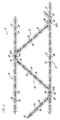
- Figure 2 is a schematic, cross sectional view along lines 2-2 of Figure 1, showing the manner in which the fibers in the face sheets and ribs are woven with each other.
- Figure 3 is a perspective view showing an apparatus (in phantom) used in the production of articles of this invention.
- Figure 4 is a cross sectional view through an embodiment of the invention.
- Figure 5 and 6 are perspective views showing embodiments of the invention.
- a fiber reinforced article in accordance with the present invention is shown in Figure 1, and is represented by the general reference numeral 10.
- the article 10 comprises face sheets 12 which are spaced apart from each other and in opposing relation to each other. Extending between the face sheets 12 is one or more ribs or trusses 16. Because of its shape, the article of this invention is referred to herein as a fiber reinforced truss panel or, more simply, a truss panel.
- the ribs 16 and face sheets 12 define cells 18.
- the cells 18 in Figure 1 have a triangular cross section; cells having other cross sectional shapes (rectangular, curvilinear, etc.) are within the scope of the invention.
- truss panels characterized by cells having different shapes and sizes. In other words, the cells in the truss panel do not all have to have the same cross sectional size or shape.
- the face sheets and ribs which characterize the truss panel of this invention are comprised of nonmetallic fibers in a glass or glass-ceramic matrix; glass matrices include borosilicate, aluminosilicate, and high silica glass; glass-ceramic matrices include lithium aluminosilicate, magnesium aluminosilicate, barium magnesium aluminosilicate, calcium aluminosilicate, barium aluminosilicate, and barium lithium aluminosilicate.
- glass matrices can include mixtures of the aforementioned glass types
- glass-ceramic matrices can include mixtures of the aforementioned glass-ceramic types as well as mixtures of the glass and glass-ceramic types.
- the fibers in the face sheets 12 and in the ribs 16 are woven with each other, as schematically shown in Figure 2.
- warp fibers 20 and 22 are interlaced with fill fibers 24 to form face sheets 12.
- warp fibers 26 and 28 are interlaced with fill fibers 30 to form ribs 16.
- the rib warp fibers 26, 28 are interlaced with the face sheet warp and fill fibers 20, 22 and 24, respectively, at the intersection of each rib 16 and face sheet 12.
- Figure 2 shows that the warp and fill fibers in the ribs 16 and face sheets 12 are interlaced in a regular, plain weave pattern, i.e., warp fibers pass over and under alternate fill fibers in a sinusoidal pattern.
- Other weave patterns may be used; for example, a pattern in which two warp fibers are interlaced with one fill fiber.
- the woven structure should be 35-50% fiber by volume, preferably about 40% by volume.
- Figure 2 also shows that at the location where the rib warp fibers 26, 28 and the face sheet warp and fill fibers 20, 22, 24 are interlaced with each other, both of the rib warp fibers 26, 28 pass along the outwardly facing surface 25a of the face sheet fill fiber 24.
- the Figure also shows that the regular weave pattern of the face sheet warp fibers is slightly modified at said location; the face sheet warp fiber 22 which would normally pass over the outwardly facing surface 25a of the fill fiber 24 (according to the plain weave, sinusoidal pattern) instead passes along the inwardly facing surface 25b of the face sheet fill fiber.
- the fibers in the truss panel 10 extend from one face sheet, through each rib, to the other face sheet. Even more preferably, the fibers extend continuously through each rib, back and forth from one face sheet to the other face sheet.
- the interweaving between the fibers in the face sheets and ribs results in a structure having vastly superior shear strength as compared to fiber reinforced composite articles described by the prior art.
- the shear strength of prior art articles measured at the joints between the ribs and face sheets, is generally equal to the shear strength of the matrix material, because the fibers do not extend between the ribs and face sheets; and because the matrix is generally a brittle material, shear strength is low.
- the shear strength of truss panels made in accordance with this invention is generally equal to the combined shear strength of the matrix material and the woven fiber structure.
- Fibers used in carrying out this invention include multifilament yarns and fiber tows (i.e., collimated bundles of individual filaments).
- Useful yarns generally contain 250 to 12,000 individual filaments, each having an average filament diameter ranging between 5 and 20 microns. The diameter of yarn must be small enough so that it can readily be woven into complex shapes.
- Useful fiber tows are characterized by single or multiple tows of bundled individual filaments; the industry standard for fiber tows is 250 individual filaments per bundle; however, this invention is not to be construed as limited to such industry standard.
- Preferable filament compositions include graphite, and carbides, borides, nitrides and oxides.
- Exemplary filament compositions are SiC, TiB2, Si3N4 and TiN, and Al203.
- the filaments may be impregnated with the glass or glass-ceramic matrix material prior to the weaving step.
- glasses which are useful as the matrix material include borosilicate, aluminosilicate and high silica glass; glass-ceramic matrices are the aluminosilicates.
- the matrix can also be a combination of glass and glass-ceramic materials.
- the fiber reinforced composite article of this invention is made by the following steps, each of which is described in detail below: First, fiber (yarn or fiber tows) from two or more spools of such materials is woven to form the three dimensional truss panel of the type shown in Figure 1. The fibers in the ribs are woven with the fiber in the face sheets; the weaving process is controlled so that the desired cell pattern is achieved as well as the desired geometry of the structure.
- the woven structure is impregnated with the desired matrix material.
- the first step in this process is to place one or more rigid inserts into each of the cells to expand the weaving into the three dimensioned shape which is desired of the fully processed truss panel.
- the inserts are made from a material with sufficient properties to withstand the temperatures and stresses of the impregnation process; suitable materials include graphite, ceramic and metal.
- the woven structure 10 is placed into a mold (shown in phantom outline) having a cavity 36 approximately sized to accept the structure 10. Then, a billet (or powder mass) of the glass or glass-ceramic matrix is heated above its flow temperature and transferred into the cavity 36 by conventional processes, to infiltrate the woven network of fibers. The transfer direction is preferably transverse to the thickness of the structure. After the matrix material has been transferred into the mold cavity 36, the mold 34 and its contents are cooled, preferably to room temperature, during which the matrix material solidifies. The inserts 32 are then removed from the structure (e.g., by leaching or machining).
- the panel is heat treated to partially or fully crystallize the matrix. Crystallization of the matrix significantly improves strength, elastic modulus and other mechanical properties. Finally, the truss panel is machined, if necessary, into its desired geometry.
- the most preferred combination of fiber and matrix material depends on the anticipated use of the truss panel. For uses up to about 430°C, graphite fiber in a borosilicate glass matrix is preferred; for uses up to about 650°C, silicon carbide or aluminum oxide fiber in a borosilicate glass matrix is preferred; for uses up to about 1,100°C, silicon carbide or aluminum oxide fibers in a lithium aluminosilicate glass matrix is preferred; and for uses over 1,100°C, the matrix is preferably barium aluminosilicate. Other combinations of fiber and matrix material may also be used, as the application requires. For example, calcium aluminosilicate and barium magnesium aluminosilicate matrices may be used up to 1,300°C; barium aluminosilicate matrices may be used up to 1,500°C.
- the diameter of the fibers in the ribs 16 is the same as the diameter of the fibers in the face sheets 12.
- the properties of the truss panel of this invention may be further tailored by using a combination of fibers having different diameters. For example, it is within the scope of this invention to use fibers having diameters of 8 and 15 microns in the face sheet, but only the 8 micron diameter fibers in the ribs. Monofilament fibers having relatively large diameters (in the range of 75-200 microns) may be incorporated into the fill fibers at selected locations in the truss panel in order to modify the properties of the panel.
- the composition of the fibers in the ribs 16 is typically the same as the composition of the fibers in the face sheets 12. Variations in properties may be obtained by using several compositions of fibers in the truss panel. For example, silicon carbide and aluminum oxide fibers may be used in the face sheets, with only silicon carbide fibers used in the ribs.
- Composite articles made in accordance with this invention have utility in the aerospace industry. For example, their density (about 2.4 grams/cubic centimeters (g/cm3)) is significantly less than the density of nickel alloy components (about 8.1 g/cm3) as well as titanium alloy components (about 4.6 g/cm3). Stress rupture properties of components in accordance with the invention are equal to or better than those of metal alloy components, and their elastic modulus is less. Thermal fatigue properties and specific stiffness of the invention articles are also superior to metal alloy components.
- Figure 4 shows an embodiment of the invention useful in applications which require fluid transfer.
- Figure 4 is a cross sectional view through a truss panel having a configuration similar to the panel shown in Figure 1, but with rectangular cross sectional shaped cells.
- the truss panel is indicated by the reference numeral 40 and the face sheets by reference numerals 42.
- the ribs 44 which extend between face sheets 42 define rectangular cross sectioned cells 46.
- a discontinuity 48 in the ribs 44 allows the cells 46 to be in fluid communication with each other.
- gaseous or liquid cooling is required to maintain the truss panel (or a component adjacent to it) at a desired temperature.
- Cooling medium is able to flow between the cells 46, as indicated by the arrows in the Figure, a result of the discontinuity 48 in the ribs 44.
- the discontinuity 48 is formed during the weaving process, or by a machining process subsequent to weaving or matrix infiltration.
- the cells are partially or completely filled with a solid or foamed material having a composition which is the same as or different from the matrix material, which modifies or enhances the properties of the truss panel.
- foamed materials such as reticulated ceramic foams, can improve mechanical properties by, e.g., increasing the buckling resistance of the ribs.
- Thermal properties can be modified by the addition to the cells of materials which make the panel more conductive or insulative of heat.
- Electromagnetic properties can be tailored in the same manner, by adding materials to the cells which modify the electromagnetic properties of the panel.
- Figure 5 shows an embodiment of the invention comprising an assembly 50 of two adjacent truss panels 52, 54.
- Adhesives such as particulate toughened ceramics may be used to bond the face sheets 56, 58 of the adjacent truss panels 52, 54, respectively, to each other.
- Mechanical, means, such as clips, bolts and the like, may also be used to join the adjacent panel face sheets 56, 58.
- the cells 53, 55 in Figure 5 run in parallel directions; however, the individual truss panels 52, 54 may be arranged such that the cells run in perpendicular or skewed directions if the applications requires such cell orientation.
- An interlayer may be placed between the adjacent face sheets 56, 58 to modify the properties of the assembly truss panel configuration shown in Figure 5 may also be obtained by weaving fibers in such a manner to form a singular, internal face sheet rather than plural face sheets as shown in Figure 5; in such case, the fibers in the ribs are interlaced with the fibers in the face sheets.
- the face sheets 62 and 64 are curved, having a radius of curvature R1 and R2, respectively about a common axis A.
- Ribs 66 extend radially between the face sheets 62, 64, and the rib fibers are interwoven with the face sheet fibers.
- Truss panels 60 of the type shown in Figure 6 are useful in rotary machines such as gas turbine engines.
- a fiber reinforced glass-ceramic matrix truss panel having cells with a triangular cross section is formed by weaving silicon carbide yarn having a nominal 12 micron diameter into a shape similar to that shown in Figure 1. After weaving, graphite inserts having a triangular cross section are placed into each one of the cells. The weaving is placed into a cavity of a graphite mold and then a billet of lithium aluminosilicate glass-ceramic is heated to about 1,300°C and then forced into the mold cavity. After applying pressure for about 30 minutes, pressure is released and the mold allowed to cool. The truss panel is removed from the mold and the graphite inserts are removed. Finally, the composite is heat treated in argon to a temperature of about 1,100°C for about 12 minutes to crystallize the matrix.
- the fully finished composite has a wall thickness of about 0.18mm and dimensions of about 12cm (width) X 30cm (length) X 1.8cm (height). It is about 40% fiber by volume. Stress rupture life, measured at 875°C is about 103 MPa, and elastic modulus is about 83 GPa.
- a component having the same dimensions but fabricated from the nickel base alloy known as Inconel Alloy 617 is about three times heavier than the invention truss panel, and has a stress rupture life of 62 MPa and an elastic modulus of about 160 GPa.
Landscapes
- Engineering & Computer Science (AREA)
- Architecture (AREA)
- Civil Engineering (AREA)
- Structural Engineering (AREA)
- Laminated Bodies (AREA)
- Woven Fabrics (AREA)
- Compositions Of Oxide Ceramics (AREA)
Claims (16)
- Article à matrice de verre ou de vitro-céramique renforcée de fibres comprenant une première et une seconde feuille de recouvrement opposée l'une à l'autre, et une nervure s'étendant depuis la première feuille de recouvrement jusqu'à la seconde feuille de recouvrement, caractérisé en ce que ces feuilles de recouvrement et la nervure comprennent des fibres non-métalliques tissées dans une matrice de verre ou de vitro-céramique, et les fibres dans la nervure sont tissées avec les fibres des feuilles de recouvrement.
- Article selon la revendication 1 comprenant une pluralité de nervures.
- Article selon la revendication 2 dans lequel les fibres dans ces nervures s'étendent depuis cette première feuille de recouvrement jusqu'à la seconde feuille de recouvrement.
- Article selon la revendication 2, dans lequel ces nervures et ces feuilles de recouvrement définissent des cellules, et les cellules sont partiellement ou entièrement remplies d'une matière solide ou de mousse ayant une composition qui est la même ou qui est différente de celle de la matière de matrice.
- Article selon la revendication 2, dans lequel ces nervures et feuilles de recouvrement définissent des cellules, et les cellules adjacentes sont en communication fluide l'une avec l'autre.
- Article selon la revendication 2, dans lequel la composition des fibres dans ces nervures est la même que la composition des fibres dans ces feuilles de recouvrement.
- Article selon la revendication 2, dans lequel le diamètre des fibres dans ces nervures est le même que le diamètre des fibres dans ces feuilles de recouvrement.
- Article selon la revendication 2, dans lequel la matrice est une ou plusieurs matières choisies dans le groupe comprenant le borosilicate, l'aluminosilicate, le verre à haute teneur de silice, l'aluminosilicate de lithium, l'aluminosilicate de magnésium, l'aluminosilicate de barium magnésium, l'aluminosilicate de calcium et l'aluminosilicate de barium.
- Article selon la revendication 2 dans lequel les fibres sont l'une ou l'autre des matières choisies dans le groupe consistant en graphite, carbure, borure, nitrure et oxyde.
- Article selon la revendication 9 dans lequel les fibres ont un diamètre entre 5 et 20 microns.
- Article selon la revendication 9 dans lequel les fibres ont un diamètre entre 8 et 15 microns.
- Un article composite à matrice de verre ou de vitro-céramique renforcé de fibres comprenant une première et une seconde feuille de recouvrement écartées l'une de l'autre et une ou plusieurs nervures s'étendant depuis la première feuille de recouvrement vers la seconde feuille de recouvrement, ces nervures et ces feuilles de recouvrement définissant des cellules entre-elles, caractérisé en ce que ces nervures et feuilles de recouvrement comprennent des fibres dans une matrice de verre ou de vitro-céramique, et les fibres s'étendent depuis cette première feuille de recouvrement au travers des nervures vers cette seconde feuille de recouvrement, et les fibres dans ces nervures sont tissées avec les fibres de ces feuilles de recouvrement, et en ce que ces fibres sont une ou plusieurs matières choisies dans le groupe consistant en graphite, oxyde d'aluminium et carbure de silicium et cette matrice est une ou plusieurs matières choisies dans le groupe consistant en borosilicate, aluminosilicate de lithium et aluminosilicate de barium.
- Article selon la revendication 12 dans lequel les fibres ont un diamètre entre 5 et 40 microns.
- Article selon la revendication 12 dans lequel les fibres sont en graphite et la matrice est en borosilicate.
- Article selon la revendication 12 dans lequel les fibres sont en oxyde d'aluminium ou de carbure de silicium, et la matrice est en borosilicate.
- Article selon la revendication 12 dans lequel les fibres sont en carbure de silicium ou oxyde d'aluminium et la matrice est en aluminosilicate de lithium.
Applications Claiming Priority (2)
| Application Number | Priority Date | Filing Date | Title |
|---|---|---|---|
| US53141990A | 1990-05-31 | 1990-05-31 | |
| US531419 | 1990-05-31 |
Publications (2)
| Publication Number | Publication Date |
|---|---|
| EP0459938A1 EP0459938A1 (fr) | 1991-12-04 |
| EP0459938B1 true EP0459938B1 (fr) | 1994-03-16 |
Family
ID=24117564
Family Applications (1)
| Application Number | Title | Priority Date | Filing Date |
|---|---|---|---|
| EP91630032A Expired - Lifetime EP0459938B1 (fr) | 1990-05-31 | 1991-05-23 | Articles composites à partir de liants de verre renforcé de fibres et de liants verre-céramique |
Country Status (4)
| Country | Link |
|---|---|
| US (1) | US5372868A (fr) |
| EP (1) | EP0459938B1 (fr) |
| JP (1) | JPH0592502A (fr) |
| DE (1) | DE69101397T2 (fr) |
Cited By (3)
| Publication number | Priority date | Publication date | Assignee | Title |
|---|---|---|---|---|
| US7194846B2 (en) | 2000-04-24 | 2007-03-27 | Hunter Douglas Inc. | Method of manufacturing a compressible structural panel with reinforcing dividers |
| US7303641B2 (en) | 2002-12-03 | 2007-12-04 | Hunter Douglas Inc. | Method for fabricating cellular structural panels |
| KR101538345B1 (ko) * | 2007-12-07 | 2015-07-29 | 알바니 엔지니어드 콤포짓스, 인크. | 교차 벽들을 갖는 폐쇄 구조물의 직조방법 |
Families Citing this family (35)
| Publication number | Priority date | Publication date | Assignee | Title |
|---|---|---|---|---|
| USD378672S (en) * | 1991-11-22 | 1997-04-01 | Lockheed Missiles And Space Company, Inc. | Grid structure for supporting antennas and reflective surfaces in extraterrestrial space |
| USD378673S (en) * | 1991-11-22 | 1997-04-01 | Lockheed Missiles And Space Company, Inc. | Grid structure for supporting antennas and reflective surfaces in extraterrestrial space |
| WO1997011825A2 (fr) * | 1995-09-11 | 1997-04-03 | Taisun Motor Industries Pte Limited | Panneau de plastique renforce de fibres |
| US5836715A (en) | 1995-11-19 | 1998-11-17 | Clark-Schwebel, Inc. | Structural reinforcement member and method of utilizing the same to reinforce a product |
| US5783286A (en) * | 1996-04-04 | 1998-07-21 | Dinicola; James L. | Hollow-core plastic structural lumber alternative |
| RU2116934C1 (ru) * | 1997-05-06 | 1998-08-10 | Акционерное общество "Центр перспективных разработок акционерного общества "Центральный научно-исследовательский институт специального машиностроения" | Нервюра из композиционных материалов (варианты) и устройство для изготовления ее плоской реберно-ячеистой структуры |
| US6174483B1 (en) | 1997-05-07 | 2001-01-16 | Hexcel Cs Corporation | Laminate configuration for reinforcing glulam beams |
| US6231946B1 (en) | 1999-01-15 | 2001-05-15 | Gordon L. Brown, Jr. | Structural reinforcement for use in a shoe sole |
| US6102482A (en) * | 1999-05-07 | 2000-08-15 | Collins & Aikman Products Co. | Lightweight suspension panel for vehicle seats and door panels |
| US7051489B1 (en) | 1999-08-12 | 2006-05-30 | Hunter Douglas Inc. | Ceiling system with replacement panels |
| US6746755B2 (en) * | 2001-09-24 | 2004-06-08 | Siemens Westinghouse Power Corporation | Ceramic matrix composite structure having integral cooling passages and method of manufacture |
| US20070207268A1 (en) * | 2003-12-08 | 2007-09-06 | Webb R K | Ribbed CVC structures and methods of producing |
| TW200626365A (en) * | 2004-09-27 | 2006-08-01 | Sumitomo Chemical Co | Light diffusing plate |
| US20090004425A1 (en) | 2007-06-28 | 2009-01-01 | The Boeing Company | Ceramic Matrix Composite Structure having Fluted Core and Method for Making the Same |
| US20090193749A1 (en) * | 2008-02-05 | 2009-08-06 | Gembol Michael P | Internally trussed monolithic structural members |
| DE102008019070B3 (de) * | 2008-04-15 | 2009-11-26 | Airbus Deutschland Gmbh | Verfahren zur Herstellung eines beidseitig mit Deckschichten versehenen Kernverbundes |
| US20110117309A1 (en) * | 2009-11-16 | 2011-05-19 | Mkp Structural Design Associates, Inc. | Biomimetic tendon-reinforced (btr) composite materials |
| SE535322C2 (sv) * | 2010-09-24 | 2012-06-26 | Cesium Holding Ab | Förfarande för framställning av ett förstärkt, sammansatt ytavgränsande element, såsom en vägg, golv eller ett tak i en container samt element tillverkat enligt förfarandet |
| US8859088B2 (en) * | 2012-04-16 | 2014-10-14 | Auburn University | Minimal weight composites using open structure |
| DE102013101219B3 (de) * | 2013-02-07 | 2014-06-12 | Technische Universität Dresden | Gewebestruktur mit zellularem Aufbau |
| US10472976B2 (en) * | 2015-06-05 | 2019-11-12 | Rolls-Royce Corporation | Machinable CMC insert |
| US10465534B2 (en) * | 2015-06-05 | 2019-11-05 | Rolls-Royce North American Technologies, Inc. | Machinable CMC insert |
| US10458653B2 (en) * | 2015-06-05 | 2019-10-29 | Rolls-Royce Corporation | Machinable CMC insert |
| US10207471B2 (en) * | 2016-05-04 | 2019-02-19 | General Electric Company | Perforated ceramic matrix composite ply, ceramic matrix composite article, and method for forming ceramic matrix composite article |
| US10641129B2 (en) * | 2017-11-08 | 2020-05-05 | United Technologies Corporation | Support rail truss for gas turbine engines |
| KR102296643B1 (ko) * | 2017-11-16 | 2021-09-01 | 난징 셩유엔 씨빌 엔지니어링 하이 테크놀로지 씨오., 엘티디 | 높은 안정성과 우수한 성능을 구비하는 풀 캐비티 콘크리트 슬래브식 구조, 캐비티 구조 및 철근 구조 |
| US12410107B2 (en) * | 2018-04-20 | 2025-09-09 | Rtx Corporation | Nanolaminate fiber interface coatings for composites |
| WO2020209847A1 (fr) * | 2019-04-10 | 2020-10-15 | Siemens Aktiengesellschaft | Structures de parois composites à matrices céramiques tridimensionnelles fabriquées au moyen de techniques de tissage avec épingles |
| US11564683B2 (en) | 2020-09-16 | 2023-01-31 | Cilag Gmbh International | Apparatus and method to apply buttress to end effector of surgical stapler via driven member |
| US11660093B2 (en) * | 2020-09-16 | 2023-05-30 | Cilag Gmbh International | Method of applying buttress to end effector of surgical stapler |
| US11559306B2 (en) | 2020-09-16 | 2023-01-24 | Cilag Gmbh International | Apparatus and method to detect full seating of buttress applicator in end effector of surgical stapler |
| US11766261B2 (en) * | 2020-09-16 | 2023-09-26 | Cilag Gmbh International | Apparatus and method to apply buttress to end effector of surgical stapler via fixed base |
| US11452523B2 (en) | 2020-09-16 | 2022-09-27 | Cilag Gmbh International | Apparatus and method to apply buttresses separately to jaws of end effector of surgical stapler |
| US11419605B2 (en) | 2020-09-16 | 2022-08-23 | Cilag Gmbh International | Apparatus and method to close end effector of surgical stapler onto buttress |
| US11413040B2 (en) | 2020-09-16 | 2022-08-16 | Cilag Gmbh International | Apparatus and method to apply buttress to end effector of surgical stapler with authentication |
Family Cites Families (9)
| Publication number | Priority date | Publication date | Assignee | Title |
|---|---|---|---|---|
| US3090406A (en) * | 1961-02-23 | 1963-05-21 | Raymond Dev Ind Inc | Woven panel and method of making same |
| US3965942A (en) * | 1972-09-20 | 1976-06-29 | Hitco | Multi-ply woven article having stiffening elements between double plies |
| US4324843A (en) * | 1980-02-13 | 1982-04-13 | United Technologies Corporation | Continuous length silicon carbide fiber reinforced ceramic composites |
| US4314852A (en) * | 1980-05-07 | 1982-02-09 | United Technologies Corporation | Silicon carbide fiber reinforced glass composites |
| US4428763A (en) * | 1982-05-25 | 1984-01-31 | United Technologies Corporation | Transfer molding method of producing fiber reinforced glass matrix composite articles |
| US4531511A (en) * | 1983-07-14 | 1985-07-30 | Hochberg Nelson D | Means for controlling heat flux |
| EP0294176A3 (fr) * | 1987-06-02 | 1989-12-27 | Corning Glass Works | Structures légères laminées ou composites |
| DE3723681A1 (de) * | 1987-07-17 | 1989-01-26 | Vorwerk Co Interholding | Bauteil auf velours-gewebebasis und verfahren zu seiner herstellung |
| US4786304A (en) * | 1987-08-10 | 1988-11-22 | United Technologies Corporation | Composite molding process |
-
1991
- 1991-05-23 EP EP91630032A patent/EP0459938B1/fr not_active Expired - Lifetime
- 1991-05-23 DE DE69101397T patent/DE69101397T2/de not_active Expired - Fee Related
- 1991-05-29 JP JP3154105A patent/JPH0592502A/ja active Pending
-
1992
- 1992-09-30 US US07/954,598 patent/US5372868A/en not_active Expired - Lifetime
Cited By (6)
| Publication number | Priority date | Publication date | Assignee | Title |
|---|---|---|---|---|
| US7194846B2 (en) | 2000-04-24 | 2007-03-27 | Hunter Douglas Inc. | Method of manufacturing a compressible structural panel with reinforcing dividers |
| US7207151B2 (en) | 2000-04-24 | 2007-04-24 | Hunter Douglas Inc. | Structural panel with compressible dividers |
| US7377084B2 (en) | 2000-04-24 | 2008-05-27 | Hunter Douglas Inc. | Compressible structural panel |
| US7398624B2 (en) | 2000-04-24 | 2008-07-15 | Hunter Douglas Inc. | Compressible structural panel with end clip |
| US7303641B2 (en) | 2002-12-03 | 2007-12-04 | Hunter Douglas Inc. | Method for fabricating cellular structural panels |
| KR101538345B1 (ko) * | 2007-12-07 | 2015-07-29 | 알바니 엔지니어드 콤포짓스, 인크. | 교차 벽들을 갖는 폐쇄 구조물의 직조방법 |
Also Published As
| Publication number | Publication date |
|---|---|
| US5372868A (en) | 1994-12-13 |
| DE69101397D1 (de) | 1994-04-21 |
| EP0459938A1 (fr) | 1991-12-04 |
| DE69101397T2 (de) | 1994-06-23 |
| JPH0592502A (ja) | 1993-04-16 |
Similar Documents
| Publication | Publication Date | Title |
|---|---|---|
| US5372868A (en) | Fiber reinforced glass matrix and glass-ceramic matrix composite articles | |
| Kelly et al. | The principles of the fibre reinforcement of metals | |
| EP0670776B1 (fr) | Structure en nid d'abeille non metallique a haute conductivite thermique | |
| US4822660A (en) | Lightweight ceramic structures and method | |
| US4741873A (en) | Method for forming rigid composite preforms | |
| US4428763A (en) | Transfer molding method of producing fiber reinforced glass matrix composite articles | |
| EP1215183B1 (fr) | Matériau composite avec matrice céramique et son procédé de fabrication | |
| EP0754121B1 (fr) | Nid d'abeille thermoconducteur non metallique et procede de production | |
| KR20000070552A (ko) | 복사 버너용 개량형 반사 스크린 | |
| US4131708A (en) | Selectively modified carbon-carbon composites | |
| JPH0244270B2 (fr) | ||
| US7012035B2 (en) | Fibre composite ceramic with a high thermal conductivity | |
| EP2774905B1 (fr) | Composite à matrice céramique | |
| WO1995011128A1 (fr) | Nid d'abeilles triaxial non metallique a conductibilite thermique elevee | |
| Bigelow | Thermal residual stresses in a silicon-carbide/titanium [0/90] laminate | |
| US5407727A (en) | Porous load bearing materials | |
| EP0595075B1 (fr) | Matériaux composés microlaminés et procédé pour leur fabrication | |
| GB2239214A (en) | A sandwich structure and a method of manufacturing a sandwich structure | |
| EP0221515A2 (fr) | Structure composite légère et rigide et son procédé de fabrication | |
| Stinton et al. | Fiber-reinforced tubular composites by chemical vapor infiltration | |
| Echigoya et al. | An investigation into the degradation mode of W-ThO2/FeCrAlY metal matrix composite under thermal cycling | |
| EP0806285B1 (fr) | Structure de fibres pour matériau composite renforcé de fibres et procédé de fabrication d'un matériau composite renforcé de fibres | |
| Vasilos et al. | Strength properties of fiber-reinforced composites | |
| CN1491301B (zh) | 复合材料及其生产方法 | |
| US5076982A (en) | Composite stiff lightweight structure and method for making same |
Legal Events
| Date | Code | Title | Description |
|---|---|---|---|
| PUAI | Public reference made under article 153(3) epc to a published international application that has entered the european phase |
Free format text: ORIGINAL CODE: 0009012 |
|
| AK | Designated contracting states |
Kind code of ref document: A1 Designated state(s): DE FR GB |
|
| 17P | Request for examination filed |
Effective date: 19920519 |
|
| 17Q | First examination report despatched |
Effective date: 19930604 |
|
| GRAA | (expected) grant |
Free format text: ORIGINAL CODE: 0009210 |
|
| AK | Designated contracting states |
Kind code of ref document: B1 Designated state(s): DE FR GB |
|
| ET | Fr: translation filed | ||
| REF | Corresponds to: |
Ref document number: 69101397 Country of ref document: DE Date of ref document: 19940421 |
|
| PLBE | No opposition filed within time limit |
Free format text: ORIGINAL CODE: 0009261 |
|
| 26N | No opposition filed | ||
| PGFP | Annual fee paid to national office [announced via postgrant information from national office to epo] |
Ref country code: FR Payment date: 19990412 Year of fee payment: 9 |
|
| PGFP | Annual fee paid to national office [announced via postgrant information from national office to epo] |
Ref country code: GB Payment date: 19990420 Year of fee payment: 9 |
|
| PGFP | Annual fee paid to national office [announced via postgrant information from national office to epo] |
Ref country code: DE Payment date: 19990426 Year of fee payment: 9 |
|
| PG25 | Lapsed in a contracting state [announced via postgrant information from national office to epo] |
Ref country code: GB Free format text: LAPSE BECAUSE OF NON-PAYMENT OF DUE FEES Effective date: 20000523 |
|
| GBPC | Gb: european patent ceased through non-payment of renewal fee |
Effective date: 20000523 |
|
| PG25 | Lapsed in a contracting state [announced via postgrant information from national office to epo] |
Ref country code: FR Free format text: LAPSE BECAUSE OF NON-PAYMENT OF DUE FEES Effective date: 20010131 |
|
| PG25 | Lapsed in a contracting state [announced via postgrant information from national office to epo] |
Ref country code: DE Free format text: LAPSE BECAUSE OF NON-PAYMENT OF DUE FEES Effective date: 20010301 |
|
| REG | Reference to a national code |
Ref country code: FR Ref legal event code: ST |