EP0460320A2 - Künstliche Netzhaut - Google Patents
Künstliche Netzhaut Download PDFInfo
- Publication number
- EP0460320A2 EP0460320A2 EP90308575A EP90308575A EP0460320A2 EP 0460320 A2 EP0460320 A2 EP 0460320A2 EP 90308575 A EP90308575 A EP 90308575A EP 90308575 A EP90308575 A EP 90308575A EP 0460320 A2 EP0460320 A2 EP 0460320A2
- Authority
- EP
- European Patent Office
- Prior art keywords
- layer
- retinal
- retina
- photodiodes
- space
- Prior art date
- Legal status (The legal status is an assumption and is not a legal conclusion. Google has not performed a legal analysis and makes no representation as to the accuracy of the status listed.)
- Granted
Links
Images



Classifications
-
- A—HUMAN NECESSITIES
- A61—MEDICAL OR VETERINARY SCIENCE; HYGIENE
- A61N—ELECTROTHERAPY; MAGNETOTHERAPY; RADIATION THERAPY; ULTRASOUND THERAPY
- A61N1/00—Electrotherapy; Circuits therefor
- A61N1/02—Details
- A61N1/04—Electrodes
- A61N1/05—Electrodes for implantation or insertion into the body, e.g. heart electrode
- A61N1/0526—Head electrodes
- A61N1/0543—Retinal electrodes
-
- A—HUMAN NECESSITIES
- A61—MEDICAL OR VETERINARY SCIENCE; HYGIENE
- A61F—FILTERS IMPLANTABLE INTO BLOOD VESSELS; PROSTHESES; DEVICES PROVIDING PATENCY TO, OR PREVENTING COLLAPSING OF, TUBULAR STRUCTURES OF THE BODY, e.g. STENTS; ORTHOPAEDIC, NURSING OR CONTRACEPTIVE DEVICES; FOMENTATION; TREATMENT OR PROTECTION OF EYES OR EARS; BANDAGES, DRESSINGS OR ABSORBENT PADS; FIRST-AID KITS
- A61F2/00—Filters implantable into blood vessels; Prostheses, i.e. artificial substitutes or replacements for parts of the body; Appliances for connecting them with the body; Devices providing patency to, or preventing collapsing of, tubular structures of the body, e.g. stents
- A61F2/02—Prostheses implantable into the body
- A61F2/14—Eye parts, e.g. lenses or corneal implants; Artificial eyes
-
- A—HUMAN NECESSITIES
- A61—MEDICAL OR VETERINARY SCIENCE; HYGIENE
- A61F—FILTERS IMPLANTABLE INTO BLOOD VESSELS; PROSTHESES; DEVICES PROVIDING PATENCY TO, OR PREVENTING COLLAPSING OF, TUBULAR STRUCTURES OF THE BODY, e.g. STENTS; ORTHOPAEDIC, NURSING OR CONTRACEPTIVE DEVICES; FOMENTATION; TREATMENT OR PROTECTION OF EYES OR EARS; BANDAGES, DRESSINGS OR ABSORBENT PADS; FIRST-AID KITS
- A61F9/00—Methods or devices for treatment of the eyes; Devices for putting in contact-lenses; Devices to correct squinting; Apparatus to guide the blind; Protective devices for the eyes, carried on the body or in the hand
- A61F9/007—Methods or devices for eye surgery
-
- A—HUMAN NECESSITIES
- A61—MEDICAL OR VETERINARY SCIENCE; HYGIENE
- A61F—FILTERS IMPLANTABLE INTO BLOOD VESSELS; PROSTHESES; DEVICES PROVIDING PATENCY TO, OR PREVENTING COLLAPSING OF, TUBULAR STRUCTURES OF THE BODY, e.g. STENTS; ORTHOPAEDIC, NURSING OR CONTRACEPTIVE DEVICES; FOMENTATION; TREATMENT OR PROTECTION OF EYES OR EARS; BANDAGES, DRESSINGS OR ABSORBENT PADS; FIRST-AID KITS
- A61F9/00—Methods or devices for treatment of the eyes; Devices for putting in contact-lenses; Devices to correct squinting; Apparatus to guide the blind; Protective devices for the eyes, carried on the body or in the hand
- A61F9/007—Methods or devices for eye surgery
- A61F9/00727—Apparatus for retinal reattachment
-
- A—HUMAN NECESSITIES
- A61—MEDICAL OR VETERINARY SCIENCE; HYGIENE
- A61F—FILTERS IMPLANTABLE INTO BLOOD VESSELS; PROSTHESES; DEVICES PROVIDING PATENCY TO, OR PREVENTING COLLAPSING OF, TUBULAR STRUCTURES OF THE BODY, e.g. STENTS; ORTHOPAEDIC, NURSING OR CONTRACEPTIVE DEVICES; FOMENTATION; TREATMENT OR PROTECTION OF EYES OR EARS; BANDAGES, DRESSINGS OR ABSORBENT PADS; FIRST-AID KITS
- A61F9/00—Methods or devices for treatment of the eyes; Devices for putting in contact-lenses; Devices to correct squinting; Apparatus to guide the blind; Protective devices for the eyes, carried on the body or in the hand
- A61F9/08—Devices or methods enabling eye-patients to replace direct visual perception by another kind of perception
-
- A—HUMAN NECESSITIES
- A61—MEDICAL OR VETERINARY SCIENCE; HYGIENE
- A61N—ELECTROTHERAPY; MAGNETOTHERAPY; RADIATION THERAPY; ULTRASOUND THERAPY
- A61N1/00—Electrotherapy; Circuits therefor
- A61N1/18—Applying electric currents by contact electrodes
- A61N1/32—Applying electric currents by contact electrodes alternating or intermittent currents
- A61N1/36—Applying electric currents by contact electrodes alternating or intermittent currents for stimulation
-
- A—HUMAN NECESSITIES
- A61—MEDICAL OR VETERINARY SCIENCE; HYGIENE
- A61N—ELECTROTHERAPY; MAGNETOTHERAPY; RADIATION THERAPY; ULTRASOUND THERAPY
- A61N1/00—Electrotherapy; Circuits therefor
- A61N1/18—Applying electric currents by contact electrodes
- A61N1/32—Applying electric currents by contact electrodes alternating or intermittent currents
- A61N1/36—Applying electric currents by contact electrodes alternating or intermittent currents for stimulation
- A61N1/36046—Applying electric currents by contact electrodes alternating or intermittent currents for stimulation of the eye
-
- H—ELECTRICITY
- H10—SEMICONDUCTOR DEVICES; ELECTRIC SOLID-STATE DEVICES NOT OTHERWISE PROVIDED FOR
- H10F—INORGANIC SEMICONDUCTOR DEVICES SENSITIVE TO INFRARED RADIATION, LIGHT, ELECTROMAGNETIC RADIATION OF SHORTER WAVELENGTH OR CORPUSCULAR RADIATION
- H10F39/00—Integrated devices, or assemblies of multiple devices, comprising at least one element covered by group H10F30/00, e.g. radiation detectors comprising photodiode arrays
- H10F39/10—Integrated devices
- H10F39/12—Image sensors
- H10F39/18—Complementary metal-oxide-semiconductor [CMOS] image sensors; Photodiode array image sensors
Definitions
- the present invention is directed to a medical product and operation procedure which can be used to correct vision loss or even complete blindness caused by certain retinal diseases.
- a variety of retinal diseases for example, cause vision loss or blindness by destruction of the choroid, choriocapillaris, and the outer retinal layers.
- the outer layers include Bruch's membrane and retinal pigment epithelium, the loss of which results in degeneration of the inner retinal photoreceptor layer. These diseases, however, often spare much of the remaining inner retinal layers of the outer nuclear, outer plexiform, inner nuclear, inner plexiform, ganglion cell and nerve fiber layers.
- the current invention involves the use of an electronic device, a photosensitive array, that is capable of mimicking the signals that would otherwise be produced by the damaged inner retinal photoreceptor layer.
- an electronic device a photosensitive array
- Another prior device involved a unit consisting of a supporting base onto which a photosensitive material such as selenium is coated.
- This device was to have been inserted through an external scleral incision made at the posterior pole resting between the sclera and choroid or between the choroid and retina.
- Light stimulation would then cause a potential to develop on the photosensitive surface causing ions to be produced which would then theoretically migrate into the retina causing stimulation.
- having no discrete surface structure to restrict the directional flow of charges, lateral migration and diffusion of charges would be allowed thereby preventing any resolution capability.
- Placement of this device between the sclera and choroid would also virtually block the discrete migration of ions to the photoreceptor and inner retinal layers due to the presence of the choroid, choriocapillaris, Bruch's membrane and the retinal pigment epithelial layer. Placement of the device between the choroid and the retina would still interpose Bruch's membrane and the retinal pigment epithelial layer in the pathway of discrete ion migration. Also, as this device would have had to be inserted into or through the highly vascular choroid of the posterior pole, severe subchoroidal, intraretinal and or intraorbital hemorrhage would likely have resulted along with disruption of blood flow to the posterior pole. One such device was apparently constructed and implanted into a patient's eye resulting in reported light perception but no formed imagery.
- the artificial retina device of this invention circumvents the limitations of previous devices. It is composed of a plurality of discrete photodiodes with their individual electrodes disposed on one surface of a substrate, the photodiodes each being connected to a common electrical ground on the other side of the substrate. Each photodiode includes an active electrode layer overlaying a photosensitive layer, and each is connected to an electrical ground.
- the photodiodes have electrical outputs that correspond to the amplitude of the light incident on said device, whereby said device can be implanted in the eye intermediate the inner retinal layer and the retinal pigment epithelium of outer layer of the retina, so that each of said photodiodes will stimulate directly individual or small groups of cells in the inner retinal layer corresponding to the light incident on said device.
- an amplitude-modulated electric potential, varying with illumination, produced by each photodiode will stimulate the overlying inner retinal layer consisting of photoreceptors, bipolar cells and horizontal cells. As these cells normally both receive and produce analog amplitude-modulated currents, the analog amplitude-modulated output of the device is well suited for stimulation of these cells.
- the amplitude-modulated signals of the bipolar cells are then modified and converted by the amacrine and ganglion cells to a frequency-modulated signal as is the normal biological event in the innermost area of the inner retinal layer for distant transmission through the optic nerve to the lateral geniculate area of the brain. Because the complex conversion of the amplitude-modulated signal to the frequency-modulated signal is left to intrinsic retinal mechanisms, the formed vision produced is much enhanced compared to devices that attempt to stimulate the nerve fiber layer directly with electronic and amplifier reconstructed frequency-modulated signals.
- Such a device has been fabricated and successfully implanted in the intraretinal space of several rabbit eyes. Electrical responses produced by the overlying retina following stimulation of the implant, compatible with visual function, has also been recorded.
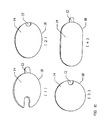
- an artificial retina device 10 is generally circular in shape with an integral grasping member (FIG. 1B) or a projecting grasping member (FIG. 1A) to grasp the device while it is being inserted.
- the device ranges from 2 mm to 20 mm in diameter and from 0.005 mm to 2 mm in thickness.
- the device 10 may be round (FIG. 1C [3]), oval (FIG. 1C [4]) elliptical (FIG. 1C [2]), or irregular (FIG. 1C [1]) in shape.
- the surface contours may be flat or curved to match the curvature of the retina.
- the edges or selected areas of the anterior 14 or posterior 16 (FIG. 2A) surfaces may be fashioned with ridges or other protrusions to improve stability within the retina and to improve biological acceptability.
- the device may also have ledges, lips or loops to aid manipulation during implantation. In addition, it may also have openings (not shown) between the two surfaces to allow passage of intraretinal nourishment and tissue ingrowth to maintain the device securely in the retina.
- the device may also be comprised of multiple smaller devices joined together by their edges.
- FIG. 1D three devices may be joined together in an articulated fashion to increase implant size and to conform to the curved retina.
- the devices are joined with an inert adhesive such as a silicon cement.
- the concavity of the articulated device is the anterior surface facing incoming light (14) and the convexity of the device is the posterior surface facing the retinal pigment epithelium (16).
- a device 10 may also have a flexible member such as a thin suture 13 attached (FIG. 1E) to facilitate removal of the implant as needed.
- Suture 13 is fashioned from an inert material such as nylon and may be left in place or removed via traction on the suture while securing the implant.
- an insertion guide 78 may be used to insert implant 10 into the eye.
- the guide portion 79 of the device is an elongated, flattened tubular structure fashioned from a curved and compressed tube of clear flexible material such as teflon or polyethylene with lips 83a and 83b at each end.
- the pusher portion 80 of the device is adapted to slide through guide portion 79, and is made from a similar material.
- Pusher 80 has multiple serrations 81 at one end to allow positive contact while pushing implant 10.
- implant 10 is placed within the guide 79 followed by pusher 80.
- the completed assembly 82 (Fig. 6) is inserted into the desired intraretinal location via a scleral incision into the intraretinal space.
- the pusher 80 is then pushed while retracting the guider 79 thus depositing the implant pass lip 83b into the intraretinal space.
- lip 83b can be used to lift and separate the desired retinal layers, and be used to deposit the implant accurately in the desired location.
- the details of the photodiode construction of the artificial retina device of the present invention consist of multiple layers of both pure and doped silicon deposited and etched.
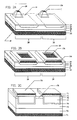
- An insulated or noninsulated polysilicon active electrode structure 13a projects from the surface in one embodiment (FIG. 2A), or a flat polysilicon active electrode surface 13b is constructed in another alternative embodiment (FIG. 2B) to transfer a current from the photodiode to the overlying photoreceptor, bipolar and inner retinal cell layers as explained in detail below.
- the polysilicon electrode structure 13a or 13b can be made by standard semiconductor plasma and/or wet etch techniques.
- a chromium base 72 and a gold surface 71 may be substituted for the conductive surfaces of the active electrode and common electrical ground.
- a NiP device employs a P-type substrate 75.
- a layer of chromium 72 is deposited on the posterior electrical ground surface followed by deposition of a layer of gold 71.
- a P+ layer 78 is then ion-implanted onto the anterior surface followed by ion implantation of individual N tubs 77.
- An automatic i layer forms at the junction of the N and P+ and N and P layers.
- a thin layer, transparent to light, of chromium 72 and then gold 71 is deposited over each N tub 77. This produces a NiP device.
- the N and P layers may be reversed to produce a PiN device.
- a PiN device would not require ion implantation of a P+ layer 78.
- conductive materials can be used as well for these layers: aluminum, platinum, conductive silicon or combinations of these materials.
- the artificial retina device of the present invention is, therefore, a large array of photovoltaic microphotodiodes of the PiN type.
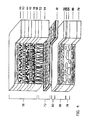
- Each microphotodiode (Figs. 2A and 2B) consists of a shallow P-doped photoactive layer 18 overlaying an intrinsic layer 20 which in turn overlays a N-doped layer 6.
- a conductive layer 22 of polysilicon that forms the common complimentary electrode or ground.
- a common complimentary electrode is shown, but the device can be constructed with a discrete complimentary electrode for each microphotodiode.
- a layer of silicon nitrate 24 covering the entire surface except for openings (or on the unmasked areas) 26 that establish electrode contact areas for the polysilicon active electrode 13a (or 13b).
- the PiN layers may be reversed (NIP) or modified to facilitate reversal of the device polarity.
- a plurality of nodes 28 are formed from a plurality of microphotodiodes described above.
- the designed current output of each self-powered photodiode node is on the order of 50 nA when the device is exposed to average room lighting. However, the electrical current output may be designed to be greater or less than this value depending upon the stimulation requirement of the overlying cell layer.
- a supplemental bias activation current may also be provided by an insulated wire or series of insulated wires leading from the device from the eye into an external or internally implanted battery unit.
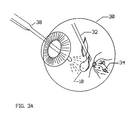
- the device 10 of this invention is inserted into the vitreous cavity of the eye 30 via a pars plana incision 32.
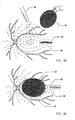
- a horizontal incision 34 (FIG. 3B) is then made through the retina from the vitreous side in the temporal portion of the posterior pole into the potential space between the photoreceptor layer and the retinal pigment epithelium.
- a horizontal incision 34 made at this location will avoid cutting inner retinal vasculature and will be parallel to coursing nerve fiber layers 36, therefore, also avoiding their injury.
- Illumination for the surgical procedure is provided by a optical fiber light pipe 38.
- the potential space is then be opened by canula irrigation of a balanced salt solution into the intraretinal space.
- the device is then placed into the intraretinal cavity (FIG. 3C) at the posterior pole under the macula area. Specifically, the device is placed between the retinal pigment epithelium 58 ( Figure 4) and photoreceptor layer 54, or if photoreceptor layer 54 is atrophied or lost then between the retinal pigment epithelium 58 and the bipolar and horizontal cell layer 52. The device is positioned such that the electrical ground 22 (or 74) is overlaying the retinal pigment epithelium 58 and the active electrode 13a (or 13b or 73) faces the incident light.
- endolaserphtocoagulation or endocautery burns 39 are made around the periphery of the device to secure the device.
- the scar tissue so formed around the periphery of the device will prevent the device from moving out of position.
- Endolaserphotocoagulation or endocautery 39 may also be used to seal the retinal incision.
- Air or other approved gaseous compounds may also be injected into the vitreous cavity to tamponade the retinal opening during healing. The pars plana incision will be closed in the usual surgical manner.
- An alternate method for implantation would involve making an incision through the sclera just posterior to the ora serata. Dissection would proceed through the choroid, choriocapillaris, Bruch's membrane and retinal pigment epithelium under stereo operating microscope control into the potential space between the inner and outer retinal layers. The artificial retinal implant would then be inserted into this space and directed posteriorly towards the macula by a pushing action imparted by a formed curved iris spatula or by use of the insertion guide 78. The device will rest in the macula area of posterior pole of the eye between the inner and outer retinal layers.
- the layers of the eye at the posterior pole from inside to outside are shown in FIG. 4: internal limiting membrane 40, nerve fiber layer 42, ganglion and amacrine cell layer 44, inner plexiform 46, inner nuclear layer 48, outer plexiform 50, outer nuclear and bipolar cell layer 52, and photoreceptor layer 54, all of which constitute the inner retinal layer 56.
- the retinal pigment epithelium 58, and Bruch's membrane 60 constitute the outer retinal layer 62.
- the choriocapillaris 64, and choroid 66 comprise the choroidal vasculature 68.
- the outer coat of the eye is the sclera 70.
- an amplitude-modulated current varying with illumination, produced by each photodiode of the device 10 will stimulate the overlying inner retinal layer consisting of photoreceptors (if present) and their cell bodies 54, 52, bipolar cells 48 and horizontal cells 52.
- cells 48-52 normally both receive and produce analog amplitude-modulated currents, the analog amplitude-modulated output of the device is well suited for stimulation of these cells.
- the amplitude-modulated signals of the bipolar cells 48 are then modified and converted by the amacrine and ganglion cells 44 to a frequency-modulated signal as is the normal biological event in the innermost area of the inner retinal layer for distant transmission through the optic nerve to the lateral geniculate area of the brain.
- each photodiode will be automatically amplitude modulated corresponding to the intensity of the incident light
- the resulting stimulation and signal current production of the overlying photoreceptor or bipolar cell layer will also be amplitude modulated thereby duplicating the normal amplitude-modulated character of these cells.
- Stimulating inner retina 56 at the above indicated location will also allow the normal function of the horizontal cell on-off receptor fields thereby allowing contrast appreciation.
Landscapes
- Health & Medical Sciences (AREA)
- Ophthalmology & Optometry (AREA)
- Engineering & Computer Science (AREA)
- Biomedical Technology (AREA)
- Life Sciences & Earth Sciences (AREA)
- Animal Behavior & Ethology (AREA)
- General Health & Medical Sciences (AREA)
- Public Health (AREA)
- Veterinary Medicine (AREA)
- Heart & Thoracic Surgery (AREA)
- Nuclear Medicine, Radiotherapy & Molecular Imaging (AREA)
- Vascular Medicine (AREA)
- Radiology & Medical Imaging (AREA)
- Cardiology (AREA)
- Surgery (AREA)
- Oral & Maxillofacial Surgery (AREA)
- Transplantation (AREA)
- Prostheses (AREA)
- Materials For Medical Uses (AREA)
Applications Claiming Priority (4)
| Application Number | Priority Date | Filing Date | Title |
|---|---|---|---|
| US07/390,562 US5016633A (en) | 1989-08-08 | 1989-08-08 | Artificial retina device |
| US390562 | 1989-08-08 | ||
| US549094 | 1990-07-06 | ||
| US07/549,094 US5024223A (en) | 1989-08-08 | 1990-07-06 | Artificial retina device |
Publications (3)
| Publication Number | Publication Date |
|---|---|
| EP0460320A2 true EP0460320A2 (de) | 1991-12-11 |
| EP0460320A3 EP0460320A3 (en) | 1993-02-24 |
| EP0460320B1 EP0460320B1 (de) | 1998-01-07 |
Family
ID=27013194
Family Applications (1)
| Application Number | Title | Priority Date | Filing Date |
|---|---|---|---|
| EP90308575A Expired - Lifetime EP0460320B1 (de) | 1989-08-08 | 1990-08-03 | Künstliche Netzhaut |
Country Status (5)
| Country | Link |
|---|---|
| US (1) | US5024223A (de) |
| EP (1) | EP0460320B1 (de) |
| CA (1) | CA2022544C (de) |
| DE (1) | DE69031908T2 (de) |
| ES (1) | ES2110410T3 (de) |
Cited By (28)
| Publication number | Priority date | Publication date | Assignee | Title |
|---|---|---|---|---|
| WO1997013551A1 (en) * | 1995-10-11 | 1997-04-17 | Trustees Of Boston University | Method and apparatus for improving the function of sensory cells |
| WO1998017344A1 (de) | 1996-10-23 | 1998-04-30 | Eberhard-Karls-Universität Tübingen Universitätsklinikum | Optisch ansteuerbare mikroelektrodenanordnung zum stimulieren von zellen, insbesondere retina-implantat |
| WO1998017343A1 (de) | 1996-10-23 | 1998-04-30 | Eberhard-Karls-Universität Tübingen Universitätsklinikum | Retina-implantat |
| WO1999015119A1 (de) * | 1997-09-19 | 1999-04-01 | Eberhard-Karls-Universität Tübingen | Vorrichtung für einen zugang in den subretinalraum eines auges |
| DE19705987C2 (de) * | 1996-10-23 | 1999-09-09 | Univ Eberhard Karls | Optisch ansteuerbare Mikroelektrodenanordnung zum Stimulieren von Zellen, insbesondere Retina-Implantat |
| EP0957975A4 (de) * | 1995-06-06 | 2000-03-08 | Vincent Chow | Retinal-implantat aus mehrphasigen mikrofotodioden und anordnung zur reizung der retina mittels adaptierender bilderzeugung |
| WO2000067838A1 (de) * | 1999-05-07 | 2000-11-16 | Eberhard-Karls-Universität Tübingen Universitätsklinikum | Retina-implantat |
| WO2002087687A1 (de) | 2001-04-28 | 2002-11-07 | Td Verwaltungs Gmbh | Mikrokontaktstruktur zur implantation bei einem säugetier, insbesondere bei einem menschen |
| WO2002041814A3 (en) * | 2000-11-21 | 2003-01-30 | Massachusetts Inst Technology | Inflatable neural prosthesis |
| GB2379784A (en) * | 2001-07-30 | 2003-03-19 | Hewlett Packard Co | Providing power and control to electrical devices |
| WO2003061537A1 (en) * | 2002-01-17 | 2003-07-31 | Masachusetts Eye And Ear Infirmary | Minimally invasive retinal prosthesis |
| WO2004067088A1 (de) | 2003-01-31 | 2004-08-12 | Eberhard-Karls-Univer Sität Tübingen | Retina-implantat zum stimulieren einer retina in abhängigkeit von einfallendem licht |
| WO2005000395A1 (de) | 2003-06-23 | 2005-01-06 | Eberhard-Karls-Universität Tübingen Universitätsklinikum | Aktives retina-implantat mit einer vielzahl von bildelementen |
| DE102004002379A1 (de) * | 2004-01-15 | 2005-08-18 | Iip-Technologies Gmbh | Neurologisches Werkzeug |
| WO2005087309A1 (de) | 2004-03-12 | 2005-09-22 | Imi Intelligent Medical Implants Ag | Stimulationselektrode |
| US7158836B2 (en) | 2001-03-30 | 2007-01-02 | Satoshi Suzuki | Electrode member for retinal stimulation, and artificial retinal device using the electrode member |
| WO2008020849A1 (en) * | 2006-08-16 | 2008-02-21 | Second Sight Medical Products, Inc. | Surgical tool for electrode implantation |
| EP1958577A3 (de) * | 1999-01-05 | 2008-10-01 | Second Sight Medical Products, Inc. | Verfahren und Vorrichtung für einen intraokularen Netzhautnagel-Inserter |
| WO2010105728A2 (en) | 2009-03-20 | 2010-09-23 | Retina Implant Ag | Active retinal implant |
| DE102009015389A1 (de) | 2009-03-20 | 2010-09-30 | Retina Implant Ag | Aktives Retina-Implantat |
| US8231637B2 (en) | 2002-07-26 | 2012-07-31 | Second Sight Medical Products, Inc. | Surgical tool for electrode implantation |
| US8612017B2 (en) | 2006-09-26 | 2013-12-17 | Retina Implant Ag | Implantable device |
| US8849401B2 (en) | 2006-09-26 | 2014-09-30 | Retina Implant Ag | Implantable device |
| US9199080B2 (en) | 2011-09-12 | 2015-12-01 | Okuvision Gmbh | Method for treating an eye |
| EP1874397B1 (de) | 2005-04-28 | 2016-06-01 | Second Sight Medical Products, Inc. | Flexibles schaltungselektroden-array |
| DE102016105174A1 (de) | 2016-03-21 | 2017-09-21 | NMI Naturwissenschaftliches und Medizinisches Institut an der Universität Tübingen | Aktives Retina-Implantat |
| WO2018146032A1 (de) | 2017-02-10 | 2018-08-16 | Retina Implant Ag | Implantat-vorrichtung mit optischer schnittstelle |
| CN110628623A (zh) * | 2019-09-10 | 2019-12-31 | 大连理工大学 | 视觉认知芯片 |
Families Citing this family (82)
| Publication number | Priority date | Publication date | Assignee | Title |
|---|---|---|---|---|
| US5476494A (en) * | 1992-09-11 | 1995-12-19 | Massachusetts Institute Of Technology | Low pressure neural contact structure |
| US5397350A (en) * | 1993-05-03 | 1995-03-14 | Chow; Alan Y. | Independent photoelectric artificial retina device and method of using same |
| US5556423A (en) * | 1993-05-03 | 1996-09-17 | Alan Y. Chow | Independent photoelectric artificial retina device and method of using same |
| US5597381A (en) * | 1993-06-03 | 1997-01-28 | Massachusetts Eye And Ear Infirmary | Methods for epi-retinal implantation |
| US5895415A (en) * | 1995-06-06 | 1999-04-20 | Optobionics Corporation | Multi-phasic microphotodiode retinal implant and adaptive imaging retinal stimulation system |
| US5873901A (en) * | 1995-06-30 | 1999-02-23 | Space Vacuum Epitaxy Center University Of Houston | Treating retinal damage by implanting thin film optical detectors |
| DE19529371C3 (de) * | 1995-08-10 | 2003-05-28 | Nmi Univ Tuebingen | Mikroelektroden-Anordnung |
| US5837995A (en) * | 1996-11-25 | 1998-11-17 | Alan Y. Chow | Wavelength-controllable voltage-phase photodiode optoelectronic switch ("opsistor") |
| US5865839A (en) * | 1996-12-30 | 1999-02-02 | Doorish; John F. | Artificial retina |
| US5836996A (en) * | 1996-12-30 | 1998-11-17 | Doorish; John F. | Artificial retina |
| US5935155A (en) * | 1998-03-13 | 1999-08-10 | John Hopkins University, School Of Medicine | Visual prosthesis and method of using same |
| US5944747A (en) * | 1998-03-13 | 1999-08-31 | Johns Hopkins University | Method for preferential outer retinal stimulation |
| US6324429B1 (en) * | 1998-05-08 | 2001-11-27 | Massachusetts Eye And Ear Infirmary | Chronically implantable retinal prosthesis |
| US6814933B2 (en) * | 2000-09-19 | 2004-11-09 | Aurora Biosciences Corporation | Multiwell scanner and scanning method |
| US6448089B1 (en) | 1999-10-12 | 2002-09-10 | Aurora Biosciences Corporation | Multiwell scanner and scanning method |
| US6586257B1 (en) | 1999-10-12 | 2003-07-01 | Vertex Pharmaceuticals Incorporated | Multiwell scanner and scanning method |
| US20040039401A1 (en) * | 2000-03-31 | 2004-02-26 | Chow Alan Y. | Implant instrument |
| US6389317B1 (en) * | 2000-03-31 | 2002-05-14 | Optobionics Corporation | Multi-phasic microphotodetector retinal implant with variable voltage and current capability |
| DE10020846A1 (de) * | 2000-04-28 | 2001-12-06 | Intelligent Implants Gmbh | Mikrokontaktstruktur für Neuroprothesen zur Implantation an Nervengewebe und Verfahren hierzu |
| US6427087B1 (en) * | 2000-05-04 | 2002-07-30 | Optobionics Corporation | Artificial retina device with stimulating and ground return electrodes disposed on opposite sides of the neuroretina and method of attachment |
| US7615356B2 (en) | 2000-07-10 | 2009-11-10 | Vertex Pharmaceuticals (San Diego) Llc | Ion channel assay methods |
| US7399599B2 (en) | 2000-07-10 | 2008-07-15 | Vertex Pharmaceuticals (San Diego) Llc | Ion channel assay methods |
| RU2213539C2 (ru) * | 2000-10-03 | 2003-10-10 | Муниципальное образовательное учреждение "Средняя общеобразовательная школа №19" г.Красноярска | Искусственный глаз |
| DE10052670A1 (de) * | 2000-10-24 | 2002-05-08 | Forschungszentrum Juelich Gmbh | Meßanordnung zum Nachweis einer ein- oder mehrdimensionalen Verteilung einer chemischen oder biochemischen Komponente |
| US7338522B2 (en) * | 2001-02-13 | 2008-03-04 | Second Sight Medical Products, Inc. | Implantable retinal electrode array configuration for minimal retinal damage and method of reducing retinal stress |
| US7149586B2 (en) * | 2002-03-28 | 2006-12-12 | Second Sight Medical Products, Inc. | Variable pitch electrode array |
| US8060211B2 (en) * | 2001-02-13 | 2011-11-15 | Second Sight Medical Products, Inc. | Method of reducing retinal stress caused by an implantable retinal electrode array |
| US7037943B2 (en) | 2001-04-10 | 2006-05-02 | Optobionics Corporation | Retinal treatment method |
| US20050033202A1 (en) * | 2001-06-29 | 2005-02-10 | Chow Alan Y. | Mechanically activated objects for treatment of degenerative retinal disease |
| US20050004625A1 (en) * | 2001-06-29 | 2005-01-06 | Chow Alan Y. | Treatment of degenerative retinal disease via electrical stimulation of surface structures |
| US7031776B2 (en) * | 2001-06-29 | 2006-04-18 | Optobionics | Methods for improving damaged retinal cell function |
| US7146221B2 (en) | 2001-11-16 | 2006-12-05 | The Regents Of The University Of California | Flexible electrode array for artifical vision |
| US20030233125A1 (en) * | 2002-06-12 | 2003-12-18 | Alfred E. Mann Institute For Biomedical Engineering At The University Of S. California | Injection devices for unimpeded target location testing |
| US20070265582A1 (en) * | 2002-06-12 | 2007-11-15 | University Of Southern California | Injection Devices for Unimpeded Target Location Testing |
| US6755530B1 (en) * | 2002-07-16 | 2004-06-29 | The United States Of America As Represented By The Administrator Of The National Aeronautics And Space Administration | Retinal light processing using carbon nanotubes |
| US8185209B2 (en) * | 2003-01-03 | 2012-05-22 | Board Of Trustees Operating Michigan State University | Methods to extend vision to infrared wavelengths |
| US7047080B2 (en) * | 2003-02-14 | 2006-05-16 | The Board Of Trustees Of The Leland Stanford Junior University | Self-sufficient retinal prosthesis powered by intraocular photovoltaic cells |
| US7483750B2 (en) * | 2003-03-21 | 2009-01-27 | Second Sight Medical Products, Inc. | Transretinal implant and method of implantation |
| US7321795B2 (en) * | 2003-03-24 | 2008-01-22 | Les Bogdanowicz | Compositions for electric stimulation of the eye |
| US7127301B1 (en) | 2003-04-28 | 2006-10-24 | Sandia Corporation | Flexible retinal electrode array |
| US8260428B2 (en) * | 2003-05-01 | 2012-09-04 | California Institute Of Technology | Method and system for training a visual prosthesis |
| US7321796B2 (en) * | 2003-05-01 | 2008-01-22 | California Institute Of Technology | Method and system for training a visual prosthesis |
| JP4412924B2 (ja) * | 2003-07-01 | 2010-02-10 | 株式会社ニデック | 視覚再生補助装置 |
| US20050239048A1 (en) * | 2004-04-09 | 2005-10-27 | Lawandy Nabil M | Method and apparatus for enhancing biological photon receptors using plasmon resonance |
| ATE408432T1 (de) * | 2004-11-02 | 2008-10-15 | Sydney Biotech Pty Ltd | Extraokulare vorrichtung |
| US20060148254A1 (en) * | 2005-01-05 | 2006-07-06 | Mclean George Y | Activated iridium oxide electrodes and methods for their fabrication |
| WO2007035743A2 (en) * | 2005-09-16 | 2007-03-29 | Second Sight Medical Products, Inc. | Downloadable filters for a visual prosthesis |
| EP2380625A1 (de) * | 2005-09-19 | 2011-10-26 | Second Sight Medical Products, Inc. | Transretinales flexibles Schaltungselektrodenarray |
| US20070250135A1 (en) * | 2006-04-21 | 2007-10-25 | Bartz-Schmidt Karl U | Compound subretinal prostheses with extra-ocular parts and surgical technique therefore |
| JP5122244B2 (ja) * | 2007-11-01 | 2013-01-16 | 株式会社ニデック | 視覚再生補助装置 |
| WO2009067668A1 (en) * | 2007-11-21 | 2009-05-28 | The Trustees Of Boston College | Apparatus and methods for visual perception using an array of nanoscale waveguides |
| TWI356691B (en) * | 2008-02-19 | 2012-01-21 | Ind Tech Res Inst | Artificial optic nerve, artificial retina chip mod |
| US8718784B2 (en) * | 2010-01-14 | 2014-05-06 | Nano-Retina, Inc. | Penetrating electrodes for retinal stimulation |
| US8706243B2 (en) | 2009-02-09 | 2014-04-22 | Rainbow Medical Ltd. | Retinal prosthesis techniques |
| US8428740B2 (en) | 2010-08-06 | 2013-04-23 | Nano-Retina, Inc. | Retinal prosthesis techniques |
| US8150526B2 (en) | 2009-02-09 | 2012-04-03 | Nano-Retina, Inc. | Retinal prosthesis |
| US8442641B2 (en) | 2010-08-06 | 2013-05-14 | Nano-Retina, Inc. | Retinal prosthesis techniques |
| US20100241060A1 (en) * | 2009-03-18 | 2010-09-23 | Roizman Keith | Surgical devices and methods |
| AU2011279250B2 (en) * | 2010-07-12 | 2014-12-04 | California Institute Of Technology | Biocompatible substrate for facilitating interconnections between stem cells and target tissues and methods for implanting same |
| US8571669B2 (en) | 2011-02-24 | 2013-10-29 | Nano-Retina, Inc. | Retinal prosthesis with efficient processing circuits |
| US8877489B2 (en) | 2011-12-05 | 2014-11-04 | California Institute Of Technology | Ultrathin parylene-C semipermeable membranes for biomedical applications |
| WO2012149468A2 (en) | 2011-04-29 | 2012-11-01 | University Of Southern California | Instruments and methods for the implantation of cell-seeded substrates |
| US9248013B2 (en) | 2011-12-05 | 2016-02-02 | California Institute Of Technology | 3-Dimensional parylene scaffold cage |
| US9427569B2 (en) * | 2012-05-09 | 2016-08-30 | Po-Kang Lin | Structure of artificial electronic retina |
| US9370417B2 (en) | 2013-03-14 | 2016-06-21 | Nano-Retina, Inc. | Foveated retinal prosthesis |
| US9474902B2 (en) | 2013-12-31 | 2016-10-25 | Nano Retina Ltd. | Wearable apparatus for delivery of power to a retinal prosthesis |
| US9331791B2 (en) | 2014-01-21 | 2016-05-03 | Nano Retina Ltd. | Transfer of power and data |
| US11439822B2 (en) * | 2017-03-31 | 2022-09-13 | ECOLE POLYTECHNIQUE FéDéRALE DE LAUSANNE | Polymer-based optoelectronic interface and methods for its manufacture |
| EP3461529A1 (de) | 2017-09-27 | 2019-04-03 | Pixium Vision SA | Spitze, inserterbefestigung und abgabevorrichtung |
| FR3072564B1 (fr) | 2017-10-25 | 2019-10-18 | Universite De Lille 1 Sciences Et Technologies | Capteur optique |
| CN112088031A (zh) | 2018-05-02 | 2020-12-15 | 纳米视网膜有限公司 | 视网膜植入物固定装置及技术 |
| AU2019352954B2 (en) | 2018-10-01 | 2022-03-10 | I-Lumen Scientific, Inc. | System and methods for controlled electrical modulation for vision therapy |
| US11305118B2 (en) | 2018-11-30 | 2022-04-19 | Biovisics Medical, Inc. | Head worn apparatuses for vision therapy |
| US11471680B2 (en) | 2019-04-10 | 2022-10-18 | Biovisics, Inc. | Systems and interfaces for ocular therapy |
| ES2992491T3 (es) | 2019-06-14 | 2024-12-13 | I Lumen Scient Inc | Dispositivo médico portátil |
| US12023498B2 (en) | 2019-07-12 | 2024-07-02 | Biovisics Medical, Inc. | Ocular therapy modes and systems |
| US12439762B2 (en) * | 2019-11-21 | 2025-10-07 | Seoul National University R&Db Foundation | Stretchable organic optoelectronic sensorimotor synapse |
| US20250195888A1 (en) | 2019-12-03 | 2025-06-19 | I-Lumen Scientific, Inc. | Systems, implantable devices and methods for vision related stimulation |
| US12702831B2 (en) | 2022-09-29 | 2026-08-11 | I-Lumen Scientific, Inc. | Systems and methods to manage microcurrent therapy dose |
| US12589243B2 (en) | 2022-10-21 | 2026-03-31 | I-Lumen Scientific, Inc. | Ocular devices and controller interfaces for ocular therapy |
| US12042432B1 (en) | 2024-01-11 | 2024-07-23 | Michael Reynard | Method and device for the treatment of glaucoma |
| US12274640B1 (en) | 2024-11-08 | 2025-04-15 | Michael Reynard | Implant for electrolysis of aqueous humor |
Family Cites Families (14)
| Publication number | Priority date | Publication date | Assignee | Title |
|---|---|---|---|---|
| US2760483A (en) * | 1953-10-29 | 1956-08-28 | Tassicker Graham Edward | Retinal stimulator |
| US3594823A (en) * | 1969-02-11 | 1971-07-27 | Patent Management Inc | Visual substitution system with receptor scanning means |
| US3628193A (en) * | 1969-02-19 | 1971-12-21 | Inst Of Medical Sciences The | Tactile image projection system |
| US3766311A (en) * | 1972-04-26 | 1973-10-16 | H Boll | Sensory substitution system |
| US3848608A (en) * | 1973-07-23 | 1974-11-19 | Gen Electric | Subject integument spatial stimulator |
| US3914800A (en) * | 1974-06-06 | 1975-10-28 | Inst Of Medical Sciences | Fluid mechanical tactile oscilloscope to augment the five senses |
| US4251887A (en) * | 1979-04-02 | 1981-02-24 | Anis Aziz Y | Posterior chamber capsular lens implant and method for implantation of the lens |
| US4272910A (en) * | 1979-07-31 | 1981-06-16 | Danz W R | Ocular prosthetic or the like |
| US4551149A (en) * | 1982-02-16 | 1985-11-05 | Michael Sciarra | Prosthetic vision system |
| US4600004A (en) * | 1982-09-08 | 1986-07-15 | Osvaldo Lopez | Intraocular lens holder and inserter |
| US4601545A (en) * | 1984-05-16 | 1986-07-22 | Kern Seymour P | Variable power lens system |
| US4628933A (en) * | 1985-07-23 | 1986-12-16 | Michelson Robin P | Method and apparatus for visual prosthesis |
| US4750498A (en) * | 1986-02-21 | 1988-06-14 | Coopervision, Inc. | Method and tool for inserting an intraocular lens |
| US4836202A (en) * | 1986-11-03 | 1989-06-06 | Coopervision, Inc. | Instrument for manipulating compressible intraocular lenses |
-
1990
- 1990-07-06 US US07/549,094 patent/US5024223A/en not_active Expired - Lifetime
- 1990-08-02 CA CA002022544A patent/CA2022544C/en not_active Expired - Lifetime
- 1990-08-03 ES ES90308575T patent/ES2110410T3/es not_active Expired - Lifetime
- 1990-08-03 EP EP90308575A patent/EP0460320B1/de not_active Expired - Lifetime
- 1990-08-03 DE DE69031908T patent/DE69031908T2/de not_active Expired - Lifetime
Cited By (54)
| Publication number | Priority date | Publication date | Assignee | Title |
|---|---|---|---|---|
| EP1435255A3 (de) * | 1995-06-06 | 2004-08-18 | Alan Y. Chow | Retinal-Implantat aus mehrphasigen Mikrophotodioden und Anordnung zur Reizung der Retina mittels adaptierender Bilderzeugung |
| EP0957975A4 (de) * | 1995-06-06 | 2000-03-08 | Vincent Chow | Retinal-implantat aus mehrphasigen mikrofotodioden und anordnung zur reizung der retina mittels adaptierender bilderzeugung |
| US7139612B2 (en) | 1995-06-06 | 2006-11-21 | Optobionics Corporation | Multi-phasic microphotodiode retinal implant and adaptive imaging retinal stimulation system |
| US5782873A (en) * | 1995-10-11 | 1998-07-21 | Trustees Of Boston University | Method and apparatus for improving the function of sensory cells |
| WO1997013551A1 (en) * | 1995-10-11 | 1997-04-17 | Trustees Of Boston University | Method and apparatus for improving the function of sensory cells |
| US6032074A (en) * | 1995-10-11 | 2000-02-29 | Trustees Of Boston University | Method and apparatus for improving the function of sensory cells |
| US6347250B1 (en) | 1996-10-23 | 2002-02-12 | Nmi Univ Tuebingen | Optically controllable microelectrode array for stimulating cells within a tissue |
| WO1998017343A1 (de) | 1996-10-23 | 1998-04-30 | Eberhard-Karls-Universität Tübingen Universitätsklinikum | Retina-implantat |
| DE19705987C2 (de) * | 1996-10-23 | 1999-09-09 | Univ Eberhard Karls | Optisch ansteuerbare Mikroelektrodenanordnung zum Stimulieren von Zellen, insbesondere Retina-Implantat |
| DE19705988C2 (de) * | 1996-10-23 | 2002-04-11 | Univ Eberhard Karls | Retina-Implantat |
| JP2001505448A (ja) * | 1996-10-23 | 2001-04-24 | エベルハルト−カルルス−ウニバーシテート チュービンゲン ウニバーシテートクリニクム | 網膜移植組織 |
| US6298270B1 (en) | 1996-10-23 | 2001-10-02 | Eberhard-Karls-Universitat Tubingen Universitatsklinkum | Retina implant |
| WO1998017344A1 (de) | 1996-10-23 | 1998-04-30 | Eberhard-Karls-Universität Tübingen Universitätsklinikum | Optisch ansteuerbare mikroelektrodenanordnung zum stimulieren von zellen, insbesondere retina-implantat |
| US6761724B1 (en) | 1997-09-19 | 2004-07-13 | Eberhard-Karls-Universität Tübingen Universitätsklinikum | Method and device for entering the subretinal region of the eye |
| DE19741487C2 (de) * | 1997-09-19 | 2000-08-31 | Univ Eberhard Karls | Vorrichtung für einen Zugang in den Subretinalraum eines Auges |
| WO1999015119A1 (de) * | 1997-09-19 | 1999-04-01 | Eberhard-Karls-Universität Tübingen | Vorrichtung für einen zugang in den subretinalraum eines auges |
| EP1958577A3 (de) * | 1999-01-05 | 2008-10-01 | Second Sight Medical Products, Inc. | Verfahren und Vorrichtung für einen intraokularen Netzhautnagel-Inserter |
| WO2000067838A1 (de) * | 1999-05-07 | 2000-11-16 | Eberhard-Karls-Universität Tübingen Universitätsklinikum | Retina-implantat |
| US6804560B2 (en) | 1999-05-07 | 2004-10-12 | Eberhard-Karls-Universitat Tubingen Universitatsklinikum | Retina implant |
| WO2002041814A3 (en) * | 2000-11-21 | 2003-01-30 | Massachusetts Inst Technology | Inflatable neural prosthesis |
| US7158836B2 (en) | 2001-03-30 | 2007-01-02 | Satoshi Suzuki | Electrode member for retinal stimulation, and artificial retinal device using the electrode member |
| EP1712253A3 (de) * | 2001-04-28 | 2009-01-14 | IMI Intelligent Medical Implants AG | Mikrokontaktstruktur zur Implantation bei einem Säugetier, insbesondere bei einem Menschen |
| EP2263740A3 (de) * | 2001-04-28 | 2011-03-16 | IMI Intelligent Medical Implants AG | Mikrokontaktstruktur zur Implantation bei einem Säugetier, insbesondere bei einem Menschen |
| US7177697B2 (en) | 2001-04-28 | 2007-02-13 | Intelligent Acquisition Llc | Microcontact structure for implantation in a mammal, especially a human being |
| WO2002087687A1 (de) | 2001-04-28 | 2002-11-07 | Td Verwaltungs Gmbh | Mikrokontaktstruktur zur implantation bei einem säugetier, insbesondere bei einem menschen |
| US6570386B2 (en) | 2001-07-30 | 2003-05-27 | Hewlett-Packard Development Company, L.P. | System and method for providing power to electrical devices |
| GB2379784B (en) * | 2001-07-30 | 2005-09-14 | Hewlett Packard Co | System and method for providing power to electrical devices |
| GB2379784A (en) * | 2001-07-30 | 2003-03-19 | Hewlett Packard Co | Providing power and control to electrical devices |
| US6976998B2 (en) | 2002-01-17 | 2005-12-20 | Massachusetts Institute Of Technology | Minimally invasive retinal prosthesis |
| WO2003061537A1 (en) * | 2002-01-17 | 2003-07-31 | Masachusetts Eye And Ear Infirmary | Minimally invasive retinal prosthesis |
| US8231637B2 (en) | 2002-07-26 | 2012-07-31 | Second Sight Medical Products, Inc. | Surgical tool for electrode implantation |
| WO2004067088A1 (de) | 2003-01-31 | 2004-08-12 | Eberhard-Karls-Univer Sität Tübingen | Retina-implantat zum stimulieren einer retina in abhängigkeit von einfallendem licht |
| JP2006517435A (ja) * | 2003-01-31 | 2006-07-27 | エーバーハルト−カルルス−ウニヴェルズィテート テュービンゲン ウニヴェルズィテートクリーニクム | 入射光の関数として網膜を刺激するための網膜インプラント |
| JP2007506466A (ja) * | 2003-06-23 | 2007-03-22 | エバーハルト・カールス・ユニバーシタット テュービンゲン ユニバーシタットスクリニクム | 複数のピクセルエレメントを備える能動型の網膜インプラント |
| WO2005000395A1 (de) | 2003-06-23 | 2005-01-06 | Eberhard-Karls-Universität Tübingen Universitätsklinikum | Aktives retina-implantat mit einer vielzahl von bildelementen |
| EP2098264A1 (de) | 2003-06-23 | 2009-09-09 | Retina Implant AG | Aktives Retina-Implantat mit einer Vielzahl von Bildelementen |
| US7751896B2 (en) | 2003-06-23 | 2010-07-06 | Retina Implant Ag | Active retina implant with a multiplicity of pixel elements |
| DE102004002379A1 (de) * | 2004-01-15 | 2005-08-18 | Iip-Technologies Gmbh | Neurologisches Werkzeug |
| WO2005087309A1 (de) | 2004-03-12 | 2005-09-22 | Imi Intelligent Medical Implants Ag | Stimulationselektrode |
| EP1874397B2 (de) † | 2005-04-28 | 2019-12-25 | Second Sight Medical Products, Inc. | Flexibles schaltungselektroden-array |
| EP1874397B1 (de) | 2005-04-28 | 2016-06-01 | Second Sight Medical Products, Inc. | Flexibles schaltungselektroden-array |
| WO2008020849A1 (en) * | 2006-08-16 | 2008-02-21 | Second Sight Medical Products, Inc. | Surgical tool for electrode implantation |
| US8849401B2 (en) | 2006-09-26 | 2014-09-30 | Retina Implant Ag | Implantable device |
| US8612017B2 (en) | 2006-09-26 | 2013-12-17 | Retina Implant Ag | Implantable device |
| DE102009061008A1 (de) | 2009-03-20 | 2011-07-14 | Retina Implant AG, 72770 | Testvorrichtung für Zellen, Zellkulturen und/oder organotypische Zellverbände |
| DE102009061008B4 (de) * | 2009-03-20 | 2014-09-25 | Retina Implant Ag | Verwendung einer Testvorrichtung und Verfahren zum Test von Zellen, Zellkulturen und/oder organotypischen Zellverbänden |
| US9162060B2 (en) | 2009-03-20 | 2015-10-20 | Retina Implant Ag | Active retinal implant |
| DE102009015389A1 (de) | 2009-03-20 | 2010-09-30 | Retina Implant Ag | Aktives Retina-Implantat |
| WO2010105728A2 (en) | 2009-03-20 | 2010-09-23 | Retina Implant Ag | Active retinal implant |
| US9199080B2 (en) | 2011-09-12 | 2015-12-01 | Okuvision Gmbh | Method for treating an eye |
| DE102016105174A1 (de) | 2016-03-21 | 2017-09-21 | NMI Naturwissenschaftliches und Medizinisches Institut an der Universität Tübingen | Aktives Retina-Implantat |
| WO2017162458A1 (de) | 2016-03-21 | 2017-09-28 | NMI Naturwissenschaftliches und Medizinisches Institut an der Universität Tübingen | Aktives retina-implantat |
| WO2018146032A1 (de) | 2017-02-10 | 2018-08-16 | Retina Implant Ag | Implantat-vorrichtung mit optischer schnittstelle |
| CN110628623A (zh) * | 2019-09-10 | 2019-12-31 | 大连理工大学 | 视觉认知芯片 |
Also Published As
| Publication number | Publication date |
|---|---|
| US5024223A (en) | 1991-06-18 |
| DE69031908T2 (de) | 1998-07-16 |
| DE69031908D1 (de) | 1998-02-12 |
| EP0460320A3 (en) | 1993-02-24 |
| CA2022544A1 (en) | 1991-02-09 |
| EP0460320B1 (de) | 1998-01-07 |
| ES2110410T3 (es) | 1998-02-16 |
| CA2022544C (en) | 2002-04-23 |
Similar Documents
| Publication | Publication Date | Title |
|---|---|---|
| US5024223A (en) | Artificial retina device | |
| US5016633A (en) | Artificial retina device | |
| US6389317B1 (en) | Multi-phasic microphotodetector retinal implant with variable voltage and current capability | |
| US7003354B2 (en) | Artificial retina device with stimulating and ground return electrodes disposed on opposite sides of the neuroretina and method of attachment | |
| US7139612B2 (en) | Multi-phasic microphotodiode retinal implant and adaptive imaging retinal stimulation system | |
| AU2001243665A1 (en) | Multi-phasic microphotodetector retinal implant with variable voltage and current capability and apparatus for insertion | |
| US7031776B2 (en) | Methods for improving damaged retinal cell function | |
| AU2001255783A1 (en) | Artificial retina device with stimulating and ground return electrodes disposed on opposite sides of the neuroretina and method of attachment | |
| AU2002352103A1 (en) | Methods for improving damaged retinal cell function |
Legal Events
| Date | Code | Title | Description |
|---|---|---|---|
| PUAI | Public reference made under article 153(3) epc to a published international application that has entered the european phase |
Free format text: ORIGINAL CODE: 0009012 |
|
| AK | Designated contracting states |
Kind code of ref document: A2 Designated state(s): DE ES FR GB IT |
|
| PUAL | Search report despatched |
Free format text: ORIGINAL CODE: 0009013 |
|
| AK | Designated contracting states |
Kind code of ref document: A3 Designated state(s): DE ES FR GB IT |
|
| 17P | Request for examination filed |
Effective date: 19930823 |
|
| 17Q | First examination report despatched |
Effective date: 19950127 |
|
| GRAG | Despatch of communication of intention to grant |
Free format text: ORIGINAL CODE: EPIDOS AGRA |
|
| GRAG | Despatch of communication of intention to grant |
Free format text: ORIGINAL CODE: EPIDOS AGRA |
|
| GRAG | Despatch of communication of intention to grant |
Free format text: ORIGINAL CODE: EPIDOS AGRA |
|
| GRAH | Despatch of communication of intention to grant a patent |
Free format text: ORIGINAL CODE: EPIDOS IGRA |
|
| GRAH | Despatch of communication of intention to grant a patent |
Free format text: ORIGINAL CODE: EPIDOS IGRA |
|
| GRAA | (expected) grant |
Free format text: ORIGINAL CODE: 0009210 |
|
| AK | Designated contracting states |
Kind code of ref document: B1 Designated state(s): DE ES FR GB IT |
|
| ET | Fr: translation filed | ||
| REF | Corresponds to: |
Ref document number: 69031908 Country of ref document: DE Date of ref document: 19980212 |
|
| REG | Reference to a national code |
Ref country code: ES Ref legal event code: FG2A Ref document number: 2110410 Country of ref document: ES Kind code of ref document: T3 |
|
| ITF | It: translation for a ep patent filed | ||
| PLBQ | Unpublished change to opponent data |
Free format text: ORIGINAL CODE: EPIDOS OPPO |
|
| PLBI | Opposition filed |
Free format text: ORIGINAL CODE: 0009260 |
|
| PLBF | Reply of patent proprietor to notice(s) of opposition |
Free format text: ORIGINAL CODE: EPIDOS OBSO |
|
| 26 | Opposition filed |
Opponent name: EBERHARD-KARLS-UNIVERSITAET TUEBINGEN, Effective date: 19981007 |
|
| PLBF | Reply of patent proprietor to notice(s) of opposition |
Free format text: ORIGINAL CODE: EPIDOS OBSO |
|
| PLBF | Reply of patent proprietor to notice(s) of opposition |
Free format text: ORIGINAL CODE: EPIDOS OBSO |
|
| PLBO | Opposition rejected |
Free format text: ORIGINAL CODE: EPIDOS REJO |
|
| APAC | Appeal dossier modified |
Free format text: ORIGINAL CODE: EPIDOS NOAPO |
|
| APAE | Appeal reference modified |
Free format text: ORIGINAL CODE: EPIDOS REFNO |
|
| APAC | Appeal dossier modified |
Free format text: ORIGINAL CODE: EPIDOS NOAPO |
|
| REG | Reference to a national code |
Ref country code: GB Ref legal event code: IF02 |
|
| APAC | Appeal dossier modified |
Free format text: ORIGINAL CODE: EPIDOS NOAPO |
|
| PLBN | Opposition rejected |
Free format text: ORIGINAL CODE: 0009273 |
|
| STAA | Information on the status of an ep patent application or granted ep patent |
Free format text: STATUS: OPPOSITION REJECTED |
|
| 27O | Opposition rejected |
Effective date: 20030605 |
|
| APAH | Appeal reference modified |
Free format text: ORIGINAL CODE: EPIDOSCREFNO |
|
| PGFP | Annual fee paid to national office [announced via postgrant information from national office to epo] |
Ref country code: ES Payment date: 20090821 Year of fee payment: 20 Ref country code: FR Payment date: 20090819 Year of fee payment: 20 |
|
| PGFP | Annual fee paid to national office [announced via postgrant information from national office to epo] |
Ref country code: DE Payment date: 20090713 Year of fee payment: 20 Ref country code: GB Payment date: 20090821 Year of fee payment: 20 |
|
| PGFP | Annual fee paid to national office [announced via postgrant information from national office to epo] |
Ref country code: IT Payment date: 20090825 Year of fee payment: 20 |
|
| REG | Reference to a national code |
Ref country code: GB Ref legal event code: PE20 Expiry date: 20100802 |
|
| REG | Reference to a national code |
Ref country code: ES Ref legal event code: FD2A Effective date: 20100804 |
|
| PG25 | Lapsed in a contracting state [announced via postgrant information from national office to epo] |
Ref country code: GB Free format text: LAPSE BECAUSE OF EXPIRATION OF PROTECTION Effective date: 20100802 |
|
| PG25 | Lapsed in a contracting state [announced via postgrant information from national office to epo] |
Ref country code: DE Free format text: LAPSE BECAUSE OF EXPIRATION OF PROTECTION Effective date: 20100803 |