EP0460604A2 - Synchronisateur de structures de données - Google Patents
Synchronisateur de structures de données Download PDFInfo
- Publication number
- EP0460604A2 EP0460604A2 EP19910109109 EP91109109A EP0460604A2 EP 0460604 A2 EP0460604 A2 EP 0460604A2 EP 19910109109 EP19910109109 EP 19910109109 EP 91109109 A EP91109109 A EP 91109109A EP 0460604 A2 EP0460604 A2 EP 0460604A2
- Authority
- EP
- European Patent Office
- Prior art keywords
- clock
- low
- speed
- output
- speed data
- Prior art date
- Legal status (The legal status is an assumption and is not a legal conclusion. Google has not performed a legal analysis and makes no representation as to the accuracy of the status listed.)
- Withdrawn
Links
- 230000001360 synchronised effect Effects 0.000 claims abstract description 17
- 238000001514 detection method Methods 0.000 claims description 9
- 230000003111 delayed effect Effects 0.000 abstract description 8
- 238000005259 measurement Methods 0.000 description 12
- 230000005540 biological transmission Effects 0.000 description 11
- 238000010586 diagram Methods 0.000 description 6
- 230000003252 repetitive effect Effects 0.000 description 3
- 102100029469 WD repeat and HMG-box DNA-binding protein 1 Human genes 0.000 description 2
- 101710097421 WD repeat and HMG-box DNA-binding protein 1 Proteins 0.000 description 2
- 238000010276 construction Methods 0.000 description 2
- 230000008054 signal transmission Effects 0.000 description 2
- 230000001960 triggered effect Effects 0.000 description 2
- 238000004891 communication Methods 0.000 description 1
- 230000007547 defect Effects 0.000 description 1
- 230000008030 elimination Effects 0.000 description 1
- 238000003379 elimination reaction Methods 0.000 description 1
- 238000012986 modification Methods 0.000 description 1
- 230000004048 modification Effects 0.000 description 1
- 230000003287 optical effect Effects 0.000 description 1
Images



Classifications
-
- H—ELECTRICITY
- H04—ELECTRIC COMMUNICATION TECHNIQUE
- H04J—MULTIPLEX COMMUNICATION
- H04J3/00—Time-division multiplex systems
- H04J3/02—Details
- H04J3/06—Synchronising arrangements
- H04J3/0602—Systems characterised by the synchronising information used
- H04J3/0605—Special codes used as synchronising signal
- H04J3/0608—Detectors therefor, e.g. correlators, state machines
Definitions
- the present invention relates to a pattern synchronizing circuit which is used, for example, in measurement of the error rate of a digital signal transmission system, for synchronizing a reference pattern generator with input test data (a pseudo random pattern) prior to the measurement. More particularly, the invention pertains to a demultiplexed pattern synchronizing circuit whereby parallel sequences of input data obtained by demultiplexing a high-speed pseudo random pattern are synchronized with parallel sequences of reference patterns.
- a measurement pattern formed by a repetition of a certain pattern of a predetermined bit length is provided from a pattern generator to the digital transmission system at the transmitting side thereof.
- the same pattern as the measurement pattern at the transmission side is generated as a reference pattern and compared, bit by bit, with an input pattern provided through the transmission system and containing errors, by which the errors in the input pattern are detected, and the number of errors per unit bit is counted.
- a pseudo random pattern usually a repetitive pattern of a maximum length linear shift register sequence of a (2 n -1)-bit length.
- bit length of a non-repetitive or random maximum length pattern is 2 n -1, and such a pattern is called a maximum length linear shift register sequences.
- ML sequence maximum length linear shift register sequence
- similar N parallel sequences of low-speed patterns are generated as reference patterns at the receiving side and are respectively compared with the demultiplexed N parallel sequences of low-speed data, by which the error rate of the digital transmission system can be measured.
- the number of disagreements in the results of comparison by the four comparators is counted, and when the count value exceeds a predetermined value, it is decided that the four parallel sequences of low-speed data and the four parallel sequences of reference patterns are not synchronized with each other. Thereafter, upon each counting of a predetermined number of disagreements, one of the low-speed clocks for generating the reference patterns is eliminated, by which the four parallel sequences of reference patterns are all delayed by one bit relative to corresponding four parallel sequences of low-speed data. The one-bit delay of the reference patterns is repeated until the four parallel sequences of reference patterns are synchronized with the four parallel sequences of low-speed data.
- the frequency f is 2 GHz and the number N of parallel sequences of low-speed data is 16, then one period of the reference pattern becomes around 67 milliseconds.
- the frequency f is 2 GHz and the number N is 16, one period of the reference pattern becomes about 17 seconds.
- high-speed input data is demultiplexed by demultiplexer, in synchronization with a high-speed clock, into N parallel sequences of low-speed data on N output lines and N parallel sequences of reference patterns are generated by a pattern generator in synchronization with frequency-divided clocks obtained by frequency dividing the high-speed clock down to 1/N.
- an Nth sequence of low-speed data composed of data of every Nth bits of the N-bit data which is provided from the demultiplexer upon each occurrence of the divided clock, is compared by N comparators with the N parallel sequences of reference patterns from the reference pattern generator.
- a control circuit starts to detect disagreements in the comparator outputs and, when every one of the N comparators has yielded the disagreement output at least once, generates a first clock pulse eliminating signal to eliminate one clock pulse from the divided clock input into the reference pattern generator and is reset to the disagreement detection starting state.
- second clock pulse eliminating signal is generated the number of times corresponding to the difference in output line position between the sequence of the matching reference pattern and the above-mentioned Nth sequence of low-speed data to eliminate, by the same number as the second clock pulse eliminating signals, clock pulses of the high-speed clock which is applied to the demultiplexer.
- the output line position of the Nth parallel sequence of low-speed data in the demultiplexer is shifted to the output line position of the sequence of matching reference patterns.
- Fig. 1 illustrates in block form an embodiment of the pattern synchronizing circuit according to the present invention.
- High-speed data HD which is a repetition of an ML sequence having a pattern length of (2 n -1) bits, is provided via a digital transmission system (not shown) to a terminal 11 and is demultiplexed by a demultiplexer 15 into N parallel sequences of low-speed data on N output lines 1 to N.
- High-speed clocks HCL are being applied to a terminal 12 in synchronization with the high-speed input data HD.
- the high-speed clock HCL is applied to a pre-clock eliminator 13, which normally outputs it intact but, when supplied with one clock pulse eliminating signal CT2, eliminates one clock pulse as described later on.
- the output clock FCL from the pre-clock eliminator 13 is divided by a divider 14 down to 1/N.
- the demultiplexer 15 operates as a serial-parallel converter and repeats operations of fetching the high-speed input data HD of N consecutive bits in synchronization with N clock pulses HCL and outputting them in parallel in synchronization with one divided clock DCL.
- the high-speed input data HD is converted to N parallel sequences of low-speed data LD1 to LD N under control of the clock HCL from the terminal 12 and the clock DCL from the divider 14 as referred to above.
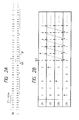
- the output clock DCL from the divider 14 is delayed for a quarter period (corresponding to one bit of the high-speed input data HD), accordingly the positions of the four consecutive bits, which are demultiplexed, lag one bit as indicated by the broken line frame BF in Fig. 2A.
- the sequences of low-speed data LD1, LD2, LD3 and LD4 on the output lines 1, 2, 3 and 4 shown in Fig. 2B shift to the output lines 4, 1, 2 and 3, respectively, as indicated by the arrows. That is, the sequences of low-speed data on all the output lines shift by one line position upon each elimination of one clock pulse of the high-speed clock HCL which is applied to the demultiplexer 15.
- the sequence of low-speed data of the most advanced phase is an Nth sequence of low-speed data which is composed of data of every Nth bits contained in each consecutive N-bit data which is demultiplexed by the demultiplexer 15 into N sequences and is output upon each occurrence of the divided clock DCL.
- the clocks DCL from the divider 14 are applied to a post-clock eliminator 16, which normally outputs them intact but, when supplied with one clock eiliminating signal CT1, eliminates one of the divided clocks DCL.
- a reference pattern generator 17 Based on the divided clock RCL from the post-clock eliminator 16, a reference pattern generator 17 generates N parallel sequences of reference patterns RP1 through RP N .
- the reference patterns RP1 to RP N sequentially advance in phase by a fixed number of bits and are common in frequency as is the case with the error-free low-speed data LD1 to LD N .
- (N-1) selectors 181 to 18 N-1 are provided for switching between the low-speed data LD N of the most advanced phase in the output of the demultiplexer 15 and the other sequences of low-speed data LD1 through LD N-1 .
- the (N-1) parallel sequences of low-speed data DX1 to DX N-1 which are the outputs from the (N -1) selectors 181 to 18 N-1 and the low-speed data LD N of the most advanced phase are provided to N comparators 191 to 19 N for comparison with the N parallel sequences of reference patterns RP1 to RP N .
- a counter 21 counts the number of clocks RCL from the post-clock eliminator 16 and is reset by the clock pulse eliminating signal CT1 as described later on.
- a synchronizing operation start signal SS to a terminal 22, the outputs of the comparators 191 to 19 N , the output of the counter 21, ect. are applied to a control circuit 23.
- the control circuit 23 outputs a select signal SC and, when predetermined conditions are satisfied, generates the clock pulse eliminating signals CT1 and CT2 and a synchronization completion signal SO.
- the select signal SC is applied to the selectors 181 through 18 N-1 to cause each of them to select the one or the other input thereto, depending on whether the select signal SC is high- of low-level.
- the post-clock eliminator 16 eliminates one clock pulse from the input clock DCL, in consequence of which the reference patterns RP1 through RP N respectively lag in phase by one bit.
- the clock pulse eliminating signal CT1 is applied as a reset signal to the counter 21.
- the pre-clock eliminator 13 eliminates one clock pulse from the high-speed clock HCL, in consequence of which the output clock DCL of the divider 14 is delayed for the 1/N period as mentioned previously; hence, the positions for demultiplexing to the N sequences thereafter shift one by one.
- the control circuit 23 controls, by the select signal SC, the selectors 181 through 18 N-1 to select the low-speed data LD N of the most advanced phase. Accordingly, the N parallel sequences of reference patterns RP1 through RP N from the reference pattern generator 17 are all compared with the low-speed data LD N of the most advanced phase.
- the control circuit 23 outputs the first clock pulse eliminating signal CT1 and, at the same time, enters the disagreement detection starting state. After this, whenever a disagreement has been detected by every one of the comparators 191 to 19 N at least once, the control circuit 23 produces the clock pulse eliminating signal CT1 and is reset itself to the disagreement detection starting state.
- the post-clock eliminator 16 When supplied with the clock pulse eliminating signal CT1 from the control circuit 23, the post-clock eliminator 16 eliminates one clock pulse from the divided clock DCL, accordingly the phases of generation of the reference patterns RP1 through RP N by the reference generator 17 are delayed one bit behind the low-speed data LD N .
- the signal CT1 also resets the counter 21.
- each of the N parallel sequences of low-speed data LD1 to LD N also becomes an ML sequence.
- the demultiplexed sequences sequentially advance in phase by two bits (2/7 ⁇ 1/4).
- the N parallel sequences of reference patterns RP1 to RP N are ML sequences which sequentially advance in phase by approximately 1/N of the pattern period. Accordingly, the low-speed data LD N of the most advanced phase and the N parallel sequences of reference patterns RP1 to RP N are compared by the comparators 191 to 19 N' respectively, and whenever a disagreement has been detected by every one of the comparators at least once, the operations of delaying the generation of each of the reference patterns RP1 to RP N by one bit and resetting the control circuit 23 to the disagreement detection starting state are repeated, by which any one of the N parallel sequences of reference patterns matches the low-speed data LD N of the most advanced phase within a period of time nearly equal to 1/N of the reference pattern period at the longest.
- This decision of the pattern matching is made when the agreement is detected for n consecutive bits, if the number of bits of one period of the reference pattern is 2 n -1 bits.
- the control circuit 23 applies the clock pulse eliminating signal CT2 to the pre-clock eliminator 13 a required number of times, by which the line position of the sequence of low-speed data which has been of the most advanced phase is moved to the same line position as that of the reference pattern found to match it.
- (N-i) clock pulses are eliminated by the pre-clock eliminator 13 from the high-speed clock HCL, by which the N parallel sequences of low-speed data are brought into synchronization with the N parallel sequences of reference patterns.
- the selectors 181 to 18 N-1 are controlled to select the low-speed data on the output lines 1 to N-1 corresponding to them, respectively, to count the numbers of disagreements (i. e. errors) detected by the comparators 191 to 19 N , by which the error rate of the transmission system is measured.
- the demultiplexer 15 comprises four flip-flops 15A to 15D and it fetches 1-bit data of the high-speed input data HD into the flip-flop 15A in synchronization with one clock pulse of the high-speed clock HCL and fetches the data from the flip-flop 15A into the flip-flop 15B in synchronization with the next clock pulse of the clock HCL and, at the same time, fetches the next bit data of the high-speed input data HD into the flip-flop 15A.
- the contents of the flip -flops 15A and 15B are fetched by the output clock DCL of the divider 14 into the flip-flops 15D and 15C, respectively.
- the selector 181 comprises gates 18A, 18B and 18C.
- the select signal SC is high-level
- the gate 18A is enabled, by which the output LD N of the flip-flop 15D is selected
- the select signal SC is low-level
- the gate 18B is enabled, by which the output LD1 of the flip-flop 15C is selected.
- the pre-clock eliminator 13 comprises a cascade connection of flip-flops 13A and 13B and gates 13C and 13D. Normally, the output of the gate 13C is high-level and the high-speed clock HCL passes through the gate 13D.
- the high-level of the clock pulse eliminating signal CT2 is applied to the flip-flop 13A, a high-level input is fetched thereinto by a clock pulse of the high-speed clock HCL, its Q output goes high on the trailing edge of the clock HCL, the high-level Q output is fetched by the next clock pulse of the clock HCL into the flip-flop 13B, and its Q output goes high on the trailing edge of the clock HCL.
- the divider 14 is formed by a flip-flop and frequency-divides the output clock FCL from the pre-clock eliminator 13 into one half the frequency. When one clock pulse is eliminated from the output clock FCL, the divided output DCL is delayed for a one-half period.
- the post-clock eliminator 16 in Fig. 1 is exactly identical in construction with the pre-clock eliminator 13, and hence is not shown.
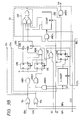
- Fig. 3B illustrates a specific operative example of the control circuit 23 in Fig. 1.
- the synchronizing operation start signal SS resets flip-flops 23A, 23B and 23C via a gate OR and, at the same time, it is output as the clock pulse eliminating signal CT1, which resets the counter 21 which forms a 1/n divider.
- CT1 clock pulse eliminating signal
- the control circuit 23 is placed in the disagreement detection starting state.
- the flip-flop 23A reset by the signal SS outputs, as the select signal SC, its q output having gone high and, at the same time, it enables a gate AND3 and resets an encoder 23D and a counter 23E. Consequently, gates AND1 and AND2 are enabled thereafter upon each occurrence of the clock RCL.
- the counter 21 starts counting of clock pulses of the clock RCL from zero each time it is reset.
- all sequences of three or more successive bits differ one another; so that the count value "3" of the counter 21 means establishment of synchronization between one of the reference patterns RP1 and RP N and the low-speed date LD N in either one of the comparators 191 and 19 N .
- the high-level output of the counter 21 triggers the flip-flop 23A, making its q output low and its Q output high. Accordingly, the gates AND1, AND2 and AND3 are disabled, the select signal SC goes low and a gate AND5 is enabled.
- the one of the flip-flops 23B and 23C which corresponds to the comparator 191 or 19 N having provided the agreement output (L-level) for three bits in succession, remains in the reset state, its Q output remains low and the Q output of the other flip-flop remains high (The two reference patterns RP1 and RP N cannot simultaneously be synchronized with the low-speed data LD1).
- the Q outputs of the flip-flops 23B and 23C are applied to input terminals D1 and D2 of the encoder 23D and encoded into the number of clock pulse eliminating signals CT2 to be output, depending upon which input terminal is supplied with the high-level Q output.
- the encoder 23D is so designed as to output "00" when the pieces of data which are provided to the input terminals D1 and D2 are "1" and "0", respectively.
- the comparator 191 yields the agreement output for three successive bits, it means that the low-speed data LD N and the reference pattern RP1 have been synchronized with each other, and consequently, the low-speed data LD1 and the reference pattern RP N are not synchronized with each other. Accordingly, the clock pulse eliminating signal CT2 needs to be generated once to move the line position of low-speed data LD N to the line position of low-speed data LD1.
- the encoder 23D outputs "01".
- the clock RCL is provided via a gate AND4 to the counter 23E for counting and at the same time it is output as the clock pulse eliminating signal CT2 from the gate AND4.
- the count value of the counter 23E and the output of the encoder 23D are applied to a match detector 23F.
- the match detector 23F generates a high-level output when the count value of the counter 23E and the output of the encoder 23D do not match each other and also generates a low-level output when they match each other.
- the match detector 23F produces a low-level output, by which the gate AND4 is disabled, and at the same time, the synchronization completion signal SO is provided from the gate AND5.
- the control circuit controls the selector 181 by the select signal SC, to set it so as to select the low-speed data LD N . Consequently, the comparators 191 and 19 N are supplied at one input with the low-speed data LD N , which is compared with the reference patterns RP1 and RP N on a bitwise basis.
- the control circuit controls the selector 181 by the select signal SC, to set it so as to select the low-speed data LD N . Consequently, the comparators 191 and 19 N are supplied at one input with the low-speed data LD N , which is compared with the reference patterns RP1 and RP N on a bitwise basis.
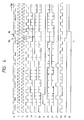
- the control circuit 23 responds to the synchronizing operation start signal SS to output a first shot of the clock pulse eliminating signal CT1 and reset its internal circuits to the disagreement detection starting state.
- the control circuit 23 outputs the clock pulse eliminating signal CT1, by which one clock pulse of the input clock RCL of the reference pattern generator 17 is eliminated as indicated by the broken line.
- the reference patterns RP1 and RP N are caused to retain the same data for a two-clock time duration.
- the reference patterns RP1 and RP N are each delayed in phase by one bit.
- the one-bit delay by such a disagreement detection is shown to be repeated twice.
- the count value of the counter 21 goes to "3" at a time point t1; so that the clock pulse eliminating signal CT2 is provided from the control circuit 23, and immediately thereafter, one clock pulse is eliminated by the pre-clock eliminator 13 from the clock FCL which is supplied to the divider 14, as indicated by the broken line.
- the clock DCL from the divider 14 and the clock RCL from the post-clock eliminator 16 are each composed of two consecutive pulses.
- the phases of the low-speed data LD1 and LD N are exchanged so that a bit HDa in the high-speed input data HD to be demultiplexed into the low-speed data LD1 is skipped over but instead the next bit HDb is demultiplexed thereinto as indicated by the arrows.
- the low-speed data LD1 and LD N and the reference patterns RP1 and RP N are synchronized with each other, respectively, and the control circuit 23 generates the synchronization completion signal SO, after which the selector 181 is placed in a state in which to select the low-speed data LD1 .
- the numbers of disagreements in the compared outputs provided to output terminals 251 and 25 N of the comparators 191 and 19 N are counted by a device (not shown), by which the error rate can be obtained. If comparators for obtaining the error rate are provided separately of the comparators 191 through 19 N depicted in Fig. 1, then the selectors 181 through 18 N-1 will be unnecessary and the low-speed data LD N will be provided directly to the comparators 191 through 19 N .
- the embodiment of the pattern synchronizing circuit of the present invention depicted in Fig. 1 is constructed so that during the synchronizing operation the low-speed data LD N is compared with each of the reference patterns RP1 through RP N .
- the high-speed input data HD contains errors with a particular period and that errors are unevenly distributed in the low-speed data LD N from the demultiplexer 15; accordingly, it is difficult to synchronize the low-speed data LD N with either one of the reference patterns RP1 and RP. N .
- Fig. 5 illustrates another embodiment of the present invention which obviates such a defect.
- the Fig. 5 embodiment is identical in construction with the Fig. 1 embodiment except the provision of a counter 24 and an OR gate 26.
- the counter 24 is reset by the synchronizing operation start signal SS applied to the control circuit 23, and it counts the number of clock pulse eliminating signals CT1 which are applied to the post-clock eliminator 16 and generates a high-level output when its count value reaches a predetermined value M.
- the high-level output is combined by the OR gate 26 with the output of the gate AND4 in Fig. 3B and applied as the clock pulse eliminating signal CT2 to the pre-clock eliminator 13 via the OR gate 26.
- the value M is set to 4.
- the low-speed data LD N is output as low-speed output data DX1 to DX N-1 of the selectors 181 to 18 N-1 and it is determined in the comparators 191 to 19 N whether or not the low-speed data LD N matches the reference patterns RP1 to RP N , respectively.
- the high-speed input data HD contains errors with a particular period and errors are unevenly distributed in the low-speed data LD N
- a state of generating the clock pulse eliminating signal CT1 at least once occurs in any n consecutive bits, and in this instance, no synchronization can be established as long as the errors are unevenly distributed.
- the counter 24 counts the number of pulses of the clock pulse eliminating signal CT1, and when its count value goes to M, the control circuit 23 generates the clock pulse eliminating signal CT2.
- one clock pulse is eliminated by the pre-clock eliminator 13 from the clock FCL which is applied to the divider 14, by which the line positions of low-speed data LD1 to LD N are sequentially shifted by one line position in the demultiplexer 15.
- errors are unevenly distributed in the sequence of low-speed data LD N-1 ; so that no error are evenly distributed in the low-speed data LD N of the most advanced phase after the line position shift selected by the selectors 181 to 18 N-1 .
- This ensures synchronization of the low-speed data LD1 to LD N and the reference patterns RP1 to RP N by the synchronizing operation as is the case with the Fig. 1 embodiment.
Landscapes
- Engineering & Computer Science (AREA)
- Computer Networks & Wireless Communication (AREA)
- Signal Processing (AREA)
- Synchronisation In Digital Transmission Systems (AREA)
- Detection And Prevention Of Errors In Transmission (AREA)
Applications Claiming Priority (2)
| Application Number | Priority Date | Filing Date | Title |
|---|---|---|---|
| JP147629/90 | 1990-06-06 | ||
| JP2147629A JPH0440125A (ja) | 1990-06-06 | 1990-06-06 | パターン同期回路 |
Publications (2)
| Publication Number | Publication Date |
|---|---|
| EP0460604A2 true EP0460604A2 (fr) | 1991-12-11 |
| EP0460604A3 EP0460604A3 (en) | 1993-01-20 |
Family
ID=15434652
Family Applications (1)
| Application Number | Title | Priority Date | Filing Date |
|---|---|---|---|
| EP19910109109 Withdrawn EP0460604A3 (en) | 1990-06-06 | 1991-06-04 | Pattern sychronizing circuit |
Country Status (4)
| Country | Link |
|---|---|
| US (1) | US5210754A (fr) |
| EP (1) | EP0460604A3 (fr) |
| JP (1) | JPH0440125A (fr) |
| CA (1) | CA2043803A1 (fr) |
Cited By (2)
| Publication number | Priority date | Publication date | Assignee | Title |
|---|---|---|---|---|
| US6882683B2 (en) | 1999-03-12 | 2005-04-19 | Nokia Corporation | Monitoring method and monitoring arrangement |
| US7683812B2 (en) | 2005-12-12 | 2010-03-23 | Qinetiq Limited | Pattern matching apparatus |
Families Citing this family (13)
| Publication number | Priority date | Publication date | Assignee | Title |
|---|---|---|---|---|
| JPH05160825A (ja) * | 1991-12-03 | 1993-06-25 | Fujitsu Ltd | 同期回路 |
| US5448668A (en) * | 1993-07-08 | 1995-09-05 | Perelson; Alan S. | Method of detecting changes to a collection of digital signals |
| JP2694807B2 (ja) * | 1993-12-16 | 1997-12-24 | 日本電気株式会社 | データ伝送方式 |
| CA2128587A1 (fr) * | 1994-07-21 | 1996-01-22 | Ed Morson | Methode et dispositif de reconnaissance de signaux codes |
| US5661763A (en) * | 1995-07-28 | 1997-08-26 | Adtran, Inc. | Apparatus and method for detecting programmable length bit pattern in serial digital data stream |
| US6459393B1 (en) * | 1998-05-08 | 2002-10-01 | International Business Machines Corporation | Apparatus and method for optimized self-synchronizing serializer/deserializer/framer |
| US7047196B2 (en) | 2000-06-08 | 2006-05-16 | Agiletv Corporation | System and method of voice recognition near a wireline node of a network supporting cable television and/or video delivery |
| US7039074B1 (en) * | 2000-09-14 | 2006-05-02 | Agiletv Corporation | N-way demultiplexer |
| US8095370B2 (en) | 2001-02-16 | 2012-01-10 | Agiletv Corporation | Dual compression voice recordation non-repudiation system |
| JP3597142B2 (ja) * | 2001-04-20 | 2004-12-02 | 日本電気株式会社 | 中心位相判定回路とその中心位相判定方法 |
| US7352777B2 (en) * | 2001-10-31 | 2008-04-01 | Intel Corporation | Data framer |
| US7188290B2 (en) * | 2002-04-23 | 2007-03-06 | Intel Corporation | Data alignment for telecommunications networks |
| US11940836B2 (en) | 2022-03-31 | 2024-03-26 | International Business Machines Corporation | Dual chip clock synchronization |
Family Cites Families (5)
| Publication number | Priority date | Publication date | Assignee | Title |
|---|---|---|---|---|
| US3144515A (en) * | 1959-10-20 | 1964-08-11 | Nippon Electric Co | Synchronization system in timedivision code transmission |
| JPH0775343B2 (ja) * | 1986-02-14 | 1995-08-09 | 株式会社日立製作所 | 同期検出回路及び方法 |
| JPH01165239A (ja) * | 1987-12-21 | 1989-06-29 | Advantest Corp | データパターン同期装置 |
| JPH0828691B2 (ja) * | 1988-03-14 | 1996-03-21 | 富士通株式会社 | フレーム同期方式 |
| US4984249A (en) * | 1989-05-26 | 1991-01-08 | First Pacific Networks | Method and apparatus for synchronizing digital data symbols |
-
1990
- 1990-06-06 JP JP2147629A patent/JPH0440125A/ja active Pending
-
1991
- 1991-06-04 US US07/710,522 patent/US5210754A/en not_active Expired - Fee Related
- 1991-06-04 CA CA002043803A patent/CA2043803A1/fr not_active Abandoned
- 1991-06-04 EP EP19910109109 patent/EP0460604A3/en not_active Withdrawn
Cited By (2)
| Publication number | Priority date | Publication date | Assignee | Title |
|---|---|---|---|---|
| US6882683B2 (en) | 1999-03-12 | 2005-04-19 | Nokia Corporation | Monitoring method and monitoring arrangement |
| US7683812B2 (en) | 2005-12-12 | 2010-03-23 | Qinetiq Limited | Pattern matching apparatus |
Also Published As
| Publication number | Publication date |
|---|---|
| EP0460604A3 (en) | 1993-01-20 |
| JPH0440125A (ja) | 1992-02-10 |
| US5210754A (en) | 1993-05-11 |
| CA2043803A1 (fr) | 1991-12-07 |
Similar Documents
| Publication | Publication Date | Title |
|---|---|---|
| US5210754A (en) | Pattern synchronizing circuit | |
| EP0405761B1 (fr) | Système de synchronisation de groupes de données tramées dans une transmission en série de bits | |
| US5761216A (en) | Bit error measurement system | |
| CA2017579C (fr) | Detecteur de defaillance dans les circuits de communication | |
| JP2732759B2 (ja) | フレーム同期制御方式 | |
| US4920546A (en) | Frame synchronizing apparatus | |
| KR100263789B1 (ko) | 임의 정렬 병렬 프레이머를 갖는 원격 통신 시스템 및 원격 통신 수행 방법 | |
| EP0405760B1 (fr) | Système de synchronisation de groupes de données tramées dans une transmission en série de bits | |
| JP4541155B2 (ja) | フレーム同期化デバイス及び方法 | |
| US7219250B2 (en) | Status indication detection and device and method | |
| EP0311448B1 (fr) | Multiplexeur numérique | |
| EP0545392B1 (fr) | Circuit synchrone | |
| EP0782276B1 (fr) | Procédé et appareil pour la synchronisation de données reçues dans des intervalles temporels | |
| US5163069A (en) | Pattern synchronizing circuit and method | |
| US5946327A (en) | Method and apparatus for converting between a multi-bit TDM bus and a single-bit TDM bus using digital logic | |
| JP2917522B2 (ja) | クロック同期方法および回路 | |
| US4203003A (en) | Frame search control for digital transmission system | |
| JPH0748725B2 (ja) | フレーム同期回路 | |
| EP0409168B1 (fr) | Circuit de mémoire élastique | |
| JP3487701B2 (ja) | フレームカウンタ | |
| US6011808A (en) | Redundant codes for clock recovery in serial links | |
| JP3033543B2 (ja) | フレーム同期回路 | |
| KR0172459B1 (ko) | 클럭재생방법 및 장치 | |
| JPH04342327A (ja) | 同期検出回路 | |
| WO1993023937A1 (fr) | Circuit retardant la transmission de donnees a l'aide de signaux de validation de verrouillage multiplexes dans le temps |
Legal Events
| Date | Code | Title | Description |
|---|---|---|---|
| PUAI | Public reference made under article 153(3) epc to a published international application that has entered the european phase |
Free format text: ORIGINAL CODE: 0009012 |
|
| 17P | Request for examination filed |
Effective date: 19910604 |
|
| AK | Designated contracting states |
Kind code of ref document: A2 Designated state(s): DE FR GB |
|
| RIN1 | Information on inventor provided before grant (corrected) |
Inventor name: NAKAJIMA, TAKAYUKI Inventor name: SOTOME, TETSUO Inventor name: TAKAHASHI, TOSIRO Inventor name: AKIYAMA, NOBORU |
|
| PUAL | Search report despatched |
Free format text: ORIGINAL CODE: 0009013 |
|
| AK | Designated contracting states |
Kind code of ref document: A3 Designated state(s): DE FR GB |
|
| STAA | Information on the status of an ep patent application or granted ep patent |
Free format text: STATUS: THE APPLICATION HAS BEEN WITHDRAWN |
|
| 18W | Application withdrawn |
Withdrawal date: 19940317 |