EP0460642A2 - Méthode et système pour l'ajustement des paramètres d'inférence floue - Google Patents
Méthode et système pour l'ajustement des paramètres d'inférence floue Download PDFInfo
- Publication number
- EP0460642A2 EP0460642A2 EP91109196A EP91109196A EP0460642A2 EP 0460642 A2 EP0460642 A2 EP 0460642A2 EP 91109196 A EP91109196 A EP 91109196A EP 91109196 A EP91109196 A EP 91109196A EP 0460642 A2 EP0460642 A2 EP 0460642A2
- Authority
- EP
- European Patent Office
- Prior art keywords
- value
- output
- input
- node
- fuzzy inference
- Prior art date
- Legal status (The legal status is an assumption and is not a legal conclusion. Google has not performed a legal analysis and makes no representation as to the accuracy of the status listed.)
- Ceased
Links
Images




Classifications
-
- G—PHYSICS
- G06—COMPUTING OR CALCULATING; COUNTING
- G06N—COMPUTING ARRANGEMENTS BASED ON SPECIFIC COMPUTATIONAL MODELS
- G06N3/00—Computing arrangements based on biological models
- G06N3/02—Neural networks
- G06N3/04—Architecture, e.g. interconnection topology
- G06N3/043—Architecture, e.g. interconnection topology based on fuzzy logic, fuzzy membership or fuzzy inference, e.g. adaptive neuro-fuzzy inference systems [ANFIS]
-
- G—PHYSICS
- G06—COMPUTING OR CALCULATING; COUNTING
- G06N—COMPUTING ARRANGEMENTS BASED ON SPECIFIC COMPUTATIONAL MODELS
- G06N5/00—Computing arrangements using knowledge-based models
- G06N5/04—Inference or reasoning models
- G06N5/048—Fuzzy inferencing
-
- G—PHYSICS
- G06—COMPUTING OR CALCULATING; COUNTING
- G06N—COMPUTING ARRANGEMENTS BASED ON SPECIFIC COMPUTATIONAL MODELS
- G06N7/00—Computing arrangements based on specific mathematical models
- G06N7/02—Computing arrangements based on specific mathematical models using fuzzy logic
- G06N7/023—Learning or tuning the parameters of a fuzzy system
Definitions
- the present invention relates to a method and system for automatically adjusting parameters contained in fuzzy inference so that difference of inference output from a teacher data can be reduced to increase the inference accuracy, and more particularly concerns a method and system for effectively indicating calculation status of fuzzy inference or neural network during or after learning of input-output relationship.
- the prior art 1 assumed that special forms of fuzzy rules or fuzzy inference rules be used. It can not be applied to general fuzzy inference. It also does not take account shortening the calculation time needed for the parameter adjustment. It proves to have a disadvantage in increase of calculation cost for the parameter adjustment if the number of the rules and the parameters to be adjusted is increased.
- the prior art 2 will not adjust membership functions contained in condition and output sections of a parameter, but only its weight for a fuzzy rule. This is disadvantageous in not making fine adjustment so that the fuzzy inference after adjustment is limited in increasing the performance.
- the prior art 3 makes the fuzzy inference on the neural network in more natural way. However, it does not take learning, or automatic parameter adjustment, into account.
- the prior art 5 makes use of the so-called error backpropagation method as neural network learning algorithm that an error of the network output from a desired one is propagated back in a reverse direction of the calculation in the network.
- the original error backpropagation method which is for use in the neural network, can also be applied to the fuzzy inference as shown in the prior art 4, where the fuzzy inference is approximated and represented by a neural network.
- the method has the algorithm that can adjust the parameters of the network so that the network output can approach the desired one as close as possible when one or plurality of sets of inputs and outputs are given.
- the actual output and desired one will not coincide completely, often remaining some error after learning. It was difficult to explain why the error remains as the status inside the network was treated like a black box. To further reduce the error, therefore, trial-and-error work has to be repeated such as the initial parameter status at the start of learning has to be changed, or the structure of the network has to be modified.
- the first object of the present invention is to provide a parameter adjusting method and system useful for adjusting all parameters in fuzzy inference. It also is to provide a method and system that can reduce the amount of computation and is preferable for the parameter adjustment in a general fuzzy inference including multi-staged fuzzy inference in a way that the adjustment can be on a calculation network of neural network type.
- the second object of the present invention is to provide a method and system that can easily recognize the status inside the network to efficiently redefine the network structure and fuzzy rules in a way if the fuzzy inference or neural network is used to make learning of input-output relationship, a calculation status of the network during or after learning can be indicated.
- the present invention has the fuzzy inference process represented on the calculation network, has the inference made as flow of signal in forward direction on the network, and has the parameter adjustment performed by making the difference of the inference output from the teacher data flow in reverse (backward) direction on the network.
- a feature of the present invention relates to a method for fuzzy inference parameter adjustment in a fuzzy inference system for obtaining an output value by a node from at least one input value in a calculation network having a plurality of nodes for calculating the output value from at least one input value in predetermined procedures and at least one link for connection between the nodes, for obtaining a fuzzy inference output value with use of the calculation network by inputting an output value of a node to another node through the link for the node, for obtaining an error of the fuzzy inference output value from a predetermined expected output value, and for adjusting the fuzzy inference parameter on the basis of the error.
- the present invention can calculate for a given input a value which is differentiation or finite difference calculation of a difference of actual output from teacher data in terms of an intermediate result in the parameter to be adjusted or fuzzy inference process or output of each node in the neural network.
- Data of the differentiated or finite difference calculated value made for each set of the given input and output, are processed depending on purpose in a desired method, and intermediate status of calculation in the fuzzy inference and neural network are indicated.
- the present system can clearly express dependent relationship of the inference result on various parameters contained in the inference in a way the fuzzy inference process is expressed on the calculation network.
- the inference process is performed by making forward signal flow on the calculation network. Through the process, the inputoutput relationship at any portion of the calculation network can be determined. As the parameter in the inference are contained in the input-output relationship, actual input and output at the portion can be determined. For small variation of any of the parameters, it is possible to obtain a differential coefficient to know of how the output at the portion varies. Similarly, for small variation of the input at the portion, it also is possible to know of how the output varies.
- An object of the parameter adjustment is to minimize difference of actual output as a result of the inference from a teacher data.
- the inference result is an output at the last portion of the calculation network. If the portion contains any parameter to be adjusted, it is possible to obtain a differential coefficient related to the parameter and another differential coefficient related to the input.
- repetition of calculation can be omitted as compared with a method that the differential coefficient is obtained while the parameter contained in the inference is small varied independently. This can reduce the amount of calculation to a great extent.
- the system described above can express the inference process on the calculation network not only through a single stage of fuzzy inference, but also a multi-staged fuzzy inference to perform the parameter adjustment in right the same way.
- the conventional backpropagation method adjusts a parameter on the basis of an averaged value of the foregoing differentiated or finite difference calculated values for the set of the given input and output. If the parameter stands still in a state that it will not be changed any more after the learning, the averaged value should become nearly 0.
- the conventional backpropagation method cannot give more information than that as it uses only the averaged value of the differentiated or finite difference calculated values.
- the present invention can make calculation of the differentiation or finite difference calculation for each pair of input and output to indicate higher order statistical value such as dispersion and the like, or to indicate a relationship between the input value for each node in the neural network and the differentiated or finite difference calculated value, or to indicate distribution of the differentiated or finite difference calculated values for a intermediate calculation result in the fuzzy inference.
- This can indicate an intermediate status of calculation during or after the learning.
- This can express the information that cannot be given only in the parameter adjustment algorithm by the conventional error backpropagation method or the like.
- Such a feature can support redefining the rules in the fuzzy inference and reconfiguration of the network structure in the neural network.
- Fig. 1 is a block diagram for the fuzzy inference system according to the present invention.
- Fig. 2 is a calculation network for representing the fuzzy inference process described above.
- Fig. 3 is an illustration of the inference process described above.
- Fig. 4 is an membership function which takes a trapezium shape.
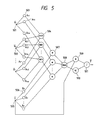
- Fig. 5 is a calculation network for the fuzzy inference process, corresponding to Fig. 2.
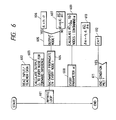
- Fig. 6 is a flow chart for carrying out the first and second embodiments as an example for processing in the parameter adjustment algorithm in Fig. 1.
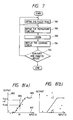
- Fig. 7 is a typical process flow for building the fuzzy inference system in the third embodiment.
- Fig. 8(a) is a resulted indication of learning status with respect of the node (for example, 503 in Fig. 5) for calculation a membership function corresponding to an input variable.
- Fig. 8(b) shows a status that learning is not well performed for the node concerned, while Fig. 8(a) is the sate that it is rather well.
- Fig. 9 shows results indicated as the learning status in a fourth embodiment of the present invention.
- Fig. 10 shows results indicated as the learning statuses in a fifth embodiment of the present invention.
- Fig. 11 is a flow chart for carrying out the third embodiment of the present invention.
- Fig. 1 is a block diagram for the fuzzy inference system according to the present invention.
- the present invention relates to the adjustment algorithm.
- fuzzy inference mechanism There are several different definitions for the fuzzy inference executed by the fuzzy inference mechanism shown in Fig. 1. The most common method for the fuzzy inference is described, for example, in the Information Process, Vol. 30, No. 8, pp 942947, 1989. Description of the fuzzy inference is based on the method here. Of course, the present invention shall not be limited to the method.
- Eq. (1) appears every input variable in every rule. If this is made, for example, if the ith input variable is not in connection with the jth rule, it can be regarded that A ij is a function always taking value 1. Since the group of rules for different variables can be regarded independent, the following describes only the rules given in Eq. (1).
- Fig. 3 is an illustration of the inference process described above.
- 301 is a membership function A11 of the variable x1.
- 302 is a membership function A21
- 303 is a membership function A12
- 304 is a membership function A22.
- 305 calculates a minimum value of A i1 ( x 1) to obtain the fuzzy grade W1 for the rule 1.
- 306 denotes a membership function B1.
- a shaded portion 307 is a membership function corresponding W1 * B1.
- 308 obtains the fuzzy grade W2 for the rule 2.
- 309 denotes a membership function B2.
- a shaded portion 3107 is a membership function corresponding to W2 * B2.
- the 311 denotes a output membership function B obtained by taking the maximum value of the membership functions of the output variables y for the rules.
- the output y is at the center of gravity of the portion enclosed by the graph of the function 311 and the x-axis.
- Fig. 2 is a calculation network for representing the fuzzy inference process described above.
- 201 denotes a node corresponding to the input variable x 1.
- a real input value x 1 should be set.
- 202 denotes a node corresponding to the input value x2, and nodes are made to correspond to n input variables.
- the node 203 is a node corresponding to the membership function of a variable 1 in the rule 1.
- the node 203 can output value A11 ( x 1) if a value x 1 is input.
- a node is provided for every membership function appearing in Eq. (1).
- 204 is a node for obtaining the fuzzy grade for the rule 1. It is a node that can output a minimum one of A11 ( x 1), A21 ( x 2), ..., A n1 ( x n ) which are input according to Eq. (2). Similarly, nodes are provided for obtaining the fuzzy grade for the respective rules.
- a node 205 calculates the numerator of Eq. (6). It multiplies the fuzzy grade of every rule calculated in the node 204 by the weight y i in Eq. (8), and sums the products before outputting the result.
- a node 206 calculates the denominator of Eq. (6) in which the weight is s i for the node 205. It may be assumed here that y i is a parameter associated with the node 205, and s i is a parameter associated with the node 206.
- a node 207 divides the output of the node 205 by the output of the node 206 to calculate the final output value y.
- the calculation network shown in Fig. 2 can execute the fuzzy inference in Eqs. (1) through (8).
- An object for the parameter adjustment is to minimize a square error of a target output y t and actual output.
- a steepest descent method is used to make the parameter adjustment. Therefore, it is to obtain a partial differential coefficient of the object function E by all the parameters contained in the fuzzy inference process described above.
- the target output y t should be prepared for the actual output value y.
- a node 208 calculates a difference (y t - y) of the two output values. The result is an error signal ⁇ 207 for the node 207. After this, the calculation procedures are traced back to obtain the partial differential coefficient for the output value y of each node.
- the error signal ⁇ for the output node 207 is proportional to the partial differential value of the object function E by the output y of the node 207.
- the partial differential coefficient of the object function by the output z205 can be obtained using the differential rule of the composite function as
- the partial differential coefficient of the object function by the output z206 can be obtained as
- the partial differential coefficient in connection with the parameter y1 contained in the node 205 in Fig. 2 can be obtained as
- the proportional coefficient in Eq. (16) is generally called a learning coefficient, which is one of factors for determining a speed of convergence.
- the following describes a parameter adjustment method in connection with the nodes such as the node 203 representing the membership function.
- Fig. 4 is an membership function 401 which takes a trapezium shape.
- the shape of the membership function is specified with coordinates a1, a2, a3, and a4, of four corners of the trapezium.
- the parameter adjustment can be made by the steepest descent method as in Eq. (16).
- the adjustment of fuzzy inference parameters can be made by changing every parameter little by little. It is apparent that the method can greatly reduce the amount of calculation as compared with the one for obtaining the partial differential coefficients.
- the parameters for specifying the shape of the membership function may be defined in any desired way.
- Fig. 4 for example, only the right and left parallel movement of the trapezium can be used for the parameter adjustment. It is also obvious that membership functions other than the trapezium can be defined by any desired parameters.
- the parameters for the fuzzy inference can be automatically adjusted so that the actual output can approach a teacher data, if the inputs and a set of outputs desired for them are given or if the learning data are give.
- the following describes a second embodiment of the present invention with reference to Fig. 5.
- the second embodiment executes Eq. (3) directly, while the first one made the fuzzy inference by replacing the maximum calculation in Eq. (3) with algebraic addition.
- Fig. 5 is a calculation network for the fuzzy inference process, corresponding to Fig. 2.
- 501 denotes a node corresponding to an input variable x 1.
- a real input value x 1 should be set.
- 502 denotes a node corresponding to the input value x2, and nodes are made to correspond to n input variables.
- the 503 is a node corresponding to the membership function of a variable 1 in the rule 1.
- the node 503 can output value A11 ( x 1) if a value x 1 is input.
- a node is provided for every membership function appearing in Eq. (1).
- a 504 is a node for obtaining the fuzzy grade for the rule 1. It is a node that can output a minimum one of A11 ( x 1), A21 (x2), ...,, A n1 ( x n ) which are input according to Eq. (2). Similarly, nodes are provided for obtaining the fuzzy grade for the respective rules.
- y (y[1], y[2], ..., y[k]).
- B1(y) (B1(y[1]), B1(y[2]), ..., B1(y[k])). Similarly, nodes corresponding to the other membership functions are provided.
- a node 509 has the outputs of the nodes 508 and 505 input thereto, and outputs their inner product.
- a node 510 has the output of the node 508 input thereto, and sums the k components to output.
- a node 511 calculates (output of the node 509)/(output of the node 510), and outputs a final output value y.
- Fig. 5 represents the input-output relationships of the vector values by thick lines.
- the calculation network in Fig. 5 executes the fuzzy inference according Eqs. (2), (3), and (19).
- the parameter adjustment can be made in right the same way as in the first embodiment.
- Fig. 5 are adjusted parameters contained in the membership function A ij and B i of the input and output variables.
- Fig. 6 is a flow chart for carrying out the first and second embodiments as an example for processing in the parameter adjustment algorithm in Fig. 1.
- z i be the output of each calculation node in Fig. 2 or 5
- ⁇ i be a differential coefficient of the output y by z i .
- step 601 repeats steps 602 through 612 unconditionally.
- Step 602 reads data used for learning, i.e., values of the input variables and output value y t desired for them.
- Step 603 makes fuzzy inference on the basis of the values of the input variables read in step 602. In this process, we can obtain the output values z i of all the nodes of the calculation network in Fig. 2 or 5.
- Step 604 retraces back all the nodes of the calculation network from the output to input. It should be noticed that as the calculation network contains no closed loops, the retrace is determined unambiguously. Let i denote the number of the node selected in step 604.
- Step 605 judges whether the node selected in step 604 is the last one of the calculation network. If it is output node, step 606 is executed, If not, step 607 is executed.
- Step 607 obtains ⁇ i for the nodes other than the output node using where the summation is made for all the nodes j which have the outputs z i of the selected nodes input thereto.
- Step 608 executes steps 609 and 610 for all the parameters to be adjusted.
- Step 609 calculates ⁇ z i / ⁇ for the node i contained in the parameter ⁇ . Since ⁇ is a parameter for determining the input-output relationship in the node i, the differential value can be easily obtained.
- Step 611 judges whether predetermined end conditions are met. As an example, it judges whether the above mentioned steps have been executed by a predetermined number of times, or judges whether a difference of the actual output and teacher data is smaller than a predetermined value as a result of the parameter adjustment. Step 602 can be executed only when the end conditions are met.
- Step 612 regards that the parameter adjustment ends, comes out of the infinite loop in step 601, and stops the process.
- the first and second embodiments described above are most different in that: It is assumed that the first embodiment have the rules give independent effects to the output variables, and therefore the effects can be added up linearly.
- the second embodiment on the other hand, as seen from the fact that the maximum computation is contained in Eq. (3), has non-independent effects of the rules, remaining non-linear effects. Taking the non-linear effect into account, the configuration in Eq. (5) can be simplified further to reduce the amount of computations needed for the parameter adjustment.
- the membership functions be piecewise linear functions. It is, of course, possible to use differentiable functions of any input values such as sigmoid functions often used in the artificial neural networks.
- the two embodiments used the single stage of fuzzy inference for parameter adjustment as an example.
- the present invention can apply its system and method to make a multiple of stages of fuzzy inference.
- the two embodiments had all the parameters to be adjusted contained in the input-output relationships of the nodes. It is, of course, possible to provide for a link an additional parameters of representing a connection strength for connection between the nodes as in ordinary artificial neural network. For the purpose, the parameter adjustment procedures are right the same as described in the embodiments described above.
- Fig. 7 is a typical process flow for building the fuzzy inference system in the third embodiment.
- a fuzzy rule defining step 701 defines a fuzzy rule.
- a membership function defining step 702 defines a membership function contained in the fuzzy rule.
- a learning step 703 uses a given input and an output desired for it to make learning parameters such as membership function shapes contained in the fuzzy inference using a proper learning algorithm.
- a learning status display step 704 indicates the fuzzy inference status after learning.
- an evaluate and analyze step 705 a system building person evaluates and analyzes the performance of fuzzy inference system on the basis of the data displayed. If it is sufficient, the system building ends. If not, he returns to the fuzzy rule defining step 701 or the membership function defining step 702 to make rebuilding the fuzzy inference system.
- the third embodiment of present embodiment relates to the learning status display step 704.
- the learning status can be indicated in terms of calculated through the learning process described in the second embodiment where ⁇ is any of desired parameters or a value of an intermediate output in the fuzzy inference.
- ⁇ is any of desired parameters or a value of an intermediate output in the fuzzy inference.
- the value of ⁇ is used for adjusting the parameter.
- summation of ⁇ for a set of inputs and outputs will be nearly 0. If a desired performance is not obtained even at the end of learning because, for example, the first fuzzy rule was defined improperly, or the learning was trapped to a local optimum value, it was not possible to teach what a cause is and how to act to it.
- the present invention can store the value of ⁇ calculated by the above mentioned means, and adequately process it to indicate. The following describes the learning status display step 704 in Fig. 7.
- Fig. 8(a) is a resulted indication of learning status with respect of the node (for example, 503 in Fig. 5) for calculation a membership function corresponding to an input variable.
- An x-axis 801 of the figure assumes value of input variable X i , and an y-axis is output value of the node.
- a graph 803 shows a shape of the membership function representing the input-output relationship of the node concerned.
- the graph can visually make clear representation what kinds of error signal the membership function undergoes when the learning ends.
- Fig. 8(b) shows a status that learning is made bad for the node concerned
- Fig. 8(a) is the status that it is rather well.
- the membership function undergoes far different error signals for similar input values. That is, the value of averaged for the sets of input and output is 0, but they are dispersed to a great extent. This means that the fuzzy rule does not represent the input-output relationship properly.
- Fig. 7 are made turning processes for the fuzzy rules and membership functions on the basis of the data indicated in Fig. 8.
- FIG. 8 has f(X i ) + ⁇ indicated as the ordinate, it need hardly be said that similar effect can be obtained only by f(X i ).
- Fig. 11 is a flow chart for carrying out the third embodiment described above.
- z i be the output of each calculation node in Fig. 5
- ⁇ i be a differential coefficient of the output Y by z i .
- step 1101 repeats steps 1102 through 1112 unconditionally.
- Step 1102 reads data used for learning, i.e., values of the input variables and output value y t desired for them.
- Step 1103 makes fuzzy inference on the basis of the values of the input variables read in step 1102. In this process, we can obtain the output values z i of all the nodes of the calculation network in Fig. 5.
- Step 1104 retraces back all the nodes of the calculation network from the output to input. It should be noticed that as the calculation network contains no closed loops, the retrace is determined certainly. Let i denote the number of the node selected in step 1104.
- Step 1105 judges whether the node selected in step 1104 is the last one of the calculation network. If it is output node, step 1106 is executed, if not, step 1107 is executed.
- Step 1108 executes steps 1109 and 1110 for all the parameters ⁇ to be adjusted.
- Step 1109 calculates ⁇ z i / ⁇ for the node i contained in the parameter ⁇ . Since ⁇ is a parameter for determining the input-output relationship in the node i, the differential value can be easily obtained.
- Step 1111 judges whether predetermined end conditions are met. As an example, it judges whether the above mentioned steps have been executed by a predetermined number of times, or judges whether a difference of the actual output and teacher date is smaller than a predetermined value as a result of the parameter adjustment. Step 1112 can be executed only when the end conditions are met.
- Step 1112 regards that the parameter adjustment ends, comes out of the infinite loop in step 1101.
- Step 1113 processes the value of ⁇ i calculated in step 1107 to the shape shown in Fig. 8 to indicate the learning status after the learning.
- Fig. 9 shows results indicated as the learning statuses in a fourth embodiment of the present invention.
- the results are dispersions of ⁇ calculated in step 1107 in Fig. 11 in connection with sets of input and output, and arranged in descending order of dispersion, including the node numbers, variable numbers, corresponding rule numbers, and variances.
- 901 is a column for the order numbers sorted in descending order of dispersion
- 902 is for the node numbers
- 903 is for the numbers for the variables input to the node
- 904 is for the lists of the rule numbers containing the node
- 905 is for the variances.
- Fig. 9 has the nodes, variable, and rules denoted by numbers. It is, of course, possible to indicate all or parts of them by other symbols.
- the variable number 5, as an example, can be replaced by a variable name represented by it, for example, "temperature”.
- Fig. 10 shows results indicated as the learning status in a fifth embodiment of the present invention.
- the figure is a histogram which shows distribution of the values of ⁇ calculated in step 1107 in Fig. 11.
- An x-axis 1001 takes value of the error signal ⁇
- an y-axis 1002 is number of learning samples contained in a range in which the value of ⁇ is specified.
- the third through fifth embodiments of the present invention described above are examples of the fuzzy inference. It can be seen in the calculation network in Fig. 5 that they are quite similar to the neural network. It is very easy to apply the indication way of learning status of the embodiments to the neural network. Thus, similar effects are accomplished.
- the error signal ⁇ was calculated by means of the error backpropagation method in which the errors of the output was propagated back in the calculation network.
- the present invention is not inherent in the backpropagation, but can provide similar effect by way of, for example, a finite difference calculus which makes clear how the parameter to be adjusted relates to the output in a way that change of the output value is measured when the parameter is varied little. That is, the error backpropagation method has amount proportional to ⁇ E/ ⁇ z as the error signal ⁇ , while the finite difference calculus has amount proportional to ⁇ E/ ⁇ z as ⁇ . Even in the latter method, if ⁇ z is sufficiently small , the finite difference value approximates the differentiated value, ignoring the computational quantity and time needed for calculation.
- the above mentioned embodiments had the indications on the basis of the error signal of node output. In another way, however, they can indicate dispersion and distribution of the error signal in connection with any of the parameters to be adjusted, for example, the parameters for specifying the shapes of the membership functions in the fuzzy inference, such as a1, a2, a3, and a4 in Fig. 4. This also can be expected to provide similar effect.
- the above mentioned embodiments had the indication of the learning status after completion of the learning.
- the indication can also be made before the learning. This allows knowing of the entire characteristic aspect of the set of input and output given. Learning therefore can be started by computer before roughly adjusting the parameters. This is advantageous to reduce the calculation time for learning and the time needed for building the entire fuzzy inference or neural network system.
- the fuzzy inference system can calculate the sensitivity of any of the parameters contained in the inference affecting the output, or the partial differential coefficient, in the way that the fuzzy inference process is represented in the calculation network, the difference of the actual output from the teacher date is made the error signal, and the error signal is made to flow in the calculation network in a reverse direction of the inference.
Landscapes
- Engineering & Computer Science (AREA)
- Software Systems (AREA)
- Physics & Mathematics (AREA)
- Theoretical Computer Science (AREA)
- General Physics & Mathematics (AREA)
- Fuzzy Systems (AREA)
- Automation & Control Theory (AREA)
- Mathematical Physics (AREA)
- Data Mining & Analysis (AREA)
- General Engineering & Computer Science (AREA)
- Computing Systems (AREA)
- Evolutionary Computation (AREA)
- Artificial Intelligence (AREA)
- Mathematical Optimization (AREA)
- Health & Medical Sciences (AREA)
- Computational Mathematics (AREA)
- Biomedical Technology (AREA)
- Life Sciences & Earth Sciences (AREA)
- General Health & Medical Sciences (AREA)
- Molecular Biology (AREA)
- Mathematical Analysis (AREA)
- Pure & Applied Mathematics (AREA)
- Computational Linguistics (AREA)
- Biophysics (AREA)
- Algebra (AREA)
- User Interface Of Digital Computer (AREA)
- Feedback Control In General (AREA)
- Devices For Executing Special Programs (AREA)
Applications Claiming Priority (4)
| Application Number | Priority Date | Filing Date | Title |
|---|---|---|---|
| JP14624490 | 1990-06-06 | ||
| JP146244/90 | 1990-06-06 | ||
| JP337092/90 | 1990-11-30 | ||
| JP2337092A JPH04127239A (ja) | 1990-06-06 | 1990-11-30 | ファジィ推論パラメータの自動調節方法および学習状態の表示方法 |
Publications (2)
| Publication Number | Publication Date |
|---|---|
| EP0460642A2 true EP0460642A2 (fr) | 1991-12-11 |
| EP0460642A3 EP0460642A3 (en) | 1993-05-19 |
Family
ID=26477124
Family Applications (1)
| Application Number | Title | Priority Date | Filing Date |
|---|---|---|---|
| EP19910109196 Ceased EP0460642A3 (en) | 1990-06-06 | 1991-06-05 | A method and system for adjusting fuzzy inference parameters |
Country Status (3)
| Country | Link |
|---|---|
| EP (1) | EP0460642A3 (fr) |
| JP (1) | JPH04127239A (fr) |
| KR (1) | KR920001362A (fr) |
Cited By (7)
| Publication number | Priority date | Publication date | Assignee | Title |
|---|---|---|---|---|
| GB2259796A (en) * | 1991-09-20 | 1993-03-24 | Hitachi Ltd | Providing status output in a fuzzy logic system |
| DE4415693A1 (de) * | 1994-05-04 | 1995-11-09 | Thomson Brandt Gmbh | Verfahren zur Fuzzy-Inferenz in einem Fuzzy-Regelkreis |
| WO1997006493A1 (fr) * | 1995-08-07 | 1997-02-20 | Siemens Aktiengesellschaft | Procede de simulation de fonctions d'appartenance notamment triangulaires ou trapezoidales lors de la transformation d'un systeme a logique floue en un reseau neuronal |
| RU2121711C1 (ru) * | 1997-04-14 | 1998-11-10 | Московский государственный университет путей сообщения (МИИТ) | Вычислитель ранговой статистики |
| RU2122746C1 (ru) * | 1997-04-14 | 1998-11-27 | Московский государственный университет путей сообщения (МИИТ) | Вычислитель ранговой статистики |
| CN111784537A (zh) * | 2020-06-30 | 2020-10-16 | 国网信息通信产业集团有限公司 | 一种配电网状态参数监测方法、装置及电子设备 |
| CN116336400A (zh) * | 2023-05-30 | 2023-06-27 | 克拉玛依市百事达技术开发有限公司 | 油气集输管道基线检测方法 |
Families Citing this family (2)
| Publication number | Priority date | Publication date | Assignee | Title |
|---|---|---|---|---|
| JP3417973B2 (ja) * | 1992-09-29 | 2003-06-16 | 富士通株式会社 | ファジイ構造型ニューロコンピュータと財務コンサルト情報収集方法 |
| JPH06131188A (ja) * | 1992-10-22 | 1994-05-13 | Hitachi Ltd | ファジィルール獲得方法およびファジィ推論システム |
Family Cites Families (1)
| Publication number | Priority date | Publication date | Assignee | Title |
|---|---|---|---|---|
| JP2820704B2 (ja) * | 1989-02-08 | 1998-11-05 | 津田駒工業株式会社 | 織機の回転数のファジィ制御方法および装置 |
-
1990
- 1990-11-30 JP JP2337092A patent/JPH04127239A/ja active Pending
-
1991
- 1991-06-03 KR KR1019910009156A patent/KR920001362A/ko not_active Abandoned
- 1991-06-05 EP EP19910109196 patent/EP0460642A3/en not_active Ceased
Cited By (8)
| Publication number | Priority date | Publication date | Assignee | Title |
|---|---|---|---|---|
| GB2259796A (en) * | 1991-09-20 | 1993-03-24 | Hitachi Ltd | Providing status output in a fuzzy logic system |
| DE4415693A1 (de) * | 1994-05-04 | 1995-11-09 | Thomson Brandt Gmbh | Verfahren zur Fuzzy-Inferenz in einem Fuzzy-Regelkreis |
| WO1997006493A1 (fr) * | 1995-08-07 | 1997-02-20 | Siemens Aktiengesellschaft | Procede de simulation de fonctions d'appartenance notamment triangulaires ou trapezoidales lors de la transformation d'un systeme a logique floue en un reseau neuronal |
| RU2121711C1 (ru) * | 1997-04-14 | 1998-11-10 | Московский государственный университет путей сообщения (МИИТ) | Вычислитель ранговой статистики |
| RU2122746C1 (ru) * | 1997-04-14 | 1998-11-27 | Московский государственный университет путей сообщения (МИИТ) | Вычислитель ранговой статистики |
| CN111784537A (zh) * | 2020-06-30 | 2020-10-16 | 国网信息通信产业集团有限公司 | 一种配电网状态参数监测方法、装置及电子设备 |
| CN116336400A (zh) * | 2023-05-30 | 2023-06-27 | 克拉玛依市百事达技术开发有限公司 | 油气集输管道基线检测方法 |
| CN116336400B (zh) * | 2023-05-30 | 2023-08-04 | 克拉玛依市百事达技术开发有限公司 | 油气集输管道基线检测方法 |
Also Published As
| Publication number | Publication date |
|---|---|
| EP0460642A3 (en) | 1993-05-19 |
| KR920001362A (ko) | 1992-01-30 |
| JPH04127239A (ja) | 1992-04-28 |
Similar Documents
| Publication | Publication Date | Title |
|---|---|---|
| Ishibuchi et al. | Fuzzy neural networks with fuzzy weights and fuzzy biases | |
| Castillo et al. | Sensitivity analysis in discrete Bayesian networks | |
| Buckley et al. | Neural nets for fuzzy systems | |
| Lin et al. | A neural fuzzy system with linguistic teaching signals | |
| Buckley et al. | Fuzzy and neural: Interactions and applications | |
| US4907170A (en) | Inference machine using adaptive polynomial networks | |
| EP0646879A1 (fr) | Méthode pour structurer un système expert utilisant un ou plusieurs réseaux neuronaux | |
| Gilda et al. | Analytical overview of defuzzification methods | |
| EP0460642A2 (fr) | Méthode et système pour l'ajustement des paramètres d'inférence floue | |
| EP0384709B1 (fr) | Machine élève | |
| EP0646878A1 (fr) | Méthode pour convertir un système expert en un système utilisant un ou plusieurs réseaux neuronaux | |
| US5761384A (en) | Fuzzy neural network system | |
| Rezayat | On the use of an SPSA-based model-free controller in quality improvement | |
| EP0444878B1 (fr) | Réseau neuronal | |
| Gupta et al. | Fuzzy neuro-computational technique and its application to modelling and control | |
| McKim | Neural networks and identification and estimation of risk | |
| Anderson et al. | MR. FIS: Mamdani rule style fuzzy inference system | |
| Postlethwaite et al. | A new identification algorithm for fuzzy relational models and its application in model-based control | |
| Clifton et al. | Design of generalized Sugeno controllers by approximating hybrid fuzzy-PID controllers | |
| Choi et al. | A constructive approach for nonlinear system identification using multilayer perceptrons | |
| Mammadova et al. | Intelligent control system of multi-motion mobile robot | |
| Basu | Nuclear power plant status diagnostics using a neural network with dynamic node architecture | |
| Nikravesh et al. | Process control of nonlinear time variant processes via artificial neural network | |
| EP0567983A2 (fr) | Dispositif d'apprentissage de reconnaissance de la forme d'onde | |
| JP3328953B2 (ja) | 非線形シナプスニューロン、そのデバイス及びそれを用いた予測方法 |
Legal Events
| Date | Code | Title | Description |
|---|---|---|---|
| PUAI | Public reference made under article 153(3) epc to a published international application that has entered the european phase |
Free format text: ORIGINAL CODE: 0009012 |
|
| AK | Designated contracting states |
Kind code of ref document: A2 Designated state(s): DE FR GB |
|
| PUAL | Search report despatched |
Free format text: ORIGINAL CODE: 0009013 |
|
| AK | Designated contracting states |
Kind code of ref document: A3 Designated state(s): DE FR GB |
|
| 17P | Request for examination filed |
Effective date: 19931118 |
|
| 17Q | First examination report despatched |
Effective date: 19941229 |
|
| GRAG | Despatch of communication of intention to grant |
Free format text: ORIGINAL CODE: EPIDOS AGRA |
|
| STAA | Information on the status of an ep patent application or granted ep patent |
Free format text: STATUS: THE APPLICATION HAS BEEN REFUSED |
|
| 18R | Application refused |
Effective date: 19990130 |