EP0460767A1 - Procédé et appareil pour la fermentation anaérobique - Google Patents
Procédé et appareil pour la fermentation anaérobique Download PDFInfo
- Publication number
- EP0460767A1 EP0460767A1 EP19910201401 EP91201401A EP0460767A1 EP 0460767 A1 EP0460767 A1 EP 0460767A1 EP 19910201401 EP19910201401 EP 19910201401 EP 91201401 A EP91201401 A EP 91201401A EP 0460767 A1 EP0460767 A1 EP 0460767A1
- Authority
- EP
- European Patent Office
- Prior art keywords
- fermentation
- fermented
- process according
- organic material
- compartments
- Prior art date
- Legal status (The legal status is an assumption and is not a legal conclusion. Google has not performed a legal analysis and makes no representation as to the accuracy of the status listed.)
- Granted
Links
- 238000000855 fermentation Methods 0.000 title claims abstract description 127
- 238000000034 method Methods 0.000 title claims abstract description 47
- 230000004151 fermentation Effects 0.000 claims abstract description 104
- 239000011368 organic material Substances 0.000 claims abstract description 63
- 238000009434 installation Methods 0.000 claims abstract description 14
- 239000002699 waste material Substances 0.000 claims abstract description 8
- 238000002347 injection Methods 0.000 claims abstract description 6
- 239000007924 injection Substances 0.000 claims abstract description 6
- 239000010791 domestic waste Substances 0.000 claims abstract description 4
- 235000013311 vegetables Nutrition 0.000 claims abstract description 4
- 239000000463 material Substances 0.000 claims description 80
- 239000007788 liquid Substances 0.000 claims description 17
- 239000007787 solid Substances 0.000 claims description 17
- 238000010438 heat treatment Methods 0.000 claims description 14
- 230000011218 segmentation Effects 0.000 claims description 11
- XLYOFNOQVPJJNP-UHFFFAOYSA-N water Substances O XLYOFNOQVPJJNP-UHFFFAOYSA-N 0.000 claims description 7
- 238000005192 partition Methods 0.000 claims description 6
- 239000011261 inert gas Substances 0.000 claims description 4
- 239000010801 sewage sludge Substances 0.000 claims description 4
- 241001148471 unidentified anaerobic bacterium Species 0.000 claims description 3
- 239000002028 Biomass Substances 0.000 claims description 2
- 230000020477 pH reduction Effects 0.000 claims description 2
- 238000002955 isolation Methods 0.000 claims 1
- 238000002203 pretreatment Methods 0.000 abstract description 3
- 238000003860 storage Methods 0.000 description 8
- 238000006243 chemical reaction Methods 0.000 description 5
- 238000005273 aeration Methods 0.000 description 4
- 238000010924 continuous production Methods 0.000 description 4
- 230000002349 favourable effect Effects 0.000 description 4
- 241000894006 Bacteria Species 0.000 description 3
- 230000015556 catabolic process Effects 0.000 description 3
- 238000010276 construction Methods 0.000 description 3
- 238000006731 degradation reaction Methods 0.000 description 3
- 239000002253 acid Substances 0.000 description 2
- 239000012467 final product Substances 0.000 description 2
- 238000012423 maintenance Methods 0.000 description 2
- 229910052751 metal Inorganic materials 0.000 description 2
- 239000002184 metal Substances 0.000 description 2
- 150000002739 metals Chemical class 0.000 description 2
- VNWKTOKETHGBQD-UHFFFAOYSA-N methane Chemical compound C VNWKTOKETHGBQD-UHFFFAOYSA-N 0.000 description 2
- 239000010815 organic waste Substances 0.000 description 2
- 238000000354 decomposition reaction Methods 0.000 description 1
- 230000018044 dehydration Effects 0.000 description 1
- 238000006297 dehydration reaction Methods 0.000 description 1
- 230000001419 dependent effect Effects 0.000 description 1
- 230000000694 effects Effects 0.000 description 1
- 230000005611 electricity Effects 0.000 description 1
- DNJIEGIFACGWOD-UHFFFAOYSA-N ethanethiol Chemical compound CCS DNJIEGIFACGWOD-UHFFFAOYSA-N 0.000 description 1
- 239000007789 gas Substances 0.000 description 1
- 239000011521 glass Substances 0.000 description 1
- 230000002452 interceptive effect Effects 0.000 description 1
- 238000004519 manufacturing process Methods 0.000 description 1
- 244000005700 microbiome Species 0.000 description 1
- 230000003647 oxidation Effects 0.000 description 1
- 238000007254 oxidation reaction Methods 0.000 description 1
- 229920003023 plastic Polymers 0.000 description 1
- 239000004033 plastic Substances 0.000 description 1
- 239000000047 product Substances 0.000 description 1
- 230000001737 promoting effect Effects 0.000 description 1
- 239000004576 sand Substances 0.000 description 1
- 230000035943 smell Effects 0.000 description 1
- 238000003892 spreading Methods 0.000 description 1
- 239000000126 substance Substances 0.000 description 1
- 239000005418 vegetable material Substances 0.000 description 1
- 239000002918 waste heat Substances 0.000 description 1
Images

Classifications
-
- C—CHEMISTRY; METALLURGY
- C12—BIOCHEMISTRY; BEER; SPIRITS; WINE; VINEGAR; MICROBIOLOGY; ENZYMOLOGY; MUTATION OR GENETIC ENGINEERING
- C12M—APPARATUS FOR ENZYMOLOGY OR MICROBIOLOGY; APPARATUS FOR CULTURING MICROORGANISMS FOR PRODUCING BIOMASS, FOR GROWING CELLS OR FOR OBTAINING FERMENTATION OR METABOLIC PRODUCTS, i.e. BIOREACTORS OR FERMENTERS
- C12M21/00—Bioreactors or fermenters specially adapted for specific uses
- C12M21/04—Bioreactors or fermenters specially adapted for specific uses for producing gas, e.g. biogas
-
- C—CHEMISTRY; METALLURGY
- C12—BIOCHEMISTRY; BEER; SPIRITS; WINE; VINEGAR; MICROBIOLOGY; ENZYMOLOGY; MUTATION OR GENETIC ENGINEERING
- C12M—APPARATUS FOR ENZYMOLOGY OR MICROBIOLOGY; APPARATUS FOR CULTURING MICROORGANISMS FOR PRODUCING BIOMASS, FOR GROWING CELLS OR FOR OBTAINING FERMENTATION OR METABOLIC PRODUCTS, i.e. BIOREACTORS OR FERMENTERS
- C12M23/00—Constructional details, e.g. recesses, hinges
- C12M23/44—Multiple separable units; Modules
-
- C—CHEMISTRY; METALLURGY
- C12—BIOCHEMISTRY; BEER; SPIRITS; WINE; VINEGAR; MICROBIOLOGY; ENZYMOLOGY; MUTATION OR GENETIC ENGINEERING
- C12M—APPARATUS FOR ENZYMOLOGY OR MICROBIOLOGY; APPARATUS FOR CULTURING MICROORGANISMS FOR PRODUCING BIOMASS, FOR GROWING CELLS OR FOR OBTAINING FERMENTATION OR METABOLIC PRODUCTS, i.e. BIOREACTORS OR FERMENTERS
- C12M27/00—Means for mixing, agitating or circulating fluids in the vessel
- C12M27/18—Flow directing inserts
- C12M27/20—Baffles; Ribs; Ribbons; Auger vanes
-
- C—CHEMISTRY; METALLURGY
- C12—BIOCHEMISTRY; BEER; SPIRITS; WINE; VINEGAR; MICROBIOLOGY; ENZYMOLOGY; MUTATION OR GENETIC ENGINEERING
- C12M—APPARATUS FOR ENZYMOLOGY OR MICROBIOLOGY; APPARATUS FOR CULTURING MICROORGANISMS FOR PRODUCING BIOMASS, FOR GROWING CELLS OR FOR OBTAINING FERMENTATION OR METABOLIC PRODUCTS, i.e. BIOREACTORS OR FERMENTERS
- C12M41/00—Means for regulation, monitoring, measurement or control, e.g. flow regulation
- C12M41/12—Means for regulation, monitoring, measurement or control, e.g. flow regulation of temperature
- C12M41/18—Heat exchange systems, e.g. heat jackets or outer envelopes
- C12M41/24—Heat exchange systems, e.g. heat jackets or outer envelopes inside the vessel
-
- Y—GENERAL TAGGING OF NEW TECHNOLOGICAL DEVELOPMENTS; GENERAL TAGGING OF CROSS-SECTIONAL TECHNOLOGIES SPANNING OVER SEVERAL SECTIONS OF THE IPC; TECHNICAL SUBJECTS COVERED BY FORMER USPC CROSS-REFERENCE ART COLLECTIONS [XRACs] AND DIGESTS
- Y02—TECHNOLOGIES OR APPLICATIONS FOR MITIGATION OR ADAPTATION AGAINST CLIMATE CHANGE
- Y02E—REDUCTION OF GREENHOUSE GAS [GHG] EMISSIONS, RELATED TO ENERGY GENERATION, TRANSMISSION OR DISTRIBUTION
- Y02E50/00—Technologies for the production of fuel of non-fossil origin
- Y02E50/30—Fuel from waste, e.g. synthetic alcohol or diesel
-
- Y—GENERAL TAGGING OF NEW TECHNOLOGICAL DEVELOPMENTS; GENERAL TAGGING OF CROSS-SECTIONAL TECHNOLOGIES SPANNING OVER SEVERAL SECTIONS OF THE IPC; TECHNICAL SUBJECTS COVERED BY FORMER USPC CROSS-REFERENCE ART COLLECTIONS [XRACs] AND DIGESTS
- Y02—TECHNOLOGIES OR APPLICATIONS FOR MITIGATION OR ADAPTATION AGAINST CLIMATE CHANGE
- Y02W—CLIMATE CHANGE MITIGATION TECHNOLOGIES RELATED TO WASTEWATER TREATMENT OR WASTE MANAGEMENT
- Y02W30/00—Technologies for solid waste management
- Y02W30/40—Bio-organic fraction processing; Production of fertilisers from the organic fraction of waste or refuse
Definitions
- the present invention relates to a process for the essentially anaerobic fermentation of organic material, for example originating from domestic waste or vegetable waste, as well as to a device for implementation of said process.
- organic materials are anaerobically fermented in a (semi-) continuous process, wherein during the feed of the device with fresh, fermentable material a part of the partially fermented material is removed from the reaction vessel, it is mixed with new organic material and it is recycled into said reaction vessel.
- Said organic material may originate from waste, from which heavy components, such as metals, glass etc. are removed, which organic material, if desired, may be reduced and homogenized.
- a disadvantage of such a (semi-) continuous process is that in one single reaction vessel all stages of the fermentation process occur simultaneously, whereas each stage has its specific and optimum conditions. It should be clear that by the use of such a (semi-) continuous process in only one single fermentation vessel in favour of the occurrence of all stages of the fermentation process in said vessel the optimum conditions may not be met simultaneously.
- the object of the present invention is to provide a process and a device which effectively eliminate these disadvantages and allow batchwise, anaerobic fermentation of organic material.
- the invention provides a process of the kind described in the preamble, characterized in that said organic material is fed into a container and there thoroughly mixed with a solid and/or liquid graft material containing anaerobic bacteria, after which the such obtained mass is transferred into one of the fermentation compartments of an anaerobic fermentation installation comprising several fermentation compartments in which said mass is heated and it is kept at the required temperature until the organic material is almost completely fermented while the biogas obtained from said fermentation is removed and whereafter the such obtained fermented material is removed entirely from said fermentation compartment and, if desired, it is subjected to a post-treatment.
- An advantage of the present process is that in one single fermentation compartment organic material is present which occurs in one single fermentation stage of the anaerobic fermentation, resulting in almost ideal process conditions for the said stage in said fermentation compartment. All stages of the fermentation process are completed in succession in this compartment.
- a further advantage is that the thus obtained, after fermentation to be removed material, is a homogeneously fermented mass, which improves the quality of the final product considerably.
- Another feature of the process of the invention is that prior to the anaerobic fermentation in a fermentation compartment of the fermentation device, the organic material is treated and simultaneously aereted in a rotating drum or tubular container which is preferably a so-called DANO drum.
- the effect of said aeration is, that due to aerobic decomposition processes the temperature of the organic material to be processed increases but does not achieve yet the optimum temperature that is required for the anaerobic fermentation, to wit about 55°C.
- the organic material in said drum which is preferably a so-called DANO drum is aerated prior to mixing it in the mixer and homogenizing the same. It should be noted that the aeration of the organic material also may take place in the storage.
- the organic waste materials which have to be processed are, in addition to increasing the temperature by natural oxidation, usually heated in a rotating drum (which is preferably a DANO drum) by injection of steam.
- a rotating drum which is preferably a DANO drum
- a further characteristic of the process according to the invention is that mixing occurs under aerobic conditions.
- the processable material particularly domestic waste
- the graft material containing anaerobic bacteria wherein said mass is thoroughly mixed.
- a rotating drum preferably the so-called DANO drum which is a rotating horizontally mounted tubular container.
- Such a tubular container is in open contact with the air.
- Prior to transport the thus obtained homogenized mass into a fermentation compartment of a fermentation device it is necessary to remove coarse non-fermentable components from the mass for example by means of sieves and magnets.
- said organic materials are squashed and reduced in order to improve the subsequent anaerobic degradation significantly.
- An advantageous variant of the process of the invention is when during the aerobic treatment additional air is introduced resulting in a further rise of the temperature of the material to be fermented.
- Another variant of the present process is characterized in that after the transfer of the obtained thoroughly mixed mass into one of the fermentation compartments said mass is heated to 30-60°C, preferably to 50-65°C, which temperature is maintained for the anaerobic fermentation of said mass.
- the required heat can be partly obtained by aeration whereas the optimum required heat preferably may be obtained by injection of steam in the rotating drum which is preferably a DANO drum.
- said graft material is heated prior to mixing it with said organic material to a temperature of 30-65°C, and preferably to 50-65°C.
- the material to be fermented keeps the desired temperature after introduction of said graft material.
- said organic material optionally together with said graft material is heated to 30-65°C, and preferably to 50-65°C, and preferably by injection of steam.
- anaerobic graft material preferably use is made of fermented sewage sludge, fermented solid organic material or press liquid from dehydrators for fermented solid organic material or to this end specially grown biomass.
- Such graft material may be recovered from the fermentation compartment of the present anaerobic fermentation installation, so that there is no need to purchase and transport this graft material, which improves the economy of the process.
- said graft material is used in such an amount that excessive acidification of the mass in the particular fermentation compartment is prevented. Acidifying bacteria may not be present in excess.
- the medium should be such that the methane forming bacteria can exist. Excessive acifidication inhibits or even prevents proper fermentation.
- An advantageous aspect of the proces of the invention is that the moisture content of the material to be fermented, introduced into a fermentation compartment, ranges from 40 to 80%, by weight.
- a practical feature of the present process is the fact that the transport of graft material and material to be fermented to the particular fermentation compartment is effected with a conveying system.
- a further preferred aspect of the present process is that said transport is carried out by means of a closed conveying system, preferably a closed conveyor belt.
- jack screw transport and prop transport means which are used for transport of wet sand.
- Preferably use is made of a traditional closed chain conveyor system or more preferably a closed conveyor belt.
- Another feature of the present process concerns the fact that per fermentation compartment an amount of organic material to be fermented is introduced which corresponds to the average daily supply of new processable organic material.
- the biogas formed during the fermentation is blown through the material to be fermented in a fermentation compartment. This results in a loosening up of the fermentable mass and in promoting the release of biogas.
- the fermented material in the particular fermentation compartment is blown through with an inert gas or air.
- the fermented material is treated aerobically before its removal from the fermentation compartment or after its removal. By doing so the not completely degraded material is aerobically processed and stabilized, which improves the quality of the obtained fermented final product.
- the invention also comprises a device for carrying out the process of the invention.
- the device is characterized in that said device is provided with at least a container for solid graft material and a container for liquid graft material, as well as a container for thoroughly mixing of the organic material to be fermented and the solid and/or liquid graft material and which device further is provided with a conveying system for transport of the thoroughly mixed mass from container to one of the anaerobic fermentation compartments of an anaerobic fermentation installation comprising several heatable fermentation compartments, where said device is, if desired, provided with means for further post-treatment of said fermented organic material.
- the mixing, usually under aerobic conditions, of the material to be fermented and the graft material may be carried out.
- each of the separate fermentation compartments may be provided with at one or more segmentation walls, if necessary, which depends on the size and capacity of the fermentation installation. Favourable results are obtained when in the fermentation compartment the segmentation walls are placed in a way that the relative distance between each other and the walls of the compartment is about the same. Furthermore, it is preferred when the height of the segmentation wall amounts about 5-15% less than the height of the partition wall of the fermentation compartment.
- Such a segmentation wall as well as the partition wall of the compartment are provided with one or more heating elements which preferably comprise hot water heating elements.
- the device is provided with at least one container for fresh, fermentable organic material, in which it can be subjected to an aerobic treatment.
- This embodiment will especially be used in case of with relatively clean, virtually not-contaminated, vegetable waste.
- the container is a simple mixing container.
- each of the fermentation compartments is provided with concrete partition walls wherein preferably a heating element is built in.
- Said concrete walls do have the advantage of a very good installation resulting in the maintenance of an optimum thermophilic temperature during the fermentation.
- Both the rear wall and the roof construction of the compartments are preferably made from an isolating sandwich panel or they are also made from concrete, in which case this is provided with isolating material at the outside surface in order to achieve an optimum isolating construction.
- each of the mentioned fermentation compartments is provided with heatable floors which also contributes to bringing the mass to be fermented to a higher temperature as well as to maintain the required fermentation temperature.
- the heating is preferably achieved by means of a hot water heating system.
- the fermentation compartments are moisture and air tight in order to enable an optimum anaerobic fermentation.
- the device of the invention is provided with a closed conveying system between said separate containers for transport of said organic mass in any form, and/or said solid and/or said liquid graft material.
- a closed conveyor belt is used.
- Said closed conveying system enables the transport of the mass streams without unnecessary heat loss and/or the causing of a stench inconvenience to the employees and environment.
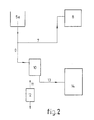
- Fig. 1 represents the preferred embodiment of the device of the invention.
- the material to be fermented is first, if required, pre-treated, in order to remove inert and/or interfering substances such as plastics and metals as much as possible.
- the said pre-treated organic material is generally transported into container 3 which is usually a rotating drum and preferably a so-called DANO drum, wherein said material is reduced and thoroughly mixed.
- container 3 which is usually a rotating drum and preferably a so-called DANO drum, wherein said material is reduced and thoroughly mixed.
- a container 3 solid graft material from container 1 and liquid graft material from container 2 are added.
- said liquid graft material advantageously may be added to the organic material after leaving said container 3 and prior to its transportation into the fermentation arrangement 5a, 5b, 5c,... by means of transportation installation 4. This option is not shown in Fig. 1. By doing so the anaerobic micro-organism content of the organic material to be fermented may easily be adjusted to the optimum level required for an optimum anaerobic fermentation in said fermentation compartment.
- the waste material is suitable for direct treatment in container 3, which is preferably a DANO drum.
- Said DANO drum is a horizontally arranged rotating tubular vessel, wherein the organic material to be fermented is mixed thoroughly in the presence of air.
- aerobic degradation occurs, which causes the increase of the temperature of the moisture.
- the temperature in said container 3 advantageously may be increased by injection of steam prior to its transfer to said fermentation compartment.
- the temperature of the organic mass is usually increased to 30-65°C, and preferably to 50-65°C.
- an additional container may be placed (not shown in the drawing) in order to obtain additional heating, grafting and water supply.
- the size of a fermentation compartment which compartment is preferably rectangular, for example 5a, depends on the average daily supply of new organic material to be fermented. Per working day one fermentation compartment will be filled, whereupon that compartment is closed off for the duration of the fermentation. The fermentation takes place during 15-50 days.
- each of the fermentation compartments 5a, 5b, 5c, ... shown in the figure is provided with two segmentation walls 15 which preferably are provided with one or more heating elements (not shown in the figure).
- Said heating elements are advantageously hot water heating elements.
- the heating elements also may be the electrical elements.
- waste heat which is developed by the gas engines, which convert the obtained biogas in electricity.
- Such fermentation compartments appear to ensure a good and efficient fermentation.
- the invention is not restricted to two segmentation walls per fermentation compartment. Dependant on the dimensions and therefore the capacity of the fermentation compartment one segmentation wall or three or more may be used, whereas in case of a small capacity no segmentation wall is used at all.
- press liquid which may be formed in the fermentation compartment may be recycled into the fermentation compartment in order to keep the water content of the organic mass at the required level.
- the capacity of the fermentation compartments may be for example about 250 to 750m3. It will be clear that the smaller or larger fermentation compartments can be used. Usually the stacking height after charging of the material in the fermentation compartments is about 4.5 to 5.5 meters, whereas the capacity of the fermentation compartment may be accommodated by adapting the length of the compartments.
- the total capacity of the fermentation installation may be increased by increasing the number of fermentation compartments.
- the fermentation compartments may be constructed of many different materials. However, an acid resistant concrete construction is preferred.
- Each of the fermentation compartments (5a, 5b, 5c ...) preferably comprises a concrete floor, concrete partition walls and concrete segmentation walls, if any, whereas the rear wall and roof are made from isolating sandwich panels or they also may be made from concrete in which case the outer walls and roof are provided with an isolating material at the outside.
- the fermented material may be removed from the fermentation compartment by means of an excavator.
- the fermented material from a fermentation compartment (for instance 5b) may be transported partially through transportation means such as a conveyor belt etc. 7 to a storage container 8 and it may serve as graft material for new fermentable organic material.
- the fermented sewage sludge may be brought to or maintained at a temperature of about 40-65°C. This permits that preferably each batch of new, fermentable organic material has the optimum temperature during the pre-treatment stage.
- the solid organic material from storage container 12 may subsequently be dried and/or carried off.
- the press liquid from storage container 14 and the fermented solid organic material from storage container 12 may be re-used as graft material for new, fermentable material.
- the amount of graft material should always be sufficient to suppress the predominance of acid forming bacteria in the first stage of the fermentation process.
Landscapes
- Health & Medical Sciences (AREA)
- Life Sciences & Earth Sciences (AREA)
- Chemical & Material Sciences (AREA)
- Engineering & Computer Science (AREA)
- Zoology (AREA)
- Bioinformatics & Cheminformatics (AREA)
- Organic Chemistry (AREA)
- Wood Science & Technology (AREA)
- Genetics & Genomics (AREA)
- Sustainable Development (AREA)
- Microbiology (AREA)
- Biochemistry (AREA)
- General Engineering & Computer Science (AREA)
- General Health & Medical Sciences (AREA)
- Biotechnology (AREA)
- Biomedical Technology (AREA)
- Molecular Biology (AREA)
- Analytical Chemistry (AREA)
- Thermal Sciences (AREA)
- Clinical Laboratory Science (AREA)
- General Chemical & Material Sciences (AREA)
- Physics & Mathematics (AREA)
- Oil, Petroleum & Natural Gas (AREA)
- Processing Of Solid Wastes (AREA)
- Preparation Of Compounds By Using Micro-Organisms (AREA)
- Fertilizers (AREA)
- Treatment Of Sludge (AREA)
- Apparatus Associated With Microorganisms And Enzymes (AREA)
- Purification Treatments By Anaerobic Or Anaerobic And Aerobic Bacteria Or Animals (AREA)
Applications Claiming Priority (2)
| Application Number | Priority Date | Filing Date | Title |
|---|---|---|---|
| NL9001282A NL9001282A (nl) | 1990-06-07 | 1990-06-07 | Werkwijze en inrichting voor anaerobe vergisting. |
| NL9001282 | 1990-06-07 |
Publications (2)
| Publication Number | Publication Date |
|---|---|
| EP0460767A1 true EP0460767A1 (fr) | 1991-12-11 |
| EP0460767B1 EP0460767B1 (fr) | 1996-01-10 |
Family
ID=19857199
Family Applications (1)
| Application Number | Title | Priority Date | Filing Date |
|---|---|---|---|
| EP19910201401 Expired - Lifetime EP0460767B1 (fr) | 1990-06-07 | 1991-06-06 | Procédé et appareil pour la fermentation anaérobique |
Country Status (9)
| Country | Link |
|---|---|
| EP (1) | EP0460767B1 (fr) |
| JP (1) | JPH06320134A (fr) |
| AT (1) | ATE132895T1 (fr) |
| CA (1) | CA2044089A1 (fr) |
| DE (1) | DE69116232T2 (fr) |
| DK (1) | DK0460767T3 (fr) |
| ES (1) | ES2090230T3 (fr) |
| GR (1) | GR3019651T3 (fr) |
| NL (1) | NL9001282A (fr) |
Cited By (4)
| Publication number | Priority date | Publication date | Assignee | Title |
|---|---|---|---|---|
| AT401742B (de) * | 1995-01-24 | 1996-11-25 | Porr Umwelttechnik | Verfahren zum auftrennen und konditionieren von kommunalen abfallstoffen |
| WO1999054434A1 (fr) * | 1998-04-18 | 1999-10-28 | Amec Civil Engineering Limited | Systeme de gestion de dechets |
| AT4070U3 (de) * | 1999-11-12 | 2001-07-25 | Rosinger Anlagentechnik Gmbh & | Fermentationsreaktor mit kippsicherheit bezüglich der biologie |
| CN115449457A (zh) * | 2021-06-09 | 2022-12-09 | 广东叶沅环保科技有限公司 | 一种滚筒式有机垃圾高温好氧发酵系统 |
Families Citing this family (1)
| Publication number | Priority date | Publication date | Assignee | Title |
|---|---|---|---|---|
| CN104556351A (zh) * | 2014-12-25 | 2015-04-29 | 东南大学 | 一种利用高温废水加温生物反应器的设备及方法 |
Citations (7)
| Publication number | Priority date | Publication date | Assignee | Title |
|---|---|---|---|---|
| FR893767A (fr) * | 1942-03-28 | 1944-10-30 | Procédé d'obtention d'un gaz combustible par fermentation de matières organiques | |
| FR1006958A (fr) * | 1949-12-16 | 1952-04-29 | Centrale Tech Francaise | Installation de traitement des matières organiques pour fabrication d'engrais et production de gaz utilisables |
| FR2327974A1 (fr) * | 1975-10-16 | 1977-05-13 | Morel Pierre | Procede de traitement des ordures menageres et installation pour sa mise en oeuvre |
| FR2346293A1 (fr) * | 1976-04-01 | 1977-10-28 | Morel Pierre | Procede de recyclage des detritus, ordures menageres et autres residus organiques, par un traitement permettant la production industrielle d'un gaz artificiel dont la composition et la production sont controles |
| US4204842A (en) * | 1976-04-01 | 1980-05-27 | Antonin Jullien | Process for converting biodegradable wastes into industrial gases |
| GB2041403A (en) * | 1979-01-30 | 1980-09-10 | Univ Waterloo | Bioconversion of Agricultural Wastes into Proteinaceous Animal Feed |
| WO1982002059A1 (fr) * | 1980-12-12 | 1982-06-24 | Martin Hunziker | Procede et installation de recuperation d'ordures menageres et d'autres dechets organiques pour l'obtention de gaz methane |
Family Cites Families (1)
| Publication number | Priority date | Publication date | Assignee | Title |
|---|---|---|---|---|
| FR327974A (fr) * | 1902-05-26 | 1903-07-07 | Guedon Leon Louis | Système de postes de concentration pour la manoeuvre des appareils des voies ferrées |
-
1990
- 1990-06-07 NL NL9001282A patent/NL9001282A/nl not_active Application Discontinuation
-
1991
- 1991-06-06 EP EP19910201401 patent/EP0460767B1/fr not_active Expired - Lifetime
- 1991-06-06 DE DE69116232T patent/DE69116232T2/de not_active Expired - Fee Related
- 1991-06-06 DK DK91201401T patent/DK0460767T3/da active
- 1991-06-06 ES ES91201401T patent/ES2090230T3/es not_active Expired - Lifetime
- 1991-06-06 AT AT91201401T patent/ATE132895T1/de not_active IP Right Cessation
- 1991-06-07 JP JP23260391A patent/JPH06320134A/ja active Pending
- 1991-06-07 CA CA 2044089 patent/CA2044089A1/fr not_active Abandoned
-
1996
- 1996-04-11 GR GR960401032T patent/GR3019651T3/el unknown
Patent Citations (7)
| Publication number | Priority date | Publication date | Assignee | Title |
|---|---|---|---|---|
| FR893767A (fr) * | 1942-03-28 | 1944-10-30 | Procédé d'obtention d'un gaz combustible par fermentation de matières organiques | |
| FR1006958A (fr) * | 1949-12-16 | 1952-04-29 | Centrale Tech Francaise | Installation de traitement des matières organiques pour fabrication d'engrais et production de gaz utilisables |
| FR2327974A1 (fr) * | 1975-10-16 | 1977-05-13 | Morel Pierre | Procede de traitement des ordures menageres et installation pour sa mise en oeuvre |
| FR2346293A1 (fr) * | 1976-04-01 | 1977-10-28 | Morel Pierre | Procede de recyclage des detritus, ordures menageres et autres residus organiques, par un traitement permettant la production industrielle d'un gaz artificiel dont la composition et la production sont controles |
| US4204842A (en) * | 1976-04-01 | 1980-05-27 | Antonin Jullien | Process for converting biodegradable wastes into industrial gases |
| GB2041403A (en) * | 1979-01-30 | 1980-09-10 | Univ Waterloo | Bioconversion of Agricultural Wastes into Proteinaceous Animal Feed |
| WO1982002059A1 (fr) * | 1980-12-12 | 1982-06-24 | Martin Hunziker | Procede et installation de recuperation d'ordures menageres et d'autres dechets organiques pour l'obtention de gaz methane |
Non-Patent Citations (1)
| Title |
|---|
| FSTA - Journal Abstract 79-02-P0256, Technological measurements for determining the reaction heat in fermenting whey with a mixed culture of Lactobacillus bulgaricus and Saccharomyces cerevisiae in a 20 m 3 fermenter plant. GRASSHOFF A. et al., & Kieler Milchwirtschaftliche Forschungsberichte, Vol. 30, No. 2, P. 189-195, 1978 DE, Abstract. * |
Cited By (4)
| Publication number | Priority date | Publication date | Assignee | Title |
|---|---|---|---|---|
| AT401742B (de) * | 1995-01-24 | 1996-11-25 | Porr Umwelttechnik | Verfahren zum auftrennen und konditionieren von kommunalen abfallstoffen |
| WO1999054434A1 (fr) * | 1998-04-18 | 1999-10-28 | Amec Civil Engineering Limited | Systeme de gestion de dechets |
| AT4070U3 (de) * | 1999-11-12 | 2001-07-25 | Rosinger Anlagentechnik Gmbh & | Fermentationsreaktor mit kippsicherheit bezüglich der biologie |
| CN115449457A (zh) * | 2021-06-09 | 2022-12-09 | 广东叶沅环保科技有限公司 | 一种滚筒式有机垃圾高温好氧发酵系统 |
Also Published As
| Publication number | Publication date |
|---|---|
| DK0460767T3 (da) | 1996-05-28 |
| DE69116232T2 (de) | 1996-09-05 |
| DE69116232D1 (de) | 1996-02-22 |
| ES2090230T3 (es) | 1996-10-16 |
| NL9001282A (nl) | 1992-01-02 |
| CA2044089A1 (fr) | 1991-12-08 |
| EP0460767B1 (fr) | 1996-01-10 |
| JPH06320134A (ja) | 1994-11-22 |
| ATE132895T1 (de) | 1996-01-15 |
| GR3019651T3 (en) | 1996-07-31 |
Similar Documents
| Publication | Publication Date | Title |
|---|---|---|
| DE19615551C2 (de) | Verfahren zur mehrstufigen anaeroben Behandlung von Biomassen zur Erzeugung von Biogas sowie Vorrichtung zur Durchführung des Verfahrens | |
| DE102007012861B3 (de) | Biogaserzeugung durch Trockenfermentation nachwachsender Rohstoffe | |
| CN106316489B (zh) | 餐厨垃圾沼渣堆肥处理系统 | |
| CA2161005A1 (fr) | Methode et dispositif pour le compostage et la fermentation humide des dechets biologiques | |
| JP5252762B2 (ja) | 有機性廃棄物処理方法 | |
| PL198224B1 (pl) | Sposób oraz instalacja do obróbki mieszaniny zawierającej składniki strukturalne i składniki organiczne | |
| CN116213403A (zh) | 一种餐厨垃圾昆虫过腹转化全流程处理系统及方法 | |
| US7960165B2 (en) | Method and apparatus for drying organic material | |
| CN206680393U (zh) | 一种有机废弃物资源化处理系统 | |
| EP0498084B1 (fr) | Méthode pour le traitement du lisier | |
| EP0460767B1 (fr) | Procédé et appareil pour la fermentation anaérobique | |
| EP0803568A1 (fr) | Installation de fermentation et procédé à plusieurs étapes exécutable au moyen de ce procédé | |
| JPH10130672A (ja) | 固形燃料の製造方法 | |
| CN101676381A (zh) | 用于减少生活垃圾的体积和容积的方法 | |
| KR100279664B1 (ko) | 유기성 쓰레기의 혐기성 분해에 의한 처리방법및 그 장치 | |
| KR100245607B1 (ko) | 음식물 쓰레기 및 식품폐기물에 미생물 첨가에의한 유용물질의 제조방법과 그 장치 | |
| EP1215187B1 (fr) | Procédé et dispositif pour le traitement de déchets urbains solides | |
| KR20230126768A (ko) | 가축분뇨를 주로 한 혼합 유기성폐자원의 에너지화(바이오가스, 고형폐기물 연료) 통합공정 | |
| KR200425486Y1 (ko) | 암롤 트럭에 적재하여 수거운반이 가능한 음식물쓰레기발효숙성 건조장치 | |
| CN114195562B (zh) | 一种无菌剂添加的易腐垃圾生物干化促腐熟处理工艺 | |
| KR200182396Y1 (ko) | 식품쓰레기의 사료 및 퇴비화 처리장치 | |
| JPS6352000B2 (fr) | ||
| GB2296493A (en) | Composting sludge | |
| FI98300C (fi) | Kompostori | |
| KR20010113208A (ko) | 인분주재 비료 제조방법 및 그 제조장치 |
Legal Events
| Date | Code | Title | Description |
|---|---|---|---|
| PUAI | Public reference made under article 153(3) epc to a published international application that has entered the european phase |
Free format text: ORIGINAL CODE: 0009012 |
|
| AK | Designated contracting states |
Kind code of ref document: A1 Designated state(s): AT BE CH DE DK ES FR GB GR IT LI LU NL SE |
|
| 17P | Request for examination filed |
Effective date: 19911127 |
|
| 17Q | First examination report despatched |
Effective date: 19940518 |
|
| 111Z | Information provided on other rights and legal means of execution |
Free format text: 940802 AT BE CH DE DK ES FR GB GR IT LI LU NL SE |
|
| GRAA | (expected) grant |
Free format text: ORIGINAL CODE: 0009210 |
|
| AK | Designated contracting states |
Kind code of ref document: B1 Designated state(s): AT BE CH DE DK ES FR GB GR IT LI LU NL SE |
|
| PG25 | Lapsed in a contracting state [announced via postgrant information from national office to epo] |
Ref country code: GR Free format text: LAPSE BECAUSE OF FAILURE TO SUBMIT A TRANSLATION OF THE DESCRIPTION OR TO PAY THE FEE WITHIN THE PRESCRIBED TIME-LIMIT Effective date: 19960110 |
|
| REF | Corresponds to: |
Ref document number: 132895 Country of ref document: AT Date of ref document: 19960115 Kind code of ref document: T |
|
| REF | Corresponds to: |
Ref document number: 69116232 Country of ref document: DE Date of ref document: 19960222 |
|
| ITF | It: translation for a ep patent filed | ||
| REG | Reference to a national code |
Ref country code: ES Ref legal event code: BA2A Ref document number: 2090230 Country of ref document: ES Kind code of ref document: T3 |
|
| ET | Fr: translation filed | ||
| REG | Reference to a national code |
Ref country code: DK Ref legal event code: T3 |
|
| PG25 | Lapsed in a contracting state [announced via postgrant information from national office to epo] |
Ref country code: DK Effective date: 19960606 Ref country code: AT Effective date: 19960606 |
|
| REG | Reference to a national code |
Ref country code: DK Ref legal event code: EBP |
|
| PG25 | Lapsed in a contracting state [announced via postgrant information from national office to epo] |
Ref country code: SE Effective date: 19960607 Ref country code: ES Free format text: LAPSE BECAUSE OF EXPIRATION OF PROTECTION Effective date: 19960607 |
|
| REG | Reference to a national code |
Ref country code: GR Ref legal event code: FG4A Free format text: 3019651 |
|
| PG25 | Lapsed in a contracting state [announced via postgrant information from national office to epo] |
Ref country code: LU Free format text: LAPSE BECAUSE OF NON-PAYMENT OF DUE FEES Effective date: 19960630 Ref country code: LI Effective date: 19960630 Ref country code: CH Effective date: 19960630 Ref country code: BE Effective date: 19960630 |
|
| REG | Reference to a national code |
Ref country code: ES Ref legal event code: FG2A Ref document number: 2090230 Country of ref document: ES Kind code of ref document: T3 |
|
| PLBE | No opposition filed within time limit |
Free format text: ORIGINAL CODE: 0009261 |
|
| STAA | Information on the status of an ep patent application or granted ep patent |
Free format text: STATUS: NO OPPOSITION FILED WITHIN TIME LIMIT |
|
| REG | Reference to a national code |
Ref country code: ES Ref legal event code: FG2A Ref document number: 2090230 Country of ref document: ES Kind code of ref document: T3 |
|
| PGFP | Annual fee paid to national office [announced via postgrant information from national office to epo] |
Ref country code: GB Payment date: 19961206 Year of fee payment: 6 |
|
| BERE | Be: lapsed |
Owner name: DUTCH ENVIRONMENTAL MANAGEMENT GROUP B.V. Effective date: 19960630 |
|
| PG25 | Lapsed in a contracting state [announced via postgrant information from national office to epo] |
Ref country code: NL Effective date: 19970101 |
|
| 26N | No opposition filed | ||
| REG | Reference to a national code |
Ref country code: GR Ref legal event code: MM2A Free format text: 3019651 |
|
| PG25 | Lapsed in a contracting state [announced via postgrant information from national office to epo] |
Ref country code: FR Effective date: 19970228 |
|
| PG25 | Lapsed in a contracting state [announced via postgrant information from national office to epo] |
Ref country code: DE Effective date: 19970301 |
|
| EUG | Se: european patent has lapsed |
Ref document number: 91201401.6 |
|
| NLV4 | Nl: lapsed or anulled due to non-payment of the annual fee |
Effective date: 19970101 |
|
| REG | Reference to a national code |
Ref country code: FR Ref legal event code: ST |
|
| PG25 | Lapsed in a contracting state [announced via postgrant information from national office to epo] |
Ref country code: GB Free format text: LAPSE BECAUSE OF NON-PAYMENT OF DUE FEES Effective date: 19970606 |
|
| GBPC | Gb: european patent ceased through non-payment of renewal fee |
Effective date: 19970606 |
|
| REG | Reference to a national code |
Ref country code: ES Ref legal event code: FD2A Effective date: 20000601 |
|
| PG25 | Lapsed in a contracting state [announced via postgrant information from national office to epo] |
Ref country code: IT Free format text: LAPSE BECAUSE OF NON-PAYMENT OF DUE FEES Effective date: 20050606 |
|
| REG | Reference to a national code |
Ref country code: CH Ref legal event code: NV Representative=s name: JEAN S. ROBERT ING.-CONSEIL |