EP0460806A2 - Elément sensible électrophotographique - Google Patents
Elément sensible électrophotographique Download PDFInfo
- Publication number
- EP0460806A2 EP0460806A2 EP91304006A EP91304006A EP0460806A2 EP 0460806 A2 EP0460806 A2 EP 0460806A2 EP 91304006 A EP91304006 A EP 91304006A EP 91304006 A EP91304006 A EP 91304006A EP 0460806 A2 EP0460806 A2 EP 0460806A2
- Authority
- EP
- European Patent Office
- Prior art keywords
- photosensitive
- photosensitive member
- photosensitive layer
- binder
- liquid monomer
- Prior art date
- Legal status (The legal status is an assumption and is not a legal conclusion. Google has not performed a legal analysis and makes no representation as to the accuracy of the status listed.)
- Withdrawn
Links
Images

Classifications
-
- G—PHYSICS
- G03—PHOTOGRAPHY; CINEMATOGRAPHY; ANALOGOUS TECHNIQUES USING WAVES OTHER THAN OPTICAL WAVES; ELECTROGRAPHY; HOLOGRAPHY
- G03G—ELECTROGRAPHY; ELECTROPHOTOGRAPHY; MAGNETOGRAPHY
- G03G5/00—Recording-members for original recording by exposure, e.g. to light, to heat or to electrons; Manufacture thereof; Selection of materials therefor
- G03G5/02—Charge-receiving layers
- G03G5/04—Photoconductive layers; Charge-generation layers or charge-transporting layers; Additives therefor; Binders therefor
- G03G5/05—Organic bonding materials; Methods for coating a substrate with a photoconductive layer; Inert supplements for use in photoconductive layers
- G03G5/0528—Macromolecular bonding materials
- G03G5/0532—Macromolecular bonding materials obtained by reactions only involving carbon-to-carbon unsatured bonds
- G03G5/0546—Polymers comprising at least one carboxyl radical, e.g. polyacrylic acid, polycrotonic acid, polymaleic acid; Derivatives thereof, e.g. their esters, salts, anhydrides, nitriles, amides
-
- G—PHYSICS
- G03—PHOTOGRAPHY; CINEMATOGRAPHY; ANALOGOUS TECHNIQUES USING WAVES OTHER THAN OPTICAL WAVES; ELECTROGRAPHY; HOLOGRAPHY
- G03G—ELECTROGRAPHY; ELECTROPHOTOGRAPHY; MAGNETOGRAPHY
- G03G5/00—Recording-members for original recording by exposure, e.g. to light, to heat or to electrons; Manufacture thereof; Selection of materials therefor
- G03G5/02—Charge-receiving layers
- G03G5/04—Photoconductive layers; Charge-generation layers or charge-transporting layers; Additives therefor; Binders therefor
- G03G5/05—Organic bonding materials; Methods for coating a substrate with a photoconductive layer; Inert supplements for use in photoconductive layers
- G03G5/0528—Macromolecular bonding materials
- G03G5/0592—Macromolecular compounds characterised by their structure or by their chemical properties, e.g. block polymers, reticulated polymers, molecular weight, acidity
Definitions
- the present invention relates to an electrophotographically sensitive member. More particularly, the present invention relates to an electrophotographically sensitive member which has a photosensitive layer comprising photoconductive fine crystals or particles dispersed in a thin layer of a self-hardening binder.
- the theoretical elucidation of the digital photosensitive member is based upon the triggering of an avalanche phenomenon when so-called intrinsic crystals having little crystal asymmetry or amorphous particles of a photoconductive material are dispersed in a highly insulative binder having a volume specific resistivity of at least 1013 ⁇ -cm.
- the use of intrinsic crystals or amorphous particles in combination with a highly insulative binder is considered necessary for triggering the avalanche phenomenon in a digital photosensitive member.
- the prior art theories regarding the binder are insufficient, and the interaction between the photoconductive particles and the binder has been insufficiently studied. Experimental efforts to improve the photosensitive characteristics of the member by making various changes in the binder have not been well thought out, and have been unable to give consistently good results.
- the present invention focuses on problems associated with the binder, and has as its object to overcome these problems. More particularly, the present invention has as its object to overcome certain problems to be explained below which are associated with a self-hardening binder in a high ⁇ photosensitive member used in a printer.
- High ⁇ photosensitive members are capable of printing with high resolution and high contrast. These properties are more useful in printers than in copiers where a certain degree of grey scale may be desired.
- Photosensitive members used in printers up to now include those based on Se, hydrogenated amorphous silicon, and multilayer organic photoconductor systems wherein each layer performs a separate function.
- binder-type photosensitive members Up to now, there has been almost no use of binder-type photosensitive members in printers.
- the sole example known to the inventor of a binder-type photosensitive member in a printer employs a biased belt or roller to effect transfer. The inventor believes that this kind of transfer system is used in order to prevent damage to the surface of the photosensitive member which would occur if a transfer corona were used.
- an electrophotographically sensitive member which is used in a printer have durability in an ozone atmosphere.
- binder-type photosensitive members which have photosensitive layers comprising fine particles of a photoconductive material set in a binder
- This non-uniformity in the binder occurs during the hardening process.
- the non-uniformity of the binder thus tends to make binder-type photosensitive members more sensitive to ozone. Therefore, it is difficult to employ such photosensitive members in printers having transfer coronas.
- the latent image retention properties of the member vary over a wide range depending on whether or not transfer is effected by direct exposure to a corona.
- a photosensitive member is used in a printer which employs a negative development process and a transfer corona, its capacity to retain a latent image drops with frequency of use and fog is seen in the background of printed pages.
- a photosensitive member for use in an electrophotographic printer comprising an electroconductive substrate and a photosensitive layer on top of the electroconductive substrate, the photosensitive layer comprising photoconductive fine particles dispersed in a self-hardening binder material and a liquid monomer impregnated into and hardened within the photosensitive layer.
- a novel photosensitive member for use in an electrophotographic printer comprises an electroconductive substrate and a photosensitive layer on top of the electroconductive substrate, the photosensitive layer comprising fine particles of ⁇ -type copper phthalocyanine dispersed in a self-hardening binder and a liquid instant adhesive, such as cyanoacrylate, impregnated into and allowed to harden within the photosensitive layer.
- a novel method for improving the latent image retention properties of a binder-type photosensitive member comprising a photosensitive layer of photoconductive fine particles dispersed in a self-hardening binder, comprises impregnating the photosensitive layer with a liquid monomer, such as cyanoacrylate, and allowing the liquid monomer to harden.
- a liquid monomer such as cyanoacrylate
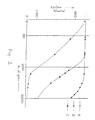
- FIG 1 is a graph showing surface potential versus light input for a number of photosensitive members, including a photosensitive member in accordance with the present invention.
- FIG 2 is a graph showing surface potential versus number of charge/discharge cycles for a number of photosensitive members, including a photosensitive member in accordance with the present invention.
- a photosensitive member for use in electrophotographic printing which employs a negative development process is of the binder type and comprises an electroconductive substrate, such as aluminum, onto which a photosensitive layer has been applied.
- the photosensitive layer has a thickness of about 5 ⁇ m to about 30 ⁇ m and comprises fine particles of a photoconductive material dispersed in a self-hardening binder.
- the photoconductive fine particles preferably have a mean particle diameter of about 0.01 ⁇ m to about 0.5 ⁇ m.
- the photoconductive particles are fine crystals of an intrinsic semiconductor or an amorphous semiconductor
- the binder has a volume specific resistivity of at least about 1013 ⁇ -cm, preferably about 1015 ⁇ -cm, whereby the photosensitive member has a ⁇ of at least about 6 and has digital properties.
- the photosensitive layer is impregnated with a liquid monomer that has been allowed to polymerize and harden by cross-linking. While not entirely understood, it is believed that the liquid monomer retards the deleterious effects of ozone by filling in the voids which are formed in the binder, thus improving the latent image retention capacity of the photosensitive member.
- Suitable liquid monomers are those known as instant adhesives, such as the alkyl cyanoacrylates. Among these methylcyanoacrylate, ethylcyanoacrylate, isobutylcyanoacrylate, isopropylcyanoacrylate, and ⁇ -cyanoacrylic acid ethoxyethyl may be mentioned.
- These monomers are suitable because they have a low molecular weight and low viscosity, allowing them to impregnate the photosensitive layer without too much difficulty. Furthermore, they harden readily when exposed to even minute amounts of moisture. In fact, they harden so readily, in some cases the liquid monomer hardens on the surface of the photosensitive member before it has an opportunity to penetrate into the photosensitive layer. To overcome this, it is desirable to dilute the liquid monomer with a solvent, such as xylene, which slows the hardening process. As a result, the liquid monomer is able to fill the voids and repair the uneven surface of the binder, thus rendering binder-type photosensitive members more resistant to ozone exposure.
- a solvent such as xylene
- liquid monomers which may be mentioned for the practice of this invention are acrylic urethane, silicone, and nitrocellulose.
- the previously prepared original composition was coated onto each of the two aluminum cylinders carrying the soluble nylon layer by the same coating method.
- each of the aluminum cylinders was heated for three hours in an electric furnace at 200°C, and then cooled to obtain two untreated photosensitive members, each of which has a photosensitive layer about 15 ⁇ m thick.
- the photosensitive layer may be between about 5 ⁇ m and about 30 ⁇ m thick, with the photoconductive fine particles having a diameter between about 0.01 ⁇ m and 0.5 ⁇ m dispersed in a self-hardening binder having a volume specific resistivity higher than 1013 ⁇ -cm.
- One of the two untreated photosensitive members was then treated by coating with a liquid monomer, namely, an instant adhesive having ethylcyanoacrylate as its main ingredient (Aronarufua 101 made by Toa Gosei Kagaku K.K.) diluted with 50 wt% of xylene.
- a liquid monomer namely, an instant adhesive having ethylcyanoacrylate as its main ingredient (Aronarufua 101 made by Toa Gosei Kagaku K.K.) diluted with 50 wt% of xylene.
- the instant adhesive immediately permeates into the photosensitive layer.
- the photosensitive member initially shows luster which soon vanishes as the liquid permeates into the photosensitive layer.
- the treated photosensitive member was then exposed to warm air at 80°C for five minutes and was then cooled at room temperature for five minutes. This process was repeated four times until the photosensitive member retained its lustrous surface. For finishing, the treated photosensitive member was heated in an oven at 100
- the treated photosensitive member (designated as A) and the untreated photosensitive member (designated as B) were installed in a printer that normally contains a commercial Se-type photosensitive member. This printer was not modified except that the developer unit was removed and the intensity of light in the erase lamp was increased 70-fold.
- the developer unit was removed in order to speed up any deterioration caused by ozone.
- oxides formed on the surface of the photosensitive member by exposure to ozone adhere to the toner particles. These oxides are removed from the surface when the toner is removed. Thus, any damage caused by exposure to ozone occurs more rapidly if the developer unit has been removed.
- FIG 1 shows that initially both photosensitive members A and B display the same digital properties that are described in U.S. 4,963,452. However, after 700 cycles, untreated photosensitive member A shows a marked decrease in photosensitivity. After 3,000 cycles, photosensitive member A shows no photosensitivity at all. In contrast, the treated photosensitive member B continues to show substantially the same digital photosensitive properties even after 5,000 cycles.
- FIG 2 is a graph showing the initial excitation surface potential that is obtainable after numerous cycles for photosensitive members A and B.
- FIG 2 also demonstrates the markedly superior properties of the treated photosensitive member B even after 10,000 cycles in comparison to the untreated photosensitive member A.
- the ethylcyanoacrylate monomer present in the treating solution is an example of an instant adhesive. Compounds in this class are quickly volatilized by minute amounts of moisture and by cross-linked hardening. Other instant adhesives that perform in the same manner are methylcyanoacrylate, ethylcyanoacrylate, isobutylcyanoacrylate, isopropylcyanoacrylate and ⁇ -cyanoacrylic acid ethoxyethyl. All of these materials have very low molecular weights because the acrylic monomer is their basic repeating unit.
- the monomer solution was diluted with 50 wt% of xylene with the object being to control the extremely rapid hardening of the instant adhesive so that it would fully impregnate the photosensitive layer.
- a treatment solution containing ethylcyanoacrylate monomer as its main ingredient and 50 wt% of xylene in order to suppress the excessively rapid absorption and hardening of the instant adhesive molecules would not significantly alter the photosensitivity of the photosensitive member since it would permit the instant adhesive to permeate the photosensitive layer before hardening.
- Xylene was chosen as the solvent since instant adhesives based on cyanoacrylate completely dissolve therein. Furthermore, since the molecular weight of the instant adhesive monomers is very low, there is almost no change in viscosity even under dilution with xylene, and permeation of the photosensitive layer occurs without hindrance. Even though diluted with xylene, the acrylic monomer will be absorbed into the photosensitive layer and absorption proceeds to completion as the xylene volatilizes. When xylene has finished volatilizing, there is absorption of moisture from the air, and the basic instant adhesive will harden into an acrylic resin. Once this is completed, it is possible to apply one or more additional coatings of the same treatment solution comprising liquid ethylcyanoacrylate monomer diluted with xylene. These additional coatings further improve the superior characteristics of the photosensitive member.
- the binder in the photosensitive layer is of a self-hardening type. This is important because self-hardening materials are characterized by a cross-linking reaction and the resulting material conventionally has very great resistance to solvents. Accordingly, there is no damage to the underlying structure of the photosensitive layer even when strong solvents are used as part of the treatment solution.
- xylene was chosen as the diluent, other substances can also be used.
- a low boiling point solvent such as dichloroethane is used, the permeability of the treatment solution increases while the photosensitive layer is cooled because of rapid volatilization of the dichloroethane.
- treatment solution used in this example contained ethylcyanoacrylate as its main ingredient
- other acrylic monomers may also comprise the main ingredient of the treatment solution.
- An instant adhesive whose main ingredient is ethylcyanoacrylate monomer has high permeability and is very easy to use from the standpoint of coatability. These same properties may be found in other monomeric materials, for example, in urethane modified silicone. However, it is necessary to ensure that the liquid monomer that is used is sufficiently permeable in the photosensitive layer so that it may penetrate therein. Problems in permeability may be overcome to a certain extent by applying the coating under an overpressure so as to force permeation to occur.
- the monomeric material may be impregnated into the internal structure of the photosensitive layer by first coating the photosensitive layer with a monomeric solution of low viscosity, followed by coating with a second monomeric solution of higher viscosity, and, if necessary, by coating the photosensitive layer with a third monomeric solution of yet higher viscosity.
- An untreated photosensitive body was prepared in the same manner as described in Example 1.
- the untreated photosensitive body was coated sequentially with each of the three monomeric solutions described above and dried to give photosensitive member C.
- the photosensitive member C had a mirror surface luster.
- the photosensitive member C was then tested for photosensitive properties in the same manner as described in Example 1.
- the technology of the present invention can also be taken into account in matching the toner to the properties of the photosensitive member. As is well known, a high degree of matchability is required between the photosensitive member and the toner and carrier. Once the characteristics of the photosensitive member are selected, there is little freedom allowed for choosing the characteristics of the toner and carrier with a high degree of matchability.
- Examples 1 and 2 were combined.
- a photosensitive member similar to photosensitive member B was prepared using ethylcyanoacrylate monomer as the main ingredient for impregnation except that the number of coatings was increased three-fold. Thereafter, a mixed solution of urethane modified silicone 8% + ethyl acetate was applied as a final coating and the photosensitive member was dried to complete its manufacture.
- This photosensitive member was then tested in the same manner as in Examples 1 and 2. This so-treated photosensitive member showed nearly the same photoconductive properties including latent image retention properties, as the photosensitive member B of Example 1.
- a photosensitive member which has a photosensitive layer comprising photoconductive fine particles dispersed in a self-hardening binder can be improved by being impregnated with a monomeric material.
- the monomeric material hardens and fills the voids and other defects in the photosensitive layer, thereby increasing the latent image retention properties of the photosensitive member.
Landscapes
- Physics & Mathematics (AREA)
- Spectroscopy & Molecular Physics (AREA)
- General Physics & Mathematics (AREA)
- Chemical & Material Sciences (AREA)
- Chemical Kinetics & Catalysis (AREA)
- Photoreceptors In Electrophotography (AREA)
Applications Claiming Priority (2)
| Application Number | Priority Date | Filing Date | Title |
|---|---|---|---|
| JP14757890A JPH0440465A (ja) | 1990-06-06 | 1990-06-06 | 電子写真感光体の製造方法及び電子写真感光体 |
| JP147578/90 | 1990-06-06 |
Publications (2)
| Publication Number | Publication Date |
|---|---|
| EP0460806A2 true EP0460806A2 (fr) | 1991-12-11 |
| EP0460806A3 EP0460806A3 (en) | 1992-04-08 |
Family
ID=15433528
Family Applications (1)
| Application Number | Title | Priority Date | Filing Date |
|---|---|---|---|
| EP19910304006 Withdrawn EP0460806A3 (en) | 1990-06-06 | 1991-05-02 | Electrophotographic sensitive member |
Country Status (2)
| Country | Link |
|---|---|
| EP (1) | EP0460806A3 (fr) |
| JP (1) | JPH0440465A (fr) |
Cited By (1)
| Publication number | Priority date | Publication date | Assignee | Title |
|---|---|---|---|---|
| EP0852342A1 (fr) * | 1996-12-26 | 1998-07-08 | Sharp Kabushiki Kaisha | Composition de revêtement liquide pour des éléments photosensibles électrophotographiques et procédé de fabrication d'éléments photosensibles électrophotograpiques utilisant cette composition |
Family Cites Families (1)
| Publication number | Priority date | Publication date | Assignee | Title |
|---|---|---|---|---|
| JPS63262655A (ja) * | 1987-04-21 | 1988-10-28 | Koichi Kinoshita | 感光体 |
-
1990
- 1990-06-06 JP JP14757890A patent/JPH0440465A/ja active Granted
-
1991
- 1991-05-02 EP EP19910304006 patent/EP0460806A3/en not_active Withdrawn
Cited By (2)
| Publication number | Priority date | Publication date | Assignee | Title |
|---|---|---|---|---|
| EP0852342A1 (fr) * | 1996-12-26 | 1998-07-08 | Sharp Kabushiki Kaisha | Composition de revêtement liquide pour des éléments photosensibles électrophotographiques et procédé de fabrication d'éléments photosensibles électrophotograpiques utilisant cette composition |
| US5952146A (en) * | 1996-12-26 | 1999-09-14 | Sharp Kabushiki Kaisha | Coating liquid composition for photosensitive member for electrophotography and method of manufacturing photosensitive member for electrophotography using same |
Also Published As
| Publication number | Publication date |
|---|---|
| JPH0534662B2 (fr) | 1993-05-24 |
| EP0460806A3 (en) | 1992-04-08 |
| JPH0440465A (ja) | 1992-02-10 |
Similar Documents
| Publication | Publication Date | Title |
|---|---|---|
| US4133684A (en) | Electrophotographic material with intermediate layer | |
| US4362799A (en) | Image-holding member with a curable epoxyacrylate resin insulating layer | |
| US3745002A (en) | Method of preparing a printing master by xerography | |
| US3406063A (en) | Xerographic material containing an inorganic photoconductor and nonpolymeric crystalline organic substances and methods of using of such material | |
| EP0460806A2 (fr) | Elément sensible électrophotographique | |
| US3717461A (en) | Removal of protective resin layer by liquid developer in electrophotographic imaging | |
| US3300410A (en) | Conductive liquid developer for xerographic images | |
| US3041168A (en) | Electrostatic printing | |
| US3653886A (en) | Preparation of printing forms by the ionic polymerization of photoconductors | |
| US4283474A (en) | Oleophilic resin encapsulates photoconductive zinc oxide particles dispersed in vinyl chloride and vinyl acetate resin binder for electrophotosensitive recording layer | |
| US3867145A (en) | Methanol and heat treated zinc oxide | |
| US3376134A (en) | Photoconductive compositions comprising zinc oxide and methods for using such | |
| US3681065A (en) | Dye transfer color electrophotography | |
| JP3147177B2 (ja) | イオノグラフィー画像形成部材 | |
| JPH03141365A (ja) | 電子写真用感光体 | |
| JPH0261739B2 (fr) | ||
| JPS6148149B2 (fr) | ||
| JPH052982B2 (fr) | ||
| US3352671A (en) | Activated photoconductors and recording element therewith | |
| US3941594A (en) | Electrophotographic element with ZnO and TiO2 | |
| JPH0248669A (ja) | 電子写真用感光体 | |
| US5612156A (en) | Electrophotographic photosensitive element and a process for manufacturing an offset printing master from the element | |
| JP3137418B2 (ja) | 電子写真用感光体 | |
| JPS5938751A (ja) | 電子写真用感光体 | |
| DE2007995A1 (de) | Verfahren zur Herstellung von Gelatinebildern |
Legal Events
| Date | Code | Title | Description |
|---|---|---|---|
| PUAI | Public reference made under article 153(3) epc to a published international application that has entered the european phase |
Free format text: ORIGINAL CODE: 0009012 |
|
| AK | Designated contracting states |
Kind code of ref document: A2 Designated state(s): DE GB NL |
|
| PUAL | Search report despatched |
Free format text: ORIGINAL CODE: 0009013 |
|
| AK | Designated contracting states |
Kind code of ref document: A3 Designated state(s): DE GB NL |
|
| STAA | Information on the status of an ep patent application or granted ep patent |
Free format text: STATUS: THE APPLICATION IS DEEMED TO BE WITHDRAWN |
|
| 18D | Application deemed to be withdrawn |
Effective date: 19921009 |