EP0460907A1 - Operationsgewand mit Raglanärmeln - Google Patents
Operationsgewand mit Raglanärmeln Download PDFInfo
- Publication number
- EP0460907A1 EP0460907A1 EP91305028A EP91305028A EP0460907A1 EP 0460907 A1 EP0460907 A1 EP 0460907A1 EP 91305028 A EP91305028 A EP 91305028A EP 91305028 A EP91305028 A EP 91305028A EP 0460907 A1 EP0460907 A1 EP 0460907A1
- Authority
- EP
- European Patent Office
- Prior art keywords
- garment
- portions
- sleeve
- shoulder
- body portion
- Prior art date
- Legal status (The legal status is an assumption and is not a legal conclusion. Google has not performed a legal analysis and makes no representation as to the accuracy of the status listed.)
- Granted
Links
- 239000000463 material Substances 0.000 claims abstract description 49
- 238000000034 method Methods 0.000 claims abstract description 15
- 238000004519 manufacturing process Methods 0.000 claims abstract description 4
- 210000000707 wrist Anatomy 0.000 claims description 7
- 238000009966 trimming Methods 0.000 claims description 6
- 238000009958 sewing Methods 0.000 claims description 3
- 239000004744 fabric Substances 0.000 abstract description 23
- 238000010276 construction Methods 0.000 abstract description 19
- 239000002699 waste material Substances 0.000 abstract description 9
- 230000008901 benefit Effects 0.000 abstract description 3
- 210000001503 joint Anatomy 0.000 description 2
- 239000007788 liquid Substances 0.000 description 2
- 230000000737 periodic effect Effects 0.000 description 2
- 230000006978 adaptation Effects 0.000 description 1
- 239000000853 adhesive Substances 0.000 description 1
- 230000001070 adhesive effect Effects 0.000 description 1
- 230000004888 barrier function Effects 0.000 description 1
- 238000011109 contamination Methods 0.000 description 1
- 210000002310 elbow joint Anatomy 0.000 description 1
- 210000000245 forearm Anatomy 0.000 description 1
- 230000004927 fusion Effects 0.000 description 1
- 208000015181 infectious disease Diseases 0.000 description 1
- 230000001788 irregular Effects 0.000 description 1
- 238000012986 modification Methods 0.000 description 1
- 230000004048 modification Effects 0.000 description 1
- 239000004745 nonwoven fabric Substances 0.000 description 1
- 230000035699 permeability Effects 0.000 description 1
- 230000002980 postoperative effect Effects 0.000 description 1
- 230000002787 reinforcement Effects 0.000 description 1
- 230000002940 repellent Effects 0.000 description 1
- 239000005871 repellent Substances 0.000 description 1
- 210000000323 shoulder joint Anatomy 0.000 description 1
- 230000007704 transition Effects 0.000 description 1
Images

Classifications
-
- A—HUMAN NECESSITIES
- A41—WEARING APPAREL
- A41D—OUTERWEAR; PROTECTIVE GARMENTS; ACCESSORIES
- A41D13/00—Professional, industrial or sporting protective garments, e.g. surgeons' gowns or garments protecting against blows or punches
- A41D13/12—Surgeons' or patients' gowns or dresses
- A41D13/1209—Surgeons' gowns or dresses
-
- A—HUMAN NECESSITIES
- A41—WEARING APPAREL
- A41D—OUTERWEAR; PROTECTIVE GARMENTS; ACCESSORIES
- A41D27/00—Details of garments or of their making
- A41D27/10—Sleeves; Armholes
Definitions
- the present invention relates to garments for use by medical personnel or their patients, and more specifically, to disposable surgical gowns.
- Medical gowns such as those worn by operating room personnel and others typically comprise a body portion and sleeves cut from a medical grade fabric, such as the many non-woven fabrics well known in the art.
- Many gowns sold today are disposable and are packaged in sterile wrappers. Since the pattern shapes from which the parts of the gown are cut are irregular, the design of the gown body and sleeves results in wasted fabric from the portions cut to provide arm and neck holes. Because these types of garments are manufactured in great quantities, it would be desirabLe both economically and environmentally to reduce waste to as great an extent as possible.
- a sleeve construction such as that disclosed in U.S. Patent 3,803,640--Ericson is known generally as a "raglan" sleeve and is shaped so as to provide a seam running from beneath the juncture of the shoulder and the torso, partially across the chest and up to the neck opening. If a raglan sleeve were removed, split open and laid flat, the shoulder portion of the sleeve would have a "U" shaped end matching that made in the shoulder region of the body portion. These pieces are waste material, since the sleeve is sewn directly to the body.
- U.S. Patent No. 4,586,196--White discloses a disposable surgical gown having areas manufactured from material having a high degree of air permeability, while other portions of the gown are manufactured of materials which are liquid repellent or impermeable.
- the sleeve of the gown is divided into upper and lower portions at a seam disposed below the elbow area of the arm.
- the lower portion of the sleeve is comprised of a liquid impermeable material to protect the forearm of the wearer.
- Similar sleeve constructions are disclosed by U.S. Patent Nos. 4,504,977--King et al.
- a raglan sleeve design as applied to a patient's comfort gown, is disclosed by U.S. Patent 3,276,036--Cater.
- a sleeve may be formed using a typical raglan construction as described above.
- the sleeve is terminated above the bicep portion of the arm, i.e., just off the shoulder, to form a short sleeve garment.
- the sleeve portions are detachably affixed to the body portion of the garment, which is formed from two pieces of material and therefore has two side seams.
- the sleeve portions are formed from separate sleeve blanks of a dimension which results in each sleeve portion seam terminating at its respective side seam.
- a set in sleeve Another type of sleeve construction found in many garments is known generally as a "set in" sleeve.
- Many items of apparel utilize the set in construction, such as dress shirts, blouses and coats.
- the sleeve portion of a set in sleeve is substantially tubular or slightly tapered in the form of a truncated cone, therefore, if split and laid flat, the sleeve portion would be formed of a substantially rectangular or trapezoidal portion of material. Waste in the sleeve portion is thus reduced, but still occurs since the body portion has cutouts not unlike those required for a raglan sleeve, only smaller in size.
- the set in sleeve is more difficult to construct and provides less freedom of movement to the wearer.
- shoulder portions may be constructed from the formerly wasted material.
- the shoulder portion When attached to the body portion, the shoulder portion extends to cover the bicep of the wearer.
- a lower sleeve portion may the be attached to the shoulder portion to provide a long sleeve garment such as a surgical gown. Because wasted material is substantially eliminated, the garments of the present invention may be efficiently manufactured of disposable materials.
- the present invention provides a garment comprising a body portion formed of a single section of material which has a neck opening and two arm openings formed by removing sections of the material.
- Two shoulder portions are formed from the sections of material removed to make the arm openings, and therefore each has an area substantially equal to one of the arm openings in the body portion.
- the garment also comprises two lower sleeve portions, each affixed to one of the shoulder portions.
- the shoulder portions of the garment terminate between the shoulder and the elbow of the wearer and the lower sleeve portions of the garment extend downward toward the wrist of the wearer.
- garments made in accordance with the present invention are adapted for use as surgical gowns.
- the body portion of the garment has two edges which are overlapped along the back of the wearer when the garment is worn.
- One or more means for securing the body portion of the garment to the wearer are also provided.
- sleeve termination means such as knit cuffs, for securing the lower sleeve portions to the wrists of the wearer, are also added.
- the present invention also provides methods for constructing garments.
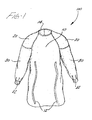
- FIG. 1 is an Isometric view of an operating gown made in accordance with the present invention.
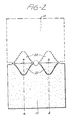
- FIG. 2 illustrates, partially in phantom, a pattern for cutting fabric in order to construct the body and shoulder portions of the gown of FIG. 1.
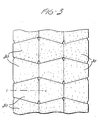
- FIG. 3 illustrates a pattern for cutting fabric in order to construct the lower sleeve portions of the gown of FIG. 1.
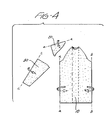
- FIG. 4 is an exploded elevation view of the manner in which the pieces of fabric cut along the patterns shown in FIGS. 2 and 3 are attached to each other.
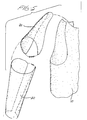
- FIG. 5 is an exploded partial isometric view of the shoulder and lower sleeve section of the gown shown in FIG. 1.
- FIG. 6 is a partial isometric view of the sleeve and shoulder portions of the gown of FIG. 1 as worn on the body.
- FIG. 1 there is shown a surgical gown 100 made in accordance with the present invention.
- FIG. 1 depicts a surgical gown
- those of ordinary skill will understand that the construction and features of the present invention may be advantageously incorporated into other types of garments, including those worn by both patients and medical personnel.
- Such gowns, garments or covers may be worn in the operating room, during pre- and post- operative (perioperative) procedures, or in other locations such as examination rooms or wards.
- the present invention provides a garment construction particularly suited to use with non-woven, disposable fabrics, however, any fabric or similar material may be substituted depending upon the qualities desired in the resulting garment, such as absorbency, flexibility, etc.
- a surgical gown 100 made in accordance with the present invention will preferably comprise a body portion 10, a shoulder portion 20 and a lower sleeve portion 30.
- tie straps 12 are provided which are attached to the body portion 10, allowing the wearer to secure the gown 100 around the torso.
- the shoulder portions 20 are joined to the body portion 10 and thereby form a raglan sleeve construction.
- the neck opening is surrounded with a suitable neck band 14 or other reinforcement.
- the lower end of the shoulder portions 20 lie at about the bicep of the wearer, i.e., on the arm between the shoulder joint and the elbow joint.
- the lower sleeve portion 30 is joined to the shoulder portion 20 and extends downwardly to about the wrist of the wearer, where it is preferably terminated by a knit wrist cuff 32, as typically used in the art.
- the distal end of the lower sleeve portion 30 may alternately be comprised of an elastic section or finished with a hem, or by other suitable means.
- the length which the lower sleeve section 30 extends down the arm may be varied as desired to cover more or less of the wearer's arm; however, in most instances where the garment is being worn to provide a barrier to infection and contamination, it will be desirable to extend the lower sleeve portion 30 to cover the wrist of the wearer.
- FIG. 2 illustrates a pattern for cutting fabric in order to construct the body portion 10 and shoulder portions 20 of the gown 100 depicted in FIG. 1.
- the body portion 10 is cut in the pattern shown, creating the arcuate pieces which comprise the shoulder portions 20.
- a second body portion 10 and shoulder portions 20 may be cut from a symmetrical "mirror image" pattern if desired.
- one of ordinary skill will be able to envision a pattern wherein the section shown in phantom in FIG.
- the lines delineating the body potion 10 and the shoulder portions 20 are not perfectly matched. It has been found that in order to provide a garment having a suitable appearance and degree of comfort, as depicted in FIG. 1, it is necessary to slightly trim the body portion 10 or the shoulder portions 20 in order to either achieve a correct fit and smooth seams. However, in certain embodiments of the present invention, the techniques used to construct the garment and the characteristics of the fabric may permit such trimming to be avoided while still providing an acceptable garment. Thus, the only wasted fabric which results when cutting the portions in FIG. 2 are the arcuate cutouts necessary to form a neck opening in the gown and any waste pieces resulting from the trimming described above.
- FIG. 3 there is depicted a pattern for cutting fabric in order to construct the lower sleeve portions 30 of the gown of FIG. 1.
- the pattern layout for the lower sleeve portions 30 depicted is designed to minimize wasted fabric.
- the substantially trapezoidal sections of fabric are arranged in a repeating periodic pattern having substantially no waste, except the arcuate section cut from each corner of the base of each trapezoid.
- the fabric of FIG. 3 preferably is not trimmed to create the lower sleeve portions 30, and therefore the pattern lines are depicted as straight cuts.
- a tubular section of material may be provided, such as a knitted tubular fabric section, which is then cut to length and directly attached to the shoulder portion 20 by a circumferential seam to form the lower sleeve portion 30 as depicted in FIG. 1.
- FIGS. 2 and 3 The assembly of the pieces cut from the fabric patterns illustrated in FIGS. 2 and 3 is shown in the exploded elevation view of FIG. 4.
- FIG. 4 For illustrative purposes, only the construction of the right side of the gown is depicted, however, the opposite shoulder and sleeve portions are affixed in the same way.
- the body portion 10 is formed by folding the fabric of the gown 100 about the axes labelled "a-a" and "b-b" shown in both FIGS. 2 and 4. As shown by the arrows in FIG.
- the lateral edges of the body portion 10 are brought substantially together, thereby forming a tubular body portion 10, as depicted, having arm and neck cutouts and a seam or overlap in the back of the garment, as shown by the dashed lines.
- the shoulder portion 20 is also folded about axis "a-a” as shown by the arrow in FIG. 4 and re-oriented slightly to the position shown, where it may be joined to the body porion 10 to form a substantially raglan sleeve construction.
- the lower sleeve section 30 is folded along its longitudinal axis "c-c" shown in FIGS. 3 and 4 in the manner shown by the arrow in FIG. 4 to produce a substantially tapered lower sleeve portion 30.
- FIG. 5 A partial isometric view of the construction of the gown of the present invention is depicted in FIG. 5.
- the body portion 10 is folded or draped into a substantially tubular configuration such that an arm hole section is formed as depicted in FIG. 5.
- the armhole section is substantially the same as that which is formed when constructing a standard raglan sleeve.
- the formerly wasted section of fabric may be utilized to create the shoulder portion 20, which is joined to the body portion 10.
- the lower end of the shoulder portion 20 will form a substantially tubular shape which provides a transition to join the lower sleeve portion 30 with a simple circumferential seam or joint.
- FIG. 6 is a partial isometric view of the gown 100 of FIG. 1 as worn on the body.
- the body portion 10 has been omitted from this view.
- the shoulder portion 20 extends from the neck band 14 down, over the shoulder to approximately the bicep area of the wearer, creating a curved seam extending from the neck to the armpit, in the manner of a raglan sleeve.
- the size of the shoulder portion 20 and the distance it extends downwardly from the wearer's shoulder toward the elbow is a function of the cutout made for the armhole, as explained above.
- the shoulder portion 20 is formed from the fabric section resulting from the arm opening cut out, they will have about the same area.
- the lower section of the shoulder portion 20 is formed into-a substantially tubular structure, which is affixed to the lower sleeve portion as depicted by the dashed lines in FIG. 6.
- the distal end of the lower sleeve portion 10 is preferably terminated with a knit cuff 32, as described above.
- the construction disclosed herein readily adapts to the use of two or more different materials.
- One type of material may be used to create the body portion 10 and shoulder portion 20, while another type of material having different characteristics may be used to form the lower sleeve section 30.
- the relative length of the shoulder portion 20 and lower sleeve portion 30 are governed by the size of the cutout made in the body portion, the variations of this type of designs are somewhat limited.
- the present invention also provides methods of gown construction.
- the methods of making a garment in accordance with the present invention comprise providing a first section of material and cutting a neck opening and two arm openings by removing a portion of the material.
- a second section of material is then provided and two lower sleeve portions are cut from it.
- the next step includes forming a body portion of a garment from the first section of material and forming two shoulder portions form the portions of the first section of material removed to form the arm openings.
- Two sleeve portions are formed from the pieces cut from the second section of material and are attached to the shoulder portions. The shoulder portions are then attached to the body portion of the garment.
- the methods of the present invention include the step of trimming the body portion or the shoulder portions to achieve a proper fit.
- a knit cuff may be attached to the termination of the lower sleeve portion.
- the methods of the present invention may also be adapted to produce multiple pieces.
- the first and the second sections of material will comprise multiple layers of material and the steps of cutting will comprise cutting the multiple layers simultaneously. A plurality of body portions, shoulder portions and sleeve portions will therefore be formed, permitting efficient mass production.
- the joints and seams depicted in FIG. 6 and described above are most preferably stitched joints between two or more layers of overlapped fabric.
- the steps of attaching the shoulder portions to the body portions and of attaching the sleeve portions to the shoulder portions comprises sewing a seam.
- adhesives or heat fusion it may be preferred to used adhesives or heat fusion to form these seams.
- mechanical fasteners such as zippers, snaps or velcro-type fastening systems may be preferred.
Landscapes
- Engineering & Computer Science (AREA)
- Textile Engineering (AREA)
- Health & Medical Sciences (AREA)
- General Health & Medical Sciences (AREA)
- Physical Education & Sports Medicine (AREA)
- Professional, Industrial, Or Sporting Protective Garments (AREA)
- Details Of Garments (AREA)
- Materials For Medical Uses (AREA)
- Auxiliary Devices For And Details Of Packaging Control (AREA)
Applications Claiming Priority (2)
| Application Number | Priority Date | Filing Date | Title |
|---|---|---|---|
| US532920 | 1990-06-04 | ||
| US07/532,920 US5062160A (en) | 1990-06-04 | 1990-06-04 | Raglan sleeve surgical gown |
Publications (2)
| Publication Number | Publication Date |
|---|---|
| EP0460907A1 true EP0460907A1 (de) | 1991-12-11 |
| EP0460907B1 EP0460907B1 (de) | 1995-07-26 |
Family
ID=24123746
Family Applications (1)
| Application Number | Title | Priority Date | Filing Date |
|---|---|---|---|
| EP91305028A Expired - Lifetime EP0460907B1 (de) | 1990-06-04 | 1991-06-04 | Operationsgewand mit Raglanärmeln |
Country Status (10)
| Country | Link |
|---|---|
| US (1) | US5062160A (de) |
| EP (1) | EP0460907B1 (de) |
| JP (1) | JP3268535B2 (de) |
| AT (1) | ATE125429T1 (de) |
| AU (1) | AU634066B2 (de) |
| BR (1) | BR9102270A (de) |
| DE (1) | DE69111520T2 (de) |
| ES (1) | ES2077802T3 (de) |
| GR (1) | GR1001005B (de) |
| ZA (1) | ZA914199B (de) |
Cited By (4)
| Publication number | Priority date | Publication date | Assignee | Title |
|---|---|---|---|---|
| WO1995002973A1 (en) * | 1993-07-22 | 1995-02-02 | Kimberly-Clark Corporation | Surgical gown and method for making the same |
| WO1995026649A1 (en) * | 1994-03-30 | 1995-10-12 | Kimberly-Clark Corporation | Surgical gown and method for making the same |
| SG88816A1 (en) * | 2000-04-21 | 2002-05-21 | Uni Charm Corp | Disposable gown |
| WO2021076015A1 (ru) * | 2019-10-15 | 2021-04-22 | Общество с ограниченной ответственностью "Тактика" | Компрессионная рубашка под бронежилет |
Families Citing this family (10)
| Publication number | Priority date | Publication date | Assignee | Title |
|---|---|---|---|---|
| CA2153923A1 (en) * | 1994-08-04 | 1996-02-05 | David Loring Covington | Reinforced sleeve for surgical gown |
| SE525415C2 (sv) * | 2002-07-03 | 2005-02-15 | Moelnlycke Health Care Ab | Värmeavgivande patientdräkt |
| US6990686B2 (en) * | 2002-08-07 | 2006-01-31 | Scott William Palmer | Protective garment for caregivers of infants and small children |
| DE10250275B4 (de) * | 2002-10-28 | 2014-08-21 | Paul Hartmann Ag | Wegwerfbares Bekleidungsstück |
| CA2558326A1 (en) * | 2006-07-14 | 2008-01-14 | Sophia Kelly | Hospital garment |
| KR101116311B1 (ko) | 2009-09-10 | 2012-03-13 | (주)아원 | 일회용 보호가운 |
| KR101116315B1 (ko) | 2009-09-10 | 2012-03-13 | (주)아원 | 일회용 보호가운 |
| US11547160B2 (en) | 2018-10-23 | 2023-01-10 | Medline Industries, Lp | Gown with selectively openable sleeve |
| WO2022266715A1 (en) * | 2021-06-23 | 2022-12-29 | Multigate Medical Products Pty Ltd | Medical gown and method of manufacture |
| JP7684699B2 (ja) * | 2022-07-26 | 2025-05-28 | 株式会社オンライン | ラグランスリーブ型衣服 |
Citations (3)
| Publication number | Priority date | Publication date | Assignee | Title |
|---|---|---|---|---|
| US3349285A (en) * | 1967-05-08 | 1967-10-24 | Angelica Uniform Company | Surgical gown with static electricity discharge means |
| US4504977A (en) * | 1983-04-29 | 1985-03-19 | King Mary K | Disposable zoned surgical gown |
| US4586196A (en) * | 1984-10-03 | 1986-05-06 | The Kendall Company | Disposable surgical gown |
Family Cites Families (7)
| Publication number | Priority date | Publication date | Assignee | Title |
|---|---|---|---|---|
| US2668294A (en) * | 1951-04-02 | 1954-02-09 | Phyllis B Gilpin | Disposable hospital gown |
| GB1059765A (en) * | 1964-03-19 | 1967-02-22 | Cav Ltd | Electrical speed-control apparatus |
| US3353189A (en) * | 1965-06-07 | 1967-11-21 | Zimmon & Company Inc | Disposable gown with one-piece body and sleeves having elastic sleeve closure |
| US3570012A (en) * | 1969-03-12 | 1971-03-16 | Kimberly Clark Co | Surgical gown |
| US4214320A (en) * | 1979-01-11 | 1980-07-29 | Superior Surgical Mfg. Co., Inc. | Surgical gown and method of donning gown |
| US4622699A (en) * | 1984-12-26 | 1986-11-18 | Hospital Corporation Of Lanier, Inc. | Hospital gown |
| US4920578A (en) * | 1989-04-03 | 1990-05-01 | Bertha Janzen | Patient's gown |
-
1990
- 1990-06-04 US US07/532,920 patent/US5062160A/en not_active Expired - Lifetime
-
1991
- 1991-06-03 GR GR910100240A patent/GR1001005B/el not_active IP Right Cessation
- 1991-06-03 BR BR919102270A patent/BR9102270A/pt not_active IP Right Cessation
- 1991-06-03 ZA ZA914199A patent/ZA914199B/xx unknown
- 1991-06-03 JP JP15738891A patent/JP3268535B2/ja not_active Expired - Fee Related
- 1991-06-03 AU AU78124/91A patent/AU634066B2/en not_active Ceased
- 1991-06-04 AT AT91305028T patent/ATE125429T1/de not_active IP Right Cessation
- 1991-06-04 EP EP91305028A patent/EP0460907B1/de not_active Expired - Lifetime
- 1991-06-04 DE DE69111520T patent/DE69111520T2/de not_active Expired - Fee Related
- 1991-06-04 ES ES91305028T patent/ES2077802T3/es not_active Expired - Lifetime
Patent Citations (3)
| Publication number | Priority date | Publication date | Assignee | Title |
|---|---|---|---|---|
| US3349285A (en) * | 1967-05-08 | 1967-10-24 | Angelica Uniform Company | Surgical gown with static electricity discharge means |
| US4504977A (en) * | 1983-04-29 | 1985-03-19 | King Mary K | Disposable zoned surgical gown |
| US4586196A (en) * | 1984-10-03 | 1986-05-06 | The Kendall Company | Disposable surgical gown |
Cited By (5)
| Publication number | Priority date | Publication date | Assignee | Title |
|---|---|---|---|---|
| WO1995002973A1 (en) * | 1993-07-22 | 1995-02-02 | Kimberly-Clark Corporation | Surgical gown and method for making the same |
| WO1995026649A1 (en) * | 1994-03-30 | 1995-10-12 | Kimberly-Clark Corporation | Surgical gown and method for making the same |
| US6115839A (en) * | 1994-03-30 | 2000-09-12 | Kimberly-Clark Worldwide, Inc. | Surgical gown and method for making the same |
| SG88816A1 (en) * | 2000-04-21 | 2002-05-21 | Uni Charm Corp | Disposable gown |
| WO2021076015A1 (ru) * | 2019-10-15 | 2021-04-22 | Общество с ограниченной ответственностью "Тактика" | Компрессионная рубашка под бронежилет |
Also Published As
| Publication number | Publication date |
|---|---|
| ZA914199B (en) | 1993-02-24 |
| ES2077802T3 (es) | 1995-12-01 |
| GR910100240A (en) | 1992-08-25 |
| DE69111520D1 (de) | 1995-08-31 |
| AU634066B2 (en) | 1993-02-11 |
| JP3268535B2 (ja) | 2002-03-25 |
| AU7812491A (en) | 1991-12-05 |
| JPH05106102A (ja) | 1993-04-27 |
| US5062160A (en) | 1991-11-05 |
| GR1001005B (el) | 1993-03-31 |
| ATE125429T1 (de) | 1995-08-15 |
| EP0460907B1 (de) | 1995-07-26 |
| BR9102270A (pt) | 1992-01-14 |
| DE69111520T2 (de) | 1996-02-08 |
Similar Documents
| Publication | Publication Date | Title |
|---|---|---|
| US5083315A (en) | Unisex scrub shirt and methods for making same | |
| EP0460907B1 (de) | Operationsgewand mit Raglanärmeln | |
| US5444872A (en) | Overlapping hospital gown | |
| US4017909A (en) | Disposable operating room gown | |
| US4631756A (en) | Method of making apparel | |
| US4587671A (en) | Open, wraparound, sleeved garment | |
| US4369528A (en) | Garment for maintaining body temperature and method of making same | |
| US5274852A (en) | One piece, open seam wrapping garment for covering and uncovering the human body on-demand | |
| US5093934A (en) | Raglan sleeve surgical gown | |
| JP2550376B2 (ja) | 衣服用材料片及び該材料片から製造した衣服 | |
| US4819275A (en) | Disposable gown for medical patients | |
| US6868556B1 (en) | Shirt with hook and loop fasteners | |
| JP2999983B2 (ja) | 手術用ガウン | |
| CA2126913A1 (en) | Surgical gown and method for making the same | |
| JP7312347B2 (ja) | 衣服 | |
| JP2603716Y2 (ja) | 分離と接合が容易な衣服 | |
| JPH0532484Y2 (de) | ||
| JPH033529Y2 (de) | ||
| JP3616288B2 (ja) | 防火服の上着 | |
| EP0625316A1 (de) | Unterhose | |
| JP2533748Y2 (ja) | 前毛芯 | |
| JP3003542U (ja) | ネクタイ形状の切り抜きを有するシャツ及びシャツ構成体組み合わせジャケット | |
| US20030213048A1 (en) | Customizable gloves | |
| JPH0634326Y2 (ja) | ストール | |
| WO2026083914A1 (ja) | 衣服 |
Legal Events
| Date | Code | Title | Description |
|---|---|---|---|
| PUAI | Public reference made under article 153(3) epc to a published international application that has entered the european phase |
Free format text: ORIGINAL CODE: 0009012 |
|
| AK | Designated contracting states |
Kind code of ref document: A1 Designated state(s): AT CH DE ES FR GB IT LI SE |
|
| 17P | Request for examination filed |
Effective date: 19920516 |
|
| 17Q | First examination report despatched |
Effective date: 19931129 |
|
| GRAA | (expected) grant |
Free format text: ORIGINAL CODE: 0009210 |
|
| AK | Designated contracting states |
Kind code of ref document: B1 Designated state(s): AT CH DE ES FR GB IT LI SE |
|
| REF | Corresponds to: |
Ref document number: 125429 Country of ref document: AT Date of ref document: 19950815 Kind code of ref document: T |
|
| REF | Corresponds to: |
Ref document number: 69111520 Country of ref document: DE Date of ref document: 19950831 |
|
| ET | Fr: translation filed | ||
| ITF | It: translation for a ep patent filed | ||
| REG | Reference to a national code |
Ref country code: ES Ref legal event code: FG2A Ref document number: 2077802 Country of ref document: ES Kind code of ref document: T3 |
|
| PLBE | No opposition filed within time limit |
Free format text: ORIGINAL CODE: 0009261 |
|
| STAA | Information on the status of an ep patent application or granted ep patent |
Free format text: STATUS: NO OPPOSITION FILED WITHIN TIME LIMIT |
|
| 26N | No opposition filed | ||
| PGFP | Annual fee paid to national office [announced via postgrant information from national office to epo] |
Ref country code: SE Payment date: 19970618 Year of fee payment: 7 |
|
| PG25 | Lapsed in a contracting state [announced via postgrant information from national office to epo] |
Ref country code: SE Free format text: LAPSE BECAUSE OF NON-PAYMENT OF DUE FEES Effective date: 19980605 |
|
| EUG | Se: european patent has lapsed |
Ref document number: 91305028.2 |
|
| REG | Reference to a national code |
Ref country code: GB Ref legal event code: IF02 |
|
| REG | Reference to a national code |
Ref country code: CH Ref legal event code: PUE Owner name: ETHICON, INC. TRANSFER- MOELNLYCKE HEALTH CARE AB Ref country code: CH Ref legal event code: PFA Free format text: JOHNSON & JOHNSON MEDICAL, INC. TRANSFER- ETHICON, INC. |
|
| REG | Reference to a national code |
Ref country code: GB Ref legal event code: 732E |
|
| PGFP | Annual fee paid to national office [announced via postgrant information from national office to epo] |
Ref country code: CH Payment date: 20040614 Year of fee payment: 14 |
|
| PGFP | Annual fee paid to national office [announced via postgrant information from national office to epo] |
Ref country code: AT Payment date: 20040621 Year of fee payment: 14 |
|
| PG25 | Lapsed in a contracting state [announced via postgrant information from national office to epo] |
Ref country code: AT Free format text: LAPSE BECAUSE OF NON-PAYMENT OF DUE FEES Effective date: 20050604 |
|
| PG25 | Lapsed in a contracting state [announced via postgrant information from national office to epo] |
Ref country code: LI Free format text: LAPSE BECAUSE OF NON-PAYMENT OF DUE FEES Effective date: 20050630 Ref country code: CH Free format text: LAPSE BECAUSE OF NON-PAYMENT OF DUE FEES Effective date: 20050630 |
|
| REG | Reference to a national code |
Ref country code: CH Ref legal event code: PL |
|
| PGFP | Annual fee paid to national office [announced via postgrant information from national office to epo] |
Ref country code: ES Payment date: 20070618 Year of fee payment: 17 |
|
| PGFP | Annual fee paid to national office [announced via postgrant information from national office to epo] |
Ref country code: DE Payment date: 20070622 Year of fee payment: 17 |
|
| PGFP | Annual fee paid to national office [announced via postgrant information from national office to epo] |
Ref country code: GB Payment date: 20070612 Year of fee payment: 17 |
|
| PGFP | Annual fee paid to national office [announced via postgrant information from national office to epo] |
Ref country code: IT Payment date: 20070616 Year of fee payment: 17 |
|
| PGFP | Annual fee paid to national office [announced via postgrant information from national office to epo] |
Ref country code: FR Payment date: 20070531 Year of fee payment: 17 |
|
| GBPC | Gb: european patent ceased through non-payment of renewal fee |
Effective date: 20080604 |
|
| REG | Reference to a national code |
Ref country code: FR Ref legal event code: ST Effective date: 20090228 |
|
| PG25 | Lapsed in a contracting state [announced via postgrant information from national office to epo] |
Ref country code: DE Free format text: LAPSE BECAUSE OF NON-PAYMENT OF DUE FEES Effective date: 20090101 |
|
| PG25 | Lapsed in a contracting state [announced via postgrant information from national office to epo] |
Ref country code: GB Free format text: LAPSE BECAUSE OF NON-PAYMENT OF DUE FEES Effective date: 20080604 |
|
| REG | Reference to a national code |
Ref country code: ES Ref legal event code: FD2A Effective date: 20080605 |
|
| PG25 | Lapsed in a contracting state [announced via postgrant information from national office to epo] |
Ref country code: FR Free format text: LAPSE BECAUSE OF NON-PAYMENT OF DUE FEES Effective date: 20080630 Ref country code: IT Free format text: LAPSE BECAUSE OF NON-PAYMENT OF DUE FEES Effective date: 20080604 |
|
| PG25 | Lapsed in a contracting state [announced via postgrant information from national office to epo] |
Ref country code: ES Free format text: LAPSE BECAUSE OF NON-PAYMENT OF DUE FEES Effective date: 20080605 |