EP0461690A2 - Wärmegenerator für kalte Kernfusion - Google Patents
Wärmegenerator für kalte Kernfusion Download PDFInfo
- Publication number
- EP0461690A2 EP0461690A2 EP91201214A EP91201214A EP0461690A2 EP 0461690 A2 EP0461690 A2 EP 0461690A2 EP 91201214 A EP91201214 A EP 91201214A EP 91201214 A EP91201214 A EP 91201214A EP 0461690 A2 EP0461690 A2 EP 0461690A2
- Authority
- EP
- European Patent Office
- Prior art keywords
- cathode
- hydrogen
- nuclei
- fusion
- boron
- Prior art date
- Legal status (The legal status is an assumption and is not a legal conclusion. Google has not performed a legal analysis and makes no representation as to the accuracy of the status listed.)
- Withdrawn
Links
Images
Classifications
-
- G—PHYSICS
- G21—NUCLEAR PHYSICS; NUCLEAR ENGINEERING
- G21B—FUSION REACTORS
- G21B3/00—Low temperature nuclear fusion reactors, e.g. alleged cold fusion reactors
-
- Y—GENERAL TAGGING OF NEW TECHNOLOGICAL DEVELOPMENTS; GENERAL TAGGING OF CROSS-SECTIONAL TECHNOLOGIES SPANNING OVER SEVERAL SECTIONS OF THE IPC; TECHNICAL SUBJECTS COVERED BY FORMER USPC CROSS-REFERENCE ART COLLECTIONS [XRACs] AND DIGESTS
- Y02—TECHNOLOGIES OR APPLICATIONS FOR MITIGATION OR ADAPTATION AGAINST CLIMATE CHANGE
- Y02E—REDUCTION OF GREENHOUSE GAS [GHG] EMISSIONS, RELATED TO ENERGY GENERATION, TRANSMISSION OR DISTRIBUTION
- Y02E30/00—Energy generation of nuclear origin
- Y02E30/10—Nuclear fusion reactors
Definitions
- This invention relates to a novel method and apparatus for generating heat energy by means of cold nuclear fusion.
- Plasmas at such temperatures cannot be contained in conventional vessels. Therefore, most of the research has been directed towards confining plasmas in magnetic fields or pelletizing fusionable fuel so that it can be ignited by high energy laser or particle beams. Currently, "hot" fusion has not provided a net output of usable energy.
- muons negatively charged elementary particles which are about 206 times more massive than electrons, could be used to catalyze fusion reactions between low atomic weight constituents such as protons and deuterons. Muon catalyzed nuclear fusion was later observed.
- cold fusion means a reaction between at least two nuclei to produce one or more new nuclei plus energy where the reaction constituents are not contained in a plasma.
- a cold fusion thermal generator which uses the electrolysis of water (H2O) in the electrolyte to pack hydrogen in a specially adapted cathode.
- the cathode comprises a matrix of boron and a molecular sieve that selectively adsorbs hydrogen and releases helium.
- An inert hydrogen adsorbing metal such as palladium or platinum may be included in the matrix to improve electrical conductivity.
- the anode comprises an electrically conductive chemically resistant metal such as Monel and preferably surrounds the cathode.
- the electrodes are retained in a pressure vessel adjacent a container for a heat exchange fluid. Vents are provided for gases produced by the electrolysis and fusion reactions. Means are provided to replenish the electrolyte while the cell is operating.
- a like method of producing heat by fusion entails substituting Lithium for boron at the cathode and applying appropriate current density and voltage to cause the following reaction p + 6Li ⁇ 3He + ⁇ (4.0 MeV).
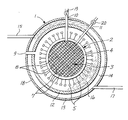
- the figure is a plan sectional view of a cell for generating heat by cold fusion showing the hydrogen-adsorbing cathode, the anode, the reaction vessel and heat exchange vessel.
- FIG. 1 a sectional view of a cell 1 for generating heat by cold fusion is shown.
- Cell 1 is electrolytic in nature, current passing between anode 2 and cathode 3.
- Anode 2 comprises ring 4 of conductive metal surrounding cathode 3.
- a plurality of T-shaped fins 5 are attached to ring 4 to increase its surface area.
- Cathode 3 is a composite of a hydrogen adsorbing agent, such as an alumosilicate molecular sieve, an inert and/or hydrogen adsorbing metallic conductor such as platinum, or a zeolyte catalyst; and 11B isotope, preferably amorphous elemental boron.
- the matrix is formed to be microporous with uniform lattice vacancies sized to allow retention of hydrogen nuclei at the active (cathodic) surface and the escape of helium or alpha particles, such as the adsorption/desorption processes occurring in packed-column gas-chromatographs or vapor-fractometers.
- Cathode 3 has a right circular cylindrical outside shape and a plurality of walls 7 and channels 8 for flow of electrolyte 16.
- the grid shape provides increased surface area along and within walls 7 for the cathodic adsorption of hydrogen and for nuclear reactions with boron to occur.
- Reaction vessel 12 is preferably made of a strong, heat conductive, non-magnetic alloy such as austenitic stainless steel. Fluid inlet 9 and an optional outlet (not shown) are provided to augment electrolyte 16 with water or chemicals and remove spent reaction products. Vent 10 with pressure relief valve 19 is provided adjacent cathode 3 for releasing alpha particles and/or helium produced by fusion, and vent 11 with pressure relief valve 20 is provided at anode 2 to exhaust oxygen from electrolysis of water. If desired, the helium can be sparged through reaction vessel 12 to encourage mixing.
- Reaction vessel 12 is surrounded by larger vessel 13 in which a heat exchange medium 14 is disposed. Heat from fusion reactions is transferred to medium 14 and collected for a use such as turbine power generation.
- medium 14 is a fluid at reactor operating temperatures that is recirculated through inlet 15 and outlet 17.
- Medium 14 may be a liquid metal such as sodium, for example.
- Larger vessel 13 is insulated with a heat resistant layer of insulation 18, such as an ultra-lightweight aerogel of the type being developed for the National Aeronautics and Space Administration (NASA).
- An aerogel would also serve as a shield for any low-level radiation that may be produced by the reaction.
- One major advantage of this invention is that no neutron shielding is required since no or insignificant numbers of neutrons are produced.
- Electrolyte 16 in reaction vessel 12 is water-based and preferably an aqueous solution of a boron compound such as boric acid. Electrolyte 16 can be replenished, as needed with water and chemicals.
- a further advantage of this invention is that ordinary water rather than heavy water is used in the electrolytic cell.
- a direct current is applied across the electrodes so that hydrogen ions are produced at cathode 3 and oxygen is produced at anode 2.
- the voltage is preferably in the range of from about 1 to 30 Volts, and the current density about 1 to 100 mA/cm2.
- the oxygen is vented from anode 2 through vent 11 and pressure relief valve 20.
- the hydrogen ion is held in solution and adsorbed into cathode 3.
- the rate of electrolysis is preferably controlled by adjusting current density to maximize hydrogen adsorption.
- the exact reaction mechanism of the nuclear fusion is not understood.
- the adsorbed hydrogen in the cathode is believed to fuse with 11B nuclei by the reaction p + 11B ⁇ 3 ⁇ (8.7 MeV) where the released energy is transformed to heat in the reaction vessel and removed through a heat exchanger.
- the calculated energy release is based on the resonance cross section of the constituent nuclei at 1 MeV or less.
- the fusion reaction and amount of heat liberated by the cell may be controlled by varying current and voltage across the electrodes and the temperature of the cell. Alpha particles are converted to helium and vented.
- lithium is substituted for boron in the composite cathode and the fusion reaction p + 6Li ⁇ 3He + ⁇ (4.0 MeV) is carried out.
- the current, voltage and cell temperature are adjusted to optimize the reaction.
Landscapes
- Physics & Mathematics (AREA)
- Engineering & Computer Science (AREA)
- Plasma & Fusion (AREA)
- General Engineering & Computer Science (AREA)
- High Energy & Nuclear Physics (AREA)
- Electrolytic Production Of Non-Metals, Compounds, Apparatuses Therefor (AREA)
Applications Claiming Priority (2)
| Application Number | Priority Date | Filing Date | Title |
|---|---|---|---|
| US53864090A | 1990-06-13 | 1990-06-13 | |
| US538640 | 1990-06-13 |
Publications (2)
| Publication Number | Publication Date |
|---|---|
| EP0461690A2 true EP0461690A2 (de) | 1991-12-18 |
| EP0461690A3 EP0461690A3 (en) | 1992-03-11 |
Family
ID=24147782
Family Applications (1)
| Application Number | Title | Priority Date | Filing Date |
|---|---|---|---|
| EP19910201214 Withdrawn EP0461690A3 (en) | 1990-06-13 | 1991-05-21 | Cold nuclear fusion thermal generator |
Country Status (1)
| Country | Link |
|---|---|
| EP (1) | EP0461690A3 (de) |
Cited By (7)
| Publication number | Priority date | Publication date | Assignee | Title |
|---|---|---|---|---|
| WO2002031833A1 (en) * | 2000-09-29 | 2002-04-18 | Arie Melis De Geus | Nuclear transmutational processes |
| ITPI20110046A1 (it) * | 2011-04-26 | 2012-10-27 | Chellini Fabio | Metodo e apparato per generare energia mediante reazioni nucleari di idrogeno adsorbito per cattura orbitale da una nanostruttura cristallina di un metallo |
| KR20180118035A (ko) * | 2017-04-20 | 2018-10-30 | 한국과학기술원 | 양성자-붕소 핵반응을 이용한 발전 시스템 |
| KR20190062789A (ko) * | 2017-11-29 | 2019-06-07 | 한국과학기술원 | 양성자-붕소 핵반응을 이용한 발전 시스템 |
| KR20190062786A (ko) * | 2017-11-29 | 2019-06-07 | 한국과학기술원 | 중성자-붕소 핵반응을 이용한 발전 시스템 |
| CN109983539A (zh) * | 2016-11-17 | 2019-07-05 | 诺伦特聚变能公司 | 用于产生在聚变反应器中具有预定用途的μ介子的设备 |
| KR20190138627A (ko) * | 2017-11-29 | 2019-12-13 | 한국과학기술원 | 양성자-붕소 핵반응을 이용한 발전 시스템 |
Family Cites Families (2)
| Publication number | Priority date | Publication date | Assignee | Title |
|---|---|---|---|---|
| DE3910806A1 (de) * | 1989-04-04 | 1990-10-11 | Hora Heinrich | Verfahren und anordnung zu kernverschmelzungsreaktionen bei tiefen temperaturen |
| JPH04505505A (ja) * | 1989-06-02 | 1992-09-24 | ジョンソン マッセイ パブリック リミティド カンパニー | 材料の改良 |
-
1991
- 1991-05-21 EP EP19910201214 patent/EP0461690A3/en not_active Withdrawn
Cited By (9)
| Publication number | Priority date | Publication date | Assignee | Title |
|---|---|---|---|---|
| WO2002031833A1 (en) * | 2000-09-29 | 2002-04-18 | Arie Melis De Geus | Nuclear transmutational processes |
| ITPI20110046A1 (it) * | 2011-04-26 | 2012-10-27 | Chellini Fabio | Metodo e apparato per generare energia mediante reazioni nucleari di idrogeno adsorbito per cattura orbitale da una nanostruttura cristallina di un metallo |
| WO2012147045A1 (en) * | 2011-04-26 | 2012-11-01 | Piantelli, Silvia | Method and apparatus for generating energy by nuclear reactions of hydrogen adsorbed by orbital capture on a nanocrystalline structure of a metal |
| CN103518237A (zh) * | 2011-04-26 | 2014-01-15 | S·皮安泰利 | 通过由金属的纳米晶体结构上的轨道俘获吸附的氢的核反应产生能量的方法和装置 |
| CN109983539A (zh) * | 2016-11-17 | 2019-07-05 | 诺伦特聚变能公司 | 用于产生在聚变反应器中具有预定用途的μ介子的设备 |
| KR20180118035A (ko) * | 2017-04-20 | 2018-10-30 | 한국과학기술원 | 양성자-붕소 핵반응을 이용한 발전 시스템 |
| KR20190062789A (ko) * | 2017-11-29 | 2019-06-07 | 한국과학기술원 | 양성자-붕소 핵반응을 이용한 발전 시스템 |
| KR20190062786A (ko) * | 2017-11-29 | 2019-06-07 | 한국과학기술원 | 중성자-붕소 핵반응을 이용한 발전 시스템 |
| KR20190138627A (ko) * | 2017-11-29 | 2019-12-13 | 한국과학기술원 | 양성자-붕소 핵반응을 이용한 발전 시스템 |
Also Published As
| Publication number | Publication date |
|---|---|
| EP0461690A3 (en) | 1992-03-11 |
Similar Documents
| Publication | Publication Date | Title |
|---|---|---|
| JP2008201671A (ja) | より低エネルギー水素の方法と構造 | |
| US3957597A (en) | Process for recovering tritium from molten lithium metal | |
| GB2382591A (en) | Method of Separating and Recovering Fission Products from Spent Nuclear Fuels | |
| EP0473681B1 (de) | Fusionsenergieerzeugung | |
| US20070280398A1 (en) | Modified electrodes for low energy nuclear reaction power generators | |
| WO2002097166A1 (en) | Pulsed electrolytic cell | |
| US20010019594A1 (en) | Method and apparatus to control loaded isotopic fuel within a material | |
| JP2009150709A (ja) | リチウムクラスター化学核融合発生方法及びリチウムクラスター化学核融合装置 | |
| WO1991006959A2 (en) | Media for solid state fusion | |
| Fundamenski et al. | Evolution and status of D-3He fusion: a critical review | |
| US3350231A (en) | Fuel cell electrode and method of using same | |
| JP2002512377A (ja) | 金属的性質を有する水素化物からエネルギーを発生させる方法および装置 | |
| WO1990013897A1 (en) | Deuterium-lithium energy conversion cell | |
| US20150055740A1 (en) | In space startup method for nuclear fusion rocket engines | |
| AU4145993A (en) | Energy production from the control of probabilities through quantum level induced interactions | |
| WO2026028231A2 (en) | Apparatus for producing energy, and method for using the apparatus | |
| US12278016B1 (en) | Two-stage process for hydrogen isotope loading in a cathode material | |
| WO1991019294A1 (en) | Distributed deuterium-lithium energy apparatus | |
| Kim | Fission-induced inertial confinement hot fusion and cold fusion with electrolysis | |
| Kunkel | Multimegawatt neutral beams for tokamaks | |
| Protsenko et al. | Properties and Characteristics of Hydrogen | |
| Furth | The energy source: nuclear fusion reactors | |
| Pike | Chemical Aspects of LENR | |
| Ushakov | Unconventional (Alternative) Methods of Electric Energy Production | |
| Forsley et al. | Low and High Temperature Non-Thermonuclear Fusion Approaches to Energy Production |
Legal Events
| Date | Code | Title | Description |
|---|---|---|---|
| PUAI | Public reference made under article 153(3) epc to a published international application that has entered the european phase |
Free format text: ORIGINAL CODE: 0009012 |
|
| AK | Designated contracting states |
Kind code of ref document: A2 Designated state(s): DE FR GB IT NL |
|
| PUAL | Search report despatched |
Free format text: ORIGINAL CODE: 0009013 |
|
| AK | Designated contracting states |
Kind code of ref document: A3 Designated state(s): DE FR GB IT NL |
|
| 17P | Request for examination filed |
Effective date: 19920901 |
|
| 17Q | First examination report despatched |
Effective date: 19940221 |
|
| STAA | Information on the status of an ep patent application or granted ep patent |
Free format text: STATUS: THE APPLICATION IS DEEMED TO BE WITHDRAWN |
|
| 18D | Application deemed to be withdrawn |
Effective date: 19970305 |