EP0461884A2 - Identifikation einer Störungsquelle - Google Patents
Identifikation einer Störungsquelle Download PDFInfo
- Publication number
- EP0461884A2 EP0461884A2 EP91305312A EP91305312A EP0461884A2 EP 0461884 A2 EP0461884 A2 EP 0461884A2 EP 91305312 A EP91305312 A EP 91305312A EP 91305312 A EP91305312 A EP 91305312A EP 0461884 A2 EP0461884 A2 EP 0461884A2
- Authority
- EP
- European Patent Office
- Prior art keywords
- signal
- receiver
- identification
- amplitude
- transmitter
- Prior art date
- Legal status (The legal status is an assumption and is not a legal conclusion. Google has not performed a legal analysis and makes no representation as to the accuracy of the status listed.)
- Withdrawn
Links
Images


Classifications
-
- H—ELECTRICITY
- H04—ELECTRIC COMMUNICATION TECHNIQUE
- H04B—TRANSMISSION
- H04B1/00—Details of transmission systems, not covered by a single one of groups H04B3/00 - H04B13/00; Details of transmission systems not characterised by the medium used for transmission
- H04B1/06—Receivers
- H04B1/10—Means associated with receiver for limiting or suppressing noise or interference
- H04B1/1027—Means associated with receiver for limiting or suppressing noise or interference assessing signal quality or detecting noise/interference for the received signal
Definitions
- This invention relates to communications systems, and more particularly to interference among separate communications channels in a communications system.
- each transmitter covers a specific "field of view" and reveivers associated with the transmitter are disposed within the field of view and tuned to the proper frequency.
- a first transmitter may cover a first portion of the United States and use the same frequency band as a second transmitter aimed toward a second portion of the United States.
- a receiver Depending on which field of view a receiver is located in, it will receive the transmissions of one of the transmitters.
- FIG. 1 is a block diagram which depicts the above discussed problem in a terrestrial/satellite communications system.
- Transmitters 101-103 are intended to transmit information to receivers 109-113, 114-117, and 104-103, respectively.
- satellite 118 is intended to transmit information to several other receivers (not shown). It can be seen, that if the distance between any two of transmitters 101-103 is not large enough, transmissions from a transmitter will be received by receivers which are associated with a different transmitter.
- the transmitters In practice, in order to determine which particular one of many possible sources is causing the interference, the transmitters must be turned off, one at a time, until turning off a particular transmitter results in substantial reduction in interference. The particular transmitter is then identified as that causing the problem, and appropriate adjustements to this transmitter can then be made.
- a small identification (ID) signal is superimposed on a main signal, and the sum is transmitted from a transmitter.
- the ID signal is different for each transmitter.
- each receiver When the system is functioning properly, the only ID signal received by each receiver should be that of the transmitter intended to transmit to that receiver. If any other ID signal appears with any substantial amount of energy at a receiver, it means that the transmitter associated with that ID signal is interfering with the signal being received by the receiver. Thus, by comparing the relative magnitudes of several received ID signals, each receiver can determine if interference occurs, the source of such interference, and the relative strength of the interference, almost instantaneously and with no interruption of service.
- the ID signal is a pseudorandom, spread spectrum signal
- the comparing is accomplished by using a bank of matched filter, surface acoustic wave filters, or correlators.
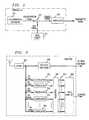
- FIG. 1 shows a block diagram of a terrestrial communication system.
- FIG. 2 depicts a transmitter capable of superimposing an identification signal on a transmitted data signal.
- FIG. 3 shows a receiver for receiving a signal transmitted by the transmitter of FIG. 2.
- FIG. 4 depicts an alternative embodiment of a transmitter for use with the invention.
- FIG. 5 shows a block diagram of a receiver for receiving signals transmitted by the transmitter of FIG. 4.
- FIG. 2 shows a transmitter comprising pseudorandom generator 101, summer 103 and modulator 104. Also shown in FIG. 1 is a data source 102 connected to the transmitter.
- the data source may be any type of equipment such as a multiplexer, computer, switch, etc. Further, while a the general term data is used, the data may actually be video, voice, or any other type of information.
- signals from the data source 102 are transmitted to summer 103.
- Pseudorandom generator 101 also transmits a pseudorandom code to summer 103.
- the amplitude of the pseudorandom code is preferably adjusted to be much less than the amplitude of the data signals transmitted by the data source to summer 103.
- the output from summer 103 will be comprised mostly of energy from the data signal and only a small portion, say one percent, energy from the pseudorandom signal. This pseudorandom signal is the identification code previously discussed.
- This summed signal from summer 103 is then conveyed to modulator 104 as depicted in FIG. 2.
- Modulator 104 is then connected to an appropriate transmitting antenna (not shown) for transmission of the signal.
- the pseudorandom signal generated at each transmitter in the communication system is preferably unique to that transmitter. Further, the pseudorandom signals at the transmitters should be substantially orthogonal to each other.
- Thechniques for generating these orthogonal signals such as maximal length shift register with pre-determined feedback paths and Gold codes, are well known in the art and can be used to practice this invention.
- FIG. 3 shows an exemplary receiver for receiving the signal transmitted by the transimitter of FIG. 2.
- the receiver of FIG. 3 can demodulate and process the desired signal and can also identify the presence of, as well as the source of, interference caused by other transmitters in the communications system.
- FIG. 3 comprises demodulator 301, correlators 302-306, comparator 307, table lookup means 308, and receiver-processor 309.
- a signal is received at demodulator 301 via, for example, an antenna, (not shown).
- the demodulated signal is sent to receiver-processor 309.
- Receiver-processor 309 perform any other channel functions necessary to receive the signal such as digital decoding, etc.
- Each of correlators 302-306 is matched to a separate one of the pseudorandom signal in the communications system. As such, each correlator repetitively correlates the received signal to a separate pseudorandom signal for predetermined time intervals. Because of the orthoganality of the pseudorandom signals, the output of any correlator is comprised of energy due for the most part to a signal which was transmitted from the transmitter associated with that pseudorandom signal.
- correlator 302 is matched to the pseudorandom signal transmitted from a transmitter which it is desired to receive information from.
- the output of correlator 302 should be relatively large compared with the outputs of the other correlators 303-306.
- Correlators 303-306, and any other correlators which are not shown, would be matched to the pseudorandom signals from other transmitters in the communications system. Any energy received from these other transmitters represents the undesired interference discussed previously herein.
- Comparator 307 would note the large amplitude of the output of correlator 302 as compared to the amplitude output from correlators 303-306. Accordingly, no further action must be taken by the receiver.
- comparator 307 determines this difference. Depending upon the amount of tolerable interference at each receiver, comparator 307 is adjusted to output and alarm signal at an appropriate level. For example, if it is desired that each receiver receive interference signals which are no greater than 20 db below the desired signal, comparator 307 would be adjusted to output an alarm signal whenever any one or more outputs is greater than 20 db less than the desired signal.
- comparator 307 Upon determining that substantial interference exists in the received signal, comparator 307 will output, onto bus 310, an identifier which addressed the particular correlator output which has grown to an unacceptable level. If the output from more than one correlator has grown to an unacceptable level, comparator 307 could, for example, output this information successively onto bus 310.
- Table lookup 308 is arranged to sample the address on bus 310 at predetermined time intervals. Table lookup 308 then maps the address on bus 310 to the particular transmitter causing the interference. Table lookup 308, after doing so, will then output an identifier signal.
- the identifier signal could be the name of the party responsive for the transmitter causing the interfering signal. Further, the identifier signal can conveniently be displayed on a terminal or even transmitted out of band back to the interfering transmitter to inform in that it is causing interference. The transmitter causing the interference can then be adjusted or turned off to avoid such interference.
- Correlator 302-306 must be synchronized with the incoming identifier codes. Techniques for implementing such synchronization are well known in the art. Further, correlators 302-306 may replaced with matched filters, digital signal processors, or a variety of other means which are well known in the art.
- FIG. 4 shows an alternative embodiment of the invention. Corresponding elements in FIGs. 4 and 2 are labeled with corresponding numbers.
- a pseudorandom sequence of tones generated by tone generator 401, is superimposed onto the transmitted data signal.
- the tone generator 401 would generate a single frequency tone at a different place in the bandwidth of the data signal at different times.
- the remainder of the operation of FIG. 4 is analysis to that of FIG. 2 and, therefore, is not described in any further detail.
- FIG. 5 is conceptual block diagram of a receiver to be used in a communications system with transmitters such as that of FIG. 4.
- FIG. 5 is similar to FIG. 3, howerver, correlators 502-506 would be designed slightly different from correlators 302-306. These correlators 502-506 would also generate tones at different parts of the frequency band of the transmitted signal at pseudorandom times. These tone could be used to tune a narrow band filter to the tones of the tone generator being transmitted by the tranmitting terminal. Thus, if the tones generated at the particular times in a particular correlator match those of the corresponding transmitter, than that correlator will output a large amplitude signal. If the tones do not match up, than that correlator will output a much smaller signal. This is similar to implementing the ID signal as a frequency hopped spread spectrum signal. Thus, by using a comparator as previously discussed, the source of, and presence of, interference can be ascertained, as before.
- any suitable identification signal may be used so long as it does not substantially interfere with the data signal itself.
- the identification signal may be superimposed either before modulating, as describes previously, or after modulating the signal to be transmitted.
- the ID signal may be combined with the data signal and directly input to a power amplifier.
- modulator 104 would be replaced with a power amplifier and demodulator 301 would be replaced with any typical receiver front end.
- the invention may be utilized in satellite communications, terrestrial communications, fiber optics, cable television, or anywhere else where interference among a variety of users is a problem.
- a main advantage of the present invention is that the ID signal is independent of the particular data being transmitted.
- the invention may be also be advantageously utilized by assigning one identification code to a plurality of transmitters such as a particular network where several users share the same satellite transmitter. While this will not identify the exact source of the interference, it will certainly narrow down the possibilities by determining that the interference is coming from one transmitter of a particular group. This technique would, howerver, require less mutually orthogonal identification codes to implement the system. Accordingly, less correlators would be required, resulting in a less expensive system. Furthermore, since less identification codes are required, each identification code will have a shorter length. Therefore, the compare and table lookup can be done more frequently resulting in quicker detection of interference.
Landscapes
- Engineering & Computer Science (AREA)
- Computer Networks & Wireless Communication (AREA)
- Signal Processing (AREA)
- Mobile Radio Communication Systems (AREA)
- Noise Elimination (AREA)
- Near-Field Transmission Systems (AREA)
Applications Claiming Priority (2)
| Application Number | Priority Date | Filing Date | Title |
|---|---|---|---|
| US07/538,367 US5048015A (en) | 1990-06-14 | 1990-06-14 | Interference source identification |
| US538367 | 1990-06-14 |
Publications (2)
| Publication Number | Publication Date |
|---|---|
| EP0461884A2 true EP0461884A2 (de) | 1991-12-18 |
| EP0461884A3 EP0461884A3 (en) | 1993-12-08 |
Family
ID=24146632
Family Applications (1)
| Application Number | Title | Priority Date | Filing Date |
|---|---|---|---|
| EP19910305312 Withdrawn EP0461884A3 (en) | 1990-06-14 | 1991-06-12 | Interference source identification |
Country Status (4)
| Country | Link |
|---|---|
| US (1) | US5048015A (de) |
| EP (1) | EP0461884A3 (de) |
| JP (1) | JPH04233344A (de) |
| CA (1) | CA2044562C (de) |
Cited By (2)
| Publication number | Priority date | Publication date | Assignee | Title |
|---|---|---|---|---|
| CN1084979C (zh) * | 1994-10-31 | 2002-05-15 | 诺基亚流动电话有限公司 | 对运行在同一个信道中的信号进行分离的方法和装置 |
| EP2717481A3 (de) * | 2012-10-05 | 2017-07-26 | Fraunhofer-Gesellschaft zur Förderung der angewandten Forschung e.V. | System und Verfahren zur Bestimmung eines ein Störsignal übertragenden Störers |
Families Citing this family (42)
| Publication number | Priority date | Publication date | Assignee | Title |
|---|---|---|---|---|
| US5651030A (en) * | 1991-05-06 | 1997-07-22 | Motorola, Inc. | Receiver with signal classifier |
| DE4121481C1 (de) * | 1991-06-26 | 1993-02-04 | Siemens Ag, 8000 Muenchen, De | |
| US5539810A (en) | 1992-01-27 | 1996-07-23 | Highwaymaster Communications, Inc. | Data messaging in a communications network |
| US6295449B1 (en) | 1992-01-27 | 2001-09-25 | @Track Communications, Inc. | Data messaging in a communications network using a feature request |
| US5287374A (en) * | 1992-04-30 | 1994-02-15 | Hughes Aircraft Company | Identification of encoder type through observation of data received |
| US6144859A (en) * | 1993-08-27 | 2000-11-07 | Aeris Communications, Inc. | Wireless cellular communicator system and apparatus |
| US5889474A (en) * | 1992-05-18 | 1999-03-30 | Aeris Communications, Inc. | Method and apparatus for transmitting subject status information over a wireless communications network |
| US5594740A (en) * | 1993-08-27 | 1997-01-14 | Axion Logistics Corporation | Wireless communications application specific enabling method and apparatus |
| EP0678999B1 (de) * | 1994-04-08 | 2001-09-26 | Nec Corporation | Adaptive Einstellung von Entscheidungspegeln |
| US5784403A (en) * | 1995-02-03 | 1998-07-21 | Omnipoint Corporation | Spread spectrum correlation using saw device |
| FI98108C (fi) * | 1995-05-17 | 1997-04-10 | Nokia Mobile Phones Ltd | Menetelmä yhteyden laadun arvioimiseksi ja vastaanotin |
| US6018317A (en) * | 1995-06-02 | 2000-01-25 | Trw Inc. | Cochannel signal processing system |
| US5999808A (en) * | 1995-12-12 | 1999-12-07 | Aeris Communications, Inc. | Wireless gaming method |
| US5845203A (en) * | 1996-01-25 | 1998-12-01 | Aertis Cormmunications | Remote access application messaging wireless method |
| US5926761A (en) * | 1996-06-11 | 1999-07-20 | Motorola, Inc. | Method and apparatus for mitigating the effects of interference in a wireless communication system |
| US6144692A (en) * | 1998-04-07 | 2000-11-07 | Harris Corporation | System and method of testing for passive intermodulation in antennas |
| US6807405B1 (en) | 1999-04-28 | 2004-10-19 | Isco International, Inc. | Method and a device for maintaining the performance quality of a code-division multiple access system in the presence of narrow band interference |
| US6771698B1 (en) | 1999-04-12 | 2004-08-03 | Harris Corporation | System and method for testing antenna gain |
| US6236371B1 (en) | 1999-07-26 | 2001-05-22 | Harris Corporation | System and method for testing antenna frequency response |
| US7728755B1 (en) * | 2005-03-16 | 2010-06-01 | Damjan Jocic | Reactive parallel processing jamming system |
| CN1956357A (zh) * | 2005-10-25 | 2007-05-02 | 华为技术有限公司 | 一种干扰源信息收集上报方法 |
| EP2016694B1 (de) * | 2006-05-09 | 2019-03-20 | Cognio, Inc. | System und verfahren zur identifikation drahtloser geräte über impuls-fingerabdrücke und sequenzanalyse |
| JP4247267B2 (ja) * | 2006-07-31 | 2009-04-02 | 株式会社エヌ・ティ・ティ・ドコモ | 無線送信機、無線受信機、無線通信システム、及び無線信号制御方法 |
| ATE554580T1 (de) * | 2007-10-02 | 2012-05-15 | Nokia Corp | Interferenzstromerkennung in drahtlosen kommunikationssystemen |
| US8483621B2 (en) * | 2008-07-01 | 2013-07-09 | Intel Corporation | Radio frequency interference sensing system and method |
| US8385483B2 (en) | 2008-11-11 | 2013-02-26 | Isco International, Llc | Self-adaptive digital RF bandpass and bandstop filter architecture |
| US9048919B2 (en) | 2008-11-11 | 2015-06-02 | Isco International Llc | Method and apparatus for an adaptive filter architecture |
| US9893927B2 (en) * | 2010-04-08 | 2018-02-13 | Cometch EF Data Corp. | Embedded meta-carrier with spread spectrum via overlaid carriers |
| US8755425B2 (en) | 2010-06-30 | 2014-06-17 | Comtech Ef Data Corp. | Method and system for transmission of identification via metadata for repeating relays using spread-spectrum technology |
| US8699545B2 (en) | 2010-04-08 | 2014-04-15 | Comtech Ef Data Corp. | Embedded meta-carrier with code progression message reassembly |
| US9088346B2 (en) | 2010-06-30 | 2015-07-21 | Comtech Ef Data Corp. | System and method for a broadcast recovery carrier channel for static and dynamic carrier systems |
| US9319916B2 (en) | 2013-03-15 | 2016-04-19 | Isco International, Llc | Method and appartus for signal interference processing |
| US9775116B2 (en) | 2014-05-05 | 2017-09-26 | Isco International, Llc | Method and apparatus for increasing performance of communication links of cooperative communication nodes |
| FI3651386T3 (fi) | 2015-05-04 | 2023-11-15 | Isco Int Llc | Menetelmä ja laitteisto viestintäpolkujen suorituskyvyn lisäämiseksi viestintäsolmuille |
| US10551215B2 (en) * | 2015-06-11 | 2020-02-04 | Analog Devices Global Unlimited Company | Systems, circuits and methods for determining a position of a movable object |
| US9900792B2 (en) | 2016-01-05 | 2018-02-20 | The Johns Hopkins University | Aggregate radio interference modeling and simulation platform |
| MX2018014697A (es) | 2016-06-01 | 2019-09-13 | Isco Int Llc | Metodo y aparato para realizar acondicionamiento de señales para mitigar la interferencia detectada en un sistema de comunicacion. |
| US10103756B1 (en) * | 2016-08-03 | 2018-10-16 | Google Llc | Radio interference detection |
| US10298279B2 (en) | 2017-04-05 | 2019-05-21 | Isco International, Llc | Method and apparatus for increasing performance of communication paths for communication nodes |
| US10284313B2 (en) | 2017-08-09 | 2019-05-07 | Isco International, Llc | Method and apparatus for monitoring, detecting, testing, diagnosing and/or mitigating interference in a communication system |
| US10812121B2 (en) | 2017-08-09 | 2020-10-20 | Isco International, Llc | Method and apparatus for detecting and analyzing passive intermodulation interference in a communication system |
| CN116318472A (zh) * | 2023-02-16 | 2023-06-23 | 上海闻泰信息技术有限公司 | 信号识别方法以及装置 |
Family Cites Families (11)
| Publication number | Priority date | Publication date | Assignee | Title |
|---|---|---|---|---|
| AT29092B (de) * | 1906-04-07 | 1907-07-10 | Florent De Grauwe | Gasheizofen. |
| US3864674A (en) * | 1972-12-18 | 1975-02-04 | Criminalistics Inc | Emergency Radio Warning System |
| JPS5824060B2 (ja) * | 1979-06-08 | 1983-05-19 | 日本電信電話株式会社 | 音声帯域多重伝送方式 |
| US4280222A (en) * | 1980-01-14 | 1981-07-21 | The Singer Company | Receiver and correlator switching method |
| JPS60117939A (ja) * | 1983-11-30 | 1985-06-25 | Matsushita Electric Works Ltd | 情報伝送方式 |
| JPS60143039A (ja) * | 1983-12-29 | 1985-07-29 | Nec Corp | 干渉波検出方式 |
| JPS623536A (ja) * | 1985-06-29 | 1987-01-09 | Oki Electric Ind Co Ltd | 移動体データ通信の良否判定装置 |
| JP2595965B2 (ja) * | 1987-05-11 | 1997-04-02 | 株式会社日立製作所 | 同報通信システム |
| US4776037A (en) * | 1987-08-03 | 1988-10-04 | Motorola, Inc. | Method and apparatus for providing priority channel scan in a radio |
| US4791653A (en) * | 1987-08-25 | 1988-12-13 | Hewlett-Packard Company | Pseudorandom word sequence synchronizer |
| US4894842A (en) * | 1987-10-15 | 1990-01-16 | The Charles Stark Draper Laboratory, Inc. | Precorrelation digital spread spectrum receiver |
-
1990
- 1990-06-14 US US07/538,367 patent/US5048015A/en not_active Expired - Lifetime
-
1991
- 1991-06-12 EP EP19910305312 patent/EP0461884A3/en not_active Withdrawn
- 1991-06-13 CA CA002044562A patent/CA2044562C/en not_active Expired - Fee Related
- 1991-06-14 JP JP3142187A patent/JPH04233344A/ja not_active Withdrawn
Cited By (2)
| Publication number | Priority date | Publication date | Assignee | Title |
|---|---|---|---|---|
| CN1084979C (zh) * | 1994-10-31 | 2002-05-15 | 诺基亚流动电话有限公司 | 对运行在同一个信道中的信号进行分离的方法和装置 |
| EP2717481A3 (de) * | 2012-10-05 | 2017-07-26 | Fraunhofer-Gesellschaft zur Förderung der angewandten Forschung e.V. | System und Verfahren zur Bestimmung eines ein Störsignal übertragenden Störers |
Also Published As
| Publication number | Publication date |
|---|---|
| CA2044562A1 (en) | 1991-12-15 |
| US5048015A (en) | 1991-09-10 |
| JPH04233344A (ja) | 1992-08-21 |
| EP0461884A3 (en) | 1993-12-08 |
| CA2044562C (en) | 1995-11-07 |
Similar Documents
| Publication | Publication Date | Title |
|---|---|---|
| US5048015A (en) | Interference source identification | |
| US6522642B1 (en) | Antenna diversity techniques | |
| US6549582B1 (en) | Method and apparatus for combining transponders on multiple satellites into virtual channels | |
| CA2054361C (en) | Cellular telephone service using spread spectrum transmission | |
| US6480702B1 (en) | Apparatus and method for distributing wireless communications signals to remote cellular antennas | |
| AU4640696A (en) | Network entry channel for cdma systems | |
| US5349606A (en) | Apparatus for multipath DSSS communications | |
| US4280222A (en) | Receiver and correlator switching method | |
| GB1561699A (en) | Signal transmission systems | |
| JPH07222253A (ja) | 直接拡散通信方式の多元接続方法及びそれに使用される多元接続装置 | |
| GB2159023A (en) | Transmitting stereo audio signals | |
| ES2065409T3 (es) | Emisor, procedimiento de emision y receptor. | |
| US3197563A (en) | Non-synchronous multiplex communication system | |
| US4205202A (en) | Method and means for improving the spectrum utilization of multichannel telephone systems | |
| US5898362A (en) | System for transmitting and receiving polarized CDMA signals and method of operation thereof | |
| US5313491A (en) | Acquisition method for DSSS communications | |
| TW353834B (en) | Interference rejection combining with frequency correction | |
| US5612971A (en) | Intermediate frequency receiver apparatus | |
| Kochevar | Spread spectrum multiple access communications experiment through a satellite | |
| US5220584A (en) | System for demodulation and synchronizing multiple tone waveforms | |
| US6275509B1 (en) | Masked signal transceiver | |
| US5313490A (en) | Acquisition apparatus for DSSS communications | |
| US4205201A (en) | Method and means for reducing intelligible crosstalk in telephone systems | |
| RU2660800C1 (ru) | Переносная станция спутниковой связи | |
| JP2885211B2 (ja) | スプレッドスペクトラム変復調器 |
Legal Events
| Date | Code | Title | Description |
|---|---|---|---|
| PUAI | Public reference made under article 153(3) epc to a published international application that has entered the european phase |
Free format text: ORIGINAL CODE: 0009012 |
|
| AK | Designated contracting states |
Kind code of ref document: A2 Designated state(s): DE FR GB IT |
|
| PUAL | Search report despatched |
Free format text: ORIGINAL CODE: 0009013 |
|
| AK | Designated contracting states |
Kind code of ref document: A3 Designated state(s): DE FR GB IT |
|
| RAP3 | Party data changed (applicant data changed or rights of an application transferred) |
Owner name: AT&T CORP. |
|
| 17P | Request for examination filed |
Effective date: 19940526 |
|
| 17Q | First examination report despatched |
Effective date: 19951205 |
|
| STAA | Information on the status of an ep patent application or granted ep patent |
Free format text: STATUS: THE APPLICATION HAS BEEN WITHDRAWN |
|
| 18D | Application deemed to be withdrawn |
Effective date: 19960618 |
|
| 18W | Application withdrawn |
Withdrawal date: 19960718 |