EP0463595A2 - Imprimante thermique ligne par ligne - Google Patents
Imprimante thermique ligne par ligne Download PDFInfo
- Publication number
- EP0463595A2 EP0463595A2 EP91110364A EP91110364A EP0463595A2 EP 0463595 A2 EP0463595 A2 EP 0463595A2 EP 91110364 A EP91110364 A EP 91110364A EP 91110364 A EP91110364 A EP 91110364A EP 0463595 A2 EP0463595 A2 EP 0463595A2
- Authority
- EP
- European Patent Office
- Prior art keywords
- head
- platen
- printer
- auxiliary member
- holding member
- Prior art date
- Legal status (The legal status is an assumption and is not a legal conclusion. Google has not performed a legal analysis and makes no representation as to the accuracy of the status listed.)
- Granted
Links
Images









Classifications
-
- B—PERFORMING OPERATIONS; TRANSPORTING
- B41—PRINTING; LINING MACHINES; TYPEWRITERS; STAMPS
- B41J—TYPEWRITERS; SELECTIVE PRINTING MECHANISMS, i.e. MECHANISMS PRINTING OTHERWISE THAN FROM A FORME; CORRECTION OF TYPOGRAPHICAL ERRORS
- B41J25/00—Actions or mechanisms not otherwise provided for
- B41J25/304—Bodily-movable mechanisms for print heads or carriages movable towards or from paper surface
- B41J25/316—Bodily-movable mechanisms for print heads or carriages movable towards or from paper surface with tilting motion mechanisms relative to paper surface
Definitions
- the present invention relates to a line thermal printer for printing characters or images as dot lines on heat sensitive paper and, more particularly, to a mechanism for supporting the thermal head and for raising the head of such printer.
- the head is maintained, e.g., to clean the surface of the head, screws are removed, and then a head support portion is disassembled or deformed, thereby exposing the surface of the head.
- the head is detached, as described in JP-A-134274/1988.
- the heat sensitive paper is heated along each print line at the accuracy equal to the dot pitch and, therefore, the print quality is greatly affected by the accuracy with which the heat-generating portion of the thermal head is positioned relative to the platen. Hence, this accuracy is an important factor affecting the print quality.
- the conventional head-lifting mechanism has numerous problems with respect to the easiness of operation.
- the head is disassembled, e.g., the screws are detached. This operation is cumbersome to perform.
- any of the screws falls into the printer, causing an electrical short-circuit on the circuit board. This will lead to a breakdown.
- the screws may be lost.
- the heat-generating portion of the head tends to shift from its proper position. Further, if the head is mounted and detached frequently, then an FPC (flexible printed circuit) or connector connected with the head is easily damaged.
- the present invention is intended to solve all the foregoing various problems of the prior art techniques. It is an object of the invention to provide a line thermal printer having a conventional head-lifting mechanism which is equipped with a lever and to which only a few parts are added so that the head can be raised more greatly to expose the surface of the head.
- the head can be "opened”, i.e. moved relatively far away from the platen, if the paper jams, it can be easily removed without the need to detach the head. Additionally, the head can be easily maintained, e.g., cleaned, without the necessity of detaching the head. With the solution as claimed the optimum positional relation of the heat-generating portion of the head to the platen is maintained to provide good print quality.
- the present invention offers a printer which is simple in structure but capable of yielding the aforementioned advantages without increasing the size of the printer.
- a paper cutter is fixedly mounted to the printer. It may be thought that with this kind of printer, the paper cutter constitutes an impediment in raising the head greatly.
- the present invention is also applicable to a printer having a paper cutter.
- the locking means for locking the auxiliary member is the second lever member. Therefore, the auxiliary member can be easily unlocked and rotated without using a tool or the like. At this time, the thermal head is rotated through more than 30 degrees. The surface of the thermal head is then far apart from the platen. Thus, under this condition, it is easy to maintain the head, e.g., to clean the head surface. Mere addition of the auxiliary member and the second lever member would tend to increase the size of the printer.
- a torsion coil spring is preferably used as claimed in claim 5 to prevent the auxiliary member from being located above both, head and head-holding member. In this way, an increase in the height of the printer can be avoided. This leads to a miniaturization of the printer.
- the thermal head is kept in a given position during printing by the position-setting portions.
- the position-setting portions are not required to consist of special parts.
- portions of the bearings supporting the platen can be made to place the thermal head in position as claimed in claim 4. In this manner, the printer can be designed reasonably.
- Another possibility is, as claimed in claim 5, to combine the auxiliary member and the second lever member into one unit, thus dispensing with a separate second lever member.
- the paper cutter interlocks and rotates with the thermal head. Therefore, the cutter can move far away from the platen. Hence, it is unlikely that the paper cutter prevents the head from turning.
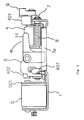
- a frame 1 is fabricated by bending a metal plate into a U-shaped form, and has a bottom portion, a right side portion, and a left side portion.
- a platen 2 consisting of a rubber roller is supported to both side portions via bearings.
- a manually operated knob 201 is mounted to the right side of the platen 2 to allow the platen 2 to be rotated manually.
- a toothed wheel is mounted to the left side of the platen so that an electric motor may drive the platen via the wheel.
- a thermal head 3 is normally rigidly mounted to a head mount plate 300 to form a head subassembly. This head subassembly has a central portion connected with a head-holding member 4 by a support shaft 405.
- the head subassembly can swing about the shaft 405.
- the width of the head-holding member 4 is less than the width of the head subassembly as shown in Fig. 1.
- the head-holding member is connected with the head subassembly via a connector located at the position of the shaft 405. This connector is disposed to the left of the center of the head-holding member 4. Those components which press the head-holding member 4 and the head subassembly against the platen 2 are concentrated in the right portion of the printer.
- the width of the head-holding member pushing against the head is substantially equal to the width of the head subassembly in order that the head be pressed against the platen with a force which is uniform in the horizontal direction.
- the head subassembly is pushed only via the central support shaft portion. In this case, it suffices to hold the head subassembly so as to maintain it parallel to the platen at least when the head is pushed.
- the width of the head-holding member 4 can be made small and shifted to the right or left with respect to the head subassembly.
- a space surrounded by the thermal head 3, the mechanism portion for holding the head, and the left side portion of the frame 1 is formed to the left of the present printer.
- An electric motor 5 is installed in this space without protruding outwardly from this space. This can reduce the width of the printer, which in turn makes the printer small in size. Power from the motor 5 is transmitted to the platen 2 via a gear train mounted on the left side portion of the frame 1.
- the motor 5 is mounted in the following manner.
- a pinion is disposed at the front side of the motor. This front side is attached to the left side portion of the frame 1 via screws.
- a heat-dissipating auxiliary plate 501 formed by a metal plate bent into an L-shaped form is mounted via screws to the rear side of the motor.
- the heat-dissipating auxiliary plate 501 is affixed via screws to the bottom portion of the frame 1.
- characters are printed while incrementing the paper. Therefore, in use the motor is driven continuously. For this reason, the motor often gets hot, leading to a reduction in the torque. Also, the motor life is shortened.
- the heat generated by the motor 5 is dissipated even from the rear side of the motor to the heat-dissipating auxiliary plate 501 and to the frame 1.
- the heat dissipation is improved greatly over the structure in which heat is dissipated only from the front side of the motor.
- the present printer is a small-sized line thermal printer operated at 24 volts. The temperature of the coil inside the motor when characters were actually printed was measured. When the heat-dissipating auxiliary plate 501 was not present, the temperature rose up to 130°C. On the other hand, when the plate 501 was added, the temperature rose up to only 120°C. Therefore, E-type wires used for coils and withstanding only up to 125°C can be used.
- An auxiliary member 6 is rotatably held to the frame 1 together with the head-holding member 4 by a shaft 7.
- the head-holding member 4 and the auxiliary member 6 can rotate about the axis of the shaft 7.
- a spring member 8 (torsion coil spring) is mounted on the shaft 7 and has arm portions abutting against portions of the head-holding member 4 and the auxiliary member 6, respectively, to bias these two members apart from each other.
- a first lever member 9 having a cam portion 901 is fitted on a shaft portion mounted on the right side portion of the frame 1 so as to be capable of rotating within a certain angular range.
- the head-holding member 4 has a first engaging portion 401 and a second engaging portion 402 which engage the cam portion 901 of the first lever member 9 and the auxiliary member 6, respectively. It is possible to press the head subassembly against the platen 2 or to move the subassembly away from the platen by operating the first lever member 9. In the former condition, the head is down. In the latter condition, the head is up.
- a detector 10 consists of a microswitch and is turned on or off by the movement of the first lever member 9. The detector output is used to avoid that printing is effected when the head is up.
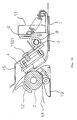
- a second lever member 11 locks the auxiliary member 6 in a given position and is fitted on a shaft portion mounted to the auxiliary member 6 so as to be rotatable within a given angular range. In the position shown in Figs. 1 and 2 one arm of the two armed lever member 11 extends down to the bottom of the frame 1 and abuts a portion 1a of the bottom bent upright. In this condition the bent portion 1a of the frame bottom receives the force of the spring member 8 wire the auxiliary member 6 and the lever member 11.
- the second engaging portion 402 of the head-holding member 4 does not engage the auxiliary member 6 in order not to prevent the head-holding member 4 and the head subassembly to be urged against the platen 2 by means of the spring member 8.
- the second lever member 11 is turned counterclockwise, i.e. in the direction indicated by the arrow in Fig. 2, its downward extending arm is released from the engagement with the portion 1a of the bottom of the frame 1 to unlock the auxiliary member 6.
- the auxiliary member 6 is unlocked it is turned backward by means of an auxiliary spring 601 around shaft 7.
- the second engaging portion 402 of the head-holding member 4 comes into engagement with the auxiliary member 6 due to the force of the spring member 8. Therefore, the head-holding member 4 and the head subassembly are turned backward together with the auxiliary member 6.
- the auxiliary spring 601 is stretched between the auxiliary member 6 and a part of the frame 1.
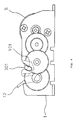
- Fig. 4 is a left side elevation of the printer.
- the gear train rotating the platen 2 is shown in this figure.
- a position-setting portion 101 for placing the head subassembly in position is formed in the left side portion of the frame 1 and takes the form of a groove.
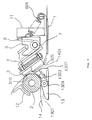
- Fig. 5 is a right side elevation showing the condition in which the first lever member 9 has been rotated to secure a head gap A, i.e., the head is up.
- Another position-setting portion 102 is formed in the right side portion of the frame 1 such that the two position-setting portions 101 and 102 are symmetrically located.
- Positioning engaging portions 301 and 302 are formed on opposite sides of the head mount plate 300 of the head subassembly so as to engage the position-setting portions 101 and 102, respectively.
- the engaging portions 301 and 302 move within the position-setting portions 101 and 102 of the frame 1 when the head changes from the condition shown in Fig. 4, i.e., the head is down, to the condition shown in Fig. 5, i.e., the head is up. In this way, when the head is down, the head subassembly is placed in position. At this time, the thermal head 3 is firmly held such that it is kept parallel to the platen 2.
- the force which presses the head subassembly against the printer is uniform horizontally, the central portion of the head subassembly being held swingably.
- the heat-generating portion of the thermal head 3 is so positioned relative to the platen 2 that optimum printing is accomplished. If the head is repeatedly moved up and down, the positional relationship between the platen 2 and the head 3 is kept constant all the times. Consequently, good printing can be effected stably.
- a head cover 305 is fabricated by bending a sheet of stainless steel.
- the cover 305 has a left bent portion 306 and a right bent portion 307.
- Recesses 308 and 309 each having a height substantially equal to the sheet thickness of the cover 305 are formed at the left end and the right end, respectively, of the rear surface of the thermal head 3.
- a driver IC and an FPC (not shown) are coupled to the head 3.
- the joints of the driver IC and FPC are protected by the head cover 305.
- the head mount plate 300 has the positioning engaging portions 301 and 302 at its right and left ends, respectively, the engaging portions being located at symmetrical positions.
- the plate 300 is centrally provided with support shaft holes 303 and 304.
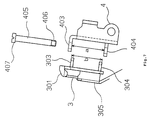
- Fig. 7 shows the structure holding the head subassembly.
- the head-holding member 4 has bent portions provided with support shaft holes 403 and 404.
- a support shaft 405 passes through the support shaft holes 403, 404, 303 and 304.
- An external thread 406 is formed at one end of the support shaft 405.
- a flange 407 is formed at the other end.
- the support shaft hole 404 in which the external thread 406 is engaged is internally threaded.
- the shaft 405 is screwed to the head-holding member 4. In this way, the head subassembly is held to the head-holding member 4.
- the inside distance a between the bent portions of the head-holding member 4 is longer than the outside distance b between the bent portions of the head mount plate 300. Since the support shaft holes 303 and 304 are larger than the diameter of the support shaft 405, the head subassembly is so held that some gap is left around the support shaft.
- the head subassembly can be easily replaced by rotating the flange 407 with a screwdriver, coin, or the like and removing the support shaft 405.
- Paper delivery guides 12 are mounted inside of both side portions of the frame 1 to prevent the printed paper from being wound around the platen 2 again.
- a paper guide 13 is installed on the bottom portion of the frame 1.
- the paper guide 13 defines two paper insertion portions 1301 and 1302. Where normal thermal paper 14 is used for printing, it is passed through the paper insertion portion 1301 and wound around the platen 2 as shown in Fig. 8. Where thick paper such as thermal label paper 1401 is employed, it is fed almost straight through a paper passage hole formed in the bottom wall of the frame 1 and through a paper guide channel formed by the paper insertion portion 1302 and the head cover 305. In any case, the paper is held between the platen 2 and the thermal head 3. The paper is incremented by a frictional force produced by rotation of the platen 2.
- the heat-generating portion 310 of the thermal head 3 is always retained at the position best suited for printing during printing by a position-setting mechanism formed by the position-setting portions 101, 102 and the position engaging portions 301, 302 described above.
- a paper detector 1303 makes use of a reflection type photosensor.
- An auxiliary roller 1304 assists in paper feeding. The paper is automatically fed by the rotation of the platen 2 and printing is started simply by inserting the thermal paper 14 between the platen 2 and the auxiliary roller 1304. In this way, the printer operates to print characters while the head is down.
- the head subassembly is pressed against the platen by the spring member 8.
- the spring member 8 i.e. the torsion coil spring is mounted on the shaft 7 forming the center of rotation. Consequently, the spring is not located above the head subassembly. Hence, the height of the printer can be made small. In this way, the printer can be rendered compact.
- the first lever member 9 is operated to raise the head as shown in Fig. 5. In this state, a gap A of about 1 to 3 mm is created between the thermal head 3 and the platen 2 to thereby prevent the platen 2 from being deformed.
- the paper is shifted to fine adjust the print portion.
- the head subassembly rotates about the shaft 7 to the position shown in Fig. 9 and moves a long distance away from the platen 2. As a result, the head subassembly protrudes above the body of the printer. In this state, where the thermal head 3 has rotated through an angle B of about 45 degrees the head can be said to be opened. This state can be distinguished from the state in which the head is raised by operating the first lever member 9.
- the prior art line thermal printer When the prior art line thermal printer operates normally and the head is up, it has rotated through an angle less than 30 degrees. In the present example, this angle B is set larger than 30 degrees.
- the thermal head 3 is separated from the platen 2 by a large distance not achieved by operating the prior art lever, and the surface of the head is exposed. By opening the head in this way, the user can easily clean the head with a cotton swab or the like. Also in this open state, the head can be replaced with a new one. In addition, the paper can be removed if it jams. Generally, the head is opened much less frequently than it is raised.
- the lever member 11 for opening the head is independent of the lever for raising the head, and the colors of these two levers are made different to facilitate distinguishing them from each other. In this way, erroneous operation can be prevented. Also, they are conveniently used.
- the spring member 8 is so mounted as to push against the bottom of the frame 1, when the auxiliary member 6, the second lever member 11, and the auxiliary spring 601 are removed.
- the operation for raising the head can be performed in exactly the same way by operating the first lever member 9 as the operation for opening the head.
- a low cost, disposable printer that is assumed not to be maintained is fabricated as a commercial product based on the present printer, the auxiliary member 6, the second lever member 11, and the auxiliary spring 601 are omitted.
- the configuration is totally adopted. In this way, the structure may be varied according to the application. That is, a reduction in the cost can be attained by mass production, which is accomplished by using common components in both high-grade printers and economy printers.
- a method of locking the paper guide 13 is next described with reference to Fig. 11.
- the paper guide 13 is placed on the bottom portion of the frame 1.
- Left and right platen bearings 202 are fitted into engaging portions 1305 and 103, respectively, so that the platen 2 is rotatably mounted to the frame 1. Also, these bearings 202 prevent the paper guide 13 from escaping upward.
- the paper guide 13 is anchored to the frame 1.
- the above-described structure does not need any medium such as a screw when the paper guide is mounted.
- the present printer can be assembled at improved efficiency and lower cost.
- the paper guide 13 can also be removed. In this state, it is easy to maintain the paper detector 1303 mounted on the paper guide 13 and the auxiliary roller 1304. Additionally, paper dust can be easily removed.
- the gap between the inner surface of the paper guide and the surface of the platen 2 can be formed accurately, since the platen bearings 202 are in intimate contact with the paper guide 13.
- a paper cutter and a motor cover can be installed on the present printer. This installation is described next with reference to Figs. 12 to 14.
- the paper cutter indicated by 15, is mounted to the head-holding member 4 by a securing screw 1501.
- the paper cutter has been normally mounted to the frame or to the top portion of the case.
- the paper cutter is mounted to the rotatable head-holding member 4. When the head is up, the cutter moves slightly away from the platen 2 in the same way as the head subassembly. Therefore, the paper does not easily stick to the paper cutter 15. In consequence, the paper can be inserted with greater ease.
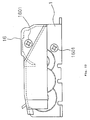
- Fig. 13 shows one side of the motor cover 16. As shown in this Figure, the motor cover is tightened together with the motor 5 from the side portion of the frame 1 by means of securing screws 1601. The motor cover 16 keeps the user's hand from touching the motor 5, which becomes hot.
- Fig. 14 is a plan view of the printer on which the paper cutter 15 and the motor cover 16 are mounted. In the illustrated example, the user manually cuts the paper with the paper cutter. It is also possible to attach a motor-driven automatic cutter unit to the head-holding member 4.
- Figs. 15 and 16 show a second example.
- This example is similar to the first example in that the first lever member 18 engages the head-holding member 17 to raise or lower the head.
- the auxiliary member 19 is wider than the head-holding member 17, and the second lever member 20 is mounted on the right side portion of the frame in the same way as the first lever member.
- This configuration permits the manually operated portion to be located close to the head.
- the case can be designed with greater degree of freedom.
- the auxiliary member 19 is easily twisted or deformed by a spring force, since the auxiliary member 19 is wide.
- the shaft 21 about which a rotation is made has a non-circular cross section.
- the shape of the shaft hole in the auxiliary member 19 conforms to the shape of the shaft.
- the shaft 21 and the auxiliary member 19 are coupled together so that they rotate as a unit. In this way, the mechanical strength is increased.
- the second lever member 20 In order to open the head, the second lever member 20 is rotated in the direction indicated by the arrow in Fig. 16, for unlocking the auxiliary member 19.
- Position-setting portions 22 mounted to one side of the frame are made to bear against the thermal head 23 to place the head subassembly in position.
- the positions of the position-setting portions 22 can be fine adjusted during printing to accomplish the optimum print position.
- Fig. 17 shows the third example.
- a pair of bearings 24 support the shaft portions at both ends of the platen. Portions of the bearings 24 extend to the position of the thermal head 25 to form position-setting portions which place the head 25 in position.
- the position-setting portions which constitute one feature of the invention can be formed by slightly modifying portions of the existing components without fabricating new components. As a result, a rationalization is achieved.
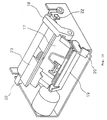
- Fig. 18 is a perspective view of a part of a printer forming the fourth example.
- a part of an auxiliary member 26 protrudes to form a lever 2601 which can be manually operated.
- the auxiliary member and the second lever member described in the first example are combined into one unit. This results in a reduction in the number of components.
- a dowel 2602 mounted on the auxiliary member 26 engages a hole 27 formed in one side surface of the frame to lock the auxiliary member 26.
- the lever 2601 is rotated in the direction indicated by the arrow with a large force.
- the dowel 2602 disengages from the hole 27 and engages another hole 28, whereby the dowel comes to a stop.
- the auxiliary member 26 is locked in one of two given positions corresponding to normal operation and the open state, respectively.
- the head subassembly is permitted to be raised greatly, i.e., the head is opened, by adding the auxiliary member and the second lever member to a conventional printer.
- the surface of the head can be exposed.
- the maintenance includes cleaning of the head.
- the positional relation of the head subassembly to the platen is maintained optimal. Hence, good print quality can be provided.
Landscapes
- Electronic Switches (AREA)
- Common Mechanisms (AREA)
Applications Claiming Priority (10)
| Application Number | Priority Date | Filing Date | Title |
|---|---|---|---|
| JP167382/90 | 1990-06-26 | ||
| JP67554/90U | 1990-06-26 | ||
| JP167383/90 | 1990-06-26 | ||
| JP6755490U JPH0426742U (fr) | 1990-06-26 | 1990-06-26 | |
| JP16738390 | 1990-06-26 | ||
| JP6755590U JPH0426739U (fr) | 1990-06-26 | 1990-06-26 | |
| JP67555/90U | 1990-06-26 | ||
| JP16738290 | 1990-06-26 | ||
| JP64868/91 | 1991-03-28 | ||
| JP6486891A JP2973241B2 (ja) | 1990-06-26 | 1991-03-28 | ラインサーマルプリンタ |
Publications (3)
| Publication Number | Publication Date |
|---|---|
| EP0463595A2 true EP0463595A2 (fr) | 1992-01-02 |
| EP0463595A3 EP0463595A3 (en) | 1992-05-20 |
| EP0463595B1 EP0463595B1 (fr) | 1995-01-25 |
Family
ID=27523867
Family Applications (1)
| Application Number | Title | Priority Date | Filing Date |
|---|---|---|---|
| EP91110364A Expired - Lifetime EP0463595B1 (fr) | 1990-06-26 | 1991-06-24 | Imprimante thermique ligne par ligne |
Country Status (4)
| Country | Link |
|---|---|
| US (1) | US5181787A (fr) |
| EP (1) | EP0463595B1 (fr) |
| DE (1) | DE69106946T2 (fr) |
| HK (1) | HK102297A (fr) |
Cited By (10)
| Publication number | Priority date | Publication date | Assignee | Title |
|---|---|---|---|---|
| EP0645256A3 (fr) * | 1993-09-24 | 1995-12-13 | Esselte Meto Int Gmbh | Appareil d'impression et montage de la tête d'impression. |
| EP0645254A3 (fr) * | 1993-09-24 | 1995-12-20 | Esselte Meto Int Gmbh | Imprimante avec un dispositif permettant d'ajuster la pression de la tête d'impression sur le cylindre. |
| EP0659574A3 (fr) * | 1993-12-27 | 1996-04-03 | Seiko Instr Inc | Imprimante. |
| GB2280874B (en) * | 1993-07-06 | 1996-11-27 | Citizen Watch Co Ltd | Thermal printer |
| EP0738606A4 (fr) * | 1994-11-08 | 1997-02-19 | Seiko Instr Inc | Imprimante |
| US5697714A (en) * | 1993-12-27 | 1997-12-16 | Seiko Instruments Inc. | Line printer equipped with easily assembled/replaceable print head |
| US5903298A (en) * | 1995-06-13 | 1999-05-11 | Seiko Instruments Inc. | Line thermal printer |
| FR2783458A1 (fr) * | 1998-09-17 | 2000-03-24 | Samsung Electro Mech | Dispositif pour reguler la pression des tetes dans une imprimante miniature |
| EP1018435A3 (fr) * | 1998-11-11 | 2000-10-11 | Eltron International, Inc. | Imprimante à tête flottante |
| CN101088767B (zh) * | 2006-06-12 | 2010-08-25 | 精工爱普生株式会社 | 热敏印刷机 |
Families Citing this family (23)
| Publication number | Priority date | Publication date | Assignee | Title |
|---|---|---|---|---|
| JPH06247001A (ja) * | 1993-02-26 | 1994-09-06 | Sony Corp | プリンターのヘッド圧着機構 |
| US5265966A (en) * | 1993-03-05 | 1993-11-30 | Rimage Corporation | Printer linkage |
| DE4323885A1 (de) * | 1993-07-16 | 1995-01-19 | Esselte Meto Int Gmbh | Thermodruckkopfhalterung |
| US5541635A (en) * | 1994-03-18 | 1996-07-30 | Mettler-Toledo, Inc. | Printer mechanism |
| JPH07309052A (ja) * | 1994-05-18 | 1995-11-28 | Asahi Optical Co Ltd | 感熱プリンタ |
| JP3154622B2 (ja) * | 1994-09-09 | 2001-04-09 | 東北リコー株式会社 | サーマルプリンタ |
| JP3079360B2 (ja) * | 1996-07-30 | 2000-08-21 | セイコーインスツルメンツ株式会社 | プリンタ装置 |
| DE19832093A1 (de) * | 1997-08-22 | 1999-02-25 | Esselte Nv | Banddruckgerät |
| US6163329A (en) * | 1997-12-15 | 2000-12-19 | Identity Group, Inc. | Thermal head printer and method of using same to print on a thermoplastic medium |
| US5942312A (en) * | 1997-12-15 | 1999-08-24 | Identity Group, Inc. | Pre-inked thermoplastic medium useful for forming thermal images thereon |
| WO2000021758A1 (fr) | 1998-10-15 | 2000-04-20 | Identity Group, Inc. | Imprimante et procede d'utilisation de celle-ci pour imprimer sur un support thermoplastique |
| US6406200B2 (en) | 1999-07-30 | 2002-06-18 | Inovise Medical, Inc. | Printer assembly with lateral and longitudinal self-alignment |
| US7063399B2 (en) * | 2003-06-25 | 2006-06-20 | Lexmark International, Inc. | Imaging apparatus and method for facilitating printing |
| KR100581354B1 (ko) * | 2004-03-19 | 2006-05-17 | 주식회사 신흥정밀 | 써멀프린터의 써멀프린터헤드 정렬장치 |
| JP4306548B2 (ja) * | 2004-07-05 | 2009-08-05 | 船井電機株式会社 | 画像形成装置 |
| US20060095280A1 (en) * | 2004-11-03 | 2006-05-04 | Lexmark International, Inc. | Method and apparatus for paying for printing materials in a printer over the usage time of a printer cartridge |
| KR100677585B1 (ko) * | 2005-05-20 | 2007-02-02 | 삼성전자주식회사 | Tph를 채용하는 화상형성장치 |
| JP4827035B2 (ja) * | 2007-01-25 | 2011-11-30 | セイコーインスツル株式会社 | プラテン保持機構および記録装置 |
| US9333776B2 (en) | 2013-07-16 | 2016-05-10 | Esselte Ipr Ab | Cartridge for label printer |
| USD753585S1 (en) | 2014-05-08 | 2016-04-12 | Esselte Ipr Ab | Battery module for a printer |
| USD775274S1 (en) | 2014-05-08 | 2016-12-27 | Esselte Ipr Ab | Printer |
| USD763350S1 (en) | 2014-05-08 | 2016-08-09 | Esselte Ipr Ab | Cartridge for printer |
| DE102017104424A1 (de) | 2017-03-02 | 2018-09-06 | Dreyer System GmbH | Thermodrucker |
Family Cites Families (9)
| Publication number | Priority date | Publication date | Assignee | Title |
|---|---|---|---|---|
| JPS5364042A (en) * | 1976-11-19 | 1978-06-08 | Canon Inc | Printing apparatus |
| DE2954358C2 (de) * | 1978-03-08 | 1987-01-29 | Canon K.K., Tokio/Tokyo | Wärmedruckvorrichtung |
| JPS589756U (ja) * | 1981-07-15 | 1983-01-21 | 株式会社サト− | サ−マルヘツド支持機構 |
| JPS58188682A (ja) * | 1982-04-30 | 1983-11-04 | Fujitsu Ltd | 印字ヘツド位置決め機構 |
| JPS59182763A (ja) * | 1983-04-01 | 1984-10-17 | Kyocera Corp | プリンタ−の記録紙装填機構 |
| JPS58191175A (ja) * | 1983-04-06 | 1983-11-08 | Toshiba Corp | 熱印刷装置 |
| JPS60255469A (ja) * | 1984-06-01 | 1985-12-17 | Mitsubishi Electric Corp | 印字機器 |
| DD251253A3 (de) * | 1985-10-04 | 1987-11-11 | Robotron Bueromasch | Vorrichtung zum an- und abschwenken eines thermodruckkopfes von der druckwalze |
| JP2543176B2 (ja) * | 1989-03-17 | 1996-10-16 | シャープ株式会社 | 熱記録装置 |
-
1991
- 1991-06-24 DE DE69106946T patent/DE69106946T2/de not_active Expired - Lifetime
- 1991-06-24 EP EP91110364A patent/EP0463595B1/fr not_active Expired - Lifetime
- 1991-06-25 US US07/720,312 patent/US5181787A/en not_active Expired - Lifetime
-
1997
- 1997-06-26 HK HK102297A patent/HK102297A/en not_active IP Right Cessation
Cited By (11)
| Publication number | Priority date | Publication date | Assignee | Title |
|---|---|---|---|---|
| GB2280874B (en) * | 1993-07-06 | 1996-11-27 | Citizen Watch Co Ltd | Thermal printer |
| EP0645256A3 (fr) * | 1993-09-24 | 1995-12-13 | Esselte Meto Int Gmbh | Appareil d'impression et montage de la tête d'impression. |
| EP0645254A3 (fr) * | 1993-09-24 | 1995-12-20 | Esselte Meto Int Gmbh | Imprimante avec un dispositif permettant d'ajuster la pression de la tête d'impression sur le cylindre. |
| EP0659574A3 (fr) * | 1993-12-27 | 1996-04-03 | Seiko Instr Inc | Imprimante. |
| US5697714A (en) * | 1993-12-27 | 1997-12-16 | Seiko Instruments Inc. | Line printer equipped with easily assembled/replaceable print head |
| EP0738606A4 (fr) * | 1994-11-08 | 1997-02-19 | Seiko Instr Inc | Imprimante |
| EP0885736A3 (fr) * | 1994-11-08 | 1999-03-17 | Seiko Instruments Inc. | Imprimante |
| US5903298A (en) * | 1995-06-13 | 1999-05-11 | Seiko Instruments Inc. | Line thermal printer |
| FR2783458A1 (fr) * | 1998-09-17 | 2000-03-24 | Samsung Electro Mech | Dispositif pour reguler la pression des tetes dans une imprimante miniature |
| EP1018435A3 (fr) * | 1998-11-11 | 2000-10-11 | Eltron International, Inc. | Imprimante à tête flottante |
| CN101088767B (zh) * | 2006-06-12 | 2010-08-25 | 精工爱普生株式会社 | 热敏印刷机 |
Also Published As
| Publication number | Publication date |
|---|---|
| EP0463595A3 (en) | 1992-05-20 |
| EP0463595B1 (fr) | 1995-01-25 |
| US5181787A (en) | 1993-01-26 |
| HK102297A (en) | 1997-08-15 |
| DE69106946D1 (de) | 1995-03-09 |
| DE69106946T2 (de) | 1995-07-06 |
Similar Documents
| Publication | Publication Date | Title |
|---|---|---|
| EP0463595B1 (fr) | Imprimante thermique ligne par ligne | |
| US6232996B1 (en) | Thermal printer | |
| EP0738213B1 (fr) | Imprimante portative et sa cartouche | |
| CA2383129A1 (fr) | Systeme pour dissiper des charges electrostatiques dans une imprimante | |
| US7145583B2 (en) | Thermal printer | |
| JP3116157B2 (ja) | ラインプリンタ | |
| GB2135246A (en) | Daisy wheel supporting structure | |
| JPH0671809B2 (ja) | サーマルラインプリンタ | |
| JP2004098699A (ja) | サーマルヘッドの押圧機構及びそれを備えたプリンタ | |
| JPH09216436A (ja) | サーマルヘッドの押圧機構及びそれを用いたプリンタ | |
| JP2973241B2 (ja) | ラインサーマルプリンタ | |
| JP3656671B2 (ja) | 小型プリンタ | |
| JPH05212923A (ja) | 感熱記録装置 | |
| JP2005081729A (ja) | ラベルプリンタ | |
| JPH10258555A (ja) | ペーパーカッター装置 | |
| JP3696061B2 (ja) | プリンタ | |
| JPH081881Y2 (ja) | ラベルプリンタの台紙巻取装置 | |
| JP2005081730A (ja) | ラベルプリンタ | |
| JP4087649B2 (ja) | 感熱記録ヘツドの取付構造 | |
| JP2614125B2 (ja) | サーマルプリンタ | |
| JPH08282026A (ja) | ラベルプリンタ | |
| JP2648529B2 (ja) | サーマルプリンタにおけるヘッド取付装置 | |
| KR200151949Y1 (ko) | 기록지 자동절단기의 취부구조 | |
| JP2578130Y2 (ja) | 密着センサの保持構造 | |
| JPH04284281A (ja) | サーマルラインプリンタ |
Legal Events
| Date | Code | Title | Description |
|---|---|---|---|
| PUAI | Public reference made under article 153(3) epc to a published international application that has entered the european phase |
Free format text: ORIGINAL CODE: 0009012 |
|
| AK | Designated contracting states |
Kind code of ref document: A2 Designated state(s): DE FR GB IT |
|
| PUAL | Search report despatched |
Free format text: ORIGINAL CODE: 0009013 |
|
| AK | Designated contracting states |
Kind code of ref document: A3 Designated state(s): DE FR GB IT |
|
| 17P | Request for examination filed |
Effective date: 19920623 |
|
| 17Q | First examination report despatched |
Effective date: 19921217 |
|
| GRAA | (expected) grant |
Free format text: ORIGINAL CODE: 0009210 |
|
| AK | Designated contracting states |
Kind code of ref document: B1 Designated state(s): DE FR GB IT |
|
| REF | Corresponds to: |
Ref document number: 69106946 Country of ref document: DE Date of ref document: 19950309 |
|
| ET | Fr: translation filed | ||
| ITF | It: translation for a ep patent filed | ||
| PLBE | No opposition filed within time limit |
Free format text: ORIGINAL CODE: 0009261 |
|
| STAA | Information on the status of an ep patent application or granted ep patent |
Free format text: STATUS: NO OPPOSITION FILED WITHIN TIME LIMIT |
|
| 26N | No opposition filed | ||
| REG | Reference to a national code |
Ref country code: GB Ref legal event code: IF02 |
|
| PGFP | Annual fee paid to national office [announced via postgrant information from national office to epo] |
Ref country code: IT Payment date: 20080625 Year of fee payment: 18 |
|
| PGFP | Annual fee paid to national office [announced via postgrant information from national office to epo] |
Ref country code: FR Payment date: 20100709 Year of fee payment: 20 |
|
| PGFP | Annual fee paid to national office [announced via postgrant information from national office to epo] |
Ref country code: GB Payment date: 20100623 Year of fee payment: 20 Ref country code: DE Payment date: 20100616 Year of fee payment: 20 |
|
| PG25 | Lapsed in a contracting state [announced via postgrant information from national office to epo] |
Ref country code: IT Free format text: LAPSE BECAUSE OF NON-PAYMENT OF DUE FEES Effective date: 20090624 |
|
| REG | Reference to a national code |
Ref country code: DE Ref legal event code: R071 Ref document number: 69106946 Country of ref document: DE |
|
| REG | Reference to a national code |
Ref country code: DE Ref legal event code: R071 Ref document number: 69106946 Country of ref document: DE |
|
| REG | Reference to a national code |
Ref country code: GB Ref legal event code: PE20 Expiry date: 20110623 |
|
| PG25 | Lapsed in a contracting state [announced via postgrant information from national office to epo] |
Ref country code: GB Free format text: LAPSE BECAUSE OF EXPIRATION OF PROTECTION Effective date: 20110623 |
|
| PG25 | Lapsed in a contracting state [announced via postgrant information from national office to epo] |
Ref country code: DE Free format text: LAPSE BECAUSE OF EXPIRATION OF PROTECTION Effective date: 20110625 |