EP0463700A2 - Verfahren und Gerät zur Bilderzeugung - Google Patents
Verfahren und Gerät zur Bilderzeugung Download PDFInfo
- Publication number
- EP0463700A2 EP0463700A2 EP19910201593 EP91201593A EP0463700A2 EP 0463700 A2 EP0463700 A2 EP 0463700A2 EP 19910201593 EP19910201593 EP 19910201593 EP 91201593 A EP91201593 A EP 91201593A EP 0463700 A2 EP0463700 A2 EP 0463700A2
- Authority
- EP
- European Patent Office
- Prior art keywords
- image
- pixel
- array
- renditions
- sample points
- Prior art date
- Legal status (The legal status is an assumption and is not a legal conclusion. Google has not performed a legal analysis and makes no representation as to the accuracy of the status listed.)
- Granted
Links
Images

Classifications
-
- G—PHYSICS
- G06—COMPUTING OR CALCULATING; COUNTING
- G06T—IMAGE DATA PROCESSING OR GENERATION, IN GENERAL
- G06T15/00—Three-dimensional [3D] image rendering
- G06T15/50—Lighting effects
- G06T15/503—Blending, e.g. for anti-aliasing
-
- G—PHYSICS
- G06—COMPUTING OR CALCULATING; COUNTING
- G06F—ELECTRIC DIGITAL DATA PROCESSING
- G06F3/00—Input arrangements for transferring data to be processed into a form capable of being handled by the computer; Output arrangements for transferring data from processing unit to output unit, e.g. interface arrangements
-
- G—PHYSICS
- G06—COMPUTING OR CALCULATING; COUNTING
- G06T—IMAGE DATA PROCESSING OR GENERATION, IN GENERAL
- G06T11/00—Two-dimensional [2D] image generation
- G06T11/10—Texturing; Colouring; Generation of textures or colours
-
- G—PHYSICS
- G06—COMPUTING OR CALCULATING; COUNTING
- G06T—IMAGE DATA PROCESSING OR GENERATION, IN GENERAL
- G06T11/00—Two-dimensional [2D] image generation
- G06T11/40—Filling planar surfaces by adding surface attributes, e.g. adding colours or textures
Definitions
- the invention relates to a method of generating, from primitive data comprising geometric and surface descriptions of a plurality of image primitives, an image of objects in a three dimensional space in a regular, two-dimensional pixel array having two principal axes, the method comprising:
- the invention further relates to an apparatus for generating an image of objects in a three dimensional space in a regular, two-dimensional pixel array, the apparatus comprising:
- the primary aim of the filtering applied by this method is to reduce aliasing artefacts caused by the sampling process.
- One obtrusive artefact of aliasing is the "staircase" structure imposed on a primitive edge which slopes relative to the pixel array axes. This effect can become particularly obtrusive for certain classes of image feature, for example primitive edges which are nearly aligned with an axis of the pixel array.
- a basic array in the form of a simple grid having principal axes aligned with those of the pixel array, leads to a substantial wastage of the filtering potential of N-fold oversampling in the particular case outlined where aliasing is most obtrusive.
- the invention provides a method as set forth in the opening paragraph, characterized in that the N offsets are determined by:
- the invention allows antialias filtering to be implemented at high speed and low cost while ensuring that the N sampling points are fully exploited in the elimination of the most obtrusive aliasing artefacts.
- the selected class of image features may comprise edges which are nearly aligned with one or the other axis of the pixel array, the N offsets being chosen so that the pixel area is divided at substantially N places in the direction of one or both of the principal axes.
- the basic array of N sample points may for example be a regular two-dimensional array whose principal axes are not aligned with the principal axes of the pixel array.
- Such an array improves the antialiasing of edges nearly aligned with the pixel array axes.
- aliasing for edges nearly aligned with the sub-pixel array axes or other axes may increase as a result, aliasing of such edges not aligned with axes of the main pixel array is inherently less obtrusive, so that an overall benefit is obtained.
- the sub-pixel array of sample points may constitute a non-regular two-dimensional array.
- the offsets may be chosen so that the sub-pixel array of sample points has a bias toward the periphery of the pixel area.
- a wide spread of sample points is desirable for edge antialiasing, while a low-density central region in the sub-pixel array only in itself increases vertex aliasing, which is inherently less obtrusive, so that overall benefit may be obtained.
- the invention further provides a method as set forth in the opening paragraph, characterized in that different types of surface information are combined in the filtered image by using each type of surface information for a different subset of the renditions.
- the different types of surface information may for example relate to different primitives, to achieve translucency effects, or they may be from different texture maps, to provide texture blending.
- each subset of the renditions may be chosen with regard to its own filtering characteristic, in the same manner as the whole basic array of N points.
- the renditions may be ordered so as to group together the members of each said subset.
- the renditions may be ordered so as to disperse and interleave the members of the subsets. The latter alternative may be preferable for example when effecting successive refinements of an image on screen.
- the invention further provides a method as set forth in the opening paragraph, characterized in that the primitive data are up-dated between renditions so that the filtered image incorporates motion blurring. Primitives which are moving quickly will thus appear appropriately "smeared out” over a number of pixels, while stationary primitives can benefit from antialiasing provided by the multiple renditions.
- the sub-pixel array may be defined to optimise the desired filtering as described above.
- the renditions may also be ordered so that successive sample points are spread widely over the pixel area.
- the invention further provides a method as set forth in the opening paragraph wherein the image is part of a motion picture sequence generated in real time, wherein the value of N is chosen adaptively in response to changes in the time required for each rendition, so as to maximise the value of N while maintaining a predetermined minimum image rate.
- This method allows a system having finite rendering performance to maintain an optimum image quality adapted to scenes of varying complexity.
- An adaptive choice of N can be used to similar effect in any multiple rendering system, having regular or stochastic sample patterns.
- the scene complexity may be determined for example by actual measurment of the time taken by the system to render the first intermediate pixel array, by an estimation based on knowledge of the primitive data, or by a combination of both.
- the basic array, or even the value of N, may also be varied from pixel to pixel or line to line, to take account of different image features present at different parts of the image.
- the invention further provides an apparatus as set forth in the second opening paragraph, characterized in that the N offsets are predetermined in accordance with the invention as set forth above.
- Figure 1 shows schematically an apparatus for the display of images representing 3-D objects.
- a database module OBJ stores and manages a database forming a model of a 3-D environment, the "object space", containing various 3-D objects, each modelled as a group of object primitives.
- Each primitive may for example be a polygonal surface or a curved patch, which in turn is defined by a geometric description (for example vertex coordinates) and a surface description (colour, texture, transparency, surface normal, etc.).
- Geometric and surface descriptions of light sources may also be included.
- Another module VEW defines a "viewing space", for example in terms of the position of a viewpoint, the direction of view and the field of view.
- User input means INP such as a tracker ball, mouse and/or keyboard are connected to a human/computer interface module HCI which allows a user to manipulate or modify objects within the object space or manipulate the viewpoint, direction of view and other attributes of the viewing space.
- HCI human/computer interface module
- a geometry module GEOM performs geometric transformations to translate the various object space geometric descriptions of primitives, defined in the database module OBJ, to equivalent descriptions in the viewing space. These transformations will generally include translation, rotation and perspective, as is well-known in the art.
- the surface descriptions of the primitives are also modified in accordance with lighting conditions in viewing space. In the normal case where the image is only two-dimensional, coordinates in the viewing space in two dimensions (typically called x and y) will correspond linearly to screen coordinates, while a third coordinate (z) corresponds to the "depth" of an object "into” the screen.
- the geometry module GEOM passes the viewing space primitive descriptors to a rendering module DRW which converts the viewing space primitive descriptions into a form suitable for display, typically by scan conversion into a 2-D array of pixel values in an image buffer memory IMINT.
- the rendering module DRW may perform calculations for hidden-surface removal (using the z coordinates) and shading. Suitable means for performing such tasks are well-known in the art.
- the pixel array in the buffer IMINT is an intermediate, point sampled image.
- a module OFFS supplies for each of the N renderings a different predetermined offset, so that the sample point for each pixel moves between renderings.
- An image accumulator buffer IMACC adds together the intermediate images as they are generated so that after N renderings the buffer IMACC contains an image which has been oversampled and filtered in accordance with the sample point distribution and any weightings that may be attached to each sample point.
- the values maintained in the buffer IMACC should be normalised so as to form a true running average after each rendition. Otherwise, the intermediate pixel values can simply be added together and divided by N after all renditions to obtain the final average. Division by N can be greatly simplified if N is limited to powers of two (2,4,8,16 etc).
- the offsets may be used to move the primitives relative to a stationary sample point array.
- Aliasing is a problem which is more apparent on some features of an image than others.
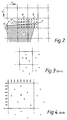
- an edge such as the edge E which slopes very slightly with respect to the principal axes x and y of the pixel array tends to generate very visible "staircase" effects. This is particularly disturbing in motion picture image sequences, when the steps of the staircase appear to run at high speed along the edge E as it moves for example to positions E' and E'' in successive images.
- Figure 2 shows how the regular grid pattern uses the potential 16 quantisation levels inefficiently, particularly in the case described when aliasing is generally most obtrusive.
- the filtered colour value remains constant at 8/16.
- the value jumps four levels to 12/16.
- the effort of 16 times oversampling has been expended to yield the benefit of only 4 times oversampling.
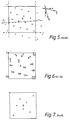
- Solid dots represent the basic array of sample points for pixel area A, while open circles represent sample points of neighbouring pixel areas.
- the novel arrays are arranged so that the edge E of a primitive which is nearly aligned with the x or y axis crosses the sample points one at a time as it moves in the y or x direction respectively, rather than in groups as with the array of Figure 2.
- the arrays of Figures 3, 4, 5 and 7 are such that the pixel area A is divided at exactly N different places in both x and y directions.
- the 8 points of intersection are marked by arrows along the edges of the pixel area A in Figure 4. This property can be compared with the array of Figure 2 in which only ⁇ N points of intersection are afforded by N sample points.
- the advantage of providing N intersection points is that all N quantisation levels are used to antialias an edge which is near-horizontal, or near-vertical.
- the sub-pixel array of 16 sample points shown in Figure 5 is a regular array, with axes ⁇ and ⁇ inclined relative to x and y. This has the consequence that only 4 effective quantisation levels are obtained in the pixel in the special case where an edge is parallel to one of the array axes ⁇ or ⁇ . This may not be a significant problem, since edge aliasing is inherently less obtrusive for sloping edges which slope markedly with respect to the principal axes of the pixel array. It may be noted in this respect that the sample point array of Figure 5 is not coherent across the pixel boundaries.
- sample points should be distributed widely and evenly across the pixel areas.
- This basic array is non-regular, thereby avoiding the special case problem mentioned above.
- the module OFFS in Figure 1 receives a complexity signal COMP for each image and modifies the number N of renditions so as to maintain the best image filtering (for example for antialiasing) which is consistent with a desired image update rate.
- the complexity signal COMP should represent the amount of time taken for the rendering module DRW to make each rendition.
- the signal COMP may for example be obtained by direct feedback from the module DRW of the time taken for the first rendition. That is, if less than 50% of the time available is used for the first rendition, then another rendition can be made.
- it may be supplied by the geometry module GEOM, if that module contains means for estimating rendering time, for example by totalling the screen areas of all primitives in the image or a prediction of image complexity could be made based on time taken to render the previous image in the motion picture sequence, possibly supplemented with a complexity-change signal from the geometry module GEOM.
- subsets of points can be chosen so that each sub-array meets to some extent the criteria for good filtering as set forth above in relation to the whole array.
- Two such subsets are distinguished in Figure 6 by means of crosses superimposed on a first subset of eight of the sixteen sample points in the basic array.
- tonal mixing by multiple rendition is the mixing of textures from two different texture maps.
- a fine, repetitive texture in luminance could be blended with a broader colour texture by rendering the first subset using one texture map and the second subset using another.
- "texture mapping” is to be taken as including a whole family of applications of mapping, a number of which are described for example by Paul S. Heckbert in his paper "A Survey of Texture Mapping", in IEEE Computer Graphics and Applications, November 1986 at pages 56 to 67.
- the sample points in Figure 6 have been ordered in accordance with the numbers 1 to 16 marked in the Figure.
- the ordering groups together the first subset as numbers 1 to 8 and the second subset as numbers 9 to 16.
- the rendering module DRW need switch only once between the two sources of the two tonal descriptions which are being combined, which may save time in some embodiments.
- Ordering the renditions as shown also has advantages when successive refinement is being implemented on-screen using the whole array without blending, since the order illustrated is such that a wide and even spread of sample points is obtained after only a few renditions, so that each successively refined image will be optimally filtered.
- the rendition sequence may be advantageous for the rendition sequence to be such that the members of the subsets are dispersed and interleaved in the sequence, thereby avoiding dramatic changes in the image's appearance as the successive renditions are added into the running average in the accumulator buffer IMACC.
- Another effect that can be obtained by multiple rendition is that of motion blur.
- the object and view databases modules OBJ and VEW
- OBJ and VEW object and view databases
- the different samples are effectively spread in time as well as space, and fast moving objects will appear smeared out over an area of the image which corresponds to the distance moved by the primitive during the said image period.
- correct ordering of the renditions is also important, again so as to achieve a wide and even spread of sample points as the array builds up.
- filtering quality is lost for fast moving primitives, while full filtering is maintained for slow or stationary primitives.
Landscapes
- Engineering & Computer Science (AREA)
- Theoretical Computer Science (AREA)
- Physics & Mathematics (AREA)
- General Physics & Mathematics (AREA)
- Computer Graphics (AREA)
- Human Computer Interaction (AREA)
- General Engineering & Computer Science (AREA)
- Image Generation (AREA)
- Image Processing (AREA)
- Processing Or Creating Images (AREA)
Applications Claiming Priority (4)
| Application Number | Priority Date | Filing Date | Title |
|---|---|---|---|
| GB9014528A GB2245805A (en) | 1990-06-29 | 1990-06-29 | Generating an anti-aliased image |
| GB9014528 | 1990-06-29 | ||
| GB9014555 | 1990-06-29 | ||
| GB9014555A GB2245806A (en) | 1990-06-29 | 1990-06-29 | Generating an image |
Publications (3)
| Publication Number | Publication Date |
|---|---|
| EP0463700A2 true EP0463700A2 (de) | 1992-01-02 |
| EP0463700A3 EP0463700A3 (en) | 1993-03-31 |
| EP0463700B1 EP0463700B1 (de) | 1997-09-03 |
Family
ID=26297264
Family Applications (1)
| Application Number | Title | Priority Date | Filing Date |
|---|---|---|---|
| EP91201593A Expired - Lifetime EP0463700B1 (de) | 1990-06-29 | 1991-06-21 | Verfahren und Gerät zur Bilderzeugung |
Country Status (4)
| Country | Link |
|---|---|
| EP (1) | EP0463700B1 (de) |
| JP (1) | JPH04233086A (de) |
| KR (1) | KR100239969B1 (de) |
| DE (1) | DE69127516T2 (de) |
Cited By (29)
| Publication number | Priority date | Publication date | Assignee | Title |
|---|---|---|---|---|
| US5898793A (en) * | 1993-04-13 | 1999-04-27 | Karron; Daniel | System and method for surface rendering of internal structures within the interior of a solid object |
| WO1999041704A1 (en) * | 1998-02-17 | 1999-08-19 | Sun Microsystems, Inc. | Estimating graphics system performance for polygons |
| WO1999064990A3 (en) * | 1998-06-12 | 2000-04-13 | Intergraph Corp | System for reducing aliasing on a display device |
| WO2000049578A1 (en) * | 1999-02-17 | 2000-08-24 | Sun Microsystems, Inc. | Graphics system having a super-sampled sample buffer with generation of output pixels using selective adjustment of filtering for reduced artifacts |
| WO2000049575A1 (en) * | 1999-02-17 | 2000-08-24 | Sun Microsystems, Inc. | Graphics system having a super-sampled sample buffer with generation of output pixels using selective adjustment of filtering for implementation of display effects |
| WO2000049574A1 (en) * | 1999-02-17 | 2000-08-24 | Sun Microsystems, Inc. | Graphics system which renders samples into a sample buffer and generates pixels in response to stored samples at different rates |
| WO2000049576A1 (en) * | 1999-02-17 | 2000-08-24 | Sun Microsystems, Inc. | Graphics system having a super-sampled sample buffer with efficient storage of sample position information |
| US6157393A (en) * | 1998-07-17 | 2000-12-05 | Intergraph Corporation | Apparatus and method of directing graphical data to a display device |
| US6181355B1 (en) | 1998-07-17 | 2001-01-30 | 3Dlabs Inc. Ltd. | Graphics processing with transcendental function generator |
| EP0910047A3 (de) * | 1997-10-15 | 2001-02-07 | Compaq Computer Corporation | Vollszeneantialiasing mit verbesserten Superabtastungstechniken |
| US6188410B1 (en) | 1998-07-17 | 2001-02-13 | 3Dlabs Inc. Ltd. | System for processing vertices from a graphics request stream |
| US6417861B1 (en) | 1999-02-17 | 2002-07-09 | Sun Microsystems, Inc. | Graphics system with programmable sample positions |
| US6424343B1 (en) | 1998-02-17 | 2002-07-23 | Sun Microsystems, Inc. | Graphics system with programmable real-time sample filtering |
| US6426755B1 (en) | 2000-05-16 | 2002-07-30 | Sun Microsystems, Inc. | Graphics system using sample tags for blur |
| US6459453B1 (en) | 1998-07-17 | 2002-10-01 | 3Dlabs Inc. Ltd. | System for displaying a television signal on a computer monitor |
| US6476816B1 (en) | 1998-07-17 | 2002-11-05 | 3Dlabs Inc. Ltd. | Multi-processor graphics accelerator |
| US6480913B1 (en) | 1998-07-17 | 2002-11-12 | 3Dlabs Inc. Led. | Data sequencer with MUX select input for converting input data stream and to specific output data stream using two exclusive-or logic gates and counter |
| US6496187B1 (en) | 1998-02-17 | 2002-12-17 | Sun Microsystems, Inc. | Graphics system configured to perform parallel sample to pixel calculation |
| US6518971B1 (en) | 1998-07-17 | 2003-02-11 | 3Dlabs Inc. Ltd. | Graphics processing system with multiple strip breakers |
| US6577316B2 (en) | 1998-07-17 | 2003-06-10 | 3Dlabs, Inc., Ltd | Wide instruction word graphics processor |
| US6624823B2 (en) | 1998-02-17 | 2003-09-23 | Sun Microsystems, Inc. | Graphics system configured to determine triangle orientation by octant identification and slope comparison |
| US6674440B1 (en) | 1999-04-05 | 2004-01-06 | 3Dlabs, Inc., Inc. Ltd. | Graphics processor for stereoscopically displaying a graphical image |
| US6717578B1 (en) | 1998-02-17 | 2004-04-06 | Sun Microsystems, Inc. | Graphics system with a variable-resolution sample buffer |
| EP1024458A4 (de) * | 1998-03-31 | 2004-05-06 | Sony Computer Entertainment Inc | Bild-zeichnungs-vorrichtung, bild-zeichnungs-verfahren, und ausstattungs-medium |
| EP1431920A1 (de) * | 2002-12-20 | 2004-06-23 | Telefonaktiebolaget LM Ericsson (publ) | Kostengünstige supersampling-Aufrasterung |
| WO2004057538A3 (en) * | 2002-12-20 | 2004-08-12 | Ericsson Telefon Ab L M | Low-cost supersampling rasterization |
| US6956576B1 (en) | 2000-05-16 | 2005-10-18 | Sun Microsystems, Inc. | Graphics system using sample masks for motion blur, depth of field, and transparency |
| US7518616B1 (en) | 1998-07-17 | 2009-04-14 | 3Dlabs, Inc. Ltd. | Graphics processor with texture memory allocation system |
| CN111489711A (zh) * | 2019-01-28 | 2020-08-04 | 咸阳彩虹光电科技有限公司 | 一种利用演算法改善视角低色偏的方法、装置及显示面板 |
Families Citing this family (5)
| Publication number | Priority date | Publication date | Assignee | Title |
|---|---|---|---|---|
| JPH08221593A (ja) * | 1995-02-14 | 1996-08-30 | Hitachi Ltd | 図形表示装置 |
| US12602751B2 (en) | 2021-08-19 | 2026-04-14 | Intel Corporation | Sample distribution-informed denoising and rendering |
| US12400293B2 (en) | 2021-08-19 | 2025-08-26 | Intel Corporation | Temporally amortized supersampling using a mixed precision convolutional neural network |
| US12254590B2 (en) * | 2021-11-05 | 2025-03-18 | Intel Corporation | Combined denoising and upscaling network with importance sampling in a graphics environment |
| US12374006B2 (en) | 2021-11-05 | 2025-07-29 | Intel Corporation | Augmenting temporal anti-aliasing with a neural network for history validation |
Family Cites Families (1)
| Publication number | Priority date | Publication date | Assignee | Title |
|---|---|---|---|---|
| US4897806A (en) * | 1985-06-19 | 1990-01-30 | Pixar | Pseudo-random point sampling techniques in computer graphics |
-
1991
- 1991-06-21 EP EP91201593A patent/EP0463700B1/de not_active Expired - Lifetime
- 1991-06-21 DE DE69127516T patent/DE69127516T2/de not_active Expired - Lifetime
- 1991-06-26 KR KR1019910010644A patent/KR100239969B1/ko not_active Expired - Lifetime
- 1991-06-27 JP JP3181554A patent/JPH04233086A/ja active Pending
Cited By (41)
| Publication number | Priority date | Publication date | Assignee | Title |
|---|---|---|---|---|
| US5898793A (en) * | 1993-04-13 | 1999-04-27 | Karron; Daniel | System and method for surface rendering of internal structures within the interior of a solid object |
| EP0910047A3 (de) * | 1997-10-15 | 2001-02-07 | Compaq Computer Corporation | Vollszeneantialiasing mit verbesserten Superabtastungstechniken |
| US6734850B2 (en) | 1998-02-17 | 2004-05-11 | Sun Microsystems, Inc. | Graphics system with a programmable sample position memory |
| US6496186B1 (en) | 1998-02-17 | 2002-12-17 | Sun Microsystems, Inc. | Graphics system having a super-sampled sample buffer with generation of output pixels using selective adjustment of filtering for reduced artifacts |
| US6466206B1 (en) | 1998-02-17 | 2002-10-15 | Sun Microsystems, Inc. | Graphics system with programmable real-time alpha key generation |
| US7474308B2 (en) | 1998-02-17 | 2009-01-06 | Sun Microsystems, Inc. | Graphics system having a variable density super-sampled sample buffer |
| WO1999041704A1 (en) * | 1998-02-17 | 1999-08-19 | Sun Microsystems, Inc. | Estimating graphics system performance for polygons |
| US6483504B1 (en) | 1998-02-17 | 2002-11-19 | Sun Microsystems, Inc. | Graphics system having a super sampled-sample buffer with efficient storage of sample position information |
| US6717578B1 (en) | 1998-02-17 | 2004-04-06 | Sun Microsystems, Inc. | Graphics system with a variable-resolution sample buffer |
| US6489956B1 (en) | 1998-02-17 | 2002-12-03 | Sun Microsystems, Inc. | Graphics system having a super-sampled sample buffer with generation of output pixels using selective adjustment of filtering for implementation of display effects |
| US6624823B2 (en) | 1998-02-17 | 2003-09-23 | Sun Microsystems, Inc. | Graphics system configured to determine triangle orientation by octant identification and slope comparison |
| US6313838B1 (en) | 1998-02-17 | 2001-11-06 | Sun Microsystems, Inc. | Estimating graphics system performance for polygons |
| US6496187B1 (en) | 1998-02-17 | 2002-12-17 | Sun Microsystems, Inc. | Graphics system configured to perform parallel sample to pixel calculation |
| US6424343B1 (en) | 1998-02-17 | 2002-07-23 | Sun Microsystems, Inc. | Graphics system with programmable real-time sample filtering |
| EP1024458A4 (de) * | 1998-03-31 | 2004-05-06 | Sony Computer Entertainment Inc | Bild-zeichnungs-vorrichtung, bild-zeichnungs-verfahren, und ausstattungs-medium |
| WO1999064990A3 (en) * | 1998-06-12 | 2000-04-13 | Intergraph Corp | System for reducing aliasing on a display device |
| US7616200B1 (en) | 1998-06-12 | 2009-11-10 | 3Dlabs Inc. Ltd. | System for reducing aliasing on a display device |
| US6480913B1 (en) | 1998-07-17 | 2002-11-12 | 3Dlabs Inc. Led. | Data sequencer with MUX select input for converting input data stream and to specific output data stream using two exclusive-or logic gates and counter |
| US6181355B1 (en) | 1998-07-17 | 2001-01-30 | 3Dlabs Inc. Ltd. | Graphics processing with transcendental function generator |
| US6459453B1 (en) | 1998-07-17 | 2002-10-01 | 3Dlabs Inc. Ltd. | System for displaying a television signal on a computer monitor |
| US7518616B1 (en) | 1998-07-17 | 2009-04-14 | 3Dlabs, Inc. Ltd. | Graphics processor with texture memory allocation system |
| US6157393A (en) * | 1998-07-17 | 2000-12-05 | Intergraph Corporation | Apparatus and method of directing graphical data to a display device |
| US6476816B1 (en) | 1998-07-17 | 2002-11-05 | 3Dlabs Inc. Ltd. | Multi-processor graphics accelerator |
| US6518971B1 (en) | 1998-07-17 | 2003-02-11 | 3Dlabs Inc. Ltd. | Graphics processing system with multiple strip breakers |
| US6577316B2 (en) | 1998-07-17 | 2003-06-10 | 3Dlabs, Inc., Ltd | Wide instruction word graphics processor |
| US6188410B1 (en) | 1998-07-17 | 2001-02-13 | 3Dlabs Inc. Ltd. | System for processing vertices from a graphics request stream |
| WO2000049574A1 (en) * | 1999-02-17 | 2000-08-24 | Sun Microsystems, Inc. | Graphics system which renders samples into a sample buffer and generates pixels in response to stored samples at different rates |
| AU763011B2 (en) * | 1999-02-17 | 2003-07-10 | Sun Microsystems, Inc. | Graphics system having a super-sampled sample buffer with generation of output pixels using selective adjustment of filtering for implementation of display effects |
| US6417861B1 (en) | 1999-02-17 | 2002-07-09 | Sun Microsystems, Inc. | Graphics system with programmable sample positions |
| WO2000049576A1 (en) * | 1999-02-17 | 2000-08-24 | Sun Microsystems, Inc. | Graphics system having a super-sampled sample buffer with efficient storage of sample position information |
| WO2000049575A1 (en) * | 1999-02-17 | 2000-08-24 | Sun Microsystems, Inc. | Graphics system having a super-sampled sample buffer with generation of output pixels using selective adjustment of filtering for implementation of display effects |
| WO2000049578A1 (en) * | 1999-02-17 | 2000-08-24 | Sun Microsystems, Inc. | Graphics system having a super-sampled sample buffer with generation of output pixels using selective adjustment of filtering for reduced artifacts |
| US6674440B1 (en) | 1999-04-05 | 2004-01-06 | 3Dlabs, Inc., Inc. Ltd. | Graphics processor for stereoscopically displaying a graphical image |
| US6426755B1 (en) | 2000-05-16 | 2002-07-30 | Sun Microsystems, Inc. | Graphics system using sample tags for blur |
| US6956576B1 (en) | 2000-05-16 | 2005-10-18 | Sun Microsystems, Inc. | Graphics system using sample masks for motion blur, depth of field, and transparency |
| CN100353382C (zh) * | 2002-12-20 | 2007-12-05 | 艾利森电话股份有限公司 | 低成本超级采样光栅化 |
| US7495672B2 (en) | 2002-12-20 | 2009-02-24 | Telefonaktiebolaget Lm Ericsson (Publ) | Low-cost supersampling rasterization |
| WO2004057538A3 (en) * | 2002-12-20 | 2004-08-12 | Ericsson Telefon Ab L M | Low-cost supersampling rasterization |
| EP1431920A1 (de) * | 2002-12-20 | 2004-06-23 | Telefonaktiebolaget LM Ericsson (publ) | Kostengünstige supersampling-Aufrasterung |
| CN111489711A (zh) * | 2019-01-28 | 2020-08-04 | 咸阳彩虹光电科技有限公司 | 一种利用演算法改善视角低色偏的方法、装置及显示面板 |
| CN111489711B (zh) * | 2019-01-28 | 2022-01-04 | 咸阳彩虹光电科技有限公司 | 一种利用演算法改善视角低色偏的方法、装置及显示面板 |
Also Published As
| Publication number | Publication date |
|---|---|
| DE69127516T2 (de) | 1998-02-26 |
| EP0463700B1 (de) | 1997-09-03 |
| DE69127516D1 (de) | 1997-10-09 |
| KR920001376A (ko) | 1992-01-30 |
| EP0463700A3 (en) | 1993-03-31 |
| JPH04233086A (ja) | 1992-08-21 |
| KR100239969B1 (ko) | 2000-01-15 |
Similar Documents
| Publication | Publication Date | Title |
|---|---|---|
| EP0463700B1 (de) | Verfahren und Gerät zur Bilderzeugung | |
| US6088036A (en) | Method of generating an image | |
| US5856829A (en) | Inverse Z-buffer and video display system having list-based control mechanism for time-deferred instructing of 3D rendering engine that also responds to supervisory immediate commands | |
| US5394516A (en) | Generating an image | |
| US5742749A (en) | Method and apparatus for shadow generation through depth mapping | |
| EP0447227B1 (de) | Verfahren zur Erzeugung von Adressen zu texturierten, in RIP Maps gespeicherten graphischen Primitiven | |
| US6850236B2 (en) | Dynamically adjusting a sample-to-pixel filter in response to user input and/or sensor input | |
| US6956576B1 (en) | Graphics system using sample masks for motion blur, depth of field, and transparency | |
| US5307450A (en) | Z-subdivision for improved texture mapping | |
| US5480305A (en) | Weather simulation system | |
| US5977982A (en) | System and method for modification of the visual characteristics of digital 3D objects | |
| EP0430501A2 (de) | System und Verfahren zum unverfälschten Polygonenzeichnen | |
| US20020005862A1 (en) | Dynamically adjusting a sample-to-pixel filter to compensate for the effects of negative lobes | |
| US5409379A (en) | Weather simulation system | |
| US6317525B1 (en) | Method and apparatus for full scene anti-aliasing | |
| CN1158539A (zh) | 用于生成非均匀分辨率图象数据的方法和设备 | |
| EP1058912B1 (de) | Antialiasing mit unterabtastung für textur-raender | |
| CN119559317B (zh) | 一种基于重采样和探针的混合式屏幕空间全局光照方法 | |
| US8115780B2 (en) | Image generator | |
| Hibbard | 4-d display of meteorological data | |
| GB2245806A (en) | Generating an image | |
| CA1322062C (en) | Texture mapping for computer graphics display controller system | |
| Mueller | Architectures of image generators for flight simulators | |
| DE69506531T2 (de) | Schnelle abbildung in 3-d-rechnergraphik | |
| Rubin | The representation and display of scenes with a wide range of detail |
Legal Events
| Date | Code | Title | Description |
|---|---|---|---|
| PUAI | Public reference made under article 153(3) epc to a published international application that has entered the european phase |
Free format text: ORIGINAL CODE: 0009012 |
|
| AK | Designated contracting states |
Kind code of ref document: A2 Designated state(s): DE FR GB IT |
|
| RAP3 | Party data changed (applicant data changed or rights of an application transferred) |
Owner name: PHILIPS ELECTRONICS UK LIMITED Owner name: N.V. PHILIPS' GLOEILAMPENFABRIEKEN |
|
| PUAL | Search report despatched |
Free format text: ORIGINAL CODE: 0009013 |
|
| AK | Designated contracting states |
Kind code of ref document: A3 Designated state(s): DE FR GB IT |
|
| 17P | Request for examination filed |
Effective date: 19930827 |
|
| 17Q | First examination report despatched |
Effective date: 19931110 |
|
| GRAG | Despatch of communication of intention to grant |
Free format text: ORIGINAL CODE: EPIDOS AGRA |
|
| GRAH | Despatch of communication of intention to grant a patent |
Free format text: ORIGINAL CODE: EPIDOS IGRA |
|
| GRAH | Despatch of communication of intention to grant a patent |
Free format text: ORIGINAL CODE: EPIDOS IGRA |
|
| GRAA | (expected) grant |
Free format text: ORIGINAL CODE: 0009210 |
|
| AK | Designated contracting states |
Kind code of ref document: B1 Designated state(s): DE FR GB IT |
|
| PG25 | Lapsed in a contracting state [announced via postgrant information from national office to epo] |
Ref country code: IT Free format text: LAPSE BECAUSE OF FAILURE TO SUBMIT A TRANSLATION OF THE DESCRIPTION OR TO PAY THE FEE WITHIN THE PRESCRIBED TIME-LIMIT;WARNING: LAPSES OF ITALIAN PATENTS WITH EFFECTIVE DATE BEFORE 2007 MAY HAVE OCCURRED AT ANY TIME BEFORE 2007. THE CORRECT EFFECTIVE DATE MAY BE DIFFERENT FROM THE ONE RECORDED. Effective date: 19970903 |
|
| REF | Corresponds to: |
Ref document number: 69127516 Country of ref document: DE Date of ref document: 19971009 |
|
| ET | Fr: translation filed | ||
| PLBE | No opposition filed within time limit |
Free format text: ORIGINAL CODE: 0009261 |
|
| STAA | Information on the status of an ep patent application or granted ep patent |
Free format text: STATUS: NO OPPOSITION FILED WITHIN TIME LIMIT |
|
| 26N | No opposition filed | ||
| REG | Reference to a national code |
Ref country code: FR Ref legal event code: CD |
|
| REG | Reference to a national code |
Ref country code: GB Ref legal event code: IF02 |
|
| REG | Reference to a national code |
Ref country code: GB Ref legal event code: 746 Effective date: 20050518 |
|
| REG | Reference to a national code |
Ref country code: GB Ref legal event code: 732E Free format text: REGISTERED BETWEEN 20090604 AND 20090610 |
|
| REG | Reference to a national code |
Ref country code: FR Ref legal event code: TP |
|
| PGFP | Annual fee paid to national office [announced via postgrant information from national office to epo] |
Ref country code: FR Payment date: 20100617 Year of fee payment: 20 |
|
| PGFP | Annual fee paid to national office [announced via postgrant information from national office to epo] |
Ref country code: GB Payment date: 20100401 Year of fee payment: 20 Ref country code: DE Payment date: 20100630 Year of fee payment: 20 |
|
| REG | Reference to a national code |
Ref country code: DE Ref legal event code: R071 Ref document number: 69127516 Country of ref document: DE |
|
| REG | Reference to a national code |
Ref country code: DE Ref legal event code: R071 Ref document number: 69127516 Country of ref document: DE |
|
| REG | Reference to a national code |
Ref country code: GB Ref legal event code: PE20 Expiry date: 20110620 |
|
| PG25 | Lapsed in a contracting state [announced via postgrant information from national office to epo] |
Ref country code: GB Free format text: LAPSE BECAUSE OF EXPIRATION OF PROTECTION Effective date: 20110620 |
|
| PG25 | Lapsed in a contracting state [announced via postgrant information from national office to epo] |
Ref country code: DE Free format text: LAPSE BECAUSE OF EXPIRATION OF PROTECTION Effective date: 20110622 |