EP0463716A2 - Composé absorbant et procédé pour sa fabrication - Google Patents
Composé absorbant et procédé pour sa fabrication Download PDFInfo
- Publication number
- EP0463716A2 EP0463716A2 EP91303296A EP91303296A EP0463716A2 EP 0463716 A2 EP0463716 A2 EP 0463716A2 EP 91303296 A EP91303296 A EP 91303296A EP 91303296 A EP91303296 A EP 91303296A EP 0463716 A2 EP0463716 A2 EP 0463716A2
- Authority
- EP
- European Patent Office
- Prior art keywords
- web
- latex
- fibrous web
- fibers
- weight
- Prior art date
- Legal status (The legal status is an assumption and is not a legal conclusion. Google has not performed a legal analysis and makes no representation as to the accuracy of the status listed.)
- Granted
Links
Images


Classifications
-
- A—HUMAN NECESSITIES
- A61—MEDICAL OR VETERINARY SCIENCE; HYGIENE
- A61F—FILTERS IMPLANTABLE INTO BLOOD VESSELS; PROSTHESES; DEVICES PROVIDING PATENCY TO, OR PREVENTING COLLAPSING OF, TUBULAR STRUCTURES OF THE BODY, e.g. STENTS; ORTHOPAEDIC, NURSING OR CONTRACEPTIVE DEVICES; FOMENTATION; TREATMENT OR PROTECTION OF EYES OR EARS; BANDAGES, DRESSINGS OR ABSORBENT PADS; FIRST-AID KITS
- A61F13/00—Bandages or dressings; Absorbent pads
- A61F13/15—Absorbent pads, e.g. sanitary towels, swabs or tampons for external or internal application to the body; Supporting or fastening means therefor; Tampon applicators
- A61F13/45—Absorbent pads, e.g. sanitary towels, swabs or tampons for external or internal application to the body; Supporting or fastening means therefor; Tampon applicators characterised by the shape
- A61F13/47—Sanitary towels, incontinence pads or napkins
- A61F13/474—Sanitary towels, incontinence pads or napkins adjustable
-
- A—HUMAN NECESSITIES
- A61—MEDICAL OR VETERINARY SCIENCE; HYGIENE
- A61F—FILTERS IMPLANTABLE INTO BLOOD VESSELS; PROSTHESES; DEVICES PROVIDING PATENCY TO, OR PREVENTING COLLAPSING OF, TUBULAR STRUCTURES OF THE BODY, e.g. STENTS; ORTHOPAEDIC, NURSING OR CONTRACEPTIVE DEVICES; FOMENTATION; TREATMENT OR PROTECTION OF EYES OR EARS; BANDAGES, DRESSINGS OR ABSORBENT PADS; FIRST-AID KITS
- A61F13/00—Bandages or dressings; Absorbent pads
- A61F13/15—Absorbent pads, e.g. sanitary towels, swabs or tampons for external or internal application to the body; Supporting or fastening means therefor; Tampon applicators
- A61F13/15577—Apparatus or processes for manufacturing
- A61F13/15617—Making absorbent pads from fibres or pulverulent material with or without treatment of the fibres
- A61F13/15642—Making absorbent pads from fibres or pulverulent material with or without treatment of the fibres by depositing continuous layers or pads of fibrous material on single sheets or webs
-
- A—HUMAN NECESSITIES
- A61—MEDICAL OR VETERINARY SCIENCE; HYGIENE
- A61F—FILTERS IMPLANTABLE INTO BLOOD VESSELS; PROSTHESES; DEVICES PROVIDING PATENCY TO, OR PREVENTING COLLAPSING OF, TUBULAR STRUCTURES OF THE BODY, e.g. STENTS; ORTHOPAEDIC, NURSING OR CONTRACEPTIVE DEVICES; FOMENTATION; TREATMENT OR PROTECTION OF EYES OR EARS; BANDAGES, DRESSINGS OR ABSORBENT PADS; FIRST-AID KITS
- A61F13/00—Bandages or dressings; Absorbent pads
- A61F13/15—Absorbent pads, e.g. sanitary towels, swabs or tampons for external or internal application to the body; Supporting or fastening means therefor; Tampon applicators
- A61F13/15577—Apparatus or processes for manufacturing
- A61F13/15617—Making absorbent pads from fibres or pulverulent material with or without treatment of the fibres
- A61F13/15658—Forming continuous, e.g. composite, fibrous webs, e.g. involving the application of pulverulent material on parts thereof
-
- A—HUMAN NECESSITIES
- A61—MEDICAL OR VETERINARY SCIENCE; HYGIENE
- A61F—FILTERS IMPLANTABLE INTO BLOOD VESSELS; PROSTHESES; DEVICES PROVIDING PATENCY TO, OR PREVENTING COLLAPSING OF, TUBULAR STRUCTURES OF THE BODY, e.g. STENTS; ORTHOPAEDIC, NURSING OR CONTRACEPTIVE DEVICES; FOMENTATION; TREATMENT OR PROTECTION OF EYES OR EARS; BANDAGES, DRESSINGS OR ABSORBENT PADS; FIRST-AID KITS
- A61F13/00—Bandages or dressings; Absorbent pads
- A61F13/15—Absorbent pads, e.g. sanitary towels, swabs or tampons for external or internal application to the body; Supporting or fastening means therefor; Tampon applicators
- A61F13/53—Absorbent pads, e.g. sanitary towels, swabs or tampons for external or internal application to the body; Supporting or fastening means therefor; Tampon applicators characterised by the absorbing medium
- A61F13/534—Absorbent pads, e.g. sanitary towels, swabs or tampons for external or internal application to the body; Supporting or fastening means therefor; Tampon applicators characterised by the absorbing medium having an inhomogeneous composition through the thickness of the pad
-
- A—HUMAN NECESSITIES
- A61—MEDICAL OR VETERINARY SCIENCE; HYGIENE
- A61F—FILTERS IMPLANTABLE INTO BLOOD VESSELS; PROSTHESES; DEVICES PROVIDING PATENCY TO, OR PREVENTING COLLAPSING OF, TUBULAR STRUCTURES OF THE BODY, e.g. STENTS; ORTHOPAEDIC, NURSING OR CONTRACEPTIVE DEVICES; FOMENTATION; TREATMENT OR PROTECTION OF EYES OR EARS; BANDAGES, DRESSINGS OR ABSORBENT PADS; FIRST-AID KITS
- A61F13/00—Bandages or dressings; Absorbent pads
- A61F13/15—Absorbent pads, e.g. sanitary towels, swabs or tampons for external or internal application to the body; Supporting or fastening means therefor; Tampon applicators
- A61F13/551—Packaging before or after use
-
- A—HUMAN NECESSITIES
- A61—MEDICAL OR VETERINARY SCIENCE; HYGIENE
- A61F—FILTERS IMPLANTABLE INTO BLOOD VESSELS; PROSTHESES; DEVICES PROVIDING PATENCY TO, OR PREVENTING COLLAPSING OF, TUBULAR STRUCTURES OF THE BODY, e.g. STENTS; ORTHOPAEDIC, NURSING OR CONTRACEPTIVE DEVICES; FOMENTATION; TREATMENT OR PROTECTION OF EYES OR EARS; BANDAGES, DRESSINGS OR ABSORBENT PADS; FIRST-AID KITS
- A61F13/00—Bandages or dressings; Absorbent pads
- A61F13/15—Absorbent pads, e.g. sanitary towels, swabs or tampons for external or internal application to the body; Supporting or fastening means therefor; Tampon applicators
- A61F13/15203—Properties of the article, e.g. stiffness or absorbency
- A61F2013/15284—Properties of the article, e.g. stiffness or absorbency characterized by quantifiable properties
-
- A—HUMAN NECESSITIES
- A61—MEDICAL OR VETERINARY SCIENCE; HYGIENE
- A61F—FILTERS IMPLANTABLE INTO BLOOD VESSELS; PROSTHESES; DEVICES PROVIDING PATENCY TO, OR PREVENTING COLLAPSING OF, TUBULAR STRUCTURES OF THE BODY, e.g. STENTS; ORTHOPAEDIC, NURSING OR CONTRACEPTIVE DEVICES; FOMENTATION; TREATMENT OR PROTECTION OF EYES OR EARS; BANDAGES, DRESSINGS OR ABSORBENT PADS; FIRST-AID KITS
- A61F13/00—Bandages or dressings; Absorbent pads
- A61F13/15—Absorbent pads, e.g. sanitary towels, swabs or tampons for external or internal application to the body; Supporting or fastening means therefor; Tampon applicators
- A61F13/51—Absorbent pads, e.g. sanitary towels, swabs or tampons for external or internal application to the body; Supporting or fastening means therefor; Tampon applicators characterised by the outer layers of the pads
- A61F13/514—Backsheet, i.e. the impermeable cover or layer furthest from the skin
- A61F13/51401—Backsheet, i.e. the impermeable cover or layer furthest from the skin characterised by the material
- A61F2013/51441—Backsheet, i.e. the impermeable cover or layer furthest from the skin characterised by the material being a fibrous material
- A61F2013/5145—Backsheet, i.e. the impermeable cover or layer furthest from the skin characterised by the material being a fibrous material being treated materials
-
- A—HUMAN NECESSITIES
- A61—MEDICAL OR VETERINARY SCIENCE; HYGIENE
- A61F—FILTERS IMPLANTABLE INTO BLOOD VESSELS; PROSTHESES; DEVICES PROVIDING PATENCY TO, OR PREVENTING COLLAPSING OF, TUBULAR STRUCTURES OF THE BODY, e.g. STENTS; ORTHOPAEDIC, NURSING OR CONTRACEPTIVE DEVICES; FOMENTATION; TREATMENT OR PROTECTION OF EYES OR EARS; BANDAGES, DRESSINGS OR ABSORBENT PADS; FIRST-AID KITS
- A61F13/00—Bandages or dressings; Absorbent pads
- A61F13/15—Absorbent pads, e.g. sanitary towels, swabs or tampons for external or internal application to the body; Supporting or fastening means therefor; Tampon applicators
- A61F13/53—Absorbent pads, e.g. sanitary towels, swabs or tampons for external or internal application to the body; Supporting or fastening means therefor; Tampon applicators characterised by the absorbing medium
- A61F2013/530481—Absorbent pads, e.g. sanitary towels, swabs or tampons for external or internal application to the body; Supporting or fastening means therefor; Tampon applicators characterised by the absorbing medium having superabsorbent materials, i.e. highly absorbent polymer gel materials
- A61F2013/5307—Absorbent pads, e.g. sanitary towels, swabs or tampons for external or internal application to the body; Supporting or fastening means therefor; Tampon applicators characterised by the absorbing medium having superabsorbent materials, i.e. highly absorbent polymer gel materials characterized by the quantity or ratio of superabsorbent material
-
- A—HUMAN NECESSITIES
- A61—MEDICAL OR VETERINARY SCIENCE; HYGIENE
- A61F—FILTERS IMPLANTABLE INTO BLOOD VESSELS; PROSTHESES; DEVICES PROVIDING PATENCY TO, OR PREVENTING COLLAPSING OF, TUBULAR STRUCTURES OF THE BODY, e.g. STENTS; ORTHOPAEDIC, NURSING OR CONTRACEPTIVE DEVICES; FOMENTATION; TREATMENT OR PROTECTION OF EYES OR EARS; BANDAGES, DRESSINGS OR ABSORBENT PADS; FIRST-AID KITS
- A61F13/00—Bandages or dressings; Absorbent pads
- A61F13/15—Absorbent pads, e.g. sanitary towels, swabs or tampons for external or internal application to the body; Supporting or fastening means therefor; Tampon applicators
- A61F13/53—Absorbent pads, e.g. sanitary towels, swabs or tampons for external or internal application to the body; Supporting or fastening means therefor; Tampon applicators characterised by the absorbing medium
- A61F2013/530481—Absorbent pads, e.g. sanitary towels, swabs or tampons for external or internal application to the body; Supporting or fastening means therefor; Tampon applicators characterised by the absorbing medium having superabsorbent materials, i.e. highly absorbent polymer gel materials
- A61F2013/530708—Absorbent pads, e.g. sanitary towels, swabs or tampons for external or internal application to the body; Supporting or fastening means therefor; Tampon applicators characterised by the absorbing medium having superabsorbent materials, i.e. highly absorbent polymer gel materials characterized by the absorbency properties
-
- Y—GENERAL TAGGING OF NEW TECHNOLOGICAL DEVELOPMENTS; GENERAL TAGGING OF CROSS-SECTIONAL TECHNOLOGIES SPANNING OVER SEVERAL SECTIONS OF THE IPC; TECHNICAL SUBJECTS COVERED BY FORMER USPC CROSS-REFERENCE ART COLLECTIONS [XRACs] AND DIGESTS
- Y10—TECHNICAL SUBJECTS COVERED BY FORMER USPC
- Y10S—TECHNICAL SUBJECTS COVERED BY FORMER USPC CROSS-REFERENCE ART COLLECTIONS [XRACs] AND DIGESTS
- Y10S428/00—Stock material or miscellaneous articles
- Y10S428/906—Roll or coil
-
- Y—GENERAL TAGGING OF NEW TECHNOLOGICAL DEVELOPMENTS; GENERAL TAGGING OF CROSS-SECTIONAL TECHNOLOGIES SPANNING OVER SEVERAL SECTIONS OF THE IPC; TECHNICAL SUBJECTS COVERED BY FORMER USPC CROSS-REFERENCE ART COLLECTIONS [XRACs] AND DIGESTS
- Y10—TECHNICAL SUBJECTS COVERED BY FORMER USPC
- Y10T—TECHNICAL SUBJECTS COVERED BY FORMER US CLASSIFICATION
- Y10T442/00—Fabric [woven, knitted, or nonwoven textile or cloth, etc.]
- Y10T442/10—Scrim [e.g., open net or mesh, gauze, loose or open weave or knit, etc.]
- Y10T442/102—Woven scrim
- Y10T442/159—Including a nonwoven fabric which is not a scrim
-
- Y—GENERAL TAGGING OF NEW TECHNOLOGICAL DEVELOPMENTS; GENERAL TAGGING OF CROSS-SECTIONAL TECHNOLOGIES SPANNING OVER SEVERAL SECTIONS OF THE IPC; TECHNICAL SUBJECTS COVERED BY FORMER USPC CROSS-REFERENCE ART COLLECTIONS [XRACs] AND DIGESTS
- Y10—TECHNICAL SUBJECTS COVERED BY FORMER USPC
- Y10T—TECHNICAL SUBJECTS COVERED BY FORMER US CLASSIFICATION
- Y10T442/00—Fabric [woven, knitted, or nonwoven textile or cloth, etc.]
- Y10T442/20—Coated or impregnated woven, knit, or nonwoven fabric which is not [a] associated with another preformed layer or fiber layer or, [b] with respect to woven and knit, characterized, respectively, by a particular or differential weave or knit, wherein the coating or impregnation is neither a foamed material nor a free metal or alloy layer
- Y10T442/2762—Coated or impregnated natural fiber fabric [e.g., cotton, wool, silk, linen, etc.]
- Y10T442/277—Coated or impregnated cellulosic fiber fabric
-
- Y—GENERAL TAGGING OF NEW TECHNOLOGICAL DEVELOPMENTS; GENERAL TAGGING OF CROSS-SECTIONAL TECHNOLOGIES SPANNING OVER SEVERAL SECTIONS OF THE IPC; TECHNICAL SUBJECTS COVERED BY FORMER USPC CROSS-REFERENCE ART COLLECTIONS [XRACs] AND DIGESTS
- Y10—TECHNICAL SUBJECTS COVERED BY FORMER USPC
- Y10T—TECHNICAL SUBJECTS COVERED BY FORMER US CLASSIFICATION
- Y10T442/00—Fabric [woven, knitted, or nonwoven textile or cloth, etc.]
- Y10T442/60—Nonwoven fabric [i.e., nonwoven strand or fiber material]
- Y10T442/659—Including an additional nonwoven fabric
- Y10T442/673—Including particulate material other than fiber
-
- Y—GENERAL TAGGING OF NEW TECHNOLOGICAL DEVELOPMENTS; GENERAL TAGGING OF CROSS-SECTIONAL TECHNOLOGIES SPANNING OVER SEVERAL SECTIONS OF THE IPC; TECHNICAL SUBJECTS COVERED BY FORMER USPC CROSS-REFERENCE ART COLLECTIONS [XRACs] AND DIGESTS
- Y10—TECHNICAL SUBJECTS COVERED BY FORMER USPC
- Y10T—TECHNICAL SUBJECTS COVERED BY FORMER US CLASSIFICATION
- Y10T442/00—Fabric [woven, knitted, or nonwoven textile or cloth, etc.]
- Y10T442/60—Nonwoven fabric [i.e., nonwoven strand or fiber material]
- Y10T442/693—Including a paper layer
-
- Y—GENERAL TAGGING OF NEW TECHNOLOGICAL DEVELOPMENTS; GENERAL TAGGING OF CROSS-SECTIONAL TECHNOLOGIES SPANNING OVER SEVERAL SECTIONS OF THE IPC; TECHNICAL SUBJECTS COVERED BY FORMER USPC CROSS-REFERENCE ART COLLECTIONS [XRACs] AND DIGESTS
- Y10—TECHNICAL SUBJECTS COVERED BY FORMER USPC
- Y10T—TECHNICAL SUBJECTS COVERED BY FORMER US CLASSIFICATION
- Y10T442/00—Fabric [woven, knitted, or nonwoven textile or cloth, etc.]
- Y10T442/60—Nonwoven fabric [i.e., nonwoven strand or fiber material]
- Y10T442/699—Including particulate material other than strand or fiber material
Definitions
- This invention relates to liquid absorbent structures.
- this invention relates to dry laid webs containing superabsorbent materials and stabilized with binder for use as liquid absorbent structures.
- Another aspect of the invention includes the method for making such structures.
- Dry forming systems and in particular air laying systems, in which the fiber orientation is randomly distributed in the plane of the web or fabric, are used now commercially in the manufacture of a variety of liquid absorbent products.
- the fibers which may be cellulosic, synthetic, or a combination of both, are suspended in a gas stream (e.g., air) and then conveyed to a forming screen where the fibers are formed or condensed into a web.
- a gas stream e.g., air
- the resulting web lacks integrity, and therefore one of several techniques is used to bond the fibers and thereby stabilize the structure.
- the fabric products produced are soft, flexible and porous, and are suitable for a number of commercial products, particularly disposable products.
- the fiber content is hydrophilic or can be rendered hydrophilic, and therefore the products are especially useful as liquid absorbent products, such as disposable diapers, incontinent pads, wipes, feminine napkins, and filtration materials.
- hydrogels have been incorporated into the fibrous web in order to increase the absorptive capacity of the web.
- These hydrogels have an absorptive capacity for water and body fluids far exceeding that of the hydrophilic fiber, e.g. wood pulp fiber used in the web, and in fact are capable of absorbing twenty times or more their own weight of water and retain this fluid under pressure.
- Hydrogel particles have two serious limitations, however, that initially have militated against their acceptance in absorptive fibrous products.
- hydrogel particles if not used properly, exhibit gel blocking, a phenomenon that inhibits liquid transmission to the interior; and, secondly, when hydrogel particles are incorporated into a web or fabric, the particles tend to migrate or sift and as a consequence, during manufacture, storage or use, the particles migrate from the useful part of the product or can be lost or cause dust.
- United States Patent Number 4,640,810 to Laursen et al. discloses a system for forming an aidaid web, and proposes that a superabsorbent material may be incorporated into the web.
- the airlaid product is useful for disposable diapers, feminine napkins, underpads, and liquid filters.
- the patent also discloses in a general manner that the fibrous layer can be bonded to impart integrity to the web, and although alternate bonding methods are suggested, the patent describes using only heated embossing rollers in conjunction with the inventive process and apparatus.
- the background section of the Laursen et al. patent discusses the Kroyer patent, supra, but hastens to conclude that stabilizing the web or fabric with latex for absorbent products has numerous manufacturing disadvantages and drawbacks, and places complete emphasis on stabilizing the web with heated rolls and embossing.
- This invention has therefore as its purpose to overcome the deficiencies of the prior art, and to provide a soft, absorbent structure that exhibits high integrity and relatively low bulk.
- the invention provides for a method of making a dry laid liquid absorbent structure that has high absorptive capacity, retention, and rate of absorption, and has stability or integrity, has a high basis weight, and has low bulk.
- a dry laid web preferably aidaid, is first formed having incorporated therein a water insoluble hydrogel or superabsorbent.
- a liquid latex is applied to at least one surface of the resulting web, and the latex is rendered active as by curing with heat.
- the latex is applied in sufficient quantity to impart integrity to the structure without substantially impairing the effective absorbent capacity of the hydrogel to absorb liquid by controlling the depth of penetration of the latex into the web and the degree of coverage of the hydrogel particles by the latex.
- a conventional air forming system includes two or more distributors, and fibers are conveyed from each distributor to the forming screen, whereby plies of fibers are condensed on the screen as a web.
- the hydrogel or superabsorbent material may be incorporated into the fibrous plies or web at any convenient or desired point in the system, such as between plies or within the plies.
- Water insoluble hydrogels or superabsorbent materials which are well known and commercially available polymeric materials, are applied to the fibrous layer or batt as a solid and in particulate form, which may include, for example, powders, particles, flake, fibers, globules, and the like.
- the hydrogel is distributed or deposited onto a layer or ply of fiber about midway during the formation of the web.
- the absorbent structure may include a porous reinforcing web either as an outside layer, or as an interjacent layer with the hydrogel applied to one side only of the reinforcing web.
- a suitable reinforcing web may include, for example, creped paper, 3-D formed paper which is characterized by relatively large number of fiber-filled nubs, or scrim which typically is of a polyester or polyolefin material.
- the fibers used in the manufacture of the structure may be cellulosic or modified cellulosic, synthetic, or a combination, and may be either hydrophilic or hydrophobic.
- Such fibers include, for example, wood pulp fibers, rayon, polyethylene and polypropylene. When such fibers are dry laid, there is some mechanical entanglement but not sufficient to provide good integrity to the structure.
- a latex emulsion or solution typically in an aqueous medium, is applied to one or both surfaces of the web to provide a latex coating which partially impregnates the web, and upon curing stabilizes the structure.
- the latex may be applied to the web by any suitable means such as spraying, brushing, flooding, rolling, and the like.
- the amount of latex applied and the degree of penetration of the latex are controlled so as to avoid impairing the effective absorbency of the hydrogel, thereby achieving a product of relatively high basis weight exhibiting on an area basis high absorbency as compared to similar prior art webs comprised of fiber and hydrogel only.
- This invention provides a web or pad that is thinner for equal area relative to the prior art webs, yet exhibits favorable absorbency and retention properties at a relatively high breaking length.
- the fibrous structure of the present invention exhibits high liquid absorbency and retention, including body fluids, is soft, and has low bulk, the structure is especially useful in disposable products such as diapers, feminine pads, wipes, towels, and in filtration media.
- the absorbent structures of the present invention may be made using conventional equipment designed for dry laying systems, and although the invention is described hereinbelow with particular reference to airlaid structures, it should be understood that other dry laid systems, e.g. carding, are also applicable.
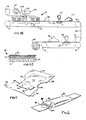
- the air forming system indicated generally by the numeral 10 includes a distributor unit 12 disposed transversely above a continuous forming screen 14 mounted on rollers 16 and driven by a suitable motor (not shown), and vacuum means or suction box 18 is positioned beneath the screen.
- upstream of the distributor unit is a defibrator or feeder (not shown), such as a hammermill or Rando-Feeder, where bales, laps or the like are defiberized, and further the fibers may be cleaned and/or blended if necessary or desired depending largely on the type of fibers used, the blend of fibers used, and the end product sought.
- a defibrator or feeder such as a hammermill or Rando-Feeder, where bales, laps or the like are defiberized, and further the fibers may be cleaned and/or blended if necessary or desired depending largely on the type of fibers used, the blend of fibers used, and the end product sought.
- wood pulp fibers can be blended with synthetic fibers and applied as a blend by the distributor, or each distributor can convey a different fiber to the screen to form separate plies or layers.
- the fibers are carried by an air stream via conduit 20 to the distributors.
- the porous forming screen 14 is essentially coextensive with the distributors, and the suction box 18 beneath the screen draws the air stream downwardly and conveys the fibers to the surface of the screen thereby forming plies or a loose web 22. At this stage in the process, the web exhibits little integrity, and the vacuum means retains the loose, fibrous web on the screen.
- the distributor unit typically comprises a plurality of individual distributors, and although Figure 1 shows schematically four distributors at 12A, 12B, 12C and 12D, this number of distributors and particular arrangement can be altered or varied depending on such factors as machine speed, capacity, type of fibers, and end product desired.
- Web 22 formed on screen 14 has incorporated therein a water-insoluble superabsorbent material.
- a dosing unit or feed hopper 24, containing superabsorbent particles 26, is positioned in the middle of the distributor unit, i.e. between distributors 12B and 12C.
- superabsorbent particles are deposited between plies of fluff laid by each distributor. That is, the superabsorbent particles are discharged from hopper 24 onto the moving layer of fluff laid down by distributors 12A and 12B, and the plies of fluff laid down by distributors 12C and 12D are laid over the superabsorbent particles.
- the plies are relatively porous, and therefore the particles tend to migrate somewhat into adjacent plies.
- the superabsorbent particles may be blended with the fibers in one or more distributors, such as in distributor 12B or 12C, thereby forming a web with superabsorbent particles intermixed with one or more fibrous plies of the web.
- the web 22 condensed on forming wire 14 has very little integrity and requires stabilization.
- the web is advanced by the continuous screen, and where desired, the web first may be passed between compression rollers 28, which may be heated, to densify the web, but this step is optional.
- This densification step enhances the penetration of the latex into the web, and the degree or percent of densification can vary depending on such factors as the amount of hydrogel, basis weight of the web, the desired degree of penetration of the latex into the web, and the end product sought.
- the web is transported to a suitable dispensing means 30, such as a spray nozzle, doctor blade, roller applicator, or the like, where a latex binder is applied to the surface of the loose web.
- a vacuum applied by suction box 31 positioned beneath the dispensing means and screen helps to draw the latex into the web.
- the dispensing means or applicator is essentially coextensive with the width of the web, and preferably a substantially uniform coating is applied to the web surface.
- the latex may be applied as a nonuniform, random or pattern coating, and because the latex is water-based, it will diffuse throughout the web and function as a binder when cured. The latex when cured imparts integrity to the web, and therefore some penetration of the latex is required.
- the extent or degree of penetration of the latex into the web is controlled by controlling the amount of latex applied and by controlling the vacuum applied to the web in that the vacuum helps to draw the latex into the web.
- the latex is usually applied as an aqueous emulsion, and is a thermosetting plastic.
- the latex emulsion contains a suitable curing agent or cross-linking agent, and after the web is coated, the latex is cured to effect cross-linking.
- curing is accomplished by passing the coated web through a hot air oven orthrough air drier 32, and the temperature typically ranges from about 200 to 500°F but this depends upon the specific type of latex resin used, upon the curing agent or cross-linking agent, upon the amount of latex, the thickness of the web, the degree of vacuum, and the machine speed.
- the resulting web structure 40 exiting from the last oven now exhibits sufficient integrity and can be cut, rolled, packaged, etc. As shown, the web 40 is taken up on roller 42, and may be used as stock for a finished product such as of the type described below in detail.
- the fibrous structure made in accordance with the foregoing process is illustrated in Figure 2.
- the structure indicated generally by the numeral 44, comprises randomly distributed fibers 46, such as wood pulp fibers, and superabsorbent particles 48 are randomly distributed in the web. It will be observed that the particles of hydrogel are more concentrated in the middle zone of the web, but some particles migrate to other sections of the web. Both surfaces of the web bear a latex coating 50, which has penetrated or impregnated the web to some degree and has partially coated some of the fibers and hydrogel particles. As explained above, the penetration is controlled so as not to substantially impair the absorbent capacity of the hydrogel.
- the web is soft yet strong and absorbent, exhibiting a relatively high tensile strength and breaking length. It is desirable for fibrous structures of this type to have relatively low bulk, because a more dense web, when compared to similar structures containing no latex and of about equal absorptive capacity but of higher bulk, can be thinner yet highly absorbent and consequently less bulky.
- a reduction in bulk, which means a reduction in volume the web is occupying, without sacrificing significantly other desired properties is important from the standpoint of manufacturing, storage and packaging.
- the basis weight ranges from about 20 to 500 grams per square meter, and more preferably from about 75 to 350.
- the web structures should have a breaking length of not less than about 750 meters, and preferably not less than about 1000, as measured according to TAPPI method T 494 om-88 (except the TAPPI method was modified so that the rate of jaw separation was 100 mm/min). Breaking length, as defined by this TAPPI test is the calculated limiting length of a strip of uniform width, beyond which, if such a strip were suspended by one end, it would break of its own weight. Thus, a breaking length value less than this minimum results in a product that may be too weak for some applications.
- the absorption capacity, retention, and absorption rate properties for the absorbent structures of this invention are particularly meaningful.
- the Gravimetric Absorbency Test is used by the industry to study and measure these properties, and the basic procedure and apparatus are described in Bergeni et al., Textile Research Journal, 37 (1967) 356, and in United States Patent number 4,357,827 to McConnell.
- a porous plate of glass fiber is connected to a water reservoir which is placed over an analytical balance.
- the porous plate is supported by a vertical slide assembly which allows one to adjust the height of the plate to the same level (or higher) as the water reservoir. Normally, the height of the porous plate is set at a hydrostatic tension of 1.5 cm over the water reservoir.
- the absorption and retention values are based on the hypothetical value of the water absorbed by one gram of the sample.
- the values obtained are a measurement of the capabilities of the materials being tested, in that a higher absorption value indicates a higher absorptive capacity, and a higher retention value indicates a better wipe dry characteristic or holding the fluid under pressure.
- the absorbent structures of this invention exhibit an absorptive capacity of not less than about six grams of a one percent saline solution per gram of structure, and preferably, about eight grams, as measured by the Gravimetric Absorbency Test.
- the absorption rate which is an indication of how fast a sample can absorb fluid, can be determined from the initial slope of the absorption curve. The higher or steeper the absorption curve, the faster the absorption rate.
- the absorption rate depends on such factors as type of fibers, type of hydrogel, and density or basis weight of the structure.
- the retention property is meaningful because the consumer most typically is applying some form of pressure to the structure when in use.
- the structures exhibit a retention capability of not less than about five gramms of a one percent saline solution per gram of structure, and preferably not less than about six grams.
- the fibers may be cellulosic, modified cellulosic, or synthetic, and include such fibers as wood pulp, rayon, cotton, cellulose acetate, polyester, polyethylene, polypropylene, nylon, and the like.
- a fibrous web comprising cellulosic fibers such as wood pulp fibers is particularly useful in such products as disposable diapers or wipes because the cellulose is liquid absorbent and therefore enhances the overall absorbency of the structure.
- Products of this type also advantageously use a blend of cellulosic and synthetic fibers, typically comprising about 65 to 95 weight percent cellulosic fibers, and more preferably up to about 20 percent by weight of the synthetic fiber.
- the synthetic fiber which can be provided in any length including staple-length can improve the strength of the structure, but its content is frequently limited because it decreases the rate of absorbency of the structure.
- a structure comprising all synthetic fibers can be useful in such applications as a filter medium.
- the type of fiber and particular blend can be varied depending upon the end product.
- the structures of this invention can be used for incontinent pads, diaper core, diaper insert, and for surgical and wound bandages.
- Superabsorbent polymers useful in the absorbent structures of this invention are substantially water insoluble but water swellable, and comprise, for example, saponified starch-polyacrylonitrile graft copolymers, starch-polyacrylic acid graft copolymers, cross-linked/grafted cellulose, saponified vinyl acetate-acrylic acid copolymers, starch grafted polyvinyl acetate, acrylic acid polymers, cross-linked polyethylene oxide, isobutylene maleic anhydride copolymers, and the like.
- the hydrogels used in the fibrous web structures may be the same or a mixture of absorbent polymers, and are incorporated into the web as a discontinuous solid material.
- the amount of hydrogel can vary widely depending on the end use of the product, and the weight percent can be determined, taking into account the end use, through experiment by one having skill in the art. For example, if the absorbent structure is used in a wipe or towel, a useful range for the hydrogel has been found to be from as low as 1 percent up to about 10 percent by weight. If used in a diaper or feminine pad, the weight percent hydrogel usually ranges from about 10 to 65 weight percent of the structure, and preferably from about 15 to 55 weight percent.
- the percent hydrogel is too low, the product will not be sufficiently absorbent because the latex does obscure to some extent the absorbent properties of both the hydrogel and fibers.
- the amount can vary depending on such factors as type of fiber, the absorbent capacity of the hydrogel for the particular fluid to be absorbed, the amount of latex, and basis weight of the structure.
- the absorbent particulates may be in the form of fibers, flakes, particles, granules, powder, and the like.
- Particularly useful hydrogels comprise particles having a size of from about 40 to 700 microns. Particulate within this size range are relatively easy to handle and further ensure a rapid and even distribution of such particles in the web. Also, particles that are too small have a geeater tendency to migrate or sift from the structure and be lost or generate excessive dust.
- the latex is applied as an aqueous emulsion or dispersion, which typically contains about 45 to 65 percent solids, and these materials are readily available from several manufacturers. Because the latex emulsions are water miscible, they may be further diluted, if desired, before being applied to the web. Also, these latex compositions are thermosetting, and in order to effect cross-linking, they contain a small amount of a suitable cross-linking agent which is a well known chemical agent for this purpose, such as N-methylolacrylamide.
- Latices available are classified by chemical family, and those particularly useful include vinyl acetate and acrylic ester copolymers, ethylene vinyl acetate copolymers, styrene butadiene carboxylate copolymers, and polyacrylonitriles, and sold, for example, under the trade names of Airbond, Airflex and Vinac of Air Products, Inc., Hycar and Geon of Goodrich Chemical Co., and Fulatex of H. B. Fuller Company.
- the amount of latex used in the structure cannot be so high as to substantially impair or obscure the effective absorbent properties of the hydrogel and hydrophilic fibers, or as to impart a stiffness to the structure as to render it impractical. I have found that the latex may range from about 5 to 30 weight percent of the structure, and preferably from about 10 to 20 weight percent.
- a porous reinforcing web such as creped paper, 3D formed paper, or scrim, may be incorporated into the fibrous web structure either as a surface web or as an intermediate web disposed interjacent the surfaces of the fibrous web.
- Figures 3A and 4A relate to the embodiment wherein the web is a surface web and Figures 3B and 4B relate to the embodiment wherein the web is an intermediate web disposed between the surfaces of the fibrous web.
- the structure 59 comprises fibers 60 and hydrogel particles 61 interspersed in the web but more concentrated in the middle zone. Scrim 62 is formed on one surface of the web structure, and the opposite surface bears a cured latex coating 64.
- FIG. 3A One method of forming structure 59 is illustrated in Figure 3A wherein reference numerals which are in common with those in Figure 1 relate to like features.
- the air forming system shown generally at 10 is similar to that shown in Figure 1.
- the scrim 52A which typically is a polyester or polyolefin, is fed from a source roll 53 across idler roll 54 and onto the continuous screen 14. Fibers from distributor 12A are conveyed onto the scrim to form a first ply, and the fibers become somewhat mechanically entangled with the scrim. Additional fibers and hydrogel particles are conveyed as in Figure 1 to the screen zone bearing scrim and fibers to build the desired loose web.
- the fibrous web is then transported to dispensing means 30 where the latex emulsion is applied, and the latex is cured on passing through hot air oven 32.
- the structure is then wound on roller 55.
- Figure 3A also shows a second latex dispensing means 36, 37 and drier 38 for disposing latex on to the other face of the structure, that is the face containing scrim 62 ( Figure 4), if desired.
- FIG 4B wherein the reference numerals which are common with Figure 4A represent like features, illustrates a structure wherein the reinforcing web (scrim) 62 is disposed between the surfaces of the fibrous web.
- One method of forming this alternative structure is illustrated in Figure 3B wherein reference numerals which are common with those of Figure 1 represent like features.
- scrim 52B is fed from source roll 57 positioned intermediate the distributors, such as between distributors 12B and 12C as shown, and into converging relation with formed plies condensed on the screen from the distributors positioned upstream of roll 57.
- Superabsorbent material from hopper 24 is deposited onto the scrim surface, and additional plies of fibers are formed over the superabsorbent particles.
- a latex is then applied to one surface of the fibrous web, using latex dispensing means 30, the latex is cured by drier 32 and the finished structure is wound on roller 58, as described above. If both surfaces of the web are to be coated with latex, the second surface is coated using dispensing means 36 and the latex cured by drier 38.
- the embodiment with the scrim interjacent the surfaces has the desirable feature in that the scrim prevents the hydrogel particles from migrating to the underside of the fibrous web thereby maintaining the particles in the desired location toward or in the vicinity of the center of the web.
- Scrim material which is a useful reinforcement for fibrous webs, is readily available from several sources, and typically comprises a polyester, polyethylene, polypropylene or polyacrylic. Particularly useful materials for these embodiments of the invention include scrim having an opening ranging from about 20 to 700 microns and a denier of from about 1.2 to 5. Also, a woven scrim with openings of from about .1 to 7 mm can be used.
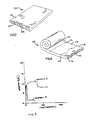
- FIGs 5 through 8, inclusive depict useful products embodying the fibrous structure of this invention.
- a diaper comprising a moisture-permeable facing member 66 for the body-side of the pad, such as a nonwoven polypropylene fabric, and a puncture-impervious backing member 68, such as a polyethylene film or sheet.
- the diaper is the typical hour-glass configuration with cut-out leg sections 70 and crotch section 72. Tabs 74 are provided in order to secure the diaper around the waist of the wearer.
- the fibrous absorbent structure or core of the type shown in Figure 2 comprising fibers 76, preferably wood pulp fibers which, if desired, may be combined with up to about 20 percent by weight synthetic fibers, and superabsorbent particles 78.
- a latex coating 80 is provided on both surfaces, and the latex partially penetrates the web and coats a portion only of the fibers and hydrogel particles.
- the diaper is sealed along the marginal edges by conventional means. The body fluid permeates fabric 66, and because of the wicking action of the fibers, the fluid is transported to all areas of the batt and absorbed by the hydrogel and fibers.
- the facing fabric being liquid-permeable, is perceived by the wearer as dry even when the inner batt or web is saturated. Because the liquid absorbent structure is relatively dense and exhibits high absorbency, the diaper made utilizing this structure is exceptionally thin, and the absorbency rate compares very favorably with a more bulky pad bearing no latex. (Absorbency rate and comparative data is discussed in greater detail with reference to Figures 9 through 12, below.) It should be understood that the term "diaper" as used herein and in the appended claims includes adult incontinent diapers.
- FIG. 6 a feminine napkin with a broken away portion to illustrate the construction of the pad.
- the napkin comprises a moisture-permeable facing member 82, such as a nonwoven fabric, a moisture-impermeable backing member 84, such as a polyethylene film, and the napkin is sealed along the marginal edges in a conventional manner.
- the absorbent core comprises fibers 86, hydrogel particles 88, and latex coating 90.
- the absorbent structure for this feminine pad is soft, dense, and highly absorbent.
- Figure 7 depicts a wipe 100 comprising fibers 102, hydrogel particles 104, and latex coating 106.
- the fibers may consist of cellulosic fibers, synthetic fibers, or a blend of fibers.
- the latex coating imparts integrity to the structure in that it exhibits relatively high tensile strength and breaking length without substantially impairing the absorptive capacity.
- Figure 8 shows a partial roll illustrating how a blank of the absorbent structure can be used, for example, as a diaper or diaper insert.
- the roll indicated generally by the numeral 108, comprises a plurality of blanks 110, and a single blank can be separated from the roll along score line 112.
- Each blank is sealed along its marginal edges by a glue line or other sealant means (not shown).
- the blank can have the conventional hour-glass configuration such as shown in Figure 5.
- a roll of feminine napkins could be provided with the napkins rolled about its longitudinal axis (the long axis), and each napkin separable from the roll along the score line.
- the blank can have a rectangular shape.
- Each blank comprises fibers 114, superabsorbent particles 116, and a latex coating 118.
- the absorbent structure has a relatively high density or low bulk, a large number of blanks can be provided in roll form, which is a convenience and advantage. For example, a roll approximately five inches in diameter on a one and one half inch core (such as for a paper towel) may comprise about 50 lineal feet. It would be impractical to form such a roll with conventional absorbent structures which are more bulky, i. e. less dense.
- samples were made substantially in accordance with the procedure shown in Figure 1. Accordingly, layers of fibers were airlaid and hydrogel particles deposited between layers to form the loose web. The webs were densified, both sides of each web impregnated with latex, and the webs then dried in a forced hot air oven.
- Absorbent webs approximately 30 by 30 cm were prepared using 100% Southern pine bleached Kraft pulp from Weyerhaeuser Company at a basis weight of about 100 g/m 2 , and 1 M-1500 superabsorbent powder manufactured by Celanese Chemical Co. was added at a weight of about 80 g/m 2 .
- the webs were coated on both sides with A-109 (k) latex from Air Products and Chemicals, Inc., and the resulting webs comprised about 17% by weight latex.
- the webs, identified as Samples "1" and "2” were tested for absorption and retention with a 1% saline solution and with water using the Gravimetric Absorbency Testing unit described above.
- Example 1 In order to further demonstrate the structure of the present invention, comparative tests were conducted as in Example 1 using the same materials for the inventive structure and for the one control (Control A). In addition, a comparison was made between a second control (Control B) comprising kittyhawk fluff from Weyerhaeuser Company containing 20 weight percent polyethylene fiber, and hydrogel as in Example 1, but no latex was used in Control B.
- Control B a second control
- the absorptivity results are illustrated in Figures 11 and 12 and Table II. It will be observed from Figure 11 that the absorbency rate measured using a 1% saline solution for the structure of the invention is almost as fast as Control A and much faster than Control B.
- the structure of the present invention exhibits fast absorbency and excellent retention, thereby making the product a useful liquid absorptive structure such as for body fluids.
- the absorbent structure was made on a pilot machine using two distributors for air laying fibers and a dosing unit positioned between the distributors for depositing hydrogel particles.
- the web comprised JDL fluff pulp from ITT Rayonnier at a basis weight of approximately 100 g/m 2 , Aquakeep 10 SHP superabsorbent powder at a weight of about 80 g/m 2 from Norsolor Chemical Company, and Vinumul 33003 latex at a weight of approximately 10 g/m 2 /side.
- the Vinumul 33003 latex is a vinyl acetate ethylene emulsion with an anionic surfactant from Vinumul which is a subsidiary of National Starch Company.
- the basis weight for samples tested from the web structure varied from about 177 to 227 g/m 2 .
- the structure had a breaking length of about 6079 meters in the machine direction and 5111 meters in the cross direction (TAPPI T 494 om-88, described above), which shows relatively high strength for webs of this type.
- Absorption and retention test data in grams of solution per gram of fibrous web for a 1% saline solution are shown in Table III below.
- a structure of the present invention exhibits not only relatively high absorption but excellent retention of fluid. From the foregoing, it will be observed that the structures are particularly useful in absorbent products, such as those used in absorbing body fluids and as filters.
- the excellent combination of physical, tactile and liquid absorbence properties of the structure of the invention results from the unique combination of dry laid fibers, particulate superabsorbent material and latex coating and in particularfrom employing the latex coating in an amount which is sufficient to impart integrity to the structure but which is not such as to substantially impair the effectiveness of the superabsorbent material to absorb liquid.
- the amount of latex employed it is possible to control the extent of surface coating by the latex, the depth of penetration of the latex into the structure and the degree of coverage of the superabsorbent material by the latex.
- the latex coating is discontinuous and by virtue of their being surrounded by fibrous material the superabsorbent particles are largely unaffected by the latex. The coverage of the particles by the latex is even further restricted in the preferred case where they are located in a generally central portion of the structure.
Landscapes
- Health & Medical Sciences (AREA)
- Engineering & Computer Science (AREA)
- Epidemiology (AREA)
- Veterinary Medicine (AREA)
- Vascular Medicine (AREA)
- Life Sciences & Earth Sciences (AREA)
- Animal Behavior & Ethology (AREA)
- General Health & Medical Sciences (AREA)
- Public Health (AREA)
- Biomedical Technology (AREA)
- Heart & Thoracic Surgery (AREA)
- Manufacturing & Machinery (AREA)
- Absorbent Articles And Supports Therefor (AREA)
- Processes Of Treating Macromolecular Substances (AREA)
- Nonwoven Fabrics (AREA)
- Solid-Sorbent Or Filter-Aiding Compositions (AREA)
- Medicines That Contain Protein Lipid Enzymes And Other Medicines (AREA)
- Orthopedics, Nursing, And Contraception (AREA)
- Laminated Bodies (AREA)
- Treatments For Attaching Organic Compounds To Fibrous Goods (AREA)
Applications Claiming Priority (2)
| Application Number | Priority Date | Filing Date | Title |
|---|---|---|---|
| US07/511,452 US5128082A (en) | 1990-04-20 | 1990-04-20 | Method of making an absorbant structure |
| US511452 | 1990-04-20 |
Related Child Applications (1)
| Application Number | Title | Priority Date | Filing Date |
|---|---|---|---|
| EP98200930 Division | 1998-03-25 |
Publications (3)
| Publication Number | Publication Date |
|---|---|
| EP0463716A2 true EP0463716A2 (fr) | 1992-01-02 |
| EP0463716A3 EP0463716A3 (en) | 1993-12-29 |
| EP0463716B1 EP0463716B1 (fr) | 1999-06-09 |
Family
ID=24034965
Family Applications (1)
| Application Number | Title | Priority Date | Filing Date |
|---|---|---|---|
| EP19910303296 Revoked EP0463716B1 (fr) | 1990-04-20 | 1991-04-15 | Composé absorbant et procédé pour sa fabrication |
Country Status (6)
| Country | Link |
|---|---|
| US (2) | US5128082A (fr) |
| EP (1) | EP0463716B1 (fr) |
| AT (1) | ATE180961T1 (fr) |
| DE (1) | DE69131306T2 (fr) |
| DK (1) | DK0463716T3 (fr) |
| ES (1) | ES2133279T3 (fr) |
Cited By (18)
| Publication number | Priority date | Publication date | Assignee | Title |
|---|---|---|---|---|
| FR2717836A1 (fr) * | 1994-03-28 | 1995-09-29 | Kimberly Clark Co | Appareil et procédé pour former une couche séparée de matériau particulaire dans une nappe composite fibreuse. |
| WO1996017574A3 (fr) * | 1994-12-07 | 1996-08-29 | Mcneil Ppc Inc | Procede de fabrication d'une structure absorbante stratifiee |
| WO1997003598A1 (fr) * | 1995-07-21 | 1997-02-06 | Hugh Rogers Mclaughlin | Appareil pour le sechage de planchers durs |
| EP0850615A1 (fr) | 1996-12-20 | 1998-07-01 | The Procter & Gamble Company | Structuré etendue à sec contentant des matériaux à particules |
| EP0850616A1 (fr) | 1996-12-20 | 1998-07-01 | The Procter & Gamble Company | Structure étendue à sec avec matériau désodorisant |
| WO1998028479A1 (fr) | 1996-12-20 | 1998-07-02 | The Procter & Gamble Company | Structure produite a sec et contenant une matiere particulaire |
| WO1999056686A1 (fr) * | 1998-05-07 | 1999-11-11 | The Procter & Gamble Company | Element absorbant et procede de formation de celui-ci |
| GB2315221B (en) * | 1996-07-12 | 2001-01-17 | Camelot Superabsorbents Ltd | Absorbent articles |
| DE10054928A1 (de) * | 2000-11-06 | 2002-05-08 | Rudolf Demhartner | Verfahren zur Herstellung von flüssigkeitsaufnehmenden Unterlagen |
| US6610899B1 (en) | 1998-05-07 | 2003-08-26 | The Procter & Gamble Company | Absorbent member and a method for forming the same |
| GB2351742B (en) * | 1999-07-06 | 2004-01-14 | Acordis Fibres | Superabsorbent fibre with a hydrophobic finish |
| EP1293187A4 (fr) * | 2000-05-23 | 2004-03-31 | Toyo Eizai Kk | Feuille ultra-mince absorbante, article absorbant jetable equipe de cette feuille et dispositif de production de celle-ci |
| WO2005012620A1 (fr) * | 2003-08-04 | 2005-02-10 | Fintex & Partners Italia S.P.A. | Materiau composite absorbant, articles constitues dudit materiau et procede et dispositif pour la production de ce materiau |
| DE19824825B4 (de) * | 1997-11-18 | 2009-07-09 | Alexander Maksimow | Verfahren zur Herstellung eines Folienverbundes |
| WO2011015377A1 (fr) * | 2009-08-07 | 2011-02-10 | Duetto Licence Ag | Structure plate |
| WO2023178636A1 (fr) * | 2022-03-25 | 2023-09-28 | 3M Innovative Properties Company | Partie centrale de couche |
| WO2025142463A1 (fr) * | 2023-12-28 | 2025-07-03 | ユニ・チャーム株式会社 | Procédé de fabrication de corps absorbant |
| WO2025142456A1 (fr) * | 2023-12-28 | 2025-07-03 | ユニ・チャーム株式会社 | Dispositif de formation de noyau absorbant et procédé de formation de noyau absorbant |
Families Citing this family (150)
| Publication number | Priority date | Publication date | Assignee | Title |
|---|---|---|---|---|
| US5230959A (en) | 1989-03-20 | 1993-07-27 | Weyerhaeuser Company | Coated fiber product with adhered super absorbent particles |
| US5505718A (en) * | 1990-04-02 | 1996-04-09 | The Procter & Gamble Company | Absorbent structures containing specific particle size distributions of superabsorbent hydrogel-forming materials |
| US5419956A (en) * | 1991-04-12 | 1995-05-30 | The Procter & Gamble Company | Absorbent structures containing specific particle size distributions of superabsorbent hydrogel-forming materials mixed with inorganic powders |
| US5422169A (en) * | 1991-04-12 | 1995-06-06 | The Procter & Gamble Company | Absorbent structures containing specific particle size distributions of superabsorbent hydrogel-forming materials in relatively high concentrations |
| GB9113861D0 (en) * | 1991-06-26 | 1991-08-14 | Lock Peter M | Absorptive fibrous sheets and processes for their manufacture |
| US6319599B1 (en) | 1992-07-14 | 2001-11-20 | Theresa M. Buckley | Phase change thermal control materials, method and apparatus |
| US5543215A (en) * | 1992-08-17 | 1996-08-06 | Weyerhaeuser Company | Polymeric binders for binding particles to fibers |
| US7144474B1 (en) | 1992-08-17 | 2006-12-05 | Weyerhaeuser Co. | Method of binding particles to binder treated fibers |
| US5308896A (en) * | 1992-08-17 | 1994-05-03 | Weyerhaeuser Company | Particle binders for high bulk fibers |
| US6391453B1 (en) * | 1992-08-17 | 2002-05-21 | Weyernaeuser Company | Binder treated particles |
| US5547541A (en) * | 1992-08-17 | 1996-08-20 | Weyerhaeuser Company | Method for densifying fibers using a densifying agent |
| US5589256A (en) * | 1992-08-17 | 1996-12-31 | Weyerhaeuser Company | Particle binders that enhance fiber densification |
| US5538783A (en) * | 1992-08-17 | 1996-07-23 | Hansen; Michael R. | Non-polymeric organic binders for binding particles to fibers |
| US6340411B1 (en) | 1992-08-17 | 2002-01-22 | Weyerhaeuser Company | Fibrous product containing densifying agent |
| US5300192A (en) * | 1992-08-17 | 1994-04-05 | Weyerhaeuser Company | Wet laid fiber sheet manufacturing with reactivatable binders for binding particles to fibers |
| US5641561A (en) * | 1992-08-17 | 1997-06-24 | Weyerhaeuser Company | Particle binding to fibers |
| US5807364A (en) * | 1992-08-17 | 1998-09-15 | Weyerhaeuser Company | Binder treated fibrous webs and products |
| US5352480A (en) * | 1992-08-17 | 1994-10-04 | Weyerhaeuser Company | Method for binding particles to fibers using reactivatable binders |
| US5998032A (en) * | 1992-08-17 | 1999-12-07 | Weyerhaeuser Company | Method and compositions for enhancing blood absorbence by superabsorbent materials |
| KR950702909A (ko) | 1992-08-17 | 1995-08-23 | 패트릭 디. 쿠갠 | 입자 결합제 |
| US5284610A (en) * | 1993-02-09 | 1994-02-08 | Kang Na Hsiung Enterprise Co., Ltd. | High molecular absorbent sheet manufacturing process and the related equipment |
| CA2114815C (fr) | 1993-02-24 | 2005-06-14 | Mark Kevin Melius | Composite absorbant |
| ATE189599T1 (de) * | 1993-10-21 | 2000-02-15 | Procter & Gamble | Flüssigkeitsabsorbierende monatsbinden |
| US7037394B2 (en) * | 1994-01-07 | 2006-05-02 | Scan-Web I/S | Method and apparatus for manufacturing a dryformed fibrous web |
| US5599335A (en) * | 1994-03-29 | 1997-02-04 | The Procter & Gamble Company | Absorbent members for body fluids having good wet integrity and relatively high concentrations of hydrogel-forming absorbent polymer |
| US5695486A (en) * | 1995-09-19 | 1997-12-09 | Buckeye Cellulose Corporation | Light-weight, low density absorbent structure and method of making the structure |
| US5665082A (en) * | 1995-11-01 | 1997-09-09 | Johnson & Johnson Inc. | Highly absorbent transfer layer structure |
| US5763044A (en) * | 1995-11-22 | 1998-06-09 | The Procter & Gamble Company | Fluid pervious, dispersible, and flushable webs having improved functional surface |
| US5670110A (en) * | 1995-12-21 | 1997-09-23 | The Procter & Gamble Company | Method for making three-dimensional macroscopically-expanded webs having improved functional surfaces |
| BR9612399A (pt) * | 1996-01-11 | 1999-07-13 | Procter & Gamble | Estrutura absorvente dotada de zonas circundadas por uma regi o de polímero absorvente de formação de hidrogel contínua |
| FR2748404B1 (fr) * | 1996-05-09 | 1998-07-24 | Atochem Elf Sa | Poudres superabsorbantes a forte absorption et forte sucion capillaire |
| US6319239B1 (en) | 1996-12-20 | 2001-11-20 | The Procter & Gamble Company | Absorbent article having improved integrity and acquisition |
| EP1260627A3 (fr) * | 1997-01-28 | 2002-12-11 | Camelot Superabsorbents Ltd | Procédé pour lier une nappe de fibres |
| US7670324B2 (en) | 1997-03-27 | 2010-03-02 | The Procter And Gamble Company | Disposable absorbent articles with replaceable absorbent core components having regions of permeability and impermeability on same surface |
| US6932800B2 (en) | 1997-03-27 | 2005-08-23 | The Procter & Gamble Company | Absorbent articles comprising a material having a high vertical wicking capacity |
| US6989005B1 (en) * | 1997-03-27 | 2006-01-24 | The Procter & Gamble Company | Absorbent articles having removable components |
| US7601145B2 (en) | 1997-03-27 | 2009-10-13 | The Procter & Gamble Company | Disposable absorbent articles having multiple absorbent core components including replaceable components |
| US7291137B2 (en) | 1997-03-27 | 2007-11-06 | The Procter & Gamble Company | Disposable absorbent articles having multiple absorbent core components including replaceable components |
| US6121510A (en) * | 1997-12-03 | 2000-09-19 | Kimberly-Clark Worldwide, Inc. | Absorbent article having improved containment flaps |
| US6420626B1 (en) | 1999-06-08 | 2002-07-16 | Buckeye Technologies Inc. | Unitary fluid acquisition, storage, and wicking material |
| US6479415B1 (en) * | 1998-06-08 | 2002-11-12 | Bki Holding Corporation | Absorbent structures having fluid acquisition and distribution layer |
| US6241713B1 (en) | 1998-06-08 | 2001-06-05 | Buckeye Technologies Inc. | Absorbent structures coated with foamed superabsorbent polymer |
| US6353148B1 (en) | 1998-06-08 | 2002-03-05 | Bki Holding Corporation | Fracture resistant superabsorbent polymers |
| US6403857B1 (en) * | 1998-06-08 | 2002-06-11 | Buckeye Technologies Inc. | Absorbent structures with integral layer of superabsorbent polymer particles |
| US6726672B1 (en) * | 1998-09-28 | 2004-04-27 | Icu Medical, Inc. | Intravenous drug access system |
| US6344109B1 (en) | 1998-12-18 | 2002-02-05 | Bki Holding Corporation | Softened comminution pulp |
| US6613028B1 (en) * | 1998-12-22 | 2003-09-02 | Kimberly-Clark Worldwide, Inc. | Transfer delay for increased access fluff capacity |
| DE19918343C2 (de) * | 1999-04-22 | 2001-03-08 | Wacker Chemie Gmbh | Verfahren zur Herstellung von Faservliesen nach dem Airlaidverfahren |
| US7195810B1 (en) * | 1999-04-27 | 2007-03-27 | Fort James Corporation | Air-laid absorbent sheet with sinuate emboss |
| US6893525B1 (en) | 1999-05-05 | 2005-05-17 | Fort James Corporation | Method for embossing air-laid webs using laser engraved heated embossing rolls |
| EP1067228B1 (fr) * | 1999-07-05 | 2011-10-05 | Kao Corporation | Feuille dotée de récupération après compression, procédé de fabrication et article absorbant la renfermant |
| US6491993B1 (en) | 1999-08-12 | 2002-12-10 | Pactiv Corporation | Absorbent pouches |
| US6807702B2 (en) * | 1999-11-12 | 2004-10-26 | Kimberly-Clark Worldwide, Inc. | Cleaning system and apparatus |
| EP1133961A1 (fr) * | 2000-03-15 | 2001-09-19 | The Procter & Gamble Company | Serviette hygiénique ou protège-slip pour slip tanga |
| US20040092898A1 (en) * | 2000-03-15 | 2004-05-13 | Schaefer Jochen | Sanitary napkin or panty liner for use with a tanga undergarment |
| US20030208175A1 (en) * | 2000-06-12 | 2003-11-06 | Gross James R. | Absorbent products with improved vertical wicking and rewet capability |
| US6608237B1 (en) | 2000-08-03 | 2003-08-19 | Kimberly-Clark Worldwide, Inc. | High-strength, stabilized absorbent article |
| US6533978B1 (en) | 2000-08-03 | 2003-03-18 | Kimberly-Clark Worldwide, Inc. | Process and apparatus for forming a stabilized absorbent web |
| US6533989B1 (en) | 2000-08-03 | 2003-03-18 | Kimberly-Clark Worldwide, Inc. | Multi-chamber process and apparatus for forming a stabilized absorbent web |
| EP1398013A4 (fr) * | 2000-09-21 | 2010-12-08 | Japan Absorbent Tech Inst | Produit absorbant comprenant des absorbants amovibles |
| US6488670B1 (en) | 2000-10-27 | 2002-12-03 | Kimberly-Clark Worldwide, Inc. | Corrugated absorbent system for hygienic products |
| WO2002055774A2 (fr) * | 2000-11-14 | 2002-07-18 | Weyerhaeuser Co | Produit cellulosique reticule forme par un procede d'extrusion |
| US7411110B2 (en) | 2000-12-20 | 2008-08-12 | Kimberly-Clark Worldwide, Inc. | Thin, high capacity absorbent structure and method for producing same |
| US6664437B2 (en) | 2000-12-21 | 2003-12-16 | Kimberly-Clark Worldwide, Inc. | Layered composites for personal care products |
| US6689242B2 (en) | 2001-03-26 | 2004-02-10 | First Quality Nonwovens, Inc. | Acquisition/distribution layer and method of making same |
| US7264615B2 (en) | 2001-04-03 | 2007-09-04 | Kimberly-Clark Worldwide, Inc. | Absorbent insert for use with an outer absorbent garment |
| DE10126515A1 (de) * | 2001-05-30 | 2002-12-05 | Fleissner Gerold | Verfahren zum Verfestigen einer aus Wood Pulp gebildeten Warenbahn |
| US7727211B2 (en) | 2001-07-23 | 2010-06-01 | The Procter & Gamble Company | Absorbent article having a replaceable absorbent core component having an insertion pocket |
| CA2465210C (fr) * | 2001-11-09 | 2012-07-17 | Bki Holding Corporation | Coussin intermediaire monobloc absorbant multicouche |
| US6861477B2 (en) | 2001-12-21 | 2005-03-01 | Kimberly-Clark Worldwide, Inc. | Microphase separated superabsorbent compositions and method for making |
| US7152761B2 (en) * | 2002-01-04 | 2006-12-26 | Paragon Trade Brands, Inc. | System and method for dry forming zoned absorbent cores |
| US6989118B2 (en) * | 2002-01-15 | 2006-01-24 | Kimberly-Clark Worldwide, Inc. | Process for making a reinforced fibrous absorbent member |
| US6802834B2 (en) | 2002-01-15 | 2004-10-12 | Kimberly-Clark Worldwide, Inc. | Absorbent article having discontinuous absorbent core |
| US7745687B2 (en) * | 2002-01-15 | 2010-06-29 | Kimberly-Clark Worldwide, Inc. | Absorbent article with reinforced absorbent structure |
| US20030135176A1 (en) * | 2002-01-16 | 2003-07-17 | Troy Delzer | System and method for depositing particulate matter in absorbent cores |
| DE60323731D1 (de) * | 2002-03-11 | 2008-11-06 | Matsushita Electric Industrial Co Ltd | Heizeinrichtung mit elektromagnetischer induktion und fuser |
| EP1353001A1 (fr) * | 2002-04-11 | 2003-10-15 | Main S.p.A. | Article absorbant |
| US20040058605A1 (en) * | 2002-09-19 | 2004-03-25 | Hansen Michael R. | Polysaccharide treated cellulose fibers |
| US6982052B2 (en) * | 2002-09-26 | 2006-01-03 | Kimberly-Clark Worldwide, Inc. | Process and apparatus for air forming an article having a plurality of superimposed fibrous layers |
| US6971981B2 (en) * | 2002-10-16 | 2005-12-06 | Kimberly-Clark Worldwide, Inc. | Method and apparatus for making interlabial pads |
| US20040087923A1 (en) * | 2002-10-31 | 2004-05-06 | Cole Robert Theodore | Core for an absorbent article and method for making the same |
| US6981297B2 (en) | 2002-11-27 | 2006-01-03 | Kimberly-Clark Worldwide, Inc. | Controlled placement of a reinforcing web within a fibrous absorbent |
| US20040102751A1 (en) * | 2002-11-27 | 2004-05-27 | Kimberly-Clark Worldwide, Inc. | Absorbent article with reinforced absorbent structure |
| US7103445B2 (en) | 2002-11-27 | 2006-09-05 | Kimberly-Clark Worldwide, Inc. | System and method for controlling the dispense rate of particulate material |
| US6888044B2 (en) * | 2002-12-23 | 2005-05-03 | Kimberly-Clark Worldwide, Inc. | High capacity absorbent structure and method for producing same |
| US6939492B2 (en) * | 2002-12-26 | 2005-09-06 | Kimberly-Clark Worldwide, Inc. | Method for making fibrous web materials |
| US20040127870A1 (en) * | 2002-12-27 | 2004-07-01 | Dipalma Joseph | Thin curved elasticized absorbent article with absorbent concentration profile |
| US7147446B2 (en) * | 2003-01-02 | 2006-12-12 | Weyerhaeuser Company | Crosslinking agent application method and system |
| US20050000669A1 (en) * | 2003-03-14 | 2005-01-06 | Hugh West | Saccharide treated cellulose pulp sheets |
| US20050010183A1 (en) * | 2003-06-24 | 2005-01-13 | Weyerhaeuser Company | Absorbent structure for absorbing blood |
| US7345004B2 (en) * | 2003-07-15 | 2008-03-18 | Kimberly-Clark Worldwide, Inc. | Scrim reinforced absorbent article with reduced stiffness |
| US7594906B2 (en) | 2003-07-15 | 2009-09-29 | Kimberly-Clark Worldwide, Inc. | Absorbent article having a stretchable reinforcement member |
| US20050031841A1 (en) * | 2003-08-05 | 2005-02-10 | Weyerhaeuser Company | Attachment of superabsorbent materials to fibers using oil |
| EP1651706A1 (fr) * | 2003-08-06 | 2006-05-03 | The Procter & Gamble Company | Matiere gonflable dans l'eau revetue |
| JP2007501079A (ja) * | 2003-08-06 | 2007-01-25 | ザ プロクター アンド ギャンブル カンパニー | コーティングされた水膨潤性ポリマー類を含む水膨潤性材料を製造する方法 |
| WO2005013939A1 (fr) * | 2003-08-06 | 2005-02-17 | Nirmal Mulye | Composition pharmaceutique contenant un medicament hydrosoluble |
| US20050045296A1 (en) * | 2003-08-29 | 2005-03-03 | Adam Gabriel Hammam | Stabilized absorbent composite material and method for making |
| US20080251187A1 (en) * | 2003-10-17 | 2008-10-16 | Enamul Haque | Composite material with improved structural, acoustic and thermal properties |
| US20050266757A1 (en) * | 2003-10-17 | 2005-12-01 | Roekens Bertrand J | Static free wet use chopped strands (WUCS) for use in a dry laid process |
| US20050133180A1 (en) * | 2003-12-19 | 2005-06-23 | Hugh West | Densification agent and oil treated cellulose fibers |
| US20050178518A1 (en) * | 2004-02-13 | 2005-08-18 | Hugh West | Sodium sulfate treated pulp |
| DE102004009556A1 (de) * | 2004-02-25 | 2005-09-22 | Concert Gmbh | Verfahren zur Herstellung einer Faserbahn aus Cellulosefasern in einem Trockenlegungsprozess |
| US8324446B2 (en) * | 2004-06-30 | 2012-12-04 | Kimberly-Clark Worldwide, Inc. | Unitary absorbent core with binding agents |
| DE602004026566D1 (de) | 2004-07-28 | 2010-05-27 | Procter & Gamble | Indirekter Druck von AMG |
| PL1621165T3 (pl) * | 2004-07-28 | 2010-09-30 | Procter & Gamble | Pośredni druk AGM |
| US7407701B2 (en) * | 2004-07-30 | 2008-08-05 | Kx Technologies Llc | Lofted composite with enhanced air permeability |
| US20060029567A1 (en) | 2004-08-04 | 2006-02-09 | Bki Holding Corporation | Material for odor control |
| US7279059B2 (en) * | 2004-12-28 | 2007-10-09 | Owens Corning Intellectual Capital, Llc | Polymer/WUCS mat for use in automotive applications |
| US20060137799A1 (en) * | 2004-12-29 | 2006-06-29 | Enamul Haque | Thermoplastic composites with improved sound absorbing capabilities |
| US7962993B2 (en) | 2005-09-30 | 2011-06-21 | First Quality Retail Services, Llc | Surface cleaning pad having zoned absorbency and method of making same |
| US20070074366A1 (en) * | 2005-09-30 | 2007-04-05 | Glaug Frank S | Absorbent cleaning pad and method of making same |
| US7694379B2 (en) | 2005-09-30 | 2010-04-13 | First Quality Retail Services, Llc | Absorbent cleaning pad and method of making same |
| US20070074365A1 (en) * | 2005-09-30 | 2007-04-05 | Carol Erdman | Absorbent pad with cleaning cuffs and method of making the same |
| GB0600494D0 (en) * | 2006-01-12 | 2006-02-22 | 3M Innovative Properties Co | Wiping articles |
| US8652288B2 (en) * | 2006-08-29 | 2014-02-18 | Ocv Intellectual Capital, Llc | Reinforced acoustical material having high strength, high modulus properties |
| US7824387B2 (en) | 2006-10-26 | 2010-11-02 | The Procter & Gamble Company | Method for using a disposable absorbent article as training pant |
| US7824386B2 (en) * | 2006-10-26 | 2010-11-02 | The Procter & Gamble Company | Method for using a disposable absorbent article as a swim pant |
| US7766887B2 (en) | 2006-11-13 | 2010-08-03 | The Procter & Gamble Company | Method for making reusable disposable article |
| US20080110775A1 (en) * | 2006-11-13 | 2008-05-15 | Theodora Beck | Absorbent articles with replaceable core components having stiffness characteristics and method for evaluating such characteristics |
| US20080114320A1 (en) * | 2006-11-13 | 2008-05-15 | Theodora Beck | Absorbent articles having fluid partitioning characteristics and method for evaluating such characteristics |
| DE102006060156A1 (de) * | 2006-12-18 | 2008-06-19 | Evonik Stockhausen Gmbh | Wasserabsorbierende Polymergebilde, welche unter Einsatz von Polymerdispersionen hergestellt wurden |
| US7935207B2 (en) * | 2007-03-05 | 2011-05-03 | Procter And Gamble Company | Absorbent core for disposable absorbent article |
| WO2011019895A1 (fr) * | 2009-08-14 | 2011-02-17 | The Procter & Gamble Company | Structures fibreuses et procédés pour leur réalisation |
| BR112012002881A2 (pt) * | 2009-08-14 | 2016-03-22 | Procter & Gamble | estruturas fibrosas e método para fabricação das mesmas |
| AU2010282480A1 (en) * | 2009-08-14 | 2012-03-01 | The Procter & Gamble Company | Fibrous structures and method for making same |
| US20110184365A1 (en) | 2010-01-28 | 2011-07-28 | Glatfelter Falkenhagen Gmbh | Flexible, highly absorbent material |
| ITBO20110186A1 (it) * | 2011-04-08 | 2012-10-09 | Gdm Spa | Metodo e unità per la realizzazione di imbottiture per articoli assorbenti igienici. |
| EP2524677B1 (fr) * | 2011-05-16 | 2014-08-06 | The Procter and Gamble Company | Non-tissé aérolique amélioré |
| GB2503924A (en) * | 2012-07-13 | 2014-01-15 | Glatfelter Switzerland Sarl | Super-absorbent sandwich web |
| US10596042B2 (en) * | 2013-09-30 | 2020-03-24 | Kimberly-Clark Worldwide, Inc. | Method of forming an absorbent structure |
| US9572729B2 (en) * | 2013-09-30 | 2017-02-21 | Kimberly-Clark Worldwide, Inc. | Method of forming an absorbent structure |
| JP6126968B2 (ja) * | 2013-10-18 | 2017-05-10 | ユニ・チャーム株式会社 | 不織布の嵩回復装置、及び嵩回復方法 |
| ES2928562T3 (es) | 2016-01-12 | 2022-11-21 | Georgia Pacific Mt Holly Llc | Sustrato de limpieza no tejido |
| BR112018067512B1 (pt) | 2016-03-31 | 2022-08-30 | Kimberly-Clark Worldwide, Inc | Núcleo absorvente |
| CN108779594A (zh) | 2016-03-31 | 2018-11-09 | 金伯利-克拉克环球有限公司 | 吸收芯和形成吸收芯的方法 |
| BR112018068096B1 (pt) | 2016-03-31 | 2022-08-16 | Kimberly-Clark Worldwide, Inc | Método para formação de um núcleo absorvente |
| US11135097B2 (en) | 2016-03-31 | 2021-10-05 | Kimberly-Clark Wordwide, Inc. | Absorbent cores and methods for forming absorbent cores |
| US20200016012A1 (en) | 2017-04-03 | 2020-01-16 | Georgia-Pacific Nonwovens LLC | Multi-layer unitary absorbent structures |
| WO2019067432A1 (fr) | 2017-09-27 | 2019-04-04 | Georgia-Pacific Nonwovens LLC | Matériau non tissé à fibres à deux composants à noyau élevé |
| WO2019104240A1 (fr) | 2017-11-22 | 2019-05-31 | Extrusion Group, LLC | Ensemble embout de matrice et procédé de fusion-soufflage |
| WO2019178111A1 (fr) | 2018-03-12 | 2019-09-19 | Georgia-Pacific Nonwovens LLC | Matériau non tissé avec fibres bi-composants à noyau prépondérant |
| KR102884278B1 (ko) | 2018-09-19 | 2025-11-13 | 글래트펠터 코포레이션 | 일체형 부직포 재료 |
| CN114127350A (zh) | 2019-05-30 | 2022-03-01 | 佐治亚-太平洋Mt.哈利有限责任公司 | 低迳流气流成网的非织造材料 |
| CA3150410A1 (fr) | 2019-08-08 | 2021-02-11 | Glatfelter Corporation | Materiaux non tisses formes par voie aerodynamique a faible teneur en poussieres |
| CA3155103A1 (fr) | 2019-09-18 | 2021-03-25 | Glatfelter Corporation | Materiaux de non-tisses absorbants |
| US11840841B2 (en) * | 2019-11-05 | 2023-12-12 | Iris Woven U.S., Llc | Self-sealing construction material |
| MX2023002028A (es) | 2020-08-25 | 2023-05-10 | Kimberly Clark Co | Estructuras absorbentes y métodos para la fabricación de estructuras absorbentes. |
| WO2023064509A1 (fr) * | 2021-10-13 | 2023-04-20 | Hello Hazel, Inc. | Vêtement absorbant |
| DE102023129655A1 (de) * | 2023-10-27 | 2025-04-30 | Voith Patent Gmbh | Verfahren und Maschine zur Herstellung einer trockengelegten Faserstoffbahn |
| CN117695088A (zh) * | 2023-12-11 | 2024-03-15 | 江苏中方聚优科技有限公司 | 一种天然乳胶混合芯体、制造方法及卫生裤 |
Family Cites Families (35)
| Publication number | Priority date | Publication date | Assignee | Title |
|---|---|---|---|---|
| US3017304A (en) * | 1956-05-24 | 1962-01-16 | Personal Products Corp | Absorbent fibrous structure and method of production |
| US2905568A (en) * | 1956-08-16 | 1959-09-22 | Personal Products Corp | Method and apparatus for manufacturing an absorbent product |
| US2955641A (en) * | 1956-08-16 | 1960-10-11 | Personal Products Corp | Method of manufacturing an absorbent product |
| SE340264B (fr) * | 1967-01-05 | 1971-11-15 | K Kroeyer | |
| US4102340A (en) * | 1974-12-09 | 1978-07-25 | Johnson & Johnson | Disposable article with particulate hydrophilic polymer in an absorbent bed |
| US4103062A (en) * | 1976-06-14 | 1978-07-25 | Johnson & Johnson | Absorbent panel having densified portion with hydrocolloid material fixed therein |
| US4141772A (en) * | 1977-06-27 | 1979-02-27 | The Procter & Gamble Company | Method and apparatus for forming a continuous reinforced fibrous web |
| FR2402474A1 (fr) * | 1977-09-13 | 1979-04-06 | Beghin Say Sa | Procede de fabrication de structures absorbantes et structures obtenues |
| US4260443A (en) * | 1978-10-20 | 1981-04-07 | Grain Processing Corporation | Laminated absorbent process |
| US4292271A (en) * | 1979-12-28 | 1981-09-29 | American Can Company | Methods of applying bonding materials onto fibrous webs |
| US4392908A (en) * | 1980-01-25 | 1983-07-12 | Lever Brothers Company | Process for making absorbent articles |
| JPS56137949A (en) * | 1980-03-31 | 1981-10-28 | Matsushita Electric Works Ltd | Particle board and manufacture thereof |
| US4347092A (en) * | 1980-05-27 | 1982-08-31 | Kimberly-Clark Corporation | Panty liner |
| US4348251A (en) * | 1980-12-19 | 1982-09-07 | American Can Company | System for applying binding agents to fibrous webs |
| US4600462A (en) * | 1981-09-29 | 1986-07-15 | James River/Dixie-Northern, Inc. | Incorporation of a hydrophile in fibrous webs to enhance absorbency |
| US4500315A (en) * | 1982-11-08 | 1985-02-19 | Personal Products Company | Superthin absorbent product |
| US4610678A (en) * | 1983-06-24 | 1986-09-09 | Weisman Paul T | High-density absorbent structures |
| US4685914A (en) * | 1983-09-23 | 1987-08-11 | Personal Products Company | Disposable urinary pad |
| US4600458A (en) * | 1983-12-20 | 1986-07-15 | The Procter & Gamble Co. | Method of making an absorbent laminate structure |
| US4604313A (en) * | 1984-04-23 | 1986-08-05 | Kimberly-Clark Corporation | Selective layering of superabsorbents in meltblown substrates |
| US4724114A (en) * | 1984-04-23 | 1988-02-09 | Kimberly-Clark Corporation | Selective layering of superabsorbents in meltblown substrates |
| US4640810A (en) * | 1984-06-12 | 1987-02-03 | Scan Web Of North America, Inc. | System for producing an air laid web |
| JPS6190657A (ja) * | 1984-10-11 | 1986-05-08 | 三井東圧化学株式会社 | 尿の吸収・保持剤 |
| EP0202472B1 (fr) * | 1985-04-22 | 1989-08-09 | Grain Processing Corporation | Produit absorbant non laminé formé à sec |
| JPS61275355A (ja) * | 1985-05-29 | 1986-12-05 | Kao Corp | 吸収性物品 |
| US4908175A (en) * | 1986-05-28 | 1990-03-13 | The Procter & Gamble Company | Apparatus for and methods of forming airlaid fibrous webs having a multiplicity of components |
| EP0254393A1 (fr) * | 1986-07-18 | 1988-01-27 | Showa Denko Kabushiki Kaisha | Absorbant élastique et procédé et appareil pour sa fabrication |
| US4927582A (en) * | 1986-08-22 | 1990-05-22 | Kimberly-Clark Corporation | Method and apparatus for creating a graduated distribution of granule materials in a fiber mat |
| GB8627916D0 (en) * | 1986-11-21 | 1986-12-31 | Bonar Carelle Ltd | Absorbent products |
| US4927346A (en) * | 1986-12-08 | 1990-05-22 | Nordson Corporation | Apparatus for depositing particulate material into a pad of fibrous material in a forming chamber |
| DE3720031A1 (de) * | 1987-06-16 | 1989-01-05 | Freudenberg Carl Fa | Saugkoerper aus vliesstoff und verfahren zu seiner herstellung |
| US4795335A (en) * | 1987-07-20 | 1989-01-03 | Johnson & Johnson | Multi-headed ductless webber |
| US4842593A (en) * | 1987-10-09 | 1989-06-27 | The Procter & Gamble Company | Disposable absorbent articles for incontinent individuals |
| EP0357474A1 (fr) * | 1988-07-28 | 1990-03-07 | James River Corporation Of Virginia | Tissu fibreux absorbant l'eau |
| US5098775A (en) * | 1989-03-29 | 1992-03-24 | Nippon Shokubai Kagaku Kogyo Co., Ltd. | Body fluid-absorbing article |
-
1990
- 1990-04-20 US US07/511,452 patent/US5128082A/en not_active Expired - Lifetime
-
1991
- 1991-04-15 ES ES91303296T patent/ES2133279T3/es not_active Expired - Lifetime
- 1991-04-15 DK DK91303296T patent/DK0463716T3/da active
- 1991-04-15 DE DE69131306T patent/DE69131306T2/de not_active Revoked
- 1991-04-15 AT AT91303296T patent/ATE180961T1/de not_active IP Right Cessation
- 1991-04-15 EP EP19910303296 patent/EP0463716B1/fr not_active Revoked
- 1991-10-15 US US07/776,557 patent/US5378528A/en not_active Expired - Lifetime
Cited By (28)
| Publication number | Priority date | Publication date | Assignee | Title |
|---|---|---|---|---|
| FR2717836A1 (fr) * | 1994-03-28 | 1995-09-29 | Kimberly Clark Co | Appareil et procédé pour former une couche séparée de matériau particulaire dans une nappe composite fibreuse. |
| EP0679446A3 (fr) * | 1994-03-28 | 1998-03-25 | Kimberly-Clark Worldwide, Inc. | Appareil et procédé pour déposer un matériau particulaire dans un substrat composite |
| WO1996017574A3 (fr) * | 1994-12-07 | 1996-08-29 | Mcneil Ppc Inc | Procede de fabrication d'une structure absorbante stratifiee |
| US5766388A (en) * | 1994-12-07 | 1998-06-16 | Mcneil-Ppc, Inc. | Process for forming laminated absorbent structures having reduced delamination tendencies |
| WO1997003598A1 (fr) * | 1995-07-21 | 1997-02-06 | Hugh Rogers Mclaughlin | Appareil pour le sechage de planchers durs |
| GB2315221B (en) * | 1996-07-12 | 2001-01-17 | Camelot Superabsorbents Ltd | Absorbent articles |
| EP0850615A1 (fr) | 1996-12-20 | 1998-07-01 | The Procter & Gamble Company | Structuré etendue à sec contentant des matériaux à particules |
| EP0850616A1 (fr) | 1996-12-20 | 1998-07-01 | The Procter & Gamble Company | Structure étendue à sec avec matériau désodorisant |
| WO1998028479A1 (fr) | 1996-12-20 | 1998-07-02 | The Procter & Gamble Company | Structure produite a sec et contenant une matiere particulaire |
| WO1998028478A1 (fr) | 1996-12-20 | 1998-07-02 | The Procter & Gamble Company | Structure obtenue a sec comprenant des moyens neutralisant les mauvaises odeurs |
| EP0948676A4 (fr) * | 1996-12-20 | 2002-05-08 | Procter & Gamble | Structure produite a sec et contenant une matiere particulaire |
| EP0948675A4 (fr) * | 1996-12-20 | 2002-05-08 | Procter & Gamble | Structure obtenue a sec comprenant des moyens neutralisant les mauvaises odeurs |
| DE19824825B4 (de) * | 1997-11-18 | 2009-07-09 | Alexander Maksimow | Verfahren zur Herstellung eines Folienverbundes |
| EP0963746A1 (fr) * | 1998-05-07 | 1999-12-15 | The Procter & Gamble Company | Une couche absorbante et son procédé de fabrication |
| WO1999056686A1 (fr) * | 1998-05-07 | 1999-11-11 | The Procter & Gamble Company | Element absorbant et procede de formation de celui-ci |
| US6610899B1 (en) | 1998-05-07 | 2003-08-26 | The Procter & Gamble Company | Absorbent member and a method for forming the same |
| GB2351742B (en) * | 1999-07-06 | 2004-01-14 | Acordis Fibres | Superabsorbent fibre with a hydrophobic finish |
| EP1293187A4 (fr) * | 2000-05-23 | 2004-03-31 | Toyo Eizai Kk | Feuille ultra-mince absorbante, article absorbant jetable equipe de cette feuille et dispositif de production de celle-ci |
| JP4795612B2 (ja) * | 2000-05-23 | 2011-10-19 | 株式会社リブドゥコーポレーション | 超薄型吸収シート体、超薄型吸収シート体を備えた使い捨て吸収性物品および超薄型吸収シート体の製造装置 |
| US6972011B2 (en) | 2000-05-23 | 2005-12-06 | Toyo Eizai Kabushiki Kaisha | Ultra-thin absorbing sheet body, disposable absorbent article provided with ultra-thin absorbing sheet body and production device for ultra-thin absorbing sheet body |
| DE10054928A1 (de) * | 2000-11-06 | 2002-05-08 | Rudolf Demhartner | Verfahren zur Herstellung von flüssigkeitsaufnehmenden Unterlagen |
| WO2005012620A1 (fr) * | 2003-08-04 | 2005-02-10 | Fintex & Partners Italia S.P.A. | Materiau composite absorbant, articles constitues dudit materiau et procede et dispositif pour la production de ce materiau |
| WO2011015377A1 (fr) * | 2009-08-07 | 2011-02-10 | Duetto Licence Ag | Structure plate |
| AU2010280979B2 (en) * | 2009-08-07 | 2016-01-21 | Pervormance International Gmbh | Textile fabric |
| US9834874B2 (en) | 2009-08-07 | 2017-12-05 | Pervormance International Gmbh | Textile fabric |
| WO2023178636A1 (fr) * | 2022-03-25 | 2023-09-28 | 3M Innovative Properties Company | Partie centrale de couche |
| WO2025142463A1 (fr) * | 2023-12-28 | 2025-07-03 | ユニ・チャーム株式会社 | Procédé de fabrication de corps absorbant |
| WO2025142456A1 (fr) * | 2023-12-28 | 2025-07-03 | ユニ・チャーム株式会社 | Dispositif de formation de noyau absorbant et procédé de formation de noyau absorbant |
Also Published As
| Publication number | Publication date |
|---|---|
| US5378528A (en) | 1995-01-03 |
| ES2133279T3 (es) | 1999-09-16 |
| ATE180961T1 (de) | 1999-06-15 |
| DE69131306T2 (de) | 1999-11-25 |
| EP0463716B1 (fr) | 1999-06-09 |
| US5128082A (en) | 1992-07-07 |
| DK0463716T3 (da) | 1999-11-15 |
| EP0463716A3 (en) | 1993-12-29 |
| DE69131306D1 (de) | 1999-07-15 |
Similar Documents
| Publication | Publication Date | Title |
|---|---|---|
| EP0463716B1 (fr) | Composé absorbant et procédé pour sa fabrication | |
| US5188624A (en) | Absorbent article with superabsorbent particle containing insert pad and liquid dispersion pad | |
| EP0202472B1 (fr) | Produit absorbant non laminé formé à sec | |
| EP0637952B1 (fr) | Corps absorbant dans un article absorbant tel qu'une serviette hygienique, un protege-slip, un article de protection contre l'incontinence, une couche et autres | |
| US5837627A (en) | Fibrous web having improved strength and method of making the same | |
| US7176149B2 (en) | High-performance absorbent structure | |
| EP0528248B1 (fr) | Matérial composite, formé par voie humide et procédé pour le produire | |
| EP0666350B1 (fr) | Procédé pour la fabrication d'un matériau composite | |
| US20020026166A1 (en) | Unitary absorbent layer | |
| CA2391528A1 (fr) | Parties centrales absorbantes a gradient de densite y | |
| RU2644902C2 (ru) | Мягкое слоистое полотно, содержащее высокие концентрации супервпитывающего материала, целлюлозные волокна и поверхностно-нанесенное связующее | |
| US4391869A (en) | Nonwoven fibrous product | |
| SK86197A3 (en) | Absorbent structure having improved liquid permeability | |
| MX2013002740A (es) | Capa de tratamiento de liquidos en articulos absorbentes para el cuidado personal. | |
| US4794034A (en) | Water absorbing article | |
| US4551143A (en) | Nonwoven fibrous product and method of making same | |
| AU5698798A (en) | A dry laid structure comprising particulate material | |
| EP0850615A1 (fr) | Structuré etendue à sec contentant des matériaux à particules | |
| AU748366B2 (en) | Absorbent structures having fluid distribution and storage layers | |
| EP2524677A1 (fr) | Non-tissé aérolique amélioré | |
| JPS612854A (ja) | 吸収性物品の表面材 | |
| EP1917938B1 (fr) | Matériau de couverture pour article absorbant incluant une composition de soins cutanés et article absorbant doté d'un matériau de couverture incluant la composition de soins cutanés | |
| EP1917941A1 (fr) | Procédé de fabrication de matériel de couverture, y compris une composition de soins dermatologiques | |
| CA2099919A1 (fr) | Materiau absorbant et methode de fabrication | |
| MXPA99005690A (en) | A dry laid structure comprising particulate material |
Legal Events
| Date | Code | Title | Description |
|---|---|---|---|
| PUAI | Public reference made under article 153(3) epc to a published international application that has entered the european phase |
Free format text: ORIGINAL CODE: 0009012 |
|
| AK | Designated contracting states |
Kind code of ref document: A2 Designated state(s): AT BE CH DE DK ES FR GB GR IT LI LU NL SE |
|
| PUAL | Search report despatched |
Free format text: ORIGINAL CODE: 0009013 |
|
| AK | Designated contracting states |
Kind code of ref document: A3 Designated state(s): AT BE CH DE DK ES FR GB GR IT LI LU NL SE |
|
| 17P | Request for examination filed |
Effective date: 19940603 |
|
| 17Q | First examination report despatched |
Effective date: 19960116 |
|
| GRAG | Despatch of communication of intention to grant |
Free format text: ORIGINAL CODE: EPIDOS AGRA |
|
| RAP1 | Party data changed (applicant data changed or rights of an application transferred) |
Owner name: FORT JAMES CORPORATION |
|
| GRAG | Despatch of communication of intention to grant |
Free format text: ORIGINAL CODE: EPIDOS AGRA |
|
| GRAG | Despatch of communication of intention to grant |
Free format text: ORIGINAL CODE: EPIDOS AGRA |
|
| GRAG | Despatch of communication of intention to grant |
Free format text: ORIGINAL CODE: EPIDOS AGRA |
|
| GRAH | Despatch of communication of intention to grant a patent |
Free format text: ORIGINAL CODE: EPIDOS IGRA |
|
| GRAH | Despatch of communication of intention to grant a patent |
Free format text: ORIGINAL CODE: EPIDOS IGRA |
|
| GRAA | (expected) grant |
Free format text: ORIGINAL CODE: 0009210 |
|
| AK | Designated contracting states |
Kind code of ref document: B1 Designated state(s): AT BE CH DE DK ES FR GB GR IT LI LU NL SE |
|
| PG25 | Lapsed in a contracting state [announced via postgrant information from national office to epo] |
Ref country code: GR Free format text: LAPSE BECAUSE OF NON-PAYMENT OF DUE FEES Effective date: 19990609 |
|
| REF | Corresponds to: |
Ref document number: 180961 Country of ref document: AT Date of ref document: 19990615 Kind code of ref document: T |
|
| REG | Reference to a national code |
Ref country code: CH Ref legal event code: EP |
|
| REF | Corresponds to: |
Ref document number: 69131306 Country of ref document: DE Date of ref document: 19990715 |
|
| ET | Fr: translation filed | ||
| REG | Reference to a national code |
Ref country code: CH Ref legal event code: NV Representative=s name: ISLER & PEDRAZZINI AG |
|
| REG | Reference to a national code |
Ref country code: DK Ref legal event code: T3 |
|
| PLBQ | Unpublished change to opponent data |
Free format text: ORIGINAL CODE: EPIDOS OPPO |
|
| PLBQ | Unpublished change to opponent data |
Free format text: ORIGINAL CODE: EPIDOS OPPO |
|
| PLBI | Opposition filed |
Free format text: ORIGINAL CODE: 0009260 |
|
| PG25 | Lapsed in a contracting state [announced via postgrant information from national office to epo] |
Ref country code: LU Free format text: LAPSE BECAUSE OF NON-PAYMENT OF DUE FEES Effective date: 20000415 |
|
| 26 | Opposition filed |
Opponent name: BUCKEYE TECHNOLOGIES INC. Effective date: 20000309 Opponent name: THE PROCTER & GAMBLE COMPANY Effective date: 20000306 Opponent name: M&J FIBRETECH A/S Effective date: 20000308 |
|
| PLBF | Reply of patent proprietor to notice(s) of opposition |
Free format text: ORIGINAL CODE: EPIDOS OBSO |
|
| NLR1 | Nl: opposition has been filed with the epo |
Opponent name: BUCKEYE TECHNOLOGIES INC. Opponent name: THE PROCTER & GAMBLE COMPANY Opponent name: M&J FIBRETECH A/S |
|
| PLBF | Reply of patent proprietor to notice(s) of opposition |
Free format text: ORIGINAL CODE: EPIDOS OBSO |
|
| PLBF | Reply of patent proprietor to notice(s) of opposition |
Free format text: ORIGINAL CODE: EPIDOS OBSO |
|
| PLBF | Reply of patent proprietor to notice(s) of opposition |
Free format text: ORIGINAL CODE: EPIDOS OBSO |
|
| PLBF | Reply of patent proprietor to notice(s) of opposition |
Free format text: ORIGINAL CODE: EPIDOS OBSO |
|
| RAP2 | Party data changed (patent owner data changed or rights of a patent transferred) |
Owner name: GEORGIA-PACIFIC CORPORATION |
|
| REG | Reference to a national code |
Ref country code: GB Ref legal event code: IF02 |
|
| NLT2 | Nl: modifications (of names), taken from the european patent patent bulletin |
Owner name: GEORGIA-PACIFIC CORPORATION |
|
| REG | Reference to a national code |
Ref country code: GB Ref legal event code: 732E |
|
| RDAH | Patent revoked |
Free format text: ORIGINAL CODE: EPIDOS REVO |
|
| APAC | Appeal dossier modified |
Free format text: ORIGINAL CODE: EPIDOS NOAPO |
|
| APAC | Appeal dossier modified |
Free format text: ORIGINAL CODE: EPIDOS NOAPO |
|
| PGFP | Annual fee paid to national office [announced via postgrant information from national office to epo] |
Ref country code: ES Payment date: 20040407 Year of fee payment: 14 |
|
| APAA | Appeal reference recorded |
Free format text: ORIGINAL CODE: EPIDOS REFN |
|
| PGFP | Annual fee paid to national office [announced via postgrant information from national office to epo] |
Ref country code: AT Payment date: 20050308 Year of fee payment: 15 |
|
| PGFP | Annual fee paid to national office [announced via postgrant information from national office to epo] |
Ref country code: FR Payment date: 20050310 Year of fee payment: 15 |
|
| PGFP | Annual fee paid to national office [announced via postgrant information from national office to epo] |
Ref country code: DK Payment date: 20050311 Year of fee payment: 15 |
|
| PGFP | Annual fee paid to national office [announced via postgrant information from national office to epo] |
Ref country code: GB Payment date: 20050314 Year of fee payment: 15 Ref country code: CH Payment date: 20050314 Year of fee payment: 15 |
|
| PGFP | Annual fee paid to national office [announced via postgrant information from national office to epo] |
Ref country code: NL Payment date: 20050316 Year of fee payment: 15 Ref country code: DE Payment date: 20050316 Year of fee payment: 15 |
|
| PGFP | Annual fee paid to national office [announced via postgrant information from national office to epo] |
Ref country code: SE Payment date: 20050321 Year of fee payment: 15 |
|
| PGFP | Annual fee paid to national office [announced via postgrant information from national office to epo] |
Ref country code: BE Payment date: 20050504 Year of fee payment: 15 |
|
| APAH | Appeal reference modified |
Free format text: ORIGINAL CODE: EPIDOSCREFNO |
|
| APBU | Appeal procedure closed |
Free format text: ORIGINAL CODE: EPIDOSNNOA9O |
|
| RDAG | Patent revoked |
Free format text: ORIGINAL CODE: 0009271 |
|
| STAA | Information on the status of an ep patent application or granted ep patent |
Free format text: STATUS: PATENT REVOKED |
|
| REG | Reference to a national code |
Ref country code: CH Ref legal event code: PL |
|
| 27W | Patent revoked |
Effective date: 20051007 |
|
| GBPR | Gb: patent revoked under art. 102 of the ep convention designating the uk as contracting state |
Free format text: 20051007 |
|
| PGFP | Annual fee paid to national office [announced via postgrant information from national office to epo] |
Ref country code: IT Payment date: 20060430 Year of fee payment: 16 |
|
| NLR2 | Nl: decision of opposition |
Effective date: 20051007 |
|
| REG | Reference to a national code |
Ref country code: SE Ref legal event code: ECNC |
|
| PLAB | Opposition data, opponent's data or that of the opponent's representative modified |
Free format text: ORIGINAL CODE: 0009299OPPO |