EP0464277B1 - Verfahren zur Trennung durch Adsorption von 2,6- oder 3,5-Diethyltoluol aus einer Mischung davon mit einem anderen Diethyltoluolisomer - Google Patents
Verfahren zur Trennung durch Adsorption von 2,6- oder 3,5-Diethyltoluol aus einer Mischung davon mit einem anderen Diethyltoluolisomer Download PDFInfo
- Publication number
- EP0464277B1 EP0464277B1 EP90307281A EP90307281A EP0464277B1 EP 0464277 B1 EP0464277 B1 EP 0464277B1 EP 90307281 A EP90307281 A EP 90307281A EP 90307281 A EP90307281 A EP 90307281A EP 0464277 B1 EP0464277 B1 EP 0464277B1
- Authority
- EP
- European Patent Office
- Prior art keywords
- det
- adsorbent
- isomer
- desorbent
- feed
- Prior art date
- Legal status (The legal status is an assumption and is not a legal conclusion. Google has not performed a legal analysis and makes no representation as to the accuracy of the status listed.)
- Expired - Lifetime
Links
- 239000000203 mixture Substances 0.000 title claims description 49
- 238000000034 method Methods 0.000 title claims description 48
- 238000001179 sorption measurement Methods 0.000 title claims description 9
- 238000000926 separation method Methods 0.000 title description 31
- HILAULICMJUOLK-UHFFFAOYSA-N 1,3-diethyl-5-methylbenzene Chemical compound CCC1=CC(C)=CC(CC)=C1 HILAULICMJUOLK-UHFFFAOYSA-N 0.000 title description 11
- PBWHJRFXUPLZDS-UHFFFAOYSA-N (1-Ethylpropyl)benzene Chemical class CCC(CC)C1=CC=CC=C1 PBWHJRFXUPLZDS-UHFFFAOYSA-N 0.000 title description 7
- 239000003463 adsorbent Substances 0.000 claims description 86
- 239000010457 zeolite Substances 0.000 claims description 58
- 229910021536 Zeolite Inorganic materials 0.000 claims description 42
- HNPSIPDUKPIQMN-UHFFFAOYSA-N dioxosilane;oxo(oxoalumanyloxy)alumane Chemical group O=[Si]=O.O=[Al]O[Al]=O HNPSIPDUKPIQMN-UHFFFAOYSA-N 0.000 claims description 42
- DSNHSQKRULAAEI-UHFFFAOYSA-N 1,4-Diethylbenzene Chemical compound CCC1=CC=C(CC)C=C1 DSNHSQKRULAAEI-UHFFFAOYSA-N 0.000 claims description 35
- AFZZYIJIWUTJFO-UHFFFAOYSA-N 1,3-diethylbenzene Chemical compound CCC1=CC=CC(CC)=C1 AFZZYIJIWUTJFO-UHFFFAOYSA-N 0.000 claims description 28
- YXFVVABEGXRONW-UHFFFAOYSA-N Toluene Chemical compound CC1=CC=CC=C1 YXFVVABEGXRONW-UHFFFAOYSA-N 0.000 claims description 27
- URLKBWYHVLBVBO-UHFFFAOYSA-N Para-Xylene Chemical group CC1=CC=C(C)C=C1 URLKBWYHVLBVBO-UHFFFAOYSA-N 0.000 claims description 26
- 239000000463 material Substances 0.000 claims description 25
- 229910052788 barium Inorganic materials 0.000 claims description 20
- DSAJWYNOEDNPEQ-UHFFFAOYSA-N barium atom Chemical compound [Ba] DSAJWYNOEDNPEQ-UHFFFAOYSA-N 0.000 claims description 19
- DGAQECJNVWCQMB-PUAWFVPOSA-M Ilexoside XXIX Chemical compound C[C@@H]1CC[C@@]2(CC[C@@]3(C(=CC[C@H]4[C@]3(CC[C@@H]5[C@@]4(CC[C@@H](C5(C)C)OS(=O)(=O)[O-])C)C)[C@@H]2[C@]1(C)O)C)C(=O)O[C@H]6[C@@H]([C@H]([C@@H]([C@H](O6)CO)O)O)O.[Na+] DGAQECJNVWCQMB-PUAWFVPOSA-M 0.000 claims description 16
- HFPZCAJZSCWRBC-UHFFFAOYSA-N p-cymene Chemical compound CC(C)C1=CC=C(C)C=C1 HFPZCAJZSCWRBC-UHFFFAOYSA-N 0.000 claims description 16
- 229910052708 sodium Inorganic materials 0.000 claims description 16
- 239000011734 sodium Substances 0.000 claims description 16
- 238000003795 desorption Methods 0.000 claims description 12
- ZLMJMSJWJFRBEC-UHFFFAOYSA-N Potassium Chemical compound [K] ZLMJMSJWJFRBEC-UHFFFAOYSA-N 0.000 claims description 9
- 229910052700 potassium Inorganic materials 0.000 claims description 9
- 239000011591 potassium Substances 0.000 claims description 9
- RYGMFSIKBFXOCR-UHFFFAOYSA-N Copper Chemical compound [Cu] RYGMFSIKBFXOCR-UHFFFAOYSA-N 0.000 claims description 8
- 229910052802 copper Inorganic materials 0.000 claims description 8
- 239000010949 copper Substances 0.000 claims description 8
- OYPRJOBELJOOCE-UHFFFAOYSA-N Calcium Chemical compound [Ca] OYPRJOBELJOOCE-UHFFFAOYSA-N 0.000 claims description 7
- 229910052791 calcium Inorganic materials 0.000 claims description 7
- 239000011575 calcium Substances 0.000 claims description 7
- 239000007791 liquid phase Substances 0.000 claims description 7
- WHXSMMKQMYFTQS-UHFFFAOYSA-N Lithium Chemical compound [Li] WHXSMMKQMYFTQS-UHFFFAOYSA-N 0.000 claims description 4
- 229910052744 lithium Inorganic materials 0.000 claims description 4
- XZZNTLNFQVAKFD-UHFFFAOYSA-N 1,3-diethyl-2-methylbenzene Chemical compound CCC1=CC=CC(CC)=C1C XZZNTLNFQVAKFD-UHFFFAOYSA-N 0.000 claims description 3
- 150000004945 aromatic hydrocarbons Chemical class 0.000 claims description 3
- 239000003085 diluting agent Substances 0.000 claims description 3
- 125000002950 monocyclic group Chemical group 0.000 claims description 3
- NPYPAHLBTDXSSS-UHFFFAOYSA-N Potassium ion Chemical compound [K+] NPYPAHLBTDXSSS-UHFFFAOYSA-N 0.000 claims description 2
- 150000002170 ethers Chemical class 0.000 claims description 2
- 150000008282 halocarbons Chemical class 0.000 claims description 2
- 238000012360 testing method Methods 0.000 description 40
- IMNFDUFMRHMDMM-UHFFFAOYSA-N N-Heptane Chemical compound CCCCCCC IMNFDUFMRHMDMM-UHFFFAOYSA-N 0.000 description 36
- 239000000047 product Substances 0.000 description 27
- 150000001768 cations Chemical group 0.000 description 20
- 239000000700 radioactive tracer Substances 0.000 description 18
- VYPSYNLAJGMNEJ-UHFFFAOYSA-N Silicium dioxide Chemical compound O=[Si]=O VYPSYNLAJGMNEJ-UHFFFAOYSA-N 0.000 description 14
- 239000000243 solution Substances 0.000 description 13
- 230000000274 adsorptive effect Effects 0.000 description 7
- 239000000377 silicon dioxide Substances 0.000 description 7
- 239000004927 clay Substances 0.000 description 6
- VLKZOEOYAKHREP-UHFFFAOYSA-N n-Hexane Chemical compound CCCCCC VLKZOEOYAKHREP-UHFFFAOYSA-N 0.000 description 6
- 239000002245 particle Substances 0.000 description 6
- 239000011800 void material Substances 0.000 description 6
- NHTMVDHEPJAVLT-UHFFFAOYSA-N Isooctane Chemical compound CC(C)CC(C)(C)C NHTMVDHEPJAVLT-UHFFFAOYSA-N 0.000 description 5
- PWATWSYOIIXYMA-UHFFFAOYSA-N Pentylbenzene Chemical class CCCCCC1=CC=CC=C1 PWATWSYOIIXYMA-UHFFFAOYSA-N 0.000 description 5
- 239000011230 binding agent Substances 0.000 description 5
- -1 diethyltoluene diamines Chemical class 0.000 description 5
- JVSWJIKNEAIKJW-UHFFFAOYSA-N dimethyl-hexane Natural products CCCCCC(C)C JVSWJIKNEAIKJW-UHFFFAOYSA-N 0.000 description 5
- 238000006317 isomerization reaction Methods 0.000 description 5
- 239000007788 liquid Substances 0.000 description 5
- 230000014759 maintenance of location Effects 0.000 description 5
- PNEYBMLMFCGWSK-UHFFFAOYSA-N aluminium oxide Inorganic materials [O-2].[O-2].[O-2].[Al+3].[Al+3] PNEYBMLMFCGWSK-UHFFFAOYSA-N 0.000 description 4
- 229910000323 aluminium silicate Inorganic materials 0.000 description 4
- 125000003118 aryl group Chemical group 0.000 description 4
- 238000013375 chromatographic separation Methods 0.000 description 4
- 239000012013 faujasite Substances 0.000 description 4
- 239000012535 impurity Substances 0.000 description 4
- 239000000376 reactant Substances 0.000 description 4
- 235000012239 silicon dioxide Nutrition 0.000 description 4
- 239000004215 Carbon black (E152) Substances 0.000 description 3
- 229910052681 coesite Inorganic materials 0.000 description 3
- 229910052906 cristobalite Inorganic materials 0.000 description 3
- 229930195733 hydrocarbon Natural products 0.000 description 3
- 150000002430 hydrocarbons Chemical class 0.000 description 3
- 239000011159 matrix material Substances 0.000 description 3
- 239000002808 molecular sieve Substances 0.000 description 3
- 229920002635 polyurethane Polymers 0.000 description 3
- 239000004814 polyurethane Substances 0.000 description 3
- 239000000843 powder Substances 0.000 description 3
- 239000002243 precursor Substances 0.000 description 3
- URGAHOPLAPQHLN-UHFFFAOYSA-N sodium aluminosilicate Chemical compound [Na+].[Al+3].[O-][Si]([O-])=O.[O-][Si]([O-])=O URGAHOPLAPQHLN-UHFFFAOYSA-N 0.000 description 3
- 239000007787 solid Substances 0.000 description 3
- 229910052682 stishovite Inorganic materials 0.000 description 3
- 229910052905 tridymite Inorganic materials 0.000 description 3
- XLYOFNOQVPJJNP-UHFFFAOYSA-N water Substances O XLYOFNOQVPJJNP-UHFFFAOYSA-N 0.000 description 3
- KVNYFPKFSJIPBJ-UHFFFAOYSA-N 1,2-diethylbenzene Chemical compound CCC1=CC=CC=C1CC KVNYFPKFSJIPBJ-UHFFFAOYSA-N 0.000 description 2
- YNQLUTRBYVCPMQ-UHFFFAOYSA-N Ethylbenzene Chemical compound CCC1=CC=CC=C1 YNQLUTRBYVCPMQ-UHFFFAOYSA-N 0.000 description 2
- 229910001422 barium ion Inorganic materials 0.000 description 2
- 239000003054 catalyst Substances 0.000 description 2
- 125000002091 cationic group Chemical group 0.000 description 2
- 239000003795 chemical substances by application Substances 0.000 description 2
- 239000000356 contaminant Substances 0.000 description 2
- 238000010924 continuous production Methods 0.000 description 2
- 229910052593 corundum Inorganic materials 0.000 description 2
- 239000013078 crystal Substances 0.000 description 2
- DIOQZVSQGTUSAI-UHFFFAOYSA-N decane Chemical compound CCCCCCCCCC DIOQZVSQGTUSAI-UHFFFAOYSA-N 0.000 description 2
- 230000018044 dehydration Effects 0.000 description 2
- 238000006297 dehydration reaction Methods 0.000 description 2
- 230000001419 dependent effect Effects 0.000 description 2
- 230000004048 modification Effects 0.000 description 2
- 238000012986 modification Methods 0.000 description 2
- TVMXDCGIABBOFY-UHFFFAOYSA-N octane Chemical compound CCCCCCCC TVMXDCGIABBOFY-UHFFFAOYSA-N 0.000 description 2
- 238000002360 preparation method Methods 0.000 description 2
- 238000011084 recovery Methods 0.000 description 2
- 239000012808 vapor phase Substances 0.000 description 2
- 229910001845 yogo sapphire Inorganic materials 0.000 description 2
- CHRJZRDFSQHIFI-UHFFFAOYSA-N 1,2-bis(ethenyl)benzene;styrene Chemical compound C=CC1=CC=CC=C1.C=CC1=CC=CC=C1C=C CHRJZRDFSQHIFI-UHFFFAOYSA-N 0.000 description 1
- PISLZQACAJMAIO-UHFFFAOYSA-N 2,4-diethyl-6-methylbenzene-1,3-diamine Chemical compound CCC1=CC(C)=C(N)C(CC)=C1N PISLZQACAJMAIO-UHFFFAOYSA-N 0.000 description 1
- IOTUOULZCAHGBG-UHFFFAOYSA-N 2,4-diisocyanato-1-pentan-3-ylbenzene Chemical compound CCC(CC)C1=CC=C(N=C=O)C=C1N=C=O IOTUOULZCAHGBG-UHFFFAOYSA-N 0.000 description 1
- 239000005995 Aluminium silicate Substances 0.000 description 1
- BHPQYMZQTOCNFJ-UHFFFAOYSA-N Calcium cation Chemical compound [Ca+2] BHPQYMZQTOCNFJ-UHFFFAOYSA-N 0.000 description 1
- JPVYNHNXODAKFH-UHFFFAOYSA-N Cu2+ Chemical compound [Cu+2] JPVYNHNXODAKFH-UHFFFAOYSA-N 0.000 description 1
- HBBGRARXTFLTSG-UHFFFAOYSA-N Lithium ion Chemical compound [Li+] HBBGRARXTFLTSG-UHFFFAOYSA-N 0.000 description 1
- CTQNGGLPUBDAKN-UHFFFAOYSA-N O-Xylene Chemical compound CC1=CC=CC=C1C CTQNGGLPUBDAKN-UHFFFAOYSA-N 0.000 description 1
- 229920002396 Polyurea Polymers 0.000 description 1
- CDBYLPFSWZWCQE-UHFFFAOYSA-L Sodium Carbonate Chemical compound [Na+].[Na+].[O-]C([O-])=O CDBYLPFSWZWCQE-UHFFFAOYSA-L 0.000 description 1
- FKNQFGJONOIPTF-UHFFFAOYSA-N Sodium cation Chemical compound [Na+] FKNQFGJONOIPTF-UHFFFAOYSA-N 0.000 description 1
- 230000029936 alkylation Effects 0.000 description 1
- 238000005804 alkylation reaction Methods 0.000 description 1
- 235000012211 aluminium silicate Nutrition 0.000 description 1
- 238000010923 batch production Methods 0.000 description 1
- 239000011324 bead Substances 0.000 description 1
- 230000015572 biosynthetic process Effects 0.000 description 1
- 238000009835 boiling Methods 0.000 description 1
- 229910001424 calcium ion Inorganic materials 0.000 description 1
- 238000006243 chemical reaction Methods 0.000 description 1
- 229910052570 clay Inorganic materials 0.000 description 1
- 229910001431 copper ion Inorganic materials 0.000 description 1
- 239000002178 crystalline material Substances 0.000 description 1
- 125000004122 cyclic group Chemical group 0.000 description 1
- 229930007927 cymene Natural products 0.000 description 1
- 238000010790 dilution Methods 0.000 description 1
- 239000012895 dilution Substances 0.000 description 1
- 230000008034 disappearance Effects 0.000 description 1
- 238000004821 distillation Methods 0.000 description 1
- SNRUBQQJIBEYMU-UHFFFAOYSA-N dodecane Chemical compound CCCCCCCCCCCC SNRUBQQJIBEYMU-UHFFFAOYSA-N 0.000 description 1
- 230000000694 effects Effects 0.000 description 1
- 238000002474 experimental method Methods 0.000 description 1
- 238000004508 fractional distillation Methods 0.000 description 1
- 238000005194 fractionation Methods 0.000 description 1
- 238000004817 gas chromatography Methods 0.000 description 1
- 239000008187 granular material Substances 0.000 description 1
- 230000036571 hydration Effects 0.000 description 1
- 238000006703 hydration reaction Methods 0.000 description 1
- 239000013067 intermediate product Substances 0.000 description 1
- 239000012948 isocyanate Substances 0.000 description 1
- 150000002513 isocyanates Chemical class 0.000 description 1
- NLYAJNPCOHFWQQ-UHFFFAOYSA-N kaolin Chemical compound O.O.O=[Al]O[Si](=O)O[Si](=O)O[Al]=O NLYAJNPCOHFWQQ-UHFFFAOYSA-N 0.000 description 1
- 229910001416 lithium ion Inorganic materials 0.000 description 1
- 229910052751 metal Inorganic materials 0.000 description 1
- 239000002184 metal Substances 0.000 description 1
- 150000002739 metals Chemical class 0.000 description 1
- 229940094933 n-dodecane Drugs 0.000 description 1
- 239000011368 organic material Substances 0.000 description 1
- 229920000620 organic polymer Polymers 0.000 description 1
- TWNQGVIAIRXVLR-UHFFFAOYSA-N oxo(oxoalumanyloxy)alumane Chemical compound O=[Al]O[Al]=O TWNQGVIAIRXVLR-UHFFFAOYSA-N 0.000 description 1
- 125000004430 oxygen atom Chemical group O* 0.000 description 1
- 150000002932 p-cymene derivatives Chemical class 0.000 description 1
- 239000012188 paraffin wax Substances 0.000 description 1
- 239000008188 pellet Substances 0.000 description 1
- 229920000642 polymer Polymers 0.000 description 1
- 239000011148 porous material Substances 0.000 description 1
- 229910001414 potassium ion Inorganic materials 0.000 description 1
- 238000004064 recycling Methods 0.000 description 1
- 238000007670 refining Methods 0.000 description 1
- 230000000717 retained effect Effects 0.000 description 1
- 229910001415 sodium ion Inorganic materials 0.000 description 1
- 239000007858 starting material Substances 0.000 description 1
- 239000000126 substance Substances 0.000 description 1
- 239000008096 xylene Substances 0.000 description 1
- 150000003738 xylenes Chemical class 0.000 description 1
Images


Classifications
-
- B—PERFORMING OPERATIONS; TRANSPORTING
- B01—PHYSICAL OR CHEMICAL PROCESSES OR APPARATUS IN GENERAL
- B01D—SEPARATION
- B01D15/00—Separating processes involving the treatment of liquids with solid sorbents; Apparatus therefor
- B01D15/08—Selective adsorption, e.g. chromatography
-
- C—CHEMISTRY; METALLURGY
- C07—ORGANIC CHEMISTRY
- C07C—ACYCLIC OR CARBOCYCLIC COMPOUNDS
- C07C7/00—Purification; Separation; Use of additives
- C07C7/12—Purification; Separation; Use of additives by adsorption, i.e. purification or separation of hydrocarbons with the aid of solids, e.g. with ion-exchangers
- C07C7/13—Purification; Separation; Use of additives by adsorption, i.e. purification or separation of hydrocarbons with the aid of solids, e.g. with ion-exchangers by molecular-sieve technique
-
- B—PERFORMING OPERATIONS; TRANSPORTING
- B01—PHYSICAL OR CHEMICAL PROCESSES OR APPARATUS IN GENERAL
- B01D—SEPARATION
- B01D15/00—Separating processes involving the treatment of liquids with solid sorbents; Apparatus therefor
- B01D15/08—Selective adsorption, e.g. chromatography
- B01D15/10—Selective adsorption, e.g. chromatography characterised by constructional or operational features
- B01D15/18—Selective adsorption, e.g. chromatography characterised by constructional or operational features relating to flow patterns
- B01D15/1814—Recycling of the fraction to be distributed
Definitions
- the field of art to which this invention pertains is the solid bed adsorptive separation of isomeric mixtures of diethyltoluene (DET). More specifically, the invention relates to a process for separating particular isomers of DET--specifically, 2,6- and 3,5-diethyltoluene from other diethyltoluene isomers by employing a solid bed adsorption system.
- DET diethyltoluene
- Both 2,6- and 3,5-diethyltoluene isomers are important starting materials for making diethyltoluene diamines, from which polyureas and polyurethanes are derived. Also, 2,6- and 3,5-diethyltoluene find application as a desorbent material in certain adsorptive chromatographic separations, e.g., p-xylene from its isomers and p-xylene from mixtures of C8 and C9 aromatics (US-A-4,864,069).
- crystalline aluminosilicates, or zeolites used in other adsorptive or chromatographic separations of various mixtures, can be made in the form of agglomerates having high physical strength and attrition resistance.
- Methods for forming the crystalline powders into such agglomerates include the addition of an inorganic binder, generally a clay comprising a silicon dioxide and aluminum oxide, to the high purity zeolite powder in wet mixture.
- the blended clay zeolite mixture is extruded into cylindrical type pellets or formed into beads which are subsequently calcined in order to convert the clay to an amorphous binder of considerable mechanical strength.
- binders clays of the kaolin type, water permeable organic polymers or silica are generally used.
- the invention herein involves using such agglomerates as adsorbent in a chromatographic process which can be practiced in fixed or moving adsorbent bed systems.
- the preferred system for this separation is a countercurrent simulated moving bed system, such as described in Broughton U.S. Patent 2,985,589.
- Cyclic advancement of the input and output streams can be accomplished by a manifolding system, which are also known, e.g., by rotary disc valves shown in U.S. Patents 3,040,777 and 3,422,848.
- Equipment utilizing these principles are familiar, in sizes ranging from pilot plant scale (deRosset U.S. Patent 3,706,812) to commercial scale in flow rates from a few ml per hour to many thousands of cubic meters per hour.
- This intermediate stream can be termed a second raffinate stream, as in U.S. Patent 4,313,015 or a second extract stream, as in U.S. Patent 3,723,302.
- This case pertains when a contaminating component in the feed is more strongly adsorbed than the desired product or when two product streams are desired and additional material in the feed can be removed in an intermediate stream.
- a first extract is taken off, high in concentration of the desired component and lower in the contaminating product followed by a second extract withdrawn at a point in the extract zone between the desorbent inlet and the first extract point, containing a high concentration of the contaminant and a lower concentration of the desired product. It may not be necessary to use a second desorbent if the desorbent is able to first desorb the lightly held product and then desorb the remaining more strongly held contaminants.
- Some separations cases discussed herein may require a two-stage process, wherein a first stage separation is operated in the rejective mode to obtain a highly purified raffinate product, e.g., 3,5-DET, and the extract from the first stage is reprocessed in the same or a different column with the same adsorbent/desorbent combination to separate the most strongly adsorbed component, the extract product, e.g., 2,6-DET, from the intermediately-held components of the feed.
- a first stage separation is operated in the rejective mode to obtain a highly purified raffinate product, e.g., 3,5-DET
- the extract from the first stage is reprocessed in the same or a different column with the same adsorbent/desorbent combination to separate the most strongly adsorbed component, the extract product, e.g., 2,6-DET, from the intermediately-held components of the feed.
- the separations may also be reversed with the first stage separation operation to obtain a highly purified extract product, e.g., 2,6-DET and contacting a second adsorbent with the first stage raffinate in rejective mode to obtain a highly purified second stage raffinate product, e.g., 3,5-DET.
- a highly purified extract product e.g. 2,6-DET
- a second adsorbent with the first stage raffinate in rejective mode
- a highly purified second stage raffinate product e.g., 3,5-DET.
- the latter modification is similar to that disclosed in deRosset U.S. Patent 4,213,913 and will be understood therefrom.
- the invention may also be practiced in a cocurrent, pulsed batch or continuous process, like those described in U.S. Patents 4,159,284 and 4,402,832, respectively.
- the continuous process described in 4,402,832 is also capable of operating so as to obtain three product streams as mentioned above.
- isomers of DET or mixtures thereof are known, e.g., as precursors of reactants, e.g., curing agents or isocyanates for making polyurethanes, e.g., diethyltoluene diamine and diethyltoluene diisocyanate, they have recently been found to be a highly advantageous heavy desorbent for a chromatographic process for separating para-xylene from mixtures of xylene isomers.
- reactants e.g., curing agents or isocyanates for making polyurethanes, e.g., diethyltoluene diamine and diethyltoluene diisocyanate
- DET isomer desorbents are preferred especially for separating xylene mixtures which also contain C9 aromatics, the latter of which are difficult to separate from p-diethylbenzene, (p-DEB), a frequently taught desorbent for use in this application.
- p-DEB p-diethylbenzene
- the yield of individual DET isomers can be increased by isomerizing, at isomerization conditions, the raffinate isomer mixture with an isomerization catalyst selected for a particular isomer, for example, zeolites containing trace metals, as is known in the art, and recycling the raffinate with increased concentration in one of the isomers with the feed to the instant process.
- the invention is in one embodiment a chromatographic process for separating 2,6-or 3,5-DET from a mixture thereof with at least one other DET isomer of diethyltoluene.
- the process comprises contacting the DET isomer mixture at adsorption conditions with an adsorbent selected from the following Groups: A) X zeolite exchanged with a potassium cation; B) X zeolite exchanged with sodium or copper or Y zeolite exchanged with copper, sodium, barium or calcium; and C) X zeolite exchanged with barium or lithium or with potassium and barium or Y zeolite exchanged with potassium, sodium, barium or calcium, thereby selectively adsorbing one of the DET isomers contained in the feed thereon and removing, or eluting at least one relatively non-adsorbed DET isomer from contact with the adsorbent to form a raffinate sream.
- an adsorbent selected
- An extract stream containing the adsorbed DET isomer is thereafter recovered by subjecting the rich adsorbent to desorption conditions with a desorbent material comprising monocyclic alkyl-substituted aromatic hydrocarbon, e.g., p-xylene, p-diethylbenzene, m-diethylbenzene, toluene or p-cymene.
- a desorbent material comprising monocyclic alkyl-substituted aromatic hydrocarbon, e.g., p-xylene, p-diethylbenzene, m-diethylbenzene, toluene or p-cymene.
- the invention is as described above in the first embodiment except that the feed contains 3,5-DET, the adsorbent is limited to those recited in Group A, the adsorbed isomer is 3,5-DET, the extract stream is rich in 3,5-DET and the raffinate stream is depleted in 3,5 DET relative to the feed.
- the invention is as described above in the first embodiment except that the feed contains 2,6-DET, the adsorbent is limited to those specified in Group B, the adsorbed isomer is 2,6-DET, the extract stream is rich in 2,6-DET and the raffinate stream is depleted in 2,6-DET relative to the feed.
- the invention is as described above in the first embodiment except that the feed contains 3,5-DET, the adsorbent is limited to those set forth in Group C, the non-adsorbed isomer is 3,5-DET, the extract stream is depleted in 3,5-DET and the raffinate stream is enriched in 3,5-DET relative to the feed.
- adsorbent such as those listed above in Group C, which in combination with a desorbent liquid mixture will selectively adsorb all the DET isomers except 3,5-DET, which is relatively non-adsorbed and which elutes near the void volume, 3,5-DET is eluted as raffinate and other components are adsorbed and eluted as extract by desorption with the desorbent.
- This so-called rejective separation mode is particularly desirable where the 3,5-DET is the major component, since utilities are lower and adsorbent capacity requirement is lower per unit of output product.
- One group of adsorbents, on which 2,6-DET is selectively adsorbed most strongly consists of those adsorbents that we listed above in Group B and in this case 2,6-DET is recovered in the extract and the other DET isomers in the raffinate; the desorbent is selected from p-DEB, m-DEB and toluene.
- adsorbents which least strongly adsorb 3,5-DET, consists of Y zeolites, cation exchanged with sodium, calcium or barium.
- the preferred desorbents are toluene, p-DEB, m-DEB, and p-xylene. It has now been established that these adsorbents will alter the selectivity pattern such that 2,6-DET is the most strongly adsorbed isomer and 3,5-DET is the least strongly adsorbed, or rejected, isomer.
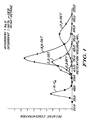
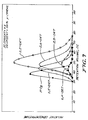
- Figure 1 is a chromatograph trace of the separation of 2,6-DET from a mixture of DET isomers with NaX zeolite adsorbent and a desorbent comprising 30 vol % p-DEB and 70 vol % iso-octane.
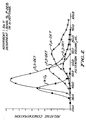
- Figure 2 is a similar chromatographic trace to illustrate the separation of 3,5-DET by a rejective separation process, using a BaY adsorbent and 30 vol.% p-DEB/70 vol.% n-heptane desorbent.
- This figure also illustrates an embodiment of the invention in which 2,6-DET is the most strongly adsorbed isomer, therefore permitting recovery of 3,5-DET and 2,6-DET in purified form in the same process.
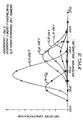
- Figure 3 is a chromatographic trace to illustrate the separation of 3,5-DET by a rejective separation process using a Ba-exchanged X faujasite adsorbent and a mixture of 30 vol % p-xylene and 70 vol % n-heptane as desorbent.
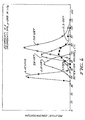
- Figures 4 and 5 are chromatographic traces similar to Figure 2 in that both 2,6-DET and 3,5-DET can be separated and separately recovered in the extract and raffinate, respectively, in Figure 4 with a NaY zeolite adsorbent and p-DEB desorbent and in Figure 5 with a CaY zeolite adsorbent and 30% m-DEB in n-heptane as desorbent.
- Figure 6 is a chromatographic trace of the separation of 3,5-diethyltoluene from a mixture of DET isomers with KX zeolite adsorbent and a desorbent comprising 30% p-DEB and 70% isoctane.
- Figure 7 is a chromatographic trace similar to Figure 1, except that the desorbent is 100% p-cymene.
- Adsorbents used in the process of this invention comprise specific crystalline aluminosilicates or molecular sieves, namely, X and Y zeolites.
- the zeolites have known cage structures in which the alumina and silica tetrahedra are intimately connected in an open three-dimensional network to form cage-like structures with window-like pores.
- the tetrahedra are cross-linked by the sharing of oxygen atoms with spaces between the tetrahedra occupied by water molecules prior to partial or total dehydration of this zeolite.
- the dehydration of the zeolite results in crystals interlaced with cells having molecular dimensions and thus the separation which they effect is dependent essentially upon differences between the sizes of the feed molecules as, for instance, when smaller normal paraffin molecules are separated from larger isoparaffin molecules by using a particular molecular sieve.
- molecular sieves although widely used, is not strictly suitable since the separation of specific aromatic isomers is apparently dependent on differences in electrochemical attraction between the different isomers and the adsorbent rather than on pure physical size differences between the isomer molecules.
- the crystalline aluminosilicates encompass type X zeolites which are represented by Formula 1 below in terms of moles of oxides:
- M is a cation having a valence of not more than 3 which balances the electrovalence of the tetrahedra and is generally referred to as an exchangeable cation
- n represents the valence of the cation
- y which represents the moles of water, is a value up to about 9 depending upon the identity of "M” and the degree of hydration of the crystal.
- the SiO2/A12O3 mole ratio is 2.5 ⁇ 0.5.
- the cation "M" is usually predominately sodium, that is, the major cation at the exchangeable cationic sites is sodium and the zeolite is therefore referred to as a sodium-X zeolite.
- the zeolite is therefore referred to as a sodium-X zeolite.
- other cations mentioned above may be present, however, as impurities.
- operative adsorbents are formed when the sodium cation of an X zeolite, as prepared, is substantially completely cation exchanged by barium, lithium or mixtures of barium and potassium.
- 2,6-DET is selectively adsorbed by the adsorbent
- operative adsorbents are formed when the cation of an X zeolite is exchanged with copper or sodium (i.e., original form as prepared).
- the preferred adsorbent is X zeolite exchanged with potassium.
- the type Y structured zeolite, in the hydrated or partially hydrated form, can be similarly represented in terms of moles of oxides as in Formula 2 below:
- M2/ n O:Al2O3:wSiO2:yH2O where "M”, "n” and “y” are the same as above and “w” is a value greater than about 3 up to about 6.
- the SiO2/Al2O3 mole ratio for type Y structured zeolites can thus be from about 3 to about 6.
- the cation "M” may be one or more of a variety of cations but, as the Y type zeolites are initially prepared, the cation "M” is also usually predominately sodium.
- the type Y zeolite containing predominately sodium cations at the exchangeable cationic sites is, therefore, referred to as a sodium-exchanged type-Y, or NaY, zeolite.
- a sodium-exchanged type-Y, or NaY, zeolite Depending upon the purity of the reactants used to make the zeolite, other cations mentioned above may be present, however, as impurities.
- 2,6-DET is selectively adsorbed by a Y zeolite exchanged with barium or copper or 3,5-DET can be recovered in a rejective separation with a Y zeolite in the sodium form or exchanged with barium or potassium.
- the selectivity order is unexpectedly altered such that 2,6-DET is the most strongly adsorbed DET isomer while 3,5-DET is the rejected, or least strongly adsorbed, DET isomer.
- both species can be isolated with a chromatographic process using the same adsorbent and it is further possible to recover both rejected and most strongly adsorbed isomers in a single process.
- the adsorbents in which it has been discovered that the selectivity order is as above described, are Y zeolites, cation exchanged with sodium (i.e., in the initial form, or as prepared), calcium or barium cations.
- Feed preparation could include either removal of 2,3-DET prior to separation, or isomerization to convert 2,3-DET to another isomer or modification of reaction conditions, e.g., selection of the catalyst, to minimize the formation of 2,3-DET.
- 2,6-DET extract containing considerable amounts of 2,3-DET and/or 2,5-DET, for example, as a preferred mixture for use as a desorbent in separating p-xylene from its isomers and ethylbenzene.
- adsorbents used in separative processes contain the crystalline zeolite material dispersed in an amorphous matrix or binder, having channels and cavities therein which enable liquid access to the crystalline material.
- Silica, alumina, clay or mixtures thereof are inorganic substances typical of such matrix materials.
- Organic materials, such as polymers of styrene/divinyl-benzene, are also used as a matrix.
- the binder aids in forming or agglomerating the crystalline particles which otherwise would comprise a fine powder.
- the adsorbent may thus be in the form of particles such as extrudates, aggregates, tablets, macrospheres or granules having a desired particle range, preferably from about 16 to about 60 mesh (Standard U.S. Mesh) which corresponds to a nominal apperture of 0.25 to 1.19 mm.
- Feed mixtures which can be utilized in the process of this invention will comprise at least one of the isomers, 3,5-DET or 2,6-DET, and may additionally contains at least one other DET aromatic isomer.
- Crude hydrocarbon streams containing substantial quantities of C11 aromatic isomers are produced by alkylation and isomerization processes, which are well known to the refining and petrochemical arts.
- C11 aromatics other than DET isomers such as butyltoluenes and cymenes, may be formed which may necessitate their removal by other means, such as fractionation, or isomerization to DET isomers. Otherwise, they may be coextracted with the product DET isomer or be eluted with the raffinate (non-adsorbed) product, and, of course, reduce the purity of the desired DET isomer product.
- adsorbent selected from the group aforementioned, on which 3,5-DET is least strongly adsorbed, consisting of X zeolites, cation exchanged with barium, mixtures of barium and potassium or lithium and Y zeolites, cation exchanged with barium, potassium or sodium (i.e., in the original form as prepared), at adsorption conditions whereby the 3,5-DET is the least selectively adsorbed isomer.
- the other isomers are adsorbed and retained by the adsorbent while the 3,5-DET is relatively unadsorbed and is eluted from the interstitial void spaces between the particles of adsorbent and from the surface of the adsorbent.
- the adsorbent containing the more selectively adsorbed isomer is referred to as a "rich" adsorbent.
- the other isomers which may include 2,6-DET and other DET isomers in the feed are then recovered from the rich adsorbent by contacting the rich adsorbent with a desorbent material at desorption conditions.
- the relatively more strongly adsorbed isomers of DET referred to as the extract, can be isomerized to increase the concentration of one or more of said isomers and can be recycled to the separation process to increase the recovery of 3,5-DET.
- the general flow scheme for such a rejective adsorptive separation involves recovering the less adsorbed feed component(s) from the non-selective void volume and weakly adsorbing volume before the more strongly adsorbed component(s); the relatively unadsorbed component(s) is thereby recovered in the raffinate.
- a particular advantage of such a system lies where the unadsorbed fraction or component is large in relation to the other fraction or components, since substantially less adsorbent and smaller sized equipment is required for a given feed throughout than if the large fraction is selectively adsorbed on the adsorbent.
- the mixture is contacted with an adsorbent selected from the group mentioned above, on which 2,6-DET is most strongly adsorbed, consisting of X zeolites, cation exchanged with sodium (as prepared) or copper and Y zeolites, cation exchanged with sodium (as prepared), calcium, copper or barium.
- an adsorbent selected from the group mentioned above, on which 2,6-DET is most strongly adsorbed, consisting of X zeolites, cation exchanged with sodium (as prepared) or copper and Y zeolites, cation exchanged with sodium (as prepared), calcium, copper or barium.
- the desorbent material relied upon must be judiciously selected to satisfy several criteria.
- the desorbent material should displace an extract component from the adsorbent with reasonable mass flow rates without itself being so strongly adsorbed as to unduly prevent the extract component from displacing the desorbent material in a following adsorption cycle.
- the desorbent material must be compatible with the particular adsorbent and the particular feed mixture. More specifically, it must not reduce or destroy the critical selectivity of the adsorbent for an extract component with respect to the raffinate component or react chemically with the feed components.
- the desorbent material should additionally be easily separable from the feed mixture that is passed into the process. Both the raffinate components and the extract components are typically removed from the adsorbent in admixture with desorbent material, and without a method of separating at least a portion of desorbent material, the purity of the extract product and the raffinate product would not be very high nor would the desorbent material be available for reuse in the process.
- any desorbent material used in this process will have a substantially different average boiling point than that of the feed mixture or any of its components, i.e., more than about 5°C difference, to allow separation of at least a portion of the desorbent material from feed components in the extract and raffinate streams by simple fractional distillation, thereby permitting reuse of desorbent material in the process.
- desorbent materials should be readily available and reasonable in cost. However, a suitable desorbent or desorbents for a particular separation with specific adsorbent are not always predictable.
- desorbent materials comprising monocyclic alkyl-substituted aromatic hydrocarbons, such as p-DEB, m-DEB, toluene, p-cymene or p-xylene, must be selected with regard to the specific separation in order to effectively desorb the extract from the adsorbent.
- the desorbent can be separated from the extract product by distillation.
- Diluents for the desorbent may also be used in some instances to modify the desorbent strength to achieve better separation, resolution and desorption rates.
- dilution agents include normal paraffins, isoparaffins, ethers, and halogenated hydrocarbons.
- Adsorption conditions will include a temperature range of from 20 to 250°C with 60 to 200°C being more preferred and a pressure just sufficient to maintain liquid phase, which may be from atmospheric to 4240 kPa.
- Desorption conditions will include the same range of temperatures and pressure as used for adsorption conditions.
- liquid-phase operation is preferred for this process because of the lower temperature requirements and because of the higher yields of extract product that can be obtained with liquid-phase operation over those obtained with vapor-phase operation.
- a dynamic testing apparatus is employed to test various adsorbents and desorbent material with a particular feed mixture to measure the adsorbent characteristics of adsorptive capacity and exchange rate.
- the apparatus consists of a helical adsorbent chamber of approximately 70-75 ml volume having inlet and outlet portions at opposite ends of the chamber.
- the chamber is contained within a temperature control means and, in addition, pressure control equipment is used to operate the chamber at a constant predetermined pressure.
- Quantitative and qualitative equipment such as refractomers, polarimeters, chromatographs, etc., can be attached to the outlet line of the chamber and used to analyze, "on-stream", the effluent stream leaving the adsorbent chamber.
- a pulse test performed using this apparatus and the following general procedure, is used to determine data, e.g., selectivities, for various adsorbent systems.
- the adsorbent in the chamber is filled to equilibrium with a particular desorbent by passing the desorbent material through the adsorbent chamber.
- a pulse of feed containing known concentrations of a tracer and of a particular extract component or of a raffinate component, or both, normally diluted in desorbent material is injected for a duration of several minutes.
- Desorbent flow is resumed, and the tracer and the extract and raffinate components are eluted as in a liquid-solid chromatographic operations.
- the effluent can be analyzed by on-stream chromatographic equipment and traces of the envelopes of corresponding component peaks developed. Alternatively, effluent samples can be collected periodically and later analyzed separately by gas chromatography.
- adsorbent performance can be rated in terms of void volume, retention volume for an extract or a raffinate component, and the rate of desorption of an extract component from the adsorbent and selectivity.
- Void volume is the non-selective volume of the adsorbent, which is expressed by the amount of desorbent pumped during the interval from the initial flow to the center of the peak envelope of the tracer.
- the net retention volume (NRV) of an extract or a raffinate component may be characterized by the distance between the center of the peak envelope (gross retention volume) of the extract or raffinate component and the center of the peak envelope (void volume) of the tracer component or some other known reference point.
- the rate of exchange or desorption rate of an extract component with the desorbent material can generally be characterized by the width of the peak envelopes at half intensity. The narrower the peak width, the faster the desorption rate.
- the desorption rate can also be characterized by the distance between the center of the tracer peak envelope and the disappearance of an extract component which has just been desorbed. This distance is again the volume of desorbent material pumped during this time interval.
- Selectivity, ⁇ is determined by the ratio of the net retention volumes (NRV) of the more strongly adsorbed component to each of the other components.
- the previously described pulse test apparatus was used to obtain data for this example, which illustrates the separation of 2,6-DET, in the extract, from the other isomers of DET.
- the liquid temperature was 165° and the flow was up the column at the rate of 1.26 ml/min.
- the feed stream comprised 2.0 ml pulses of a solution containing 1.5 ml of a mixture of the diethyltoluene isomers, 2,3-, 2,5-, 2,6- and 3,5-DET, and 0.3 ml of n-hexane tracer and 1.0 ml of desorbent, 30% vol. p-diethylbenzene in 70% vol. iso-octane.
- the mixture of DET isomers was approximately 43 % (vol) 3,5-DET, 20% 2,5 DET, 23% 2,6-DET and 7% 2,3-DET with the balance consisting of other C11 aromatics.
- the column was packed with clay bound Na-X faujasite adsorbent of 20-50 mesh particle size corresponding to an apperature size of 0.297 to 0.84 mm.
- the 2,6-DET isomer was selectively adsorbed and recovered as the extract product.
- the previously described pulse test was also used to obtain data similar to that of Example 1, but using a different adsorbent in place of the NaX zeolite exemplified above.
- the feed was 2.0 ml of a solution containing 1.5 ml of the DET isomer mixture of Example 1, 0.3 ml n-hexane tracer and 1 ml of the same desorbent, 30% p-diethylbenzene in iso-octane.
- the adsorbent was Cu-X.
- the column temperature was 165°C, flow rate up the column was 1.14 ml per min.
- Table 2 shows that indicates a 2,6-DET selective process.
- the adsorbent was a Y zeolite, exchanged with barium ions at the exchangeable sites and the desorbent was 30% p-DEB diluted with n-heptane.
- the feed pulse was 2 ml of a solution containing 1.7 ml of the DET isomer mixture of Example 1 and 0.3 ml n-C11 tracer.
- the results of the pulse test are shown in Fig. 2 and Table 3 below.
- 2,6-DET was most strongly adsorbed onto the BaY zeolite and therefore illustrates one adsorbent which can be employed to separate either or both 2,6- and 3,5-DET isomers in a single process.
- the adsorbent was X zeolite exchanged with a mixture of barium and potassium ions and the desorbent was 30% p-DEB in n-heptane.
- the feed pulse was the same as in Test No. 1.
- the adsorbent was X zeolite, exchanged with lithium ions and the desorbent was 30% p-DEB in iso-octane.
- the feed pulse was the same as in Example 1.
- the adsorbent was Y zeolite exchanged with barium at the exchangeable sites and the desorbent was 30% toluene in n-heptane.
- the feed pulse was the same as in Test No. 1.
- Test No. 1 In Test No.
- the adsorbent was KY and the desorbent was 30% p-xylene in n-heptane.
- the feed pulse was 5 cc of a solution containing 1.5 cc of the DET isomer mixture of Example 1, 0.29 cc n-C9 tracer, and 3 cc desorbent.
- the adsorbent was X faujasite, exchanged with barium cations, and the desorbent was 30% p-xylene in n-heptane.
- the feed pulse was 2 cc of a solution containing 1.7 cc of the DET isomer mixture of Example 1 and 0.3 cc n-C12.
- 3,5-DET was the least strongly adsorbed isomer, illustrating a separating system which can be employed to separate 3,5-DET in a rejective process.
- the sequence of the stages, as set forth above, can be reversed.
- the feed pulse was 2 cc of a solution containing 1 cc of the DET isomer mixture of Example 1, 1 cc of the desorbent and 0.3 cc n-C8.
- the desorbent was 100% p-DEB.
- the feed pulse was 5 cc of a solution containing 1 cc desorbent, 0.3 cc n-C10 tracer, and 4 cc of a DET isomer mixture with the following composition: 41.2 vol % 3,5-DET, 5.4% 2,3-DET, 14.3% 2,6-DET, and 9.2% 2,5-DET, with the balance consisting of other C11 aromatics such as butyl toluene isomers and p-cymene.
- the desorbent in this test was 50% p-DEB in n-heptane.
- Test No. 3 at 200°C and column flow of 1.21 cc/min, the feed pulse was 2 cc of the same solution as Test 1.
- the desorbent was 30% m-diethylbenzene (m-DEB) diluent with n-heptane.
- the adsorbent in each of the preceding tests was Y zeolite, with sodium ions in the cation-exchangeable sites.
- Test No. 4 at 200°C and column flow rate of 1.23 cc/min., the feed pulse was 2 cc of the same solution as Test 1.
- the adsorbent in this test was Y zeolite with calcium ions in the cation-exchangeable sites.
- the desorbent in this test was 30% m-DEB in n-heptane. The results of the experiments are shown in Table 4 below. Pulse Test No.
- the liquid temperature in this pulse test was 165°C and the flow was up the column at the rate of 1.26ml/min.
- the feed stream comprised 2.0 ml pulses of a solution containing 1.5 ml of a mixture of diethyltoluene isomers, and 0.3 ml of n-hexane tracer and 1.0 ml of desorbent, 30% vol p-diethylbenzene in 70% (vol) iooctane.
- the mixture of DET isomers was approximately the same as in Example 1.
- the column was packed with clay bound K-X faujasite adsorbent of 0.297 to 0.84 mm particle size.
- the 3,5-DET isomer was selectively adsorbed and recovered is the extract product.
- the previously described pulse test was also used to obtain data similar to that of Example 5, but using a desorbent other than exemplified above.
- the feed was 2 ml of a solution containing 1 ml of the same DET isomer mixture used in Example 1, 0.3 ml n-octane tracer, and 1 ml of desorbent.
- the desorbent was p-cymene.
- the column temperature was 145°C, flow rate up the column was 1.14 ml per min.
- the results of the pulse test are shown in Figure 7 and Table 6 below.
Landscapes
- Chemical & Material Sciences (AREA)
- Organic Chemistry (AREA)
- Analytical Chemistry (AREA)
- Chemical Kinetics & Catalysis (AREA)
- Engineering & Computer Science (AREA)
- Oil, Petroleum & Natural Gas (AREA)
- Water Supply & Treatment (AREA)
- Organic Low-Molecular-Weight Compounds And Preparation Thereof (AREA)
- Solid-Sorbent Or Filter-Aiding Compositions (AREA)
- Treatment Of Liquids With Adsorbents In General (AREA)
Claims (12)
- Verfahren zur Abtrennung von 3,5- oder 2,6-Diethyltoluol (DET) von einem Beschickungsgemisch desselben mit wenigstens einem anderen DET-Isomeren, indem man das Beschickungsgemisch bei Adsorptionsbedingungen mit einem Adsorbens aus den GruppenA. Zeolith X, ausgetauscht mit Kaliumkation,B. Zeolith X, ausgetauscht mit Natrium oder Kupfer, oder Zeolith Y, ausgetauscht mit Kupfer, Natrium, Barium oder Calcium, undC. Zeolith X, ausgetauscht mit Barium oder Lithium oder mit Kalium und Barium, oder Zeolith Y, ausgetauscht mit Kalium, Natrium, Barium oder Calcium,in Berührung bringt und dabei selektiv eines der in der Beschickung enthaltenen DET-Isomeren adsorbiert, wenigstens ein relativ unadsorbiertes DET-Isomeres aus der Berührung mit dem Adsorbens entfernt, um einen Raffinatstrom zu bilden, und das adsorbierte DET-Isomere gewinnt, indem man das resultierende angereicherte Adsorbens bei Desorptionsbedingungen einer Desorption mit einem Desorbensmaterial, das einen monozyklischen alkylsubstituierten aromatischen Kohlenwasserstoff umfaßt, unterzieht, um einen Extraktstrom zu bilden.
- Verfahren nach Anspruch 1, bei dem die Beschickung 3,5-DET enthält, wobei das Adsorbens aus der Gruppe A ausgewählt ist und das adsorbierte Isomere 3,5-DET ist und der Extraktstrom an diesem Isomer angereichert ist, während der Raffinatstrom bezüglich dieses Isomeren gegenüber der Beschickung verarmt ist.
- Verfahren nach Anspruch 1, bei dem die Beschickung 2,6-DET enthält, wobei das Adsorbens aus der Gruppe B ausgewählt ist, das Desorbens aus der Gruppe p-Diethylbenzol, m-Diethylbenzol und Toluol ausgewählt ist, das adsorbierte Isomere 2,6-DET und der Extraktstrom bezüglich dieses Isomeren angereichert ist und der Raffinatstrom bezüglich dieses Isomeren gegenüber der Beschickung verarmt ist.
- Verfahren nach Anspruch 1, bei dem die Beschickung 3,5-DET enthält, wobei das Adsorbens aus der Gruppe C ausgewählt ist, das nichtadsorbierte Isomere 3,5-DET ist und das Raffinat reich an diesem Isomeren ist und der Austrittsstrom bezüglich dieses Isomeren gegenüber der Beschickung verarmt ist.
- Verfahren nach Anspruch 3, bei dem das Adsorbens NaY ist und das Desorbens p-Diethylbenzol umfaßt.
- Verfahren nach Anspruch 3, bei dem das Adsorbens BaY ist und das Desorbens p-Diethylbenzol oder Toluol umfaßt.
- Verfahren nach Anspruch 3, bei dem das Adsorbens CaY ist und das Desorbens m-Diethylbenzol umfaßt.
- Verfahren nach Anspruch 1, bei dem das Desorbens aus der Gruppe Toluol, p-Diethylbenzol, m-Diethylbenzol, p-Xylol und p-Cymol ausgewählt ist.
- Verfahren nach Anspruch 4, bei dem das Desorbens aus der Gruppe p-Diethylbenzol, m-Diethylbenzol, Toluol und p-Xylol ausgewählt ist.
- Verfahren nach einem der Ansprüche 1 bis 9, bei dem die Adsorptions-und Desorptionsbedingungen eine Temperatur im Bereich von 60 bis 200 °C und einen ausreichenden Druck, um flüssige Phase aufrechtzuerhalten, einschließen.
- Verfahren nach einem der Ansprüche 1 bis 10, bei dem das Verfahren mit einem simulierten Bewegtbett-Fließsystem durchgeführt wird.
- Verfahren nach einem der Ansprüche 1 bis 11, bei dem das Desorbens ein aus der Gruppe der Normalparaffine, Isoparaffine, Ether und halogenierten Kohlenwasserstoffe ausgewähltes Verdünnungsmittel enthält.
Priority Applications (4)
| Application Number | Priority Date | Filing Date | Title |
|---|---|---|---|
| US07/339,536 US4940548A (en) | 1989-04-17 | 1989-04-17 | Chromatographic separation process for recovering individual diethyltoluene isomers |
| DE69023764T DE69023764T2 (de) | 1989-04-17 | 1990-07-03 | Verfahren zur Trennung durch Adsorption von 2,6- oder 3,5-Diethyltoluol aus einer Mischung davon mit einem anderen Diethyltoluolisomer. |
| ES90307281T ES2080117T3 (es) | 1989-04-17 | 1990-07-03 | Procedimiento para la separacion por adsorcion de 2,6- o 3,5-dietiltolueno a partir de una mezcla de los mismos con otro isomero de dietiltolueno. |
| EP90307281A EP0464277B1 (de) | 1989-04-17 | 1990-07-03 | Verfahren zur Trennung durch Adsorption von 2,6- oder 3,5-Diethyltoluol aus einer Mischung davon mit einem anderen Diethyltoluolisomer |
Applications Claiming Priority (2)
| Application Number | Priority Date | Filing Date | Title |
|---|---|---|---|
| US07/339,536 US4940548A (en) | 1989-04-17 | 1989-04-17 | Chromatographic separation process for recovering individual diethyltoluene isomers |
| EP90307281A EP0464277B1 (de) | 1989-04-17 | 1990-07-03 | Verfahren zur Trennung durch Adsorption von 2,6- oder 3,5-Diethyltoluol aus einer Mischung davon mit einem anderen Diethyltoluolisomer |
Publications (2)
| Publication Number | Publication Date |
|---|---|
| EP0464277A1 EP0464277A1 (de) | 1992-01-08 |
| EP0464277B1 true EP0464277B1 (de) | 1995-11-22 |
Family
ID=40139207
Family Applications (1)
| Application Number | Title | Priority Date | Filing Date |
|---|---|---|---|
| EP90307281A Expired - Lifetime EP0464277B1 (de) | 1989-04-17 | 1990-07-03 | Verfahren zur Trennung durch Adsorption von 2,6- oder 3,5-Diethyltoluol aus einer Mischung davon mit einem anderen Diethyltoluolisomer |
Country Status (4)
| Country | Link |
|---|---|
| US (1) | US4940548A (de) |
| EP (1) | EP0464277B1 (de) |
| DE (1) | DE69023764T2 (de) |
| ES (1) | ES2080117T3 (de) |
Families Citing this family (16)
| Publication number | Priority date | Publication date | Assignee | Title |
|---|---|---|---|---|
| US5019271A (en) * | 1988-12-30 | 1991-05-28 | Uop | Extractive chromatographic separation process for recovering 3,5-diethyltoluene |
| US5174979A (en) * | 1989-10-06 | 1992-12-29 | Uop | Mixed ion-exchanged zeolites and processes for the use thereof in gas separations |
| FI86440C (fi) | 1990-01-15 | 1992-08-25 | Cultor Oy | Foerfarande foer samtidig framstaellning av xylitol och etanol. |
| US7109005B2 (en) | 1990-01-15 | 2006-09-19 | Danisco Sweeteners Oy | Process for the simultaneous production of xylitol and ethanol |
| ES2046846T3 (es) * | 1990-07-19 | 1994-02-01 | Cindu Chemicals B.V. | Proceso para separar constituyentes polares y no polares de los destilados de alquitran de carbon. |
| US5258058A (en) * | 1992-10-05 | 1993-11-02 | Air Products And Chemicals, Inc. | Nitrogen adsorption with a divalent cation exchanged lithium X-zeolite |
| FI96225C (fi) | 1993-01-26 | 1996-05-27 | Cultor Oy | Menetelmä melassin fraktioimiseksi |
| US6663780B2 (en) | 1993-01-26 | 2003-12-16 | Danisco Finland Oy | Method for the fractionation of molasses |
| FI98791C (fi) * | 1994-04-21 | 1997-08-25 | Xyrofin Oy | Menetelmä liuoksen fraktioimiseksi |
| US5795398A (en) | 1994-09-30 | 1998-08-18 | Cultor Ltd. | Fractionation method of sucrose-containing solutions |
| DE19545024B4 (de) | 1995-12-02 | 2005-02-17 | Sig Corpoplast Gmbh & Co. Kg | Verfahren zur Herstellung von Behältern |
| US6224776B1 (en) * | 1996-05-24 | 2001-05-01 | Cultor Corporation | Method for fractionating a solution |
| BR9807521A (de) | 1997-01-29 | 2000-03-21 | Amalgamated Res Inc | |
| FR2789914B1 (fr) * | 1999-02-22 | 2001-04-06 | Ceca Sa | Adsorbants zeolitiques agglomeres a faible taux de liant inerte, leur procede d'obtention et leurs utilisations |
| FI20010977L (fi) | 2001-05-09 | 2002-11-10 | Danisco Sweeteners Oy | Kromatografinen erotusmenetelmä |
| CN101497022B (zh) * | 2008-01-31 | 2011-06-15 | 中国石油化工股份有限公司 | 聚结型沸石吸附剂及其制备方法 |
Family Cites Families (24)
| Publication number | Priority date | Publication date | Assignee | Title |
|---|---|---|---|---|
| US2985589A (en) * | 1957-05-22 | 1961-05-23 | Universal Oil Prod Co | Continuous sorption process employing fixed bed of sorbent and moving inlets and outlets |
| US3040777A (en) * | 1959-04-10 | 1962-06-26 | Universal Oil Prod Co | Rotary valve |
| US3422848A (en) * | 1966-06-09 | 1969-01-21 | Universal Oil Prod Co | Multiport rotary disc valve with liner protection means |
| BE759902A (fr) * | 1969-12-05 | 1971-06-04 | Mobil Oil Corp | Procede de separation selective par chromatographie |
| US3706812A (en) * | 1970-12-07 | 1972-12-19 | Universal Oil Prod Co | Fluid-solid contacting apparatus |
| US4051192A (en) * | 1971-04-21 | 1977-09-27 | Uop Inc. | Separation of bi-alkyl substituted monocyclic aromatic isomers |
| US3723302A (en) * | 1971-04-30 | 1973-03-27 | Universal Oil Prod Co | Process for separating olefins from saturated hydrocarbons |
| US3878129A (en) * | 1973-05-02 | 1975-04-15 | Universal Oil Prod Co | Method of manufacturing a zeolitic adsorbent useful for aromatic separation |
| US3894109A (en) * | 1973-05-02 | 1975-07-08 | Universal Oil Prod Co | Aromatic hydrocarbon isomer separation by adsorption |
| US3943184A (en) * | 1974-02-15 | 1976-03-09 | Universal Oil Products Company | Aromatic hydrocarbon isomer separation process |
| US3864416A (en) * | 1974-03-18 | 1975-02-04 | Universal Oil Prod Co | Separation of tetra-alkyl substituted aromatic hydrocarbon isomers |
| GB1526065A (en) * | 1974-10-16 | 1978-09-27 | Asahi Chemical Ind | Process for separation of hydrocarbon mixture |
| JPS5148620A (en) * | 1974-10-17 | 1976-04-26 | Teijin Yuka Kk | 1*3*55 torimechirubenzenno seiseiho |
| JPS557216A (en) * | 1978-06-30 | 1980-01-19 | Mitsui Petrochem Ind Ltd | Separation of trimethylbenzene isomer |
| US4213913A (en) * | 1979-03-12 | 1980-07-22 | Uop Inc. | Two-stage process for separating mixed fatty-acid esters |
| US4313015A (en) * | 1980-02-07 | 1982-01-26 | Uop Inc. | Separation process |
| US4423279A (en) * | 1982-02-25 | 1983-12-27 | Uop Inc. | Separation of bi-alkyl substituted monocyclic aromatic isomers with pyrolyzed adsorbent |
| US4402832A (en) * | 1982-08-12 | 1983-09-06 | Uop Inc. | High efficiency continuous separation process |
| US4467126A (en) * | 1983-07-18 | 1984-08-21 | Uop Inc. | Process for the separation of di-substituted benzene |
| US4482777A (en) * | 1984-04-02 | 1984-11-13 | Uop Inc. | Separation of ortho bi-alkyl substituted monocyclic aromatic isomers |
| US4584424A (en) * | 1984-10-29 | 1986-04-22 | Exxon Research & Engineering Company | Process for separating ethylbenzene from xylenes by selective adsorption on a Beta zeolite |
| US4717778A (en) * | 1985-10-01 | 1988-01-05 | Uop Inc. | Process for separating the minor isomers of dinitrotoluene |
| US4642397A (en) * | 1985-10-01 | 1987-02-10 | Uop Inc. | Process for separating isomers of dinitrotoluene |
| US4864069A (en) * | 1988-05-23 | 1989-09-05 | Uop | Zeolitic para-xylene separation with diethyltoluene heavy desorbent |
-
1989
- 1989-04-17 US US07/339,536 patent/US4940548A/en not_active Expired - Lifetime
-
1990
- 1990-07-03 DE DE69023764T patent/DE69023764T2/de not_active Expired - Fee Related
- 1990-07-03 ES ES90307281T patent/ES2080117T3/es not_active Expired - Lifetime
- 1990-07-03 EP EP90307281A patent/EP0464277B1/de not_active Expired - Lifetime
Also Published As
| Publication number | Publication date |
|---|---|
| EP0464277A1 (de) | 1992-01-08 |
| DE69023764T2 (de) | 1996-04-11 |
| US4940548A (en) | 1990-07-10 |
| DE69023764D1 (de) | 1996-01-04 |
| ES2080117T3 (es) | 1996-02-01 |
Similar Documents
| Publication | Publication Date | Title |
|---|---|---|
| US4886930A (en) | Zeolitic para-xylene separation with tetralin heavy desorbent | |
| US5382747A (en) | Process for the adsorptive separation of metaxylene from aromatic hydrocarbons | |
| US4940548A (en) | Chromatographic separation process for recovering individual diethyltoluene isomers | |
| US5057643A (en) | Zeolitic para-xylene separation with tetralin derivatives as heavy desorbent | |
| EP0683148B1 (de) | Verfahren zur Abtrennung von Ethylbenzol durch Adsorption an mit Cesium ausgetauschtem Zeolith X | |
| US5849981A (en) | Adsorptive separation of para-xylene using isopropylbenzene desorbent | |
| US5012038A (en) | Zeolitic para-xylene separation with diethyltoluene heavy desorbent | |
| US4529828A (en) | Separation of ortho-xylene | |
| US4886929A (en) | Separation of para-xylene | |
| US5495061A (en) | Adsorptive separation of para-xylene with high boiling desorbents | |
| US5107062A (en) | Zeolitic para-xylene separation with tetralin derivatives as heavy desorbent | |
| EP0712825A1 (de) | Verfahren zur adsorptiven Abtrennung von meta-Xylol von aromatischen Kohlenwasserstoffen | |
| US5159131A (en) | Zeolitic para-xylene separation with indan and indan derivatives as heavy desorbent | |
| US4996380A (en) | Process for extracting meta-dichlorobenzene from isomer mixtures with mixed alkali metal exchanged X zeolite adsorbents | |
| EP0160744B1 (de) | Trennung von ortho-bialkyl-substituierten monocyclischen aromatischen Isomeren | |
| US4876390A (en) | Process for separating dichlorodiphenylsulfone isomers | |
| US4721807A (en) | Process for separating 2,6-toluene diisocyanate from isomers of toluene diisocyanate | |
| US4956522A (en) | Zeolitic para-ethyltoluene separation with tetralin heavy desorbent | |
| CA2020406C (en) | Chromatographic separation process for recovering either 2,6-det or 3,5-det from a mixture thereof with another det isomer | |
| US5019271A (en) | Extractive chromatographic separation process for recovering 3,5-diethyltoluene | |
| US5177300A (en) | Process for separating naphthalene from substituted benzene hydrocarbons | |
| KR930003210B1 (ko) | 다른 det 이성질체와의 혼합물로부터 2,6-det 또는 3.5-det를 크로마토그래피에 의하여 분리 및 회수하는 방법 | |
| US5223589A (en) | Process for separating durene from substituted benzene hydrocarbons | |
| US4827049A (en) | Process for the separation of dihydroxybenzene isomers | |
| AU636849B2 (en) | Sharps destruction and disposal apparatus |
Legal Events
| Date | Code | Title | Description |
|---|---|---|---|
| PUAI | Public reference made under article 153(3) epc to a published international application that has entered the european phase |
Free format text: ORIGINAL CODE: 0009012 |
|
| AK | Designated contracting states |
Kind code of ref document: A1 Designated state(s): BE DE ES FR GB IT NL |
|
| 17P | Request for examination filed |
Effective date: 19920610 |
|
| 17Q | First examination report despatched |
Effective date: 19950316 |
|
| GRAA | (expected) grant |
Free format text: ORIGINAL CODE: 0009210 |
|
| AK | Designated contracting states |
Kind code of ref document: B1 Designated state(s): BE DE ES FR GB IT NL |
|
| PG25 | Lapsed in a contracting state [announced via postgrant information from national office to epo] |
Ref country code: BE Effective date: 19951122 |
|
| ITF | It: translation for a ep patent filed | ||
| REF | Corresponds to: |
Ref document number: 69023764 Country of ref document: DE Date of ref document: 19960104 |
|
| REG | Reference to a national code |
Ref country code: ES Ref legal event code: FG2A Ref document number: 2080117 Country of ref document: ES Kind code of ref document: T3 |
|
| ET | Fr: translation filed | ||
| PG25 | Lapsed in a contracting state [announced via postgrant information from national office to epo] |
Ref country code: GB Effective date: 19960703 |
|
| PLBE | No opposition filed within time limit |
Free format text: ORIGINAL CODE: 0009261 |
|
| STAA | Information on the status of an ep patent application or granted ep patent |
Free format text: STATUS: NO OPPOSITION FILED WITHIN TIME LIMIT |
|
| 26N | No opposition filed | ||
| GBPC | Gb: european patent ceased through non-payment of renewal fee |
Effective date: 19960703 |
|
| PGFP | Annual fee paid to national office [announced via postgrant information from national office to epo] |
Ref country code: FR Payment date: 20010619 Year of fee payment: 12 |
|
| PGFP | Annual fee paid to national office [announced via postgrant information from national office to epo] |
Ref country code: DE Payment date: 20010620 Year of fee payment: 12 |
|
| PGFP | Annual fee paid to national office [announced via postgrant information from national office to epo] |
Ref country code: NL Payment date: 20010621 Year of fee payment: 12 |
|
| PGFP | Annual fee paid to national office [announced via postgrant information from national office to epo] |
Ref country code: ES Payment date: 20010808 Year of fee payment: 12 |
|
| PG25 | Lapsed in a contracting state [announced via postgrant information from national office to epo] |
Ref country code: ES Free format text: LAPSE BECAUSE OF NON-PAYMENT OF DUE FEES Effective date: 20020704 |
|
| PG25 | Lapsed in a contracting state [announced via postgrant information from national office to epo] |
Ref country code: NL Free format text: LAPSE BECAUSE OF NON-PAYMENT OF DUE FEES Effective date: 20030201 Ref country code: DE Free format text: LAPSE BECAUSE OF NON-PAYMENT OF DUE FEES Effective date: 20030201 |
|
| PG25 | Lapsed in a contracting state [announced via postgrant information from national office to epo] |
Ref country code: FR Free format text: LAPSE BECAUSE OF NON-PAYMENT OF DUE FEES Effective date: 20030331 |
|
| NLV4 | Nl: lapsed or anulled due to non-payment of the annual fee |
Effective date: 20030201 |
|
| REG | Reference to a national code |
Ref country code: FR Ref legal event code: ST |
|
| REG | Reference to a national code |
Ref country code: ES Ref legal event code: FD2A Effective date: 20030811 |
|
| PG25 | Lapsed in a contracting state [announced via postgrant information from national office to epo] |
Ref country code: IT Free format text: LAPSE BECAUSE OF NON-PAYMENT OF DUE FEES Effective date: 20050703 |