EP0464547A1 - Produktion von Schmiermitteln mit hohem Viskositätsindex - Google Patents
Produktion von Schmiermitteln mit hohem Viskositätsindex Download PDFInfo
- Publication number
- EP0464547A1 EP0464547A1 EP91110355A EP91110355A EP0464547A1 EP 0464547 A1 EP0464547 A1 EP 0464547A1 EP 91110355 A EP91110355 A EP 91110355A EP 91110355 A EP91110355 A EP 91110355A EP 0464547 A1 EP0464547 A1 EP 0464547A1
- Authority
- EP
- European Patent Office
- Prior art keywords
- catalyst
- process according
- isomerization
- hydrocracking
- weight percent
- Prior art date
- Legal status (The legal status is an assumption and is not a legal conclusion. Google has not performed a legal analysis and makes no representation as to the accuracy of the status listed.)
- Granted
Links
- 239000000314 lubricant Substances 0.000 title claims abstract description 16
- 238000004519 manufacturing process Methods 0.000 title description 5
- 239000003054 catalyst Substances 0.000 claims abstract description 151
- 238000000034 method Methods 0.000 claims abstract description 126
- 230000008569 process Effects 0.000 claims abstract description 109
- 239000010457 zeolite Substances 0.000 claims abstract description 98
- HNPSIPDUKPIQMN-UHFFFAOYSA-N dioxosilane;oxo(oxoalumanyloxy)alumane Chemical compound O=[Si]=O.O=[Al]O[Al]=O HNPSIPDUKPIQMN-UHFFFAOYSA-N 0.000 claims abstract description 87
- 229910021536 Zeolite Inorganic materials 0.000 claims abstract description 85
- 239000001993 wax Substances 0.000 claims abstract description 85
- 238000006243 chemical reaction Methods 0.000 claims abstract description 72
- 238000004517 catalytic hydrocracking Methods 0.000 claims abstract description 68
- 238000006317 isomerization reaction Methods 0.000 claims abstract description 54
- UFHFLCQGNIYNRP-UHFFFAOYSA-N Hydrogen Chemical compound [H][H] UFHFLCQGNIYNRP-UHFFFAOYSA-N 0.000 claims abstract description 34
- 239000001257 hydrogen Substances 0.000 claims abstract description 34
- 229910052739 hydrogen Inorganic materials 0.000 claims abstract description 34
- 125000003118 aryl group Chemical group 0.000 claims abstract description 28
- ZOXJGFHDIHLPTG-UHFFFAOYSA-N Boron Chemical compound [B] ZOXJGFHDIHLPTG-UHFFFAOYSA-N 0.000 claims abstract description 25
- 229910052796 boron Inorganic materials 0.000 claims abstract description 25
- 229910000510 noble metal Inorganic materials 0.000 claims abstract description 13
- 239000012188 paraffin wax Substances 0.000 claims abstract description 12
- 239000012169 petroleum derived wax Substances 0.000 claims abstract description 5
- 235000019381 petroleum wax Nutrition 0.000 claims abstract description 5
- BASFCYQUMIYNBI-UHFFFAOYSA-N platinum Chemical compound [Pt] BASFCYQUMIYNBI-UHFFFAOYSA-N 0.000 claims description 55
- 229910052751 metal Inorganic materials 0.000 claims description 34
- 239000002184 metal Substances 0.000 claims description 34
- 239000000463 material Substances 0.000 claims description 30
- 238000009835 boiling Methods 0.000 claims description 25
- PNEYBMLMFCGWSK-UHFFFAOYSA-N aluminium oxide Inorganic materials [O-2].[O-2].[O-2].[Al+3].[Al+3] PNEYBMLMFCGWSK-UHFFFAOYSA-N 0.000 claims description 19
- 238000005984 hydrogenation reaction Methods 0.000 claims description 17
- 229910052697 platinum Inorganic materials 0.000 claims description 17
- YCKRFDGAMUMZLT-UHFFFAOYSA-N Fluorine atom Chemical compound [F] YCKRFDGAMUMZLT-UHFFFAOYSA-N 0.000 claims description 16
- 239000011737 fluorine Substances 0.000 claims description 16
- 229910052731 fluorine Inorganic materials 0.000 claims description 16
- 230000002378 acidificating effect Effects 0.000 claims description 12
- 230000001588 bifunctional effect Effects 0.000 claims description 11
- 239000011159 matrix material Substances 0.000 claims description 6
- 239000002480 mineral oil Substances 0.000 claims description 5
- 235000010446 mineral oil Nutrition 0.000 claims description 5
- 239000004215 Carbon black (E152) Substances 0.000 claims description 3
- 229930195733 hydrocarbon Natural products 0.000 claims description 3
- 150000002430 hydrocarbons Chemical class 0.000 claims description 3
- 230000000737 periodic effect Effects 0.000 claims description 3
- 230000000694 effects Effects 0.000 abstract description 26
- 239000000047 product Substances 0.000 description 72
- VYPSYNLAJGMNEJ-UHFFFAOYSA-N Silicium dioxide Chemical compound O=[Si]=O VYPSYNLAJGMNEJ-UHFFFAOYSA-N 0.000 description 23
- 239000011148 porous material Substances 0.000 description 18
- 238000012545 processing Methods 0.000 description 16
- 239000003921 oil Substances 0.000 description 15
- 239000002904 solvent Substances 0.000 description 15
- 239000000377 silicon dioxide Substances 0.000 description 11
- 238000005336 cracking Methods 0.000 description 10
- PXHVJJICTQNCMI-UHFFFAOYSA-N Nickel Chemical compound [Ni] PXHVJJICTQNCMI-UHFFFAOYSA-N 0.000 description 9
- 150000002222 fluorine compounds Chemical class 0.000 description 9
- 150000002739 metals Chemical class 0.000 description 8
- 238000002360 preparation method Methods 0.000 description 8
- 239000000203 mixture Substances 0.000 description 7
- VLKZOEOYAKHREP-UHFFFAOYSA-N n-Hexane Chemical compound CCCCCC VLKZOEOYAKHREP-UHFFFAOYSA-N 0.000 description 7
- 230000007935 neutral effect Effects 0.000 description 7
- 238000010025 steaming Methods 0.000 description 7
- PFEOZHBOMNWTJB-UHFFFAOYSA-N 3-methylpentane Chemical compound CCC(C)CC PFEOZHBOMNWTJB-UHFFFAOYSA-N 0.000 description 6
- KDLHZDBZIXYQEI-UHFFFAOYSA-N Palladium Chemical compound [Pd] KDLHZDBZIXYQEI-UHFFFAOYSA-N 0.000 description 6
- YXFVVABEGXRONW-UHFFFAOYSA-N Toluene Chemical compound CC1=CC=CC=C1 YXFVVABEGXRONW-UHFFFAOYSA-N 0.000 description 6
- 235000019271 petrolatum Nutrition 0.000 description 6
- 238000007142 ring opening reaction Methods 0.000 description 6
- 238000000926 separation method Methods 0.000 description 6
- 238000001179 sorption measurement Methods 0.000 description 6
- ZFFMLCVRJBZUDZ-UHFFFAOYSA-N 2,3-dimethylbutane Chemical compound CC(C)C(C)C ZFFMLCVRJBZUDZ-UHFFFAOYSA-N 0.000 description 5
- 239000004264 Petrolatum Substances 0.000 description 5
- 239000002253 acid Substances 0.000 description 5
- 230000008901 benefit Effects 0.000 description 5
- 238000001354 calcination Methods 0.000 description 5
- 238000011065 in-situ storage Methods 0.000 description 5
- 229910052759 nickel Inorganic materials 0.000 description 5
- 239000002245 particle Substances 0.000 description 5
- 229940066842 petrolatum Drugs 0.000 description 5
- CTQNGGLPUBDAKN-UHFFFAOYSA-N O-Xylene Chemical group CC1=CC=CC=C1C CTQNGGLPUBDAKN-UHFFFAOYSA-N 0.000 description 4
- ATUOYWHBWRKTHZ-UHFFFAOYSA-N Propane Chemical compound CCC ATUOYWHBWRKTHZ-UHFFFAOYSA-N 0.000 description 4
- 239000010953 base metal Substances 0.000 description 4
- 239000011230 binding agent Substances 0.000 description 4
- 230000003197 catalytic effect Effects 0.000 description 4
- 238000005470 impregnation Methods 0.000 description 4
- 238000005342 ion exchange Methods 0.000 description 4
- 229910044991 metal oxide Inorganic materials 0.000 description 4
- 150000004706 metal oxides Chemical class 0.000 description 4
- 238000012360 testing method Methods 0.000 description 4
- 229910052721 tungsten Inorganic materials 0.000 description 4
- QGJOPFRUJISHPQ-UHFFFAOYSA-N Carbon disulfide Chemical compound S=C=S QGJOPFRUJISHPQ-UHFFFAOYSA-N 0.000 description 3
- NINIDFKCEFEMDL-UHFFFAOYSA-N Sulfur Chemical compound [S] NINIDFKCEFEMDL-UHFFFAOYSA-N 0.000 description 3
- 150000001336 alkenes Chemical class 0.000 description 3
- 229910052782 aluminium Inorganic materials 0.000 description 3
- XAGFODPZIPBFFR-UHFFFAOYSA-N aluminium Chemical compound [Al] XAGFODPZIPBFFR-UHFFFAOYSA-N 0.000 description 3
- 239000002199 base oil Substances 0.000 description 3
- 238000009826 distribution Methods 0.000 description 3
- 239000012467 final product Substances 0.000 description 3
- 238000005194 fractionation Methods 0.000 description 3
- 239000007789 gas Substances 0.000 description 3
- 230000006872 improvement Effects 0.000 description 3
- 239000010687 lubricating oil Substances 0.000 description 3
- 229910052763 palladium Inorganic materials 0.000 description 3
- 239000003208 petroleum Substances 0.000 description 3
- 125000003367 polycyclic group Chemical group 0.000 description 3
- 230000009467 reduction Effects 0.000 description 3
- 229910052717 sulfur Inorganic materials 0.000 description 3
- 239000011593 sulfur Substances 0.000 description 3
- -1 that is Substances 0.000 description 3
- WFKWXMTUELFFGS-UHFFFAOYSA-N tungsten Chemical compound [W] WFKWXMTUELFFGS-UHFFFAOYSA-N 0.000 description 3
- 239000010937 tungsten Substances 0.000 description 3
- WSWCOQWTEOXDQX-MQQKCMAXSA-M (E,E)-sorbate Chemical compound C\C=C\C=C\C([O-])=O WSWCOQWTEOXDQX-MQQKCMAXSA-M 0.000 description 2
- MMZYCBHLNZVROM-UHFFFAOYSA-N 1-fluoro-2-methylbenzene Chemical compound CC1=CC=CC=C1F MMZYCBHLNZVROM-UHFFFAOYSA-N 0.000 description 2
- IJGRMHOSHXDMSA-UHFFFAOYSA-N Atomic nitrogen Chemical compound N#N IJGRMHOSHXDMSA-UHFFFAOYSA-N 0.000 description 2
- RWSOTUBLDIXVET-UHFFFAOYSA-N Dihydrogen sulfide Chemical compound S RWSOTUBLDIXVET-UHFFFAOYSA-N 0.000 description 2
- XEEYBQQBJWHFJM-UHFFFAOYSA-N Iron Chemical group [Fe] XEEYBQQBJWHFJM-UHFFFAOYSA-N 0.000 description 2
- LSDPWZHWYPCBBB-UHFFFAOYSA-N Methanethiol Chemical compound SC LSDPWZHWYPCBBB-UHFFFAOYSA-N 0.000 description 2
- ZOKXTWBITQBERF-UHFFFAOYSA-N Molybdenum Chemical compound [Mo] ZOKXTWBITQBERF-UHFFFAOYSA-N 0.000 description 2
- LDDQLRUQCUTJBB-UHFFFAOYSA-N ammonium fluoride Chemical compound [NH4+].[F-] LDDQLRUQCUTJBB-UHFFFAOYSA-N 0.000 description 2
- 230000015572 biosynthetic process Effects 0.000 description 2
- 230000015556 catabolic process Effects 0.000 description 2
- 229910017052 cobalt Inorganic materials 0.000 description 2
- 239000010941 cobalt Substances 0.000 description 2
- GUTLYIVDDKVIGB-UHFFFAOYSA-N cobalt atom Chemical compound [Co] GUTLYIVDDKVIGB-UHFFFAOYSA-N 0.000 description 2
- 238000007796 conventional method Methods 0.000 description 2
- 230000002596 correlated effect Effects 0.000 description 2
- 230000000875 corresponding effect Effects 0.000 description 2
- 238000006731 degradation reaction Methods 0.000 description 2
- 238000006356 dehydrogenation reaction Methods 0.000 description 2
- 238000001035 drying Methods 0.000 description 2
- 238000002474 experimental method Methods 0.000 description 2
- 230000002349 favourable effect Effects 0.000 description 2
- 229910001657 ferrierite group Inorganic materials 0.000 description 2
- 125000005842 heteroatom Chemical group 0.000 description 2
- 229910000037 hydrogen sulfide Inorganic materials 0.000 description 2
- FAHBNUUHRFUEAI-UHFFFAOYSA-M hydroxidooxidoaluminium Chemical compound O[Al]=O FAHBNUUHRFUEAI-UHFFFAOYSA-M 0.000 description 2
- 230000000977 initiatory effect Effects 0.000 description 2
- 238000012423 maintenance Methods 0.000 description 2
- 239000003607 modifier Substances 0.000 description 2
- 229910052750 molybdenum Inorganic materials 0.000 description 2
- 239000011733 molybdenum Substances 0.000 description 2
- 229940078552 o-xylene Drugs 0.000 description 2
- 230000001737 promoting effect Effects 0.000 description 2
- 239000001294 propane Substances 0.000 description 2
- 238000007670 refining Methods 0.000 description 2
- 230000000717 retained effect Effects 0.000 description 2
- 229940075554 sorbate Drugs 0.000 description 2
- 238000003786 synthesis reaction Methods 0.000 description 2
- RPAJSBKBKSSMLJ-DFWYDOINSA-N (2s)-2-aminopentanedioic acid;hydrochloride Chemical class Cl.OC(=O)[C@@H](N)CCC(O)=O RPAJSBKBKSSMLJ-DFWYDOINSA-N 0.000 description 1
- NPNPZTNLOVBDOC-UHFFFAOYSA-N 1,1-difluoroethane Chemical compound CC(F)F NPNPZTNLOVBDOC-UHFFFAOYSA-N 0.000 description 1
- PAWQVTBBRAZDMG-UHFFFAOYSA-N 2-(3-bromo-2-fluorophenyl)acetic acid Chemical compound OC(=O)CC1=CC=CC(Br)=C1F PAWQVTBBRAZDMG-UHFFFAOYSA-N 0.000 description 1
- DDFHBQSCUXNBSA-UHFFFAOYSA-N 5-(5-carboxythiophen-2-yl)thiophene-2-carboxylic acid Chemical compound S1C(C(=O)O)=CC=C1C1=CC=C(C(O)=O)S1 DDFHBQSCUXNBSA-UHFFFAOYSA-N 0.000 description 1
- MIMUSZHMZBJBPO-UHFFFAOYSA-N 6-methoxy-8-nitroquinoline Chemical compound N1=CC=CC2=CC(OC)=CC([N+]([O-])=O)=C21 MIMUSZHMZBJBPO-UHFFFAOYSA-N 0.000 description 1
- BTBUEUYNUDRHOZ-UHFFFAOYSA-N Borate Chemical compound [O-]B([O-])[O-] BTBUEUYNUDRHOZ-UHFFFAOYSA-N 0.000 description 1
- VEXZGXHMUGYJMC-UHFFFAOYSA-M Chloride anion Chemical compound [Cl-] VEXZGXHMUGYJMC-UHFFFAOYSA-M 0.000 description 1
- DGAQECJNVWCQMB-PUAWFVPOSA-M Ilexoside XXIX Chemical compound C[C@@H]1CC[C@@]2(CC[C@@]3(C(=CC[C@H]4[C@]3(CC[C@@H]5[C@@]4(CC[C@@H](C5(C)C)OS(=O)(=O)[O-])C)C)[C@@H]2[C@]1(C)O)C)C(=O)O[C@H]6[C@@H]([C@H]([C@@H]([C@H](O6)CO)O)O)O.[Na+] DGAQECJNVWCQMB-PUAWFVPOSA-M 0.000 description 1
- OAICVXFJPJFONN-UHFFFAOYSA-N Phosphorus Chemical compound [P] OAICVXFJPJFONN-UHFFFAOYSA-N 0.000 description 1
- XUIMIQQOPSSXEZ-UHFFFAOYSA-N Silicon Chemical compound [Si] XUIMIQQOPSSXEZ-UHFFFAOYSA-N 0.000 description 1
- 238000002441 X-ray diffraction Methods 0.000 description 1
- 230000004913 activation Effects 0.000 description 1
- 229910052783 alkali metal Inorganic materials 0.000 description 1
- 150000001340 alkali metals Chemical class 0.000 description 1
- 229910000323 aluminium silicate Inorganic materials 0.000 description 1
- 238000004458 analytical method Methods 0.000 description 1
- 229940045985 antineoplastic platinum compound Drugs 0.000 description 1
- 238000013459 approach Methods 0.000 description 1
- 150000001491 aromatic compounds Chemical class 0.000 description 1
- 229910001593 boehmite Inorganic materials 0.000 description 1
- 229940063013 borate ion Drugs 0.000 description 1
- KGBXLFKZBHKPEV-UHFFFAOYSA-N boric acid Chemical compound OB(O)O KGBXLFKZBHKPEV-UHFFFAOYSA-N 0.000 description 1
- 239000004327 boric acid Substances 0.000 description 1
- 244000309464 bull Species 0.000 description 1
- 238000004523 catalytic cracking Methods 0.000 description 1
- 238000006555 catalytic reaction Methods 0.000 description 1
- 238000005341 cation exchange Methods 0.000 description 1
- 150000001875 compounds Chemical class 0.000 description 1
- 239000010779 crude oil Substances 0.000 description 1
- 230000001419 dependent effect Effects 0.000 description 1
- 238000013461 design Methods 0.000 description 1
- 238000011161 development Methods 0.000 description 1
- 230000018109 developmental process Effects 0.000 description 1
- 238000000605 extraction Methods 0.000 description 1
- 238000001125 extrusion Methods 0.000 description 1
- 239000012530 fluid Substances 0.000 description 1
- 125000004435 hydrogen atom Chemical group [H]* 0.000 description 1
- 238000001027 hydrothermal synthesis Methods 0.000 description 1
- 238000010348 incorporation Methods 0.000 description 1
- 229910052500 inorganic mineral Inorganic materials 0.000 description 1
- 239000003350 kerosene Substances 0.000 description 1
- 239000007788 liquid Substances 0.000 description 1
- 238000011068 loading method Methods 0.000 description 1
- 238000005461 lubrication Methods 0.000 description 1
- 238000002844 melting Methods 0.000 description 1
- 230000008018 melting Effects 0.000 description 1
- 239000005300 metallic glass Substances 0.000 description 1
- 125000002496 methyl group Chemical group [H]C([H])([H])* 0.000 description 1
- 239000011707 mineral Substances 0.000 description 1
- 239000002808 molecular sieve Substances 0.000 description 1
- 239000010705 motor oil Substances 0.000 description 1
- MOWMLACGTDMJRV-UHFFFAOYSA-N nickel tungsten Chemical compound [Ni].[W] MOWMLACGTDMJRV-UHFFFAOYSA-N 0.000 description 1
- 229910052757 nitrogen Inorganic materials 0.000 description 1
- 238000005457 optimization Methods 0.000 description 1
- 239000001301 oxygen Substances 0.000 description 1
- 229910052760 oxygen Inorganic materials 0.000 description 1
- 238000005453 pelletization Methods 0.000 description 1
- 238000005504 petroleum refining Methods 0.000 description 1
- 229910052698 phosphorus Inorganic materials 0.000 description 1
- 239000011574 phosphorus Substances 0.000 description 1
- 150000003058 platinum compounds Chemical class 0.000 description 1
- 229920000058 polyacrylate Polymers 0.000 description 1
- 238000006116 polymerization reaction Methods 0.000 description 1
- 230000005855 radiation Effects 0.000 description 1
- 150000003839 salts Chemical class 0.000 description 1
- 229910052710 silicon Inorganic materials 0.000 description 1
- 239000010703 silicon Substances 0.000 description 1
- 229910052708 sodium Inorganic materials 0.000 description 1
- 239000011734 sodium Substances 0.000 description 1
- URGAHOPLAPQHLN-UHFFFAOYSA-N sodium aluminosilicate Chemical compound [Na+].[Al+3].[O-][Si]([O-])=O.[O-][Si]([O-])=O URGAHOPLAPQHLN-UHFFFAOYSA-N 0.000 description 1
- 239000007787 solid Substances 0.000 description 1
- 239000012265 solid product Substances 0.000 description 1
- 238000000638 solvent extraction Methods 0.000 description 1
- 241000894007 species Species 0.000 description 1
- 239000007858 starting material Substances 0.000 description 1
- 238000003756 stirring Methods 0.000 description 1
- 238000006467 substitution reaction Methods 0.000 description 1
- 125000000101 thioether group Chemical group 0.000 description 1
- 238000004148 unit process Methods 0.000 description 1
- 238000005292 vacuum distillation Methods 0.000 description 1
Images




Classifications
-
- C—CHEMISTRY; METALLURGY
- C10—PETROLEUM, GAS OR COKE INDUSTRIES; TECHNICAL GASES CONTAINING CARBON MONOXIDE; FUELS; LUBRICANTS; PEAT
- C10G—CRACKING HYDROCARBON OILS; PRODUCTION OF LIQUID HYDROCARBON MIXTURES, e.g. BY DESTRUCTIVE HYDROGENATION, OLIGOMERISATION, POLYMERISATION; RECOVERY OF HYDROCARBON OILS FROM OIL-SHALE, OIL-SAND, OR GASES; REFINING MIXTURES MAINLY CONSISTING OF HYDROCARBONS; REFORMING OF NAPHTHA; MINERAL WAXES
- C10G47/00—Cracking of hydrocarbon oils, in the presence of hydrogen or hydrogen- generating compounds, to obtain lower boiling fractions
- C10G47/02—Cracking of hydrocarbon oils, in the presence of hydrogen or hydrogen- generating compounds, to obtain lower boiling fractions characterised by the catalyst used
- C10G47/10—Cracking of hydrocarbon oils, in the presence of hydrogen or hydrogen- generating compounds, to obtain lower boiling fractions characterised by the catalyst used with catalysts deposited on a carrier
-
- C—CHEMISTRY; METALLURGY
- C10—PETROLEUM, GAS OR COKE INDUSTRIES; TECHNICAL GASES CONTAINING CARBON MONOXIDE; FUELS; LUBRICANTS; PEAT
- C10G—CRACKING HYDROCARBON OILS; PRODUCTION OF LIQUID HYDROCARBON MIXTURES, e.g. BY DESTRUCTIVE HYDROGENATION, OLIGOMERISATION, POLYMERISATION; RECOVERY OF HYDROCARBON OILS FROM OIL-SHALE, OIL-SAND, OR GASES; REFINING MIXTURES MAINLY CONSISTING OF HYDROCARBONS; REFORMING OF NAPHTHA; MINERAL WAXES
- C10G65/00—Treatment of hydrocarbon oils by two or more hydrotreatment processes only
- C10G65/02—Treatment of hydrocarbon oils by two or more hydrotreatment processes only plural serial stages only
- C10G65/12—Treatment of hydrocarbon oils by two or more hydrotreatment processes only plural serial stages only including cracking steps and other hydrotreatment steps
-
- B—PERFORMING OPERATIONS; TRANSPORTING
- B01—PHYSICAL OR CHEMICAL PROCESSES OR APPARATUS IN GENERAL
- B01J—CHEMICAL OR PHYSICAL PROCESSES, e.g. CATALYSIS OR COLLOID CHEMISTRY; THEIR RELEVANT APPARATUS
- B01J29/00—Catalysts comprising molecular sieves
- B01J29/04—Catalysts comprising molecular sieves having base-exchange properties, e.g. crystalline zeolites
- B01J29/06—Crystalline aluminosilicate zeolites; Isomorphous compounds thereof
- B01J29/70—Crystalline aluminosilicate zeolites; Isomorphous compounds thereof of types characterised by their specific structure not provided for in groups B01J29/08 - B01J29/65
- B01J29/7007—Zeolite Beta
-
- B—PERFORMING OPERATIONS; TRANSPORTING
- B01—PHYSICAL OR CHEMICAL PROCESSES OR APPARATUS IN GENERAL
- B01J—CHEMICAL OR PHYSICAL PROCESSES, e.g. CATALYSIS OR COLLOID CHEMISTRY; THEIR RELEVANT APPARATUS
- B01J29/00—Catalysts comprising molecular sieves
- B01J29/04—Catalysts comprising molecular sieves having base-exchange properties, e.g. crystalline zeolites
- B01J29/06—Crystalline aluminosilicate zeolites; Isomorphous compounds thereof
- B01J29/70—Crystalline aluminosilicate zeolites; Isomorphous compounds thereof of types characterised by their specific structure not provided for in groups B01J29/08 - B01J29/65
- B01J29/72—Crystalline aluminosilicate zeolites; Isomorphous compounds thereof of types characterised by their specific structure not provided for in groups B01J29/08 - B01J29/65 containing iron group metals, noble metals or copper
- B01J29/74—Noble metals
- B01J29/7415—Zeolite Beta
-
- B—PERFORMING OPERATIONS; TRANSPORTING
- B01—PHYSICAL OR CHEMICAL PROCESSES OR APPARATUS IN GENERAL
- B01J—CHEMICAL OR PHYSICAL PROCESSES, e.g. CATALYSIS OR COLLOID CHEMISTRY; THEIR RELEVANT APPARATUS
- B01J2229/00—Aspects of molecular sieve catalysts not covered by B01J29/00
- B01J2229/30—After treatment, characterised by the means used
- B01J2229/36—Steaming
-
- B—PERFORMING OPERATIONS; TRANSPORTING
- B01—PHYSICAL OR CHEMICAL PROCESSES OR APPARATUS IN GENERAL
- B01J—CHEMICAL OR PHYSICAL PROCESSES, e.g. CATALYSIS OR COLLOID CHEMISTRY; THEIR RELEVANT APPARATUS
- B01J2229/00—Aspects of molecular sieve catalysts not covered by B01J29/00
- B01J2229/30—After treatment, characterised by the means used
- B01J2229/37—Acid treatment
Definitions
- Mineral oil based lubricants are conventionally produced by a separative sequence carried out in the petroleum refinery which comprises fractionation of a paraffinic crude oil under atmospheric pressure followed by fractionation under vacuum to produce distillate fractions (neutral oils) and a residual fraction which, after deasphalting and severe solvent treatment may also be used as a lubricant basestock usually referred to as bright stock.
- Neutral oils, after solvent extraction to remove low viscosity index (V.I.) components are conventionally subjected to dewaxing, either by solvent or catalytic dewaxing processes, to the desired pour point, after which the dewaxed lubestock may be hydrofinished to improve stability and remove color bodies.
- the lube hydrocracking process which is well established in the petroleum refining industry, generally comprises an initial hydrocracking step carried out under high pressure in the presence of a bifunctional catalyst which effects partial saturation and ring opening of the aromatic components which are present in the feed.
- the hydrocracked product is then subjected to dewaxing in order to reach the target pour point since the products from the initial hydrocracking step which are paraffinic in character include components with a relatively high pour point which need to be removed in the dewaxing step.
- V.I. viscosity indices
- High V.I. values have conventionally been attained by the use of V.I. improvers, e.g. polyacrylates, but there is a limit to the degree of improvement which may be effected in this way.
- V.I. improvers tend to undergo degradation under the effects of high temperatures and high shear rates encountered in the engine, the more stressing conditions encountered in high efficiency engines resulting in even faster degradation of oils which employ significant amounts of V.I. improvers.
- automotive lubricants which are based on fluids of high viscosity index and which are stable to the high temperature, high shear rate conditions encountered in modern engines.
- Synthetic lubricants produced by the polymerization of olefins in the presence of certain catalysts have been shown to possess excellent V.I. values, but they are expensive to produce by the conventional synthetic procedures and usually require expensive starting materials. There is therefore a need for the production of high V.I. lubricants from mineral oil stocks which may be produced by techniques comparable to those presently employed in petroleum refineries.
- lubricants should be highly paraffinic in nature since paraffins possess the desirable combination of low viscosity and high viscosity index.
- Normal paraffins and slightly branched paraffins, e.g. n-methyl paraffins, are waxy materials which confer an unacceptably high pour point on the lube stock and are therefore removed during the dewaxing operations in the conventional refining process described above. It is, however, possible to process waxy feeds in order to retain many of the benefits of their paraffinic character while overcoming the undesirable pour point characteristic.
- a severe hydrotreating process for manufacturing lube oils of high viscosity index is disclosed in Developments in Lubrication, PD 19(2), 221-228, S.
- waxy feeds such as waxy distillates, deasphalted oils and slack waxes are subjected to a two-stage hydroprocessing operation in which an initial hydrotreating unit processes the feeds in blocked operation with the first stage operating under higher temperature conditions to effect selective removal of the undesirable aromatic compounds by hydrocracking and hydrogenation.
- the second stage operates under relatively milder conditions of reduced temperature at which hydrogenation predominates, to adjust the total aromatic content and influence the distribution of aromatic types in the final product.
- the viscosity and flash point of the base oil are then controlled by topping in a subsequent redistillation step after which the pour point of the final base oil is controlled by dewaxing in a solvent dewaxing (MEK-toluene) unit.
- MEK-toluene solvent dewaxing
- the slack waxes removed from the dewaxer may be reprocessed to produce a base oil of high viscosity index.
- a slack wax produced by the dewaxing of a waxy feed is subjected to hydrocracking over a bifunctional hydrocracking catalyst at hydrogen pressures of 2,000 psig (13881 kPa) or higher, followed by dewaxing of the hydrocracked product to obtain the desired pour point.
- Dewaxing is stated to be preferably carried out by the solvent process with recycle of the separated wax to the hydrocracking step.
- the hydrocracking catalyst is typically a bifunctional catalyst containing a metal hydrogenation component on an amorphous acidic support.
- the metal component is usually a combination of base metals, with one metal selected from the iron group (Group VIII) and one metal from Group VIB of the Periodic Table, for example, nickel in combination with molybdenum or tungsten.
- Modifiers such as phosphorus or boron may be present, as described in GB 1,350,257, GB 1,342,499, GB 1,440,230, FR 2,123,235, FR 2,124,138 and EP 199,394. Boron may also be used as a modifier as described in GB 1,440,230.
- the activity of the catalyst may be increased by the use of fluorine, either by incorporation into the catalyst during its preparation in the form of a suitable fluorine compound or by in situ fluoriding during the operation of the process, as disclosed in GB 1,390,359.
- the amorphous catalysts are effective for the saturation of the aromatics under the high pressure conditions which are typically used (about 2,000 psig) their activity and selectivity for isomerization of the paraffinic components is not as high as might be desired; the relatively straight chain paraffins are not, therefore, isomerized to the less waxy isoparaffins of relatively high viscosity index but with low pour point properties, to the extent required to fully meet product pour point specifications.
- the waxy paraffins which pass through the unit therefore need to be removed during the subsequent dewaxing step and recycled, thus reducing the capacity of the unit.
- the restricted isomerization activity of the amorphous catalysts also limits the single- pass yields to a value below about 50 percent, with the corresponding waxy conversion being about 30 to 60%, even though higher yields would obviously enhance the efficiency of the process.
- the product V.I. is also limited by the isomerization activity, typically to about 145 at 0°F (-18°C) pour point in a single pass operation.
- the temperature requirement of the amorphous catalysts is also relatively high, at least in comparison to zeolite catalysts, typically being about 700 to 800°F (371 to 427°C).
- the zeolite beta catalyst isomerizes the high molecular weight paraffins contained in the back end of the feed to less waxy materials while minimizing cracking of these components to materials boiling outside the lube range.
- the waxy paraffins in the front end of the feed are removed in a subsequent dewaxing step, either solvent or catalytic, in order to achieve the target pour point.
- the combination of paraffin hydroisomerization with the subsequent selective dewaxing process on the front end of the feed is capable of achieving higher product V.I. values than either process on its own and, in addition, the process may be optimized either for yield efficiency or for V.I. efficiency, depending upon requirements.
- the lube yield also tends to be constrained by the low wax isomerisation selectivity at low conversions and by wax cracking out of the lube boiling range at high conversions: maximum lube yields are typically obtained in the 20 to 30 weight percent conversion range (650°F+ conversion). It would therefore be desirable to increase isomerization selectivity and simultaneously to reduce hydrocracking selectivity in order to improve lube yield while retaining the high V.I. numbers in the product.
- the processes using amorphous catalysts can be regarded as inferior in terms of single pass conversion and overall yield because the amorphous catalysts are relatively non-selective for paraffin isomerization but have a high activity for cracking so that overall yield remains low and dewaxing demands are high.
- the zeolite-catalyzed process is capable of achieving higher yields since the zeolite has a much higher selectivity for paraffin isomerization in the presence of polycyclic components but under the moderate hydrogen pressures used in the process, the aromatics are not effectively dealt with in lower quality feeds and operation is constrained by the differing selectivity factors of the zeolite at different conversion levels.
- V.I. high viscosity index
- the process is capable of producing products with very high viscosity indices, typically above about 140, usually in the range of 140 to 155 with values of 143 to 147 being typical.
- the process is capable of being operated with feeds of varying composition to produce high quality lube basestocks in good yield.
- a process for producing a high viscosity index lubricant having a viscosity index of at least 140 from a hydrocarbon feed of mineral oil origin having a wax content of at least 50 weight percent comprises
- the feed typically comprises a petroleum wax having a wax content of at least 60 weight percent and an aromatic content of from 5 to 20 weight percent, such as a slack wax having an aromatic content of from 8 to 12 weight percent.
- the metal component of the hydrocracking catalyst preferably comprises at least one metal of Group VIII and at least one metal of Group VI of the Periodic Table, and the acidic support material is suitably alumina.
- the hydrocracking catalyst is a fluorided lube hydrocracking catalyst, and may have been pre-fluorided to a fluorine content of 1 to 10 weight percent fluorine.
- the conversion during the hydrocracking step to 650°F- (343°C-) material is usually from 10 to 30 weight percent of the feed.
- the isomerization catalyst suitably has an alpha value not greater than 10, or even not greater than 5.
- Boron may be present as a framework component of the zeolite beta, the isomerization catalyst comprising from 0.5 to 2 weight percent platinum on a support comprising zeolite beta containing boron as a framework component and a matrix.
- the isomerization is preferably carried out in the presence of hydrogen at a pressure of at least 200 psig (1479 kPa), and the conversion to 650°F- (343°C-) product is generally not more than 30 weight percent, based on the feed to the isomerization step.
- the hydrocracking and/or isomerization may advantageously be carried out at a temperature not greater than 650°F (343°C).
- Both hydrocracking and isomerization may be carried out in the presence of hydrogen at a pressure of at least 1000 psig (6991 kPa), with the isomerization being carried out at a temperature of from 550 to 700°F (288 to 371 °C).
- the effluent from the hydrocracking may be cascaded directly to the isomerization.
- the isomerization catalyst comprises a steamed Pt/zeolite beta catalyst containing boron as a framework component of the zeolite, having an alpha value not greater than 5 and a platinum content from 0.5 to 1.5 weight percent based on the total weight of the catalyst, and the product has a V.I. of 143 to 147.
- the isomerization is carried out in the presence of hydrogen at a hydrogen partial pressure from 200 to 1000 psig (1479 to 6991 kPa) at a temperature from 600 to 700°F (316 to 371 °C) in the presence of a paraffin isomerization catalyst comprising a noble metal hydrogenation component on a low acidity support having an alpha value not greater than 10, the zeolite beta contains boron as a framework component, and the product has a viscosity index of at least 140.
- the feed is subjected to hydroprocessing over a bifunctional catalyst comprising a metal hydrogenation component on an amorphous acidic support under relatively mild conditions of limited conversion.
- the second stage comprises a hydroisomerization step which is carried out over a noble metal- containing zeolitic catalyst of low acidity.
- the low quality aromatic components of the feed are subjected to hydrocracking reactions which result in complete or partial saturation of aromatic rings accompanied by ring opening reactions to form products which are relatively more paraffinic; the limited conversion in the first stage, however, enables these products to be retained without undergoing further cracking to products boiling below the lube boiling range, typically below about 650°F (343°C).
- the conversion in the first stage is limited to no more than 30 weight percent of the original feed.
- the conditions are optimized for hydroisomerization of the paraffins originally present in the feed together with the paraffins produced by hydrocracking in the first stage.
- a low acidity catalyst with high isomerization selectivity is employed, and for this purpose, a low acidity zeolite beta catalyst has been found to give excellent results.
- a noble metal preferably platinum, is used to provide hydrogenation-dehydrogenation functionality in this catalyst in order to promote the desired hydroisomerization reactions.
- Two particularly favored embodiments of the invention differ from one another in the manner in which the second stage is carried out. Both of these embodiments require relatively high pressure in the first stage in order to maximize removal of aromatic components in the feed and for this purpose pressures of 800 psig (5613 kPa), usually from 800 to 3,000 psig (5613 to 20771 kPa abs) are suitable.
- the second stage may be operated either by, in one embodiment, cascading the first stage effluent directly into the second stage without a pressure reduction or, in the other, the second stage may be operated at relatively lower pressures, typically up to 1,000 psig (6991 kPa abs) by passing the first stage products through an interstage separator to remove light ends and inorganic heteroatoms.
- the cascade process without interstage separation represents a preferred mode of operation because of its simplicity, although operation with the same or a reduced pressure in the second stage may be desirable if no high pressure vessel is available for this part of the operation. In both cases, however, the process is well suited for upgrading waxy feeds such as slack wax with aromatic contents greater than about 15 weight percent to high viscosity index lubricating oils with high single pass yields and a limited requirement for product dewaxing.
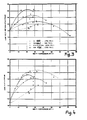
- FIG. 1 to 7 are graphs illustrating the results of wax hydroprocessing experiments reported in the Examples.
- the feed to the process comprises petroleum wax which contains at least 50 weight percent wax, as determined by ASTM test D-3235.
- the waxes are mostly paraffins of high pour point, comprising straight chain and slightly branched chain paraffins such as methylparaffins.
- Petroleum waxes that is, waxes of paraffinic character are derived from the refining of petroleum and other liquids by physical separation from a wax-containing refinery stream, usually by chilling the stream to a temperature at which the wax separates, usually by solvent dewaxing, e.g., MEK/toluene dewaxing or by means of an autorefrigerant process such as propane dewaxing.
- solvent dewaxing e.g., MEK/toluene dewaxing or by means of an autorefrigerant process such as propane dewaxing.
- autorefrigerant process such as propane dewaxing.
- the presence of lower boiling components is not to be excluded since they will be removed together with products of similar boiling range produced during the processing during the separation steps which follow the characteristic processing steps. Since these components will, however, load up the process units they are preferably excluded by suitable choice of feed cut point.
- the end point of wax feeds derived from the solvent dewaxing of neutral oils, i.e, distillate fractions produced by the vacuum distillation of long or atmospheric resids will usually be not more than about 1100°F (about 595°C) so that they may normally be classified as distillate rather than residual streams but high boiling wax feeds such as petrolatum waxes, i.e., the waxes separated from bright stock dewaxing, which may typically have an end point of up to about 1300°F (about 705°C), may also be employed.
- the wax content of the feed is high, generally at least 50, more usually at least 60 to 80, weight percent with the balance from occluded oil comprising isoparaffins, aromatics and naphthenics.
- the non-wax content of aromatics, polynaphthenes and highly branched naphthenes will normally not exceed about 40 weight percent of the wax and preferably will not exceed 25 to 30 weight percent.
- the waxy, highly paraffinic wax stocks usually have low viscosities because of their relatively low content of aromatics and naphthenes although the high content of waxy paraffins gives them melting points and pour points which render them unacceptable as lubricants without further processing.
- Feeds of this type will normally be slack waxes, that is, the waxy product obtained directly from a solvent dewaxing process, e.g. an MEK or propane dewaxing process.
- the slack wax which is a solid to semi-solid product, comprising mostly highly waxy paraffins (mostly n- and mono-methyl paraffins) together with occluded oil, may be fed directly to the first step of the present processing sequence as described below without the requirement for any initial preparation, for example, by hydrotreating.
- compositions of some typical waxes are given in Table 1 below.
- a typical slack wax feed has the composition shown in Table 2 below.
- This slack wax is obtained from the solvent (MEK) dewaxing of a 300 SUS (65 cSt) neutral oil obtained from an Arab Light Crude.
- Another slack wax suitable for use in the present process has the properties set out in Table 3 below. This wax is prepared by the solvent dewaxing of a 450 SUS (100cS) neutral raffinate:
- the waxy feed is subjected to a two-step hydrocracking-hydroisomerization process in which both steps may be carried out in the presence of hydrogen.
- an amorphous bifunctional catalyst is used to promote the saturation and ring opening of the low quality aromatic components in the feed to produce hydrocracked products which are relatively more paraffinic.
- This stage is carried out under high pressure to favor aromatics saturation but the conversion is maintained at a relatively low level in order to minimize cracking of the paraffinic components of the feed and of the products obtained from the saturation and ring opening of the aromatic materials.
- the hydrogen pressure in the first stage is at least 800 psig (5613 kPa abs) and usually is in the range of 1,000 to 3,000 psig (6991 to 20771 kPa abs).
- hydrogen partial pressures of at least 1500 psig (10436 kPa abs) are best in order to obtain a high level of aromatic saturation with pressures in the range of 1500 to 2500 psig (10436 to 17326 kPa abs) being suitable for most high pressure equipment.
- the conversion of the feed to products boiling below the lube boiling range, typically to 650°F- (about 343°C-) products is limited to no more than 50 weight percent of the feed and will usually be not more than 30 weight percent of the feed in order to maintain the desired high single pass yields which are characteristic of the process while preparing the feed for the second stage of the processing; an initial V.I. for the first stage product of at least about 130 is normally desirable for the final product to have the desired V.I. of 140 of higher.
- the actual conversion is, for this reason, dependent on the quality of the feed with slack wax feeds requiring a lower conversion than petrolatums where it is necessary to remove more low quality polycyclic components.
- the conversion of 343°C + (650°F+) material will, for all practical purposes not be greater than 10 to 20 weight percent, with about 15 weight percent being typical for heavy neutral slack waxes.
- Higher conversions may be encountered with petrolatum feeds in order to prepare the feed for the second stage processing.
- the first stage conversion will typically be in the range of 20 to 25 weight percent for high V.I. products.
- the conversion may be maintained at the desired value by control of the temperature in this stage which will normally be in the range 600 to 800°F (about 315 to 430°C) and more usually in the range of about 650 to 750°F (about 343 to 400°C).
- Space velocity variations may also be used to control severity although this will be less common in practice in view of mechanical constraints on the system.
- the exact temperature selected to achieve the desired conversion will depend on the characteristics of the feed and of the catalyst as well as upon the extent to which it is necessary to remove the low quality aromatic components from the feed. In general terms, higher severity conditions are required for processing the more aromatic feeds up to the usual maximum of about 30 percent aromatics, then with the more paraffinic feeds.
- the properties of the feed should be correlated with the activity of the selected catalyst in order to arrive at the required operating temperature for the first stage in order to achieve the desired product properties, with the objective at this stage being to remove the undesirable, low quality aromatic components by hydrocracking while minimizing conversion of the more desirable paraffinic components to products boiling below the lube boiling range.
- temperature may also be correlated with the space velocity although for practical reasons, the space velocity will normally be held at a fixed value in accordance with mechanical and other constraints such as minimizing pressure drop. Generally, the space velocity will be in the range of 0.25 to 2 LHSV, hr- 1 and usually in the range of 0.5 to 1.5 LHSV.
- a characteristic feature of the first stage operation is the use of a bifunctional lube hydrocracking catalyst.
- Catalysts of this type have a high selectivity for aromatics hydrocracking reactions in order to remove the low quality aromatic components from the feed.
- these catalysts include a metal component for promoting the desired aromatics saturation reactions and frequently a combination of base metals is used, with one metal from the iron group (Group VIII) in combination with a metal of Group VIB.
- a base metal such as nickel or cobalt is used in combination with molybdenum or tungsten.
- a preferred combination is nickel/tungsten since it has been found to be highly effective for promoting the desired aromatics hydrocracking reaction.
- Noble metals such as platinum or palladium may be used since they have good hydrogenation activity in the absence of sulfur but they will normally not be preferred.
- the amounts of the metals present on the catalyst are conventional for lube hydrocracking catalysts of this type and generally will range from 1 to 10 weight percent of the Group VIII metal and 10 to 30 weight percent of the Group VI metal, based on the total weight of the catalyst. If a noble metal component such as platinum or palladium is used instead of a base metal such as nickel or cobalt, relatively lower amounts are in order in view of the higher hydrogenation activities of these noble metals, typically from about 0.5 to 5 weight percent being sufficient.
- the metals may be incorporated by any suitable method including impregnation onto the porous support after it is formed into particles of the desired size or by addition to a gel of the support materials prior to calcination. Addition to the gel is a preferred technique when relatively high amounts of the metal components are to be added, e.g. above 10 weight percent of the Group VIII metal and above 20 weight percent of the Group Vi metal. These techniques are conventional in character and are employed for the production of lube hydrocracking catalysts.
- the metal component of the catalyst is supported on a porous, amorphous metal oxide support and alumina is preferred for this purpose although silica-alumina may also be employed. Other metal oxide components may also be present in the support although their presence is less desirable.
- the support should have a pore size and distribution which is adequate to permit the relatively bulky components of the high boiling feeds to enter the interior pore structure of the catalyst where the desired hydrocracking reactions occur. To this extent, the catalyst will normally have a minimum pore size of about 50 A° (5 nm), i.e.
- Preferred catalysts for the first stage have at least 60 percent of the pores in the 50-200 (5-20 nm) range.
- Table 4 The pore size distribution and other properties of some typical lube hydrocracking catalysts suitable for use in the first stage are shown in Table 4 below:
- the catalyst may by promoted with fluorine, either by incorporating fluorine into the catalyst during its preparation or by operating the hydrocracking in the presence of a fluorine compound which is added to the feed.
- fluorine compounds may be incorporated into the catalyst by impregnation during its preparation with a suitable fluorine compound such as ammonium fluoride (NH 4 F) or ammonium bifluoride (NH 4 F.HF) of which the latter is preferred.
- the amount of fluorine used in catalysts which contain this element is preferably from about 1 to 10 weight percent, based on the total weight of the catalyst, usually from about 2 to 6 weight percent.
- the fluorine may be incorporated by adding the fluorine compound to a gel of the metal oxide support during the preparation of the catalyst or by impregnation after the particles of the catalyst have been formed by drying or calcining the gel. If the catalyst contains a relatively high amount of fluorine as well as high amounts of the metals, as noted above, it is preferred to incorporate the metals and the fluorine compound into the metal oxide gel prior to drying and calcining the gel to form the finished catalyst particles.
- the catalyst activity may also be maintained at the desired level by in situ fluoriding in which a fluorine compound is added to the stream which passes over the catalyst in this stage of the operation.
- the fluorine compound may be added continuously or intermittently to the feed or, alternatively, an initial activation step may be carried out in which the fluorine compound is passed over the catalyst in the absence of the feed, e.g. in a stream of hydrogen in order to increase the fluorine content of the catalyst prior to initiation of the actual hydrocracking.
- In situ fluoriding of the catalyst in this way is preferably carried out to induce a fluorine content of about 1 to 10 percent fluorine prior to operation, after which the fluorine can be reduced to maintenance levels sufficient to maintain the desired activity.
- Suitable compounds for in situ fluoriding are orthofluorotolune and difluoroethane.
- the metals present on the catalyst are preferably used in their sulfide form, and to achieve this presulfiding of the catalyst may be carried out prior to initiation of the hydrocracking.
- Sulfiding is an established technique and it is typically carried out by contacting the catalyst with a sulfur-containing gas, usually in the presence of hydrogen.
- the mixture of hydrogen and hydrogen sulfide, carbon disulfide or a mercaptan such a butol mercaptan is conventional for this purpose.
- Presulfiding may also be carried out by contacting the catalyst with hydrogen and a sulfur-containing hydrocarbon oil such as a sour kerosene or gas oil.
- the feeds are highly paraffinic, the heteroatom content is low and accordingly the feed may be passed directly into the first process step, without the necessity of a preliminary hydrotreatment.
- the low quality, relatively aromatic components of the feed are converted by hydrocracking to products which are relatively more paraffinic in character by saturation and ring opening.
- the paraffinic materials present in the stream at this stage of the process possess good V.I. characteristics but have relatively high pour points as a result of their paraffinic nature.
- the objective in the second stage of the process is to effect a selective hydroisomerization of these paraffinic components to isoparaffins which, while possessing good viscometric properties, also have lower pour points. This enables the pour point of the final product to be obtained without an excessive degree of dewaxing following the hydroisomerization. Because the low quality aromatic components have been removed by the initial hydrocracking step.
- Another mode of operation is with higher hydrogen pressures in the second stage, typically over 1000 psig (6991 kPa). This mode of operation is preferred since the second stage can be operated in cascade with the first stage, at an inlet pressure equal to the outlet pressure of the first stage.
- the second stage will operate at a hydrogen partial pressure of 400 to 1000 psig (2857 to 6991 kPa) in the low pressure mode or at hydrogen partial pressures of 1000 to 3000 psig (6991 to 20771 kPa), usually 1500-2500 psig (10436 to 17326 kPa) in the high pressure mode. Hydrogen circulation rates are comparable to those used in the first stage.
- the catalyst used in the second stage is one which has a high selectivity for the isomerization of waxy, linear or near linear paraffins to less waxy, isoparaffinic products.
- Catalysts of this type are bifunctional in character, comprising a metal component on a large pore size, porous support of relatively low acidity. The acidity is maintained at a low level in order to reduce conversion to products boiling outside the lube boiling range during this stage of the operation.
- an alpha value below 20 should be employed, with preferred values below 10, best results being obtained with alpha values below 5 and good results being achieved at alpha values of 1 to 2.
- the alpha value is an approximate indication of the catalytic cracking activity of the catalyst compared to a standard catalyst.
- the alpha test is described in US-A-3,354,078 and in J. Catalysis, 4, 527 (1965); 6, 278 (1966); and 61, 395 (1980).
- the alpha value is determined in the absence of the metal component.
- the support material for the paraffin hydroisomerization catalyst is zeolite beta, a highly siliceous, zeolite in a form which has the required low level of acid activity to minimize paraffin cracking and to maximize paraffin isomerisation.
- Low acidity values in the zeolite may be obtained by use of a sufficiently high silica:alumina ratio in the zeolite, achievable either by direct synthesis of the zeolite with the appropriate composition or by steaming or dealuminization procedures such as acid extraction. Isomor- phous substitution of metals other than aluminum may also be utilized to produce a zeolite with a low inherent acidity.
- the zeolite may be subjected to alkali metal cation exchange to the desired low acidity level, although this is less preferred than the use of a zeolite which contains framework elements other than aluminum.
- Zeolite beta is the preferred support since this zeolite has been shown to possess outstanding activity for paraffin isomerization in the presence of aromatics, as disclosed in US-A-4,419,220.
- the low acidity forms of zeolite beta may be obtained by synthesis of a highly siliceous form of the zeolite, e.g. with a silica-alumina ratio above about 50:1 or, more readily, by steaming zeolites of lower silica-alumina ratio to the requisite acidity level.
- Another method is by replacement of a portion of the framework aluminum of the zeolite with another trivalent element such as boron which results in a lower intrinsic level of acid activity in the zeolite.
- the preferred zeolites of this type are those which contain framework boron, and normally at least 0.1 weight percent, preferably at least 0.5 weight percent, of framework boron is preferred in the zeolite.
- the framework consists principally of silicon tetrahedrally coordinated and interconnected with oxygen bridges.
- a minor amount of a trivalent element (alumina in the case of aluminosilicate zeolite beta) is usually also coordinated and forms part of the framework.
- the zeolite also contains material in the pores of the structure although these do not form part of the framework constituting the characteristic structure of the zeolite.
- frame boron is used here to distinguish between material in the framework of the zeolite which is evidenced by contributing ion exchange capacity to the zeolite, from material which is present in the pores and which has no effect on the total ion exchange capacity of the zeolite.
- the zeolite should contain at least 0.1 weight percent boron. Normally, the maximum amount of boron will be about 5 weight percent of the zeolite and in most cases not more than 2 weight percent of the zeolite.
- the framework will normally include some alumina and the silica:alumina ratio will usually be at least 30:1, in the as-synthesized conditions of the zeolite.
- a preferred zeolite beta catalyst is made by steaming an initial boron-containing zeolite containing at least 1 weight percent boron (as B 2 0 3 ) to result in an ultimate alpha value no greater than about 10 and preferably no greater than 5.
- the steaming conditions should be adjusted in order to attain the desired alpha value in the final catalyst and typically utilize atmospheres of 100 percent steam, at temperatures of from about 800 to about 1100°F(about 427 to 595°C). Normally, the steaming will be carried out for about 12 to 48 hours, typically about 24 hours, in order to obtain the desired reduction in acidity.
- the use of steaming to reduce the acid activity of the zeolite has been found to be especially advantageous, giving results which are not achieved by the use of a zeolite which has the same acidity in its as-synthesized condition. It is believed that these results may be attributable to the presence of trivalent metals removed from the framework during the steaming operation which enhance the functioning of the zeolite in a manner which is not fully understood.
- the zeolite will usually be composited with a matrix material to form the finished catalyst and for this purpose conventional non-acidic matrix materials such as alumina, silica-alumina and silica are suitable with preference given to silica as a non-acidic binder, although non-acidic aluminas such as alpha boehmite (alpha alumina monohydrate) may also be used, provided that they do not confer any substantial degree of acidic activity on the matrixed catalyst.
- non-acidic aluminas such as alpha boehmite (alpha alumina monohydrate) may also be used, provided that they do not confer any substantial degree of acidic activity on the matrixed catalyst.
- the use of silica as a binder is preferred since alumina, even if non-acidic in character, may tend to react with the zeolite under hydrothermal reaction conditions to enhance its acidity.
- the zeolite is usually composited with the matrix in amounts from 80:20 to 20:80 by weight, typically from 80:20 to 50:50 zeolite:matrix. Compositing may be done by conventional means including mulling the materials together followed by extrusion or pelletizing into the desired finished catalyst particles.
- a preferred method for extruding the zeolite with silica as a binder is disclosed in US-A-4,582,815. If the catalyst is to be steamed in order to achieve the desired low acidity, it is performed after the catalyst has been formulated with the binder, as is conventional.
- the isomerization catalyst also includes a metal component in order to promote the desired hydroisomerization reactions which, proceeding through unsaturated transitional species, require mediation by a hydrogenation-dehydrogenation component.
- a metal component in order to promote the isomerization activity of the catalyst, metals having a strong hydrogenation function are preferred and for this reason, platinum and the other noble metals such as palladium are given a preference.
- the amount of the noble metal hydrogenation component is typically in the range 0.5 to 5 weight percent of the total catalyst, usually from 0.5 to 2 weight percent.
- the platinum may be incorporated into the catalyst by conventional techniques including ion exchange with complex platinum cations such as platinum tetraammine or by impregnation with solutions of soluble platinum compounds, for example, with platinum tetraammine salts such as platinum tetraam- minechloride.
- the catalyst may be subjected to a final calcination under conventional conditions in order to convert the noble metal to the oxide form and to confer the required mechanical strength on the catalyst. Prior to use the catalyst may be subjected to presulfiding, by established techniques.
- the conditions for the hydroisomerization are adjusted to achieve the objective of isomerizing the waxy, linear and near-linear paraffinic components in the feed to less waxy but high V.I. isoparaffinic materials of relatively lower pour point while minimizing conversion to non-lube boiling range products (usually 650°F-(345°C-) materials). Since the catalyst used has a low acidity, conversion to lower boiling products is usually at a relatively low level and by appropriate selection of severity, the operation of the process may be optimized for isomerization over cracking.
- temperatures in the second stage will typically be in the range of about 550 to about 700°F (about 290 to 370°C) with 650°F + (343°C + ) conversion typically being from about 10 to 30 weight percent, more usually 12 to 20 weight percent, of the second stage feed.
- temperatures may be used outside this range, for example, as low as about 500°F (260°C) up to about 750°F (about 400°C) although the higher temperatures will usually not be preferred since they will be associated with a lower isomerization selectivity and the production of less stable lube products as a result of the hydrogenation reactions being thermodynamically less favored at progressively higher operating temperatures.
- temperatures in the second stage may be somewhat lower than those appropriate to low pressure operation; in the high pressure mode, temperatures of 550 to 700°F (about 290 to 370°C) will be preferred, as compared to the preferred range of 600 to 700°F (about 315 to 370°C) for this stage of the operation in the low pressure mode.
- Space velocities will typically by in the range of 0.5 to 2 LHSV (hr- 1 ) although in most cases a space velocity of about 1 LHSV will be most favorable.
- Hydrogen circulation rates are comparable to those used in the first step, as described above but since there is no significant hydrogen consumption as a result of near hydrogen balance in this second step of the process, lower circulation rates may be employed if feasible. In the cascade operational mode, the excess hydrogen from the first stage will be found adequate for the second stage operation.
- a particular advantage of the present process is that it enables a functional separation to be effected in the entire operating scheme.
- the undesirable low V.I. components are removed by a process of saturation and ring opening under conditions of high pressure and relatively high temperature.
- the second stage is intended to maximize the content of iso-paraffins in the product and because the low V.I. materials have been dealt with in the first stage, can be optimized to effect a selective isomerization of the paraffinic materials.
- the relatively low temperature conditions which are appropriate for the paraffin isomerization disfavor cracking reactions but are thermodynamically favorable for the saturation of any lube range olefins which may be formed by cracking, particularly in the presence of the highly active hydrogenation components on the catalyst.
- the hydroisomerization is also effective for hydrofinishing the product so that product stability is improved, especially stability to ultraviolet radiation, a property which is frequently lacking in conventional hydrocracked lube products.
- the isomerized product may therefore be subjected simply to a final dewaxing step in order to achieve the desired target pour point and usually there will be no need for any further finishing steps since a low unsaturates content, both of aromatics and of lube range olefins, results from the optimized processing in the two functionally separated steps of the process.
- the product may be subjected to a final fractionation to remove lower boiling materials, followed by a final dewaxing step in order to achieve target pour point for the product.
- the extent of dewaxing required is relatively small.
- the loss during the final dewaxing step will be not more than 15-20 weight percent of the dewaxer feed and may be lower.
- Either catalytic dewaxing or solvent dewaxing may be used at this point and if a solvent dewaxer is used, the removed wax may be recycled to the first or second stages of the process for further treatment. Since the wax removed in a solvent dewaxer is highly paraffinic, it may be recycled directly to the second stage if this is feasible, for example, in the embodiment where the second stage is operated at a relatively low pressure.
- the preferred catalytic dewaxing processes utilize an intermediate pore size zeolite such as ZSM-5, but the most preferred dewaxing catalysts are based on the highly constrained intermediate pore size zeolites such as ZSM-22, ZSM-23 or ZSM-35, since these zeolites have been found to provide highly selective dewaxing, giving dewaxed products of low pour point and high V.I. Dewaxing processes using these zeolites are described in US-A-4,222,855.
- the zeolites whose use is preferred here may be characterized in the same way as described therein, i.e, as zeolites having pore openings which result in the possession of defined sorption properties set out in the patent, namely: (1) a ratio of sorption of n-hexane to o-xylene, on a volume percent basis, of greater than about 3, which sorption is determined at a P/P o of 0.1 and at a temperature of 50°C for n-hexane and 80-°C for o-xylene and (2) by the ability of selectively cracking 3-methylpentane (3MP) in preference to the doubly branched 2,3-dimethylbutane (DMB) at 1000°F (538°C) and 1 atmosphere (bar) pressure from a 1/1/1 weight ratio mixture of n-hexane/3-methyl-pentane/2,3-dimethylbutane, with the ratio of rate constants k 3MP /k DMB determined at a temperature of 1000
- P/P o is accorded its usual significance as described in the literature, for example, in "The Dynamical Character of Adsorption” by J.H. deBoer, 2nd Edition, Oxford University Press (1968) and is the relative pressure defined as the ratio of the partial pressure of sorbate to the vapor pressure of sorbate at the temperature of sorption.
- the ratio of the rate constants, k 3MP /k DMB is determined from 1 st order kinetics, in the usual manner, by the following equation: where k is the rate constant for each component, T is the contact time and E is the fractional conversion of each component.
- Zeolites conforming to these sorption requirements include the naturally occurring zeolite ferrierite as well as the known synthetic zeolites ZSM-22, ZSM-23 and ZSM-35. These zeolites are at least partly in the acid or hydrogen form when they are used in the dewaxing process and a metal hydrogenation component, preferably a noble metal such as platinum is preferably used. Excellent results have been obtained with a Pt/ZSM-23 dewaxing catalyst.
- zeolites ZSM-22, ZSM-23 and ZSM-35 are described in US-A-4,810,357 (ZSM-22), 4,076,842 and 4,104,151 (ZSM-23) and 4,016,245 (ZSM-35), to which reference is made for a description of this zeolite and its preparation.
- Ferrierite is a naturally-occurring mineral, described in the literature, see e.g. D.W. Breck, ZEOLITE MOLECULAR SIEVES, John Wiley and Sons (1974), pages 125-127, 146, 219 and 625, to which reference is made for a description of this zeolite.
- the present process provides a significant improvement over the process employing solely amorphous catalysts where a significant degree of dewaxing is required.
- the functional separation inherent in the process enables higher single pass wax conversions to be achieved, typically about 70 to 80% as compared to 50% for the amorphous catalyst process so that unit throughput is significantly enhanced with respect to the conventional process.
- conversions levels above 80 percent may be employed so that the load on the dewaxer is reduced, the product V.I. and yield decrease at the same time and generally, the final dewaxing stage cannot be completely eliminated unless products with a V.I. below about 135 are accepted.
- the products from the process of the invention are high V.I., low pour point materials which are obtained in excellent yield. Besides having excellent viscometric properties they are also highly stable, both oxidatively and thermally and to ultraviolet light. V.I. values in the range of 140 to 155 are typically obtained, with values of 143 to 147 being readily achievable with product yields of at least 50 weight percent, usually at least 60 weight percent, based on the original wax feed, corresponding to wax conversion values of almost 80 and 90 percent, respectively.
- Another notable feature of the process is that the products retain desirable viscosity values as a result of the limited boiling range conversions which are inherent in the process: conversely, higher yields are obtained at constant product viscosity.
- Examples 1 and 2 directly following, illustrate the preparation of low acidity Pt/zeolite beta catalysts containing framework boron.
- a boron-containing zeolite beta catalyst was prepared by crystallizing the following mixture at 285°F(140°C) for 13 days, with stirring:
- the calcined product had the following analysis and was confirmed to have the structure of zeolite beta by x-ray diffraction:
- Example 1 An as-synthesized boron-containing zeolite beta of Example 1 was mulled and extruded with silica in a zeolite:silica weight ratio of 65:35, dried and calcined at 900°F (480°C) for 3 hours in nitrogen, followed by 1000°F (540°C) in air for three hours.
- the resulting extrudate was exchanged with IN ammonium nitrate solution at room temperature for 1 hour after which the exchanged catalyst was calcined in air at 1000°F (540°C) for 3 hours, followed by 24 hours in 100 percent steam at 1025°F(550°C).
- the steamed extrudate was found to contain 0.48 weight percent boron (as B 2 0 3 ), 365 ppm sodium and 1920 ppm A1 2 0 3 .
- the steamed catalyst was then exchanged for 4 hours at room temperature with IN platinum tetraammine chloride solution with a final calcination at 660°F (350°C) for three hours.
- the finished catalyst contained 0.87 weight percent platinum and had an alpha value of 4.
- a slack wax with the properties shown in Table 3 above and containing 30 wt% oil based on bulk solvent dewaxing (35 wt% oil by ASTM D3235) was processed by hydrocracking over a 1.5 mm trilobe NiW/fluorided alumina catalyst of the type described in Table 4 above (4.8 wt% Ni, 22.3 wt% W).
- the catalyst was sulfided and fluorided in-situ using o-fluorotoluene at a level of 600 ppm fluorine for one week at a temperature of 725°F (385°C) before introducing the slack wax.
- the hydrocracking was carried out with fluorine maintenance at 25 ppm F using o-fluorotoluene under the following conditions:
- Wax conversion is defined as the difference between wax in feed and wax obtained by solvent dewaxing, divided by wax in feed.
- Figure 1 shows the lube yield relative to wax conversion, with the results from the two-stage LHDC/HDI experiments of Example 5 included for comparison. The figure shows that the lube yield for the single stage LHDC process of Example 3 reaches a maximum value of about 46 percent at about 40-60 percent wax conversion.
- This Example illustrates a single step wax hydroisomerization process (no initial hydrocracking) using a low acidity hydroisomerization catalyst.
- a low acidity silica-bound zeolite beta catalyst prepared by the method described in Example 2 above was charged to a reactor in the form of 30/60 mesh (Tyler) particles and then sulfided using 2% H 2 S/98% H 2 by incrementally increasing the reactor temperature up to 750°F (400°C) at 50 psig (445 kPa abs).
- the same slack wax that was mildly hydrocracked in Example 3 was charged directly to the catalyst without first stage hydrocracking.
- the reaction conditions were 400 psig (2857 kPa abs), 2500 SCF H 2 /Bbl (445 n.I.I.- 1 ), and 0.5 LHSV.
- Table 7 The results are given in Table 7 below.
- LHDC/HDI cascade lube hydrocracking/hydroisomerization
- the low acidity Pt/zeolite beta catalyst of Example 2 was charged to the reactor and pre-sulfided as described in Example 4.
- the hydrocracked distillate 650°F + (343°C +) fraction from Example 3 was then processed over this catalyst at temperatures from 622 to 667°F (328 to 353°C), 0.5 LHSV, 400 psig (2857 kPa abs) and 2500 SCF H 2 /Bbl (445 n.I.I.- 1 ).
- the bottoms fraction was distilled to product 650°F+ (343°F+) material which was subsequently dewaxed using MEK/toluene.
- the lube yield of the two-step LHDC/HDI sequence relative to wax conversion is shown in Figure 1 with the yield of the single step LHDC process given for comparison.
- the figure shows that the two-step processing achieves a higher lube yield of about 61 percent at about 88 percent wax conversion, both these values being significantly higher than achieved by the single step LHDC process. Process optimization is therefore achieved by the functional separation of the processing steps.
- the yield data in Figure 1 also show that the high wax conversion selectivity (ratio of isomerate formed/wax converted) can be maintained at very high wax conversions (up to 90 weight percent) whereas the mild hydrocracking scheme (Example 3) cannot maintain high wax conversion selectivities above 40-50 weight percent wax conversion due to excessive overcracking at the higher conversion levels.
- Figure 2 shows that, along with the lube yield, there is an improvement in the viscosity index (V.I.) of the product obtained from the combined LHDC/HDI scheme of Example 5 of about three numbers over the product of the mild hydrocracking of Example 3.
- V.I. viscosity index
- a two-step lube hydrocracking/hydroisomerization process was carried out using the slack wax feed of Table 3 above and the catalysts of Example 3 (hydrocracking) and Example 2 (Pt/zeolite beta).
- the process was operated in direct cascade at a pressure of 2000 psig (13881 kPa) in each stage, at a temperature of 715°F (380°C) for the hydrocracking and 645°F (340°C) for the hydroisomerization.
- the space velocity was 1.0 hr- 1 in each stage.
- the Pt/beta hydroisomerization catalyst used in the second stage was presulfided in the same way as described in Example 4. The results are given in Table 7 below.
- Table 7 compares the maximum lube yields, product V.I.s, and reactor temperature requirements for all four slack wax processing schemes: (i) mild hydrocracking (Example 3), (ii) wax isomerization using a low acidity HDI catalyst (Pt/B-beta) (Example 4), (iii) the combined LHDC/HDI scheme of mild hydrocracking over an amorphous HDC catalyst followed by low pressure wax hydroisomerization over a low acidity Pt/B-beta catalyst (Example 5) and (iv) cascade LHDC/HDI over an amorphous HDC catalyst followed by high pressure wax hydroisomerization over a low acidity Pt/B-beta catalyst (Example 6).
- Table 7 shows that the combined mild hydrocracking, hydroisomerization processes of Examples 5 and 6 have a significant activity advantage (about 130°F, 54°C) over the single stage paraffin hydroisomerization process of Example 4 using the same hydroisomerization catalyst (Pt/B-beta) at comparable product viscosity. Moreover, the combined processes also produce a higher V.I. product in higher yield than either the single stage high pressure hydrocracking process or the low pressure isomerization process. Thus, the integrated process scheme using either low or high pressure hydroisomerization is superior to either of the individual processes.
- This Example compares the use of low and high pressure wax hydroisomerizations.
- This Example in conjunction with Example 8 also shows that a low acidity second stage catalyst (a ⁇ 15) is preferred over a higher acidity catalyst.
- Example 2 The catalyst of Example 2 was charged to a downflow reactor and sulfided as described in Example 4. The slack wax of Example 3 was then fed with hydrogen to the reactor in cocurrent downflow under the following conditions:
- a zeolite beta sample with a bulk Si0 2 /AI 2 0 3 ratio of 40:1 was extruded with alumina to form a 65/35 weight percent cylindrical extrudate. This material was then dried, calcined and steamed to reduce the alpha to 55. Platinum was incorporated by means of ion exchange using Pt(NH 3 ) 4 CI 2 . The final Pt loading was 0.6 weight percent. This catalyst was then charged to the reactor and sulfided as described above. Hydrogen was fed to the reactor together with the same slack wax described in Example 3 in cocurrent downflow under the following conditions:
- Table 8 compares the maximum lube yields and V.I. of the products at maximum yield from the runs described in Examples 3, 7 and 8.
- Figures 3 to 6 compare the yield and V.I. data as a function of conversion of the slack wax for the processes of Examples 3, 4, 7 and 8. Conversion here is defined as the net amount of feed converted to 650°F-(343°C-). These results show that the low acidity Pt/zeolite beta catalyst of Example 2 (4a) produces the highest yield for processing the raw slack wax, as shown by Example 4: the 4a Pt/zeolite beta catalyst produces as much as 15 percent more lube than the amorphous NiW/A1 2 0 3 catalyst used in Example 3 and 10 to 20% more lube than the higher acidity 55a Pt/zeolite beta catalyst of Example 8. Increasing the operating pressure of the hydroisomerization results in a significant yield loss in the case of the higher acidity Pt/zeolite beta catalyst of Example 8, but results in a yield increase for the low acidity Pt/zeolite beta catalyst used in Example 7.
- Product V.I. is not as strongly affected by pressure with the low acidity Pt/zeolite beta as it is with the higher acidity Pt/zeolite beta catalyst.
- Figure 7 shows the relationship between the kinematic viscosity (at 100°C) of the product at varying wax conversions for the LHDC/HDI/SWD sequence of the present invention as well as for a conventional LHDC/SWD sequence using the same slack wax feed taken to a constant product cut point of 650°F (about 343°C).
- the figure shows that the present process enables viscosity to be retained to a greater degree than with the conventional processing technique as a result of the selective conversion of wax to high V.I. oil without excessive conversion of oil out of the lube boiling range. This valuable feature enables products of varying viscosities to be manufactured by suitable selection of conditions.
- the lube yields and properties are reported for a constant viscosity cut of 7.8 cSt., at approximately 650°F (343°C) cut point.
- the product is produced in good yield and has excellent viscometric properties, as shown by Table 10.
Landscapes
- Chemical & Material Sciences (AREA)
- Engineering & Computer Science (AREA)
- Organic Chemistry (AREA)
- Chemical Kinetics & Catalysis (AREA)
- Oil, Petroleum & Natural Gas (AREA)
- Crystallography & Structural Chemistry (AREA)
- Materials Engineering (AREA)
- General Chemical & Material Sciences (AREA)
- Production Of Liquid Hydrocarbon Mixture For Refining Petroleum (AREA)
- Lubricants (AREA)
Applications Claiming Priority (2)
| Application Number | Priority Date | Filing Date | Title |
|---|---|---|---|
| US54870290A | 1990-07-05 | 1990-07-05 | |
| US548702 | 1990-07-05 |
Publications (2)
| Publication Number | Publication Date |
|---|---|
| EP0464547A1 true EP0464547A1 (de) | 1992-01-08 |
| EP0464547B1 EP0464547B1 (de) | 1998-05-13 |
Family
ID=24190038
Family Applications (1)
| Application Number | Title | Priority Date | Filing Date |
|---|---|---|---|
| EP91110355A Expired - Lifetime EP0464547B1 (de) | 1990-07-05 | 1991-06-24 | Verfahren zur Herstellung von Schmiermitteln mit hohem Viskositätsindex |
Country Status (8)
| Country | Link |
|---|---|
| EP (1) | EP0464547B1 (de) |
| JP (1) | JP3068245B2 (de) |
| KR (1) | KR100195350B1 (de) |
| AU (1) | AU640490B2 (de) |
| CA (1) | CA2045106C (de) |
| DE (1) | DE69129388T2 (de) |
| ES (1) | ES2116272T3 (de) |
| SG (1) | SG49629A1 (de) |
Cited By (101)
| Publication number | Priority date | Publication date | Assignee | Title |
|---|---|---|---|---|
| EP0575077A1 (de) * | 1992-06-15 | 1993-12-22 | Mobil Oil Corporation | Produktion von Schmiermitteln mit hohem Viskositätsindex |
| US5302279A (en) * | 1992-12-23 | 1994-04-12 | Mobil Oil Corporation | Lubricant production by hydroisomerization of solvent extracted feedstocks |
| EP0776959A3 (de) * | 1995-11-28 | 1998-03-11 | Shell Internationale Researchmaatschappij B.V. | Verfahren zur Herstellung von Schmierölen |
| EP0799082A4 (de) * | 1994-12-19 | 1998-12-30 | Mobil Oil Corp | Hydroisomerisationsprozess von wachsen |
| EP0796304A4 (de) * | 1994-12-07 | 1998-12-30 | Mobil Oil Corp | Herstellung von schmiermitteln mit hohem viskositätsindexn |
| WO2006128646A2 (en) | 2005-06-03 | 2006-12-07 | Exxonmobil Chemical Patents Inc. | Elastomeric structures |
| WO2006132964A2 (en) | 2005-06-03 | 2006-12-14 | Exxonmobil Research And Engineering Company | Ashless detergents and formulated lubricating oil contraining same |
| WO2007050352A1 (en) | 2005-10-21 | 2007-05-03 | Exxonmobil Research And Engineering Company | Improvements in two-stroke lubricating oils |
| WO2007133554A2 (en) | 2006-05-09 | 2007-11-22 | Exxonmobil Research And Engineering Company | Lubricating oil composition |
| WO2008002425A1 (en) | 2006-06-23 | 2008-01-03 | Exxonmobil Research And Engineering Company | Lubricating compositions |
| US7615589B2 (en) | 2007-02-02 | 2009-11-10 | Exxonmobil Chemical Patents Inc. | Properties of peroxide-cured elastomer compositions |
| US7745544B2 (en) | 2006-11-30 | 2010-06-29 | Exxonmobil Chemical Patents Inc. | Catalytic epoxidation and hydroxylation of olefin/diene copolymers |
| WO2011084468A1 (en) | 2009-12-17 | 2011-07-14 | Exxonmobil Chemical Patents, Inc. | Polypropylene composition with plasticiser suitable for sterilisable films |
| WO2014107315A1 (en) | 2013-01-04 | 2014-07-10 | Exxonmobil Research And Engineering Company | Method for improving engine fuel efficiency |
| WO2015050690A1 (en) | 2013-10-03 | 2015-04-09 | Exxonmobil Research And Engineering Company | Compositions with improved varnish control properties |
| WO2015099820A1 (en) | 2013-12-23 | 2015-07-02 | Exxonmobil Research And Engineering Company | Method for improving engine fuel efficiency |
| WO2015099821A1 (en) | 2013-12-23 | 2015-07-02 | Exxonmobil Research And Engineering Company | Method for improving engine fuel efficiency |
| WO2015099819A1 (en) | 2013-12-23 | 2015-07-02 | Exxonmobil Research And Engineering Company | Method for improving engine fuel efficiency |
| WO2015171980A1 (en) | 2014-05-09 | 2015-11-12 | Exxonmobil Research And Engineering Company | Method for preventing or reducing low speed pre-ignition |
| WO2015171978A1 (en) | 2014-05-09 | 2015-11-12 | Exxonmobil Research And Engineering Company | Method for preventing or reducing low speed pre-ignition |
| WO2015171981A1 (en) | 2014-05-09 | 2015-11-12 | Exxonmobil Research And Engineering Company | Method for preventing or reducing low speed pre-ignition |
| WO2015171292A1 (en) | 2014-05-08 | 2015-11-12 | Exxonmobil Research And Engineering Company | Method for preventing or reducing engine knock and pre-ignition |
| WO2015183455A1 (en) | 2014-05-29 | 2015-12-03 | Exxonmobil Research And Engineering Company | Lubricating oil compositions with engine wear protection |
| WO2016043944A1 (en) | 2014-09-17 | 2016-03-24 | Exxonmobil Research And Engineering Company | Composition and method for preventing or reducing engine knock and pre-ignition in high compression spark ignition engines |
| WO2016073149A1 (en) | 2014-11-03 | 2016-05-12 | Exxonmobil Research And Engineering Company | Low transition temperature mixtures or deep eutectic solvents and processes for preparation thereof |
| WO2016106211A1 (en) | 2014-12-24 | 2016-06-30 | Exxonmobil Research And Engineering Company | Methods for authentication and identification of petroleum products |
| WO2016106214A1 (en) | 2014-12-24 | 2016-06-30 | Exxonmobil Research And Engineering Company | Methods for determining condition and quality of petroleum products |
| WO2016109322A1 (en) | 2014-12-30 | 2016-07-07 | Exxonmobil Research And Engineering Company | Lubricating oil compositions containing encapsulated microscale particles |
| WO2016109382A1 (en) | 2014-12-30 | 2016-07-07 | Exxonmobil Research And Engineering Company | Lubricating oil compositions with engine wear protection |
| US9506008B2 (en) | 2013-12-23 | 2016-11-29 | Exxonmobil Research And Engineering Company | Method for improving engine fuel efficiency |
| WO2016191409A1 (en) | 2015-05-28 | 2016-12-01 | Exxonmobil Research And Engineering Company | Composition and method for preventing or reducing engine knock and pre-ignition in high compression spark ignition engines |
| WO2017007670A1 (en) | 2015-07-07 | 2017-01-12 | Exxonmobil Research And Engineering Company | Composition and method for preventing or reducing engine knock and pre-ignition in high compression spark ignition engines |
| WO2017172254A1 (en) | 2016-03-31 | 2017-10-05 | Exxonmobil Research And Engineering Company | Lubricant compositions |
| US9885004B2 (en) | 2013-12-23 | 2018-02-06 | Exxonmobil Research And Engineering Company | Method for improving engine fuel efficiency |
| WO2018026982A1 (en) | 2016-08-03 | 2018-02-08 | Exxonmobil Research And Engineering Company | Lubricating engine oil for improved wear protection and fuel efficiency |
| WO2018027227A1 (en) | 2016-08-05 | 2018-02-08 | Rutgers, The State University Of New Jersey | Thermocleavable friction modifiers and methods thereof |
| US9926509B2 (en) | 2015-01-19 | 2018-03-27 | Exxonmobil Research And Engineering Company | Lubricating oil compositions with engine wear protection and solubility |
| WO2018067905A1 (en) | 2016-10-07 | 2018-04-12 | Exxonmobil Research And Engineering Company | Method for preventing or minimizing electrostatic discharge and dielectric breakdown in electric vehicle powertrains |
| WO2018067906A1 (en) | 2016-10-07 | 2018-04-12 | Exxonmobil Research And Engineering Company | High conductivity lubricating oils for electric and hybrid vehicles |
| WO2018067903A1 (en) | 2016-10-07 | 2018-04-12 | Exxonmobil Research And Engineering Company | Method for controlling electrical conductivity of lubricating oils in electric vehicle powertrains |
| US10000721B2 (en) | 2014-12-30 | 2018-06-19 | Exxonmobil Research And Engineering Company | Lubricating oil compositions with engine wear protection |
| WO2018118477A1 (en) | 2016-12-19 | 2018-06-28 | Exxonmobil Research And Engineering Company | Composition and method for preventing or reducing engine knock and pre-ignition compression spark ignition engines |
| WO2018125956A1 (en) | 2016-12-30 | 2018-07-05 | Exxonmobil Research And Engineering Company | Low viscosity lubricating oil compositions for turbomachines |
| WO2018144166A1 (en) | 2017-02-01 | 2018-08-09 | Exxonmobil Research And Engineering Company | Lubricating engine oil and method for improving engine fuel efficiency |
| WO2018144301A1 (en) | 2017-02-06 | 2018-08-09 | Exxonmobil Chemical Patents Inc. | Low transition temperature mixtures and lubricating oils containing the same |
| WO2018156304A1 (en) | 2017-02-21 | 2018-08-30 | Exxonmobil Research And Engineering Company | Lubricating oil compositions and methods of use thereof |
| WO2018175830A1 (en) | 2017-03-24 | 2018-09-27 | Exxonmobil Research And Engineering Company | Method for improving engine fuel efficiency and energy efficiency |
| WO2019014092A1 (en) | 2017-07-13 | 2019-01-17 | Exxonmobil Research And Engineering Company | CONTINUOUS PROCESS FOR FAT PRODUCTION |
| WO2019018145A1 (en) | 2017-07-21 | 2019-01-24 | Exxonmobil Research And Engineering Company | METHOD FOR IMPROVING DEPOSITION REGULATION AND CLEANING PERFORMANCE IN A LUBRICATED ENGINE WITH LUBRICATING OIL |
| US10190072B2 (en) | 2013-12-23 | 2019-01-29 | Exxonmobil Research And Engineering Company | Method for improving engine fuel efficiency |
| WO2019040576A1 (en) | 2017-08-25 | 2019-02-28 | Exxonmobil Research And Engineering Company | ASH-FREE LUBRICANTS FOR ENGINES FOR HIGH TEMPERATURE APPLICATIONS |
| WO2019040580A1 (en) | 2017-08-25 | 2019-02-28 | Exxonmobil Research And Engineering Company | ASHless engine lubricants for high temperature applications |
| WO2019055291A1 (en) | 2017-09-18 | 2019-03-21 | Exxonmobil Research And Engineering Company | HYDRAULIC OIL COMPOSITIONS HAVING IMPROVED HYDROLYTIC AND THERMO-OXIDATIVE STABILITY |
| WO2019060144A1 (en) | 2017-09-22 | 2019-03-28 | Exxonmobil Research And Engineering Company | LUBRICATING OIL COMPOSITIONS WITH VISCOSITY CONTROL AND DEPOSITS |
| WO2019089181A1 (en) | 2017-10-30 | 2019-05-09 | Exxonmobil Research And Engineering Company | Lubricating oil compositions with engine wear protection |
| WO2019090038A1 (en) | 2017-11-03 | 2019-05-09 | Exxonmobil Research And Engineering Company | Lubricant compositions with improved performance and methods of preparing and using the same |
| WO2019094019A1 (en) | 2017-11-09 | 2019-05-16 | Exxonmobil Research And Engineering Company | Method for preventing or reducing low speed pre-ignition while maintaining or improving cleanliness |
| WO2019103808A1 (en) | 2017-11-22 | 2019-05-31 | Exxonmobil Research And Engineering Company | Lubricating oil compositions with oxidative stability in diesel engines |
| WO2019112711A1 (en) | 2017-12-04 | 2019-06-13 | Exxonmobil Research And Enginerring Company | Method for preventing or reducing low speed pre-ignition |
| WO2019118115A1 (en) | 2017-12-15 | 2019-06-20 | Exxonmobil Research And Engineering Company | Lubricating oil compositions containing microencapsulated additives |
| WO2019133411A1 (en) | 2017-12-28 | 2019-07-04 | Exxonmobil Research And Engineering Company | Flat viscosity fluids and lubricating oils based on liquid crystal base stocks |
| WO2019133191A1 (en) | 2017-12-29 | 2019-07-04 | Exxonmobil Research And Engineering Company | Lubrication of oxygenated diamond-like carbon surfaces |
| WO2019133218A1 (en) | 2017-12-29 | 2019-07-04 | Exxonmobil Research And Engineering Company | Lubricating oil compositions with wear and sludge control |
| WO2019133255A1 (en) | 2017-12-29 | 2019-07-04 | Exxonmobil Research And Engineering Company | Grease compositions with improved performance comprising thixotropic polyamide, and methods of preparing and using the same |
| WO2019183187A1 (en) | 2018-03-20 | 2019-09-26 | Basf Se | Lubricant composition |
| WO2019217058A1 (en) | 2018-05-11 | 2019-11-14 | Exxonmobil Research And Engineering Company | Method for improving engine fuel efficiency |
| WO2019240965A1 (en) | 2018-06-11 | 2019-12-19 | Exxonmobil Research And Engineering Company | Non-zinc-based antiwear compositions, hydraulic oil compositions, and methods of using the same |
| US10519394B2 (en) | 2014-05-09 | 2019-12-31 | Exxonmobil Research And Engineering Company | Method for preventing or reducing low speed pre-ignition while maintaining or improving cleanliness |
| WO2020023437A1 (en) | 2018-07-24 | 2020-01-30 | Exxonmobil Research And Engineering Company | Lubricating oil compositions with engine corrosion protection |
| WO2020023430A1 (en) | 2018-07-23 | 2020-01-30 | Exxonmobil Research And Engineering Company | Lubricating oil compositions with oxidative stability in diesel engines using biodiesel fuel |
| WO2020068439A1 (en) | 2018-09-27 | 2020-04-02 | Exxonmobil Research And Engineering Company | Low viscosity lubricating oils with improved oxidative stability and traction performance |
| US10647936B2 (en) | 2016-12-30 | 2020-05-12 | Exxonmobil Research And Engineering Company | Method for improving lubricant antifoaming performance and filterability |
| WO2020096804A1 (en) | 2018-11-05 | 2020-05-14 | Exxonmobil Research And Engineering Company | Lubricating oil compositions having improved cleanliness and wear performance |
| WO2020112338A1 (en) | 2018-11-28 | 2020-06-04 | Exxonmobil Research And Engineering Company | Lubricating oil compositions with improved deposit resistance and methods thereof |
| WO2020123440A1 (en) | 2018-12-10 | 2020-06-18 | Exxonmobil Research And Engineering Company | Method for improving oxidation and deposit resistance of lubricating oils |
| US10689593B2 (en) | 2014-08-15 | 2020-06-23 | Exxonmobil Research And Engineering Company | Low viscosity lubricating oil compositions for turbomachines |
| WO2020131310A1 (en) | 2018-12-19 | 2020-06-25 | Exxonmobil Research And Engineering Company | Method for improving high temperature antifoaming performance of a lubricating oil |
| WO2020131515A2 (en) | 2018-12-19 | 2020-06-25 | Exxonmobil Research And Engineering Company | Lubricant compositions with improved wear control |
| WO2020131439A1 (en) | 2018-12-19 | 2020-06-25 | Exxonmobil Research And Engineering Company | Grease compositions having polyurea thickeners made with isocyanate terminated prepolymers |
| WO2020131440A1 (en) | 2018-12-19 | 2020-06-25 | Exxonmobil Research And Engineering Company | Grease compositions having calcium sulfonate and polyurea thickeners |
| WO2020132164A1 (en) | 2018-12-19 | 2020-06-25 | Exxonmobil Research And Engineering Company | Lubricating oil compositions with viscosity control |
| WO2020132166A1 (en) | 2018-12-19 | 2020-06-25 | Exxonmobil Research And Engineering Company | Lubricating oil compositions with antioxidant formation and dissipation control |
| WO2020131441A1 (en) | 2018-12-19 | 2020-06-25 | Exxonmobil Research And Engineering Company | Grease compositions having improved performance |
| WO2020139333A1 (en) | 2018-12-26 | 2020-07-02 | Exxonmobil Research And Engineering Company | Formulation approach to extend the high temperature performance of lithium complex greases |
| US10712105B1 (en) | 2019-06-19 | 2020-07-14 | Exxonmobil Research And Engineering Company | Heat transfer fluids and methods of use |
| WO2020176171A1 (en) | 2019-02-28 | 2020-09-03 | Exxonmobil Research And Engineering Company | Low viscosity gear oil compositions for electric and hybrid vehicles |
| EP3712235A1 (de) | 2019-03-20 | 2020-09-23 | Basf Se | Schmiermittelzusammensetzung |
| US10793801B2 (en) | 2017-02-06 | 2020-10-06 | Exxonmobil Chemical Patents Inc. | Low transition temperature mixtures and lubricating oils containing the same |
| WO2020257371A1 (en) | 2019-06-19 | 2020-12-24 | Exxonmobil Research And Engineering Company | Heat transfer fluids and methods of use |
| WO2020257379A1 (en) | 2019-06-19 | 2020-12-24 | Exxonmobil Research And Engineering Company | Heat transfer fluids and methods of use |
| WO2020257377A1 (en) | 2019-06-19 | 2020-12-24 | Exxonmobil Research And Engineering Company | Heat transfer fluids and methods of use |
| WO2020257375A1 (en) | 2019-06-19 | 2020-12-24 | Exxonmobil Research And Engineering Company | Heat transfer fluids and methods of use |
| WO2020257376A1 (en) | 2019-06-19 | 2020-12-24 | Exxonmobil Research And Engineering Company | Heat transfer fluids and methods of use |
| WO2020257370A1 (en) | 2019-06-19 | 2020-12-24 | Exxonmobil Research And Engineering Company | Heat transfer fluids and methods of use |
| WO2020257373A1 (en) | 2019-06-19 | 2020-12-24 | Exxonmobil Research And Engineering Company | Heat transfer fluids and methods of use |
| WO2020257374A1 (en) | 2019-06-19 | 2020-12-24 | Exxonmobil Research And Engineering Company | Heat transfer fluids and methods of use |
| WO2020257378A1 (en) | 2019-06-19 | 2020-12-24 | Exxonmobil Research And Engineering Company | Heat transfer fluids and methods of use |
| WO2021194813A1 (en) | 2020-03-27 | 2021-09-30 | Exxonmobil Research And Engineering Company | Monitoring health of heat transfer fluids for electric systems |
| US11760952B2 (en) | 2021-01-12 | 2023-09-19 | Ingevity South Carolina, Llc | Lubricant thickener systems from modified tall oil fatty acids, lubricating compositions, and associated methods |
| EP4715960A1 (de) | 2024-09-19 | 2026-03-25 | Dr. Ing. h.c. F. Porsche Aktiengesellschaft | Verfahren zum betreiben einer wärmemanagementanordnung |
| EP4715023A1 (de) | 2024-09-19 | 2026-03-25 | ExxonMobil Technology and Engineering Company | Wärmeübertragungsflüssigkeit |
Families Citing this family (15)
| Publication number | Priority date | Publication date | Assignee | Title |
|---|---|---|---|---|
| EP0775739B1 (de) * | 1995-11-21 | 2003-08-13 | Fina Technology, Inc. | Entwachsung mittels eines Nickel-Silicalitkatalysators |
| CA2237068C (en) * | 1995-12-08 | 2005-07-26 | Exxon Research And Engineering Company | Biodegradable high performance hydrocarbon base oils |
| US6824671B2 (en) | 2001-05-17 | 2004-11-30 | Exxonmobil Chemical Patents Inc. | Low noack volatility poly α-olefins |
| US8003725B2 (en) | 2002-08-12 | 2011-08-23 | Exxonmobil Chemical Patents Inc. | Plasticized hetero-phase polyolefin blends |
| US7531594B2 (en) | 2002-08-12 | 2009-05-12 | Exxonmobil Chemical Patents Inc. | Articles from plasticized polyolefin compositions |
| US7271209B2 (en) | 2002-08-12 | 2007-09-18 | Exxonmobil Chemical Patents Inc. | Fibers and nonwovens from plasticized polyolefin compositions |
| US7998579B2 (en) | 2002-08-12 | 2011-08-16 | Exxonmobil Chemical Patents Inc. | Polypropylene based fibers and nonwovens |
| CN100345896C (zh) | 2002-08-12 | 2007-10-31 | 埃克森美孚化学专利公司 | 增塑聚烯烃组合物 |
| US6869917B2 (en) | 2002-08-16 | 2005-03-22 | Exxonmobil Chemical Patents Inc. | Functional fluid lubricant using low Noack volatility base stock fluids |
| US8192813B2 (en) | 2003-08-12 | 2012-06-05 | Exxonmobil Chemical Patents, Inc. | Crosslinked polyethylene articles and processes to produce same |
| US8389615B2 (en) | 2004-12-17 | 2013-03-05 | Exxonmobil Chemical Patents Inc. | Elastomeric compositions comprising vinylaromatic block copolymer, polypropylene, plastomer, and low molecular weight polyolefin |
| WO2007011530A2 (en) | 2005-07-15 | 2007-01-25 | Exxonmobil Chemical Patents, Inc. | Elastomeric compositions |
| JP4769085B2 (ja) * | 2006-01-13 | 2011-09-07 | Jx日鉱日石エネルギー株式会社 | ワックスの水素化処理方法 |
| JP6190091B2 (ja) * | 2007-03-30 | 2017-08-30 | Jxtgエネルギー株式会社 | 潤滑油基油及びその製造方法並びに潤滑油組成物 |
| US11976251B2 (en) | 2019-12-18 | 2024-05-07 | ExxonMobil Technology and Engineering Company | Method for controlling lubrication of a rotary shaft seal |
Citations (5)
| Publication number | Priority date | Publication date | Assignee | Title |
|---|---|---|---|---|
| EP0095303A1 (de) * | 1982-05-18 | 1983-11-30 | Mobil Oil Corporation | Katalytisches Entparaffinerungsverfahren |
| EP0188913A2 (de) * | 1984-12-27 | 1986-07-30 | Mobil Oil Corporation | Ein formselektives Metall aus Gruppe VIII mit Katalysatorzusammensetzung, die aus einem porösen kristallinen Silikat besteht |
| EP0225053A1 (de) * | 1985-11-01 | 1987-06-10 | Mobil Oil Corporation | Verfahren zur Herstellung von Schmieröl |
| EP0280476A2 (de) * | 1987-02-26 | 1988-08-31 | Mobil Oil Corporation | Integriertes Wasserstoffumwandlungsschema zur Erzeugung von Premiumqualitätsdestillaten und Schmierölen |
| WO1990009363A1 (en) * | 1989-02-17 | 1990-08-23 | Chevron Research And Technology Company | Isomerization of waxy lube oils and petroleum waxes using a silicoaluminophosphate molecular sieve catalyst |
-
1991
- 1991-06-19 AU AU79110/91A patent/AU640490B2/en not_active Expired
- 1991-06-20 CA CA002045106A patent/CA2045106C/en not_active Expired - Lifetime
- 1991-06-24 DE DE69129388T patent/DE69129388T2/de not_active Expired - Lifetime
- 1991-06-24 ES ES91110355T patent/ES2116272T3/es not_active Expired - Lifetime
- 1991-06-24 SG SG1996001731A patent/SG49629A1/en unknown
- 1991-06-24 EP EP91110355A patent/EP0464547B1/de not_active Expired - Lifetime
- 1991-07-04 KR KR1019910011327A patent/KR100195350B1/ko not_active Expired - Fee Related
- 1991-07-05 JP JP3164880A patent/JP3068245B2/ja not_active Expired - Lifetime
Patent Citations (5)
| Publication number | Priority date | Publication date | Assignee | Title |
|---|---|---|---|---|
| EP0095303A1 (de) * | 1982-05-18 | 1983-11-30 | Mobil Oil Corporation | Katalytisches Entparaffinerungsverfahren |
| EP0188913A2 (de) * | 1984-12-27 | 1986-07-30 | Mobil Oil Corporation | Ein formselektives Metall aus Gruppe VIII mit Katalysatorzusammensetzung, die aus einem porösen kristallinen Silikat besteht |
| EP0225053A1 (de) * | 1985-11-01 | 1987-06-10 | Mobil Oil Corporation | Verfahren zur Herstellung von Schmieröl |
| EP0280476A2 (de) * | 1987-02-26 | 1988-08-31 | Mobil Oil Corporation | Integriertes Wasserstoffumwandlungsschema zur Erzeugung von Premiumqualitätsdestillaten und Schmierölen |
| WO1990009363A1 (en) * | 1989-02-17 | 1990-08-23 | Chevron Research And Technology Company | Isomerization of waxy lube oils and petroleum waxes using a silicoaluminophosphate molecular sieve catalyst |
Cited By (134)
| Publication number | Priority date | Publication date | Assignee | Title |
|---|---|---|---|---|
| EP0575077A1 (de) * | 1992-06-15 | 1993-12-22 | Mobil Oil Corporation | Produktion von Schmiermitteln mit hohem Viskositätsindex |
| US5302279A (en) * | 1992-12-23 | 1994-04-12 | Mobil Oil Corporation | Lubricant production by hydroisomerization of solvent extracted feedstocks |
| EP0796304A4 (de) * | 1994-12-07 | 1998-12-30 | Mobil Oil Corp | Herstellung von schmiermitteln mit hohem viskositätsindexn |
| EP0799082A4 (de) * | 1994-12-19 | 1998-12-30 | Mobil Oil Corp | Hydroisomerisationsprozess von wachsen |
| EP0776959A3 (de) * | 1995-11-28 | 1998-03-11 | Shell Internationale Researchmaatschappij B.V. | Verfahren zur Herstellung von Schmierölen |
| EP1365005A1 (de) * | 1995-11-28 | 2003-11-26 | Shell Internationale Researchmaatschappij B.V. | Verfahren zur Herstellung von Schmierölen |
| EP2363453A1 (de) | 2005-06-03 | 2011-09-07 | ExxonMobil Research and Engineering Company | Aschefreie Detergentien und damit versehenes formuliertes Schmieröl |
| EP2366763A1 (de) | 2005-06-03 | 2011-09-21 | ExxonMobil Research and Engineering Company | Aschefreie Detergentien und damit versehenes formuliertes Schmieröl |
| WO2006128646A2 (en) | 2005-06-03 | 2006-12-07 | Exxonmobil Chemical Patents Inc. | Elastomeric structures |
| WO2006132964A2 (en) | 2005-06-03 | 2006-12-14 | Exxonmobil Research And Engineering Company | Ashless detergents and formulated lubricating oil contraining same |
| EP2366764A1 (de) | 2005-06-03 | 2011-09-21 | ExxonMobil Research and Engineering Company | Aschefreie Detergentien und damit versehenes formuliertes Schmieröl |
| WO2007050352A1 (en) | 2005-10-21 | 2007-05-03 | Exxonmobil Research And Engineering Company | Improvements in two-stroke lubricating oils |
| WO2007133554A2 (en) | 2006-05-09 | 2007-11-22 | Exxonmobil Research And Engineering Company | Lubricating oil composition |
| WO2008002425A1 (en) | 2006-06-23 | 2008-01-03 | Exxonmobil Research And Engineering Company | Lubricating compositions |
| US7745544B2 (en) | 2006-11-30 | 2010-06-29 | Exxonmobil Chemical Patents Inc. | Catalytic epoxidation and hydroxylation of olefin/diene copolymers |
| US7615589B2 (en) | 2007-02-02 | 2009-11-10 | Exxonmobil Chemical Patents Inc. | Properties of peroxide-cured elastomer compositions |
| EP2390279A1 (de) | 2009-12-17 | 2011-11-30 | ExxonMobil Chemical Patents Inc. | Polypropylenzusammensetzung mit Weichmacher für sterilisierbare Folien |
| WO2011084468A1 (en) | 2009-12-17 | 2011-07-14 | Exxonmobil Chemical Patents, Inc. | Polypropylene composition with plasticiser suitable for sterilisable films |
| WO2014107315A1 (en) | 2013-01-04 | 2014-07-10 | Exxonmobil Research And Engineering Company | Method for improving engine fuel efficiency |
| WO2015050690A1 (en) | 2013-10-03 | 2015-04-09 | Exxonmobil Research And Engineering Company | Compositions with improved varnish control properties |
| US9506008B2 (en) | 2013-12-23 | 2016-11-29 | Exxonmobil Research And Engineering Company | Method for improving engine fuel efficiency |
| WO2015099820A1 (en) | 2013-12-23 | 2015-07-02 | Exxonmobil Research And Engineering Company | Method for improving engine fuel efficiency |
| WO2015099821A1 (en) | 2013-12-23 | 2015-07-02 | Exxonmobil Research And Engineering Company | Method for improving engine fuel efficiency |
| WO2015099819A1 (en) | 2013-12-23 | 2015-07-02 | Exxonmobil Research And Engineering Company | Method for improving engine fuel efficiency |
| US10190072B2 (en) | 2013-12-23 | 2019-01-29 | Exxonmobil Research And Engineering Company | Method for improving engine fuel efficiency |
| US9885004B2 (en) | 2013-12-23 | 2018-02-06 | Exxonmobil Research And Engineering Company | Method for improving engine fuel efficiency |
| US9896634B2 (en) | 2014-05-08 | 2018-02-20 | Exxonmobil Research And Engineering Company | Method for preventing or reducing engine knock and pre-ignition |
| WO2015171292A1 (en) | 2014-05-08 | 2015-11-12 | Exxonmobil Research And Engineering Company | Method for preventing or reducing engine knock and pre-ignition |
| WO2015171978A1 (en) | 2014-05-09 | 2015-11-12 | Exxonmobil Research And Engineering Company | Method for preventing or reducing low speed pre-ignition |
| US10519394B2 (en) | 2014-05-09 | 2019-12-31 | Exxonmobil Research And Engineering Company | Method for preventing or reducing low speed pre-ignition while maintaining or improving cleanliness |
| WO2015171980A1 (en) | 2014-05-09 | 2015-11-12 | Exxonmobil Research And Engineering Company | Method for preventing or reducing low speed pre-ignition |
| WO2015171981A1 (en) | 2014-05-09 | 2015-11-12 | Exxonmobil Research And Engineering Company | Method for preventing or reducing low speed pre-ignition |
| WO2015183455A1 (en) | 2014-05-29 | 2015-12-03 | Exxonmobil Research And Engineering Company | Lubricating oil compositions with engine wear protection |
| US9506009B2 (en) | 2014-05-29 | 2016-11-29 | Exxonmobil Research And Engineering Company | Lubricating oil compositions with engine wear protection |
| US10689593B2 (en) | 2014-08-15 | 2020-06-23 | Exxonmobil Research And Engineering Company | Low viscosity lubricating oil compositions for turbomachines |
| US9944877B2 (en) | 2014-09-17 | 2018-04-17 | Exxonmobil Research And Engineering Company | Composition and method for preventing or reducing engine knock and pre-ignition in high compression spark ignition engines |
| WO2016043944A1 (en) | 2014-09-17 | 2016-03-24 | Exxonmobil Research And Engineering Company | Composition and method for preventing or reducing engine knock and pre-ignition in high compression spark ignition engines |
| US10920161B2 (en) | 2014-11-03 | 2021-02-16 | Exxonmobil Research And Engineering Company | Low transition temperature mixtures or deep eutectic solvents and processes for preparation thereof |
| WO2016073149A1 (en) | 2014-11-03 | 2016-05-12 | Exxonmobil Research And Engineering Company | Low transition temperature mixtures or deep eutectic solvents and processes for preparation thereof |
| US9957459B2 (en) | 2014-11-03 | 2018-05-01 | Exxonmobil Research And Engineering Company | Low transition temperature mixtures or deep eutectic solvents and processes for preparation thereof |
| WO2016106214A1 (en) | 2014-12-24 | 2016-06-30 | Exxonmobil Research And Engineering Company | Methods for determining condition and quality of petroleum products |
| WO2016106211A1 (en) | 2014-12-24 | 2016-06-30 | Exxonmobil Research And Engineering Company | Methods for authentication and identification of petroleum products |
| WO2016109382A1 (en) | 2014-12-30 | 2016-07-07 | Exxonmobil Research And Engineering Company | Lubricating oil compositions with engine wear protection |
| WO2016109322A1 (en) | 2014-12-30 | 2016-07-07 | Exxonmobil Research And Engineering Company | Lubricating oil compositions containing encapsulated microscale particles |
| US10066184B2 (en) | 2014-12-30 | 2018-09-04 | Exxonmobil Research And Engineering Company | Lubricating oil compositions containing encapsulated microscale particles |
| US10000717B2 (en) | 2014-12-30 | 2018-06-19 | Exxonmobil Research And Engineering Company | Lubricating oil compositions containing encapsulated microscale particles |
| US10000721B2 (en) | 2014-12-30 | 2018-06-19 | Exxonmobil Research And Engineering Company | Lubricating oil compositions with engine wear protection |
| US9926509B2 (en) | 2015-01-19 | 2018-03-27 | Exxonmobil Research And Engineering Company | Lubricating oil compositions with engine wear protection and solubility |
| WO2016191409A1 (en) | 2015-05-28 | 2016-12-01 | Exxonmobil Research And Engineering Company | Composition and method for preventing or reducing engine knock and pre-ignition in high compression spark ignition engines |
| US10119093B2 (en) | 2015-05-28 | 2018-11-06 | Exxonmobil Research And Engineering Company | Composition and method for preventing or reducing engine knock and pre-ignition in high compression spark ignition engines |
| WO2017007670A1 (en) | 2015-07-07 | 2017-01-12 | Exxonmobil Research And Engineering Company | Composition and method for preventing or reducing engine knock and pre-ignition in high compression spark ignition engines |
| US10119090B2 (en) | 2015-07-07 | 2018-11-06 | Exxonmobil Research And Engineering Company | Composition and method for preventing or reducing engine knock and pre-ignition in high compression spark ignition engines |
| US9951290B2 (en) | 2016-03-31 | 2018-04-24 | Exxonmobil Research And Engineering Company | Lubricant compositions |
| WO2017172254A1 (en) | 2016-03-31 | 2017-10-05 | Exxonmobil Research And Engineering Company | Lubricant compositions |
| WO2018026982A1 (en) | 2016-08-03 | 2018-02-08 | Exxonmobil Research And Engineering Company | Lubricating engine oil for improved wear protection and fuel efficiency |
| WO2018027227A1 (en) | 2016-08-05 | 2018-02-08 | Rutgers, The State University Of New Jersey | Thermocleavable friction modifiers and methods thereof |
| US10640725B2 (en) | 2016-08-05 | 2020-05-05 | Rutgers, The State University Of New Jersey | Thermocleavable friction modifiers and methods thereof |
| WO2018067903A1 (en) | 2016-10-07 | 2018-04-12 | Exxonmobil Research And Engineering Company | Method for controlling electrical conductivity of lubricating oils in electric vehicle powertrains |
| WO2018067902A1 (en) | 2016-10-07 | 2018-04-12 | Exxonmobil Research And Engineering Company | Lubricating oil compositions for electric vehicle powertrains |
| WO2018067905A1 (en) | 2016-10-07 | 2018-04-12 | Exxonmobil Research And Engineering Company | Method for preventing or minimizing electrostatic discharge and dielectric breakdown in electric vehicle powertrains |
| WO2018067906A1 (en) | 2016-10-07 | 2018-04-12 | Exxonmobil Research And Engineering Company | High conductivity lubricating oils for electric and hybrid vehicles |
| WO2018067908A1 (en) | 2016-10-07 | 2018-04-12 | Exxonmobil Research And Engineering Company | Low conductivity lubricating oils for electric and hybrid vehicles |
| WO2018118477A1 (en) | 2016-12-19 | 2018-06-28 | Exxonmobil Research And Engineering Company | Composition and method for preventing or reducing engine knock and pre-ignition compression spark ignition engines |
| WO2018125956A1 (en) | 2016-12-30 | 2018-07-05 | Exxonmobil Research And Engineering Company | Low viscosity lubricating oil compositions for turbomachines |
| US10647936B2 (en) | 2016-12-30 | 2020-05-12 | Exxonmobil Research And Engineering Company | Method for improving lubricant antifoaming performance and filterability |
| WO2018144167A1 (en) | 2017-02-01 | 2018-08-09 | Exxonmobil Research And Engineering Company | Lubricating engine oil and method for improving engine fuel efficiency |
| WO2018144166A1 (en) | 2017-02-01 | 2018-08-09 | Exxonmobil Research And Engineering Company | Lubricating engine oil and method for improving engine fuel efficiency |
| WO2018144301A1 (en) | 2017-02-06 | 2018-08-09 | Exxonmobil Chemical Patents Inc. | Low transition temperature mixtures and lubricating oils containing the same |
| US10793801B2 (en) | 2017-02-06 | 2020-10-06 | Exxonmobil Chemical Patents Inc. | Low transition temperature mixtures and lubricating oils containing the same |
| WO2018156304A1 (en) | 2017-02-21 | 2018-08-30 | Exxonmobil Research And Engineering Company | Lubricating oil compositions and methods of use thereof |
| US10487289B2 (en) | 2017-02-21 | 2019-11-26 | Exxonmobil Research And Engineering Company | Lubricating oil compositions and methods of use thereof |
| WO2018175830A1 (en) | 2017-03-24 | 2018-09-27 | Exxonmobil Research And Engineering Company | Method for improving engine fuel efficiency and energy efficiency |
| WO2019014092A1 (en) | 2017-07-13 | 2019-01-17 | Exxonmobil Research And Engineering Company | CONTINUOUS PROCESS FOR FAT PRODUCTION |
| WO2019018145A1 (en) | 2017-07-21 | 2019-01-24 | Exxonmobil Research And Engineering Company | METHOD FOR IMPROVING DEPOSITION REGULATION AND CLEANING PERFORMANCE IN A LUBRICATED ENGINE WITH LUBRICATING OIL |
| WO2019040580A1 (en) | 2017-08-25 | 2019-02-28 | Exxonmobil Research And Engineering Company | ASHless engine lubricants for high temperature applications |
| WO2019040576A1 (en) | 2017-08-25 | 2019-02-28 | Exxonmobil Research And Engineering Company | ASH-FREE LUBRICANTS FOR ENGINES FOR HIGH TEMPERATURE APPLICATIONS |
| WO2019055291A1 (en) | 2017-09-18 | 2019-03-21 | Exxonmobil Research And Engineering Company | HYDRAULIC OIL COMPOSITIONS HAVING IMPROVED HYDROLYTIC AND THERMO-OXIDATIVE STABILITY |
| WO2019060144A1 (en) | 2017-09-22 | 2019-03-28 | Exxonmobil Research And Engineering Company | LUBRICATING OIL COMPOSITIONS WITH VISCOSITY CONTROL AND DEPOSITS |
| WO2019089181A1 (en) | 2017-10-30 | 2019-05-09 | Exxonmobil Research And Engineering Company | Lubricating oil compositions with engine wear protection |
| WO2019089180A1 (en) | 2017-10-30 | 2019-05-09 | Exxonmobil Research And Engineering Company | Lubricating oil compositions having improved cleanliness and wear performance |
| US10738262B2 (en) | 2017-10-30 | 2020-08-11 | Exxonmobil Research And Engineering Company | Lubricating oil compositions with engine wear protection |
| WO2019089177A1 (en) | 2017-10-30 | 2019-05-09 | Exxonmobil Research And Engineering Company | Lubricating oil compositions with engine wear protection |
| WO2019090038A1 (en) | 2017-11-03 | 2019-05-09 | Exxonmobil Research And Engineering Company | Lubricant compositions with improved performance and methods of preparing and using the same |
| WO2019094019A1 (en) | 2017-11-09 | 2019-05-16 | Exxonmobil Research And Engineering Company | Method for preventing or reducing low speed pre-ignition while maintaining or improving cleanliness |
| WO2019103808A1 (en) | 2017-11-22 | 2019-05-31 | Exxonmobil Research And Engineering Company | Lubricating oil compositions with oxidative stability in diesel engines |
| WO2019112711A1 (en) | 2017-12-04 | 2019-06-13 | Exxonmobil Research And Enginerring Company | Method for preventing or reducing low speed pre-ignition |
| WO2019118115A1 (en) | 2017-12-15 | 2019-06-20 | Exxonmobil Research And Engineering Company | Lubricating oil compositions containing microencapsulated additives |
| WO2019133411A1 (en) | 2017-12-28 | 2019-07-04 | Exxonmobil Research And Engineering Company | Flat viscosity fluids and lubricating oils based on liquid crystal base stocks |
| WO2019133407A1 (en) | 2017-12-28 | 2019-07-04 | Exxonmobil Research And Engineering Company | Low traction/energy efficient liquid crystal base stocks |
| WO2019133409A1 (en) | 2017-12-28 | 2019-07-04 | Exxonmobil Research And Engineering Company | Friction and wear reduction using liquid crystal base stocks |
| US10774286B2 (en) | 2017-12-29 | 2020-09-15 | Exxonmobil Research And Engineering Company | Grease compositions with improved performance and methods of preparing and using the same |
| WO2019133255A1 (en) | 2017-12-29 | 2019-07-04 | Exxonmobil Research And Engineering Company | Grease compositions with improved performance comprising thixotropic polyamide, and methods of preparing and using the same |
| WO2019133218A1 (en) | 2017-12-29 | 2019-07-04 | Exxonmobil Research And Engineering Company | Lubricating oil compositions with wear and sludge control |
| WO2019133191A1 (en) | 2017-12-29 | 2019-07-04 | Exxonmobil Research And Engineering Company | Lubrication of oxygenated diamond-like carbon surfaces |
| WO2019183187A1 (en) | 2018-03-20 | 2019-09-26 | Basf Se | Lubricant composition |
| US12215294B2 (en) | 2018-03-20 | 2025-02-04 | Basf Se | Lubricant composition |
| WO2019217058A1 (en) | 2018-05-11 | 2019-11-14 | Exxonmobil Research And Engineering Company | Method for improving engine fuel efficiency |
| WO2019240965A1 (en) | 2018-06-11 | 2019-12-19 | Exxonmobil Research And Engineering Company | Non-zinc-based antiwear compositions, hydraulic oil compositions, and methods of using the same |
| WO2020023430A1 (en) | 2018-07-23 | 2020-01-30 | Exxonmobil Research And Engineering Company | Lubricating oil compositions with oxidative stability in diesel engines using biodiesel fuel |
| WO2020023437A1 (en) | 2018-07-24 | 2020-01-30 | Exxonmobil Research And Engineering Company | Lubricating oil compositions with engine corrosion protection |
| WO2020068439A1 (en) | 2018-09-27 | 2020-04-02 | Exxonmobil Research And Engineering Company | Low viscosity lubricating oils with improved oxidative stability and traction performance |
| WO2020096804A1 (en) | 2018-11-05 | 2020-05-14 | Exxonmobil Research And Engineering Company | Lubricating oil compositions having improved cleanliness and wear performance |
| WO2020112338A1 (en) | 2018-11-28 | 2020-06-04 | Exxonmobil Research And Engineering Company | Lubricating oil compositions with improved deposit resistance and methods thereof |
| WO2020123440A1 (en) | 2018-12-10 | 2020-06-18 | Exxonmobil Research And Engineering Company | Method for improving oxidation and deposit resistance of lubricating oils |
| WO2020132166A1 (en) | 2018-12-19 | 2020-06-25 | Exxonmobil Research And Engineering Company | Lubricating oil compositions with antioxidant formation and dissipation control |
| WO2020131310A1 (en) | 2018-12-19 | 2020-06-25 | Exxonmobil Research And Engineering Company | Method for improving high temperature antifoaming performance of a lubricating oil |
| WO2020132164A1 (en) | 2018-12-19 | 2020-06-25 | Exxonmobil Research And Engineering Company | Lubricating oil compositions with viscosity control |
| WO2020131440A1 (en) | 2018-12-19 | 2020-06-25 | Exxonmobil Research And Engineering Company | Grease compositions having calcium sulfonate and polyurea thickeners |
| WO2020131441A1 (en) | 2018-12-19 | 2020-06-25 | Exxonmobil Research And Engineering Company | Grease compositions having improved performance |
| WO2020131515A2 (en) | 2018-12-19 | 2020-06-25 | Exxonmobil Research And Engineering Company | Lubricant compositions with improved wear control |
| WO2020131439A1 (en) | 2018-12-19 | 2020-06-25 | Exxonmobil Research And Engineering Company | Grease compositions having polyurea thickeners made with isocyanate terminated prepolymers |
| WO2020139333A1 (en) | 2018-12-26 | 2020-07-02 | Exxonmobil Research And Engineering Company | Formulation approach to extend the high temperature performance of lithium complex greases |
| US11629308B2 (en) | 2019-02-28 | 2023-04-18 | ExxonMobil Technology and Engineering Company | Low viscosity gear oil compositions for electric and hybrid vehicles |
| WO2020176171A1 (en) | 2019-02-28 | 2020-09-03 | Exxonmobil Research And Engineering Company | Low viscosity gear oil compositions for electric and hybrid vehicles |
| EP3712235A1 (de) | 2019-03-20 | 2020-09-23 | Basf Se | Schmiermittelzusammensetzung |
| US11739282B2 (en) | 2019-03-20 | 2023-08-29 | Basf Se | Lubricant composition |
| US11066620B2 (en) | 2019-03-20 | 2021-07-20 | Basf Se | Lubricant composition |
| WO2020190859A1 (en) | 2019-03-20 | 2020-09-24 | Basf Se | Lubricant composition |
| WO2020257370A1 (en) | 2019-06-19 | 2020-12-24 | Exxonmobil Research And Engineering Company | Heat transfer fluids and methods of use |
| WO2020257377A1 (en) | 2019-06-19 | 2020-12-24 | Exxonmobil Research And Engineering Company | Heat transfer fluids and methods of use |
| WO2020257373A1 (en) | 2019-06-19 | 2020-12-24 | Exxonmobil Research And Engineering Company | Heat transfer fluids and methods of use |
| WO2020257368A1 (en) | 2019-06-19 | 2020-12-24 | Exxonmobil Research And Engineering Company | Heat transfer fluids and methods of use |
| WO2020257374A1 (en) | 2019-06-19 | 2020-12-24 | Exxonmobil Research And Engineering Company | Heat transfer fluids and methods of use |
| WO2020257378A1 (en) | 2019-06-19 | 2020-12-24 | Exxonmobil Research And Engineering Company | Heat transfer fluids and methods of use |
| WO2020257375A1 (en) | 2019-06-19 | 2020-12-24 | Exxonmobil Research And Engineering Company | Heat transfer fluids and methods of use |
| WO2020257376A1 (en) | 2019-06-19 | 2020-12-24 | Exxonmobil Research And Engineering Company | Heat transfer fluids and methods of use |
| US11092393B1 (en) | 2019-06-19 | 2021-08-17 | Exxonmobil Research And Engineering Company | Heat transfer fluids and methods of use |
| US10712105B1 (en) | 2019-06-19 | 2020-07-14 | Exxonmobil Research And Engineering Company | Heat transfer fluids and methods of use |
| WO2020257379A1 (en) | 2019-06-19 | 2020-12-24 | Exxonmobil Research And Engineering Company | Heat transfer fluids and methods of use |
| WO2020257371A1 (en) | 2019-06-19 | 2020-12-24 | Exxonmobil Research And Engineering Company | Heat transfer fluids and methods of use |
| WO2021194813A1 (en) | 2020-03-27 | 2021-09-30 | Exxonmobil Research And Engineering Company | Monitoring health of heat transfer fluids for electric systems |
| US11760952B2 (en) | 2021-01-12 | 2023-09-19 | Ingevity South Carolina, Llc | Lubricant thickener systems from modified tall oil fatty acids, lubricating compositions, and associated methods |
| EP4715960A1 (de) | 2024-09-19 | 2026-03-25 | Dr. Ing. h.c. F. Porsche Aktiengesellschaft | Verfahren zum betreiben einer wärmemanagementanordnung |
| EP4715023A1 (de) | 2024-09-19 | 2026-03-25 | ExxonMobil Technology and Engineering Company | Wärmeübertragungsflüssigkeit |
Also Published As
| Publication number | Publication date |
|---|---|
| JPH04226594A (ja) | 1992-08-17 |
| SG49629A1 (en) | 1998-06-15 |
| KR100195350B1 (ko) | 1999-06-15 |
| CA2045106C (en) | 2003-05-27 |
| JP3068245B2 (ja) | 2000-07-24 |
| ES2116272T3 (es) | 1998-07-16 |
| KR920002747A (ko) | 1992-02-28 |
| DE69129388T2 (de) | 1998-09-03 |
| CA2045106A1 (en) | 1992-01-06 |
| AU640490B2 (en) | 1993-08-26 |
| EP0464547B1 (de) | 1998-05-13 |
| AU7911091A (en) | 1992-01-09 |
| DE69129388D1 (de) | 1998-06-18 |
Similar Documents
| Publication | Publication Date | Title |
|---|---|---|
| EP0464547B1 (de) | Verfahren zur Herstellung von Schmiermitteln mit hohem Viskositätsindex | |
| US5358628A (en) | Production of high viscosity index lubricants | |
| AU699046B2 (en) | Production of high viscosity index lubricants | |
| US5275719A (en) | Production of high viscosity index lubricants | |
| US5885438A (en) | Wax hydroisomerization process | |
| EP0464546B1 (de) | Produktion von Schmiermittel mit hohem Viskositätsindex | |
| US6231749B1 (en) | Production of high viscosity index lubricants | |
| US5976351A (en) | Wax hydroisomerization process employing a boron-free catalyst | |
| US6190532B1 (en) | Production of high viscosity index lubricants | |
| AU698961B2 (en) | Wax hydroisomerization process | |
| CA2399616C (en) | Production of high viscosity lubricating oil stock with improved zsm-5 catalyst | |
| AU706864B2 (en) | Wax hydroisomerization process | |
| AU705654B2 (en) | Wax hydroisomerization process | |
| CA2203366A1 (en) | Production of high viscosity index lubricants |
Legal Events
| Date | Code | Title | Description |
|---|---|---|---|
| PUAI | Public reference made under article 153(3) epc to a published international application that has entered the european phase |
Free format text: ORIGINAL CODE: 0009012 |
|
| AK | Designated contracting states |
Kind code of ref document: A1 Designated state(s): BE DE ES FR GB IT NL |
|
| 17P | Request for examination filed |
Effective date: 19920626 |
|
| 17Q | First examination report despatched |
Effective date: 19940513 |
|
| GRAG | Despatch of communication of intention to grant |
Free format text: ORIGINAL CODE: EPIDOS AGRA |
|
| GRAG | Despatch of communication of intention to grant |
Free format text: ORIGINAL CODE: EPIDOS AGRA |
|
| GRAH | Despatch of communication of intention to grant a patent |
Free format text: ORIGINAL CODE: EPIDOS IGRA |
|
| GRAH | Despatch of communication of intention to grant a patent |
Free format text: ORIGINAL CODE: EPIDOS IGRA |
|
| GRAA | (expected) grant |
Free format text: ORIGINAL CODE: 0009210 |
|
| AK | Designated contracting states |
Kind code of ref document: B1 Designated state(s): BE DE ES FR GB IT NL |
|
| REF | Corresponds to: |
Ref document number: 69129388 Country of ref document: DE Date of ref document: 19980618 |
|
| REG | Reference to a national code |
Ref country code: ES Ref legal event code: FG2A Ref document number: 2116272 Country of ref document: ES Kind code of ref document: T3 |
|
| ITF | It: translation for a ep patent filed | ||
| ET | Fr: translation filed | ||
| PLBE | No opposition filed within time limit |
Free format text: ORIGINAL CODE: 0009261 |
|
| STAA | Information on the status of an ep patent application or granted ep patent |
Free format text: STATUS: NO OPPOSITION FILED WITHIN TIME LIMIT |
|
| 26N | No opposition filed | ||
| REG | Reference to a national code |
Ref country code: GB Ref legal event code: IF02 |
|
| PGFP | Annual fee paid to national office [announced via postgrant information from national office to epo] |
Ref country code: ES Payment date: 20090623 Year of fee payment: 19 Ref country code: NL Payment date: 20090611 Year of fee payment: 19 |
|
| PGFP | Annual fee paid to national office [announced via postgrant information from national office to epo] |
Ref country code: BE Payment date: 20090710 Year of fee payment: 19 |
|
| PGFP | Annual fee paid to national office [announced via postgrant information from national office to epo] |
Ref country code: FR Payment date: 20100617 Year of fee payment: 20 |
|
| PGFP | Annual fee paid to national office [announced via postgrant information from national office to epo] |
Ref country code: IT Payment date: 20100621 Year of fee payment: 20 |
|
| PGFP | Annual fee paid to national office [announced via postgrant information from national office to epo] |
Ref country code: DE Payment date: 20100630 Year of fee payment: 20 Ref country code: GB Payment date: 20100401 Year of fee payment: 20 |
|
| BERE | Be: lapsed |
Owner name: *MOBIL OIL CORP. Effective date: 20100630 |
|
| REG | Reference to a national code |
Ref country code: NL Ref legal event code: V1 Effective date: 20110101 |
|
| PG25 | Lapsed in a contracting state [announced via postgrant information from national office to epo] |
Ref country code: NL Free format text: LAPSE BECAUSE OF NON-PAYMENT OF DUE FEES Effective date: 20110101 |
|
| REG | Reference to a national code |
Ref country code: DE Ref legal event code: R071 Ref document number: 69129388 Country of ref document: DE |
|
| REG | Reference to a national code |
Ref country code: DE Ref legal event code: R071 Ref document number: 69129388 Country of ref document: DE |
|
| PG25 | Lapsed in a contracting state [announced via postgrant information from national office to epo] |
Ref country code: BE Free format text: LAPSE BECAUSE OF NON-PAYMENT OF DUE FEES Effective date: 20100630 |
|
| REG | Reference to a national code |
Ref country code: GB Ref legal event code: PE20 Expiry date: 20110623 |
|
| REG | Reference to a national code |
Ref country code: ES Ref legal event code: FD2A Effective date: 20110715 |
|
| PG25 | Lapsed in a contracting state [announced via postgrant information from national office to epo] |
Ref country code: ES Free format text: LAPSE BECAUSE OF NON-PAYMENT OF DUE FEES Effective date: 20110705 |
|
| PG25 | Lapsed in a contracting state [announced via postgrant information from national office to epo] |
Ref country code: GB Free format text: LAPSE BECAUSE OF EXPIRATION OF PROTECTION Effective date: 20110623 |
|
| PG25 | Lapsed in a contracting state [announced via postgrant information from national office to epo] |
Ref country code: ES Free format text: LAPSE BECAUSE OF NON-PAYMENT OF DUE FEES Effective date: 20100625 |
|
| PG25 | Lapsed in a contracting state [announced via postgrant information from national office to epo] |
Ref country code: DE Free format text: LAPSE BECAUSE OF EXPIRATION OF PROTECTION Effective date: 20110625 |