EP0464861A2 - Apparat zum Durchführen von Reaktionen mit Flüssigkeiten - Google Patents
Apparat zum Durchführen von Reaktionen mit Flüssigkeiten Download PDFInfo
- Publication number
- EP0464861A2 EP0464861A2 EP91113165A EP91113165A EP0464861A2 EP 0464861 A2 EP0464861 A2 EP 0464861A2 EP 91113165 A EP91113165 A EP 91113165A EP 91113165 A EP91113165 A EP 91113165A EP 0464861 A2 EP0464861 A2 EP 0464861A2
- Authority
- EP
- European Patent Office
- Prior art keywords
- liquids
- slide
- ring seal
- reagent
- liquid
- Prior art date
- Legal status (The legal status is an assumption and is not a legal conclusion. Google has not performed a legal analysis and makes no representation as to the accuracy of the status listed.)
- Withdrawn
Links
- 239000007788 liquid Substances 0.000 title claims abstract description 33
- 238000006243 chemical reaction Methods 0.000 title claims abstract description 23
- 239000011521 glass Substances 0.000 claims description 7
- 229920002379 silicone rubber Polymers 0.000 claims description 2
- 239000004945 silicone rubber Substances 0.000 claims description 2
- 239000003153 chemical reaction reagent Substances 0.000 abstract description 25
- 238000011282 treatment Methods 0.000 description 9
- 238000000034 method Methods 0.000 description 5
- 230000002572 peristaltic effect Effects 0.000 description 5
- 229910001220 stainless steel Inorganic materials 0.000 description 5
- 239000010935 stainless steel Substances 0.000 description 5
- 238000007789 sealing Methods 0.000 description 3
- 238000010186 staining Methods 0.000 description 3
- 229920005439 Perspex® Polymers 0.000 description 2
- 238000010586 diagram Methods 0.000 description 2
- 239000000463 material Substances 0.000 description 2
- 239000004926 polymethyl methacrylate Substances 0.000 description 2
- 239000000243 solution Substances 0.000 description 2
- 239000002699 waste material Substances 0.000 description 2
- WYTGDNHDOZPMIW-RCBQFDQVSA-N alstonine Natural products C1=CC2=C3C=CC=CC3=NC2=C2N1C[C@H]1[C@H](C)OC=C(C(=O)OC)[C@H]1C2 WYTGDNHDOZPMIW-RCBQFDQVSA-N 0.000 description 1
- 238000011109 contamination Methods 0.000 description 1
- 238000001816 cooling Methods 0.000 description 1
- LOKCTEFSRHRXRJ-UHFFFAOYSA-I dipotassium trisodium dihydrogen phosphate hydrogen phosphate dichloride Chemical compound P(=O)(O)(O)[O-].[K+].P(=O)(O)([O-])[O-].[Na+].[Na+].[Cl-].[K+].[Cl-].[Na+] LOKCTEFSRHRXRJ-UHFFFAOYSA-I 0.000 description 1
- 239000012153 distilled water Substances 0.000 description 1
- 229920006332 epoxy adhesive Polymers 0.000 description 1
- 239000012530 fluid Substances 0.000 description 1
- 239000005337 ground glass Substances 0.000 description 1
- 238000010438 heat treatment Methods 0.000 description 1
- 230000001771 impaired effect Effects 0.000 description 1
- 239000002953 phosphate buffered saline Substances 0.000 description 1
- 229920001296 polysiloxane Polymers 0.000 description 1
- 238000005086 pumping Methods 0.000 description 1
- 230000001360 synchronised effect Effects 0.000 description 1
- XLYOFNOQVPJJNP-UHFFFAOYSA-N water Chemical compound O XLYOFNOQVPJJNP-UHFFFAOYSA-N 0.000 description 1
Images





Classifications
-
- G—PHYSICS
- G01—MEASURING; TESTING
- G01N—INVESTIGATING OR ANALYSING MATERIALS BY DETERMINING THEIR CHEMICAL OR PHYSICAL PROPERTIES
- G01N1/00—Sampling; Preparing specimens for investigation
- G01N1/28—Preparing specimens for investigation including physical details of (bio-)chemical methods covered elsewhere, e.g. G01N33/50, C12Q
- G01N1/30—Staining; Impregnating ; Fixation; Dehydration; Multistep processes for preparing samples of tissue, cell or nucleic acid material and the like for analysis
- G01N1/31—Apparatus therefor
- G01N1/312—Apparatus therefor for samples mounted on planar substrates
Definitions
- This invention relates to apparatus for carrying out reactions with liquids.
- GB 1 454 365 (now lapsed) is described an apparatus for treating slide specimens, for example, specimens used in histopathology, haematology or cytology.
- the slide specimens were supported on a slide carrier so as to form a recess into which a trea- ment liquid, such as a stain, could be introduced so as to contact the specimen.
- the liquid was supplied to a plurality of recesses covered by specimen-carrying slides along a liquid supply channel and collected therefrom in a collection channel.
- the slide carrier was formed of a glass or Perspex (Registered Trade Mark) block with a recessed ground upper surface. Problems were encountered with the build up of deposits on the ground glass or Perspex, which led to impaired sealing of the microscope slide on to the recess.
- Perspex Registered Trade Mark
- the present invention seeks to provide an apparatus which does not have the sealing problems of the apparatus of the above mentioned patent.
- the invention comprises apparatus for carrying out reactions on a specimen with liquids comprising reaction chamber means formed between separable, adjacent surfaces by O-ring seal means pressed between the surfaces and liquid inlet and outlet means.
- the apparatus may comprise a plurality of separate reaction chambers formed between two separable, adjacent surfaces by O-ring seal means.
- At least one of said surfaces may be of a glass plate and one of said surfaces may be profiled to locate O-ring seals thereon.
- Said chamber means may be formed on one side by a standard microscope slide, the O-ring seal means being so dimensioned as to be contained within the edges of the slide.
- the inlet and outlet means may be in the same surface.
- the O-ring seal means may be of silicone rubber or like material.
- the drawings illustrate apparatus for carrying out reactions with liquids, in particular, in this case, for carrying out treatment of slide-mounted specimens used in histopathology, haematology or cytology with liquid, for example, a stain.
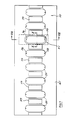
- the housing of the apparatus illustrated in Figures 1 to 6 comprises the slide carrier shown in Figures 1, 2, 3 and 3a which includes an elongate block 2, formed of glass in the present example, having an upper plane surface 4 in which there are formed a series of eight rectangular recesses 6 spaced apart by bridge pieces 8 and having depths of about 1 mm. The upper faces of the bridge pieces are flush with the surface 4 of the block.
- Stainless steel inlet and outlet tubes 10 and 12 respectively are provided for connection of each recess 6 to a supply of liquid reagent. These tubes are connected to a flow control system in the form of solenoid operated valves and a peristaltic pump arrangement to ensure the supply of the liquid in an even and controlled manner.
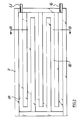
- Figure 2 shows the temperature control system of the apparatus, cooling or heating liquid being circulated, through inlet 14 and outlet 16, to a serpentine chamber 18 which extends beneath the area occupied by the reaction recess 6.
- the slide carrier is shown more clearly in Figures 4 and 5 which illustrates the glass block 2 formed having a ground upper plane surface 4.
- the recess 6 formed in the plane surface 4 has a depth of approximately 1 mm.
- One inlet tube 10 and outlet tube 12, both made of stainless steel are shown which enter the recess 6 for delivery of reagent to the recess and for collection of used reagent therefrom, respectively.
- a slide S carrying a specimen to be treated is laid inverted over the recess 6 to completely cover it, the position of a 3" by 1 (70 mm by 25 mm) slide so placed being shown in Figure 1 in dotted lines. Liquid for the treatment is then drawn into the recess through the inlet tube 10 by the application of suction to the outlet tube 12.
- the support arrangement for a series of containers 20 of liquid for treatment of the slide specimen is arranged in a so-called carousel comprising sixteen outer positions at A and sixteen inner position, B. It is thus possible to arrange as required admixtures of solutions from the outer positions B to containers in the inner positions A.
- the selection of containers 20 is according to a pre-arranged sequence and is entirely computer controlled.
- liquid in a container 20 in position B is required for mixing it is pumped in a desired quantity to the container in position A by means of a first peristaltic pump 22.
- liquid is drawn by the action of a second peristaltic pump 24 into a line 26 which supplied the liquid to all eight inlet tubes 10 of the reaction recesses 6 (only three shown in Figure 6).
- Selected recesses 6 may be omitted from the flow by means of solenoid operated pinch valves 28 on lines 10 and similar valves 30 on lines 12 which isolate the appropriate recesses 6 as required.
- reagent liquid leaving the recess 6 through tubes 12 joins a line 32 which leads either to a return line 34 to be pumped via a filter 36 back to the container 20 at A to a waste line 38 to disposal receptacle 40 attached to a vacuum pump arrangement indicated at 42, according to the settings of motorised valves 46 and 48 on lines 38, 26 and 38'.
- a computer controls the apparatus through a computer interface and includes a timing system to give accurate control of the process stages.
- the staining machine as explained above is controlled by a series of solenoid pinch valves.
- Mains powered synchronous motors drive the peristaltic pumps, the vacuum pump, rotate the reagent carousel, and raise and lower dipper tubes, 58, into the reagents.
- These power devices are switched by the computer interface through isolating opto-couplers for the mains devices, and sensors on various parts of the machine are interrogated by the interface to detect specific conditions in the machine.
- Each individual slide has its reagent reaction schedule stored in a series of "strings" describing the desired reagent treatment, time in the reagent, and temperature.
- the strings are constructed and modified by a programme which stores the finished technique allowing it to be called up as and when required under its specific technique name for use in the staining programme.
- Each reagent schedule in the present example may have up to 85 individual steps in it and last up to 99 hours each or for as short a period as a few seconds.
- the temperature may be varied for each stage within certain limitations but all slides are subjected to the same temperature at a particular time. Reagents in the apparatus may be maintained at a controlled temperature, typically 4°C. It will be understood that the temperature conditions may be varied as desired by computer control.
- the reaction chamber means 167 includes a number - as illustrated, eight - of individual reaction chambers each adapted to hold a different microscope slide-mounted specimen.
- Figures 7 to 12 illustrate reaction chambers 111 formed between separable, adjacent surfaces 112, 113 by O-ring seal means 14 pressed between the surfaces 112, 113 and liquid inlet and outlet means 115, 116.
- One of the surfaces, 112 is of a glass block or plate 117 which is profiled to locate the O-ring seals 14 thereon.
- the block or plate 117 has raised lands 118 around which the O-ring seals 114 fit and intermediate raised retaining areas 119 separating the chambers.
- the O-ring seals 114 fit snugly around the raised lands 118 (which may be adhesively secured to a flat face of the block or plate 117) and are so dimensioned that a standard microscope slide 21 (3" x 1 " or 7.6 mm x 2.5 mm) will cover the O-ring seal 114.
- the surface 113 is simply a flat face of another glass block or plate 122.
- Inlet and outlet tubes 115, 116 of e.g. stainless steel are fixed in the block or plate 117 e.g. by an epoxy adhesive.
- the blocks or plates 117, 122 are pressed together by any convenient means such as spring clamps (not shown).
- Figure 11 illustrates a different form of O-ring having a non-circular cross-section.
- the apparatus illustrated has been found to operate in a working environment without any tendency to leak or to waste reagents and to provide convenient reaction chamber means with ready interchange of slide-mounted specimens.
- O-rings 114 of silicone material do not appear to develop undue wear despite constant use, and no special slides - just regular laboratory specimen slides - are needed to obtain good sealing.
- the apparatus can be operated, on account of the fluid-tightness of the O-ring seals in particular and the layout and operational flexibility of the apparatus in general, to process different specimens on adjacent slides with different reagents according to different treatment specifications as to duration of treatment and number of treatment operations, all under computer control so that the operations are carried out automatically without operator intervention except for the initial program specification and the loading of the reagents into the carousel pots.
- This loading can, of course, be carried out under computer prompting to avoid the possibility of loading error.
Landscapes
- Health & Medical Sciences (AREA)
- Life Sciences & Earth Sciences (AREA)
- Chemical & Material Sciences (AREA)
- Biomedical Technology (AREA)
- Molecular Biology (AREA)
- Physics & Mathematics (AREA)
- Engineering & Computer Science (AREA)
- Analytical Chemistry (AREA)
- Biochemistry (AREA)
- General Health & Medical Sciences (AREA)
- General Physics & Mathematics (AREA)
- Immunology (AREA)
- Pathology (AREA)
- Automatic Analysis And Handling Materials Therefor (AREA)
- Sampling And Sample Adjustment (AREA)
Applications Claiming Priority (4)
| Application Number | Priority Date | Filing Date | Title |
|---|---|---|---|
| GB8629045 | 1986-12-04 | ||
| GB868629045A GB8629045D0 (en) | 1986-12-04 | 1986-12-04 | Specimen treatment apparatus |
| GB8723558 | 1987-10-07 | ||
| GB878723558A GB8723558D0 (en) | 1987-10-07 | 1987-10-07 | Reactions with liquids |
Related Parent Applications (2)
| Application Number | Title | Priority Date | Filing Date |
|---|---|---|---|
| EP87310636A Division EP0270363A3 (de) | 1986-12-04 | 1987-12-03 | Apparat zum Durchführen von Reaktionen mit Flüssigkeiten |
| EP87310636.3 Division | 1987-12-03 |
Publications (2)
| Publication Number | Publication Date |
|---|---|
| EP0464861A2 true EP0464861A2 (de) | 1992-01-08 |
| EP0464861A3 EP0464861A3 (en) | 1992-07-01 |
Family
ID=26291645
Family Applications (2)
| Application Number | Title | Priority Date | Filing Date |
|---|---|---|---|
| EP87310636A Withdrawn EP0270363A3 (de) | 1986-12-04 | 1987-12-03 | Apparat zum Durchführen von Reaktionen mit Flüssigkeiten |
| EP19910113165 Withdrawn EP0464861A3 (en) | 1986-12-04 | 1987-12-03 | Apparatus for reactions with liquids |
Family Applications Before (1)
| Application Number | Title | Priority Date | Filing Date |
|---|---|---|---|
| EP87310636A Withdrawn EP0270363A3 (de) | 1986-12-04 | 1987-12-03 | Apparat zum Durchführen von Reaktionen mit Flüssigkeiten |
Country Status (2)
| Country | Link |
|---|---|
| EP (2) | EP0270363A3 (de) |
| GB (1) | GB2200210B (de) |
Cited By (1)
| Publication number | Priority date | Publication date | Assignee | Title |
|---|---|---|---|---|
| WO1996030124A1 (en) * | 1995-03-28 | 1996-10-03 | Medical Research Council | Improvements in or relating to sample processing |
Families Citing this family (8)
| Publication number | Priority date | Publication date | Assignee | Title |
|---|---|---|---|---|
| JPH01126474U (de) * | 1988-02-22 | 1989-08-29 | ||
| DE58909567D1 (de) * | 1988-06-24 | 1996-02-22 | Lutz Kothe | Vorrichtung zum Abfangen von einer Gewebeprobe, Gewebeflüssigkeit od.dgl. |
| US5188963A (en) * | 1989-11-17 | 1993-02-23 | Gene Tec Corporation | Device for processing biological specimens for analysis of nucleic acids |
| US5273905A (en) * | 1991-02-22 | 1993-12-28 | Amoco Corporation | Processing of slide mounted material |
| CA2339163C (en) * | 1998-08-10 | 2010-01-12 | Genomic Solutions, Inc. | Thermal and fluidic cycling device for nucleic acid hybridization |
| EP1161984A1 (de) * | 2000-06-08 | 2001-12-12 | F. Hoffmann-La Roche Ag | Vorrichtung zum Verpacken eines chipförmigen Trägers und Verfahren zum Zusammenbau einer Vielzahl derartiger Träger |
| US20060182664A1 (en) * | 2005-02-14 | 2006-08-17 | Peck Bill J | Flow cell devices, systems and methods of using the same |
| DE102014001481A1 (de) | 2013-10-28 | 2015-04-30 | Euroimmun Medizinische Labordiagnostika Ag | Verbesserte Vorrichtung und Verfahren für Reaktionen zwischen einer festen und einer flüssigen Phase |
Family Cites Families (9)
| Publication number | Priority date | Publication date | Assignee | Title |
|---|---|---|---|---|
| US2940360A (en) * | 1957-05-23 | 1960-06-14 | Jr William H Carter | Perfusion chamber |
| FR2061826A5 (de) * | 1969-05-12 | 1971-06-25 | Janetski Heinz K G | |
| GB1454365A (en) * | 1972-10-06 | 1976-11-03 | Mawhinney W H B | Apparatus for treating slide specimens |
| GB1528918A (en) * | 1974-12-17 | 1978-10-18 | Nat Res Dev | Device for use in the testing of fluid samples on microscope slides |
| US4103722A (en) * | 1976-08-23 | 1978-08-01 | Max Zollinger | Apparatus for sequentially treating one or more specimens of cellular material with a plurality of treating liquids |
| US4200056A (en) * | 1977-01-21 | 1980-04-29 | Miles Laboratories, Inc. | Segmented platen for applying liquids to a flat surface |
| DE2849713A1 (de) * | 1978-11-16 | 1980-05-29 | Siegwald Dr Pentz | Objekttraegerkammer |
| DE2953696C2 (de) * | 1979-04-14 | 1984-04-12 | Frhr. von Hardo Dr.med. 7400 Tübingen Gise | Inkubationseinrichtung zur Behandlung von histologischen Präparaten |
| DE8627457U1 (de) * | 1986-10-15 | 1987-06-19 | Graskötter, Karl-Rainer, 4630 Bochum | Vorrichtung zur Untersuchung von in vitro gehaltenen Gewebeproben |
-
1987
- 1987-12-03 EP EP87310636A patent/EP0270363A3/de not_active Withdrawn
- 1987-12-03 EP EP19910113165 patent/EP0464861A3/en not_active Withdrawn
- 1987-12-03 GB GB8728271A patent/GB2200210B/en not_active Expired - Lifetime
Cited By (3)
| Publication number | Priority date | Publication date | Assignee | Title |
|---|---|---|---|---|
| WO1996030124A1 (en) * | 1995-03-28 | 1996-10-03 | Medical Research Council | Improvements in or relating to sample processing |
| US5958760A (en) * | 1995-03-28 | 1999-09-28 | Medical Research Council | Sample processing device with a chamber forming member |
| US6395536B2 (en) | 1995-03-28 | 2002-05-28 | Medical Research Council | Sample processing device with a chamber forming member |
Also Published As
| Publication number | Publication date |
|---|---|
| EP0270363A3 (de) | 1988-11-02 |
| GB2200210A (en) | 1988-07-27 |
| EP0464861A3 (en) | 1992-07-01 |
| EP0270363A2 (de) | 1988-06-08 |
| GB2200210B (en) | 1991-07-24 |
| GB8728271D0 (en) | 1988-01-06 |
Similar Documents
| Publication | Publication Date | Title |
|---|---|---|
| US4543236A (en) | Incubating apparatus for selective and exact treatment of histological preparations | |
| EP0464861A2 (de) | Apparat zum Durchführen von Reaktionen mit Flüssigkeiten | |
| EP1058826B1 (de) | Färbegerät für mikroskop-plättchen mit "random access" und trennung von flüssigem müll | |
| CA2315809C (en) | Cartridge device for processing a sample mounted on a surface of a support member | |
| EP1058827B1 (de) | Objektträgerfärbevorrichtung mit wahlfreiem zugriff und unabhängiger objektträgerheizungsregelung | |
| US7318913B2 (en) | Fluid exchange in a chamber on a microscope slide | |
| US10416051B2 (en) | Tissue processing apparatus | |
| JP6854767B2 (ja) | 切替バルブ、及びこれを備える吸入吐出装置 | |
| EP2404991A2 (de) | Verfahren und System zur Zellproduktion sowie Zellprodukte und ihre Anwendung | |
| JPH06507710A (ja) | スライドガラス上に置かれた組織標本を染色するための方法および装置 | |
| JP2004535572A (ja) | 自動化流体操作システムおよび方法 | |
| PT86054B (pt) | Instrumento automatizado para a analise de amostras de pacientes | |
| EP1171761A1 (de) | Flüssigkeitswechsel in einer kammer auf einem mikroskopobjektträger | |
| CN106281992B (zh) | 全自动艾姆斯实验仪 | |
| CN213068417U (zh) | 一种全自动免疫组化染色设备 | |
| GB2234348A (en) | Apparatus for treating specimens with liquids | |
| US8383069B2 (en) | Incubation device for serology and histology slides | |
| JPS63214648A (ja) | 液体反応装置 | |
| WO2010077975A1 (en) | Apparatus for sealing slide bottom | |
| CN107629952A (zh) | 核酸杂交仪 | |
| JPH04310841A (ja) | 染色装置と染色用トレー | |
| CN207259496U (zh) | 核酸杂交仪 | |
| WO1995011450A1 (en) | Improvements in or relating to electrophoresis | |
| JP3574657B2 (ja) | フレームに取り付けられた膜の流体処理のための装置 | |
| CN118500856A (zh) | 一种浮游生物鉴定的多玻片样品快速制备系统及制备方法 |
Legal Events
| Date | Code | Title | Description |
|---|---|---|---|
| PUAI | Public reference made under article 153(3) epc to a published international application that has entered the european phase |
Free format text: ORIGINAL CODE: 0009012 |
|
| AC | Divisional application: reference to earlier application |
Ref document number: 270363 Country of ref document: EP |
|
| AK | Designated contracting states |
Kind code of ref document: A2 Designated state(s): AT BE CH DE ES FR GB GR IT LI LU NL SE |
|
| PUAL | Search report despatched |
Free format text: ORIGINAL CODE: 0009013 |
|
| AK | Designated contracting states |
Kind code of ref document: A3 Designated state(s): AT BE CH DE ES FR GB GR IT LI LU NL SE |
|
| 17P | Request for examination filed |
Effective date: 19921203 |
|
| STAA | Information on the status of an ep patent application or granted ep patent |
Free format text: STATUS: THE APPLICATION HAS BEEN WITHDRAWN |
|
| 18W | Application withdrawn |
Withdrawal date: 19930702 |