EP0465006B1 - Verfahren zur Erzeugung eines Kontrollsumme - Google Patents
Verfahren zur Erzeugung eines Kontrollsumme Download PDFInfo
- Publication number
- EP0465006B1 EP0465006B1 EP91304961A EP91304961A EP0465006B1 EP 0465006 B1 EP0465006 B1 EP 0465006B1 EP 91304961 A EP91304961 A EP 91304961A EP 91304961 A EP91304961 A EP 91304961A EP 0465006 B1 EP0465006 B1 EP 0465006B1
- Authority
- EP
- European Patent Office
- Prior art keywords
- bit
- bit signal
- value
- octet
- bytes
- Prior art date
- Legal status (The legal status is an assumption and is not a legal conclusion. Google has not performed a legal analysis and makes no representation as to the accuracy of the status listed.)
- Expired - Lifetime
Links
Images






Classifications
-
- H—ELECTRICITY
- H03—ELECTRONIC CIRCUITRY
- H03M—CODING; DECODING; CODE CONVERSION IN GENERAL
- H03M13/00—Coding, decoding or code conversion, for error detection or error correction; Coding theory basic assumptions; Coding bounds; Error probability evaluation methods; Channel models; Simulation or testing of codes
- H03M13/03—Error detection or forward error correction by redundancy in data representation, i.e. code words containing more digits than the source words
- H03M13/05—Error detection or forward error correction by redundancy in data representation, i.e. code words containing more digits than the source words using block codes, i.e. a predetermined number of check bits joined to a predetermined number of information bits
- H03M13/09—Error detection only, e.g. using cyclic redundancy check [CRC] codes or single parity bit
- H03M13/095—Error detection codes other than CRC and single parity bit codes
- H03M13/096—Checksums
-
- G—PHYSICS
- G06—COMPUTING OR CALCULATING; COUNTING
- G06F—ELECTRIC DIGITAL DATA PROCESSING
- G06F11/00—Error detection; Error correction; Monitoring
- G06F11/07—Responding to the occurrence of a fault, e.g. fault tolerance
- G06F11/08—Error detection or correction by redundancy in data representation, e.g. by using checking codes
- G06F11/10—Adding special bits or symbols to the coded information, e.g. parity check, casting out 9's or 11's
Definitions
- This invention relates to checksum generation.
- Checksum generation is useful, for example, in communication among processors interconnected in a network.
- a packet of information containing, for example, a binary-encoded bit string of control information and data
- errors may be introduced into the information packet by, for example, spurious network noise.
- Processing of an erroneous packet by an intermediate or destination processor may cause that processor to reject, or "lose", the packet, and may also cause the processor to fail.
- error-checking mechanisms may be used to verify the correctness of bits received at a processor, allowing erroneous information packets to be discarded before causing faulty processing to occur.
- a checking mechanism could involve, for example, generating an arithmetic quantity based on some of the bits to be sent from an originating processor, including the arithmetic quantity in the packet when the packet is transmitted, and then verifying the quantity when the packet is received by an intermediate or destination processor.
- One such error-checking mechanism is a so-called arithmetic checksum, defined by the International Organization for Standardization (ISO) in ISO/TC 97/SC 6 - ISO 8473: "Information Processing Systems - Data Communications - Protocol for Providing the Connectionless-mode Network Service", with its Addendum 1: “Provision of the Underlying Service assumed by the ISO 8473," March 1987, incorporated herein by reference.
- the ISO checksum is required as part of the standard communications protocol for any network subscribing to the ISO network configuration.
- the ISO protocol for error-checking an information packet is based on grouping bits of the packet into eight-bit groups, or octets.
- the eight bit positions in an octet are numbered 1 through 8 from right to left.
- the value of a given bit that appears as a "1" is then taken to be 2 p-1 , where p is the bit position.
- An octet is then taken to have a so-called octet value that is equal to the sum of the bit position values of "1" bits.
- an octet having, for example, the bits 10110101 is said to have an octet value of 181 base 10.
- a checksum is generated with regard to an information packet whenever that packet is transmitted or received.
- the checksum may be generated using all of the bits in the packet, or alternatively, only a segment of the packet's bits. In either case, the string of bits that is used in the checksum generation is called the checksum scope.
- the checksum scope is specified to include some number, L, of octets. These L octets are numbered from 1 to L, with octet 1 [L] being that octet in the checksum scope which is first [last] submitted to the network during an information packet transmittal.
- a processor e.g., an originating or destination processor
- the processor processes, in sequence, the L octets of the checksum scope bit string to produce a checksum value.
- This generation technique follows a checksum algorithm as defined by J.G. Fletcher in "An Arithmetic Checksum for Serial Transmission,” IEEE Trans. Comm., Vol. Com30, No. 1, 1982.
- the i th octet in a checksum scope is assembled by a processor from eight contiguous bits in the bit string.
- the processor assigns the bit position values of 2 0 , 2 1 , 2 2 , 2 3 , 2 4 , 2 5 , 2 6 , and 2 7 to the corresponding bits in the octet, starting from the right-most (least significant) bit, respectively.
- the octet is given an octet value O i that is the sum of the bit position values assigned to all of the octet bits which are a "1", giving an octet value O i equal to 181 base 10 for the example sequence.
- the checksum comprises two checksum variables, C 0 and C 1 , which are each a function of the checksum scope's octet values.
- a processor executes the iterative relationship once, both C 1 and C 0 include one block for the first octet's value, O 1 .
- a second execution of the relationship adds one block to C 0 for the second octet's value, as shown in Fig.
- a third execution of the relationship adds, as shown in Fig. 2E, one block to C 0 for the third octet's value, and to C 1 adds a third block for the first octet's value, a second block for the second octet's value, and one block for the third octet's value, O 3 .
- an intermediate or destination processor in an ISO network When an intermediate or destination processor in an ISO network receives an information packet for which a checksum has been generated, it regenerates a checksum for the information packet's checksum scope to verify the correctness of the packet.
- the invention in its broad form resides in a method for generating a checksum byte as in claims 1 and 7, and an apparatus as recited in claim 5 corresponding to claim 1.
- the invention features a method for assigning a value to a bit string having a number, N, of bits, the number N being an integral multiple of a number, q.
- the method includes storing the bit string, itself representing the value of the sum, in a hardware register that is a number, R, of bits-long, the value of R being no less than the value of N.
- the invention features a method for determining a value of such a bit by assigning a bit position value as above, and adding together, mod (2 q - 1), the bit position values of all of the bits in the bit string that contain a "1", storing the addition result in such a hardware, and adding any carry bit that is generated by the addition of the bit in the q th bit position to the bit in the first bit position, the addition result representing the value of the bit string.
- Preferred embodiments include the following features. q is equal to 8, or 16, or 32, or 64.
- the method includes assigning bit position values as before, whereby the assigned bit position values designate each of the M q bit-long bit groups in the bit string, adding, mod (2 q - 1), the bit position values of all of the bits in the bit string that contain a "1", and storing the addition result in such a hardware register.
- the addition result representing the sum, mod (2 q - 1), of the values of the M q bit-long bit groups.
- the method includes, in sequence, assembling successive bit groups of a number, L, of bits, each L bit-long bit group comprising M contiguous groups each of q bits; assigning bit position values as before whereby the assigned bit position values in a given L bit-long group designate each of the M q bit-long bit groups in that L bit-long bit group; adding, mod (2 q - 1), the bit position values of all of the bits in a given L bit-long bit group that contain a "1", to produce a first addition result for each of the L bit-long bit groups; storing each of the first addition results in a hardware register that is a number, R, of bits-long, the value of R being no less than the value of L, each first addition result representing the sum, mod (2 q - 1), of the values of each of the M q bit-long bit groups in a given L bit-long group; adding, mod (2 q - 1), the first addition results to produce a second addition result; and storing the second addition result in a hardware
- q is 8 and R is 32 or q is 8 and R is 64; M may be 2 or 4 or 6 or 8.
- the invention features a method for adding, mod (2 q - 1), the bits of a first bit string with the bits of a second bit string, the first and second bit strings each having a number, N, of bits, the number N being a multiple of a number, q.
- the invention features a method for adding, mod (2 q - 1), the bits of a first bit string to the bits of a second bit string, the first bit string having a number, M, of bits and the second bit string having a number, N, of bits, the numbers M and N being a multiple of a number, q, the number N being less than the number M such that the first bit string includes a number, M-N, of more significant bits than the second bit string.
- the invention features a method for adding, mod (2 q - 1), the bits of a first bit string to the bits of a second bit string, the first and second bit strings each having a number, N, of bits, the number N being a multiple of a number, q.
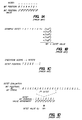
- Fig. 1A is a diagram illustrating the bit positions and bit position values of an octet.
- Fig. 1B presents the computation of the octet value of an example octet.
- Fig. 1C is a diagram illustrating the octet positions in a checksum scope.
- Fig. 1D presents the computation of the octet value of an example octet within an example checksum scope.
- Fig. 2A is a diagram illustrating a pictorial representation of the checksum variable C 0 .
- Fig. 2B is a diagram illustrating a pictorial representation of the checksum variable C 1 .
- Figs. 2C-2E are diagrams of pictorial representations of the checksum variables C 0 and C 1 after a first, second, and third iteration, respectively, of the ISO standard checksum generation technique.
- Fig. 2F is a diagram illustrating a pictorial representation of the checksum variable C 1 and a pictorial representation of the checksum variable C 0 after completing the ISO standard checksum generation technique for an example checksum scope consisting of nine octets.
- Fig. 3 is a diagram illustrating the octet positions in a checksum scope to be processed by the checksum generation technique of the invention and also illustrating the process of computing the octet value of an example octet in the checksum scope.
- Fig. 4 presents the computation of the octet field value of an example octet field in a checksum scope to be processed by the checksum generation technique of the invention.
- Fig. 5 is a flow diagram of the checksum generation technique of the invention.
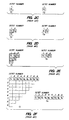
- Fig. 6A-6C are diagrams illustrating pictorial representations of the checksum variables C 0 and C 1 as they are produced after a first, second, and third process loop, respectively, of the checksum generation technique of Fig. 5, using an example checksum scope including nine octets.
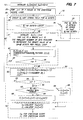
- Fig. 7 is a detailed flow diagram of the checksum generation technique illustrated in Fig. 5.
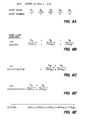
- Figs. 8A-8E present the computation of the value of the C 1 increment variable, D 1 , in the inner process loop of the checksum generation technique illustrated in Fig. 7, as that value is produced for an example octet field including five octets.
- Fig. 9A is a diagram illustrating the addition of an example bit string with an example register string having the same number of bits as the bit string; this is one method for implementing the addition operations in the checksum generation technique of Fig. 7.
- Fig. 9B is a diagram illustrating the addition of an example bit string with an example register string having a greater number of bits than the bit string; this is a second method for implementing the addition operations in the checksum generation technique of Fig. 7.
- Fig. 10A is a diagram illustrating the addition of the eight most significant bits of an example register string of 24 bits back into the eight least significant bits of a copy of the bit string having the eight most significant bits set to zero; this is a method for ensuring that any hardware registers like the hardware register of Fig. 9B that are used in the checksum generation technique of Fig. 7 will not overflow as bit strings are added to them.
- Figs. 11A-11C are diagrams illustrating pictorial representations of the checksum variables C 0 and C 1 as they are produced after a first and second process loop, respectively, of the checksum generation technique of Fig. 7, specified to process octet fields including a number, M, of octets that is a power of two, here, as an example, including eight octets
- Fig. 12A is a diagram illustrating an example bit rearrangement of a bit string of 16 bits as the bit string is copied to a register string also having 16 bits during the inner process loop of a refined version of the checksum generation technique of Fig. 7.
- Fig. 12B is a diagram illustrating an example bit rearrangement of a bit string of 24 bits as the bit string is copied to a register string also having 24 bits during the inner process loop of a refined version of the checksum generation technique of Fig. 7.
- Fig. 13A is a diagram illustrating the addition of an example bit string with an example register string having the same number of bits as the bit string; this is a third method for implementing the addition operations in the checksum generation technique of Fig. 7.
- Fig. 13B is a diagram illustrating the addition of an example bit string with an example register string having the same number of bits as the bit string but having each of its octets stored in a separate register; this is a fourth method for implementing the addition operations in the checksum generation technique of Fig. 7.
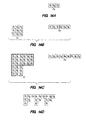
- Figs. 14A-14C are diagrams illustrating pictorial representations of the checksum variables C 0 and C 1 as they are produced by a first, second, and third, respectively, iteration of the inner process loop of a refined version of the checksum generation technique of Fig. 7 specified to process octet fields each including three octets.
- Fig. 14D is a diagram illustrating the number of octet value blocks by which the pictorial representation of C 0 in Fig. 14A is deficient.
- Each octet in the checksum scope has an octet value, O ij , that is equal to the sum of the bit position values assigned to the bits in that octet that are a "1".
- O ij the sum of the bit position values assigned to the bits in that octet that are a "1".
- the 5 th octet in the 3 rd octet field having the bit sequence 10110101, has an octet value O 53 that is equal to the decimal value 181.
- the example octet field in Fig. 4, which could be of any octet field position "j" in a checksum scope, includes 24 bits, or M 3 octets. To evaluate this octet field, a processor would assign a bit position value to each bit in the octet field as follows. As shown in Fig.
- each bit position is assigned the value (2 b ) mod 255, with b ranging from 0 to 7.
- the sequence is repeated until every bit in the octet field has a bit position value equal to a value between (2 0 ) mod 255 and (2 7 ) mod 255.
- This bit position enumeration thereby assigns each eight-bit sequence with corresponding octet bit position values without explicitly grouping each octet first.
- the octet field is given an octet field value N j that is the sum, mod 255, of the bit position values assigned to the bits in the octet field that are a "1".
- N j is the sum, mod 255, of the bit position values assigned to the bits in the octet field that are a "1".
- this bit position assignment and evaluation produces an octet field value N j that is equal to (532) mod 255, or 22 base 10.
- a given octet field value N j is thus precisely the same as the value that would result if each octet in the octet field were individually grouped and evaluated for an octet value O i , and then each of the octet values were added, mod 255.
- the binary representation of the sum, mod 255, of the octet values in an octet field is bit-wise identical to the field itself. This correspondence has important advantages for implementing a technique to generate the checksum variables C 0 and C 1 .
- a processor generates values for the checksum variables C 0 and C 1 using the checksum generation technique 10.
- the bits of a single octet field are first grouped 30 to form an M octet-long bit string.
- values for the checksum variables C 0 and C 1 are then generated 40 for octet field "j", whereby C 0 for octet field "j" is equal to N j (the value of octet field "j"), and C 1 for octet field "j" is equal to the weighted sum of octet values within octet field "j".
- the values of the checksum variables C 0 and C 1 for the checksum scope are updated 50 by adding the generated octet field values to the running variables C 0 (j) and C 1 (j). If, after processing octet field "j," other unprocessed octets remain in the checksum scope, the processor then loops back 55 to group 30 and process 40 those succeeding octet fields. With the processing of octet field F, the last octet field, the processor completes 60 evaluation of the checksum scope, and the last updated values 70 of the running variables C 0 (j) and C 1 (j) become the final checksum variable values for the checksum scope.
- the checksum generation technique requires only 3 iterative loops to generate a checksum value for all 9 octets in the example checksum scope.
- NUMBER(bit-string) is defined to be the operation of interpreting a specified bit string, which includes M octets, as a mod 255 number, i.e., treating the bit string as a number stored in M octets.
- the operation NUMBER is therefore computationally null, but distinguishes between a string of bits and the mod 255 number that could be represented by that string of bits.
- VALUEOF(bit-string) is defined to be the operation of assigning a mod 255 value to an integer bit string, e.g., an integer bit string produced by the NUMBER operation.
- the operation VALUEOF(NUMBER(011010101101010111010101)) produces a mod 255 integer having the equivalent decimal value of 22.
- MASK(bit-string, mask-string) is defined to be the operation of masking a first specified bit string with a second, masking bit string, to produce a third bit string. Both the first and masking bit strings are specified to be of length M octets, and thereby produce a third bit string which is also of length M octets.
- the masking operation if a given bit of the masking bit string is a "1", then the corresponding bit of the first specified bit string appears in the corresponding bit of the third bit string, while if a given bit of the masking bit string is a "0", then the corresponding bit of the third bit string is also a "0".
- the operation MASK(10101011, 01101001) produces the bit string 00101001 by "masking" the bits of the first bit string with the masking bit string.
- SHIFT(bit-string, integer) is defined to be the operation of circularly shifting, to the left, a specified mod 255 bit string by a number, "integer", of bits. This circular shifting causes any bits that are "shifted" off of the left end (most significant bit) of the bit string to be inserted back at the right end (least significant bit) of the bit string.
- the effective result of the SHIFT operation is the multiplication, mod 255, of the specified bit string by a factor of 2 integer . For example, the operation SHIFT(10110100, 3) produces the bit string 10100101.
- the original bit string which has a decimal value, mod 255, of 180, when multiplied, mod 255, by 2 3 , produces a decimal value of 165, which is equal to the mod 255 value of the shifted bit string, 10100101, as expected.
- B j is defined to be the bit string in the j th octet field of the checksum scope, and includes M octets. Thus, B j comprises the 8xM bits in the j th octet field.
- PATTERN1(i) is defined (for i ⁇ 0) to be a bit string of length M octets having bit values each of which are a function of the value of the integer variable "i" as follows. Starting with the right-most (least significant) bit, the bit string includes a number (possibly zero), (2 i -1)x8, of bits with the value zero, followed by a number, 2 i x8, of bits with the value one, etc., up to the bit string length of 8xM bits.
- C 0 (j) and C 1 (j) are defined to be the updated values of the checksum variables C 0 and C 1 , and thus include the contribution of each octet field in the checksum scope up to and including octet field j.
- Both C 0 (j) and C 1 (j) are specified as mod 255 numbers that are represented by bit strings of lengths equal to an integral number of octets, with the number of octets specified for particular processing configurations, as discussed below.
- D 1 (i) is defined to be the running intermediate value of the octet field checksum variable C 1 , i.e., the intermediate contribution of the j th octet field to the value of the updated checksum variable C 1 (j) as the contribution is incrementally generated.
- D 1 (i) is specified as a mod 255 number which is represented by a bit string of a length equal to an integral number of octets, with the number of octets specified as discussed below.
- the checksum generation technique when implemented in a processor using conventional hardware, executes the operations defined above using conventional hardware registers of a length M octets or longer to store the results of the various operations.
- the values of the updated checksum variables C 1 (j) and C 0 (j) are initialized 12 by the processor to both equal zero.
- the processor groups 30 an octet field "j" by first assembling 32 the bit string "B j " from the next 8xM bits to be processed in the checksum scope, where M is the prespecified number of octets to be included in each octet field. It is assumed that the checksum scope includes an integral number of octets.
- the processor "pads" 35, or appends a number of octets of zeros to the end (right side) of the bit string to give the bit string the correct length of 8xM bits.
- the processor begins an inner process loop 40 for that bit string by initializing 41 the value of the incremental checksum variable D 1 (i) to equal zero.
- the value of "i" is incremented 42. If the incremented value of "i" is less than or equal to the value of the variable "p", the processing system loops back 45 to the inner process loop generating step 42 to continue generating incremental octet field checksum variable values. If, however, the inner loop repetition variable "i" is greater 46 than the value of "p", then the inner loop processing repetition is complete and the processor exits the inner loop to continue further processing.
- the loop generation computation 42 takes the form NUMBER(SHIFT(MASK(B j , PATTERN1(0)), 0)), where the bit string PATTERN1(0) has the sequence 1111111100000000111111110000000011111111.
- MASK(B j , PATTERN1(0)) produces a bit string having the same first, third, and fifth octets as the original bit string B j , and second and fourth octets of all zeros.
- SHIFT(MASK(B j , PATTERN1(0)), 0) shifts the new bit string by 0 bits, or multiplies the bit string by a factor of 1.
- the nested operations first produce (using the MASK operation) a bit string having only the same third and fourth octets as the original bit string B j . These two octets are then shifted (using the SHIFT operation) to be equal to the product mod 255, of the octets and the number 2. Finally, the shifted bit string is designated to produce the second mod 255 integer bit string, whose value includes the sum of (2xO 3j ) +(2xO 4j ).
- This bit string is "added in” to the first intermediate value D 1 (0) to produce the updated octet field checksum variable D 1 (1).
- the shifted bit string is then designated as the final mod 255 integer bit string, whose value includes the sum of (4xO 1j ) + (4xO 2j ).
- the final intermediate value D 1 (2) is then obtained by adding the last bit string in with the previous incremental value D 1 (1).
- the value of the last intermediate octet field checksum variable, D 1 (2) is equal to the weighted sum of the octet values in the octet field, as shown in Fig. 8E. Accordingly, the value of the example octet field variable D 1 (2) is the same as the value that would be obtained by serially grouping and summing the octet values as (5xO 1j ) + (4xO 2j ) + (3xO 3j ) + (2xO 4j ) + (1xO 5j ).
- the complete octet field checksum variable C 1 for octet field "j" is obtained with a number, p+1, of shift, mask, and addition operations to produce the same result that would be obtained with a number, M, of multiplication operations and M-1 addition operations.
- the processor updates 50 the checksum variables for the checksum scope.
- the running update checksum variable C 0 (j) is also similarly updated 52 as the sum of the last updated C 0 (j) value plus the mod 255 integer represented by the designation of the NUMBER(B j ) operation on the last assembled bit string B j .
- the processor keeps a running value of the checksum scope variables as each octet field in the checksum scope is processed in sequence.
- the value of the octet field position variable j is incremented.
- the processor then checks 54 the field position variable value; if the incremented value of j is less than or equal to the number, F, of octet fields in the checksum scope, the processor loops back 55 to begin assembly 30 and processing 40 of the next octet field bit string B j . If the incremented value of j is greater 60 than F, the processor has completed assembling and processing each of the octet fields, and so begins the final processing steps required to determine the values of the checksum scope variables.
- a processor using conventional hardware executes the operations of the checksum generation technique with conventional hardware registers of a length "M" octets or longer to store the bit strings resulting from the various operations. If, for example, the designated hardware registers have lengths equal to M octets, or equivalently, 8xM bits, i.e., the number of bits in one octet field bit string B j' the arithmetic operation of addition used in the various checksum generation operations must be specified to correspond with this register length.
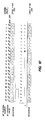
- FIG. 9A an example addition operation is shown for a register, RegisterA, that is 16 bits, or two octets long.
- M the number of octets in an octet field, is also taken to be equal to two. If RegisterA were specified to store some result of the checksum generation technique, e.g., the update value C 0 (j), then new C 0 (j) bit string components would be continually added to the register.
- bit position values are implicitly assigned to the new bit string component and RegisterA string as follows. Starting with the right-most (least significant) bit, each corresponding bit position of the bit string and register string is assigned a value ranging from (2 0 ) mod 255 to (2 7 ) mod 255, with the sequence of bit position values repeating until each bit position in the bit string and register string has a value. For the example bit string and register string of Fig. 9A, which each include 16 bits, this bit position value assignment designates two octets in each string of bits.
- each of the bit values of the two strings ranging from the first bit position to the fifteenth bit position, are added together, with any carry bit being added to the next most significant bit from the bit that generated the carry. Any carry bit that is generated by the sum of the bits in the sixteenth bit position is wrapped around to be added back into the least significant (first) bit.
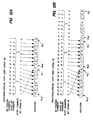
- a register that is 24 bits, or three octets long.
- M the number of octets in an octet field, is again taken to be equal to two.
- RegisterB were specified to store some result of the checksum generation technique, e.g., the update value C 1 (j), then, like RegisterA (Fig. 9A), RegisterB would continually have new C 1 (j) bit string components added to it.
- both the bits of RegisterB and the bits of any bit string components added to RegisterB have implicit bit position value assignments that designate the octets in each string of bits. Accordingly, the new component bit string of Fig. 9B is seen to have two designated octets, while RegisterB is seen to have three designated octets.
- the extra left-most eight bits (1 octet) that are included in RegisterB are used during an addition operation in the following way.
- all of RegisterB's bits are initialized to zero.
- To add a new bit string component with the RegisterB string each of the bit values of the two strings, ranging from the first bit position to the fifteenth bit position, are added together, with any carry bit being added to the next most significant bit from the bit that generated the carry. Any carry that is generated by the sum of the bits in the sixteenth bit position is added into the seventeenth bit position.
- the size of the storage registers may alternatively be more than 1 octet greater than the size of the octet fields.
- each of the addition schemes provides an identical integer representation for the addition result of a given bit string and register string.
- the new bit string component is given as 1101101001011001
- the RegisterA and RegisterB strings are both given as 1010010010010010.
- each of the addition operations handles the most significant carry bit in a different manner, the final result of the operations is the same, i.e., each of the final bit strings has the same decimal value, 107.
- the mod 255 cyclical bit position value assignments of the bit strings and registers are what provide for this correspondence.
- either of the addition operations of Figs. 9A or 9B may be used to obtain the same result.
- both of the addition schemes in Fig. 9 ensure that overflow of a hardware register will not occur unless sufficient high order bits of that register are equal to "1".
- a further register operation may be employed during the checksum generation process. As shown in Fig. 10, if the most significant octet in RegisterB is designated to "store" extra carries, the bits of that octet may be periodically “folded,” or added back into the eight least significant bits of the register to "clear out” the most significant octet.
- bit values of RegisterB's most significant octet are added, in the manner described above, to a copy of the RegisterB string that has those bit values set to zero. Any carries generated by this addition are handled just as if a new bit string component were being added to the register.
- the RegisterB string of 111111110111111011101011 is folded to achieve the register string of 000000001111111101010. This folding effectively subtracts one multiple of 255 from the register.
- the register string inherently has bit position value assignments that are cyclical, mod 255, removal of any number of multiples of 255 from the register does not change the value of the integer stored in the register.
- the original RegisterB string and the folded RegisterB string both have the same value, decimal 106, but the folded RegisterB string can accommodate the generation of more carry bits before overflowing.
- the number of addition operations which may be completed on a given register before that register will overflow may be computed for each of the operations in the checksum generation process.
- the folding operation described above may be periodically completed, thereby clearing the register to continue adding and storing values in the register without causing register overflow.
- the original register string and the folded register string have the same value (decimal 235) because both are multiples of the number 255.
- the folding operation in Fig. 10B may be used to fold any number of octets in a register string back into itself. For example, given a register of 6 octets in length, the bits of the three most significant octets in the register could be folded back into the register after a predetermined number of allowable addition operations have been completed with the register, whereby the register is protected from overflowing at any time.
- the process may be refined if the number, M, of octets in each octet field is prespecified to be equal to an integral power of 2, i.e., 2 b , where "b" is an integer.
- the computation step 42 of the inner processing loop 40 which generates incremental values D 1 (i) for the octet field checksum variable C 1 , may be simplified for the following consideration. With M as a power of 2, during the last iteration of the inner loop, only one octet of the masked Bj bit string has a nonzero value.
- the MASK and PATTERN1 operations use the binary representation of the octet numbers within an octet field to set the MASK bits that determine which octets will be included in a given MASK operation; the binary representation of the value of 2 b requires one more bit than the binary representation of the value of (2 b -1). Therefore, the number of inner process loop iterations may be reduced by adding one less multiple of each octet value in an octet field, and then recovering this deficiency only after all of the octet fields a checksum scope have been processed.
- FIG. 11 building of the pictorial triangle representation for C 1 and the rectangular representation for C 0 is shown for this case.
- the checksum generation process proceeds as follows.
- This checksum generation scheme thereby eliminates one set of SHIFT, MASK, and addition operations from each iteration of the checksum inner process loop, for a total of F eliminated MASK, SHIFT, and addition operations in the overall checksum generation process.
- the refined checksum generation process utilizes a bit string specification PATTERN2(i) that is defined to be a bit string of length M octets having bit values that are a function of the value of the integer variable "i", as follows. Starting with the right-most (least significant) bit, the bit string includes a number, 2 i x8, of bits with the value zero, followed by a number, 2 i x8 , of bits with the value one, followed by a number, 2 i x8, of bits with the value zero, etc, up to the bit string length of 8xM bits.
- the refined inner process loop 40 produces a final incremental octet field checksum variable that is equal to the sum of (0xO Mj ) + (1xO (M-1)j ) +...+ ((M-1)xO 1j ).
- the computation "(MxC 0 (j-1)) " in the update operation 48 may be implemented by one left circular shift of the bit string C 0 (j) by a number "b", of bits, because shifting a bit string by b bits corresponds to multiplication of that bit string by 2 b mod (255).
- the checksum generation process may be implemented in a processor having conventional hardware, or may alternatively be implemented in a processor having customized hardware that is specifically configured for the various operations used in the checksum process. Considering this second possible implementation, the checksum generation process may be completed by a processor having hardware registers which permit specific rearrangement of the bits in a bit string whenever that bit string is copied to a register.
- this specialized copy function utilizes predefined operations to specify the particularly chosen bit rearrangement.
- the operation SPECIALCOPYM(bit-string) is defined to create a copy of a specified bit string with a predefined rearrangement of the bit string's bits, depending on the number, M, of octets that are included in each octet field of the checksum scope.
- a x,y denotes bit number "y" of octet number "x” in RegisterA.
- B x,y denotes bit number "y” of octet number "x” in bit stringB.
- octets in the bit string and register string are numbered starting with 1, while within each octet, bits are numbered from 1 to 8 starting with the rightmost (least significant) bit. Accordingly, as shown in Fig. 12A, the leftmost bit in RegisterA is denoted A 1,8 , while the rightmost bit in RegisterA is denoted A 2,1 .
- the operation SPECIALCOPYM(bit-string) when invoked as RegisterA SPECIALCOPY3(bit stringB) copies bit string B to RegisterA as follows:
- the two SPECIALCOPYM(bit-string) operations described above are examples of operations for efficiently implementing the checksum generation process with hardware registers that have at least as many bits as each octet field in the checksum scope. For example, if the number M of octets in each octet field of the checksum scope is specified to be two, the following substitutions in the checksum generation technique (Fig. 7) produce a refined checksum generation technique, CHECXSUM2.
- the above CHECKSUM2 specification eliminates the entire inner processing loop 40 by incorporating the SPECIALCOPY2 operation in the update operation 52.
- the SPECIALCOPY2 by specifying bit placement, produces the same results as the SHIFT, MASK, PATTERN1, and addition operations of the inner process loop 40, and eliminates a corresponding number of those operations, thereby increasing the speed of the overall process.
- the operation "2xC 0 (j-1)" in CHECKSUM2 may be completed by either one left circular shift of the bit string C 0 (j-1) or by two separate addition operations.
- the above CHECKSUM3 specification like the CHECKSUM2 specification, eliminates the entire inner processing loop 40 by incorporating the SPECIALCOPY3 operation in the update operation 52.
- this process generates the update variables C 0 (j) and C 1 (j) by rearranging the bits of the bit string B j , rather than explicitly adding the octets in the bit string B j , thereby increasing the speed of the process.
- the operation "3xC 0 (j-1)" may be completed by an addition and a left circular shift of one bit and an addition operation, or by three separate addition operations.
- bits of a bit string may be rearranged as they are copied to bits of a register string so that, while they may be copied to an octet position different from their original octet position, they have the same bit value.
- SPECIALCOPYM(bit-string) operations in each specification are customized for the particular number of octet field octets given by that specification.
- RegisterA SPECIALCOPY6ii(bit stringB) copies bit stringB to RegisterA as follows:
- RegisterA - SPECIALCOPY7ii(bit stringB) copies bit stringB to RegisterA as follows:
- RegisterA SPECIALCOPY8ii(bit stringB) copies bit stringB to RegisterA as follows:
- RegisterA SPECIALCOPY16ii(bit stringB) copies bit stringB to RegisterA as follows:
- RegisterA SPECIALCOPY16ii(bit stringB) copies bit stringB to RegisterA as follows:
- An additional refinement to the checksum algorithm may be used where the register is larger than the bit string.
- RegisterA 64 bits-long
- bit stringB 48 bits-long
- RegisterA - SPECIALCOPY6-8 bit stringB
- the checksum generation technique may be implemented using customized hardware registers that explicitly designate each octet to be unique.
- One hardware scheme for keeping the octets in a bit string unique requires that any operations on a given bit string act on each octet in the bit string independently, i.e., the octets do not interact as a result of the operation.
- a customized hardware configuration like this when used in, e.g., an addition operation, keeps any carry bits generated by a particular octet within that octet.
- M 3 octets
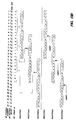
- the addition of a bit string, bit stringB, with a register string, RegisterA is shown in the figure.
- the addition proceeds as 3 separate, independent mod 255 additions between each of the octets in bit stringB and RegisterA in the following manner.
- Each of the bit values of the two strings, ranging from the first bit position to the seventh bit position in each octet, are added together, with any carry bit being added to the next most significant bit from the bit that generated the carry.
- Any carry bit that is generated by the sum of the bits in the eighth bit position of each octet is wrapped around to be added back into the least significant (first) bit of that octet. In this way, the addition operation proceeds as several simultaneous, parallel operations.
- the operation A (+) B represents the result of adding bit string A with bit string B by keeping the octets within the resulting bit string "separate" in the manner described above.
- the operation A (x) B represents the result of multiplying a scaler number A by bit string B in the same manner.
- a bit string e.g., bit stringB
- a hardware scheme like that of Fig. 13B, which specifies one hardware register for each of the additions of the M octets in the bit string.
- one register, RegisterA1 adds the last octet of bit stringB to its register string
- one register, RegisterA2 adds the second octet of bit stringB to its register string
- one register, RegisterA3 adds the first octet of bit stringB to its register string.
- Each of the registers must be at least one octet long, but will generally be longer. If the registers are exactly one octet long, then the resulting addition operation is essentially the same as that illustrated in Fig. 13A.
- each of the three registers in Fig. 13B provides, just as the register in Fig. 9B provides, at least one more significant octet than the number of octets being added into the register.
- These extra octets act to "hold" any carry bits generated by the addition of the bits in the bit string and register string that are in the 8 th bit position, thereby eliminating overflow of the register string without requiring the carry bit to be wrapped around and added to the least significant bit.
- the register strings may be "folded", or the most significant octet may be added back to the least significant octet of the register to allow for more additions to the register without overflowing the register.
- C 0 (j) and C 1 (j) are defined to be the values of the checksum update variables, with lengths equal to M octets, as required by the customized hardware specification.
- the first loop acts to generate the complete value of the variable C 0 , while generating only a component of the value of the variable C 1 .
- C 1 is deficient by [(M x O 11 ) + ((M-1) x O 21 ) +...+ (1 x O M1 ) + (M x O 12 ) +...+ (2 x O (M-1)F ) + (1 x O MF )].
- the second loop provides the additionally required components of the variable C 1 using the exact inner processing loop 42 of the checksum generation technique in Fig. 7.
Landscapes
- Engineering & Computer Science (AREA)
- Theoretical Computer Science (AREA)
- Physics & Mathematics (AREA)
- Quality & Reliability (AREA)
- General Engineering & Computer Science (AREA)
- General Physics & Mathematics (AREA)
- Probability & Statistics with Applications (AREA)
- Detection And Correction Of Errors (AREA)
- Compression Of Band Width Or Redundancy In Fax (AREA)
Claims (13)
- Verfahren zum Erzeugen eines Kontrollsummenbytes von q elektrischen Bitsignalen aus einer Sequenz von q-bit Signalbytes (Oi), die zusammen einen Bitsignalstring (Oij) bilden, mit den Computer-implementierten Schritten:Zerlegen (30) des Bitsignalstrings in F Signalgruppen (Bj), mit F ≥ 3, wobei jede Bitsignalgruppe M Bytes umfaßt, mit M ≥ 2;Initialisieren einer gewichteten Kumulativsumme und einer ungewichteten Kumulativsumme; undAusführen der folgenden Schritte a) bis d) für jede der aufeinanderfolgenden Bitsignalgruppen:a) Berechnen eines ungewichteten Summenwerts der Bytes der jeweiligen Signalgruppe;b) Berechnen eines gewichteten Summenwerts von Bytes der jeweiligen Signalgruppe, wobei vor dem Aufsummieren jedes Byte der jeweiligen Signalgruppe mit einem Faktor M-i+1 multipilziert wird, wobei i die Position des Bytes in der Bitsignalgruppe ist, und, für die zweite und nachfolgende Bitsignalgruppen, Addieren eines Werts, der das Produkt der ungewichteten Kumulativsumme und der Anzahl M der Bytes in jeder Signalgruppe ist, zu dem gewichteten Summenwert;c) Aktualisieren der ungewichteten Kumulativsumme durch Hinzuaddieren des ungewichteten summenwerts;d) Aktualisieren der gewichteten Kumulativsumme durch Hinzuaddieren des gewichteten Summenwerts.
- Verfahren nach Anspruch 1, wobei jeder Schritt b) das Berechnen des gewichteten Summenwerts aus allen M Bytes der jeweiligen Signalgruppe aufweist.
- Verfahren nach Anspruch 1, wobei jeder Schritt b) das Berechnen des gewichteten Summenwerts aus M-1 Bytes der jeweiligen Signalgruppe aufweist und weiterhin einen Schlußschritt des Addierens der ungewichteten Kumulativschlußsumme zu der gewichteten Kumulativschlußsumme umfaßt.
- Verfahren nach Anspruch 1, wobei die Bytes entweder acht bit lang oder sechzehn bit lang sind und wobei M gleich entweder 2, 4, 6 oder 8 ist.
- Vorrichtung zum Erzeugen eines Kontrollsummenbytes von q elektrischen Bitsignalen aus einer Sequenz von q-bit Signalbytes (Oi), die zusammen einen Bitsignalstring (Oij) bilden, mit:Mitteln zum Zerlegen (30) des Bitsignalstrings in F Signalgruppen (Bj), mit F ≥ 3, wobei jede Bitsignalgruppe M Bytes umfaßt, mit M ≥ 2;Mitteln zum Initialisieren einer gewichteten Kumulativsumme und einer ungewichteten Kumulativsumme; undMitteln zum Ausführen der folgenden Schritte a) bis d) für jede aufeinanderfolgende Bitsignalgruppe:a) Berechnen eines ungewichteten Summenwerts (Co) der Bytes der jeweiligen Signalgruppe;b) Berechnen eines gewichteten Summenwerts (C1) von Bytes der jeweiligen Signalgruppe, wobei vor dem Aufsummieren jedes Byte der jeweiligen Signalgruppe mit einem Faktor M-i+1 multipliziert wird, wobei i die Position des Bytes in der Bitsignalgruppe ist, und, für die zweite und nachfolgende Bitsignalgruppen, Addieren eines Werts, der das Produkt der ungewichteten Kumulativsumme und der Anzahl M der Bytes in jeder Signalgruppe ist, zu dem gewichteten Summenwert;c) Aktualisieren der ungewichteten Kumulativsumme durch Hinzuaddieren des ungewichteten Summenwerts;d) Aktualisieren der gewichteten Kumulativsumme durch Hinzuaddieren des gewichteten Summenwerts.
- Vorrichtung nach Anspruch 4, wobei die Bytes entweder acht bit lang oder sechzehn bit lang sind und wobei M gleich entweder 2, 4, 6 oder 8 ist.
- Verfahren zum Erzeugen eines Kontrollsummenbytes von q elektrischen Bitsignalen aus einer Sequenz von q-bit Signalbytes (Oi), die zusammen einen Bitsignalstring (Oij) bilden, mit den Computer-implementierten Schritten:Zerlegen (30) des Bitsignalstrings in F Signalgruppen (Bj), mit F ≥ 3, wobei jede Bitsignalgruppe M Bytes umfaßt, mit M ≥ 2;Speichern (30) der M Bytes der ersten Bitsignalgruppe (Bj) in einem ersten Register;Speichern (41) einer elektrischen Darstellung eines Nullwerts in einem zweiten Register;Aktualisieren (52) des Werts (Co), der in dem zweiten Register gespeichert ist, durch Addieren des ungewichteten Werts der Bytes, die in dem ersten Register gespeichert sind, zu dem Wert, der in dem zweiten Register gespeichert ist, und Speichern einer elektrischen Darstellung des Ergebnisses in dem zweiten Register; dannAktualisieren (42) des Werts, der in dem ersten Register gespeichert ist, durch Addieren jedes jeweiligen Bytes, das in dem ersten Register gespeichert ist, zu einem entsprechenden Byte der nächsten Signalgruppe und Speichern des Ergebnisses in dem ersten Register am Platz des jeweiligen Bytes aus dem ersten Register;Wiederholen der Aktualisierungsschritte für eine dritte und weitere Bitsignalgruppen, bis alle Bitsignalgruppen verwendet worden sind;Erzeugen einer gewichteten Summe (C1) der Bytes, die in dem ersten Register gespeichert sind, wobei jedes Byte, das in dem ersten Register gespeichert ist, vor dem Aufsummieren mit einem Faktor M-i+1 multipilziert wird, wobei i die Position des Bytes in dem Register ist;Erzeugen (52) eines Produkts des Werts, der in dem zweiten Register gespeichert ist, und der Anzahl M der Bytes in der Bitsignalgruppe; undErzeugen (52) des Prüfsummenbytes durch Addieren der gewichteten Summe zu dem Produkt.
- Verfahren nach Anspruch 7, wobei jede gewichtete Summe der Bytes jeder Eingangsbitsignalgruppe durch die Computer-implementierten Schritte erzeugt wird:Herstellen (42) einer Maskenbitsignalgruppe aus Maskenbitsignalen, wobei die Maskenbitsignalgruppe alternierende nichtnull- und null-Sammlungen von q-bit Signalbytes umfaßt, wobei jedes Maskenbitsignal in jedem Byte einer nichtnull-Sammlung einen logische nichtnull-Wert aufweist und jedes Maskenbitsignal in jedem Byte einer null-Sammlung einen null-Wert aufweist;Bilden einer Zwischenbitgruppe aus Zwischenbitsignalen, wobei jedes Zwischenbitsignal das logische UND eines Eingangsbitsignals, das eine gegebene Position innerhalb der Eingangsbitsignalgruppe belegt, und eines Maskenbitsignals, das die gegebene Position innerhalb der Maskenbitsignalgruppe belegt, wiedergibt, wobei das Zwischenbitsignal eine andere Position als die gegebene Position innerhalb der Zwischenbitsignalgruppe belegt;Wiederholen der Schritte Herstellen und Bilden, um zusätzliche Zwischenbitsignalgruppen zu bilden, die nicht alle identisch sind; undErzeugen der ungewichteten Summe der Zwischenbitsignalgruppen.
- Verfahren nach Anspruch 8, wobei:die Eingangsbitsignalgruppe M Bytes umfaßt;die Schritte Herstellen und Bilden N+1-mal wiederholt werden, wobei N + 1 die kleinste Anzahl von Bits ist, die zum Wiedergeben des binären Werts von M erforderlich sind, wobei die niedrigstwertige Sammlung von q-bit Signalbytes in der Maskenbitsignalgruppe eine null-Sammlung ist; undwährend der n-ten Wiederholung des Schritts Herstellen die niedrigstwertige Sammlung der Maskenbitsignalgruppe 2n-1 (möglicherweise auf null stehende) q-bit Signalbytes enthält und alle anderen dieser Sammlungen 2n q-bit Signalbytes enthalten.
- Verfahren nach Anspruch 8, wobei:die Eingangssignalgruppe M Bytes umfaßt, wobei M eine Potenz von 2 ist;die Schritte Herstellen und Bilden B-mal wiederholt werden, wobei B die Potenz von 2 ist, die dem Wert M entspricht;die niedrigstwertige Sammlung von q-bit Signalbytes in der Maskenbitsignalgruppe eine null-Sammlung ist; undwährend der b-ten Wiederholung des Schritts Herstellen alle Sammlungen 2b-bit Bytes enthalten.
- Verfahren nach Anspruch 7, wobei jede gewichtete Summe der Bytes einer Eingangsbitsignalgruppe über die computer-implementierten Schritte erzeugt wird:
Bilden einer ersten resultierenden Bitsignalgruppe aus ersten resultierenden Bitsignalen, wobei jedes erste resultierende Bitsignal denselben logischen Status wie ein Eingangsbitsignal aufweist, das eine gegebene Position innerhalb der Eingangsbitsignalgruppe belegt, wobei jedes erste resultierende Bitsignal eine andere Position als die gegebene Position innerhalb der ersten resultierenden Bitsignalgruppe belegt. - Verfahren nach Anspruch 11, wobei die gewichtete Summe über die weiteren Computer-implementierten Schritte erzeugt wird:Bilden einer zweiten resultierenden Bitsignalgruppe aus zweiten resultierenden Bitsignalen, wobei jedes zweite resultierende Bitsignal denselben logischen Status wie ein Eingangsbitsignal aufweist, das eine gegebene Position innerhalb der Eingangsbitsignalgruppe belegt, wobei jedes zweite resultierende Bitsignal eine andere Position als die gegebene Position innerhalb der zweiten resultierenden Bitsignalgruppe belegt; undErzeugen der ungewichteten Summe der ersten und der zweiten resultierenden Bitsignalgruppe.
- Verfahren nach Anspruch 11, wobei die Bytes entweder acht bit lang oder sechzehn bit lang sind und wobei M gleich entweder 2, 4, 6 oder 8 ist.
Applications Claiming Priority (2)
| Application Number | Priority Date | Filing Date | Title |
|---|---|---|---|
| US07/546,012 US5247524A (en) | 1990-06-29 | 1990-06-29 | Method for generating a checksum |
| US546012 | 1990-06-29 |
Publications (2)
| Publication Number | Publication Date |
|---|---|
| EP0465006A1 EP0465006A1 (de) | 1992-01-08 |
| EP0465006B1 true EP0465006B1 (de) | 1999-07-14 |
Family
ID=24178496
Family Applications (1)
| Application Number | Title | Priority Date | Filing Date |
|---|---|---|---|
| EP91304961A Expired - Lifetime EP0465006B1 (de) | 1990-06-29 | 1991-05-31 | Verfahren zur Erzeugung eines Kontrollsumme |
Country Status (5)
| Country | Link |
|---|---|
| US (1) | US5247524A (de) |
| EP (1) | EP0465006B1 (de) |
| JP (1) | JPH0588923A (de) |
| CA (1) | CA2045930A1 (de) |
| DE (1) | DE69131437T2 (de) |
Cited By (1)
| Publication number | Priority date | Publication date | Assignee | Title |
|---|---|---|---|---|
| TWI736998B (zh) * | 2019-10-04 | 2021-08-21 | 東隆五金工業股份有限公司 | 資料加解密處理方法 |
Families Citing this family (57)
| Publication number | Priority date | Publication date | Assignee | Title |
|---|---|---|---|---|
| US5454000A (en) * | 1992-07-13 | 1995-09-26 | International Business Machines Corporation | Method and system for authenticating files |
| DE69320321T2 (de) * | 1993-02-05 | 1998-12-24 | Hewlett-Packard Co., Palo Alto, Calif. | Verfahren und Gerät zum Nachprüfen von CRC-Koden, wobei CRC Teilkode kombiniert werden |
| US5561765A (en) * | 1994-07-27 | 1996-10-01 | Siemens Rolm Communications, Inc. | Algorithm for testing a memory |
| US5583862A (en) * | 1995-03-28 | 1996-12-10 | Bay Networks, Inc. | Method and apparatus for routing for virtual networks |
| US5663952A (en) * | 1995-07-07 | 1997-09-02 | Sun Microsystems, Inc. | Checksum generation circuit and method |
| US5701316A (en) * | 1995-08-31 | 1997-12-23 | Unisys Corporation | Method for generating an internet protocol suite checksum in a single macro instruction |
| US5691997A (en) * | 1995-09-28 | 1997-11-25 | Cisco Systems, Inc. | Encoder for use in asynchronous transfer mode systems |
| KR100228297B1 (ko) * | 1996-05-10 | 1999-11-01 | 윤종용 | 디지탈 셀룰라시스템의 기지국에서 로딩에러 검출방법 |
| DE19640346C2 (de) * | 1996-09-20 | 1999-03-04 | Tektronix Inc | Verfahren zum Überprüfen eines gemäß einem Kommunikationsprotokoll durchgeführten Datenaustausches |
| KR100201946B1 (ko) * | 1997-03-19 | 1999-06-15 | 윤종용 | Fft 망의 첵섬 계산장치 및 방법 |
| US6038694A (en) * | 1997-03-24 | 2000-03-14 | Cisco Systems, Inc. | Encoder for producing a checksum associated with changes to a frame in asynchronous transfer mode systems |
| FI110286B (fi) * | 1999-09-10 | 2002-12-31 | Tamtron Oy | Menetelmä ja järjestely punnitustulosten käsittelemiseksi ja vertaamiseksi |
| GB0011797D0 (en) | 2000-05-16 | 2000-07-05 | Yeoman Group Plc | Improved vehicle routeing |
| US6732329B2 (en) * | 2001-03-27 | 2004-05-04 | Intel Corporation | Providing a header checksum for packet data communications |
| GB2377142A (en) * | 2001-06-29 | 2002-12-31 | Motorola Inc | Encoder for generating an error checkword |
| US6728930B2 (en) * | 2001-07-13 | 2004-04-27 | Cirticom Corp. | Method for computing the internet checksum |
| US6976170B1 (en) * | 2001-10-15 | 2005-12-13 | Kelly Adam V | Method for detecting plagiarism |
| GB2384354A (en) * | 2002-01-18 | 2003-07-23 | Yeoman Group Plc | Navigation System |
| US7137142B2 (en) * | 2002-06-28 | 2006-11-14 | Motorola, Inc. | Method and system for vehicle authentication of a component using key separation |
| US7010469B2 (en) * | 2003-09-30 | 2006-03-07 | International Business Machines Corporation | Method of computing partial CRCs |
| CN100502277C (zh) * | 2004-04-10 | 2009-06-17 | 鸿富锦精密工业(深圳)有限公司 | 数据传输的正确性检查系统及方法 |
| DE102004051458A1 (de) * | 2004-10-22 | 2006-04-27 | Robert Bosch Gmbh | Verfahren zur Verwaltung von Metadaten bzw. Informationen über Daten |
| US7318064B2 (en) * | 2004-10-28 | 2008-01-08 | International Business Machines Corporation | Using MD4 checksum as primary keys to link transactions across machines |
| US8769663B2 (en) * | 2005-08-24 | 2014-07-01 | Fortinet, Inc. | Systems and methods for detecting undesirable network traffic content |
| JP4708291B2 (ja) * | 2006-01-16 | 2011-06-22 | 三菱電機株式会社 | 通信システム |
| US8490489B2 (en) * | 2006-11-10 | 2013-07-23 | Siemens Medical Solutions Usa, Inc. | Transducer array imaging system |
| US9295444B2 (en) * | 2006-11-10 | 2016-03-29 | Siemens Medical Solutions Usa, Inc. | Transducer array imaging system |
| US20080114251A1 (en) * | 2006-11-10 | 2008-05-15 | Penrith Corporation | Transducer array imaging system |
| US8600299B2 (en) * | 2006-11-10 | 2013-12-03 | Siemens Medical Solutions Usa, Inc. | Transducer array imaging system |
| US9084574B2 (en) * | 2006-11-10 | 2015-07-21 | Siemens Medical Solution Usa, Inc. | Transducer array imaging system |
| US20080112265A1 (en) * | 2006-11-10 | 2008-05-15 | Penrith Corporation | Transducer array imaging system |
| US20080114241A1 (en) * | 2006-11-10 | 2008-05-15 | Penrith Corporation | Transducer array imaging system |
| US20070161904A1 (en) * | 2006-11-10 | 2007-07-12 | Penrith Corporation | Transducer array imaging system |
| US8079263B2 (en) * | 2006-11-10 | 2011-12-20 | Penrith Corporation | Transducer array imaging system |
| US8220334B2 (en) | 2006-11-10 | 2012-07-17 | Penrith Corporation | Transducer array imaging system |
| US20080114247A1 (en) * | 2006-11-10 | 2008-05-15 | Penrith Corporation | Transducer array imaging system |
| US8312771B2 (en) * | 2006-11-10 | 2012-11-20 | Siemens Medical Solutions Usa, Inc. | Transducer array imaging system |
| US8499634B2 (en) | 2006-11-10 | 2013-08-06 | Siemens Medical Solutions Usa, Inc. | Transducer array imaging system |
| US7984651B2 (en) * | 2006-11-10 | 2011-07-26 | Penrith Corporation | Transducer array imaging system |
| US20080194961A1 (en) * | 2007-02-08 | 2008-08-14 | Randall Kevin S | Probes for ultrasound imaging systems |
| US7891230B2 (en) * | 2007-02-08 | 2011-02-22 | Penrith Corporation | Methods for verifying the integrity of probes for ultrasound imaging systems |
| US20080194963A1 (en) * | 2007-02-08 | 2008-08-14 | Randall Kevin S | Probes for ultrasound imaging systems |
| US20080194960A1 (en) * | 2007-02-08 | 2008-08-14 | Randall Kevin S | Probes for ultrasound imaging systems |
| US9706976B2 (en) * | 2007-02-08 | 2017-07-18 | Siemens Medical Solutions Usa, Inc. | Ultrasound imaging systems and methods of performing ultrasound procedures |
| US7443321B1 (en) * | 2007-02-13 | 2008-10-28 | Packeteer, Inc. | Compression of stream data using a hierarchically-indexed database |
| US20090207998A1 (en) * | 2008-01-07 | 2009-08-20 | Angus Wall | Determining unique material identifier numbers using checksum values |
| US8463109B2 (en) | 2008-01-07 | 2013-06-11 | Black Mariah, Inc. | Editing digital film |
| US8112691B1 (en) | 2008-03-25 | 2012-02-07 | Oracle America, Inc. | Method for efficient generation of a Fletcher checksum using a single SIMD pipeline |
| US8566688B2 (en) * | 2009-09-01 | 2013-10-22 | Ensequence, Inc. | Method of certifying multiple versions of an application |
| US9471308B2 (en) | 2013-01-23 | 2016-10-18 | International Business Machines Corporation | Vector floating point test data class immediate instruction |
| US9513906B2 (en) | 2013-01-23 | 2016-12-06 | International Business Machines Corporation | Vector checksum instruction |
| US9778932B2 (en) | 2013-01-23 | 2017-10-03 | International Business Machines Corporation | Vector generate mask instruction |
| US9804840B2 (en) | 2013-01-23 | 2017-10-31 | International Business Machines Corporation | Vector Galois Field Multiply Sum and Accumulate instruction |
| US9715385B2 (en) | 2013-01-23 | 2017-07-25 | International Business Machines Corporation | Vector exception code |
| US9823924B2 (en) | 2013-01-23 | 2017-11-21 | International Business Machines Corporation | Vector element rotate and insert under mask instruction |
| US11290106B2 (en) | 2019-10-21 | 2022-03-29 | Stmicroelectronics S.R.L. | Low-power digital signal processing |
| CN114499757B (zh) * | 2022-01-07 | 2024-06-18 | 锐捷网络股份有限公司 | 一种生成校验和的方法、装置及电子设备 |
Family Cites Families (11)
| Publication number | Priority date | Publication date | Assignee | Title |
|---|---|---|---|---|
| US3137788A (en) * | 1960-11-04 | 1964-06-16 | Emi Ltd | Error checking system using residue redundancy |
| NL280165A (de) * | 1961-06-27 | |||
| GB1327747A (en) * | 1971-02-17 | 1973-08-22 | Int Computers Ltd | Universal check digit verifier/generator systems |
| GB1439915A (en) * | 1972-06-14 | 1976-06-16 | Goldberg L L | Check digit generation verification apparatus |
| MX4130E (es) * | 1977-05-20 | 1982-01-04 | Amdahl Corp | Mejoras en sistema de procesamiento de datos y escrutinio de informacion utilizando sumas de comprobacion |
| SU752340A1 (ru) * | 1978-02-07 | 1980-07-30 | За витель Б.Ю. ЕвЛОВ | Устройство дл контрол информации |
| US4329572A (en) * | 1978-12-19 | 1982-05-11 | Autographic Business Forms, Inc. | Check-digit printing means |
| SE417760B (sv) * | 1979-05-15 | 1981-04-06 | Ellemtel Utvecklings Ab | Sett att vid dataoverforing mellan en sendande dator och en mottagande dator overvaka fel och anordning for genomforande av settet |
| US4715045A (en) * | 1984-09-13 | 1987-12-22 | Gridcomm, Inc. | System protocol for composite shift keying communication system |
| US4849978A (en) * | 1987-07-02 | 1989-07-18 | International Business Machines Corporation | Memory unit backup using checksum |
| US4868824A (en) * | 1987-12-28 | 1989-09-19 | American Telephone And Telegraph Company | Measurement of missed start-up rate and missed message rate |
-
1990
- 1990-06-29 US US07/546,012 patent/US5247524A/en not_active Expired - Lifetime
-
1991
- 1991-05-31 DE DE69131437T patent/DE69131437T2/de not_active Expired - Fee Related
- 1991-05-31 EP EP91304961A patent/EP0465006B1/de not_active Expired - Lifetime
- 1991-06-28 JP JP3254098A patent/JPH0588923A/ja active Pending
- 1991-06-28 CA CA002045930A patent/CA2045930A1/en not_active Abandoned
Cited By (1)
| Publication number | Priority date | Publication date | Assignee | Title |
|---|---|---|---|---|
| TWI736998B (zh) * | 2019-10-04 | 2021-08-21 | 東隆五金工業股份有限公司 | 資料加解密處理方法 |
Also Published As
| Publication number | Publication date |
|---|---|
| US5247524A (en) | 1993-09-21 |
| JPH0588923A (ja) | 1993-04-09 |
| DE69131437D1 (de) | 1999-08-19 |
| CA2045930A1 (en) | 1991-12-30 |
| DE69131437T2 (de) | 1999-12-16 |
| EP0465006A1 (de) | 1992-01-08 |
Similar Documents
| Publication | Publication Date | Title |
|---|---|---|
| EP0465006B1 (de) | Verfahren zur Erzeugung eines Kontrollsumme | |
| US7472334B1 (en) | Efficient method for the reconstruction of digital information | |
| Assmus, Jr et al. | Coding and combinatorics | |
| Koopman | 32-bit cyclic redundancy codes for internet applications | |
| Cole et al. | Deterministic coin tossing and accelerating cascades: micro and macro techniques for designing parallel algorithms | |
| US20030061561A1 (en) | Method, apparatus, and product for use in generating CRC and other remainder based codes | |
| US5440570A (en) | Real-time binary BCH decoder | |
| US8533555B2 (en) | Efficient encoding and decoding methods for representing schedules and processing forward error correction codes | |
| US7447310B2 (en) | Lean multiplication of multi-precision numbers over GF(2m) | |
| Saints et al. | Algebraic-geometric codes and multidimensional cyclic codes: a unified theory and algorithms for decoding using Grobner bases | |
| US7343472B2 (en) | Processor having a finite field arithmetic unit utilizing an array of multipliers and adders | |
| US7162679B2 (en) | Methods and apparatus for coding and decoding data using Reed-Solomon codes | |
| CN100442671C (zh) | 用于获得消息的循环冗余码的方法和装置 | |
| US7243289B1 (en) | Method and system for efficiently computing cyclic redundancy checks | |
| US6295626B1 (en) | Symbol based algorithm for hardware implementation of cyclic redundancy check | |
| US7266760B1 (en) | Method and apparatus for calculating cyclic redundancy checks for variable length packets | |
| US6442747B1 (en) | Method of synthesizing a cycle redundancy code generator circuit using hardware description language | |
| Braden et al. | RFC1071: Computing the internet checksum | |
| US5450420A (en) | Error correction system for correcting errors generated in digital signals | |
| US5526370A (en) | Weighted sum codes for error detection | |
| US20020016713A1 (en) | Decoding method and device and systems implementing them | |
| US7293206B2 (en) | Test data pattern for testing a CRC algorithm | |
| Crew et al. | e-basis Coefficients of Chromatic Symmetric Functions | |
| Rowshan et al. | Efficient Partial Rewind of Polar Codes' Successive Cancellation-based Decoders for Re-decoding Attempts | |
| Rao | The General Properties Of Finite, Weighted Number Systems. |
Legal Events
| Date | Code | Title | Description |
|---|---|---|---|
| PUAI | Public reference made under article 153(3) epc to a published international application that has entered the european phase |
Free format text: ORIGINAL CODE: 0009012 |
|
| 17P | Request for examination filed |
Effective date: 19910614 |
|
| AK | Designated contracting states |
Kind code of ref document: A1 Designated state(s): DE FR GB IT NL |
|
| 17Q | First examination report despatched |
Effective date: 19941027 |
|
| GRAG | Despatch of communication of intention to grant |
Free format text: ORIGINAL CODE: EPIDOS AGRA |
|
| GRAG | Despatch of communication of intention to grant |
Free format text: ORIGINAL CODE: EPIDOS AGRA |
|
| GRAG | Despatch of communication of intention to grant |
Free format text: ORIGINAL CODE: EPIDOS AGRA |
|
| GRAH | Despatch of communication of intention to grant a patent |
Free format text: ORIGINAL CODE: EPIDOS IGRA |
|
| GRAH | Despatch of communication of intention to grant a patent |
Free format text: ORIGINAL CODE: EPIDOS IGRA |
|
| RAP1 | Party data changed (applicant data changed or rights of an application transferred) |
Owner name: CABLETRON SYSTEMS, INC. |
|
| GRAA | (expected) grant |
Free format text: ORIGINAL CODE: 0009210 |
|
| AK | Designated contracting states |
Kind code of ref document: B1 Designated state(s): DE FR GB IT NL |
|
| PG25 | Lapsed in a contracting state [announced via postgrant information from national office to epo] |
Ref country code: NL Free format text: LAPSE BECAUSE OF FAILURE TO SUBMIT A TRANSLATION OF THE DESCRIPTION OR TO PAY THE FEE WITHIN THE PRESCRIBED TIME-LIMIT Effective date: 19990714 |
|
| REF | Corresponds to: |
Ref document number: 69131437 Country of ref document: DE Date of ref document: 19990819 |
|
| ET | Fr: translation filed | ||
| NLV1 | Nl: lapsed or annulled due to failure to fulfill the requirements of art. 29p and 29m of the patents act | ||
| PLBE | No opposition filed within time limit |
Free format text: ORIGINAL CODE: 0009261 |
|
| STAA | Information on the status of an ep patent application or granted ep patent |
Free format text: STATUS: NO OPPOSITION FILED WITHIN TIME LIMIT |
|
| 26N | No opposition filed | ||
| PGFP | Annual fee paid to national office [announced via postgrant information from national office to epo] |
Ref country code: FR Payment date: 20010411 Year of fee payment: 11 |
|
| PGFP | Annual fee paid to national office [announced via postgrant information from national office to epo] |
Ref country code: GB Payment date: 20010419 Year of fee payment: 11 |
|
| REG | Reference to a national code |
Ref country code: GB Ref legal event code: IF02 |
|
| PG25 | Lapsed in a contracting state [announced via postgrant information from national office to epo] |
Ref country code: GB Free format text: LAPSE BECAUSE OF NON-PAYMENT OF DUE FEES Effective date: 20020531 |
|
| GBPC | Gb: european patent ceased through non-payment of renewal fee |
Effective date: 20020531 |
|
| PG25 | Lapsed in a contracting state [announced via postgrant information from national office to epo] |
Ref country code: FR Free format text: LAPSE BECAUSE OF NON-PAYMENT OF DUE FEES Effective date: 20030131 |
|
| REG | Reference to a national code |
Ref country code: FR Ref legal event code: ST |
|
| PGFP | Annual fee paid to national office [announced via postgrant information from national office to epo] |
Ref country code: DE Payment date: 20030428 Year of fee payment: 13 |
|
| PG25 | Lapsed in a contracting state [announced via postgrant information from national office to epo] |
Ref country code: DE Free format text: LAPSE BECAUSE OF NON-PAYMENT OF DUE FEES Effective date: 20041201 |
|
| PG25 | Lapsed in a contracting state [announced via postgrant information from national office to epo] |
Ref country code: IT Free format text: LAPSE BECAUSE OF NON-PAYMENT OF DUE FEES;WARNING: LAPSES OF ITALIAN PATENTS WITH EFFECTIVE DATE BEFORE 2007 MAY HAVE OCCURRED AT ANY TIME BEFORE 2007. THE CORRECT EFFECTIVE DATE MAY BE DIFFERENT FROM THE ONE RECORDED. Effective date: 20050531 |