EP0465139A2 - Ajustage d'aimants dans des systèmes à RMN - Google Patents
Ajustage d'aimants dans des systèmes à RMN Download PDFInfo
- Publication number
- EP0465139A2 EP0465139A2 EP91305851A EP91305851A EP0465139A2 EP 0465139 A2 EP0465139 A2 EP 0465139A2 EP 91305851 A EP91305851 A EP 91305851A EP 91305851 A EP91305851 A EP 91305851A EP 0465139 A2 EP0465139 A2 EP 0465139A2
- Authority
- EP
- European Patent Office
- Prior art keywords
- inhomogeneity
- pixel
- nmr
- shim coils
- image
- Prior art date
- Legal status (The legal status is an assumption and is not a legal conclusion. Google has not performed a legal analysis and makes no representation as to the accuracy of the status listed.)
- Withdrawn
Links
Images


Classifications
-
- G—PHYSICS
- G01—MEASURING; TESTING
- G01R—MEASURING ELECTRIC VARIABLES; MEASURING MAGNETIC VARIABLES
- G01R33/00—Arrangements or instruments for measuring magnetic variables
- G01R33/20—Arrangements or instruments for measuring magnetic variables involving magnetic resonance
- G01R33/24—Arrangements or instruments for measuring magnetic variables involving magnetic resonance for measuring direction or magnitude of magnetic fields or magnetic flux
-
- G—PHYSICS
- G01—MEASURING; TESTING
- G01R—MEASURING ELECTRIC VARIABLES; MEASURING MAGNETIC VARIABLES
- G01R33/00—Arrangements or instruments for measuring magnetic variables
- G01R33/20—Arrangements or instruments for measuring magnetic variables involving magnetic resonance
- G01R33/28—Details of apparatus provided for in groups G01R33/44 - G01R33/64
- G01R33/38—Systems for generation, homogenisation or stabilisation of the main or gradient magnetic field
- G01R33/387—Compensation of inhomogeneities
- G01R33/3875—Compensation of inhomogeneities using correction coil assemblies, e.g. active shimming
Definitions
- This invention relates to nuclear magnetic resonance (NMR) systems and more particularly to shimming the magnets used with such systems.
- a uniform polarizing magnetic field B0 is applied to an imaged object along the z axis of a spatial Cartesian reference frame.
- the effect of the magnetic field B0 is to align some of the object's nuclear spins along the z axis.
- ⁇ is the Larmor frequency
- ⁇ is the gyromagnetic ratio which is constant and a property of the particular nucleus.
- the protons of water because of their relative abundance in biological tissue are of primary interest in NMR imaging.
- the value of the gyromagnetic ratio ⁇ for the protons in water is about 4.26 kHz/Gauss. Therefore in a 1.5 Tesla polarizing magnetic field B0, the resonance or Larmor frequency of protons is approximately 63.9 MHz.
- a spatial z axis magnetic field gradient (G z ) is applied at the time of a narrow bandwidth RF pulse such that only the nuclei in a slice through the object in a planar slab orthogonal to the z-axis are excited into resonance.
- Spatial information is encoded in the resonance of these excited nuclei by applying a phase encoding gradient (G y ) along the y axis and then acquiring a NMR signal in the presence of a magnetic field gradient (G x ) in the x direction.
- the magnitude of the phase encoding gradient pulse G y is incremented between the acquisitions of each NMR signal to produce a view set of NMR data from which a slice image may be reconstructed.
- An NMR pulse sequence is described in the article entitled: "Spin Warp NMR Imaging and Applications to Human Whole Body Imaging” by W. A. Edelstein et al., Physics in Medicine and Biology , Vol. 25 pp. 751-756 (1980).
- the polarizing magnetic field B0 may be produced by a number of types of magnets including: permanent magnets, resistive electromagnets and superconducting magnets.
- the latter, superconducting magnets are particularly desirable because strong magnetic fields may be maintained without expending large amounts of energy.
- the magnetic field B0 is maintained within a cylindrical magnet bore tube whose axis is aligned with the z-axis referred to above.
- the accuracy of the image formed by NMR imaging techniques is highly dependant of the uniformity of this polarizing magnetic field B0.
- Most standard NMR imaging techniques require a field homogeneity better than ⁇ 4 ppm ( ⁇ 250 Hz) at 1.5 Tesla over the volume of interest, located within the magnet bore.
- the homogeneity of the polarizing magnetic field B0 may be improved by shim coils, as are known in the art.
- Such coils may be axis-symmetric with the z or bore axis, or transverse to the z or bore axis.
- the axis-symmetric coils are generally wound around a coil form coaxial with the magnet bore tube while the transverse coils are generally disposed in a so-called saddle shape on the surface of a coil form.
- Each such shim coil may be designed to produce a magnetic field corresponding to one spherical harmonic ("associated Legendre polynomial") of the magnetic field B0 centered at the isocenter of the magnet.
- the shim coils of different order spherical harmonics may correct a variety of inhomogeneities.
- the lowest order shim coils are those which produce a linear gradient along one axis of the spatial reference frame.
- Correction of the inhomogeneity of the polarizing field B0 involves adjustment of the individual shim coil currents so that the combined fields of the shim coils just balance any variation in the polarizing field B0 to eliminate the inhomogeneity. This procedure is often referred to as shimming.
- the CSI method is more accurate and much faster than that of repositioning of a magnetometer probe within the bore of the magnet. Nevertheless, the CSI method has a number of shortcomings: First, the signal-to-noise ratio of the acquired spectra at each voxel must be high to provide accurate determination of the spectral peak. This in turn requires that the size of the voxels in which the inhomogeneity is determined be relatively large. The large size of the voxels reduces the spatial resolution of the inhomogeneity determination and adversely affects the calculation of the higher order shimming fields.
- the acquisition time for each spectrum is relatively long.
- the frequency resolution of the spectra is inversely proportional to the length of time over which the NMR signal is sampled.
- a sufficiently well resolved spectrum for use in the CSI method requires an NMR acquisition time on the order of one half second for each voxel. This may be contrasted with the approximately 8 ms readout per 256 voxels required in an ordinary NMR imaging scan.
- the acquisition of data for the above CSI method requires approximately 5 minutes per 16 by 16 voxel image, a relatively long time.
- One aspect of the present invention relates to a method of measuring the inhomogeneities of a polarizing magnetic field B0 directly from two conventional NMR images having different phase evolution times.
- the inhomogeneity data so derived may be expanded against polynomials approximating the fields produced by the shim coils.
- the coefficients of this expansion may be used to determine the setting of the currents in the shim coils necessary to correct the inhomogeneity.
- a first and second NMR view set is acquired with a first and second, different evolution time t E1 and t E2 .
- a gradient echo or spin echo pulse sequence may be used.
- a corresponding first and second complex multipixel image is reconstructed from each NMR view set, and these two images are divided, one by the other on a pixel by pixel basis, to produce a complex multipixel ratio image.
- the argument of this complex multipixel ratio image provides an inhomogeneity map of the polarizing magnetic field, from which the compensating energization of the shim coils may be determined.
- the method of adjusting the shim coils may include fitting the inhomogeneity map over a volume of interest to a set of polynomials which approximate the fields produced by the shim coils. The value of the coefficients of these polynomials after the expansion will approximate the required shim coil currents. Also, a calibration matrix describing the deviation of the fields produced by each shim coil from the associated polynomial may be determined and used in conjunction with the coefficients of the polynomials to adjust the energization of the shim coils.
- the method of the present invention is less sensitive to the signal-to-noise ratio of the NMR view images and hence the inhomogeneity of smaller voxels may be measured.
- FIG. 1 is a block diagram of an NMR imaging system of a type suitable for the practice of the invention. It should be recognized, however, that the claimed invention may be practiced on any suitable apparatus.
- a computer 10 controls a pulse control module 12 which in turn controls gradient coil power amplifiers 14.
- the pulse control module 12 and the gradient amplifiers 14 together produce the proper gradient waveforms G x , G y , and G z , as will be described below, for a gradient echo pulse sequence.
- the gradient waveforms are connected to gradient coils 16 which are positioned around the bore of the magnet 34 so that gradients G x , G y , and G z are impressed along their respective axes on the polarizing magnetic field B0 from magnet 34.
- the pulse control module 12 also controls a radio frequency synthesizer 18 which is part of an RF transceiver system, portions of which are enclosed by dashed line block 36.
- the pulse control module 12 also controls a RF modulator 20 which modulates the output of the radio frequency synthesizer 18.
- the resultant RF signals amplifled by power amplifier 22 and applied to RF coil 26 through transmit/receive switch 24, are used to excite the nuclear spins of the imaged object (not shown).
- the NMR signals from the excited nuclei of the imaged object are picked up by the RF coil 26 and presented to preamplifier 28 through transmit/receive switch 24, to be amplified and then processed by a quadrature phase detector 30.
- the detected signals are digitized by an high speed A/D converter 32 and passed to computer 10 for processing to produce NMR images of the object.
- a series of shim coil power supplies 38 provide current to shim coils 40.
- Each shim coil may generate a magnetic field which can be described in terms of spherical harmonic polynomials.
- the first order shim fields can be produced by either the gradient coils 16 or the shim coils 40, with higher order shim fields produced by the shim coils 40 only.
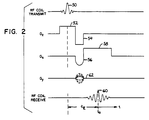
- a gradient echo pulse sequence begins with the transmission of a narrow bandwidth radio frequency (RF) pulse 50 in the presence of slice selection G z pulse 52.
- the energy and the phase of this initial RF pulse may be controlled such that at its termination the magnetic moments of the individual nuclei are aligned in the x-y plane of a rotating reference frame of the nuclear spin system.
- a pulse of such energy and duration is termed a 90° RF pulse.
- the rotating frame differs from the previously described spatial reference frame in that the rotating frame rotates about the spatial z-axis at a frequency ⁇ 0 equal to the Larmor frequency of the dominant proton species without any additional shim fields.
- the result of the combined RF signal and gradient pulse 52 is that the nuclear spins of a narrow slice in the three dimensional imaged object along spatial z-plane are excited. Only those spins with a Larmor frequency, under the combined field G z and B0, within the frequency bandwidth of the RF pulse will be excited. Hence the position of the slice may be controlled by the gradient G z intensity and the RF frequency.
- a negative G z rewinder gradient pulse 54 serves to rephase the nuclear spins in the x-y plane of the rotating frame. Rewinder pulse 54 therefore is approximately equal to half the area of that portion of slice select gradient 52 which occurs during the RF pulse 50.
- the G x prewinder pulse 56 is applied.
- the prewinder pulse 56 begins to dephase the precessing nuclei: those nuclei at higher spatial locations within the slice advance in phase faster as a result of the G x -induced higher Larmor frequency than those nuclei at lower spatial locations.
- a positive G x readout pulse 58 centered at time t E after the center of RF pulse 50 causes the dephased spins to rephase into a gradient echo or NMR signal 60 at or near the center of the read-out pulse 58.
- the gradient echo 60 is the NMR signal for one row or column in the image.
- a gradient pulse G y 62 is applied to phase encode the spins along the y axis during the prewinder gradient 56.
- the sequence is then repeated with different G y gradients, as is understood in the art, to acquire an NMR view set from which a tomographic image of the imaged object may be reconstructed according to conventional reconstruction techniques.
- the NMR signal 60 is the sum of the component signals from many precessing nuclei throughout the excited slice. Ideally, the phase of each component signal will be determined by the strength of the G z , G x and G y gradients at the location of the individual nuclei during the read out pulse 58, and hence by the spatial z-axis, x-axis and y-axis locations of the nuclei. In practice, however, numerous other factors affect the phase of the NMR signal 60.
- ⁇ (x) is the spin density, i.e. the number of nuclei at a given voxel in the x direction
- ⁇ is the gyromagnetic constant of the nuclei of the material being imaged
- B0 is the strength of the polarizing magnetic field
- G x is the slope of the x axis gradient
- t E is the phase evolution time described above.
- the first complex term of this integral represents the effect of the readout gradient 58 on the NMR signal S(t).
- the gradient prewinder 56 causes this effect to be referenced not from the start of the gradient pulse 58 but from t0 the center of the gradient pulse 58 as shown in Figure 2.
- the second complex term of this equation e i ⁇ B 0 (t E +t) , represents the effect of the polarizing field B0 on the NMR signal S(t).
- B0 is continuously present and hence, in the gradient echo pulse sequence, the effect of B0 on S(t) is measured from the instant of occurrence of the RF pulse 50.
- the time elapsed since the RF pulse 50, in the gradient echo pulse sequence is t E +t as shown in Figure 2.
- the third complex term of this equation arises from inhomogeneities in the magnetic field B0. These inhomogeneities are generally spatially variable and may be derived from the second complex term of equation (2). Specifically e i ⁇ B 0 (t E +t) becomes e i ⁇ (B 0 + ⁇ B (x)) (t E +t) where ⁇ B(x) is the inhomogeneity of B0 and generally a function of x.
- the phase error of such inhomogeneities in B0 increases for increasing phase evolution time and hence this term is a function of t E +t, for the same reasons as those described above for the second complex term of equation (2).
- the fourth complex term of this equation, e i ⁇ collects phase lags or leads resulting from the signal processing of the NMR signal chain.
- the RF coil structure 26, shown in Figure 1 may introduce certain phase distortions as may the RF power amplifier 22 and the preamplifier 28. These phase terms may also vary with x and are represented by the term e i ⁇ .
- the reconstruction is performed by performing the reverse Fourier transform upon S′(t) to derive a complex, multipixel image P(x)′ :
- the pixels of the image P(x)′ are displaced from their true positions x by the terms used in the substitution given in equation (4), however this displacement may be ignored if the displacement is on the order of one pixel.
- a displacement of less than one pixel will result if the inhomogeneity ⁇ B of the magnetic field B0 is small relative to the gradient strength G x . Specifically if ⁇ (x)/ ⁇ G x ⁇ one pixel or by the previous definition of ⁇ (x) in terms of ⁇ B, ⁇ B(x)/G x ⁇ one pixel.
- the pixel displacement will be on the order of one pixel if the magnet has an initial homogeneity of 2 ppm.
- the term ⁇ F / ⁇ G x is then approximately 1.7 and may be ignored in areas of the imaged object where there there is little change in the signal from pixel to pixel as will generally be the case with a phantom.
- the expansion process will tend to further decrease error resulting from occasional deviations from these assumptions.
- the inhomogeneity data ⁇ may be extracted by performing two experiments and producing two signals P1(x) and P2(x) with two different evolution times t E1 and t E2 .
- the difference between t E1 and t E2 will be termed ⁇ and its selection is arbitrary subject to the following constraints: larger values of ⁇ increase the resolution of the measurement of inhomogeneity but cause the inhomogeneity data ⁇ to "wrap around" with large magnetic field inhomogeneities. Conversely, smaller values of ⁇ decrease the resolution of the measurement of inhomogeneity but permit the measurement of larger magnet inhomogeneities without "wrap around". Wrap arounds results from the periodicity of the trigonometric functions used to calculate the inhomogeneity data ⁇ as will be described in more detail below.
- P3 is an image whose argument ⁇ , (the angle of the complex number e i ⁇ (x) ⁇ ) is proportional to the inhomogeneity ⁇ (x).
- the inhomogeneity ⁇ (x) may be calculated at any point x by dividing ⁇ (x), the argument of P3(x) at the pixel associated with x, by ⁇ .
- the argument ⁇ (x) of the complex image P3 divided by ⁇ yields a map of the inhomogeneity ⁇ (x) over the image P3′s surface.
- the complex array P3 is represented digitally within the NMR system by means of two quadrature arrays indicating the magnitudes of sine and cosine terms of P3 respectively.
- the argument or phase angle of P3 may be extracted by application of the arctangent function to the ratio of these quadrature arrays.
- the arctangent function has a range of - ⁇ to + ⁇ and therefore the argument of ⁇ (x) will be limited to values within this range.
- the measured inhomogeneity ⁇ ′ is equal to the argument ⁇ divided by ⁇ and therefore the measured inhomogeneity value ⁇ ′ will be restricted to the range - ⁇ / ⁇ to + ⁇ / ⁇ . For values of the actual inhomogeneity ⁇ outside of this range, ⁇ ′ will "wrap around".
- FIG. 3(a) an example map of measured inhomogeneity ⁇ ′(x,y) 80 over a two dimensional image P3(x,y) is shown with ⁇ ′(x,y) plotted in the vertical dimension.
- the actual inhomogeneity ⁇ (x,y) increases monotonically over the surface P3, however, as explained, the measured inhomogeneity ⁇ ′(x,y) is bounded between the arctangent imposed limits of - ⁇ / ⁇ to + ⁇ / ⁇ . Accordingly, discontinuities 81 occur at the points where the arctangent function is discontinuous at ⁇ and - ⁇ .
- the actual inhomogeneity ⁇ (x,y) may be determined by by "unwrapping" the discontinuities, a complex topological problem that requires tallying the discontinuities as one moves over the surface of the P3(x,y) argument array 80 and adding or subtracting 2 ⁇ to the measured inhomogeneity ⁇ ′ as each discontinuity 81 is passed.
- This difficult tallying procedure may be avoided, provided that the image object has only one proton species, as would be the case with a phantom used for shimming, if ⁇ is chosen to be small enough to eliminate wrap arounds. Specifically, ⁇ ⁇ 1 ⁇ v , where ⁇ v is the frequency spread of the resonating protons across the measured volume caused by the magnet inhomogeneity. Once the initial inhomogeneity is corrected with this small value of ⁇ , the process may be repeated with larger ⁇ 's to improve the resolution of the inhomogeneity measurement for subsequent iterations.
- the wrap arounds may be detected and corrected by taking the spatial partial derivatives of the measured inhomogeneity map 80.
- a first partial derivative, ⁇ ′/ ⁇ x, along line 82 is shown in Figure 3(c).
- the partial derivative exhibits "spikes" 81′ at the points of discontinuity 81 in Figure 3(b). These points of discontinuity may be readily detected by comparing curve 84 to a threshold value 85 and creating a weighting function T(x), as shown in Figure 3(d), whose value is zero when the magnitude of curve 84 is greater than the threshold value 85 and one otherwise.
- the threshold is preferably set to ⁇ /8 ⁇ although other values may be used.
- the phase weighting function, T(x) is then used to fit the derivative inhomogeneity data to spatial derivatives of the spherical harmonic polynomials as will be described below.
- an amplitude weighting function W(x,y) is also constructed such that the amplitude weighting function W(x,y) equals zero when the magnitude of image value P3 is less than a second threshold value and one otherwise.
- the second threshold is set to 15% of the maximum signal magnitude within the area of the image under consideration, although other values could be selected depending on the signal to noise ratio of the image.
- the amplitude weighting function is used to diminish the importance during expansion of the inhomogeneity map in areas where there is little signal strength, as indicated by the magnitude of P3, and hence serves to eliminate incoherent, irrelevant phase wrap arounds arising from regions with no amplitude.
- the weighting function W(x) may be implemented in numerous other ways.
- W(x) may be a continuous function of the magnitude of the image or the power of the image (P)2.
- the associated Legendre polynomials may be fit to the inhomogeneity data by a weighted least squares method using weighting functions T and W as described above and as is understood in the art. If ⁇ is chosen such that no wrap arounds occur, then the inhomogeneity data is fit to the appropriate associated Legendre polynomials directly. If ⁇ is chosen such that wrap arounds do occur, the wrap arounds are removed as described above and the resultant differentiated inhomogeneity data is fit to the appropriate differentiated associated Legendre polynomials.
- a straight forward least squares fitting of the data in this manner carries the implicit assumption that the inhomogeneities are centered at the isocenter of the magnet. This will not always be the case however, and if the inhomogeneities are off center, the coefficients so determined will include errors if the full complement of appropriate Legendre polynomials are not used in the field correction. This distortion of the fitting may be corrected, if the offset is known, by spatially shifting the associated Legendre polynomials by the amount that the inhomogeneities are off center.
- each polynomial is performed by substituting the variables x-x0, y-y0, and z-z0 for x, y, z, where x0, y0, and z0 are the distances by which the center of the inhomogeneities are offset from the isocenter. This procedure effectively shifts the polynomials so that they are centered on the inhomogeneity prior to the fitting process being performed.
- the inhomogeneity data acquired in the above manner may be used to determine the proper settings of the shim coils.
- the technique of determining the setting of the shim coils from inhomogeneity data is described in detail in the previously cited U.S. Patent 4,740,753 at column 6 lines 62 et seq . and is hereby incorporated by reference. This process is summarized as follows:
- the inhomogeneity data or derivative data corrected by the weighting function provides a set of inhomogeneity measurements within a plane determined by the gradients of the imaging sequence of Figure 2. Additional data is obtained for planes rotated about the z-axis by 45°, 90°, and 135° to provide inhomogeneity measurements within the volume of a cylinder radial symmetric about the z-axis. The rotation of the imaging plane is obtained by simultaneous excitation of the gradients with various factors applied to the amplitudes as known in the art.
- This collection of inhomogeneity measurements may be expanded throughout a volume of interest as a series of spherical harmonics or the spatial derivatives thereof.
- a variety of polynomials may be used, however, the polynomials are preferably related to the fields produced by the shim coils 40.
- the shim coils 40 are designed to produce fields approximating those described by orthonormal associated Legendre polynomials and hence associated Legendre polynomials ("spherical harmonic polynomials”) or their spatial derivatives (if the above unwrapping procedure was used) are used for the calculation of the currents to be applied to the shim coils.
- the above process involves fitting the inhomogeneity measurements to the polynomials or their spatial derivatives by adjusting the coefficients of the polynomials according to a least squares minimization or other well known curve fitting process.
- the coefficients of the polynomials may be used to set the currents in the shim coils to correct the inhomogeneity per a calibration matrix as will be now described.
- the fields of the shim coils 40 are designed to be orthonormal, that is, each will correct a different component in the spherical harmonic polynomial.
- the currents in the shim coils 40 would be proportional to the coefficients of the corresponding polynomials.
- a calibration matrix must be determined. The calibration matrix is produced by measuring, individually, the effect of each shim coil 40 on the magnetic field homogeneity. The currents in the shim coils may be then determined by means of the calibration matrix and the polynomial coefficients. Any remaining error may be corrected by repeating the entire process for several iterations.
- pulse sequences other than gradient echo pulse sequences may be used, as will be understood from this discussion and a review of the techniques taught in the previously cited application.
Landscapes
- Physics & Mathematics (AREA)
- Condensed Matter Physics & Semiconductors (AREA)
- General Physics & Mathematics (AREA)
- Magnetic Resonance Imaging Apparatus (AREA)
Applications Claiming Priority (2)
| Application Number | Priority Date | Filing Date | Title |
|---|---|---|---|
| US546286 | 1990-06-29 | ||
| US07/546,286 US5168232A (en) | 1990-06-29 | 1990-06-29 | Method for rapid magnet shimming |
Publications (2)
| Publication Number | Publication Date |
|---|---|
| EP0465139A2 true EP0465139A2 (fr) | 1992-01-08 |
| EP0465139A3 EP0465139A3 (en) | 1992-08-05 |
Family
ID=24179723
Family Applications (1)
| Application Number | Title | Priority Date | Filing Date |
|---|---|---|---|
| EP19910305851 Withdrawn EP0465139A3 (en) | 1990-06-29 | 1991-06-27 | Shimming magnets in nmr systems |
Country Status (5)
| Country | Link |
|---|---|
| US (1) | US5168232A (fr) |
| EP (1) | EP0465139A3 (fr) |
| JP (1) | JP2716889B2 (fr) |
| CA (1) | CA2042148A1 (fr) |
| IL (1) | IL98511A0 (fr) |
Cited By (4)
| Publication number | Priority date | Publication date | Assignee | Title |
|---|---|---|---|---|
| GB2304901A (en) * | 1995-08-25 | 1997-03-26 | Bruker Instr Inc | MRI magnet shimming using 1-D projection FID signals |
| US5823959A (en) * | 1996-02-08 | 1998-10-20 | U.S. Philips Corporation | MR method for determining the magnetic field inhomogeneity in an examination zone, and MR apparatus for carrying out the method |
| EP1662270A1 (fr) * | 2004-11-27 | 2006-05-31 | Bruker BioSpin AG | Procédé pour l'ajustage automatique du champ magnétique pour la spectroscopie par résonance magnétique |
| WO2014076469A1 (fr) * | 2012-11-14 | 2014-05-22 | Oxford Instruments Industrial Products Limited | Mappage et homogénéisation de champ magnétique b0 dans un système de résonance magnétique nucléaire (rmn) |
Families Citing this family (18)
| Publication number | Priority date | Publication date | Assignee | Title |
|---|---|---|---|---|
| DE69225564T2 (de) * | 1991-11-29 | 1998-11-26 | Philips Electronics N.V., Eindhoven | Magnetische Resonanzanordnung |
| US5345178A (en) * | 1992-04-21 | 1994-09-06 | Siemens Aktiengesellschaft | Method for setting the current through shim coils and gradient coils in a nuclear magnetic resonance apparatus |
| US5321359A (en) * | 1993-03-29 | 1994-06-14 | General Electric Company | Selective imaging among three or more chemical species |
| JP3386509B2 (ja) * | 1993-04-27 | 2003-03-17 | 株式会社東芝 | Mr撮像方法および磁気共鳴イメージング装置 |
| DE4333440C1 (de) * | 1993-09-30 | 1995-04-06 | Siemens Ag | Verfahren zur Shimmung eines Magnetfeldes in einem Untersuchungsraum eines Kernspinresonanzgerätes |
| DE4437443C2 (de) * | 1994-10-19 | 1996-09-12 | Siemens Ag | Verfahren zum Betrieb eines Kernspintomographiegerätes mit dynamisch lokalisierter Shimmung des Grundmagnetfeldes |
| US5592090A (en) * | 1994-12-12 | 1997-01-07 | Houston Advanced Research Center | Compact, open geometry U-shaped magnet for magnetic resonance imaging |
| US5623430A (en) * | 1995-01-17 | 1997-04-22 | General Electric Company | Method for passively shimming an open magnet |
| JPH08196518A (ja) * | 1995-01-20 | 1996-08-06 | Toshiba Corp | Mri装置 |
| DE19511791C1 (de) * | 1995-03-30 | 1996-08-22 | Siemens Ag | Verfahren zur Shimmung eines Magnetsystems eines Kernspintomographen und Vorrichtung zur Durchführung des Verfahrens |
| US5617029A (en) * | 1995-12-14 | 1997-04-01 | General Electric Company | Method of magnet shimming |
| US6064208A (en) * | 1998-04-02 | 2000-05-16 | Picker International, Inc. | Two-peak alignment method of field shimming |
| GB9924833D0 (en) * | 1999-10-20 | 1999-12-22 | Btg Int Ltd | Permanent magnet and shim design |
| US6529002B1 (en) * | 2000-08-31 | 2003-03-04 | The Board Of Trustees Of The Leland Stanford Junior University | High order shimming of MRI magnetic fields using regularization |
| US6627003B2 (en) | 2001-10-24 | 2003-09-30 | Ge Medical Systems Global Technology Company, Llc | NMR shim forming method |
| US8970217B1 (en) | 2010-04-14 | 2015-03-03 | Hypres, Inc. | System and method for noise reduction in magnetic resonance imaging |
| US9513359B2 (en) * | 2012-09-04 | 2016-12-06 | General Electric Company | Systems and methods for shim current calculation |
| US20230194639A1 (en) * | 2021-12-16 | 2023-06-22 | Siemens Healthcare Gmbh | Method for acquiring a magnetic resonance image dataset of a subject and magnetic resonance imaging system |
Family Cites Families (7)
| Publication number | Priority date | Publication date | Assignee | Title |
|---|---|---|---|---|
| US4649346A (en) * | 1983-11-09 | 1987-03-10 | Technicare Corporation | Complex quotient nuclear magnetic resonance imaging |
| JPS6117054A (ja) * | 1984-07-03 | 1986-01-25 | Yokogawa Medical Syst Ltd | 核磁気共鳴断層撮影装置 |
| IL72388A (en) * | 1984-07-12 | 1988-07-31 | Elscint Ltd | Nmr imaging systems |
| US4720679A (en) * | 1985-12-31 | 1988-01-19 | Picker International, Inc. | Magnetic resonance imaging with phase encoded chemical shift correction |
| US4740753A (en) * | 1986-01-03 | 1988-04-26 | General Electric Company | Magnet shimming using information derived from chemical shift imaging |
| IL80814A (en) * | 1986-11-30 | 1990-07-12 | Elscint Ltd | Spectral component separation in mr imaging |
| US4987371A (en) * | 1989-11-27 | 1991-01-22 | General Electric Company | Method for in-vivo shimming |
-
1990
- 1990-06-29 US US07/546,286 patent/US5168232A/en not_active Expired - Lifetime
-
1991
- 1991-05-09 CA CA002042148A patent/CA2042148A1/fr not_active Abandoned
- 1991-06-16 IL IL98511A patent/IL98511A0/xx not_active IP Right Cessation
- 1991-06-27 EP EP19910305851 patent/EP0465139A3/en not_active Withdrawn
- 1991-06-28 JP JP3183991A patent/JP2716889B2/ja not_active Expired - Lifetime
Cited By (7)
| Publication number | Priority date | Publication date | Assignee | Title |
|---|---|---|---|---|
| GB2304901A (en) * | 1995-08-25 | 1997-03-26 | Bruker Instr Inc | MRI magnet shimming using 1-D projection FID signals |
| GB2304901B (en) * | 1995-08-25 | 2000-05-17 | Bruker Instr Inc | Shimming method for NMR magnet having large magnetic field inhomogeneities |
| US5823959A (en) * | 1996-02-08 | 1998-10-20 | U.S. Philips Corporation | MR method for determining the magnetic field inhomogeneity in an examination zone, and MR apparatus for carrying out the method |
| EP1662270A1 (fr) * | 2004-11-27 | 2006-05-31 | Bruker BioSpin AG | Procédé pour l'ajustage automatique du champ magnétique pour la spectroscopie par résonance magnétique |
| US7348775B2 (en) | 2004-11-27 | 2008-03-25 | Bruker Biospin Ag | Method for automatic shimming for nuclear magnetic resonance spectroscopy |
| WO2014076469A1 (fr) * | 2012-11-14 | 2014-05-22 | Oxford Instruments Industrial Products Limited | Mappage et homogénéisation de champ magnétique b0 dans un système de résonance magnétique nucléaire (rmn) |
| GB2522601A (en) * | 2012-11-14 | 2015-07-29 | Oxford Instr Ind Products Ltd | B0 mapping and shimming in an NMR system |
Also Published As
| Publication number | Publication date |
|---|---|
| JP2716889B2 (ja) | 1998-02-18 |
| JPH04288136A (ja) | 1992-10-13 |
| IL98511A0 (en) | 1992-07-15 |
| US5168232A (en) | 1992-12-01 |
| EP0465139A3 (en) | 1992-08-05 |
| CA2042148A1 (fr) | 1991-12-30 |
Similar Documents
| Publication | Publication Date | Title |
|---|---|---|
| US4987371A (en) | Method for in-vivo shimming | |
| US5168232A (en) | Method for rapid magnet shimming | |
| US5711300A (en) | Real time in vivo measurement of temperature changes with NMR imaging | |
| US5151656A (en) | Correction of nmr data acquired by an echo-planar technique | |
| JP3402916B2 (ja) | 核スピントモグラフ装置のマグネット装置のシム調整方法及び方法を実施する装置 | |
| US5770943A (en) | Method for measuring and compensating for spatially and temporally varying magnetic fields induced by eddy currents | |
| JP3524159B2 (ja) | Mriシステムでのプレスキャン | |
| US5001428A (en) | Method for mapping the RF transmit and receive field in an NMR system | |
| US5345178A (en) | Method for setting the current through shim coils and gradient coils in a nuclear magnetic resonance apparatus | |
| US5226418A (en) | Phase correction of complex - difference processed magnetic resonance angiograms | |
| US6507190B1 (en) | Method and apparatus for compensating polarizing fields in magnetic resonance imaging | |
| US5545995A (en) | Measurement of geometric distortion in MRI images | |
| EP0470845A2 (fr) | Imagerie par résonance magnétique nucléaire de différentes espèces chimiques | |
| US4553096A (en) | Nuclear magnetic resonance method and apparatus | |
| US5101156A (en) | Rapid flow measurement using an nmr imaging system | |
| US4766380A (en) | Method and arrangement for determining a nuclear magnetization distribution in a part of a body | |
| US4706027A (en) | Method for correcting phase errors in magnetic resonance imaging data | |
| US5856744A (en) | Method and apparatus for B0 eddy current compensation by B1 phase modulation | |
| EP0230027B1 (fr) | Réglage d'aimant utilisant l'information acquise par imagerie du déplacement chimique | |
| US4709211A (en) | Nuclear magnetic resonance system | |
| US4777439A (en) | Spatially localized spectroscopy | |
| US6025718A (en) | RF power calibration for an MRI system using local coils | |
| US5905377A (en) | Method and apparatus for correcting gradient system and static magnetic field in magnetic resonance imaging | |
| US4789830A (en) | Determining absolute image intensity in magnetic resonance systems | |
| US6057686A (en) | Shifted echo MR method and device |
Legal Events
| Date | Code | Title | Description |
|---|---|---|---|
| PUAI | Public reference made under article 153(3) epc to a published international application that has entered the european phase |
Free format text: ORIGINAL CODE: 0009012 |
|
| AK | Designated contracting states |
Kind code of ref document: A2 Designated state(s): DE FR GB NL |
|
| PUAL | Search report despatched |
Free format text: ORIGINAL CODE: 0009013 |
|
| AK | Designated contracting states |
Kind code of ref document: A3 Designated state(s): DE FR GB NL |
|
| 17P | Request for examination filed |
Effective date: 19930201 |
|
| 17Q | First examination report despatched |
Effective date: 19930405 |
|
| STAA | Information on the status of an ep patent application or granted ep patent |
Free format text: STATUS: THE APPLICATION IS DEEMED TO BE WITHDRAWN |
|
| 18D | Application deemed to be withdrawn |
Effective date: 19940826 |