EP0465304A1 - Verfahren und Vorrichtung zur Reinigung von durch stickstoffhaltige Abfallstoffe verunreinigtem Wasser - Google Patents
Verfahren und Vorrichtung zur Reinigung von durch stickstoffhaltige Abfallstoffe verunreinigtem Wasser Download PDFInfo
- Publication number
- EP0465304A1 EP0465304A1 EP19910401735 EP91401735A EP0465304A1 EP 0465304 A1 EP0465304 A1 EP 0465304A1 EP 19910401735 EP19910401735 EP 19910401735 EP 91401735 A EP91401735 A EP 91401735A EP 0465304 A1 EP0465304 A1 EP 0465304A1
- Authority
- EP
- European Patent Office
- Prior art keywords
- bed
- water
- polluted water
- waste
- pipe
- Prior art date
- Legal status (The legal status is an assumption and is not a legal conclusion. Google has not performed a legal analysis and makes no representation as to the accuracy of the status listed.)
- Withdrawn
Links
- XLYOFNOQVPJJNP-UHFFFAOYSA-N water Substances O XLYOFNOQVPJJNP-UHFFFAOYSA-N 0.000 title claims abstract description 91
- 239000002699 waste material Substances 0.000 title claims abstract description 30
- 238000000034 method Methods 0.000 title claims abstract description 21
- QJGQUHMNIGDVPM-UHFFFAOYSA-N nitrogen group Chemical group [N] QJGQUHMNIGDVPM-UHFFFAOYSA-N 0.000 title claims abstract description 9
- 238000000746 purification Methods 0.000 title claims description 18
- 238000001914 filtration Methods 0.000 claims abstract description 20
- 239000008187 granular material Substances 0.000 claims abstract description 16
- 239000002028 Biomass Substances 0.000 claims abstract description 14
- 230000005484 gravity Effects 0.000 claims abstract description 8
- 238000006213 oxygenation reaction Methods 0.000 claims abstract description 8
- 239000008213 purified water Substances 0.000 claims description 8
- 239000000463 material Substances 0.000 claims description 7
- 238000007599 discharging Methods 0.000 claims description 5
- 241000251468 Actinopterygii Species 0.000 claims description 4
- 241001465754 Metazoa Species 0.000 claims description 3
- 230000000750 progressive effect Effects 0.000 claims description 3
- 239000000126 substance Substances 0.000 claims description 3
- 239000002154 agricultural waste Substances 0.000 claims description 2
- 230000000737 periodic effect Effects 0.000 claims description 2
- 238000009309 intensive farming Methods 0.000 claims 1
- 230000014759 maintenance of location Effects 0.000 claims 1
- QVGXLLKOCUKJST-UHFFFAOYSA-N atomic oxygen Chemical compound [O] QVGXLLKOCUKJST-UHFFFAOYSA-N 0.000 description 6
- 239000001301 oxygen Substances 0.000 description 6
- 229910052760 oxygen Inorganic materials 0.000 description 6
- 241000894006 Bacteria Species 0.000 description 4
- 239000004927 clay Substances 0.000 description 4
- 238000010908 decantation Methods 0.000 description 4
- 241000605159 Nitrobacter Species 0.000 description 3
- XSQUKJJJFZCRTK-UHFFFAOYSA-N Urea Chemical compound NC(N)=O XSQUKJJJFZCRTK-UHFFFAOYSA-N 0.000 description 3
- 239000004202 carbamide Substances 0.000 description 3
- 239000007789 gas Substances 0.000 description 3
- 238000009434 installation Methods 0.000 description 3
- 239000004033 plastic Substances 0.000 description 3
- 238000004064 recycling Methods 0.000 description 3
- 241000252073 Anguilliformes Species 0.000 description 2
- BVKZGUZCCUSVTD-UHFFFAOYSA-M Bicarbonate Chemical compound OC([O-])=O BVKZGUZCCUSVTD-UHFFFAOYSA-M 0.000 description 2
- 238000004176 ammonification Methods 0.000 description 2
- 230000001580 bacterial effect Effects 0.000 description 2
- 230000000721 bacterilogical effect Effects 0.000 description 2
- 239000002131 composite material Substances 0.000 description 2
- 230000000694 effects Effects 0.000 description 2
- 239000003344 environmental pollutant Substances 0.000 description 2
- 238000009313 farming Methods 0.000 description 2
- 239000013505 freshwater Substances 0.000 description 2
- 238000012423 maintenance Methods 0.000 description 2
- 244000005700 microbiome Species 0.000 description 2
- -1 organic base compounds Chemical class 0.000 description 2
- 238000005325 percolation Methods 0.000 description 2
- 231100000719 pollutant Toxicity 0.000 description 2
- 239000013535 sea water Substances 0.000 description 2
- 239000010802 sludge Substances 0.000 description 2
- 229910001220 stainless steel Inorganic materials 0.000 description 2
- 239000010935 stainless steel Substances 0.000 description 2
- 239000002351 wastewater Substances 0.000 description 2
- 241000861223 Issus Species 0.000 description 1
- 241001494479 Pecora Species 0.000 description 1
- 241000282887 Suidae Species 0.000 description 1
- 239000002253 acid Substances 0.000 description 1
- 238000005273 aeration Methods 0.000 description 1
- 150000001413 amino acids Chemical class 0.000 description 1
- 239000011324 bead Substances 0.000 description 1
- 239000012620 biological material Substances 0.000 description 1
- 230000000903 blocking effect Effects 0.000 description 1
- 238000006243 chemical reaction Methods 0.000 description 1
- 238000000354 decomposition reaction Methods 0.000 description 1
- 238000005202 decontamination Methods 0.000 description 1
- 230000003588 decontaminative effect Effects 0.000 description 1
- 238000007872 degassing Methods 0.000 description 1
- 238000001035 drying Methods 0.000 description 1
- 239000000839 emulsion Substances 0.000 description 1
- 210000003608 fece Anatomy 0.000 description 1
- 239000003337 fertilizer Substances 0.000 description 1
- 239000010794 food waste Substances 0.000 description 1
- 210000002816 gill Anatomy 0.000 description 1
- 239000003365 glass fiber Substances 0.000 description 1
- XLYOFNOQVPJJNP-ZSJDYOACSA-N heavy water Substances [2H]O[2H] XLYOFNOQVPJJNP-ZSJDYOACSA-N 0.000 description 1
- 238000002347 injection Methods 0.000 description 1
- 239000007924 injection Substances 0.000 description 1
- 150000002500 ions Chemical class 0.000 description 1
- 229920002521 macromolecule Polymers 0.000 description 1
- 238000004519 manufacturing process Methods 0.000 description 1
- 230000004060 metabolic process Effects 0.000 description 1
- 230000001089 mineralizing effect Effects 0.000 description 1
- 238000002156 mixing Methods 0.000 description 1
- 238000006386 neutralization reaction Methods 0.000 description 1
- 239000011368 organic material Substances 0.000 description 1
- 239000010815 organic waste Substances 0.000 description 1
- 239000002245 particle Substances 0.000 description 1
- 230000002093 peripheral effect Effects 0.000 description 1
- 238000009372 pisciculture Methods 0.000 description 1
- 239000011148 porous material Substances 0.000 description 1
- 238000011045 prefiltration Methods 0.000 description 1
- 230000001681 protective effect Effects 0.000 description 1
- 102000004169 proteins and genes Human genes 0.000 description 1
- 108090000623 proteins and genes Proteins 0.000 description 1
- 238000011084 recovery Methods 0.000 description 1
- 239000002990 reinforced plastic Substances 0.000 description 1
- 239000011347 resin Substances 0.000 description 1
- 229920005989 resin Polymers 0.000 description 1
- 229920006395 saturated elastomer Polymers 0.000 description 1
- 239000007787 solid Substances 0.000 description 1
- 239000012265 solid product Substances 0.000 description 1
- 238000011144 upstream manufacturing Methods 0.000 description 1
- 239000003643 water by type Substances 0.000 description 1
- 238000003466 welding Methods 0.000 description 1
Images
Classifications
-
- A—HUMAN NECESSITIES
- A01—AGRICULTURE; FORESTRY; ANIMAL HUSBANDRY; HUNTING; TRAPPING; FISHING
- A01K—ANIMAL HUSBANDRY; AVICULTURE; APICULTURE; PISCICULTURE; FISHING; REARING OR BREEDING ANIMALS, NOT OTHERWISE PROVIDED FOR; NEW BREEDS OF ANIMALS
- A01K63/00—Receptacles for live fish, e.g. aquaria; Terraria
- A01K63/04—Arrangements for treating water specially adapted to receptacles for live fish
-
- C—CHEMISTRY; METALLURGY
- C02—TREATMENT OF WATER, WASTE WATER, SEWAGE, OR SLUDGE
- C02F—TREATMENT OF WATER, WASTE WATER, SEWAGE, OR SLUDGE
- C02F3/00—Biological treatment of water, waste water, or sewage
- C02F3/02—Aerobic processes
- C02F3/06—Aerobic processes using submerged filters
-
- C—CHEMISTRY; METALLURGY
- C02—TREATMENT OF WATER, WASTE WATER, SEWAGE, OR SLUDGE
- C02F—TREATMENT OF WATER, WASTE WATER, SEWAGE, OR SLUDGE
- C02F3/00—Biological treatment of water, waste water, or sewage
- C02F3/02—Aerobic processes
- C02F3/12—Activated sludge processes
- C02F3/24—Activated sludge processes using free-fall aeration or spraying
-
- Y—GENERAL TAGGING OF NEW TECHNOLOGICAL DEVELOPMENTS; GENERAL TAGGING OF CROSS-SECTIONAL TECHNOLOGIES SPANNING OVER SEVERAL SECTIONS OF THE IPC; TECHNICAL SUBJECTS COVERED BY FORMER USPC CROSS-REFERENCE ART COLLECTIONS [XRACs] AND DIGESTS
- Y02—TECHNOLOGIES OR APPLICATIONS FOR MITIGATION OR ADAPTATION AGAINST CLIMATE CHANGE
- Y02W—CLIMATE CHANGE MITIGATION TECHNOLOGIES RELATED TO WASTEWATER TREATMENT OR WASTE MANAGEMENT
- Y02W10/00—Technologies for wastewater treatment
- Y02W10/10—Biological treatment of water, waste water, or sewage
Definitions
- the present invention relates to a process for purifying polluted water into soluble and insoluble nitrogenous waste, by physico-chemical and biological treatment, and a device implementing such a process, of the type comprising filtration by passage from bottom to top of the water through a fixed immersed bed of granular material loaded with biomass.
- granular material is meant a porous material, of the expanded clay type, or beads of microporous plastic material, with a particle size for example between a few tenths of a millimeter and a few millimeters.
- biomass is meant a living material, consisting in particular of bacteria, for example, of the type known under the name Nitrosomas and under the name Nitrobacter; the nitrogenous waste treated also consists essentially of urea and / or other food waste comprising organic macromolecules.
- the invention finds a particularly important, although not exclusive, application in the field of the purification of polluted water from intensive or semi-intensive fish farming, or in the field of treatment of agricultural waste from animal droppings, for example sheep or pigs.
- the polluted water can be fresh water, or sea water, intended or not, to be reused after purification.
- the document FR 2,604,990 describes a filtration process by the passage from bottom to top of polluted water through a column filter.
- the water to be purified is conveyed, without prior decontamination, from the bottom to the top of the column comprising a multilayer granular bed; an oxygenated gas injection point determines two successive zones of the bed, namely a so-called anaerobic zone and a so-called aerobic zone, allowing the biological purification of the waste.
- This process is not specifically intended for the treatment of polluted water into nitrogenous waste, but for the treatment of all types of waste water.
- Polluted water must be supplied with pressure, at the bottom of the column, just like oxygenated gas, in the middle of the column.
- the present invention aims to provide a method and a device which meet the requirements of the practice better than those previously known, in particular in that it is easy to implement, that it presents little or no risk of clogging. , and that it allows easy access and maintenance of the biomass used, without requiring the pressure supply of an oxygenation gas or polluted water to be treated.
- the invention above all allows a significant reduction in sludge of animal origin and the recycling of at least part of the wastewater (up to around 90%), which allows significant cost savings.
- the invention essentially provides a method for purifying polluted water into soluble and insoluble nitrogenous waste by physicochemical and biological treatment, comprising filtration by passing water from bottom to top at through a fixed, immersed bed of granular material loaded with biomass, characterized in that, immediately before said filtration, the oxygenation of the polluted water is completed with air, by gravitational discharge, in vertical fall, polluted water directly above the polluted water supply means of the bed in the lower part.
- the reactor includes a lower decantation part, during filtration, of insoluble or precipitated waste, and means for emptying the reactor arranged to eliminate this decanted waste by gravity entrainment of the waste using polluted water.
- the upper part of the reactor is cylindrical, the polluted water supply pipe being constituted by a central pipe arranged to receive in the upper part the polluted water supplied in fall, the lower decantation part of the reactor being conical or substantially conical, and provided, at the top of the cone, with a pipe for emptying the waste by entrainment.
- the central pipe is provided with measuring means indicating the progressive clogging of the filter or bed of granular material.
- the device is mobile or removable, which makes it possible to move it to treat polluted water at different locations. It can thus be used, for example, in the event of accidental pollution requiring rapid movement of the device on the site of pollution.
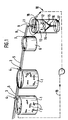
- FIG. 1 schematically represents tanks 1 for growing fish 2. These tanks continuously discharge water 3 polluted by organic waste from the cultures, via weirs 9, in a pipe 5, arranged in a gentle slope, and open to the air.
- the water to be treated flows by gravity in this pipe to a settling tank 6 of known type.
- the tank 6 comprises an overflow 7 for discharging the polluted water, after decantation, in a second sloping pipe 8, also open to the air, allowing the delivery of the water to be treated up to the end 9 of the pipe, the end located directly above and at a distance from the filtration device 10.
- the routing of polluted water to the open air in the channel 8 allows a first oxygenation of the water before its arrival at the end 9.
- the water to be purified then pours out by gravity from the end 9, in vertical fall 11, over a distance of several centimeters, for example of the order of 50 cm, above the device 10 which will be more particularly described with reference in Figure 2.
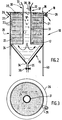
- the polluted water, located in the lower part, is then driven (principle of the communicating vessels) upwards, along the path indicated by the arrows 14, through the bacterial biomass 13 fixed on a filtering support for example made of clay expanded.
- the bacterial biomase being, for its part, composed of more than a hundred different microorganisms, essentially comprising bacteria designated under the names Nitrosomas and Nitrobacter.
- bacteriological purification consists in mineralizing nitrogenous compounds, this purification being carried out in two phases: a first phase of ammonification and a second phase of nitrification.
- Ammonification consists of breaking down proteins and organic molecules into amino acids and organic base compounds.
- Nitrification is carried out in two stages:
- Draining means 16, and recovery means 17, accumulated waste, are provided.
- the device 10 comprises an overflow 18, for evacuating the purified water in the upper part, possibly connected to a circuit 19 for recycling clean water in the tanks 1.
- the device 10 comprises a reactor 20, for example made of stainless steel, or a composite material of the reinforced plastic type, resin reinforced with glass fibers, etc. provided with a cylindrical upper part 21 open to the open air, for retaining and supporting the bed 22 of granular material 23, for example made of expanded clay, loaded with biomass 13 .
- the bed 22 is held between two grids, a lower grid 24 for supporting the bed and an upper protective grid 25, removable, for example constituted by grids in the form of a mesh screen 0.5 mm ⁇ 0.5 mm, for example in stainless steel or a composite material of the plastic type reinforced with metallic wires.
- the means 18 for discharging the overflow of purified water in the upper part are constituted by a peripheral channel or chute 26 fixed, for example by welding, in the upper part 27 of the cylindrical upper part 21, and arranged to recover the purified water which overflows over the end 28 of the upper part 21.
- a tube 29 for emptying the channel 26 is provided.
- the device also comprises means 30 for supplying polluted water to the lower part 12 of the bed, comprising a central pipe 31, cylindrical, for example made of plastic material of the type known as PVC.
- the pipe 31 is provided in the upper part 32, with a skirt, or funnel 33, for receiving the polluted water supplied in fall.
- the lower part 12 of the pipe 31 opens out below or at the level of the grid 24 for supporting the bed.
- the reactor 20 also comprises a lower part 15, for settling the waste during filtration, of conical shape.
- the summit 34 of the cone comprises a pipe 35, at least partially vertical from the said top, for discharging waste by entrainment, provided with a valve 36.
- the pipe 31 is provided with measuring means 37 indicating the progressive clogging of the filter, means for example constituted by blades or fins of increasing lengths upwards, placed in the upper internal part 39 of the tube 31 As the clogging, and therefore the increase in the pressure drop due to the filter, the water level in the pipe, initially similar to the level of the upper grid 25, rises and covers the fins.
- the device also comprises means 40 for supporting the reactor, constituted in a manner known per se, and allowing, for example, easy movement of the reactor.
- the method according to the invention allows compliance with such constraints.
- the other operating conditions are as follows.
- a pH between 6.5 and 8 allows good activity of bacteria.
- Nitrification also generating acid ions
- regular neutralization is planned, for example by adding bicarbonate (H+ + HCO3 ---> CO2 + H2O).
- the process according to the invention by allowing maintenance at a sufficient oxygen level, thus makes purification possible and effective.
- the biomass renewal rate, as well as the pollutant load, are moreover simultaneously controlled in a known manner, and so as to respect the optimum conditions of purification for polluted waters of determined characteristics.
- the temperature should be taken into account, knowing that the nitrification capacity varies with temperature, from 0.16g NH3 / m3 / day at 9.5 ° C, to 2.10g NH3 / m3 / day at 22 ° VS; nitrification is also faster in fresh water than in sea water.
- Each tray 1 for eel farming for example has a volume of 10m3, for a quantity of eels per tray of the order of 350Kg, with an average unit weight of eel of 90g.
- the rate of water renewal per basin is for example 8 times per 24 hours; the pollutant (NH3) production is around 300g per 24 hours, and per tank.
- the device 10 is integrated into a water treatment chain comprising, upstream of the device, a mechanical prefiltration (not shown), eliminating most of the suspended solids (MES), for example of the order of 80% , and a pre-settling (tank 6).
- the chain comprises, downstream of the device, degassing of the water and thermal regulation means, (not shown) before recycling by the circuit 19.
- the method according to the embodiment more particularly described here will make it possible to reduce the amount of NH3 from 2mg / l to 0.5mg / l, and the amount of NO2 by 1 at 0.1 mg / l.
- a device with a total volume of the order of 5 m3, and a biomass volume of 0.8 m3, can for example be provided.
- the polluted water from tanks 1 first of all overflows into the decentation tank 6 via the pipe 5. This is open to the open air, and arranged to allow the oxygenation of the polluted water with an oxygen content dissolved in water at least equal to 50%.
- the polluted water thus oxygenated then pours in vertical fall 11, directly in the lower part, which causes mixing and a large emulsion, between the polluted water and the air, as we have seen.
- Filtration by passage from bottom to top of the water through the bed 13, following the arrows 14 is then carried out with a percolation speed, (flow rate / surface of filter material) for example of 5 m3 / h per m2 of filtration. , the proper functioning of the process, in the case of the example considered, requiring a percolation speed of less than around 9 m / h.
- the purified water is discharged through the overflow 18 before being recycled to the tanks 1 via the circuit 19, known in itself.
- waste hunts are carried out by gravity entrainment of the waste, using the means 16.
- the waste formed from mineralized sludge is very rich in microorganisms and constitutes a biological material which can be used as fertilizer, after drying.
Landscapes
- Life Sciences & Earth Sciences (AREA)
- Biodiversity & Conservation Biology (AREA)
- Water Supply & Treatment (AREA)
- Hydrology & Water Resources (AREA)
- Engineering & Computer Science (AREA)
- Environmental & Geological Engineering (AREA)
- Microbiology (AREA)
- Chemical & Material Sciences (AREA)
- Organic Chemistry (AREA)
- Environmental Sciences (AREA)
- Marine Sciences & Fisheries (AREA)
- Animal Husbandry (AREA)
- Biological Treatment Of Waste Water (AREA)
Applications Claiming Priority (2)
| Application Number | Priority Date | Filing Date | Title |
|---|---|---|---|
| FR9008123 | 1990-06-27 | ||
| FR9008123A FR2663921B1 (fr) | 1990-06-27 | 1990-06-27 | Procede et dispositif de purification d'une eau polluee en dechets azotes. |
Publications (1)
| Publication Number | Publication Date |
|---|---|
| EP0465304A1 true EP0465304A1 (de) | 1992-01-08 |
Family
ID=9398084
Family Applications (1)
| Application Number | Title | Priority Date | Filing Date |
|---|---|---|---|
| EP19910401735 Withdrawn EP0465304A1 (de) | 1990-06-27 | 1991-06-26 | Verfahren und Vorrichtung zur Reinigung von durch stickstoffhaltige Abfallstoffe verunreinigtem Wasser |
Country Status (2)
| Country | Link |
|---|---|
| EP (1) | EP0465304A1 (de) |
| FR (1) | FR2663921B1 (de) |
Cited By (2)
| Publication number | Priority date | Publication date | Assignee | Title |
|---|---|---|---|---|
| ES2059229A1 (es) * | 1992-02-17 | 1994-11-01 | Dihidrox S A | Sistema de depuracion de aguas residuales mediante lagunas de estabilizacion. |
| FR3029068A1 (fr) * | 2014-11-27 | 2016-06-03 | Cie De L'hydraulique Et De La Filtration - C H F | Filtre pour la purification d'une eau polluee d'aquarium, dispositif de purification pour aquarium incorporant ledit filtre, et ensemble aquarium equipe d'un tel filtre ou d'un tel dispositif de purification |
Citations (6)
| Publication number | Priority date | Publication date | Assignee | Title |
|---|---|---|---|---|
| DE1928730A1 (de) * | 1968-07-05 | 1970-01-29 | Inst Wasserwirtschaft | Verfahren zum Eintragen von Sauerstoff und Chemikalien in Wasser,insbesondere in Oberflaechengewaesser und Einrichtung zur Durchfuehrung des Verfahrens |
| US4411780A (en) * | 1981-02-19 | 1983-10-25 | Nipon Sangyo Kikai Kabushiki Kaisha | Sewage disposal plant |
| EP0227081A2 (de) * | 1985-12-21 | 1987-07-01 | IWTS Consulting Engineers GmbH | Verfahren und Vorrichtung zur biologischen Reinigung von Wasser, vorzugsweise vorgeklärtem Abwasser |
| FR2604990A1 (fr) * | 1986-10-01 | 1988-04-15 | Omnium Traitement Valorisa | Procede de purification, par voie biologique, d'eaux residuaires sur lit de materiau granulaire |
| EP0306053A2 (de) * | 1987-09-03 | 1989-03-08 | Gmbh Tecon | Reaktor und Verfahren zum biologischen Reinigen von schadstoffhaltigem Wasser |
| DE3816679A1 (de) * | 1988-05-17 | 1989-11-23 | Int Biotech Lab | Verfahren und vorrichtung zur kontinuierlichen beseitigung von schadstoffen aus waessern |
-
1990
- 1990-06-27 FR FR9008123A patent/FR2663921B1/fr not_active Expired - Fee Related
-
1991
- 1991-06-26 EP EP19910401735 patent/EP0465304A1/de not_active Withdrawn
Patent Citations (6)
| Publication number | Priority date | Publication date | Assignee | Title |
|---|---|---|---|---|
| DE1928730A1 (de) * | 1968-07-05 | 1970-01-29 | Inst Wasserwirtschaft | Verfahren zum Eintragen von Sauerstoff und Chemikalien in Wasser,insbesondere in Oberflaechengewaesser und Einrichtung zur Durchfuehrung des Verfahrens |
| US4411780A (en) * | 1981-02-19 | 1983-10-25 | Nipon Sangyo Kikai Kabushiki Kaisha | Sewage disposal plant |
| EP0227081A2 (de) * | 1985-12-21 | 1987-07-01 | IWTS Consulting Engineers GmbH | Verfahren und Vorrichtung zur biologischen Reinigung von Wasser, vorzugsweise vorgeklärtem Abwasser |
| FR2604990A1 (fr) * | 1986-10-01 | 1988-04-15 | Omnium Traitement Valorisa | Procede de purification, par voie biologique, d'eaux residuaires sur lit de materiau granulaire |
| EP0306053A2 (de) * | 1987-09-03 | 1989-03-08 | Gmbh Tecon | Reaktor und Verfahren zum biologischen Reinigen von schadstoffhaltigem Wasser |
| DE3816679A1 (de) * | 1988-05-17 | 1989-11-23 | Int Biotech Lab | Verfahren und vorrichtung zur kontinuierlichen beseitigung von schadstoffen aus waessern |
Cited By (2)
| Publication number | Priority date | Publication date | Assignee | Title |
|---|---|---|---|---|
| ES2059229A1 (es) * | 1992-02-17 | 1994-11-01 | Dihidrox S A | Sistema de depuracion de aguas residuales mediante lagunas de estabilizacion. |
| FR3029068A1 (fr) * | 2014-11-27 | 2016-06-03 | Cie De L'hydraulique Et De La Filtration - C H F | Filtre pour la purification d'une eau polluee d'aquarium, dispositif de purification pour aquarium incorporant ledit filtre, et ensemble aquarium equipe d'un tel filtre ou d'un tel dispositif de purification |
Also Published As
| Publication number | Publication date |
|---|---|
| FR2663921B1 (fr) | 1992-12-11 |
| FR2663921A1 (fr) | 1992-01-03 |
Similar Documents
| Publication | Publication Date | Title |
|---|---|---|
| KR100216016B1 (ko) | 수정화방법 및 장치 | |
| US4294694A (en) | Anaerobic filter | |
| FR2632947A1 (fr) | Procede et dispositif d'epuration d'eaux residuaires sur filtre biologique a particules moins denses que l'eau | |
| EP0504065B1 (de) | Verfahren und Einrichtung für biologische Abwasserreinigung | |
| WO2016110657A1 (fr) | Dispositif de traitement des eaux usées, de type filtre planté à percolation verticale, comprenant un système d'aération actif d'une couche inférieure saturée | |
| US5178093A (en) | Aquaculture system | |
| KR101027047B1 (ko) | 이엠을 이용한 초기우수 및 비점오염원 정화 방법 및 장치 | |
| KR101934267B1 (ko) | 바이오플락시스템 유기고형물 제거장치 | |
| CN114291970A (zh) | 一种海水养殖尾水处理系统 | |
| FR2690683A1 (fr) | Procédé et installation d'épuration d'eaux résiduaires, et en particulier d'élimination de la pollution azotée, par voie biologique. | |
| FR2663921A1 (fr) | Procede et dispositif de purification d'une eau polluee en dechets azotes. | |
| JP2001170617A (ja) | 泡沫分離装置及びそれを用いた水浄化システム | |
| EP3177573B1 (de) | Sequencing-batch-anlage zur verringerung des stickstoffgehalts in abwässern | |
| KR200227408Y1 (ko) | 양어장 사육조내 찌거기 여과장치 | |
| JPH10323683A (ja) | 浄水処理方法および装置 | |
| CN208242604U (zh) | 一种支架跑道式养殖池及陆基受控循环水养殖系统 | |
| KR101613993B1 (ko) | 컴팩트형 하폐수 처리장치 | |
| KR101609534B1 (ko) | 조류 제거장치 | |
| WO2006029481A2 (en) | Modular aquaculture system | |
| FR2913419A1 (fr) | Procede biologique pour le traitement des eaux usees. | |
| JP2573902B2 (ja) | 水浄化方法及び装置 | |
| JP5147930B2 (ja) | 廃棄乳処理装置及び方法 | |
| BE1013375A3 (fr) | Procede et installation pour la nitrification d'eaux polluees. ' | |
| CN120024999B (zh) | 一种有机废水净化处理装置 | |
| FR2839898A1 (fr) | Dispositif d'aeration et de brassage d'eaux usees dans un reacteur de traitement, son utilisation pour l'epuration des eaux usees et son utilisation en tant que fermenteur |
Legal Events
| Date | Code | Title | Description |
|---|---|---|---|
| PUAI | Public reference made under article 153(3) epc to a published international application that has entered the european phase |
Free format text: ORIGINAL CODE: 0009012 |
|
| AK | Designated contracting states |
Kind code of ref document: A1 Designated state(s): AT BE CH DE DK ES GB GR IT LI LU NL SE |
|
| 17P | Request for examination filed |
Effective date: 19920703 |
|
| 17Q | First examination report despatched |
Effective date: 19930216 |
|
| STAA | Information on the status of an ep patent application or granted ep patent |
Free format text: STATUS: THE APPLICATION IS DEEMED TO BE WITHDRAWN |
|
| 18D | Application deemed to be withdrawn |
Effective date: 19930827 |