EP0465371A2 - Cartouche chimique pour masque de protection respiratoire - Google Patents
Cartouche chimique pour masque de protection respiratoire Download PDFInfo
- Publication number
- EP0465371A2 EP0465371A2 EP91401861A EP91401861A EP0465371A2 EP 0465371 A2 EP0465371 A2 EP 0465371A2 EP 91401861 A EP91401861 A EP 91401861A EP 91401861 A EP91401861 A EP 91401861A EP 0465371 A2 EP0465371 A2 EP 0465371A2
- Authority
- EP
- European Patent Office
- Prior art keywords
- filter section
- active filter
- chemical
- pollutant
- recited
- Prior art date
- Legal status (The legal status is an assumption and is not a legal conclusion. Google has not performed a legal analysis and makes no representation as to the accuracy of the status listed.)
- Granted
Links
Images


Classifications
-
- A—HUMAN NECESSITIES
- A62—LIFE-SAVING; FIRE-FIGHTING
- A62B—DEVICES, APPARATUS OR METHODS FOR LIFE-SAVING
- A62B23/00—Filters for breathing-protection purposes
- A62B23/02—Filters for breathing-protection purposes for respirators
Definitions
- the present invention relates to a chemical air filtering device comprising an active filter section in series with a conventional and universal filter section.
- the active filter section comprises a reagent capable to capture a target toxic pollutant having a chemically active function and to derive it into inert, non-volatile and non-toxic matter.
- the universal filter section is positioned downstream the active filter section to capture other types of pollutants passing through the active section.
- the conventional respiratory masks using a chemical cartridge are not safe enough against toxic pollutants having a chemically active function such as for example the isocyanates.
- the isocyanates mixed with other solvents are found in the paint shops, polyurethane foam factories, foundries, chemical plants, etc... and, as the workers are exposed, they can cause very serious respiratory illnesses such as acute poisoning, acute and chronic respiratory functional affections, professional asthma, etc. even at very low concentrations.
- the pollutant can migrate through the absorbent and can therefore be inhaled by the user.
- the pollutant also migrates when the mask is unused and can of course be inhaled when the mask is subsequently worn.
- An object of the present invention is therefore to provide a safe alternative to the prior art chemical cartridges for adequately protecting the workers against toxic pollutants having a chemically active function.
- Another object of the present invention is a chemical cartridge for protective respiratory mask capable of capturing and deriving a target toxic pollutant into a non-toxic and non-volatile inert matter without reducing the efficiency of the cartridge in capturing the other types of pollutants, whereby air contaminated with the target pollutant and passing through such a chemical cartridge can be inhaled without risk.
- the subject invention relates to a chemical device for filtering air contaminated by a target toxic pollutant having a chemically active function and by other types of pollutants, comprising a separate active filter section and a universal filter section.
- the active filter section includes a chemical reagent capable to capture the target pollutant and derive this pollutant into an inert, non-volatile and non-toxic matter as the contaminated air passes through this active filter section.
- the active filter section is permeable to the other types of pollutants, and the universal filter section is positioned downstream the active filter section and is capable to capture these other types of pollutants.
- the target pollutant is captured and derived into inert, non-volatile and non-toxic matter by the active filter section, while the other types of pollutants pass through the active filter section and are captured by the universal filter section.
- the chemical device can further comprise an indicator positioned between the active and universal filter sections to indicate passage of the target pollutant through the active filter section.
- the active filter section comprises an absorbent medium impregnated with the chemical reagent
- the universal filter section comprises activated carbon
- the chemical filtering device also comprises means for enabling replacement of the active filter section.
- the term "pollutant” is intended to designate any toxic pollutant having a chemically active function
- the term “reagent” any reagent capable to capture and derive such a pollutant into inert, non-volatile and non-toxic matter.
- the present invention is applied to a protective respiratory mask. It should however be kept in mind that it is not limited to this particular application. Indeed, the invention can be used for the general purpose of filtering air contaminated by a given toxic pollutant, that is the target pollutant.
- the present invention also applies to other types of toxic pollutants having a chemically active function such as to give some examples the aldehydes, ketones, ozone, alcohols, amines, amides, ammonia, epoxy resins, etc.
- the chemical reagent is selected in function of the target pollutant; the reagent should be capable to capture and derive the pollutant into inert, non-volatile and non-toxic matter.
- a chemical cartridge in accordance with the present invention is illustrated in Figure 1.
- the chemical cartridge is installed on a conventional protective respiratory mask 2 partially shown and made for example of rubber material.
- the cartridge l can be installed on different types of protective respiratory masks presently available on the market.
- Figure 1 depicts a respiratory valve 3 including an externally threaded tubular section 4, and a perforated disk section 5 secured at one end of the tubular section.
- the disk section 5 is perpendicular to the tubular one.
- the valve 3 further comprises a circular and flexible rubber flap 6 attached to the disk section 5 through a central fastener 7 coaxial with the tubular section 4.
- the flap 6 moves away from the disk section 5 to allow the inhaled air to pass through the perforations such as 9 of the latter section.
- the flap 6 comes into contact with the disk section 5 to prevent the exhaled air to penetrate the cartridge 1 through the perforations 9; migration of the pollutants captured in the cartridge 1 is thereby prevented to maintain the efficiency and safety of the chemical cartridge.
- the exhaled air is evacuated through another valve (not shown) of the mask 2.
- the tubular section 4 is first inserted in a hole 13 made in the rubber material with the disk section 5 and the flap 6 inside the mask.
- An internally threaded tubular section 12 is then screwed on the tubular section 4 until the rubber material of the mask 2 is squeezed between the disk section 5 and the free end of the tubular section 12 to thereby form a sealed joint.
- the chemical cartridge 1 comprises, as illustrated in Figure 1, a first hollow and cylindrical body 10 advantageously manufactured with metal or molded plastic material in accordance with conventional techniques.
- the body 10 is formed at one end with an annular wall 11 perpendicular to the axis of the body 10.
- Connected to the wall 11 is the central, internally threaded tubular section 12.
- the section 12 is coaxial to the body 10, and has a diameter smaller than that of the latter body.
- a layer 14 of glass wool is placed inside the body 10 against the annular wall 11.
- the open end of the body 10 is closed by means of another layer 15 of glass wool and the space in the body 10 between the layers 14 and 15 is filled with activated carbon.
- a material other than glass wool can obviously be used in the manufacture of the layers 14 and 15. It is also within the scope of the present invention to replace the activated carbon by another equivalent filtering material.
- a perforated cover (not shown), made of plastic material or of sheet metal can be placed over the layer 15 of glass wool.
- the cartridge 1 further comprises a second hollow and cylindrical body 17 preferably formed with a perforated cover 18.
- the body 17 is advantageously made of plastic material whereby the cover 18 can be molded integral therewith.
- an absorbent medium 19 made for example of glass wool.
- the medium 19 has preferably a thickness of about 1-2 cm and is impregnated with an active reagent.
- the open end of the body 17 is closed by a color changing indicator 20.
- the free end of the body 10 is externally embossed while the corresponding end of the body 17 is internally grooved so that the body 17 can be snapped onto the body 10.
- the diameters of these two bodies are obviously selected for that purpose. This enables easy removal of the body 17 to check whether the indicator 20 has changed color.
- air contaminated with the target pollutant is inhaled by the user and passes through the perforations in the cover 18, the impregnated medium 19, the color changing indicator 20, the layer 15, the activated carbon 16, the layer 14, and finally the respiratory valve 3.
- the absorbent medium 19 is impregnated with a reagent capable to capture and derive the target pollutant contaminating the inhaled air into an inert, non-toxic and non-volatile matter through a chemical reaction.
- the medium 19 constitutes an active filter section designed to selectively derive the target, toxic pollutant.
- This active filter section can be impregnated through immersion of the absorbent medium 19 into a solution containing the reagent and a solvent, and through subsequent drying of the so immersed medium. It should be pointed out here that impregnation of the medium 19 with reagent must not increase the resistance of the cartrige 1 to respiration. Obviously, the reagent of which the medium 19 is impregnated is selected in function of the pollutant to derive.
- reagents can eventually be used provided that they are capable to derive the pollutant of concern efficiently in the conditions of temperature and humidity encountered.
- the medium 19 is impregnated with reagent over its entire volume, all the pollutant passing through the active filter section should come into contact with the reagent, and is therefore captured by the reagent and derived into inert matter.
- the indicator 20 is a sheet of fibrous and porous paper impregnated with a chemical substance reacting with the pollutant to develop a color. It is believed to be within the skill of an expert in the art to select the appropriate chemical substance in function of the target pollutant.
- the indicator 20 changes color, the hollow body 17 along with the indicator 20 and impregnated medium 19 are removed from the body 10 and replaced by another fresh active filter section (body 17, medium 19 and indicator 20).
- the indicator 20 greatly improves the safety of the workers exposed to odorless pollutants.
- the activated carbon 16 constitutes a universal filter section which captures the other types of pollutants present in the inhaled, contaminated air, and passing through the active filter section.
- the efficiency of activated carbon for that purpose is well known in the art.
- the pollutants captured by the universal filter section pass through the active filter section, they do not contribute in saturating the latter filter section and, therefore, in reducing its lifetime and its efficiency in capturing and deriving the target pollutant.
- the active filter section is formed of absorbent medium evenly impregnated with reagent and is separate and independent from the universal filter section (activated carbon 16) to enable selective and very efficient derivation of the target, toxic pollutant into inert matter while allowing the universal filter section to capture without reduction in efficiency the other pollutants in suspension in the inhaled air.
- the so filtered air can therefore be inhaled without risk.
- a solution containing hexamethylene diisocyanate (HDI) dispersed in toluene is vaporized and diluted in air, and used as target pollutant.
- the flow rate of the so contaminated air is 15 liters/minute which corresponds to respiration of a relaxed human.
- the concentration of the pollutant in the air is of the order of 18-20 PPB and the active filter section is not impregnated with reagent.
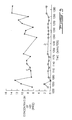
- the graph of Figure 2 shows that the concentration of HDI upstream (curve A) the cartridge I follows that downstream (curve B) the cartridge 1.
- a solution containing HDI dispersed in toluene is vaporized and diluted in air, and the so produced contaminated air is passed through the cartridge 1.
- the flow rate is again of about 15 liters/minute and the concentration of pollutant in the air is of the order of 6-14 PPB as evidenced in the graph of Figure 3.
- the active filter section is formed of a medium 19 of glass wool 1-2 cm thick and impregnated with 26 mg of methyl-aminomethyl anthracene (MAMA ).
- MAMA methyl-aminomethyl anthracene
- the curve C represents the concentration of HDI upstream the cartridge 1
- the curve D the concentration of HDI downstream the same cartridge.
- the graph of Figure 3 therefore demonstrates that most of the HDI is captured and derived by the active filter section. In this particular example, breakthrough is not reached yet after 23 hours of operation.
- concentration of the reagent By changing the concentration of the reagent, the efficiency of the active filter section can eventually be improved.
- the present invention encompasses the use of reagents other than MAMA to derive HDI or other types of very toxic pollutant.
- the active filter section can be impregnated with one or many chemical reagents capable to capture and derive all the target pollutants.
Landscapes
- Health & Medical Sciences (AREA)
- General Health & Medical Sciences (AREA)
- Business, Economics & Management (AREA)
- Emergency Management (AREA)
- Respiratory Apparatuses And Protective Means (AREA)
Applications Claiming Priority (2)
| Application Number | Priority Date | Filing Date | Title |
|---|---|---|---|
| CA2020503 | 1990-07-05 | ||
| CA002020503A CA2020503C (fr) | 1990-07-05 | 1990-07-05 | Cartouche de filtrage des produits chimiques pour masques a gaz |
Publications (3)
| Publication Number | Publication Date |
|---|---|
| EP0465371A2 true EP0465371A2 (fr) | 1992-01-08 |
| EP0465371A3 EP0465371A3 (en) | 1992-11-25 |
| EP0465371B1 EP0465371B1 (fr) | 1995-12-13 |
Family
ID=4145412
Family Applications (1)
| Application Number | Title | Priority Date | Filing Date |
|---|---|---|---|
| EP91401861A Expired - Lifetime EP0465371B1 (fr) | 1990-07-05 | 1991-07-04 | Cartouche chimique pour masque de protection respiratoire |
Country Status (5)
| Country | Link |
|---|---|
| US (1) | US5090407A (fr) |
| EP (1) | EP0465371B1 (fr) |
| AT (1) | ATE131395T1 (fr) |
| CA (1) | CA2020503C (fr) |
| DE (1) | DE69115370D1 (fr) |
Cited By (1)
| Publication number | Priority date | Publication date | Assignee | Title |
|---|---|---|---|---|
| WO1996022823A1 (fr) * | 1995-01-27 | 1996-08-01 | Mine Safety Appliances Company | Systeme filtrant pour masque a gaz |
Families Citing this family (7)
| Publication number | Priority date | Publication date | Assignee | Title |
|---|---|---|---|---|
| US5269294A (en) * | 1992-05-26 | 1993-12-14 | Wallace J. Rogozinski | Face mask impregnated with odor reducing molecular sieve material |
| US5322060A (en) * | 1993-05-05 | 1994-06-21 | Johnson A R | Fire-resistant smoke escape face masks |
| WO2002013946A2 (fr) * | 2000-08-17 | 2002-02-21 | Vase Technology | Cartouche de filtre bi/pluri-directionnelle et support de filtre sur lequel fixer cette cartouche |
| DE102005026674A1 (de) * | 2005-05-31 | 2006-12-07 | M + W Zander Facility Engineering Gmbh | Verfahren zum Abscheiden von gasförmigen Bestandteilen in gasförmigen Medien sowie Filter zur Durchführung des Verfahrens |
| CA2720226C (fr) * | 2008-04-04 | 2017-09-19 | Pierre Legare | Dispositifs de filtration d'air |
| WO2010127161A2 (fr) * | 2009-04-29 | 2010-11-04 | Koehler Richard H | Masque facial chirurgical, y compris masques réutilisables, avec valves d'inspiration et d'expiration filtrées |
| CN105636468B (zh) | 2013-08-08 | 2017-08-29 | 理查德·H·科勒 | 面具密封件、面具系统及面具密封方法 |
Family Cites Families (12)
| Publication number | Priority date | Publication date | Assignee | Title |
|---|---|---|---|---|
| US1789194A (en) * | 1925-03-20 | 1931-01-13 | Paul O Rockwell | Process and apparatus for purifying air |
| US4155358A (en) * | 1976-12-13 | 1979-05-22 | Minnesota Mining And Manufacturing Company | Respirator |
| US4326514A (en) * | 1980-06-20 | 1982-04-27 | Minnesota Mining And Manufacturing Company | Cartridge respirator with service life indicator |
| US4365627A (en) * | 1980-09-22 | 1982-12-28 | The Dow Chemical Company | Filter-type respirator canister |
| US4428907A (en) * | 1981-02-23 | 1984-01-31 | Nederlandse Centrale Organizatie Voor Toegepast Natuurwetenschappelijk Onderzoek | Detector for detecting air components |
| US4488547A (en) * | 1982-09-07 | 1984-12-18 | Kenneth R. Bowers, Jr. | Face mask |
| US4643182A (en) * | 1983-04-20 | 1987-02-17 | Max Klein | Disposable protective mask |
| US4517111A (en) * | 1984-01-16 | 1985-05-14 | The Dow Chemical Company | Absorbents for airborne formaldehyde |
| US4600002A (en) * | 1984-10-24 | 1986-07-15 | American Optical Corporation | Disposable respirator |
| DE3613512C3 (de) * | 1986-04-22 | 1994-09-29 | Auergesellschaft Gmbh | Elektrische Warneinrichtung zur Anzeige des Erschöpfungszustandes eines Schadgase zurückhaltenden Gasfilters |
| US4790306A (en) * | 1987-09-25 | 1988-12-13 | Minnesota Mining And Manufacturing Company | Respiratory mask having a rigid or semi-rigid, insert-molded filtration element and method of making |
| US4921512A (en) * | 1989-03-30 | 1990-05-01 | American Optical Corporation | Filter element |
-
1990
- 1990-07-05 CA CA002020503A patent/CA2020503C/fr not_active Expired - Fee Related
- 1990-08-20 US US07/569,562 patent/US5090407A/en not_active Expired - Fee Related
-
1991
- 1991-07-04 AT AT91401861T patent/ATE131395T1/de active
- 1991-07-04 DE DE69115370T patent/DE69115370D1/de not_active Expired - Lifetime
- 1991-07-04 EP EP91401861A patent/EP0465371B1/fr not_active Expired - Lifetime
Cited By (2)
| Publication number | Priority date | Publication date | Assignee | Title |
|---|---|---|---|---|
| WO1996022823A1 (fr) * | 1995-01-27 | 1996-08-01 | Mine Safety Appliances Company | Systeme filtrant pour masque a gaz |
| US5714126A (en) * | 1995-01-27 | 1998-02-03 | Mine Safety Appliances Company | Respirator filter system |
Also Published As
| Publication number | Publication date |
|---|---|
| CA2020503A1 (fr) | 1992-01-06 |
| EP0465371A3 (en) | 1992-11-25 |
| DE69115370D1 (de) | 1996-01-25 |
| ATE131395T1 (de) | 1995-12-15 |
| US5090407A (en) | 1992-02-25 |
| CA2020503C (fr) | 1998-11-17 |
| EP0465371B1 (fr) | 1995-12-13 |
Similar Documents
| Publication | Publication Date | Title |
|---|---|---|
| US5714126A (en) | Respirator filter system | |
| CN105102103B (zh) | 用于分层滤筒的使用寿命终点指示系统 | |
| US4530706A (en) | Respirator cartridge end-of-service life indicator | |
| EP2790812B1 (fr) | Systèmes d'indication de fin de durée de vie pour cartouches de filtre en couches | |
| US4365627A (en) | Filter-type respirator canister | |
| US6277178B1 (en) | Respirator and filter cartridge | |
| DE2755966C2 (fr) | ||
| US20060283453A1 (en) | Refillable filter mask cartridge | |
| EP0465371B1 (fr) | Cartouche chimique pour masque de protection respiratoire | |
| US7503962B2 (en) | End of service and residual life indicator | |
| Lodewyckx | Adsorption of chemical warfare agents | |
| EP0584160B1 (fr) | Filtre | |
| EP0159698A2 (fr) | Cartouche pour masque à gaz | |
| EP0155991A1 (fr) | Appareil respiratoire pour la protection contre le monoxyde de carbone | |
| Moyer et al. | Preliminary evaluation of an active end-of-service-life indicator for organic vapor cartridge respirators | |
| RU2061517C1 (ru) | Противогазовая коробка для поглощения паров токсичных органических веществ из вдыхаемого воздуха | |
| AU654550B2 (en) | Filter | |
| CN104245093B (zh) | 用于分层滤筒的使用寿命终点指示系统 | |
| DE1073872B (de) | Filteratemschutzgerät, insbesondere für den Bergbau | |
| AU1644200A (en) | Filter | |
| DE3931682A1 (de) | Atemschutzgeraet | |
| UA79641C2 (en) | Sorption-filtering element for air purification | |
| PL61737Y1 (en) | Absorber for respiration air pollutants |
Legal Events
| Date | Code | Title | Description |
|---|---|---|---|
| PUAI | Public reference made under article 153(3) epc to a published international application that has entered the european phase |
Free format text: ORIGINAL CODE: 0009012 |
|
| AK | Designated contracting states |
Kind code of ref document: A2 Designated state(s): AT BE CH DE DK ES FR GB GR IT LI LU NL SE |
|
| PUAL | Search report despatched |
Free format text: ORIGINAL CODE: 0009013 |
|
| AK | Designated contracting states |
Kind code of ref document: A3 Designated state(s): AT BE CH DE DK ES FR GB GR IT LI LU NL SE |
|
| 17P | Request for examination filed |
Effective date: 19930510 |
|
| 17Q | First examination report despatched |
Effective date: 19950405 |
|
| GRAA | (expected) grant |
Free format text: ORIGINAL CODE: 0009210 |
|
| AK | Designated contracting states |
Kind code of ref document: B1 Designated state(s): AT BE CH DE DK ES FR GB GR IT LI LU NL SE |
|
| PG25 | Lapsed in a contracting state [announced via postgrant information from national office to epo] |
Ref country code: IT Free format text: LAPSE BECAUSE OF FAILURE TO SUBMIT A TRANSLATION OF THE DESCRIPTION OR TO PAY THE FEE WITHIN THE PRE;WARNING: LAPSES OF ITALIAN PATENTS WITH EFFECTIVE DATE BEFORE 2007 MAY HAVE OCCURRED AT ANY TIME BEFORE 2007. THE CORRECT EFFECTIVE DATE MAY BE DIFFERENT FROM THE ONE RECORDED.SCRIBED TIME-LIMIT Effective date: 19951213 Ref country code: LI Effective date: 19951213 Ref country code: GR Free format text: LAPSE BECAUSE OF FAILURE TO SUBMIT A TRANSLATION OF THE DESCRIPTION OR TO PAY THE FEE WITHIN THE PRESCRIBED TIME-LIMIT Effective date: 19951213 Ref country code: NL Free format text: LAPSE BECAUSE OF FAILURE TO SUBMIT A TRANSLATION OF THE DESCRIPTION OR TO PAY THE FEE WITHIN THE PRESCRIBED TIME-LIMIT Effective date: 19951213 Ref country code: ES Free format text: THE PATENT HAS BEEN ANNULLED BY A DECISION OF A NATIONAL AUTHORITY Effective date: 19951213 Ref country code: AT Effective date: 19951213 Ref country code: CH Effective date: 19951213 Ref country code: BE Effective date: 19951213 Ref country code: DK Effective date: 19951213 Ref country code: FR Effective date: 19951213 |
|
| REF | Corresponds to: |
Ref document number: 131395 Country of ref document: AT Date of ref document: 19951215 Kind code of ref document: T |
|
| REF | Corresponds to: |
Ref document number: 69115370 Country of ref document: DE Date of ref document: 19960125 |
|
| PG25 | Lapsed in a contracting state [announced via postgrant information from national office to epo] |
Ref country code: SE Effective date: 19960313 |
|
| PG25 | Lapsed in a contracting state [announced via postgrant information from national office to epo] |
Ref country code: DE Effective date: 19960314 |
|
| EN | Fr: translation not filed | ||
| NLV1 | Nl: lapsed or annulled due to failure to fulfill the requirements of art. 29p and 29m of the patents act | ||
| REG | Reference to a national code |
Ref country code: CH Ref legal event code: PL |
|
| PG25 | Lapsed in a contracting state [announced via postgrant information from national office to epo] |
Ref country code: GB Effective date: 19960704 |
|
| PG25 | Lapsed in a contracting state [announced via postgrant information from national office to epo] |
Ref country code: LU Free format text: LAPSE BECAUSE OF NON-PAYMENT OF DUE FEES Effective date: 19960731 |
|
| PLBE | No opposition filed within time limit |
Free format text: ORIGINAL CODE: 0009261 |
|
| STAA | Information on the status of an ep patent application or granted ep patent |
Free format text: STATUS: NO OPPOSITION FILED WITHIN TIME LIMIT |
|
| 26N | No opposition filed | ||
| GBPC | Gb: european patent ceased through non-payment of renewal fee |
Effective date: 19960704 |