EP0465388A1 - Verfahren zur Behandlung durch Thermoschock von verbrauchten Auskleidungen der elektrolytischen Hall-Heralt-Zellen - Google Patents
Verfahren zur Behandlung durch Thermoschock von verbrauchten Auskleidungen der elektrolytischen Hall-Heralt-Zellen Download PDFInfo
- Publication number
- EP0465388A1 EP0465388A1 EP91420217A EP91420217A EP0465388A1 EP 0465388 A1 EP0465388 A1 EP 0465388A1 EP 91420217 A EP91420217 A EP 91420217A EP 91420217 A EP91420217 A EP 91420217A EP 0465388 A1 EP0465388 A1 EP 0465388A1
- Authority
- EP
- European Patent Office
- Prior art keywords
- gas flow
- temperature
- mixture
- reactor
- particles
- Prior art date
- Legal status (The legal status is an assumption and is not a legal conclusion. Google has not performed a legal analysis and makes no representation as to the accuracy of the status listed.)
- Granted
Links
Images
Classifications
-
- A—HUMAN NECESSITIES
- A62—LIFE-SAVING; FIRE-FIGHTING
- A62D—CHEMICAL MEANS FOR EXTINGUISHING FIRES OR FOR COMBATING OR PROTECTING AGAINST HARMFUL CHEMICAL AGENTS; CHEMICAL MATERIALS FOR USE IN BREATHING APPARATUS
- A62D3/00—Processes for making harmful chemical substances harmless or less harmful, by effecting a chemical change in the substances
- A62D3/40—Processes for making harmful chemical substances harmless or less harmful, by effecting a chemical change in the substances by heating to effect chemical change, e.g. pyrolysis
-
- B—PERFORMING OPERATIONS; TRANSPORTING
- B09—DISPOSAL OF SOLID WASTE; RECLAMATION OF CONTAMINATED SOIL
- B09B—DISPOSAL OF SOLID WASTE NOT OTHERWISE PROVIDED FOR
- B09B3/00—Destroying solid waste or transforming solid waste into something useful or harmless
- B09B3/30—Destroying solid waste or transforming solid waste into something useful or harmless involving mechanical treatment
- B09B3/35—Shredding, crushing or cutting
-
- B—PERFORMING OPERATIONS; TRANSPORTING
- B09—DISPOSAL OF SOLID WASTE; RECLAMATION OF CONTAMINATED SOIL
- B09B—DISPOSAL OF SOLID WASTE NOT OTHERWISE PROVIDED FOR
- B09B3/00—Destroying solid waste or transforming solid waste into something useful or harmless
- B09B3/30—Destroying solid waste or transforming solid waste into something useful or harmless involving mechanical treatment
- B09B3/38—Stirring or kneading
-
- B—PERFORMING OPERATIONS; TRANSPORTING
- B09—DISPOSAL OF SOLID WASTE; RECLAMATION OF CONTAMINATED SOIL
- B09B—DISPOSAL OF SOLID WASTE NOT OTHERWISE PROVIDED FOR
- B09B3/00—Destroying solid waste or transforming solid waste into something useful or harmless
- B09B3/70—Chemical treatment, e.g. pH adjustment or oxidation
-
- C—CHEMISTRY; METALLURGY
- C25—ELECTROLYTIC OR ELECTROPHORETIC PROCESSES; APPARATUS THEREFOR
- C25C—PROCESSES FOR THE ELECTROLYTIC PRODUCTION, RECOVERY OR REFINING OF METALS; APPARATUS THEREFOR
- C25C3/00—Electrolytic production, recovery or refining of metals by electrolysis of melts
- C25C3/06—Electrolytic production, recovery or refining of metals by electrolysis of melts of aluminium
- C25C3/08—Cell construction, e.g. bottoms, walls, cathodes
-
- A—HUMAN NECESSITIES
- A62—LIFE-SAVING; FIRE-FIGHTING
- A62D—CHEMICAL MEANS FOR EXTINGUISHING FIRES OR FOR COMBATING OR PROTECTING AGAINST HARMFUL CHEMICAL AGENTS; CHEMICAL MATERIALS FOR USE IN BREATHING APPARATUS
- A62D2101/00—Harmful chemical substances made harmless, or less harmful, by effecting chemical change
- A62D2101/40—Inorganic substances
- A62D2101/45—Inorganic substances containing nitrogen or phosphorus
-
- A—HUMAN NECESSITIES
- A62—LIFE-SAVING; FIRE-FIGHTING
- A62D—CHEMICAL MEANS FOR EXTINGUISHING FIRES OR FOR COMBATING OR PROTECTING AGAINST HARMFUL CHEMICAL AGENTS; CHEMICAL MATERIALS FOR USE IN BREATHING APPARATUS
- A62D2101/00—Harmful chemical substances made harmless, or less harmful, by effecting chemical change
- A62D2101/40—Inorganic substances
- A62D2101/49—Inorganic substances containing halogen
-
- Y—GENERAL TAGGING OF NEW TECHNOLOGICAL DEVELOPMENTS; GENERAL TAGGING OF CROSS-SECTIONAL TECHNOLOGIES SPANNING OVER SEVERAL SECTIONS OF THE IPC; TECHNICAL SUBJECTS COVERED BY FORMER USPC CROSS-REFERENCE ART COLLECTIONS [XRACs] AND DIGESTS
- Y10—TECHNICAL SUBJECTS COVERED BY FORMER USPC
- Y10S—TECHNICAL SUBJECTS COVERED BY FORMER USPC CROSS-REFERENCE ART COLLECTIONS [XRACs] AND DIGESTS
- Y10S588/00—Hazardous or toxic waste destruction or containment
- Y10S588/90—Apparatus
Definitions
- the invention relates to a process for the treatment, by thermal shock in a reactor, of spent pot lining originating in particular from the dismantling of tanks for the production of aluminum by electrolysis according to the Hall-Heroult technique.
- an aluminum production plant with a capacity of 240,000 tonnes / year generates around 4,000 tonnes / year of spent pot lining, which consists of carbonaceous cathode blocks, seals and side linings made of carbonaceous paste, but also by all of the refractories and insulators arranged on the side walls and the bottom of the metal box forming the electrolysis tank.
- these packing products are heavily impregnated with harmful products, such as soluble sodium or sodo-aluminous fluorides, and cyanides which must be insolubilized or destroyed before being landfilled or reused.
- thermal treatment methods generally operating in a fluidized bed and based either on a pyrohydrolysis at more than 1000 ° C. of the spent linings according to US 4,065,551 Elkem, or US 4,113,832 and US 4,116,809 Kaiser, or on a simple combustion in air or in an oxidizing atmosphere of the carbon elements, at a temperature of approximately 800 ° C, sufficient to decompose cyanides without causing significant release of volatile fluorinated compounds ... according to US 4,053,375 Reynolds or according to the article by LC Blayden and SG Epstein, Journal of Metals, July 1984 page 24.
- US 4,763,585 uses carbonaceous pot lining in a circulating fluid bed reactor with an additive consisting of finely ground refractory oxides. This additive must remain inert during combustion, that is to say neither react nor melt on contact with carbonaceous waste in the chosen temperature range generally between 760 ° C. and 1200 ° C. Depending on the size of the grains of ground oxide the residence time in the reactor can vary from a few seconds to 1 hour.
- the coating of the carbonaceous pot lining grains with the powdery refractory additive prevents surface bonding of the grain during combustion in air.
- the problem of agglomeration is only resolved to the extent that we deal with carbonaceous pot linings or at least pot linings from linings with a very low silica content, therefore essentially based on alumina, the lifespan is significantly lower than that of modern linings in preformed silico-aluminous.
- the method according to the invention consists in heating suddenly and for a very short time the spent pot lining, to a temperature sufficient to allow the decomposition of the cyanides, and preferably in the presence of a reactive pulverulent additive, that is to say capable of combining chemically with fluorinated products permeating the pot lining, to form stable and insoluble compounds such as CaF2, binary, ternary or quaternary compounds of NaF, CaF2, CaO, SiO2, Al2O3, CaSO4, Na2SO4, of the nepheline type, haüyne or whatever.
- a reactive pulverulent additive that is to say capable of combining chemically with fluorinated products permeating the pot lining, to form stable and insoluble compounds
- CaF2 binary, ternary or quaternary compounds of NaF, CaF2, CaO, SiO2, Al2O3, CaSO4, Na2SO4, of the nepheline type, haüyne or whatever.
- the essential characteristic of the method according to the invention is based on the observation that it is possible to carry out, without solidification of the spent brazing charge following a possible melting of the particles, the depollution reactions consisting in destroying the cyanides and in insolubilize the fluorinated impregnation compounds by chemical recombination, in particular with the additive.
- This by creating a thermal shock on the solid particles of the mixture suddenly brought into contact, for a very short time, of the order of 0.3 to 3 seconds, with a gas flow at a temperature T preferably fixed between 1200 ° C and 1700 ° C.
- the hot gas flow is the product of the combustion of a fuel gas such as methane, butane or natural gas, in the presence of air, oxygen or their mixture.
- the thermal shock thus created allows the decomposition of cyanides and the recombination of fluorinated impregnating agents almost instantaneously while the temperature in the solid particles remains lower than that of the gas flow and generally between 800 ° C and 1200 ° C.
- the softening of solid particles by partial melting, linked in particular to the formation of fusible eutectic compounds, is not troublesome insofar as one prevents any prolonged contact and therefore any sticking between particles by creating sufficient agitation in the reaction. This agitation is obtained by adjusting the speed of the gas flow to a sufficient value, at least 1 m / second at the treatment temperature considered.
- the average residence time of the particles in the reaction chamber should also be fixed.
- the chosen range of 0.3 to 3 seconds is the best compromise for effective treatment of pot lining of very different composition, within the limit of maximum acceptable contents (Na ⁇ 20% and Si ⁇ 25%), requiring heating of the particles of the mixing at a temperature of at least 750 ° C and preferably between 800 ° C and 1200 ° C to ensure sufficient kinetics of the recombination reactions without causing a frank fusion of the particles with risk of solidification.
- the residence time of the particles is not only a function of the speed of the circulating gas flow but also of more technological parameters such as the dimensions of the reaction chamber generally of conical or cylindro-conical shape as well as the trajectory of the gas flow. circulating linked to the chosen injection mode, therefore to the characteristics of the injector.
- the used pot linings are ground to obtain particles of dimension less than 5 mm and preferably less than 2 mm.
- the powdery mineral additive mixed with the ground mixtures in the weight proportion of 0 to 50% of the final mixture and capable of combining chemically with the impregnation products, in particular with the fluorides to form stable and insoluble compounds is preferably kaolin, anhydrous CaSO4, lime or their mixture, being inexpensive and very available reactive materials.
- the powder additive should be intimately mixed with the ground mixes and an advantageous variant in the preparation of the mixture may consist in introducing the additive into the coarsely ground mixes and terminate the grinding on the mixture until the particle size required for the ramming particles is obtained.
- the gas flow laden with solid particles is extracted at the base of the reactor where, after cooling, the gas flow is separated from the solid particles forming an insoluble residue, while the dusted gas flow is released to the atmosphere after capture of the small fraction of fluorinated gases it contains.
- the effectiveness of the insolubilization treatment is checked by taking samples of the residue and leaching according to standard F. X31-210.
- the CN and F assays are carried out on the leaching juices, the solubilized cyanide and fluorine contents relative to the weight of the residue, which must remain below 0.01% and 0.05% - 0.3% respectively, according to standards. in force.
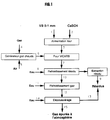
- the pulverulent mixture containing at least 50% by weight of crushed pot lining (1) of grain size 0 - 1 mm supplemented with anhydrous CaSO4 (2) or Kaolin or lime or their mixture, is extracted at the base of a hopper of storage by a screw conveyor with variable speed.
- This screw feeder is connected (3) to the upper part of a VICARB type cylindrical reactor fitted with a gas injector, according to patented model (EP 0 171 316), acting as a gas flow generator at a chosen temperature T preferably between 1200 ° C and 1700 ° C by adjusting the combustion of the fuel gas (4) air (5) mixture.
- the pulverulent mixture the flow rate of which in the present case can vary by means of the screw with adjustable speed between 50 kg / hour and 300 k / hour, must form with the gas flow a suspension whose concentration is between 0, 1 and 1.5 Kg per Nm3 and preferably between 0.15 and 1 Kg per Nm3.
- the metered powder mixture (3) is injected into the center of a vortex formed by the flow of hot gases (6) arriving tangentially at the top of the cylindrical reaction chamber and animated by a vortex movement.
- the speed of the flow is adjusted to 6m / second and taking into account the dimensions of the reaction chamber (diameter 0.25 meter and height 3 meters) the time corresponding stay is 0.5 seconds.
- T chosen at the inlet of the reactor, generally between 1200 ° C and 1700 ° C, and for an average residence time of the order of 0.5 seconds of the solid particles, the weight flow of which can vary from 50 to 300 kg / h
- a temperature of at least 750 ° C. and generally from 800 ° C. to 1200 ° C. is reached for these solid particles before leaving the reactor and cooling.
- the control of the temperature To of the gas flow measured in the same zone shows that To varies as t between 800 ° C and 1200 ° C according to the thermal regime chosen and in accordance with the relation T> To ⁇ t.
- the temperature of which can locally exceed 1200 ° C. it is advantageous to cool these walls, for example by air sweeping. of the outer wall.
- the gas flow (7) at the outlet of the reactor is separated from the solid particles which are cooled and trapped by falling into a water retention tank (8) placed under the reactor in the extension of the reaction chamber. After extraction from the tank, a first solid residue is obtained.
- the gas flow (10) is channeled to a water spray cooling device (11) where it is cooled (12) to around 70-80 ° C before entering a water trickle filter (17 ) to get rid of its dust (13) which constitutes a second solid residue, before release to the atmosphere (15).
Landscapes
- Engineering & Computer Science (AREA)
- Chemical & Material Sciences (AREA)
- Chemical Kinetics & Catalysis (AREA)
- Environmental & Geological Engineering (AREA)
- General Health & Medical Sciences (AREA)
- General Chemical & Material Sciences (AREA)
- Toxicology (AREA)
- Health & Medical Sciences (AREA)
- Metallurgy (AREA)
- Organic Chemistry (AREA)
- Materials Engineering (AREA)
- Business, Economics & Management (AREA)
- Emergency Management (AREA)
- Electrochemistry (AREA)
- Processing Of Solid Wastes (AREA)
- Electrolytic Production Of Metals (AREA)
- Compounds Of Alkaline-Earth Elements, Aluminum Or Rare-Earth Metals (AREA)
- Compositions Of Oxide Ceramics (AREA)
- Devices And Processes Conducted In The Presence Of Fluids And Solid Particles (AREA)
- Silicates, Zeolites, And Molecular Sieves (AREA)
- Disintegrating Or Milling (AREA)
Applications Claiming Priority (2)
| Application Number | Priority Date | Filing Date | Title |
|---|---|---|---|
| FR9009174A FR2664297B1 (fr) | 1990-07-04 | 1990-07-04 | Procede de traitement par choc thermique de brasquages uses provenant de cuves d'electrolyse hall-heroult. |
| FR9009174 | 1990-07-04 |
Publications (2)
| Publication Number | Publication Date |
|---|---|
| EP0465388A1 true EP0465388A1 (de) | 1992-01-08 |
| EP0465388B1 EP0465388B1 (de) | 1995-03-01 |
Family
ID=9398860
Family Applications (1)
| Application Number | Title | Priority Date | Filing Date |
|---|---|---|---|
| EP91420217A Expired - Lifetime EP0465388B1 (de) | 1990-07-04 | 1991-07-02 | Verfahren zur Behandlung durch Thermoschock von verbrauchten Auskleidungen der elektrolytischen Hall-Heralt-Zellen |
Country Status (11)
| Country | Link |
|---|---|
| US (1) | US5245115A (de) |
| EP (1) | EP0465388B1 (de) |
| AU (1) | AU639799B2 (de) |
| CA (1) | CA2044965C (de) |
| DE (1) | DE69107709T2 (de) |
| ES (1) | ES2069253T3 (de) |
| FR (1) | FR2664297B1 (de) |
| GR (1) | GR3015750T3 (de) |
| IS (1) | IS1676B (de) |
| NO (1) | NO178655C (de) |
| NZ (1) | NZ238775A (de) |
Cited By (9)
| Publication number | Priority date | Publication date | Assignee | Title |
|---|---|---|---|---|
| EP0542404A1 (de) * | 1991-10-11 | 1993-05-19 | Reynolds Metals Company | Entgiftung von verbrauchter Ofenauskleidung aus Aluminium |
| EP0580533A1 (de) * | 1992-07-24 | 1994-01-26 | Aluminium Pechiney | Verfahren zur thermischen Behandlung von verbrauchten Auskleidungen aus elektrolytischen Hall-Heroult Zellen |
| EP0693005A4 (de) * | 1993-04-06 | 1997-04-02 | Ausmelt Ltd | Schmelzen von kohlenstoffhaltigem material |
| FR2756198A1 (fr) * | 1996-11-26 | 1998-05-29 | Pechiney Aluminium | Procede d'insolubilisation et de consolidation de brasques usees provenant des cuves d'electrolyse hall-heroult |
| WO2002012594A3 (en) * | 2000-08-04 | 2002-08-15 | Servibras Servicos Especiais I | Treatment process for waste from aluminium production cells |
| EP1840083A1 (de) * | 2006-03-28 | 2007-10-03 | Council Of Scientific & Industrial Research | Ein Verfahren zur Produktion von Siliziumkarbid |
| CN105214275A (zh) * | 2015-10-15 | 2016-01-06 | 郑州经纬科技实业有限公司 | 电解铝废槽衬中氰化物和氟化物的处理方法 |
| CN109013669A (zh) * | 2018-09-28 | 2018-12-18 | 长春黄金研究院有限公司 | 一种氰化尾矿库尾矿渣处理方法 |
| CN109332350A (zh) * | 2018-09-10 | 2019-02-15 | 新疆生产建设兵团第八师天山铝业股份有限公司 | 铝电解大修渣无害化处理方法 |
Families Citing this family (12)
| Publication number | Priority date | Publication date | Assignee | Title |
|---|---|---|---|---|
| US5365012A (en) * | 1990-07-04 | 1994-11-15 | Aluminium Pechiney | Process for the heat treatment of spent pot linings derived from Hall-Heroult electrolytic cells |
| NO176648C (no) * | 1991-11-07 | 1995-05-10 | Elkem Technology | Fremgangsmåte for behandling av brukte katodebunner |
| US5476990A (en) * | 1993-06-29 | 1995-12-19 | Aluminum Company Of America | Waste management facility |
| US5558690A (en) * | 1994-12-23 | 1996-09-24 | Vortec Corporation | Manufacture of ceramic tiles from spent aluminum potlining |
| AU2445397A (en) * | 1996-04-09 | 1997-10-29 | Vortec Corporation | Manufacture of ceramic tiles from fly ash |
| US6439138B1 (en) | 1998-05-29 | 2002-08-27 | Hamon Research-Cottrell, Inc. | Char for contaminant removal in resource recovery unit |
| RU2199488C2 (ru) * | 2000-11-30 | 2003-02-27 | Открытое акционерное общество "ВОЛГОГРАДСКИЙ АЛЮМИНИЙ" | Способ переработки отработанной угольной футеровки алюминиевых электролизеров |
| RU2402621C1 (ru) * | 2009-09-03 | 2010-10-27 | Общество с ограниченной ответственностью Торговый дом "Байкальский алюминий" (ООО ТД "Байкальский алюминий") | Способ переработки фторсодержащих материалов, используемых в электролитическом производстве алюминия |
| US20110081284A1 (en) * | 2009-10-02 | 2011-04-07 | Mark Weaver | Treatment of bauxite residue and spent pot lining |
| RU2624570C1 (ru) * | 2016-08-23 | 2017-07-04 | Общество с ограниченной ответственностью "Безотходные и малоотходные технологии" (ООО "БМТ") | Способ переработки натрий-фтор-углеродсодержащих отходов электролитического производства алюминия |
| RU2630117C1 (ru) * | 2016-12-16 | 2017-09-05 | федеральное государственное бюджетное образовательное учреждение высшего образования "Иркутский национальный исследовательский технический университет" (ФГБОУ ВО "ИРНИТУ") | Способ переработки отработанной углеродной футеровки алюминиевого электролизера |
| CN112692042B (zh) * | 2020-12-08 | 2022-05-24 | 广西博世科环保科技股份有限公司 | 一种铝电解槽废耐火材料处理工艺及其系统 |
Citations (5)
| Publication number | Priority date | Publication date | Assignee | Title |
|---|---|---|---|---|
| US4065551A (en) * | 1968-02-01 | 1977-12-27 | Elkem-Spigerverket A/S | Method of recovering fluorine from carbonaceous waste material |
| GB2059403A (en) * | 1979-08-29 | 1981-04-23 | Alcan Res & Dev | Treatment of fluoride- containing waste |
| US4444740A (en) * | 1983-02-14 | 1984-04-24 | Atlantic Richfield Company | Method for the recovery of fluorides from spent aluminum potlining and the production of an environmentally safe waste residue |
| US4763585A (en) * | 1987-09-08 | 1988-08-16 | Ogden Environmental Services | Method for the combustion of spent potlinings from the manufacture of aluminum |
| EP0294300A1 (de) * | 1987-06-01 | 1988-12-07 | Aluminium Pechiney | Silicopyrohydrolytisches Verfahren zur Behandlung der Auskleidung von elektrolytischen Hall-Heroult-Zellen |
Family Cites Families (8)
| Publication number | Priority date | Publication date | Assignee | Title |
|---|---|---|---|---|
| US4158701A (en) * | 1978-11-06 | 1979-06-19 | Kaiser Aluminum & Chemical Corporation | Pyrohydrolysis system for processing fluorine-containing spent and waste materials |
| US4735784A (en) * | 1986-07-11 | 1988-04-05 | Morrison-Knudsen Company, Inc. | Method of treating fluoride contaminated wastes |
| US5024822A (en) * | 1988-03-29 | 1991-06-18 | Aluminum Company Of America | Stabilization of fluorides of spent potlining by chemical dispersion |
| US4993323A (en) * | 1988-09-08 | 1991-02-19 | Tabery Ronald S | Fluidized bed combustion of aluminum smelting waste |
| SE467224B (sv) * | 1989-01-25 | 1992-06-15 | Skf Plasma Tech | Foerfarande och anordning foer att oeverfoera urlakningsbara substanser i avfallsmaterial till gas eller till lakningsstabila foereningar |
| US4973464A (en) * | 1989-02-21 | 1990-11-27 | Ogden Environmental Services | Method for the removal of cyanides from spent potlinings from aluminum manufacture |
| AU7539491A (en) * | 1990-04-24 | 1991-11-07 | Alcan Australia Limited | Process for treating spent potliner material from an aluminium smelter process and products therefrom |
| US5164174A (en) * | 1991-10-11 | 1992-11-17 | Reynolds Metals Company | Detoxification of aluminum spent potliner by thermal treatment, lime slurry quench and post-kiln treatment |
-
1990
- 1990-07-04 FR FR9009174A patent/FR2664297B1/fr not_active Expired - Fee Related
-
1991
- 1991-06-03 NO NO912121A patent/NO178655C/no not_active IP Right Cessation
- 1991-06-17 US US07/716,104 patent/US5245115A/en not_active Expired - Fee Related
- 1991-06-19 CA CA002044965A patent/CA2044965C/fr not_active Expired - Fee Related
- 1991-06-25 AU AU79332/91A patent/AU639799B2/en not_active Ceased
- 1991-06-28 IS IS3727A patent/IS1676B/is unknown
- 1991-06-28 NZ NZ238775A patent/NZ238775A/xx unknown
- 1991-07-02 DE DE69107709T patent/DE69107709T2/de not_active Expired - Fee Related
- 1991-07-02 EP EP91420217A patent/EP0465388B1/de not_active Expired - Lifetime
- 1991-07-02 ES ES91420217T patent/ES2069253T3/es not_active Expired - Lifetime
-
1995
- 1995-04-11 GR GR950400895T patent/GR3015750T3/el unknown
Patent Citations (5)
| Publication number | Priority date | Publication date | Assignee | Title |
|---|---|---|---|---|
| US4065551A (en) * | 1968-02-01 | 1977-12-27 | Elkem-Spigerverket A/S | Method of recovering fluorine from carbonaceous waste material |
| GB2059403A (en) * | 1979-08-29 | 1981-04-23 | Alcan Res & Dev | Treatment of fluoride- containing waste |
| US4444740A (en) * | 1983-02-14 | 1984-04-24 | Atlantic Richfield Company | Method for the recovery of fluorides from spent aluminum potlining and the production of an environmentally safe waste residue |
| EP0294300A1 (de) * | 1987-06-01 | 1988-12-07 | Aluminium Pechiney | Silicopyrohydrolytisches Verfahren zur Behandlung der Auskleidung von elektrolytischen Hall-Heroult-Zellen |
| US4763585A (en) * | 1987-09-08 | 1988-08-16 | Ogden Environmental Services | Method for the combustion of spent potlinings from the manufacture of aluminum |
Cited By (13)
| Publication number | Priority date | Publication date | Assignee | Title |
|---|---|---|---|---|
| EP0542404A1 (de) * | 1991-10-11 | 1993-05-19 | Reynolds Metals Company | Entgiftung von verbrauchter Ofenauskleidung aus Aluminium |
| EP0580533A1 (de) * | 1992-07-24 | 1994-01-26 | Aluminium Pechiney | Verfahren zur thermischen Behandlung von verbrauchten Auskleidungen aus elektrolytischen Hall-Heroult Zellen |
| FR2693928A1 (fr) * | 1992-07-24 | 1994-01-28 | Pechiney Aluminium | Procédé de traitement thermique de brasquages usés provenant de cuves d'électrolyse Hall-Héroult. |
| EP0693005A4 (de) * | 1993-04-06 | 1997-04-02 | Ausmelt Ltd | Schmelzen von kohlenstoffhaltigem material |
| US5947888A (en) * | 1996-11-26 | 1999-09-07 | Aluminium Pechiney | Process for insolubilizing and consolidating spent linings from hall-heroult electrolysis cells |
| WO1998023551A1 (fr) * | 1996-11-26 | 1998-06-04 | Aluminium Pechiney | Procede d'insolubilisation et de consolidation de brasques usees provenant des cuves d'electrolyse hall-heroult |
| FR2756198A1 (fr) * | 1996-11-26 | 1998-05-29 | Pechiney Aluminium | Procede d'insolubilisation et de consolidation de brasques usees provenant des cuves d'electrolyse hall-heroult |
| WO2002012594A3 (en) * | 2000-08-04 | 2002-08-15 | Servibras Servicos Especiais I | Treatment process for waste from aluminium production cells |
| EP1840083A1 (de) * | 2006-03-28 | 2007-10-03 | Council Of Scientific & Industrial Research | Ein Verfahren zur Produktion von Siliziumkarbid |
| CN105214275A (zh) * | 2015-10-15 | 2016-01-06 | 郑州经纬科技实业有限公司 | 电解铝废槽衬中氰化物和氟化物的处理方法 |
| CN109332350A (zh) * | 2018-09-10 | 2019-02-15 | 新疆生产建设兵团第八师天山铝业股份有限公司 | 铝电解大修渣无害化处理方法 |
| CN109013669A (zh) * | 2018-09-28 | 2018-12-18 | 长春黄金研究院有限公司 | 一种氰化尾矿库尾矿渣处理方法 |
| CN109013669B (zh) * | 2018-09-28 | 2021-07-06 | 长春黄金研究院有限公司 | 一种氰化尾矿库尾矿渣处理方法 |
Also Published As
| Publication number | Publication date |
|---|---|
| FR2664297A1 (fr) | 1992-01-10 |
| NO178655B (no) | 1996-01-29 |
| CA2044965C (fr) | 1999-08-17 |
| AU639799B2 (en) | 1993-08-05 |
| DE69107709T2 (de) | 1995-08-17 |
| ES2069253T3 (es) | 1995-05-01 |
| NZ238775A (en) | 1993-09-27 |
| CA2044965A1 (fr) | 1992-01-05 |
| NO912121L (no) | 1992-01-06 |
| IS1676B (is) | 1997-12-31 |
| EP0465388B1 (de) | 1995-03-01 |
| DE69107709D1 (de) | 1995-04-06 |
| IS3727A7 (is) | 1992-01-05 |
| AU7933291A (en) | 1992-01-09 |
| NO912121D0 (no) | 1991-06-03 |
| FR2664297B1 (fr) | 1992-09-11 |
| GR3015750T3 (en) | 1995-07-31 |
| US5245115A (en) | 1993-09-14 |
| NO178655C (no) | 1996-05-08 |
Similar Documents
| Publication | Publication Date | Title |
|---|---|---|
| EP0465388B1 (de) | Verfahren zur Behandlung durch Thermoschock von verbrauchten Auskleidungen der elektrolytischen Hall-Heralt-Zellen | |
| EP0580533B1 (de) | Verfahren zur thermischen Behandlung von verbrauchten Auskleidungen aus elektrolytischen Hall-Heroult Zellen | |
| JPS6051621A (ja) | 二段バツチ液化プロセス及び装置 | |
| FI73742C (fi) | Syrekonverteringsprocess foer fast metallsten. | |
| EP3818019B1 (de) | Herstellung von ausgangsstoffen für glasschmelzofen | |
| CA2272976C (en) | Method of removal of light metals from aluminum | |
| CN1107184A (zh) | 从含锌粉尘中回收锌的方法 | |
| US3163519A (en) | Pellet of iron ore and flux, apparatus and method for making same | |
| FR2546511A1 (fr) | Procede et appareil nouveaux pour fabriquer des ciments hydrauliques | |
| CA2289279C (fr) | Procede de recyclage de dechets de fonderies de laitons | |
| CA2273004C (fr) | Procede d'insolubilisation et de consolidation de brasques usees provenant des cuves d'electrolyse hall-heroult | |
| AU621989B2 (en) | Method and apparatus for producing boron carbide crystals | |
| FR2641993A1 (en) | Process and device for causing leachable substances present in a waste material to move into a gas or into compounds which are stable to leaching | |
| US3319949A (en) | Apparatus for making pallet of iron ore and flux | |
| US5365012A (en) | Process for the heat treatment of spent pot linings derived from Hall-Heroult electrolytic cells | |
| FR2791586A1 (fr) | Conditionnement de poussieres de filtres et vitrification de ces poussieres ainsi conditionnees | |
| FR2609019A1 (fr) | Utilisation de la magnesite et procede pour la mise en oeuvre d'une telle utilisation | |
| US3301659A (en) | Pellet of iron ore and flux, apparatus and method for making same | |
| SU1375402A1 (ru) | Смесь дл утеплени поверхности жидкого металла | |
| SU767216A1 (ru) | Способ приготовлени науглероживающего реагента дл производства стали | |
| FR2581397A1 (fr) | Procede de reduction thermique de preparation de calcium avec utilisation d'aluminium comme reducteur | |
| NO156967B (no) | Fremgangsmÿte og apparat for fremstilling av metallgranuler. | |
| EP0636584A2 (de) | Verfahren zum Verglasen von festen Rückständen aus der Verbrennung von Haus- und/oder Industrieabfällen, Vorrichtung dafür und das dadurch erhaltende Produkt | |
| BE819885A (fr) | Fondant ameliore pour le procede de refonte a la scorie electrique et son procede de fabrication. | |
| MXPA99008276A (en) | Method for recycling iron bearing sludges in a steelmaking operation |
Legal Events
| Date | Code | Title | Description |
|---|---|---|---|
| PUAI | Public reference made under article 153(3) epc to a published international application that has entered the european phase |
Free format text: ORIGINAL CODE: 0009012 |
|
| AK | Designated contracting states |
Kind code of ref document: A1 Designated state(s): CH DE ES GB GR IT LI NL |
|
| 17P | Request for examination filed |
Effective date: 19920118 |
|
| 17Q | First examination report despatched |
Effective date: 19940117 |
|
| GRAA | (expected) grant |
Free format text: ORIGINAL CODE: 0009210 |
|
| AK | Designated contracting states |
Kind code of ref document: B1 Designated state(s): CH DE ES GB GR IT LI NL |
|
| REF | Corresponds to: |
Ref document number: 69107709 Country of ref document: DE Date of ref document: 19950406 |
|
| ITF | It: translation for a ep patent filed | ||
| REG | Reference to a national code |
Ref country code: ES Ref legal event code: FG2A Ref document number: 2069253 Country of ref document: ES Kind code of ref document: T3 |
|
| GBT | Gb: translation of ep patent filed (gb section 77(6)(a)/1977) |
Effective date: 19950410 |
|
| REG | Reference to a national code |
Ref country code: GR Ref legal event code: FG4A Free format text: 3015750 |
|
| PG25 | Lapsed in a contracting state [announced via postgrant information from national office to epo] |
Ref country code: LI Effective date: 19950731 Ref country code: CH Effective date: 19950731 |
|
| PLBE | No opposition filed within time limit |
Free format text: ORIGINAL CODE: 0009261 |
|
| STAA | Information on the status of an ep patent application or granted ep patent |
Free format text: STATUS: NO OPPOSITION FILED WITHIN TIME LIMIT |
|
| 26N | No opposition filed | ||
| REG | Reference to a national code |
Ref country code: CH Ref legal event code: PL |
|
| PGFP | Annual fee paid to national office [announced via postgrant information from national office to epo] |
Ref country code: GR Payment date: 19960522 Year of fee payment: 6 |
|
| PGFP | Annual fee paid to national office [announced via postgrant information from national office to epo] |
Ref country code: GB Payment date: 19960613 Year of fee payment: 6 |
|
| PGFP | Annual fee paid to national office [announced via postgrant information from national office to epo] |
Ref country code: DE Payment date: 19960620 Year of fee payment: 6 |
|
| PGFP | Annual fee paid to national office [announced via postgrant information from national office to epo] |
Ref country code: ES Payment date: 19960716 Year of fee payment: 6 |
|
| PGFP | Annual fee paid to national office [announced via postgrant information from national office to epo] |
Ref country code: NL Payment date: 19960731 Year of fee payment: 6 |
|
| PG25 | Lapsed in a contracting state [announced via postgrant information from national office to epo] |
Ref country code: GB Free format text: LAPSE BECAUSE OF NON-PAYMENT OF DUE FEES Effective date: 19970702 |
|
| PG25 | Lapsed in a contracting state [announced via postgrant information from national office to epo] |
Ref country code: ES Free format text: LAPSE BECAUSE OF THE APPLICANT RENOUNCES Effective date: 19970703 |
|
| PG25 | Lapsed in a contracting state [announced via postgrant information from national office to epo] |
Ref country code: GR Free format text: LAPSE BECAUSE OF NON-PAYMENT OF DUE FEES Effective date: 19970731 |
|
| PG25 | Lapsed in a contracting state [announced via postgrant information from national office to epo] |
Ref country code: NL Free format text: LAPSE BECAUSE OF NON-PAYMENT OF DUE FEES Effective date: 19980201 |
|
| GBPC | Gb: european patent ceased through non-payment of renewal fee |
Effective date: 19970702 |
|
| NLV4 | Nl: lapsed or anulled due to non-payment of the annual fee |
Effective date: 19980201 |
|
| PG25 | Lapsed in a contracting state [announced via postgrant information from national office to epo] |
Ref country code: DE Free format text: LAPSE BECAUSE OF NON-PAYMENT OF DUE FEES Effective date: 19980401 |
|
| REG | Reference to a national code |
Ref country code: ES Ref legal event code: FD2A Effective date: 20001102 |
|
| PG25 | Lapsed in a contracting state [announced via postgrant information from national office to epo] |
Ref country code: IT Free format text: LAPSE BECAUSE OF NON-PAYMENT OF DUE FEES;WARNING: LAPSES OF ITALIAN PATENTS WITH EFFECTIVE DATE BEFORE 2007 MAY HAVE OCCURRED AT ANY TIME BEFORE 2007. THE CORRECT EFFECTIVE DATE MAY BE DIFFERENT FROM THE ONE RECORDED. Effective date: 20050702 |